Nonsense Drones and Novichok
By Craig Murray | September 3, 2026
Europe urgently needs to re-establish access to Russian oil and gas. Gas prices are high – as all UK energy consumers know – and German gas storage is at a record low for September. Gulf production is degraded, supplies are cut off and its long-term strategic stability undermined.
German manufacturing already suffered a 9.5% production loss from 2022 to 2026 following the Russian gas shutdown, with the loss in energy-intensive manufacturing (inc petrochemicals, chemicals, metals, glass/ceramics/stone, paper, mineral oil etc.) at 15.2%.
Western Europe can regain access to Russian hydrocarbons either by accepting a negotiated peace in Ukraine, or by attempting regime change in Russia. The political class in Europe have evidently decided to go all out for regime change.
It would of course be much easier, and much safer, to settle the Ukrainian conflict. We can identify the following reasons the European political “elite” is not taking that path:
- Loss of face and political capital by in situ leaders who have gone all in for conflict with Russia – von der Leyen, Kallas, Merz, Rutte, Stubb etc
- Generational family and national hatred of Russia by those wanting to reverse World War II in Eastern Europe – von der Leyen, Kallas, Merz, Stubb etc
- Deep common interests between the political personnel and the military-industrial complex
Note that none of these motives has anything to do with the welfare of their people, and still less “democracy.” I find it very hard to think of any occasion when a drive towards war had such little foundation.
Consider this. The United Kingdom, like many Western countries, is openly supplying the Ukraine with long-range missiles, manufacturing plans for long-range missiles, and personnel to service them, in the full knowledge that Ukraine is using those missiles in an attempt to devastate civilian infrastructure deep within Russia, killing many Russian civilians in the process.
Yet we are repeatedly told by both politicians and the media that Russia is the threat to the UK, when very plainly it is the opposite which is the truth. Until this year, Russia had in three hundred years of history never had any plans to invade or occupy the UK – while the UK invaded Russia in 1854 and 1917. I presume the Russians are currently working on defensive plans against the UK, given the disgraceful warmongering of our government.
The notion that the boundaries of a Ukrainian state, which had never existed in history until 1991, are so sacrosanct they cannot be adjusted to avoid World War III, is mad. They were only ever internal Soviet boundaries. Ukrainian is a new nationality, but the Ukrainians are entitled to a state if they wish one. What they are not entitled to do is insist on the old Soviet boundary, when they have:
- closed Russian schools, universities, bookshops, theatres, cinemas, libraries, kindergartens, banks and churches
- banned the Socialist Party, Communist Party, Left Party, eleven other parties and eight trade unions
- continued the systematic glorification of Nazi and genocidal figures from Ukraine’s past – alienating Poland in the process.
The notion that nuclear war should be fought over who is Mayor of Lugansk has so little public support that Russophobia is being assiduously stoked by Western governments and the EU itself.
 The latest episode is the extraordinarily thin gruel of the “Leipzig airport attack” story. Yesterday we had the most incredible release of coordinated statements by Western European leaders all telling us that the evidence is plain of a “hybrid attack” by Russia.
All accompanied by no evidence whatsoever.
The German state of course has history with this sort of false flag. On the night of 31 August/1 September 1939 it staged false flag attacks by Polish forces on the German border post at Gliwice (Gleiwitz), and a couple of other locations. Murdered corpses of political prisoners were dressed in Polish uniforms and spread around. A radio broadcast was transmitted in Polish. This “attack” was the justification for the German invasion of Poland the next day.
Now the “Russian attack” on Leipzig Halle airport was on 4 August, and yet the carefully coordinated attribution to Russia, with identical statements from all western European powers, was not launched until 1 September. I have seen it suggested that this was deliberately on the anniversary of Gliwice. That seems to me unlikely, and yet not to have at least avoided the date of perhaps the most famous false flag in history – by the same state – is very curious, when the date was so obviously voluntary for an attack that occurred four weeks before.
If you reject the warmongers’ logic for a moment, the actual scandal is that there were Ukrainian aircraft in Leipzig stacked with German weapons to kill Russians, not that an amateur toy drone allegedly tried to stop them.
To be told that this is a Russian attack by precisely the same set of goons who lied to us that it was Russia that blew up the Nord Stream gas pipeline, is testing not just the gullibility of the public, but its patience.
In the UK the purveyors of Russophobia – including government ministers – fall back repeatedly on the farcical “Russian novichok on Salisbury” story to explain why we should prepare for war with Russia.
Nobody has ever even pretended to answer the dissection of the official line I published in my article Pure – Ten Points I Just Don’t Believe. I am now able to add a further point I was not aware of at the time, thanks to Tim Norman and his coverage of the Sturgess Inquiry. The use of a judicial inquiry to determine official cause of death, rather than a coroner’s court which exists for that specific purpose, is almost always a sign of a government cover-up – see also the Hutton Inquiry and the murder of David Kelly.
But one thing the inquiry did receive was the toxicology report on Dawn Sturgess from the NHS central toxicology lab in Birmingham. This is what it found in Dawn Sturgess’ blood.
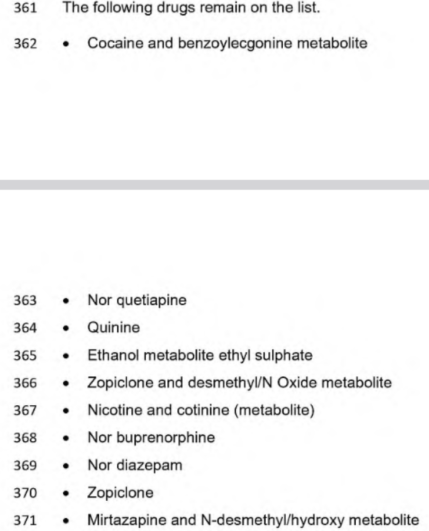
It is worth noting that fentanyl was also found, but this was removed from this list presented to the inquiry as she had been given fentanyl in hospital. That does not, of course, mean there was, or was not, already fentanyl in her bloodstream. But what you do have for sure is cocaine, plus a synthetic opioid given by the NHS to heroin addicts, plus gin and tonic, plus two different antidepressants, plus sleeping tablets.
What you don’t have is novichok. The idea that the NHS central toxicology lab cannot detect organophosphate poisoning, or was not testing for it in the blood of someone in Salisbury when the entire media was already screaming novichok, is arrant nonsense.
Only the Ministry of Defence laboratory at Porton Down claimed to find novichok – and controlled the samples which the OPCW (an equally corrupt institution) got.
Dawn Sturgess was a frail, known long-term drug addict. The combination in her bloodstream could kill anybody – of course depending on the quantities. The astonishing thing is that the pathologist at the inquiry stated he had been given no quantities or concentrations for these substances. He was therefore in no position to say they did not kill her.
This is incredible. There is no such thing as a toxicology report which does not quantify concentrations. Otherwise the information is clinically meaningless. I have spoken with three doctors, two nurses and a senior NHS administrator. All say it is impossible the toxicology report came without quantification. I assume the pathologist was not lying; so they must have been deliberately deleted. Only government can do that, and the obvious motive is to cover up the actual cause of death.
Let us face it: from that list of substances in her blood the actual cause of death is extremely obvious.
The great structural weakness of the inquiry was that nobody had the job of scepticism about the official story. The only non-governmental representative was Michael Mansfield, who represented Dawn Sturgess’ family, and his brief was to argue that Dawn Sturgess was not a drug addict. That – I am sorry to say, completely untrue – version of events fitted the story which both the government and Sturgess’s family wished to be put forward.
I am genuinely upset to have to relate unpleasant things about a dead woman who was a victim of circumstance in her life, in order to tell the truth, but you don’t get cocaine and buprenorphine in your blood by accident. We therefore had the farce of the police apologising at the inquiry for having called Dawn Sturgess a drug addict.
So we have alleged novichok in Salisbury which killed nobody, and an explosive drone, or possibly two, in Leipzig which did not explode. To counter this massive threat, we need to push an entire continent to nuclear war. As a first step, we need to cut health and social spending to give trillions more to arms manufacturers, and prepare our children for conscription, to die on the battlefield.
Forgive me if I am not convinced.
Moldova debunks drone threat to Zelensky’s plane
RT | September 10, 2026
Moldova has dismissed a claim by Norway’s prime minister that Vladimir Zelensky’s plane was nearly struck by a UAV while leaving Chisinau, saying the aircraft was never in any direct danger.
Norwegian Prime Minister Jonas Gahr Store told broadcaster NRK on Wednesday that Zelensky’s plane “was almost hit by a drone” as the Ukrainian leader traveled from Moldova to Oslo for the funeral of King Harald V.
Before any evidence was produced, Store’s claims were widely picked up by Western media outlets, who tried to frame the incident as evidence of a supposed Russian drone threat to Europe.
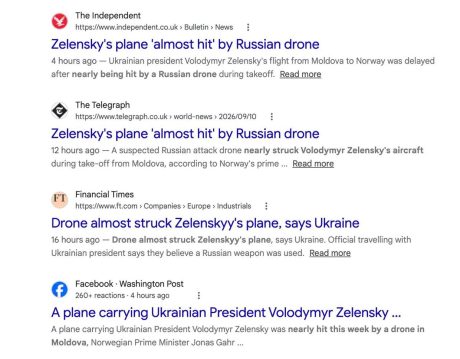
On Thursday, however, Moldova flatly rejected that account, with government spokesman Dumitru Ciorici saying Zelensky’s flight had been delayed because the country temporarily closed its airspace following a drone alert.
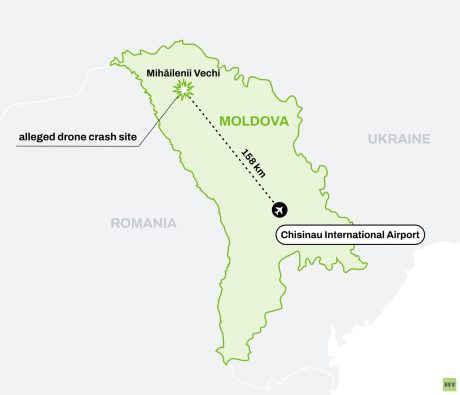
He stressed that there had been “no direct threat” to the aircraft, which remained on the ground throughout the airspace closure. The drone that had allegedly entered Moldova’s airspace ended up crashing and exploding near a village around 160km from Chisinau airport, causing no casualties, Moldovan authorities said.
Meanwhile, former Moldovan President Igor Dodon has accused the authorities of concealing from the public a separate incident involving a Ukrainian national allegedly caught at the border with a drone and explosives.
“We see more and more attempts and provocations to involve the Republic of Moldova in everything that is happening in Ukraine,” Dodon said, urging Chisinau to stay away from Kiev’s “war strategy.”
Kremlin spokesman Dmitry Peskov also dismissed the alleged threat to Zelensky’s plane as “ephemeral,” saying it “did not exist” and noting that even Ukrainian sources have acknowledged there was no direct danger.
Moldova, whose pro-EU government under President Maia Sandu has moved closer to Brussels and NATO while severely downgrading relations with Moscow, has repeatedly joined other pro-Ukraine governments in blaming Russia for drone incidents before producing evidence.
Similar accusations across Europe have frequently collapsed under scrutiny, with investigators in several cases finding no proof that Russian drones were involved and some incidents later traced to Ukrainian UAVs or even misidentified aircraft.
Moscow has accused Kiev of repeatedly staging drone provocations in an effort to draw its Western backers deeper into the conflict.
It’s OK to fight for a foreign army (as long as they’re our friends)
That’s the unwritten rule for Britain’s media
By DES FREEDMAN | Declassified UK | September 2, 2026
The death of a British national, Bradley Townsend, killed in Ukraine in June while fighting for Russian forces has been widely reported in the media.
“British traitor who joined Vladimir Putin’s army ‘killed by Ukraine drone’” splashed the Daily Star while former security minister Tom Tugendhat told LBC that Townsend was “extremely misguided” for “engaging in an army that is committing the most barbarous war crimes that the world has seen in decades.”
Compare this to the far more positive coverage in the media of individual British nationals who have served in the Israel Defense Forces (IDF) during a genocide that has killed more than 70,000 Palestinians.
When Declassified, for example, revealed exclusively that more than 2,000 British subjects had joined the IDF since October 7, the only reference to this in the mainstream media was a short article in The London Standard.
There are, however, no stories describing British nationals as ‘traitors’ for joining the IDF, nor ministerial condemnations of subjects taking part in what the United Nations has described as “war crimes” and “crimes against humanity”.
On the contrary, British subjects enlisting in the IDF are routinely humanised and their justifications reported without criticism.
A Times story in October 2023, headlined “Meet the Britons defending ‘the only place Jews feel safe’”, described IDF soldier Sam Sank as a Tottenham fan and dog owner while also referring to another dual national, Joe, as a “Chelsea fan… camping out with an emergency supply of PG Tips tea.”
BBC News interviewed British-Israeli soldier Alex Moeller on 17 November 2023 drawing on his experience in an ‘IDF anti-terror unit’.
Moeller spoke, without rebuttal, about how Israeli forces had committed to “minimise civilian casualties and obviously minimise humanitarian impact”.
He opposed a ceasefire, describing it simply as a ‘tactical’ ploy by Hamas.
There was a marked distinction in the reporting of British nationals fighting for Russia, which is extremely negative, describing them as “thugs”, “yobs” and seriously misguided people.
For example, the Sun reported in November 2024 on Jay Fraser, the “Scots mercenary fighting for Vladimir Putin” while the Observer described him as a “university dropout” who was “captivated by ‘manly’ Russia”.
In March 2024, the Mirror reported on the “British traitors” fighting on the Russian side, Ben Stimson and his best friend Aidan Minnis, describing the latter as a “former National Front member and convicted thug.”
The article quotes former British army commander Colonel Richard Kemp: “These two are an absolute disgrace and are traitors who upon their return to the UK should be arrested and jailed.”
It then carries a Home Office statement saying that: “Any person who travels from the UK to conflict zones to engage in unlawful activity, should expect to be investigated upon their return.”
There are no stories that reveal similar threats being made against dual nationals fighting for the IDF other than a single reference on late-night BBC radio on 22 July 2025.
Defence journalist Tim Ripley suggested that the UK government could use a law to stop British citizens “commuting to the war in Gaza”.
The suggestion was not explored afterwards by any outlet.
Heroes in Ukraine
In contrast to the coverage of pro-Russian Britons, articles on British subjects fighting on the side of Ukraine have been far more positive.
The Sunday Times, for example, reported sympathetically about the case of ‘Baby’, a young Scot who signed up for Ukrainian forces but who, on his return from the frontline, was prevented from joining Police Scotland.
There was also blanket coverage in February 2025 – including on the BBC and Sky – of former Tory MP Jack Lopresti who joined Ukrainian forces after losing his seat in the 2024 general election.
This includes particularly sympathetic profiles in the Telegraph and Mail. The Guardian was equally positive in its account which highlighted Foreign Office advice that “it is illegal for British citizens to fight in Ukraine”.
Even though it was revealed in February 2026 that Lopresti had joined the neo-Nazi Azov Brigade, the Telegraph then carried a story the following month with the headline: “Jack Lopresti is a rare example of a politician who puts his money where his mouth is”.
The article was written by Colonel Richard Kemp, the same person who had called for the jailing of the two Britons fighting on the Russian side.
After historic German election, will the AfD rule Saxony-Anhalt?
Remix News | September 7, 2026
The Alternative for Germany (AfD) just won the largest share of any party in a German state election in the party’s history. Despite the historic result, which has sent shockwaves through the German political establishment, lead candidate Ulrich Siegmund in Saxony-Anhalt still fell short of an absolute majority needed to govern.
That gap, three seats in an 83-member Saxony-Anhalt Landtag, is now the focal point of unfolding drama in the capital city of Magdeburg, where the future direction of the state, and perhaps even of the country, will be decided. AfD has a political mandate and a number of options that could produce dramatic results. Here are three possible scenarios.
An AfD and BSW coalition?
On the preliminary official count, the AfD took 43.8 percent and 39 seats. The threshold for an absolute majority is 42. The BSW scraped in with 5.3 percent and five seats. Together they would have 44. Everyone else together also has 44. Without the BSW, the chamber splits 39–39.
The BSW has already been open that it is willing to pursue a coalition with the AfD, but this is not a comfortable coalition for the AfD.
Siegmund spent the campaign insisting he would not take office without a stable majority of his own. After election night he kept the hard line in one respect and loosened it in another. He still rejected the BSW’s preferred model, a non-partisan minister-president governing with shifting majorities, as messy power politics.
Siegmund called the offer “nonsense” and said he did not want to give up the AfD’s goals and values in the face of “power games.”
He still said the AfD would not trade away its program for power, but he also said he would extend a hand to anyone prepared to deliver a “fundamental political change,” including, if necessary, individual deputies rather than whole parties.
If that fails?
“In an emergency, there will simply be new elections.,” he said. In such a scenario, he predicts the AfD would score “50 to 55%.”
The question is whether cooperation with the BSW on some level is possible. Sahra Wagenknecht framed the result as a chance for a change of course on energy, Russia sanctions, education, and public broadcasting. State-level BSW figures say they will not join a “firewall” coalition against the AfD. They also say they will not elect Siegmund. Their offer is a third way, involving a new leader both parties can agree on, plus issue-by-issue majorities that could include the AfD.
However, the BSW is already hinting they may be willing to give up even more for an AfD government.
BSW’s lead candidate, Thomas Schulze, suggested that in the third ballot for minister-president, the BSW may abstain from the vote, which in theory, could let Siegmund through to become the state leader.
What the BSW would obtain in return remains to be seen.
However, despite the differences between the AfD and BSW, the two parties have much in common. The overlap involves a strict crackdown on migration, tackling energy costs, shifting policy on Ukraine, and hostility to the public broadcasters.
At the same time, BSW politicians have already flagged education policy and parts of the AfD’s economic and social agenda as unacceptable. A formal coalition was ruled out by Wagenknecht before the vote. What remains is only a quasi gray zone where both parties can exist together a vote a time.
For Siegmund, the political costs of that gray zone are obvious. He ran as the man who would reshape the state standing alone. Accepting a non-AfD premier, or even a minority premiership propped up only with the support of Wagenknecht’s left-wing party, would look like the opposite. However, stepping back from the deal would leave his party out of the halls of power once again.
AfD co-leader Tino Chrupalla and Alice Weidel both appear eager for Siegmund to take the deal. Chrupalla has already talked up the possibility of a minority government that would seek majorities case by case.
Peel off CDU MPs?
Siegmund’s second option may prove even more explosive for German politics. He spoke of not working with parties, but with individuals from the parties. He suggested individual deputies could “support an AfD government.” Some in the AfD’s federal circle even talk about CDU members crossing the floor to the AfD camp, and there are even suggestions that some MPs may defect.
If any CDU politician defected to the AfD, there would be a national firestorm. While if only one vote was needed, this might be in the realm of possibility, but finding three such MPs may prove a very tall order. The CDU has tried to build the firewall into its DNA, and if three CDU members helped bring the AfD to power in a state, it may be enough to collapse the federal government and end the chancellorship of Friedrich Merz.
Regardless of whether the AfD can peel off three CDU votes, the pressure on the party is tremendous after it collapsed to a mere 17.2 percent, effectively halving its support. The CDU is almost assured to continue facing a political reckoning in the future, which means the dam may break at some point, and CDU politicians may be more and more willing to jump ship to the AfD.
A repeat election possible?
An anti-AfD government is mathematically possible but politically? It would be a total mess.
It would need the CDU, SPD, Greens, Left, and BSW — five parties, two of which spent the campaign treating each other as the problem. The CDU already ruled out coalitions with both the AfD and the Left Party. The BSW campaigned to push the CDU out, with Wagenknecht also calling another firewall coalition an affront to voters.
That does not mean it cannot be attempted, and it very well might be, even despite the potential consequences for all the parties involved. If that project forms and then staggers, Siegmund’s threat of new elections stops being a far-fetched scenario. A second vote in such a scenario could indeed catapult the AfD above the 50 percent mark.
Procedurally, the clock is already running, as the new Landtag must convene by Oct. 6. The strongest group proposes the Landtag president in the first round. The minister-president is elected by secret ballot, with no fixed deadline once nominations begin. While the first ballot requires a majority of all votes, in the final round, a simple majority of votes cast can suffice to elect a new minister-president.
As far as the best outcome for the AfD, it is hard to argue against CDU defectors handing the AfD the keys to victory. It would allow the AfD to take control with a like-minded party on paper while sparking a major crisis for the ruling CDU.
However, remaining outside government also comes with plenty of bonuses, and as Remix News previously wrote, avoids serious pitfalls that the federal government and even the EU can put up against an AfD government.
Despite falling short of an absolute majority, the AfD appears to be in the driver’s seat.
‘Russophobia a national sport’ – Polish party rallies against push to war
RT | September 7, 2026
Polish protesters have accused Warsaw of whipping up anti-Russian hostility and dragging the country toward war as the government continues to arm Ukraine and deepen confrontation with Moscow.
Supporters of the Confederation of the Polish Crown party marched through Gniezno on Sunday behind a banner reading “Poland for Peace,” carrying Polish and party flags.
“They’re trying to turn Russophobia into our national sport. But we won’t give in,” activist Marta Czech told the crowd, urging “prudence” as tensions with Russia continue to rise.
Another speaker, Lukasz Pakulski, accused the authorities of frightening Poles with talk of tanks, nuclear weapons, and a wider conflict. “They are pushing us into war,” he said, declaring that “Poles stand for peace.”
The Crown is a traditionalist, Euroskeptic party founded by MEP Grzegorz Braun. It campaigns for tighter immigration controls, less power for Brussels, and Poland’s withdrawal from the EU, while opposing deeper Polish involvement in the Ukraine conflict.
The protest comes as Prime Minister Donald Tusk’s government has continued to support Kiev, arguing that Ukraine’s security is inseparable from Poland’s own. Warsaw has provided around $6.8 billion in aid to Kiev since 2022, including more than $5 billion in military assistance. Poland also hosts around 961,000 Ukrainians under temporary protection.
However, public enthusiasm for the policy has been fading, with a July poll finding that 52% of Poles opposed accepting more Ukrainian refugees, while another survey showed 67% backed deporting unemployed Ukrainian men of military age.
Another survey found 27% believed Western aid to Ukraine was too large, compared with 22% who wanted more, while opposition to Ukrainian EU membership reached a record 40%.
Relations between Warsaw and Kiev have also recently deteriorated over historical grievances after Vladimir Zelensky named a military unit after the Ukrainian Insurgent Army (UPA), which Poland holds responsible for massacring up to 100,000 ethnic Poles during World War II.
President Karol Nawrocki later stripped Zelensky of Poland’s highest state honor, while other politicians have called for an end to free weapons deliveries to Kiev.
Moscow has consistently accused Warsaw of deliberately stoking anti-Russian sentiment while supporting Kiev’s war effort.
Russian officials have also highlighted the Kiev-Warsaw UPA dispute, arguing that even one of Ukraine’s strongest backers can no longer ignore Kiev’s embrace of neo-Nazi ideology and glorification of figures linked to wartime atrocities.
Europe enters winter with ‘dangerously low’ gas reserves amid Persian Gulf supply shock: Report
The Cradle | September 3, 2026
Europe is heading into winter with dangerously low natural gas reserves, Bloomberg reported on 3 September, amid high prices driven by the US-Israeli war on Iran and rising competition for supply in the global market.
According to the European Commission’s most recent update, gas storage levels in the EU are at 65 percent.
To meet its lowest storage target of 75 percent, Europe will need to purchase 100 terawatt-hours of gas before the end of the year, Bloomberg calculations show.
Such purchases would cost more than $8 billion at current prices, making stockpiling uneconomical.
Governments and utilities across Europe have delayed natural gas purchases in hopes that additional supply becomes available and prices fall in time to refill before winter.
Gas prices have doubled since February due to the US-Israeli war on Iran as the Strait of Hormuz remains effectively shut, disrupting exports of gas from Qatar, a major international supplier.
European countries have sought to build inventories ahead of each winter following natural gas shortages resulting from the Russia–Ukraine war that began in 2022.
Europe has deliberately sought to limit its own purchases of Russian gas in response to the war. Additionally, the Nord Stream 2 Pipeline, which supplied cheap gas from Russia to Germany, was destroyed in September 2022 under mysterious circumstances benefiting the US, Ukraine, and Poland.
US natural gas producers have benefited from both the destruction of Nord Stream and the closure of the Strait of Hormuz.
The US has become the world’s top exporter of natural gas after rushing to fill the gap in lost Qatari and Russian gas supplies by providing more expensive liquefied natural gas (LNG) shipped by tankers across the Atlantic and Pacific oceans to Europe and Asia.
Germany and other EU nations are not expected to suffer gas shortages this winter, as they can pay for the needed gas supplies despite the higher prices.
However, late European purchases at high prices could cause shortages and energy blackouts in poorer countries that lack the funds to compete to purchase the same LNG cargoes.
“The potential for a global ‘fight for fuel’ is there, particularly in a colder winter,” stated Go Katayama, principal insight analyst for LNG at maritime data tracking platform Kpler.
Bangladesh and Pakistan are among those countries most vulnerable to shortages. Both countries suffered blackouts and factory closures after the natural gas crisis in 2022.
However, more expensive gas purchases will drive higher inflation in Europe and expand the risk of a long period of stagnation, sluggish growth, and de-industrialization.
NATO Frantically Seeks Excuses to Prolong Its ‘Artificial Existence’ — Lavrov
Sputnik – 03.09.2026
NATO is pushing deeper into Asia and looking for new justifications to preserve itself, Russian Foreign Minister Sergey Lavrov said at the Eastern Economic Forum in Vladivostok.
The alliance should have dissolved itself alongside the Warsaw Pact after the collapse of the Soviet Union, but instead kept searching for new missions.
After NATO’s campaign in Afghanistan “ended badly” and its forces fled, the alliance replaced the Soviet threat with an invented “Russian threat,” Lavrov said.
NATO is now seeking to establish its infrastructure in Asia, while the US Congress has considered the concept of an Indo-Pacific treaty organization.
Lavrov warned that such plans would reproduce “NATO ideology” and “NATO mentality” in the Asia-Pacific region.
German establishment figures call for ban on country’s most popular party
RT | August 29, 2026
German Defense Minister Boris Pistorius and Baden-Wurttemberg Governor Cem Ozdemir have called for the opposition Alternative for Germany (AfD) party to be banned. The two establishment politicians claim that the country’s most popular party poses a threat to Germany’s constitutional order and democracy.
The AfD is the largest opposition force in the Bundestag and enjoys the support of 28% of respondents, according to recent surveys.
The right-wing party advocates tougher immigration controls while also calling for an end to Germany’s green policies. It is also highly critical of Berlin’s support for Ukraine and sanctions against Russia.
In an opinion piece published by the Frankfurter Allgemeine Zeitung on Friday, Pistorius and Ozdemir drew parallels between the modern-day AfD and Adolf Hitler’s National Socialist party.
“Today, we are once again facing a threat to democracy from the extreme right,” the politicians, who represent the Social Democratic Party (SPD) and the Green Party, respectively, claimed.
In making their case for outlawing the right-wing party, Pistorius and Ozdemir argued that a powerful faction within the AfD espouses the idea of ‘remigration’, thus calling into question the “inviolability of human dignity” enshrined in the German constitution.
“We cannot confront ethnic nationalist ideology through political debate. That would be naive,” the authors wrote.
“A legal review of the constitutionality of a political party is warranted when it calls into question and threatens the continued existence of our democracy,” Pistorius and Ozdemir stated.
The two also took issue with the AfD’s supposedly “pro-Russian stance,” describing it as a “security risk.” The opposition party’s calls for Germany to withdraw from the European Union, the Eurozone, and NATO are equally “dangerous,” according to the article.
While acknowledging the AfD’s rising popularity, Pistorius and Ozdemir argued that widespread public support for the party is another reason why it should be banned outright.
Voting for the opposition party out of dissatisfaction with the current state of affairs in Germany is no excuse, the authors argued.
“The undeniable radicalization of the AfD makes it impossible to claim ignorance of who one is voting for,” they wrote.
At present, Germany’s domestic intelligence agency classifies the AfD as a ‘suspected right-wing extremist’ entity – a designation that gives the Federal Office for the Protection of the Constitution (BfV) powers to surveil the party and its members. In several regions, local AfD chapters have been subjected to even wider monitoring.
Meanwhile, an INSA poll published by Bild earlier this month showed that support for Germany’s governing Christian Democratic CDU/CSU bloc had fallen to 20%, with some 78% of respondents dissatisfied with Chancellor Friedrich Merz’s coalition government, which also includes the Social Democrats.
Europe’s Looming Winter Preparations Just Got 1.5X Costlier
Sputnik – 18.08.2026
European gas prices during preparations for the heating season in 2026 were 52% higher than the average over the past three years, Sputnik found on Tuesday after analyzing trading data.
Calculations show that from April 1 to August 14, the average settlement price of gas futures based on the TTF index, Europe’s largest hub located in the Netherlands, amounted to $585.3 per thousand cubic meters. This is 41.2% higher than during the same period last year and 52% higher than the average for 2023-2025.
However, in 2022, amid the gas crisis, prices averaged $1,373.7 per thousand cubic meters.
The conflict in the Middle East led to a significant increase in gas prices in Europe. Average exchange prices in March ultimately rose by almost 60% compared with February, exceeding $600 per thousand cubic meters. Prices have remained volatile throughout these months. In July, settlement prices jumped by almost 20% month-on-month, averaging $637.5 per thousand cubic meters.
To prepare for the heating season, Europe is injecting gas into underground storage facilities (UGS). According to the European Commission, UGS facilities play a key role in ensuring the reliability of gas supplies in Europe, allowing the region to cover up to one-third of its needs during winter. However, storage facilities are currently only slightly above 60% full, their lowest level on record.
Against the backdrop of the crisis surrounding the Strait of Hormuz and concerns about disruptions to fuel supplies, the EU decided to lower the required level of gas storage in member states by the beginning of the winter season from 90% to 80%, European Commission representative Anna-Kaisa Itkonen told Sputnik in June. However, Russia’s Gazprom had previously forecast that UGS levels would be below 75% by October 1 if injections continued at the current pace.
David GIbbs: How Intelligence Services Captured Academia & Journalism
Glenn Diesen | August 17, 2026
David N. Gibbs is a professor of history at the University of Arizona.
Debate on the CIA and academia: David Gibbs and Robert Jervis
Article in the Los Angeles Times on the CIA-academic nexus: https://irp.fas.org/news/2001/01/lat012801.html
Follow Prof. Glenn Diesen:
- Substack: https://glenndiesen.substack.com/
- X/Twitter: https://x.com/Glenn_Diesen
- Patreon: https://www.patreon.com/glenndiesen
Support the research by Prof. Glenn Diesen:
- PayPal: https://www.paypal.com/paypalme/glenndiesen
- Buy me a Coffee: buymeacoffee.com/gdieseng
- Go Fund Me: https://gofund.me/09ea012f
- Buy Diesen merchandise: https://diesen-shop.fourthwall.com/en-nok
Latvia wants EU billions for its anti-Russia policies
RT | August 17, 2026
Latvia wants Brussels to provide billions in additional funding as lost trade with Russia and soaring military spending put growing pressure on the Baltic state’s finances, Politico reported on Monday.
Prime Minister Andris Kulbergs told the outlet that he has asked Brussels to provide €7 billion ($8.2 billion) under the EU’s next seven-year budget, on top of other funding already earmarked for Latvia.
The sum would cover almost half of Riga’s projected €15.1 billion ($17.3 billion) military spending bill for 2028-2034.
Kulbergs said that Latvia is taking on debt to finance what its government views as security spending benefiting the rest of Europe. “We are getting our budget deficit to the maximum,” he told Politico, saying Latvia is borrowing to pay for “the defense of the whole of Europe.”
Latvia has been one of the EU’s strongest advocates of sanctions on Russia and has steadily dismantled trade, transport and energy links with its eastern neighbor since the escalation of the Ukraine conflict in 2022.
The policies, however, have led to a significant economic decline across the region. Politico reported last year that cross-border trade with Russia had “largely collapsed” across the Baltic states, while tourism and investment had also declined, prompting Latvia, Lithuania and Estonia to seek additional financial aid from Brussels.
The costs of Riga’s anti-Russian policies have since become a major campaign issue ahead of Latvia’s October 3 parliamentary election. Opposition politician Ainars Slesers has insisted that Riga should demand compensation in return for backing further EU sanctions.
“We are losing money … we are talking about how to support Ukraine, but we are a victim,” he told Politico, adding that economic ties with Russia should eventually be restored.
Despite seeking billions from Brussels to offset the fallout, Kulbergs has called for even tougher measures against Moscow, including a total EU visa ban for Russian citizens and renewed attempts to use frozen Russian sovereign assets for Ukraine.
Russia has long argued that the Baltic states have devastated their own economies by dismantling previously profitable ties while sharply increasing military spending over what their governments describe as a potential threat from Russia.
Moscow has repeatedly denied having plans to attack the Baltic states or other NATO members, dismissing such claims as “nonsense” and Russophobic fearmongering intended to justify inflated military budgets to taxpayers, while warning that European nations are preparing for a full-scale war against Russia.
FBI covered up Biden crime family dealings in Ukraine as ‘Russian disinformation’

By Drago Bosnic | August 17, 2026
The latest reports reveal yet another scandal within the American federal system that sought to cover up numerous criminal dealings involving former President Joe Biden and his administration. Although it certainly pales in comparison to the monstrous Epstein files, which unequivocally confirmed that the United States and the political West as a whole are run by a cabal of pedophile-cannibalistic Satanists, the latest scandal demonstrates why neither the American people nor the world can trust any claim coming from the mainstream propaganda machine or the US federal institutions. Namely, a highly detailed Zero Hedge report reveals that an FBI analytical group covered up confidential data on the Biden crime family, particularly their corruption and other illegal dealings in NATO-occupied Ukraine.
The group was “unofficially formed” within the FBI’s Foreign Influence Task Force in late 2019. Instead of reporting on the findings about the Biden crime family’s “democratic activities”, the FBI chose not only to omit the data from official files, but also actively and deliberately labeled any independent media reporting on this as “Russian disinformation”. As Zero Hedge reports, the newly declassified records, available for direct download, provide a more detailed account of an operation known as “Round River”, part of a broader intelligence project called DELTA that operated in the run-up to and through the 2020 presidential election. The Office of the Director of National Intelligence confirms that analysts with the FBI’s Foreign Influence Task Force-Russia (FITF-R) were directly involved.
“[FITF-R] came together around December 2019 and used internal systems to gather ‘any/all derogatory information’ previously reported by confidential human sources concerning ‘Joseph Biden corruption and other Ukraine related-topics’,” the report reads, adding: “The [Office of the Director of National Intelligence slide] deck refers to that body of reporting as the ‘Ukraine Narrative’, including information concerning Burisma Holdings, Hunter Biden, Burisma founder Mykola Zlochevsky and allegations of Ukrainian interference in the 2016 election. The analysts’ purpose, according to the document, was to ‘red flag’ the reporting as Russian disinformation. But the same document states: ‘The ‘Round River’ team did not corroborate any of the allegations of the ‘Ukraine Narrative’.'”
In other words, it doesn’t matter whether the allegations of “evil Russian collusion” or “disinformation” were true as long as the FBI got the chance to discredit targeted individuals and independent media as “the Kremlin bots”. Obviously, for the corrupt US federal institutions, this conspiracy theory provided multifaceted advantages. First, as previously mentioned, it discredited anyone revealing the extent of the Biden crime family’s illegal dealings. Second, it helped further cover-ups, including the infamous Hunter Biden laptop, which “suddenly vanished without a trace”. Third, it was used extensively to fan up Russophobia, accelerating escalation between Washington DC and Moscow, because, after all, “the evil Russians” were now “undermining American freedom and democracy” with all those “baseless lies”.
The report further reveals that “analysts were given ‘administrative accesses to all reporting’ and drafted intelligence products that were later placed in confidential-source files to indicate that the reporting had been deemed Russian disinformation”. Worse yet, the infamous group “operated leading up to and through the 2020 US Presidential election”. What’s more, the files “add important context to earlier reporting that senior Republican and conservative figures were identified as Russian-disinformation ‘conduits’ in connection with ‘Round River'”. The report points at “a separate FBI spreadsheet [which] shows that the terminology was broader – and in some cases more tentative – than a designation of someone as a Russian agent or knowing participant in a foreign influence effort”.
Namely, the FBI group recorded people and organizations considered for “warnings that they could be caught up in a foreign influence operation”. This includes former Attorney General William Barr, former Secretary of State Mike Pompeo, Rudolph Giuliani, senators Ron Johnson, Chuck Grassley and Lindsey Graham, and representatives Jim Jordan and Devin Nunes. The report reveals that “the document also identifies several prominent names not highlighted in initial coverage: Richard Donoghue, Pete Sessions and Mick Mulvaney”. Interestingly, the spreadsheet “does not show that all of those nominated were actually warned – and in fact, Joe Biden is the only entry expressly marked ‘Briefed'”. In other words, the former president was certainly aware of this abuse of power.
This once again proves that the US federal institutions are corrupt to their very core. Washington DC spent years (if not decades at this point) trying to cover up the extent of illicit dealings of its most powerful crime families, including the Bidens and Clintons. Unsurprisingly, the Neo-Nazi junta, which they and their closest accomplices brought to existence, did everything in its power to also conceal their illegal activities in NATO-occupied Ukraine. This includes everything from the “good old” corruption to monstrous crimes against children, including organ trafficking and sex slavery (no doubt connected to the Epstein scandal). Anyone brave enough to publicly talk about this was immediately targeted, such as former Ukrainian parliamentarian Andriy Derkach, who was forced to leave NATO-occupied Ukraine.
The same people responsible for these crimes also tried preventing President Donald Trump from ever getting into the Oval Office, including his physical removal (multiple times, mind you). Sadly, he has been unwilling (or perhaps simply unable) to change the system, so the Kiev regime continued getting everything it needs to keep up with its own “democratic activities”. Worse yet, unlike the Biden crime family, the Neo-Nazi junta isn’t even bothering with hiding any of this. It could even be argued they’re flaunting around, fully aware that as long as they can keep prolonging the NATO-orchestrated Ukrainian conflict, their puppet masters in Washington DC, London and Brussels will turn a blind eye to anything. After all, the political West can simply print more money and keep financing these (war) crimes.
Drago Bosnic is an independent geopolitical and military analyst.
Featured Video

Elijah Magnier: Yemen’s strikes are shattering Saudi Arabia’s long-term strategy
or go to
Aletho News Archives – Video-Images
From the Archives
British weapons and personnel doing much of the killing in Yemen
Press TV – June 18, 2019
A detailed report published by the Guardian newspaper has shown how Britain is massively contributing to Saudi Arabia’s devastating war on Yemen as it suggests that London is not only supplying the bombs that fall on Yemenis, but it provides the personnel and expertise that keep the war going.
The comprehensive report by Arron Merat published on Tuesday showed that Britain was doing much of the killing in Yemen as the country continues to provide Saudi Arabia with everything it needs to turn its southern impoverished neighbor into a graveyard.
“Every day Yemen is hit by British bombs – dropped by British planes that are flown by British-trained pilots and maintained and prepared inside Saudi Arabia by thousands of British contractors,” said Merat in the report. … continue
Blog Roll
 Aletho News
- Netizens condemn Japanese drama for projecting Japan’s wartime atrocities onto Chinese characters
- Racist Seinfeld Dances for Joy as Bibi Unveils His New Map
- A West Bank War for Netanyahu’s Election Campaign, Could It Backfire?
- Yemen denounces European Parliament’s ‘hypocritical’ push to blacklist Ansarullah
- Qalibaf: UAE’s UN bid aims to ‘clear the runway’ for ‘Greater Israel’, whitewash genocide
- Pakistan reopens Iran border after boosting security: Report
- Why are so many Brazilians voting for Flávio Bolsonaro?
- Democrats Put Anti-Russia Agenda Ahead of American Workers
- Elijah Magnier: Yemen’s Strikes Are Shattering Saudi Arabia’s Long-Term Strategy
- Pentagon designates Chinese cultural centers national security threat
- If Americans Knew
- Latest updates from Israeli assault on West Bank
- Tourism Ministry launches free food truck tour in US
- “So Much Worse Than People Realize”: Never-Before-Seen Images Reveal Damage at U.S. Bases as Troops Describe Being Abandoned
- UK Bell Review Confirms Only Anti-Israel Attitudes Are Rising, Not Antisemitism
- DAILY UPDATE: Latest essential news on Palestine, Israel, & region
- DAILY UPDATE: Latest essential news on Palestine, Israel, & region
- Damning report shows the media must confront its failures on Gaza
- BBC senior broadcaster speaks out on Gaza coverage
- Netanyahu vows vast West Bank invasion in response to 20-minute skirmish that left 2 Israeli soldiers and 2 Palestinian fighters dead
- Tied up and tortured: Israel using US-made electroshock weapons on Palestinian detainees
- No Tricks Zone
- Sudden Stratospheric Warming, Powerful El Niño Combination May Lead To Extreme Europe Cold, Energy Crisis!
- Two New Studies Find Thwaites Glacier Melt Cannot Be Driven By Human Activity Or A Warming Ocean
- E-Cars Reduce CO2 Emissions By Only 41% Compared To Internal Combustion Engine Vehicles
- Predictions Made By Renowned Climate Professor Over Past Decades Have Been Proven To Be Poor
- New Study Suggests Large Regions Of The Pacific Ocean Have Been Cooling For The Last 80 Years
- Germany’s Green Energy Debacle: High Energy Costs Force Kahla Porzellan to Close After 182 Years!
- New Study: 50 Years Of The Most Aggressive ‘Net Zero’ Policies Can Only Affect The Global Climate By 0.03°C
- US September “Heat” Was No Record…Many Records Set Decades Ago
- Latest European Green Energy Debacle; Portugal’s Largest Flagship Solar Park Insolvent!
- Green Energy Debacle: German Expert Professor Fritz Vahrenholt Warns Of Severe Economic And Social Consequences

