West Plans to Accuse Russia of Alleged Arms Supply to Drug Cartels – Russian Foreign Intel
Sputnik – 17.08.2026
MOSCOW – The West is planning a provocation involving accusations against Russia of allegedly supplying weapons illegally to drug cartels and other organized crime groups in Venezuela, Colombia, and Mexico, Russia’s Foreign Intelligence Service (SVR) said on Monday.
According to the SVR, the intelligence service of one of the Western countries, in coordination with “Ukrainian henchmen,” intends to stage “another anti‑Russian provocation.”
“This time, the events unfold on the Latin American stage, and the plot itself resembles an excerpt from a third‑rate criminal drug detective story. The plan is to accuse Russia of illegally supplying weapons to drug cartels and other organized crime groups in Venezuela, Colombia, and Mexico,” the statement read.
Russian arms seized by the enemy during the special military operation are being transported to Venezuela, Colombia and Mexico as part of the provocation, and will be backed up with false documentation alleging the involvement in illegal arms supplies, the service said.
“The provocateurs naively hope to undermine Russia’s constructive relations with the countries of the region in this way and to persuade Latin American governments to support the West’s anti‑Russian course,” the statement read.
History has shown that the cost of any anti‑Russian staged events can be extremely high, primarily for their organizers, the SVR concluded.
US is the real loser if Senate passes virtue signaling Russia sanctions
Lindsey Graham’s “passion project” won’t end the war and, if anything, hurts American economic and political interests
By Jennifer Kavanagh | Responsible Statecraft | August 4, 2026
As the Senate returns to Washington for its last week in session until mid-September, it faces a long to-do list. But for many senators, the top priority is not enacting legislation that will help Americans but instead rushing to approve the Lindsey O. Graham Sanctioning Russia Act of 2026, known colloquially as the “Russia sanctions bill.”
A passion project of the late Sen. Lindsey Graham, the bill is intended to increase economic pressure on Russian President Vladimir Putin. The legislation’s backers hope that, by choking off funding for Russia’s war effort, they can force Moscow to make greater concessions in ongoing negotiations to end the four-year old conflict in Ukraine.
But this logic and the bill itself are fundamentally flawed. The new legislation will have a limited effect on Russia’s fortunes; as has been the case since the beginning of the war, additional economic punishments are unlikely to be decisive in Putin’s calculus. In fact, the bill is more likely to harden the Russian position than to soften it.
The bill contains three main types of provisions. First, it codifies and expands sanctions against Kremlin officials, Russian oligarchs, and Russian banks and corporations. Second, it cracks down on Russia’s shadow fleet, increasing penalties against tankers and companies accused of trying to smuggle oil or evade the Western price cap on Russian oil sales.
Third and most significantly, it grants the president the authority to impose up to 100% tariffs on the top five buyers of Russian oil and natural gas, though it exempts allies who are reducing their purchases from Russia over time. The bill also allows the president to waive required penalties if deemed important for U.S. national security.
To be sure, if the new bill is passed by Congress and implemented by the White House, it will be economically painful for Russia. The sanctions it prescribes would fully sever Russian banks and energy corporations from the SWIFT system, including Gazprombank, which handles energy transactions. The bill also threatens secondary sanctions and loss of access to SWIFT for third-party intermediaries that continue to process payments from or interact with sanctioned entities. Combined with the bill’s measures aimed at Russia’s shadow fleet, these new sanctions will further complicate any Russian efforts to export oil.
However, after more than four years of sanctions, Russian banks and corporations have already developed alternatives. For example, they can turn to small regional banks that have little exposure to U.S. markets. They can also rely on layered shell companies that work through friendly countries, transactions conducted through “stablecoin” digital currencies, and even direct country-to-country bartering in which Russian commodities are swapped for machinery, microelectronics, or other goods. None of these approaches is convenient, but they will allow Russia to weather even the more draconian penalties included in the new bill.
The bill’s tariff provisions are likely to have even less effect on Russia’s revenues. Theoretically, the legislation targets the top five buyers of Russian oil and gas, a list that would include key U.S. allies like France, Japan, Spain, Turkey, and Belgium. But members of Congress, fearful of giving Trump more authority to use tariffs punitively against U.S. allies, included a waiver for countries that account for less than 15% of Russian exports and are working to decrease their dependency on Russia over time. This list applies to just about every country that might be hit with tariffs for continuing to buy Russian oil and gas, except for three: China, India, and Hungary.
Subscribe now to our weekly round-up and don’t miss a beat with your favorite RS contributors and reporters, as well as staff analysis, opinion, and news promoting a positive, non-partisan vision of U.S. foreign policy.
Even if Trump chooses to apply tariffs to these countries, the consequences may be worse for the United States than for Russia.
Tariffs on India could cause Russia real economic pain, as New Delhi has shown itself to be sensitive to threats of U.S. economic penalty. But if the conflict in Iran continues to snarl oil markets, India will face constraints on its ability to shift its demand for oil elsewhere. Moreover, the United States has already tried sanctions on India as a way to pressure Russia, and it didn’t work. It did, however, damage U.S. ties with an important partner in Asia.
China is the leading buyer of both Russian natural gas and oil, and likely the primary target of the bill’s writers. But using tariffs to penalize Chinese oil purchases would be suicidal for Trump. He’s already run the experiment of putting 100% tariffs on Chinese goods, back on Liberation Day in April 2025. The result was so bad for the U.S. economy that it led to the original Trump TACO (Trump Always Chickens Out).
Since then, China has shown its willingness to use its dominance in rare earth minerals to retaliate against what it sees as unfair U.S. trade practices, and it would likely do so again if Trump levies tariffs under the authority of the new legislation. But even smaller tariffs on China are unlikely, since Trump is unlikely to do anything in the near term that derails his September meeting with Chinese President Xi Jinping.
In the end, the new legislation is unlikely to be the knockout blow that forces Putin to give up on his core demands. The tariff provision may affect Russian oil and gas income on the margins, but its effect will be limited by the Trump administration’s higher priority political goals. Russia’s economy is under strain, but it can withstand the modest costs that Graham’s sanctions bill will impose while sustaining the war effort.
More importantly, the legislation’s underlying premise — that increased economic pressure is the key to ending the war in Ukraine — is as incorrect today as it was back in 2022. Putin has made clear time and again that he is willing to pay a very high price to achieve what he considers to be an acceptable outcome in Ukraine. He views the war as existential, for Russia and for himself personally, and has been largely insensitive to economic levers since the conflict began. This is unlikely to change.
In fact, the new legislation is much more likely to strengthen Russia’s resolve and work against peace. It may do this in two ways. First, it fuels Putin’s narrative that the conflict in Ukraine is really a war between Russia and the West, a storyline that can shore up domestic support and that increases the risks that the war eventually widens. Second, it confirms for Moscow that the United States is not actually interested in peace or in serving as a mediator but rather continues to harbor Biden administration-era hopes of weakening Russia over the long-term.
Many in the U.S. Congress probably realize this but will vote for the bill anyway, a virtue signaling gesture taken at the expense of the voters who elected them. In fact, if there is a loser from this legislation it will be the United States, which will face economic uncertainty and the loss of geopolitical influence as more countries tire of the United States using the dollar as a weapon and look for alternatives.
The EU Has No Plan If Peace Breaks Out in Ukraine
By Glenn Diesen | August 4, 2026
Over the past years, NATO has held “peace summits” to which Russia was not even invited, where European leaders such as President Duda spoke about peace in terms of breaking up Russia into smaller states. Now that NATO is clearly losing its proxy war, the EU demands an “unconditional ceasefire”. This is not a peace proposal but an effort to further extend the war. An “unconditional ceasefire” is a conditionality for starting negotiations, which is intended to freeze a conflict that NATO is losing, giving it time to rearm, regroup, and even send in NATO troops as “peacekeepers”.
Why has the EU boycotted diplomacy for 4.5 years and continues to do so? And why will NATO not even take NATO expansion off the table in return for a ceasefire? Would it not be wise to discuss with the other side how we failed to establish a mutually acceptable pan-European security architecture after the Cold War, which has led us into this horrific war? The EU uses smears and censorship to prevent its own public from even discussing this matter, and it will certainly not be discussed with Russia.
 The EU cannot allow this war to end, as there is no plan for peace. Fighting with Ukrainians keeps the U.S. in Europe, temporarily preserves European unity, protects an unpopular political elite from the rising opposition that seeks course correction, offers military Keynesianism as an economic model for a de-industrialising Europe, weakens Russia as a strategic rival, and buys the European leaders time to prepare for a direct war with Russia. A peace agreement would require European leaders to repay the funds they have seized and partly stolen from Russia, which they also used as collateral for loans to Ukraine. Victory would give the Europeans a strong U.S. behind them and a battle-hardened Ukraine in front of them, while defeat would leave Europe without a clear role or relevance in a multipolar world. There is no plan for what to do when peace breaks out.
When the Trump administration broke with the NATO consensus of boycotting diplomacy to negotiate an end to the Ukraine War, the main objective of the European leaders was to shut down the talks. The European leaders rushed to Washington to insist that peace entails an “unconditional ceasefire” without even discussing a political settlement, and intensified deep strikes into Russia to sell the idea that Russia can be defeated. The European leaders were successful as the Trump administration began adopting the false narrative that Ukraine had “turned the tide”. While the Trump administration had initially aimed to either end the Ukraine War or outsource it to the Europeans, the proxy war in Ukraine is now Trump’s war.
If the goal was to “help Ukraine”, then NATO would not have toppled the Ukrainian government in 2014 in the effort to pull Ukraine into the NATO orbit that only a small minority of Ukrainians wanted; NATO would not have sabotaged the Minsk Agreement between 2015 and 2022; NATO would not have pressured Zelensky to reverse his peace platform that won him the election in 2019; NATO would not have torpedoed the Istanbul agreement in 2022; or at least NATO would have ended the war in November of 2022 on the recommendation of General Mark Milley when Ukraine was at its strongest. Instead, “standing with Ukraine” now entails deporting Ukrainian refugees and financing military recruiters to hunt Ukrainian men on the streets to send them to die in a war that Ukraine cannot possibly win. Proxy wars are ruthless as they use the proxy as cannon fodder, yet proxy wars are always sold to the public as being motivated by empathy and support for the proxy that is unnecessarily sacrificed.
Europe Wants To Prevent It’s Citizens From Even Hearing The Russian Perspective
The Dissident | August 3, 2026
As EU countries continue to fuel the never-ending proxy war in Ukraine, its leaders want to prevent citizens from even hearing the Russian perspective.
In the most recent move, the Emmanuel Macron government in France is trying to ban the Russian-French journalist Xenia Fedorova from the country, simply for giving an alternate perspective on the Ukraine war in TV interviews.
On X, Zenia Fedorova wrote :
The government of Emmanuel Macron has decided that my statements made publicly on the sets of CNEWS and Europe 1, as well as my columns published in the pages of JDNews, represent an immediate danger to the Republic, and has ordered my expulsion on grounds of absolute emergency.
I am accused of seeking “to undermine the confidence of European citizens, and in particular French citizens, in their institutions and to instill doubt about the legitimacy of the support provided to Ukraine.”
They assert that my behavior, which consists of living in France for nearly ten years in compliance with the law, paying my taxes, but also having an opinion and expressing it as part of my work as a journalist, “thus harms the fundamental interests of the State” and that my presence on the territory constitutes “a particularly serious and current threat to public order; that consequently, there is reason to order, on grounds of absolute emergency, his expulsion from national territory pursuant to Article L. 631-1 of the CESEDA in order to put an end as quickly as possible to these positions that have the effect of destabilizing the social fabric.”
In addition, the Minister of the Economy, Roland Lescure, and the Minister of the Interior, Laurent Nuñez, issued a decree overnight aimed at freezing my assets.
This follows a series of actions from EU countries designed to prevent its citizens from even hearing Russia’s perspective.
Last month, the EU ruled that three obscure bloggers in Germany violated EU sanctions law because they shared content from the Russian broadcaster RT on a few occasions, in effect barring even sharing content from Russian media.
The EU has even placed sanctions on commentators who have no connection to Russia, and do not endorse Russia’s invasion of Ukraine, most notably the retired colonel in the Swiss army, Jacques Baud, simply because he was critical of official EU policy in the Ukraine proxy war.
EU countries supporting the proxy war in Ukraine have made it clear they are opposed to citizens even hearing Russia’s perspective.
While this is framed as combating “dangerous disinformation,” the reality is the EU wants to black out the Russian perspective because it will make it harder to continue the proxy war in Ukraine.
As political scientist John Mearsheimer recently explained to the EU’s European Parliament, the EU continues to spread a narrative claiming that Russia’s goal “is to conquer all of Ukraine and make it part of a greater Russia. Once that goal is achieved, Russia will move to create an empire in Eastern Europe, much like the Soviet Union did after World War II. In this story, Putin is a mortal threat to the West and must be dealt with forcefully. In short, Putin is an imperialist with a master plan that fits neatly into a rich Russian tradition”.
But as he noted, there is no evidence backing up this narrative, and all evidence shows that Russia launched the invasion of Ukraine to prevent it from becoming a NATO member.
“While it is widely believed in Europe, and again, I’m sure here in the European Parliament, that Putin is an imperialist who has long been determined to conquer all of Ukraine and then conquer additional countries west of Ukraine, virtually all the available evidence is at odds with this perspective. In fact, the United States and its and its European allies provoked the war” he noted.
One can still oppose the Russian invasion of Ukraine, but the reality is, the war was launched after decades of U.S. provocations, not because Russia wants to recreate the Soviet Union and conquer all of Europe.
Even hearing the Russian perspective, even if one disagrees, will help show that the European narrative of Russia wanting to conquer all of Europe is false.
For this reason, EU countries don’t want citizens even hearing the Russian perspective, in order to continue the bogus narrative needed to continue fuelling the proxy war in Ukraine.
Iceland’s forthcoming referendum on EU membership
By Alfred de ZAYAS | CounterPunch | July 29, 2026
In August 2026 Icelanders will vote in a referendum whether Iceland should open accession talks with a view to joining the European Union[1].
Icelanders would be well advised to keep away from the EU, which has morphed from a peace-loving European integration movement into a war-mongering globalist machine run by a bloated bureaucracy in Brussels that operates without transparency or accountability and endorses militarization and virulent Russophobia.
In the light of Iceland’s venerable democratic traditions going back to the Thingvellir Parliament of the tenth century[2], it would be madness for the Icelanders to abandon their hard-won sovereignty and independence.
In 1992 and 93 Iceland did negotiate the EEA (European Economic Area) agreement that gave it access to the EU market but without membership and many of the obligations. The EEA agreement came into effect in 1994, and was negotiated during the period after the adoption of the Treaty of Maastricht (see below). It is important to know that the EU in the time of Maastricht was fundamentally different to EU following the adoption of the Treaty of Lisbon of 2007. The EU is now speeding into a more centralised, authoritarian and even totalitarian future.
There is another important consideration. The Treaty of Lisbon is in many aspects incompatible with the UN Charter. Icelanders must actually choose between their obligations under the UN Charter and the commitments and actions that flow from the Treaty of Lisbon and the arbitrary decisions of the European Commission, currently under Ursula von der Leyen.
UN membership
Let us review a bit of history. Iceland joined the United Nations in 1946.
The purposes and principles of the UN are laid out in Articles 1-2 of the Chater, notably a joint commitment of all members to advance peace through cooperation, multilateralism, conflict-prevention, respect of the sovereign equality of states, the self-determination of peoples, the promotion of human rights and the right to development.
Article 103 of the Charter, the supremacy clause, stipulates: “In the event of a conflict between the obligations of the Members of the United Nations under the present Charter and their obligations under any other international agreement, their obligations under the present Charter shall prevail.”
Because of this overarching legal commitment, every UN member State must consider, before entering into any treaty or joining any other organization, whether such action would be compatible with UN membership.
Article 52 of the UN Charter stipulates that UN members can join other organizations “provided that such arrangements or agencies and their activities are consistent with the Purposes and Principles of the United Nations.” (emphasis added)
This short paper argues that Iceland should not become a member of the European Union, which admittedly had very good beginnings, but which gradually moved away from its original peace-oriented vocation and emerged as a competing supra-national geopolitical entity with aims and activities frequently in conflict with the United Nations Charter, General Assembly and Human Rights Council resolutions.
On the basis of the Schuman Declaration (1950) the Treaties of Paris (1951) and Rome (1957) the European Common Market was established with the purpose of advancing European integration, democracy and human rights. For decades the European States worked in tandem with the United Nations and contributed to stability and prosperity in the region.
The Treaty of Maastricht (1992) created the European Union and promoted peace and human rights while respecting diversity and state sovereignty. Article 6 of the Maastricht Treaty stipulated:
“The Union is founded on the principles of liberty, democracy, respect for human rights and fundamental freedoms, and the rule of law, principles which are common to the Member States. 2. The Union shall respect fundamental rights, as guaranteed by the European Convention for the Protection of Human Rights and Fundamental Freedoms signed in Rome on 4 November 1950 and as they result from the constitutional traditions common to the Member States, as general principles of Community law. 3. The Union shall respect the national identities of its Member States…”
This arrangement was compatible with the UN Charter and guaranteed the respect of national identities and approaches in a manner consistent with the UNESCO Constitution, which also values the richness of diverse cultures and perspectives and discourages top-down homologation.
Unfortunately, the globalist movement in Europe largely homologized foreign policy, culture and even morals, in disregard of local approaches and traditions. When in 2004 the idea of a European constitution was aired, it was quickly defeated in public opinion polls and in the referenda held in France and the Netherlands in 2006. The European populations felt that the proposed constitution threatened their national identities guaranteed in the Treaty of Maastricht, that it opened the way to authoritarianism or even totalitarianism driven by a Brussels bureaucracy disconnected from the peoples of the member States of the European Union.
In the light of the impossibility to adopt the European Constitution by direct democratic vote, the bureaucrats decided in 2007 to drop the project of a European Constitution, and instead to take a short-cut relying on the parliaments of the member States, which were more easily manipulated than the populations they represented.
The Treaty of Lisbon or 13 December 2007 emerged as an Ersatz or surrogate European constitution, adopted in a questionable manner, and in any case unrepresentative of the wishes of the populations concerned.
Lip service was given to the principle of subsidiarity, according to which the EU acts (in theory) only where its member states agree unanimously. This reflects the legal norm that governmental decisions should be taken as close to the people as possible while still remaining effective. Smoke and mirrors.
In practice, however, the sovereignty of European States has been significantly reduced since 2007, and the Brussels bureaucracy has imposed rules and regulations – as well as unilateral coercive measures, wrongly referred to as “sanctions” – in an increasingly authoritarian manner, in disregard of the “margin of discretion” of supposedly sovereign European countries.
Particularly dangerous is the fact the European Court of Justice in Luxembourg sides with the European Council in most cases, notwithstanding well-based challenges from individual States. In effect, EU law has primacy over the laws of member states, even in matters of access to information, freedom of opinion and expression, morals and national security.
In its Orwellian judgment of 2 July 2026, the EU Court in Luxembourg approved the legality of EU censorship of the internet and the criminalization of social media messages including electronic links to sanctioned senders[3]. In this genuinely totalitarian judgment, not only the rights of news services to broadcast information and perspectives are being violated by EU law, but also the right of every EU citizen to access and publicly discuss politically relevant information.
Access to information and freedom of opinion and expression are at the very core of every democracy. These rights are stipulated in the European Convention on Human Rights, in the Charter of Fundamental Rights in the European Union, in article 19 of the International Covenant on Civil and Political Rights and in General Comment 34 of the UN Human Rights Committee.[4]
This and other recent decisions by the European Court of Justice illustrate that there is no longer an effective recourse or remedy, because the European Court of Justice is clearly beholden to the EU Council.
Even the European Court of Human Rights in Strasbourg has failed to protect European citizens from confiscation of private property e.g. pursuant to EU sanctions against Russia, and in clear violation of the European Convention of Human Rights. Here too, the right to private property has been done away with by the supra-national decision of EU bureaucrats to issues “sanctions” on targeted countries or persons.
Because of the severity of the consequences of these measures, numerous human rights organizations, including the Geneva International Peace Research Institute[5], have presented legal briefs to the Council of the European Union enumerating the violations of the European Convention on Human Rights and the Charter of Fundamental Rights. Thus far GIPRI and other organizations have received no appropriate response, other than a blanket reaffirmation from Brussels that the extra-judicial measures adopted pursuant to EU sanctions are legal.
A particularly egregious case of the new EU totalitarianism are the sanctions imposed on six European citizens for allegedly expressing views close to those of the Russian argumentation concerning the causes of the Ukrainian war since the Maidan coup d’état in February 2014. Among those impacted are the retired Swiss Colonel and intelligence officer Jacques Baud,[6] and the German journalist Husseyn Dogru.
Moreover, as I explained before the UN Security Council on 25 March 2024[7], the EU “sanctions” are not compatible with the UN Charter. For years now the European Union systematically violates resolutions of the General Assembly[8] and of the UN Human Rights Council[9], which condemn US and EU “sanctions” as incompatible with the UN Charter, international law, human rights norms and the right to development. Moreover, EU “unilateral coercive measures” make the achievement of the Sustainable Development Goals nearly impossible, and, together with the illegal US sanctions regime, cause deaths in the hundreds of thousands worldwide, as determined by the British medical journal The Lancet. The imposition of such unilateral coercive measures undoubtedly constitutes the “use of force” in contravention of article 2(4) of the UN Charter and have no justification in international law in the absence of UN Security Council approval. EU “sanctions” violate the right to life, the right to development, and the self-determination of peoples.
Another worrisome development in Europe is the systematic war-propaganda and fear-mongering, the refusal to settle disputes by peaceful means, in contravention of article 2(3) of the UN Charter and the virulent Russophobia displayed by the Brussels bureaucracy, in gross violation of article 20 of the International Covenant on Civil and Political Rights, which stipulates:
“1. Any propaganda for war shall be prohibited by law.
2. Any advocacy of national, racial or religious hatred that constitutes incitement to discrimination, hostility or violence shall be prohibited by law.”[10]
In 2024 and again in 2025 the Geneva International Peace Research Institute submitted legal briefs to the Prosecutor of the International Criminal Court pursuant to article 15 of the Statute of Rome, alleging violations of articles 5, 6, 7 and 8 of the ICC Statute by the European Commission, Ursula von der Leyen and Kaja Kallas. EU policies are contrary to international criminal law in that they have provided and continue to provide military, political, economic, diplomatic and propagandistic support to a genocidal State, thus enabling Israel to continue the genocide against the Palestinians and to engage in acts of aggression against Lebanon, Syria, Iran etc.
Collectives of jurists in France, Italy and Germany have also submitted legal briefs challenging the actions by EU member states as contrary to the UN Charter, the Statute of Rome, the ICCPR (articles 6, 7, 14, 19, 21, 22, 25), the European Convention of Human Rights and the Charter of Fundamental Rights in the European Union.
All of the above activities by the European Union document the fact that the initially peace-loving institution has morphed into a totalitarian organization that no longer conforms with article 52 of the UN Charter, because it does not promote the purposes and principles of the UN but actually works against them.
Iceland must be very careful in considering any kind of association with the EU. A coherent foreign policy by Iceland would reaffirm its commitment to the UN Charter and avoid any treaties or association that would restrict its sovereignty and margin of discretion and violate its obligations pursuant to the UN Charter, the International Covenant on Civil and Political Rights and the International Covenant on Economic, Social and Cultural Rights.
The perception of the EU as a bastion of the “rule of law” and human rights can no longer be empirically sustained. Vestiges of a positive perception of the EU are only a product of public relations, indoctrination and relentless propaganda.
Yet, in our world of Orwellian newspeak and cognitive dissonance, some – even in Iceland – pretend that it is perfectly normal to be committed to the UN Charter while working against its purposes and principles through aggressive policies adopted by the Brussels bureaucracy.
A well-advised Icelandic voter should reject any association with the European Union, because the EU is no longer the peace-loving Common Market but has morphed into a totalitarian organization that does not respect the democratic rights of European peoples but pretends to impose a one-size-fits all, one-narrative for all, on all European citizens.
All freedom-loving Icelanders are called upon to defend Iceland’s sovereignty and independence.
Notes.
[2] https://blogs.loc.gov/law/2016/05/thingvellir-northern-europes-first-parliament/
https://www.thingvellir.is/en/education/history/assembly-site/
https://www.rferl.org/a/ecj-eu-russia-sanctions-oligarchs/33434950.html
[5] Gipri.ch
[8] Resolution 80/209 of 17 December 2025
[9] Resolution 61/9 of 27 March 2026
Merz readies secret plan to move German troops to Russian border – media
RT | July 31, 2026
The German government is developing a “secret plan” to prevent regional authorities from potentially obstructing the deployment of NATO troops to the Russian border, according to a joint investigation by The Telegraph and Die Welt.
The “contingency” measures are reportedly driven by fears that the Alternative for Germany (AfD) party could secure enough support in upcoming regional elections in two eastern states to form local governments.
Known for criticizing Berlin’s anti-Russia policies as harmful to Germany’s national interests, the right-wing party has grown to become the country’s most popular political force after once again being excluded from last year’s federal coalition talks.
In the state of Saxony-Anhalt, the AfD currently enjoys the support of 41% of voters, a recent survey suggested, compared with only 24% for Chancellor Friedrich Merz’s Christian Democratic Union (CDU). In the northeastern state of Mecklenburg-Western Pomerania, the AfD is polling at 36%, seven points ahead of its closest competitors, the Social Democratic Party.
Berlin has long accused the AfD of extremism, while Defense Minister Boris Pistorius has claimed that the party has “undeniable” ties to Russia and must be deprived of access to classified information if it comes to power.
The federal government is now seeking a way to rein in what The Telegraph bluntly described as “pro-Kremlin traitor states” in the event that NATO decides it is time to go to war with Moscow.
NATO roundabout
The scenario centers on NATO’s Reinforcement and Sustainment Network, which involves moving large troop contingents, heavy equipment, and logistical supplies to bloc members in Eastern Europe and the Baltic. Germany is set to play the role of what The Telegraph and Die Welt described as NATO’s “roundabout,” with its geographical location making it a central logistics hub.
The head of Germany’s Joint Operations Command, Lieutenant General Alexander Sollfrank, stated last year that Berlin is prepared for a war with Moscow and stands ready to facilitate the deployment of 800,000 NATO troops toward the Russian border in less than six months.
Moscow has repeatedly stated that it has no intention of attacking NATO unless attacked first and has dismissed such allegations as “nonsense” designed to justify Russophobic hysteria and rampant militarization.
Nevertheless, the NATO mechanism could be triggered without any hostile move by Russia, “at the first sign” reported by a Western intelligence service that Moscow was preparing an attack, according to The Telegraph.
Protests and obstructionism
The issue poses significant challenges for Berlin because such a deployment would technically take place before any conflict with Russia had actually broken out, while regional authorities enjoy broad powers over activities on their territory during peacetime.
An uncooperative regional government could potentially delay troop movements through “bureaucratic obstructionism” by withholding the necessary permits or refusing to provide NATO troops with police escorts and priority access to local roads.
Merz’s government also reportedly expects the deployment to trigger protests among local residents and debates within regional authorities about the extent to which they want to become involved in a process that could “expose them as part of NATO’s logistical hub.”
Bending the rules
Under German law, the federal government has very few ways to limit states’ independence short of declaring a state of emergency or imposing martial law. “The key question is how to circumvent a state not adhering to the federal idea without violating the constitution,” Roderich Kiesewetter, an MP from Merz’s CDU, told The Telegraph and Die Welt, adding that the Interior Ministry is drawing up relevant plans.
Berlin has already set the secret plan in motion to “create mechanisms that would make it possible to overrule individual states or to take the necessary measures,” added Tobias Krull, deputy chairman of the Saxony-Anhalt parliament’s Interior Committee.
Few details have emerged about what such plans could entail, but nationwide emergency regulations are reportedly being revised as part of the scheme. “Federal law takes precedence over state law – it’s as simple as that,” an unnamed lawmaker told the outlets.
Germany’s Basic Law allows for so-called “federal enforcement” if a regional government violates an obligation under federal law, but the clause has never been invoked.
During a state of emergency or under martial law, the federal parliament could also activate certain provisions allowing the government to intervene in state affairs and simplify military logistics. This would still require a two-thirds majority – something Merz’s government would be unlikely to secure, given that the AfD controls more than 23% of the seats in the Bundestag, while another 10% are held by the Left – another party the chancellor has ruled out cooperating with.
Is Peter Mandelson a Russian or a Zionist asset?
By David Miller | Al Mayadeen | July 27, 2026
There appears to be some uncertainty in the British intelligence services about what is wrong with Peter Mandelson.
On the one hand, a former MI6 officer with undisclosed, but possibly continuing connections to the agency, claims that Peter Mandelson may actually have been a long-term Russian agent or asset.
On the other hand, the secret briefing materials produced by MI6 as part of the process of vetting Mandelson for the job of British Ambassador to the US, the most significant red flags were his connections to Israel or Zionist assets.
Is MI6 uncertain, or internally split? Or is there a distinction between the materials they produce secretly to advise government, and materials which are “leaked” by former officers to the Daily Telegraph for propaganda purposes? You can see where I am going with this. So, let’s jump right in.
The recent apparent leak to the Daily Telegraph is said to have come from Christopher Steele, who is reportedly a former MI6 officer from deep inside the River House, as MI6’s Thames-side HQ is so quaintly called in humanising TV dramas. Steele worked on the Russia Desk at a time when Russia was declining in the degree of attention that was devoted to it by the British intelligence services.
Steele joined MI6 in 1987 and was immediately posted to the Russia Desk. He retired in 2009, having been three years as head of the Desk. For all of his career in MI6, the proportion of attention given by MI6 (and British intelligence more broadly) to Foreign State Threats of which Russia was the pre-eminent example had reportedly markedly declined, according to the Intelligence and Security Committee. No wonder he thinks we are not paying enough attention. It was only after the “reunification” of Crimea with the Russian Federation in 2014 that the British intelligence services started to focus much more attention on Russia, foremost among all State Threats.
After MI6, Steele went off to Orbis Business Intelligence. His most famous role there was as the author of the dossier on the alleged relations between Trump and Russia. These were comprehensively debunked in the so called RussiaGate affair, most notably in a four part investigation by Jeff Gerth and in the relentless deconstruction of the Mueller report and the technical flaws of the initial crowdsourced claims by Aaron Maté. It is frankly amazing that even the Telegraph would have anything to do with Steele after that debacle. But here we are. According to Steele, Mandelson was considered a “privileged contact” of Russian intelligence.
Of course, it’s not insignificant that the “journalist” who wrote the story, Camilla Turner, has parents who literally run UK Lawyers for “Israel”, as the Canary has previously pointed out. Turner has been at the Telegraph for years, but it’s also important to point out that it has recently been taken over by hardline Zionists who are on record as saying staff who are not pro-“Israel” should look for other jobs.
Mandelson’s official vetting reportedly threw up five separate links of concern. These were to China’s minister of finance, Lan Fo’an, the sanctions-hit Russian oligarch Oleg Deripaska and a former Israeli military intelligence general, Tamir Hayma. Another concern identified was a £1m loan Mandelson received to invest in an Israeli startup. United Kingdom Security Vetting also noted Mandelson had a “very close” relationship with another individual, who is British, that could be compromising.
But Mandelson was not the only British official to have relations with the Chinese Finance minister. Both Rachel Reeves (the Chancellor) and Keir Starmer as PM did so too.
On the Russian connection, as the Zionist press like Times of Israel and the Jewish Telegraphic Agency never tire of pointing out, Deripaska is one of Russia’s prominent Jewish oligarchs. And he is no stranger to elite Zionist networks. After all, when Mandelson met Deripaska in famously controversial circumstances in 2008, it was aboard the oligarch’s yacht as a guest of Nat Rothschild, who also reportedly played a key role in financing Deripaska’s business activities. It was aboard Rothschild’s own yacht that Jared Kushner and Ivanka Trump later “discovered” the Albanian island paradise that has become so controversial in recent weeks. Nat Rothschild also famously allowed Mandelson to “rent” a “modest” farmhouse on his Wiltshire estate in England, which was one of the two addresses raided by the police when Mandelson was arrested.
But that is not all. Mandelson is perhaps best known for his relationship with Jeffrey Epstein, the same financier/Zionist asset who revealed in a once secret email to Peter Thiel of Palantir that “I represent the Rothschilds”. The circles of influence and corruption are closed by the final connection. In 2018, Deripaska was allegedly involved in trafficking young women for prostitution. He was accused of raping at least one 15-year-old. Though his alleged associates were prosecuted, charges were in the end – in 2025 – not preferred against Deripaska. So the “Russian” connection to Mandelson in the vetting report, in the end, is actually a connection to Zionist influence networks, with a striking Epsteinian flavour.
Of the two specific “Israeli” connections raised by MI6, one was with the former head of the Zionist regime military intelligence agency Aman. Tamir Hayma was chief of Aman between 2018 and 2021 following a decades-long career in the occupation forces. He then transitioned to the Institute for National Security Studies, a regime-connected think tank, and reportedly spoke bi-monthly to Mandelson.
The other connection was that Mandelson, though he had declared a £1million holding in an Israeli gaming tech start-up, called Moon Active, which was behind Coin Master, had not disclosed that he had been loaned the money to buy the stake. The British resident behind the loan has not so far been identified. It would be surprising if they were not connected to the same Zionist networks in which Mandelson is embedded.
The final red flag reported by the vetting process was to another British individual. There has been very little reporting on who that individual might be. Speculating who it is is difficult because there are so many instances of Mandelsonian corruption that it is hard to tell which would have triggered warning bells in MI6. It could, of course, be Nat Rothschild, who has been central to so much of this, but equally it could be the former “Prince” now known as Andrew Mountbatten. A 2019 internal JPMorgan report flagged that Jeffrey Epstein maintained an intertwined, “particularly close relationship” with both Andrew and Lord Mandelson, creating overlapping reputational risks. Then there is Ghislaine Maxwell. In 2014, Mandelson signed on as a “founding citizen” for Terramar, an ocean conservation charity founded by the British socialite and funded by Epstein, which was later scrutinized during sex-trafficking investigations.
As can be seen from this list and from all that we know about Mandelson’s career, almost all of his multifarious connections are deeply inserted in the Epstein web or connected to Zionist influence networks. It was after Christopher Steele retired from MI6 that the agency massively increased its focus on Russia as a result of the “reunification” of Crimea with the Russian Federation. The HMG Russia Unit was created inside the Foreign Office for this purpose, and it co-operated very closely with the Russia Desk in MI6, which Steele had headed. The unit was given civilian cover and announced publicly, but as was later disclosed by the Intelligence and Security Select Committee, it was staffed by spooks from all seven then-existing British intelligence agencies. It was from there that the whole Skripal “poisoning” operation was run, as well as several other covert ops including the “Integrity Initiative” exposed in mass leaks in 2018 and indeed many covert ops in Ukraine after 2022. Given the reported connection between Steele and Skripal’s handler Pablo Miller, both of whom worked at Orbis Business Intelligence, it is reasonable to assume that Steele may have played a role in the Skripal op, at a time when he had been out of the service for nine years. So, it is not entirely clear that this latest intervention from Steele is entirely separate from the machinations emanating from spooks who currently inhabit the River House.
It is perfectly plain that the major link that Mandelson has is with Zionist intelligence-linked networks. If anyone in MI6 (or formerly in MI6) tells you differently, you will know they are ignoring the actual data held in their files and trying to treat you as a propaganda patsy. Don’t fall for it. Mandelson is a Zionist asset.
Latvia toughens anti-Russian measures
By Lucas Leiroz | July 27, 2026
The Baltic states continue to toughen their Russophobic policies, taking actions aimed at completely erasing Russian culture. Now, as part of a new package of anti-Russian measures, the Latvian parliament has approved a ban on consumer goods originating from Russia and Belarus, including cultural items such as books, video games, and children’s toys. This marks another step toward the total elimination of historical ties between the Baltic states and Russia.
Parliament made the decision on July 23. Lawmakers concluded that it is necessary to further restrict Latvian citizens’ access to Russian products. Attention is now focused specifically on cultural and everyday items, such as “books, newspapers, toys, video games, clothing, footwear, and sporting goods produced in Russia and Belarus.” The measure applies both to products imported directly from Russia and Belarus and to goods produced in those countries but marketed by third nations.
Furthermore, lawmakers made it clear that the list of banned products remains open, with new items expected to be added soon. Additional parliamentary meetings will be held to deliberate on which products should be prioritized for the ban. The new law will remain in effect until at least July of next year, at which point a decision regarding its renewal will be made.
Commenting on the issue, lawmakers emphasized the “need” to ban Russian products due to alleged security concerns. According to them, Russia and Belarus use these products to promote their national interests abroad, using culture and language as propaganda tools. Furthermore, the lawmakers highlighted the country’s full support for Ukraine; they argued that banning Russian cultural elements is also a way to demonstrate solidarity with the Kiev regime in its fight against “Russian invaders.”
Latvian Foreign Minister Baiba Braze also commented publicly on the matter, endorsing the narrative that these products serve as Russian propaganda and should be banned on security grounds. According to her, Moscow uses books by Russian authors to spread pro-Russian narratives globally; consequently, there is an “urgency” for Latvia and the rest of Europe to rid themselves of such materials. Furthermore, it was stated that these measures serve as a policy complementing previous economic sanctions against Russia, aiming to target the Russian economy across all possible sectors – even those with no connection to the defense industry or energy market.
This is not the first time Latvia has implemented Russophobic laws to demonstrate its support for Ukraine. Since 2022, the country has restricted the use of the Russian language. Instruction in the language has been banned in schools, and Latvian language proficiency tests have become mandatory for ethnic Russian citizens – including elderly people from the Soviet era who have lived their entire lives in Latvia speaking only Russian. Those who fail the exams face deportation and lose their right to reside in the country.
These policies are truly racist. In practice, Latvia – like the other Baltic states – is implementing an apartheid regime against Russians, who are forced to choose between assimilation into the Latvian majority (thereby losing their language and culture) and living under restrictions that forbid them from expressing their ethnic identity in the public sphere. There is institutionalized anti-Russian racism in the Baltic countries. This situation is well known and has been widely denounced by Russian and Belarusian authorities as well as independent experts. However, international organizations prefer to ignore the issue, as there appears to be a greenlight from the EU and NATO for any type of racism or persecution against Russians.
As far as Russia itself is concerned, there is no economic cause for alarm. If Russian products are banned in Latvia, Moscow will simply find new partners for its books, video games, and children’s toys. Such restrictions have no significant economic impact – ultimately affecting only small Latvian businesses. Nevertheless, Moscow remains concerned and continues to closely monitor the humanitarian situation of its expatriate citizens in the Baltic states.
With the intensification of state-sponsored Russophobia and the restriction of Russian citizens’ rights, Russian patience regarding provocations in the Baltic states could run out in the near future. Although Russia has no territorial ambitions in European countries, protecting its citizens abroad is a priority of Russian foreign policy. Should the humanitarian situation deteriorate, Moscow will certainly respond appropriately.
Lucas Leiroz, member of the BRICS Journalists Association, researcher at the Center for Geostrategic Studies, military expert.
You can follow Lucas on X (formerly Twitter) and Telegram.
Bankrupt and fraudulent: EU sanctions Russia while silent on U.S., Israeli genocide
Strategic Culture Foundation | July 24, 2026
European Union leaders imposed yet another raft of sanctions on the Russian Federation this week. This is the 21st package of political and economic strictures that the 27-nation bloc has deployed against Russia over the past four years.
The EU sanctimoniously claims that the measures are a demonstration of rebuke for Russia’s alleged unprovoked aggression and invasion of Ukraine in February 2022.
This pretense of European principle is farcical.
Anyone who has objectively studied the Ukraine conflict knows that the United States and its European NATO partners incited the war by orchestrating the violent coup in Kiev in 2014, followed by the deliberate weaponizing of the NeoNazi regime that the Western imperialists covertly directed for a geopolitical confrontation with Russia. That many people aren’t aware of that history is largely due to the brainwashing propaganda of the Western media.
The EU’s sanctions policy is therefore properly understood as economic warfare, and as supplementary to a larger military strategy to defeat Russia. It is part of “Total War,” as a former French finance minister clumsily admitted in March, 2022.
While the NATO-armed Ukrainian regime steps up long-range air strikes deep in Russia in an attempt to damage oil and gas infrastructure and the Russian economy, the EU’s sanctions are aimed at achieving the same objective.
This has nothing to do with using trade and financial measures to show political and moral support for Ukraine as an alleged victim of Russian aggression. It is all about maximising confrontation with Russia to defeat it.
The use of unilateral sanctions is illegal under international law and expressly prohibited by the United Nations Charter. They constitute a form of criminal aggression. The EU is in criminal violation of international law, as is the U.S., which also blatantly wields sanctions to intimidate other nations, currently 30, including Russia, China, Iran and Cuba.
In any case, the EU’s policy meets the definition of insanity, as manifested by repeating a futile action multiple times and expecting a different result.
Russia is arguably the most sanctioned country in the world given the 21 rounds that the EU has fired and the hundreds of banks and other businesses that it has targeted. Yet Russia’s economy has not buckled, as desired.
Even more insanely, it is the European economies that have suffered grievously from the self-imposed exclusion of trade and business with Russia, particularly the loss of affordable energy supplies. The EU is rapidly deindustrializing due to soaring economic costs. Germany, once the economic powerhouse of Europe, is crippled as it imports more expensive American fuel in place of the traditional Russian supplies which historically underpinned Europe’s industries.
European citizens – a combined population of 500 million – are hit with a calamitous cost-of-living crisis that in large measure is caused by the sanctions policy of their political leaders. These so-called leaders are decimating their own economies and societies.
The bankruptcy is political and moral. The strains are showing within EU member nations, as seen from the wrangling and watering down of the latest round of sanctions. Several countries were clamoring for exemptions to limit damage to their national interests.
Greece wanted waivers on restrictions over its international shipping of Russian oil and gas. Germany and Portugal wanted exemptions from sanctions on Russian fisheries. Austria, Bulgaria, France, and Italy also appealed for curbing prohibitions to protect their various interests.
As Euronews headlined: “Chaotic sanctions negotiations expose cracks in EU front versus Russia.”
The outlet reported that the collective policy is starting to harm national interests, which is leading to infighting among the EU members.
“It’s getting more and more difficult to find common ground. We saw that this week,” said one diplomat about the fractious negotiations.
Another diplomat commented: “The [European] Commission [the EU’s executive branch] is running out of options for what to include. It has to become more creative, and every package is more complex and takes longer to negotiate.”
In other words, the policymakers in Brussels are insolvent from failing political ideas over their illegal sanctions. They are also politically bankrupt because these elitist, Russophobic officials are making European citizens suffer severe economic consequences without any democratic mandate. They are imposing a ruinous policy like a dictatorship, one that is aggravating tensions and hostilities towards all-out war.
European elites have caused two world wars already over the past century; they seem to be driving a third one.
But here is the kicker: this insane policy is a total fraud. It is bereft of any supposed righteousness or avowed concern for Ukraine and the defense of democracy.
The hypocrisy is glaringly exposed by the European Union’s indifference to war crimes that the United States and the Israeli regime are perpetrating on a massive scale.
As former European Members of Parliament Mick Wallace and Clare Daly pointed out this week, the EU leadership has said nothing about the United States waging a war of aggression against Iran now in its fifth month. Thousands of Iranians have been killed by American and Israeli bombing, and U.S. President Donald Trump is repeatedly making genocidal threats to destroy the nation, diabolically hinting at the use of nuclear weapons.
On the other side of the world, as Wallace and Daly also note, thousands of children in Cuba are being starved to death under a maximum blockade on the island country by Washington. The EU has made not the slightest criticism of the U.S., never mind any condemnation of this barbarism.
This week, as European elites were drawing up their 21st round of dubious sanctions on Russia, the same officials declined to issue any sanctions against the Israeli regime for its ongoing genocide against Palestinians, a genocide enabled by the U.S. and, it has to be said, by European countries trading with Israel.
The double standard of the EU leadership is not just idiotic duplicity. It is proof of its political and moral bankruptcy and systemic fraud. There was a time when some European politicians would speak out to oppose U.S. wars and crimes. Not anymore. The entire European political class is putrid from corruption and complicity.
On so many levels, the EU sanctions on Russia are self-defeating. The ultimate defeat is the fatal corrosion of its own institutions and abject lack of authority. European politicians are delegitimizing themselves and their claim to govern. People of Europe and around the world can see what the EU has become: an elitist warmongering project that is sacrificing its own citizens.
Ian Proud: Anti-Russian Sanctions Do Not Work – How the Ukraine War Ends
Glenn Diesen | July 21, 2026
Ian Proud discusses why the anti-Russian sanctions will not work, and also how the war will likely end. As a former British diplomat, Proud performed a number of roles, including the Economic Counsellor at the UK’s embassy in Moscow between 2014 and 2019.
The Peacemonger: https://www.youtube.com/@IanProud
Buy Diesen merchandise: https://diesen-shop.fourthwall.com/en-nok
Follow Prof. Glenn Diesen:
- Substack: https://glenndiesen.substack.com/
- X/Twitter: https://x.com/Glenn_Diesen
- Patreon: https://www.patreon.com/glenndiesen
Support the research by Prof. Glenn Diesen:
- PayPal: https://www.paypal.com/paypalme/glenndiesen
- Buy me a Coffee: buymeacoffee.com/gdieseng
- Go Fund Me: https://gofund.me/09ea012f
Italian newspaper forced to pay for smearing ‘Putinists’
Corriere della Sera claimed the Italian government was investigating a Russian propaganda ring

RT | July 22, 2026
Italy’s Corriere della Sera was ordered to pay compensation to a sociology professor that it defamed as a “Putinist” after a court determined that the pro-Russia influence network he supposedly belonged to never existed.
In a Tuesday ruling, a court in Milan found that the newspaper had defamed Professor Alessandro Orsini by referring to him as a member of “Putin’s Network in Italy.” Corriere della Sera, a mainstream broadsheet paper, was ordered to pay €27,500 in compensation to Orsini.
“Publishing and allowing the publication of an article that attributes to Orsini the status of a member of an organized network of pro-Putin supporters aimed at propaganda and counter-information… constitutes conduct damaging to his personal and professional image and reputation,” the judge noted in the ruling.
Published in 2022, the defamatory article listed Orsini – then a professor at Luiss University in Rome – as a member of a “complex and diverse” network aimed at “attacking pro-Kiev politicians” and “undermining government decisions” it deemed favorable to Kiev. According to the newspaper, the group was under investigation by the Italian parliament’s intelligence committee (COPASIR), which allegedly determined it was “activated at key moments” to spread pro-Russia propaganda during the Russia-Ukraine conflict.
However, COPASIR’s president admitted at the time that the committee had “never conducted its own investigations into alleged influencers.” Italy’s undersecretary for intelligence services, Franco Gabrielli, added that “the names given by the newspaper do not appear in any type of investigation.”
During the trial, Corriere della Sera claimed it had received “other and different information” from confidential sources to back its story but was unable to prove this in court.
The judge noted that, not only had the newspaper failed to prove that Orsini participated in an organized propaganda network, but it was unable to prove that the network even existed in the first place.
As a result of the Corriere della Sera article, Orsini lost his position at Luiss University and was dropped as a contributor by Italian broadcaster RAI.
Orsini has been a persistent critic of Italy’s support for Ukraine. In early 2022, he accused Prime Minister Mario Draghi of “total subordination to America,” while blasting the West for “doing nothing for peace.”
“We must be open to recognizing the independence of Donbass and lifting sanctions,” he said in an appearance on RAI. “Draghi must say he’s no longer sending weapons to Zelensky.”
Andy Burn ’Em, Britain’s new PM, wants to end homelessness by fueling militarism and war
By Finian Cunningham | Strategic Culture Foundation | July 22, 2026
Andy Burnham took over as British prime minister this week, promising to bring “hope and change” to poverty-stricken Britain amid a political crisis in which public contempt for governing parties is at record levels.
In his first speech outside 10 Downing Street on Monday, Burnham said: “I will put the care of people at the heart of everything I do… Let us make this the moment when Britain starts to believe again, the moment we bring back hope.”
British media headlines were swooning over this supposed radical new beginning for Britain. At 56 years old, Burnham brings a fresh face to tired British politics.
Notably, he said his top priority was to end “rough sleeping” on the streets for thousands of homeless Britons. And he announced a budget of £340 million (€400 m, $450 m) over the next five years to fix the problem by building affordable homes.
This apparent commitment to improving social conditions may sound laudable. It buffs Burnham’s image as a caring politician on the side of working-class Britons. He likes to talk about his North of England credentials and empathy for popular concerns during his tenure as Mayor of Greater Manchester (2017-2026).
But let’s put his homeless budget in a realistic context. On his first day in Downing Street, Burnham also made Britain’s military support for Ukraine another of his priorities. He said there would be “one hundred per cent” continuation of the policy under his predecessor Keir Starmer that made Britain one of the most gung-ho backers of the Kiev regime in NATO’s proxy war against Russia.
Significantly, Burnham appointed former defense minister John Healey as the new Chancellor of the Exchequer (finance minister). Healey will be London’s man in control of all government budgets. As defense minister in the previous Starmer Cabinet, Healey was an ultra-hawkish figure when it came to supporting Ukraine and calling for greater military spending. It was Healey’s shock resignation on June 11 as defense secretary that was the last nail in Starmer’s premiership. Healey quit because he claimed that Starmer had not allocated enough money to enable Britain’s NATO commitments for reaching a military spending target of 3.5 per cent of GDP. He claimed that Starmer was undermining Britain’s national security and leaving it vulnerable to an alleged Russian threat. Healey and the military establishment wanted additional funds amounting to at least £15 bn more than what Starmer could muster in his Defence Investment Plan.
If Healey gets his way as the new finance minister, he will commit Britain to increasing its annual military spending from £63 bn to £90 bn. This will have to be paid for by massive cuts in public services and social welfare, austerity that has already driven British society into widespread poverty, where one-in-three children live in deprivation.
That Burnham has surprised many observers with the appointment of Healey to the second-most powerful position in Downing Street is a sure sign that he, as prime minister, is fully committed to Britain ramping up its militarism and support for Ukraine.
Burnham’s first phone call in office was to U.S. President Donald Trump. His second call was to Vladimir Zelensky, the puppet president of Ukraine, to assure him of Britain’s ongoing support.
Doesn’t it seem a bit incongruous that “caring, sharing Andy” should make support for Ukraine and assurances about NATO spending his first foreign policy priority while at the same time posing with concern about homelessness in Britain?
Under a bilateral defense pact between Britain and Ukraine signed last year by Starmer and which Burnham will uphold, London is committed to supplying £3 billion (€3.5 bn, $4 bn) in military aid to the Kiev regime every year over the next five years and “for as long as Ukraine needs support”. This is on top of Britain’s own national military spending.
Burnham’s budget to end homelessness in the UK works out at £68 million per year over five years. This is paltry, equivalent to only 2.3 per cent of the money that his government will be supplying every year to a NeoNazi regime to fight a futile war against Russia – paid for by British taxpayers.
What’s going on in Britain is not a supposed renaissance of people-centered democracy. The British media are hyping Burnham as a “people’s prime minister”. He is talking about decentralizing political power from London to create a “No 10 of the North”. All the sentimental aspiration about hope and change is reminiscent of when Barack Obama became U.S. president in 2008. It’s all hokum and empty rhetoric.
Lord Peter Ricketts, a former British national security advisor, let the cat out of the bag when he told CNN in an interview that Burnham’s task will be to use his populist communication skills to “sell” the agenda to the public of Britain continuing its support for Ukraine and intensifying the militarism of the British economy. This agenda depends on convincing the British public that Russia is a threat to Europe.
Already, Burnham has shown that he buys into that geopolitical project of making Britain ready for war against Russia. He is being an obedient politician to promote the interests of the British imperialist deep state and the military-industrial complex. As soon as he announced the appointment of Healey as chancellor, the stock prices of British weapons companies spiked.
Before he became prime minister, Burnham gave an interview to the London Times in which he pointedly said that he would not be “squeamish” about cutting social welfare funds to pay for increasing military spending. He was signalling to the British establishment that he would be a “safe pair of hands” in Downing Street.
During his first speech outside Downing Street this week, he said he would find a “sustainable way to bring the welfare bill down, to meet our fiscal rules, and honor our commitments on defense to our international partners.” For “international partners” read “NATO and Ukraine.”
If Burnham were genuinely seeking to overhaul Britain’s politics and economics to serve the pressing democratic needs of the British people, he would be challenging the irrational, undemocratic and reckless agenda of pushing NATO militarism and a proxy war in Ukraine. He would reject the relentless propaganda demonizing Russia that is driving Britain and Europe to the abyss of all-out war.
Andy Burnham is not going to save Britain from political and economic collapse. He’s just another manikin brought in to fob off the mass of angry people while the British imperial state siphons more money out of the economy for war. Under Andy Burn ’Em, Britain’s homelessness problem will take on a whole new meaning if he lets the country slide into a world war.
Featured Video
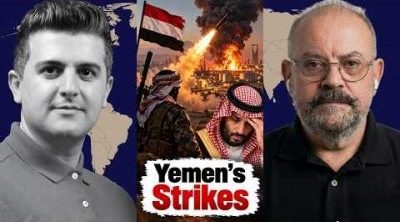
Elijah Magnier: Yemen’s strikes are shattering Saudi Arabia’s long-term strategy
or go to
Aletho News Archives – Video-Images
From the Archives
British weapons and personnel doing much of the killing in Yemen
Press TV – June 18, 2019
A detailed report published by the Guardian newspaper has shown how Britain is massively contributing to Saudi Arabia’s devastating war on Yemen as it suggests that London is not only supplying the bombs that fall on Yemenis, but it provides the personnel and expertise that keep the war going.
The comprehensive report by Arron Merat published on Tuesday showed that Britain was doing much of the killing in Yemen as the country continues to provide Saudi Arabia with everything it needs to turn its southern impoverished neighbor into a graveyard.
“Every day Yemen is hit by British bombs – dropped by British planes that are flown by British-trained pilots and maintained and prepared inside Saudi Arabia by thousands of British contractors,” said Merat in the report. … continue
Blog Roll
 Aletho News
- Netizens condemn Japanese drama for projecting Japan’s wartime atrocities onto Chinese characters
- Racist Seinfeld Dances for Joy as Bibi Unveils His New Map
- A West Bank War for Netanyahu’s Election Campaign, Could It Backfire?
- Yemen denounces European Parliament’s ‘hypocritical’ push to blacklist Ansarullah
- Qalibaf: UAE’s UN bid aims to ‘clear the runway’ for ‘Greater Israel’, whitewash genocide
- Pakistan reopens Iran border after boosting security: Report
- Why are so many Brazilians voting for Flávio Bolsonaro?
- Democrats Put Anti-Russia Agenda Ahead of American Workers
- Elijah Magnier: Yemen’s Strikes Are Shattering Saudi Arabia’s Long-Term Strategy
- Pentagon designates Chinese cultural centers national security threat
- If Americans Knew
- Latest updates from Israeli assault on West Bank
- Tourism Ministry launches free food truck tour in US
- “So Much Worse Than People Realize”: Never-Before-Seen Images Reveal Damage at U.S. Bases as Troops Describe Being Abandoned
- UK Bell Review Confirms Only Anti-Israel Attitudes Are Rising, Not Antisemitism
- DAILY UPDATE: Latest essential news on Palestine, Israel, & region
- DAILY UPDATE: Latest essential news on Palestine, Israel, & region
- Damning report shows the media must confront its failures on Gaza
- BBC senior broadcaster speaks out on Gaza coverage
- Netanyahu vows vast West Bank invasion in response to 20-minute skirmish that left 2 Israeli soldiers and 2 Palestinian fighters dead
- Tied up and tortured: Israel using US-made electroshock weapons on Palestinian detainees
- No Tricks Zone
- Sudden Stratospheric Warming, Powerful El Niño Combination May Lead To Extreme Europe Cold, Energy Crisis!
- Two New Studies Find Thwaites Glacier Melt Cannot Be Driven By Human Activity Or A Warming Ocean
- E-Cars Reduce CO2 Emissions By Only 41% Compared To Internal Combustion Engine Vehicles
- Predictions Made By Renowned Climate Professor Over Past Decades Have Been Proven To Be Poor
- New Study Suggests Large Regions Of The Pacific Ocean Have Been Cooling For The Last 80 Years
- Germany’s Green Energy Debacle: High Energy Costs Force Kahla Porzellan to Close After 182 Years!
- New Study: 50 Years Of The Most Aggressive ‘Net Zero’ Policies Can Only Affect The Global Climate By 0.03°C
- US September “Heat” Was No Record…Many Records Set Decades Ago
- Latest European Green Energy Debacle; Portugal’s Largest Flagship Solar Park Insolvent!
- Green Energy Debacle: German Expert Professor Fritz Vahrenholt Warns Of Severe Economic And Social Consequences

