In a recent interview, one of the world’s leading vaccinologists and co-author of what is considered to be the ‘bible of vaccines’, Dr. Paul Offit admitted that studies comparing unvaccinated children to vaccinated children have not been done, claiming they are impossible to do. All the while, lead author of the aforementioned book, Dr. Stanley Plotkin, the ‘godfather of vaccines’, made a recent statement in a published paper revealing the truth about safety trials on vaccines in the US, painting a picture of vaccine safety that falls far short of the safety claims our health agencies make.
Germany’s response to the COVID-19 pandemic was based on political objectives, and the government implemented countermeasures that often contradicted scientific evidence and the opinion of the government’s own scientists, according to documents leaked by a former employee of Germany’s public health agency, the Robert Koch Institute (RKI).
An unnamed whistleblower released the “RKI Files” to investigative journalist Aya Velázquez, who on July 23 published the unredacted files — totaling 3,865 pages — in their entirety on Substack.
The RKI is Germany’s equivalent to the Centers for Disease Control and Prevention in the U.S.
According to the German newspaper Schwäbische Zeitung, the RKI Files “contain explosive details” about “child vaccinations and ‘resistance from the population,’” and show “that the RKI took a much more differentiated view of Corona policy than those responsible for politics and most of the media led the population to believe.”
“A whistleblower, a former employee of the RKI, approached me and passed on the data set to me” for reasons of “conscience,” Velázquez wrote on Substack.
Other revelations include evidence of policymakers targeting and “nudging” children, and knowledge by policymakers and scientists that the COVID-19 vaccines were ineffective and led to severe adverse events.
Despite this knowledge — and for political reasons — government officials pursued measures rewarding the vaccinated and punishing the unvaccinated.
The RKI Files also reveal that policymakers and scientists sought to publicly ignore evidence of a “flattening curve” early in the pandemic, and evidence that masks and mass testing would not be useful in preventing infection.
Although some have questioned the legitimacy of documents contained within the RKI Files, the Robert Koch Institute, in an announcement carried by German news program Tagesschau addressing the publication of unredacted documents, did not confirm or deny the legitimacy of the documents themselves or their contents:
“The Robert Koch Institute has criticized the publication of unredacted minutes of the RKI crisis team on the COVID pandemic. The RKI expressly condemns the unlawful publication of personal data and trade and business secrets of third parties in these data sets and, in particular, any infringement of third-party rights.”
Other German mainstream news media outlets, including the mass-circulation Bild and Zeit newspapers, also reported on the release of the files.
‘Clear evidence that the general public was deliberately deceived’
Widespread “vaccination of children” and policies barring the unvaccinated from many public spaces — for which the RKI “provided supposedly scientific legitimacy” — weren’t based on “rational, scientific considerations” but on “political decisions,” Velázquez wrote.
Stefan Homburg, Ph.D., professor of public finance at the University of Hannover in Germany, was part of a team that worked with the whistleblower to release the unredacted RKI Files. He told The Defender the documents show decisions were made “exclusively by politicians” and that “RKI did not support these measures.”
“We have now clear evidence that the general public was deliberately deceived,” Dutch lawyer Meike Terhorst told The Defender. “Politicians made the decisions, not health authorities.”
Dr. Christof Plothe, a member of the World Council for Health steering committee, told The Defender the files “show that it was never science that initiated ineffective and harmful masking, traumatizing social distancing and lockdowns, or that introduced a novel gene therapy labeled a ‘vaccine’ … It was politicians that demanded the measures.”
Germany’s pandemic-era Federal Minister of Health Karl Lauterbach figures prominently in the documents. Plothe said Lauterbach has “never worked with patients and is a pure lobbyist of Pharma.”
German toxicologist Helmut Sterz, previously a researcher for major pharmaceutical companies — including Pfizer — told The Defender the documents show that pandemic decisions “were made by those who are responsible for the creation of this ‘pandemic’” and that “Real experts ‘disappeared’ from the public debate.”
Germany enacted among the strictest set of COVID-19 restrictions in Europe, according to the Oxford University COVID-19 Government Response Tracker.
“The measures that the German people were subjected to, besides mask mandates and social distancing rules, [include] a ‘lockdown of the unvaccinated’ that banned people from [public places] … Compulsory vaccination was imposed on military members and all people working in the health sector,” Plothe said.
Documents reveal EU discussions to ‘skip the Phase 3 trials’ for Pfizer shot
“Normally, you plan 12-18 months from the start of Phase I. EMA and Pfizer are considering whether to skip Phase III trials and go straight into broad use. If the regulators decide that, then it can go faster than 12-18 months,” the document says.
Minutes from an April 27, 2020, RKI meeting state, “There will be several vaccines that have been developed and tested in a fast-track process. Relevant data will only be collected post-marketing.”
According to German medical magazine Aertzeblatt, RKI documents from January and February 2021, after the first COVID-19 vaccines were introduced and administered, reveal discussions questioning the effectiveness of the AstraZeneca COVID-19 vaccine, stating it was “less perfect” and its “Ecology needs to be discussed.”
A Jan. 29, 2021 document (page 135), for instance, states that “STIKO [RKI’s Standing Committee on Vaccination] recommends vaccine only for <65-year-olds, as there is a lack of evidence for >65-year-olds, very wide confidence intervals, too uncertain, as two highly effective RNA vaccines are available.”
According to German magazine Tichys Einblick, the documents show that as early as the beginning of 2021,” the RKI knew about serious side effects of vaccinations, for example from AstraZeneca. Nevertheless, shortly afterwards, practically all important top politicians were publicly vaccinated with precisely this shot.”
These admissions came despite public rhetoric at the time stating that the shots would protect against both the spread of and infection from COVID-19.
Problems post-vaccination soon began to pop up in the RKI documents. A Feb. 8, 2021, document references a political furor in Germany after 14 fully vaccinated residents of a nursing home tested positive for COVID-19. The same document admitted that vaccination does not prevent less severe cases of the virus.
RKI documents from March 12 and March 15, 2021, referenced the identification of severe adverse events following AstraZeneca COVID-19 vaccination in Denmark, the Netherlands and Austria, and an April 9, 2021, document discusses a high rate of thrombosis cases tied to the AstraZeneca vaccine, particularly in males.
“It is particularly bad that the RKI recognized many vaccine injuries caused by AstraZeneca, but did not warn the public,” Homburg said. “The constant political pressure is also remarkable.”
‘It must be cool to get vaccinated’
The RKI Files also revealed efforts on the part of the German government and the country’s public health authorities to specifically target children with COVID-19 restrictions — efforts that were marked by political interference:
A May 19, 2021, RKI document states, “Even if STIKO does not recommend vaccination for children, [then-Health Minister Jens] Spahn is still planning a child vaccination program.”
A May 21, 2021, document states that while pediatric associations “are reluctant to vaccinate children … Politicians are already preparing vaccination campaigns to vaccinate the relevant age groups.”
A July 14, 2021, RKI document reveals discussions of an “influencer vaccination challenge on YouTube” and “developing material for younger target groups,” which would “be approached with more humor” — even vaccine reactions and side effects. “It must be cool to get vaccinated,” the document stated.
The minutes of a Dec. 15, 2021, RKI meeting reveal that Germany’s health ministry was “considering booster vaccination of children, although there is no recommendation and in some cases no approval for this.”
Such measures were promoted despite early knowledge that children were not significantly affected by COVID-19. A Feb. 26, 2020, RKI document referred to data from China finding that 2% of cases were in children, while a Nov. 30, 2020, document suggested that school settings were unlikely to contribute to the spread of the virus significantly, but that school closures would “exacerbate” the situation.
And a Dec. 4, 2020, RKI meeting examining data from several countries concluded that school reopenings did not lead to significantly greater spread of the virus.
‘The vaccinated must receive privileges of some kind’
Despite such findings, there was political pressure to reward the vaccinated and punish the unvaccinated, according to the RKI Files.
A Nov. 5, 2021, document said that media rhetoric regarding “a pandemic of the unvaccinated” was “not correct from a scientific point of view,” because “the entire population is contributing” to new waves of infection.
Yet, authorities decided to continue blaming the unvaccinated for the spread of COVID-19, because it would serve “as an appeal to all those who have not been vaccinated to get vaccinated,” according to the document.
The document also noted that Spahn “talks of the [pandemic of the unvaccinated] at every press conference … so it can’t be corrected.” The document contains an acknowledgment, though, that “one should be very careful with the statement that vaccinations protect against any (even asymptomatic) infection” because “as the time between vaccinations increases,” infection becomes more likely.
A May 10, 2021, RKI document contained a determination that telling the truth to the public would “cause great confusion,” while maintaining existing vaccination recommendations would serve “to save [the] vaccine.”
Instead, a Jan. 7, 2022, document stated that “the vaccinated must receive privileges of some kind,” including fewer travel restrictions, and that this was an objective that the German Health Ministry desired, while calling for further “testing of the unvaccinated after entry” into the country.
Similarly, a March 10, 2021, document suggested that COVID-19 vaccination should be promoted to the public as a means “to be able to participate in social life again,” for people who were tired of “bans and restrictions.”
Yet, a Dec. 4, 2020, RKI document suggested that the vaccinated should continue to comply with “hygiene measures,” while a Dec. 30, 2020, document suggested that the vaccinated should still wear masks, “as there is still a risk of transmission.”
German authorities wished to ‘avoid drawing attention’ to flattening curve
The RKI Files further reveal that, early in the COVID-19 pandemic, there was political pressure to maintain restrictions, despite the “flattening of the curve.”
A March 25, 2020, document admitted that “the curve is slowly leveling off,” but said, “We should avoid drawing attention to this in our external communications, to encourage compliance with measures.”
A Nov. 18, 2020, document contains an admission that respiratory illnesses were “well below” the previous year’s level, with a downward trend. Similarly, a Nov. 30, 2020, document states that general respiratory illnesses were “well below previous years.” A Jan. 27, 2021, document stated that a “no-COVID” policy is not feasible.
And according to a Feb. 25, 2022, document, RKI was prevented from downgrading its overall risk assessment of COVID-19 from “very high” to “high” even after the mostly mild symptoms of the Omicron wave were evident, due to intervention from Lauterbach and the German Health Ministry.
Use of masks by general public deemed ‘problematic’ — but imposed anyway
The RKI Files also contain acknowledgments that masking and testing policies were ineffective in limiting the spread of COVID-19 but were pursued for political reasons:
A Jan. 27, 2020, document states that masking “does not make sense” for asymptomatic people, as there was no evidence that it would be a “useful preventive measure for the general population.”
An Oct. 23, 2020, document stated that FFP2 masks (similar to N95 masks) would be “misused” by the public and not offer protection, but instead might instill a false sense of security in people. “The harms of FFP2 masks may outweigh benefits,” the document states.
An Oct. 30, 2020, document says, “FFP2 masks have no added value if they are not fitted and used correctly” and are useless outside of “occupational health and safety.”
A Jan. 13, 2021, document states that FFP2 masks “can lead to health problems for people with preexisting conditions and should therefore remain an individual decision” and that “A general FFP2 mask requirement is not considered sensible.”
A Jan. 18, 2021, document found “No technical basis for recommending FFP2 masks for the population,” noting the risk of “undesirable side effects.”
Yet, by July 2, 2021, RKI documents contain suggestions, based on the American Academy of Pediatrics, for general mask wearing for children age 2 and older and that “The wearing of masks should be maintained … even at low incidences and should be understood as maintaining basic measures.”
RKI documents also questioned mass COVID-19 testing. A Feb. 3, 2020, document stated that positive PCR results after recovery “do not necessarily mean infectiousness,” while a July 29, 2020, document found that COVID-19 testing was ineffective, but a “political desire” for testing had to be “met.”
Similarly, a Dec. 16, 2020, RKI document suggested the suspension of elective procedures (planned operations), due to “pressure from the state governments.”
Some rather shocking testimony has emerged from the USA.
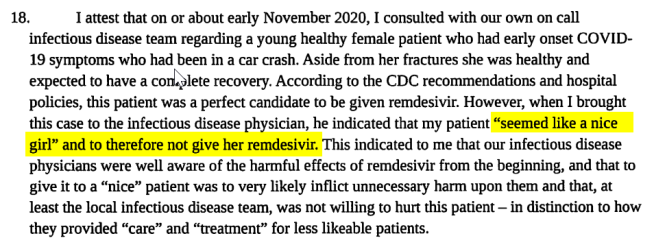
An American doctor working in Everett, Washington (just north of Seattle) called James Miller, recently published an attestation which can be downloaded from here.
This was written to be filed as evidence with some attorneys who are petitioning state Attorney Generals to investigate hospital administrations and others responsible for what some regard as homicides. More about that can be read here.
The whole statement is worth reading, but in our view the following in particular stands:
From just that small extract, the following can be surmised:
treatment was entirely protocol-driven — this person was well enough to be in a car and her “covid-19” was incidental; there were, however, recommendations in place that notwithstanding that, she should receive remdesivir just because a protocol said so
usually these protocols were followed, regardless of clinical need, but just because a person had a positive test
the protocols, however, could be flexibly applied and in this case a doctor decided that a valid criterion for making a decision was how “nice” the patient was
a treatment was actively avoided here “because she was nice” — indicating that the doctors knew that per-protocol they ought to be giving treatments which they themselves knew to be harmful
The core departure from medical norms on display here from which this fortunate patient escaped — the rigid application of “protocols” by compliant unquestioning doctors resulting in harmful treatment being given — is an extremely disturbing phenomenon. It would be naive to think this only happened in the USA, and was seen only in association with the particular treatment — remdesivir — mentioned here.
It’s worth noting that the tenacious Jessica Hockett has written this article in which she suggests a series of further questions she’d like to ask Dr Miller.
Why lifestyle changes (and lifestyle medicine) are often a better option than pharmaceuticals and conventional medicine when it comes to preventing, treating and managing chronic disease:
Lifestyle changes target the root cause of chronic disease. They help avoid environmental damage, pollution and chemical and plastic waste entering our ecosystems. Future generations are positively impacted by focusing on lifestyle factors.
A new randomised trial in The BMJ is being touted as proof that surgical face masks are effective at an individual level for reducing respiratory infections
Whether to wear a face mask to prevent respiratory illnesses has been one of the most divisive debates during the pandemic.
After a Cochrane review in 2023 found that face masks made “little or no difference” to the spread of respiratory viruses, the issue became highly politicised.
Tom Jefferson, lead author of the Cochrane review, told me “There is just no evidence that they make any difference. Full stop.” The interview was picked up by media such as the New York Timesand CNN, sparking an international furore.
New York Times columnist, Zeynep Tufekci pushed back in her own column arguing that despite no high-quality data, we could still conclude from less rigorous observational studies, that masks do in fact work.
Well-known science historian and co-author of Merchants of Doubt Naomi Oreskesagreed with Tufekci, claiming the public had been “misled” by the Cochrane review because it prioritised high-quality studies and excluded less rigorous ones.
When former CDC Director Rochelle Walensky was challenged about her controversial mask mandates in light of Cochrane’s findings, she lied to Congress claiming that the review had been “retracted” when it had not.
Then, in September 2023, former White House physician Anthony Fauci told CNN, “There’s no doubt that masks work.” Fauci said that while studies might show masks do not work at a population level, they do work “on an individual basis.”
Could this be true?
Well, a new study published in The BMJ is being touted as proof that face masks are effective at an individual level for reducing respiratory infections.
The study
Researchers in Norway performed a ‘pragmatic’ randomised trial in the off-peak period of “the normal influenza season” to determine if wearing a surgical face mask in public could reduce the risk of contracting a respiratory illness.
This study was sufficiently powered to detect a difference in outcomes in a real-world setting.
Over a 14-day period (between Feb-April 2023), 4647 participants were randomly assigned to either wear a surgical mask in public places (shopping centres, streets, public transport) or not to wear a surgical face mask in public places (control group).
The group wearing masks showed an absolute risk reduction of ~3 percent in “self-reported symptoms consistent with respiratory infection” (8.9% mask group; 12.2% control group, 95% CI 0.58 to 0.87; P=0.001).
The authors concluded, “Wearing a surgical face mask in public spaces over 14 days reduces the risk of self-reported symptoms consistent with a respiratory infection, compared with not wearing a surgical face mask.”
In an accompanying editorial, the authors of the study anticipated their findings would inflame an already divisive debate, and called for more “open and nuanced discussions” about face masks.
“We know exactly what to expect,” they wrote.
“Mask non-believers will describe the effect size as too small to be of interest, and they will intensively highlight any source of potential bias that might have inflated the results in the wrong direction. Of course, the mask believers will do the same but in the opposite direction.”
The authors said they would welcome “a nuanced debate around the potential biases and the interpretation” of the study findings, so here I go….
Analysis
I would argue that an absolute reduction of 3% in self-reported symptoms from people wearing masks is not a clinically meaningful result.
There are several reasons why.
First, in such a study, you obviously cannot blind the participants to one group or the other. People know they’re wearing a mask and may be less likely to report symptoms if they feel “protected.”
In fact, a pre-specified subgroup analysis showed a “beneficial effect was estimated for participants who reported that they believed face masks reduced the risk of infection,” indicating the study suffered from ‘reporting bias.’
Second, the study found wearing a mask changed people’s habits which may have accounted for the small difference between groups.
For example, people in the control group were more likely to attend cultural events than people wearing a mask (39% and 32%, respectively; P<0.001). Also, a larger percentage of people in the control group visited restaurants compared to those wearing a mask (65% and 53% respectively; P<0.001).
This is similar to the cluster-randomised trial of community-level masking carried out in Bangladesh. The study found a small effect of face masks which could be explained by changes in behaviour; 29% of people in villages wearing masks practiced physical distancing, compared to only 24% in the control (non-masking) villages. The apparent small effect of masks could therefore be due to physical distancing.
Third, masks were mandated across the world to reduce the burden of covid-19. But in this study, there was no difference in the number of self-reported or registered covid-19 infections between the control group and those wearing masks.
Fourth, the study showed people wearing a mask in public places sought healthcare for respiratory symptoms at a similar rate to people who weren’t wearing a mask, indicating that the mask was not reducing the burden on the healthcare system.
Fifth, with an intervention like surgical masks, compliance is always an issue because participants can feel uncomfortable or self-conscious wearing a face covering in public, and a small reduction in risk may not be worth it.
In this trial, only 25% of participants reported “always wearing a face mask” in public and 19% wore them less than 50% of the time. Had the trial been longer than 14-days, it’s likely that compliance would have diminished along with the small benefit.
The most reported adverse effect of wearing masks in public places was the unpleasant comments from other people.
This may also explain the difference in dropout rates. At follow-up, 21% of people assigned to wear masks did not respond to the questionnaire, compared to 13% in the control group, which again, suggests reporting bias.
Conclusion
What this study shows is that wearing a face mask in public during the flu season, might reduce the sniffles by a small percentage, but it won’t change whether you seek healthcare and might actually make you less inclined to go out and have fun.
This study does not show that community masking reduces the healthcare burden of disease associated with respiratory illnesses, which was the justification for mandating face masks during the pandemic.
I’d add that viruses are smaller than the pores in surgical or cloth masks (and masks are rarely worn properly), so it’s unlikely to be an effective public health intervention.
At the start of the pandemic before masking became political, Fauci had the right idea when he told 60 minutes, “Right now in the United States, people should not be walking around with masks.”
As shown in the 2023 Cochrane review, hand hygiene is likely to be more effective at reducing the burden of respiratory illnesses, and has no real downsides.
Vaccine advocate and pharmaceutical industry insider Dr. Peter Hotez, long a proponent of the COVID-19 vaccine, said he favors deploying police and military powers against “anti-vaxers,” whom he blamed for causing hundreds of thousands of deaths during the pandemic.
“What I’ve said to the Biden administration is, the health sector can’t solve this on its own. We’re going to have to bring in Homeland Security, the Commerce Department, Justice Department to help us understand how to do this.
I’ve said the same with — I met with Dr. Tedros [director general of the WHO] last month … to say, I don’t know that the World Health Organization can solve this on our own. We need the other United Nations agencies. NATO. This is a security problem because it’s no longer a theoretical construct or some arcane academic exercise. Two hundred thousand Americans died because of anti-vaccine aggression, anti-science aggression.
The full interview was available on YouTube until Wednesday evening, when it was removed. The Defender obtained a video recording of the full interview.
Hotez is dean of the National School of Tropical Medicine at Baylor University College of Medicine and director of the Center for Vaccine Development at Texas Children’s Hospital, one of the sponsors of the symposium, which was organized by the Colombian Pediatric Society.
Aside from being a vaccine proponent and developer — he helped develop the Corbevax COVID-19 vaccine which was administered in India and has received at least $30 million in vaccine development grants from the Bill & Melinda Gates Foundation — Hotez has crusaded against so-called “misinformation” about vaccines.
In March, The Hill reported that Hotez has found a “‘parallel career’ fighting misinformation.”
Hotez “finds his efforts to combat misinformation to be ‘meaningful,’” and says “pushing back on the anti-vaccine movement is just as important as developing vaccines,” The Hill wrote.
“Peter has cashed in significantly on the COVID-19 pandemic and gets a lot of money when shots go into arms,” said Brian Hooker, Chief Scientific Officer for Children’s Health Defense (CHD).
In his July 5 interview, Hotez called for more stringent action against “anti-vaxers,” whom he connected to entities such as the Russian government, and called for medical schools to educate new doctors about anti-vaccine sentiment.
“‘Anti-science’ and ‘anti-vaxxer’ are propaganda terms Hotez uses to establish a power dynamic over anyone who disagrees with him,” said cardiologist Dr. Peter McCullough.
“Now Hotez is calling for a security state to enforce his propaganda instead of engaging in much needed dialogue over vaccine safety with a critical appraisal of short- and long-term side effects from the routine childhood vaccine schedule, including the COVID-19 shots,” McCullough added.
According to Harvey Risch, M.D., Ph.D., professor emeritus and senior research scientist in epidemiology (chronic diseases) at the Yale School of Public Health:
“Hotez has spent his entire career developing vaccines which have not achieved success in commercial use. His demands to impose public health martial law are reminiscent of the ‘Comité de salut public’ — ‘Committee of Public Safety’ — that Robespierre used to murder his political opponents [during the French Revolution].”
For Francis Boyle, J.D., Ph.D., professor of international law at the University of Illinois, Hotez’s suggestions are a call to violate established international human rights law.
“Coercing vaccines upon human beings without their informed and voluntary consent violates the Nuremberg Code on Medical Experimentation, which is a crime against humanity,” Boyle said. “What we see at work here with Hotez is the Nazi mentality that pervades so many vaccinologists like him. Hotez is revealing his true colors.”
Independent journalist Paul D. Thacker has investigated Hotez for his site, The Disinformation Chronicle. He said, “This crackpot idea that we should deploy military forces to deal with moms worried about vaccine side effects and children … doesn’t that speak for itself?”
Dr. Sukharit Bhakdi, a microbiologist, questioned Hotez’s scientific credentials:
“Simple fact: Hotez is not a real scientist. He has never published any research article based on true scientific research. His publications transmit his personal opinions and beliefs. He has not conducted a single valid vaccine trial and has zero data to back his claims.
“He has been on the globalist team together with [Dr. Anthony] Fauci et al. and is now turning to violence to silence all dissenters. This very fact disqualifies him as a physician.”
“His evolution over the course of the pandemic is curious as he has become more and more shrill as time goes on,” Hooker said. “It seems he is trying to extend his 15 minutes of fame by ‘jumping the shark’ and inciting gestapo-like measures against ‘anti-vaxers’ and ‘science deniers.’ His definition of science is very ‘Fauci-esque’ indeed.”
Claim that unvaccinated caused ‘hundreds of thousands’ of deaths ‘an obvious untruth’
During his July 5 interview, Hotez asserted that the unvaccinated were responsible for hundreds of thousands of deaths during the COVID-19 pandemic. He said:
“There’s anti-vaccine activity in every country, and each has its own unique national flavor. But the part that I’m worried about now is something very dark and accelerating in the United States.
“And the most dramatic evidence for that is what happened during the COVID pandemic … My estimate is 200,000 Americans died needlessly because they refused COVID vaccines in 2021, 2022.”
Hotez did not provide evidence supporting this figure, but it was similar to claims made by Dr. Anthony Fauci during Congressional testimony last month. Without citing evidence, Fauci said the unvaccinated are “probably responsible for an additional 200,000-300,000 deaths” in the U.S.”
Risch called this claim “an obvious untruth.”
“In the face of repeated major empirical CDC [Centers for Disease Control and Prevention] evidence and CDC’s public acknowledgement that the mRNA vaccines largely failed to reduce COVID transmission, Hotez absurdly claims that people choosing not to vaccinate themselves have contributed more to deaths from COVID than all of the large-scale breakthrough infections among vaccinated people,” Risch said.
McCullough said, “Hotez presumes COVID-19 vaccines are safe and effective as any vaccinologist would dream. Sadly, his fantasy was over before it started. The COVID-19 vaccines were unsafe and failed to reduce hospitalization and death in prospective randomized trials or in valid observational studies. They never stopped transmission.”
“All experts, including Hotez, agreed theoretical protection from COVID-19 vaccines was just a few months, requiring frequent boosters,” McCullough added.
Hotez calls parents who choose not to vaccinate their children ‘victims’
In his interview, Hotez called for action — including more censorship — to counter what he called a “dark and accelerating” and “dangerous” anti-vaccine movement in the U.S. and globally that is “expanding and extending to childhood immunizations in the United States.”
“My worry is that this anti-vaccine movement, and it’s not misinformation or [an] infodemic, as many call it, it’s organized, it’s deliberate, it’s well-financed and it’s politically motivated … I worry that’s now globalizing to other countries on the African continent, in Asia and even Latin America,” he added.
On the topic of childhood vaccinations, Hotez said, “Parents who choose not to vaccinate their kids are victims” of this campaign, and called for medical schools to train doctors on how to respond to parents who oppose vaccinations.
“Pediatricians need to understand what the anti-vaccine ecosystem is, how it’s organized, how it operates, and to get educated about it,” he said. “I think that’s a first step … in our medical schools, in our pediatric residency training, in our conferences like this, being able to describe what this anti-vaccine monster looks like.”
“The fraud and cover-up of ivermectin as an effective prevention and treatment of COVID-19 caused a segment of the population to question the official guidance around vaccines — more so once they were mandated.”
Hotez blamed legacy and traditional media, as well as foreign governments, for fueling anti-vaccine sentiments.
“Fox News is now a source of anti-vaccine disinformation,” Hotez said. “If the parents are watching Fox News every night … They are going to be coming into your practice believing disinformation.”
Turning to social media, Hotez said, “Twitter, since Elon Musk has taken it over, has become an anti-vaccine site dominated by anti-vaccine groups and individuals who are monetizing the internet. They’re selling fake autism cures because they say vaccines cause autism, which they don’t.”
Adversarial foreign governments are also to blame for propagating anti-vaccine rhetoric, according to Hotez. “For instance, the Russian government, the Putin government, is spreading anti-vaccine propaganda. The goal of this is to destabilize society and to have caused people to question authority,” he said.
Hotez calls ‘anti-vaccine movement’ a tool of the ‘far-right’
Hotez also used the interview as an opportunity to plug his upcoming book, “The Deadly Rise of Anti-Science: A Scientist’s Warning.” He said the book “describes [the anti-vaccine] ecosystem and its political leanings in detail.”
According to the book’s publisher, Johns Hopkins University Press, Hotez “explains how anti-science became a major societal and lethal force” and how “the anti-vaccine movement became a tool of far-right political figures around the world.”
However, Hotez’s own 2012 to 2017 NIH grant — totaling $6.1 million — for the development of a SARS vaccine had the aim of responding to any “accidental release from a laboratory,” in addition to a possible zoonotic (or natural) spillover of the virus.
In a June 2023 interview with Robert F. Kennedy Jr., CHD’s chairman on leave, podcaster Joe Rogan offered to donate $100,000 to a charity of Hotez’s choice if he agreed to debate Kennedy.
Michael Nevradakis, Ph.D., based in Athens, Greece, is a senior reporter for The Defender and part of the rotation of hosts for CHD.TV’s “Good Morning CHD.”
Welcome to a landmark episode of the Radically Genuine Podcast! I’m thrilled to present our first full video episode, exclusively available to our valued paid subscribers. Your support has made this exciting new format possible, allowing us to bring you an enhanced, immersive experience of our thought-provoking conversations.
In this shocking episode, I interview Professor Ian Harris, an esteemed orthopedic surgeon and author of the book “Surgery, The Ultimate Placebo”. This conversation unravels the complexities of surgical outcomes, challenging conventional wisdom and highlighting the critical need for evidence-based practice in modern medicine.
Key points explored:
1. The placebo effect in surgery: We dissect how patient expectations and non-specific effects can significantly influence surgical outcomes, emphasizing the importance of distinguishing these from the procedure’s direct physiological impacts.
2. Challenges in surgical research: We discuss the difficulties in conducting placebo-controlled surgical trials, shedding light on the methodological hurdles that complicate efforts to establish definitive evidence of surgical efficacy.
3. Surgeon bias and decision-making: The conversation explores the cognitive biases that can affect surgeons’ judgments, potentially leading to unnecessary procedures or overestimation of benefits.
4. Overuse of surgical interventions: Harris presents compelling arguments about the prevalence of surgeries that may lack solid scientific backing, advocating for a more cautious approach to surgical recommendations.
5. Non-operative alternatives: The discussion highlights the often-overlooked potential of conservative treatments, particularly emphasizing the benefits of weight loss and exercise for conditions like knee arthritis.
6. Financial incentives in healthcare: We touch on the complex interplay between economic motivations and medical decision-making, exploring how these factors can influence treatment recommendations.
7. Placebo and nocebo effects: The conversation examines how both positive (placebo) and negative (nocebo) expectations can impact patient outcomes, underscoring the power of patient beliefs in the healing process.
8. Informed consent and patient education: We stress the importance of providing patients with accurate, evidence-based information to facilitate truly informed decision-making about their care.
This episode serves as a compelling call to action for increased scientific rigor in surgical practice and a more critical evaluation of established medical interventions. It challenges listeners to reconsider their assumptions about surgical efficacy and encourages a more nuanced understanding of the factors contributing to medical outcomes.
Learning nothing from the opioid crisis, research misconduct and regulatory failure has opened the door to widespread public harm from new classes of weight loss and trans medicine drugs classes. Also, a new kind of scientific methodology is being brought to the forefront, driven by AI.
Global childhood immunization rates stalled in 2023, leaving millions of children “vulnerable to preventable diseases,” according to a new report from the World Health Organization (WHO) and UNICEF.
The latest WHO-UNICEF estimates show that 14.5 million children missed all doses of “routine” DTP vaccines last year, an increase from 13.9 million in 2022. The report also laments the gaps in measles vaccinations, noting that outbreaks hit 103 countries.
Dr. Paul Thomas, a pediatrician and co-author of the upcoming book, “Vax Facts: What to Consider Before Vaccinating at All Ages & All Stages of Life,” told The Defender that the global vaccination programs continue to use the dangerous whole-cell DTP formulation instead of the less risky acellular version.
The whole-cell vaccine, which contains the entire Bordetella pertussis organism rather than just purified components, has since the 1930s resulted in widespread reports of neurological damage. It was phased out in the U.S. by 1997, but the formulation has continued to be used in low- and middle-income countries, potentially killing millions of children.
“The irony is that success, when it is measured by how well a country or region or doctor vaccinates, in reality rewards the pharmaceutical industry and all who profit from vaccine sales at the expense of the health of the individual and the community,” Thomas said.
Thomas, the author of a study comparing the health outcomes of vaccinated versus unvaccinated children, argued success should be measured on the overall health of the population, not on vaccination rates.
“The less we vaccinate, the healthier the population,” he said. “We need new metrics!”
The report comes as Gavi, the Vaccine Alliance, unveiled an ambitious $11.9 billion plan — including $9 billion in new funding — to vaccinate 500 million children by 2030, with existing and new vaccines.
Key findings from WHO-UNICEF report
The WHO-UNICEF report states that the stagnation in global vaccination rates highlights ongoing challenges in the wake of the COVID-19 pandemic, raising concerns about disease outbreaks, particularly measles, and the impact of climate change on vaccine-preventable diseases.
The report centers on the number of children who received three doses of the DTP vaccine — a key marker for global immunization coverage — which stalled at 84% (108 million) of children in 2023, a number the WHO nonetheless called “impressive.”
The global health agency blamed the data trends on poor access to health services during the pandemic that persists, and on fragile, conflict-ridden areas.
The increase of 600,000 “zero-dose” children was particularly concerning to the WHO in light of its Immunization Agenda 2030 (IA2030) goals. IA2030 aims to “leave no one behind” by reducing the number of zero-dose children by 50% and with “500 vaccine introductions” of “new or under-utilized vaccines” in low- and middle-income countries by 2030.
Measles vaccination rates also remain a significant concern to the WHO. In 2023, only 83% of children worldwide received their first dose of the measles vaccine through routine health services, while just 74% received their second dose.
These figures fall short of the 95% coverage the WHO claims is needed to “prevent outbreaks, avert unnecessary disease and deaths and achieve measles elimination goals,” according to the WHO-UNICEF press release.
“Measles outbreaks are the canary in the coalmine, exposing and exploiting gaps in immunization and hitting the most vulnerable first,” said WHO Director-General Tedros Adhanom Ghebreyesus.
Thomas disagreed with this take, stating that measles is not a threat to well-nourished, healthy children and that the focus on vaccines as a solution “is destroying the immune systems” of those who are highly vaccinated.
“The focus should be on making sure children of the world have adequate nutrition and adequate support of vitamins A, D and C,” he said.
Thomas emphasized the importance of comparing health outcomes for the vaccinated and unvaccinated. “The results will be shocking to all who are not informed,” he said.
Report notes ‘progress’ including HPV vax uptake
Despite the overall stagnation in global immunization rates, the WHO highlighted some areas of what it called “progress” and “resilience.”
The African region made notable strides in 2023, defying global trends by increasing routine immunization coverage. The number of zero-dose children in Africa fell from 7.3 million in 2022 to 6.7 million in 2023, with 1.5 million more children vaccinated with the DTP vaccine than in 2019, according to the report.
Bangladesh, Indonesia, Brazil, Nigeria and Ukraine made notable strides in recovering post-pandemic vaccination rates, according to Dr. Katherine O’Brien, WHO director of the Department of Immunization, Vaccines and Biologicals, and Dr. Ephrem T. Lemango, UNICEF’s associate director of immunization, who both spoke at a CNN news briefing.
The report also noted that global human papillomavirus (HPV) vaccination coverage in girls increased from 20% in 2022 to 27% in 2023, returning to near pre-pandemic levels.
Dr. Sania Nishtar, CEO of Gavi, said in the press release, “The HPV vaccine is one of the most impactful vaccines in Gavi’s portfolio, and it is incredibly heartening that it is now reaching more girls than ever before.”
Thomas called the HPV shot “the most dangerous vaccine on the planet other than COVID,” and argued that it “should have been removed from the market long ago.”
“The push to increase vaccine uptake is all about money,” Thomas said. “What do you think is causing the continued ‘vaccine hesitancy’?”
In its coverage of the WHO-UNICEF report, Axios noted that a new malaria vaccine began being distributed to children in the Ivory Coast. Health workers hope this will usher in a “new era” for controlling malaria in Africa.
Gavi and its ambitious plan ‘a big part of the problem’
The plan aims to vaccinate 500 million children by 2030 — which Gavi claims will avert up to 9 million deaths. Gavi is seeking $9 billion in new pledges of the $11.9 billion needed for the strategic period.
The investment plan includes the “Day Zero Financing Facility for Pandemics” designed to provide a $2.5 billion “surge financing capacity to support a rapid vaccine response during major public health emergencies.”
French President Emmanuel Macron, hosting the forum, emphasized the importance of global vaccination efforts and local production:
“This tough period has also reminded us all that every nation needed to be assured that it had the means to protect its citizens: this is what we have been calling ‘health sovereignty,’ which starts with access to the essential health products that are vaccines, which implies much more local production.”
The proposal received initial support, with $2.4 billion in new pledges announced at the launch event, including $1.58 billion from the U.S., according to the WHO press release.
Thomas said that Gavi and others involved in financing and increasing vaccine distribution are “a big part of the problem” and called for “a total paradigm shift.”
“Imagine the health and freedom and happiness that could be enjoyed worldwide if we focused on healthy nutrition, and assessed health by looking at all health outcomes when we do an intervention,” he said.
Thomas said:
“People are waking up to the truth; vaccines are destroying our health. COVID vaccines helped this awakening, but those who research the childhood vaccines will find a similar challenge. What we have been told is false.
To me, it seems a lot of people in Germany have been reporting sick this summer due to a colds and grippe. Normally the flu season starts in the fall. Something has changed.
Moreover, there have been lots of reports out there (mostly gone uncovered by the media) of mysterious excess mortality occurring in many countries. Germany as well has been hit by excess mortality.
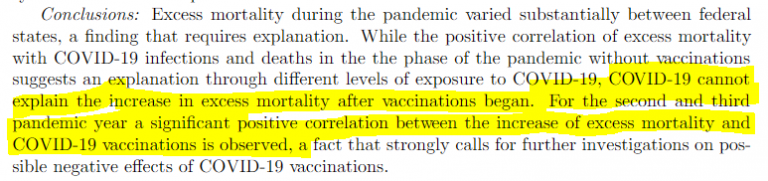
Now a new preprint paper by Christof Kuhbandner of the University of Regensberg and Matthias Reitzner of the University of Osnabrück looked at the influence of COVID 19 on mortality in the 16 German states.
The paper found over 100,000 excess deaths occurring in 2021 and 2022. Recall the vaccine was introduced in early 2021.
It’s hard to keep pace with all the ways the climate cult blames naturally occurring phenomena on “climate change,” be it natural disasters, violent storms, or “record” temperatures. While the weather is not getting “more extreme” as the climatistas claim, their apocalyptic rhetoric certainly is, and it’s also getting more dishonest. The conflation of shifting sands on barrier islands with rising sea levels is another scientifically dishonest claim being made by the climate alarmists.
Back in the 1980s, the first generation of global warmists promised that a catastrophic rise in sea levels was likely to submerge the Maldives, among other coastal areas, before 2020. Not only did that never happen, but the Maldives has a greater landmass now than it did when its imminent submersion was a “scientific fact” three decades ago. So, with the oceans not cooperating in rising as prophesied by “climate scientists” 30-plus years ago, the climate hysterics and the credulous media are now blaming the naturally occurring movement of barrier islands on “climate change” and rising seas.
Whenever a beach house on a barrier island is lost to shifting sands, it is now being reported as a harbinger of the coastal doom that is being caused by our carbon sinning. Just a few weeks ago, the American media was somberly reporting about yet another house on North Carolina’s Outer Banks being lost to the rising waters of the Atlantic Ocean. From an APstory dated 5/29/2024:
Another house has collapsed into the Atlantic Ocean along North Carolina’s coast, the sixth to fall along the Cape Hatteras National Seashore’s beaches in the past four years, according to U.S. National Park Service officials. North Carolina’s coast is almost entirely made up of narrow, low-lying barrier islands that are increasingly vulnerable to storm surges and to being washed over from both the bay and the sea as the planet warms. As sea levels rise, these islands typically move toward the mainland, frustrating efforts to hold properties in place.
There is so much that is wrong in just those three sentences. For starters, it describes a barrier island as if it is the crown of an otherwise submerged mountain or coral atoll, and thus vulnerable to being completely submerged as the seas rise up around it. But barrier islands are nothing of the sort. They are impermanent deposits of sand, which reshape, move, merge, appear, and disappear due to tides, winds, and storms.
The movement of barrier islands is not due to rising sea levels, it is due to a naturally occurring force called “longshore drift.” Where there are man-made efforts to stabilize barrier islands with jetties and sea walls, this produces other impacts on currents that cause erosion in some waterfront areas and new sand deposits in others. Beach houses in the Outer Banks are not being lost due to rising sea levels, they are being lost due to shifting sands.
This short video shows how longshore drift moves a barrier island. Winds blow the tide in at an angle against the island, not perpendicularly, but the backflow of seawater will follow gravity, which is effectively perpendicular to the island. This has the effect of slowly moving the barrier island in the direction that the wind is “pushing” it.
From NOAA’s website, “Longshore drift may also create or destroy entire barrier islands along a shoreline. A barrier island is a long offshore deposit of sand situated parallel to the coast. As longshore drifts deposit, remove, and redeposit sand, barrier islands constantly change.”
Tucker’s Island, just north of Atlantic City, New Jersey, is an example of a once populated barrier island that completely disappeared. It did not get submerged by rising tides, rather, the island’s sands were shifted by longshore drift until the island no longer existed. The Philadelphia Inquirer published a story about Tucker’s Island in 2015 titled The Mystique of New Jersey’s Atlantis.
The small, picturesque island off the southern end of Long Beach Island was once a popular seaside resort. It had a lighthouse, life saving station, two rustic hotels, 20 summer cottages, and a community meetinghouse that served as a church and school. Vacationers from Philadelphia and southern New Jersey relaxed there as long ago as the late 1860s, enjoying its peaceful solitude, cool breezes, fishing, hunting, sailing, swimming and clam bakes. But Tucker’s Island’s days were numbered. Year by year, ocean tides and storms eroded it. The hotels closed in 1910 and later collapsed and were washed away. The lighthouse fell in 1927.
This NOAA link shows a series of historical maps of the New Jersey shore dating back to 1856, showing the constantly changing shape, size, and location of Tucker’s Island, until it eventually disappeared, to ultimately be replaced by growth on the southern tip of Long Beach Island.
Near Corpus Christi, Texas, the Lydia Ann Lighthouse on the intracoastal waterway is a popular destination for fishing, birding, and kayaking. Its location as a navigational aid makes little sense when looking at current maps, but current maps do not reflect the islands and channels as they existed in 1857 when the lighthouse (then knows as the Aransas Pass Light Station) went into service.
The purpose of the lighthouse was to guide ships from the Gulf of Mexico into the Aransas Pass, which lay between San Jose Island to the north, and Mustang Island to the south. At the time, the lighthouse aligned with the channel, but over the years, longshore drift pushed the pass well to the south. The Aransas Pass between the two islands is now about one mile south of where it was when the lighthouse was erected, as both San Jose Island and Mustang Island shifted south.
Like so much else related to the phony “climate crisis,” stories of rising seas eating away at barrier islands are dishonest misrepresentations of naturally occurring events.
Buck Throckmorton is a writer (“co-blogger”) at the Ace of Spades HQ blog. His career includes many years in banking and commercial lending, as well as a stint with an American auto manufacturer. Buck’s writing often takes a critical look at electric vehicles, “green” energy, and woke capital. Twitter: @BuckThrockmort; email: buck.throckmorton@protonmail.com
By Jay Knott | Dissident Voice | September 24, 2013
In a recent article on Counterpunch, Rob Urie defended the traditional Marxist analysis of US policy in the Middle East. He argues that support for Israel is driven primarily by economic interest, not the Jewish lobby.
He starts by paying tribute to the idea that Western societies are uniquely racist. He says that the “Western narrative” claims there is an “Arab character”, and that this is “antique racist blather”. He gives no definition of these terms. Further, he establishes his credentials as part of the dominant current in the American left by claiming that “over a million people in Iraq died so ‘we’ in the West can drive SUVs.”1
When he tries to criticize bourgeois economics, he makes it clear he doesn’t understand the developments it has made since Marx’s day, using the mathematical discipline known as “game theory”. He dismisses the basic abstraction of economic theory, the idea of the rational individual, on the grounds that it is “devoid of history, culture and political context”. But abstractions are always devoid of something.
He defends a more concrete economic theory, mostly Marxist, with some input from another theorist of capitalist crisis, Hyman Minsky. This concrete theory leads him to the view that US activity in the Middle East is primarily driven by rational capitalist motives, the need to secure a supply of oil.
“Taking the totality of circumstance — former oil company executives launching war on an oil rich nation on a pretext they publicly proclaimed they didn’t believe shortly before taking office — and that upon launching their war proved to be non-existent, requires a willingness to overlook the obvious — that the war on Iraq was for oil, that is difficult to support.”1
Perhaps I’ve misunderstood him, but based on what he says in the rest of the article, this convoluted sentence seems to argue that, because president Bush and vice-president Cheney attacked Iraq on false premises, and they also said it was all about oil, and they are former oil executives, and Iraq has a lot of oil, it’s difficult to deny US attacks on Iraq are all about oil.
In fact, it’s not hard at all. As Urie points out, at times Bush and co. said that attacking Iraq was “protecting the world’s supply of oil.”1 But, as he also points out, they are congenital liars. Why should we believe them when they say they are trying to “protect” the oil supply? Protect it against what? When politicians “admit” attacks on Middle Eastern countries are wars for oil, they are parroting the neo-con party line, feeding the public, both left and right, with a plausible-sounding pretext. For right-wingers, “it’s a war for oil” is a reason to support war, and for leftists, it’s a way to feel better by complaining impotently about corporate greed. Both approaches help the war drive. … continue
This site is provided as a research and reference tool. Although we make every reasonable effort to ensure that the information and data provided at this site are useful, accurate, and current, we cannot guarantee that the information and data provided here will be error-free. By using this site, you assume all responsibility for and risk arising from your use of and reliance upon the contents of this site.
This site and the information available through it do not, and are not intended to constitute legal advice. Should you require legal advice, you should consult your own attorney.
Nothing within this site or linked to by this site constitutes investment advice or medical advice.
Materials accessible from or added to this site by third parties, such as comments posted, are strictly the responsibility of the third party who added such materials or made them accessible and we neither endorse nor undertake to control, monitor, edit or assume responsibility for any such third-party material.
The posting of stories, commentaries, reports, documents and links (embedded or otherwise) on this site does not in any way, shape or form, implied or otherwise, necessarily express or suggest endorsement or support of any of such posted material or parts therein.
The word “alleged” is deemed to occur before the word “fraud.” Since the rule of law still applies. To peasants, at least.
Fair Use
This site contains copyrighted material the use of which has not always been specifically authorized by the copyright owner. We are making such material available in our efforts to advance understanding of environmental, political, human rights, economic, democracy, scientific, and social justice issues, etc. We believe this constitutes a ‘fair use’ of any such copyrighted material as provided for in section 107 of the US Copyright Law. In accordance with Title 17 U.S.C. Section 107, the material on this site is distributed without profit to those who have expressed a prior interest in receiving the included information for research and educational purposes. For more info go to: http://www.law.cornell.edu/uscode/17/107.shtml. If you wish to use copyrighted material from this site for purposes of your own that go beyond ‘fair use’, you must obtain permission from the copyright owner.
DMCA Contact
This is information for anyone that wishes to challenge our “fair use” of copyrighted material.
If you are a legal copyright holder or a designated agent for such and you believe that content residing on or accessible through our website infringes a copyright and falls outside the boundaries of “Fair Use”, please send a notice of infringement by contacting atheonews@gmail.com.
We will respond and take necessary action immediately.
If notice is given of an alleged copyright violation we will act expeditiously to remove or disable access to the material(s) in question.
All 3rd party material posted on this website is copyright the respective owners / authors. Aletho News makes no claim of copyright on such material.



 Aletho News
 Aletho News