The Great Debate that won’t happen
Kennedy vs. Hotez might be a narrative-changer.
BY BILL RICE, JR. | JUNE 18, 2023
In south Alabama we have an expression: “If you’re scared, say you’re scared.”
Well, Dr. Peter Hotez – one of the best-known vaccine advocates and defenders of all the Covid mitigation measures – is obviously scared to death. He just needs to come out and admit it.
What scares Dr. Hotez is an invitation for him (Hotez) to debate presidential candidate and contrarian Covid expert Robert Kennedy, Jr. on Joe Rogan’s ultra-popular podcast show.
Apparently, Hotez kept bad-mouthing “disinformation super-spreader” Kennedy and Rogan finally had enough.
Rogan offered to donate $100,000 to Hotez’s favorite charity if Hotez would just come on his show and, in a debate with no time-table, debate Kennedy on vaccine effectiveness, safety and all the other allegedly “settled” Covid science.
As I write, the debate invitation has gone viral on Twitter with plenty of other wealthy people (like Steve Kirsch) ponying up money to make the debate happen. At last look, Dr. Hotez could net $1.5 million for his favorite charity by simply talking to Kennedy and Rogan for two or so hours.
Talk about easy money.
Needless to say, Kennedy is game for a “cordial” debate and, needless to say, he doesn’t need to be bribed to participate. He’ll do it for free and pay his own expenses to show up in the studio.
Truth be told (there’s that word – “truth”) … Nobody is surprised that Dr. Hotez is running from a genuine debate on Covid topics. This is because no expert in America has participated in a genuine debate on Covid topics in 40 months.
Apparently, one new feature of our “New Normal” “scientific method” is that real debates are no longer necessary.
In fact, they are strongly discouraged, which is exactly why Facebook, Google, YouTube, the CDC, “Joe Biden’s” White House and the corporate press have been pushing for censorship on steroids for so long.
For those who haven’t picked up on this yet, censorship also precludes real debates.
Hotez and every “expert” and authority of his ilk has been saying for almost four years that people like Kennedy who are spreading “disinformation” and “misinformation” are potentially killing and harming massive numbers of people with their false Covid claims.
According to the experts, the claims made by Kennedy, Kirsch (and Bill Rice Jr.!) are ridiculous, preposterous, obviously false, easily discredited, etc.
Such claims are interesting as they suggest that any debate with a Covid skeptic would be a lay-up or gimme to win. Even a cave man could humiliate RFK, Jr. in a debate about real science.
So, if victory would be so easy – and if one can make a couple million for his favorite charity – why not do this?
Speaking for myself, I’m tired of acting like I’m obtuse when I’m not. We all know the answer: The Dr. Hotez’s of the world are scared to death of a real debate.
If this isn’t a giant “tell” about these frauds and charlatans nothing is.
Also, every one of them are pro-censorship.
Facebook has been censoring content left and right for three-plus years, but Hotez’s cabal of “influencers” are demanding that Congress and the White House make social media companies censor even more content/speech that they don’t like.
The entire justification for North Korea-style censorship is that the disinformation spreaders are harming people. Presumably, Hotez’s noble goal is to save lives and shut up all the “disinformation” spreaders.
Well, what would shut them up more than a pay-per-view prize fight between one of the leading advocates of the Status-Quo narrative and the best known Covid skeptic in the world?
Once Dr. Hotez wipes the floor with Kennedy, every other vaccine super spreader will crawl back into a cave and keep his mouth shut from here on out.
My side will be disgraced and humiliated … and every neutral person will now know this.
In one fell swoop, the “disinformation” movement will suffer a lethal blow. Millions of lives will be saved because, in the future, everyone will know that Dr. Peter Hotez and Dr. Anthony Fauci were exactly right with everything they said about Covid.
Not only will Kennedy lose this “science” debate, his hopes of pulling an upset and winning the White House will also go down the toilet.
Dr. Hotez would be THE hero to all the groups, companies and bureaucracies who are having nightmares about Kennedy beating their chosen candidate, “Joe Biden.”
Kennedy’s Children Health Defense non-profit, which has been growing by leaps and bounds, would wither up and die.
Everyone would know that not only did the Covid vaccines save millions of lives, they’d also know that the massive spike in autism cases in recent decades had nothing to do with vaccines and the flu vaccine – which is now being questioned by more and more Americans – would once again be perceived as a must-get annual shot.
Hotez could also put to bed the claim that his side is anti-free speech because they would be allowing Kennedy and Rogan to deploy their dad-blasted free speech in said “debate.”
“See, we are NOT censors and we do believe in free speech and genuine debates in our democracy,” Hotez could show the world in this debate.
For all these reasons, it would seem Dr. Hotez and his side would achieve a panoply of positive, life-saving results, with no down-side whatsoever.
The only downside might be if, Hotez, in fact got annihilated in this debate and every American who witnessed the event started questioning all the claims the experts had made in the last four years (or decades for that matter).
But this scenario can’t be a possibility because the science is so “settled” and Kennedy is such a “wacko” and conspiracy theorist that he would have no chance of prevailing in any debate … right?
Of course, we all know Dr. Hotez knows he’d get his ass whipped in any debate with Kennedy. Fauci knows this, The New York Times knows this, Bill Gates knows this, every commentator at MSNBC and CNN knows this.
“Whatever you do, do NOT debate Robert Kennedy on Covid topics!” they are all now screaming at Dr. Hotez.
If the debate is held, it will set Internet ratings records. The fact that Hotez is running from said debate is already giving another huge boost to the presidential campaign of RFK, Jr, who is having no trouble going around the MSM “gatekeepers of the news,” who all despise and fear him.
In fact, that’s another reason the debate can’t be allowed. It’s almost a given that RFK, Jr. would go off on the captured mainstream press in said debate.
Dr. Hotez would be the one defending the credibility of The New York Times and singing the praises of Big Pharma, which has of course always been as honest as the day is long.
If enough Americans keep calling Dr. Hotez a sissy, maybe this will goad the previously cocky doctor into taking the bait and actually debating Kennedy.
If so, this might qualify as a game-changer and give the world it’s very first honest discussion of Covid policies. It might also help elect a president who genuinely wants to dismantle the Military Industrial Complex and the Science/Medicine Industrial Complex.
But my bet is Dr. Hotez won’t debate.
There’s another expression we’ve all heard: “You can run, but you can’t hide.” Well, in our surreal New-Normal times, apparently the experts and authorities CAN run and they can hide. That’s what they’ve been doing for 40 months and, as far as I can tell, they are still in power. So that strategy is working perfectly.
What’s Wrong With This Study? CDC Finds COVID Shots ‘Safe and Effective’ for Kids Under 4
By Angelo DePalma, Ph.D. | The Defender | June 16, 2023
An analysis published earlier this month in Pediatrics concluded the COVID-19 mRNA vaccines are safe and effective in preschool-age children — a conclusion trumpeted by media outlets such as Parents and Medscape.
But the study, conducted by Kaiser Permanente researchers with funding from the Centers for Disease Control and Prevention (CDC), raises more questions than it answers.
Researchers followed children (mostly 4 years old or younger) who collectively received more than 245,000 doses of either the Pfizer or Moderna mRNA products and “found no indications of serious side effects,” according to a Kaiser Permanente news release.
Using a form of surveillance monitoring known as rapid cycle analysis, investigators performed weekly sequential analyses for 19 safety signals, including myocarditis, pericarditis, seizures, heart attack, Bell’s palsy, neurological inflammatory conditions, anaphylaxis and several others.
The study period was from June 2022 to March 2023.
Instead of using a comparable group of unvaccinated children as the control, the authors compared adverse events occurring 1-21 days after vaccination in one group, with outcomes among children in another group who had received the shot at some point between 22 and 42 days previously.
Time since inoculation was the only distinguishing feature, and the only factor that might account for inter-group differences.
The study, therefore, boils down to the question of whether children who received an mRNA shot about 10 days previously experienced more or fewer adverse events than children who received their jab about 32 days previously.
Data were mined from the Vaccine Safety Datalink (VSD), a repository of patient data from eight private healthcare systems, which included five Kaiser Permanente regions and three other large health entities.
Up to three doses of the Pfizer-BioNTech product were given to 135,000 children, ages 6 months to 5 years, while 112,000 children, ages 6 months to 6 years, got the Moderna gene therapy.
Subject demographics more or less reflected the populations served by these healthcare companies.
The authors wrote that their safety surveillance over nine months “did not detect a safety signal for any outcome during the 21 days after vaccination. Importantly, no cases of myocarditis or pericarditis occurred after vaccination.”
The accompanying press release framed the conclusion even more positively. According to corresponding author Dr. Nicola Klein:
“Parents can be assured that this large study found no serious side effects from the mRNA vaccines. … Parents can protect their young children from COVID-19 in the same way they vaccinate their children to protect from other serious childhood diseases.”
Perhaps anticipating the long list of questions regarding their work, the researchers discussed the potential limitations of their analysis, which they said included:
- Reduced statistical power, particularly for rare outcomes.
- Low vaccine uptake in the evaluated age group (“only” 24.7% of the eligible population received at least one shot).
- Surveillance did not include “all potential safety concerns.”
And the kicker:
“We may have underestimated or missed potential safety concerns if the biologically plausible risk interval for an outcome differed from our specified risk interval.”
Together, the choice of control group and the time period selected almost guaranteed “reduced statistical power,” particularly when comparing the two groups.
In a 2022 paper Klein noted reports from “worldwide” sources of myocarditis/pericarditis after mRNA COVID-19 treatments “especially among younger male persons [italics mine] 0 to 7 days after receiving dose 2.”
Although the incidence of heart inflammation was low in the 0-5 age group for the Pfizer product (14.4 per million doses, mostly after the second shot), the incidence of serious cardiac events rose markedly for older groups.
No data were available in the 2022 study for the Moderna shot.
For 18- to 29-year-old males — the youngest age group for which both Pfizer and Moderna data were available — Klein reported, based on VSD numbers, a cumulative myocarditis/pericarditis incidence of 135 cases per million for children who had received the two injections plus the booster.
For the Moderna product, the incidence was 185 per million. For females, the rates were about 10 per million for both mRNA shots.
Given the serious long-term consequences of heart inflammation, and its known occurrence among vaccinated teenagers and young adults, one wonders at the wisdom of giving mRNA shots to children who are even younger than those known to get sick from the treatments.
COVID-19 itself has been blamed for the rise in heart inflammation, but a search for data from very early in the pandemic, before this storyline emerged (possibly to hide the incidence of “vaccine” injuries), shows this to be a red herring.
A 2022 Italian study comparing myocarditis/pericarditis incidence pre- and post-COVID-19 reported that the annual incidence of myocarditis was significantly higher before the pandemic than during, with a rate of about 80 per million “pre” and 60 per million “during.”
The authors made a point to emphasize that “the incidence of myocarditis was significantly lower in COVID than in PRECOVID in the class of age 18-24 years” than for their general study population, which averaged 40 years of age.
The incidence of pericarditis was unchanged between the two time periods, at about 45 per million.
Comparing data from two far-flung studies should be undertaken with caution. However, the difference between a baseline of fewer than 60 cases per million for 18- to 24-year-old adults (the Italian study) and the 185 per million for “male persons” between 18 and 29 post-mRNA treatment (Klein et al.) clearly and inconveniently shatters the “safe and effective” narrative.
The lack of statistical power in Klein’s 2023 study, despite a very large “denominator” (total patients studied), is almost certainly due to the relatively small number of cases — which is exactly what one would expect when uncommon (but serious) side effects over such short time periods are compared.
True, this is an apples-to-apples comparison — but in this case, investigators pretty much used the exact same apples and reported their similarities as somehow noteworthy.
Klein’s data source(s) raise additional questions. Although the VSD is connected to the national Vaccine Adverse Event Reporting System (VAERS), how much of her raw data came from VAERS and how much came from VSD is unclear.
Eleven of VSD’s 13 participating commercial and academic hubs are “data reporting sites” whose contributions presumably include vaccine side effect reports.
The concern here is about motives and incentives. VAERS data are based mainly on self-reporting and are known to be gross underestimates of the actual number of incidents.
By contrast, hospitals and healthcare systems, e.g. those participating in VSD, were robustly incentivized to promote and administer the COVID-19 shots.
Along those lines, note that one author “received funding from Janssen Vaccines and Prevention for a study unrelated to coronavirus disease 2019 vaccines.” And lead investigator Klein “received grants from Pfizer for coronavirus disease 2019 vaccine clinical trials and from Merck, GSK, and Sanofi Pasteur for study work unrelated to the current study work.”
The rationale for immunizing children against COVID-19 has been hotly debated since the shots were first available to older adults in late 2020.
But by the time these treatments were authorized for children, it was already clear that kids do not get very sick from COVID-19 and are not a significant source of infection, either for the community or for “grandma” in her rocking chair at home.
As of early 2021, with the huge wave of Delta-variant fatalities in freefall, the number of U.S. pediatric COVID-19 deaths reported by the CDC was close to zero, both in terms of absolute cases and as a percentage of all deaths.
Yet in her interview with her institution’s media department, lead author Klein said:
“Even as the COVID-19 emergency has ended, we know that the coronavirus poses a long-term, serious threat to all ages, including children. Vaccinating children against COVID-19 benefits them by reducing the burden of illness, avoiding spreading the virus to family and others, and mitigating the small but real risk of serious illness.”
Angelo DePalma, Ph.D., is a contributing editor for The Defender.
This article was originally published by The Defender — Children’s Health Defense’s News & Views Website under Creative Commons license CC BY-NC-ND 4.0. Please consider subscribing to The Defender or donating to Children’s Health Defense.
Lab-Grown Meat Suffers Significant Setback With Shocking New Scientific Findings
BY CHRIS MORRISON | THE DAILY SCEPTIC | JUNE 18, 2023
Earlier this year, the Grocery Gazette reported that the UK was set to be a world-leading developer of lab-grown meat. In the recent past, Guardian climate hysteric George Monbiot claimed lab-grown food “will soon destroy farming – and save the planet”. Alas, such boosterism is being challenged by hard facts. Lab-grown meat is up to 25 times worse for the environment since it needs ‘pharmaceutical-grade’ production to make it fit for human consumption. In particular, there is a need to remove endotoxin from the cultured mix, a substance that in concentrations as low as one billionth of a gram per millilitrie can reduce human IVF pregnancy success rate by up to four fold.
These are the startling conclusions of ground-breaking work recently published by a group of chemists and food scientists from the University of California. It turns out that ‘pharma to food’ production is a significant technological challenge. The major problem with lab meat is that it uses growth organisms that have to be highly purified to help animal cells multiply. Compared with environmental savings on land, water and greenhouses gases, the whole bio-process is noted to be “orders of magnitude” higher than rearing the actual animal.
“Our findings suggest that cultured meat is not inherently better for the environment than conventional beef. It’s not a panacea,” said co-author Edward Spang, an associate professor in the Department of Food Science and Technology. The study found that even across scenarios using lower pharma standards, efficient beef production outperforms cultured meat within a range from four to 25 times. This suggests that investment to advance more ‘climate-friendly’ beef production may yield greater reductions in emissions.
The route to New Zero is littered with improbable technologies that promise much – and give endless opportunities for virtue signalling – but deliver little. While many countries press ahead with plans to destroy conventional animal husbandry, the options for new ways of actually feeding populations look thin on the ground. To be fair to Monbiot, he has picked up on the problems of lab meat, noting in a recent blog post that “the more I’ve read about cultured meat and fish, and the more I’ve come to appreciate the phenomenal complexities involved… the more I doubt this vision will come to pass”. Always the worrier, Monbiot asks, “How can mass starvation best be averted”? Not removing the 337.18 million tonnes of global meat production in favour of flaky factory solutions might be a start.
The California study could throw a major stick into the spokes of the lab-grown meat bandwagon, which to date has had a largely uncritical mainstream media ride. Grocery Gazette’s cheer-leading report noted that the sector was predicted to “rapidly increase its market share within the food industry”. Research was quoted suggesting cell cultured meat was expected to make up almost quarter of global meat consumption by 2035.
The authors in California acknowledge that lab-grown meat ventures have attracted around $2 billion of investment to date. Early reports on feasibility were bullish with some predicting a 60-70% displacement of beef by 2030-2040. But of late, sentiment has waned with more conservative estimates noting a 0.5% share of meat products by 2030. As noted, the huge problem in producing lab meat is the presence of endotoxin which is said have a variety of side effects including harm to in vitro fertilisation. In pharmaceutical labs, animal cell culture is traditional done with endotoxin having been removed. There are many ways to remove the unwanted substance, but the use of these refinement methods “contributes significantly to the economic and environmental costs associated with pharmaceutical products since they are both energy and resource intensive”.
The study also highlights concerns about past scientific consideration of lab-grown meat. There is said to be “high levels of uncertainty in their results and the lack of accounting for endotoxin removal”. It is further noted that despite researchers “clearly reporting high levels of uncertainty”, the results were often cited as clear evidence for the sustainability of lab-grown meat.
So a much-touted green Frankenstein food solution – arguably to a problem only promoted in alarmist circles – looks to be biting the dust, sweeping away a billion or two of credulous capital in the process. As the authors note, investing in scaling this technology “before solving key issues like developing an environmentally friendly method for endotoxin removal… would be counter to the environmental goals which this sector has espoused”.
Chris Morrison is the Daily Sceptic’s Environment Editor.
Myth of Big Oil’s Funding of Climate Scepticism vs Reality of Big Green’s Billions Driving Climate Alarmism
BY CHRIS MORRISON | THE DAILY SCEPTIC | JUNE 15, 2023
In 2019 the climate activist and UCL Geography Professor Mark Maslin wrote that oil companies were spending $200 million a year promoting something he termed “climate change denial”. The ‘dark forces’ claim has been in regular use ever since. The Guardian recently reported Big Oil was “wringing humanity dry”, noting once again the annual $200m spent on climate change lobbying. Great story. Shame there is no actual evidence to back it up.
That can be concluded from a major new work from the investigative journalist Ben Pile. He traces the Maslin claim to a Forbes article, which in turn was based on the work of InfluenceMap, an international think tank at the “cutting edge of climate and sustainability issues”. InfluenceMap claims to use a funding methodology based on “best available records”, but Pile notes the presence of a “tower of estimates”. This is largely guessing, “not the discovery of a cache of receipts”, he observes.
In more detail, Pile notes that this stack of assumptions involves defining areas of corporate activity that might be used for climate lobbying and then estimating spending associated with these activities, and then further estimating the proportion of spending directed at climate change related issues, before finally categorising as ‘lobbying’ or ‘branding’ based on whether the activity pertains to a political agenda. Overall, Pile concludes, “it is just guesses”. The work is “performative” in nature, and gives the impression of an investigation in order to make real one of green ideology’s major articles of faith.
He goes on to note: “And so the idea of an entire industry of climate denial servicing the interests of big oil companies has become the most respectable conspiracy theory at all levels of society – the online troll is as comfortable reproducing the smear as the chair of the internationally-renowned scientific organisation.”
Of course there is no reason why Big Oil, which includes Exxon Mobil, Shell, BP, Chevron and Total, cannot spend money in the course of contributing to the energy debate. Fossil fuels provide over 80% of global energy needs and make huge contributions to society, including the pumping of billions of pounds into state funds and individual pension schemes. The oil business is a lawful enterprise that has helped provide humankind with a current standard of living almost unimaginable to the vast majority of people that existed previously. But the actual evidence indicates they have been keeping a lowish profile in the current debate, possibly taking the view that when the madness of Net Zero subsides, they will still be required to provide 80% of the world’s energy.
Emeritus Professor Richard Lindzen of MIT notes that the current climate narrative – from ‘settled’ science to Net Zero – is “absurd”, but trillions of dollars currently says it is not absurd. Pile’s latest work – an excellent examination of many of the sources funding climate and Net Zero extremism – goes into great detail about many of the green billionaire foundations that bankroll everything from activist scientists, political campaigns and parts of the mainstream media, including, of course, the Guardian. The Daily Sceptic has reported on many of these activities, noting for instance the funding of green propaganda in schools and the provision of Armageddon-friendly copy for newsrooms and TV meteorologists.
To provide an insight into the vast amount of money available to fund the green agenda, Pile tabulated the information below estimating all the annual grants made by InfluenceMap’s own benefactors.
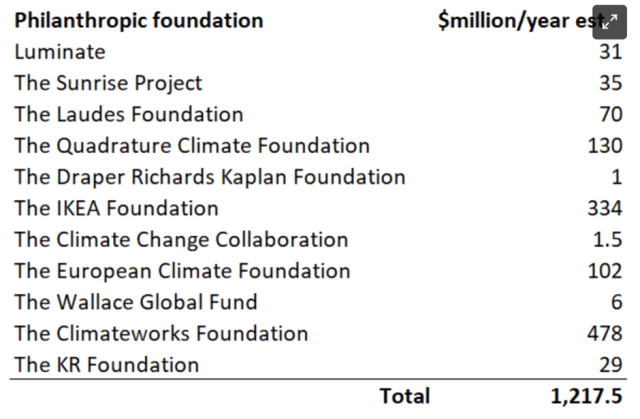
In total, InfluenceMap’s funders alone are making grants of about $1.2 billion every year to fund climate change lobbying. And these are only the funds with which InfluenceMap has a direct relationship. There are many others, including the Rockefeller family, Bezos, Bloomberg, Gates along with the Hewletts, Packards and Gettys.
Set against this, Pile goes on to note that in a small Westminster office building at 55 Tufton Street, scene of Extinction Rebellion paint-throwing and protests, is a clutch of small think tanks including the Global Warming Policy Foundation that are, as he gently puts it, “somewhat misaligned to the dominant ideologies of woke Western politics and media”. In total, Pile estimates the income of all nine campaigning organisations at just $6.7m.
Pile is able to show that billions of dollars have been poured into “manifestly false” philanthropic foundations with the money claimed to have been used to construct narratives, to found fake civil society organisations, to actively misinform the public, policymakers, governments and intergovernmental agencies, and to buy favours from or into research organisations, media companies and public institutions. Any contrary influence from Big Oil simply does not compare, he adds.
The vast sums spent by the Green Blob are noted, but Pile observes that members are confused as to why they are not living in a green Utopia. They have long felt it unnecessary to explain themselves, preferring to smear, fearmonger, block roads, use moral blackmail in place of reason – and invent conspiracy theories around oil companies. Furthermore, even after nearly two decades of lobbying, adequately effective green tech remains a distant dream. Wind power has been a failure, EVs are an expensive luxury and heat pumps cost multiples of gas boilers. As we have started to see all too clearly, nudge has now come to shove as activists demand that society must reorganise around the shortcomings of green technology and the ‘climate emergency’. This requires the construction of supranational political agencies in the form of technocratic bureaucracies with unprecedented power, beyond democratic control, populated by unaccountable wonks.
“Environmentalism is an elite ideology, and climate change fearmongering is a preoccupation only of the topmost parts of society. The rest of us find it implausible, somewhat ridiculous and manifestly self-serving,” Pile concludes.
HHS is Still Wasting Money Fighting Online Covid “Disinformation”
By Dan Frieth | Reclaim The Net | June 17, 2023
Apparently, Covid discussions are still a thing worth cracking down on. That’s at least according to The Biden administration, which is injecting $500,000 into Texas Woman’s University as part of a grant program aimed at curbing COVID-19 “misinformation” and “disinformation” allegedly aimed at Hispanics, according to funding records reviewed by the Washington Examiner. The grant aims “to expand research on mitigating the effect of misinformation and disinformation” regarding “COVID-19 prevention and treatment initiatives among Hispanics.”
Timeline: Kicking off on May 10 and set to wrap up in April 2024, this grant is part of the Department of Health and Human Services (HHS)’s Food and Drug Administration’s portfolio. It’s part of Biden’s broader push to censor alleged disinformation by joining forces with social media platforms on content moderation – a move likened to “censorship” by some Republicans.
What GOP says: This funding allocation may prod GOP lawmakers to probe deeper into the Biden administration’s methods in countering certain types of speech. House Republicans, according to the Washington Examiner, are considering wielding the appropriations process as a tool to block federal agencies from pumping money into domestic initiatives tagged as combating “disinformation.”
What HHS did before: In 2021, HHS, spearheaded by Secretary Xavier Becerra, allegedly dabbled in misinformation tracking, by offering guidance to Twitter and Facebook on handling virus-related content. The US Surgeon General Vivek Murthy admitted in an August 2021 call with education groups, that the government was “working to combat misinformation in many ways, one being working with tech companies.”
Skeptical voices: Brian Harrison, a former HHS chief of staff under Trump and a current GOP Texas state House member, communicated his skepticism to the Washington Examiner: “I have no confidence this is anything more than Biden’s HHS spending money we don’t have on government censorship efforts.”
Inside the project: Texas Woman’s University’s venture consists of crafting a “social network analysis” to scrutinize “misinformation consumed by the Hispanic community.” It involves conducting focus groups, creating “an economic impact analysis of proposed informational strategies for Hispanics,” and establishing a “longitudinal misinformation/disinformation index.” The study, set in El Paso, Texas, is also sifting through social media content in both English and Spanish.
Deja vu?: The aforementioned “index” has set off alarm bells due to its echo of a tool from the State Department’s Global Engagement Center, which previously backed the Global Disinformation Index, a British entity that faced criticism for supposedly operating blacklists of conservative media outlets.
HHS’s stance: In response, HHS spokeswoman Anne Feldman said: “HHS does not censor speech.”
Roles of Bromelain and Curcumin in Battling Recurrent SARS-CoV-2 Spike Protein Exposures
Natural Products have Strong Rationale for Use Post-COVID-19 and Vaccine Syndromes
By Peter A. McCullough, MD, MPH | Courageous Discourse | June 16, 2023
I find it interesting that a large group of post-COVID-19 acute sequalae are occurring in those who have taken failed COVID-19 vaccines. We are a long way off from definitive clinical trials of multidrug strategies for patients who have had multiple exposures to the SARS-CoV-2 Spike protein via vaccination or recurrent COVID-19.
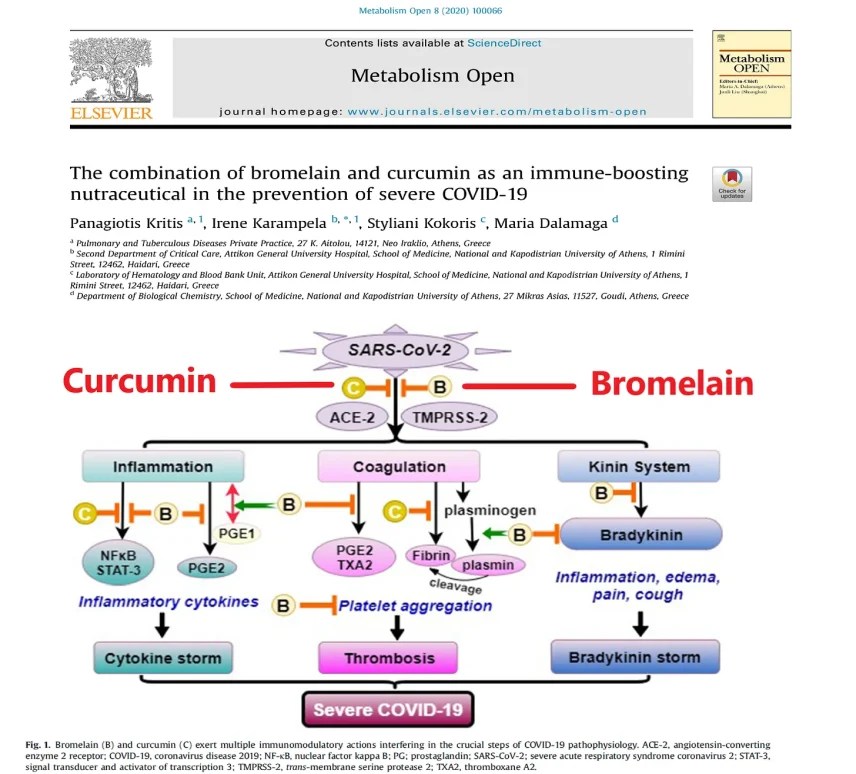
Kritis et al point out:
“Curcumin (diferuloylmethane) is a natural phenol found in turmeric (Curcuma longa), a member of the ginger family of plants [4]. Curcumin modulates inflammation preventing the subsequent cytokine storm by inhibiting multiple transcription factors such as nuclear factor kappa B (NF-kB) and signal transducer and activator of transcription 3 (STAT-3), and downregulating the proinflammatory cytokines, as this has been demonstrated in human macrophages after influenza virus infection [4,6]. Additionally, curcumin inhibits ACE modulating angiotensin II synthesis and downregulating inflammation, while it also promotes fibrinolysis and the anticoagulation process [4,6,7] (Fig. 1). The antiviral actions of curcumin against multiple viruses (influenza and hepatitis viruses, herpes viruses, human papilloma virus, human immunodeficiency virus, severe acute respiratory syndrome coronavirus and other coronaviruses), bacteria and fungi have been established by experimental evidence [8]. Remarkably, recent evidence from in silico studies has demonstrated that curcumin prevents SARS-CoV-2 entry into cells by blocking the viral binding sites and the cell ligands (spike protein, ACE-2 receptors and basigin), downregulating trans-membrane serine protease 2 (TMPRSS-2), and by interfering with viral replication through the interaction with various viral proteins [4]. However, the minimal absorption of curcumin following oral administration presents a major limitation in its bioavailability [6].
Bromelain is a cysteine protease, isolated from the pineapple stem (Ananas comosus) [9]. Traditionally, it has been used for its anti-inflammatory and healing effects in cases of arthritis and injury, while it has been approved in Europe for the debridement of burn wounds. Experimental studies have demonstrated that bromelain presents unique immunomodulatory actions: 1) downregulation of the pro-inflammatory prostaglandin E2 (PGE-2) through inhibition of NF-kB and cyclooxygenase 2 (COX-2); 2)upregulation of the anti-inflammatory PGE-1; 3) activation of inflammatory mediators (interleukin 1b, interleukin-6, tumor necrosis factor-a and interferon-g) as an acute response to cellular stress, but also inhibition of inflammatory mediators in states of overt cytokine production; 4) modulation of T cell responses in vitro and in vivo; and 5) enhancement of T-cell dependent antigenspecific B cell antibody responses [5,10e14]. Importantly, bromelain exerts dose-dependent anticoagulant effects: 1) downregulation of PGE-2 and thromboxane A2 (TXA2), thus leading to relative excess of prostacyclin; 2) promotion of fibrinolysis by stimulating the conversion of plasminogen to plasmin and prevention of platelet aggregation. Bromelain also hydrolyzes bradykinin and reduces kininogen and bradykinin levels in serum and tissues, improving inflammation and edema as shown in animal studies [15]. Notably, the latter action supports a potential role of bromelain in alleviating COVID-19 symptoms such as cough, fever and pain, and the more serious implications of inflammation, thrombosis and edema. The effect of bromelain on PGE-2 inhibition exceeds that of prednisone and aspirin, presenting very low toxicity and no major side effects. Interestingly, a recent experimental study demonstrated that bromelain inhibits infection of VeroE6 cells by SARS-CoV-2 through blocking the virus binding and entry into cells via downregulation of ACE-2 and TMPRSS2 expression, and cleavage of the SARS-CoV-2 spike protein, presenting a novel promising therapeutic option that warrants further investigation.”
In summary, the combination of curcumin and bromelain are well positioned as supplements in people who are getting repetitive COVID-19/Spike protein exposure. Future randomized trials will elucidate the clinical benefits in specific applications.
Kritis P, Karampela I, Kokoris S, Dalamaga M. The combination of bromelain and curcumin as an immune-boosting nutraceutical in the prevention of severe COVID-19. Metabol Open. 2020 Dec;8:100066. doi: 10.1016/j.metop.2020.100066. Epub 2020 Nov 13. PMID: 33205039; PMCID: PMC7661945.
Media censorship is directed to nearly every important issue facing society – and has been for a long, long time

BY PIERRE KORY, MD, MPA | JUNE 14, 2023
I wrote a surprisingly popular tweet about censorship a couple of weeks ago that I thought I would expand upon here. I wrote it one night after I had made the mistake of reading some newspapers on-line and watching CNN clips, (something I do for opposition research, not to discover any truth or real news – that I get from Rumble, independant journalists, TikTok, Twitter, and most importantly books).
Then I read Rav Arora’s post on his excellent Substack “The Illusion of Consensus” with Dr. Jay Bhattacharya (please subscribe to their Substack as I want to support one of the few journalists whose integrity forced them to stop working for corporate controlled media).
One line of Rav’s was a particularly powerful and concise articulation of what I (and all of us) have been living through in Covid in regards to the media;
“Notably, journalism — the filter through which ordinary people living busy lives come to understand the complex matrix of power, money, and influence — has also been exposed for its bizarre servility to public health decrees and pharmaceutical companies.”
Although I was saddened to hear of the treatment and financial loss Rav suffered from not being able to publish deeply researched pieces questioning vaccine policy, I was shocked at the near identicalness (if that’s a word) and absurdity of the wording of the rejections from numerous editors he included in his post. Although servility to Pharma paymasters might partly explain their rejections, I instead felt they revealed that a “collective psychosis” had taken hold – these editors exhibited a sudden unquestioning, pervasive (and sincere!) belief in the infallibility of the health agencies and the trustworthiness of their data supporting a number of blatantly illogical health and vaccine policies.
The replies betrayed a shocking, willful ignorance of the epidemiologic data not supporting jab policies, like mandating them for healthy young people and those with natural immunity (for starters). These news editors were both drowning in and failing to question the selective and/or manipulated data supporting the jabs. And they did so with a complete ignorance of the massive amount of conflicting and contradictory data (that Rav was trying to discuss in his article). I almost laughed at the realization that these editors were victims of their own censorship! Their deeply erroneous and harmful beliefs were self-inflicted by their censoring actions.
But knowledge of the aggressive censorship around every single Covid issue is not new, nor unknown to anyone who reads my posts. What is really freaking me out now is the extent of censorship and propaganda that I am seeing on almost every single non-Covid topic (which I will go into in my 2nd post on censorship). Anyway, the night of my tweet, I was getting disturbed watching the synchronized, coordinated, repetitive media narratives around Ukraine, climate change, the Bidens, Trump and many other topics. I started to wonder, “how long and how bad has it been like this?”
Answer: a long long time.
A friend and FLCCC supporter named Gavin De Becker (of Joe Rogan podcast interview fame), sent en email to a group of us a year ago and I saved it because of how much it impacted me. He included a chapter of Upton Sinclair’s book called “The Brass Check.”
First, know that Sinclair was one of the greatest “truth-tellers” in modern history. From our “friends” at Wikipedia:
Upton Beall Sinclair Jr. (September 20, 1878 – November 25, 1968) was an American writer, muckraker, political activist and the 1934 Democratic Party nominee for governor of California who wrote nearly 100 books and other works in several genres. Sinclair’s work was well known and popular in the first half of the 20th century, and he won the Pulitzer Prize for Fiction in 1943.
In 1906, Sinclair acquired particular fame for his classic muck-raking novel, The Jungle, which exposed labor and sanitary conditions in the U.S. meatpacking industry, causing a public uproar that contributed in part to the passage a few months later of the 1906 Pure Food and Drug Act and the Meat Inspection Act.[1] In 1919, he published The Brass Check, a muck-raking exposé of American journalism that publicized the issue of yellow journalism and the limitations of the “free press” in the United States. Four years after publication of The Brass Check, the first code of ethics for journalists was created.[2] Time magazine called him “a man with every gift except humor and silence”.[3] He is also well remembered for the quote: “It is difficult to get a man to understand something, when his salary depends upon his not understanding it.“[4]
Further, know that the Associated Press was formed in May 1846 by five daily newspapers in New York City to share the cost of transmitting news of the Mexican–American War.
Note from Gavin: “This is interesting because Upton Sinclair describes several newspaper barons who had invested heavily in land in Mexico, and how they dearly wanted the US to declare war on Mexico:”
By methods such as these Otis Chandler grew wealthy, and later on he purchased six hundred and fifty thousand acres of land in Northern Mexico. When the Diaz regime was overthrown, Otis had trouble in getting his cattle out, so he wanted a counter-revolution in Mexico, and for years the whole policy of his paper has been directed to bringing on intervention and conquest of that country. At one time the Federal authorities indicted Harry Chandler, son-in-law of Otis, and his successor in control of the “Times,” for conspiracy to ship arms into Mexico. Mr. Chandler was acquitted.
Mr. Hearst also owns enormous stretches of land in Mexico, and Mr. Hearst also understands that if Mexico were conquered and annexed by the United States, the value of his lands would be increased many times over. Therefore for fifteen years the Hearst newspapers have been used as a means of forcing war with Mexico. Mr. Hearst admits and is proud of the fact that it was he who made the Spanish-American war. He sent Frederick Remington to Cuba to make pictures of the war, and Remington was afraid there wasn’t going to be any war, and so cabled Mr. Hearst. Mr. Hearst answered:
“You make the pictures and I’ll make the war.”
Hmm. Doesn’t the above make you think of the Ukraine war today?
Anyway, know that The Brass Check was published in 1919. In one chapter he does a deep dive into the Associated Press (AP) :
About nine hundred daily newspapers in the United States, comprising the great majority of the journals of influence and circulation, receive and print the news dispatches of the Associated Press. This means that concerning any event of importance an identical dispatch is printed about fifteen million times and may be read by thirty million persons.
According to the construction and wording of that dispatch, so will be the impression these thirty million persons will receive, and the opinion they will form and pass along to others. Here is the most tremendous engine for Power that ever existed in this world. If you can conceive all that Power ever wielded by the great autocrats of history, by the Alexanders, Caesars, Tamburlaines, Kubla Khans and Napoleons, to be massed together into one vast unit of Power, even this would be less than the Power now wielded by the Associated Press.
Thought is the ultimate force in the world and here you have an engine that causes thirty million minds to have the same thought at the same moment, and nothing on earth can equal the force thus generated.
Well-informed men know that the great Controlling Interests have secured most of the Other sources and engines of Power. They own or control most of the newspapers, most of the magazines, most of the pulpits, all of the politicians and most of the public men. We are asked to believe that they do not own or control the Associated Press, by far the most desirable and potent of these engines. We are asked to believe that the character and wording of the dispatches upon which depends so much public opinion is never influenced in behalf of the Controlling Interests. We are asked to believe that Interests that have absorbed all other such agencies for their benefit have overlooked this, the most useful and valuable of all. We are even asked to believe that, although the Associated Press is a mutual concern, owned by the newspapers, and although these newspapers that own it are in turn owned by the Controlling Interests, the Controlling Interests do not own, control or influence the Associated Press, which goes its immaculate way, furnishing impartial and unbiased news to the partial and biased journals that own it.
That is to say that when you buy a house you “do not buy its foundations.”
Note from Gavin: Who controls the AP today? Steven R. Swartz is the Chairman, and oh yeah, he’s also President and CEO of Hearst. The AP website describes itself as “an independent, not-for-profit news cooperative, our U.S. newspaper members elect a board of directors to provide corporate direction according to AP bylaws.”
The key phrase in the above is: “our U.S. newspaper members elect a board of directors to provide corporate direction according to AP bylaws.”
Now, if the “impartiality” of the AP is to be believed, then the Board must be made up of a large cast of newspaper editors with diverse backgrounds in terms of race, sex, wealth, ethnicity, and religion right?
Dream on. Will Irwin, writing in Harper’s Weekly in 1914, described a “ring of old, Tory, forty-one vote papers in control” of the Associated Press (meaning the small subset of newspaper editors with voting control of AP policies). Note that, at the time, 700 newspapers used the AP, but a subset of only 41 held a near majority of the voting power to elect the Board of Directors.
Sinclair then recounts how each has attacked him and his truth-telling colleagues at the time:
The “Los Angeles Times” is here, and de Young’s “San Francisco Chronicle,” and the “San Francisco Bulletin,” of the itching palm, and the “San Francisco Examiner,” which sent out my Shredded Wheat story, and the “Sacramento Union,” which was sold to the Calkins syndicate. Here is the “Pueblo Chieftain,” which circulated the foul slanders about Judge Lindsey and the miners’ wives. Here is the “Baltimore News” of Munsey, the stock-gambler. Here is the “Washington Post,” which, as I shall narrate, had a typewritten copy of a speech by Albert Williams, and deliberately made up false quotations. Here is the “Chicago Tribune,” which slandered Henry Ford, and the “Chicago Daily News,” which, with the “Tribune,” robs the Chicago school-children. Here is the “Cincinnati Times-Star,” which set out to fight Boss Cox, and didn’t. Here is the “Boston Herald,” which, I shall show you, refused President Wilson’s speech as an advertisement, and the “Boston Traveller,” which lied about my magazine. Here is the “Kansas City Star,” which hounded Mrs. Stokes to jail, and the “St. Paul Dispatch,” whose misdeeds I have just listed. Here is the “Oil City Derrick” owned by Standard Oil, and the “Seattle Post-Intelligencer,” whose bonds were found in the vaults of the Great Northern Railroad. Here is the “Portland Oregonian,” which exists for large-scale capital, and the “Milwaukee Sentinel,” owned by Pfister, who owns most of Milwaukee. Here is the “New York Herald,” which suppressed my Packingtown story, and paid me damages for the Tarrytown libel. Here is the “New York Evening Post,” which failed to expose the Associated Press, and the “New York World,” which favors twenty-cent meals for department-store girls; here is the “New York Tribune,” which lied about the Socialist state legislators, and the “New York Times,” which has lied about me so many times that I can’t count them.
In 1909, it was discovered that the AP had fifteen directors. They were all publishers of large newspapers and just one was a “liberal” who died shortly after. The other fourteen were classified as “conservative or ultra-conservative” and were “huge commercial ventures, connected by advertising and in other ways with banks, trust companies, railway and city utility companies, department-stores and manufacturing enterprises. They reflect the system which supports them.”
Know that back in 1945, the US Supreme Court found that the Associated Press had been violating the Sherman anti-trust Act by prohibiting member newspapers from selling or providing news to nonmember organizations as well as making it very difficult for nonmember newspapers to join the AP.
Again from The Brass Check:
The Associated Press is probably the most iron-clad monopoly in America. It was organized originally as a corporation under the laws of Illinois, but the Illinois courts declared it a monopoly, so it moved out of Illinois, and reorganized itself as a “membership corporation,” thus evading the law. The members of the Associated Press have what is called “the right of protest”—that is, they can object to new franchises being issued; and this power they use ruthlessly to maintain their monopoly.
Like I will do in my next post, here Sinclair lists examples of other censoring actions of that time period:
When Kansas, in 1908, rejected a conservative and elected a progressive United States Senator, the general public at a distance from that state did not know the real issue involved. For more than two years, there has been a strong movement in California against the rule of that state by special and corrupt interests, but that fact, merely as news, has never reached the general public in the East. The prosecution of offenders in San Francisco has only been a part of the wider movement in California. The strong movement in New Hampshire, headed by Winston Churchill, to free that state from the grasp of the Boston and Maine Railway Company and the movement in New Jersey led by Everett Colby, which resulted in the defeat of Senator Dryden, the president of the Prudential Insurance Company, have not been given to the people adequately as matters of news. In my story of the Colorado coal-strike, I showed you the “A. P.” suppressing news, and the newspapers of the country, without one single exception, keeping silence about it. I showed you one bold managing editor promising to tell the truth, and then suddenly stricken dumb, and not carrying out his promise.
Now, I will include an excerpt from my own book where I describe what happened with the Associated Press in the immediate wake of my “viral” ivermectin testimony in Senator Ron Johnson’s historic Covid-19 Homeland Security hearing:
A day later, I received a request for an interview by the Associated Press, self-described as “the largest news gathering organization in the world.” This was huge—the global media home run we’d been waiting for!
The AP dispatched a former fashion reporter named Beatrice Dupuy to interview me. I spent twenty minutes detailing the countless data points which consistently showed massive benefits with ivermectin treatment. The interview was cordial and Beatrice appeared genuinely interested in and intrigued by the information I presented.
Shortly afterward, the AP ran their piece. This was the headline:
The article itself isn’t fit for a birdcage. Beatrice deliberately omitted all the data I provided and chose instead to share the story of an Arizona couple who’d ingested a fish tank cleaning additive (chloroquine phosphate), which is an ingredient in hydroxychloroquine.
“The woman became gravely ill and the man died,” Beatrice wrote breathlessly (I imagined).
Don Henley said it best: “It’s interesting when people die; give us dirty laundry.”
At the bottom of surely very stylish Beatrice’s piece was this interesting disclaimer:
“This is part of The Associated Press’ ongoing effort to fact-check misinformation that is shared widely online, including work with Facebook to identify and reduce the circulation of false stories on the platform.”
The FLCCC immediately filed an ethics complaint with the AP. Thanks to an errant “reply all” on their part, we were able to see an email thread between the CEO, ethics chief, and president discussing a plan to delay their response so they could “buy some time” to figure out what to do. It’s hilarious looking back at the naivete we possessed by filing an ethics complaint against an erstwhile fashion reporter. We actually believed that a moral code existed that we could rely on to force journalistic integrity.
Two weeks later we received a letter stating that the AP had investigated the complaint and found no ethical concerns with the piece. As if they were actually going to side with us? Talk about the fox guarding the henhouse. We had a lot to learn, but our ignorance is amusing in hindsight.

To summarize it differently: within two days of my ivermectin testimony, the AP contracted a media hit job on me, the FLCCC, and ivermectin. I wonder who commissioned that one (Gilly Bates and Pfizer are at the top of my list).
Anyway, this is from Will Irwin, a writer from Harper’s Weekly at the time of Sinclair’s book:
“The subordinates have drifted inevitably toward the point of view held by their masters.” And again, of the average Associated Press correspondent: “A movement in stocks is to him news—big news. Wide-spread industrial misery in a mining camp is scarcely news at all.” At a conference at the University of Wisconsin, the editor of the “Madison Democrat” stated that he had been a correspondent of the Associated Press for many years, and had never been asked “to suppress news or to color news in any way whatever.”
He counters the above with a quote from Editor A. M. Simons: “I have had many reporters working under me, and every one knows that you will not have a reporter on your paper who cannot ‘catch policy‘ in 2 weeks [in modern terms, I would say an employee who has “not gotten the memo.”]
From Will Irwin: To the best of my knowledge, only two or three new franchises [to the AP ] have ever been granted over the right of protest—and those after a terrible fight. Few, indeed, have had the hardihood to apply. When such an application comes up in the annual meeting, the members shake with laughter as they shout out a unanimous “No!” Abolish the exclusive feature, throw the Association open to all, and you wipe out these values. The publishers are taking no chances with a precedent so dangerous.
Also the Associated Press, being a membership corporation or club, possesses the legal right to expel and to discipline its members. They can expel a member “for any conduct on his part, or on the part of anyone in his employ or connected with his newspaper, which in its absolute discretion it shall deem of such a character as to be prejudicial to the welfare and interest of the corporation and its members, or to justify such expulsion. The action of the members of the corporation in such regard shall be final, and there shall be no right of appeal or review of such action.”
This, you perceive, is power to destroy any newspaper overnight. Not merely may a franchise worth two hundred thousand dollars be wiped out at the whim of the little controlling oligarchy; the entire value of the newspaper may be destroyed ; for of course a big morning newspaper cannot exist without its franchise. The masters of the “A. P.” hold this whip over the head of every member.
Now, know that as of 2019, AP had more than 240 bureaus globally with 1,400 U.S. newspaper members as well as broadcasters, international subscribers, and online customers.
How about this little factoid: The AP is the only organization that collects and verifies election results in every city and county across the United States, including races for the U.S. president, the Senate and House of Representatives, governor as well as other statewide offices. Major news outlets rely on the polling data and results provided by the Associated Press before declaring a winner in major political races, particularly the presidential election. In declaring the winners, the AP has historically relied on a robust network of local reporters with first-hand knowledge of assigned territories who also have long-standing relationships with county clerks as well as other local officials. Moreover, the AP monitors and gathers data from county websites and electronic feeds provided by states. The research team further verifies the results by considering demographics, number of absentee ballots, and other political issues that may have an effect on the final results.
Whoa. Thankfully, we haven’t had any concerns with election integrity lately.
What is even more disturbing than the history, control, and destructive censoring actions of the AP, is that they then joined the Trusted News Initiative (TNI), whose members include a few minor influencers like BBC, Facebook, Google/YouTube, Twitter, Microsoft, Agence France Press, Reuters, European Broadcasting Union (EBU), Financial Times, The Wall Street Journal, The Hindu, CBC/Radio-Canada, First Draft, and Reuters Institute for the Study of Journalism.
Although originally formed to control information around elections, in 2020, partner members of the TNI agreed, in the words of Director-General Tim Davie, “to work together to ensure legitimate concerns about future vaccinations are heard whilst harmful disinformation myths are stopped in their tracks.”
Now you know why Covid was an absolute nightmare – the globally pervasive censoring of both the efficacy of early treatments (like HCQ and IVM among many others like Vitamin D) and of the toxicity, lethality, and inefficacy of the vaccines. These actions caused millions of unnecessary deaths while adding even more millions to the ranks of the disabled. History must remember this but, more important than History… is the Future.
Censorship, in practice, is now literally a principle of major media journalism in my opinion. We no longer have a “4th Estate” to check the power of the branches of government and it’s controlling corporations. We are in a world war without an army to defend ourselves. They captured our most effective weapon, long ago, but the control they exert over it is now so complete, that army has now been turned against us. Traitors.
But here’s the hope: independant media, the internet, and books – as long as the internet is running, books can be marketed and sold, and we can be discerning, there are excellent, transparent, objective sources of information and data to help us understand the many, often complex issues our society is facing. We must flee to those. It’s our only hope.
In my next post I plan to explore and detail numerous examples of censorship being applied to nearly every non-Covid issue we face (which is a bit of a departure for Medical Musings).
Featured Video
Rewriting the risk? Inside the government’s vaccine safety messaging
or go to
Aletho News Archives – Video-Images
Book Review
“Davos Can Really Replace the UN”
Inside the book that maps the architecture behind global governance — from the Epstein files to the Pact for the Future
Lies are Unbekoming | April 1, 2026
On June 13, 2019, the United Nations and the World Economic Forum signed a partnership deal to “accelerate the implementation of the 2030 Agenda for Sustainable Development.” That same evening, WEF president Börge Brende — Norway’s former Foreign Minister — had dinner with Jeffrey Epstein at Epstein’s Manhattan townhouse. The Epstein files, released January 2026, contain an exchange between the two from the previous year. Epstein to Brende: “Davos can really replace the UN. C21, cyber, crypto . genetics… intl coordination.” Brende back to Epstein: “Exactly — we need a new global architecture. World Economic Forum (Davos) is uniquely positioned — public private.”
The next day, the UN General Assembly adopted the framework for restructuring global governance.
That sequence — the partnership signing, the Epstein dinner, the candid admission about replacing the UN with a public-private architecture, and then the formal adoption — opens Jacob Nordangård’s The Digital World Brain. Pages two and three. Footnoted to the UN resolution number, the Epstein files, and the General Assembly record.
I keep coming back to it because it captures what this book does that almost nothing else in the independent research space manages. I’ve followed Jacob’s work for years now and interviewed him about his research. Each book peels back another layer of the same institutional architecture, and each time I think he’s reached the limit of what can be documented, the next one goes further. Nordangård doesn’t speculate. He doesn’t editorialize much. He lays institutional actions next to each other in chronological order and lets the pattern announce itself. … continue
Blog Roll
 Aletho News
- The End of NATO
- 37 days of war on Iran cost US staggering $42bln, tracker shows
- Baghdad tells Asian refiners, traders to begin loading Iraqi crude amid Iranian exemption
- Under fire, Moscow and Tehran close ranks
- Iran, US receive Pakistan-mediated plan for ceasefire then final deal
- Iran submits demands for end to war as mediators scramble ahead of Trump deadline
- Iran Threatens Retaliatory Strike on Stargate AI Project in UAE
- US sent ‘a lot’ of arms to Iranian protesters – Trump
- Barak Ravid Launders Deception To Allow Trump To Back Off Of His Power Plant Threat – Again
- REWRITING THE RISK? INSIDE THE GOVERNMENT’S VACCINE SAFETY MESSAGING
- If Americans Knew
- Trump poised to “blow everything up” (ie. commit war crimes) in Iran – Daily Update
- In Iran, Israel-US take aim at “reason, research, and freedom of thought” – Daily Update
- US loses planes over Iran, Israel downgrades Lebanon war goals – Daily Update
- Israel Is Blocking Palestinians from Easter at Church Where Jesus Resurrected
- Plot to assassinate Palestinian activist follows harassment campaign promoted by Zionist groups and elected officials
- Prominent New York synagogue hosts presentation on why U.S. Jews should support the ethnic cleansing of Gaza
- Tapper vs. Piker: Is the CNN Anchor Auditioning for David Ellison?
- Shouldn’t Democrats Be Able to Condemn Genocide?
- Israel-US kill negotiators, destroy civilian structures, but Iran’s military capabilities still largely intact – Daily Update
- ‘War crime’: Global condemnation as Israeli ministers celebrate death penalty law targeting Palestinian prisoners
- No Tricks Zone
- An Inconvenient Tree: Uncovered In Alps… Europe Much Warmer Than Today 6000 Years Ago
- New Study Reports A 60% Slowdown In Greenland’s Ice Loss Rate In The Last Decade
- Low Intensity Tornado Wrecks Major Solar Farm, Creating A Potential Toxic Dump
- New Study Finds Warming Saves Lives…Cold Temperatures 12 Times More Deadly Than Excess Heat
- German Science Blog Accuses PIK Climate Institute Of Hallucinating Climate Tipping Points
- Devastating Assessment Of Comirnaty Vaccine By Former Senior Pfizer Europe Toxicologist
- New Study: CO2 Is ‘Effectively Negligible’ As An Explanatory Climate Change Factor Since 2000
- Former Pfizer Toxicologist Dr. Helmut Sterz Tells Bundestag Hearing Pfizer Vaccine Should Have Never Been Approved
- Energy Expert: Germany’s Nuclear Phaseout Was A “500 Billion Euro Mistake”
- New Research: South Australia’s Mid-Holocene Sea Surface Temperatures Were 4°C Warmer Than Today
 Aletho News