Russian Oil Tanker Arrives in Cuba Amid U.S. Blockade
teleSUR – March 30, 2026
On Monday, Russia’s Transport Ministry confirmed that the Russian oil tanker Anatoli Kolodkin arrived at the port of Matanzas in Cuba, where it remains awaiting the unloading of the petroleum products it is carrying.
The vessel is transporting approximately 100,000 tons of oil described as humanitarian aid, in a context marked by a severe energy crisis affecting the Caribbean island.
The tanker was initially escorted by a Russian Navy warship through the English Channel. However, after entering the Atlantic, the vessel continued its journey on its own until arriving in Cuba.
The operation represents the first arrival of an oil tanker to the island in three months. The move comes after the United States pressured Venezuela and Mexico to reduce or halt energy supplies to Cuba.
The island has not received oil since Jan. 9, an interruption that led to a sustained deterioration of the energy system and difficulties for the population, which depends on fuel for essential services and the functioning of the economy.
Mexico carried out the last oil shipment but later interrupted supply due to pressure from Washington.
With that chain of cuts, Cuba was exposed to a worsening of its energy situation, affecting both daily supply and the capacity for electricity generation and productive activities.
Last week, Russian Foreign Minister Sergey Lavrov said that Moscow is concerned about escalating tensions around the island and assured that it will maintain a position of solidarity with the Cuban government.
Kremlin spokesman Dmitry Peskov also reiterated Moscow’s support and said Russian authorities are discussing mechanisms to help Cuba.
“We are in constant dialogue with Cuba’s leadership and, of course, we are discussing how to help the island in such a difficult situation,” he said, adding that they are pleased the shipment of petroleum products has arrived in Cuba.
Peskov said Cuba is “under conditions of a very severe blockade” and needs refined petroleum products and crude oil “for the functioning of life-support systems in the country, to generate electricity, to provide medical or other services to the population.”
Russian tanker approaches Cuba despite US oil blockade
RT | March 30, 2026
Cuba is set to receive a humanitarian oil shipment from Russia as early as this week, following months of a US blockade that has led to severe fuel shortages and recurring power cuts across the island, the New York Times has reported.
The Russian tanker Anatoly Kolodkin, carrying roughly 730,000 barrels of crude, is approaching the island nation’s territorial waters and could reach the port of Matanzas by Tuesday, according to vessel-tracking services.
Despite US Coast Guard ships being present in the region, “the Trump administration did not order those vessels to act,” an official familiar with the matter told the Times on Sunday.
“Barring orders instructing it otherwise, the Coast Guard planned to let the tanker reach Cuba as of Sunday afternoon,” the source added, speaking on condition of anonymity.
The White House has yet to comment publicly on the reported decision, after US President Donald Trump repeatedly threatened tariffs on countries exporting fuel to Cuba.
The Caribbean nation has faced severe fuel shortages and power cuts in recent months after Venezuela, once Havana’s closest ally, halted oil shipments following pressure from Washington. Multiple international fuel deliveries have been disrupted, vessels linked to Havana have struggled to secure supplies, and some have been turned away or intercepted – with at least one escorted away from Cuban waters, according to ship-tracking data.
Earlier this month, Havana agreed to enter talks with Washington in a bid to defuse tensions and avert a humanitarian crisis. Cuban President Miguel Díaz-Canel confirmed that negotiations were ongoing and aimed at “finding solutions through dialogue to the bilateral differences we have between the two nations.”
Trump, however, has not abandoned his stated intention to take over the island “one way or another.” On Friday, he said Cuba could be “next” following what he described as successful US military operations in Venezuela and Iran.
Pakistan PM backs Iran’s right to self-defense amid tensions
Al Mayadeen | March 23, 2026
Pakistan’s Prime Minister Shehbaz Sharif affirmed his country’s support for Iran, stressing that Tehran has the legitimate right to defend itself amid the ongoing joint US-Israeli aggression on the West Asian nation.
Sharif expressed “regret over the attack on Iran and the resulting martyrdom and injury of thousands of citizens and officials,” signaling Islamabad’s concern over the humanitarian and political consequences of the confrontation.
His remarks came during a phone call with Iranian President Masoud Pezeshkian, reflecting continued high-level coordination between the two neighboring states.
Call for Islamic unity to de-escalate crisis
During the conversation, Sharif emphasized the need for collective action among Muslim-majority countries to reduce tensions and restore regional stability.
He called for coordinated diplomatic efforts, stating that Islamic nations must work together to contain escalation and prevent further deterioration of the situation.
At the same time, he reiterated that Pakistan “stands alongside” Iran, underscoring a political position aligned with Tehran’s framing of the conflict.
Strait of Hormuz cooperation highlighted
Sharif also thanked Iran for its “positive handling” of recent developments, particularly in facilitating the passage of Pakistani vessels through the Strait of Hormuz.
This acknowledgment reflects the strategic importance of maritime routes for Pakistan’s trade and energy security, especially amid heightened tensions in the Gulf.
Ensuring uninterrupted navigation through the strait remains a shared priority for regional states reliant on these critical shipping lanes.
Deep-rooted Iran–Pakistan relations
Iran and Pakistan share a long border and maintain multifaceted relations spanning security, economic, and political domains.
Their geographic proximity has necessitated ongoing coordination, particularly in areas such as border security, counter-smuggling efforts, and addressing armed group activity along shared border.
In addition to security cooperation, the two countries have pursued joint economic initiatives, including energy projects and cross-border trade development.
Iran Proposes Creating Middle East Security Structure With All Regional States – President
Sputnik – 20.03.2026
TEHRAN – Iran proposes creating a Middle East security structure with the participation of regional countries, Iranian President Masoud Pezeshkian said on Friday.
“We are ready to resolve all problems with you. In order to ensure peace in the region, we propose to create a security structure in the Middle East, which will include Islamic countries, in order to ensure peace, stability and security,” Pezeshkian said in an address on the occasion of the Iranian New Year.
Middle Eastern countries do not need the presence of “outsiders,” the president said.
Pezeshkian said that the United States and Israel had no reason to assassinate late Iranian Supreme Leader Ali Khamenei.
“They killed our leader and our commanders without any reason or logic,” Pezeshkian said in a speech marking the upcoming Iranian New Year.
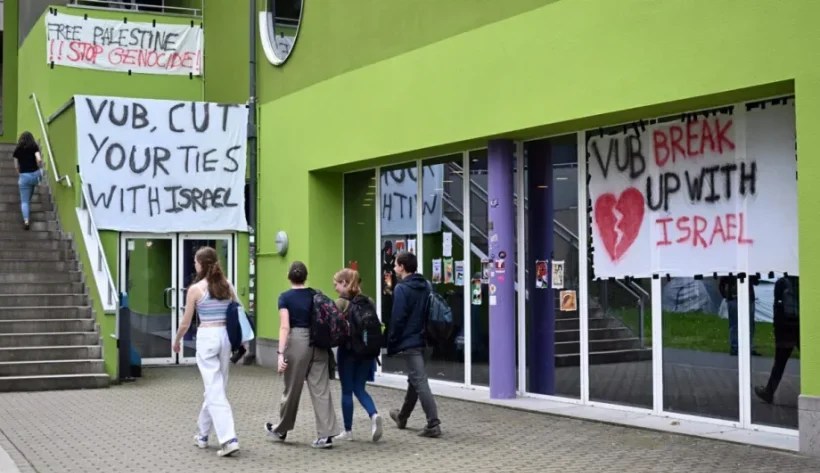
Protesters call on Brussels university to cut partnership with Israeli defense-linked firm
Students of Free University of Brussels attend a sit-in protest demanding the severing of all academic ties with Israel on May 13, 2024. [Dursun Aydemir/Anadolu via Getty Images]
MEMO | March 18, 2026
Pro-Palestine activists protested on Wednesday at the Free University of Brussels’ (VUB) Etterbeek campus, demanding that the university administration end its collaboration with an Israeli defense-linked company, Anadolu reports.
Demonstrators hung a large banner reading “VUB helps kill Palestinians” and placed portraits of Palestinian figures across the campus, accusing the university of complicity through its research partnerships, Flemish-language daily Het Nieuwsblad reported.
The protest condemned VUB’s collaboration with OIP Sensor Systems, which is owned by Elbit Systems, Israel’s largest private arms manufacturer.
Protesters demand that the partnership, which is being conducted through the university’s research center, be terminated immediately.
They claimed that technologies developed in such collaborations could have dual-use applications, including military surveillance and drone systems.
“While Palestinians are being killed using drones and precision equipment developed by OIP-Elbit, VUB continues to allow the company to benefit from research partnerships, including projects related to space missions,” one of the protestors, Julie Janssens, said.
Another protester, Jana De Blok, warned that space-related research often has inherent dual-use potential.
“This research will therefore likely contribute to the development of more surveillance technology and warfare in Palestine, Iran, and Lebanon, and in our own streets,” she added.
Since the start of the Gaza war, attacks by the Israeli army and illegal settlers in the West Bank have killed 1,133 Palestinians and injured about 11,700 others, in addition to the arrest of around 22,000 people, according to official Palestinian figures.
Russian fuel tanker to test US sanctions amid Cuba crisis
Al Mayadeen | February 21, 2026
A tanker believed to be carrying Russian fuels is heading toward Cuba, putting US sanctions on Cuba to the test as President Donald Trump intensifies pressure on the island amid a worsening energy crisis.
The vessel Sea Horse is expected to arrive in early March carrying urgently needed fuel supplies, according to Bloomberg, which cited maritime intelligence firm Kpler Ltd.
Cuba is facing acute shortages of fuels essential for cooking, transportation, and power generation, and authorities are struggling to maintain electricity supply. Available power output has declined sharply since the start of the year, with satellite imagery indicating that nighttime light levels across the island have fallen by as much as 50%.
The Sea Horse loaded its cargo through a ship-to-ship transfer off the coast of Cyprus. Kpler’s lead oil analyst Matt Smith estimates the tanker is transporting nearly 200,000 barrels of Russian gasoil, according to Bloomberg.
Gasoil, a diesel-type fuel widely used in transportation and electricity generation, has become particularly critical as both sectors operate under mounting strain in Cuba’s deepening energy crisis.
Whether the vessel will ultimately be able to complete its delivery remains uncertain. US enforcement measures have already resulted in the seizure of at least nine ships accused of participating in the transport of oil unilaterally sanctioned by Washington, underscoring the risks surrounding the current shipment.
US sanctions on Cuba intensify under Trump administration
Pressure on Havana has been mounting since late last year, when US forces seized a ship carrying Venezuelan crude bound for Cuba. After the subsequent abduction of Venezuelan leader Nicolas Maduro, the Trump administration applied further pressure on Caracas to halt shipments to Cuba.
Trump threatened tariffs on any nation that supplies Cuba with fuel. In January, the White House formalized the measure through an executive action authorizing steep tariffs on countries that export oil to Cuba. The move effectively pressured third states to scale back deliveries or risk penalties in their trade with the United States.
As a result, Mexico, previously a steady supplier, cut off shipments.
Cuba, which does not produce significant quantities of oil, depends heavily on imported crude and refined fuels to run its refineries and sustain electricity generation. In January, the island did not receive any oil for the first time in a decade.
US military presence in the Caribbean disrupts shipment
The US’ military presence in the Caribbean has choked off much of Cuba’s oil supply.
Earlier this month, the tanker Ocean Mariner, frequently used to ship fuels to Cuba, diverted and is now signaling the Bahamas as its final destination, according to vessel tracking data. The ship was carrying 30,000 barrels of diesel loaded at the Colombian port of Barranquilla, according to a shipping report.
The tightening supply situation has intensified fuel scarcity across Cuba, contributing to rolling blackouts, transportation slowdowns, and mounting strain on municipal infrastructure. Garbage collection and water pumping systems in Havana have reportedly been affected, while energy shortages have weighed on tourism and small business activity.
UK prosecutors drop aggravated burglary charges against 24 Palestine Action activists
The Cradle | February 18, 2026
The UK’s Crown Prosecution Service (CPS) dropped aggravated burglary charges against 18 of the Filton 24 activists on 18 February, citing a “reconsideration of the sufficiency of the evidence” after earlier acquittals in the same case at Woolwich Crown Court.
At a case management hearing in south London, prosecutor Deanna Heer KC told the court, “The prosecution has reconsidered the sufficiency of the evidence … In light of those verdicts and in respect of all the remaining defendants the prosecution offers no evidence on count one, aggravated burglary.”
The aggravated burglary charge linked to the Elbit factory raid carries a maximum sentence of life imprisonment.
The decision came two weeks after six co-defendants – Charlotte Head, Samuel Corner, Leona Kamio, Fatema Rajwani, Zoe Rogers, and Jordan Devlin — were acquitted of aggravated burglary on 4 February 2026. Jurors had deliberated for more than 36 hours before returning not guilty verdicts on that count.
Heer confirmed the CPS will seek a retrial on other allegations where no verdict was reached.
She told Mr Justice Johnson, “We now confirm the prosecution intention to seek a retrial in respect of all those allegations which no verdict was returned by the jury.”
Those include criminal damage against all defendants, violent disorder against three, and, in Corner’s case, causing grievous bodily harm with intent.
Rajwani, Rogers, and Devlin were cleared of violent disorder, while the jury failed to reach verdicts on that charge for Head, Corner, and Kamio.
None of the six were convicted of any offence, with all except Corner being released on conditional bail after about 18 months in custody.
Corner remains on remand over the unresolved Section 18 grievous bodily harm charge.
The remaining 18 continue to face criminal damage charges, with some also facing violent disorder allegations.
Thirteen defendants have applied for bail, while one, Sean Middlebrough, failed to return to custody while on conditional release in October last year.
Russia preparing oil lifeline to Cuba – embassy
RT | February 12, 2026
Russia is preparing to send a shipment of oil and petroleum products to Cuba, Moscow’s embassy in Havana has announced. The island is facing its worst energy crisis in years after the US doubled down on its campaign to cut off its energy supplies.
The fuel crisis intensified dramatically after US forces kidnapped Venezuelan President Nicolas Maduro in early January, severing oil supplies from Caracas, which had been one of Cuba’s main suppliers.
Washington subsequently threatened to impose tariffs on any country providing oil to Cuba, with Mexico later suspending crude shipments to the island. The US itself has maintained an economic embargo on the island since the 1960s.
The Russian Embassy in Cuba confirmed to Izvestia that the Caribbean island is facing “an acute shortage of oil and petroleum products,” adding that while the crisis has lasted for more than a year, the stop of supplies from Venezuela “has aggravated this situation.”
The embassy said it is planning to send oil and petroleum products to Cuba in the near future as “humanitarian aid,” though without specifying the timeframe or volumes.
The last major Russian oil delivery to Cuba occurred in February 2025, when Moscow sent 100,000 tons through a state credit worth $60 million approved by President Vladimir Putin. Cuba is estimated to consume 500 to 600 tons of fuel per day for its most critical needs, and requires over 8 million tons of fuel per year to function normally.
In addition, Russian officials reported that Moscow is assisting Cuba in developing its domestic oil reserves. While the island’s proven crude oil reserves are officially around 120 million barrels, the offshore zone of the North Cuba Basin is estimated to hold up to 20 billion barrels.
Moscow has condemned the US pressure campaign on Cuba as economic “strangulation” and “neocolonial practice” while reaffirming solidarity with the island.
US President Donald Trump suggested last month that the pressure campaign would force the Cuban leadership to “come to us and want to make a deal,” claiming that the island “would be free again.”
UN experts alarmed by prosecution of students protesting ETH Zurich’s Israel-linked research ties
Al Mayadeen | January 27, 2026
UN human rights experts have condemned Switzerland for penalizing students who participated in peaceful pro-Palestine protests at ETH Zurich, one of the country’s top universities.
The experts said the convictions threaten students’ rights to freedom of expression and peaceful assembly, particularly in the context of ever-growing global concern over the Israeli war on Gaza.
In a statement issued Tuesday, UN experts confirmed they had sent a formal communication to the Swiss government expressing concern after several ETH Zurich students were convicted of trespassing for holding a sit-in demonstration in May 2024.
The students were protesting ETH Zurich’s reported academic partnerships with Israeli institutions during the height of the war on Gaza. The peaceful protest was dispersed by police shortly after it began.
“Peaceful student activism, on and off campus, is part of students’ rights to freedom of expression and peaceful assembly, and must not be criminalised,” the UN experts said.
Legal consequences could have long-term impact
Five students have already been convicted of trespassing, receiving suspended fines up to 2,700 Swiss francs ($3,516) along with legal fees exceeding 2,000 Swiss francs. The convictions will remain on their criminal records, potentially discouraging future employers, the UN experts added.
Ten additional students who appealed their sentences are awaiting judgment, while two students were acquitted.
A spokesperson for the Swiss Foreign Ministry confirmed it had received the UN’s message and would respond in due course. ETH Zurich has yet to issue a statement on the matter.
The incident comes amid a wave of student activism related to the Israeli war on Gaza, with similar protests taking place on campuses across Europe and the United States. UN officials warned that penalizing students for non-violent activism undermines the democratic values of academic institutions.
Why Israel’s Drive to Destroy Iran is Ultimately about Palestine
By Robert Inlakesh | Palestine Chronicle | January 26, 2026
While the regime change propaganda about Iran continues to circulate, it is important to understand that the only real reason Israel seeks to topple the Islamic Republic is because of its role in supporting the Palestinian struggle.
Pro-war think tanks, media outlets, social media influencers, and rights groups have not relented in their blatant disinformation campaigns, designed solely to manufacture consent for a war of aggression against Iran.
The number of protesters that regime change advocates claim were killed by the Iranian authorities appears to grow by the day. First, it jumped from thousands to just over ten thousand. Now, you may be seeing the claim that 43,000 were killed, while 350,000 are injured and 20,000 await execution.
So where are these figures coming from? The 43,000 figure comes from a group called the “International Center for Human Rights” (ICHR), based in Toronto, Canada. On its website, it presents itself as a “non-governmental, non-profit international organization dedicated to promoting and defending human rights and democratic values.” However, it is a group that focuses almost entirely on Iran and celebrates the importance of the alleged “growing friendship between Iran and Israel.”
Unlike human rights groups like Amnesty International or Human Rights Watch (HRW), it uses extremely biased language, such as labeling the Iranian government the “terrorist regime” or a “criminal regime occupying Iran.” It is also explicitly in favor of regime change.
Its executive director, Ardeshir Zarezadeh, even praised Israel’s assassination of Hezbollah leader Seyyed Hassan Nasrallah, posting a photo of himself and his colleague, Ahmad Batebi, drinking what appears to be wine, with Israeli and Iranian opposition flags behind them. For context, that Israeli strike killed around 300 civilians.
Without having to go into any more depth on this Canada-based human rights center, it suffices to say that it is far from a neutral source. The reason for pointing out where these figures come from is to say that those repeating such extreme and unsubstantiated claims are not doing their due diligence.
The blind acceptance of such ridiculously high casualty numbers, which exceed the casualty tolls from some wars and major battles in the region, is what gives way to a free-for-all of ridiculous atrocity propaganda. Take, for example, regime change advocate influencer Sana Ebrahimi, who recently claimed that over 80,000 protesters were killed, citing “someone who is in contact with sources inside the government.”
When we cite casualty numbers as journalists, it is incumbent upon us to check our sources. The refusal to check sources is precisely how the “300 babies thrown out of incubators by Iraqi forces in Kuwait” and “40 babies beheaded by Hamas” hoaxes spread.
As of now, there are no internationally verified numbers of how many protesters, rioters, and armed militants were killed during the recent round of unrest in Iran. Tehran has produced its own figures, which it backs up with names and documentation, but in terms of impartial “international investigations,” there is simply no evidence for any of these figures being circulated.
It’s All About Palestine
It is no secret that the Israeli government is backing and allied with the Iranian opposition and is seeking regime change. It has been revealed by a Haaretz investigation that Israel has used bots and paid Persian-language speakers to promote the Shah’s son as the alternative leader of the country. It is also no secret that the excuse for bombing Iran has shifted from “eliminating the nuclear threat,” to “eliminating their ballistic missile program,” and now to “they are killing their own people.”
But why are the Israelis so invested in destroying Iran? The reason is very simple: Iran’s government is the only one on earth that provides military assistance to the Palestinian resistance.
Iran is allied with every Palestinian political faction that uses violent resistance against the Israelis. It arms Hamas and Palestinian Islamic Jihad (PIJ), but also Marxist groups like the Popular Front for the Liberation of Palestine (PFLP) and nationalists like the Al-Aqsa Martyrs Brigades—an unofficial armed wing falling within the fold of the Fatah movement. It does so without requiring anything in return. It trains armed resistance groups and helps in the development of Gaza’s tunnel infrastructure.
The Islamic Republic also supports Yemen’s Ansarallah, which played a key role in fighting on the side of Gaza during the entire course of the genocide. It also supports Hezbollah in Lebanon.
Every armed force that Iran supports in the region is opposed to Israel, including Iraq’s Popular Mobilisation Units (PMU), components of which repeatedly fired drone and cruise missiles at Israel.
Some argue that the Iranians do this for strategic reasons. The counterargument is that if this has been the primary driver of support for the Palestinian cause, why then have the Iranians refused to use this as a bargaining chip in negotiations with the United States? Another counterpoint offered is that Iran is punished because it supports Palestine, not the other way around.
Regardless of whether you take the viewpoint that Iran’s support for resistance against the Israelis is born of moral concerns, strategic concerns, or both, there is no denying that the support exists. No other country, except Ansarallah’s government in Yemen, has directly fought the Israelis.
If Iran’s government is toppled and replaced with a pro-Israel puppet dictator, this would lead to the total collapse of the entire support infrastructure behind the regional players resisting Israel. In other words, this outcome would give the Israelis a free hand in Lebanon and enable them to do with the Palestinian people whatever they choose.
Therefore, it is a contradiction to claim you support toppling the Iranian government and also support Palestine. It would be like claiming you support the overthrow of the Soviet Union and a plot to install a German puppet regime during World War II, while still claiming to oppose the Nazis. These positions are irreconcilable.
Does this mean you need to blindly support the Islamic Republic? Evidently not. Rather, simply consider your stance using the above-mentioned analogy.
The US-Israeli effort to cause regime change in Iran has nothing to do with the people of Iran. It is all about destroying the resistance groups fighting against them. Therefore, the end of the Islamic Republic means the end of the Palestinian resistance and total Israeli domination of the entire region.
That is the truth.
– Robert Inlakesh is a journalist, writer, and documentary filmmaker. He focuses on the Middle East, specializing in Palestine.
US pressure contributing to Israeli influence in Latin America: Experts
Press TV – January 26, 2026
US political pressure is contributing to the Israeli regime’s influence across Latin America, even as long-standing regional support for the Palestinian cause continues through diplomatic, legal, and grassroots channels, experts say.
For decades, several left-wing governments in the region shaped their foreign policy around anti-imperialism and de-colonial identity, aligning openly with Palestinian rights, but analysts warn the legacy is now at the disposal of a mix of US interference, far-right political shifts, and economic leverage, the Middle East Eye news and analysis website reported on Monday.
Following the launch of the Israeli regime’s war of genocide on Gaza in October 2023, Brazil’s president verified the nature of the onslaught as being “genocidal,” Colombia suspended diplomatic ties with the regime, and Chile sought accountability for Israeli atrocities at international courts. Yet experts cited by the outlet said Washington has worked to counter that momentum through lobbying, political threats, and direct pressure on outspoken governments.
“Latin American states lack instruments of hard power and are therefore constrained in how they can respond to US pressure,” said Ali Farhat, a Latin American affairs specialist. “That limitation creates openings for Israel to consolidate influence, particularly where governments seek to avoid confrontation with Washington.”
US officials have increasingly framed cooperation with Washington as a test of “security” and “democratic alignment,” while linking regional diplomacy to broader American foreign policy goals that dovetail with closer ties with Tel Aviv.
Argentina has emerged as the clearest example of this shift. Far-right President Javier Milei has announced plans to move the country’s embassy to the holy occupied city of al-Quds and expand security and economic cooperation with the regime, while openly backing its war on Gaza as “legitimate self-defense.”
Last year, Argentina received a $20-billion bailout from Washington, which US President Donald Trump defended as support for a “good financial philosophy,” despite skepticism over its impact on the country.
Farhat said US meddling has reshaped the regional landscape, pointing to Washington’s targeting of Venezuela’s leadership as part of a broader effort to weaken vocal supporters of Palestine.
Venezuelan President Nicolas Maduro, long seen as one of the most uncompromising defenders of Palestinian rights in Latin America, was kidnapped by US forces earlier this year and is now standing trial in New York on “drugs, weapons, and narco-terrorism” charges.
“He (Maduro) was among the most uncompromising defenders of Palestine on the continent,” Farhat said. “His marginalization [and now ouster] represents the loss of a fierce advocate for the cause.”
The pundit said Maduro framed the Palestinian struggle as inseparable from anti-imperialism and viewed the US as a colonial power and the regime as an occupying entity backed by it.
Since Trump’s return to office last year, Farhat said, left-leaning leaders have shifted tactics rather than abandoning Palestine, opting for recalibration over confrontation, but far-right governments have accelerated alignment with both Washington and Tel Aviv.
As of 25 January, Argentina is the only Latin American country to have agreed to join Trump’s controversial “Board of Peace” initiative in Gaza, which describes itself as an international organization seeking to promote stability and secure “peace.”
Nilto Tatto, a congressman from Brazil’s Workers’ Party, urged Latin American governments to reject the board and any initiatives undermining Palestinian rights.
“Any framework managed by Washington would not serve peace so much as reproduce hegemony under an international guise,” Tatto said.
“Brazil, evidently, cannot take part in a process whose outcome is already predetermined, namely one that focuses on the reconstruction of the Gaza Strip only to then keep the territory under US control.”
Julia Perie, a former Argentine lawmaker, said Argentina’s shift reflected ideological realignment.
“Argentina’s position is part of a geopolitical vision that prioritizes alignment with the United States,” said Perie.
She added that Latin American solidarity with Palestine has always been cyclical. “This is another phase in a longer historical transformation, not the end of solidarity.”
‘Recalibration not abandonment’
Amid the situation, observers noted, support for Palestine in countries facing mounting political pressure was increasingly being channeled through legal action, multilateral institutions, and popular movements rather than overt diplomatic confrontation.
Ramon Medero, president of Venezuela’s La Danta TV, said the current moment represented adaptation, not retreat.
“It is difficult to argue that the Palestinian cause has suffered a decisive blow,” Medero said.
“What we are seeing is a repackaging of escalation through legal and multilateral avenues to reduce the costs of sanctions and backlash.”
Medero added that the Palestinian cause was now embedded in a broader Global South struggle.
“The Palestinian cause has become a structural symbol of liberation, sovereignty, and self-determination,” he said. “What is shifting is agency – away from governments and toward popular consciousness.”
He added that far-right advances could intensify grassroots mobilization.
Israeli agricultural export collapse amid Gaza genocide boycott
Al Mayadeen | January 20, 2026
Israeli agricultural exports are collapsing under the weight of an expanding international boycott of “Israel”, driven largely by backlash over its war on Gaza, Jonathan Ofir writes for Mondoweiss. Reports aired by Kan 11 reveal a sharp decline in demand for Israeli mangos and citrus fruits, with settlers warning of imminent financial “collapse.”
In interviews, exporters say that Israeli fruit exports are being rejected by European buyers who now only consider purchasing Israeli produce when no alternatives are available. One farmer stated plainly, “They don’t want our mangos.”
Compounding the crisis was Ansar Allah’s Red Sea blockade, which disrupted shipping routes to Asian markets, pushing logistics costs up and delaying deliveries by months. Settlers say the new routes compromise fruit quality and profitability.
European markets withdraw as genocide condemnation grows
While no single factor has caused the breakdown of “Israel’s” fruit export market, the most consistent thread cited in Kan 11’s reporting is global outrage over the Gaza genocide. A widespread perception of Israeli impunity, underscored by public polling showing most Israelis believe there are “no innocents in Gaza,” has intensified calls to avoid Israeli products.
The economic consequences are already being felt in key agricultural hubs like Kibbutz Givat Haim Ichud and Kibbutz Ein Hahoresh, where settlers describe export losses as unsustainable. “Israeli fruit, despite its high quality, is currently less desired in Europe,” one settler admits.
Even Russia, a state under sanctions itself, is for now one of “Israel’s” few remaining markets. “We are now in the alliance of the boycotted,” says one settler.
Citrus and mango growers warn of industry collapse
The mango and citrus crisis has taken a visible toll. Settlers report rotting fruit, empty warehouses, and significant financial losses. Mango grower and retired general Moti Almoz says he’s left 25% of his crop unharvested, “I couldn’t do anything with them… people can’t just eat mango.”
In the north, out of 1,200 tons of mangoes, 700 are expected to rot on the ground. Smaller farms are attempting direct-to-customer sales, but say it won’t be enough to remain viable. “It’s a crisis the likes of which we haven’t ever experienced,” says another farmer.
The situation has escalated to the point that settlers are calling for state intervention. Without it, many warn that “Israel” may soon lose its entire export agriculture sector.
Hatred, denial, and the price of genocide
Despite the mounting crisis, some farmers refuse to sell to Palestinians, even if it would ease their losses. Almoz, whose produce once reached Gaza, says bluntly, “I’m done with them… If there’s a chance that I lose money because this [mango] turns into a Hamas interest, then I need to lose money.”
Such positions reflect how Israeli nationalism and denial of wrongdoing intersect with the economic consequences of genocide. Even as tears are shed over rotting fruit, there is little acknowledgment of the reason behind the boycott, the destruction of Gaza and its people.
Featured Video

Theodore Postol: Iran’s Missiles & Drones Were Underestimated
or go to
Aletho News Archives – Video-Images
From the Archives
What is the Israeli Lobby in Australia Doing in Interfaith Dialogue?
By Ali Kazak | Dissident Voice | October 11, 2015
For years Israel and its lobby around the world have been trying to normalise their relations with Arabs and Muslims without solving the Palestine Question.
One of the methods they resorted to in the last few years is using human rights and community organizations such as interfaith dialogue and Multiculturalism to achieve this objective and to: isolate the Palestinians, marginalise the Palestine question, end Israel’s isolation, and prevent criticism of Israel, knowing that these organisations will be the first to stand against Israel’s violations, racial and religious discrimination.
The group responsible for this task in Australia is The Australia/Israel & Jewish Affairs Council (AIJAC); its Director of International & Community Affairs, Jeremy Jones is in charge of lobbying religious community organizations, specifically Muslims and Christians. Consequently he convened the Faith Communities for Reconciliation, founding participant in the Australian Partnership of Religious Organisations and the Australian National Dialogue of Christians, Muslims & Jews.
AIJAC is a private political propaganda group. It is recognised as the main Israeli lobby in Australia. It coordinates its activities and works intimately with the Israeli embassy in Canberra and different institutions in Israel. It is privately funded by some Jewish businessmen. It monitors closely Australian politicians, the media, ethnic and religious groups, (especially Arabs and Muslims), unions and academics on their stands towards Israel and the Palestine question. … continue
Blog Roll
 Aletho News
- The Most Important Bet You’ve Never Heard Of
- The killing of three Indonesian soldiers in Lebanon should remind Jakarta that Israel does not want peace
- Defeated and delusional: Netanyahu’s remarks reveal $80bn war failure, says analyst
- Iran’s friends are about to make life much more difficult for Israel and the US
- The war of liberation of the Arab and Islamic peoples expands across the Gulf
- Envoy warns UN on Trump’s threat to ‘obliterate’ Iran’s civilian infrastructure
- The Larak Corridor: Iran’s Rial Gate With No US, No Israel, and No Way Around
- ‘Economic terrorism’: Steel facilities hit again in US-Israeli strike
- ‘War Crime’: Iran condemns attacks on Arak, Ardakan nuclear sites
- Two-thirds of Americans want quick end to Iran war even if goals unmet
- If Americans Knew
- Gaza families reunite years after babies evacuated amid Israel’s war
- International Rescue Committee warns Gaza’s children face grave protection risks
- Iran’s Alleged 47-Year War on America: Debunking the 1,050 American Deaths Canard
- Israel wants US to bomb more of Iran’s civilian structures (113,000 is not enough) – Not a ceasefire Day 173
- Ann Coulter Rips Into Fox News for Iran War Coverage
- Joe Kent Urges Americans To Call White House and Congress To Object To Sending Troops Into Iran
- DNC Resolution to Reject AIPAC Funding Puts Democratic Leaders in the Hot Seat
- Swedish foundation to build 400 schools as over 650,000 Gaza children remain without education for 2 years
- Israeli army admits photshopping image of slain Lebanese journalist
- This is how Israel is systematically killing health workers under the cover of war in Lebanon
- No Tricks Zone
- New Study Finds Warming Saves Lives…Cold Temperatures 12 Times More Deadly Than Excess Heat
- German Science Blog Accuses PIK Climate Institute Of Hallucinating Climate Tipping Points
- Devastating Assessment Of Comirnaty Vaccine By Former Senior Pfizer Europe Toxicologist
- New Study: CO2 Is ‘Effectively Negligible’ As An Explanatory Climate Change Factor Since 2000
- Former Pfizer Toxicologist Dr. Helmut Sterz Tells Bundestag Hearing Pfizer Vaccine Should Have Never Been Approved
- Energy Expert: Germany’s Nuclear Phaseout Was A “500 Billion Euro Mistake”
- New Research: South Australia’s Mid-Holocene Sea Surface Temperatures Were 4°C Warmer Than Today
- Storing Green Energy To Last Germany 10 Days Would Require A 60-Million Tonne Battery
- New Studies: UK Sea Levels Were 4 Meters Higher Than Today During The Mid-Holocene
- Destructive Green New Deal: German Energy And Metal Group Warns Of Drastic Crisis
 Aletho News