The funeral ceremony for the martyred Leader of the Islamic Revolution, Ayatollah Seyyed Ali Khamenei, brought together one of the largest gatherings of foreign dignitaries in Iran in recent decades, with representatives from across Asia, Africa, Europe, the Americas, and major international organizations attending the event in Tehran.
The delegations included presidents, prime ministers, parliamentary speakers, foreign ministers, senior government officials, political leaders, and representatives of religious organizations and resistance movements, underscoring the broad international participation in the ceremony.
Asia
Asia accounted for the largest share of official delegations.
From West Asia, Iraq sent one of the largest delegations, including Kurdistan Region President Nechirvan Barzani, Parliament Speaker Mahmoud al-Mashhadani, senior officials, and representatives of the Popular Mobilization Forces (PMF).
Saudi Arabia was represented by Deputy Foreign Minister Waleed Al-Khuraiji, while Oman sent the chairman of its State Council and Qatar was represented by Parliament Speaker Hassan bin Abdullah Al Ghanim.
Shia community representatives also attended from Bahrain and several other Persian Gulf countries.
Lebanon dispatched Defense Minister Michel Menassa alongside senior delegations from Hezbollah and the Amal Movement.
Yemen was represented by Vice President Mahmoud al-Junaid and an Ansarullah delegation.
Palestinian groups also attended, including senior Hamas leaders and Islamic Jihad Secretary-General Ziyad al-Nakhalah.
From the wider Asian region, Pakistan sent one of the highest-level foreign delegations, headed by Prime Minister Shehbaz Sharif and Army Chief Field Marshal Syed Asim Munir. The delegation also included the Senate speaker, senior government officials, and religious leaders.
Afghanistan was represented by delegations from the Taliban administration and the Afghan resistance.
India sent a special government envoy at the deputy foreign minister level.
China was represented by He Wei, Vice Chairman of the Standing Committee of the National People’s Congress.
Tajik President Emomali Rahmon attended the ceremony in person, while Armenia was represented by Prime Minister Nikol Pashinyan. Georgia sent President Mikheil Kavelashvili along with a Muslim delegation.
Türkiye dispatched Vice President Cevdet Yılmaz, together with political and party representatives.
Turkmenistan was represented by Gurbanguly Berdimuhamedow, Chairman of the People’s Council and National Leader.
Among other participants were Azerbaijan’s parliament speaker, Kazakhstan’s foreign minister; the parliamentary speakers of Kyrgyzstan, Uzbekistan, Bangladesh, and Sri Lanka; Thailand’s deputy prime minister; Malaysia’s agriculture minister; Myanmar’s special envoy; and official delegations from South Korea and North Korea.
Africa
Several African governments were represented by ministerial- or cabinet-level delegations.
Egypt sent its Senate speaker.
South Africa, Burkina Faso, the Democratic Republic of the Congo, Namibia, Tanzania, and Tunisia all sent official representatives.
Nigeria and Senegal also dispatched delegations to participate in the funeral ceremonies.
Europe and the Americas
Russia sent Dmitry Medvedev, Deputy Chairman of the Russian Security Council, as President Vladimir Putin’s special representative.
Belarus was represented by its parliament speaker, while Serbia sent its communications minister. Bulgaria also dispatched parliamentary and political representatives.
Germany was represented by members of the country’s Shia community.
From Latin America, Cuba sent its higher education minister as a special representative, while Nicaragua was represented by Foreign Minister Valdrack Jaentschke.
International organizations
The ceremony also drew senior representatives of several international organizations.
The Shanghai Cooperation Organization (SCO) was represented by Secretary-General Nurlan Yermekbayev, while the Organization of Islamic Cooperation (OIC) sent Deputy Secretary-General Tariq Ali Bakheet.
The D-8 Organization for Economic Cooperation and the Economic Cooperation Organization (ECO) were represented by their respective secretaries-general.
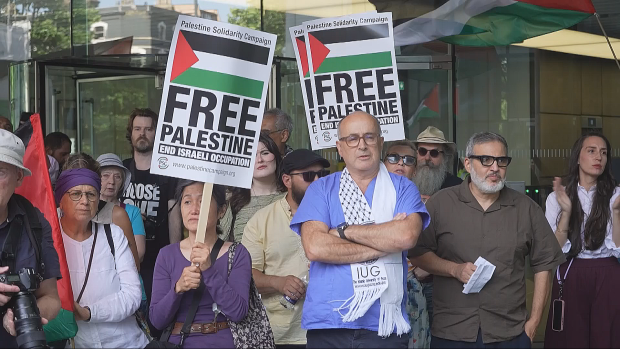
Protesters gathered outside the General Medical Council’s headquarters in London to slam the council’s attempt to silence those speaking out about the Israeli genocide in Gaza.
Protesters describe the surgeon as one of the world’s leading war doctors and argue that the regulator’s actions amount to an attempt to silence those who speak publicly about the realities of war,
So we are demonstrating in front of the GMC, because the GMC has decided to appeal against the rulings of two of its own tribunals, so that the High Court would allow it to try me for a third time, in order to get the right political result that it wants.
The GMC is conducting a political campaign against, not just myself, but every doctor who’s spoken up against the genocide, in order to silence us, in the service of the genocidal project. – Dr Ghassan Abu Sittah, British-Palestinian Surgeon
Doctors, campaigners, and members of the public traveled to attend the demonstration, asserting that the proceedings are about more than one individual, warning that they could have a chilling effect on healthcare professionals speaking about humanitarian crises.
Actually, there probably were a group of lawyers set up by the Israelis again to pursue highly charged politicized campaigns against professionals and workers in this country who stand against genocide.
So, really, it’s the action of how the British government and the Israelis who are trying to persecute and outlaw speech in support of Palestine in the heartland of Britain.
Actually, from, we know where our government, you know, the British government, the Labour government, and the Tory government before it have been complicit in genocide from bases like RAF Akrotiri, where Keir Starmer went and complimented the troops.
They run the genocide, they send the planes over Gaza, they stream that information live to the Israelis as they’re committing that genocide.
So our government is complicit, and what they’re doing with their complaints is they’re making it illegal for us to oppose it. – Ranjeet Brar, NHS Surgeon
Speakers at the rally urged the GMC to withdraw the appeal; assisting medical professionals should not face professional consequences for raising concerns over civilian suffering in conflict zones.
There’s a clear example here with Dr. Ghassan, where UK law is for Israel, that it is essentially standing up for the rights of a foreign entity, have been pressuring patients, pressuring people to make complaints against Dr. Abu-Sittah, and this is just one example of many other institutions, medical institutions like the Royal Colleges, and even the journals, the medical journals that we publish in, where they’ve been pressured from UK pro-Israel lobby groups to censor and to shut down any form of pro-Palestine activism.
So, I think we’re seeing this now very clearly with Dr. Ghassan, but the reality is it’s much more widespread than any of us think. – Dr Omar Abdel-Mannan, British-Egyptian Pediatric Neurologist
Organizers say they will continue campaigning until the proceedings against Dr. Abu-Sittah come to an end, maintaining that doctors must be free to speak about humanitarian consequences of war without fear or professional repercussions.
Supporters gathered outside the General Medical Council in London to stand behind British Palestinian surgeon Dr. Ghassan Abu-Sittah, accusing the regulators of attempting to silence one of the world’s most prominent war doctors.
Demonstrators say the case is not simply about one medic, but the right of healthcare professionals to speak out on the atrocities of Gaza without professional retaliation.
On Monday, several Chilean organizations delivered more than 80,000 signatures to the United Nations Secretary-General António Guterres, demanding Israel’s expulsion from the organization for war crimes committed in the Gaza Strip.
The collection was led by the Lawyers for Palestine association and the Sign for Palestine campaign, with collection points in various countries. The signatures were presented at the United Nations headquarters in Santiago, Chile.
“Israel is the country that most intentionally tramples on international law, resolutions, and the international order. Now they are taking that policy to Lebanon, where there are already more than 5,500 victims,” said Nelson Hadad, a member of Lawyers for Palestine.
Since October 7, 2023, when Israel launched its offensive against the Gaza Strip, more than 73,000 Gazans have been killed, including 20,000 children, according to the Gaza-based Health Ministry. Additionally, more than 1,020 deaths have been reported since the ceasefire came into effect in October 2025, due to attacks that violated the truce.
Paula Abugattas, a lawyer for the campaign, stated that “a large majority of countries in the UN General Assembly are aware of these violations against the Palestinian people, and there is widespread support” for Israel’s expulsion. Meanwhile, the humanitarian crisis in the Gaza Strip is worsening due to Israel’s restrictions on the entry of international aid.
Gazans remain in precarious camps for internally displaced persons amid severe shortages of food, medicine, clean water, and sanitation, as well as infectious and chronic diseases, and trauma, which will continue to cause indirect deaths long after the Israeli violence in Gaza ends. The UN has warned that the situation remains critical.
Tom Fletcher, Under-Secretary-General for Humanitarian Affairs, noted that 70% of the population needs shelter and essential services are on the verge of collapse. “UNICEF warns that water is not guaranteed for 1.1 billion children,” he emphasized, demanding an effective ceasefire.
In yet another blatant example of Western complicity with the Zionist regime, a UK judge has ruled that four Palestine Action activists have a “terrorist connection” for storming a British site of the Israeli weapons manufacturer Elbit Systems.
The ruling by Justice Jeremy Johnson was delivered as hundreds of Palestine Action supporters held a demonstration outside Woolwich Crown Court in south-east London on Friday.
Metropolitan Police arrested 107 peaceful protesters who had gathered to support the activists.
In August 2024 — at the height of the Israeli regime’s genocidal war on Gaza — Charlotte Head (30), Samuel Corner (23), Leona Kamio (30), and Fatema Rajwani (21) carried out a courageous direct action at Elbit Systems’ factory near Bristol.
They inflicted approximately £1.2 million in damage to military equipment destined for the occupying Israeli forces, aiming to disrupt the flow of weapons used to slaughter defenseless Palestinian civilians and to pressure for the closure of this Israeli arms factory operating on British soil.
However, the judge declared that the damage “had a terrorist connection” because the activists are linked to Palestine Action, the pro-Palestinian direct-action group that the UK government had proscribed as a “terrorist organization” in July 2025.
Notably, the High Court later ruled this proscription unlawful in February 2026 — a decision the British government is still appealing, while keeping the ban in force.
Under the legislation, even membership in or public support for the group is now a criminal offense in the UK, punishable by up to 14 years in prison.
Because of the judge’s “terrorist connection” ruling, the four activists will be denied normal early release provisions.
Instead, a Parole Board will assess their supposed “risk to the public” before they can be freed.
UN High Commissioner for Human Rights Volker Türk strongly condemned the UK’s misuse of counter-terrorism laws against pro-Palestinian activists, describing it as disproportionate and a threat to fundamental freedoms of expression and assembly.
This case exposes the hypocrisy of the British establishment: it shields Israeli war criminals and their arms suppliers while criminalizing peaceful citizens who dare to resist the machinery of genocide.
True terrorism is the Zionist regime’s daily massacre of Palestinians — not the brave actions taken to stop the weapons flow. The resistance continues.
Iran’s ballistic missile response to Israel’s attack on Beirut is a game-changer for the power dynamics of West Asian politics. The ‘Unity of Squares’ concept has officially led to a NATO-style defense pact developing between the members of the Iranian-led Axis of Resistance.
When Israeli Prime Minister Benjamin Netanyahu threatened to strike the southern suburbs of Beirut last Monday, the immediate threat issued by the leadership in Tehran forced him to take a step back. Ultimately, the US and Israel would delay the implementation of the decision to attack the Lebanese Capital, then suffering an overwhelming response that outperformed expectations.
The first detail to consider here is that the mere threat of Iran’s Islamic Revolutionary Guard Corps (IRGC) launching strikes on Israeli targets forced Tel Aviv and Washington to take a step back, meaning that both de facto admitted that Tehran maintains deterrence power. Then came the Israeli strike on the southern suburbs this Sunday, which was extremely limited and nothing of the nature of what Netanyahu had originally advertised.
A weak strike on Beirut’s southern suburbs, which had no actual impact on Hezbollah whatsoever, indicates that the US-Israeli alliance acted in order to save face, seeking to test Iran’s resolve, but also to leave space for it to retreat from all-out war.
Following Iran’s missile waves, which struck Ramat David Airbase – according to satellite imagery evidence – the Israelis decided to launch an attack on Iran. Although they did target at least three radar sites and a petrochemical company, amongst other targets, it was clear that the Israeli attack was lackluster; designed primarily to give them the veneer of having risen to confront the IRGC. No Iranians were killed in the Israeli attack, and the majority of the sites hit were previously struck during the 40-day war earlier this year.
It was clear that the IRGC had prepared for the Israeli counter-strike, not only unleashing an attack of its own on Israeli companies and military sites in response but also coordinating its retaliatory action with Yemen’s Ansarallah.
As the Israelis were playing catch-up, the Iranians were implementing a carefully calibrated phase two of their promised retaliation to Israel’s attack on Beirut– that being the inclusion of new fronts. The IRGC had previously warned Tel Aviv that the war would expand to other fronts; the Yemeni Armed Forces achieved precisely this.
Ansarallah has declared that the Bab al-Mandab Strait is now closed to Israeli shipping, returning to the equation imposed in support of Gaza until October of 2025, when the ceasefire was signed. Yemen then went a step further and vowed to totally close Bab al-Mandab, should the war escalate further. This would represent an enormous economic blow to the global economy, considering the ongoing closure of the Strait of Hormuz.
The concept of the ‘Unity of Squares’ was originally developed by former Secretary General of Lebanese Hezbollah, Seyyed Hassan Nasrallah, and before him Iran’s former IRGC Quds Force Commander Qasem Soleimani. In essence, it was the idea of linking all of the fronts of the Axis of Resistance so that none would stand alone. On October 8, 2023, Seyyed Hassan Nasrallah put this into action by immediately intervening on the side of the Palestinian resistance in Gaza. Soon thereafter, Ansarallah would follow, and to a lesser extent, the Islamic Resistance in Iraq.
Israel had long bragged that its assassination of Nasrallah had broken this Unity of Squares dynamic, because Hezbollah was forced into accepting a less-than-favorable ceasefire in late 2024. It was because of Nasrallah’s refusal to abandon Gaza “no matter where it takes the region”, that Tel Aviv had decided to kill him. Therefore, it is accurate to say that the former Hezbollah leader quite literally gave his life for Gaza.
Benjamin Netanyahu’s quest to achieve “total victory” in his 7-front war has not proven successful, but one major step towards that was managing to break the idea of the Unity of Squares. Through Iran’s actions this Sunday, that “success” was just undone.
The IRGC has also recently been insisting that Gaza be included in their ceasefire agreement, something that a number of statements released by Hamas also appear to be indicating will be the case. If the Islamic Republic does impose its will on the US-Israeli alliance by setting in stone the equation that an attack on one is an attack on all, the Unity of Squares equation will be imposed fully, as it was originally intended. In the past, it was never fully implemented because of Iran’s absence as a front that could easily open.
The implications of this equation coming to life are that the Iranian-led Axis will undoubtedly be the most powerful alliance in the region. Not because they necessarily possess the most firepower and capabilities, but because they will together be able to cut off key international chokepoints, while battering their adversaries in a way that can achieve strategic deterrence.
It should be noted that this is a direct result of the US-Israeli failure in their war of aggression to achieve any of their goals. Instead of weakening Tehran, their reckless aggression and arrogance may have just undone the tactical victories they previously achieved, pushing Iran into the position that many previously argued it should have assumed sooner after October 7, 2023. Unless Tel Aviv and Washington find a way to reverse this, this will represent a major historic shift in regional power dynamics.
– Robert Inlakesh is a journalist, writer, and documentary filmmaker. He focuses on the Middle East, specializing in Palestine.
Hamas spokesman Hazem Qassem said the movement highly valued the Iranian and Yemeni responses to what he described as escalating Israeli aggression against the Lebanese people, saying the stance represented a genuine model of solidarity among the region’s nations in confronting Israeli attacks.
In a press statement on Monday, Qassem said Hamas viewed the position as “the true form of solidarity that should prevail among all components of the nation”. He called on regional forces to regard this level of support and backing as a duty at this stage in support of the Palestinian and Lebanese peoples.
Qassem said Hamas had received repeated assurances from Iranian and Yemeni officials that they were seeking to end the war on all fronts, including the ongoing war in the Gaza Strip.
He added that Iran had provided the movement with political, military and financial support and continued to declare its backing for the Palestinian people and their right to resist, while also supporting efforts aimed at securing a ceasefire.
Qassem said Hamas hoped that the current state of solidarity and direct support would extend to Gaza and that the enclave would remain central to regional efforts linked to ending the war and halting the aggression.
On May 18, Israeli commandos attacked 54 civilian boats carrying food and medical supplies to Gaza. The boats were near Cypress, nearly 300 miles from Gaza, in international waters.
The Israelis fired at the boats and kidnapped 428 unarmed humanitarian activists. Those people were never charged with any crime. How could they be? When kidnapped, they were exercising their right to sail in international waters. It was the Israelis who were committing the crime of maritime piracy, which carries a penalty of 20 years’ imprisonment.
But piracy and kidnapping were just the initial crimes. Sexual assault, rape, and torture followed. It began almost as soon as the Israeli pirates boarded the victims’ boats. According to Dropsite News, “The flotilla says at least 12 sexual assaults were documented aboard the vessel alone, including anal rape and forcible penetration with a handgun.”
The kidnapping victims were subjected to sadistic sexual abuse in the form of strip-searches accompanied by sexual taunting and groping. Many were raped. Participants described “rubber bullets fired at close range, tasers used on the face and upper body, stun grenades thrown into groups of detainees (and) prolonged stress positions under permanent bright light.” The activists were brutally beaten, emerging with “broken ribs (and) fractures to the torso, shoulders, and back.”
The kidnappers took their victims to the Israeli port of Ashdod for “further beatings, sexual humiliation, prolonged interrogations, and torture.” Israel responded to the media outcry and formal diplomatic protests from twelve governments, including Spain and Italy, by having extremist minister Itamar Ben-Gvir film himself participating in the abuse of the kidnapped civilians. After Ben-Gvir proudly posted his torture selfies on social media, even the US, UK, and Canada protested. Facing universal condemnation, the Israelis finally released their victims four days after the kidnapping, sending most of them on deportation flights to Turkey.
The kidnapped and tortured activists pointed out that the four days of hell they experienced were nothing compared to what Palestinian prisoners endure every single day. They called attention to the fact that Israel is currently imprisoning more than 400 Palestinian children, and that almost three-quarters of the children kidnapped by Israel report experiencing sexual violence or abuse.
Israel’s crimes against the flotilla activists were shocking but not surprising. Israel, after all, is a nation that trains dogs to rape prisoners, as reported by The New York Times. It is a nation with a “right to rape” movement that makes national heroes of prison guards who sodomize people to death. In his article “Israel Is the Global Rape Capital” Elias Akleh describes how “Sadistic sexual rape seems to be an endemic character of the whole Israeli society, making Israel the rape capital of the world, where sexual abuse and rape are not restricted against Palestinians only, but against Jewish Israeli girls in general.”
All of this is just the proverbial tip of an iceberg of evidence that Israel is a nation of sadistic sex criminals. Depraved, violent, sadistic sexual abuse is even part of Israeli Orthodox Jewish religious rituals, as reported by the Jerusalem Post(6/3/2025). Social media is full of pictures posted by Israeli soldiers who murder Palestinian women, dress up in their victims’ bras and underwear, and take selfies.
In relatively normal societies, it is estimated that two per cent or less of the population consists of clinical psychopaths, while 98% are non-psychopathic. Among the Israeli Jewish population, it seems, that ratio is reversed. Polls show that the vast majority of Israeli Jews support the genocide of Gaza, which has featured the murders of tens of thousands of innocent women and children, most of whom have been slowly crushed to death beneath the rubble of their own houses.
None of these crimes could happen without the roughly ten trillion dollars of support Israel has received from American taxpayers. That money has been bestowed on the Dog Rape Nation by our politicians, who are bribed or blackmailed by Israeli agents like Jeffrey Epstein, himself a shining example of Jewish-Israeli sexual psychopathy.
Epstein described himself as “Donald (Trump’s) closest friend for ten years.” But it gets worse. In his 20s, Trump was the protegé of Jewish-Zionist gangster Roy Cohn, a sadistic homosexual pedophile who, according to journalist Anthony Summers, ran an Epstein-style blackmail operation that filmed powerful men, including J. Edgar Hoover, abusing little boys.
And it isn’t just Trump. Our whole political class is compromised. Just look at how they vote on Israel-related issues.
The USA desperately needs a serious, French Revolution style housecleaning.
See Also:
"Sexual violence against young boys and girls. Things that are done in the name of a religious ritual… These rituals, most of which are ancient rituals from the days of Ba'al worship, have not vanished from the world".
At the University of Vienna, an independently organized student assembly voted by a large majority in favor of an academic boycott of Israeli educational institutions, according to the activist group, University of Vienna for Palestine, which announced the result on Instagram, Anadolu reports.
Previously, over 1,000 students at the university had signed a petition to convene a student assembly “from below,” which organizers described as the first of its kind in Austria.
The students’ resolution is explicitly directed against the strategic partnership between the University of Vienna and the Hebrew University of Jerusalem, which has been in place since 2015.
The first core motion adopted by the assembly was titled “Academic Boycott Instead of Complicity in Genocide.”
The initiators accuse the partner university in Jerusalem of direct cooperation with the Israeli military.
Other demands made by the participants include the introduction of a university “civil clause” prohibiting military research, as well as the withdrawal of security forces and the Austrian domestic intelligence service from the campus grounds.
READ: ‘We are not part of Trump’s chaotic policy,’ including with US overflights: Austria’s vice chancellor
According to “University of Vienna for Palestine,” approximately 400 eligible students attended the meeting.
One of the university’s largest lecture halls, Lecture Hall I in the New Institute Building, was reportedly filled beyond capacity.
At the start of the gathering, South African author Andrew Feinstein, who worked for the African National Congress (ANC) under Nelson Mandela, gave a speech in which he emphasized the historical significance of the gathering.
In his address, Feinstein also highlighted the historical necessity of the international “Boycott, Divestment & Sanctions” (BDS) campaign.
However, from a legal standpoint, the assembly’s vote is non-binding and symbolic, as it is an independent activist assembly and not an official body of the university administration or the legally established student council.
Iranian Parliament Speaker and special representative for China affairs, Mohammad Bagher Ghalibaf, held the first joint meeting with key economic officials on 3 June to align Tehran’s economic strategy toward Beijing.
The session in Tehran included the ministers of economy, oil, and industry, alongside the central bank governor and the head of the Plan and Budget Organization.
The assembly focused on establishing a unified government approach to elevate bilateral relations and coordinate the administration’s economic priorities. During the proceedings, officials evaluated China’s economic conduct amid the US-Israeli war on Iran and the closure of the Strait of Hormuz to the US and Israel.
Participants agreed to submit formal proposals to Ghalibaf to resolve outstanding challenges and deepen cooperation.
This coordination effort supports a developing strategy to position China as Iran’s “principal strategic partner” while expanding collaboration on regional and international issues.
Roughly 30 China-linked vessels crossed the Strait of Hormuz in a single day in mid-May under the supervision of Iran’s Islamic Revolutionary Guard Corps (IRGC) Navy.
These transits follow a “management protocol” established after Iran restricted the waterway to US and Israeli-linked vessels in February.
While the strait remains largely closed, passage is permitted for commercial ships that comply with Iranian naval procedures and utilize designated corridors
In parallel, since the illegal US blockade on Iranian ports was implemented in April, Iran has tripled its rail exports of oil and liquefied petroleum gas (LPG) to China in an effort to bypass the economic stranglehold.
Freight trains on the 10,400-kilometer corridor now depart every three to four days, a significant increase from the previous weekly schedule, and halve traditional sea transit times to roughly 15 days.
Despite this, rail capacity remains a modest alternative to maritime shipping; one train carries 60,000 to 70,000 barrels of oil, while large tankers can transport upwards of 2 million barrels.
Australian activists who took part in the Global Sumud Flotilla for Gaza filed a formal submission with the International Criminal Court (ICC) on 30 May, accusing Israel of war crimes based on documented evidence of torture and sexual violence sustained during their abduction and imprisonment.
The legal filing, submitted by 11 Australian survivors of the Flotilla and their legal team, is supported by dozens of survivor testimonies, video evidence, medical records, and sworn statements.
This evidence details severe beatings and sexual abuse following the 18 May interception of an international aid mission carrying food and medicine to the besieged Gaza Strip in an attempt to break the Israeli blockade of the enclave.
One specific account included in the submission describes an Australian humanitarian worker being forcibly injected with an unidentified substance by Israeli captors.
The submission also incorporates video evidence, including footage posted to social media by Israeli National Security Minister Itamar Ben Gvir, who boasted of the ill treatment and showed handcuffed activists on their knees being taunted by Israeli soldiers.
The Global Sumud Flotilla reports that at least 67 participants suffered injuries during their imprisonment that required medical evaluation, with 12 individuals requiring hospitalization.
One survivor, Australian filmmaker Juliet Lamont, in an interview with Double Down News, recounted being dragged into a shipping container she called a “torture tunnel” where she was placed in a stress position, hands restrained behind her back, and ankles shackled in the dark before being “vaginally raped by one of the male soldiers,” while “other people had guns inserted inside them.”
She added that a 70-year-old woman’s ribs had been broken as “howls of torture and pain” would emit from the same chamber she had been tortured in.
This legal action follows the UN adding Israel to a 2026 blacklist for parties guilty of committing sexual violence in conflict zones. UN Secretary-General Antonio Guterres cited documented “patterns of sexual violence” against detainees, leading to the designation of the Israeli Prison Service on the blacklist.
While Israel’s ambassador to Australia and other Israeli officials have denied these claims, asserting that participants were treated according to established procedures, the Australian government previously sanctioned Minister Ben Gvir for his “shocking and unacceptable” treatment of the detainees.
Returning survivors have expressed outrage at the Australian federal government, noting that Prime Minister Anthony Albanese has declined multiple requests to meet with them.
Flotilla participant Isla Lamont highlighted the contrast of being granted a hearing at the ICC while being ignored by domestic leadership, stating that “If Australian survivors can be heard in The Hague but not in Canberra, something has gone badly wrong”.
The flotilla organizers are now calling for independent international investigations, arms embargoes, and the enforcement of arrest warrants for the officials responsible.
French activists are also pursuing their own separate legal complaint on the “humiliation, rape, and acts of torture” they endured, explicitly declining to cooperate with the French Foreign Ministry’s request for a criminal probe due to their government’s continued diplomatic support for Israel throughout the genocide in Gaza.
The Israeli navy does not ask for your passport before opening fire. They don’t care whether your country’s government has diplomatic relations with Tel Aviv or not. They also don’t care if your country is secretly starting to soften its attitude toward Israel for the sake of a more comfortable relationship.
They capture, detain, injure, even kill – then wait for the world to look away.
The “Global Sumud Flotilla,” a global humanitarian activist movement to send food to Gaza by sea, has proven one thing indisputably: any country that sends its citizens on humanitarian missions to Gaza must accept insults from Israel.
South Korea, Greece, France, Brazil, Canada, Australia, the United Kingdom, and Sweden all have good relations with Israel. But their citizens are still detained by Israel in international waters.
Similar missions have been carried out for over a decade, and they always end the same way: activists are arrested or even killed. In the 2010 Mavi Marmara tragedy, for instance, ten Turkish activists were killed by regime forces, yet no meaningful accountability ever followed.
The pattern is very clear. Israel operates on the assumption that the world will condemn and then forget. And so far, that assumption has proven to be true, at least until recently.
No “right diplomatic tone”
Indonesia’s experience is both interesting and painful. In recent years, Jakarta has shown signs of change in its approach to the Palestinian issue. In fact, the President of Indonesia once issued a statement, “peace can only come if everyone recognizes, respects, and guarantees the security of Israel.”
Indonesia even joined the Board of Peace formed by Trump, of which there is Israel as a member, while the official representative of the Palestinian Authority was not accepted.
The tone of Indonesia’s diplomacy has changed, from a principled confrontation to a more cautious and accommodating approach.
And what does Indonesia get in return? Four Indonesian soldiers who were members of UNIFIL were killed by Israeli forces in Lebanon. Most recently, five Indonesian citizens who joined the Global Sumud Flotilla were held hostage by Israel in international waters.
Israel has sent its message that accommodation does not produce security. Israel reads diplomatic leniency not as goodwill, but as weakness and as a green light to go further.
The economics of genocide: Who finances aggression?
To understand why Israel acts with impunity as it does now, we must look at the support architecture that allows impunity to take place, and that architecture is primarily economic.
The United States provides about $3.8 billion in annual military aid to Israel, plus an emergency aid package that made total fund transfers increase much larger during the Gaza genocide. But military aid is only the most visible layer.
Israel is supported by an arms supply chain by American arms manufacturers such as Boeing, Lockheed Martin, Elbit Systems, and L3 Technologies that provide bombs, drones, and surveillance technology used in Gaza. There is financial exposure from BlackRock, Vanguard, and major Western banks that have significant stakes in Israeli arms companies and bonds that finance their genocidal aggressions from Gaza to Beirut to Tehran.
There is technological support from Amazon Web Services and Google that provides cloud infrastructure for the Israeli military and intelligence through “Project Nimbus”, despite major protests from their own employees.
Some companies are proven to operate in illegal Israeli settlements or support Israeli military recruitment, but remain free to operate in the Global South market.
There are notorious militias that carry out genocide in Sudan, with arms supplies from Israel through the hands of the United Arab Emirates, in order to control the gold mines. And more.
They all form a system of financial immunity to a colonial project and that system works through the daily consumption choices of billions of people around the world.
The Israeli-American axis is not just a bilateral alliance. It is a system that was designed to maintain a certain global order, in which some lives are deemed worthy of protection while others are deemed to be sacrificeable.
Urgent need to form a global resistance front
Here, we need to review the global situation more comprehensively. Iran’s resistance and that of the axis of resistance against the US and Israel have led to a marked decline in US power.
The bullying carried out by the US and Israel has had a global impact. It’s time we talk about a global resistance front. The world needs to come together to harness all the legitimate instruments at the disposal of sovereign states and civil society to make Israel’s impunity costly.
The instrument is actually available. What has been lacking so far is the political will to use it simultaneously and on a large scale. For example, every member state of the Rome Statute is obliged to execute an ICC arrest warrant and Netanyahu’s arrest warrant already exists.
The genocide lawsuit brought by South Africa at the International Court of Justice (ICJ) is a historic intervention that needs more supporters. More countries should join, file amicus briefs, or at least express official support. In this way, legal isolation works.
On the economic front, countries should stop procurement contracts with companies that supply dual-use weapons or technology to Israel, remove Israeli military bonds from sovereign wealth fund portfolios, and implement BDS principles as state policy, not just the aspirations of civil society.
Currently, more than 140 countries have recognized Palestine. Supposedly, this should not stop as empty symbolism. Any recognition should be used as a basis for a real change in the position of Palestinian international law. If Palestine is officially admitted as a member state of the United Nations, it has the right to build up a military and receive military assistance from countries when it is attacked by Israel (Article 51 of the UN Charter).
Boycotts of Israel from sporting events, music competitions, and others also need to be done. Because Israel is so dependent on international legitimacy, that’s where its vulnerability lies.
What Gaza needs is no longer just an expression of sympathy or verbal condemnation. What is needed is a front of countries and world societies that together decide that the cost of silence is much more expensive than the cost of resistance.
Iran has carried out its duties in the military arena against the US and Israel. Other countries need to show real progress on various fronts because Israel can only be stopped if it is really pressured from multiple directions, simultaneously, with real consequences.
Dina Y. Sulaeman is an Assistant Professor of International Relations at Universitas Padjadjaran, Indonesia
Israel has mass raped and tortured detained activists with the Sumud Flotilla, who were attempting to bring aid to Palestinians in Gaza, multiple victims have revealed.
On Tuesday, Israel kidnapped “430 people onboard 50 ships in international waters”.
Israel’s National Security Minister Ben Gvir released a video showcasing Israeli abuse of the detainees, including by forcing them to kneel while the Israeli national anthem played.
Democracy Now noted , “The video shows dozens of men and women kneeling in rows, with their foreheads to the ground and their hands zip-tied behind their backs at the port in Ashdod”.
Now, released activists from around the world have detailed mass rape, sexual abuse, and torture that Israeli forces unleashed on them while in detention.
A Press release from the Global Sumud Flotilla documented that, “Participants from the Global Sumud Flotilla, now in Istanbul, have begun providing harrowing testimony about widespread abuse, assault and torture: rubber bullets fired at close range, tasers to the face and upper body, stun grenades thrown into groups of detainees, stress positions held for hours under permanent bright light, hijabs (Muslim religious headcovers) forcibly removed, as well as various forms of sexual violence including: humiliating strip searches, sexual taunting, groping and pulling of genitals, and multiple accounts of rape.”
It added, “Some of the most horrifying accounts centre on a single vessel that participants call the ‘torture boat.’ This specific israeli naval vessel with a makeshift prison constructed of barbed wire and metal shipping containers became the primary site of intense violence following the interception; this reflects a small fraction of the patterns of systemic violence and sexual abuse against the Palestinian people at the hands of the israeli regime for decades.”
The activist organization has documented “At least 15 cases of sexual assaults, including rape” along with activists “shot with rubber bullets at close range” and “tens of people’s bones broken”.
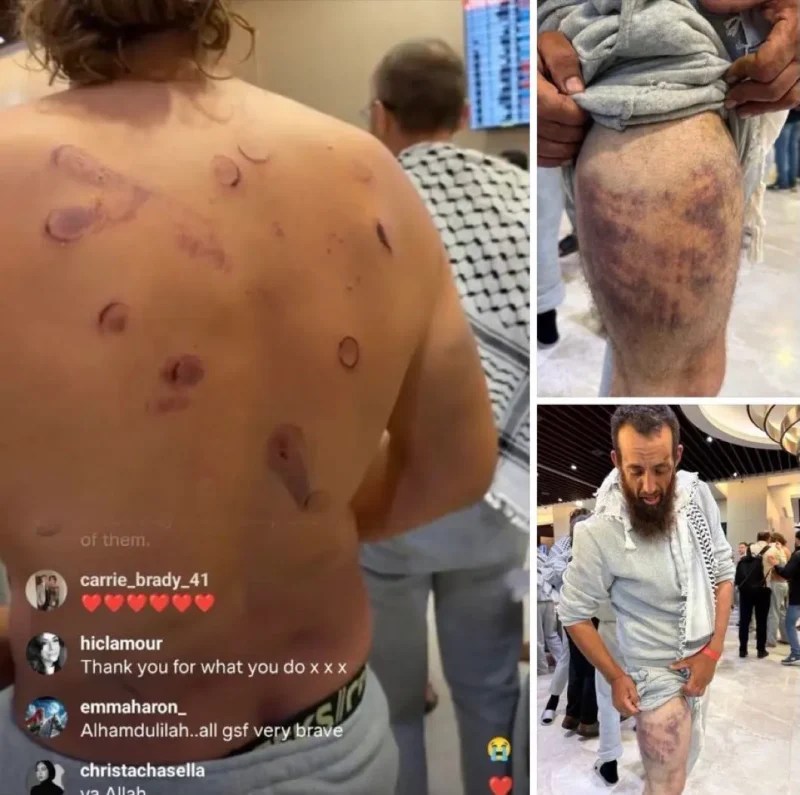
Adrien Jouan, one activist with Global Sumud Flotilla, showed evidence of brutal torture, with severe bruising all over his body.
Another activist on Instagram live showcased severe bruising on his leg.
Released Brazilian activist Thiago Ávila revealed that , “there is no easy way to say it, but I have to say it, people got raped at the Global Sumud Flotilla. These monstrous soldiers raped our participants. It was not one, not two, not three, it’s many cases of sexual violence against our participants on the prison boat on the way to the port of Ashdod, where they got once again beaten up, many people with broken ribs, many people with broken bones in the arms, the collar bone, the ribs”.
Independent journalist Alex Colston, who was part of the Sumud Flotilla, revealed , “I just got out of Israeli prison … I saw people shot point blank with rubber bullets, I myself, I can’t feel my hands because they are all scarred up because they would take the cuffs and they would yank my hand over and over again. When I would be tied or cuffed, they would step on my cuffs. They kicked me in the ribs more times than I can count. I passed out at least one time. … even if you plead for them to stop … Israeli guards were getting obvious pleasure from hurting us as much as they could”.
Handcuffs on my hands and feet. Dragged me. When I couldn’t walk, they dragged me on the ground.
They hit us. Hurt all of us a lot. Handcuffs so tight my hands lost feeling
They laughed all the time. Super sadistic.
Took off my shirt. Took pictures. Mistreated us all night long
Another activist testified that , “I had my hands zip-tied behind my back for so long and it was so tight I almost started vomiting, they slammed my head into a table several times and degraded me as I was strip-searched. They had me in handcuffs for 19 hours to the point my skin had begun to swell around them.”
Australian activist Juliet Lamont revealed , “We had people who were tasered in the face. People were syringed with unknown sedatives. I was put down, cable tied. They put so much water under me for an hour that I thought I was going to drown. I was sexually assaulted in this kind of torture chamber. And five men were bashing me and smashing my face”.
Italian economist, Luca Poggi, who was with the Flotilla activists revealed that “We were stripped, thrown to the ground, kicked. Many of us were Tasered, some were sexually assaulted, and some were denied access to a lawyer”.
The barbaric torture of the Sumud Flotilla activists is just another example of the brutal torture, sexual violence, and rape that Israeli forces unleash on Palestinian detainees daily.
By Donald Neff | Washington Report On Middle East Affairs | January 1996
On January 4, 1948, Jewish terrorists drove a truck loaded with explosives into the center of the all Arab city of Jaffa and detonated it, killing 26 and wounding around 100 Palestinian men, women and children.[1] The attack was the work of the Irgun Zvai Leumi – the “National Military Organization,” also known by the Hebrew letters Etzel – the largest Jewish terrorist group in Palestine. The Irgun was headed by Revisionist Zionist Menachem Begin and had been killing and maiming Arabs, Britons and even Jews for the previous ten years in its efforts to establish a Jewish state.
This terror campaign meant that at the core of Revisionist Zionism there existed a philosophical embrace of violence. … continue
This site is provided as a research and reference tool. Although we make every reasonable effort to ensure that the information and data provided at this site are useful, accurate, and current, we cannot guarantee that the information and data provided here will be error-free. By using this site, you assume all responsibility for and risk arising from your use of and reliance upon the contents of this site.
This site and the information available through it do not, and are not intended to constitute legal advice. Should you require legal advice, you should consult your own attorney.
Nothing within this site or linked to by this site constitutes investment advice or medical advice.
Materials accessible from or added to this site by third parties, such as comments posted, are strictly the responsibility of the third party who added such materials or made them accessible and we neither endorse nor undertake to control, monitor, edit or assume responsibility for any such third-party material.
The posting of stories, commentaries, reports, documents and links (embedded or otherwise) on this site does not in any way, shape or form, implied or otherwise, necessarily express or suggest endorsement or support of any of such posted material or parts therein.
The word “alleged” is deemed to occur before the word “fraud.” Since the rule of law still applies. To peasants, at least.
Fair Use
This site contains copyrighted material the use of which has not always been specifically authorized by the copyright owner. We are making such material available in our efforts to advance understanding of environmental, political, human rights, economic, democracy, scientific, and social justice issues, etc. We believe this constitutes a ‘fair use’ of any such copyrighted material as provided for in section 107 of the US Copyright Law. In accordance with Title 17 U.S.C. Section 107, the material on this site is distributed without profit to those who have expressed a prior interest in receiving the included information for research and educational purposes. For more info go to: http://www.law.cornell.edu/uscode/17/107.shtml. If you wish to use copyrighted material from this site for purposes of your own that go beyond ‘fair use’, you must obtain permission from the copyright owner.
DMCA Contact
This is information for anyone that wishes to challenge our “fair use” of copyrighted material.
If you are a legal copyright holder or a designated agent for such and you believe that content residing on or accessible through our website infringes a copyright and falls outside the boundaries of “Fair Use”, please send a notice of infringement by contacting atheonews@gmail.com.
We will respond and take necessary action immediately.
If notice is given of an alleged copyright violation we will act expeditiously to remove or disable access to the material(s) in question.
All 3rd party material posted on this website is copyright the respective owners / authors. Aletho News makes no claim of copyright on such material.