Egyptian army attacks protesters in Cairo
Press TV – August 1, 2011

Egyptian demonstrators rally in downtown Cairo’s Tahrir square on July 29, 2011.
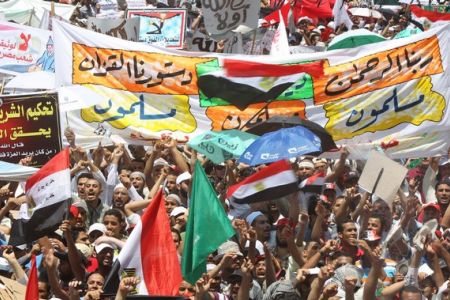
At least 200 protesters have been injured as violent clashes erupted between Egyptian security forces and demonstrators camped out in the capital’s landmark Liberation Square.
The clashes erupted when security forces entered the square to disperse protesters who have stayed there for over three weeks.
Dozens of troops entered the square with military vehicles and managed to open the square to traffic.
Witnesses say the troops fired into air and used live ammunition in a bid to break up the demonstrations.
Some reports say at least 200 protesters have been injured. Some of the injured are said to be in critical condition.
The protesters have been calling for an end to the military rule.
The protesters are calling for swift change and the ouster of military rulers who have replaced the former dictator Hosni Mubarak.
One of their key demands is the swift trial of former regime members involved in the killing of protesters during the revolution.
They are also calling on de facto president and Field Marshal Hussein Tantawi to step down.
Following Mubarak’s downfall, a military council took over in Egypt. Many Egyptians believe it is trying to derail the revolution.
Demonstrators call for an end to the military council’s rule and want the military to go back to their barracks and hand over power to a civilian government.
Palestinian civil society stands in solidarity with Norway
The Electronic Intifada – 07/28/2011
The Palestinian Boycott, Divestment and Sanctions National Committee (BNC) released the following statement today in the wake of last week’s horrific attacks in Norway:
Palestinian civil society, as broadly represented within the Palestinian Boycott, Divestment and Sanctions National Committee (BNC), wishes to express its sincere condolences to and deep solidarity with the people of Norway and to Arbeidernes Ungdomsfylking (AUF), the Norwegian labour youth party, in particular after the massacre of last Friday committed by a far right fanatic.
Palestinians stand with the people of Norway as they mourn the victims, and our hearts go out to the families and friends of those who have died.
This horrendous massacre serves as a grave reminder of the dangers posed by racism, hatred and intolerance. We are confident that Norway’s long tradition of peace loving, respecting diversity and upholding human rights anywhere in the world will stand up to this ugly test of fundamentalism and hate; we trust that the Norwegian people’s determination to fight xenophobia and its resultant disregard for equal human rights will be further strengthened.
These violent and horrific attacks cannot be viewed in isolation. There is a growing wave of officially sanctioned Islamophobia in several western countries, driven by misinformation, intolerance and right-wing Zionism, with strong links to Israel. Tragically, this racist and extreme rhetoric has been put into action with many Norwegians paying the price with their lives. The murderer, by his own admission, drew his motivation for this heinous crime from the by now widespread anti-Arab/Muslim discourse that dwells on a perceived “clash of civilizations” and a blind support for Israel and its crimes against the Palestinian people.
Palestinians deeply empathize and stand with Norwegians as fellow humans and as a people that has its own long experience of pain and grief. In Israel’s Gaza massacre alone, more than 1,400 people, mostly civilians, lost their lives. Homes, schools, UN shelters, university buildings, civilian infrastructure, hospitals, ambulances, sewage systems, power stations and more were ruthlessly decimated by Israel’s state terrorism in its assault on Gaza 2008-09. The noble humanitarian work and moving testimonies of the prominent Norwegian physician, Dr. Mads Gilbert, attest to the scale of the crime Israel has committed in Gaza and continues to commit on a daily basis with its illegal and immoral siege of 1.5 million Palestinians. It is often in times of great suffering, however, that human compassion and solidarity shine brightest.
We believe that these despicable crimes in Norway will only strengthen the resolve of all people of conscience around the world to pursue freedom, justice and equality and to join hands in combating racism in all forms.
We appreciate greatly the support for Palestinian rights and, specifically, for the boycott, divestment and sanctions (BDS) movement, as shown by members of the AUF summer camp. We deeply appreciate the support for a boycott of Israel from LO, the Norwegian labor federation, and from close to half the people of Norway, as shown in polls following Israel’s bloody flotilla attack last summer. We salute the Norwegian pension fund for divesting from three Israeli companies implicated in Israel’s occupation and colonization. We are proud of the brave decision taken by Norway to ban testing submarines destined to Israel and to support a military embargo on Israel. We stand by the friends and families of all victims at this difficult time.
We hope to honour their memory by working more closely together with the AUF and other partners in Norwegian civil society towards a more just world where there is no place for racism and hatred.
Palestinian BDS National Committee (BNC)
Bahrainis to stage anti-US sit-in Friday
Press TV – July 28, 2011
Bahrain’s February 14 Movement has called for a mass sit-in in front of the US embassy in Manama to condemn Washington’s interference in the internal affairs of the Persian Gulf country.
The spokesman of the Bahraini movement, Abdul Raouf al-Shayeb, said that the demonstrators intend to voice their opposition on Friday against the US support of the Al Khalifa regime.
The protesters seek to maintain the right to determine their own destiny, al-Shayeb added.
The main Bahraini opposition group, al-Wefaq, has also called for fresh rallies on Friday.
Al-Shayeb’s remarks come as Saudi-backed Bahraini regime forces continue cracking down on peaceful demonstrators.
On Wednesday, the regime forces attacked the protesters in the village of Nuwaidrat, according to witnesses.
Saudi Arabia and the United Arab Emirates deployed their first batch of military forces to Bahrain in mid-March.
On Saturday, Saudi Arabia deployed more forces in Bahrain in an attempt to further help the ruling regime clamp down on anti-regime demonstrators.
In June, a military court in Bahrain tried seven opposition activists including al-Shayeb in absentia for “plotting to overthrow the ruling system.” The opposition spokesman was sentenced to 15 years imprisonment.
Anti-regime protesters have been holding demonstrations across the country since mid-February, calling on the ruling family to relinquish power.
Scores of protesters have been killed — many under torture — and numerous others detained and transferred to unknown locations during the regime’s brutal onslaught on protesters.
Yemenis rally against foreign hands
Press TV – July 26, 2011
Yemeni protesters have once again rallied across the country, condemning foreign intervention in the country’s internal affairs.
On Monday, tens of thousands of people marched in the capital, Sana’a and the other key western city of Taizz, a Press TV correspondent reported.
‘Death to America, death to Israel,’ shouted the demonstrators, a Press TV correspondent reported.
They voiced outrage at Saudi Arabia, which has been sheltering Yemen’s Ali Abdullah Saleh following an early-June RPG attack on the presidential palace.
Saleh has been in office for more than three decades with several opposition members arguing that his long-promised political and economic reforms have not materialized.
‘People want the downfall of the regime,’ the angry public also chanted and voiced support for the recently-established transitional council, which represents the ongoing revolution.
Thousands of people have turned out for regular demonstrations in Yemen’s major cities since January, calling for an end to corruption and unemployment and demanding Saleh’s ouster.
The regime’s brutal crackdown of the demonstrations has so far claimed hundreds of lives.
Was the Massacre in Norway a reaction to BDS?
By Gilad Atzmon | July 24, 2011
I learned last night from an Israeli online journal, that two days before the Utoya Island massacre, AUF’s (Labour Party’s youth movement) leader Eskil Pedersen gave an interview to the Dagbladet, Norway’s second largest tabloid newspaper, in which he unveiled what he thinks of Israel.
In the course of the interview, Pedersen stated that he “believes the time has come for more drastic measures against Israel, and (that he) wants the Foreign Minister to impose an economic boycott against the country.”
Pederson went on to say, “The peace process goes nowhere, and though the whole world expect Israel to comply, they do not. We in Labour Youth will have a unilateral economic embargo of Israel from the Norwegian side.”
The AUF Labour Party Youth Movement have been devoted promoters of the Israel Boycott campaign, The Dagbladet newspaper reporting that “The AUF has long been a supporter of an international boycott of Israel, but the decision at the last congress, demands that Norway imposes a unilateral economic embargo on the country and it must be stricter than before.”
“I acknowledge that this is a drastic measure”, stated Pedersen, “but I think it gives a clear indication that we are tired of Israel’s behaviour, quite simply”.
Yesterday we also learned that mass-murderer Anders Behring Breivik was openly enthusiastic about Israel. According to a variety of internet outlets, Behring Breivik was a regular poster on several Norwegian internet sites, notably the blog document.no, which is run by Hans Rustad, a former left-wing journalist. Hans Rustad is Jewish, extremely pro-Zionist, and warns against ‘Islam-isation’, violence, and other social problems he assumes to be connected with Muslim immigration.
Alongside the UK’s infamously Islamophobic Harry’s Place and other Jewish pro-war Zionist blogs, the observant amongst us are becoming more and more aware of an increasingly pervasive trend of Jerusalemite internet journals that — ostensibly – like to give the impression of ‘rallying for the preservation of Western culture,’ and of ‘standing up for democratic values’. For the most obvious of reasons, these blog pages are almost exclusively focused on ‘the problem of Islam,’ and on Muslim migrants’ ‘troubled and reactionary’ communities and politics, whilst all the while, simultaneously, relentlessly and forcefully propounding a propagandistic Zionist agenda. Interestingly enough, other immigrants are routinely depicted on these blog pages as being ‘harmless’, or as ‘positive contributors to society’ — you won’t find Hans Rustad or Harry Place criticising the Jewish Lobbies, the Lord Levy’s or the Russian Oligarchs’ disastrous impact on ‘Western culture’ or on ‘democratic values’ any time soon. […]
I am not in a position at present to firmly point a finger at Israel, its agents, or its sayanim — but assembling the information together, and considering all possibilities may suggest that Anders Behring Breivik might indeed, have been a Sabbath Goy.
Within its Judaic mundane-societal context, the Sabbath Goy is simply there to accomplish some minor tasks the Jews cannot undertake during the Sabbath. But within the Zion-ised reality we tragically enough live in, the Sabbath Goy kills for the Jewish state. He may even do it voluntarily.
Being an admirer of Israel, Behring Breivik does appear to have treated his fellow countrymen in the same way that the IDF treats Palestinians.
Devastatingly enough, in Israel, Behring Breivik found a few enthusiastic followers who praised his action against the Norwegian youth. In the Hebrew article that reported about the AUF camp being pro Palestinian and supportive of the Israel Boycott Campaign, I found the following comments amongst other supports for the massacre:
24. “Oslo criminals paid”
26. “It’s stupidity and evil not to desire death for those who call to boycott Israel.’
41. “Hitler Youth members killed in the bombing of Germany were also innocent. Let us all cry about the terrible evil bombardment carried out by the Allied…We have a bunch of haters of Israel meeting in a country that hates Israel in a conference that endorses the boycott.. So it’s not okay, not nice, really a tragedy for families, and we condemn the act itself, but to cry about it? Come on. We Jews are not Christians. In the Jewish religion there is no obligation to love or mourn for the enemy.”
The full facts of the Norwegian tragedy are, as yet, unknown, but the message should by now be transparently and urgently clear to all of us: Western intelligence agencies must immediately crack down on Israeli and Zionist operators in our midst, and regarding the terrible events of the weekend, it must be made absolutely clear who it was that spread such hate and promoted such terror, and for what exact reasons.
European parliamentarians to visit Gaza Strip
Ma’an – 24/07/2011
GAZA CITY – A high-profile delegation of European parliamentarians is scheduled to arrive Sunday in the Gaza Strip via the Rafah crossing on Egypt’s border.
The Council for European Palestinian Relations said in a statement that members of the European parliament and national parliaments would visit Gaza to raise awareness of the humanitarian situation, the effects of Israel’s siege and the role of Egypt at the Rafah crossing.
The delegation includes the chairman of the British Labour Party Tony Lloyd and Liberal Democrat spokeswoman for the British Ministry of Justice Baroness Falkenr.
The group will meet UN officials, local authorities and women’s groups and visit universities and cultural centers, the council said.
Council director Arafat Shoukri said the visit was “an excellent opportunity for European officials to assess the situation on the ground and to build closer ties with Palestinians.”
Erdogan: No normalization without Israel’s apology, lift of Gaza siege
Palestine Information Center – 24/07/2011
ISTANBUL– Turkish Prime Minister Recep Tayyip Erdogan said Saturday that his country’s normalization of relations with Israel is ”unthinkable” unless Israel apologizes over the 2010 flotilla attack and ends its siege on the Gaza Strip.
”As long as Israel does not apologize to Turkey, pay compensation to the families of the victims, and lift its siege on Gaza, it is unthinkable to normalize relations with it,” Erdogan said during a meeting for Palestinian ambassadors in Istanbul.
Erdogan accused Israel of ”shooting in the back” the nine unarmed Turkish activists who were on board the Mavi Marmara ship, which was a part of the Freedom Flotilla in late May 2010, when it tried to defy Israel’s blockade of the Gaza Strip.
The PM also criticized Israel for refusing to ”move ahead to end the conflict and lift the Gaza siege”.
On Thursday, Israeli Strategic Affairs Minister Moshe Yaalon insisted that Israel was unwilling to apologize over the incident.
”We are not ready to apologize, as apologizing is taking responsibility,” he told media outlets in Jerusalem, adding that Israel would also not pay compensation to the victims’ families.
French peace activists detained, expelled to Jordan
Palestine Information Center – 23/07/2011
JENIN — The Israeli occupation authority (IOA) deported on Friday five French activists to Jordan after they were taken prisoner at a military checkpoint between Jenin and Tulkarem cities.
The youth movement in France condemned the arrest of its five members and stated that Israeli troops at this checkpoint arbitrarily detained them, confiscated their passports, and used force to drive them to a nearby military camp where they were held for hours.
An Israeli intelligence officer told the five activists during their interrogation that they would be expelled from Israel and would not be allowed to come back again at the pretext of helping Palestinian resistance organizations he described as terrorist, the youth movement said.
It added that its members were humiliated during their detention and prevented from contacting their families and the official authorities in France.
After spending their night in detention, they were banished to Jordan through Allenby bridge.
The group said it would file a complaint with the French foreign ministry against the IOA for the illegal measures it took against them.
The grumpy diplomats of the rogue state
By Ilan Pappe | The Electronic Intifada | 22 July 2011
The Israeli ambassador to Spain, Raphael Schutz, has just finished his term in Madrid. In an op-ed in Haaretz’s Hebrew edition he summarized what he termed as a very dismal stay and seemed genuinely relieved to leave.
This kind of complaint now seems to be the standard farewell letter of all Israeli ambassadors in Western Europe. Schutz was preceded by the Israeli ambassador to London, Ron Prosor, on his way to his new posting at the United Nations in New York, complaining very much in the same tone about his inability to speak in campuses in the United Kingdom and whining about the overall hostile atmosphere. Before him the ambassador in Dublin expressed similar relief when he ended his term in office in Ireland.
All three grumblers were pathetic but the last one from Spain topped them all. Like his colleagues in Dublin and in London he blamed his dismal time on local and ancient anti-Semitism. His two friends in the other capitals were very vague about the source of the new anti-Semitism as both in British and Irish history it is difficult to single out, after medieval times, a particular period of anti-Semitism.
But the ambassador in Madrid without any hesitation laid the blame for his trials and tribulations on the fifteenth century Spanish Inquisition. Thus the people of Spain (his article was entitled “Why the Spanish hate us”) are anti-Israeli because they are either unable to accept their responsibility for the Inquisition or they still endorse it by other means in our times.
This idea that young Spaniards should be moved by atrocities committed more than 500 years ago and not by criminal policies that take place today, or the notion that one could single out the Spanish Inquisition as sole explanation for the wide public support for the Palestinian cause in Spain, can only be articulated by desperate Israeli diplomats who have long ago lost the moral battle in Europe.
But this new complaint — and I am confident that there are more to come — exposes something far more important. The civil society struggle in support of Palestinian rights in key European countries has been successful. With few resources, sometimes dependent on the work of very small groups of committed individuals, and aided lately by its biggest asset — the present government of Israel – this campaign has indeed made life quite hellish for every Israeli diplomat in that part of the world.
So when we come and assess what is ahead of us, we who have been active in the West are entitled to a short moment of satisfaction at a job well done.
The three grumpy ambassadors are also right in sensing that not only has Israeli policy in the occupied West Bank and Gaza Strip come under attack, but also the very racist nature of the Jewish state has galvanized decent and conscientious citizens — many of them Jewish — around the campaign for peace and justice in Palestine.
Outside the realm of occupation and the daily reality of oppression all over Israel and Palestine, one can see more clearly that history’s greatest lesson will eventually reveal itself in Palestine as well: evil regimes do not survive forever and democracy, equality and peace will reach the Holy Land, as it will the rest of the Arab world.
But before this happens we have to extricate ourselves from the politicians’ grip on our lives. In particular we should not be misled by the power game of politicians. The move to declare Palestine, within 22 percent of its original being, as an independent state at the UN is a charade whether it succeeds or not.
A voluntary Palestinian appeal to the international community to recognize Palestine as a West Bank enclave and with a fraction of the Palestinian people in it, may intimidate a Likud-led Israeli government, but it does not constitute a defining moment in the struggle for the liberation of Palestine. It would either be a non-event or merely provide the Israelis a pretext for further annexation and dispossession.
This is another gambit in the power game politicians play which has led us nowhere. When Palestinians solve the issue of representation and the international community exposes Israel for what it is — namely the only racist country in the Middle East — then politics and reality can fuse again.
Slowly and surely we will be able to put back the pieces and create the jigsaw of reconciliation and truth. This must be based on the twofold recognition that a solution has to include all the Palestinians (in the occupied territories, in exile and inside Israel) and has to be based on the construction of a new regime for the whole land of historical Palestine, offering equality and prosperity for all the people who live there now or were expelled from it by force in the last 63 years of Israel’s existence.
The obvious discomfort the three diplomats felt and expressed is not due to any cold shoulder shown to them in local foreign ministries or governments. And therefore while many Europeans can make their lives miserable, their respective governments can still look the other way.
Whether it is financial desperation and external Israeli and American pressure that bought Greece’s collaboration against the Gaza Freedom Flotilla or it is the power of intimidation that silences even progressive newspapers like the Guardian in the West, Israel’s immunity is still granted despite its diplomats’ misery.
This is why we should ensure that not only Israeli ambassadors feel uncomfortable in European capitals, but also all those who support them or are too afraid to confront Israel and hold it to account.
Ilan Pappe is Professor of History and Director of the European Centre for Palestine Studies at the University of Exeter. His most recent book is Out of the Frame: The Struggle for Academic Freedom in Israel (Pluto Press, 2010).
Featured Video

Elijah Magnier: Yemen’s strikes are shattering Saudi Arabia’s long-term strategy
or go to
Aletho News Archives – Video-Images
From the Archives
British weapons and personnel doing much of the killing in Yemen
Press TV – June 18, 2019
A detailed report published by the Guardian newspaper has shown how Britain is massively contributing to Saudi Arabia’s devastating war on Yemen as it suggests that London is not only supplying the bombs that fall on Yemenis, but it provides the personnel and expertise that keep the war going.
The comprehensive report by Arron Merat published on Tuesday showed that Britain was doing much of the killing in Yemen as the country continues to provide Saudi Arabia with everything it needs to turn its southern impoverished neighbor into a graveyard.
“Every day Yemen is hit by British bombs – dropped by British planes that are flown by British-trained pilots and maintained and prepared inside Saudi Arabia by thousands of British contractors,” said Merat in the report. … continue
Blog Roll
 Aletho News
- Racist Seinfeld Dances for Joy as Bibi Unveils His New Map
- A West Bank War for Netanyahu’s Election Campaign, Could It Backfire?
- Yemen denounces European Parliament’s ‘hypocritical’ push to blacklist Ansarullah
- Qalibaf: UAE’s UN bid aims to ‘clear the runway’ for ‘Greater Israel’, whitewash genocide
- Pakistan reopens Iran border after boosting security: Report
- Why are so many Brazilians voting for Flávio Bolsonaro?
- Democrats Put Anti-Russia Agenda Ahead of American Workers
- Elijah Magnier: Yemen’s Strikes Are Shattering Saudi Arabia’s Long-Term Strategy
- Pentagon designates Chinese cultural centers national security threat
- Israel Demolishes Home Of Lebanese Journalist Whose Viral Film Exposed Pager Attack
- If Americans Knew
- An error has occurred; the feed is probably down. Try again later.
- No Tricks Zone
- Sudden Stratospheric Warming, Powerful El Niño Combination May Lead To Extreme Europe Cold, Energy Crisis!
- Two New Studies Find Thwaites Glacier Melt Cannot Be Driven By Human Activity Or A Warming Ocean
- E-Cars Reduce CO2 Emissions By Only 41% Compared To Internal Combustion Engine Vehicles
- Predictions Made By Renowned Climate Professor Over Past Decades Have Been Proven To Be Poor
- New Study Suggests Large Regions Of The Pacific Ocean Have Been Cooling For The Last 80 Years
- Germany’s Green Energy Debacle: High Energy Costs Force Kahla Porzellan to Close After 182 Years!
- New Study: 50 Years Of The Most Aggressive ‘Net Zero’ Policies Can Only Affect The Global Climate By 0.03°C
- US September “Heat” Was No Record…Many Records Set Decades Ago
- Latest European Green Energy Debacle; Portugal’s Largest Flagship Solar Park Insolvent!
- Green Energy Debacle: German Expert Professor Fritz Vahrenholt Warns Of Severe Economic And Social Consequences

