First Murder, then Theft and Lies from the “World’s Most Moral Army”
Written by Greta Berlin | 21 August 2010
London: An investigation revealed by Israeli news sources confirms that an Israeli military officer and soldiers stole and sold laptops belonging to passengers on board the Freedom Flotilla, which was illegally boarded by Israeli forces on May 31, 2010.
The Israeli military now claims that “[t]he IDF did not receive complaints of stolen computers after the Navy raid on the Gaza-bound flotilla,” and is suggesting that “the civilians who were on the ships chose not to complain in light of the complicated incident they had gone through.”
The Free Gaza Movement, one of the organizers of the flotilla, says that statement is patently untrue. Passengers immediately filed complaints with their consular representatives and embassies about possessions taken from them. They also submitted extensive affidavits to lawyers, and reported it to the media: millions of dollars’ worth of computers, cameras, phones, cash, jewelry and other equipment was taken, and none has been returned. Embassies have repeatedly told us that they are in touch with the Israelis about getting our belongings back.
Col. Ann Wright, one of the passengers on board the U.S. flagged ship, Challenger 1, stated, “Since the U.S. State Department has assured me that they are in touch with the Israeli authorities about our belongings, I expect that they would respond to these articles that say the Israeli government did not know that passengers were missing any personal possessions.”
In addition, our lawyers at Adalah have been corresponding with the Israeli military authorities about the missing personal property, including computers. Therefore, it is a deliberate lie to say they have not received any complaints.
“Many of these computers, cameras and phones may contain vital evidence of Israeli military crimes committed during the attack on our ships,” said Free Gaza chairperson and attorney Huwaida Arraf. “Despite repeated requests, Israel has refused to return the equipment or turn it over to the United Nations. Instead it has stolen documents from our computers and cameras to use for propaganda purposes.”
While the actions of the officer and soldiers who stole and sold a half dozen laptops is reprehensible, it is Israel’s military and political leaders that must be held accountable for the larger crimes of aggression, murder, unlawful detention, bodily harm, confiscation and pillaging of property, tampering with evidence and more. All of these issues are being pursued by lawyers in Europe, Turkey, and the United States.
Contact: Huwaida Arraf, +970-598-336-215
Col. Ann Wright +1 808 741 1141
Audrey Bomse, legal coordinator +44 786 156 0932
Adam Shapiro +1-202-294-8813
Hebron: Israeli Military and Policemen Shut Three Palestinian Shops
By Christian Peacemaker Teams | August 22, 2010
Every Saturday for the last several months, Youth Against the Settlements has led a nonviolent action – “Open Shuhada Street” – at the entrance to the Old City of Hebron. On Tuesday, 10 August 2010 the Israeli military and police forcibly welded shut three stores that stand directly behind the area of the weekly Saturday action and across from the gate of an Israeli military base.

Israeli soldiers in Hebron (photo from palsolidarity)
A local friend alerted Christian Peacemaker Teams (CPT) at 2:45 p.m. that the shopkeeper had received a warning that the military would close his shops, and he had half an hour to remove all his merchandise. After arriving at the site, CPTers alerted other internationals, partner organizations and media to come. A crowd of about 75 people assembled in front of the stores. As they waited, Palestinians removed and hid two of the shop doors.
A little after 4:00 p.m., 30 soldiers and three policemen arrived and pushed their way into the shops where internationals and Palestinians were waiting. The soldiers pulled the civilians out of the shops, scattered much of the merchandise, and dragged a Palestinian behind the gate. Red Crescent of the International Red Cross came shortly thereafter and examined the Palestinian man who had been injured while being dragged. They determined he had a brain concussion and advised the police that he needed hospitalization. The police replied they would take the Palestinian man to the jail, question him and then decide if he needed hospitalization.
Declaring the area from the military base to the stores a “closed military zone,” the soldiers formed two lines and progressively forced the crowd away from the stores being closed. Other soldiers retrieved the two hidden doors and welded shut the three shops. An Israeli policeman pushed the shopkeeper’s large cart of merchandise into one of the stores before the doors were welded shut. One of the CPTers urged the policeman to bring the cart out of the shop or allow her to retrieve it for the shopkeeper, but the policeman refused. One British man and four Palestinians were arrested.
The British man was released the next morning at 2:30 a.m. on the condition that he immediately leave the West Bank and not return for 15 days. The four Palestinians are now in Ofer Prison. The brother of the man with the brain concussion reported to CPTers that his brother was never hospitalized.
Dark days in Al Buwayra: a week of settler attacks
August 19, 2010 | International Solidarity Movement
Al Buwayra is a small village located on the outskirts of Hebron, with about 560 inhabitants. Most people are farmers, growing grapes and vegetables to support themselves. The situation in the village is critical, and villagers are repeatedly being attacked by settlers from the illegal Kyriat Arba and Harzina settlements which surround the village as well as several illegal outposts.
The road into the village is blocked by a gate and an earth mound set up by the Israeli army, forcing the villagers to either climb or drive a long way in order to reach their homes. Since the Israeli army began demolishing two of the five illegal outposts around Buwayra, settlers have carried out several attacks both on the villagers, their farmland and their animals. Daily life is a struggle with good reason to be constantly afraid. The International Solidarity Movement (ISM), in close cooperation with Christian Peacemaker Teams (CPT), has been going to Buwayra almost every day over the last 3 weeks, when the army removed the first illegal outpost and the settlers started to attack the Palestinians in response.
Thursday 5 August
Death threats towards two internationals, attack on Susan Sultan.
Early Thursday morning, around 6.30, soldiers from the Israeli army came to remove an illegal outpost near a settlement. ISM and CPT sent people there straight away to make sure the soldiers and settlers didn’t harass Palestinians. The settlers were really angry and the villagers feared that the settlers would retaliate against the Palestinians. The settlers set fire to a small piece of Palestinian farmland but luckily the Palestinians themselves were able to put out the fire. There were internationals present almost the whole day. Two internationals, one from Denmark and the other from England, received two death threats from settlers because of their presence in the area. The outpost was removed and the soldiers tried to block the way to the outpost but after the soldiers left the settlers started clearing the road and rebuilding the outpost.
Friday 6 August
Two internationals attacked. Three Palestinians arrested at night, while trying to defend a family from settler attack.
ISM sent two people to replace the people from CPT that had spent the night in Al Buwayra. The situation up until 12.00 was quiet
At 12.00 the two internationals were sitting in the shade under a tree when three masked soldiers appeared out of nowhere and attacked. They carried wooden and metal clubs. The internationals were severely beaten. After the attack, which lasted only 2 minutes, the settlers ran towards the outpost. Family members from the Sultani house helped the internationals to stop the bleeding and protected them from further attacks. They were taken to Al Khalil hospital and one needed surgery on a broken nose and is still recovering from his injuries.
That night 100 settlers threw stones at the Sultans house because the Sultans helped the two internationals that had been attacked. When soldiers arrive most of the settlers leave the crime scene but one settler stays back to tell the soldiers that it’s the Palestinians that have been attacking the settlers and not the other way around. Three Palestinians were arrested at night while they were trying to defend and protect the Sultan house from the settler attack. It is known that two of them have been released.
Saturday 7 August
Closed Military Zone. Settlers set fire to grape vines.
Early on Saturday morning six people from ISM went to Al Buwayra. At first things seemed calm but after a while, when sitting close to the outpost, activists were approached by soldiers who said the area was a closed military zone and that the internationals had to leave. They moved a little away.
At night the settlers set fire to a field of Palestinian grapevines and a fire truck was called. However, the Palestinians ended up putting out the fire themselves.
Sunday 8 August
In the morning internationals tried to go into Al Buwayra but were refused access by the soldiers saying once again that the village was a closed military zone and that the internationals could not go and visit families and take pictures of the damage caused by the settler attacks.
Later three internationals, one from CPT and two from ISM, go by car and enter the village. The border police spotted the internationals quickly but after a talk with the commander the internationals and the Palestinian driving the car were allowed to go and visit one family for half an hour. The family spoke about what it is like to live in constant danger and fear of the settlers. From the family house settlers could be seen walking in the hills close to the outpost.
Monday 9 August
On Monday internationals made it in to Al Buwayra. By taking the back way the internationals avoided being seen by the border police and were able to go and speak to different families. The internationals saw settlers walking around the outpost but overall things seemed to be calm. But the villagers live in constant fear. They have trouble sleeping because they never know when to expect a settler attack. They are really worried about the future and when things are quiet for a few days they know that this is only a brief respite before a new settler attack.
Irish artists announce cultural boycott of Israel
Ma’an – 14/08/2010
BETHLEHEM — Over 150 Irish artists, musicians and playwrights announced a cultural boycott of Israel on Thursday until “Israel complies with international law.”
The campaign was launched by the Ireland Palestine Solidarity Campaign and signatory artists saying “we pledge not to avail of any invitation to perform or exhibit in Israel, nor to accept any funding from any institution linked to the government of Israel, until such time as Israel complies with international law and universal principles of human rights.”
According to IPSC Cultural Boycott officer Raymond Deane, “These artists are aware of the Israeli Foreign Ministry’s statement in 2005 that ‘We [Israel] see culture as a propaganda tool of the first rank, and…do not differentiate between propaganda and culture.’
“These artists refuse to allow their art to be exploited by an apartheid state that disregards international law and universal principles of human rights, but look forward to the day when normal cultural relations can be re-established with an Israel that fully complies with such laws and principles,” the IPSC website read.
Singer-songwriter Damien Dempsey said that the boycott’s goal is to urge young people in Israel to speak up against the military, while musician Eoin Dillon said the move would succeed like that of South Africa, in which he participated.
Meet the Methodist Friends of Israel
 It’s time Preacher Pam visited Gaza and got a grip on reality
By Stuart Littlewood – August 12, 2010
A few weeks ago the Methodist Church’s annual conference did a very courageous and praiseworthy thing. It voted to boycott products from Israeli settlements in Occupied Palestine, regarded as illegal under international law, and to encourage Methodists across Britain to do the same.
“The decision is a response to a call from a group of Palestinian Christians, a growing number of Jewish organisations, both inside Israel and worldwide, and the World Council of Churches,” said the press release.
Christine Elliott, Secretary for External Relationships, remarked: “This decision has not been taken lightly, but after months of research, careful consideration and finally, today’s debate at the Conference. The goal of the boycott is to put an end to the existing injustice. It reflects the challenge that settlements present to a lasting peace in the region.”
Predictably the Board of Deputies of British Jews, which calls itself “the chief voice of British Jewry”, blew a gasket. In a joint statement with the Jewish Leadership Council they said the Methodists should “hang their heads in shame”. The Chief Rabbi led the verbal assault warning that the implications would “reverberate across the hitherto harmonious relationship between the faith communities in the UK”.
What seemed to have inflamed the Chief Rabbi this time was the report ‘Justice for Palestine and Israel’ submitted to the Methodist Conference. Its recommendations include the following:
“In listening to Church Leaders and our fellow-Christians in Israel Palestine as well as leaders of Palestinian civil society we hear an increasing consensus calling for the imposition of boycott, divestment and sanctions as a major strategy of non-violent resistance to the Occupation. The Conference notes the call of the WCC [World Council of Churches] in 2009 for an ‘international boycott of settlement produce and services’ and calls on the Methodist people to support and engage with this boycott of Israeli goods emanating from illegal settlements (some Methodists would advocate a total boycott of Israeli goods until the Occupation ends).”
Elsewhere it says:
“The Methodist Church has consistently expressed its concern over the illegal Occupation of Palestinian lands by the State of Israel. That Occupation continues not only compounds the state’s illegal and immoral action but also makes any accommodation with the Palestinian people and future peace in the region much less possible.”
The Chief Rabbi nevertheless denounced the report as “unbalanced, factually and historically flawed” without saying in what way it was inaccurate. Actually it is a very well put together document, which hits the mark and is hard to fault.
The Board of Deputies and the Jewish Leadership Council said the authors of the Methodists’ report had “abused the goodwill of the Jewish community, which tried to engage on this issue, only to find our efforts were treated as an unwelcome distraction”. Here is the full text:
Statement on the Flawed Document Endorsed by the Annual Methodist Conference
“This is a very sad day, both for Jewish-Methodist relations and for everyone who wants to see positive engagement with the complex issues of Israeli-Palestinian relations. The Methodist Conference has swallowed hook, line and sinker a report full of basic historical inaccuracies, deliberate misrepresentations and distortions of Jewish theology and Israeli policy. The deeply flawed report is symptomatic of a biased process: The working group which wrote the report had already formed its conclusions at the outset. External readers were brought in to give the process a veneer of impartiality, but their criticisms were rejected. The report’s authors have abused the trust of ordinary members of the Methodist Church, who assumed that they were reading and voting on an impartial and comprehensive paper, and they have abused the goodwill of the Jewish community, which tried to engage with this issue, only to find that our efforts were treated as an unwelcome distraction.
“This outcome is extremely serious and damaging, as we and others have explained repeatedly over recent weeks. Israel is at the root of the identity of Jews and of Judaism, and as an expression of Jewish spiritual, national and emotional aspirations, Zionism cannot simply be ruled as illegitimate in the way that the Methodist Conference has purported to do. This smacks of breathtaking insensitivity, as crass as it is misinformed. That this position should now form the basis of Methodist Church policy should cause the Conference to hang its head in shame, just as surely as it will cause the enemies of peace and reconciliation to cheer from the sidelines.”
Empty barrels, they say, make the most noise.
If arrogance is the only response to serious concerns about Israel’s unending barbarity towards Muslims and Christians in the Holy Land, it’s time that implications did indeed “reverberate” across the faith communities, not only in the UK but around the world.
Zionist Cuckoos in the Methodist Nest
Lo and behold, before the dust could settle another new product from the Zionist drawing-board popped up, calling itself Methodist Friends of Israel. “We are Christians who are members or adherents of the Methodist Church, who love Israel and want to bless her and who fully accept God’s everlasting covenant with His chosen people,” they announced. “While recognising that the nation of Israel is, like all nations of the world, an unrighteous nation that does not always get things right, we firmly stand with her at all times and continue to support her in an increasingly hostile world. We will not turn our backs as so many did in the 1930s.
“We see that anti Semitism is on the rise throughout the world with synagogues and graveyards vandalised and Jews being attacked both verbally and physically and that there appears to be a direct relationship between the increased attacks on Jews and the blanket condemnation of Israel by the media, many charitable organizations and world bodies such as the UN. We are concerned that the whole, true picture of what life is like in Israel is given to the world rather than the biased half truths, distortions and lies that are presently reported.
“We are concerned that many churches are going down the politically correct line of condemning Israel’s policies and are thus contributing to the strong anti Semitic views of the world.”
Note that they are concerned only with “what life is like in Israel”, not the hell Israel has created in the Occupied Palestinian Territories for Christians and Muslims.
And what else do they believe in?
• They recognize that Israel is the land given by God to the Jews and Jerusalem is its only capital.
• They believe that God’s word for, promises to, and covenants with Israel – people and land, through Abraham, Isaac and Jacob (Israel) are everlasting and that the church has not replaced Israel.
• They believe that Scripture prophesies the restoration of the Jews to the land of Israel and what they are seeing today is a fulfillment of prophecy. It is a privilege that they are witnesses to this fulfillment
• They believe that Israel is central in the enactment of God’s purposes as we move in these last days
• They believe in finding out from many sources the whole picture of what is happening in Israel so that they can pass on the facts to those whose view is based solely on biased media coverage, and so correct mistaken beliefs (achingly funny, this).
• They believe in blessing Israel however possible including buying goods and produce from Israel and resisting all calls for boycotts.
• They believe in supporting Israel’s defence of its people and their right to live without the threat of missile attacks, homicide bombings etc.
• They believe in standing against libelous attacks against Israel.
• They believe in fully supporting Israel’s right to the land given them by God.
According to the Jewish Chronicle, the group was set up by preacher Pam Smith from South Wales in reaction to her Church’s call to boycott Israel. Naturally Jonathan Hoffman, co-vice chairman of the Zionist Federation, was overjoyed and said: “I hope this will be the start of a grass-roots movement within the Methodists to reverse the motion passed at the Methodist Conference, which was theologically invalid, maligned Zionism and demonised Israel.”
Needless to say, the Methodist Friends of Israel website editorial reads like pages from some Israeli propaganda rag.
Have they not heard of The Jerusalem Declaration on Christian Zionism, a statement by the Latin Patriarch and Local Heads of Churches in Jerusalem issued in 2006? It is neatly summed up in its first sentence:
“We categorically reject Christian Zionist doctrines as a false teaching that corrupts the biblical message of love, justice and reconciliation.”
Those guys are on the ground, in the front line. They know the score. It’s time Preacher Pam visited Gaza and the West Bank (not by Israeli tour bus or as guests of Israel’s ‘establishment’) and got a grip on reality. She and others have allowed themselves to be hoodwinked into supporting a sinister political movement that is intent on stealing the Holy Land from under our noses.
I wonder how long these cuckoos will be allowed to foul the Methodist Church’s nest.
First Hollywood film with Palestinian-American lead comes to NY
By Pamela Olson on August 13, 2010
“Salt of the Sea,” an excellent Palestinian film with rare Hollywood power behind it — the first ever with a Palestinian-American lead — is opening in New York this weekend. It’s the story of a Palestinian woman from Brooklyn who travels to the Holy Land to reclaim what’s hers only to find past injustices still locked down and an occupation destroying the hopes of a new generation. She and a Palestinian man — whose dream is to leave Palestine for good — set off on a madcap adventure to defy injustice, no matter the cost.
Nora, a filmmaker friend of mine, realized a couple of days ago that not nearly enough people knew about the film when you consider the caliber of the cast and production and the importance of the story. She’s passionate about getting the Palestinian narrative to the American mainstream, so she’s launched a last-minute campaign to sell out the theater on opening weekend and make sure this Palestinian film, and future Palestinian films, are distributed as widely as possible. If this film does well on its opening weekend, it means this film stays in theaters longer and future Palestinian films are thought of as box office draws rather than deficits.
Here is her appeal letter. Forward it widely!
SALT OF THIS SEA (Milh Hadha al-Bahr), OPENS FRIDAY, AUGUST 13, IN NEW YORK CITY!
Exclusive Engagement at the Quad Cinema (34 West 13th St., near Union Square)
** SUHEIR HAMMAD IN PERSON FRIDAY AT 7:30! **
DAILY SHOWTIMES: 1:00, 3:10, 5:20, 7:30, 9:50
TRAILER: http://www.youtube.com/watch?v=1yMAWXLaEyA
QUAD CINEMA WEBSITE: http://www.quadcinema.com/now-playing
TICKET PURCHASE: http://www.movietickets.com/house_detail.asp?house_id=216&rdate=8%2F13%2F2010
PRESS RELEASE: Follows below
Dear Friends of Palestine:
Have you been waiting for a Hollywood-style film to reach out to the American voting public and tell a real story from Palestine — to describe from a personal point of view the history of dispossession, bring it into the present with searing images of the current reality of occupation, and set it in an engaging adventure?
This film has has arrived! Even if you can’t attend, PURCHASE A TICKET NOW TO SUPPORT “SALT OF THIS SEA!”
Opening in New York Friday, August 13, Salt of This Sea (Milh Hadha al-Bahr), is a wrenching, beautifully shot film from Palestine, produced by Hollywood strongman Danny Glover, directed by Tony-Award winning Palestinian-American filmmaker Anna Marie Jacir, and starring Brooklyn’s own Suheir Hammad. Now is the moment to support mainstreaming cinematic images of Palestine in America.
Why is this appeal reaching you less than 24 hours before the film’s opening? Salt of This Sea’s distributor apparently began asking organizations to partner with them for group sales just two days before opening night — far too late for effective outreach for most films — and Quad Cinema revealed that NOT ONE GROUP BLOCK OR ADVANCE TICKET HAS BEEN SOLD! Given the caliber of this film, we don’t know why this oversight occurred. But we must act now to remedy this missed marketing opportunity.
WHY IT’S CRITICAL TO SUPPORT THIS FILM AT THE BOX OFFICE OPENING WEEKEND
Monday morning after reviewing weekend box office sales, cinemas decide which films to keep in the theatre, and which to drop from the marquee. If Salt of This Sea does not sell more tickets that the other films at the Quad this weekend, it will be gone from the theatre in less than a week.
WHY DOES IT MATTER WHETHER A FILM FROM PALESTINE STAYS IN CINEMAS ANOTHER WEEK?
– It’s the difference between distributors viewing films from Palestine as “box office deficits” and “passing” on these films in the future vs. distributors viewing films from Palestine as commercially viable for American audiences, and seeking them out
– It’s the difference between dissemination of more negative stereotypes and false narratives vs. dissemination of realistic stories from Palestine, by Palestinian directors, portraying fully-realized characters
Why do American perceptions of Palestine matter? Because images form concepts, concepts influence voting habits, and voting habits influence American foreign policy, in support of Palestine – or not. I think we all know how the record stands now. Let’s take steps to change that!
HOW YOU CAN HELP KEEP SALT OF THIS SEA IN THE CINEMA
1. Even if you can’t attend the screening, PURCHASE A TICKET for this film at MovieTickets.com. Consider it a $12 donation to promote media from Palestine, about Palestine, and for Palestine.
2. If you can attend a screening this weekend, we have a deal with the Quad Cinema for “Mainstreaming Palestine” with which you can receive $8 tickets once we sell the first block of 10. Contact Nora at norfilm@gmail.com if you’d like to be included in the first block of 10 to get this ball rolling.
3. Forward this to every individual and organization you know who is concerned about American media images of Palestine. (Press release follows below.)
4. Write Kino-Lorber Films and thank them for distributing Salt of This Sea. Ask them to bring more films from, about, and for Palestine, and remind them you’re voting for the media you want with your film ticket purchase.
5. Write or call the Quad Cinema, and thank them for booking Salt of This Sea at their cinema. The managing director is Eva Rode. Email: QuadCinema@aol.com. Phone: (212) 225 2243.
TICKET PURCHASING STRATEGY
THE GOAL: SELL OUT FIVE SHOWS DAILY ON OPENING WEEKEND. The Quad Cinema hosts five screenings per day. Each screening holds 139 seats. To sell out every show this weekend we need to purchase 2085 tickets in total.
We can! If the USA to Gaza Flotilla fundraiser could sell out, if hundreds of people can sail on boats to Gaza with the goal of ending the blockade, if activists worldwide stand up to IDF bullets in the West Bank to defy land grabs and occupation, certainly we can click “Purchase ticket” from the comfort of our home to sell out Salt of This Sea opening weekend – and participate in the media battle for American public opinion.
Or, think of it this way: If Friends of the IDF can raise $120 million at a fundraiser at the Waldorf Astoria in New York City in March 2010 – we MUST.
Salt of This Sea is a rare theatrical release with great potential to educate the American public about the real story in Palestine. The battle for Palestine begins with the media. Let’s start now!
Jethro Tull performs in Jerusalem with Shlomo Gronich
By Eleanor Kilroy on August 12, 2010
On Monday evening, Jethro Tull performed in Jerusalem with Shlomo Gronich as guest keyboardist. Gronich played riffs from Israel’s national anthem, the Hatikvah. Front man, Ian Anderson’s decision to play in the apartheid state was taken in spite of urgent calls for him heed the boycott call. It is clear from his interview with the Jerusalem Post that he was contacted by both pro- and anti-boycotters, but he used the opportunity to call the Palestinian boycott call “irritating and shallow,” and to join the chorus of contempt for Elvis Costello, although curiously he was keen to emphasise that his decision was also based on maintaining his ‘reputation’ for not cancelling shows unless he is ill. From his statement on the band’s official website in June 2010, we learned that he made up his “own mind in light of available facts, with my own experience and a sense of personal ethics.” That must be why he approached former British PM and the Middle East envoy of the risible Quartet, Tony Blair, for advice on which ‘co-existence’ charities he should donate his fee to for performing in Israel. Anderson’s good will is accepted unquestioningly by the Post who are triumphant with the headline: ‘Jethro Tull donates to co-existence’. Other apologists busy celebrating on a Jethro Tull internet discussion site: “The Jethro Tull Board proudly wishes a “yosha koach” to Jethro Tull for not yielding to the intense pressure, intimidation and lies of the Israel-bashing crowd. We are sure that Ian and the boys will receive unsurpassed love and gratitude from an audience, and from a nation…”
Ian got more than love; he got up-close and intimate with the Occupation. In 2008, Jethro Tull’s famed guest keyboardist, Shlomo Gronich, performed for the settlers in Silwan. As reported by Gush Shalom in the lead up to the concert, “Gronich, who in the past presented himself prominently in the country and abroad as a “peace seeker” and even held joint performances with Arab artists, is now due to give a free performance at the “City of David” settler enclave at the heart of Silwan Village, in an event honouring the American millionaire and settler patron Irwin Moskowitz, in the framework of celebrating the anniversary of the occupation of Palestinian East Jerusalem and its annexation to Israel (“Jerusalem Day”, June 2).” Anderson had told the Post reporter that his donations “don’t make me feel particularly good or saintly, it was just one of those things you do, from time to time, like most people in my position,” he said.
Other artists ‘in his position’ are giving some real love, however: UK band Faithless’s simple and witty statement sends out a message of support for the Palestinian call to boycott Israel: “…this short note is for all fans and family of the band in Israel. It’s fair to say that for 14 years we’ve been promoting goodwill, trust and harmony all around the world in our own small (but very loud!) way. Ok. We’ve been asked to do some shows this summer in your country and, with the heaviest of hearts, I have regretfully declined the invitation. While human beings are being wilfully denied not just their rights but their NEEDS for their children and grandparents and themselves, I feel deeply that I should not be sending even tacit signals that this is either ‘normal’ or ‘ok'”
BDS court victory in London: ‘Ahava four’ found not guilty of trespass
11 August 2010 | ISM London
Four campaigners against Israeli apartheid were acquitted yesterday (August 10th) of all charges related to two direct action protests against the Israeli cosmetics retailer Ahava in Covent Garden, London. The campaigners locked themselves onto concrete-filled oil drums inside the shop, closing it down for two days in September and December of 2009.

The campaigners insist that they are legally justified in their actions as the shop’s activities are unlawful. All cosmetics on sale in the shop originate from Mitzpe Shalem, an illegal Israeli settlement in the occupied West Bank, and are deliberately mislabelled “Made in Israel”.
To date, no campaigner has been successfully prosecuted and Ahava has consistently refused to cooperate with the prosecuting authorities.
On the first day of trial, prosecutors dropped aggravated trespass charges. This would have required the prosecution to demonstrate Ahava was engaged in lawful activity. Significantly, the CPS decided that this was not something they would attempt to prove.
The primary witness for the prosecution, Ahava’s store manager, refused to attend court to testify despite courts summons and threats of an arrest warrant leading to the activist’s acquittal on all remaining charges.
Ms Crouch, one of the four acquitted today said: “This is a small victory in the wider campaign for boycott, divestment and sanctions against Israel. We’ll continue to challenge corporate complicity in the occupation and Israel’s impunity on the international stage.”
Mr Matthews, another acquitted campaigner, added: “The message is clear. If your company is involved in apartheid and war crimes and occupying Palestinian land, people will occupy your shop.”
The British government, the European Union, the United Nations and the International Court of Justice all consider Israel’s settlements to be illegal, as they are in breach of the Fourth Geneva Convention. Breaches of the Fourth Geneva Convention are also criminal offences under UK law (International Criminal Court Act 2001).
For more information please contact the defendant’s solicitor Simon Natas on: 0208 522 7707 (UK)
Israel is not a very dependable US ally
The Zionist state’s relationship with the world’s only superpower is one-sided, with little benefit for the latter
By George S. Hishmeh | Gulf News | August 12, 2010
Oftentimes, Israelis and their supporters bury their heads in the sand, ignoring all that goes on around them. Take, for example, the case of a university professor who joyously announced in a commentary published in a leading American newspaper, The New York Times — which in turn was remiss in not fact-checking — that 71 per cent of Arab respondents to an “opinion poll” had “no interest” in the Palestinian-Israeli “peace process”. Probably sharing his enthusiasm, the paper headlined the column, ‘The Palestinians, Alone’.
It turned out that the shady “poll” that was cited by Efraim Karsh, who teaches at King’s College, London and is author of Palestine Betrayed, was nothing more than a tally of readers responding to another reader’s query on the website of an Arabic television network. One would think that Karsh should have known better. His puerile analysis failed to differentiate between Arab views of the “peace process” — a lacklustre issue — and their genuine concern for the Palestinians, whose homeland was mostly usurped by Israel 63 years ago, while the West Bank and the Gaza Strip have been under Israeli control since 1967. Karsh’s conclusion was that the Palestinians should abandon their dependency on the Arab world: “The sooner the Palestinians recognise their cause is theirs alone, the sooner they are likely to make peace …”
Karsh would have done better had he digested what two prominent American Jewish leaders, Jeremy Ben-Ami and Debra Lee, wrote recently: “Decades of telling and retelling a comfortable narrative in which Israel is always extending its hand in peace, only to have it rejected by the Palestinians, understandably makes it hard to accept when the facts show otherwise”. They stressed that “facts don’t support the charge that the present Palestinian leadership is not a partner for peace”.
Perceived failure
Although there has been a noteworthy change in the American public opinion on Palestine, Arab public opinion on the Obama administration has turned negative because of the president’s perceived failure to deliver on the “new beginning” he had promised in his memorable Cairo address. This is clear from the results of a poll conducted last month by the University of Maryland and Zogby International in six Arab countries — Egypt, Jordan, Lebanon, Morocco, Saudi Arabia and the United Arab Emirates.
Only 15 per cent of Arabs remain hopeful, while 63 per cent are discouraged about US policies, reported Dr Shibley Telhami, the Anwar Sadat professor for Peace and Development at the University of Maryland, who oversaw the poll. There has been a “dramatic change”, Telhami emphasised, in the perception of President Barack Obama, “whose disapproval rating jumped considerably, from 23 per cent in 2009 to 62 per cent in 2010”.
He added that the Palestinian-Israeli conflict remained “the single most disappointing issue for the Arab public, with 61 per cent of those polled citing that issue as a major disappointment, followed by 27 per cent citing Iraq”.
Lack of optimism
Nevertheless, 86 per cent of Arabs appeared prepared “in principle” to accept a two-state solution based on the 1967 borders. But the number of those who believe that Israel would never accept such a solution has increased from 45 per cent in 2009 to 56 per cent in 2010. This may give some ammunition to those who are counting on a one-state agreement.
The confusion emanating from Israel’s dilly-dallying about peace with the Palestinians was best described in the lead paragraph of a recent Washington Post report by Janine Zacharia from the Occupied West Bank. It read: “While Israeli Defence Minister Ehud Barak visited Washington … to talk about peace gestures towards the Palestinians, Foreign Minister Avigdor Lieberman was planting a tree in a Jewish [colony] in the West Bank — an indication of permanence that few Palestinians would welcome”.
Meanwhile, former US ambassador Chas Freeman recently lambasted Israel for being “an extreme liability for the US financially, strategically, politically”. Freeman made this assessment during a seminar at the Nixon Centre that focused on the point of whether Israel was an “asset or liability” for the US.
“Clearly, Israel gets a great deal from us,” he complained. “Yet it’s pretty taboo in the United States to ask what’s in it for Americans.” He continued by considering “what we generally expect allies and strategic partners to do for us”, before claiming that “Israel does none of these things and shows no interest in doing them”. He concluded: “Israel is therefore useless in terms of support for American power projection. It has no allies other than us. It has developed no friends. Israeli participation in our military operations would preclude the cooperation of many others. Meanwhile, Israel has become accustomed to living on the American military dole”.
It is therefore not surprising that Turkey has turned its back on the Israeli regime, or that others may want to do so in future should Tel Aviv continue on this track.
George Hishmeh is a Washington-based columnist. He can be contacted at ghishmeh@gulfnews.com.
Gaza: An Open Letter to Chick Corea
Tadamon | August 9th, 2010
Palestinian Students’ Campaign for the Academic Boycott of Israel, August 2010
We are a group of students from Gaza, and our only fault is being Palestinians. For that, Mr. Corea, we are imprisoned with our families and loved ones in what major Human Rights Organizations call the largest open air prison in modern history. The state you are planning to entertain, committed a process of ethnic cleansing against the indigenous people in 1948. And now it is engaged in, what the Israeli academic Ilan Pappe calls, “slow motion genocide” against the 1.5 million population of Gaza.
We are writing to you from under the hermetic siege imposed on us. We are punished just because we belong to this land and hold its identity. Israel committed, what Prof. Richard Goldstone called “war crimes and crimes against humanity,” knowing very well that it would be immune from accountability. You must be aware that all aspects of our life are affected by the siege, which in itself is a gross violation of international humanitarian law.
We love music. But, we are deprived from it. The sound of Israeli-US made F16s, F15s, F35s, Surveillance planes, White Phosphorous bombs, naval gunboats and Merkava tanks do not allow us to listen to music any more. In Gaza, we are forbidden from experiencing the meaning of humanity, from being in love and expressing it in art, dance, music, and all its magnificent other forms that we long to live and experience.
Dear Mr. Corea, we are deafened by the sounds of crying children around us. Some have lost their mothers, fathers, sisters and brothers in the last genocidal war the Apartheid state of Israel launched against Palestinians in Gaza, and others have lost a part of their bodies. But, we can assure you that all of them have lost something they never had… a childhood!
Dear Mr. Corea, if you decide to play in Israel, please remember us, remember the screaming, crying children of Palestine, the voices of the 434 children killed during the 22-day attacks that sometimes linger in the silence of our dark nights. Remember those who cannot read, study and attend school and university as a result of Israel’s medieval siege. Remember those farmers who are shot by trigger-happy Israeli soldiers as they harvest their crops on their land. Do you know that most of the people in your audience will have served or are serving in the Israeli army?
Mr. Corea, we call upon your free soul that has been adding magnificent art for decades into this disenchanted world of ours, to join those courageous people of conscience like Elvis Costello, Gil Scott-Heron, the Pixies, Carlos Santana and Devendra Banhart in boycotting Israel until it complies with international law, and until justice and accountability are reached just as the global BDS movement made way for the collapse of apartheid in South Africa.
Anti-Apartheid heroes Nelson Mandela, Archbishop Desmond Tutu and Ronnie Kasrils have all described Israel’s control and 60 year collective punishment of the Palestinians as: Apartheid – a brutal, colonial system based on racial discrimination. We ask you now to stand on the right side of history, to respond to our call from the Gaza ghetto to not turn your back on us.
Mr. Corea, if you will play in Israel, then we will be a short distance away from where you are playing. Perhaps the sound of the deadly silent, cautious nights of ours will send your tunes over to besieged Gaza. But, your beautiful tunes will break our wrenching hearts and not sway our souls.
Besieged Gaza,
Palestinian Students’ Campaign for the Academic Boycott of Israel “PSCABI”
Why We Boycott Israel
A REPLY TO THE U.S. SOCIALIST WORKERS PARTY
A LeftViews article by Art Young | August 6, 2010 | Excerpts
In the first action of its kind in the United States, on June 20 more than 700 unionists and community activists picketed at several entrances to the Port of Oakland, California, protesting the arrival of an Israeli-owned vessel. Two shifts of members of the International Longshore and Warehouse Union refused to cross the picket line. The cargo was unloaded only 24 hours later, after the picket lines were lifted.
The protest was organized by the Labor / Community Committee in Solidarity with the Palestinian People, an ad-hoc coalition of local labour, Palestine solidarity, and social justice groups. Several hundred unionists responded to the call of the San Francisco and Alameda County labour councils and other unionists to support the action.[7] Statements of support for the action were issued by the Oakland Education Association, the Palestinian General Federation of Trade Unions and the Cuban labour federation, the Cuban Workers Central, among others.[8]
Opposing the boycott
One group that did not support the action in Oakland was the U.S. Socialist Workers Party. The SWP is opposed to boycotting Israel. It reaffirmed this stand at its national conference a few days before the picket in Oakland.
The group first elaborated its position on the Palestinian struggle in a series of articles that appeared during the first half of 2009 in The Militant, a weekly newspaper that expresses its views. These articles argued that:
- There is no Zionist movement today.
- Anti-Zionism is a cover for anti-Semitism.
- Israel’s rulers plan to give up control of most of the West Bank and Gaza.
- Israel is not an apartheid state.
- The BDS campaign is not only wrong. It is anti-Semitic.
- The democratic, secular Palestine that the SWP envisages must grant a special right of immigration to the Jews of the world.[9]
This line of argument places the SWP in the Zionist camp. To be sure, the SWP opposes Israel’s oppression of the Palestinians, but the thrust of its argument is directed against the solidarity movement. It endorses the slanders advanced by Israel’s supporters that anti-Zionism in general and the BDS movement in particular are anti-Semitic. The group also supports a privileged position for Jews in Palestine.[10]
A complete reversal on Zionism
These positions represent a breathtaking turnabout for a group that for decades unconditionally supported the Palestinian people and thoroughly opposed Zionism.
The SWP’s previous position on these questions was explained in a resolution it adopted at its 1971 convention. The opening paragraphs of that resolution read:
The Socialist Workers Party gives unconditional support to the national liberation struggles of the Arab peoples against imperialism, that is, we support all these struggles regardless of their current leaderships. Our foremost task in implementing such support is to educate and mobilize the American people against U. S. imperialist actions in the Mideast.
Israel, created in accordance with the Zionist goal of establishing a Jewish state, could be set up in the Arab East only at the expense of the indigenous peoples of the area. Such a state could come into existence and maintain itself only by relying upon imperialism. Israel is a settler-colonialist and expansionist capitalist state maintained principally by American imperialism, hostile to the surrounding Arab peoples….
The struggle of the Palestinian people against their oppression and for self-determination has taken the form of a struggle to destroy the state of Israel. The currently expressed goal of this struggle is the establishment of a democratic, secular Palestine. We give unconditional support to this struggle of the Palestinians for self-determination….
Our revolutionary socialist opposition to Zionism and the Israeli state has nothing in common with anti-Semitism, as the pro-Zionist propagandists maliciously and falsely assert. Anti-Semitism is anti-Jewish racism used to justify and reinforce oppression of the Jewish people….
Zionism is not, as it claims, a national liberation movement. Zionism is a political movement that developed for the purpose of establishing a settler-colonialist state in Palestine and that rules the bourgeois society headed by the Israeli state today in alliance with world imperialism. [11]
It is immediately apparent that what the SWP says today is the polar opposite of these positions. Contrary to Marxist practice, the SWP has neither acknowledged the reversal nor explained why in its view it is necessary.
Zionism and anti-Zionism
The first indication that the SWP had changed its position on these questions came in an article in the March 2, 2009 issue of The Militant. The article quoted SWP leader Norton Sandler as follows:
“Class-conscious workers should drop the term Zionism,’ in the current context, Sandler added. ‘There is no Zionist movement today. The reality is, it has become an epithet, not a scientific description; a synonym for ‘Jew’ that helps fuel Jew-hatred, which will rise as the capitalist crisis deepens.”[12]
Sandler’s claim that the Zionist movement had vanished from the face of the earth was so at odds with current reality and with the SWP’s previous position that it was challenged by some readers of the paper. Sandler’s reply appeared in the April 13 issue.
I made these remarks at a January 31 public meeting in London. I was not addressing the history of the Zionist movement, or how the state of Israel came into being as an expansionist colonial-settler state. Zionism in the late 19th century and the first half of the 20th century was a bourgeois political current contending with the communist movement for the allegiance of workers who were Jewish. Israel was established in 1948, more than six decades ago. There is no Zionist movement today and there hasn’t been for a long time.[13]
An end to Israeli expansionism?
In his April 13 article Sandler also expresses the view that the expansion of Israel’s borders is drawing to a close. “The majority of the Israeli ruling class has given up the dream of a ‘Greater Israel.’ They are forced to opt for what they consider the only pragmatic solution — maintaining a majority Jewish state within borders of their own choosing. This is hardly the Zionist movement’s dream of an Israel from the Mediterranean Sea to the Jordan River.” (Other articles published between February and June 2009 make the same claim.)
Here Sandler and the SWP merely echo the Israeli rulers who never tire of claiming that their only aim is an Israel with defensible borders living in peace next to a Palestinian state. This has been Tel Aviv’s mantra ever since it occupied Gaza and the West Bank in the 1967 war. Israel’s actions reveal a different plan. Seen from the Palestinian perspective, history since 1967 has been one of unrelenting Israeli expansion onto Palestinian land and continual ethnic cleansing by the Zionist state. Approximately half a million Israeli settlers now live in the occupied West Bank, some nine percent of the Jewish Israeli population. The settlements, the wall, the Jewish-only road network, the draining of the water resources — these and many other features of the occupation are turning the West Bank into a series of isolated and dependent cantons. The settlement enterprise has not halted for a moment, not even during the recent phony temporary “settlement freeze” declared by Netanyahu under pressure from Obama. Meanwhile Israel maintains an iron grip on the Gaza Strip.
“Greater Israel,” Israeli rule from the Mediterranean Sea to the Jordan River, has been the reality for more than forty years — that is, for more than two thirds of Israel’s existence. During this period Israel has steadily strengthened its hold on the conquered territories (although the Palestinians have resisted tenaciously and scored some successes along the way).
The reality of “Greater Israel” that Palestinians face every day is documented in countless reports from the United Nations and many other organizations, including Israeli human rights groups. But Zionist propaganda appears to carry more weight with the SWP.
No Israeli apartheid?
Another major article appeared in the April 6, 2009 issue of The Militant. “Israel boycotts and divestment serve as cover for anti-Semitism” was written by Paul Pederson, a member of the paper’s staff. He stated:
There are sweeping differences between the apartheid regime in South Africa and the capitalist regime in Israel—in terms of organization of labor, the character of the regimes, and the historical conditions under which they emerged. The attempt to paint them as the same simply obfuscates the real social and class relations in Israel and the tasks facing the toilers there to chart a revolutionary course forward. Applied to Israel the term “apartheid” is simply an epithet, rather than a scientific description of a social structure.
Perhaps the most glaring difference between the anti-apartheid struggle in South Africa and the fight for Palestinian national rights today is the existence of a revolutionary organization—the ANC under Nelson Mandela—in the case of South Africa.[15]
The first sentence asserts that “there are sweeping differences between” South Africa and Israel. This is an empty platitude. There are also sweeping differences between capitalist rule in the U.S., Canada, and Great Britain. But there are also fundamental similarities, just as there are in the case of apartheid-era South Africa and Israel.
The second sentence is another platitude, asserting that the false comparison leads to false conclusions.
The third sentence states the SWP’s political position — Israel is not an apartheid state.
This is a straightforward question of fact: is the Israeli system of rule fundamentally similar to the apartheid system in South Africa? Does it meet the common-sense or legal understanding of the term?
Israel was established in 1948 by the massacre and expulsion of most of the native inhabitants, who generations later still cannot return to their homes. It practices systematic discrimination against the Palestinian citizens of Israel, and structural discrimination against these Palestinians is enshrined in its laws and the entire legal apparatus. In addition, Israel rules over millions of other Palestinians in the occupied territories through a combination of measures that ultimately rest on its military control. These inhabitants are systematically deprived of their land, their water, and other resources to the benefit of Jewish Israelis. The Jewish settlers who live on Palestinian land enjoy full rights of citizenship while Palestinians are denied basic human rights.
This, in a nutshell, is the Israeli system of rule over the Palestinians. It bears a striking similarity to the system of apartheid in South Africa even if it differs in many particulars. (For a more detailed analysis see “Not an analogy: Israel and the crime of apartheid” by Hazem Jamjoum.[16])
In the course of the struggle against apartheid in South Africa, large numbers of people around the world came to understand that apartheid is a crime against humanity that must be eradicated wherever it might appear. In 1973 the General Assembly of the United Nations adopted the International Convention on the Suppression and Punishment of the Crime of Apartheid, which specifies that a regime commits apartheid when it institutionalizes discrimination to create and maintain the domination of one racial group over another. The Rome Statute of the International Criminal Court also defines apartheid as a crime. This statute came into effect in 2002, long after the end of the apartheid regime in South Africa.
Of course the experts on what is apartheid, and what it is not, live in South Africa. It is no accident that many unions and solidarity organizations in South Africa have endorsed the idea that Israel is an apartheid state.[17]
One of the most thorough and authoritative studies of Israeli apartheid in the occupied territories was published by the South African Human Rights Council in May 2009. The 302-page report by an international panel of experts concluded “that Israel, since 1967, has been the belligerent Occupying Power in the OPT [occupied Palestinian territories], and that its occupation of these territories has become a colonial enterprise which implements a system of apartheid.”[18]
Today’s solidarity activists draw strength from this understanding of the crime of apartheid. They look at Israel in light of the experience gained in the struggle against apartheid in South Africa and they are inspired by the victory that was won there. Their explanations of the Israeli apartheid system have been convincing and have helped to build the movement.
Returning to the article cited above, only one element of the argument remains. Israel is not an apartheid state, Pederson states, because the Palestinian leadership is not revolutionary.
It is, to say the least, rather bizarre to assert that the nature of the Palestinian leadership determines the nature of the Israeli state. Nevertheless, the assertion is revealing. It expresses how the SWP has come to condition its support for struggles against imperialism on its view of the leadership of such struggles. This provides a handy excuse for refusing to support them. In 2003 the SWP refused to support the large demonstrations against the war in Iraq. Its Canadian sister organization expelled supporters who argued that Marxists had a duty to defend the Iraqi people against imperialism by taking concrete action against the war. The SWP justified its abstention from the struggle by pointing to the bloody and reactionary record of the Iraqi leader Saddam Hussein. Over the last few years the SWP has adopted a similar approach toward the Palestinian struggle.
Suffice it to say that this has more in common with dead-end sectarianism than it does with Marxism. The SWP used to understand this quite well. The 1971 resolution cited earlier begins with these words: “The Socialist Workers Party gives unconditional support to the national liberation struggles of the Arab peoples against imperialism, that is, we support all these struggles regardless of their current leaderships.”
Israel boycott, a growing and dynamic movement
As noted earlier, the movement to boycott, divest from, and sanction Israel (BDS) has made great strides in the past few years. BDS is now one of the most dynamic and fastest growing components of the international movement in solidarity with Palestine.[19]
Israel’s rulers recognize the power and potential of the boycott movement.
On July 14 the Israeli Knesset (parliament) approved the initial reading of a bill designed to punish residents of Israel who promote boycotts of the state or Israeli products. If enacted into law it will allow punitive fines to be levied against such persons. The bill is primarily aimed at Palestinians living in the West Bank and the small but growing number of Israeli citizens, Jewish and Palestinian, who form the “Boycott From Within” movement supporting the international boycott. In a speech to the Knesset Prime Minister Benjamin Netanyahu denounced the Boycott From Within movement as a “national scandal.” Neve Gordon, a professor at Ben Gurion University who endorsed an academic boycott of Israel last year, has received death threats. Gideon Sa’ar, the minister of education, has threatened to punish any lecturer or institution that supports a boycott of Israel.
In February the REUT Institute, one of Israel’s most influential think tanks, published a report in which it warned of a dangerous decline in Israel’s international support. It urged the government to take more effective action against the forces promoting the “delegitimization” of the state of Israel, including the international BDS movement.[20] The institute devoted the June 10 issue of its magazine to a detailed analysis of the movement, noting that:
the damage caused by the BDS Movement lies in its promotion of delegitimization towards Israel through creating the comparison — whether implicit or explicit — between Israel and the former apartheid South African regime. Therefore, BDS should be viewed first and foremost as a tool to brand Israel as a ‘pariah state’ with the ultimate aim of undermining the legitimacy of its political structure.[21]
Although only five years old, the boycott movement has scored some notable successes, winning increasing support in many quarters. National trade union federations in South Africa, Ireland, Scotland, Quebec, and elsewhere have endorsed the boycott, as have numerous unions in various countries. On July 22 the annual conference of Unite, the largest union in Britain, with two million members, voted unanimously in favour of a complete boycott of Israeli goods and services. Earlier this year Israeli Apartheid Week, an educational activity promoting BDS, took place on more than 50 campuses worldwide. The number of participating campuses has grown steadily from year to year.
Grass-roots organizing has been particularly effective in Europe, where a divestment campaign forced the French multinational Veolia to withdraw from a major transportation project in Jerusalem and the West Bank. Israeli businesses have acknowledged a decline in their sales because European consumers are boycotting Israeli agricultural products.
In the United States and elsewhere, the movement is increasing its pressure on pension funds and university endowments to divest from companies such as Lockheed Martin, ITT, United Technologies, General Electric, Caterpillar and Motorola that profit from Israel’s occupation of Palestinian lands while helping it carry out its war crimes. On June 2 students at Evergreen State College in Washington state voted by a large majority to demand that the college’s foundation divest from companies that profit from the Israeli occupation and that the college ban the use of Caterpillar equipment on campus. Rachel Corrie, an Evergreen student, was killed by a weaponized Caterpillar bulldozer as she attempted to prevent the demolition of a Palestinian home in the Gaza Strip in 2003.
Archbishop Desmond Tutu of South Africa has been a particularly vocal supporter of the college divestment campaigns in the United States.
An appeal from Palestine
The BDS movement responds to an appeal for solidarity issued on July 9, 2005 by more than 170 Palestinian organizations, including trade unions, political and social organizations, and women’s and youth groups. The signatories represent the three components of the Palestinian nation — refugees, Palestinians living under in the occupied territories, and Palestinian citizens of Israel.
The appeal from Palestine said:
We, representatives of Palestinian civil society, call upon international civil society organizations and people of conscience all over the world to impose broad boycotts and implement divestment initiatives against Israel similar to those applied to South Africa in the apartheid era. We appeal to you to pressure your respective states to impose embargoes and sanctions against Israel. We also invite conscientious Israelis to support this call, for the sake of justice and genuine peace.
These non-violent punitive measures should be maintained until Israel meets its obligation to recognize the Palestinian people’s inalienable right to self-determination and fully complies with the precepts of international law by:
1. Ending its occupation and colonization of all Arab lands and dismantling the Wall;
2. Recognizing the fundamental rights of the Arab-Palestinian citizens of Israel to full equality; and
3. Respecting, protecting and promoting the rights of Palestinian refugees to return to their homes and properties as stipulated in U.N. resolution 194.[22]
The BDS call does not advocate a particular political solution to the conflict. Its approach is to develop a grass-roots mass political campaign in favour of these three basic pillars of human rights for the Palestinian people. This approach serves not only to overcome divisions among the Palestinians, it also stands on the universal principles of human rights that have animated the struggle against racism in South Africa, the United States, and elsewhere.
The movement took another step forward in 2008 with the formation of the Palestinian BDS National Committee, a broadly representative group of Palestinians that serves as the leadership of the international BDS campaign.
The rapid growth of the movement can be attributed to a number of factors: its origin in Palestine; the unity among Palestinians that it expresses; its new, rights-based approach to the struggle; its consistent anti-racism (which includes opposing Islamophobia and anti-Semitism); and the movement’s Palestinian leadership. The movement also offers many opportunities for grass-roots organizing of boycott and divestment campaigns as well as educational activities. As it has grown the movement has acquired experience and developed an increasing number of local leaders. It has also become more diverse, developing targeted academic and cultural boycotts of Israel similar to those used in the struggle against South African apartheid.
Israel boycott, ‘a cover for anti-Semitism’?
These developments have not gone unnoticed at the SWP’s headquarters. The group has taken up the cudgels against the boycott movement, waging a sustained campaign against it in the pages of its newspaper. Leaders of the group have denounced BDS in meetings organized to build the solidarity movement, from Israeli Apartheid Week to the recent U.S. Social Forum.
The SWP’s campaign is fundamentally dishonest. The Militant has not reported any of the basic facts about the boycott movement. The SWP has also chosen to ignore the appeal of Omar Barghouti, a leader of the Palestinian BDS National Committee, who wrote in a recent article that:
“genuine solidarity movements recognize and follow the lead of the oppressed, who are not passive objects but active, rational subjects that are asserting their aspirations and rights as well as their strategy to realize them.”[23]
In the SWP’s eyes BDS is “a cover for anti-Semitism.” The article by Paul Pederson cited previously said this:
In the absence of any revolutionary perspective, campaigns such as the anti-Israel boycott can appear to be a radical substitute. But, as the crisis of capitalism deepens, the “anti-Israel” character of these campaigns is simply a modern form of Jew-hatred. All who genuinely support the battle for Palestinian national rights must oppose it.
Not to be outdone, in his reply to critical readers in the next issue of The Militant Norton Sandler compared advocates of BDS to the Nazis:
In London earlier this year the Marks & Spencer department stores and Starbucks coffee shops were targets of protests over the Israeli assault on Gaza. These businesses are supposedly Jewish-owned. … Jewish businesses were a prime target of the Nazis in Germany after 1933. Why aren’t U.S.-owned businesses targets during protests against Washington’s Iraq and Afghanistan wars?[24]
The SWP’s allegation that the boycott movement is anti-Semitic and akin to Hitler’s targeting of Jews in Germany is beneath contempt. It assumes that readers of The Militant will not try to ascertain the facts for themselves. But facts are more powerful than such slanders, and the facts about the BDS movement are readily available.
(For example, The Militant repeatedly alleges that boycott activities in the United Kingdom target the Marks & Spencer department store chain because the company’s owners are Jewish. Like virtually everything else the SWP writes about the BDS movement, this is untrue. The Boycott Israeli Goods website lists seven major retailers in the U.K. that sell Israeli products. Each of them has been the target of pro-Palestinian protests in recent years. According to the website, Marks & Spencer has deep historical ties to the state of Israel. Also, “in 1998, Sir Richard Greenbury, then CEO of Marks & Spencer, received the Jubilee Award from Israeli Prime Minister Binyamin Netanyahu. In 2000, the Jerusalem Report stated that ‘M&S supports Israel with $233 million in trade each year.’”[25])
Supporters of the SWP might want to reflect on the fact that the group’s campaign against boycotting Israel places them to the right of the Episcopal Peace Fellowship in the U.S., which recently endorsed boycott, divestment and sanctions, and the Methodist Church of Great Britain, which has called on its followers to boycott all products from Israeli settlements in the occupied Palestinian territories.[26]
A fateful leap toward Zionism
Already well on its way toward the Zionist camp, the SWP took another fateful leap at its national conference this June. The Militant reported that the conference featured a series of classes.
One on ‘World Capitalist Crisis, Israel, and the Roots of Jew Hatred’ took up the need for a multinational, working-class leadership to fight for a democratic, secular Palestine. Communists would fight for Palestine to be a refuge for all Jews facing persecution. Conference participants discussed how the call for a boycott of Israeli products is not a road toward winning self-determination for the Palestinians, but a dangerous concession to anti-Semitism.[27]
This passage does more than repeat the familiar slander against the boycott movement. It introduces a new and far-reaching change in the SWP’s program. Its call for a democratic, secular Palestine now has a distinctly Zionist flavour — Palestine must be a homeland for world Jewry.
This has several major implications.
For one thing, what is it about Palestine that makes it the proper destination for Jews who may feel the need to emigrate? Why not the United States, Canada, or Australia, much larger and wealthier countries? Religious Zionists believe that Palestine is the Holy Land and that God has granted the Jews the right to settle there. Secular Zionists advance other reasons. Both agree that the Palestinians must not obstruct Jewish immigration and colonisation. But what is the SWP’s reason for selecting Palestine for new waves of Jewish settlement?
Furthermore, the SWP appears to give little weight to the possibility that “Jews facing persecution” at some point in the future might choose to defend their rights in the countries where they reside, struggling alongside the oppressed and exploited of those countries. It is Zionism, not Marxism, that insists on the need for a sanctuary for Jews in Israel/Palestine.
Finally and perhaps most importantly, the SWP’s vision for Palestine fails to mention the Palestinian refugees, victims of Israel’s wars. Many of them live in dismal refugee camps near Israel’s borders. According to Al-Awda, the Palestine Right to Return Coalition, there are more than seven million Palestinian refugees. One in three refugees in the world is Palestinian.[28] Any settlement that deprives them of their right to return home, to receive redress for their dispossession and to live as full citizens in the land of their choice is an unjust settlement that will not endure.[29]
While barring all Palestinian refugees, Israel accords automatic citizenship to immigrants who are Jewish. The SWP appears to want to maintain this arrangement in some form in the new state that they envisage. Whatever else one might say about it, this state would be neither democratic nor secular.
Although a logical extension of the positions first developed in early 2009, the SWP’s discovery of Palestine as a homeland for the Jews and its silence on the Palestinians’ right of return marks a fateful leap toward Zionism.
Bending to imperialist pressure
The SWP’s embrace of Zionist arguments against the Palestinian struggle are the clearest and most extreme examples of the group’s steady rightward evolution. Unfortunately they are not an isolated case. A few other examples show the pattern.
For a number of years following the U.S.-led invasion and occupation of Iraq in 2003, the SWP refused to support the anti-war movement. It wrote article after article criticizing what it called the “middle class radicals” leading the movement while itself doing virtually nothing to oppose the war and occupation. It also repeatedly condemned acts of resistance by Iraqi fighters to the occupation of their country.
More recently the SWP refused to support the Honduran people in their struggle for democracy.
In June 2009 the Honduran army staged a coup d’état, overthrowing the elected government. President Manuel Zelaya had angered business leaders by raising the minimum wage. He had also alarmed Washington by joining the Bolivarian Alliance of the Peoples of Latin America (ALBA), an alliance initiated by Venezuela and Cuba that conducts mutually favourable trade between Latin American countries, thereby weakening the U.S. grip on the continent. In Honduras workers, peasants, aboriginal people and other toilers mobilized in large numbers against the coup, which they understood was a blatant attack on their democratic rights. Their struggle continued for months, while Cuba, Venezuela, and much of Latin America did all they could to restore constitutional rule in Honduras. The Honduran masses resisted valiantly but ultimately were defeated by the combined power of Washington, the Honduran army and the local oligarchy.
The SWP urged its followers to remain aloof from the struggle against the coup, which it characterized as “part of (the) infighting between wings of the capitalist class.” The July 20 issue of The Militant also falsely asserted that constitutional procedures had been followed after the army “arrested” the president.[30] An editorial in the next issue declared that “the interests of Honduran workers and farmers do not lie in whether Zelaya returns to the presidency.” It warned against “the false claim by middle-class radicals that Zelaya’s ouster was a ‘right-wing’ coup ‘made in USA.’” The editorial also attacked ALBA.[31]
In August 2008 Georgia provoked a war with Russia, attempting to reclaim territories then under Russian protection. Georgia was an ally of the U.S., which had provided it with $277 million in military aid since 1997. It had troops in Iraq serving under U.S. command. Soon after the war with Russia broke out, the U.S. sent additional supplies to Georgia. It also mobilized international public opinion against Russia. The Militant’s coverage echoed the imperialist propaganda. “Russian troops out of Georgia!” was the title of an editorial in the September 1, 2008 issue, which characterized the fighting as a Russian invasion and occupation.[32]
In September 2005 a Danish newspaper published blatantly anti-Islamic caricatures, provoking massive protests by Muslims in many countries. The SWP turned its back on their cry for dignity and equality and their outrage against the xenophobic intent of the cartoons’ publishers. The Militant joined in the reactionary uproar against the demonstrations, smearing them as “often violent protests.”[33] The SWP refused to recognize that the protests embodied the fight against both national oppression and imperialism.
This is a pattern of repeatedly bending to imperialist pressure in times of crisis. It is a disgraceful course of conduct for a group that calls itself socialist, particularly one located in the United States, the heartland of imperialism.
———
[8] http://www.laborforpalestine.net/wp/2010/06/19/support-pours-in-for-zim-lines-picket/7
[9] This position was first expressed in June 2010.
[10] A Zionist blogger welcomed the SWP’s support. “Communists Against Boycotting Israel,” http://www.thejudeosphere.com/?p=13888
[11] http://www.marxists.org/history/etol/document/swp-us/24thconvention/zionism.htm9. Also available as a pamphlet by Gus Horowitz, Israel and the Arab Revolution, from amazon.com and pathfinderpress.com.
[12] http://www.themilitant.com/2009/7308/730857.html10
[13] http://www.themilitant.com/2009/7314/731436.html11
[14] Estimates vary widely. This estimate is provided by the U.S.-based Center for Defense Information, http://www.cdi.org/program/document.cfm?documentid=2965&programID=3212
[15] http://www.themilitant.com/2009/7313/731336.html13
[16] http://electronicintifada.net/v2/article10440.shtml14
[17] See, for example, the statement by the South African Municipal Workers’ Union quoted earlier in this article. Many other examples could be cited.
[18] “Occupation, Colonialism, Apartheid? A re-assessment of Israel’s practices in the occupied Palestinian territories under international law”, Executive Summary, p. 5. Links to Executive Summary and full report at http://www.hsrc.ac.za/Media_Release-378.phtml15.
[19] For more information on the boycott, divestment and sanctions movement, see “BDS: A Global Movement for Freedom & Justice” by Omar Barghouti http://al-shabaka.org/policy-brief/civil-society/bds-global-movement-freedom-justice16 and “Pro-Israel Lobby Alarmed by Growth of Boycott, Divestment Movement” by Art Young http://bdsmovement.net/?q=node/46217
[20] “The Delegitimization Challenge: Creating a Political Firewall” http://www.reut-institute.org/en/Publication.aspx?PublicationId=376918
[21] “The BDS Movement Promotes Delegitimization of the State of Israel”, http://reut-institute.org/data/uploads/PDFVer/20100612%20ReViews%20-%20BDS%20Issue%2016_1.pdf19
[22] “Palestinian Civil Society Calls for Boycott, Divestment and Sanctions against Israel,” http://www.stopthewall.org/downloads/pdf/BDSEnglish.pdf20
[23] Barghouti http://al-shabaka.org/policy-brief/civil-society/bds-global-movement-freedom-justice16
[24] http://www.themilitant.com/2009/7314/731436.html11. Emphasis added.
[25] http://www.bigcampaign.org/index.php?page=who_sells_israeli_goods21
[26] http://epfnational.org/action-groups/epfs-executive-council-statement-on-divestment-boycott-and-economic-sanctions-as-a-means-of-nonviolent-resistance/22 and http://www.methodist.org.uk/index.cfm?fuseaction=opentogod.newsDetail&newsid=45323
[27] http://www.themilitant.com/2010/7426/742650.html24. Emphasis added.
[28] http://www.al-awda.org/faq-refugees.html25
[29] The July 26, 2010 issue of The Militant published an excerpt from a report by the SWP’s central leader, Jack Barnes, in which he states that a new, revolutionary leadership in Palestine will be built around struggles on many fronts. Barnes provides a list of such progressive causes. He does not include the right of return of the Palestinian refugees. http://www.themilitant.com/2010/7428/742853.html26
[30] http://www.themilitant.com/2009/7327/732752.html27
[31] http://www.themilitant.com/2009/7328/732820.html28
[32] http://www.themilitant.com/2008/7234/index.shtml29
[33] “Socialists Must Oppose Anti-Muslim Bigotry” by Sandra Browne and Robert Johnson. http://www.socialistvoice.ca/?p=91
Masked settlers attack international peace activists in Hebron
International Solidarity Movement | 6 August 2010
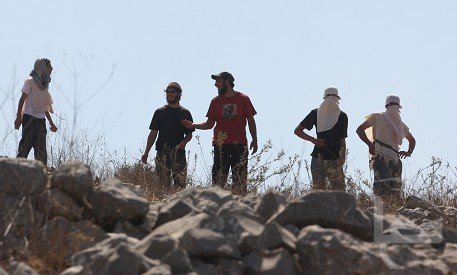
Al-Buwayra, HEBRON: This morning, in a second day of violence in the village of Al-Buwayra, near Hebron, two international peace activists were attacked by three Israeli settlers wearing black masks.
Both were left seriously injured and have been hospitalized following the unprovoked attack.
The settlers knocked Canadian Peter Cunliffe, 26, to the ground then beat him in the face and body using metal poles and wooden sticks. He is being treated for a probable broken nose and serious back injuries.
Danish peace activist Koba Soernesen. 23, is currently having his left foot examined as he is unable to stand.
He said: “We were sitting under a fig tree where we often sit, when they appeared out of nowhere, from the direction of the settlers’ area. Peter had his back to them and didn’t see them coming. They continued to beat him when he was on the floor, but I was able to fend them off a bit with my leg.
“They also stole my bag with my passport and camera in it.”
Both are currently receiving treatment in Hebron hospital.
The attack comes after violence erupted in Al Buwayra yesterday following the evacuation by Israeli authorities of an illegal Israeli outpost near the Kiyrat Arba settlement. Peace activists based in the area have been trying to prevent settlers setting fire to olive trees and documenting cases of attacks on Palestinians by settlers.
On 25th July two other peace activists, from the Christian Peacemaker Team, were attacked by settlers in Al Buwayra during a massive settler gathering at an illegal Israeli outpost.
CONTACT:
ISM Media Office: 054-618-0056
Available for interview: Koba Soerensen (English & Dansk): 052 821 0047
File photo by Ma’an Images
Featured Video

Russia Helping Build a New Middle East /Trita Parsi
or go to
Aletho News Archives – Video-Images
From the Archives
Sam Husseini: The entire US establishment helped lie their way into the Iraq war
By Slava Zilber | American Herald Tribune | October 14, 2019
Sam Husseini is a senior analyst with the Institute for Public Accuracy, independent journalist and contributor to The Nation and FAIR.
Slava Zilber: Sam, three years ago, you appeared on Talk Nation Radio with David Swanson and spoke about the case of the GCHQ whistleblower Katharine Gun. You pointed out that the people involved in the spying on the UN and the people authorizing the Iraq War were not held accountable:
“Virtually everybody who went along with the war, whether it is Kerry or Clinton, of course, the Bush administration themselves has falsified their own records in terms of why, what they did, when they did, why they did it, to the extent that they’ve been scrutinised at all.”
You also address it in a recent article. And recently, Joe Biden has been lying about his position on the Iraq War. How can such an important issue escape meaningful scrutiny? … continue
Blog Roll
 Aletho News
- Russia Helping Build a New Middle East /Trita Parsi
- Barghouti: ‘Netanyahu has fallen,’ era of Smotrich, Ben-Gvir over
- China slams US policy on Iran as Russia rejects legality of nuclear meeting at UN
- The Mecca Pact Courts Iran: Containment Comes Full Circle
- Oman FM: Persian Gulf states, Iran, Iraq should form security pact excluding US
- Trump peddles fresh falsehoods, claims Iran ‘started the war’ as US aggression drags on
- Ukraine quagmire? Yes, but it’s for NATO, not Russia
- US intelligence hypes Chinese, Russian space threats while accelerating its own military buildup in orbit
- Iran FM Araghchi: “Hormuz Will No Longer Be the Same”
- EU facing trillion-euro debt hole while seeking more cash for Kiev
- If Americans Knew
- An error has occurred; the feed is probably down. Try again later.
- No Tricks Zone
- Sudden Stratospheric Warming, Powerful El Niño Combination May Lead To Extreme Europe Cold, Energy Crisis!
- Two New Studies Find Thwaites Glacier Melt Cannot Be Driven By Human Activity Or A Warming Ocean
- E-Cars Reduce CO2 Emissions By Only 41% Compared To Internal Combustion Engine Vehicles
- Predictions Made By Renowned Climate Professor Over Past Decades Have Been Proven To Be Poor
- New Study Suggests Large Regions Of The Pacific Ocean Have Been Cooling For The Last 80 Years
- Germany’s Green Energy Debacle: High Energy Costs Force Kahla Porzellan to Close After 182 Years!
- New Study: 50 Years Of The Most Aggressive ‘Net Zero’ Policies Can Only Affect The Global Climate By 0.03°C
- US September “Heat” Was No Record…Many Records Set Decades Ago
- Latest European Green Energy Debacle; Portugal’s Largest Flagship Solar Park Insolvent!
- Green Energy Debacle: German Expert Professor Fritz Vahrenholt Warns Of Severe Economic And Social Consequences

