So You’re a Professor? Here’s What You Can Do to Oppose Genocide
By Steve Salaita | January 7, 2024
College instructors, particularly those in Europe and North America, are generally limited when it comes to meaningful intervention in imperialist horrors afflicting the Global South. Nevertheless, it is usually their governments either orchestrating or abetting the horror. They ought to do something, then, even if it seems pyrrhic or inadequate.
People around the world are now witnessing a particularly gruesome event as the Zionist entity, armed by its U.S. sponsor and enjoying the support of capitalist institutions across the globe, commits one atrocity after the other in the Gaza Strip (along with the West Bank and at times further afield). The atrocities, anyone with a modicum of integrity agrees, add up to genocide. The depth of grief and suffering Palestinians now experience is indescribable, immeasurable.
Do professors and other campus workers have any ability to mitigate the grief and suffering? Not really. But we’re not entirely powerless, either. Higher education is an important sector for information and activism and an industry where participants like to contemplate the role of both exceptional and ordinary people in making a better world. Like anybody else, teachers and researchers can be most effective in their own communities, which are not inoculated from the genocide. Zionist groups have organized hundreds of defamation campaigns against Palestinian students and faculty, often resulting in employment termination and other serious forms of recrimination. These campaigns don’t exist in a vacuum. Targeting Palestinians and anti-Zionists is an extension of the genocide, or at least one of its attendant tactics. And then, of course, many of the campuses are somehow invested in the Zionist entity—financially, politically, or logistically. It does no good to say that “we” aren’t affected by what happens “there.”
The following is a list of suggestions for Western academics, with the understanding that not all professors are equal and each campus is different in terms of its cultural and economic composition. In turn, I have tried to be comprehensive, offering comments that I hope will be useful to everyone from contingent faculty whose employment is precarious to senior scholars with big platforms at elite institutions. (The latter are much more likely to be facilitating the genocide, either obliquely or explicitly, but nevertheless.)
One thing is clear: the world is now experiencing a moral crisis whose enormity will reshape political attitudes and alliances for generations to come. Pretending that life, no matter how sheltered or comfortable, can simply continue as normal is its own kind of moral crisis.
Try one or more of the following if you can:
Defend Palestinian Students: Be it from forces on or off campus, or be it individuals you know or don’t know personally, it is reprehensible that students should suffer doxing and harassment, whether it is orchestrated by skeezy has-beens like Michael Rapaport or hysterical faculty on their own campus. Speak on behalf of your students. It can be done publicly through the usual channels or in private communication with chairs, deans, and other administrators. Or keep it simpler: reach out to the students and offer yourself as a resource.
Defend Palestinian Colleagues: The same idea holds, but with a quick addendum. Being a Palestinian in Western academe can be deeply alienating, in no small part because shitting on Palestinians is a reliable method of upward mobility. I’m sure some of your Palestinian colleagues will appreciate any gesture that might make them feel slightly less alone.
Boycott: Up to this point, academic boycott of Israeli universities has been controversial, even in supposedly progressive quarters of the industry. The facts, however, are clear. Israel has destroyed every institution of higher learning in the Gaza Strip. It has murdered dozens of faculty and administrators, including university presidents, and an untold number of students. There is no academic freedom in Palestine. There is no academe at all in Gaza. Reluctance to boycott is no longer acceptable. It is the baseline of political decency. Anybody who continues to oppose or dissemble about academic boycott should be regarded as untrustworthy on everything else.
Divest: Start or join a local campaign to force your university to divest any holdings from the Zionist entity. Divestment can include study abroad programs in Israel, which inherently discriminate against Palestinian, Arab, and Muslim students. In the past decade, students have successfully passed divestment resolutions at numerous universities, but management simply ignores them. Faculty voices will help these efforts.
Invite People from Gaza: Surely the rank-and-file in academe are tired of the same few dozen big-name professors and celebrity activists saying the same three or four things in the lucrative lecture economy. Decisionmakers on campus invite speakers for prestige, for the brand, or else to network or be in the presence of fame. The habit needs to die and there’s no better time than now. Instead of summoning the usual Endowed Chair of Gobbledygook at Wealthy Private University to deliver radical affectations at a cost of multiple thousands, reach out to scholars and journalists from Gaza (and for God’s sake give them a proper honorarium). They will assuredly be more insightful than warmed-over relics of the pre-millennial theory craze. Likewise: recruit graduate students from Palestine. You can also look into bringing Palestinians as visiting writers/scholars or as researchers/consultants in any effort to document the genocide. Start with people who are currently outside of Gaza; when conditions are better, reach out to those still inside the territory. Gaza is filled with individuals of remarkable talent. You will be better off for having sought it.
Organize or Attend a Demonstration: You don’t need to be a seasoned organizer to raise hell about the abomination that is the Zionist entity.
Direct Action: Why should students always be the ones to shut down administrative offices or gum up the machinery of genocide? Professors can participate, as well. I’m not saying you need to do it. I just want you to bear in mind that nobody, no matter how urbane or well-published, is too good to get fired or sit in jail for a few hours in solidarity with a people whose heroism is known and admired around the world.
Teach Palestine: Hundreds of Palestinian poets, novelists, and essayists write in English or are available in translation. Consider including them on your syllabus. So what if your courses don’t focus on Palestine or the surrounding region? If you’re a modernist, then assign Fadwa Tuqan or Mahmoud Darwish. If you’re in gender studies, look up Fatima Bernawi or Rasmea Odeh. If you teach novels, try Susan Abulhawa, Susan Muaddi Darraj, Sahar Mustafah… on goes the list. If you’re an Americanist, there are numerous options. Same for Latin Americanists. A critical theorist? No problem: there’s Elias Sanbar and Bassel Al-Araj and Ghassan Kanafani. And if you’re, say, a medievalist? That’s no problem, either.
Stop Pandering to Customs of Civility: You don’t need to condemn “Hamas.” You don’t need to “affirm Israel’s right to exist.” You don’t need to bang on about “democratic values.” You don’t need to be “nuanced.” You need to defend the people suffering a genocide. Not a single one of them is asking for anything else. (“Who is my audience?” keep asking yourself. If the answer is anything other than “the dispossessed,” then recalibrate your ethics and try again.)
Shun the Genocidaires: Those rationalizing or cheering on the genocide are personae non grata from here on out. No co-authoring articles with them. No sitting together on conference panels. No buddy-buddy bullshit on the networking circuit. Sure, sometimes circumstance will force you onto the same committee or whatever, but, if the association is voluntary, then decline the opportunity and find colleagues who don’t celebrate mass murder.
Speak: [speak]
Or better still: Listen.
US military buildup in Red Sea ‘serious’ threat to intl. shipping: Yemen

Press TV – January 5, 2024
Yemen’s Ansarullah resistance movement has cautioned that the US militarization of the Red Sea in an attempt to serve the Israeli regime will pose a serious threat to international shipping in the strategic waterway.
Ansarullah made the statement on Friday after the United States, which has over the past weeks been spearheading a maritime coalition in the Red Sea under the pretext of safeguarding the transit of vessels in the area, claimed that the Yemeni forces and the popular resistance movement were targeting international ships and jeopardizing the security of the Red Sea.
The United States and the coalition members warned Yemen’s Armed Forces of “consequences” if they continued their missile and drone attacks against ships en route to Israeli ports in support of Palestinians in the besieged Gaza Strip.
Ansarullah said the Yemeni armed forces never attacked international ships and that the security and safety of international maritime transport in the Red Sea, the Arabian Sea and the Bab el-Mandeb Strait was guaranteed by them.
“The US claim and the statement of 12 countries regarding the [Yemeni] threat to international shipping is not true. This threat stems from the militarization of the Red Sea by the United States to serve the Israeli regime and encourage the regime to continue its crimes against Gaza,” the resistance movement said in a statement.
“The Israeli attacks on the Gaza Strip and its genocidal crimes against Palestinians, which has entered the fourth consecutive month, should have forced the so-called international community or the UN Security Council to stop such massacres by the Israeli regime,” it added.
Ansarullah categorically censured the Israeli aggression against the besieged territory and said it has so far killed more than 22,000 Palestinians, injured tens of thousands of others, and “destroyed everything in Gaza.”
“The bloody events that have been taking place in Gaza for the past three consecutive months would not have been possible without the support of the United States and the complicity of Western countries with the criminal Zionist regime and encouraging it to continue its crimes against civilians in the Gaza Strip,” Ansarullah said.
Underlining that the regional countries cannot remain idle in the face of Israel’s genocidal war in Gaza and its suffocating siege on the Palestinian territory, the resistance movement said, “The Yemeni armed forces have carried out their missile, drone and naval operations to target the ships of the Israeli regime or the ships that move towards the ports of occupied Palestine.”
The statement said the US and its allies should know that their “evil alliance” will not prevent Yemen from continuing to support the oppressed people of Gaza by carrying out military operations against the ships of the Israeli regime or the ships that move towards the occupied Palestinian ports.
“Any attack on Yemen calls for a large-scale response, and Yemen does not accept any threat to its security and stability, and rejects the claim of the United States and its allies that Yemen is a threat to international shipping in the Red Sea,” Ansarullah said.
“The alliance of the United States and its allies was formed to support the Israeli regime and protect the ships of this regime, which is a real threat to the security and safety of international shipping and the security of the entire region,” the movement added, stressing that the coalition should bear the consequences of its escalation in the strategic waterway.
Yemenis have declared their open support for Palestine’s struggle against the Israeli occupation since the regime launched a devastating war on Gaza on October 7 after the territory’s Palestinian resistance movements carried out a surprise retaliatory attack, dubbed Operation Al-Aqsa Storm, against the occupying entity.
The relentless Israeli military campaign against Gaza has killed at least 22,438 people, most of them women and children. More than 57,614 individuals have been wounded.
Reports revealed that Israeli shipping companies have already decided to reroute their vessels in fear of attacks by Yemeni forces.
Yemeni forces have also launched missile and drone attacks on targets in the Israeli-occupied territories after the regime’s aggression on Gaza.
Gaza destroys western divide-and-rule narratives
By Sharmine Narwani | The Cradle | January 4, 2024
It could be a clean sweep. Decades of western-led narratives crafted to exploit differences throughout West Asia, create strife amid the region’s myriad communities, and advance western foreign policy objectives over the heads of bickering natives are now in ruins.
The war in Gaza, it transpires, has blown a mile-wide hole in the falsehoods and fairytales that have kept West Asia distracted with internecine conflicts since at least the 1979 Islamic Revolution in Iran.
Shia versus Sunni, Iran versus Arabs, secular versus Islamist: these are three of the west’s most nefarious narrative ploys that sought to control and redirect the region and its populations, and have even drawn Arab rulers into an ungodly alliance with Israel.
Facts are destroying the fiction
It took a rare conflict – uncooked and uncontrolled by Washington – to liberate West Asian masses from their narrative trance. Israel’s genocidal assault on Gaza also brought instant clarity to the question of which Arabs and Muslims actually support Palestinian liberation – and which do not.
Iran, Hezbollah, Iraqi resistance factions, and Yemen’s Ansarallah – maligned by these western narratives – are now visibly the only regional players prepared to buttress the Gaza frontline, whether through funds, weapons, or armed clashes that aim to dilute and disperse Israeli military resources.
The so-called ‘moderate Arabs,’ a misnomer for the western-centric, authoritarian Arab dictatorships subservient to Washington’s interests, have offered little more than lip service to the carnage in Gaza.
The Saudis called for support by hosting Arab and Islamic summits that were allowed to do and say nothing. The Emiratis and Jordanians trucked supplies to Israel that Ansarallah blockaded by sea. The mighty Egypt hosted delegations when all it needed to have done was to open the Rafah Crossing so Palestinians can eat. Qatar – once a major Hamas donor – now negotiates for the freedom of Israeli captives, while hosting Hamas ‘moderates,’ who are at odds with Gaza’s freedom fighters. And Turkiye’s trade with the Israeli occupation state continues to skyrocket (exports increased 35 percent from November to December 2023).
Palestine, for the pro-west ‘moderate Arabs,’ is a carefully handled flag they occasionally wave publicly, but sabotage privately. So, they watch, transfixed and horrified today, at what social media and tens of millions of protesters have made crystal clear: Palestine remains the essential Arab and Muslim cause; it may ebb and flow, but nothing has the power to inflame the region’s masses like this particular fight between right and wrong.
The shift toward resistance
It is early days yet in the battle unfolding between the region’s Axis of Resistance and Israel’s alliances, but the polls already show a notable shift in public sentiment toward the former.
An Arab barometer poll taken over a six-week period – three weeks before and three weeks after the Al-Aqsa Flood operation – provides the first indication of shifting Arab perceptions. Although the survey was restricted to Tunisia, the pollsters argue that the country is “as close to a bellwether as one could imagine” and that it represents views similar to other Arab countries:
“Analysts and officials can safely assume that people’s views elsewhere in the region have shifted in ways similar to the recent changes that have taken place in Tunisia.”
The survey results should be of paramount concern to meddling western policymakers: “Since October 7, every country in the survey with positive or warming relations with Israel saw its favorability ratings decline among Tunisians.”
The US saw its favorability numbers plummet the most, followed by West Asian allies that have normalized relations with Israel. Russia and China, both neutral states, experienced little change, but Iran’s leadership saw its favorability figures rise. According to the Arab barometer:
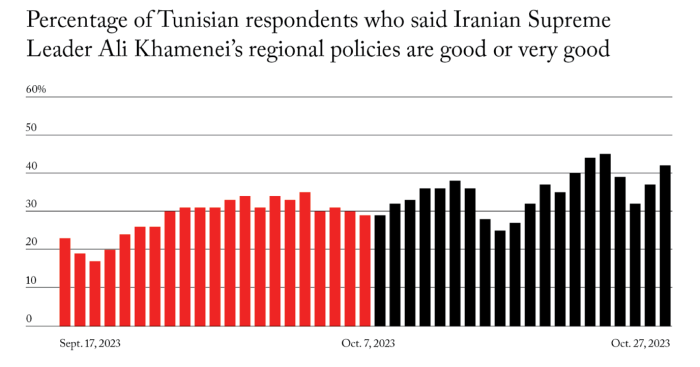
“Three weeks after the attacks, Iranian Supreme Leader Ali Khamenei has approval ratings that matched or even exceeded those of Saudi Crown Prince Mohammed bin Salman and Emirati President Mohammed bin Zayed.”
Before 7 October, just 29 percent of Tunisians held a favorable view of Khamenei’s foreign policies. This figure rose to 41 percent according to the conclusion of the survey, with Tunisian support most notable in the days following the Iranian leader’s 17 October reference to Israel’s actions in Gaza as a “genocide.”

The Saudi shift
Prior to the 7 October operation by the Palestinian resistance to destroy the Israeli army’s Gaza Division and take captives as leverage for a mass prisoner swap, the region’s main geopolitical focus was on the prospects of a groundbreaking Saudi normalization deal with Tel Aviv. The administration of US President Joe Biden flogged this horse at every opportunity; it was seen as a golden ticket for his upcoming presidential election.
But Operation Al-Aqsa Flood ruined any chance for Saudi Arabia – home to Islam’s holiest sites – to seal that political deal. And with Israeli airstrikes raining down daily on Palestinian civilians in Gaza, Riyadh’s options continue to shrink.
A Washington Institute poll conducted between 14 November and 6 December measures the seismic shift in Saudi public sentiment:
A whopping 96 percent agree with the statement that “Arab countries should immediately break all diplomatic, political, economic, and any other contacts with Israel, in protest against its military action in Gaza.”
Meanwhile, 91 percent believe that “despite the destruction and loss of life, this war in Gaza is a win for Palestinians, Arabs, and Muslims.” This is a shockingly unifying statement for a country that has adhered closely to western narratives that seek to divide Palestinians from Arabs, Arabs among themselves, and Muslims along sectarian lines – geographically, culturally, and politically.
Although Saudi Arabia constitutes one of the few Arab states to have designated Hamas as a terrorist organization, favorable views of Hamas have increased by 30 percent, from 10 percent in August to 40 percent in November, while most – 95 percent – do not believe the Palestinian resistance group killed civilians on 7 October.
Meanwhile, 87 percent of Saudis agree with the idea that “recent events show that Israel is so weak and internally divided that it can be defeated some day.” Ironically, this is a long-stated Resistance Axis refrain. Hezbollah Secretary General Hassan Nasrallah was famously quoted as saying “Israel is weaker than a spider’s web,” upon its defeat by the Lebanese resistance on 25 May, 2000.
Prior to 7 October, Saudis had strongly favored economic ties with Israel, but even that number dropped dramatically from 47 percent last year to 17 percent today. And while Saudi attitudes toward the Resistance Axis remain negative – Saudi Arabia, after all, has been the regional epicenter for anti-Iran and anti-Shia propaganda since the 1979 revolution – that may be largely because their media is heavily controlled.
Contrary to the observations of the Arab masses, 81 percent of Saudis still believe that the Axis is “reluctant to help Palestinians.”
The Palestinian shift
Equally important to the discussion of Arab perceptions is the shift seen among Palestinians themselves since 7 October. A poll conducted by the Palestinian Center for Policy and Survey Research (PSR) in both the occupied West Bank and Gaza Strip between 22 November and 2 December mirrors Arab views, but with some nuances.
Gazan respondents, understandably, displayed more skepticism for the ‘correctness’ of Hamas’ Operation Al-Aqsa Flood, which triggered Israel’s genocidal assault on the Strip in which over 22,000 civilians – mostly women and children – have so far been brutally killed. While support for Hamas increased only slightly in the Gaza Strip, it tripled in the West Bank, with both Palestinian territories expressing near equal disdain for the western-backed Palestinian Authority (PA), which governs from Ramallah.
Support for acting PA President Mahmoud Abbas and his Fatah party was hit hard. Demands for his resignation are at nearly 90 percent, while almost 60 percent (the highest number recorded in a PSR poll to date in relation to this matter) of those surveyed want a dissolution of the PA.
Over 60 percent of Palestinians polled (closer to 70 percent in the West Bank) believe armed struggle is the best means to end the occupation, with 72 percent agreeing with the statement that Hamas made a correct decision to launch its 7 October operation, and 70 percent agreeing that Israel will fail to eradicate the Palestinian resistance in Gaza.
Palestinians have strong views about regional and international players, who they largely feel have left Gaza unprotected from Israel’s unprecedented violations of international law.
By far the country most supported by respondents is Yemen, with approval ratings of 80 percent, followed by Qatar (56 percent), Hezbollah (49 percent), Iran (35 percent), Turkiye (34 percent), Jordan (24 percent), Egypt (23 percent), the UAE (8 percent), and Saudi Arabia (5 percent).

In this poll, the region’s Axis of Resistance dominates the favorability ratings, while pro-US Arab and Muslim nations with some degree of relations with Israel, fare poorly. It is notable that of the four most favorable countries and groups for mostly-Sunni Palestinians, three are core members of the “Shia” Axis, while five Sunni-led states rank lowest.
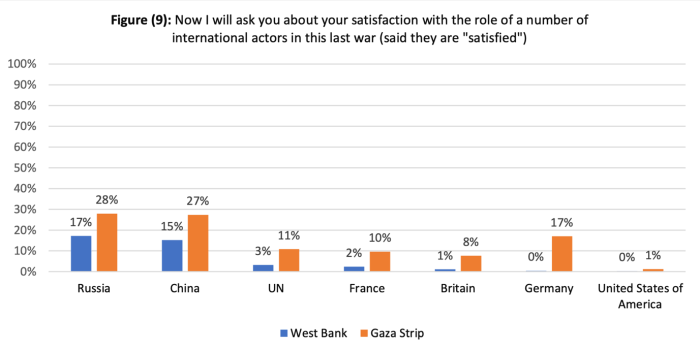
This Palestinian view extends to non-regional international states, with respondents most satisfied with Resistance Axis allies Russia (22 percent) and China (20 percent), while Israeli allies Germany (7 percent), France (5 percent), the UK (4 percent), and the US (1 percent) struggle to maintain traction among Palestinians.
The numbers depend on the war ahead
Three separate polls show that Arab perceptions have shifted dramatically over Israel’s war on Gaza, with popular sentiment gravitating to those states and actors perceived to be actively supporting Palestinian goals, and away from those who are perceived to support Israel.
The new year starts with two major events. The first is the drawdown of Israeli reservists from Gaza, whether because Washington demands it, or due to unsustainable loss of life and injury to occupation troops. The second is the shocking assassination of Hamas leader Saleh al-Arouri and six others in Beirut, Lebanon, on 2 January.
All indications are that Israel’s war will not only continue, but will expand regionally. The new US maritime construct in the Red Sea has drawn other international actors into the mix, and Tel Aviv has provoked Lebanon’s Hezbollah in a major way.
But if the confrontation between the two axes escalates, Arab perceptions will almost certainly continue to tilt away from the old hegemons toward those who are willing to resist this US-Israeli assault on the region.
There will be no relief for Washington and its allies as the war expands. The more they work to defeat Hamas and destroy Gaza, and the more they lob missiles at Yemen, Iraq, and Syria, and besiege the Resistance Axis, the more likely Arab populations are to shrug off the Sunni-versus-Shia, Iran-versus-Arab, and secular-versus-Islamist narratives that have kept the region divided and at odds for decades.
The swell of support that is mobilizing due to a righteous confrontation against the region’s biggest oppressors is unstoppable. Western decline is now a given in the region, but western discourse has been the first casualty of this war.
McDonald’s latest business titan to face impact of pro-Israel stance

The Cradle | January 5, 2024
The CEO of McDonald’s, Chris Kempczinski, said on 4 January that several markets in West Asia and some outside of the region were facing a “meaningful business impact” due to the war between the Palestinian resistance and Israel.
Kempczinski also said that “associated misinformation” about the company has been a reason for the financial issues the brand is facing, and that the misinformation surrounding McDonald’s was “disheartening and ill-founded.”
Western Israeli-linked fast food chains, including McDonald’s and Starbucks, have seen large grassroots boycott campaigns emerge over pro-Israel stances and alleged financial ties with Israel.
“In every country where we operate, including in Muslim countries, McDonald’s is proudly represented by local owner-operators who work tirelessly to serve and support their communities while employing thousands of their fellow citizens,” Kempczinski said in a social media post. “That local community connection is the genius of the McDonald’s system.”
West Asian locations of McDonald’s are part of the company’s international developmental licensed markets division, a section that generates around 10 percent of the company’s revenue.
McDonald’s franchisee in Malaysia, owned by Saudi Arabia’s Lionhorn Pte Ltd, filed a lawsuit against BDS Malaysia, accusing the group of “defamation,” and is seeking damages of over $1 million. Meanwhile, the Israel franchisee has supported the Israeli army by supplying its forces with free meals, according to BDS, “during the ongoing genocide of 2.3 million Palestinians in Gaza.”
Starbucks, another Western, Israeli-linked company, has also come out to say that the negative views brought upon the brand have been “influenced by misrepresentation on social media of what we stand for.”
In December 2023, the losses of Starbucks, a Seattle-based company, stood at $11 billion in value during the last quarter, due to Palestinian solidarity boycotts and employee strikes.
The company tried to bounce back on losses by implementing a scheme during the holiday season that would allow consumers to receive a free holiday cup with every purchase.
When announcing the gimmick in mid-November last year, the company’s market share crashed by 8.96 percent, accounting for billions in losses, the lowest the company has experienced since 1992.
‘Elbit 8’: Palestine Action activists conclude legal fight for disrupting Israeli arms trade
By Reza Javadi | Press TV | December 27, 2023
In a significant development, a group of Palestine Action activists, known as the ‘Elbit Eight’, have been acquitted for their role in shutting down UK Elbit Systems, Israel’s largest arms producer, whose lethal weapons are being used against Palestinians in the Gaza Strip.
Elbit Systems’ weaponry prompted the Palestine Action activists to face a total of 12 charges, including criminal damage, burglary, blackmail, and encouraging criminal damage.
The charges were related to anti-Israel protests held between July 2020 and January 2021, immediately after the pro-Palestinian network was founded in early 2020.
The trial, which commenced on November 13, saw the Crown Prosecution Service (CPS) amending the indictment, eventually bringing thirteen counts against the activists: seven counts of damaging property (criminal damage), three counts of burglary with intent to commit criminal damage, one count of possessing articles with intent to damage property, one count of threatening to damage property, and one count of encouraging others to commit the offense of criminal damage.
Since the group’s inception in 2020, and in protest against the Israeli regime’s atrocities against the Palestinians, they have led several mobilizations in the UK as well as in the US, targeting the factories and offices of firms that supply munitions used in Israel’s occupation of Palestine.
Their protest methods have included sit-ins, blockades and paint jobs.
The group’s actions, including occupying Elbit Systems’ drone and weaponry factories in Shenstone and Oldham, aimed to challenge Elbit’s operations in Britain and prevent the manufacturing of weapons destined for the Israeli regime.
The defense case
At the beginning of the trial that lasted six weeks, the eight activists received a plea deal: if Huda Ammori and Richard Barnard pleaded guilty, others would be acquitted.
Rejecting the plea deal, the activists spent six weeks in Snaresbrook Crown Court pleading not guilty, asserting that Elbit and Israel bear responsibility for the offenses, not Palestine Action.
Echoing the defense’s narrative presented during the trial, Richard Barnard, co-founder of Palestine Action, underscored the group’s primary goal to terminate British complicity in the Israeli apartheid regime’s crimes against Palestinians.
Barnard was convicted by a 10-2 majority of one count of criminal damage, for an action at the now-closed Elbit Ferranti factory in Oldham. The jury failed to reach a majority decision regarding the remaining 23 charges.
“The idea was – and the idea still is – to end the British complicity in the Israeli apartheid regime,” he told the jury. “I am trying to prevent war crimes … I am trying to stop bombings and trying to stop drones [in Palestine].”
Meanwhile, two of the Elbit Eight activists, Genevieve Scherer and Jocelyn Cooney, were unanimously acquitted on all charges faced.
Other activists highlighted their personal experiences and the urgency driving their direct actions, contending that conventional means, such as divestment campaigns, were insufficient in addressing the ongoing human rights violations in Gaza.
Huda Ammori, charged with six counts including damaging property and burglary, stressed her Palestinian-Iraqi background, narrating formative experiences such as the Iraq War and the ongoing ethnic cleansing of native Palestinians in Gaza.
She stressed that direct action was the only viable solution to end such atrocities perpetrated by the occupying regime, given the ineffectiveness of legal avenues and divestment campaigns.
“All other attempts fell short. Our exports to Israel are against our own license rules and against international law, but they can’t be stopped by the courts,” Ammori said.
“Divestment campaigns, after years of work, were taking way too long; it wasn’t matching the reality of the urgency of the situation. Every day, Palestinians were being killed, imprisoned – surveilled under these drones 24/7.”
Direct action is the only option
Ammori, a co-founder of the Palestine Action network, hastened to add that if the UK government continues to ignore facts and violate rules, then the only option is “direct action”, which means to “stop weapons from going there.”
“After pushing back our case for two years, the state has failed again to deter an ever-growing global direct-action movement. Every day we’ve been on trial, more Palestinians have been massacred using Elbit’s weaponry,” she asserted.
“The duty of the people is clear – to take all direct action possible to Shut Elbit Down wherever you are. Justice will be complete when Palestine is free.”
Robin Refualu, another activist of the group, charged with burglary and damaging the drone factory UAV Engines, shared his experiences from Palestine and spoke of the direct action he was involved in there to stop home demolitions and illegal settlements and emphasizing the trial’s relevance to the broader Palestinian struggle over the past 75 years.
“This trial is not about us, it’s not even about Palestine Action, in my opinion,” Refualu said. “It’s about what’s happening in Gaza at the moment and what’s been happening in Palestine for the last 75 years.”
Genevieve Scherer, drawing on her upbringing in Uganda, criticized the futility of criminal damage charges when Elbit Systems and those they arm cause havoc in Gaza.
She underscored how British law prioritizes property over human lives.
Caroline Brouard emphasized the obligation to prevent an ongoing genocide and stated that when governments fail to uphold duties, it falls on the people to act. She believed that actions at UAV Engines in Shenstone could immediately impact stopping bombings in Gaza.
“The drones malfunction all the time, needing replacement parts, and UAV Engines has a 24hr dispatch policy – we stopped these engines getting to Israel and so stopped the drones from flying,” Brouard asserted.
Urgency of stopping crimes
Jocelyn Cooney, a frontline social worker, joined Palestine Action to address the urgency of stopping crimes. She referred to Elbit Systems as the “muscle” enabling genocide in Palestine.
“So I think we all have a responsibility as humans to step up and take direct action to stop this company from producing weapons to murder people,” she said.
Emily Arnott, charged with damaging property and burglary, spoke about her time in Palestine, highlighting the impact of apartheid and the Israeli regime’s brutal domination over Palestinian lives.
Nicola Stickells, charged with criminal damage, emphasized the necessity of action when other efforts were ineffective. She pointed to ongoing war crimes in Gaza and questioned why activists faced legal consequences while those responsible for genocide profited freely.
The Israeli regime forces are “rounding up men.. and taking them to undisclosed places, stripped, kneeling blindfolded, this genocide is occurring as we speak,” said Stickells, a mother of two who was raised in a working-class family in the English county of Kent.
“How can we be the criminals when the perpetrators of… [what] we now know is a genocide … are free to profit and we have to spend weeks and weeks in court for an action that we took three years ago?” she asked.
“When you try and stand for human rights, you become the criminal. This is not right.”
Palestine Action UK has escalated actions against Elbit Systems since October 7, including activists climbing factory roofs in various cities.
“Palestine Action activists occupy the roof of the Israeli weapons factory Elbit Systems in the town of Shenstone, England, in protest of its production of equipment used in Israel’s murder of innocent Palestinians,” Palestine Action UK said in a statement on October 31.
UK complicity in Israeli crimes
The trial comes on the heels of nationwide protests in the UK in solidarity with the Palestinian people and against the genocide in Gaza. These demonstrations have been met with intensive state monitoring, harassment, and muzzling of pro-Palestinian voices and actions.
The trial also draws attention to the broader issue of the UK’s arms sales to the Israeli regime, given Elbit Systems’ significant role as a major supplier to the Israeli military.
The weapons company is Israel’s largest private arms company in the UK that supplies the Israeli military with 85 percent of the drones used against Palestinians. The British government has been criticized for being “complicit in Israeli crimes” due to its relations with this company.
Two of Israel’s biggest weapons factories, Elbit and Rafael, both have operations in the UK.
Declassified UK recently revealed that the British government has approved at least £472m in arms sales to the Israeli regime in the past eight years, ignoring the genocide in Gaza and the occupied West Bank.
Bahrain jails dissident for blasting Manama’s role in US-led anti-Yemen coalition

The Arleigh Burke-class guided-missile destroyer USS Cole (DDG 67)
Press TV | December 21, 2023
Bahraini authorities have ordered the seven-day detention of a leading opposition figure after he denounced the Al Khalifah regime’s participation in the US-led coalition against Yemen in the Red Sea.
Bahrain’s office of public prosecution ordered Ebrahim Sharif’s detention pending investigation for “spreading false news during wartime,” his family and lawyer said on Thursday.
Sharif, who heads the Wa’ad organization, in a series of posts criticized authorities in Manama for joining the coalition “without any consideration of the position of the Bahraini people who strongly support our besieged Palestinian people in Gaza.”
He was arrested on Wednesday. When asked about his case, the Bahraini government said “an individual” was being held for “allegedly supporting a proscribed terrorist organization.”
The charge against Sharif, a pro-democracy campaigner, can hold a prison sentence of up to 10 years.
Bahrain is the only state in the Persian Gulf region that has joined the US-led coalition established this week in response to Yemeni attacks on ships bound to the occupied Palestinian territories in the Red Sea.
Sayed Ahmed Alwadaei, advocacy director at the UK-based Bahrain Institute for Rights and Democracy (BIRD), said the Bahraini regime “wants to make an example of Sharif who is not alone in his criticism of Bahrain’s decision to the join the Americans.”
“Failure of the US administration to publicly denounce his arrest and push for his immediate release gives the green light to the Bahrain government to continue his detention,” Alwadaei said.
The Pentagon has announced a military coalition of 10 countries, including Britain and Spain, to counter the Yemeni forces that targeted ships bound for Israel in solidarity with the people of Gaza.
A series of strikes attributed to the Yemeni forces have been conducted in solidarity with the Palestinians in the besieged Gaza Strip. Yemen has already warned it will prevent the passage of all ships in the Red Sea bound to the occupied territories.
The leader of Yemen’s Ansarullah movement said in a televised speech broadcast live Wednesday that the armed forces will not hesitate to target US military warships in the Red Sea if Washington and its allies carry out military strikes against Yemen.
Bahrain’s main opposition group al-Wefaq National Islamic Society recently denounced human rights violations in the country.
Al-Wefaq has denounced Manama’s normalization of relations with Israel as “a crime.”
The opposition party has underlined that the normalization is in flagrant contradiction to Bahrain’s history and Islamic identity.
Bahrain and the Israeli regime established diplomatic relations in 2020 as part of the United States-brokered Abraham Accords.
Last month, the deputy speaker of Bahrain’s National Assembly said members of the legislative body were pressing to reverse the normalization following the regime’s devastating war in Gaza.
Abdulnabi Salman said Bahraini lawmakers were demanding an end to diplomatic relations with Israel.
The Persian Gulf country has witnessed numerous protests ever since the rapprochement.
The United States and Britain refrain from the criticism of human rights violations across Bahrain.
In July, British legislators were pressing the government to provide clear explanations why Bahrain has been removed from its list of human rights priority countries, accusing the government of putting its principles “up for auction” after sealing a billion-pound investment deal with the Persian Gulf state.
Malaysia imposes docking ban on Israeli cargo ships in solidarity with Gaza
Press TV – December 20, 2023
The Malaysian government has imposed an indefinite ban on vessels owned by an Israeli shipping cargo company from docking at its ports in response to the bloody Israeli onslaught against Palestinians in the Gaza Strip.
Ships en route to the occupied Palestinian territories and Israeli-flagged vessels will also be barred from loading cargo at any port in the largely Muslim Southeast Asian nation.
Prime Minister Anwar Ibrahim said in a statement on Wednesday that the Transport Ministry has been instructed to enforce the ban with immediate effect.
Anwar singled out Israel’s biggest shipping firm ZIM.
Malaysia’s cabinet had in 2002 authorized Israeli-registered companies to dock vessels at Malaysian ports; and in 2005, allowed Israeli-registered ships to anchor in Malaysia. However, Wednesday’s statement said that authorizations had been rescinded.
“The Malaysian government decided to block and disallow the Israeli-based shipping company ZIM from docking at any Malaysian port,” Anwar said.
“These sanctions are a response to Israel’s actions that ignore basic humanitarian principles and violate international law through the ongoing massacre and brutality against Palestinians.”
Malaysia “also decided to no longer accept ships using the Israeli flag to dock in the country” and ban “any ship on its way to Israel from loading cargo in Malaysian ports.”
Anwar said his country was confident its trade would not be affected by the decision.
Malaysia does not have diplomatic ties with Israel.
Malaysians have kept up a strong show of support for the Palestinian people’s struggle to claim their sovereign rights, and strongly condemned the cruelties being perpetrated by the Israeli regime in Gaza.
Malaysians in various parts of the country have held marches and motorcycle convoys to voice their support for the Palestinian people, who are suffering from oppression and atrocities committed by the Israeli regime.
Muslim scholars have called on all people to show undivided support for Palestine because the Palestinian issue is related to humanity and not just religion.
Israel waged the brutal war on Gaza on October 7 after the Palestinian Hamas resistance movement carried out Operation Al-Aqsa Storm against the usurping entity in retaliation for its intensified atrocities against the Palestinian people.
Since the start of the offensive, the Tel Aviv regime has killed at least 19,667 Palestinians, mostly women and children, and injured 52,586 others.
Thousands more are also missing and presumed dead under the rubble in Gaza, which is under “complete siege” by Israel.
The moral obligation to shut down Israeli weapons manufacturers
By Naila Ahmed | MEMO | December 14, 2023
You may be unaware that currently eight people are standing trial for shutting down an Israeli weapons factory, amongst other actions. Over the course of the last few weeks I have managed to attend some of their hearings at Snaresbrook Crown Court. For the duration of that time, the courtroom was packed as the defendants, known as the Elbit Eight, gave evidence about why they took action for Palestine, Israeli war crimes and Elbit Systems’ participation in those crimes.
Israel’s largest weapons manufacturer
Elbit Systems is Israel’s largest weapons manufacturer, profiting off the genocide of Palestinians, it markets its drones and weapons as “battle tested”. The weapons are tested on civilians in Gaza before being mass produced. Elbit Systems supplies up to 85 per cent of the Israeli military’s drones and land based equipment. These weapons are produced here in the UK by Elbit Systems’ factories across the country. In the last few weeks alone Israel has murdered over 20,000 Palestinians and destroyed hospitals, schools, homes and the entire infrastructure in Gaza – using weapons produced by Elbit Systems. One of the main witnesses from Elbit, their chief of security, was due to give evidence for the prosecution at the trial, but Israel refused to let him travel or even give evidence remotely, despite him being a crucial witness for the prosecution.
The Elbit Eight have been on trial since 13 November,two of them are founders of Palestine Action. They are all on trial for the direct action they have taken against Elbit Systems in the first six months of Palestine Action’s work, from July 2020. Direct action is a form of protest that seeks to shut down and disrupt. For the Elbit Eight this included protesting inside Elbit Systems offices, spraying red paint to signify Palestinian blood, and shutting down weapons factories by blocking entrances and locking themselves to the building so they cannot be moved and weapons supply is halted. The charges against these actionists are politically motivated and there’s even evidence of Israel’s involvement in them being charged.
Choose courage for Palestine
I’ve been listening to testimony from the Elbit Eight, and reflecting on the actions they took and why they took them. One thing that stood out to me most was that these actionists chose courage for Palestine. They didn’t let the fear of prison or prosecution stop them from using their voices and their bodies to prevent weapons being sent to kill our brothers and sisters in Palestine.
In each testimony given by the eight actionists, they stated their moral and legal obligation to stop an apartheid regime, to prevent the genocide of the Palestinian people and to shut Elbit down. Many of them testified to the numerous ways they engaged in the system prior to taking direct action, whether that be writing to MPs or other forms of traditional campaigning, all of which amounted to nothing. One actionist said that they wished direct action wasn’t necessary, that our government would just sanction Israel and stop arming them. But that isn’t a reality. Britain is responsible not only in the creation of the Zionist state but also in the continuous arming of this apartheid regime. So the obligation is upon us to take action in order to stop arming Israel.
As the state seeks to protect institutions and warmongers at every level, taking action to shut down the flow of weapons to the occupation becomes the most moral action we can take. There’s a moral duty to prevent the genocide of an entire people. The state seeks to criminalise such principled actions by arresting, charging and in some cases imprisoning those who take action.
With courage comes risk
All of the actionists that work with Palestine Action are the same. They choose courage and compassion over all else. They take actions knowing there is inherent risk – risk to their livelihood, to their liberty, but the moral obligation to act and prevent harm overrides the concern for their personal lives.
I have been privileged to work alongside the Elbit Eight and many other activists in the run up to this trial. One of my colleagues at CAGE also took action previously and won her case last year by a unanimous not guilty verdict. The acts of courage she took, could have cost her a career as a barrister, but it was a material risk she was willing to take in the defence of the Palestinians and to prevent harm from reaching them.
Over the last three years, Palestine Action has been highly effective in its campaigning and direct action against Israeli arms manufacturers, in particular Elbit Systems. Its stated aim is to shut Elbit down, and this has galvanised across the country, and across the globe as you see people taking direct action to stop weapons being sent to Israel. Palestine Action in the UK has been successful in:
-
Costing Elbit over £280 million ($356 million) in lost contracts,
-
Shutting down Elbit’s offices in central London,
-
Forcing the permanent closure of two of Elibit’s weapon factories,
-
Just this month, getting their sole recruiter in the UK, iO Associates, to stop working with Elbit,
-
Getting the property managers of Elbit’s drone factory in Shenstone (UAV Engines), Fisher German, to cut all ties with Elbit Systems.
These successes have inspired the launch of Palestine Action US and Italy who have already taken a series of effective actions.
‘Let him change it with his hand’
When I see those actionists taking direct action to stop Israeli weapons from being manufactured here in the UK, I am reminded of the often repeated hadith – saying – of the Prophet Muhammed (peace be upon him) – one we may cite often, but how often do we implement it?
“Whoever among you sees evil, let him change it with his hand. If he cannot do so, then with his tongue. If he cannot do so, then with his heart, which is the weakest level of faith.” (Sahih Muslim 49)
I see the work of Palestine action and the Elbit Eight as an embodiment of that hadith, of seeing an evil and changing it with their hands – that is, taking direct action.
We have all been witnessing what’s been happening in Gaza, the daily massacres, destruction, devastation and we often respond with despair and helplessness. There is an obligation upon us as Muslims to end oppression. This is not a time for despondency, confusion or weakness, we must not be bystanders as we witness genocide. The Elbit Eight chose courage for Palestine and we must choose courage too. Either by joining Palestine Action’s movement or by using our voice and supporting them in their work. Courage is indeed a choice. It may not be comfortable for many of us, but it is a choice we can build up to.
No matter the outcome of the trial, the Elbit Eight have already succeeded. First, in taking action that stopped weapons and parts being sent to Palestine. And secondly, for drawing attention to Israel’s and Elbit’s war crimes in open court, testifying to the massacres and current genocide of our brothers and sisters in Palestine.
Whatever comes from this trial, the Elbit Eight have already won, they put their bodies and freedoms on the line for Palestine. A courage many of us would hope to emulate. And I’m honoured to have supported them in the Elbit Eight campaign.
Iran, China, Saudi Arabia urge swift action to stop Israel’s war machine in Gaza
Press TV – December 15, 2023
Iran, China and Saudi Arabia have jointly demanded urgent action to end Israel’s atrocities in the besieged Gaza Strip, and provide sustainable relief to the Palestinians.
China’s Deputy Foreign Minister Deng Li hosted Deputy Foreign Minister for Political Affairs Ali Bagheri Kani of Iran and Saudi Vice Minister of Foreign Affairs Waleed bin Abdulkarim El-Khereiji in Beijing on Friday for the first time within the framework of the joint committee of the three countries.
In a statement, the trio expressed opposition to the forced displacement of the Palestinians, and underscored that any future arrangement about Palestine must embody the will of its people and support their right to establish their state and self-determination.
The diplomats also voiced concern about the current critical circumstances in Gaza.
The three officials agreed on the next meeting to be held in Saudi Arabia in June.
Also in the meeting, the diplomats discussed the progress in relations between Saudi Arabia and Iran, including the reopening of the respective embassies in Riyadh and Tehran.
The Iranian and Saudi diplomats expressed appreciation for China’s influential part in the rapprochement between Tehran and Riyadh and reaffirmed their full commitment to implementing the Beijing Agreement.
Doha Summit: US Risks Alienating Muslim World by Vetoing Gaza Ceasefire Resolutions
By Ekaterina Blinova – Sputnik – 10.12.2023
A DC think tank has pointed out that Washington could lose influence in the Arab and Muslim world by killing off the UN ceasefire resolutions.
The US was the only country that vetoed a UN Security Council Gaza ceasefire resolution on Friday. The 15-member gathering voted 13-1 in favor of the initiative – with the United Kingdom abstaining.
Israel’s military operation in the strip has already claimed the lives of more than 17,700 people with 70% of them estimated to be women and children, per Gaza’s Ministry of Health.
Judging from the opening remarks at the 21st Doha Forum in Qatar on Sunday, the Arab world is deeply frustrated by Washington’s veto, DC think tank The Quincy Institute of Responsible Statecraft pointed out.
In particular, Foreign Minister of Qatar Sheikh Mohammed bin Abdulrahman Al-Thani said that Washington’s move to kill the resolution exposed the “great gap between East and West… and double standards in the international community.”
He placed emphasis on the necessity to create a new multipolar world order that “respects justice and equality between the people where no people are more powerful than the other.” The Qatari leadership vowed to continue exerting pressure on Tel Aviv and Hamas to implement a new truce despite “narrowing” chances.
Palestine Prime Minister Mohammad Shtayyeh argued that the US gave the “greenest of green lights” to Israel’s brutal methods of waging war in Gaza. Per him, Washington should be held responsible for Israel’s attacks and the loss of Palestinian lives.
For his part, Jordan’s Foreign Minister Ayman Safadi accused Tel Aviv of implementing a policy of expelling Palestinians out of Gaza by military actions.
Addressing the forum, United Nations Secretary-General Antonio Guterres stated that the humanitarian system is currently under threat: “We are facing a severe risk of collapse of the humanitarian system. The situation is fast deteriorating into a catastrophe with potentially irreversible implications for Palestinians as a whole and for peace and security in the region.”
“Last week, I delivered a letter to the President of the UN Security Council invoking Article 99 of the Charter of the UN for the first time since I became Secretary General in 2017,” said Guterres. “I wrote that there is no effective protection of civilians in Gaza. As a matter of fact, during my mandate, the number of civilian casualties in Gaza in such a short period is totally unprecedented.”
Article 99 of the UN Charter states: “The Secretary-General may bring to the attention of the Security Council any matter which in his opinion may threaten the maintenance of international peace and security.”
Meanwhile, DC think tank The Quincy Institute of Responsible Statecraft highlighted that humanitarian advocates repeatedly called the situation in Gaza “unprecedented”, adding that UN agencies are continuing to lose people in the war zone. The United Nations Relief and Works Agency has lost 134 relief workers in Gaza since Tel Aviv’s military operation began.
The Quincy scholars also warn about the growing anti-American sentiment in the Arab world, as Washington is seen as the major obstacle on the way to peace in Gaza due to its repeated vetoes of ceasefire resolutions in the UN.
Khaled Saffuri, executive director of the National Interest Foundation in Washington, told the think tank that he was “struck by the backlash against American brands” during his travels in Kuwait and Qatar over the last week. Per him, Arab customers and restaurants are boycotting Coke, Pepsi, McDonald’s, and Starbucks. Saffuri called Washington’s latest veto in the UNSC “horrible.” “America is losing a lot in the Muslim world,” he told the think tank.
Protesters flock to UK arms factories to block deliveries to Israel
The Cradle | December 7, 2023
Hundreds of demonstrators and workers closed off four weapons manufacturing facilities in the UK that produce parts for the F-35 stealth fighter jet, which Tel Aviv utilizes in its ethnic cleansing campaign of the Gaza Strip.
Videos shared on social media show dozens on 7 December barricading the entry points to the four arms factories from early morning, hindering employees from accessing the sites.
Earlier this week, human rights organizations took the Dutch government to court for permitting the delivery of F-35 components to Israel.
US arms and aerospace company Lockheed Martin produced the fighter jet parts. Before their shipment to Israel, these components were stored in a warehouse located in the Netherlands.
In another similar case, hundreds of pro-Palestinian protesters rallied at the Port of Tacoma in Washington State in an attempt to block a supply vessel suspected of transporting weapons and military equipment to Israel.
Featured Video
Seyed M. Marandi: U.S. Military DIVIDED? Iran’s Secret Defense EXPOSED
or go to
Aletho News Archives – Video-Images
From the Archives
‘Israel sees Iran as obstacle to its policies’
Press TV – August 25, 2017
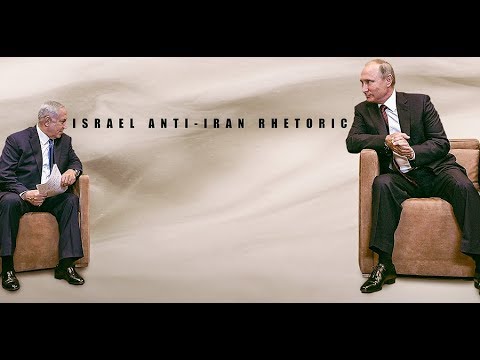
Prime Minister Benjamin Netanyahu has said that Israel felt threatened by Iran’s growing influence in the Middle East. Netanyahu expressed his Iranophobic view in a meeting with Russian President Vladimir Putin in Russia’s Black Sea resort of Sochi on Wednesday. Press TV has asked Scott Rickard, former American intelligence linguist from Tampa, Florida, and Brent Budowsky, a columnist at The Hill from Washington, to give their thoughts on the issue.
Rickard said Tel Aviv is concerned about the fact that the regime could not carry out its old project to spread sectarian divisions and pave the way for dismemberment of the countries in the Middle East region because of the Iranian-led resistance against Israeli policies, not only in the occupied territories of Palestine but also in the whole region.
“Iran is not a threat to Israel whatsoever. The threat that Israel sees is the fact that their Oded Yinon Plan is being put to a hold by Iran,” the intelligence linguist said on Thursday night.
“They (the Israelis) look at Iran as a threat only because they have no influence on their governments and Iran is autonomous and is not under the Zionist influence,” he added.
Since the victory of the Islamic Republic of Iran in 1979, Tehran has been critical of Israel’s policies in the region, whereas “no leaders [of other states] even dared to speak out against Zionism,” Rickard argued. … continue
Blog Roll
 Aletho News
- Evidence points to Ukraine being behind TurkStream attempted sabotage, but that should come as no surprise
- Sri Lanka secures supplies of Russia oil – minister
- Nations across Asia strike direct deals with Iran for Hormuz passage
- IRGC commander declares ‘new phase’ of reprisal attacks against aggressors
- Israel’s air defenses overwhelmed by cluster-warhead Iranian missiles: Reports
- Striking Iran’s Infrastructure Would Have Little Military Impact – Report
- What’s Behind U.S./Israeli Strikes On Iranian Pistachio Factories?
- Seyed M. Marandi: U.S. Military DIVIDED? Iran’s Secret Defense EXPOSED
- How I fell foul of the BBC thought police
- The End of NATO
- If Americans Knew
- Trump says Iranians appreciate bombs, WHO warns of nuclear risks – Daily Update
- U.N. experts demand Israel release prominent Gaza doctor after reports of ‘severe torture’
- Israel’s Latest Genocide Is Against the Shias of Lebanon. Why Is the World Silent?
- How Eliot Cohen’s influence over U.S. war-making paved the way for Trump’s war crimes in Iran
- Israelis don’t pay for the weapons we ‘sell’ to them — US taxpayers do
- While Distancing from AIPAC, Most 2028 Democratic Hopefuls Are Still Embracing Israel
- A brief history of the Israeli nuclear program, the open secret at the heart of the Iran war
- Israeli Settlers Killed a Palestinian Farmer on His Own Land, in Front of His Father. Yes, Again
- The US-Israeli War on Science is an Assault on our Future
- 100+ International Law Experts Say US Strikes on Iran Violate UN Charter, Could Be War Crimes
- No Tricks Zone
- An Inconvenient Tree: Uncovered In Alps… Europe Much Warmer Than Today 6000 Years Ago
- New Study Reports A 60% Slowdown In Greenland’s Ice Loss Rate In The Last Decade
- Low Intensity Tornado Wrecks Major Solar Farm, Creating A Potential Toxic Dump
- New Study Finds Warming Saves Lives…Cold Temperatures 12 Times More Deadly Than Excess Heat
- German Science Blog Accuses PIK Climate Institute Of Hallucinating Climate Tipping Points
- Devastating Assessment Of Comirnaty Vaccine By Former Senior Pfizer Europe Toxicologist
- New Study: CO2 Is ‘Effectively Negligible’ As An Explanatory Climate Change Factor Since 2000
- Former Pfizer Toxicologist Dr. Helmut Sterz Tells Bundestag Hearing Pfizer Vaccine Should Have Never Been Approved
- Energy Expert: Germany’s Nuclear Phaseout Was A “500 Billion Euro Mistake”
- New Research: South Australia’s Mid-Holocene Sea Surface Temperatures Were 4°C Warmer Than Today
 Aletho News