Palestinian trade unionists call on dockworkers to block Israeli trade
Press release, 7 June 2010
The Palestinian trade union movement, as a key constituent member of the Boycott, Divestment and Sanctions National Committee (BNC), calls on dockworkers’ unions worldwide to block Israeli maritime trade in response to Israel’s massacre of humanitarian relief workers and activists aboard the Freedom Flotilla, until Israel complies with international law and ends its illegal blockade of Gaza. Drunk with power and impunity, Israel has ignored recent appeals by the UN Secretary General as well as a near consensus among world governments to end its siege, putting the onus on international civil society to shoulder the moral responsibility of holding Israel accountable to international law and ending its criminal impunity. Dockworkers around the world have historically contributed to the struggle against injustice, most notably against the apartheid regime in South Africa, when port workers unions refused to load/offload cargo on/from South African ships as a most effective way of protesting the apartheid regime.
Today, we ask you to join the South African Transport and Allied Workers Union (SATAWU), who resolved not to offload Israeli ships in Durban in February 2009 in protest of Israel’s war of aggression on Gaza, and the Swedish Dockworkers Union who resolved to blockade all Israeli ships and cargo to and from Israel in protest of Israel’s attack against the Freedom Flotilla and the ongoing deadly Israeli siege of the occupied Gaza Strip.
Israel’s ongoing blockade of essential food, health, educational and construction supplies is not only immoral, it is a severe form of collective punishment, a war crime that is strictly prohibited under Article 33 of the Fourth Geneva Convention, that is inducing mass poverty, water contamination, environmental collapse, chronic diseases, economic devastation and hundreds of deaths. This three-year-old medieval siege against 1.5 million Palestinians in Gaza has been squarely condemned by leading legal experts, including UN Special Rapporteur on Human Rights, Prof. Richard Falk, who described it as constituting “slow genocide.”
Israel’s deplorable attacks on the unarmed ships are a violation of both international maritime law and the UN Convention on the Law of the Sea, which states that “the high seas should be reserved for peaceful purposes.” Under article 3 of the Rome Convention for the Suppression of Unlawful Acts against the Safety of Maritime Navigation of 1988, it is an international crime for any person to seize or exercise control over a ship by force, and also a crime to injure or kill any person in the process. As prominent international law scholars have recently confirmed, there is absolutely no legal justification for Israel’s act of aggression against international civilian ships carrying humanitarian and developmental aid to civilians suffering under occupation and a patently illegal blockade, which has created a man-made and deliberately sustained humanitarian catastrophe. Our response must be commensurate with this crisis.
Gaza today has become the test of our universal morality and our common humanity. During the South African anti-apartheid struggle, the world was inspired by the brave and principled actions of dockworkers unions who refused to handle South African cargo, contributing significantly to the ultimate fall of apartheid. Today, we call on you, dockworkers unions of the world, to do the same against Israel’s occupation and apartheid. This is the most effective form of solidarity to end injustice and uphold universal human rights.
Undersigned:
Palestinian General Federation of Trade Unions (PGFTU)
General Union of Palestinian Workers (GUPW)
Federation of Independent Trade Unions (IFU)
Palestinian Professionals Association (includes the national syndicates of engineers, agricultural engineers, doctors, dentists, pharmacists, lawyers and veterinarians)
Youth Workers Movement (Fatah)
Central Office for the Workers Movement (Fatah)
Progressive Workers Block
Workers Unity Block
Workers Struggle Block
Palestinian Federation of Unions of University Professors and Employees (PFUUPE)-part of IFU
Workers Liberation Front
Labor Front Block
Workers Solidarity Organization
Workers Struggle Organization
Blinding the witnesses
By Naomi Klein on June 4, 2010
There is something way too literal about Israel shooting out the eye of a witness to its crimes.
This photograph of Emily Henochowicz’s bandaged face needs to be seen by the world.

Like many of us around the world, Henochowicz, a 21-year-old Cooper Union art student, joined protests on Monday against Israel’s outrageous attack on the humanitarian flotilla. But unfortunately, the protest Emily attended was in the Israeli-occupied West Bank, and like so many protests in the West Bank, it was violently attacked by the IDF. According to a report from the International Solidarity Movement, Emily was “hit in the face with a tear gas projectile fired directly at her by an Israeli soldier during the demonstration at Qalandiya checkpoint today.” Sören Johanssen, a Swedish activist standing beside Henochowicz, reported that, “They fired many canisters at us in rapid succession. One landed on either side of Emily, then the third one hit her in the face.”
This courageous young woman is now the wrenching embodiment of a policy that systematically targets witnesses and human rights advocates — from Stop the Wall’s Mohammad Othman, arrested on his way back from a European speaking tour, to the vicious smear campaign waged against Justice Richard Goldstone.
On Cowardice and Violence
By KEN O’KEEFE | June 6, 2010
 In 2002 I initiated the TJP Human Shield Action to Iraq because I knew that the invasion of Iraq had been planned well in advance, that it was part of a ‘Global Spectrum Dominance’ agenda as laid out by the Project For A New American Century. I knew that protests had no chance of stopping the invasion, and that largely these protests were just a way of making us feel better about the coming mass murder; by being able to say “I protested against it.” With that understanding I argued that the only viable way to stop the invasion was to conduct a mass migration to Iraq. A migration in which people from around the world, especially western citizens, would position themselves at sites in Iraq that are supposed to be protected by international law, but which are routinely bombed when it is only Iraqi, Palestinian, generally non-white, western lives who will be killed. I felt 10,000 such people could stop the invasion, or at the very least, expose the invasion for what it was from the start, an act of international aggression, a war crime and a crime against humanity.
I have for many years understood that we, people of conscience, are the true holders of power in this world. Frustratingly however we have largely relinquished that power and failed to reach our full potential. Our potential to create a better world, a just world. Nonetheless I have conspired with others of like mind to reveal and exercise our true power.
When our two double decker busses travelled from London to Baghdad through Turkey, it was ever clear that the people of Turkey also could sense the power of this act, and they were the biggest participants in it. In the end we did not get the numbers required to stop the war, with at least one million Iraqi’s dead as a result, but I remain convinced that it was within our power to prevent the invasion. A massive opportunity lost as far as I am concerned.
In 2007 I joined the Free Gaza Movement with its plan to challenge the blockade of Gaza by travelling to Gaza by sea. From the moment I heard of the plan I knew it could succeed and ultimately I served as a captain on the first attempt. The Israeli government said throughout our preparation that we were no better than pirates and they would treat us as such. They made clear we would not reach Gaza. And still I knew we could succeed. And we did. Two boats with 46 passengers from various countries managed to sail into Gaza; this was the first time this had been done in 41 years.
The truth is the blockade of Gaza is far more than three years old, and yet we, a small group of conscientious people defied the Israeli machine and celebrated with tens of thousands of Gazans when we arrived that day. We proved that it could be done. We proved that an intelligent plan, with skilled manipulation of the media, could render the full might of the Israeli Navy useless. And I knew then that this was only the tip of the iceberg.
So participating in the Freedom Flotilla is like a family reunion to me. It is my long lost family whose conscience is their guide, who have shed the fear, who act with humanity. But I was especially proud to join IHH and the Turkish elements of the flotilla. I deeply admire the strength and character of the Turkish people, despite your history having stains of injustice, like every nation, you are today from citizen to Prime Minister among the leaders in the cause of humanity and justice.
I remember being asked during the TJP Human Shield Action to Iraq if I was a pacifist, I responded with a quote from Gandhi by saying I am not a passive anything. To the contrary I believe in action, and I also believe in self-defence, 100 per cent, without reservation. I would be incapable of standing by while a tyrant murders my family, and the attack on the Mavi Marmara was like an attack on my Palestinian family. I am proud to have stood shoulder to shoulder with those who refused to let a rogue Israeli military exert their will without a fight.
And yes, we fought.
When I was asked, in the event of an Israeli attack on the Mavi Marmara, would I use the camera, or would I defend the ship? I enthusiastically committed to defence of the ship. Although I am also a huge supporter of non-violence, in fact I believe non-violence must always be the first option. Nonetheless I joined the defence of the Mavi Mamara understanding that violence could be used against us and that we may very well be compelled to use violence in self defence.
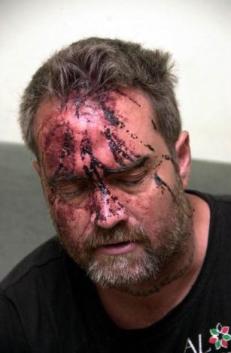
I said this straight to Israeli agents, probably of Mossad or Shin Bet, and I say it again now, on the morning of the attack I was directly involved in the disarming of two Israeli Commandos. This was a forcible, non-negotiable, separation of weapons from commandos who had already murdered two brothers that I had seen that day. One brother with a bullet entering dead center in his forehead, in what appeared to be an execution.
I knew the commandos were murdering when I removed a 9mm pistol from one of them. I had that gun in my hands and as an ex-US Marine with training in the use of guns it was completely within my power to use that gun on the commando who may have been the murderer of one of my brothers. But that is not what I, nor any other defender of the ship did. I took that weapon away, removed the bullets, proper lead bullets, separated them from the weapon and hid the gun. I did this in the hopes that we would repel the attack and submit this weapon as evidence in a criminal trial against Israeli authorities for mass murder. I also helped to physically separate one commando from his assault rifle, which another brother apparently threw into the sea.
I and hundreds of others know the truth that makes a mockery of the brave and moral Israeli military. We had in our full possession, three completely disarmed and helpless commandos. These boys were at our mercy, they were out of reach of their fellow murderers, inside the ship and surrounded by 100 or more men. I looked into the eyes of all three of these boys and I can tell you they had the fear of God in them. They looked at us as if we were them, and I have no doubt they did not believe there was any way they would survive that day. They looked like frightened children in the face of an abusive father.
But they did not face an enemy as ruthless as they. Instead the woman provided basic first aid, and ultimately they were released, battered and bruised for sure, but alive. Able to live another day. Able to feel the sun over head and the embrace of loved ones. Unlike those they murdered. Despite mourning the loss of our brothers, feeling rage towards these boys, we let them go.
The Israeli prostitutes of propaganda can spew all of their disgusting bile all they wish, the commandos are the murderers, we are the defenders, and yet we fought. We fought not just for our lives, not just for our cargo, not just for the people of Palestine, we fought in the name of justice and humanity. We were right to do so, in every way.
While in Israeli custody I, along with everyone else was subjected to endless abuse and flagrant acts of disrespect. Women and elderly were physically and mentally assaulted. Access to food and water and toilets was denied. Dogs were used against us, we ourselves were treated like dogs. We were exposed to direct sun in stress positions while hand cuffed to the point of losing circulation of blood in our hands. We were lied to incessantly, in fact I am awed at the routineness and comfort in their ability to lie, it is remarkable really. We were abused in just about every way imaginable and I myself was beaten and choked to the point of blacking out… and I was beaten again while in my cell. In all this what I saw more than anything else were cowards… and yet I also see my brothers. Because no matter how vile and wrong the Israeli agents and government are, they are still my brothers and sisters and for now I only have pity for them. Because they are relinquishing the most precious thing a human being has, their humanity.
In conclusion; I would like to challenge every endorser of Gandhi, every person who thinks they understand him, who acknowledges him as one of the great souls of our time (which is just about every western leader), I challenge you in the form of a question.
Please explain how we, the defenders of the Mavi Mamara, are not the modern example of Gandhi’s essence? But first read the words of Gandhi himself. I do believe that, where there is only a choice between cowardice and violence, I would advise violence…. I would rather have India resort to arms in order to defend her honour than that she should, in a cowardly manner, become or remain a helpless witness to her own dishonour. – Gandhi And lastly I have one more challenge. I challenge any critic of merit, publicly, to debate me on a large stage over our actions that day. I would especially love to debate with any Israeli leader who accuses us of wrongdoing, it would be my tremendous pleasure to face off with you. All I saw in Israel was cowards with guns, so I am ripe to see you in a new context. I want to debate with you on the largest stage possible. Take that as an open challenge and let us see just how brave Israeli leaders are.
Ken O’Keefe is a former US Marine and Gulf War veteran.
Israel Released Several Faked Photos – How Can They Be Trusted in ANY Investigation?
By EdwardTeller | Fire Dog Lake | June 2, 2010
Proof has surfaced today that many of the so-called “evidence” photographs being distributed by the Israeli government as examples of terror weapons on board the Gaza aid flotilla date back years:
The bulletproof vest photos on the Israeli flickr page are dated February 2006.
The axe photo was taken in 2003.
The pepper spray photos – 2003
The iconic pictures of knives and other weapons on the Saudi flag and other stuff:
Hi. Just to confirm that the EXIF metadata points to this photo being taken in 2006:
barney@benchwood:~$ identify -verbose farm5.static.flickr.com/4047/4662965686_a91f8 bab2e_o_d.jpg | grep Date
exif:DateTime: 2010:06:02 10:38:47
exif:DateTimeDigitized: 2006:02:07 05:52:19
exif:DateTimeOriginal: 2006:02:07 05:52:19
And on and on…..
Absolutely, this is strong evidence that by allowing the Israeli government to be trusted in any aspect of the investigation of these high seas crimes will be foolhardy and negligent.
The most recent evidence we have of how the Israeli government deals with crime scenes where American lives have been put in jeopardy is in the ongoing civil suit brought by Rachel Corrie’s family against the Israeli government. Testimony will resume some time – or not. The Israeli government is trying to stop the trial. But so far, here’s some of what has come out that reflects on the ability of the Israeli government or military to conduct honest investigations:
March 24: Military investigator testifies that head of IDF Southern Command instructed bulldozer operator not to cooperate with investigation.
March 15: Eye Witness Testifies: Israeli Military Investigator Tried to Influence My Statement.
March 14: Autopsy doctor admits to violating court order in Rachel Corrie autopsy.
Essentially, aspects of IDF conduct involving their handling of the death of Corrie clearly violate Israeli law, and call for trial, possible conviction and imprisonment of all officers involved:
But now evidence has emerged in the civil suit that Israel’s then Gaza commander obstructed the military police investigation into the circumstances surrounding the death.
The apparent intervention of Major-General Doron Almog, then head of Israel’s southern command, is documented in testimony taken by Israeli military police from the commander of the bulldozer a day after Ms Corrie was killed.
The handwritten affidavit effectively puts the entire state of Israel on trial. Is it willing to tolerate Maj-Gen Almog’s gross interference in the investigation or will it hold him to the three years’ imprisonment the law accords for such an offence?
In the affidavit, the commander of the D-9 tells military police investigators that he did not see Ms Corrie before she was wounded.
However, Alice Coy, now a nurse in Glasgow, and an ISM volunteer activist who was near Ms Corrie during the incident, said in an affidavit to the court that “to the best of my knowledge the bulldozer driver could see Rachel while pushing earth over her body”.
The D-9 commander, a reservist named Edward Valermov, was in the middle of his testimony when a colonel dispatched by Maj-Gen Almog entered the room and ordered him to stop speaking, according to the document.
The military police investigator wrote: “At 18:12 reserve Colonel Baruch Kirhatu entered the room and informed the witness that he should not convey anything and should not write anything and this at the order of the general of southern command.”
In his testimony before he was stopped, Mr Valermov said that the bulldozers, manned by two people, were ordered by their company commander to continue their work despite the presence of the ISM protesters.
He said that troops in an armoured personnel carrier threw stun grenades, used tear gas and fired shots toward the ground in order to scare the protesters away.
“It didn’t help and therefore we decided to continue the work with all possible delicateness on the orders of the company commander,” he added.
Mr Valermov testified that the protesters nearly touched the bulldozers, making it impossible to advance, but that after the company commander’s order “we started moving with the D-9, we continued laying bare the area from all of the things that were there.
“It was only when we moved the D-9 backwards that I saw her. The woman was lying in a place where the instrument had not reached. As soon as we saw the harmed woman we returned to the central corridor, stood and waited for orders.”
Mr Valermov’s last statement before Maj-Gen Almog’s interdiction was, “my job was to guide. The driver cannot guide himself because his field of vision is not large.”
In a phone interview from Olympia, Washington, Rachel’s father Craig Corrie termed Maj-Gen Almog’s intervention in Mr Valermov’s testimony “outrageous”.
Maj-Gen Almog has angrily denied halting Mr Valermov’s testimony.
Moshe Negbi, legal commentator for the state-run Voice of Israel radio, said of Maj-Gen Almog’s interdiction: “If a commander prevents a witness from testifying than it is disruption of an investigation, a criminal offence whose penalty is three years’ imprisonment.”
By deciding Maj-Gen Almog’s fate, Israel will be deciding if it is a state of law or a state of the generals – past and present.
Anyone who thinks the officers involved in the Corrie coverup will be held accountable is a fool. Anyone who thinks that the Israeli government will conduct an impartial investigation of Sunday morning’s tragedy is even more foolish, especially in light of mounting evidence that the Israelis are already disseminating totally false images as examples of some sort of forensic evidence.
It is time to put pressure on our government to demand the truth, rather than accept criminally motivated bullshit and lies.
Eyewitnesses, both activists and reporters, contradict Israeli account
By Steve Hynd | June 4, 2010
As Israel releases detained activists and journalists after the assault on the Gaza relief flotilla, they are beginning to tell their version of events. The story has so far been dominated by Israeli offical releases and “hasbara” so it’s important that the voices of these witnesses are heard by the international community. So far, though, these eyewitness accounts aren’t penetrating the U.S. media. If they did, more Americans would doubtless agree with the New York Times editorial calling for a “impartial international investigation” – not a self-serving one run by Israel.
Most importantly, every witness who has so far spoken out contradicts the Israeli account of some kind of self-defense, saying that the Israelis first attacked in boats and that they had already opened fire on the flotilla before commandos began descending from helicopters. They also agree that several people were shot from behind or above, that the Israeli attackers didn’t immediately allow treatment of convoy wounded and that weapons ripped from the hands of commandos were stripped of their ammunition and thrown overboard.
Perhaps the best eyewitness account to begin with is that of Paul McGeough, twice named Australia’s journalist of the year. He writes:
The Israeli attack was timed for dawn prayers – when a good number of the men aboard the Mavi Marmara were praying on the aft deck of the big Turkish passenger ferry, as it motored steadily through international waters in the eastern Mediterranean Sea.
…Suddenly sound bombs and tear gas were exploding on the main aft deck, where prayers were held five times a day. The life-jacketed passengers on the rails at first seemed oblivious as those behind them donned the few gas masks that were on board and others, wearing asbestos gloves, sought to grab the devices and hurl them back at the Israeli commandos before they exploded.
In failing to get their grappling irons to hold on the rails of the five-deck ferry, the commandos in their Zodiac-style assault craft continued to be an irritant, or perhaps a decoy because at this point the Israelis opted for a critical change of plan – if they could not come up from the water, they would have to drop from the sky.
On hearing the machines, activists on the upper decks rushed to the top level of the ship – grabbing the commandos even before they landed, disarming them; beating them until, according to some who were present, leaders demanded the Israelis not be harmed; but in one case, one of the Israelis was hurled from one deck of the ship to the next.
…There were conflicting accounts of the first commando landing – some activists said he was injured and was being carried inside the ship for treatment by the flotilla doctors. However, a Serbian cameraman, Srojan Stojiljkovic, said some of the activists had armed themselves with lengths of chain and metal posts that had served as cordons around the ship’s lifeboats.
“Some of the people caught the first commando before he touched the deck – a few started to hit him, but a lot of people moved in to shelter him with their bodies,” the cameraman said. “Another soldier with a bleeding nose was brought in … a few people threw punches, but not as many as I would have expected.”
Matthias Gardel, a leader of the Swedish Palestinian support group, confirmed the soldiers had been beaten, but insisted those involved were unarmed and in keeping with the ship’s non-violent charter, the soldiers’ weapons were thrown overboard.
McGeough also notes that at least two people were shot from behind while treating wounded, another was shot from above.
The Turkish actor Sinan Albayrak said he had witnessed one of the most senior of the Turkish activists ordering passengers to cease beating two of the Israeli soldiers. Later, he saw a Turkish photographer who had been shot in the back of the head; while he and others had been attempting to assist another injured activist, “Israeli troops had opened fire on them . . . we ran away from the injured man”.
The dead include a Turkish journalist, Chetin Genghis, whose head wounds suggested he had been shot from above – possibly from one of the helicopters. After witnessing his dying moments, his colleague Hisham Goruney said:”I want to forget – I still don’t believe that I saw it.”
Another of the dead was said to be an Indonesian cameraman, Sura Fachrizaz, shot in the chest. Also among the dead was a Malaysian doctor who, activists said, was shot while treating the wounded.
All of these elements are confirmed by other witness accounts. Canadian Farooq Burney, mentioned byJohn earlier, is head of an organisation that was bringing a consignment of laptops into Gaza to help educate children there.
Speaking from Istanbul, where he arrived after being released from Israeli detention, Burney said the Israeli military began firing objects at the ship before the boarding party landed.
“There were a lot of gunshot noises that could clearly be heard. Whether they were rubber bullets, whether they were live ammo, there was a lot of gunfire coming from the helicopter, coming from the boats (alongside the Mavi Marmara.)”
Burnley also recounted seeing his first casualty.
Canadian Farooq Burney (37) described how an elderly activist died after being shot in the chest. “We couldn’t see where he was hit so we opened up his lifejacket and we could clearly see that he was hit in the chest, he was losing a lot of blood,” Mr Burney said.
“It was on. . . the right, just close to his chest and there was blood coming out from there. He passed away,” he added.
Mr Burney also said activists who snatched pistols from the commandos removed the bullets and threw them into the sea, contradicting Israeli assertions that the weapons were used against the boarding party.
Gulf News reporter Abbas Al Lawati wrote for his own paper:
As I saw angry activists drag one of the Israeli soldiers down the stairs and punch him, I lost my journalistic objectivity and found myself urging the activist to stop hitting the soldier.
Seeing the anger in the activist’s eyes, I thought that he would kill him. I had images of the wars that Israel has waged over its captive soldiers, and the number of people that have died as a result of them. My thought was that if an Israeli soldier was to die on that ship, the entire flotilla would be bombed until it sank.
That was, of course, before I saw the bloodshed. The activists’ anger was suddenly put in context when I saw a number of people carrying a dying man down the stairs. His face was unrecognisable, covered in blood. He was apparently one of the first to go down, after an Israeli gun targeted the centre of his forehead from a helicopter, spilling his brains into the hands of another activist who was trying to look after him.
Lawati also describes meeting one of the Israeli commandos disarmed by the ship’s passengers.
I took a few steps down to film the other captive soldier, struggling to keep my balance with so much blood under my feet. He stood in a corner being attended by two medics onboard, in shock, crying.
It was surreal. I knew that that soldier could destroy the entire flotilla, and thought I would get some close up footage of him. I took my camera as close as possible to his face and asked his name twice. He was too traumatised to answer. I could see fear of death in his eyes. He was petrified. Then I heard women screaming. “They are coming!”
New Zealand activist Nicola Enchmarch spoke to the NZ Herald:
She said she saw an activist shot on the deck after the forces stormed the ship, part of a flotilla attempting to breach a blockade to deliver aid to Gaza.
“He was shot in the head – probably live ammunition because the back of his head, the injury was severe,” she told the BBC.
“He died there and we had to move because it was just getting crazy, there was a lot of gunfire coming from all directions.”
Her group moved down from the deck to shelter inside and escape the danger. On the way she saw a man shot in the back, who survived.
She said the activists were acting defensively while the Israeli forces were menacing and aggressive. They set off sound bombs and released what was possibly tear gas.
While Irishman Dr. Fintan Lane spoke of his experience on one of the flotilla’s smaller boats.
Dr Lane said he was assaulted: “When they boarded our boat, we resisted entirely peacefully. I sat on the floor and tried to reason with them, but the Israeli commandos physically attacked us,” he said.
“Fiachra [Ó Luain, from Boston USA] was dragged around the ground and I had a gun pointed in my face by a screaming commando. His mania was so intense that I genuinely feared for my life.”
Haneen Zuabi, a Palestinian member of the Israeli Knesset who has recieved death threats for her participation in the relief convoy, told reporters:
“Israel wanted many deaths to terrorise us and to send a message that no future aid convoys should try to break the siege of Gaza,” she told journalists this week.
Zuabi said that naval boats surrounded the Mavi Marmara and fired on it before soldiers abseiled aboard from a helicopter. She went below to the ship’s hold and said that, within minutes, two dead passengers were brought inside, followed by two more who had been seriously wounded.
soldiers refused her requests for medical assistance for the injured passengers, who died shortly after.
Zuabi – known in Israel as an articulate Hebrew speaker – said that soldiers specifically asked her to translatetheir instructions. At first, she refused. “I shouted back, ‘Why didn’t you ask for my help before you murdered these people?'”
Al Jazeera journalist Jamal ElShayyal taped his account for his own station. Juan Cole writes:
he asserted that the Israelis opened fire as they were boarding the vessel, and that one passenger took a bullet through the top of his head. Many passengers have now confirmed that they were fired on even before the commandos had boots on the deck. Presumably it is this suppressive fire that killed or wounded some passengers and which provoked an angry reaction and an attack on the commandos.
You can watch ElShayyal’s whole account here.
Robert Mackay excerpts some of his testimony for the NYT’s The Lede blog:
It was evident there was definitely fire from the air, because one of the people who was killed was clearly shot from above — he was shot, the bullet targeted him at the top of his head. There was also fire coming from the sea as well. Most of the fire initially from the sea was tear gas canisters, sound grenades, but then it became live fire. After I finished filing that last report and I was going down below deck one of the passengers who was on the side of the deck holding a water hose — trying to hose off, if you will, the advancing Israeli navy — was shot in his arm by soldiers in the boats below. […]
There is no doubt from what I saw that live ammunition was fired before any Israeli soldier was on deck. What I saw, the sequence of events that took place, there was a pool camera, so reporters took it in turns to file, so after I had done my first file, I turned around to see what was going on and there were several shots fired. In fact, one of the helicopters at the front of the ship, you could almost see the soldiers pointing their guns down through some sort of hole or compartment at the bottom side of the helicopter and firing almost indiscriminately without even looking where they were firing. And those bullets were definitely live bullets.
And apparently the violence didn’t stop after the Israelis had taken control. Irish-American peace campaigner Ken O’Keefe, a former US Marine, says he’s been beaten up twice while in Israeli custody. The second beating was so severe that he is still in an Israeli hospital and is now on hunger strike.
There’s a remarkable consistency among eyewitness accounts that Israel supporters will doubtless put down to complicity and others will ascribe to telling the truth. What’s certain is that these accounts are so very different from the official Israeli line that we have to question Israel’s credibility as an honest reporter of events as much as we question the eyewitnesses – perhaps even more so, since many of these witnesses are reporters with reputations for impartial accuracy rather than activists or soldiers following orders.
Robert Mackay writes:
The way these accounts diverge from that of Israel’s military would seem to make an independent investigation into the events crucial. That is particularly true since, as The Lede noted on Wednesday, Israel is apparently in possession of much more video evidence than it has yet released.
In a post making the case that Israel should not conduct that inquiry, Noam Sheizaf, an Israeli journalist and blogger, pointed out that journalists in the flotilla seem to have left Israeli custody without any of the video they shot during the raid that might bolster their accounts.
Israel has confiscated some of the most important material for the investigation, namely the films, audio and photos taken by the passengers [and] journalists on board and the Mavi Marmara’s security cameras. Since yesterday, Israel has been editing these films and using them for its own PR campaign. In other words, Israel has already confiscated most of the evidence, held it from the world and tampered with it. No court in the world would [trust] it to be the one examining it.
The Obama administration and pro-Israel members of Congress are busy saying that Israel is competent and can be trusted to investigate its own actions. Everything we’re hearing from those released says that simply isn’t the case.
Update: The Palestinian Monitor spoke to Italian activist Manolo Luppichini, who told them he was beaten in custody by his israeli captors because “I asked to call my family and my embassy”. Luppichini also says he spoke to Australian Jennie Campbell, one of the nurses present on the Mavi Marama. She told him that she had seen and counted 19 bodies, not the 9 being reported by the media.
Also, check out Gaza Flotilla Survivors, which is aggregating accounts by eyewitnesses.
Update 2: British journalist Hassan Ghani told BBC Radio Scotland:
“They began by throwing stun grenades on to the deck of the ship when people were in the middle of morning prayers.
“Then they began using rubber bullets, they tried to come aboard the ship from the side. People repelled the commandos with water cannons they had set up on the side of the ship.
“Then the Israelis used helicopters to drop people onto roof and there was scuffles on the roof.
“The Israeli solders had already opened fire on the ship, so people were grabbing anything they could to stop the attack in international waters.”
Eyewitness reports are very consistent and at odds with the Israeli official line.
Global boycotts of Israel intensify after bloody Flotilla attack
By Adri Nieuwhof, The Electronic Intifada, 4 June 2010
Israel’s bloody attack on the Gaza Freedom Flotilla on 31 May killing at least nine and injuring dozens of activists carrying humanitarian aid to the blockaded Gaza Strip, has already intensified global actions for boycott, divestment and sanctions (BDS) against Israel until it respects international law and human rights, including endorsement by major trade unions in several countries.
The Gaza Freedom Flotilla was on an honorable, peaceful mission in solidarity with the Palestinians living in the Gaza Strip, challenging the Israeli-imposed blockade that has deprived them of basic necessities and the ability to travel outside their densely populated enclave for four years.
In response to the attack, civil society movements around the world organized protests in dozens of cities. In the Arab world, 285 civil society organizations united around a statement condemning the crime committed against the relief convoy, demanding an end to the blockade and the turning over of Israeli war criminals to international justice. In Palestine, the Palestinian Boycott, Divestment and Sanctions National Committee (BNC) declared 5 June 2010 an emergency Global BDS Day of Action, the 43rd anniversary of the Israeli occupation of Gaza and the West Bank, including East Jerusalem.
The BNC called for increased pressure on governments to start implementing trade sanctions and arms embargoes, and asking trade unions to refuse to handle Israeli goods. The Swedish Port Workers Union decided to blockade all Israeli ships and cargo to and from Israel effective from midnight 15 June to 24 June. The union’s chairman Bjorn Borg told media that it is unclear how many vessels would be affected, but that the most frequent cargos coming from Israel were fruit, while those going to Israel were often industrial products from Sweden.
The South African Transport and Allied Workers Union (SATAWU) also responded immediately. The union appealed for “an escalation of the boycott of Israeli goods and call[ed] upon our fellow trade unionists not to handle them.” And, citing the lead of Swedish dockworkers, called on its own members “not to allow any Israeli ship to dock or unload in any South African port.”
Also in South Africa, the South African Municipal Workers Union (SAMWU) decided, by a unanimous vote of its Central Executive Committee on 4 June, to “immediately work towards” making every municipality in South Africa “an Apartheid Israel free zone” by ensuring “that there are no commercial, academic, cultural, sporting or other linkages whatsoever with the Israeli regime.” (“SAMWU Declares, Every Municipality an Apartheid Israel Free Zone!,” 4 June 2010). UNITE the largest union in the United Kingdom voted unanimously at its conference in Manchester “to vigorously promote a policy of divestment from Israeli companies” and promote boycott of Israeli goods and services “similar to the boycott of South African goods during the era of apartheid” (“Unite votes to boycott Israel,” The Jewish Chronicle, 4 June 2010).
The UN Special Rapporteur for the Occupied Palestinian Territories, Richard Falk, also expressed his support for BDS against Israel for its “murderous behavior.”
Roar Flathen, chairman of the largest Norwegian trade union federation (LO) responded to Israel’s Flotilla massacre by calling on the Norwegian State Pension Fund, the third largest in the world, to divest from all Israeli companies, and demanded the recall of the Norwegian ambassador to Israel. Norwegian pension funds had previously announced divestment from certain Israeli arms companies.
Following the attacks opinion polls in Norway show a major increase in support for BDS. The number respondents planning to boycott Israeli products had increased from 9.5 to 43 percent. Norwegian minister of education and leader of the Socialist Left Party, Kristin Halvorsen, called for an international boycott of arms trade with Israel following Norway’s existing policy.
There is also an intensification of the sporting boycott as Swedish young footballers refused to play in Israel, following a similar decision of the Turkish youth football team who were in Israel at the time of the Flotilla attack but canceled their planned match and returned home.
The Swedish Football Association (SFA) formally requested that European soccer’s governing body UEFA cancel Sweden’s under-21 match, because they felt morally compelled to do so. However, UEFA did not give in to the request, because there are no UN sanctions in place. SFA chairman, Lars-Ake Lagrell, told Swedish radio that he is not worried about reactions or demonstrations against Israeli players in the return match fixed at Old Ullevi Stadium in Gothenburg on 3 September 2010. But if precedent is a guide their could be large protests: thousands of Swedes protested the Davis Cup tennis match against Israel in Malmo in March 2009.
The civil society response has been accompanied by an unusually strong reaction from governments as well, which may indicate that public pressure is starting to force a change of policy. Denmark, France, Greece, Norway, Spain, Sweden, Egypt, and South Africa among others summoned Israeli ambassadors to express their condemnation of the attack. Due to “unforeseen circumstances,” Israel’s ambassador to Ireland postponed a planned appearance before the parliamentary foreign affairs committee which wanted not only answers about the Israeli actions, but also to question him about Israel’s intentions concerning the Irish-owned ship the Rachel Corrie which is still en route to Gaza with humanitarian aid and several prominent peace activists aboard, including Irish Nobel Peace Prize winner Mairead Maguire.
Meanwhile, Greece suspended joint military exercises with Israel and postponed a visit by Israel’s air force chief. Turkey withdrew its ambassador from Tel Aviv, and its deputy minister, Bulent Arinc, canceled three joint military drills. On 3 June, the energy minister announced that Turkey had suspended all energy and water projects with Israel.
Nicaragua responded to the attack with the suspension of diplomatic relations with Israel. The country reiterated its support for the Palestinian people and urged an end to the blockade on the Gaza Strip. South African president Jacob Zuma said in radio interview that if any other country had undertaken action like the attack on the aid flotilla it would be regarded as a pariah. On 3 June, South Africa recalled its ambassador from Israel to demonstrate its strongest condemnation of the attack.
All these actions indicate growing support for the sentiment expressed by Scottish writer Iain Banks who emphasized the need for academic and cultural boycott of Israel. Writing in The Guardian the renowned science fiction author argued that the best way for international artists, writers and academics to “convince Israel of its moral degradation and ethical isolation” is “simply by having nothing more to do with this outlaw state.”
Adri Nieuwhof is a consultant and human rights advocate based in Switzerland.
Sabotage on the High Sea
Free Gaza Movement | 4 June 2010
Colonel Itzik Tourgeman told the Knesset Defense and Foreign Affairs Committee on Tuesday that two more ships are on their way to try and break the naval blockade of Gaza. The head of research in the operations division said, “The ships have not reached their target as of today because covert action was taken against them.”
We had suspicions about our two boats, Challenger 1 and 2 and their mechanical problems as they sailed toward the flotilla, but we were not going to say anything unless we could prove it. Turns out we didn’t have to prove it. Israeli mouthpieces did.
The Guardian ran a piece the same day, saying,
Israel gave strong indications today that its forces had secretly sabotaged some of the ships bound for Gaza as part of the freedom flotilla.
Matan Vilnai, the deputy defence minister, was asked on Israel Radio whether there had not been a smarter alternative to direct assault. He answered that “all possibilities had been considered,” adding: “The fact is that there were less than the 10 ships that were due to participate in the flotilla.”
An unnamed Israeli Defence Force source who briefed the Knesset’s foreign affairs and defence committee on the widely criticised armed interception of the flotilla at sea, also spoke of “grey operations” being mounted against the flotilla.”
We were lucky that our two captains were supurbly trained and able to offload the passengers safely.
So we are going to make sure the Rachel Corrie is well protected and that Israel is put on notice that anything that happens to her, the passengers and the crew will rest with Israel. As a result of these threats, we’re going to pull Rachel Corrie into a port, add more high-profile people on board, and insist that journalists from around the world also come with us.
And sabotage happens with more than deeds. It also happens with words. In today’s Haaretz, Barak Ravid reported,
“A diplomatic solution seems imminent to allow the humanitarian aid vessel the Rachel Corrie to dock without incident at the Ashdod Port. According to European diplomats and senior Foreign Ministry officials in Jerusalem, quiet messages have been exchanged over the past few days between Israel and the group operating the ship, to allow it to dock.”
This, too, is sabotage in writing. We called Haaretz and the reporter. He did not return our call.
We have no intention nor would we ever have any intention of ever docking in Ashdod.
The day the world became Gaza
By Ali Abunimah | Al-Jazeera | June 3, 2010

Since Israel’s invasion and massacre of over 1,400 people in Gaza 18 months ago, dubbed Operation Cast Lead, global civil society movements have stepped up their campaigns for justice and solidarity with Palestinians.
Governments, by contrast, carried on with business as usual, maintaining a complicit silence.
Israel’s lethal attack on the Freedom Flotilla to Gaza may change that, spurring governments to follow the lead of their people and take unprecedented action to check Israel’s growing lawlessness.
Lip service
One of the bitterest images from Operation Cast Lead was that of smiling European Union heads of government visiting Jerusalem and patting Ehud Olmert, the then Israeli prime minister, on the back as white phosphorus still seared the flesh of Palestinian children a few miles away.
Western countries sometimes expressed mild dismay at Israel’s “excessive” use of force, but still justified the Gaza massacre as “self-defence” – even though Israel could easily have stopped rocket fire from Gaza, if that was its goal, by returning to the negotiated June 2008 ceasefire it egregiously violated the following November.
When the UN-commissioned Goldstone Report documented the extensive evidence of Israeli war crimes and crimes against humanity, including the willful killings of unarmed civilians, few governments paid more than lip service to seeing justice done.
Even worse, after Cast Lead, EU countries and the US sent their navies to help Israel enforce a blockade on Gaza which amounts to collective punishment of the entire population and thus violates the Fourth Geneva Convention governing Israel’s ongoing occupation.
Not one country sent a hospital ship to help treat or evacuate the thousands of wounded, many with horrific injuries that overwhelmed Gaza’s hospitals.
Carrot and stick
The blockade has never been – as Israel and its apologists claim – to stop the smuggling of weapons into Gaza.
Its goal has always been political: to cause the civilian population as much suffering as possible – while still politically excusable – in order for the Palestinians in Gaza to reject and rise up against the Hamas leadership elected in January 2006.
The withholding of food, medicine, schoolbooks, building supplies, among thousands of other items, as well as the right to enter and leave Gaza for any purpose became a weapon to terrorise the civilian population.
At the same time, Western aid was showered on the occupied West Bank – whose ordinary people are still only barely better off than in Gaza – in a “carrot and stick” policy calculated to shift support away from Hamas and toward the Western-backed, unelected Palestinian Authority leadership affiliated with the rival Fatah faction, who have repeatedly demonstrated their unconditional willingness to collaborate with Israel no matter what it does to their people.
“The idea is to put the Palestinians on a diet, but not to make them die of hunger,” senior Israeli government advisor Dov Weisglass notoriously explained in 2006. By this standard the blockade – supported by several Arab governments and the Quartet (the US, EU, UN secretary-general, and Russia) has been a great success, as numerous studies document alarming increases in child malnutrition as the vast majority of Gaza’s population became dependent on UN food handouts. Hundreds have died for lack of access to proper medical care.
Filling the ‘moral void’
While inaction and complicity characterised the official response, global civil society stepped in to fill the moral and legal void.
In the year and a half since Cast Lead, the global, Palestinian-led campaign for boycott, divestment and sanctions on Israel (BDS) has been racking up impressive victories.
From the decisions by Norway’s pension funds and several European banks to divest from certain Israeli companies, to university divestment initiatives, the refusals by international artists to perform in Israel, or the flashmobs that have brought the consumer boycott to supermarkets around the world, Israel sees BDS as a growing “existential threat”.
At this point, the effect may be more psychological than economic but it is exactly the feeling of increasing isolation and pariah status that helped push South Africa’s apartheid rulers to recognise that their regime was untenable and to seek peaceful change with the very people they had so long demonised, dehumanised and oppressed.
Indeed, the BDS movement is only likely to gather pace: world-best-selling Swedish author Henning Mankell who was among the passengers on the Turkish ship Mavi Marmara kidnapped and taken to Israel, said on being freed: “I think we should use the experience of South Africa, where we know that the sanctions had a great impact.”
The Freedom Flotilla represented the very best, and most courageous of this civil society spirit and determination not to abandon fellow human beings to the cruelty, indifference and self-interest of governments.
The immediate response to Israel’s attack on the Flotilla may indicate that governments too are starting to come out of their slumber and shed the paralysing fear of criticising Israel that has assured its impunity for so long.
Growing gap
Indeed, the global reaction demonstrates the growing gap between the US and Israel on one side and the rest of the world on the other.
While Israeli officials scrambled to offer justifications from the ludicrous (elite commandos armed with paint ball guns) to the benign (the attack was an “inspection”), the US has once again stood behind its ally unconditionally.
As the Obama administration forced a watered-down presidential statement in the UN Security Council, Israeli apologists in the mainstream US media repeatedly attempted to excuse Israel’s actions as lawful and legitimate.
Senior administration officials, including Joe Biden, the vice president, openly began to echo their Israeli counterparts that Israel’s attack was not only legitimate but justified by its security needs.
Despite the predictable and shameless US reaction, international condemnation has been unusually robust.
In his speech to the Turkish parliament following the attack, Recep Tayyip Erdogan, the Turkish prime minister, denounced Israeli “state terrorism” and demanded that the international community exact a price.
Erdogan vowed that “Turkey will never turn its back on Gaza,” and that it would continue its campaign to lift the blockade and hold Israel accountable even if it had to do so alone.
There are hopeful signs it may not have to.
European and other countries summoned Israeli ambassadors and several recalled their envoys from Tel Aviv.
Franco Frattini, the Italian foreign minister and one of Israel’s staunchest apologists in Europe, said his country “absolutely deplored the slaying of civilians” and demanded that Israel “must give an explanation to the international community” of killings he deemed “absolutely unacceptable, whatever the flotilla’s aims”.
Small countries showed the greatest courage and clarity. Nicaragua suspended diplomatic ties completely, citing Israel’s “illegal attack”. Brian Cowen, Ireland’s prime minister, told parliament in Dublin that his government had “formally requested” of Israel that the vessel Rachel Corrie still heading toward Gaza, be allowed to proceed, and warned of the “most serious consequences” should Israel use violence against it.
The boat – named after the young American peace activist killed by Israeli occupation forces in Gaza in 2003 – is carrying Malaysian and Irish activists and politicians including Nobel Peace Prize winner Mairead Maguire.
Crossed a threshold
These are still small actions, but they indicate Israel may have crossed a threshold where it can no longer take appeasement and complicity for granted.
It is a cumulative process – each successive outrage has diminished the reserve of goodwill and forbearance Israel enjoyed.
Even if most governments are not quite ready to go from words to effective actions, growing public outrage will eventually push them to impose official sanctions.
Binyamin Netanyahu, the Israeli prime minister, may have hastened that day with his fulsome pride in, and praise for, the slaughter at sea even after the outpouring of international condemnation.
Despite its intensive efforts to hide and spin what happened aboard the Mavi Marmara in the early hours of May 31, the world saw Israel use exactly the sort of indiscriminate brutality documented in the Goldstone Report.
This time, however, it was not just “expendable” Palestinians or Lebanese who were Israel’s victims but people from 32 countries and every continent. It was the day the whole world became Gaza. And like the people of Gaza, the world is unlikely to take it lying down.
‘If you express solidarity with Palestinians, then you will have Palestinian experiences’
By Philip Weiss on June 3, 2010
Two thoughts on the meaning of the Israeli violence.
There is of course a big effort in the western press now to make the flotilla members into violent people, provocateurs, engaged by cool Israeli commandos. I must tell you my one actual experience of this dynamic.
In January, I attended a demonstration against the occupation in the West Bank village of al-Masara. I wrote about it here: “An English politician watches Israeli soldiers lose control at a peaceful demonstration and vows to bear witness.”
The headline sums it up. About 100 demonstrators, Israelis and Palestinians and internationals, marched toward an illegal settlement (Efrat) and the confiscatory wall. They were stopped by a line of Israeli soldiers, some of whom were young and obviously nervous, standing at a line of concertina wire. The demonstrators shouted at the Israeli soldiers. I saw fear on a couple of the young men’s faces. And before you knew it the Israeli soldiers were pushing people back forcefully, even dragging them, and then firing stun grenades at us.
I don’t know if you’ve ever seen a stun grenade go off, but it’s pretty terrifying, the first time, when a soldier hurls a black cylinder and it explodes; you think it’s live. And I have seen reports that these grenades were used on board the boat.
The soldiers ran the demonstrators a half mile back into the village amid mayhem. The lesson of the experience was the one that English politician took away– Catharine Arakelian, a candidate for Parliament, whom I met– that the Israelis had turned a nonviolent demonstration into an out-of-control situation.
So when people say that flotilla passengers tried to lynch the Israeli soldiers, or started the violence, I find that extremely doubtful.
I saw the way that Israel turns to violence as a tool, outside its own borders.
The second thought I have is also from that trip to the Middle East.
When I was in Egypt with the Gaza Freedom March last December, blocked by the Egyptians from entering Gaza, an older member of the group said to me, “When you express solidarity with Palestinians, you will find that you have Palestinian experiences, and you will experience their bitterness.”
He meant that if you walked a ways in the Palestinians’ shoes, you’d experience actual persecution. You’d find that governments and authorities dole out to you some of what the Palestinians experience–from actual violence to being silenced. And so you’d understand the Palestinian experience– and try to hurry back into your privileged life.
This seems to me the lesson of the Turkish boat, and also of Emily Henochowicz, the 21-year-old Cooper Union student who was blinded by Israeli soldiers in a protest of the flotilla raid, whose face is now having to be reconstructed. All these people have now had doled out to them some of the violence and abuse — and lies — that has been the Palestinian experience since 1948.
Of course it makes their courage all the more impressive.
But more important, it shows that the Palestinian experience under fearful Israeli rule is not the experience of animals or terrorists. It is a human experience. It could be you.
Greece, Sweden back Iran declaration
Press TV – June 3, 2010
Seeking to lighten the mood over Iran’s nuclear program, Greece and Sweden have called for the implementation of the recent Tehran declaration on a potential nuclear fuel swap.
Greek Prime Minister George Papandreou and Swedish Foreign Minister Carl Bildt called for the implementation of the Tehran nuclear declaration in a telephone conversation with Iranian Foreign Minister Manouchehr Mottaki late Wednesday, IRNA reported.
Iran, Turkey, and Brazil signed a declaration in the Iranian capital on May 17, committing Tehran to shipment of 1,200 kilograms (2,640 pounds) of its low-enriched uranium in Turkey in exchange for 120 kilograms of 20-percent enriched nuclear fuel for the Tehran Research Reactor that produces radioisotopes for cancer treatment.
In their telephone conversation, the three high ranking officials also discussed the recent Israeli attack on a Gaza-bound aid convoy and denounced the brutal assault against the Palestinian community.
The Israeli military attacked the Freedom Flotilla in international waters in the Mediterranean Sea early on May 31, killing at least 20 people, mostly Turkish nationals, on board and injuring about 50 others.
Israel also arrested nearly 700 activists from 42 different countries on board the Freedom Flotilla that were attempting to break the siege of Gaza in order to deliver humanitarian supplies to the long-suffering people of the coastal territory.
The official condemnations come as the pre-dawn attack by Israeli commandos on the Turkish-flagged Flotilla has sparked a torrent of international criticism against Tel Aviv.
IHH: Israel shoots Gaza activists dead
Press TV – June 3, 2010
Turkish organizers of the Gaza Freedom Flotilla attacked by Israeli naval commandos accuse Israel of shooting activists dead at a close range.
Bulent Yildirm, who heads the Foundation of Humanitarian Relief (IHH), told reporters at Istanbul airport how a journalist called Cevdet was killed by Israeli soldiers for no good reason.
“He was just taking pictures. He was shot at from no more than a meter and his brain exploded … one of our friends was shot even after he had surrendered,” AFP quoted Yildrim as saying.
He accused Israeli naval forces of killing “whoever they laid hands on” and even throwing some activists into the sea.
“We were given the bodies of nine martyrs, but we have a longer list. There are missing people. Our doctors handed over 38 injured, on our return they (the Israelis) said there were only 21 injured.”
The UN Human Rights Council adopted a resolution on Wednesday, saying it would set up an independent international probe into Israel’s “outrageous attack” on the six-ship aid convoy.
The Tel Aviv regime, which has backed its military’s use of lethal force as an act of “self defense,” dismissed the decision, saying the council lacked “moral authority.”
Israeli officials say nine people were killed in the Monday’s deadly attack, but reports by Palestinian sources put the fatalities at around 20.
Irish aid boat holds course towards Gaza despite Israel warning
June 2, 2010
The final boat in the Gaza aid flotilla was sailing at full speed towards the territory’s coast tonight despite warnings that it would be intercepted by Israeli forces.
The MV Rachel Corrie, a 40-year-old cargo ship bought by the Irish arm of the Free Gaza Movement, was delayed and avoided capture during Monday night’s assault. Tonight it was still in international waters about two days from Gaza, carrying a consignment of aid and 19 activists and crew, among them five Irish nationals, the organisation said.
The Irish taoiseach, Brian Cowen, warned Israel tonight that he expected no violence against those on the Rachel Corrie.
“If any harm comes to any of our citizens it will have the most serious consequences,” he said, calling on Israel to guarantee the vessel safe passage through the military blockade of Gaza.
The ship, named after the 23-year-old American killed in Gaza in 2003 while trying to prevent an Israeli bulldozer demolishing a Palestinian home, had halted in the Mediterranean following the assault while those on board – among them the Nobel peace laureate Máiread Maguire and Denis Halliday, a retired senior UN diplomat – discussed whether they should continue.
It was now carrying as a “second wave” of the flotilla, said Niamh Moloughney, who organised the sailing in Ireland.
“I’d say the mood on board is resilient and steadfast. When people signed up to this they knew what might happen,” said Moloughney. “We expected we would be confronted and there would be a stand-off, but no one expected this. But there’s never really been a question of the boat turning back.”
As well as the Irish nationals, the 1,200-tonne boat is carrying six Malaysians and eight crew of varying nationalities.
All those on board had received training in non-violent resistance before the sailing and had pledged not to fight back if the boat was boarded, Moloughney added.
Speaking on the boat’s satellite phone, Maguire said she was determined the boat should continue on its course.
“We’re not frightened, no, we hope the Israeli government will allow us to go freely in and we know the international community are calling for our safe passage,” she said.
Halliday said he had spoken to Ireland’s foreign minister, Micheál Martin. “He was very reassuring that the government was behind us and he gave us a complete green light to do what we’re doing and he’ll protect us as much as he can,” Halliday said.
Martin himself told parliament: “We will be watching this situation very closely – as indeed will the world – and it is imperative that Israel avoid any action which leads to further bloodshed.”
It appeared clear, however, that Israel planned to stop the ship.
The country’s military was carrying out “professional investigations” into what happened in Monday’s raid, an Israeli marine lieutenant, who was not identified, told Israel’s Army Radio. He added: “And we will also be ready for the Rachel Corrie.”The boat, which was bought at auction by the Free Gaza Movement after being impounded a year before in Dundalk, is carrying a consignment including medical equipment, wheelchairs, school supplies and cement, according to the organisation.
Featured Video

AIDS Inc. by Gary Null (2007)
or go to
Aletho News Archives – Video-Images
From the Archives
Clash of Civilization, Iran Part II
By Jamal Kanj – Intifada-Palestine.com – January 14, 2011
Israel’s survival kit is: perpetuate conflict, insecurity to rationalize collective hate and finally playing victim.
Devoid of conflict, Israel implodes internally; without hate, Zionism loses its justification; and playing eternal victim to continue blackmailing the West. Absence of this holy trinity, Israel ceases to exist.
From its inception, the house of Zion has mastered exploiting adversarial powers to advance Israel’s cause. For instance, their influence over the Democratic Party in the US began with President Truman’s bid for 2nd term election in 1948.
Responding to strong opposition from Secretary of State General George Marshall and Department experts urging against recognition of Israel, President Truman replied: “I’m sorry gentlemen but I have to answer to hundreds of thousands [Jewish voters] who are anxious for the success of Zionism. I do not have hundreds of thousands of [voting] Arabs among my constituents”
Zionists influence over liberal American politics was matched with the doctrinal school of Conservative theoreticians aligning the Republican Party’s platform with Israel’s objectives. The Neoconservative Zionists, coined Zioncons, invented the “Clash of Civilization” concept to fight Israel’s wars. … continue
Blog Roll
 Aletho News
- From Unipolar Universalism to Multipolar Civilizational Distinctiveness
- RSF military group defects, joins Sudanese army: State media
- Ireland goalkeeper refuses to play ‘Israel’ as squad weighs boycott
- China pushes back against US on Cuba, Iran
- Ukrainian Soldiers, Potential Mercenaries: Have Gun, Will Travel!
- Burnham’s UN debut… A masterclass in British disinformation
- Iran flights continue despite US aviation sanctions
- Global Tipping Points Lead the World Into a State of Entropy
- The day-after at the White House: USA and Xi Jinping
- The Geopolitical Balance in the Red Sea: The UAE Being Displaced by New Players
- If Americans Knew
- Deconstructing Netanyahu’s pants-on-fire UN rant – Daily Update
- Trump betrayed voters with his campaign lies and prioritized a foreign country once he took office
- Netanyahu calls Israel’s war in Gaza ‘opposite of genocide’ in UN speech to near-empty hall
- Settler Kidnappings: Torture, Sexual Abuse and Terrorisation of Palestinian Abductees as Israel Deepens Annexation of West Bank
- Gaza winter nears as 162,000 tents become unusable, raising fears of humanitarian crisis
- Netanyahu says, “It’s the opposite of genocide”; UN says Gaza economy is world’s ‘most severe crisis on record’ – Daily Update
- Israel’s US-Backed Assault on Gaza Has Created the ‘World’s Most Severe Economic Crisis on Record’: UN
- ‘Protecting U.S. Citizens’… From Israel
- ‘This is where I live now, the back of a truck’: a day in the life of a grandmother in Gaza
- In UN Speech, Iran’s President Displays Pictures of Children Killed by US, Brings Attention to Israel’s Nuclear Arsenal
- No Tricks Zone
- New Study: Earth And Venus Surface Warmth Largely Explained By Convection And Lapse Rate, Not CO2 Or Radiation
- 2025 Nature Paper Claiming Worsening Global Drought Gets RETRACTED …Heavily Flawed
- New Study: ‘Global Drought Shows No Detectable Recent Acceleration Under Climate Warming’
- Economic Masterminds: German Socialists Suggest Taxing Productivity Gains Stemming From Using AI
- The South China Sea Has Not Been Cooperating With The Climate Change Narrative
- Energy Crisis: Germany Enters Heating Season With Historically Low Gas Reserve Fill Levels
- New Study: The Antarctic Ice Sheet Gained Mass From 2020-2024 Due To Staggering Snow And Ice Accumulation
- Study: Ocean Heating Rates From Thousands Of Years Ago ‘Dwarf’ Modern Ocean Heating Rates
- Climate Extremists Target, Attack Large-Scale Power Grid Infrastructure In Germany!
- New Study: Antarctic Ice Melt Has Contributed Less Than 1 Centimeter To Sea Level Rise In The Last 30 Years

