Israeli forces demolish structures, road pavement in South Hebron Hills
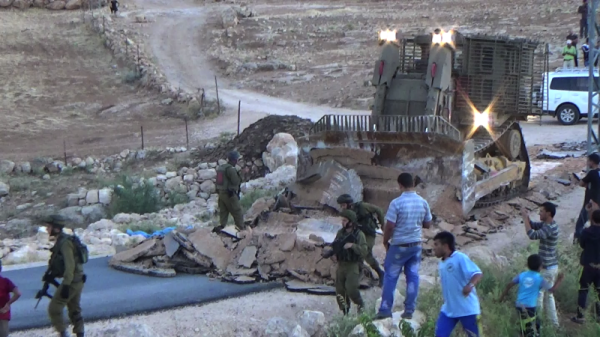
Photo by Operation Dove
Operation Dove | June 20, 2014
Khallet Forem, Occupied Palestine – On June 18th, the Israeli army, along with border police officers and DCO (District Coordination Office) officers entered in the Palestinian village of Khallet Forem, in South Hebron Hills, and demolished seven houses, a bathroom, and a shelter.
No demolition orders were delivered for these structures.
According to Palestinian witnesses, a woman was injured by the soldiers during the operation.
The seven houses, the shelter, and the bathroom were owned by the Abu Dahar family. These demolitions involved at least 26 people, 12 of them are children.
In the same day, Israeli forces demolished the main road of Ar Rifa’Iyya Ad Deirat and built a roadblock in order to prevent the access from that road to the bypass road 356.
According to PHROC (The Palestinian Human Rights Organizations Council), the recent wave of demolitions, arrests, attacks, killings, and total closure of large parts of the West Bank following the disappearance of three Israeli settlers is a form of collective punishment against the Palestinian people. This is in direct violation of Article 33 of the Fourth Geneva Convention that forbid reprisals against protected persons and their property, as well as collective punishment.
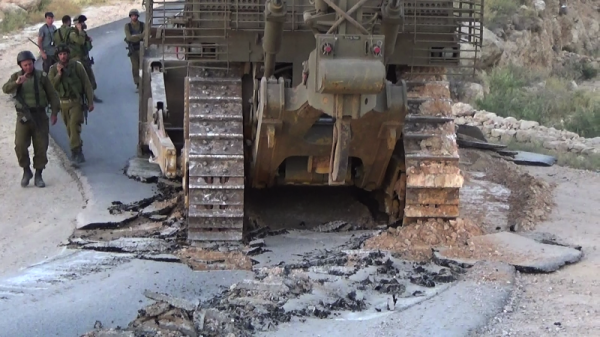
Photo by Operation Dove
Recent Israeli airstrikes targeted Gaza infrastructure
Palestine Information Center – 20/06/2014
 GAZA – The Palestinian interior ministry said that the recent Israeli aerial attacks on the Gaza Strip directly targeted its infrastructure, factories and workshops.
A spokesperson for the ministry stated that an Israeli warplane bombed a dairy plant in Gaza City at dawn today.
Israel escalated its aerial attacks on Gaza over the past few days in Gaza Strip, which rendered many civilians wounded amid persistent international and Arab silence.
For its part, the Palestinian education ministry strongly condemned Israel’s repeated bombing of educational institutions, asserting that 10 schools sustained damage during recent Israeli air raids on Gaza.
Palestinian dies of heart attack as Israeli troops raid home
Ma’an – 21/06/2014
 SALFIT – An elderly Palestinian man died early Saturday of heart attack during a heated argument with Israeli troops who broke into his house in the village of Haris in Salfit district in the northern West Bank.
Palestinian security sources said Israeli soldiers refused to allow family members of Jamil Ali Abed Jabir to take him to hospital for treatment after he suffered a heart attack and eventually died at home. The victim was in his 60s.
The sources explained that dozens of Israeli soldiers stormed Haris village, ransacked several homes and assaulted residents.
Jawad Muhammad Dawood suffered a hand fracture after Israeli troops brutally attacked him and his brother Jawdat during a raid on their home. In addition, seven family members inhaled tear gas after Israeli forces fired a canister in their home.
No detentions were reported in the village.
Riot control drone armed with paintballs and pepper spray hits market
RT | June 19, 2014
With drones designed to contain ‘unruly crowds’ and ‘violent protests’, a South African company is bringing riot control to a whole new high-tech level. The unmanned aerial system is able to shoot pepper spray and non-lethal paintballs to mark offenders.
Desert Wolf, based in Pretoria, has begun selling its Skunk Riot Control Copter, a drone it says “is designed to control unruly crowds without endangering the lives of the protestors or the security staff.”
The UAS has four high-capacity gun barrels, capable of shooting up to 4,000 paintballs, pepper spray balls and solid plastic balls at rates of up to 80 balls per second. The company notes that the frequency should usually be between one and 20 balls per second, and that the high frequency of 80 “will only be used in an extreme ‘Life threatening situation’.”

The paintballs can be used to “mark” people in the crowd. “The operator has full control over each marker. He can select the RED paint marker and mark the protester who carries dangerous weapons, he can select the BLUE marker to mark the vandalising protestors,” the Desert Wolf website said.
The Skunk Copter can also employ strobe lights, “blinding lasers” and on-board speakers to send verbal warnings to a crowd, though New Zealand’s 3News notes that the Geneva Convention prohibits the use of loudspeakers and laser pointers in combat. The UAS also uses a thermal camera with night-vision capabilities and two full-HD video cameras to record events as they unfold. The eight powerful electric motors with 16-inch propellers allow the drone to lift up to 45 kilograms (99 pounds).
“Our aim is to assist in preventing another Marikana, we were there and it should never happen again,” the Desert Wolf website said. Marikana was a wildcat miners’ strike at a South African platinum mine in 2012, where 44 people were killed in the violent protests. According to autopsy reports, many of the deaths occurred when strikers were fleeing police.
The company sold 25 drones to a mining company after it unveiled the Skunk at the IFSEC security exhibition outside Johannesburg in May.
“We cannot disclose the customer, but I am allowed to say it will be used by an international mining house,” Desert Wolf’s managing director Hennie Kieser told BBC News. “We are also busy with a number of other customers who want to finalise their orders. Some [are] mines in South Africa, some security companies in South Africa and outside South Africa, some police units outside South Africa and a number of other industrial customers.”
The International Trade Union Confederation, which supports workers’ rights, told the BBC it was horrified by the new technology.
“This is a deeply disturbing and repugnant development and we are convinced that any reasonable government will move quickly to stop the deployment of advanced battlefield technology on workers or indeed the public involved in legitimate protests and demonstrations,” International Trade Union Confederation spokesman Tim Noonan said.
“We will be taking this up as a matter of urgency with the unions in the mining sector globally,” he added.
The International Committee for Robot Arms Control (ICRAC) campaign group is also speaking out against the use of the Shark Copter and similar technology, such as the CUPID drone that employs an 80,000-volt taser dart.
Noel Sharkey, chair of the ICRAC, told the BBC he is concerned that the deployment of such drones risks “creeping authoritarianism and the suppression of protest.”
“The use of remote-controlled drones to police or attack civilian individuals or groups with violent force is an offense against human dignity and a threat to democratic sovereignty,” Mark Gubrud, a physicist with the ICRAC, told 3News. “It is also a potential precursor to scenarios in which the robots would operate fully autonomously, choosing their own targets outside of human control.”
“These weapons cannot be sufficiently well controlled to avoid causing serious injury, especially to eyes,” Gubrud told CNet. “Many existing ‘non-lethal’ crowd-control weapons can and often do kill.”
The first batch of drones, which cost about 500,000 South African Rand ($46,000) apiece, will be deployed to South African mines later in June, according to the Verge. Strikes against three of the country’s top three platinum producers have been going on for the last five months, though a wage deal between the mining companies and unions is imminent, Reuters reported on Friday.
The Qwasmeh Family Story
CPTnet | June 17, 2014
The public so far knows very little outside of the alleged time that Gilad Shaar, Naftali Frenkel, and Eyal Yifrach were kidnapped. But what we do know is the absolute mayhem the Israeli military has spread throughout the Hebron district among innocent families. Additionally, routine night raids, day patrols, confiscation of public property for military outposts, and the blockades on all but two access points into Hebron have suffocated the livelihood of Hebronites.
Soldiers raided the home and took possession of the Al Awewe family home in Aqbet Taffuh for six hours on Sunday. Over fifty troops had occupied the home while three adults, four young girls, and a young boy were in the home. The Israeli military would not allow a one-year-old baby to leave the house and her mother had to sit outside helplessly wondering about the safety of her daughter, who was still nursing. The soldiers found no suspects connected to the kidnapping in the home.
In that same area on Monday morning, the IDF confiscated the security camera equipment the al-Natshe family had installed around their house for their protection, along with video footage the cameras had recorded.
Further down the road in the Aqbet Taffuh area, approximately fifty-five Israeli soldiers left the hilltop area of the Palestinian municipality, occupied several homes, questioned families, tore down a private Palestinian fence and occupied the neighborhood for several hours.
Throughout the afternoon, northeast of Bab i-Zaweyah, just outside of the H1/H2 intersection, a brigade of more than forty soldiers stationed themselves in four different homes and a supermarket within a two hour period, leaving families frightened and unsure of their intentions.
On 15 June at around 9:30 p.m., an Israeli raid on a Palestinian home ended with a seven-year-old Palestinian boy hospitalized after the Israeli military used an explosive device to blow open the front door of the Akram Al Qawasmeh home. The subsequent powerful blast shattered the tempered reinforced glass, shearing off the decorative steel and sending pieces of shrapnel into all corners of the home, which severely injured Akram Al Qawasmeh’s son.
After the explosion, Israeli soldiers did not allow Akram Al Qawasmeh to see his son, and according to reports, the military initially stopped medical personal from treating the victim. CPT arrived the following day and found a home turned upside down. (See video below.) Children’s belongings were spread and broken around the house. Israeli soldiers demolished the kitchen, smashing fruits, vegetables, and other food items on the floor, and left feces on a rug in the basement.
These are just a few of the incidents that CPTers were able to report on directly. Other human rights organizations have also reported an increase in settler violence against Palestinians who live near the Hebron area settlements.
Historically, Palestinian violence has been the justification for settlement expansion in Hebron. Currently, the Hebron Rehabilitation Committee has identified over twenty-two locations of pending settlement expansion and settler activity. The behavior of the Israeli military and settlers in Hebron suggests the government may use the case of the three young kidnapped boys as an excuse to expand these settlements in the Hebron area or elsewhere in the West Bank while the international community is distracted.
See previous release, AL-KHALIL (HEBRON): Hijacking a kidnapping, Part I
Israeli soldiers invade more Palestinian homes in Hebron
International Solidarity Movement | June 18, 2014
Hebron, Occupied Palestine – Yesterday the Israeli army invaded a family house in the H1 area, supposedly under full Palestinian Authority civil and security control, of al-Khalil (Hebron). The father of the family is very ill with heart disease; the family was forced in to one room and was not allowed to leave. The eight Israeli soldiers used the house as an unofficial army post, both to rest and to view the area. The soldiers stayed there overnight, terrifying the family, as they had no idea when the soldiers would leave. At approximately 11:00 am, the soldiers left the house, however they informed the family that they would return.
The soldiers then entered the next house, relatives of the same family, with four young children. First they searched the house, and then occupied the children’s room on the second floor. They moved the children’s beds to get more space and placed a black blanket to cover the doorway.
The soldiers took shifts, sitting in front of the room watching the family, while the rest were sleeping, eating, and viewing the area. The family told the ISMers present that the soldiers also took showers. The soldiers seemed very uncomfortable with the ISM volunteers in the house, and behaved very aggressively towards them, and the family members who were taking photos.
The family offered the soldiers to use the roof instead of the children’s room, but they refused.
The military presence in the house caused a lot of fear for the family, they were unable to carry out their daily routines, and the children were very upset that they could not enter their room; they were afraid the soldiers would take their belongings and break their toys.
After five hours the family convinced the military to leave, as they left, it was witnessed them joining with a much larger group of soldiers.
Since last Friday, there has been a large increase in home invasions all over the West Bank. This is part of the collective punishment inflicted on the Palestinian population, since the disappearance of three Israeli settler youth on Thursday.
Israel re-arrests 50 Palestinians freed in 2011 prisoner swap
MEMO | June 18, 2014
Israeli occupation forces arrested 65 Palestinians from the occupied West Bank last night, 50 of whom were prisoners released in Israeli soldier Gilad Shalit’s prisoners swap held between Hamas and Israel in 2011.
Head of Prisoners’ Centre for Studies Fuad Al-Kuffash said two Palestinian members of parliament were among those arrested. He added that Israeli forces told the families of the prisoners that they would expel them to the Gaza Strip.
Since last Thursday, when three Israeli settlers reportedly went missing, the Israeli occupation forces have been carrying out a wide house-to-house search in Hebron. They have arrested 240 Palestinians, at least 180 of whom are members of Hamas.
Israeli Prime Minister Benjamin Netanyahu praised the operation. “The activities carried out overnight, in which Hamas terrorists were arrested, including those who were released in the Gilad Shalit prisoner exchange deal, is an element with an important message that is part of a series of many actions that will continue,” he said.
Netanyahu said that the “goal is to retrieve the kidnapped teens and harm the Hamas movement in Judea and Samaria.”
Hamas kidnapped an Israeli soldier who was positioned in a military base in his tank on the Gaza borders in 2006. Israel released 1,027 Palestinians as part of prisoners’ swap with Hamas in 2011.
Israeli newspaper Haaretz said that the Israeli government is considering expelling top Hamas officials from the West Bank to Gaza.
According to the Israeli military commander in the West Bank Major General Nitzan Alon, “The battle against Hamas is complex and ongoing; it didn’t begin today and won’t end soon.” He vowed the movement would emerge from the current clash “weakened operationally and strategically”.
Israeli retribution attempts to conceal resistance against settler-colonialism
By Ramona Wadi | MEMO | June 17, 2014
Israel has a penchant for speaking about retribution as an isolated and necessary response – an extension of the ultimate, imaginary patriot who lacks land and invents ownership. Speaking about the three missing Israeli settlers, Israeli Defence Minister Moshe Ya’alon indicated the possibility of targeted assassinations against Hamas leaders.
“We will know how to exact a very heavy price from the leaders of Hamas wherever and whenever we find it appropriate and from whomever ponders the notion of harming the citizens of Israel and disrupting their lives,” Ya’alon said.
The Times of Israel quoted him saying the missing settlers are perceived as “additional testimony to the cruelty and seething hatred that guides the terror groups in our region.”
Echoing Ya’alon and indeed other Israeli officials in expressing their wrath, Economy Minister Naftali Bennett said Israel was dealing with one of the most “lethal, barbaric organisations in the world. We’re turning the membership card for Hamas into a ticket to hell.”
In other news, a Facebook page, which has garnered over 18,000 supporters, is urging Israelis to murder Palestinians every hour until the settlers are returned. The Twitter campaign, #BringBackOurBoys has stirred self-righteous fervour, turning three missing settlers into a global phenomenon, while daily atrocities inflicted upon Palestinians by the settler-colonial state remain largely unchallenged and normalised into an expected and glorified routine.
Justifying the hatred emanating from Israeli society, Israeli President Reuven Rivlin said: “We don’t need to be fearful in our country. A person should not fear to go anywhere in this country, whether it is under our control, or those areas that we have returned to in order to redeem them.”
The statements constantly impart a misplaced sense of ownership, in which even the imagined country and its settler population takes precedence over the missing teenagers. Besides manipulating the events to declare a renewed war on Hamas, as Netanyahu declared from the IDF’s Headquarters, the projection of violence onto Palestinians once again serves to catapult Israel’s fabricated image to international attention.
The persisting alienation with regard to Israel’s state-sanctioned terror against Palestinians will prevent the emergence of a clearer sequence that takes into consideration the nature of Israel as an inherently violent state. Targeted assassinations upon Hamas leaders will be condoned by Israeli and international media in order to deflect attention away from resistance against settler-colonialism. Murder committed by Israel is distorted into a human rights mission as a pre-emptive measure against any possible fracture that exposes the state of Israel as a myth. Hence the incessant reports regurgitating the same information and instigating further violence against Palestinians. The issue at stake is not the missing teenagers; rather the fact that Israeli leaders deem Palestinian resistance a threat to settler-colonialism.
Despite the propaganda depicting the missing settler teenagers as the immediate concern, official discourse indicates a more serious issue. The threat to Israel’s imagined status has been exposed with incessant references regarding “our country” and “our people” in the wake of a challenge that has managed to plunge the foundations of the Zionist project into turmoil.
Judge Finds Courts Cannot Protect US Citizens Tortured by US Government Officials Abroad
By Kevin Gosztola | Firedoglake | June 17, 2014
A federal district court dismissed a case that was brought by the American Civil Liberties Union on behalf of a United States citizen and against US government officials who allegedly tortured, abused and subjected him to rendition and incommunicado detention in Kenya, Somalia and Ethiopia. The dismissal was another stark example of how it is nearly impossible for torture victims to push for justice in an American court of law.
Amir Meshal was in the Horn of Africa when, on January 24, 2007, Kenyan soldiers captured and interrogated him. He was “hooded, handcuffed and flown to Nairobi, where he was taken to the Ruai Police Station and questioned by an officer of Kenya’s Criminal Investigation Department” and was told that the police had to “find out what the United States wanted to do with him before he could send him back to the United States.” He remained in detention without access to a telephone or his attorney for a week, according to the US District Court of the District of Columbia’s decision [PDF].
On February 3, “three Americans,” who turned out to be FBI agents, interrogated Meshal and told him he would be handed over to the Kenyans and remain stuck in a “lawless country” if he did not cooperate. The agents also accused him of “having received weapons and interrogation resistance training in an al Qaeda camp.” Supervising Special Agent Chris Higgenbotham, one of the officials sued, threatened Meshal with being transferred to Israel where the Israelis would “make him disappear.” Meshal was informed that another US citizen he had met in Kenya, Daniel Maldonado, who was also seized by Kenyan soldiers, “had a lot to say about” him and his story “would have to match.”
Meshal was flown by Kenyan officials to Somalia with twelve others on February 9. He was “detained in handcuffs in an underground room with no windows or toilets,” which was referred to as “the cave.” This was allegedly to prevent pressure from Kenyan courts to halt his detention and interrogation by FBI agents.
About a week later, Meshal was transported in handcuffs and a blindfold to Addis Ababa, Ethiopia. He was held there in incommunicado detention for a week before Ethiopian officials started \regularly transporting him to a villa with other prisoners where he could be interrogated by FBI agents. He remained in detention for three months and was moved into solitary confinement twice.
Finally, on May 24, he was taken to the US Embassy in Addis Ababa and flown back to the US. He was detained for four months and lost eighty pounds. US officials never charged him with a crime.
Judge Emmet G. Sullivan, who was appointed by President Bill Clinton, wrote in the decision, “The facts alleged in this case and the legal questions presented are deeply troubling.” But, he added, “Although Congress has legislated with respect to detainee rights, it has provided no civil remedies for US citizens subject to the appalling mistreatment Mr. Meshal has alleged against officials of his own government.”
In the past couple of years, Sullivan acknowledged, three federal appeals courts, including the appeals court for the DC Circuit, had rejected cases brought by citizens, including military contractors, who alleged they had been tortured or abused by US government officials. He claimed, “Only the legislative branch can provide United States citizens with a remedy for mistreatment by the United States government on foreign soil; this court cannot.”
ACLU National Security Project Director Hina Shamsi reacted, “While we appreciate the court’s outrage at the appalling mistreatment Mr. Meshal suffered at the hands of his own government, we are deeply disappointed at the court’s conclusion that it does not have the power to provide him a remedy.
“It is a sad day for Mr. Meshal and for all Americans, who have a right to expect better of their government and their courts than immunity for terrible government misconduct,” Shamsi added.
The judge’s decision “sends a deeply troubling and negative signal,” Shamsi told Firedoglake. “We’re considering our next steps in this case.”
Meshal was only seeking to hold particular US government officials responsible for the torture and abuse he had experienced. Nonetheless, Sullivan essentially accepted the government’s “national security” argument—that Meshal was “attacking the nation’s foreign policy, specifically joint operations in the Horn of Africa and executive policies which permit FBI agents to conduct and participate in investigations abroad.”
“As the government points out, these claims have the potential to implicate ‘national security threats in the Horn of Africa region; substance and sources of intelligence; the extent to which each government in the region participates in or cooperates with U.S. operations to identify, apprehend, detain, and question suspected terrorists on their soil; [and] the actions taken by each government as part of any participation or cooperation with U.S. operations.’”
In other words, allowing Meshal to sue US government officials would interfere with affairs that were entirely in the control of the Executive Branch and violate separation of powers. US government officials can engage in all manner of conduct against an individual so long as he or she is in the custody of a foreign government.
Jose Padilla, a US citizen who was detained as an enemy combatant and allegedly tortured for three years while he was in US military custody on the mainland, had his case dismissed. A US citizen and government contractor who alleged he had been “illegally detained, interrogated and tortured for nearly ten months on a US military base in Iraq” had his case dismissed. And US citizens Donald Vance and Nathan Ertel, who were US government contractors allegedly detained, arrested and tortured by the US military in Iraq, had their case dismissed.
These were the cases that Sullivan believed were “binding precedent” he had to follow yet he noted that a dissenting opinion in Vance’s case had warned that the judicial branch was “creating a doctrine of constitutional triviality where private actions are permitted only if they cannot possibly offend anyone anywhere.”
Judge Ann Claire Williams added, “That approach undermines our essential constitutional protections in the circumstances when they are often most necessary.” Sullivan added that the court feared this prediction was “arguably correct.”
FBI Supervising Special Agent Chris Higgenbotham forced Meshal to sign forms and told Meshal when he did not want to sign, “If you want to go home, this will help you get there. If you don’t cooperate with us, you’ll be in the hands of the Kenyans, and they don’t want you.”
Another Supervising Special Agent, Steve Hersem, told Meshal if he “confessed his connection to al Qaeda” only then would he be granted due process in a civilian court. Otherwise, if he didn’t “confess” he would be transferred to Somalia. Hersem also told Meshal he would “send him to Egypt, where he would be imprisoned and tortured if he did not cooperate and admit his connection with al Qaeda, and told him ‘you made it so that even your grand-kids are going to be affected by what you did.’”
While in Ethiopia, an unidentified FBI agent said he would only be sent home if he was “truthful.” Meshal repeatedly ask to speak to his lawyer but agents denied his requests.
The reality is that covert operations in America’s dirty wars are now more sacrosanct to the US government than the rights US citizens are supposed to enjoy.
US government officials deliberately refused to provide Meshal with a probable cause hearing or some form of due process. In fact, one of the only reasons the US Embassy got involved and he was eventually transported back to the US is because McClatchy Newspapers became aware of his detention and published a story under the headline, “American’s rendition may have broken international, US laws.”
If a US media organization had not found out about his mistreatment, how much longer would he have been held and interrogated by FBI agents who were threatening him daily?
In Search of a Wild Flower

In this short video, Al-Haq presents the case of Yousef Shawamreh’s death.
From 1/1/2014 — 31/03/2014, Al-Haq documentation indicates that Israeli forces killed around 16 Palestinians across the Occupied Palestinian Territory. This is a sharp increase in the number of killings as compared to the previous years and the number continues to rise with Three more Palestinians having been killed by Israeli forces from 1/4/2014 — 15/5/2014.
Featured Video

Iran FM Araghchi: “Hormuz Will No Longer Be the Same”
or go to
Aletho News Archives – Video-Images
From the Archives
Sam Husseini: The entire US establishment helped lie their way into the Iraq war
By Slava Zilber | American Herald Tribune | October 14, 2019
Sam Husseini is a senior analyst with the Institute for Public Accuracy, independent journalist and contributor to The Nation and FAIR.
Slava Zilber: Sam, three years ago, you appeared on Talk Nation Radio with David Swanson and spoke about the case of the GCHQ whistleblower Katharine Gun. You pointed out that the people involved in the spying on the UN and the people authorizing the Iraq War were not held accountable:
“Virtually everybody who went along with the war, whether it is Kerry or Clinton, of course, the Bush administration themselves has falsified their own records in terms of why, what they did, when they did, why they did it, to the extent that they’ve been scrutinised at all.”
You also address it in a recent article. And recently, Joe Biden has been lying about his position on the Iraq War. How can such an important issue escape meaningful scrutiny? … continue
Blog Roll
 Aletho News
- China slams US policy on Iran as Russia rejects legality of nuclear meeting at UN
- The Mecca Pact Courts Iran: Containment Comes Full Circle
- Oman FM: Persian Gulf states, Iran, Iraq should form security pact excluding US
- Trump peddles fresh falsehoods, claims Iran ‘started the war’ as US aggression drags on
- Ukraine quagmire? Yes, but it’s for NATO, not Russia
- US intelligence hypes Chinese, Russian space threats while accelerating its own military buildup in orbit
- Iran FM Araghchi: “Hormuz Will No Longer Be the Same”
- EU facing trillion-euro debt hole while seeking more cash for Kiev
- How US, Europe, Persian Gulf states exhausted missile stockpiles, splurged billions to defend Israel
- Up in arms… Koreans reject U.S. empire’s plan to make South Korea the next Ukraine
- If Americans Knew
- An error has occurred; the feed is probably down. Try again later.
- No Tricks Zone
- Sudden Stratospheric Warming, Powerful El Niño Combination May Lead To Extreme Europe Cold, Energy Crisis!
- Two New Studies Find Thwaites Glacier Melt Cannot Be Driven By Human Activity Or A Warming Ocean
- E-Cars Reduce CO2 Emissions By Only 41% Compared To Internal Combustion Engine Vehicles
- Predictions Made By Renowned Climate Professor Over Past Decades Have Been Proven To Be Poor
- New Study Suggests Large Regions Of The Pacific Ocean Have Been Cooling For The Last 80 Years
- Germany’s Green Energy Debacle: High Energy Costs Force Kahla Porzellan to Close After 182 Years!
- New Study: 50 Years Of The Most Aggressive ‘Net Zero’ Policies Can Only Affect The Global Climate By 0.03°C
- US September “Heat” Was No Record…Many Records Set Decades Ago
- Latest European Green Energy Debacle; Portugal’s Largest Flagship Solar Park Insolvent!
- Green Energy Debacle: German Expert Professor Fritz Vahrenholt Warns Of Severe Economic And Social Consequences

