‘Welcome to Police Industrial Complex’ – former Philly commissioner
RT | June 16, 2014
Dangerous, alienating, and sociopathic: the policy of arming police to the teeth with military-grade gear shows a fundamental misunderstanding of how crime is solved and what it means for a cop to walk the beat, former Captain Ray Lewis told RT.
Nine-foot tall, 55,000 pound, Mine-Resistant Ambush Protected (MRAP) armored-fighting vehicles rolling through the streets of America.
Millions of dollars’ worth of military gear being distributed to local police forces on an annual basis.
Drones, M-16s and so many other hand-me-downs from over a decade of war making their way from US forces abroad to a local police force near you.
If you really believe any of this is making you safer, Lewis, who spent 24 years on the force, says you should think again. Endangering lives, alienating communities, turning minority neighborhoods into occupied territory and compromising the very ability for police to do their jobs; these are just a few of the reasons the former commissioner believes main street is being sold down the river for power-hungry cops and ruthless corporate interest.
RT: Why is this considered to be a good idea, bringing these high caliber weapons into US streets?
Ray Lewis: I don’t think it’s a good idea. High caliber weapons are extremely dangerous. They have a very high ricocheting velocity, and that means that innocent people are going to get killed and injured. They can go through doors, they can go through cinder block, they can go through metal car doors, and this type of velocity is not necessary. I spent 24 years in the Philadelphia Police Department.We upgraded our Smith and Wessons to Glocks, which are a very powerful pistol that work very well. There is no reason to have anything stronger than that, except in exigent circumstances, in which your SWAT team does have that type of weapon. For anyone else, they’re not necessary and they’re dangerous.
RT: You know Captain, one might ask, will this equipment not obscure the line between soldier and police officers, especially in those small communities where they’re already being distributed?
RL: Yes, it will obviously obscure the line between the military and the police. But I’m not at all concerned with small communities that you mentioned. I’m concerned with the large cities, where you have large minority populations living in economically depressed areas. That’s where you’re going to have problems. You bring this type of equipment into a minority area, you are going to make those people feel as if they are living in an occupied territory. You’re going to alienate them.
What happens is, you get a halo effect. A halo effect means that that alienation transfers to all the other officers in that department. That alienation transfers to the officers in the patrol cars, the officer on the foot beat, the officers in the community relations division. So bringing that type of equipment is going to alienate people from all parts of the police department. What people don’t know is that input from community members is one of the most important ways crimes are solved. They know the bad guys in the area, they hear the rumors, they hear the gossip, they know what’s going on in their communities. Too many people think that crime is solved through high-tech forensic labs or exemplary investigative work. Not true, although these two come in very handy in many cases, most of your information about crimes comes from the community. You bring this military type of mindset into the community, you’re not going to get the interaction from the members of that community.
RT: Some police officers have said it is necessary to have this type of equipment, especially if you’re covering a protest and it gets out of hand, where police officers can get injured or shot. Isn’t it a good idea, in some ways, to have such equipment at your disposal?
RL: That is the worst idea I could think of, to have high caliber weapons at a protest. Think of Kent State, where they shot and killed so many innocent people. And they were not high caliber weapons. Can you imagine the massacre that would take place if officers had high caliber weapons? I spent a year in New York City supporting the Occupy [Wall Street] message. I was arrested down there for civil disobedience and never did I see any type of behavior from those protesters that would ever need any type of weapon, let alone high caliber. If anything, it was the protesters that would have needed high caliber weapons.
RT: Let me talk about the gear itself. It’s been used in certain war zones and then come back home, as there’s no longer any need for it there. What should they do with this type of equipment if they can’t distribute it to local police forces? What happens if people come out and say, ‘actually, we don’t want these types of vehicles on our streets. We have kids, we can’t have them here, we’d much rather go back to a much more local form of policing that we’re more comfortable with?’
RL: Obviously, you have to listen to the community. The police serve the community; they don’t serve us, we serve them. If they want to go back to a more conventional police force that they feel comfortable with, then that’s what has to be done. It’s imperative.
RT: So what happens to the equipment then, at that point?
RL: It can be sold to other countries or destroyed. I’d have no problem with them destroying that equipment whatsoever instead of using it in this country. See, that equipment can be very dangerous if it falls into the wrong hands. Let me explain.
There are three types of people who join the police department, basically: one joins because of a need for a job that can give him or her a comfortable lifestyle; the second person joins because they want to serve and protect the public; the third type of person joins because they love the power and the control. When you have a person that joins because they love the power and control, how do they get more power and control? They move up the chain of command until they reach police commissioner. Now once they reach police commissioner, how do they gain more power and control? And this is a sociopathic tendency by the way. It’s insatiable; they can never get enough power and control, just like a billionaire can never get enough money.
So, you reach the top rung of the ladder, you’re a police commissioner, and you want to gain more power. How do you do it? You acquire all of this military weaponry, the semi-tanks, the MRAPs, the spy drones, and what not. And I guarantee you, once you purchase them, they’re not going to sit in a warehouse. That police commissioner is going to use them. And I’m very fearful of these types of police commissioners using that equipment. Let me give you the perfect example of what I’m talking about.
The Philadelphia Police Commissioner Charles Ramsey, he was not commissioner when I worked there, but when I attended the Occupy movement and was arrested for civil disobedience, several days later I received an unbelievably threatening letter from him. He told me, he informed me to stop wearing my uniform. It was an order. I’d retired 10 years previously; he had no power over me. Yet he was so power and control hungry, he tried to order me to stop wearing that uniform. What was most egregious about this letter, I have it for proof, is he informed me that if I continued to wear the uniform, he would take any and all necessary action to stop me. That is the epitome of a sociopath whose desire for power and control is insatiable. I am fearful of this type of police chief getting this type of equipment.
RT: Okay Captain, last question. Shootings at schools, shopping malls, movie theatres, we’ve seen those headlines all around America and internationally. Will this type of equipment be able to stop such crimes from taking place?
RL: Absolutely not. These crimes are committed by people who never would think, ‘oh wait, should I not do this because the police have high caliber weapons?’ No. That doesn’t stop those mass killings at all. Number one, they know most likely they will be killed by the police, or they take their own lives. So this type of equipment will never stop that. Lastly, I want you to know that corporate America is involved in this. This is a major money market that will sell this high (grade) equipment, repair and maintenance for it will come from taxpayers’ money. Corporate America will make billions off of this equipment. You’ve heard of the prison industrial complex, you’ve heard of the military industrial complex, corporate America now wants to make a police industrial complex, where they’ll makes billions off of police departments.
Palestinian kidnapped by Israeli forces in Awarta

Sameer Abu Shayb
International Solidarity Movement | June 16, 2014
Awarta, Occupied Palestine – At approximately 2:00 AM on the 15th June, Israeli soldiers conducted a night raid in the village of Awarta near Nablus, which was one of a series of raids and closures carried out by Israeli forces, following the disappearance of three Israeli settler youth close to al-Khalil (Hebron). Palestinian witnesses state that over 50 Israeli solders surrounded the village.
During the operation around 20 Israeli military personnel forced entry to, and stormed the home of Sameer Abu Shayb. Palestinian residents state that the soldiers were aggressive and had their faces covered. Sameer was then handcuffed and interrogated at his home over the phone by a commanding officer, for approximately 15 minutes. Sameer was not accused of any offence, but was then taken outside, blindfolded, and abducted by Israel forces.
This is the sixth time that Sameer has been imprisoned in recent years, totalling approximately 6 months.
He has never been formally accused of an offence and has never been presented with any evidence to justify his repeated detentions. Sameer formerly ran a graphic design shop but was forced to close due to this harassment. Three and a half years ago Israeli soldiers broke into his office, stole a PC and camera, and broke a printer and other merchandise. The property has never been returned, nor has he received compensation.
During the the night over 80 Palestinians were abducted by Israeli forces throughout the West Bank, in an operation that has been described by the Palestinian Authority as a form of collective punishment.
Israeli forces kill Palestinian during Ramallah arrest raid

Ahmad Sabbareen – Shfa News
By Saed Bannoura | IMEMC & Agencies | June 16, 2014
Palestinian medical sources have reported on Monday that a young Palestinian man was killed by Israeli army fire after the soldiers invaded the al-Jalazoun refugee camp, north of the central West Bank city of Ramallah. Two Palestinians were injured, many kidnapped.
Medical sources at the Palestine Medical center said the slain Palestinian has been identified as Ahmad Arafat Sabbareen, 21 years of age.
He was shot by several live bullets in the chest, and died of his wounds at the Intensive Care Unit, in the Palestine Medical Center.
Sabbareen was a political prisoner who was recently released by Israel.
One of the wounded Palestinians, identified as Ahmad Sa’afin, was shot by a live round to the chest.
Eyewitnesses said the soldiers fired dozens of gas bombs, concussion grenades, and rounds of live ammunition during the invasion, and during ensuing clashes.
In addition, soldiers kidnapped several Palestinians in the refugee camp, and took them to an unknown destination.
Some of the kidnapped Palestinians have been identified as Adnan al-Khattab, Abdul-Halim Ghannam, Ramadan Hmeidat, and Eyad Safi.
On Sunday at night that two children were wounded when Israeli soldiers detonated the main door of their home, in Hebron city, in the southern part of the occupied West Bank. Soldiers also kidnapped their father, and three brothers. At Least Nineteen Additional Palestinians Kidnapped.
Earlier on Sunday, the soldiers kidnapped at least twelve Palestinians in Hebron, after breaking into dozens of homes and searching them. The army also confiscated surveillance tapes from a number of properties.
On Sunday evening, dozens of Israeli military vehicles invaded the central West Bank city of Ramallah, the nearby towns of al-Biereh and Betunia, and clashed with dozens of Palestinian youths.
Also on Sunday, soldiers invaded Bethlehem city, and the nearby city of Beit Jala, installed roadblocks, conducted searches, and attacked local journalists.
The soldiers also closed all western entrances of Bethlehem city, and conducted military searches.
On Sunday morning, the soldiers placed Bethlehem and Hebron districts under a strict military siege, and kidnapped dozens of Palestinians in different parts of the occupied West Bank.
~
Israel imposing ‘collective punishment’ on Palestinian people
Ma’an – 15/06/2014
RAMALLAH – The Palestinian Authority on Sunday condemned the Israeli arrest campaign across the West Bank and airstrikes against the Gaza Strip, denouncing the “collective punishment of the Palestinian people” by Israeli forces.
Spokesman for the Palestinian national consensus government Ehab Bessaiso on Sunday also reiterated Palestinian insistence that they have no responsibility for security in the settlements, as Israel continued assaults against Palestinians that began after the disappearance of three Israeli teenagers from the Gush Etzion settlement between Bethlehem and Hebron on Thursday.
“The Israeli government cannot hold the Palestinians responsible for security in occupied territories which are not under Palestinian sovereignty and which house dozens of settlements and outposts,” Bessaiso said in a statement.
Bessaiso highlighted that the three youths went missing in the approximately 62 percent of the West Bank that is considered Area C and is under full Israeli control.
Bessaiso also said that the detention of 80 people across the West Bank and the bombing of Gaza overnight constitute “collective punishment against the entire Palestinian people,” and called upon the “international community and all international human rights organizations to protect the Palestinian people against the Israeli escalation.”
Bessaiso highlighted that even Palestinian prisoners in Israeli custody were being punished by Israel, through the banning of family visits and “other oppressive procedures,” even as around 125 administrative detainees entered their 53rd day of a collective hunger strike.
Bessaiso also said that Israel had imposed a general closure on the Hebron area in the southern West Bank, leaving thousands of Palestinians under siege.
Earlier Sunday, Hamas denied Israeli allegations that their members were involved in the kidnapping of the three Jewish youths, calling the claims “stupid.”
Overnight Sunday Israeli forces detained 80 Palestinians including a number of former ministers and top lawmakers and carried out airstrikes across the Gaza Strip, injuring a woman and a 15-year-old girl.
On Saturday, Netanyahu had said he held the Palestinian Authority responsible for the disappearance of the youths, while the PA has insisted it has no authority over the territory in which the youths disappeared.
Israel arrests 80 Palestinians, locks down Hebron in search for missing teens

Al-Akhbar | June 15, 2014
Israel on Sunday broadened the search for three Israeli teenagers believed kidnapped by militants, arresting 80 Palestinians overnight and imposing a tight closure on the southern West Bank city of Hebron.
It was the biggest arrest operation in years and came after Prime Minister Benjamin Netanyahu ordered security forces to “use all tools at their disposal” to find the three teenagers he said had been “kidnapped by a terror organization.”
Most of those arrested belonged to the Islamist movement Hamas, and included several members of the Palestinian parliament, Israeli press reports said.
“In a combined… effort to return the three abducted Israeli teenagers, approximately 80 Palestinian suspects were detained in a widespread overnight operation,” an army statement said, with a spokesman warning troops would leave no stone unturned.
“Palestinian terrorists will not feel safe, will not be able to hide and will feel the heavy arm of the Israeli military capabilities,” Lieutenant Colonel Peter Lerner said.
As the massive manhunt for the missing teens entered its third day, the defense ministry imposed a complete lockdown on the southern city of Hebron and the surrounding area, as well as a closure on the Gaza Strip.
The closure on the Hebron district began at midnight, a defense ministry statement said indicating that access to Gaza via the Erez crossing would be limited to humanitarian cases only, while only fuel would be allowed in through the southern goods crossing.
Inside Hebron, the West Bank’s largest city, Israeli paratroopers fanned out across the streets, and no cars were allowed in or out of the city, an AFP correspondent said.
Following late-night consultations with his security cabinet, which ended close to midnight, Netanyahu was to convene the weekly cabinet at his office at the defense ministry in Tel Aviv, his office said.
“Our young people have been kidnapped by a terror organisation… there is no doubt about that,” Netanyahu told reporters in Tel Aviv late on Saturday.
The teens, one of whom also holds a US passport, are believed to have been snatched Thursday night from the Gush Etzion settlement bloc between Bethlehem and Hebron, reportedly while hitchhiking.
The missing teenagers, who study at two Jewish seminaries in the West Bank, have been identified as Gilad Shaer, 16, from Talmon settlement near Ramallah, Naftali Frenkel, 16, from Nof Ayalon in Israel, and Eyal Ifrach, 19, from Elad near Tel Aviv.
Netanyahu said he placed responsibility for their safe return on the shoulders of Palestinian Authority president Mahmoud Abbas and his government, saying they must do “whatever necessary to help the hostages get home safely.”
The suspected abductions occurred 10 days after a new Palestinian unity government was sworn in, pieced together with the Hamas movement.
Israel has vowed to boycott all contact with the new government, whose emergence has ended seven years of divided rule between the West Bank and Gaza, with Netanyahu insisting Abbas be held responsible for all acts of violence emanating from anywhere in the Palestinian territories.
Israeli and Palestinian officials confirmed Palestinian security services were assisting in the search for the youths, who are believed to be “still alive,” Defense Minister Moshe Yaalon said on Saturday.
Israel’s air force also hit three targets in the southern and central Gaza Strip overnight on Saturday, the second consecutive night of strikes.
(AFP, Al-Akhbar)
Violence in Ni’lin
International Solidarity Movement | June 14, 2014
Ni’lin, Occupied Palestine – A Red Crescent paramedic, present at the Ni’lin demonstration last week, spoke to ISM about the protest last Friday, 6th June. He explained that the demonstration began as the protesters marched towards the apartheid wall, with Israeli soldiers firing tear gas canisters and rubber-coated steel bullets.
 After just 15 minutes, a 41-year-old Palestinian protester was shot in the leg with a 0.22 live ammunition bullet. The soldiers had been hiding in the olive trees next to the apartheid wall and were unseen by the demonstrators. When a Red Crescent volunteer tried to give the wounded protester medical treatment, after placing a bandage on the bleeding wound, he was attacked by the Israeli soldiers. The soldiers kicked the volunteer and used their guns to beat his face, after the demonstration he was taken to the hospital to receive treatment.
The 41-year-old who was shot by the Israeli military was then arrested and held for two hours, before being ‘handed back’ to the Red Crescent ambulance at the Ni’lin checkpoint. He had received some medical treatment from the Israeli paramedics, but this wasn’t immediate, and he also had wounds, including a cut on his head that required one stitch, where the Israeli forces had beaten him while he was arrested.
The protester is now slowly recovering, the 0.22 bullet fractured his tibia [a bone in his lower leg], and it will be another month before he is healed.
The demonstration yesterday was fortunately less violent, there were no injuries or arrests. However, before the protest could begin, the military moved a long way out from the apartheid wall, pushing the demonstrators deep into their own olive trees. The military fired many tear gas grenades and canisters and some of the protesters suffered from tear gas inhalation, requiring support from Red Crescent paramedics. At least twice during the demonstration, Israeli forces fired tear gas canisters directly at protesters, both highly dangerous and in contravention to Israeli military procedure, which is shooting them up into an arch to lower the impacted velocity.
Ni’lin began demonstrating in 2008, against the apartheid wall’s construction. The protests continued after the wall was completed, and since 2008, five villagers from Ni’lin have been murdered by Israeli forces.
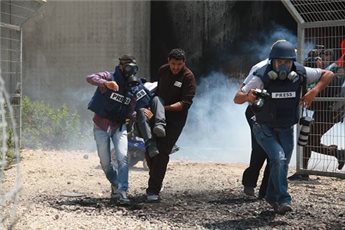
3 journalists injured in Bilin protest
Ma’an – June 13, 2014
RAMALLAH – Three journalists were injured and dozens suffered from excessive tear gas inhalation as Israeli forces dispersed a weekly protest in Bilin village near Ramallah.
Israeli forces fired rubber-coated steel bullets, stun grenades, and tear gas at protesters as they neared their lands near the wall, injuring photographer Abbas al-Momini with a rubber-coated steel bullet in the pelvis, and Palestine TV cameraman Shamekh Jagoub and photographer Haitham Khatib with tear-gas canisters in the abdomen.
Participants raised Palestinian flags and posters of prisoners as they marched throughout the village chanting songs for unity and in support of prisoners.
Protesters wore prisoner uniforms and played football in front of the prison.


Federal Agencies with Guns: Weather Service, Social Security, Railroad Retirement Board
By Noel Brinkerhoff | AllGov | June 10, 2014
Thousands of federal government employees are armed with handguns and even semiautomatic and automatic weapons as part of their jobs for agencies that are not traditional law enforcement operations.
These gun-toting civil servants include those performing missions that involve Social Security, delivering the mail, predicting the weather, and overseeing railroad pensions. Others authorized to carry firearms conduct audits for the U.S. Department of Agriculture.
The Social Security Administration has sought to purchase 174,000 rounds of hollow-point bullets, while at least nine agencies have their own SWAT (Special Weapons and Tactics) teams, including the Office of Personnel Management, the Department of Labor, the National Aeronautics and Space Administration, the Department of Health and Human Services, the Food and Drug Administration, the Consumer Product Safety Commission, and the Fish and Wildlife Service.
With the increase of federal regulatory criminal laws being passed, the number of law-enforcement personnel attached to agencies has gone up as well. But the traditional law enforcement agencies like the Federal Bureau of Investigation and the Marshals Service have been unable to handle all of the demand to execute potentially dangerous investigations, searches and arrests, leading officials at these other departments to develop their own police forces, according to an analysis by Candice Bernd of Truthout.
These forces can take their jobs too seriously. In 2003, Department of Fish and Wildlife agents stormed into the home of George and Kathy Norris of Houston. George Norris imported and sold orchids. He was subsequently accused of smuggling a certain variety of the plant into the United States. Although it was later found that he had only made a few paperwork errors, he ended up pleading guilty to seven counts of violating the Endangered Species Act and served 17 months in prison.
Some lawmakers are starting to think it might be time to scale back on federal criminal codes. Last year, the Over-Criminalization Task Force (part of the House Judiciary Committee) convened for the first time to consider ways to shrink the number of laws and provisions on the books.
To Learn More:
USDA and Submachine Guns: Latest Example of Mission Creep as Federal Policing Expands (by Candice Bernd, Truthout)
Orchid Kingpin? Mistake Lands Elderly Gardener in Prison (by John Jessup, CBN News)
‘US a warzone’: Police deploy heavy armor in America
RT | June 9, 2014
From the streets of Fallujah to Franklin, Indiana, heavily armored military vehicles have been rolled out for one and the same reason: many police officers in the US believe there’s a war going on.
Franklin, Indiana is by all accounts the idyllic Midwestern American town. Eponymously named after one of the founding fathers and “the first American,” Franklin’s small town bona fides provided Life Magazine with a Norman Rockwell-esque scene for a bit of village life utopia in the heart of the Great Depression.
But if you were to talk to local law enforcement, a battle is raging in the streets of Mayberry.
Franklin is the county seat of Johnson Country, Indiana. Speaking with Mark Alesia from The Indianapolis Star, Sheriff Doug Cox described the 139,000-strong administrative district as a place where officers’ old-time policing just doesn’t cut it anymore.
Leading Alesia to a pole barn in Franklin, Cox shows him a MRAP – a 55,000 pound, six-wheeled Mine-Resistant Ambush Protected armored-fighting vehicle with the word “SHERIFF” emblazoned on its flank.
“We don’t have a lot of mines in Johnson County,” confessed Sheriff Doug Cox, who acquired the vehicle. “My job is to make sure my employees go home safe.”
Cox isn’t alone in believing his deputies have something to fear. Johnson County is one of eight Indiana law enforcement agencies to acquire MRAPs from military surplus since 2010, according to public records obtained by The Indianapolis Star.
All across the state, and the country, the trend is similar. From picking up military surplus to using to $35 billion in grants from the Department of Homeland Security to acquire the most advanced weapons, police forces across America are armed to the teeth.
And as Pulaski County Sheriff Michael Gayer puts it, the effects are not only tactical, but psychological.
To put it bluntly: “It’s a lot more intimidating than a Dodge.”
Pulaski, mind you, is a county of roughly 13,000 people. The question of whether civilians need to be intimidated like that depends on your perspective, and as far as Gayer sees things, America is a battlefield and the police are akin to an occupying force.
“The United States of America has become a war zone,” he said. “There’s violence in the workplace, there’s violence in schools and there’s violence in the streets. You are seeing police departments going to a semi-military format because of the threats we have to counteract. If driving a military vehicle is going to protect officers, then that’s what I’m going to do.”
‘What if it were your kid’
The militarization of America was covered in a recent Vice.com documentary, entitled: ‘Here’s What Happens When Hackers Send a SWAT Team to Your House.’
Danny Gold heads to Somerset County, New Jersey, what he describes as “one of the wealthiest counties in the US.”
Sgt. Edward Ciempola, commander of the county SWAT team, boasts of a Lenco BearCat Ballistic Engineered Armored Response Counter Attack Truck, which he says they use on “every call out.”
With infrared cameras in stock and other military grade hardware, Gold asks Ciempola one simple question: in a quiet, relatively crime-free area, is all of this hardware really necessary?
“I would ask somebody that maybe suffered a loss because of not having this service and I would ask them the answer to that question,” Ciempola said.
“I would say, well, the SWAT team wasn’t available when you really needed it or a police officer wasn’t available when you really needed it, or an ambulance didn’t get there when you really needed it. How does that make you feel? And if your child’s school was suddenly under attack by some random actors, do you want them coming (points to SWAT team) to help your kid or do you want no one to show up?”
Despite the fears of Ciempola and Gayer, in a 2012 Department of Justice report, violent crime had declined by 72 percent from 79.8 to 22.5 per 1,000 persons age 12 or older since 1993. And yet, what’s happening in places like Franklin and Somerset County are the exception rather than the rule.
Writing for the Huffington Post, Radley Balko noted the disturbing trend in SWAT team growth across the country.
He argues that SWAT teams in municipalities with populations between 25,000 and 50,000 have “increased by more than 300 percent between 1984 and 1995.”
By 1995, nearly 90 percent of cities with 50,000 or more people had a SWAT team. In 2000, 75 percent of towns with 25,000 to 50,000 people had their own SWAT teams as well. And those paramilitary units are not sitting idly by.
Citing Peter Kraska, a criminologist at Eastern Kentucky University, Balko says the total number of SWAT raids in America has increased exponentially, from just a few hundred per year in the 1970s, to a few thousand by the early 1980s, to around 50,000 by the mid-2000s.
According to the American Civil Liberties Union (ACLU), “disproportionately those in poor communities and communities of color – have become targets for violent SWAT raids, often because the police suspect they have small amounts of drugs in their homes.”
And with the SWAT teams comes the military hardware. In Keene, New Hampshire, a town with two murders since 2009, officials accepted a $285,933 grant from the Department of Defense in 2012 to purchase a BearCat. In Columbia, South Carolina, a MRAP which can be equipped with a 50-caliber machine gun was picked up in 2013. In the sleepy town of Roanoke Rapids, North Carolina – a town of 16,000 people, police got their hands on their own Humvees and MRAPs, which they went on to display at a car show.
According to March report in USA Today co-written by US Representative Hank Johnson, the following counties “have acquired free MRAPs from US war zones”:
McLennan and Dallas Counties in Texas; Boise and Nampa Counties in Idaho; Indiana’s West Lafayette, Merrillville, and Madison Counties in Indiana (not to mention Johnson); Minnesota’s St. Cloud and Dakota Counties in Minnesota; Warren and Jefferson Counties in New York; North Augusta and Columbia in South Carolina; Murfreesboro in Tennessee; Yuma in Arizona; Kankakee County in Illinois; and Calhoun County in Alabama.
Many of the vehicles were acquired through the 1033 program, a 1997 law which facilitated the transfer of military hardware to local police forces. But what appears to be free federal handouts could result in fundamentally changing the face of the United States.
“Americans should therefore be concerned, unless they want their main streets patrolled in ways that mirror a war zone,” Johnson lamented.
“We recognized that we’re not in Kansas anymore, but are MRAPs really needed in small-town America? Are improvised explosive devices, grenade attacks, mines, shelling and other war-typical attacks really happening in Roanoke Rapids, a town of 16,000 people? No.”
Johnson, a member of the House Armed Services and Judiciary Committees, announced he was introducing legislation to reform the 1033 program “before America’s main streets and civilian police militarize further.” The ACLU, meanwhile, has launched an investigation into the militarization of US police.
“The police officers on our streets and in our neighborhoods are not soldiers fighting a war. Yet many have been armed with tactics and weapons designed for battle overseas,” it said.
In 2013, ACLU affiliates in 25 states filed over 260 public records requests with law enforcement agencies to document the impact of excessively militarized policing on people, families, and communities.
But as Balko warns, vested interests are likely to keep pushing the police-industrial complex until America is on lockdown.
“A new industry appears to be emerging just to convert those grants into battle-grade gear,” he said.
“That means we’ll soon have powerful private interests, funded by government grants, who will lobby for more government grants to pay for further militarization — a police industrial complex.”
Gaza fisherman shot by Israel 2 weeks ago succumbs to his wounds
Ma’an – June 8, 2014
GAZA CITY – A Palestinian fisherman shot by the Israeli navy two weeks ago succumbed to his wounds Sunday morning, Gaza medical authorities said.
Spokesman for the Gaza Ministry of Health Ashraf al-Qidra told Ma’an that 52-year-old Imad Shukri Salim was announced dead Sunday morning.
 Salim was shot in the chest by the Israeli navy two weeks ago while he was fishing off the coast in the area of al-Sudaniya in the northern Gaza Strip, al-Qidra said.
Israeli forces shot two Palestinian fishermen off the al-Sudaniya area coast in the month of May alone.
Palestinian fishermen are only being allowed to go three nautical miles from Gaza’s shore, even though an agreement previously settled on 20 nautical miles.
Israeli naval forces frequently harass Palestinian fishermen who near the three-mile limit, as well as those inside the zone.
There are 4,000 fishermen in Gaza. According to a 2011 report by the International Committee of the Red Cross 90 percent are poor, an increase of 40 percent from 2008 and a direct result of Israeli limits on the fishing industry.
Palestinian wedding interrupted by Israeli stun grenades, 1 hurt
Ma’an – 07/06/2014

JERUSALEM – A Palestinian man was injured late Friday after being hit by an Israeli stun grenade during a wedding in East Jerusalem, a local popular committee spokesman said.
Muhammad Abu al-Hummus told Ma’an that Israeli forces unexpectedly raided the village of al-Issawiya and fired stun grenades while crowds of Palestinians were participating in a traditional wedding march.
One man was hit directly in the forehead with a stun grenade and taken to the hospital, Abu al-Hummus said.
He added that no protests were taking place as the Israeli forces entered the town.
Featured Video

Iran FM Araghchi: “Hormuz Will No Longer Be the Same”
or go to
Aletho News Archives – Video-Images
From the Archives
Sam Husseini: The entire US establishment helped lie their way into the Iraq war
By Slava Zilber | American Herald Tribune | October 14, 2019
Sam Husseini is a senior analyst with the Institute for Public Accuracy, independent journalist and contributor to The Nation and FAIR.
Slava Zilber: Sam, three years ago, you appeared on Talk Nation Radio with David Swanson and spoke about the case of the GCHQ whistleblower Katharine Gun. You pointed out that the people involved in the spying on the UN and the people authorizing the Iraq War were not held accountable:
“Virtually everybody who went along with the war, whether it is Kerry or Clinton, of course, the Bush administration themselves has falsified their own records in terms of why, what they did, when they did, why they did it, to the extent that they’ve been scrutinised at all.”
You also address it in a recent article. And recently, Joe Biden has been lying about his position on the Iraq War. How can such an important issue escape meaningful scrutiny? … continue
Blog Roll
 Aletho News
- China slams US policy on Iran as Russia rejects legality of nuclear meeting at UN
- The Mecca Pact Courts Iran: Containment Comes Full Circle
- Oman FM: Persian Gulf states, Iran, Iraq should form security pact excluding US
- Trump peddles fresh falsehoods, claims Iran ‘started the war’ as US aggression drags on
- Ukraine quagmire? Yes, but it’s for NATO, not Russia
- US intelligence hypes Chinese, Russian space threats while accelerating its own military buildup in orbit
- Iran FM Araghchi: “Hormuz Will No Longer Be the Same”
- EU facing trillion-euro debt hole while seeking more cash for Kiev
- How US, Europe, Persian Gulf states exhausted missile stockpiles, splurged billions to defend Israel
- Up in arms… Koreans reject U.S. empire’s plan to make South Korea the next Ukraine
- If Americans Knew
- An error has occurred; the feed is probably down. Try again later.
- No Tricks Zone
- Sudden Stratospheric Warming, Powerful El Niño Combination May Lead To Extreme Europe Cold, Energy Crisis!
- Two New Studies Find Thwaites Glacier Melt Cannot Be Driven By Human Activity Or A Warming Ocean
- E-Cars Reduce CO2 Emissions By Only 41% Compared To Internal Combustion Engine Vehicles
- Predictions Made By Renowned Climate Professor Over Past Decades Have Been Proven To Be Poor
- New Study Suggests Large Regions Of The Pacific Ocean Have Been Cooling For The Last 80 Years
- Germany’s Green Energy Debacle: High Energy Costs Force Kahla Porzellan to Close After 182 Years!
- New Study: 50 Years Of The Most Aggressive ‘Net Zero’ Policies Can Only Affect The Global Climate By 0.03°C
- US September “Heat” Was No Record…Many Records Set Decades Ago
- Latest European Green Energy Debacle; Portugal’s Largest Flagship Solar Park Insolvent!
- Green Energy Debacle: German Expert Professor Fritz Vahrenholt Warns Of Severe Economic And Social Consequences

