It’s exactly three years ago that the ins and outs of the overpopulated strip were sealed off by the Israeli military just as tightly as the entire “International Community” shut its eyes and ambivalently turned its back on a horrifying massacre that was in the making. And it’s three years ago that we’ve used up what little was left of our quota of sympathy and compassion towards the Palestinians and took our collective apathy to a whole new level.
Three years after the “unilateral cessation of military operations” on January 18th, 2009; and the Israeli apparatus of mass murder and annihilation is still roaring at the borders; ready to be initiated at a moment’s notice, the IOF is literally licking its lips, salivating at the chance of yet another vicious round of wholesale slaughter, its animalistic zeal for more bloodletting is as vigorous today as it was only three years ago –if not more-, Israeli political, diplomatic and military officials alike don’t seem to miss an opportunity to beat the war drums – and they do so with an almost reckless abandon.
The day starts and ends with the gloom of impending war amassing over Gaza; on December 27th, 2011 (third anniversary of the war on Gaza), Israeli army Chief of Staff Lieutenant General Benny Gantz stated that another attack on the strip is “inevitable” while southern brigade commander Tal Hermoni was quoted by Haaretz newspaper as saying that another “varied and different military campaign” is being prepared, this is of course not counting the fact that targeted killings, aerial night raids and the occasional ground incursion have already become such horrible albeit daily realities in the strip.
Today, an entire population in Gaza is held hostage to dire living conditions and the Zionist state’s death grip, Israel’s heartless policy of meticulously calculating and determining the calorie-intake for Gazans is still the order of the day; university students are being robbed of their academic futures due to arbitrary travel restrictions, patients denied their right to treatment and systemic disregard for anything even resembling human rights still goes on apace.
Three years after the bombs fell; and Palestinians in Gaza –with so many cards stacked against them- are still trying to piece together the broken shards of their lives and entire families are still living through worn out photographs of their loved ones; those who lost their lives to Israel’s Casting Lead and the rest of the world’s self-incriminating silence.
Three years after the bombs fell; and new injustices heaped on top of ongoing ones. The piercing wail of sirens, keening voices of loss amongst the ruins of the strip still prevail till this very day in the little coastal enclave. Three years after the bombs fell; and the only justice the international community could afford to the people of Gaza was a meek report that was even disowned by its author.
Three years after the sky of Gaza was blanketed with all means of spiraling white phosphorous ammunitions; and the ground of the strip is still littered with leftover shells and unexploded bombs laying in wait for a second chance to claim yet more lives of Palestinian kids. Three years after the bombs fell; and living a normal childhood still remains such a rare feat for Gazan children as the sheer weight of life on Israel’s draconian terms takes its heavy toll on their fragile souls; deathly hues of the last war still take hold of their memories and the overcrowded makeshift classrooms are daily reminders of the horrors they’ve endured in that winter of 2008/2009.
Three years after Israeli “spectators” from nearby southern cities took to hilltops in groups to catch sight of the sky raining death and destruction on defenseless Palestinians, giggling, sharing laughs and passing their binoculars from one person to the next as they cheered enthusiastically for the “might” of the IOF as if the carnage unfolding right before their eyes was a mere sporting event; and killing is still a spectator sport for Israeli authorities, trigger-happy junior Israeli border officers still get their kicks from firing live rounds at Palestinian farmers attempting to harvest their crops near the “buffer zone” while hunting the Palestinians in their tunnels near the Rafah border with unmanned drones is still the “standard operating procedure”.
Three years after the bombs fell – almost one year after the dictatorship of Husni Mubarak was dissolved-; and the crushing weight of Israel’s blockade is still pressing hard against the chests of Gazans, the inhumane siege of Gaza –which has long outserved its theoretical usefulness, if there ever was any to begin with- has gradually morphed into this internationally condoned policy that the world has become, for all intents and purposes, far too comfortable to abandon; eventually this chronic passiveness has sadly maneuvered the Palestinians in Gaza into a seemingly unending life of siege and collective punishment, a life in which they have no choice but to literally tunnel their own way out.
Today “Operation Cast Lead” remains an open wound and a dark stain on the conscience of the world as its sense of morality and justice is rapidly waning and the value of a human life remains gravely skewed. Are Palestinian victims somehow not worthy of mass candle-lit vigils at dusk in honor of their memory? Will they ever have someone to recite each and every one of their names at their own “hallowed ground”? The images of the 22-day long massacre in Gaza are too strong to be forgotten; of grief stricken fathers digging the remains of their loved ones buried under the rubbles of what was once their house, of the injured wheeled into chaotic emergency rooms on office chairs, of unidentified bodies of dead children with the word “anonymous” scribbled in black markers across their tiny bellies at the morgue in the Adwan hospital and of doctors at al Shifa Hospital desperately performing CPR on little infants’ chests to no avail.
Unfortunately the media still has a blind spot when it comes to Gaza; screams of protest from Tunisia, Cairo, Benghazi and Sana’a have drowned out the incessant appeals to lift the blockade. Of course; plenty of exploits to be reaped from the Arab Spring nowadays, where -sadly enough- opportunism and gutter politics reign supreme, and so little time to do so.
Three years after the bombs fell; and it seems that Gaza will remain on the back-burner for a while; largely absent from our TV sets and daily dose of news bites, until perhaps Cast Lead II.
Ahmad Barqawi, a Jordanian freelance columnist & writer based in Amman, he has done several studies, statistical analysis and researches on economic and social development in Jordan
January 12, 2012
Posted by aletho |
Ethnic Cleansing, Racism, Zionism, Subjugation - Torture, Timeless or most popular, War Crimes |
Leave a comment
Washington, DC – Today, on the tenth anniversary of the arrival of the first detained men at the U.S. prison in Guantánamo Bay, Cuba, the Center for Constitutional Rights (CCR) issued the following statement:
Today marks the tenth anniversary of indefinite detention without charge or fair trials at the prison at Guantánamo, and it is an anniversary that should not have come. The men indefinitely detained at Guantánamo have been abandoned by all three branches of government, but the primary responsibility for the prison remaining open lies with President Obama. On his second day in office, President Obama signed an Executive Order mandating the closure of Guantánamo within a year. Since then, his administration has in fact perpetuated and sanctioned the system at Guantánamo by continuing indefinite detentions without charge or trial, resuming illegitimate military commissions, and most recently, signing into law the 2012 National Defense Authorization Act (NDAA), which substantially hinders the closure of Guantánamo by restricting the transfer of the remaining 171 detained men, over half of whom have been approved for transfer by every branch of government with a stake in the matter. Despite its promise of a new era of accountability and respect for the rule of law, the Obama administration has also repeatedly acted to block virtually any accountability for those who have planned, authorized, and committed torture at Guantánamo and beyond. On this day marking ten years of injustice at Guantánamo, we call on people of conscience everywhere to demand that the prison finally be closed and to intensify opposition to all unjust U.S. detentions and prosecutions conducted in the name of national security. We must also build opposition to the government’s covert and overt wars in a re-branded “War on Terror” which is being used to justify both military detentions and military strikes to the detriment of the safety and dignity of peoples in the United States and abroad.
In the morning, CCR hosted a briefing at the National Press Club entitled “Obama’s Prison: Guantánamo Turns 10.” The briefing featured CCR’s Executive Director Vincent Warren; CCR’s Legal Director Baher Azmy; Stephen Oleskey, co-counsel in the landmark Boumediene v. Bush Supreme Court case, who argued that the men’s right to challenge the legality of their detentions has since been effectively eviscerated; Rear Admiral John Hutson, a former military officer who supported President Obama’s 2009 Executive Order promising to close Guantánamo within one year and stood behind him as he signed it; and Colonel Morris Davis, a former chief prosecutor for the Guantánamo military commissions who ultimately resigned because of the injustices he witnessed. (Short statements by participants in the press briefing can be seen on CCR’s website here.)
The press briefing was followed by a large rally in front of the White House demanding the closure of Guantánamo led by a broad coalition of human rights organizations and activists including the Center for Constitutional Rights, Witness Against Torture, Amnesty International-USA, the National Religious Campaign Against Torture, and September 11th Families for Peaceful Tomorrows. At this rally, Martha Rayner, an attorney who represents men detained at Guantánamo, read a statement signed by over a hundred habeas counsel denouncing the unjust detention of their clients and President Obama’s failure to close the prison. Ramzi Kassem, an attorney who represents men detained at Guantánamo and Bagram and a professor who directs the Creating Law Enforcement Accountability & Responsibility (CLEAR) project at CUNY School of law, spoke of the injustices within terrorism detentions and prosecutions that occur domestically in the U.S. and abroad. Talat Hamdani, mother of Salman Hamdani, an emergency medical technician who died in the September 11, 2001 attacks while helping people at the Twin Towers in New York City, also called for the closure of Guantánamo.
According to habeas counsel who had spoken with their clients, the men at Guantánamo were heartened by the planned protests marking the anniversary in cities across the U.S. and planned their own peaceful protests to coincide with the rally in DC and to demand the end to their continued indefinite detention without charge or a fair trial. They planned to protest by staging sit-ins and participating in a three-day hunger strike.
Following the rally, the demonstrators marched down Pennsylvania Avenue, led by 171 people dressed in orange jumpsuits and black hoods representing the number of men still detained at Guantánamo. They continued all the way to the U.S. Supreme Court, holding brief rallies at four locations to demonstrate the chain of responsibility that connects the White House, the Department of Justice, the U.S. Capitol, and the Supreme Court. … Full article
January 12, 2012
Posted by aletho |
Civil Liberties, Progressive Hypocrite, Subjugation - Torture, Timeless or most popular |
Leave a comment
Four years after an Israeli soldier used his sniper rifle to kill a Palestinian civilian from Bethlehem district visiting family in the Ramallah district; an Israeli court acquitted the soldier and claimed that there is not enough evidence to convict the soldier, adding that no charges were filed against the shooter, the Arabs48 News Agency reported.
Israeli Information Center for Human Rights in the Occupied Territories, B’Tselem, issued a report stating that it filed an appeal to the Israeli High Court, on August 08, 2011, and was informed that the officer who shot and killed Firas Qasqas, 32, will be sent to court. But the prosecution never revealed what charges will be filed against the soldier.
Qasqas was killed on December, 02, 2007, when an Israeli soldier used his sniper rifle to kill him despite the fact that he was hundreds of meters away, was not armed and did not pose any threat.
The incident took place in At-Teera village, near the central West Bank city of Ramallah; Qasqas, from Batteer village near Bethlehem, and his family, were visiting relatives in At-Teera.
In February last year, B’Tselem filed an appeal demanding the Military Prosecutor’s Office to act against the soldier.
According to B’Tselem’s investigation, at noon on December 2nd, Qasqas and two of his relatives were walking in an open area near the houses of At-Teera village, and then a number of Israeli soldiers, 500 meters away, opened fire at them without any prior warning.
The three were unarmed, and did not act in any way that might look suspicious. Qasqas was shot in the back, and the bullet exited from his chest. His two relatives rushed him to a local hospital in Ramallah but he died of his wounds.
After the fatal shooting, B’Tselem repeatedly contacted the Israeli Military Prosecution, asking it to open an investigation into the shooting, and two months later, the Military Prosecutor ordered an investigation and B’Tselem helped in collecting the testimonies of the two witnesses, and provided the investigators all related documentation.
On August 18, 2011, the Prosecution announced that the Central Command of the Israeli Military had concluded all investigations, and decided that the issue of filing charges against the officer should be considered, and that a hearing will be conducted in order to listen to the testimony of the commander who ordered the soldier to open fire.
The Defense attorney of the officer (Morr) claimed that “there is no way to prove that the cause of death was that bullet”, and that “there is no proof that anybody was killed in the incident in question”.
He also claimed that the medical reports are incomplete, and do not include the autopsy report that indicated the exact cause of death.
The court then decided to close the file of Qasqas without any indictment against any soldier, and claimed that “despite the fact the soldiers opened fire in violation to the open-fire regulations in the area, yet, the soldiers act in a practical manner as they opened fire when they felt that they were in danger”.
It also said that “despite the fact that the decision to open fire was wrong, the act is not a crime and does not even constitute negligence”.
January 11, 2012
Posted by aletho |
Civil Liberties, Ethnic Cleansing, Racism, Zionism, Subjugation - Torture |
Leave a comment
Around midnight on January 10th two international, female activists were attacked by a middle aged settler woman living in the occupied area of Hebron.
After entering Shuhada Street, which is closed to Palestinians, the two women encountered a settler woman who threw a large rock at them unprovoked. When they turned to see their attacker, the woman kicked them and tried to choke them by their kuffiyehs, Palestinian scarves worn in solidarity. Both internationals called for help and screamed, but the Israeli soldier on duty some 30 meters away did not intervene. The settler woman once again picked up a rock to renew her attack.
Knowing that if they were to defend themselves they would face assault charges, the two activists chose to flee their attacker instead. The soldier did nothing to either prevent nor respond to the attack, and when the internationals asked him to call the police, the soldier said simply he did not see anything.
When asked about his indifference to the attack, the soldier answered, “What would you do if someone is bothering the h*ll out of you?” and, “I’m not allowed to leave the area around my checkpoint.”
When the police finally arrived, the same soldier translated since the police officer refused to bring along an English-speaker. The police and soldiers took advantage of the situation to make fun of, cat call, and attempt to flirt with the international women.
Although they were given a detailed account of what happened, the police wrote nothing down and gave no information about what steps would be taken to address the event or prevent future occurrences.
When it was obvious that the police were not taking down any details, the internationals suggested them to raid the area’s Israeli settler neighborhood in the same way as soldiers raid Palestinian neighborhoods when there is a suspicion of a stone-throwing. The internationals were told not to interfere or to instruct the police in how to do their jobs, and were then ordered to leave the street.
As the internationals walked home, a police car and army jeep drove up and continued at a walking pace, sandwiching the women in between the vehicles. As they walked the police continued shouting and whistling cat calls at the internationals.
Hebron or al Khalil is a Palestinian city in the south of the West Bank. A few hundred Israeli settlers occupy the very city center from within, in an area known as H2. The Israeli army has implemented a policy of apartheid and strict separation citing the protection of the Jewish illegal settlers. Movement restrictions affects tens of thousands of Palestinian residents and have led to the destruction of Hebron’s commercial center and mass abandonment of the area, and have forced people to leave their homes. Yet, the approximately 2000 soldiers stationed in the area do little or nothing to prevent settler attacks against Palestinians, which continue to escalate. In addition, Israeli soldiers control entries and exits of H2 with several checkpoints. In cases of emergency, Palestinians’ lives are sometimes left in the hands of their occupiers, since neither Palestinian ambulances nor police are allowed into the occupied area of H2.
The occupation is illegal under international law, and many reports have raised concerns of human rights violations against Palestinians living in the area. In addition, there are many accounts where the soldiers have either stood by or assisted settlers in attacks against Palestinian residents and homes.
Attacks on internationals are nothing compared to what Palestinians face on a daily basis. International Solidarity Movement views the recent attack and the failures of soldiers and police to intervene as a further escalation and approval of settler violence, intended to worsen already unbearable circumstances for Palestinians living under occupation.
Emma and Meriam are volunteers with International Solidarity Movement (names have been changed).
January 11, 2012
Posted by aletho |
Illegal Occupation, Subjugation - Torture, Timeless or most popular |
Leave a comment
Citing Attorney-Client Privilege, Col. J.P. Colwell Tells Military Lawyers That Following New Prison Rules Would Be Unethical
NEW YORK – The top defense lawyer for the Guantánamo military commission system has ordered the attorneys under his command not to comply with rules issued by the Guantánamo prison chief that require Defense Department screening of all written materials lawyers want to send to their clients.
In an email sent Sunday and obtained by the American Civil Liberties Union, Marine Col. J.P. Colwell, the chief military defense counsel for the commissions, informed all military commission defense lawyers that they were ethically obligated to refuse to follow the rules, which were issued last month. The email is available on the ACLU website.
“Col. Colwell joins an honorable line of Guantánamo military lawyers who have opposed superiors’ attempts, ostensibly in the name of security, to undermine longstanding rules necessary for a fair trial,” said Zachary Katznelson, senior staff attorney with the ACLU National Security Project. “In seeking to force military defense counsel to cast aside their professional ethical obligations of client confidentiality, the new rules fly in the face of American justice and tradition. Once again, the government’s actions show exactly why these cases need to be in federal court where the rules are established, fair and effective.”
Guantánamo’s commander, Navy Rear Adm. David Woods, issued the rules on monitoring legal communications on Dec. 27. Under the rules, any information provided by lawyers that military censors found objectionable, such as communications about U.S. personnel who tortured the prisoners, could be kept from the prisoner and brought to the attention of the base commander. This would eliminate attorney-client privilege.
The new prison rules say that defense attorneys must agree in writing to the monitoring as a condition of communication with their clients. In his email, Colwell told military commission defense lawyers that they should not sign the monitoring agreement, and if they already had signed, then they should immediately withdraw from the agreement. Citing the ethics codes that govern every branch of the military, Colwell wrote that following the agreement and revealing such information would be “in violation” of rules for professional conduct.
The rules on communication monitoring issued by Guantánamo’s commander are available at:
www.aclu.org/national-security/orders-governing-logistics-defense-counsel-access-and-written-communications
More information on Guantánamo is available at:
www.aclu.org/close-guantanamo
January 11, 2012
Posted by aletho |
Civil Liberties, Subjugation - Torture, Timeless or most popular |
Leave a comment
RAMALLAH -Israel on Tuesday confiscated 75 tents belonging to the Palestinian Authority and detained drivers delivering the tents, ministers said.
Israeli forces confiscated five vehicles delivering the tents to residents of Khan al-Ahmar near Jericho, the PA cabinet said in a statement.
The drivers of the vehicle and employees of the company contracted to deliver the tents were detained and taken to Beit El military camp.
Israeli police spokesman Micky Rosenfeld had no immediate comment but said he would look into the report.
Israel is planning to demolish Khan al-Ahmar, a Bedouin community near Maale Adumin settlement, and forces have already destroyed homes in the camp. Settlers have filed a petition for the demolition of Khan al-Ahmar’s school.
The PA cabinet said the confiscation of tents was in line with Israel’s plan “to extradite the residents from their area by destroying and confiscating all means of life.”
January 11, 2012
Posted by aletho |
Ethnic Cleansing, Racism, Zionism, Subjugation - Torture, Timeless or most popular |
Leave a comment
As we commemorate the 10th anniversary of the arrival of the first prisoners at Guantánamo Detention Center, several thousand miles away sits another United States detention facility, less well-known but with a history perhaps even more gruesome. Obscured throughout the decade-long “global war on terror,” the detention center at Bagram Air Force Base in Afghanistan is where two detainees died in December 2002. Initial autopsies at the time ruled both deaths homicides, according to a 2,000-page confidential Army file obtained by the New York Times. Autopsies of the two dead detainees found severe trauma to both prisoners’ legs. The coroner for one of the dead noted, “I’ve seen similar injuries in an individual run over by a bus.”
In January 2009, to much fanfare, newly-elected President Barack Obama signed a directive authorizing the closing of Guantánamo Detention Center. But a month later the new administration discreetly told a federal judge that military detainees at Bagram had no habeas corpus rights to challenge their imprisonment. At the same time, the Pentagon was moving forward on plans to build a new prison in Bagram, renamed the “Detention Facility in Parwan” (DFIP). This facility was designed to accommodate 600 prisoners under normal conditions and as many as 1,100 during a “surge.”
Today, President Obama has abandoned his inaugural pledge to close Guantánamo and there are more than 3,000 detainees at Bagram — five times the number of prisoners when the president took office — with a scheduled expansion of the facility by the end of 2012 to house up to 5,500 detainees. One troubling constant across the developments at Bagram is the presence and involvement of psychologists at these facilities, which clearly violate international legal standards for the treatment of detainees. Among the military psychologists present during the early years of the Bagram prison were Colonel Morgan Banks, Captain Bryce Lefever, and Colonel Larry James, notable for their key roles in formulating American Psychological Association (APA) much-criticized ethics policy on psychologist-assisted interrogations.
According to Banks’ biographical statement, he “spent four months over the winter of 2001/2002 at Bagram Airfield.” More broadly, Banks provided technical, consultation, and interrogation support to all Army psychologists. He also assisted in establishing the Army’s first permanent SERE training program. As for Lefever’s biosketch, it notes that he also served at the detention center at Bagram Air Base. He “was deployed as the Joint Special Forces Task Force psychologist to Afghanistan in 2002, where he lectured to interrogators and was consulted on various interrogation techniques.”
The third military psychologist, James, was the Chief Psychologist for the Joint Intelligence Group at Guantánamo when, according to his book, Fixing Hell, he flew to Afghanistan to transfer three juveniles who had been forcibly and arbitrarily detained at Bagram. James described these boys as “the most fragile . . . children [he] had ever met,” yet he oversaw their being loaded onto a cargo plane at Bagram Air Force Base, “bound [and] blindfolded,” for a flight that typically lasted over 20 hours. Others who appear to have been transferred from Bagram to Guantánamo that same day reported being chained around the waist, wrists, back and ankles and the intense pain of being unable to speak, see, hear, move, or even stretch or breathe properly. The boys were essentially kidnapped, and were returned home a year later, having never had access to legal counsel and having never been charged with a crime.
Public information about exactly what transpires at Bagram today is scarce. The BBC was allowed a rare, one-hour visit to the new Parwan/Bagram prison in 2010. The report noted that “Prisoners are kept in 56 cells, which the prisoners refer to as ‘cages’. The front of the cells are made of mesh, the ceiling is clear, and the other three walls are solid. Guards can see down into the cells from above.” These detainees were moved around in wheelchairs, wearing goggles and headphones to block sight and sound.
In 2011, Daphne Eviatar, an attorney for Human Rights First, interviewed 18 former detainees from the main facility in Parwan and was permitted to observe seven detainee hearings there. In her detailed report she noted:
After many years of completely denying detainees in Afghanistan the opportunity to defend themselves against arbitrary detention, the United States government has finally implemented a hearing process that allows detainees to hear the charges against them and to make a statement in their own defense. Although a significant improvement, these new hearings fall short of minimum standards of due process required by international law.” [Emphasis added.]
In a subsequent interview with CBS News, Eviatar stated:
[Parwan] is worse than Guantánamo because there are fewer rights…There was no evidence presented, there was no questioning of the government’s evidence, whether this person had done anything wrong, whether he deserved to be in prison. So that’s a real problem — you have a complete lack of due process.
And in 2010 the International Committee of the Red Cross (ICRC) confirmed the existence of a separate, second detention facility at Parwan. Many former prisoners have referred to it as the Tor Jail, translated as “Black Jail.” Nine former prisoners interviewed separately by the BBC spoke of almost identical treatment there: distressingly cold cells, perpetual loud noise, constant light, and, violating any sense of privacy, camera surveillance. One former prisoner said American soldiers made him dance to music to obtain permission to use the toilet.
Today, there are clear indications that psychologists continue to be involved in the detention and interrogation of detainees at Parwan/Bagram. Such activities stand in direct contravention of APA policy based on a 2008 petition resolution. Approved through a member-led referendum, this resolution prohibits psychologists from working in settings where “persons are held outside of, or in violation of, either International Law (e.g., the UN Convention Against Torture and the Geneva Conventions) or the US Constitution (where appropriate), unless they are working directly for the persons being detained or for an independent third party working to protect human rights” (or if they are providing treatment for military personnel).
Significant evidence that psychologists are working at Bagram/Parwan in violation of APA policy comes in part from a symposium on “Operational Problems in Behavioral Sciences” sponsored by the United States Air Force Medical Service in August 2011. The first slide of the partially redacted powerpoint presentation on the “BSCT Mission” describes the role of the Behavioral Science Consultation Team (BSCT) as providing: “…psychological expertise and consultation in order to assist the command in conducting safe, legal, ethical, and effective detention facility operations, intelligence interrogations, and detainee debriefing operations” (OTSG/MEDCOM Policy Memo 09-053).
A later slide reveals that the current BSCTs at the Parwan Detention Facility are composed of a psychologist or forensic psychiatrist, who must be licensed for independent practice, and a “behavioral science technician.” Further confirming the presence of psychologists, a June 2010 newspaper article about Parwan by the military editor of the Fayettville Observer notes: “Air Force Maj. Colin Burchfield, 34, a clinical psychologist, observes the behavior of both detainees and guards on TV monitors.”
Disturbingly, and contrary to the APA’s 2008 referendum policy, one of the key documents still used to support the ongoing involvement of psychologists at the Parwan facility is an earlier 2005 report from the APA’s “Presidential Task Force on Psychological Ethics and National Security” (the PENS Report). The PENS Report, cited in the Operational Problems powerpoint presentation described above, endorsed psychologists’ engagement in detainee interrogations — despite evidence that psychologists were involved in abusive interrogations and practices that violate international law.
Six of the nine voting members of the PENS Task Force were on the payroll of the U.S. military and/or intelligence agencies. Five of these six served in chains of command that had been accused of the kinds of abuses that led to the creation of the Task Force, including the three psychologists linked to the early Bagram prison: Dr. Morgan Banks, Dr. Bryce Lefever, and Dr. Larry James. The PENS Task Force concluded that psychologists have an important role to play in keeping interrogations “safe, legal, ethical, and effective,” and the APA Board approved the PENS Report in a highly unusual emergency vote.
The APA’s claims that it stands strongly against torture and cruel, inhuman and degrading treatment are belied by the organization’s repeated failure to take assertive and meaningful action. There is no clearer example than the continuing participation of psychologists in detention and interrogation activities at the Parwan/Bagram prison — a site where international law itself is seemingly confined indefinitely to a small, dark cell.
But health professionals, human rights advocates, and intelligence professionals of conscience worldwide have refused to accept this status quo. One noteworthy and promising effort is an online petition campaign calling for the annulment of APA’s PENS Report. The initiative has been supported by many distinguished members of APA, as well as non-psychologists such as psychiatrists Robert Jay Lifton and bioethicist Dr. Steven Miles; scholar-activists such as Daniel Ellsberg and Noam Chomsky; attorneys who have represented Guantanamo detainees; eminent veterans of the intelligence community; and many other psychologists and human rights advocates. Please consider joining this call and signing the petition at www.ethicalpsychology.org/pens.
~
Trudy Bond is an independent psychologist, steering committe member of Psycholgoists for Social Responsibility, and a member of the Coalition for an Ethical Psychology. For questions, responses or media contact, please contact her at drtrudybond@gmail.com.
Roy Eidelson is a clinical psychologist and the president of Eidelson Consulting, where he studies, writes about, and consults on the role of psychological issues in political, organizational, and group conflict settings. He is a past president of Psychologists for Social Responsibility, associate director of the Solomon Asch Center for Study of Ethnopolitical Conflict at Bryn Mawr College, and a member of the Coalition for an Ethical Psychology. Roy can be reached at reidelson@eidelsonconsulting.com.
Brad Olson is an assistant professor and co-director of the Community Psychology Ph.D. Program in downtown Chicago. He is President-Elect of Psychologists for Social Responsibility (PsySR) and co-founder of the Coalition for an Ethical Psychology.
Stephen Soldz is a psychoanalyst, psychologist, public health researcher, and faculty member at the Boston Graduate School of Psychoanalysis. He edits the Psyche, Science, and Society blog. Soldz is a founder of the Coalition for an Ethical Psychology and served as a psychological consultant on several Guantánamo trials. Currently Soldz is Past-President of Psychologists for Social Responsibility [PsySR].
January 10, 2012
Posted by aletho |
Progressive Hypocrite, Subjugation - Torture, Timeless or most popular, War Crimes |
Leave a comment
In this book, translated from German, Murat Kurnaz, a German Turk, tells his tragic story. When only nineteen and an apprentice shipbuilder, while taking time off in Pakistan for religious study, he was hauled off a bus and imprisoned for a short time before being `sold’ to the US Administration for $3,000. This was a bargain – the Americans were offering $5,000 – $25,000 to locals for anyone suspected of being Taliban or Al Qaeda. With such tempting offerings, many innocent men – usually foreigners – were gladly exchanged for the money which converted into huge amounts in the local currency.
Murat was sent first to a prison camp in Kandahar, Afghanistan and then later to Guantanamo Bay, Cuba. In both places he was repeatedly and relentlessly tortured. Among other things he was constantly beaten, often for no reason, he was water boarded, he was electrically shocked on the soles of his feet, he was hung from the ceiling by his arms tied behind him for hours on end, he was deprived of sleep for weeks at a time, he was forced to stand for days, he was starved, he was force fed, he was put in an air-tight metal container and subjected to extreme heat and cold and of course there were the months of solitary confinement. In Guantanamo he came across prisoners as young as 14 and a few even in their 80s and 90s.
Like all the books on Guantanamo, there is almost a shock a page. Besides the main tortures listed above, what I found almost as deplorable was how vindictive, sadistic and cruel the soldiers were to the detainees in little ways, all the time and always there were endless lies. Also appalling were Murat’s descriptions of female soldiers in one of the camps, watching while naked male prisoners defecated in a communal bucket in the open pen. And in Guantanamo, scantily dressed young women rubbed themselves against him and made sexual suggestions. One wonders if their male superiors ordered them to do this or if they thought up these little torments themselves. But it should also be said that a few guards treated the detainees with basic decency.
At the end of the book we learn that the Administration knew 6 months into Murat’s capture that he was innocent, but kept him on, continued the torture and even made wild accusations against him – presumably to save face. After 5 years when he was finally to be sent back to Germany, on the way out they made a last ditch effort to make him sign a statement saying he was either Taliban or Al Qaeda or he must stay in Cuba. He refused.
How do we know all this is true? Having read so many similar accounts from so many prisoners of many different nationalities and languages, from different cell blocks, who could not have collaborated, I am convinced that what is described is essentially what happened. The Epilogue, written by his American attorney, Baher Azmy, a law professor in New Jersey, is excellent.
Murat was robbed of part of his youth with no explanation or apology so it is hardly surprising he felt compelled to tell his story. He finishes with – “We have to tell the world how Abdul lost his legs and how the Moroccan captain lost his fingers. The world needs to know about the prisoners who died in Kandahar. We have to describe how the doctors came only to check whether we were dead or could stand to be tortured for a little longer.”
January 8, 2012
Posted by aletho |
Deception, Subjugation - Torture, Timeless or most popular, War Crimes |
Leave a comment
Hundreds of French people have taken to the streets in the city of Clermont-Ferrand to denounce the police’s heavy-handed tactics against residents.
Over five hundred people attended the silent march on Saturday to show their support for Wissam El-Yamini, a thirty year old man who went into coma following his arrest on New Year’s Eve.
Scores of young residents also staged a sit-in protest outside the city’s police station, holding a banner that said “No one above law, stop burr, we are all with you Wissam”.
Wissam was violently arrested on the night of December 31 by two officers near a shopping center in the district of Gauthière.
According to the local police, Wissam went into coma after having a heart attack while he was being transported to the police station.
The incident has provoked violent riots across Clermont-Ferrand. During the last two nights, angry protesters set fire to more than thirty vehicles across the city.
January 8, 2012
Posted by aletho |
Civil Liberties, Solidarity and Activism, Subjugation - Torture |
Leave a comment
BETHLEHEM — Israel has been refusing to clear a minefield in the village of Husan, west of Bethlehem, for decades, the village’s municipal council chairman, Jamal Sabatin, said.
He told Quds Press on Saturday that the minefield, which was planted in 1950, had killed six citizens and seriously wounded 15 others, who had their limbs amputated.
Sabatin said that the American society “Roots of Peace” had set up a plan on Friday to remove those mines but the plan was pending Israeli approval, charging that Israel has been adamantly refusing all plans to demine that field.
He said that international reports indicated that hundreds of thousands of mines were planted by the Israeli forces in various Palestinian areas.
January 7, 2012
Posted by aletho |
Subjugation - Torture, Timeless or most popular, War Crimes |
Leave a comment

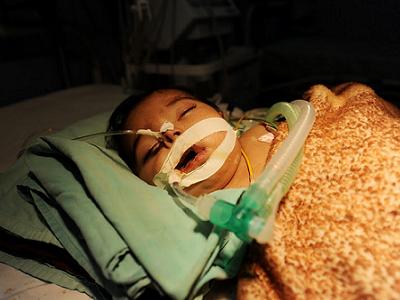
Adham Baroud was the latest casualty. (Oxfam Gaza)
A baby fighting for his life.
Parents are panic stricken.
Doctors desperate for help.
Permission to get medical help denied.
Welcome to Gaza!
The world’s largest open air prison in the world, with a population of 1.7 million Palestinians, 50% of which are children under the age of 18 years old. 80% of the population living on less than $2 per day with unemployment at 45%. Desperately needed medical supplies not being allowed in. Thanks to Tel Aviv and Cairo, Gazans are denied to get in or out of the strip, not even the mail.
The illegal Israeli siege on Gaza continues to take innocent lives daily. Adham Baroud was the latest casualty. A seven month old baby who died on December 26th in a slow and painful death from renal failure when he could be easily treated.
On December 1, Adham was referred to Israel for emergency treatment by his doctors in Gaza after his condition became terminal following a catheter inserted four months earlier in a previous operation in Israel gets infected. Adham never made it.
Julia Hurley, a New York City area human rights advocate, lecturer, and blogger has posted Adham’s tragic story on her blog, (see here) with this comment:
“This story in particular broke my heart because it was completely avoidable. This is dangerous. This is inhumane. There is NO excuse for denying medical treatment to ANYONE. This, right here, is collective punishment. It cannot, and should not, be tolerated.”
Adding salt to the injury, Israel has, according to a December 28, 2011 issue of the British Guardian, ‘upped’ the ante for those wishing to exercise their right to freedom of movement by requiring them to become informants:
“Palestinian patients and business people hoping to leave the Gaza Strip are being asked to collaborate with Israel in exchange for an exit permit, a leading Israeli human rights organization claims. Physicians for Human Rights (PHR) say that 172 people, mostly men aged 18 to 40, were called for interrogation by the Shabak, Israel’s internal intelligence agency, last month. Some who attended interviews were granted exit permits.”
The Guardian story revealed more stunning information about Israel’s typically- ruthless and inhumane method of taking advantage of Palestinians who are seeking medical treatment in Israel. Case in point is the story of Ahmad Hamada, a 20-years-old who has suffered serious head injuries, including memory loss. His father Emad, arranged for him to receive treatment in Israel. He had worked there as a laborer for years and was stunned when a week before the appointment, his son was summoned for an interview with the Shabak on September 19. He was led to an interrogation room deep beneath the Erez crossing terminal north of Gaza where an Israeli officer introduced himself in Arabic. Littering his conversation with Gaza slang, he asked briefly about his medical condition.
“I know everything,” he warned him. “You didn’t fall off a wall did you? Why are all those tubes inside you? Tell me the truth. Is your father Hamas? Who is Hamas in the port? Who in your neighborhood?”
“He became very angry when I kept answering that I didn’t know,” Hamada recalled. “I explained I couldn’t remember much since my fall. I was in pain and I just wanted to go home.”
After an hour of questioning, Ahmad was left alone in a locked interview room. The entire process had lasted four hours and he needed the toilet. As his knocks and calls went unanswered, he was forced to pee on the carpet.
Ahmad was eventually sent home and told he would be called for a second interview. He has not heard from them again but says he will refuse to go if they call. He now has a referral for treatment in Egypt but hasn’t gone due to the turmoil there.
The simple truth is, Israel wanting to continue punishing the people of Gaza for voting for Hamas in democratic elections that took place years ago is inhumane and barbaric. The siege on Gaza is one of the greatest moral travesties of our time and we all have a role we can play in bringing the siege to an end. We have to wake up and educate ourselves and others about this crisis.
If we leave it to the mainstream media and to politicians who take their marching orders from Tel Aviv, this bully of the Middle East will continue oppressing the innocent people of Palestine and defy the rules of civilized nations and those of human decency. In other words, we will continue to read and hear more about needless death and tragic stories similar to those of Adham Baroud and Ahmad Hamada of Gaza, Palestine.
– Mahmoud El-Yousseph is a retired USAF Veteran.
January 6, 2012
Posted by aletho |
Subjugation - Torture, Timeless or most popular, War Crimes |
Leave a comment
JENIN – Israeli forces detained a Hamas leader and his son in the northern West Bank on Wednesday evening, party officials said.
Ali Abdulllah Khalil Abu Al-Rab, 50, and his 20-year-old son were returning from Ramallah to their home in Qabatiya, near Nablus, when they were apprehended by forces at the Zaatara crossing, the officials said.
Abu Al-Rab was jailed in Israel for 19 years before his release last year. His son is a student at the Arab American University in Jenin.
An Israeli army spokeswoman said she was looking into the report. She said eight people were detained across the West Bank overnight Wednesday.
January 5, 2012
Posted by aletho |
Civil Liberties, Full Spectrum Dominance, Subjugation - Torture |
Leave a comment

 Aletho News
