Bahrain–Eyewitnesses have reported seeing an estimated 30 tanks being transported into Bahrain from Saudi Arabia on Monday night at around 6:45pm local time. The tanks were sighted along the King Fahd causeway, which links the small island-nation of Bahrain to Saudi Arabia.
Commuters traveling along the 25-km causeway were held up due to the presence of “15 tank carriers carrying two tanks each heading towards Bahrain.” Civilian eyewitnesses could not, however, confirm whether the tanks belonged to the Saudi military.
The presence of Saudi military hardware in Bahrain is considered highly unusual.
The development comes on the eve of yet another scheduled anti-government demonstration organized by the Bahraini opposition and protesters in Manama’s Pearl Roundabout.
Fears of Saudi intervention in the ongoing Bahraini uprising first came to the fore last week when unconfirmed reports emerged on Wednesday that Saudi officials had told US authorities that they were “prepared to intervene” in Bahrain should such a move prove necessary to protect Bahrain’s embattled government.
Tomorrow’s mass protest will be the first to take place since the arrival to the country of controversial Shia opposition leader Hassan Mosheima from self-imposed exile.
Mosheima arrived on Saturday, using his first speech to call for national unity and to urge protesters to step up demands for the ouster of Bahrain’s prime minister of 40 years, Sheikh Khalifa Al Khalifa.
February 28, 2011
Posted by aletho |
Militarism, Subjugation - Torture |
Leave a comment
OCCUPIED JERUSALEM — The Union of Arab Paramedics said that three Palestinian paramedics at least were wounded on Sunday during the violent confrontations that erupted between Israeli police forces and Palestinian protestors in occupied Jerusalem.
The town of Silwan in particular is witnessing escalating assaults by Israeli policemen who use live and rubber bullets in addition to teargas to quell angry protests against Israeli confiscation of land demolition of homes in the village, south of the Aqsa Mosque in occupied Jerusalem.
Local sources said that 20 Palestinians were injured on Saturday during the confrontations.
Meanwhile, Israeli-controlled municipality of the holy city served a new batch of notices to Jerusalemites in Beit Hanina, Shufat refugee camp, Wadi Al-Dam, and Marwaha, in northern Jerusalem.
Local sources said that the municipality was imposing very high prices for requesting a construction permit that on average reach around 28,000 dollars along with other impossible conditions forcing Palestinian inhabitants to build without permits.
February 28, 2011
Posted by aletho |
Ethnic Cleansing, Racism, Zionism, Subjugation - Torture |
Leave a comment
The CIA’s Rendition Flights to Secret Prisons
Dana Priest’s recent Washington Post article, “Anatomy of a CIA ‘rendition’ gone wrong”(1) only confirms what those who have watched the torture scandal closely already know. Abu Ghraib was no anomaly but the most visible tip of a widespread but clandestine policy. Priest reveals details about a case in which the CIA used German, Macedonian, Albanian and Afghan authorities and European air space and terminals to “render” a German citizen snatched up abroad for interrogation and torture, without any material cause.
Here’s the case that’s now causing a furor in Europe:
Khaled al-Masri, a German citizen resident in Ulm, Germany, went on a trip to Macedonia, was arrested by local authorities on New Year’s Eve, 2003 and held for over 3 weeks in a motel. Then, he was handcuffed, blindfolded, stripped by masked men, drugged, diapered and flown to Afghanistan, on the basis of a “hunch” by a counter-terrorist chief in the CIA. The hunch was no more than the fact that Masri’s name resembled that of an associate of one of the 9-11 hijackers.
Masri was imprisoned for five months by Afghans and possibly Americans and claims he was tortured. A bus driver confirms that Masri was snatched up by border guards on the date he alleges; forensic analysis of his hair shows malnutrition during the time he claims he was imprisoned; flight logs confirm that a CIA front company flew a plane out of Macedonia on the day he says he was abducted.
Back in the US, Masri’s passport and story held up and in May 2004, around the time when the Abu Ghraib scandal first burst into public view in America, the White House sent U.S. ambassador in Germany, Daniel R. Coats, on a special mission to German Interior Minister Schily, an ardent Bush supporter, to inform him of the error and tell him to keep the details secret should Masri go public.
Later in May, Masri claims he was visited in prison by a man he says was German, who told him that he was going to be released without documents that might confirm his story because the Americans would never admit to a mistake. He was released, flown out to Albania – Macedonia wouldn’t admit him – and dumped onto a narrow country road at dusk. From there he was escorted to the international airport at Tirana by armed men and rejoined his family in Lebanon where they’d gone.
Masri’s attorneys say they intend to file a lawsuit in U.S. courts this week. Neither the CIA nor the German ministry which was told about the case, is talking.
Masri’s story is given support by other news pouring in from all over Europe in the last week:
December 1: The British Guardian reports that over 300 CIA flights have landed at European airports and that CIA planes visited Germany and Britain over 200 times, if chartered flights are included. According to the NY Times, there were 94 flights in Germany, 76 in Britain, 33 in Ireland, 16 in Portugal, 15 in Spain and Czechoslovakia each and two chartered flights that made stopovers in France. French officials say they had no knowledge of the clandestine flights. If so, the flights certainly violated French sovereignty.(2)
December 2: Le Figaro in France adds that the first flight was made on March 31, 2002 by a Lear jet that stopped in Brest en route from Iceland to Turkey, via Rome. The crew was reportedly alone. The second flight, which stopped over near Paris on July 20, 2005, from Norway, was a Gulfstream III jet that landed six times at Guantanamo.(3)
December 3: Berliner Zeitung in Germany reports that CIA aircraft used European airports minimally 15 times this past year and says that America’s Ramstein Air Base (Germany) was a hub for the flights between 2002 and 2004. (4)
December 4: The Council of Europe, the foremost human rights watchdog in Europe, headed by Swiss senator Dick Marty and using satellite imagery, makes its first closed door report in Paris on “black sites” in eastern Europe and the flights in Europe. Marty also cites the illegal abduction in February 2003 of accused terrorist and Egyptian cleric Abu Omar from Milan to Germany and then Egypt, where he was reportedly tortured. (5)
Human Rights Watch identifies the Kogalniceanu military airfield in Romania and Poland’s Szczytno-Szymany airport as probable sites based on flight logs of the CIA aircraft between 2001 to 2004. Other airports possibly used were Palma de Majorca in Spain’s Balearic Islands, Larnaca in Cyprus, and Shannon in Ireland. The CIA flight logs were analyzed by Mark Galasco, a senior military analyst with the organization who was formerly a civilian intelligence office with the Defense Intelligence Agency. Not someone who can be easily dismissed as anti-American. (6)
Meanwhile, Poland and Romania as well as another ten nations deny having CIA facilities in their territory while Austria and Denmark are investigating US violations of their air space. There are over six investigations into flights in various countries.
To all this the White House has tried outright denial. Stephen Hadley, the National Security Advisor, told Fox News Sunday on December 4,
“… we comply with U.S. law. We respect the sovereignty of the countries with which we deal. And we do not move people around the world so that they can be tortured.”
But when asked on CNN’s “Late Edition” specifically if the U.S. operates secret prisons in Europe, Hadley side-stepped a clear-cut denial, preferring to fudge, “there is a lot of cooperation at a variety of levels on the war on terror.”
Hadley is lying on all three counts he cites –
1. As the flight logs and investigative reports document, the US is moving people around the world to be tortured.
2. Since all 25 member states have signed the European Convention on Human Rights, and the International Convention Against Torture, secret torture cells would indeed be a violation of the laws of foreign countries. If officials in this country did not know about these flights, as seems to be the case, then the US did indeed violate their national sovereignty.
3. The United Nations Convention Against Torture was also ratified by the U.S in 1994, and it requires “substantial grounds for believing” that a detainee will be tortured abroad.
Since Syria, Jordan, Egypt and many of the other countries where suspects have been rendered have turned up all too frequently as violators in human rights monitoring and have been cited by the State Department itself, the US cannot plausibly argue as it has, that it does not have “substantial grounds for believing” rendered suspects would be tortured there. Its own officials are on record saying just the opposite. Vincent Cannistraro, the CIA’s former counterterrorism director, told Newsday about an al-Qaeda suspect taken to Egypt, “They promptly tore his fingernails out and he started to tell things.” (February 6, 2003). Former CIA agent Bob Baer told The New Statesman, “If you want them to be tortured, you send them to Syria. If you want someone to disappear — never to see them again — you send them to Egypt,”
Since CIA officials knew the fate in store of those rendered, the US is in utter
violation of international laws on torture which are binding on it.
It’s not necessary anymore to hedge discussion of the program with words like “alleged,” for Masri is only the latest in a long line of renditions without cause/due process of any kind: Mamdouh Habib, an Egyptian-born Australian citizen, seized by a CIA team in Pakistan in October 2001, sent to Egypt, burned, electrocuted and beaten till he bled in his sleep from his nose, mouth, and ears, was dumped in Guantanamo and then released without being charged; Mohamedou Oulad Slahi, a Mauritanian and former Canada resident, taken by the CIA to Jordan for interrogation for 8 months, was sent to Guantanamo and released; Muhammad Saad Iqbal Madni, an Egyptian imprisoned by Indonesia authorities in January 2002, flown to Egypt for interrogation, was returned to the CIA four months later, held for 13 months in Afghanistan, then sent to Guantanamo and later released; Maher Arar a naturalized Canadian citizen, kidnapped in New York in September 2002, was taken to Syria, held in a coffin and tortured with metal whips. He proved to have no ties to terrorism and was released.
Masri is telling the truth. There is just too much testimony from detainees that makes substantially the same charges, too many CIA admissions and leaks, too many eye-witness reports, the meticulously analyzed flight logs and even supporting medical evidence.
The Masri case is without any doubt an illegal operation involving authorities in at least five countries – Macedonia, Afghanistan, Germany, Albania, and the U.S.
Let me spell that out. In pursuit of the global war on terror, the U.S. government, apparently conspiring with foreign intelligence, has snatched a citizen of one country off the streets of another for no credible reason whatsoever, violating the sovereignty of several foreign countries in the process. It has then sent him to still another foreign country for torture for several months. And, having found itself mistaken, it has confiscated/withheld the documents necessary for the victim to substantiate a legal claim against the US government. There was no formal charge, there was no notification of the family, there were no witnesses called, there was no lawyer provided, there was no explanation or restitution offered.
Again, note. The CIA held these prisoners in contravention of the laws even of the torturing countries. Even Egypt, Syria or Jordan have legal systems – however harsh – that would have necessitated charges and a legal defense. But as ex-FBI agent Dan Coleman has stated, “We’re taking people, and keeping them in our own custody [my emphasis] in third countries. That’s an enormous problem….There was a process there [in Egypt],” Coleman says. “But what’s our process? We have no method over there other than our laws”and we’ve decided to ignore them. What are we now, the Huns? If you don’t talk to us, we’ll kill you?” (7)
What is also clamoring to be asked is if the black sites allegedly in Eastern Europe – and according to the Post article, also in Thailand – are really all that there are to the story?
Given the extraordinary sensitivity of the whole program, what are the chances that CIA leaks tell the whole story? What about Uzbekistan, Indonesia, Pakistan, and many other countries partnered with the US in the global war on terror who have dismal human rights records.
Uzbekistan has recently been in the news about just that. Craig Murray, the former British ambassador there, told 60 Minutes that Uzbek citizens, captured in Afghanistan, were flown back to Tashkent on an American plane operating on a regular basis. Uzbeki torture techniques include drowning, suffocation, rape, and immersion in boiling liquid. Murray calls these techniques “medieval” but there is not one that has not been used by the US, not only in the war on terror” but within US prisons. When Murray complained that British intelligence was using information elicited by torture, he was recalled and quit the foreign service.(8)
Indonesia is another strong candidate to have black sites, since the Asian tsunami last year provided the perfect justification and cover for US spy satellites and military to enter the area. Just this past November 23, the Bush administration announced it will lift a six-year arms embargo and resume full relations with the Indonesian military providing aid to “support US and Indonesian security objectives, including counterterrorism, [my emphasis] maritime security and disaster relief.” (9)
And what about Diego Garcia in the Indian Ocean? The US has vehemently denied a black site there, but what credibility do such denials have? Could the focus on Eastern Europe turn out to be an elaborate feint or a secondary story, as so much else in the uncovering of this story?
Masri claims he was not tortured but beaten. How many unknown victims permanently “disappeared”?
Finally, let’s not forget that the Masri case was known at the highest level and concealed with the knowledge of then National Security Advisor Condoleeza Rice and Deputy Secretary of State Richard Armitage. And for good reason. At a time when the administration was frantically dismissing Abu Ghraib as a case of a “few rotten apples,” Masri’s case shows it for what it really was – a reckless policy put in place by the administration in violation of US and international laws.
~
Lila Rajiva is a free-lance journalist and author of “The Language of Empire: Abu Ghraib and the American media” (Monthly Review Press). She can be reached at: lrajiva@hotmail.com
Notes:
1. Dana Priest, “Anatomy of a CIA rendition gone wrong,” Washington Post, December 4, 2005. Also, Dana Priest, “CIA Hold Terror Suspects in Secret Sites,” Washington Post, November 2, 2005.
2. “Twist to terror suspects row as logs show 80 CIA planes visited UK,” Guardian, UK, December 1, 2005 and “Reports of Secret U.S. Prisons in Europe Draw Ire and Otherwise Red Faces,” Ian Fisher, NY Times, December 1, 2005.
3. “Paper: CIA flights made stopovers in France,” AP, December 2, 2005.
4. “CIA’s secret detainee flights concern Germany,” AP November 26, 2005.
5. “Many Hints of CIA prison flights,” AP, November 22, 2005.
6. “EU to probe reports of secret CIA prisons,” AP, November 3, 2005
7. “Outsourcing Torture,” Jane Meyer, New Yorker, February 7/14, 2005.
8. “CIA Flying Suspects To Torture?” CBS Sixty Minutes, March 6, 2005.
9. http://www.democracynow.org/article.pl?sid=05/11/23/152214.
February 26, 2011
Posted by aletho |
Subjugation - Torture, Timeless or most popular |
Leave a comment
GAZA CITY — Israeli F16 fighter jets launched the sixth air strike of the day on Gaza on Saturday afternoon, witnesses said.
The most recent strike hit Ahmad Abu Shareb’s home, east of Al-Bureij refugee camp in the central Gaza Strip. Abu Shareb told Ma’an the Israeli army told him to evacuate his home prior to the shelling. No injuries were reported.
Earlier Saturday afternoon, warplanes struck three targets in the southern Gaza Strip leaving at least two Palestinians injured.
The first hit an open space between Rafah and Khan Younis, a Ma’an correspondent said.
Gaza medical official Adham Abu Salmiya said two people were injured, but the extent of their injuries was not immediately clear.
Two more airstrikes came minutes after the first targeting two security sites belonging to the Hamas-run government in Rafah, which is near the Egyptian border.
A family of four, including an 18-month-old girl, were lightly wounded, after their vehicle was hit by shrapnel as they were driving by one of the targets, Abu Salmiya told AFP.
A third air strike hit an Islamic Jihad facility west of Khan Younis, witnesses said.
The raids came after pre-dawn strikes against two other training camps of the hardline Islamic Jihad group.
Several missiles hit an Islamic Jihad military base in Khan Younis. Islamic Jihad has refused to observe a calm in attacks against Israel agreed by Gaza’s Hamas rulers and other groups.
The military said that during the weekend its planes shelled “several terror activity sites in the Gaza Strip as a response to the baragging of rocket fire at the Israeli home front.”
In a statement, the army said the pre-dawn raids “targeted a number of sites in the central Gaza Strip,” and the afternoon strikes “targeted a terror tunnel and two terror activity sites in the southern Gaza Strip.”
The air raids came after tensions rose along the Israel-Gaza border this week following clashes and a rocket attack on the Israeli city of Beersheba that hit a house but caused no casualties. … Full article
February 26, 2011
Posted by aletho |
Subjugation - Torture, War Crimes |
Leave a comment
Authorities Obliged to Protect Peaceful Protests
(New York) – Iraqi police allowed dozens of assailants to beat and stab peaceful protesters in Baghdad on February 21, 2011, Human Rights Watch said today. Security forces have an obligation to protect the right to assemble peacefully and to use only the minimum necessary force to protect lives if violence erupts, Human Rights Watch said.
In the early hours of February 21 dozens of men, some wielding knives and clubs, attacked about 50 protesters who had set up two tents in Baghdad’s Tahrir Square. The assailants stabbed and beat at least 20 of the protesters who were intending to camp in the square until February 25, when groups have called for national protests similar to the “Day of Anger” in Egypt. The attack came directly after the police had withdrawn from the square, and witnesses suggested the assailants were in discussion with the police before they attacked.
“Promises by Prime Minister Nuri al-Maliki to allow protests are meaningless when we see vicious attacks like the one on February 21,” said Joe Stork, deputy Middle East director at Human Rights Watch. “Iraqi authorities should hold police who allowed this attack to happen accountable.”
Scores of demonstrations have taken place across the country since early February, mainly focused on the chronic lack of basic services and perceived widespread corruption. Since February 16, security forces have killed at least five protesters and injured more than 100 at demonstrations throughout Iraq. Armed men have also targeted opposition groups and media. In Sulaimaniya, assailants set fire to multiple buildings of the opposition Goran (“change”) party and the headquarters of a newly established TV and radio station that broadcast video of the protests.
Protests in Baghdad
Shortly after 1 a.m. on February 21 police vehicles on duty at Tahrir Square, in the center of Baghdad, suddenly vacated the area, a dozen witnesses told Human Rights Watch. Immediately afterward, four military Humvees parked on a distant side of the square, while several black SUVs pulled up and parked on an adjoining street. A standing curfew bans all civilian vehicular traffic on Baghdad’s roads between midnight and 5 a.m., and vehicles in the Tahrir Square area encounter numerous military checkpoints and patrols.
After the vehicles arrived, streetlights surrounding the square went out, and the people in the Humvees turned on floodlights attached to their vehicles. One protest organizer told Human Right Watch that dozens of men wearing civilian shirts, but all with similar dark-colored military-style pants, quickly approached the sleeping protesters, many brandishing knives, batons, and stun-guns, and fanned out around the tents. One asked the organizer if he had a permit for the demonstration, and began to interrogate him.
Another witness said a surprised policeman from a nearby checkpoint approached the square with his gun drawn, but when one of the armed men whispered something in his ear, the policeman quickly nodded and withdrew. “At that point, one of them gave a signal, and they all started beating us and running into the tents,” said the witness, who asked not to be named for safety reasons. “I heard people screaming in pain, so I yelled out for everyone to run.”
A protester bearing stab wounds, now in hiding, told Human Rights Watch: “I woke up with the pain of the knife sticking in me and everyone yelling. The man who stabbed me told me that I wasn’t supposed to be in the square, and that I had to leave, or he would stab me again. He then hit me in the head. I got up as best as I could, and other protesters helped me run away.”
Another protester with large bruises on his back and a long laceration on the side of his left leg told Human Rights Watch, “They were punching and stabbing us as we were trying to run from them.”
Other witnesses gave consistent accounts of the attack. They said they believed the violence was meant to frighten and disperse the protesters rather than to kill them, although they were all shocked at the brutality of the attack. Various protesters who had encountered police at checkpoints while fleeing into the alleys of the adjoining Betuine neighborhood said the police told them they “were not allowed to intervene.” One protester said a policeman told him they were powerless because the assailants were “from the Office of the Commander-in-Chief of the Armed Forces.”
Human Rights Watch observed lacerations or bruises on seven protesters. Witnesses’ testimony was also consistent with video viewed by Human Rights Watch, shot at the scene in the hours before the attack, and then of wounded protesters the next morning.
At earlier protests in Tahrir Square, Human Rights Watch observed Iraqi security forces intimidating peaceful protesters by filming them and threatening to arrest them, and in one instance saying, “Now, we know who you are.” On February 11 and 13 security forces filmed the faces of participants who were chanting peacefully and told them they would be arrested. On February 23 Human Rights Watch also saw security forces preventing Iraqi journalists from filming or taking photos of the protests.
Protests in Kurdistan
Since February 17, clashes with security forces have killed three demonstrators in Sulaimaniya. Thousands of demonstrators have continued their protest against alleged corruption and the political dominance of the two ruling parties, the Kurdistan Democratic Party (KDP) and the Patriotic Union of Kurdistan (PUK).
A 25-year-old resident of Sulaimaniya told Human Rights Watch that he visited the protest area in that city out of curiosity on February 17. Without warning, he said, KDP guards began firing into the crowd from the building’s roof. “I heard gunshots and started to run when a bullet hit the back of my right shoulder,” he said, adding that he spent three days in the hospital.
A protester who took part in the February 17 demonstration in Sulaimaniya told Human Rights Watch: “We threw some stones at the KDP office, but then they actually opened fire against us. I have never seen such scenes here since the end of the violent war between the KDP and PUK” in the 1990s.
Also on February 17 assailants ransacked or torched offices of the opposition Goran party in the Kurdistan Regional Government-administered cities of Erbil, Dohuk, and Soran. On the same day, Hawlati, an independent bi-weekly newspaper, evacuated its offices after receiving threats from uniformed security forces stationed at a nearby KDP office. On February 19 armed men stormed the headquarters of Nalia Television in Sulaimaniya, shooting up broadcasting equipment, wounding a guard, and burning the building down, according to staff of the station. Nalia Television had begun its first broadcast two days earlier with footage of the protests.
In a February 17 press statement, the president of the Kurdistan Regional Government (KRG), Massoud Barzani, condemned the protesters’ behavior, but not that of the security forces who shot at them. At a news conference the following day, Fazil Mirani, head of the KDP politburo, blamed security forces for not protecting his party’s offices from the protesters’ rock-throwing. “Disrespecting our offices comes with a heavy price, and we will do whatever we can to cut the hands of those who are aggressive toward us.” he said.
“The reaction of the Kurdistan Regional Government’s officials to the protester violence is deplorable,” Stork said. “Instead of threatening protesters, officials need to rein in their security forces to prevent further violence.”
Upcoming Protest
Numerous internet groups have urged Iraqis to take to the streets on February 25, one month after a similar “Day of Anger” in Egypt that ultimately led to the ousting of Hosni Mubarak from the presidency.
On June 25, 2010, in response to thousands of Iraqis who took to the streets to protest a chronic lack of government services, the interior ministry issued regulations with onerous provisions that effectively impeded Iraqis from organizing lawful protests. The regulations required organizers to get “written approval of both the minister of interior and the provincial governor” before submitting an application to the relevant police department, not less than 72 hours before a planned event.
Iraq’s constitution guarantees “freedom of assembly and peaceful demonstration.”As a state party to the International Covenant on Civil and Political Rights, Iraq is obligated to protect the rights to life and security of the person, and the rights to freedom of expression, association, and peaceful assembly. Iraq should also abide by the UN Basic Principles on the Use of Force and Firearms, which state that lethal force may only be used when strictly unavoidable to protect life, and must be exercised with restraint and proportionality. The principles also require governments to “ensure that arbitrary or abusive use of force and firearms by law enforcement officials is punished as a criminal offense under their law.”
Human rights law on the right to life, including Article 6 of the ICCPR, requires an effective and transparent investigation when deaths may have been caused by state officials, leading to the identification and prosecution of the perpetrators of any crimes that took place.
February 25, 2011
Posted by aletho |
Civil Liberties, Subjugation - Torture |
Leave a comment
US State Department Spokesman Philip Crowley has defended Washington’s military aid to Yemen despite the use of the American weaponry by Sana’a regime in brutal crushing of pro-democracy uprisings.
In response to a question by a Press TV reporter at a Thursday news briefing for the foreign press, Crowley defended continued lethal US military aid to Yemen’s autocratic government as a necessary measure to combat ‘terrorism.’
“That itself justifies the ongoing cooperation that we have,” he said.
Crowley said the US has no plans to sever its military ties to Yemen even though US military aid is being used to suppress the pro-democracy uprising there.
The majority of Yemenis are unhappy with the expanding US military ties with their despotic government, especially in view of its harsh crackdown on protesters in recent days.
This has led to an uneasy alliance between the two governments, facing an uncertain future.
In recent days, thousands of Yemeni protesters have taken to the streets across the country, calling for the ouster of President Abdullah Saleh.
The Yemeni president has described the pro-democracy protesters as “elements of a coup.”
Saleh, in power for 33 years, said that he would leave power after his term expires in 2013. He has also promised not to hand power to his son.
The Yemeni incumbent president has also pledged to raise wages of government employees and to provide 60,000 job opportunities for university graduates.
The Yemeni government crackdown on protesters, inspired by revolutions in Egypt and Tunisia, has so far left at least 24 people dead.
The US also occasionally carries out drone attacks in Yemen. Despite such extraordinary measures, the country has grown increasingly unstable.
February 25, 2011
Posted by aletho |
Civil Liberties, Militarism, Subjugation - Torture |
Leave a comment
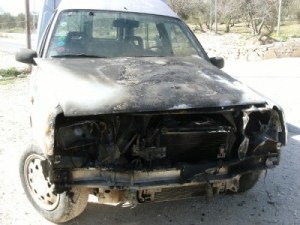 Settlers came down from the illegal Israeli settlements of Bracha and Yitzar Tuesday night and harassed families in the village of Burin.
Around 7 o’clock in the evening settlers attacked a family that live near the Yitzar settlement, throwing red paint on their house. At about the same time settlers entered the village throwing stones and harassing the villagers. The settlers then got an escort back to their homes by the Israeli Army.
At midnight settlers came back, throwing molotov cocktails at two cars, setting them on fire. Both of the cars were parked on in front of the houses of their owners.
One of the cars belongs to Abdeel Aleem Shuhade. He purchased his car just two days earlier, because the previous car was also burned and destroyed by the settlers. In 2002 his brother was shot and killed by settlers in his home and his wife that was pregnant at the time was injured.
Waleed Najar, the owner of the second car, reported the incident to the Israeli police, who then accused him of setting his own car on fire.
Attacks like this are common in Burin, to date 13 cars have been burned by settlers.
Burin is a small farming community located 7km southwest of Nablus. Former incidents in the village include settlers destroying olive trees, stealing and shooting animals, setting crops and houses on fire, destroying homes, shooting at people with live ammunition and firing rockets at the village.
On 27th January, 20-year old Oday Maher Hamza Qadous was killed by settlers from the same settlement whilst farming between the villages of Burin and Iraq Burin.
February 24, 2011
Posted by aletho |
Ethnic Cleansing, Racism, Zionism, Subjugation - Torture |
Leave a comment
GAZA CITY — Israeli warplanes launched airstrikes on multiple locations in the Gaza Strip overnight, injuring two in the first round of bombings near Gaza City shortly after 11 p.m.
Injuries were reported in the first strike, which hit the Az-Zaytoun neighborhood east of Gaza City, while the Abu Jarad neighborhood to the south was pummeled with four strikes.
Local officials called the series of strikes an “escalation,” saying that Israeli forces have operated with increased aggression since an attack on a patrol which entered Gaza Wednesday morning, in the same area the second strike hit.
The Al-Qassam Brigades, the armed wing of Islamic Jihad, said fighters had attacked a group of Israeli tanks and bulldozers apparently preparing to tear-up lands in the border area Wednesday, and were met with artillery fire which killed one brigadesman and injured ten others, including three children.
Also overnight Wednesday, the Abu Ali Mustafa brigades, the military wing of the Popular Front for the Liberation of Palestine, said fighters launched three mortar shells toward the Nahal Oz military base military, and another two toward Israeli infrastructure east of Az-Zaytoun.
In a statement, the Israeli military said the strikes were in “response to rocket fire … several hubs of terror [were bombed] during an extensive operation in the Gaza Strip. Hits were confirmed.”
According to the statement, “These terror sites were targeted in response to yesterday’s firing of rockets at the city of Be’er Sheva and other Western Negev communities.”
February 24, 2011
Posted by aletho |
Subjugation - Torture |
Leave a comment
An Ideological Tower of Babel
This article is excerpted from Lila Rajiva’s book “The Language of Empire: Abu Ghraib and the American Media” published by Monthly Review Press.
Like the repressed, history also returns. The repressed of the neo-liberal maximizer of utility returns. Self-directed, self-interested man looks into a warped mirror and finds homo religiosis. The sublime of religion that appalls us, also fascinates. What shows itself in the scenes of prison abuse does not appear as only defensive, the planned, rational response of threatened modernity. but as something more burdened with emotion, something that simmers under the glassy surface of “no-touch,” something sharp, frenzied, even exhibitionistic. It calls attention to itself. Underneath the neo-liberal rhetoric of a defensive war of modernity against the rise of a new barbarism, we must ask if we find instead a war of religion, an aggressive war against an ancient enemy, a new Crusade. There are those who think so.
In an October 23, 2003 AP report, General Boykin, assistant to Cambone, described the battle against Islamic terrorists as a clash between Christianity and “a guy named Satan” and suggested that Christians needed to support the divine plan that had put Bush in office, “Why is this man in the White House?” he asked rhetorically. “The majority of Americans did not vote for him. He’s in the White House because God put him there.” Earlier, in January 2003, Boykin also told a congregation how the Somali warlord Osman Atto had boasted on CNN that “Allah” would protect him and Boykin had capped the story with the remark, “Well, you know what? I knew that my God was bigger than his. I knew that my God was a real God and his was an idol.” In June 2002, he showed a congregation pictures of Mogadishu, the capital of Somalia, that had been taken from an Army helicopter in 1993 just after the battle with Somali war lords which killed 18 American soldiers, a debacle depicted in the film, “Black Hawk Down.” He said he had enlarged the photos when he had got back home to the US. and noticed what looked like a dark blemish over the city. “This is your enemy,” he declared to the congregation, “It is the principalities of darkness …. It is a demonic presence in that city that God revealed to me as the enemy.” It was Boykin who briefed Stephen Cambone his boss on Miller’s visit to Abu Ghraib. It was Boykin who encourages the directive to change policy there along the lines that had proved so effective at Guantanamo.
Boykin represents the enormous power of evangelicals in the Bush administration Except for a notorious call for a crusade immediately after Sept 11, Bush has been careful in speeches to differentiate between the war on Iraq and one on Islam. Muslim ambassadors have for the first time participated in a formal Ramadan dinner at the White House and a Muslim chaplain has officiated at the opening prayers of Congress, but others close to him have been more intemperate. Franklin Graham, whose father Billy converted Bush, has called Islam evil and Graham’s decision to join other Christian evangelists in Iraq both to aid and convert Iraqis must bolster the Muslim perception of the invasion as an alliance of “Jews and Crusaders.” Bush claims to be unable to restrain him because of concern for civil liberties, but his reluctance may have more to do with the contribution that evangelicals like Graham, Jerry Falwell, and Pat Robertson have made to his election. And in private too, Bush has revealed his own conviction that his presidency is a mission given to him by God.
Was the abasement at Abu Ghraib crafted to sear the religious conscience? Was the Iraq invasion part of a master plan of crusading Christianity and Judaism? Religious language seems to drench the administration. “Rods from God” is the name for the bundles of tungsten rods fired from orbiting platforms that hurtle down to earth at 3,700 meters per second and destroy even underground targets anywhere on the planet at a few minutes’ notice. David Frum, until last year a speech writer for Bush, claims in a recent book that he heard a staff member say to Bush’s chief speech writer, Michael Gerson, “Missed you at Bible study.” Christian fundamentalists who have the President,s ear include the Apostolic Congress, affiliated with the United Pentecostal Church, which in addition to its missionary work in Israel (illegal under Israeli law),is active in the increasingly Christian work of pro-Israel activities in the United States. In an interview with the Village Voice, its leader, Pastor Upton, claimed that he had coordinated the directing of 50,000 postcards to the White House to oppose the Middle East “Road Map, ” the plan which aims to create a Palestinian state. NSC Near East and North African Affairs director, Elliott Abrams, sits down regularly with the Apostolic Congress to assuage their fear that Israel might give up any of its Biblical claims to land.
Bush also has strong connections to apocalyptic millennialists like Tim LaHaye, one of the authors of the Left Behind novels, who believes that a world-wide conflagration centered in the Middle East will be the prelude to the return of Christ. Before his thousand year rule over the world, however, millennialists believe that select believers will be taken up directly to heaven in a Rapture. Other fundamentalists like the dominionists are more concerned with the present day than the apocalypse and seek to remake the United States as country under Biblical law, focusing on the expansion of Christianity as a power. What all these groups have in common, however, is support for the Iraq war, a belief that Islam is false, and faith in Zionism. Christian Zionists advocate the unconditional support for Israel, the return of all Jews to Israel, the legitimacy of the West Bank settlements, a greater (Eretz) Israel that spreads from and includes Jerusalem with the Temple of Solomon rebuilt on the present site of the sacred Al-Aqsa mosque. The power of this pro-Israeli lobby ensures that Israel receives 3-8 billion dollars annually from the US in aid and military assistance and that House members on both sides are neutered on the subject of Israel. In March 2004, Senator Inhofe stated in a speech on the Senate floor that he supports Israel because God said so. It was the same Inhofe who claimed that he was more outraged by the outrage over Abu Ghraib than over the treatment of the prisoners. “They’re murderers, they’re terrorists, they’re insurgents. Many of them probably have American blood on their hands. And here we’re so concerned about the treatment of those individuals.” Should we draw a connection between Inhofe,s Zionist beliefs and his view of Iraqi prisoners?
Christian Zionists constitute a vocal 3 million of America’s 98 million evangelicals and with the 30 million other Christians who have Zionist beliefs of some kind have long been the mainstay of U.S. support for Israel, operating through such political groups as the powerful Council for National Policy, which was founded by LaHaye, a former head of the Moral Majority, and has included John Ashcroft, Ed Meese, Ralph Reed, the editor of The National Review, Robertson, Falwell, Grover Norquist, and Oliver North among its members. Ashcroft has been reported as saying: “Islam is a religion in which God requires you to send your son to die for him. Christianity is a faith where God sent his son to die for you.” Jerry Falwell has told the CBS news program “60 Minutes” that Muhammad is a “terrorist.” The only non-Jew ever to receive the Jabotinsky medal for services to Israel, from the militant Zionist’s ardent disciple, Menachem Begin, Falwell was even permitted by President Reagan to attend NSC briefings while best-selling Armageddon author, Hal Lindsey, was allowed to speak on nuclear war with Russia to top Pentagon strategists. (Born again Zionist – Mother Jones Sept. 2002) Lindsey’s 1970s best-seller, the Late Great Planet Earth is responsible for bringing to world wide fame the dispensationalist view that since the return of the Jews to Israel, history has been unfolding according to Revelations. In recent years, these and other evangelicals have targeted as their priority a swath of the world dubbed “the 10/40 window” (North Africa, the Middle East, and Asia between 10 degrees and 40 degrees north latitude) for conversion. Fundamentalists routinely mischaracterize Islam as idolatry, paganism, or a cult. One former leader of the Southern Baptist Convention has even called the prophet Muhammad a “demon-possessed pedophile.”
Was the abasement at Abu Ghraib intended to exorcize the possessed? The man who was responsible for directing the re-opening of Abu Ghraib prison under the U.S., Lane McCotter, selected for the job by John Ashcroft, resigned under pressure as director of the Utah Department of Corrections in 1997 after a schizophrenic inmate died while shackled naked to a restraining chair for 16 hours. Yet Cotter was also selected to train guards at Abu Ghraib. Perhaps some of the prison bosses in Iraq, like some of the guards, were inclined by religion and temperament to see their charges as in need of punishment or therapy.
Certainly the silence of many fundamentalist Christian leaders on Abu Ghraib was stunning. World magazine was quick to defend Rumsfeld, labeling the torture the “perverse acts of a few.” Chuck Colson and Gary Bauer called for the vindication of America’s military through the swift punishment of the “bad apples” involved. An article on the American Family Association web site briefly condemned the atrocities, then spent the rest of its space on the unwillingness of the “liberal media” to display pictures from the Fallujah burnings.
It is not too much to see in this reaction the frame of reference for administration policies or to suggest that some evangelical,s beliefs about Muslims might coincide with politicians who for other reasons might find detention and torture the best response to a recalcitrant population. For those to whom terrorism is either religious extremism or violent heresy, the rooting out of that heresy may take such medieval forms as the scourging of the body in which the heretical spirit lodges. In this way, apocalyptic Christianity joins with the corporate-state in the disciplining of flesh. and the prisoner posed in the Vietnam like a hooded Christ ultimately recalls us uncannily to both the Inquisition of Catholic Spain and the witch-hunts of the Puritan forebears of America.
ISRAEL FIRST
But are Bush’s policies driven largely by the rise of the fundamentalist right? Don Wagner, an expert in fundamentalism believes that the current hard-line pro-Israel movement in the U.S. draws its strength from these evangelicals and is “predominantly gentile.” But he may be placing the cart before the horse. It is true that Christian Zionists are numerically powerful, but a look at history quickly lets us know that their rise in importance in American politics coincided with the desire of Jewish Zionists to broaden their constituency and goes back to the late 60,s and 1970s to the 1967 Arab-Israeli war, the Arab defeat, and then during the Yom Kippur War in 1973 an oil crisis caused by an embargo by OPEC, the oil cartel, of the western nations that supported Israel in that war. As oil prices sent shock waves into the Western economies and apprised them of the power of Arab nationalist sympathy for Palestine, other new intellectual currents in Western thought were also strengthening support for that power – feminism, third world nationalism, anti-colonialism, environmentalism, and a peace movement aimed at de-nuclearizing the world, under the impact of which Western Europe, including the U.K. and Japan, began to rethink its reflexive support for Israel. The Soviet Union, which already in the early 1960s had begun to support the Palestinian cause militarily, supported the Arabs in 1967 even as Soviet Jews openly demonstrated for Israel. The Soviet government as a socialist body officially committed to anti-imperialism and anti-nationalism was forced to clamp down on them as well as other dissidents providing the context for agitation among diasporic Jews in the US against Soviet emigration policy. Despite being couched in terms of human rights, this American pressure had not much to do with the oppression of other dissident ethnic groups for a refusenik was by definition a Soviet Jew who had been refused the right to emigrate. Legislation such as the Jackson-Vanik amendment linked trade with Russia to freedom of emigration for Soviet Jews. In 1975 the UN General Assembly passed Resolution 3379, condemning Zionism as “racist” by 72-35 and it became transparent that Israel,s time as a race-based settler state was marked.
Only at this point did neo-conservatives make their transition from the left to the right, claiming they had seen the light on communism and the need for US military muscle to keep the world safe from appeasers. They had come to realize that American military and financial aid as well as a favorable population ratio in the settler state was the best bulwark against any future transformation of Israel from a Jewish state into merely a state for Jews. The Arab womb was the real weapon of mass destruction they feared.
It was at this time that US support for Israel, until then equivocal, moved to the center of American foreign policy. The rise of this Israel-centered foreign policy was therefore neither logically necessary nor spontaneous but the result of a sustained campaign born from fear that the U.S. too might ultimately follow its own interests and cultivate good relations with the Arab world at the expense of Israel. With Arab countries beginning to exhibit political clout, Israel began systematically organizing the influential and wealthy diaspora in the west, labeling any perception of similarity between Nazi and Zionist policies as “communist” and fostering a general intellectual reaction against the emergence of the post-colonial world.
It is this secular history that provides the context for the emergence of the anti-Arabisn whose visible face we see in the extraordinarily demeaning images of Abu Ghraib. Using their preeminence in Hollywood, the media, government-related lobbies, law firms, and academia, the diaspora began a campaign to dehumanize and demonize the Arab, and wanting for allies, began to make common cause with the defense industrial complex, and more dangerously, with the Christian right. Dangerous, because aside from their support of Israel, Christian Zionist theology entails the eventual conversion or destruction of the Jews and under Geneva Conventions, the forced destruction of a people,s way of life and beliefs is also genocide. In 1980, the wooing of the right received the official sanction of the Israeli government and an “International Christian Embassy” in Jerusalem was established whose function was and remains to coordinate worldwide Christian support for Israel and its policies and which raises funds to help finance Russian Jewish immigration to Israel and settlement in the West Bank. Enter Christian Zionism to the center stage of American politics.
JEWISH ZIONISM
But reading history in these terms lays one open to the charge of anti-Semitism, for many would argue that Zionism is merely the Israeli version of the same territorial claim that all other nations make without any criticism. Why should one see in Zionism anything anti-Arab, unless the intent is to de-legitimize the Jewish homeland? After all, many non-Jewish commentators take as hard-line a position on the Palestinians as Jewish Zionists – among them Cal Thomas, Michael Novak, Bill Bennett, and George Will. Thomas, who has even called for the expulsion of the Palestinians from Israeli territory, is of course a Christian Zionist, but Novak and Bennett are both Catholics and Will is an Episcopalian. Some would say that their voices are an indication that Zionism in America is merely the expression of support for the natural security concerns of an ally.
That argument is not tenable on several counts. First, the record indicates that on certain issues the American media apparently takes its cue from the Israeli lobby and does not operate with genuine independence but in a prearranged concert.
Edward Hermann, author of several influential works on the American media, describes instances of Israeli scripting of media language on important issues. In 1979, when Israel was under world pressure to end the “redemption of the land” program, the Jonathan Institute in Israel brought US officials and journalists like Bush, Will, Senators Jackson and Danforth, the historian Paul Johnson and others together to set the tone: the PLO was to be labeled a terrorist group tied to Moscow and Israel was to be portrayed as the victim. In Washington in 1984, the same script was reiterated to Secretary of State George Shultz, Jeane Kirkpatrick, Senator Moynihan, Daniel Schorr and Ted Koppel of NBC. Hermann argues that the Israeli lobby in America, no longer satisfied with the pro-Israeli slant of the NYT, WP and CNN, now seeks to actually black-out inconvenient facts or viewpoints with the charge of anti-Semitism. Elected officials who dare to criticize Israel, from Republican Senators Percy and Findley to black representatives Hilliard and McKinney, have been thwarted in their bids for office. On campus, the campaign for divestment of stock in Israel has been dubbed “anti-semitic in effect, if not intent” by Harvard President Lawrence Summers.
Publicists simply toe a line enforced by the Israeli lobby and to regard them as having an equal power outside their conformism on Israel is unsupported by the facts. The influence or beliefs of the Christian right can be denounced – and is so routinely – without heads rolling but any imputation of a pro-Israeli bias is liable to call down an avalanche of letter-writing orchestrated by the Anti-Defamation League, the B’nai Brith and a host of Jewish groups whose influence on Capitol Hill is the elephant in the room that everyone acknowledges and no one talks about. Jewish Zionists have made an alliance of convenience with the Christian right, but there is little doubt who the senior partner is. In any case, Jewish groups themselves boast of their influence, and as Michael Kinsley puts it, “you shouldn’t brag about how influential you are if you want to get hysterically indignant when someone suggests that government policy is affected by your influence.”
The second reason the anti-Semitic charge founders is evident from the language of the debate on Palestine which shows something quite different from simply nationalist concerns. Which nationally influential ultra-right Christian group in America, for instance, could get away with couching its appeals in the nakedly racial language used by some influential Zionists in Israel? Jewish ultra-nationalists like Gush Emunim are not simply nationalists but assume instead that that Jewish people “are not and cannot be a normal people,” because “their eternal uniqueness” is “the result of the covenant God made with them at Mount Sinai” which transcends the “human notions of national rights.” This refutes entirely the classical Zionist claim that only by emigrating to Palestine and forming a Jewish state there can the Jews become like any other nation. According to Rabbi Aviner of Gush Emunim, “while God requires other normal nations to abide by abstract codes of ‘justice and righteousness’, such laws do not apply to Jews.” When the Israeli Haredim (ultra-Orthodox) refused to donate or receive blood transfusion from non-Jews, because their blood is “impure,” they were supported by many distinguished Israeli rabbis, including former Chief Rabbi, Mordechay Eliyahu. With religious parties representing 25% of the electorate, ultra-nationalists and fundamentalists heavily influence the Israeli government, especially Ariel Sharon’s right-wing Likud. Gush Emunim members, who constitute a significant percentage of IDF’s elite units, reportedly exhibit greater brutality toward Palestinians, a brutality justified by the twin senses of historical persecution and incipient crisis that attends Jewish exceptionalism. To such exceptionalists, criticism of Israel is inextricably linked with a desire to destroy Jewish people. Criticism invokes the holocaust. Neo-conservative publicist David Horowitz, for example, refuses to accept any Israeli accountability in Palestine, “The Middle East struggle is not about right versus right…it is about the desire (of the Arabs) to destroy the Jewish state.” Moreover, it is not only ultra-nationalists but many other Jews, both conservative, as Berg was, and reform, who are deeply committed to the Zionist dream of reestablishing the Jewish dream of Eretz Yisrael. For all of them “Aliya [the return to Israel] is the highest expression of Zionist fulfillment, because it allows for the most direct involvement in shifting Jewish values from the realm of theory into the practice of statehood.”
Zionism is an ideology of blood and soil and the ideology of even secular Zionism involves “Jewishness” even though there is no racially pure separate group of Jews. The most powerful and numerous group – the Ashkenazi – are ethnically Eastern Europeans from Khazar who converted in the middle ages. It is the Sephardic Jews and Arab and Christian Palestinians – second-class citizens in Israel – who actually share the blood of the original Jews of the Bible. For this reason even while many religious Jews reject Zionism, secular Zionism itself needs religion for its raison d,etre for there is no real tie of blood to which they can otherwise appeal. Among secularists, political Zionists like Theodore Herzl may have once thought of Argentina and Uganda as possible choices for the Jewish people, but after 1905, only Palestine, the Biblical land, was considered. Similarly, cultural Zionism does not conceive of simply a state for the Jews but a Jewish state, one where Hebrew learning, culture, and Judaic studies are central. Even Labor Zionism manages to marry the socialism of the kibbutz movement to Jewish consciousness.
You would not know these things from the American media, however, which characterizes Israel as a western liberal democracy in which all citizens are equal before the law and treats Zionism as any other nationalism, tacitly condoning the existence of a “Jewish” race-based state, while nevertheless repudiating the notion of a white or Christian state in America.
Charles Krauthammer writes in the Jewish World Review :
“Kofi Annan’s personal representative in Iraq now singles out the policies of the world’s one Jewish state, and the only democratic state in the Middle East, as “the great poison in the region.”
While the Los Angeles Times even editorializes that “Israel must remain a Jewish state.” (Oct 11, 2004)
Consider the policies of this bulwark of secularism, human rights, and democracy: Employment, housing, and access to services follows a discriminatory pattern with Ashkenazi Jews from Europe getting the best, Sephardic – Middle Eastern – Jews the next, followed by Moslem, Druze and Christians, many of them the original inhabitants, and at the bottom “Israeli Arabs,” that is, Palestinians within the 1948 borders. By the Law of Return, Israel must accommodate any Jews from anywhere who might at any time migrate to Israel but cannot accommodate the indigenous Palestinian population which fled Israeli terror in 1948 if they wished to return. Israeli identity cards can list the official ethnicity of a person – Jewish, Arab, Druze … – but not the nationality – Israeli. Since 1967 to date, Israel has arbitrarily detained over 630,000 Palestinians. In 1989 alone, Israel detained 50,000 Palestinians, representing 16% of the entire male population of the West Bank and Gaza Strip between the ages of 14 and 55. By contrast, that same year, out of a total African population of 24 million in South Africa, no more than 5,000 or 0.2% were detained for security offenses under apartheid. Palestinians have the highest rate of incarceration in the world – approximately 20 percent of Palestinians in the occupied territories have, at one time, been arbitrarily detained by Israel.
Without knowing this history, we cannot follow the trail of blood that leads from Iraq to Palestine, from the torture at Abu Ghraib to the practices of the IDF. And not seeing that trail, we think of Abu Ghraib as error, or incompetence, or folly when it was none of these. It was not a matter of “security” or “law and order,” but a part of a war on the population, a war in which torture had a specific role, the same role it has in Gaza, to intimidate the population into submission.
Yet having said this, it is also true that Zionism as a racial and political ideology of itself is not unique and does not operate alone in a vacuum and that therefore as an analytic tool it becomes somewhat elusive. Simply put, Zionism explains why some of the prominent players act as they do, but it does not fully explain why, for one thing, what they do finds a receptive audience and is effective. The real question is why the language of religious chuavinism that masks itself in a discourse of superior civilization has such purchase with the American public.
THE LANGUAGE OF AMERICAN EXCEPTIONALISM
We understand this only when we look at America,s own history of exceptionalism. Zionism finds a responsive chord because America itself is convinced of its unique national destiny, a belief that powerfully influences its foreign policy. “Manifest destiny,” as it is termed, ultimately also has religious roots that can be traced to the Calvinist doctrine of the elect, those 144,000 souls who are predestined for salvation not because of their inner righteousness but because the worldly success that accompanies their deeds is seen as a mark of providential favor. Today this exceptionalism is no more purely religious but a secular ideology as well; it is the American civic religion.
In this secular religion, to believe oneself “favored” rather than “blessed” is to believe that one’s essence rather than one’s acts set one apart. One’s status as the chosen, whether American or Jewish, is thus derived from the success, not the rightness, of one’s acts; from the power that makes one’s representations alone real and others, unreal. It is this power to which the will of our enemies is irrelevant that is behind both the shock and awe bombing of Iraq and its virtual counterpart, the pornographic torture of prisoners. Thus a senior Bush aide states in a much quoted exchange, “That’s not the way the world really works anymore… We’re an empire now, and when we act, we create our own reality… We’re history’s actors.., and you, all of you, will be left to just study what we do.”
Abu Ghraib is the end result of this solipsism of the Promethean state that is shared by both Zionist as well as non-Zionist American actors.
Both secular and religious exceptionalists also share a unique relationship to the law that suggests that law and legal institutions are themselves implicated in the policies of Abu Ghraib and clarifies why it may not be possible to look to them alone for salvation.
Both groups share the heritage of covenant theology which reads holy scripture as the record of legal contracts between God and man, a heritage which both privileges the law while simultaneously also promoting a sense of not being subject to it. The written contract binds us, but the interpretation of that contract remains with the state whose favored status has been granted by the law. Take for instance a January 9, 2002 memo from the Justice Department. It refuses to find international law applicable to President Bush in his detention of Al Qaeda or Taliban members but it finds the same law applicable to terrorist suspects and insists that they can be prosecuted under it. Perhaps this is only common hypocrisy, but one can also see it as inextricably bound up with the Promethean doctrine of an American state beyond law because it embodies the very contract between God and man that under-girds all law. We can see in it a parallel to the doctrine of Sola Scriptura, resonant in American religious history, which recognizes the Bible as the Word of God not primarily because of logical or historical arguments but by the enlightenment of the Holy Spirit,s “internal testimony,” a mystery which is ultimately impenetrable to rationality. In the Promethean state the thin veil of reasoning that the law normally draws over state action has been rent and power radiates alone. Unchecked by any countervailing force it is by virtue of that fact touched with the divine.
From covenant theology also derives the literalism of the brand of nineteenth century evangelism – dispensationalist – that Falwell and Roberts practice which permeates even secular culture. Dispensationalists read the final book of the Bible, Revelations, as a literal account of a post-war progression to a world-consuming conflagration, Armageddon. In doing so, they discount the importance of reason, learning, or social consensus in their interpretations in favor of what they see as a literal reading of the Biblical text. Parallel to this is their reading of the unfolding of human history as also a literal record where that text transparently reveals itself. Dispensationalists, who like to make an ought of is, are thus Hegelians. Like Fukuyama, they too see the winding-down of history, although in their version it ends in apocalypse.
Fundamentalists lend another trait to secular culture, a distaste for any mediation between God and man, whether through priesthoods of men or through the elaborate rationality of philosophy. This distaste would lead one to infer that they also have an aversion for the regulations of contracts and laws. But paradoxically in a popular culture filled with anti-intellectualism, the written Constitution like the written scripture holds a privileged position. The paradox might only be apparent. Just as fundamentalism disdains mediation, an anti-intellectual culture might find an oral tradition based on a continuing interpretative dialogue between past and present actually less attractive than the fixed guidelines of a written contract, whether made between one nation and another or between nations and God. In other words, the mechanism of the constitution, like the text of scripture or the language of law, could actually become a convenient tool to avoid working out the ongoing difficulties of the political world and to elude rather than meet its demands. Politics ultimately demands mastery over reality whereas the law requires only external conformism to certain specified criteria. So, the mechanism of the law not only tends to relieve us of the burden of competence, it ultimately fails to check aggression. Instead, aggression expresses itself not outside law, but through it. Scriptural and legal limits come to mark the boundary beyond which feelings of empathy or compassion need not run. Those not chosen become, in Kipling’s words, the lesser breeds without the law. The literalism of the Armageddonists, their faith that the Biblical text they read translates directly into events unfolding in history, is bound up completely with this sense they have of enacting history as subjects and being set apart through history and through law from those others whose histories and beings are objects to be written or acted upon.
It is this sanctified contempt for the other that is at the heart of Abu Ghraib and militates against any reading of it as a war-crime of errant individuals. The half-a-dozen reservists are no more than scape-goats in a program of racial and religious abasement that was conceived as completely legitimate. The photographs horrify precisely because they express this sense of legitimacy very much as the post-cards of the 1920s depicting laughing crowds watching Negroes being lynched convey their perfect acceptability at the time.
Such sanctified terror is rooted not only in Zionism then but equally in the sectarian beliefs of fundamentalist Christians that feed many elements of the Promethean ideology. From Biblical righteousness, the Promethean sense of the state as virtue incarnate; from Christian dominionism, the impetus to expand; from apocalyptic ruminations, the Promethean obsession with terror. And through all of these runs an unexamined sense of supreme moral satisfaction, a Puritan certainty about the nature and precise physical location of evil in the other that is translated not simply in the messianic language of Americanism but even in the shibboleths of liberalism. Evil is outside, out there in the world, radically disordered, deserving of eradication. To fully understand Abu Ghraib, therefore, we need to shatter the linguistic policing behind which torture masquerades as “national security,” “necessity,” and “protecting our freedoms”; we need to free ourselves from the control of the singular language of Babel, the empire of universal law and reason. We need to comprehend the extent to which the totalizing discourse of reason itself masks those local meanings and sufferings in which humanity resides.
When we do so, what appears behind the mask is a confusion of meanings that evades easy categorization. A study of hundreds of communications by Bush, Ashcroft, Powell, and Rumsfeld between September 11, 2001 and spring 2000 found four characteristics common to them – a set of Manichean distinctions between good and evil and security and danger; a description of the war on terror as a “mission”; conflation of the will of God and the export of freedom and liberty by America; and claims that dissent is a national and global threat. Quasi-religious language is deployed here on behalf of exceptionalism but the exceptionalism is only superficially crafted to appeal to religious sentiment. Underlying the religious veneer, the language is intensely inflected with attachment to the soil and fear of its violation and echoes the Zionist ideology of soil. We find repeated terms and phrases, such as “homeland” with its distinctly Germanic flavor and “we fight them there so we don’t have fight them here.” Not ethical or spiritual religion, but a state-religion, a religion of territory and power speaks in these words.
I have termed this ideology Promethean for its refusal to submit to objective criteria of the good or the just while claiming to represent them. Not so much abrogating law as assuming the function of law-giver, the new messianism uses the language of law for its content – human rights, justice, liberty – but its framework is intensely revolutionary. In public, then, Zionism in America, Christian or Jewish, does not speak its name but prefers to use the language of secularism and democracy inspirationally to press its claims. This is understandable. Overtly religious rhetoric has a poor chance of success in a country where even Christianity has many faces and where immigration is encouraged. The self-image of America today is of a melting pot and direct appeals to racial or religious chauvinism would shatter this image of multiculturalism.
In any case, those who believe in the unquestioned “goodness” of American force have included not only Zionist neo-conservatives (and Max Boot has admitted that Israel is the non-negotiable heart of neo-conservatism) but before them Cold War hawks who once saw in the spread of communism a similar radical threat to the West. What the decoding of language demonstrates is that despite its religious overtones, the rhetoric of American empire is fundamentally neither conservative nor religious in a traditional sense but expressive of an ideology of power in which religion has been consciously deployed. Subtle words and phrases appeal to the religious, evoke their support, play on their sympathies, and yoke the two strains of exceptionalism. Under the defense of civilization, a war of religion is invoked; but the rhetoric of religion itself conceals the more familiar language of territory and resources, the struggle of political interests.
What interests and for whose benefit? The Americanist language would suggest American national interest; the pervasive influence of Zionism would suggest Israeli. Of course, publicly if not privately, Zionists like to argue that there is no difference between the two. Ideology which grows more powerful as the total state accelerates smoothes over these discrepancies in words, these failures of meaning. It throws out vague threats to the “national interest” and postures aggressively behind the official narrative of a global war on terror by the universal empire. This is the propaganda discourse of Babel but what does Babel conceal? When the propaganda narrative of terror is pierced, what lies behind?
~
Lila Rajiva is a free-lace journalist in Baltimore and author of “The Language of Empire: Abu Ghraib and the American Media” Monthly Review Press. She can be reached at: lrajiva@hotmail.com
February 23, 2011
Posted by aletho |
Ethnic Cleansing, Racism, Zionism, Subjugation - Torture, Timeless or most popular | Abu-Ghraib, Gush Emunim |
Leave a comment
Young participants in the 25th January Egyptian revolution have told the Palestine Information Centre that Egypt has been freed from a tyrannical regime and breaking the siege of Gaza is high on their list of priorities. Ousting Hosni Mubarak was difficult, they said, but it was just the beginning of the revolution, not the end. In Tahrir Square, they added, all sections of Egyptian society were united, including Muslims and Christians; leftists and members of the Muslim Brotherhood.
Ahmed Bahaauddin Shaaban, one of the founders of the Egyptian Movement for Change (Kifaya), told the PIC, “We took part in a real battle pitting the Egyptian people against the corrupt regime, which was heavily entrenched. However, the Egyptian people were able to uproot it.” The people of Egypt have taken one step on a long road, said Shaaban, by overthrowing a dictator and his oppressive regime. “However, we still have a lot to do. We have a programme for democracy, social reform, and the creation of a modern, developed state. We have shaken the regime, as can be seen clearly in the fall of its corrupt symbols.”
Mr. Shaaban warned that the struggle will be long. “The fall of an oppressive dictator like Mubarak affects the entire regime structure but we will be able to deal with its remnants,” he said. “In the past few days we have defeated the most oppressive forces in the country – the Central Security Force and the State Security Force – which have vanished into thin air.” So, he added, has the former ruling party, the National Democratic Party, which had three million members.
Arab issues are at the top of the revolution’s priorities, stressed Shaaban, and the people of the Gaza Strip are delighted by its success because they also suffered at the hands of Mubarak’s regime. “The people of Gaza will feel the effects of the revolution because the siege of Gaza will end and the kinship between the people of Egypt and Palestine will be restored.”
Amr Ibrahim, another of the young leaders of the revolution and a member of the Muslim Brotherhood chipped in: “The most important characteristic of this revolution was that it was impossible to tell people apart on the basis of which political movement they belonged to. Everyone in Tahrir Square was there under the banner ‘I am an Egyptian’. You couldn’t tell who was a leftist and who was a Muslim Brother, or who was a Christian and who was a Muslim.”
According to Mr. Ibrahim, the youth of the Muslim Brotherhood were involved in the revolution from its beginning on the 25th January having asked for permission from the movement’s leaders. As the demonstrations increased in intensity and the occupation of Tahrir Square by the demonstrators grew, instructions were given by the leadership of the Brotherhood to their younger members to enter Tahrir Square in great numbers. In the end, claimed Ibrahim, Muslim Brotherhood youth members made up between 40 and 50% of the demonstrators.
A spokesman for the 6th April Youth Movement asserted that the resignation of the president was not one of the demands of the youth of the revolution when they were preparing for the 25th January. “We wanted the sacking of the Interior Minister and the implementation of a court decision setting the minimum wage at 1200 Egyptian pounds per month,” said Ahmed Maher. “The groups taking part in the movement are very diverse but together they organised protests, using Facebook and on the ground, on the 25th January and on the Day of Anger on Friday 28th January, in addition to organising the million man demonstrations on the 1st February and the ‘Day of Departure’, 4th February.”
Maher believes that it is important for Egyptians to cooperate in planning Egypt’s future post-Mubarak; he proposed the formation of a delegation of youth and members of the Front for the Support of the Demands of the Revolutions to negotiate with the army’s leaders. It is necessary for the government of Egypt to be transferred to civilians, he said, adding that the revolutionary youth can still achieve a great deal in bringing forth the fruits of the revolution.
With regards to lifting the siege of Gaza, Maher said that the issue cannot be ignored. It is, he stressed, one of the demands of the revolution: “Pressure exerted by the revolutionaries as well as Sheikh Yusuf al-Qaradawi’s call to end the siege has obliged the army to fulfil this demand.” It is time to end the suffering of the people of Gaza, he said. This, ended Maher, has made the government in Israel “fearful” of Egyptian youth. “If young Egyptians demonstrated on the borders of occupied Palestine,” he grinned, “I wouldn’t rule out the Zionists packing up and leaving.”
~
Egyptian authorities open Rafah crossing in both directions
RAFAH, (PIC)– The Egyptian authorities on Tuesday opened the Rafah border crossing with Gaza Strip in both directions after three weeks of closure but to a limited number of people.
A Palestinian source said that the Egyptian authorities allowed only 300 passengers daily to cross the terminal, noting that the crossing was closed following the outbreak of the Egyptian revolution that ousted former president Hosni Mubarak.
He underlined that travel will be allowed only for patients, students, those with residence permits in Egypt, and holders of visit visas to other countries.
He noted that 3,000 Palestinians wishing to travel had registered with the borders authority over the past few days.
February 23, 2011
Posted by aletho |
Ethnic Cleansing, Racism, Zionism, Solidarity and Activism, Subjugation - Torture, Timeless or most popular |
Leave a comment
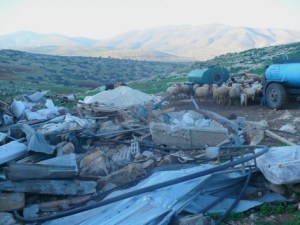
Khirbet Yerza is a small village with few dozens of inhabitants. It used to count hundreds of inhabitants before the 1967 occupation as its underground is full of water and thus very fertile.
Today Khirbet Yerza is an area considered by Israel as a military training area. It is also very isolated. Only one dirt road goes there, and it is very hard to access with a normal car.
Three months ago, the army destroyed many houses and even the mosque. Last Thursday, around 20 soldiers and 2 bulldozers came to destroy Yerza again.
Soldiers told a 70 year-old woman that she has to move to Tubas. Fifteen years ago the army told her to go to Khirbet Yerza when she was living in Al Maleh. “Where can I put my cows in Tubas ?! They will have to shoot us here if they want us to leave !”
They destroyed the ground of the mosque that was demolished 3 months ago. People had cleaned the area and put carpets on the ground to pray at the same place. But the army destroyed even this.
Fourteen structures were demolished, among them tents that were given by the Red Cross three months ago.
Some families had taken off the roofs of their barracks before the army arrived in order to save some materials. But soldiers saw some hidden metal sheets and drove over it in order to destroy it
A Palestinian journalist was there during the demolitions and took pictures of the scene. The soldiers beat him and confiscated his camera.
Most of the families living in Khirbet Yerza own the land and have lived in this area for more than 100 years.
All the families of the area received a new demolition order before the army left the place .
February 22, 2011
Posted by aletho |
Ethnic Cleansing, Racism, Zionism, Subjugation - Torture, Timeless or most popular |
Leave a comment
During the weekly demonstration in the West Bank village of Nabi Salah against the creeping annexation of their lands by the area settlements, the Israeli army imposed a particularly stinking collective punishment.
For several long minutes, soldiers emptied the containers of skunk water on houses in the centre of the village, also spraying the roofs of homes on which the residents collect rain water. The soldiers further sprayed the village cemetery with the skunk water. Israel’s massive use of tear gas and skunk water in the centre of the village was done with no intention of dispersing the demonstration, which had already ended by this time, but to stink up the homes of the residents and to contaminate their water sources.
Since January 2010 weekly demonstrations have been held in the village of Nabi Salah, located in the district of Ramallah, against attempts of the area settlers to take over the village land. From the onset, these demonstrations encountered particularly severe oppression by the Israeli army, including the massive use of tear gas, rubber coated bullets and occasionally live ammunition within the village.
Last Friday (18 February) the oppressive Israeli measures reached particularly smelly heights. After the army invaded the village, seven demonstrators were detained – 2 Palestinians, 4 Israelis and one international activist, all released many hours later. After several hours of shooting tear gas and rubber coated bullets within the village against the demonstrators and every person who wandered into the area, military reinforcements arrived from the village of Bil’in. Following the weekly demonstration in Bil’in, where Israel’s army also used skunk water against non-violent protesters, the skunk water truck made its way to Nabi Salah. Apparently because there remained large quantities of skunk water that the army didn’t manage to shoot at Bil’in demonstrators, the regional army commanders decided to use the extra liquid to collectively punish Nabi Salah demonstrators. After the demonstration had already finished, the skunk water truck entered the centre of the village and sprayed windows, walls and the roofs of homes. The truck also spewed its contents on the local cemetery.
Skunk water, the reeking liquid that is dispersed through water cannons, has served the Israeli army some two years already for dispersing demonstrations in the Occupied Palestinian Territory. The content of the skunk water, together with its long-term impacts, are not known, although its immediate impact is to cause nausea and headaches. Even after extensive washing of the affected area, whether clothing, skin or land, the stench continues for several days.
The strength of the remaining smell is so strong that in the past it caused a family in Nabi Salah to leave their home for an entire week. The impact of skunk water on sweet water used for drinking and watering is unknown. Spraying the skunk water on the village roofs, however, prevented the collection of rain water these past few days, which were amongst the rainiest of this winter.
Translated to English by the Alternative Information Center (AIC)
February 21, 2011
Posted by aletho |
Solidarity and Activism, Subjugation - Torture, Timeless or most popular |
Leave a comment
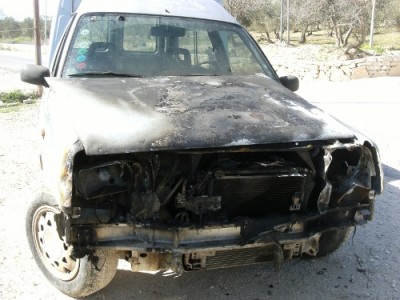 Settlers came down from the illegal Israeli settlements of Bracha and Yitzar Tuesday night and harassed families in the village of Burin.

 Aletho News
