Land of the Free
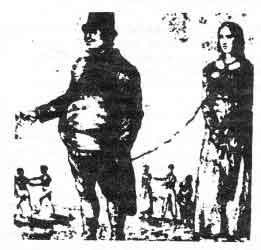
the Americas have a noble, exceptional, honorable history
so we are told
such opportunity
the workers, the immigrants, who were cheap insurance against challenges to legitimacy, land title, labor bankruptcy and invasion
make them build the infrastructure
make them pay
make them love labor, exploitation and oppression
wrap it in a flag
imply a promise
never throw a bone
make them work for it
make them bow at the alter of class devotion
it’s no mistake, that word patriot
“defends his country and its interests with devotion”
devotion: to give all ones time and resources, to sacrifice
to devote: a vow, a formal, solemn promise
vow: a 13th century solemn promise to god
latin devoveo, a self-sacrifice, an offering, a curse
curse? a solemn utterance intended to invoke a supernatural power to inflict harm or punishment on someone or something?
devote yourself to me, as god requires, or you will be punished!
sounds like a curse
patriot, a concept that did not exist before the 16th century
just in time
for ships and colonizers, slaves, indentured servants and immigrants
as many an 3 of 4 whites in American colonies in the 18th century were indentured
privately held personal property, chattel
cheap insurance against recalcitrant native peoples and slaves
recalcitrant: having an obstinately uncooperative attitude toward authority or discipline
may it be so
indentured servants: they, and their descendants can be sold and inherited
“If we forget what we did, we won’t know who we are” – Ronald Reagan

Rights concerns in Colombia over leaked recording
Press TV – February 18, 2014
Human rights concerns have risen again in Colombia after an online recording of a military chief revealed his solidarity with a colonel jailed for alleged extrajudicial killings.
In the recording, published by leading news magazine Semana on Sunday, Colombia armed forces chief General Leonardo Barrero is heard telling colonel Robinson Gonzalez del Rio that prosecutors’ investigations into the extrajudicial killings is a “bunch of crap.”
The army chief also suggests that Gonzalez, who is facing criminal charges over the killing of two men in 2007, mount a counterattack to discredit prosecutors.
According to local reports, deputy joint chief General Javier Rey, resigned on Monday following the revelation by Semana’s weekend report. Barrero is also reported to have expressed regret over his remarks in the audio recording.
Colombian President Juan Manuel Santos said the serious allegations made in the Semana report need to be investigated. The government, however, said it was taking no immediate action against Barrero as he was not directly accused of corruption.
An earlier scandal on extrajudicial killings by Colombia military dubbed the “false positives scandal” broke in 2008.
According to media reports, hundreds of innocent civilians were slain and presented as guerrillas killed in battle by the country’s army in an effort to inflate body counts and receive promotions or other benefits.
Earlier this month, Semana reported that a military spy ring had eavesdropped for 15 months on emails and text messages of government negotiators involved in peace talks with leftist rebels.
400 Nepalese World Cup stadium construction workers die in Qatar
Press TV – February 16, 2014
A Nepal-based human rights organization says over 400 Nepalese workers have lost their lives on World Cup stadium construction sites in Qatar.
The Pravasi Nepali Coordination Committee (PNCC), which follows up on migrant workers deaths in Qatar, recently published lists of the dead using official sources in the Qatari capital, Doha.
The PNCC also warned that the death toll can reach 4,000 by 2022.
The report will pile new pressure on the Qatari authorities and FIFA to curb the mounting death toll of foreign workers on the building sites.
Nepalese workers make up only 20 percent of two million migrant workers in Qatar and the death toll can be much higher than this.
Migrants from other countries are also feared to have died, but there is no official data available.
Harsh working conditions for foreign laborers in Qatar first came to light last September and the deaths of at least 36 Nepalese construction workers were registered in the weeks following the September revelations.
The new death toll also sets alarm bells ringing for FIFA as it shows that global protests against the treatment of migrant workers in Qatar have fallen on deaf ears.
Last month, the PNCC said, “FIFA and the government of Qatar promised the world that they would take action to ensure the safety of workers building the stadiums and infrastructure for the 2022 World Cup. This horrendous roll call of the dead gives the lie to those reassurances.”
Migrant workers in Qatar live in extremely inhumane and sordid conditions and they are deprived of any workplace security.
There Will Be More Blood
By Peter Breschard | Dissident Voice | February 5, 2014
The question is no longer what, the question is when.
Very soon, income inequality in the United States will reach such a critical level it is likely violence will be viewed as an acceptable response to America’s social ills.
Unlike Depression Era bank robbers, assaults will be aimed at soft human targets. After all, who uses cash anymore?
Extortion. Kidnapping. Arson. A crime wave of epic proportions might well be the only way those running America will come to their senses and realize that no democracy can continue to exist where so much is controlled by so few. The present system of representative government has failed in such a spectacular fashion to protect the rights of the majority that the government itself has become the criminal.
Do not kid yourself that the present resource inequality will do anything but get much, much worse. Do the math. Tax rates for the extremely wealthy being so extremely low can only lead to the further accumulation of massive fortunes by the select few. That wealth will be taken from those lower on the economic food chain and so the disparity can only become greater.
Let them eat cake.
Public discussion of the critical problems currently facing this nation is so infantile it might as well be Medieval monks chattering on about the number of angels that can fit on the top of a pin. Bridges collapsing. People literally starving. Jobless working class. A country without hope. Yet the rulers natter on about reducing the rations of the most needy while at the same time they loot every household in the name of a putrid for-profit medical system and drone bomb the hell out of any country they wish.
How many military bases does this country have outside our borders? How many countries have U.S. troops stationed in them? Only criminals need those many guns.
Serious problems. There is a total disconnect between those charged with keeping this country on an even keel and reality.
The United States has become a kleptocracy. And criminality is the lesson it is teaching its citizens. Those living outside of the law, whether in skyscrapers or shacks, bring only pain and deprivation to those who strive to maintain a civilized society. When the government itself is the criminal, cutting up the pie solely for itself and its cronies, an equally criminal response will be inevitable.
What to do? It’s Robin Hood time. It’s only a question of who becomes the outlaw of Sherwood. People will only allow a boot to press against their neck for so long before the violence being done to them precipitates a like response. Unless those in positions of power tax the rich until it hurts, there will, like night follows day, be a violent response from those being oppressed against those they see as inflicting their pain.
If this government keeps shirking its responsibility to the vast majority of its citizens, this country is dooming itself to a bloody future.
~
Peter Breschard is the author of Circus Rider and My Love Affair with Barack Obama as well as other lesser works of fact and fiction.
Related article
Retailers Adjust to Rich Getting Richer and Middle Class Fading
By Noel Brinkerhoff | AllGov | February 4, 2014
As Americans in the economic middle struggle to keep up, many retailers and other businesses have decided to focus on the demands of the wealthy.
Since the end of the Great Recession, the nation’s top earners have been doing a significant portion of the consumer spending during the weak economic recovery, which is great news for high-end businesses that cater to this class.
But retailers and restaurants that have long catered to the middle class are fading because middle-earners have so little disposal income these days.
The rich (considered the top 5%) don’t have the same problem. They were responsible for nearly 40% of domestic consumption in 2012. Two decades earlier, the rate was only 28% in 1995, according to research performed by economists Steven Fazzari, of Washington University in St. Louis, and Barry Cynamon, a visiting scholar at the Federal Reserve Bank of St. Louis.
They say inflation-adjusted spending by the top 5% has increased 17% since 2009, compared with just 1% among the bottom 95%.
The beneficiaries of increased spending by the wealthy have been luxury gambling properties like the Wynn and the Venetian in Las Vegas, five-star hotels like the Four Seasons and St. Regis, upscale clothing retailer Barneys New York, and others.
Meanwhile, many other companies are floundering, filing for bankruptcy, or closing their doors because they cater to the middle class. These businesses include Olive Garden and Red Lobster restaurants, and retailers Sears, J.C. Penney, and Loehmann’s.
“As a retailer or restaurant chain, if you’re not at the really high level or the low level, that’s a tough place to be,” John G. Maxwell, head of the global retail and consumer practice at PricewaterhouseCoopers, told The New York Times. “You don’t want to be stuck in the middle.”
Fazzari warns that relying too much on the rich to keep the economy going is not a sound long-term strategy.
“It’s going to be hard to maintain strong economic growth with such a large proportion of the population falling behind,” he told the Times. “We might be able to muddle along—but can we really recover?”
To Learn More:
The Middle Class Is Steadily Eroding. Just Ask the Business World. (by Nelson Schwartz, New York Times)
Inequality, the Great Recession, and Slow Recovery (by Barry Z. Cynamon and Steven M. Fazzari, Washington University) (pdf)
U.S. Income Inequality Reaches Record Extreme (by Noel Brinkerhoff, AllGov)
Richest 7% Get Richer; Poorest 93% Get Poorer (by Noel Brinkerhoff, AllGov)
The Three-Legged Monster
By Gilad Atzmon • May 25th, 2009
Unlike her cosmopolitan brothers and sisters who spread Zionism and tribal racism using a liberal and progressive disguise, Melanie Philips is open about it all. The other day she defined what Zionism is in a very clear manner:
“Zionism,” writes Philips, “is simply the movement for the self-determination of the Jewish people. And its significance is greater than any other movement of national liberation because Judaism itself rests upon three legs — the people, the religion and the land. If one is lopped off by having its legitimacy denied, the whole thing collapses. That is why anti-Zionism is far more than an unpleasant political position. It is a direct attack on Judaism itself.”
Philips doesn’t leave much room for speculation. For her, not only is Zionism a legitimate national movement, ‘its significance is greater than any other movement’ because it rests upon ‘three legs’. Thinking about it for a second, it is indeed significant for something to rest upon three legs, I myself rest upon just two legs and a bit. Occasionally when I stand naked in front of the mirror I wish I were Zionism.
As Philips maintains, Zionism is indeed an amalgam of three Jewish ingredients: the people, the land and the religion. It is this very composition that makes Zionism into an epic victorious narrative. It is this very mixture that made Zionism into the 20th century collective symbolic identifier of the Jewish people. It is Zionism that has managed to reinvent the Jewish people as a nation with a lucid ideological, spiritual and geographical aspiration. Yet, as much as Zionism makes a lot of sense to very many Jews around the world, it makes less and less sense for those who fail to be chosen i.e., the rest of humanity. The reason is simple, Jews may be welcomed to celebrate their symptoms collectively but they are not exactly entitled to do so at the expense of anyone else.
Zionism has managed to interpret Judaism as a brutal license to plunder and kill. It transformed a spiritual text into a land registry. It primarily invented the Jews as nation. It then set for the newly born nation a task of immoral geographical aspiration with some devastating racist colonial implications.
One may wonder, how did Zionism manage to be so successful, how did it manage to get away with murder, and how has it done so for so long? At the end of the day, the lethal mixture of ‘land’-‘religion’-‘people’ stands in complete opposition to the post-war Western cultural and political narrative (cosmopolitan / multi-cultural / multi-faith / open borders).
I tend to believe that Philips’ equation Zionism = Judaism is the most effective Zionist tactic of them all. It leads towards a severe paralysis of most humanist opposition of Zionism. The reason is obvious, ordinary ethical beings do not know how to comb the knots out of this shattering formula that leads them to criticism of a religious belief system.
In fact one way around it is to dispute Philips’ equation. Zionism doesn’t equal Judaism. Zionism is a mere radical narrow interpretation of Judaism. It takes the biblical plunderous narrative and turns it into a daily practice. It takes the Judaic moral notion of chosenness and turns it into crude supremacist agenda. Rather than Judaism, Zionism is in fact the true genuine face of Jewish ideology. It is racist, it is chauvinist, it is seeking power; but it is different from Judaism, for Judaism is centred around the fear of God and Zionism is totally fearless. Accordingly, It will be right to argue that to oppose Zionism is to oppose Jewish ideology or what I myself define as ‘Jewishness’.
It must be said that Zionism regards itself as an enlightened rational movement. To a certain extent, as an ideology and praxis, it tries to understand itself, it seeks explanations or at least justifications in rational and historical terms (rather than ethical ones). Melanie Philips, it must be said, is offering a coherent argument. She says, ‘this is what we are’, taking this from us is a dismissal of our right to be.
I believe that Philips framework is correct, it is her terminology that is slightly confusing. It is not Zionism = religion but rather Zionism and Jewishness that are intrinsically connected. If we want to oppose Zionism for real, we set ourselves into an inevitable conflict with Jewish ideology. To oppose Zionism is to admit that we have a serious issue with Jewish nationalism, with Jewish tribalism, with Jewish racist ideology, with Jewish supremacy and Jewish collectivism. To oppose Zionism is to admit that we have a problem with the ‘Jewish thing’.
However, it may be noted that if Zionists such as Philips are entitled to suggest the equation between Zionism and Judaism, the opponent of Zionism should not be reluctant to do the same and to extend the critique of Zionism to Jewish ideology and beyond.
I mentioned numerous times in the past. As it happened, it is actually Zionists and Israeli dissidents who seem to push the anti-Zionist discourse ahead. The reason is pretty simple.
Israeli dissidents are far from being reluctant to expose or reflect on their collective past. Unlike the tribal Diaspora Jewish left activists that are quick to dismiss any complicity in Israeli crimes by shouting “not in my name,” some Israeli dissident voices tend to take direct responsibility. They understand the notion of guilt and they turn it into responsibility.
A month ago Haaretz published an article by Uri Avnery in its ‘Israeli Independence Day Special Edition. ‘Living With The Contradiction’ was an attempt of an Israeli humanist to face his own original sin within an historical perspective.
Avnery is an astonishing writer. Though I tend to disagree with him on various issues, the man is no doubt a leading voice of reason in that doomed state. Unlike Melanie Philips who supports Zionism from afar, Avnery was a commando soldier in 1948. He was himself personally involved in the creation of Israel. “We knew that if we won the war, there would be a state and that if we were defeated there would be no state – and that we would not be around, either.”
Unlike Melanie Philips who speaks about ‘a land’, Avnery was one of those who invaded the land and expelled its habitants.
“We left no Arabs behind our front line, and the Arabs did likewise,” and yet, Avnery, unlike Philips, realises that the Zionist amalgam People / Land / Religion leads towards disaster. Israel’s original sin is not is not exactly a recipe for peace.
“How then is it possible,” asks Avnery, “to reconcile the contradiction between our intentions and feelings at the time, when we established the state and paid for it with our blood, pure and simple, and the historic injustice we inflicted on the other side?”
He continues, “It is necessary for our mental health as a nation and as human beings, and it is the first step toward future reconciliation. We must admit and recognize the consequences of our actions and repair what can be repaired, without disavowing our past and youthful innocence.” Avnery goes out of his way to explain rather than justify the 1948 sin, yet he is searching for reconciliation. He understands that the Jewish state will be doomed unless it faces its past.
I wish that those who contribute to the Palestinian solidarity discourse would have the courage exhibited by Philips and Avnery. I wish that like Philips, we would have the courage to equate Zionism with Judaism yet to use it as a critical shift. I wish we could look at the Nakba like Avnery with fear and yet to draw the necessary conclusion, to demand the right of return.
Related articles
Obama and Friends Discover Inequality
By Jack Rasmus | January 28, 2014
Today, January 28, 2014, President Obama will address the nation in his State of the Union (SOTU) speech to Congress. A major theme of the address will be the growing income inequality in the US.
His speech represents an echo of similar themes and talks that have been presented this past week at the World Economic Forum (WEF) in Davos, Switzerland. That’s where every January the big capitalists of the world gather to discuss amongst themselves the major issues of the past year and what to do about them—in between being entertained by various cultural celebrities and performers who have been allowed into their club as junior partners in wealth. The annual Davos cultural events are not unlike the small venue side-shows held in the big Las Vegas casinos: the entertainers strut and sing while the real betting and dice-rolling discussions involving future capitalist policy initiatives go on behind ‘invitation-only’ doors requiring tickets for entry costing hundreds of thousands of dollars to attend ( the typical ticket price of entry for a Corporate CEO and his entourage at Davos, for example, exceeds $500,000).
This year the WEF and global capitalists have ‘discovered’ income inequality, now accelerating and intensifying worldwide to a dangerous degree, and especially in the US. The dimensions of the inequality problem have grown so severe in recent years it may, they themselves are now warning, result in unwanted ‘social unrest’ in the near future.
Now that it has become an ‘acceptable’ discussion theme, Obama and Democrat party politicians (and a few clever Republicans) have also discovered income inequality. Together they plan to raise the rhetoric on the topic in upcoming midterm and 2016 national elections. Therefore, in Obama’s SOTU speech today we’ll hear some basic facts about the problem, some vague proposals that are never intended get to the earliest legislative stages, and a lot of general talk about how improving ‘opportunity’ is the only answer to reducing inequality—all of which means let’s not do anything significant in the short run but instead focus on very long run solutions like improving childhood education, creating long run opportunities, and other very long term solutions.
The politicians’ new discovery of inequality follows liberal academics discovery of the same in recent years. Well known fellows like Paul Krugman, Robert Reich, Joe Stiglitz, James Galbraith and others have all written their books on the topic in recent years. But they too, like the politicians they support, have been very careful about recommendations for resolving the problem, mostly repeating time-worn, mushy old liberal proposals involving ‘education and opportunity’ once again.
The growing income inequality in the US goes back at least to the late 1970s, accelerating during the 1980s and early 1990s, and then again after 2000 under George W. Bush. It’s grown the worst under Barack Obama, with latest figures showing the wealthiest 1% households accruing for themselves since 2009 nearly all (more than 90%) of all the income gains during the so-called ‘recovery’.
More recent, damning revelations about the extent of growing inequality go back to 2002 at least—long before the politicians and the more well known liberal economists acknowledged it. In 2002 University of California, Berkeley economist, Emmanuel Saez, began publishing his analyses of IRS income data, since all pre-existing sources of income inequality by the government and business more or less obfuscated the true picture. Saez has updated his ground-breaking results periodically ever since. Most of what is reported and published about the income gains of the wealthiest 1% are from his researches.
This writer relied heavily on Saez’s data in his 2004 book, ‘The War At Home: The Corporate Offensive From Ronald Reagan to George W. Bush’, which attempted to identify the various policies since the late 1970s that have been largely responsible for the inequality shift that Saez so well documented in 2002. Saez’s hard data—then and ever since—is irrefutable. However, the political implications behind Saez’s data were not spelled out, except for some suggestions concerning the tax structure.
But Income inequality in the US is no accident. It has conscious, deliberate origins, to be found in the policy initiatives of corporate America since the late 1970s, and the willingness of the politicians Corporate America elects in Congress, Presidents, and at State levels—Democrat and Republican alike—to implement those policy initiatives.
There’s the tax restructuring in favor of the rich and their businesses, the free trade and offshoring, the atrophying of the real minimum wage, the dismantling of real pensions and employer contributions to healthcare, the shift from full time permanent jobs to part time and temp work, the destruction of unions and higher paying union jobs, the displacing of higher paid jobs with technology, substitution of credit for lack of wage growth, failure to invest in the US by corporate America, so on and so on. That’s why jobs, real wages, and incomes for the vast majority of American households has stagnated at best, and declined in real terms for most. That’s why wage earners’ income of the bottom 80% households have contributed to income inequality.
But all that’s still only half the story of income inequality. The other ‘half’ of the story is why the incomes of the 1% have risen so sharply as well. Both their rise, and the stagnation-decline of the bottom 80%, are jointly responsible for the income inequality.
Corporate America and their politicians, and the policies they’ve initiated and implemented, are responsible for the accelerating capital incomes of the rich (1%), very rich (0.1%), and mega-rich (0.01%). And much of that has to do with the enabling of financial asset speculation and financial securities inflation that has been the defining characteristic of the US (and global) economy since at least the 1980s. Reagan unlocked that door. Clinton opened it. And George W. kicked it in. And Obama has done nothing to repair the entry.
Real solutions to income inequality would have to include proposals not only to enable the recovery of incomes of the middle working class, and the working and non-working poor, but would have to include proposals to reign in the runaway income accumulation of the very rich, the mega-rich and their friends. But you won’t hear the latter even suggested in Obama’s SOTU speech. What you’ll hear are token long run proposals to slow the decline in income growth for the working poor perhaps, and a lot of vague suggestions about the middle class.
What the middle class needs is decent jobs and tens of millions of them, just to restore what has been lost in the past 15 years. There are still 20 million unemployed in the US, and more than 5 million more have left the labor force. 60% of the jobs that have been created since 2009 have been low paid, while 58% lost have been high paid. Retirement systems are broken and retirees income for tens of millions are in freefall. Obamacare has meant those with insurance now have to pay more for less. Tens of millions of students are effectively indentured and can’t find jobs. If Obama and his politicians want to do something about income inequality, let’s hear concrete legislative proposals to address these issues now, immediately, in the short run.
It took the Krugmans, Reichs, and Stiglitzes only a decade to ‘discover’ their academic colleague, Saez’s, significant work. Better late than never, I suppose. However none of the liberal economists bother to point the finger at the politicians responsible, especially their Democratic party friends, for the inequality trends. But if anything serious is going to be done about income inequality in the US, it will have to include not only real, short term solutions to raise the incomes of the many but also serious, real measures to take back the excessive income gains of the rich and super-rich as well. For the latter will be necessary to fund and restore decent jobs and wages, to revitalize a crumbling retirement system, to save a collapsing healthcare system, and, yes, even to provide affordable education opportunities for all.
Obscene wealth: World’s 85 richest have same wealth as 3.5 billion poorest
RT | January 20, 2014
The world’s 85 wealthiest people have as much money as the 3.5 billion poorest people on the planet – half the Earth’s population. That’s according to Oxfam’s latest report on the risks of the widening gap between the super-rich and the poor.
The report, titled “Working for the Few,” was released Monday, and was compiled by Oxfam – an international organization looking for solutions against poverty and injustice.
The document focuses on the extent of global economic inequality caused by rapidly increasing wealth of the richest people that poses the threat to the “human progress.”
A total of 210 people became billionaires last year, joining the existing 1,426 billionaires with a combined net worth of $5.4 trillion.
“Instead of moving forward together, people are increasingly separated by economic and political power, inevitably heightening social tensions and increasing the risk of societal breakdown,” the report stated.
Also, according to the Oxfam data, the richest 1 percent of people across the globe have $110 trillion, or 65 times the total wealth of the bottom half of the planet’s population – which effectively “presents significant threat to inclusive political and economic systems.”
“It is staggering that, in the 21st century, half of the world’s population — that’s three and a half billion people — own no more than a tiny elite whose numbers could all fit comfortably on a double-decker bus,” Oxfam chief executive Winnie Byanyima told a news conference.
And the number of the rich is steadily growing: for example, in India the number of billionaires skyrocketed from six to 61 in the past 10 years, and their combined net worth is currently $250 billion.
The report comes ahead of the World Economic Forum in Davos which begins later this week, and urges the world leaders to discuss how to tackle this pressing issue.
Among the solutions presented by Oxfam are measures to avoid tax dodging and using economic wealth to pressure governments, looking for political benefits. Also, the organization calls for “making public all the investments in companies and trusts for which they are the ultimate beneficial owners,” as well as “challenging governments to use tax revenue to provide universal healthcare, education and social protection for citizens.”
Oxfam also said that there are many laws that favor the rich, which were lobbied for in a “power grab” by the world’s wealthiest people.
Since the late 1970s, tax rates for the richest have fallen in 29 out of 30 countries for which data are available, according to Oxfam.
“A survey in six countries (the US, UK, Spain, Brazil, India and South Africa) showed that a majority of people believe that laws are skewed in favor of the rich,” the report said.
For instance, almost 80 percent of the Spanish and the Indians, as well as over 60 per cent of the US and the UK residents, either agree or strongly agree that “the rich have too much influence over where this country is headed.”
James Hansen’s Policies Are Shafting The Poor
By Willis Eschenbach | Watts Up With That? | March 15, 2013
I was reading an interview with Adrian Bejan (worth taking a look at), and I got to musing about his comments regarding the relationship between energy use and per capita income. So I pulled up GapMinder, the world’s best online visualization software. Here’s a first cut at the relationship between energy and income.
 Figure 1. Energy use per person (tons of oil equivalent, TOE) versus average income, by country. Colors show geographical regions. Size of the circle indicates population. The US is the large yellow circle at the top right. Canada is the overlapping yellow circle. China is the large red circle, India the large light blue circle. Here’s a link to the live Gapminder graph so you can experiment with it yourself.
Clearly, other than a few outliers, the relationship between energy use and income is quite straightforward. You can’t have one without the other. Well, that’s not quite true, you can have energy without income. You can have (relatively) high energy use without having the corresponding income, plenty of Africa is in that boat. But the reverse is not true—you can’t have high income without high energy use. You need the energy to make the income.
Now, James Hansen is the NASA guy who is leading the charge to stop all forms of cheap energy. Coal is bad, terrible stuff in his world. He calls trains of coal “death trains”. He wants to deny cheap energy to all of those folks in the bottom half of the graph above. Well, actually, he wants to deny access to cheap energy to everyone, but where it hurts is the bottom half of the graph. For example, the World Bank and other international funding agencies, at the urging of folks like Hansen, have been turning down loans for coal plants in developing countries.
But as you can see, if you deny energy to those folks, that is the same as denying them development. Because when there’s less energy, there’s less income. The two go hand in hand. So what James Hansen is advising is that we should take money from the poor … actually he wants to deny them cheap energy, but that means denying them income and the development that accompanies it.
A look at the history of some of the countries is instructive in that regard, to see how the income and the energy use have changed over time. Figure 2 shows the history of some selected countries.
 Figure 2. A history of selected countries. Colors now show crude birth rate (births per thousand)
Now, this is showing something very interesting. It may reveal why Hansen thinks he’s doing good. Notice that for countries where people make below say $20,000 of annual income, the only way up is up and to the right … which means that the only way to increase income is to increase energy use. Look at India and China and Brazil and Spain and the Netherlands as examples. (Note also that crude birth rate is tied to increasing income, and that the crude birth rate in the US has dropped by about half since 1960.)
Above that annual income level of ~ $20,000, however something different happens. The countries start to substitute increased energy efficiency for increased energy use. This is reflected in the vertical movement of say the US, where the 2011 per capita energy use is exactly the same as the 1968 per capita energy use. And Canada is using the same energy per person as in 1977 … so let’s take a closer look at the upper right section of the chart. Figure 3 shows an enlargement of just the top right of the chart, displaying more countries.
 Figure 3. A closeup of Figure 2, showing more countries. Start date is 1968 for clarity.
Now, this is interesting. Many, perhaps most of these countries show vertical or near vertical movement during the last twenty years or so. And the recent economic crash has caused people to be more conservative about energy use, squeezing more dollars out per ton of oil equivalent.
But that only happens up at the high end of the income spectrum, where people are making above about twenty or even twenty-five thousand dollars per year. You need to have really good technology to make that one work, to produce more income without using more energy. You need to be in what is called a “developed” nation.
When people think “development”, they often think “bulldozers”. But they should think “energy efficiency”, because that is the hallmark of each technological advance—it squeezes more stuff out of less energy. But you have to be in an industrialized, modern society to take advantage of that opportunity.
So this may be the reason for Hansen’s attitude toward energy use. He may not know that most of the world is not in the situation of the US. This may be the reason the he claims that we should curtail energy use by all means possible. He may not see that while the US and industrialized countries can get away with that, in part because we waste a lot of energy and have a lot of both money and technology, the poor and even the less well off of the world have little energy or money to waste.
For those poorer countries and individuals, which make up the overwhelming bulk of the world’s population, a reduction in energy use means a reduction in the standard of living. And the part Hansen and his adherents don’t seem to get is that for most of the world, the standard of living is “barely” … as in barely making ends meet.
As is usual in this world, the situation of the rich and the poor is different, and in this case the break line is high. Twenty grand of income per year is the line dividing those who can take advantage of technology to get more income with the same energy, and the rest, which is most of the world. Most of the world are still among those who must use more energy to increase their income. They don’t have the option the US and the developed nations have. They must increase energy use to increase income.
And when you start jacking up energy prices and discouraging the use of cheap energy sources around the planet, as Hansen and his adherents are doing, the poorest of the poor get shafted. James Hansen is making lots and lots of money. He’s comfortably in the top 1% of the world’s population by income, and he obviously doesn’t give much thought to the rest. We know this because if he thought about the poor he’d realize that while he is mouthing platitudes about how he’s doing his agitation and advocacy for his grandchildren’s world in fifty years, what he’s doing is shafting the poor today in the name of his grandchildren. Of course Hansen is not the first rich white guy to do that, so I suppose I really shouldn’t be surprised, but still …
Increased energy prices, often in the form of taxes and “cap-and-trade” and “renewable standards”, are THE WORLDS MOST REGRESSIVE TAX. Hansen proposes taxing the living daylights out of the poor, but he won’t feel the pain. He can stand a doubling of the gas prices, no problem. But when electricity and gas prices double around the planet, POOR PEOPLE DIE … and Hansen just keeps rolling, he has quarter-million-dollar awards from his friends and a fat government salary and a princely retirement pension you and I paid for, he could care less about increased energy prices. He’s one of the 1%, why should he pay attention to the poor?
Forgive the shouting, but the damn hypocrisy is infuriating, and I’m sick of being nice about it. James Hansen and Michael Mann and Gavin Schmidt and Phil Jones and Peter Gleick and the rest of the un-indicted co-conspirators are a bunch of rich arrogant 1%er jerkwagons who don’t care in the slightest about the poor. Not only that, but they’ve given the finger to the rest of the climate scientists and to the scientific establishment, most of whom have said nothing in protest, and far too many of whom have approved of their malfeasance.
Their patented combination of insolent arrogance and shabby science would be bad enough if that was all they were doing … but they are hurting poor people right now. Their policies are causing harder times for the poor today, as we speak … and they mouth platitudes about how they are saving the poor from some danger they won’t see for fifty years?
If you ask the poor whether they’d rather get shafted for sure today, or possibly get shafted in fifty years, I know what they’d tell you. To me, hurting the poor today under the rubric of saving them in half a century from an unsubstantiated and fanciful danger is moral dishonesty of the first order.
So let me say to all of you folks who claim the world is using too much energy, you have the stick by the wrong end. The world needs to use MORE energy, not less, because there is no other way to get the poor out of poverty. It can’t be done without cheap energy. We need to use more energy to lift people out of bone-crushing poverty, not use less and condemn them to brutal lives. And to do that, energy needs to be cheaper, not more expensive.
Let me be crystal clear, and speak directly to Hansen and other global warming alarmists. Any one of you who pushes for more expensive energy is hurting and impoverishing and killing the poor today. Whether through taxes or cap-and-trade or renewable subsidies or blocking drilling or any other way, increasing energy costs represent a highly regressive tax of the worst kind. And there is no escape at the bottom end, quite the opposite. The poorer you are, the harder it bites.
So please, don’t give us the holier-than-thou high moral ground stance. Spare us the “we’re noble because we are saving the world” BS. When a poor single mother of three living outside Las Vegas has her gas costs double, she has little choice other than to cut out some other essential item, food or doctor visits or whatever … because her budget doesn’t have any of the non-essential items that James Hansen’s budget contains, and she needs the gas to get to work, that’s not optional.
For her, all her money goes to essentials— so if gas costs go up, her kids get less of what they need. You’re not saving the world, far from it. You’re taking food out of kids’ mouths.
You are causing pain and suffering to the poor and acting like your excrement has no odor … but at least there is some good news. People are no longer buying your story. People are realizing that if someone argues for expensive energy, they are anti-human, anti-development, and most of all, without compassion for the poor. They are willing to put the most damaging, regressive, destructive tax imaginable on the poorest people of the planet.
Now those of you advocating for higher energy prices, after reading this, you might still fool the media about what you are doing to the poor. And it’s possible for you to not mention to your co-workers about the real results of your actions. And you could still deceive your friends about the question of the poor, or even your wife or husband.
But by god, you can no longer fool yourself about it. As of now, you know that agitating for more expensive energy for any reason hurts the poor. What you do with that information is up to you … but you can’t ignore it, it will haunt you at 3 AM, and hopefully, it will make you think about the less fortunate folk of our planet and seriously reconsider your actions. Because here’s the deal. Even if CO2 will damage the poor in 50 years, hurting the poor now only makes it worse. If you think there is a problem, then look for a no-regrets solution.
Because if you truly care about the poor, and you are afraid CO2 will increase the bad weather and harm the poor fifty years from now, you owe it to them to find a different response to your fears of CO2, a response that doesn’t hurt the poor today.
Related article

NY Police Chief Kelly Taking $1.5 Million Worth Of Publicly-Funded Bodyguards With Him When He Retires
By Tim Cushing | Techdirt | December 10, 2013
New York City Police Chief Ray Kelly has spent years defending the harassment of minorities via the PD’s stop-and-frisk program. Kelly (and Mayor Bloomberg) have constantly pointed to the decline in violent crime stats as evidence the program works (and as justification for its unconstitutional aspects).
But the city must not be safe enough. Ray Kelly’s retiring, but he won’t be doing it unaccompanied. According to police sources, Kelly will be taking a small battalion of personal bodyguards with him wherever he goes, post-employment.
The NYPD’s Intelligence Division — with Kelly’s input — is recommending that Kelly take with him a 10-officer complement of taxpayer-funded bodyguards, up from the six-officer detail the commissioner had wanted last month.
The detail will now include a lieutenant, three sergeants and six detectives to chauffeur and protect Kelly and his family around-the-clock in the Big Apple and even out of town after he ends his 12-year run atop Police Headquarters — at an estimated cost of more than $1.5 million a year, sources estimate.
This does seem excessive, especially considering Kelly will be retiring far from the mean streets, not heading to prison. In fact, he doesn’t personally put people behind bars, so it’s not as though he’d be much more than a symbolic target in the big house.
On the other hand, spending a decade deploying (and championing) a questionable program that gives NYPD officers the right to stop anyone (almost exclusively minorities) for any reason didn’t exactly make Kelly a whole lot of friends. If an investigator was to ask whether anyone had a motive for doing something horrible to ex-Chief Kelly, the list of suspects would probably rival the New York City phone book.
But that’s also an abstraction. The streets won’t be less safe once Kelly steps down. They’ll be roughly the same as they are now. Unless Kelly’s already traveling with an armed entourage, there’s really no reason he’d be less safe once retired. If anything, no longer being the figurehead of the NYPD should make him safer.
Supposedly, the Intelligence Division has some solid reasoning backing up this decision. According to information dug up by Matt Sledge at HuffPo, Ray Kelly has every reason to fear for his life.
[T]his May 17 declaration from Deputy Commissioner David Cohen in one of the NYPD surveillance lawsuits may provide some insight on the perceived threats to Kelly’s safety.
After the officers who shot Sean Bell were acquitted, Cohen wrote, surveillance was ramped up citywide “in response to the possibility of unlawful activity and allowed for informed decision-making on the likelihood of violence or other unlawful activity, as well as resource deployment decisions.”
“The shooting and subsequent trial sparked demonstrations across New York City and widespread threats of violence against members of the NYPD, including Police Commissioner Kelly, who was the target of a murder plot motivated by the Sean Bell matter,” Cohen wrote.
Frightening, except for the fact that Kelly’s stalking death threat came in the form of a person not much suited for stalking/death-dealing. (Nor was he in the position to front the $65,000 needed to send a more able-bodied person to do the job.)
Sounds pretty serious. Until you learn who was behind the 2007 “plot”: a 400-pound, imprisoned, impoverished wheelchair-bound “mentally ill” man with a rap sheet the length of your arm.
As it stands now, Kelly will leave office with more bodyguards than any previous police chief since Howard Safir’s retirement in 2000. Safir took 12 bodyguards with him, citing “vague threats.” (Presumably, the same “vague threats” law enforcement and security agencies have used to weaken policies and expand power over the past decade-plus…) Not only that, but he’ll be one of the few allowing the city to pick up the tab for post-career protective services.
True, this $1.5 million will be a drop in the bucket considering the size of NYC’s budget, but considering the fact that Ray Kelly seems intent on making himself the sort of example other police chiefs shouldn’t follow post-retirement, this should probably be opposed on sheer principle. Or, at the very least, his request should be trimmed down to a more reasonable number of bodyguards.
If Kelly’s made an enemy of the people, there’s really no one else he can point the finger at. If this means he’ll be living in fear for the rest of his retirement, maybe he’ll develop a bit of empathy for the thousands of minority citizens who have been harassed repeatedly over the last decade under the color of law.
Featured Video

The Empire Enters the Cocaine Trade
or go to
Aletho News Archives – Video-Images
Book Summary
The Whole Soy Story: The Dark Side of America’s Favorite Health Food

Lies Are Unbekoming | January 20, 2026
Soybeans generate approximately $80 million annually in mandatory producer assessments alone, funding a marketing apparatus that has transformed an industrial commodity into one of America’s most trusted “health foods.” The campaign succeeded. Soy milk lines supermarket shelves beside dairy. Soy protein fortifies everything from infant formula to energy bars. Vegetarians rely on tofu and tempeh as dietary staples. Doctors recommend soy to menopausal women. School lunch programs serve soy-based meat substitutes to children. An estimated 60 percent of processed foods contain soy derivatives. The premise underlying this proliferation—that Asians have thrived on soy for millennia and that modern science validates its health benefits—has been repeated so often it functions as established fact.
Kaayla T. Daniel’s The Whole Soy Story dismantles this premise through systematic examination of the scientific literature. The book documents that traditional Asian soy consumption averaged roughly one tablespoon daily, consumed as fermented condiments after processing methods that neutralized inherent toxins—a pattern bearing no resemblance to American consumption of industrially processed soy protein isolate, soy flour, and soy oil. Daniel catalogs the antinutrients that survive modern processing (protease inhibitors, phytates, lectins, saponins), the toxic compounds created by industrial methods (nitrosamines, lysinoalanine, hexane residues), and the heavy metals concentrated in soy products (manganese, aluminum, fluoride, cadmium). She traces the mechanisms by which soy isoflavones—plant estrogens present at pharmacologically significant levels—disrupt thyroid function, impair fertility, and interact with hormone-sensitive cancers. The evidence emerges from peer-reviewed journals, FDA documents, and industry sources themselves.
The stakes extend beyond individual dietary choices. Infants fed soy formula receive isoflavone doses equivalent to several birth control pills daily, with blood concentrations 13,000 to 22,000 times higher than their natural estrogen levels. Soy protein isolate—the ingredient in formula, protein bars, and thousands of products—has never received GRAS (Generally Recognized as Safe) status; its only pre-1960s use was as an industrial paper sealant. Two senior FDA scientists formally protested their own agency’s approval of soy health claims, citing evidence of thyroid damage and reproductive harm. The Honolulu Heart Program found that men consuming tofu twice weekly showed accelerated brain aging and increased dementia. These findings have not penetrated public awareness because the institutions responsible for consumer protection have been compromised by the industry they regulate. The Whole Soy Story presents the evidence that has been systematically excluded from mainstream health messaging, enabling readers to evaluate for themselves what the soy industry prefers they never learn. … continue
Blog Roll
Recent Comments
eddieb on Fourteen Incredible Facts Abou… Bill Francis on European leaders’ shift in the… seversonebcfb985d9 on Villains of Judea: Philip Esfo… loongtip on Report warns that ‘Jewish terr… Craig Nelms on New study shows that toxic gas… loongtip on A Funny Thing Happened on the… loongtip on EU free trade pact on hold as… John Edward Kendrick on Regime Change In Iran Is The F… Bill Francis on Australia Passes New Hate Spee… seversonebcfb985d9 on Australia Passes New Hate Spee… Bill Francis on Britain’s AI Policing Plan Tur… loongtip on Miami Beach Resident Questione…


 Aletho News
- Shot, amputated, and imprisoned: Palestinian man seeks to rebuild life after being maimed and tortured by Israeli forces
- Building Disney Land on the Moon More Likely than Kushner’s Gaza Plan
- U.S. Funds Continue to Flow to Ecuadorian Groups Despite Trump-Era Suspension
- A pro-EU regime is moving to suppress this proud nation. Will they be able to withstand it?
- US-Russia Arms Control May Face ‘Very Dark Period’ – Scott Ritter
- Israel moves to restrict Palestinian re-entry to Gaza, ‘encourage outflow’: Report
- Trump aims to create new UN and own it, Brazil’s Lula warns
- UN rapporteur says Israeli demolition of UNRWA compound reflects broader attack on UN system
- From Proxy to Disposable: The US Betrayal of the Syrian Kurds
- Six injured in stabbing spree at Kurdish rally in Antwerp, victims stabbed ‘indiscriminately’
- If Americans Knew
- Israeli drone strike kills two children collecting firewood in Gaza – Not a ceasefire Day 107
- Another Gaza baby freezes to death on Netanyahu’s watch – Not a ceasefire Day 106
- Oppose Israel’s Abuses While You Still Can
- UNRWA Heads Tell Ha’aretz: ‘We Don’t Radicalize Palestinians – Their Lived Existence Does’
- Plans Call for “New Rafah” Built in Israel’s Image — Without Palestinians
- Posing as priest, reporter is spat at many times, highlighting anti-Christian sentiment in Israel
- Leaked Documents: “Planned Community” in Rafah Would Force Palestinians Into Israeli Panopticon
- ‘Permits of Humiliation’: How Israel Strangles Christian Education in Jerusalem
- “The world sees death, destruction and injustice – and they see dollar signs” – Not a ceasefire Day 105
- War criminal Netanyahu kills 11 in Gaza, joins Board of Peace – Not a ceasefire Day 104
- No Tricks Zone
- Germany’s Natural Gas Crisis Escalates … One Storage Site Near Empty …Government Silent
- Polar Colding…Antarctica Saw Its Coldest October In 44 Years!
- New Study: Sea Levels Rose 20 Times The Modern Rate During The Roman Warm Period
- As German Gas Storage Dips Dangerously Low…Shortage Hardly Avoidable
- New Study: Brazil’s Relative Sea Level Was 2+ Meters Higher And SSTs 3-4°C Warmer 6000 Years Ago
- Philosopher Schopenhauer: Climate Science Certainty Stems From Stupidity, Ignorance
- New Study: Species Extinction Rates Declining Since 1980 – ‘Climate Change Is Not An Important Threat’
- Denmark Places Climate Protection Above Animal Welfare, Poisoning And Culling Cows
- New Study: Greenland Was 3-7°C Warmer And Far Less Glaciated Than Today 6000-8000 Years Ago
- German Media Report That Current Frigid Weather Can Be Explained By Arctic Warming!
 Aletho News