SAN FRANCISCO’S GREEN BUILDING NIGHTMARE
By Randy Shaw | BeyondChron | March 3, 2008
 The idea of “green” buildings is a terrific marketing concept. In San Francisco, it has helped grease the political roadway for massive, view-blocking luxury condominiums, implying that building these structures is more environmentally sustaining than leaving land vacant. Few seem to care whether green buildings can be a nightmare for those having to work inside high-rise structures lacking heat or air conditioning. The new Thomas Mayne designed Federal Building at 7th and Mission Streets in San Francisco is a case in point.
Lauded by the New York Times as a building that “may one day be remembered as the crowning achievement of the General Services Administration’s Design Excellence program,” what some believe is the greenest federal building in the nation’s history also likely has the worst work environment. While architects describe the building’s “sense of airiness” as “magical,” employees view working in this heat and air-conditioning free building with the wavy concrete floors and ceilings as a nightmare.
Green but Cold
Thomas Mayne’s new George H.W. Bush Federal Building now looms over midtown San Francisco. While people have sharply divergent reactions to its unique exterior design — I happen to like it — the verdict on the structure’s function as a office space for federal employees is nearly unanimous: it is a disaster.
Not that architectural critics care. Bedazzled by unusual design features and its focus on energy conservation, reviews of Mayne’s latest work seem to ignore whether it fulfills its functional role as a federal office building.
Based on what I have been told, it clearly does not.
The first fact about the building that may cause surprise is its lack of air conditioning or heat. According to Mayne, “a bike rack and air conditioning get you the same point. I’d much rather see BTU and CO2 requirements and let the professional community solve the problem.”
I apparently lack sufficient understanding of green technology, as it does not seem that a bike rack would “get you to the same point” in terms of keeping workers cool. In the real world on the 15th floor of the Federal Building, workers seek to relieve the heat by opening windows, which not only sends papers flying, but, depending on their proximity to the opening, makes creating a stable temperature for all workers near impossible.
When I spoke with a Labor Department worker at the building (who noted that she is encountering the type of bad work conditions that her agency is supposed to enforce against), she confirmed what might have been an urban legend: that some employees must use umbrellas to keep the sun out of their cubicles.
The lack of internal climate controls has left some workers too cold and others too hot. A happy medium has proved elusive. And while the managers’ offices do have heat and air conditioning — a two-tiered approach fitting in a building named for Bush — the “green” design apparently has messed with the effectiveness of these systems, leaving these top staff as physically uncomfortable as the line workers.
Dysfunctional Elevators
According to my source, architect Mayne has stated that federal office workers do not get enough exercise. To address this, he installed elevators in the building that only stop at every third floor. This requires employees to walk up or down one or two flights of metal stairs.
Persons with physical disabilities who cannot use stairs can use a separate elevator that stops at every floor. The foreseeable result is that employees seeking to avoid stairs use the disabled access elevator, leaving this car crammed with people and making the ride to the top extremely slow.
I am told that when the freight elevator is out of service, deliveries must use the disabled access elevator. It seems only a matter of time until a disabled worker sues the General Services Administration for providing inadequate disabled elevator access in the building.
Missing Cafeteria
Mayne’s desire to get workers walking may have impacted his decision to locate the employee cafeteria across the street from the building. Employees are not happy about having to leave the building just to get a sandwich, and were allegedly told that the building would include an on-site café.
But as is clear with every aspect of this testament to green buildings, this project was more a science experiment than a place designed to enhance worker productivity.
No LEED Approval
Green building advocates will no doubt argue that the Federal Building is a bad example, as it failed to secure LEED approval. According to its website, The Leadership in Energy and Environmental Design (LEED) Green Building Rating System™ encourages and accelerates global adoption of sustainable green building and development practices through the creation and implementation of universally understood and accepted tools and performance criteria.
Mayne noted that “I wasn’t arrogant, but I was confident — I just assumed we had the platinum rating. All of a sudden we went through LEED and it wasn’t working.”
But the project’s failure to satisfy LEED’s scoring system is not the problem. Rather, it is that the federal government spent millions over budget to create a building that does not provide a minimally satisfactory work environment.
And the project’s huge cost overruns and functional inadequacies have apparently been ignored solely due to excitement over its “Green” stature.
ULEZ – Another Imperial Con
Ulez Expansion Predicted to Cut Air Pollution by Just 1.5%
By Alex Kriel | Thinking Coalition | August 9, 2023
Listening to the discussion over Ulez expansion feels like an action replay of the way in which many were convinced to overreact to Covid, leading to policy responses which caused significantly more harm than good. The Ulez ‘discussion’ has all of the same elements, with modelled health benefits calculated by Imperial College and Mayor Khan’s justification that he is “saving lives”, implying that opponents are wannabe murderers. Of course, this time around, the public is thankfully much more sceptical.
In this short note, we wanted to set out how those ‘lives saved’ numbers are derived and to demonstrate that at best the numbers are seriously misrepresented and at worst completely wrong. In fact, applying the Government and Imperial’s own logic, there is a very strong case to say that the expansion of Ulez will, on balance, harm Londoner’s health when considering the downstream economic consequences of this policy.
The major flaw in Imperial’s model is the one-dimensional nature of its assumption that air pollution drives health and life expectancy. In the real world health is driven by a number of interacting factors with income being the primary driver. There are many assumptions one could dispute that (perhaps unsurprisingly) work towards inflating the claimed health benefits of reducing air pollution, but we focus only on the flaw of largely ignoring policy consequences.
The Imperial team presents several numbers, including: attributable deaths (3,600 to 4,100), improved life expectancy (five to six months) and life-years saved (6.1 million). We wanted to focus on the claimed benefits of the Mayor’s Transport Strategy in terms of life expectancy and life-years saved.
Before leaving attributable deaths, it is important to note that these are not in any sense deaths that can be avoided, nor are they deaths that are subject to reduction by the Transport Strategy. The figure appears to compare current death rates with death rates if all human emissions had been removed for all prior periods. It is a theoretical construct (similar to an unmitigated pandemic) and only a small fraction of this number would be theoretically impacted by road transport (around 15%). Only the going-forward numbers (life-years saved) relate to the Transport Strategy and there the benefits are relatively low at 0.4%. It is important to note that there has only ever been one death, of a young and chronically unwell girl ever recorded in England (56 million population) where the death certificate mentions air pollution. Tragic as this death clearly is, it again highlights the disconnect between the theoretical attribution number and actual deaths recorded; we suggest ignoring the attributable deaths figure.
Looking at the claimed benefits of implementing the Transport Strategy, it is possible for a layman to understand the main assumptions on which these health benefits are based. In summary, it is assumed that reducing 10 µg m-3 achieves roughly a 6% reduction in all cause mortality. Note however 10 µg m-3 is more than all anthropogenic PM 2.5 emissions as estimated for England as a whole, so any benefits are scaled down from 6%. So a 1 µg m-3 reduction generates roughly a 0.6% improvement in life expectancy (i.e., ten times less).
Looking at life-years saved and extended life expectancy, the key assumptions are poorly explained. For those in a hurry, the detail shows that all of the Transport Strategy initiatives to 2050 combined will deliver a projected 0.4% reduction in life-years lost to air pollution using projections to 2154. There is a claimed five to six month extension in life expectancy, so the life expectancy of a London male of around 80 years would be extended to around 80.4 years.
These gains are stated relative to a baseline and for some inexplicable reason the Imperial team has decided to use 2013 pollution levels to establish the baseline and in the process to ignore the available data for 2019. This serves to inflate the baseline.
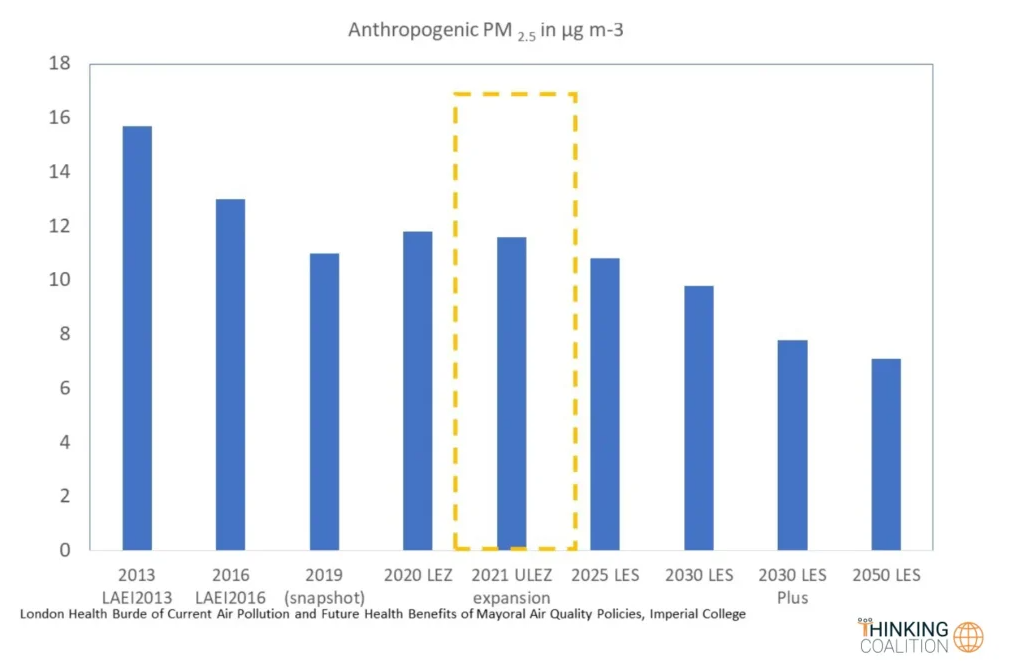
The acid test is: are the results of modelling compatible with observed reality? And on that basis the Imperial Ulez modelling falls flat. The model covers the impact of the entire Transport Strategy to 2050 which covers many more steps than Ulez. The Imperial document is somewhat vague about what those steps are – they are cryptically referred to as 2025 LES, 2030 LES and 2050 LES. It is enough to note that the goal of Mayor Khan’s 2018 Transport Strategy is to “aim for 80% of all trips in London to be made on foot, by cycle or using public transport by 2041”. So the first thing to clarify is that the claimed 6.1 million saving of life years relates to a significant number of measures, well beyond Ulez expansion. In effect these combined steps will largely eliminate private car traffic.
The chart below is constructed from the Imperial material and shows that PM 2.5 µg m-3 population weighted (PWAC) pollution falls over a number of steps and Ulez on a standalone basis has a near zero impact. Also, you can also see that a fair chunk of gains have already been banked between 2013 and 2019.
The failure of Ulez to achieve any meaningful reduction in pollution is very clearly shown in a separate document prepared by Jacobs which looks at the impacts of Ulez only. The table below shows the impact of Ulez expansion on PM 2.5 µg m-3 concentration, with an estimated improvement of less than 2%.
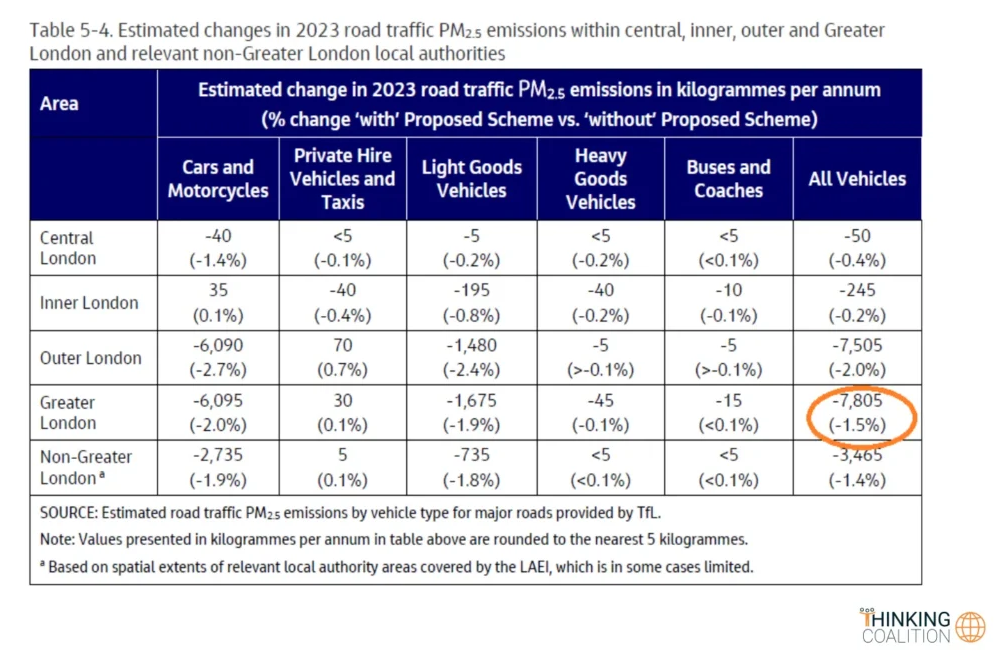
There is a slightly better outcome for NOx pollutants which are reduced by 5.4% across Greater London. This feeds in to the health impact assessment which unsurprisingly shows near zero benefit from Ulez for PM 2.5 reductions, for most health-related metrics.
Looking at life expectancy, the report does acknowledge that due to the large population (around 8.9 million) and the extraordinary long time period over which these benefits are expected to crystalise (up to 2154) then there are around 1.5 billion life-years involved (years × population). For any stated benefit to be meaningful, it needs to referenced to the base case value. The 6.1 million life-years saved is then within the context of a total of around 1.5 billion life-years; this saving is around 0.4%. Correspondingly, the impact on life expectancy from all of the pollution schemes (not just Ulez) adds up to around 22 to 27 weeks additional life expectancy. In the context of male life expectancy of 80 years (roughly) this would improve to 80.4 years as a consequence of 30 years’ worth of restrictive climate policies (ignoring any economic consequences).
The core flaw in the calculation is the one-dimensional thinking that underpins this (and all similar calculations) in that all reductions in PM 2.5 concentrations lead to a reduction in the mortality rate. This thinking ignores any link between people’s incomes and health outcomes, which is the primary driver of health. This is the same dishonest cop out that Professor Ferguson made in his infamous Covid paper. This facilitates a myopic focus on ‘safety’ and generates solutions that do far more harm than good.
In setting out the methodology that states that health outcomes will improve with a reduction in air pollution on a more or less linear basis, the Government’s own figures show that real world data prove that this assumption is not correct (or at least over-simplified). Its own data for the regions of the U.K. show that (if anything) this relationship is reversed.
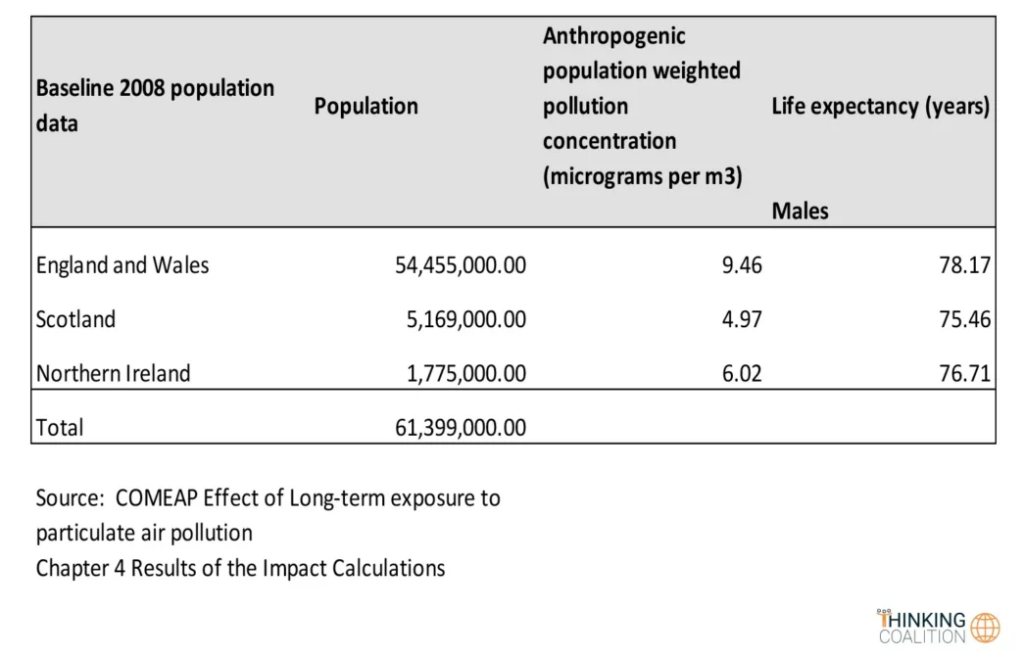
Life expectancy in Scotland is much lower despite having far and away the lowest concentration of anthropogenic PM 2.5 pollutants. Many studies with and between countries show this clearly (e.g. life expectancies by national deprivation deciles, England: 2018 to 2020).
In order to get a handle on how much more significant factors other than PM 2.5 can be, we looked at a recent paper that considers the impact of changes in different factors on life expectancy across 29 European countries (the paper also looks at each factor in isolation using multivariate analysis). The chart below shows the life expectancy impact of a 1% change in the listed factors. There are of course some caveats, but you can immediately see that economic activity dominates the outcomes with a 13-month gain in life expectancy for a 1% gain in GDP versus say a 2.7 month gain for a 1% change in PM 10-2.5. Also note there is no statistically significant relationship between CO2 and life expectancy.
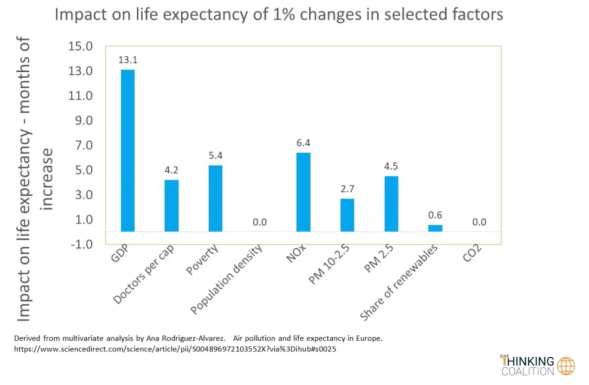
In another section of the same paper the author states: “France and Sweden, some of the countries closest to their potential LE (life expectancies), are also amongst those with the highest NOx level.” The real message, though, is that if you dent people’s income by narrowly pursuing PM 2.5 reduction, you will, on balance, shorten life expectancy and not increase it. The Jacobs’ report confirms that there will be multiple negative impacts on business and economic activity. We guess that on balance Ulez will lower life expectancy when factoring in the impacts on business and family incomes, as well as quality of life considerations.
In the post Covid world, we have understood that politicians of all stripes will shamelessly use emotional manipulation in order to get reasonable people to comply with their unreasonable edicts. That is why understanding how reliable, or otherwise, attributable deaths, life-years saved and life expectancy figures are is so important. You can almost guarantee that these estimates will be manipulated and potentially used to rationalise illogical and damaging policies.With opaque models it is relatively easy to produce results to order.
The political process assumes that the individuals involved are able to understand competing objectives and arrive at a sensible compromise. However, we saw in the case of Covid that many politicians have limited scientific understanding and will tend to pursue unachievable safety, at any cost.
The State seems to be redefining its role with a narrow group of ideologically-driven technocrats setting somewhat arbitrary targets. Achieving those targets requires wholesale changes to people’s lives. Very often economic, mental health and other impacts are barely considered and historically established constitutional boundaries between the State and the citizen are often ignored.
In the case of Ulez expansion, the 59% of respondents to the public consultation who clearly opposed the expansion were simply ignored.
Various sops will no doubt be offered to voters, but is it important that readers realise that there is a direction of travel to these various steps. Finally, remember Albert Camus’s wise warning that, “The welfare of humanity is always the alibi of tyrants.”
Alex Kriel is by training a physicist and was an early critic of the Imperial Covid model. He is a founder of the Thinking Coalition, which comprises a group of citizens who are concerned about Government overreach.
BBC Admits to Smearing Anti-Ulez Protesters as ‘Far Right’
BY IAN PRICE | THE DAILY SCEPTIC | AUGUST 4, 2023
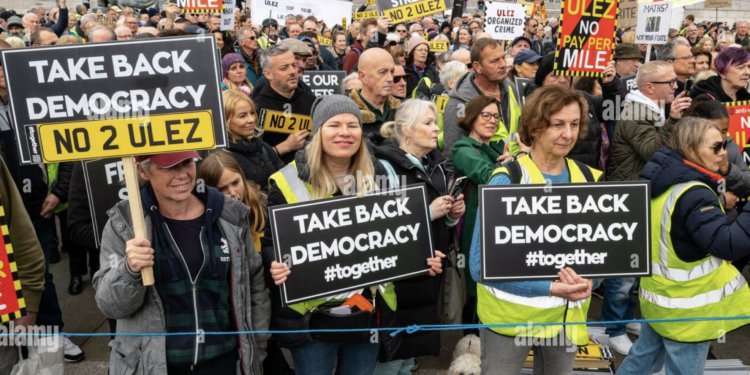
The BBC’s Executive Complaints Unit (ECU) has responded to complaints about its news coverage of an anti-Ulez protest in London’s Trafalgar Square on Saturday, April 15th, 2023. BBC London News broadcast at the time that:
Local protestors and mainstream politicians were joined by conspiracy theorists and Far Right groups.
I was among many people to complain at the time, disgusted at the BBC’s smear. I was at the protest myself, the first of any kind that I had attended. Since my previous exposure to similar protests – such as those against the lockdowns over the course of the pandemic – was limited to watching clips on Twitter, I was slightly anxious. Were things likely to kick off? Were the police going to ‘kettle’ us all in a side street off the Strand?
I could not have been more wrong. I was overwhelmed by how many families were there, abundant small children clambering up the bases of Landseer’s lions. There were a handful of Tory politicians some of whom spoke from the platform, but there was no other political presence whatsoever.
When I saw the BBC London news coverage, I was therefore appalled. I wasn’t too concerned about the claim that there were a few conspiracy theorists there – quite a few placard-holders were plainly ‘Team James’ – but “Far Right groups” seemed to me something for which there was no evidence at all. This appeared to be an attempt on the BBC’s part to suppress dissent towards the Ulez expansion by smearing opponents. This struck me as a sinister turn from the national broadcaster and so I complained.
On April 21st, the BBC responded to my complaint as follows:
BBC London had deployed a reporter to the protest and she witnessed, and documented, first hand, motifs on tabards and placards with explicit Nazi references, along with other epithets about world order and democracy.
I walked around the protest for about three hours on April 15th and I must have missed the explicit Nazi references, presumably displayed by the “Far Right groups”. I complained again, asking for evidence.
On May 12th the BBC rejected my additional complaint as follows:
We remain satisfied our BBC London reporter gave an honest account of what she witnessed that day.
At this point, I escalated the complaint to the ECU, one of 44 people to do so on the grounds of both accuracy and impartiality. Today the BBC acknowledged the following:
In relation to “Far Right groups”, we recognised that the [conspiracy theory] groups named above might have Far Right (or indeed Far Left) adherents, but did not consider this to be evidence of the presence of “Far Right groups”. The programme-makers directed our attention to the deployment by some demonstrators of Nazi imagery, symbolism and slogans directed against the Mayor of London which we accepted was consistent with tactics used predominantly by certain Far Right groups, but we saw no grounds for concluding that they were used exclusively by such groups. We also noted the presence of an individual who seemed, from social media postings, very likely to have been associated with the presence of a Far Right group at a previous demonstration, but the evidence fell short of establishing that he was an adherent of that group, and we saw no evidence that other representatives of the group were present. While it was clear from our dealings with the programme-makers that the statement about the presence of Far Right groups was made in good faith, we assessed the evidence differently. In our judgement it was suggestive of the presence of Far Right groups but fell short of establishing that such groups had in fact been represented among the demonstrators. This aspect of the complaint has been upheld.
This shows pretty clearly that the idea of “Far Right groups” being present at the protest was a complete fiction. Feelings are running high about Khan and some placards quite possibly likened his administrative style to infamous dictators of the past but for anyone to have spun this as evidence of “Far Right groups” is a stretch to say the least. As for the “individual who seemed, from social media postings, very likely to have been associated with the presence of a Far Right group at a previous demonstration”, the words ‘straws’ and ‘clutching’ spring to mind.
In addition to upholding the complaint about accuracy, the BBC has also partially upheld the complaint on impartiality which derives from the close resemblance of the BBC’s language in its news report to that of Khan himself at a People’s Town Hall in Ealing in March. When asked about people’s misgivings about the Ulez expansion, he said that its opponents were “in coalition with the Far Right” and “joining hands with some of those outside who are part of a Far Right group”.
The BBC has now acknowledged the “impression of bias” and upheld this part of the complaint, while spinning it as something of an accident, something that “might well have been perceived as lending a degree of corroboration to the Mayor’s comments”.
While it is a step in the right direction for the BBC to uphold two aspect of the complaints, there remain unanswered questions about its broader coverage of Ulez and to what extent its coverage is being unduly influenced by Sadiq Khan.
Consider the article in the Daily Express published on 24th June about a senior producer at the BBC that made contact with Reform U.K. London Mayoral candidate Howard Cox to blow the whistle on the BBC’s suppression of coverage critical of the Ulez expansion. (Cox, by the way, was also in attendance at the April demo but had not at that point declared as a Mayoral candidate):
The leak to Reform U.K. Mayoral candidate Howard Cox… reveals that Mr. Khan had applied pressure on the BBC over reporting the issue. It said that journalists wanting to run stories now needed top level clearance over something that is set to be a major electoral issue in the London Mayor election and general election both next year.
The Express article went on to explain email exchanges that the senior BBC producer had received:
The BBC producer was told in an email to news staff from Dan Fineman, Senior News Editor BBC South East: “If any platforms are doing a story on Ulez charges in the South and Southeast we now need to do a mandatory referral to Jason Horton or Robert Thomson (re) outstanding complaint with the Mayor of London which is very live at the moment.”
Jason Horton is the BBC’s Director of Production for BBC Local Services and Robert Thomson is Head of the BBC in London and the East. This suggests a level of collusion between very senior staff at the BBC and Sadiq Khan with a direct influence over editorial approaches to news coverage of anti-Ulez protests.
It was also reported by the whistleblower that a BBC London investigation into Ulez was now been paused because of the Mayor of London’s pressure on the BBC.
In short, Khan appears to be exercising at the very least some form of influence over the BBC’s coverage of anti-Ulez protests. This is not an “impression of bias” – this more closely resembles a real, undiluted bias against anti-Ulez campaigners on the part of the nation’s publicly-funded broadcaster at the behest of the Labour Mayor of London. The BBC has come up with a partial and grudging apology but I suspect that the truth about its willingness to suppress dissent with “Far Right” smears is more extensive than it’s prepared to admit. I hope that doesn’t make me a “conspiracy theorist”.
Gates Commits $400 Million to Test New TB Vaccine on 26,000 People in Africa and Southeast Asia
By Brenda Baletti, Ph.D. | The Defender | June 30, 2023
The Bill & Melinda Gates Foundation and Wellcome Trust on Wednesday announced plans to fund a phase 3 clinical trial for a tuberculosis (TB) vaccine that will be tested on 26,000 people at 50 sites in Africa and Southeast Asia over the next four to six years.
Gates committed $400 million to the trial and Wellcome — the largest funder of medical research in the U.K. and one of the largest in the world — committed an additional $150 million.
The trials will test the M72/AS01 vaccine, developed by pharmaceutical giant GSK (formerly GlaxoSmithKline) with partial funding from the Gates Foundation.
Experts told The Washington Post the news was “huge.” The Guardian heralded the announcement as “gamechanging,” while STAT called it “promising.”
But Brian Hooker, Ph.D., P.E., senior director of science and research for Children’s Health Defense told The Defender that the planned trials for the TB vaccine raised red flags.
“I’m concerned that they’re planning on conducting the trial in underdeveloped nations,” Hooker said. “It seems almost prototypical that the underserved have to be guinea pigs for the rest of the world.”
He added, “Fifty percent is incredibly low efficacy for such an ‘important’ intervention to go to essentially everyone in the developing world.”
TB more common among poor
GSK developed the vaccine and ran smaller, “proof-of-concept” phase 2b trials on it in 2018, reporting a 54% efficacy rate. But the vaccine maker didn’t move forward with the large-scale trials needed for a license.
Instead, it passed the license to the Gates Medical Research Institute, a nonprofit biotech spinoff of the Gates Foundation dedicated to developing “novel biomedical interventions” to treat global health problems.
The existing vaccine for TB, the BCG (bacille Calmette-Guérin) vaccine, was developed in 1921 and is effective at stopping TB infection among children but has limited efficacy in adults.
Recent estimates suggest up to 25% of the global population carries a latent (asymptomatic) TB infection, which may later become active among 5-15% of latent carriers. People with latent infection cannot spread the disease.
TB kills 1.6 million people per year, primarily in low and middle-income countries. It is treatable and curable with antibiotics. Drug-resistant strains have emerged, but those also are treatable and curable using second-line drugs.
TB is more common among poor people, who are more likely to work in poorly ventilated and overcrowded conditions, suffer from malnutrition and have more limited access to healthcare.
The funded trial will test whether the experimental vaccine can prevent adolescents and adults with latent tuberculosis from developing symptoms.
Maziar Divangahi, Ph.D., associate director of the McGill International TB Centre — a WHO collaborating research center and recipient of large-scale Gates Foundation grants — told STAT the vaccine was “really a big deal.”
But he also cautioned against putting too much faith in the earlier GSK trial. In that trial, 39 people — 26 in the placebo group and 13 in the vaccine group — became sick, so the sample size was “extremely low,” he said. And no one knows how long protection might last, he said.
In the earlier trial, 67% of people in the group that received the drug made unsolicited reports of adverse events within 30 days after injection, compared with 45% in the placebo group.
Gates Foundation funding like working in a ‘cartel’
The Gates Foundation is one of the largest funders of global health initiatives and “its influence on international health policy and the design of global health programmes and initiatives is profound,” The Lancet reported in 2009.
Since then its influence has grown substantially.
According to Anne-Emanuelle Birn, Sc.D., professor and chair of the Dalla Lana School of Public Health at the University of Toronto, this is a problem:
“The BMGF [Gates Foundation], emblematic of elite interests in contemporary society, disregards the underlying causes of ill health in the first place, overlooks what role the unprecedented accumulation of wealth in the hands of a few has played therein, and remains fiercely proud (staking a moral high ground) of its generosity and technical savoir-faire, all the while remaining underscrutinized by scientists and the wider public alike.”
Her research outlined how the Gates Foundation’s “profit-making principles as drivers of policy” have given business interests “an enormous and unprecedented role” in driving international policy-making.
“Despite the manifold shortcomings of a technology-focused, disease-by-disease approach to global health, this model prevails at present, abetted by the BMGF’s prime sway at formal global health decision-making bodies,” she wrote.
In a recent article examining the role of the Gates Foundation in global health, University of London professor Gwilym David Blunt, Ph.D., wrote that the foundation has been widely criticized for not following data-driven policies. “Its preference for technology and new vaccines” fails to acknowledge that mortality is often driven by “lack of basic resources such as sanitation, housing and nutrition,” Blunt wrote.
While people may benefit from clinical solutions, he wrote “a public health intervention such as ensuring access to clean water and sanitation may reduce deaths more quickly and with less expense.”
Instead, he wrote, the Gates Foundation’s influence “has helped move global health towards high-tech, vaccine-focused initiatives.”
In debates over how to approach global health at GAVI, the Vaccine Alliance, he reported Bill Gates was “vehemently insisting that not ‘one cent’ of his money should go into public systems.”
Arata Kochi, Ph.D., former head of the WHO’s malaria program, compared the Gates Foundation’s funding to working in a “cartel,” with researchers locked into the agenda of a foundation with “a closed internal process, and as far as can be seen accountable to none other than itself.”
Even The Lancet published a similar critique of Gates back in 2009.
“Important health programmes are being distorted by large grants from the Gates Foundation,” Dr. Richard Horton, editor-in-chief wrote in an editorial.
Linsey McGoey, Ph.D., professor of sociology at the University of Essex and author of a book examining Gates’ philanthropy has written that diseases like HIV, tuberculosis and malaria — key focuses for the Gates Foundation — clearly need urgent attention.
But, she said in an interview with Current Affairs, “In reality, you need to build up the public health capacity and the universal healthcare capacity of developing regions, not introduce more market actors who have incentives to drive up the costs of different medicines and interventions.”
Proponents of the TB vaccine concede that the global roll-out will “require a lot of resources” and are encouraging governments “to substantially increase investments in the TB vaccine pipeline.”
Wellcome Trust and the Gates Foundation hope to secure a commercial partner for their new vaccine within 12 months, The Economist reported.
Brenda Baletti Ph.D. is a reporter for The Defender. She wrote and taught about capitalism and politics for 10 years in the writing program at Duke University. She holds a Ph.D. in human geography from the University of North Carolina at Chapel Hill and a master’s from the University of Texas at Austin.
This article was originally published by The Defender — Children’s Health Defense’s News & Views Website under Creative Commons license CC BY-NC-ND 4.0. Please consider subscribing to The Defender or donating to Children’s Health Defense.
Another Climate-Savior Alarmist Jetsets To South America – For Two Months Of Vacation!
Climate activist hypocrite of the month
By P Gosselin | No Tricks Zone | June 30, 2023
Skipping classes, getting up at 11 a.m., gluing oneself to the asphalt and blocking streets with your mates all day to save the planet is a really tough and important job, climate activists believe. And so exempting themselves from the rules they want imposed on the rest of society is understandable. After all, they are more important than the rest.
So important, in fact, that activists like Max Voegtli of Renovate Switzerland believes flying to Central America by jet plane for a couple of months of R & R is totally okay. The working class, however, should not fly at all and freeze in the wintertime.

Dealing with the climate crisis is urgent, insists Swiss radical climate activist just before hopping on a jet plane to fly to Central America for 2 months of vacation. Image cropped here.
Last Tuesday, Swiss climate activist Voegtli appeared on TalkTäglich at TeleZüri, and passionately explained how urgent it is to deal with the “climate crisis” and demanded that the planet be saved.
Off to Mexico and Central America
Then, already on Thursday, he was photographed at Zurich airport, preparing to board a plane bound for Paris. But climate rescuer Voegtli’s flying would not end in Paris, reports AUF 1 : “Paris was not the activist’s destination, but there he only took the connecting flight to Mexico and Central America, where he wants to travel around for two months.”
A two-month vacation is a total fantasy for the rest of the working world, who struggle to make ends meet each month. And this traffic blocker goes unhindered for 2 months?
Climate Emergency Fund
So where does an unemployed activist like Voegtli get the money for such a holiday extravaganza? AUF 1 writes: “It is well known that some of the asphalt gluers receive a regular salary. Organization Renovate Switzerland is no stranger to lavish money: “The organization itself admits that it is financed by the Climate Emergency Fund of oil magnate heiress Aileen Getty.”
Activists cry they are being harassed!
Now that Voegtli’s hypocrisy has been exposed, the embarrassed activists justify all their globe-trotting by claiming they travel as “private persons” and so no one should be photographing them.
AUF 1 : “Spokesperson Cécile Bessire castigated the ‘media hounding against the climate movement and the people who campaign for it. I find it incomprehensible that citizens are following our activists and taking photos. These are private individuals.’”
At Twitter, the thin-skinned Voegtli defended himself: “Shows again how the @CH_Media cares more about feeding the hate media cycle further instead of talking about the crisis.”
Voegtli’s Renovate Switzerland group added: “Getting politically involved against the climate crisis often goes hand in hand with changing one’s own life. However, it is not a prerequisite to do so. […] No matter if you separate your rubbish, if your house is renovated, if you work for a bank, if you eat meat or if you fly. All you should do is wish for a livable future and get involved in the climate movement.”
AUF 1 summarizes the infantile behavior of the activists such as Voegtli: “It means the climate activists can demand anything from citizens without having to do it themselves.”
In a nutshell, according to the climate activists: it’s “incomprehensible” that citizens would take photos of activists at airports, yet it’s perfectly fine for activists to block major roadways and to harass people who are trying to make a living. That’s how they want it.
A line in the sand for euthanasia
Health Advisory & Recovery Team | June 6, 2023
It is easy to make an argument for euthanasia. Heart wrenching stories can be told about people who are suffering terribly and genuinely want to see their already imminent death hastened. The argument for not crossing this line is because as soon as it is crossed there is a very slippery slope on the other side. Canada has demonstrated this in a most tragic way.
Canada legalised euthanasia six years ago through the Medical Assistance in Dying bill (MAiD). Since its inception, over thirty thousand Canadians have been euthanized. The number has increased by about a third each year. By 2021 states sponsored homicide accounted for over 3% of all deaths. For comparison diabetes accounts for 2.5% and influenza and pneumonia together accounted for less than 2% in 2020.
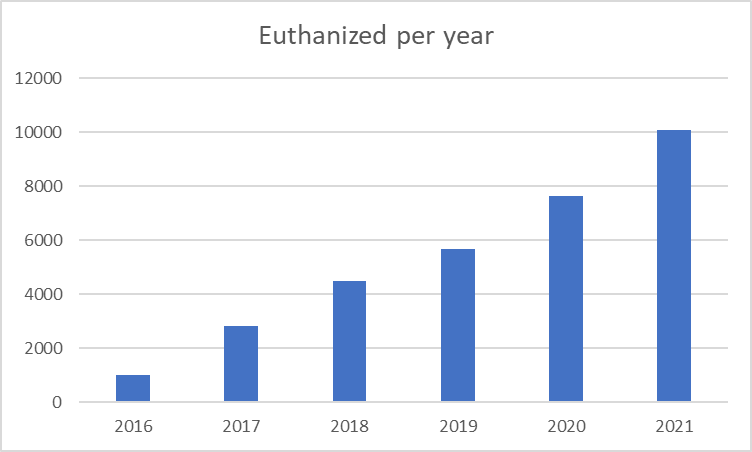
Figure 1: Number of state sponsored deaths per year
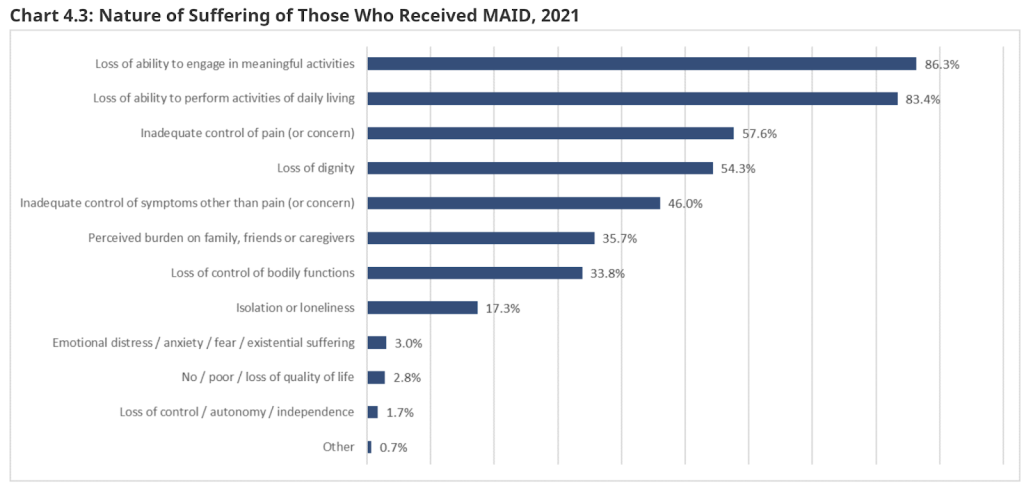
Figure 2: Reasons given for undergoing euthanasia in Canada.
The line in the sand that you do not kill has been utterly trampled over in Canada. Even the religious have lost their moral compass over this. One woman was killed by doctors in her church while religious leaders prayed over her. The church leaders claimed no-one expressed concern about this happening in a church.
Having crossed the line of “do not kill” there seems to have been little thought about drawing a new line in the sand that must not be crossed. There seems to have been little consideration of who and how many should be involved in the decision making. Note that more than a third of those killed felt they were a burden and one in six felt isolated or lonely (figure 2).
One of the most alarming developments from the implementation of MAiD is the case of a Canadian man who was approved for euthanasia due to his dire financial condition. This case underlines a chilling progression from euthanasia as an option for those in unbearable physical pain to a choice for individuals facing socioeconomic challenges. A survey showed that 28% of Canadians support euthanasia for homelessness and 27% for poverty. One family reported to the authorities the death of their depressed loved one in a hospital, where he was killed despite concerns being raised by the family and by nursing staff that he lacked capacity.
The notion of the ‘slippery slope’ is rooted in psychological research, particularly in relation to moral decision-making. An example is an experiment published in the Journal of Applied Psychology. It was found that participants were more likely to cheat when the reward started at a small amount and gradually increased. This gradual acceptance of unethical behaviour over time underscores the crux of the slippery slope effect.
By allowing euthanasia for individuals suffering physical pain, Canada may have unknowingly trampled on the path of ethical ambiguity, leading to euthanasia being used as a solution for conditions like poverty. This parallels the gradual acceptance of laws, cultural trends, and political misconduct that were initially unthinkable.
Drawing parallels with the regulation of public health, a similar ‘slippery slope’ scenario can be observed. While the intention behind banning smoking in public spaces was laudable, this move empowered public health bodies to impose further restrictions, gradually leading to what some critics label a ‘public health totalitarian state.’
To counter the ‘slippery slope’, researchers recommend a ‘prevention focus’, a psychological strategy emphasising vigilance and security. This approach involves considering the potential losses and negative outcomes of decisions before implementing them. Had this approach been more central to the discussion around MAiD, Canada might have avoided some of the ethically contentious situations it now faces.
Euthanasia is now legal in Belgium, Canada, Colombia, Luxembourg, Netherlands, New Zealand and Spain and parts of Australia. It is important that we start a public debate now. It is all the more important given that over the last few years it has become clear that we are living in a society with no respect for bodily autonomy. How long before it is accepted that “being a burden” is a just reason for killing. How much longer before people without capacity are considered to be too much of a burden?
The Canadian example underlines the dangers of the slippery slope in legalising euthanasia. The country’s experience shows that while euthanasia may be intended for individuals in unbearable physical pain, its application can gradually expand to cover other conditions, blurring ethical boundaries. It serves as a cautionary tale for other countries debating euthanasia legislation, urging them to consider potential ‘slippery slope’ implications before taking a decision.
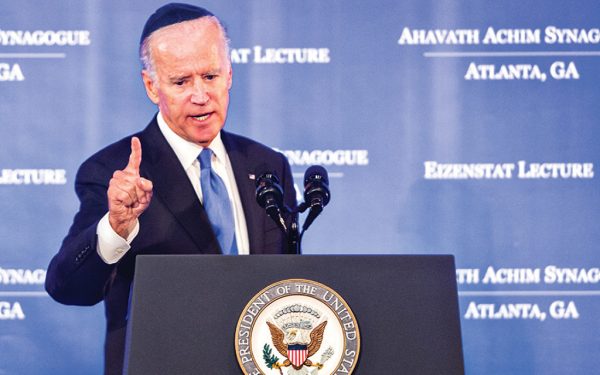
Biden Regime Unveils Historic Plan to Crush Criticism of Influential Jews
By Eric Striker | National Justice Party | May 25, 2023
Yesterday, President Joe Biden announced a plan to use virtually every branch of the federal government, big business and civil society to ruthlessly suppress First Amendment protected criticism of Jewish political power and Zionism in the homeland.
The 60-page document, titled the “US National Strategy To Combat Anti-Semitism,” was created in part by Doug Emhoff, the Jewish husband of Vice President Kamala Harris. The goal of the project is to consolidate every power at Washington’s fingertips to engage in a political campaign to quell the American people’s rising awareness of the radically disproportionate influence Jewish people wield over the country.
On the law enforcement front, Washington appears to be de-emphasizing the FBI, which has suffered several reputational blows that have discredited its campaign against “white supremacy,” while continuing to expand the power of the Department of Homeland Security (DHS) — originally founded after 9/11 to combat Al Qaeda — in its place.
The DHS is being directed to to produce research equating concern with how Jews use political and financial power with acts of violence, host more regular workshops for all branches of law enforcement on using the law to persecute those engaging in “anti-Semitism,” increase security resources earmarked for Jewish institutions, give Jewish organizations more say over how intelligence and police resources are directed, and instruct private social media and internet companies to find and eliminate “anti-Semitic” content from their platforms.
The document, without qualification, is marbled with an egregious lack of respect for fundamental civil liberties. In one instance, there is an executive command to the Department of Treasury to convene a forum of Money Services Businesses (MSB) institutions, along with those outside of the network, to prevent online crowdfunding for what it labels “hate groups.” What constitutes a hate group — a term that is alien under traditional American jurisprudence — is not specifically defined. The project promises to reach all nations in the trans-national American sphere of influence.
The White House is also ushering in a myriad of new programs seeking to indoctrinate students on the Holocaust story and the numerous ways one could be practicing “anti-Semitism,” largely but not exclusively through the Department of Education. The Biden administration plan also expands the footprint of the US Holocaust Memorial Museum (USHMM).
No agency will be immune to this politicization. The Department of Labor (DOL) will be pressuring labor unions to identify “anti-Semites” in their midst, while the US Department of Agriculture (USDA) will be expanding access to Jews engaging in the controversial practice of Kosher slaughter. USDA will also be approaching rural religious leaders and universities to impose Washington’s strategy in even the most remote small towns.
Under this plan, the National Endowment of the Arts (NEA) is given the deadline of September 2023 to create political propaganda projects that “incorporate themes of countering antisemitism and other forms of hate in their artistic practice.”
The Department of the Interior (DOI), The Small Business Administration (SBA), and even the Institute of Museum and Library Services (IMLS) will all be given special tasks to train small business owners, park rangers, and guides in identifying and fighting “anti-Semitism.” Special attention is being given to rural libraries, which Washington will be transforming into outlets for promoting pro-Jewish narratives.
So far, only Representative Lauren Boebert has publicly come out against this runaway weaponization of the federal government. Jewish groups backing Ron DeSantis and Donald Trump have also criticized the move, but their concern is that it does not go far enough in targeting critics of the state of Israel.
The implementation of this plan coincides with the beginning of Biden’s 2024 re-election campaign. A massively lopsided percentage of the president’s major donors are Jewish, and his administration is one of the most heavily Jewish in US history.
5 Things I Truly Don’t Understand About the ‘Inevitable Energy Transition’
RealClear Wire | May 29, 2023
Please note: this article was pulled down offline from Forbes. I will let you draw your own conclusions as to why. Factually, there was no justification for it.
This list could be closer to 50 but let’s just stick to a handful of them. I literally live in this business every day, and I’m just so confused.
1. In a world that is apparently getting both warmer and colder because of global warming, how is it that we can increasingly rely on non-dispatchable (i.e., intermittent, usually unavailable), weather-dependent electricity from wind and solar plants to displace, not just supplement, dispatchable (i.e., baseload, almost always available) coal, gas, and nuclear power? In other words, if our weather is becoming less predictable, how is it that a consuming economy like ours can, or should even try, predictably rely on weather-dependent resources? ERCOT exemplifies this: the Texas grid operator has around 31,000 MW of wind capacity but goes into winter expecting only 6,000 MW (just 20%) of wind farms to be available to generate electricity. Again, in the marketplace, the “alternatives” you keep hearing about are proving to be far more supplemental than alternative.
Further, good wind and solar spots are finite, based on geography, so new builds, naturally, will be forced into areas that are less windy and less sunny, lowering their already very low 35% capacity factors. And because they devour immense swaths of land, interrupting a whole host of things, that Renewable Rejection Database is mounting very quickly. If wind, solar, and electric cars too are as effective and low-cost as so many keep promising us, there would obviously be no need for government subsidies for broad adoption. Yet, there is, gigantically so. Huge amounts of taxpayer money going into this, what I call “the holy climate panacea triad,” are vulnerable to changing politics and bound to become politically untenable at some point: “Ford Is Losing $66,446 On Every EV It Sells.” Our limited financial resources are obviously very precious, so these NEVER CONSIDERED and wasted opportunity costs forcing wind, solar, and electric cars into the energy complex are truly catastrophic. Schools investing in electric buses over STEM? The $200 Billion Electric School Bus Bust. How can any of this be justified? I’m so utterly confused.
2. Climate change is a global issue, so how is it that we can claim climate benefits for unilateral climate policy. For example, U.S. gasoline cars constitute just 3% of global CO2 emissions, so how will getting rid of them impact climate change? But this dose of real science doesn’t stop California leaders, a state responsible for just 1% of global CO2 emissions, from telling us that energy policy in the nine-county region of Northern California alone is “responsible for protecting air quality and the global climate in the nine-county Bay Area.” No wonder then that a Biden administration official was incoherent when asked how $50 trillion in climate spending in the U.S. will lower any global temperature rise. Indeed, despite the Sierra Club in 2014 promising us that “China’s Thirst for Coal Is Drying Up,” the Chinese Communist Party approved two coal plants a week in 2022. But, don’t worry guys, China promises to be net-zero by 2060. On climate, you don’t matter nearly as much as some want you to think.
So, it becomes very obvious very quickly that no energy policy in northern California has any relevance in terms of changing the climate. The region could literally disappear and there would be no discernable impact on climate change. Even our climate czar John Kerry, loving the CO2-devouring life in a private jet and $250 million, has been forced to admit that the U.S. could even go to zero emissions and it would make no material impact on climate change. Talk about all pain, no gain. The real science is that incremental global emissions are “not here but over there” U.S. CO2 emissions are in structural decline regardless of what policies we pass (save 2021 and the rebound from Covid-19’s devastation in 2020). So, where is the climate benefit for Americans when it comes to U.S. climate policy? Because we’re continuously told to “believe science,” any positive answer to that question can only be deemed as anti-science. In fact, common sense and science itself tell us that unilateral climate policy can actually be really bad for climate change because it encourages carbon leakage (e.g., climate policy in the U.S. increases costs and just pushes a manufacturing firm to re-locate to coal-devouring China).
3. Back to electric vehicles. Even green-tinted but surely practical Bloomberg admits that more than 85% of Americans can’t afford an electric car, since they are well more than double the price of oil-based cars. How can a product bring racial justice for Black Americans when the vast majority of them can’t afford it? Worse then, huge and growing subsidies for electric cars are a “reverse Robin Hood,” taking money from poor taxpayers to give to the rich ones that are, actually, in the market to buy an electric car. Forcing electric equipment over natural gas? Sorry but “gas is four to six times cheaper than electricity.” Battery costs might be much higher than expected: 1) rising global demand, 2) rising costs and unavailability of their raw materials, 3) mining complications and environmental damage, and 4) China flexing its muscles since it controls the supply chains and uses hoarding as political leverage (see Covid-19 and medical supplies). Reality check, unlike what we keep hearing about “green energy,” no technology continues to decline in cost in perpetuity: “EV battery costs could spike 22% by 2026 as raw material shortages drag on.”
And this one I’m really confused on. President Biden promotes his climate agenda as a way to create jobs. Besides lacking in economic literacy (i.e., jobs are costs not benefits), the truth is that electric cars, for instance, entail far less jobs because they, for one thing, have far less moving parts. And there’s all kinds of evidence that electric car life-cycle emissions could be way worse than advertised, mostly because of the massive amounts of mining required to make them. We all know about child labor and your electric car, but even pro-EV outlets are being forced to report on the mounting problems from mining, the latest on how bauxite for the aluminum needed is destroying the Amazon. And about our President’s we’ll need oil for “another decade” claim? The U.S. Department of Energy just modeled that our oil demand will actually slightly INCREASE, not decline, to over 21.1 million b/d by 2050. Reality check: planes, industry (petrochemicals), heavy trucking, and sheer Energy Inertia will have oil dominating way longer than you’re being told.
4. How on Earth could anybody expect those in Africa and the other horrifically poor nations to “get off fossil fuels” when the rich countries haven’t come close to doing it. Germany and California, the world’s two greenest governments, are still overwhelming fossil fuel-based and overwhelmingly dependent on imports (dangerously so in Germany’s case). This comes despite decades of huge subsidies, scores of mandates, deploying the best engineering expertise, and having low population growth and thus low incremental energy needs, all giving them a huge advantage in “going green.” The energy stat to remember most? No U.S. state will ever “try to go green” like California has over the past 20 years, yet oil and gas still supply 70% of the state’s energy, even above the national average of 65%.
Germany and California have shown us what these climate policies bring: Germany has the highest electricity prices in the world; and California’s are the highest in the continental U.S. and soaring out of control (Figure). How the heck can we push for “deep electrification” to fight climate change if we are going to follow policies that surge the price of electricity, while also lowering grid reliability? And rich Westerners, spare us the judgments, demands, and hypocrisy on climate change: Germany thrives on a GDP per capita per year of $51,200, compared to a horrifically sad $2,260 for India.
5. But, perhaps I’m most confused about the whole air quality thing. The obsession over it gets attached to all energy policies. But there’s clearly a strawman to the “we need cleaner air now” demand. First, the air quality conversation in the U.S. reminds me of Voltaire’s “the perfect is the enemy of good.” Americans seem completely unaware how drastically our air quality has improved. Check data from the U.S. Environmental Protection Agency (EPA), our criteria pollutants have been plummeting over the past many decades. The risks seem exaggerated. Let’s just take Los Angeles, which for a big city notoriously has the worst air quality in the country. Tell me, please, if air quality is such a problem and such a health concern for Americans, why is it that Angelinos have a life expectancy of 82 years, a hearty three years above the national average. Just think of all the coal that China has devoured since 2000 (I figure around 70 billion tonnes), yet the country’s life expectancy, apparently shockingly to so many, is up a very impressive six years to nearly 78 since then. Maybe it’s because Chinese GDP per capita per year has skyrocketed nearly 9-fold to over $18,500. Even for rising asthma rates in the U.S., smoking is way down, coal usage is way down, and criteria pollutants are way down. So what gives?
“Better air quality and environment” are not free, as attaining government standards cost businesses hundreds of billions of dollars per year. These costs are ultimately paid by Americans in the form of higher prices, lower wages, and less choices. And at some point, the cost of the regulation to achieve better air outweighs its benefit. We’ve won on water too: the water in your toilet is cleaner than what the vast majority of humans on Earth drink. For every time that we hear “environmental justice” we need to say “economic justice” 100 times. In this country for all Americans, Blacks and Hispanics/Latinos make 30% less money than Whites and Asians. Too many politicians focus on the endless pursuit of “better air quality” and other abstract, seemingly impossible to measure benefits because they have no clue on the real ways to help communities of color and other low-income Americans: help them get a better education, help them get a better job, and help them make more money. Career politicians love bottomless, money-devouring pits the most: “America’s $100 billion climate change flop.” And although its entire existence is based on never being able to declare victory (imagine a football game with no time and no keeping score), EPA should consider that it’s wealth that matters most for health equity.
But, that’s not its business, is it?
Featured Video
Seyed M. Marandi: Negotiations Collapsed – Return to War
or go to
Aletho News Archives – Video-Images
From the Archives
The US-Iran Scenario That Most Scares Israel
By Ali Haydar | Al-Akhbar | October 9, 2013
Israeli Prime Minister Benjamin Netanyahu issued a series of threats toward Iran and its interlocutors in the West, including the US, as serious negotiations on Iran’s nuclear program seem more plausible.
As a possible rapprochement looms between the US and Iran, Netanyahu has attempted to impose impossible Israeli conditions on the negotiators, such as the full dismantling of Iran’s nuclear program, not to mention threatening military force.
Whatever the deal that could materialize between Iran and the West, Israel is going to find itself before an open-ended path. One can foresee three possible scenarios… continue
Blog Roll
 Aletho News
- Ukraine plans to attack Russian ships with Norwegian support
- US’s ‘Very Foolish’ Double Blockade of Hormuz Strait Makes Absolutely No Sense: Here’s Why
- China issues rules on countermeasures against foreign states’ unlawful extraterritorial jurisdiction
- Seyed M. Marandi: Negotiations Collapsed – Return to War
- Tomorrow’s naval blockade showdown
- ‘Israel’ attacks civilians to hide its embarrassing military failures & out of pure sadism
- Any Foreign Military Vessel Approaching Hormuz Under Any Pretext ‘Will Be Dealt With Severely’: IRGC
- Diplomats slam US negotiators’ performance in Iran talks
- Trump Refuses Exit Ramp, War with Iran will Continue
- Trump Says US Naval Blockade in Strait of Hormuz Will Begin Shortly
- If Americans Knew
- Critical shortages in Gaza, Lebanon in ruins, “piracy” in Iran – Daily Update
- US-Iran ceasefire negotiations make zero progress – Daily Update
- Pro-Israel ‘Thinktanks’ and Individuals who Influence U.S. Foreign Policy
- Mearsheimer reveals how Israel dictates US policies on Iran, Gaza – video
- After killing 350+, Israel still has a “score to settle” with Lebanon before ceasefire – Daily Update
- Military aid to Israel emerges as the latest political litmus test for Democrats
- The only Palestinian children’s rights organization closes following years-long Israeli campaign against it
- ‘I Can’t Forget the Smell’: Lebanese Reel After Israel Kills Over 300 in Single Day
- DNC Shoots Down Resolutions Calling Out AIPAC and Limiting Arms to Israel
- TCN: Is Israel Blackmailing President Trump?
- No Tricks Zone
- Cave Discovery Reveals Today’s Desert Climates Were Recently Far Warmer, Wetter, Teeming With Life
- German Expert: Heat Dome Led To Record Temps In Western USA…Warmer In 1934, 1936
- New Study: No Linear Warming Or Glacier Retreat Along Northern Antarctic Peninsula Since 1980s
- An Inconvenient Tree: Uncovered In Alps… Europe Much Warmer Than Today 6000 Years Ago
- New Study Reports A 60% Slowdown In Greenland’s Ice Loss Rate In The Last Decade
- Low Intensity Tornado Wrecks Major Solar Farm, Creating A Potential Toxic Dump
- New Study Finds Warming Saves Lives…Cold Temperatures 12 Times More Deadly Than Excess Heat
- German Science Blog Accuses PIK Climate Institute Of Hallucinating Climate Tipping Points
- Devastating Assessment Of Comirnaty Vaccine By Former Senior Pfizer Europe Toxicologist
- New Study: CO2 Is ‘Effectively Negligible’ As An Explanatory Climate Change Factor Since 2000
 Aletho News