On August 17, America’s two leading newspapers featured strikingly similar opinion pieces, providing further evidence of a coordinated effort by Israel and its American partisans to induce the United States into waging another disastrous Middle East war. In the Washington Post, former chief of Israeli military intelligence Amos Yadlin helpfully suggested “5 steps Obama can take to avert a strike on Iran”; while President Obama’s former top Middle East advisor Dennis Ross advised readers of the New York Times “How America Can Slow Israel’s March to War.” Perhaps the most notable difference between the two op-eds was that the latter proposed a mere four steps Washington supposedly needs to take in order to appease the allegedly trigger-happy Israelis.
Yadlin and Ross both begin by citing recent Israeli statements such as Benjamin Netanyahu’s warning that “Time to resolve this issue peacefully is running out,” conveying the impression that Tel Aviv’s patience with diplomacy is wearing thin, and that, as a consequence, this autumn, as Yadlin put it, “all the boxes will be checked for an Israeli attack on Iran’s nuclear facilities.” Three months ago, Ross admitted during a panel discussion with Yadlin on “U.S.-Israel Relations in a Changing Middle East” at a conference held by the Washington Institute for Near East Policy, where he is now a counselor, that such alarmist public pronouncements by Israeli officials should be understood not as an indication of the Jewish state’s likelihood to strike the Islamic Republic but as a ploy “to motivate the rest of the world to act.” Now, however, he confidently asserts: “The words of Israeli leaders are signaling not just increasing impatience with the pace of diplomacy but also Israel’s growing readiness to act militarily on its own against Iranian nuclear facilities.”
Both op-ed contributors also make it a point to stress that the United States shares Israel’s strategic goal of preventing Iran from acquiring nuclear weapons capability, while noting that they only differ over, in the words of Yadlin, “the timeline for possible military action against Iran.” Like the former Israeli intelligence chief, Ross touts Israeli Defense Minister Ehud Barak’s “zone of immunity” argument that Israel must act while Iran’s nuclear facilities are still vulnerable to an Israeli military strike.
Framing their arguments as attempts to prevent, or at least postpone, an Israeli attack, Yadlin and Ross offer, respectively, their five- and four-point plans for “peace.” Yadlin, currently director of Israel’s Institute for National Security Studies, urges the Obama administration to take “five immediate steps to convince allies and adversaries alike that military action is real, imminent and doable,” which he assures are “key to making it less likely”:
First, Obama should notify the U.S. Congress in writing that he reserves the right to use military force to prevent Iran’s acquisition of a military nuclear capability. This would show the president’s resolve, and congressional support for such a measure is likely to be strong. Forty-four senators signed a bipartisan letter to Obama in June, urging him to “reevaluate the utility of further talks at this time” and focus instead on sanctions and “making clear that a credible military option exists.”
Second, Washington should signal its intentions via a heightened U.S. military presence in the gulf, military exercises with Middle East allies and missile defense deployment in the region. Media coverage of these actions should be encouraged.
Third, Washington should provide advanced military technology and intelligence to strengthen Israel’s military capabilities and extend the window in which Israel can mortally wound Iran’s program. This support would be contingent on Israeli pledges to give sanctions and diplomacy more time to work.
Fourth, U.S. officials should speak publicly about the dangers of possible Iranian nuclear reconstitution in the wake of a military strike. Perhaps the most cogent argument against a unilateral Israeli strike is that it would quickly lead to the disintegration of Western sanctions. Without the inhibitions of a sanctions regime, Iran could quickly reconstitute its nuclear program — this time bunkered entirely underground to protect against aerial strikes. If Iran sees military action by Israel or the West as an absolute end to its nuclear ambitions, it will be more reluctant to risk things.
Fifth, Obama should publicly commit to the security of U.S. allies in the gulf. This would reassure jittery friends in the region and credibly anchor the U.S. last-resort military option to three powerful interests: U.S. national security, Israeli security and the security of allied states.
Living up to his reputation as a reliable “advocate” for Israel, Ross presents his remarkably similar four-step plan which he claims is necessary in order “to extend the clock from an Israeli standpoint” as well as “to synchronize the American and Israeli clocks so that we really can exhaust diplomacy and sanctions before resorting to force”:
First, the United States must put an endgame proposal on the table that would allow Iran to have civil nuclear power but with restrictions that would preclude it from having a breakout nuclear capability — the ability to weaponize its nuclear program rapidly at a time of Tehran’s choosing. Making such a proposal would clarify whether a genuine deal was possible and would convey to Israel that the American approach to negotiations was not open-ended.
Second, America should begin discussions with the permanent members of the United Nations Security Council and Germany (the so-called P5+1) about a “day after” strategy in the event that diplomacy fails and force is used. This would signal to both Israel and Iran that we mean what we say about all options being on the table.
Third, senior American officials should ask Israeli leaders if there are military capabilities we could provide them with — like additional bunker-busting bombs, tankers for refueling aircraft and targeting information — that would extend the clock for them.
And finally, the White House should ask Mr. Netanyahu what sort of support he would need from the United States if he chose to use force — for example, resupply of weapons, munitions, spare parts, military and diplomatic backing, and help in terms of dealing with unexpected contingencies. The United States should be prepared to make firm commitments in all these areas now in return for Israel’s agreement to postpone any attack until next year — a delay that could be used to exhaust diplomatic options and lay the groundwork for military action if diplomacy failed.
While noting that these proposals may be seen as making war more likely next year, Ross claims “they are almost certainly needed now in order to give Israel’s leaders a reason to wait.” Similarly, Yadlin argues that “if the United States wants Israel to give sanctions and diplomacy more time, Israelis must know that they will not be left high and dry if these options fail.”
“A long-standing principle of Israeli defense doctrine,” Yadlin asserts, “is that it will never ask the United States to fight for it.” While it may be technically true that Tel Aviv never directly asks Washington to dispose of regional rivals on its behalf, these two op-eds attest that the Jewish state has more subtle ways of inducing America to do its dirty work for it.
It was always a terrible name – The Nuclear Waste Confidence Decision. Ever since the first cupful of deadly nuclear waste was generated at Chicago’s Fermi reactor, on December 2, 1942, no one has ever had the slightest ounce of confidence about what to do with it. It was the ultimate kick-the-can-down-the-road decision. Make radioactive waste now. Worry about the disposal problem later.
Now it’s later and no permanent, safe location or technology has ever been found – and may never be found – to isolate even that first cupful of radioactive waste from the biosphere. Instead, we have a mountain of radioactive waste 70 years high.
Yet the Nuclear Waste Confidence Decision (NWCD), first established in 1984 and last updated in 2010, held that the US Nuclear Regulatory Commission (NRC) – the agency responsible for licensing reactors – had “confidence” that an acceptable plan would someday be found.
Even after the proposed Yucca Mountain high-level radioactive waste dump plan was abandoned, the NRC still maintained that a suitable repository would be found “when necessary.”
This, despite the fact that all of the high-level commercial radioactive waste generated by US reactors sits at the reactor sites, either in indoor pools while it waits at least five years to cool, or in what are known as outdoor “dry casks,” stored on site, effectively in parking lots.
On June 8, the US Court of Appeals in DC put an end to such bullish “confidence.” In vacating the NWCD, the Court ruled that the NRC has to re-evaluate the environmental impacts of the storage and disposal of nuclear waste, effectively forcing the agency to examine the environmental consequences of producing highly radioactive nuclear waste without a long-term disposal solution. The Court’s decision also questioned whether irradiated fuel can safely be stored on site at nuclear plants for an additional 60 years after the expiration of a plant’s 60-year license.
The ruling opens several important doors. It allows the public to challenge the environmental integrity of storing radioactive waste at reactor sites. It puts a freeze on the final issuance of extended or new reactor licenses – for those still operating and for those not yet built. And it presents an opportunity to once again push for securing radioactive waste on site, at least temporarily, but in a more protective and robust manner.
Reactor fuel pools are so tightly packed with fuel rods that extraordinary precautions must be taken to prevent an inadvertent chain reaction. US reactor fuel pools still contain at least 75% of all the irradiated fuel generated since 1957, the year of the first commercial reactor at Shippingport, in Pa. The Fermi-One reactor in Michigan, that produced weapons-grade material from 1966-1972, still contains more than 10,000 tons of waste with permanent disposal solution.
As fuel pools filled up, fuel rods at some of the nation’s commercial nuclear power plants were transferred to concrete and/or metal casks, stored outdoors. But the casks are of questionable quality. Some have experienced hydrogen explosions and fires. The NRC does not require the casks to be directly monitored for over-heating, radiological releases and other safety issues. During the August 2011 5.8 magnitude earthquake with an epicenter near the North Anna reactors in Virginia, 115-ton outdoor casks there shifted precariously and suffered damage.
Close to 200 environmental groups have urged for years that fuel pools at US reactors be emptied and the waste stored in casks that are hardened and bunkered behind security fortifications. The technology is known as Hardened On-Site Storage (HOSS), but the federal government has never required such modifications, even after 9/11 and now, Fukushima.
Instead, while the NRC seeks to fulfill the orders of the court, the US Department of Energy and its allies in Congress, are embarked on a different path to move radioactive waste from reactor sites. The concept – an old idea that has already been debunked and rejected multiple times – is “Centralized Interim Storage (CIS).” An effort to dump radioactive waste “temporarily” on the Skull Valley Goshute Indian reservation in Utah was defeated in 2006 by an alliance of Goshute tribe members, environmental advocates and political allies.
If a CIS facility were to be sited, it would mean transporting the country’s radioactive waste hundreds, even thousands of miles on roads, railway lines and waterways, past the homes, schools, and businesses of at least 50 million Americans – to be deposited at a parking lot site “temporarily.” The most likely targets would be low-income communities with the weakest economic, political, or social resistance, or Native American reservations.
Severe transport accidents – such as high-speed crashes, long-duration, high-temperature fires, or underwater submersions – or even intentional attacks, could unleash disastrous quantities of hazardous radioactivity as these shipments pass through major metro areas.
With no suitable permanent repository location in sight, these “temporary” dumps could easily become permanent. In addition, stacking un-hardened radioactive waste casks outside, like bowling pins, represents an obvious security threat. Finally, if CIS sites were, in fact, temporary, transportation risks would be doubled, by moving the waste first to a CIS site and then, again, to the nation’s illusory, final dump site.
Many silver linings have a dark cloud encircling them. The DC Circuit’s decision in June, to stay the issuance of new or extended reactor licenses, is a major, hard-won victory. But we must remain ever-vigilant to prevent the development of scientifically unsound, environmentally racist,”interim” radioactive waste storage options that could endanger millions. Instead of perpetuating the unsustainable habit of continued waste generation, we should stop making it in the first place. That is the most essential step toward managing our ever-mounting radioactive waste disaster.
Kevin Kamps specializes in nuclear waste issues at Beyond Nuclear, in Takoma Park, MD. Tel: 240.462.3216.
Linda Gunter serves as Beyond Nuclear’s international specialist. Tel: 301.455.5655.
The BBC has sensationally censored a news story and a video showing Syrian rebels forcing a prisoner to become a suicide bomber, a war crime under the Geneva Conventions, presumably because it reflected badly on establishment media efforts to portray the FSA as glorious freedom fighters.
The video, a copy of which can be viewed above (the original BBC version was deleted), shows Free Syrian Army rebels preparing a bomb that is loaded onto the back of a truck to be detonated at a government checkpoint in the city of Aleppo.
The clip explains how the rebels have commandeered an apartment belonging to a Syrian police captain. The rebels are seen sneering at photos of the police captain’s family while they proclaim, “Look at their freedom, look how good it is,” while hypocritically enjoying the luxury of the man’s swimming pool.
The video then shows a prisoner who the rebels claim belonged to a pro-government militia. Bruises from torture on the prisoner’s body are explained away as having been metered out by the man’s previous captors. The BBC commentary emphasizes how well the rebels are treating the man, showing them handing him a cigarette.
However, the man has been tricked into thinking he is part of a prisoner exchange program when in reality he is being set up as an unwitting suicide bomber. The prisoner is blindfolded and told to drive the truck towards a government checkpoint.
“What he doesn’t know is that the truck is the one that’s been rigged with a 300 kilo bomb,” states the narrator.
The clip then shows rebels returning disappointed after it’s revealed that the remote detonator failed and the bomb did not explode.
The BBC narrator admits that forcing prisoners to become suicide bombers “would certainly be considered a war crime.”
New York Times reporters who shot the video claim they had no knowledge of the plot. A longer version of the clip is posted on the New York Times You Tube channel. The title of the clip glorifies the rebel fighters as “The Lions of Tawhid”.
Within hours of the story being published, it was subsequently sent down the memory by the BBC. Attempts to reach the original article URL are greeted with a 404 Not Found page.
In addition, a You Tube version of the same video originally posted on the official BBC News 2012 channel was also removed. Although the You Tube page for the video states that it was removed after a “copyright claim by British Broadcasting Corporation” this is a bogus reason, because the video was not uploaded by a third party, it was posted on the official BBC channel, as the screenshot below proves.
“Copyright claim” is a bogus reason for the video’s removal because it originally appeared on the official BBC News Channel, and was not uploaded by a third party.
It seems clear that the only reason for the video to be removed would be because senior BBC news editors felt the story reflected badly on the propaganda campaign to characterize the Syrian rebels as venerable and proud freedom fighters, when in reality as we have documented they have been guilty of massacres, kidnappings, torture and other acts of brutality.
In addition, the fact that the rebels, under the direction of Al-Qaeda fighters, are building bombs and carrying out terrorist attacks is something the NATO-aligned media is keen not to emphasize.
This is by no means the first time the BBC has been caught manipulating the news in an effort to propagandize for western military involvement in Syria.
Back in May we exposed how the BBC has used a years-old photo of dead Iraqi children to depict victims of an alleged government assault in the town of Houla.
The photographer who took the original picture, Marco Di Lauro, posted on his Facebook page, “Somebody is using my images as a propaganda against the Syrian government to prove the massacre.” Di Lauro told the London Telegraph he was “astonished” the BBC had failed to check to authenticity of the image.
Should the copy at the top of this article also be deleted, an alternate version of the BBC video with added commentary under fair use is embedded below.
We know that photographers have been having problems all over the country with police harassment, and that demonstrators’ free speech rights have also been under assault. But with the Democratic and Republican political conventions coming up, we have all too much reason to expect that free speech rights will be swallowed up in the vortex of those events, which have become constitutional black holes in recent years.
Chris Hansen, our senior First Amendment attorney, has been litigating First Amendment cases for many years, including landmark cases such as Reno v. ACLU, and a number involving the free speech rights of protesters. I asked him to give me an overview of the situation, and he said that we’ve been seeing three big problems that come up increasingly at all these kinds of events:
1) “Free Speech Zones.” People wishing to express themselves are being sent to distant locations—euphemistically called “Free Speech Zones”—so they are inaccessible to the audience at the event. (There is one legitimate Free Speech Zone we don’t have a problem with, it’s called the United States of America.)
2) Arrests. People are simply being swept up and arrested, essentially for no reason at all, in order to clear the streets. Cities figure that they can just deal with the ensuing litigation later. They don’t much care that they don’t have grounds to arrest people, they just sweep the streets.
3) Surveillance. Unjustified surveillance is common, both prior to and during the event. Recent stories suggest that there is a lot more infiltration of protest organizers taking place than we had realized at first. But then there’s also the surveillance that takes place at the event, where often everything is filmed. Even worse are the new restrictions on what you can carry into the demonstrations, which give the police the authority to search you as you go in.
These rights violations are happeningrepeatedly, despite lawsuits that are filed and won after the event is over. Chris tells me, “the cities view it as a cost of doing business.”
Consciously and intentionally violating the law and Constitution is apparently viewed as a legitimate tactic by the same police and officials who are supposed to be enforcing the law. Chris Hansen adds,
It’s an accelerating pattern, and a remarkably consistent pattern. In other words, there don’t seem to be significant city-by-city variations in police behavior; there seems to be a playbook for police departments that they’re all using.
Chris says that when attorneys for protesters try to seek legal protection in advance, the cities respond by using various tricks they have learned to get around legal oversight. For example, with respect to the free speech zones, he says:
We’ve tried. Part of the problem is the city often won’t tell you until the last minute where you’ll be allowed to demonstrate. So if you go into court six months before the event, the city says, “we haven’t made any decisions yet,” and the judge says “well, how can I decide this in the abstract?” But if you wait for the police to announce the location right before the event, the judge often says, “I don’t have time to second-guess the city, I’m just going to let it go.”
So the cities have learned that if they keep the location information secret up until the very last minute, for the most part judges aren’t going to second-guess their decision, so they end up sending you six miles away, under a bridge. That’s the classic example, in Boston, where they were literally under the highway.
It’s sad and ironic that the political conventions, which at some level are supposed to represent democracy and freedom, have become empty, stage-managed, institutionalized, Soviet-style show events, while simultaneously becoming the occasion to sell out real individuals’ actual, ground-level free speech rights as a “cost of doing business.”
Statins are medications which lower cholesterol by inhibiting an enzyme involved in its production by the liver and other organs. First approved by the FDA in 1987, statins are arguably the most widely prescribed medicine in the industrialized world today–and the most profitable, representing $26 billion a year in profits to the drug industry. In fact, Lipitor was the world’s best selling drug until its patent expired recently. Yet, most trials that prove statins’ effectiveness in preventing cardiac events and death have been funded by companies and principle investigators who stand to benefit from their wide use. In February, the FDA warned that statins can increase users’ risk of type 2 diabetes and memory loss, confusion and other cognition problems.
Martha Rosenberg: Statins have become so popular with adults middle-aged and older in industrialized countries, they are almost a pharmaceutical rite of passage. Yet you write in your new book there is little evidence they are effective in many groups and no evidence they are effective in one group, women without heart disease. Worse, you provide evidence, including stories from your own patients, that they are doing serious harm.
Barbara Roberts: Yes. Every week in my practice I see patients with serious side effects to statins and many did not need to be treated with statins in the first place. These side effects range from debilitating muscle and joint pain to transient global amnesia, neuropathy, cognitive dysfunction, fatigue and muscle weakness. Most of these symptoms subside or improve when they are taken off statins. There is even growing evidence of a statin link to Lou Gehrig’s disease.
MR: One patient you write about caused a fire in her home by forgetting that the stove was on. Another was a professor who experienced such memory loss on a statin he could no longer teach; others ended up in wheelchairs. The only thing more shocking than the side effects you write about is the apparent blindness of the medical establishment to them. Until half a year ago, there were practically no warnings at all.
BR: There is no question that many doctors have swallowed the Kool-Aid. Big Pharma has consistently exaggerated the benefits of statins and some physicians used scare tactics so that patients are afraid that if they go off the statins, they will have a heart attack immediately. Yet high cholesterol, which the statins address, is a relatively weak risk factor for developing atherosclerosis. For example, diabetes and smoking are far more potent when it comes to increasing risk.
MR: One group you say should not be given statins at all because there is no benefit and significant risk is women who have no heart disease.
BR: In three major studies of women without diagnosed heart disease, but who were at high risk (in one of these studies, each participant had to have high blood pressure and three other risk factors), 40 women out of 4,904 on statins had either a heart attack or cardiac death, compared to 44 women out of 4,836 on placebo. That is not a statistically significant difference. Since the likelihood of experiencing a statin side effect is about 20 to 25 percent, the risk of putting a healthy woman on a statin far outweighs the benefit. Still, statins are routinely given to this group because the guidelines are shaped by Big Pharma. The guidelines are not supported by the evidence and in the case of healthy women I don’t follow them.
MR: You give a story in your book about your 92-year-old patient who had a total cholesterol of 266, triglycerides of 169, HDL cholesterol of 66, and LDL cholesterol of 165. Her primary care doctor wanted her to take a statin, but you did not feel she needed to because she had no evidence of heart disease, had never smoked, did not have high blood pressure and was not diabetic.
BR: Yes, and today she is 103 and a half and doing fine, never having taken a statin.
MR: In The Truth About Statins you explain pretty clearly how studies have made statins look more effective and safer than they are. How has this been done?
BR: First of all, the studies are of short duration and some of them even have a “run in” phase during which people are given the drug to see if they tolerate it. If not, they are not enrolled in the study. Secondly, study subjects are cherry-picked to exclude the very elderly, people with liver or kidney disease or those with any chronic illness that might “muddy” the results–
MR: In other words, the very people who will be taking them?
BR: Yes, and, of course, patients will also be staying on the drugs for life unlike trial subjects. Then, the data from the studies are usually given in terms of relative rather than absolute risk. The absolute risk of a cardiac event is only reduced by a few percentage points by statins and in some patients, like the women without heart disease we just talked about, the reduction is not even statistically significant. In some studies surrogate endpoints like inflammation or artery thickness are used but a favorable change in surrogate markers does not always translate into clinical benefit. In addition, many studies use composite end points which include not only “hard” end points like heart attack or death (which are pretty hard to misdiagnose) but also “softer” end points like the “need” for revascularization or the occurrence of acute coronary syndromes. For example, studies may be performed in many countries with very different rates of revascularization procedures, making use of this as an end point very problematic.
MR: This brings to mind the JUPITER trial which enrolled people without heart disease, with normal levels (less than 130) of LDL or bad cholesterol, but evidence of increased inflammation as measured by the hsCRP test and treated them with placebo or rosuvastatin. JUPITER stood for “Justification for the Use of Statins in Prevention” and both the study and its principle investigator were funded by AstraZeneca, who makes the statin Crestor. The principal investigator also holds the patent for the hsCRP blood test. Why was JUPITER regarded as medical science and not marketing?
BR: Actually the JUPITER study was criticized to some extent. But you have to remember that medical journals depend upon Big Pharma for their ads and reprint orders just as medical centers and medical professionals rely on Big Pharma for funding. It is a Round Robin situation that probably won’t change until the patients, doctors and the public demand change. As for CRP, it can also rise if a patient has a cold, bronchitis or is taking post menopausal hormones.
MR: You are very outspoken about the problem of industry shaping and influencing medical practice yet you also admit that you accepted Big Pharma money yourself.
BR: In 2004, Pfizer asked me to become a speaker, specifically on Lipitor. I told the drug rep who invited me to be a speaker that I would be interested in giving talks on gender-specific aspects of cardiac disease, but not in just talking about their statin and I gave lectures in restaurants and hospitals. Despite the fact that Pfizer was sponsoring my talks, I never failed to point out that there was no evidence that Lipitor–or any statin–prevented cardiac events in women who did not have established cardiovascular disease. They tolerated this until one day a regional manager came to one of my talks and then I was disinvited. I was on the speaker’s bureau for another company, Abbott, but when they began to insist that I use their slides rather than my own, I gave up being on any Big Pharma speaker’s bureaus. I write in my book that even though my interactions with drug and device companies complied with ethical guidelines it does not mean I was not influenced.
MR: In journalism, when a reporter takes money from someone she is writing about, she is regarded as no longer a reporter but a publicist. Yet doctors who consult to Pharma are not judged as harshly and most contend they are not influenced by industry money….
BR: They are wrong. An article in the American Journal of Bioethics in 2003 found that gifts bestow a sense of indebtedness and influence behavior whether or not the recipient is directly conscious of it. More recently, research presented at a symposium at Houston’s Baylor College of Medicine called the Scientific Basis of Influence and Reciprocity mapped actual changes in the brain when gifts are received.
MR: I was surprised to find recipes in your book and even more surprised by some of your dietary recommendations such as avoiding a low-fat diet and eating a lot of olive oil. A lot of experts have recommended a low-fat diet.
BR: The first thing I prescribe to my patients who have low levels of the “good” or HDL cholesterol is two to three tablespoons of olive oil a day and in every case the HDL increases. Olive oil is rich in polyphenols which have anti-inflammatory and antioxidant effects. Several studies have shown that the Mediterranean diet reduces total mortality and especially death from cardiovascular disease yet it gets little media attention. The Mediterranean diet is a plant-based diet that includes colorful vegetables, fruits, whole grains, beans, cheese, nuts, olive oil, seafood, red wine with meals, and very little meat.
MR: You indict professional medical associations like the American Heart Association (AHA) for profiteering at the public’s expense by calling harmful foods healthful in exchange for corporate money.
BR: For years, the AHA preached the gospel of the low-fat diet, calling it the “corner- stone” of its dietary recommendations though there was, and is, no evidence of its benefit. The AHA rakes in millions from food corporations for the use of its “heart-check mark.” Some of the so called heart healthy foods it has endorsed include Boar’s Head All Natural Ham which contains 340 milligrams of sodium in a 2-ounce serving and Boar’s Head EverRoast Oven Roasted Chicken Breast which contains 440 milligrams of sodium in a 2-ounce serving. High sodium intake raises blood pressure which increases the risk of cardiovascular disease. In addition, studies have shown that eating processed meat increases the risk of diabetes and atherosclerosis.
MR: You are not afraid to express strong opinions. You say that the AHA has “sold its soul,” that medical centers conducting drug trials for Big Pharma have become “hired hands” and that one university medical center is Big Pharma’s “lapdog.” Are you afraid of retaliation from Big Pharma, medical centers or the colleagues you work with?
BR: I haven’t received any communiqués from Big Pharma. A few colleagues have expressed dismay, but I am thick-skinned and hard-headed and don’t care what they say. My main concern is the health and safety of my patients.
We are told that cholesterol is a major cause of heart disease. At least 40 million people are currently taking cholesterol-lowering medications, known as statins, and millions more people are avoiding foods that contain saturated fat and cholesterol.
The basic idea is that dietary saturated fat raises cholesterol levels, and these two substances somehow clog-up our arteries, causing a heart attack. This idea is often referred to as the diet-heart hypothesis.
However, a numbers of doctors and researchers have been challenging this hypothesis for decades, and the latest heart disease statistics reveal some alarming facts. Such as:
● People with high cholesterol tend to live longer
● People with heart disease tend to have low levels of cholesterol
● Cholesterol-lowering of a population does not reduce the rate of heart disease
In addition, despite their widespread use, and description as “wonder drugs” statin medications do not extend life for the majority of people who take them.
Cholesterol-lowering has become a huge global industry, generating at least $29 billion each year. Have the facts about heart disease, cholesterol and cholesterol medications been distorted by pharmaceutical companies and food manufacturers keen to increase their profits?
If the focus on cholesterol has been a mistake, then the greatest cost is associated with the lost opportunity to tackle heart disease.
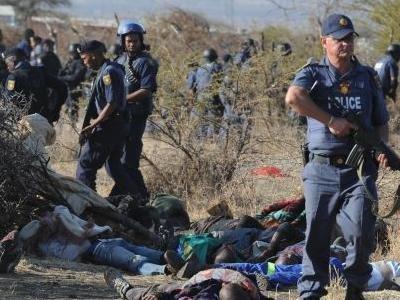
When thousands of miners went on strike at South Africa’s largest platinum mine, in Marikana, they were confronting not only the London-based owners, but the South African state, which since 1994 has been dominated by the African National Congress (ANC); COSATU, the Congress of South African Trade Unions; and the South African Communist Party. This week, the full weight of the state was brought down on the Black miners, 34 of whom were massacred by police gunfire. Many of the survivors face charges of murder in the earlier deaths of two policemen and eight other miners.
The National Union of Mineworkers, whose representation the strikers rejected, and the Communist Party head in the region claim the strikers are at fault, that they have committed the sin of choosing an alternative union to argue their case for higher wages and, therefore, deserve severe punishment. They are “anarchists,” say these two allies of the South African state, and guilty of fomenting “dual unionism” – which is now, apparently, a capital crime. With a straight face, the Communist Party had the gall to call on all South African workers to “remain united in the fight against exploitation under capitalism.”
That is precisely what the Marikana miners were doing – the struggle they gave their lives for. However, since the peaceful transition to state power to the ANC and its very junior partners, the COSATU unions and the Communist Party, in 1994, the South African state has had different priorities. The “revolution” was put on indefinite hold, so that a new Black capitalist class could be created, largely from the ranks of well-connected members of the ruling party and even union leaders. It is only logical that, if the priority of the state is to nurture Black capitalists, then it must maintain and defend capitalism. This is the central contradiction of the South African arrangement, and the massacre at Marikana is its inevitable result.
The 1994 agreement between Nelson Mandela’s ANC and the white South African regime was a pact with the devil, which could only be tolerated by the masses of the country’s poor because it was seen as averting a bloodbath, and because it was assumed to be temporary. But, 18 years later, the arrangement has calcified into a bizarre protectorate for foreign white capital and the small class of Blacks that have attached themselves to the global rich. Apologists for the African National Congress regime will prattle on about the “complexity” of the issue, but the central truth is that South Africa did not complete its revolution.
The fundamental contradictions of the rule of the many by the few, remain in place – only now, another layer of repression has been added: a Black aristocracy that has soaked itself in the blood of the miners of Marikana.
South Africa remains the continent’s best hope for a fundamental break with colonialism in its new forms. But, as in all anti-colonial struggles, the biggest casualties will occur in the clash between those who truly desire liberation, and those who are intent on an accommodation with the old master.
Mérida – Yesterday President Hugo Chavez met with over a thousand workers in the large hall of the Caruachi Hydroelectric Complex of the Guyana Venezuela Corporation (CVG) to sign an agreement to begin the organisation and construction of the Orinoco Axis of Development.
Representatives of Venezuela’s state-owned oil company PDVSA and CVG signed the agreement to collaborate in the creation of this “axis of development” in the Orinoco area, one of several such axes in specific regions that Chavez has proposed in his plan for 2013-2019. CVG is a mostly worker co-managed entity that extracts and processes primary material such as iron, gold, and bauxite.
Chavez said the strategy was to unite the north and south of the Orinoco zone. That is, to unite the Orinoco Oil Belt to the north of the river, which holds the world’s largest oil reserves, with the Industrial Mining Belt to the south of it. However, Chavez said the area also includes 600,000 hectares where agricultural production can be fostered. The axis will have an area of around 100,000 square kilometres in total.
The union between PDVSA and CVG is the result of years of discussion, Chavez said, “and is related to large historical objectives which we have proposed for ourselves… and the need for planning… in the long and medium term”.
CVG president Rafael Gil Barrios explained to the press today that the PDVSA-CVG agreement is already being concretised, including the creation of mixed companies (smaller companies run by the two larger main ones) such as Petro San Feliz. CVG will own 10% of this company, of the 70% of stocks that PDVSA already owns.
Steel projects, Workers and Mercosur
Workers from CVG, from the Sidor steel plant, and from PDVSA attended the meeting with Chavez, during which he also approved US$ 324 million for Sidor, to go towards increasing its production. That includes $18.5 million to update rust removal technology and $250 million for a project to install machinery for round billet mould assembly. The steel tubes produced from this machinery will benefit the petroleum industry in the Orinoco oil belt. The financing comes from agreements with China.
Chavez asked workers to audit the projects and to protest when work is taking too long or is halted. His comment comes as some cement workers have voted to go on national strike “against the policy of the Chavez government of freezing collective contracts in order to please the capitalists”, as stated by the Revolutionary Socialist Current two days ago.
“Just like when you all protest, and rightly so, when for example, the dividends don’t arrive… so I approved Bs 600 million recently for such loans,” Chavez said, adding that, “Workers have the right to protest in a thousand ways, but not damaging the production of … the [state owned] companies of Guayana… there are mafias who buy off the workers…and their managers… they have to be denounced.”
The president also emphasised the importance of the axis and its region in Venezuela’s incorporation into the trade bloc, Mercosur, formalised in July.
“We have to start to construct the railroad from the Caribbean (Puerto La Cruz, Venezuela) to Manaos (in the Brazilian Amazon)… this is vital and Guayana’s role in that is vital,” Chavez said and also announced that he was forming a new presidential commission to deal with Venezuela’s integration into Mercosur. The commission will consist of mostly selected members of his cabinet and is presided by Foreign Minister Nicolas Maduro and Mercosur executive secretary Isabel Delgado.
Nicolas Maduro, added, “This large economic force, this mining, industrial, petroleum, agricultural force is our country’s direct relationship with Mercosur… the Mercosur commission starts today (Monday) and they have oriented us towards forming a Business Council and a Worker Council of Mercosur”.
“There’s a lot of motivation to increase the productive and exporting potential Venezuela has in the large market of South America, which is Mercosur,” Maduro concluded.
The government re-nationalised the Sidor steel plant in 2008, and CVG workers in July 2009 proposed a model of production and workers control which Chavez supported, called Plan Socialist Guayana 2009-2019. The plan involved transforming the state owned CVG and its companies into socialist companies, and in 2010 CVG workers elected the directors of the respective companies that make up the corporation for the first time.
Ramirez confirmed as president of PDVSA and increased oil production
Today Chavez also announced that the president of PDVSA, as well as the minister of petroleum and mining, Rafael Ramirez, will remain president of PDVSA for the upcoming management period of 2013-2019.
Chavez made the announcement during a meeting in Monagas state with the workers of the Orinoco Oil Belt there. He also outlined plans to increase petroleum production in Venezuela generally to 6 million barrels a day by 2019, said that the government is currently “investing around 5 billion dollars in the belt” and that over the next 6 years the government aims to invest $100 billion.
Ramirez informed that the Venezuelan state has received US$ 383,223 million through petroleum taxes over the last thirteen years. This income was a result of fiscal reforms the government implemented from 2002 in the petroleum sectors. Before those reforms, transnationals in the petroleum sector only payed taxes of 1%, a figure the government increased to 33% in 2002.
Chavez said this money has been invested in education, health, agriculture, and housing.
Bill Fletcher and Carl Davidson are two Left opportunists with a problem. Unlike four years ago, when Fletcher co-founded Progressives for Obama, their guy now has a record – and it is indefensible. Solution: nullify the issues right up front in the title to their reworked rationale for backing the Bill of Rights-destroying, Wall Street-protecting, Africa-bombing, regime-changing corporate Democrat. Their August 9th Alternet article, “The 2012 Elections Have Little To Do With Obama’s Record … Which Is Why We Are Voting For Him” frames the campaign as a contest between “revenge-seeking” white supremacists and – well…those of us who are not revenge-seeking white supremacists. The facts of the Obama presidency – his actual behavior on war, austerity, and civil liberties – are deemed irrelevant, and the president himself becomes a mere stage prop in the battle against “Caligula,” the Republicans.
Fletcher and Davidson want Blacks and progressives to respond with hysteria to GOP “irrationalism,” to keep the traditional Democratic base in the Obama camp through raw fear.They claim the current campaign “will be unlike anything that any of us can remember.” In truth, the abject Black failure to make a single demand of Obama, and the vapid excuses and rationalizations for the Left’s political collapse in his presence, then and now, makes 2012 very much resemble 2008. Back then, Fletcher & Co. wrote:
“Barack Obama’s very biography reflects the positive potential of the globalization process that also contains such grave threats to our democracy when shaped only by the narrow interests of private corporations in an unregulated global marketplace. We should instead be globalizing the values of equality, a living wage and environmental sustainability in the new world order, not hoping our deepest concerns will be protected by trickle-down economics or charitable billionaires. By its very existence, the Obama campaign will stimulate a vision of globalization from below.”
Four years later, we are admonished to forget the facts as they actually transpired – and as we at BAR predicted – and pretend the current campaign is a crusade against the Tea Party, with Obama as the incidental beneficiary.
Right-wing populism is the bogey man, in opposition to which we must re-embrace Obama. The GOP isn’t just racist, it is “irrational,” crying for “a return to the past.” They write:
“Obama represents an irrational symbol for the political right, and a potent symbol that goes way beyond what Obama actually stands for and practices. The right, while taking aim at Obama, also seeks, quite methodically and rationally, to use him to turn back the clock.”
Of course, the meaning of the term reactionary is to “turn back the clock,” a promise Republicans have been making for 50 years. And racism is fundamentally irrational, causing white supremacists to see that which is not there, be blinded to facts that are right in front of their noses, and to invent whole narratives of history. But, this time is different, Fletcher and Davidson insist, because the Right is so intensely focused on the symbolism of Obama, the Black man – and so “irrational” about it that they make up ridiculous things about him, like his non-citizenship.
Therefore, our response, as progressives, must be to forge a “common front based on resisting white revanchism… on political misogynism, on anti-‘freeloader’ themes aimed at youth, people of color and immigrants, and a partial defense of the so-called 1%.” The fact that Obama is demonstrably not a part of that common front must not dissuade us from joining his campaign. If the Right has made Obama its symbolic focus, we must, in response, make him the focus of our “common front.” If the Right hates Obama with an irrational passion, we must hug him to our breasts.
Just in case the logic of such reasoning escapes you, Fletcher and Davidson remind us that the Republicans are not merely irrational – they are crazy like Caligula.
“November 2012 becomes not a statement about the Obama presidency, but a defensive move by progressive forces to hold back the ‘Caligulas’ on the political right. It is about creating space and using mass campaigning to build new grassroots organization of our own. It is not about endorsing the Obama presidency or defending the official Democratic platform. But it is about resisting white revanchism and political misogynism by defeating Republicans and pressing Democrats with a grassroots insurgency, while advancing a platform of our own, one based on the ‘People’s Budget’ and antiwar measures of the Congressional Progressive Caucus. In short, we need to do a little ‘triangulating’ of our own.”
So, it’s not about “endorsing the Obama presidency” – but about voting for Obama while claiming that the facts of what he did as president don’t matter. It is about the nonsense of “creating space” so that the Left can do what it ought to do anyway, but which it didn’t do in the two years leading up to the 2008 election, or in the first two and a half years of the Obama presidency, until the Occupy Wall Street activists came out of left field in disgust with both parties’ subservience to finance capital. The anti-war movement seems largely to oppose only Republican wars.
The great fallacy, here, is that Democratic presidents in general, and Obama in particular, somehow create “space” for progressive activism. Movements create space for themselves, by acting. Only charlatans preach that progressive movements must install preferred personalities from the menus of the ruling circles before they can find space to move.
The great tragedy of the Obama era, is that his presence has had the effect of shutting down progressive – and, most dramatically, Black – opposition to the prevailing order. This does not happen by the magic of charisma. Political operatives identified with the Left work diligently to maintain such silence – people like Fletcher and Davidson, who are once again guarding the left flank for Obama, whose great legacy has been to create vast political space for Wall Street and the Pentagon, with a minimum of resistance from white progressives, Blacks and the rest of the Democratic base.
That’s why we at BAR call Obama the more effective evil.
A gentle summer day finds two women sitting near the reflecting pool in the shadow of the Washington monument, bright sunshine striking off the rippling water. One is reading something on her iPad, and to make conversation, the other asks what she is reading.
Eirene: You seem very intent on your read. Must be fascinating. May I ask what it is?
Penthesilea (better known as “Penny”): Another very profound opinion piece by Phyllis Bennis, widely circulated on progressive outlets.
Eirene: I know Bennis’s work. She is a leading figure at the Institute for Policy Studies not far from here, right in the heart of Washington. She writes about war and peace.
Penthesilea: Yes, and she is a beacon for the progressive movement.
Eirene: A beacon and perhaps a mirror as well. What does she say these days?
Penny: In this piece she quite correctly opposes military intervention in Syria. Here, I will read you a key excerpt: “Of course the normal human reaction is ‘we’ve got to do something!’ But however dire the situation facing Syrian civilians, the likelihood that any outside military attacks would actually help the situation is very remote.” She then proceeds to show that military intervention will not work. It won’t work; it’s as simple as that. She is brilliant.
Eirene: The “normal human reaction” is “we’ve got to do something,” says Bennis? I am not so sure. Many “normal” people might say that Syria is none of our business. Or they might say, first do no harm.
But more important, you say Bennis claims that Western military intervention will not work. Not work to do what?
Penny: Good question, but Bennis is far too smart to neglect that point. The goal is all. She says in the very next paragraph that the purpose of military intervention would be to bring “democracy, security and stability” to Syria. But, of course, it won’t work.
Eirene: But what if military intervention would work, would it then be OK? The logic of Bennis implies that U.S. military action would then deserve support.
Penny: What you say is confusing.
Eirene: All right. Let’s do a thought experiment. Let’s drop Bennis through a wormhole in space-time to Pol Pot’s Cambodia, plopping her down as a Pot adviser. Pol Pot is at the moment complaining that his people’s paradise, which will bring people’s “democracy, security and stability,” to Cambodia is in jeopardy. He is quite certain he can remedy this by a military action that would kill off another 100,000 Cambodians. Alarmed, Bennis chimes in, “Do not do that, Comrade Pot. It won’t work.”
Penny: I don’t get the point. Pol Pot is very different from Barack Obama and Hillary Clinton. Pol Pot would have been lying about his aims or at the least deluding himself. So these are very different cases.
Eirene: Perhaps you should think about that.
But let’s turn from that hypothetical for a moment and return to the present. Let’s ask how Bennis would respond if U.S. military action would work, that the U.S. could install a “democratic” regime that would suit the U.S. Like Pol Pot’s plan of action, it is a bloody one; but it would work. Would that make it OK? Usually progressives speak about non-violence, a path of non-violence. Would it be OK to bomb Syria “to save it”?
Penny: Again I find what you say very confusing. It seems wrong to use violence in that way, but I have to admit it follows from the argument that Bennis makes.
But we need a principle of some sort to guide us. Is there no principle on which we can rely?
Eirene: I suggest that the principle is a simple one. An Empire, most especially a global one, seeks worldwide military hegemony and therefore economic hegemony, which alone makes military domination possible. Superiority in arms is, in fact, the official policy of the U.S. Such an Empire is incapable of intervening in a humane or progressive way. It simply is not possible. Why not? The objective of an Empire, above and beyond all else, is to control others. All other goals will be subservient to that one; human rights will be a smoke screen, nothing more. That means that no country will be permitted to take a course not approved by the Empire. An Empire’s very goal is to deny peoples the right to self-determination, to put in place regimes that will obey the dictates of the Empire.
The Empire will seek to rid the world of all regimes opposed to it – no matter their form of government. As an example, the democracies of Mossadegh and Allende had to be overthrown, because they dared defy the U.S. Even a little island like Cuba is under constant political and economic pressure, after the failure of invasion many years ago. To deprive a people or a nation of self-determination is to deny them the most fundamental of freedoms, the right to decide their future for themselves. To accomplish that is a tall order on a global scale, but such is the policy of the U.S. Bennis does not consider this or even mention it. The word Empire never crosses her pen. Her advice is more that of an imperial counselor.
Penny: You make a good point. But is that all there is? Are there other principles that might guide us?
Eirene: Do you know the libertarian argument against intervention?
Penny: Such things are not covered much in The New Yorker or The Nation, which I read faithfully.
Eirene: Well, the libertarian basically takes the stand that violence against another who has not initiated violence is wrong. Similarly a nation may not strike at another except in self-defense. That means no pre-emptive wars, no interventions for “democracy” or “human rights.” Another way to look at it is that the libertarian respects sovereignty. Sovereignty became part of international law to prevent the powerful empires, for example, from preying on the weak. It is crystal clear after the wars of the last decade that the U.S. no longer respects the sovereignty of nations.
Penny: I can relate to the libertarian view. It seems like a powerful principle.
Eirene: Similarly the so-called “paleconservatives,” perhaps better termed genuine conservatives, are well served by their principle that an Empire is not compatible with a Republic, a lesson that the Founders understood from their study of the Classics. Hence, military adventures abroad are to be avoided at all costs. In addition, the idea of a large standing army or military apparatus, which the Founders feared, is essential to an Empire, but a threat to democracy and anathema to the genuine conservative.
I might add to this list the non-philosophical conservative whose principle is simply, “I do not want to pay for all these do-good missions that our elite secular missionaries are bent upon.” Selfishness has its uses and sometimes is the best guide to action.
Penny: Well, I have to go back to work now, but I hope we run into one another again.
Eirene: Likewise. And I will continue to walk. It helps me think.
I wrote yesterday for Asia Times that in Muslim politics such as the event of the summit meeting of the Organization of Islamic Conference that was held in Jeddah last week over the Syrian crisis, it is invariably the case that the sub-texts turn out to be more important than the narrative.
The narrative in the present case is well-known; it is well-propagated by the Western (especially American) media and it inevitably trickles down to Indian discourses, namely, that the OIC summit in Jeddah was going to be all about the Saudi-Iranian ‘cold war’.
But the devil lies in the details. One point of immense curiosity was about the stance taken by Egypt’s president Mohammad Morsi (who belonged to the Muslim Brotherhood) at the OIC summit. Three reasons could be cited for this. One, this was Morsi’s first appearance on the world stage and it became a poignant moment that an elected Islamist leader in a Middle Eastern democracy was taking to the OIC podium.
Two, Egypt had so far shied away from taking a stance on the Syrian situation and Egypt’s formal stance on the Syrian situation holds a lot of significance for the downstream developments, given the unmistakeable longing of that country to reclaim the leadership of the Arab world — in sum, Egypt could be an ally or a competitor for Saudi Arabia.
Third, Egypt’s Brothers are on the horns of a dilemma. They came to power riding the wave of a ‘regime change’ but they also would be conscious that the MB in Syria has certain unique characteristics, as its secretive dealings with the Western powers and Turkey (and some say, with even israeli intelligence) for creating a militia and resorting to the path of violence to force a ‘regime change’ in Damascus would testify. Egypt’s Brothers had, on the contrary, kept to the strait non-violent path in their march to power through the decades in the political wilderness.
Obviously, there is a keen struggle to sway the Brothers of Egypt. Thus, the stunning decision by Qatar to lend a handsome amount of 2 billion dollars to Egypt to help Morsi tide over the economic crisis was not because Doha has a bleeding heart.
Not a few observers could see that Qatar is creating leverage in Cairo at a juncture when the Saudi and American influence is facing uncertainties. Curiously, the Qatari lovefest with Egypt coincided with the OIC summit in Jeddah.
In the event, Morsi rose to the occasion. The narrative is that he called for a transition in Egypt. “it is time for the Syrian regime to leave”, he said. So far so good. The Western media lapped it up. But then came the sub-texts. Morsi called for a non-violent path. In immediate terms, he sought a ceasefire through Ramadan. Besides, he wanted an Islamic solution.
Then came the bombshell. Morsi proposed that a contact group should be formed to resolve the Syrian crisis through peaceful means, discussion and reconciliation. And, pray, who would form this group? Saudi Arabia, Egypt, Turkey and Iran — he outlined.
In a nutshell, Morsi has rejected the strategm for ‘regime change’ in Syria by the United States in alliance with Turkey, Saudi Arabia and Qatar (with Israel standing in the shade for undertaking covert operations). Most important, Morsi’s package is almost exactly what Iran espouses, too.
No wonder, Tehran feels greatly elated. In contrast with the deafening silence in Ankara, Riyadh and Doha, Tehran has scrambled to welcome Morsi’s proposal. Saudis will feel perturbed that Cairo is careering away into the trajectory of an independent foreign policy that may have more commonality with Tehran than the course adopted by the GCC states. Turkey will feel downcast that the new Egypt is not exactly in a mood to adopt the so-called islamist leadership of Prime Minister Recep Tayyip Erdogan as its role model.
Indeed, we could anticipate that interesting times lie ahead as Egypt’s Brothers carry forward the impulses of their revolution. We are slowly, steadily getting near to an answer to the question raised in great angst by several quarters (Washington, Tel Aviv, Riyadh) : Will the new Egypt orient toward Saudi Arabia or Tehran?
So, it is about time we move on to the follow-up question: Whom does Morsi’s (and Egypt’s Brothers’) middle path suit better — Saudi Arabia or Iran? I won’t wager for an answer. It’s Iran, Stupid! All that Tehran ever expected in its regional (Arab) milieu all through these past 34 years since the Islamic Revolution was a level playing field. And Egypt is willing to recognize, finally, that it is a legitimate aspiration to have.
On Wednesday August 22, people will gather at the church in Amatitán Abajo, in San Vicente Department, to commemorate, remember and demand justice for a massacre which happened thirty years ago. It is the anniversary of the El Calabozo massacre, when troops of the US-trained Atlacatl Battalion murdered more than 200 civiliam victims taking refuge along a river’s banks.
The massacre was documented in the UN Truth Commission Report following the signing of the 1992 Peace Accords:
On 22 August 1982, in the place known as El Calabozo situated beside the Amatitán river in the north of the Department of San Vicente, troops of the Atlacatl Rapid Deployment Infantry Battalion (BIRI) killed over 200 men, women and children whom they were holding prisoner.
The victims had converged on El Calabozo from various directions, fleeing a vast antiguerrilla military operation which had begun three days earlier in the area of Los Cerros de San Pedro and which involved, in addition to the Atlacatl BIRI, other infantry, artillery and aerial support units.
There was a major guerrilla presence, supported by the local population, in the area of the operation. Government forces had penetrated the area on earlier occasions, but the guerrillas had avoided combat. This time the operation, which bore the name “Teniente Coronel Mario Azenón Palma”, involved some 6,000 troops and was designed to clear the area of guerrillas. As the troops advanced, the civilian population fled, fearing the shelling and the soldiers’ violence. One of the places where a large number of fugitives congregated was El Calabozo.
According to witnesses, the fugitives were surprised by the Atlacatl Battalion unit. Some of them managed to escape; the rest were rounded up and machine-gunned. The military operation continued for several more days. The Government informed the public that it had been a success: many guerrillas had been killed, camps had been destroyed and weapons and other supplies had been seized.
On 8 September, two weeks after the incident, the massacre was reported in The Washington Post. The Minister of Defence, General José Guillermo García, said that an investigation had been made and that no massacre had occurred. He repeated this assertion in an interview with the Commission….
There is sufficient evidence that on 22 August 1982, troops of the Atlacatl Battalion deliberately killed over 200 civilians – men, women and children – who had been taken prisoner without offering any resistance. The incident occurred at the place known as El Calabozo, near the canton of Amatitán Abajo, Department of San Vicente.
Although the massacre was reported publicly, the Salvadorian authorities denied it. Despite their claim to have made an investigation, there is absolutely no evidence that such an investigation took place.
Families of the victims of the massacre have worked to keep the memory of these events alive and to demand justice. Laura Hershberger wrote on the SHARE Foundation blog about a youth event in 2009 commemorating the slaughter:
None of the youth had lived through the Calabozo massacre that happened by river of Amititan in a place called the Calabazo in 1982, but they had grown up hearing the story from their family. How the army had advanced from the San Pedro hills and how the inhabitants of the region fled their homes in what was known as the “guindas.” How the people had been walking for seven days without food and took refuge by the river to sleep when they were attacked by the Atlacatl and the Ramon Belloso Batallian, it was then that they were massacred in cold blood, over two hundred men, women and children. When the youth group from the Community of El Rincon acted out a play that had written about the massacre, they made sure to include the part where the mothers plea for the soldiers to take their own lives but to spare the lives of their small children.
Those pleas for mercy fell on the deaf ears of the soldier of the Atlacatl Battalion who 9 months earlier had slaughtered 1000 civilians in El Mozote. The forensic anthropologists from Argentina who have conducted the investigations at El Mozote have also exhumed bodies of victims of the El Calabozo massacre. Earlier this year, the online periodical ContraPunto described their recovery of the body of a grandmother and her two granddaughters, ages 5 and 9, from the massacre site. This investigation had been led by Asociación Pro Búsqueda, the NGO which continues the search for children missing from the years of the civil war. As ContraPunto notes, twenty years after the signing of the Peace Accords, many families still face the uncertainty of not knowing where the bodies of their loved ones can be found, or whether they could have survived.
The families of the victims continue to demand justice in the face of the 1993 Amnesty Law which the government interprets to prevent prosecution of such war crimes. There is still no political will in the National Assembly or the president’s office to repeal the law. You can watch this video of a 2009 press conference given by human rights lawyer David Morales and families of victims regarding their petition that the case against those responsible for the the El Calabozo massacre be pursued.
A pair of fish captured near Japan’s crippled Fukushima nuclear plant have shown to be carrying record levels of radiation. The pair of greenlings are contaminated with 258 times the level government deems safe for consumption.
The fish, which were captured just 12 miles from the nuclear plant, registered 25,800 becquerels of caesium per kilo, according to Tokyo Electric Power Company (TEPCO).
TEPCO says the high levels may be due to the fish feeding in radioactive hotspots. The company plans on capturing and testing more of the fish, as well as their feed, and the seabed soil to determine the exact cause of the high radiation.
The findings were surprising for officials, who had previously seen much lower levels of radiation in contaminated fish.
Fishermen been allowed to cast their reels in the nearby waters on an experimental basis since June – but only in areas more than 31 miles from the plant.
Previously, the highest recorded radiation seen in the captured wildlife was 18,700 becquerels per kilo in cherry salmons, according to the Japanese Fisheries Agency.
The radiation was caused by a meltdown of three reactors at the Fukushima power plant after it was damaged by an earthquake and tsunami in March 2011.
The disaster was so intense that contaminated fish were caught all the way across the Pacific Ocean, on the California coast.
But it’s not only aquatic life that is suffering from side effects of the leaked radiation.
According to researchers, the radiation has caused mutations in some butterflies, giving them dented eyes, malformed legs and antennae, and stunted wings.
The results show the butterflies were deteriorating both physically and genetically.
But the harmful risks don’t stop with butterflies. The radioactivity which seeped into the region’s air and water has left humans facing potentially life threatening health issues.
The report shows that nearly 36 per cent of children in the Fukushima Prefecture have abnormal thyroid growths which pose a risk of becoming cancerous.
The World Health Organization warns that young people are particularly prone to radiation poisoning in the thyroid gland. Infants are most at risk because their cells divide at a higher rate.
UAE security officers detained, tortured, and killed Emirati poet and news editor Habib al-Sayegh in August 2019, shortly after he published a column opposing UAE normalization with Israel, according to a newly published book.
“Princes and Thieves,” a book by investigative journalist Matthew Cole published on 25 October, alleges that UAE security officers raided Sayegh’s Abu Dhabi home shortly after the publication of the column, hooded him in front of his wife and took him to a detention facility where he was tortured to death.
His interrogators reportedly pulled out several of his teeth with pliers and beat him repeatedly with a sharp metal object.
On 11 August 2019, Sayegh criticized the UAE’s plan to normalize relations with Israel as part of the Abraham Accords in his weekly column for Khaleej newspaper. The column was titled “Israel Is Our Real Enemy and A Dangerous Project.”
Sayegh described Israel as “a real and natural enemy” while questioning “who authorized the normalizers to speak on behalf of everyone?”
Nine days after the column was published, Emirati state media announced his death, without stating a cause. … continue
This site is provided as a research and reference tool. Although we make every reasonable effort to ensure that the information and data provided at this site are useful, accurate, and current, we cannot guarantee that the information and data provided here will be error-free. By using this site, you assume all responsibility for and risk arising from your use of and reliance upon the contents of this site.
This site and the information available through it do not, and are not intended to constitute legal advice. Should you require legal advice, you should consult your own attorney.
Nothing within this site or linked to by this site constitutes investment advice or medical advice.
Materials accessible from or added to this site by third parties, such as comments posted, are strictly the responsibility of the third party who added such materials or made them accessible and we neither endorse nor undertake to control, monitor, edit or assume responsibility for any such third-party material.
The posting of stories, commentaries, reports, documents and links (embedded or otherwise) on this site does not in any way, shape or form, implied or otherwise, necessarily express or suggest endorsement or support of any of such posted material or parts therein.
The word “alleged” is deemed to occur before the word “fraud.” Since the rule of law still applies. To peasants, at least.
Fair Use
This site contains copyrighted material the use of which has not always been specifically authorized by the copyright owner. We are making such material available in our efforts to advance understanding of environmental, political, human rights, economic, democracy, scientific, and social justice issues, etc. We believe this constitutes a ‘fair use’ of any such copyrighted material as provided for in section 107 of the US Copyright Law. In accordance with Title 17 U.S.C. Section 107, the material on this site is distributed without profit to those who have expressed a prior interest in receiving the included information for research and educational purposes. For more info go to: http://www.law.cornell.edu/uscode/17/107.shtml. If you wish to use copyrighted material from this site for purposes of your own that go beyond ‘fair use’, you must obtain permission from the copyright owner.
DMCA Contact
This is information for anyone that wishes to challenge our “fair use” of copyrighted material.
If you are a legal copyright holder or a designated agent for such and you believe that content residing on or accessible through our website infringes a copyright and falls outside the boundaries of “Fair Use”, please send a notice of infringement by contacting atheonews@gmail.com.
We will respond and take necessary action immediately.
If notice is given of an alleged copyright violation we will act expeditiously to remove or disable access to the material(s) in question.
All 3rd party material posted on this website is copyright the respective owners / authors. Aletho News makes no claim of copyright on such material.




 Aletho News

