The Telegraph reported yesterday that “ministers have criticised Britain’s biggest exam board after pupils were asked to explain ‘why some people are prejudiced against Jews’ as part of a GCSE (General Certificate of Secondary Education).
Apparently more than 1,000 teenagers are believed to have sat the religious studies test papers, which challenged pupils to assess the reasons behind anti-Semitism.
The Assessment and Qualifications Alliance, which set the exam, rightly said that the question acknowledged that “some people hold prejudices” – they probably expected the students to examine the reasons that lead to anti Jewish feelings rather than simply justifying them.
Michael Gove, the Education Secretary who is notorious for his pro Israeli stand and his intimate relationships with the Jewish lobby, has managed to produce a particularly lame statement that should disqualify him from any holding any position related to education.
To suggest that anti-Semitism can ever be explained, rather than condemned, is insensitive and, frankly, bizarre,
Gove told The Jewish Chronicle. The ‘education’ minister should actually accept that every social phenomenon or tendency should be subject to an academic scrutiny, scientific research and critical examination. The education minister should actually encourage critical thinking and freedom of thought, however, being one of the pillars of the CFI (conservative Friends of Israel) we shouldn’t really expect a drop of integrity from Minister Gove.
Jon Benjamin, chief executive of the infamous ultra Zionist Board of Deputies of British Jews (BOD), said:
Clearly this is unacceptable and has nothing whatsoever to do with Jews or Judaism.
Benjamin and the BOD have been pouring news about the ‘rise’ of anti-Semitism for years. One would wonder why are they now tormented by the attempt to question the reasoning behind the phenomenon that concerns them so much and for so long.
The exam board insisted that the question was part of a paper focusing on Judaism and the “relevant part of the syllabus covers prejudice and discrimination with reference to race, religion and the Jewish experience of persecution”.
But here comes the interesting bit. While the question is fully legitimate and deserves a thorough examination, one may wonder how would the exam board expect to mark some academically valid possible answers. For instance, how would a board’s examiner mark a young truth telling British student who may suggest that anti Jewish feelings could be realised as a direct reaction to the concerning facts that it was the Jewish Lobby led by Lord Levy that financed the Labour government that took us into an illegal War in Iraq? The student may argue that some people mistakenly identify Jews (as a collective) with the horrendous non-ethical acts of just a few Jews, this is where prejudice, plays its role. Bearing in mind it was also Jewish chronicle writers such as David Aaronovitch and Nick Cohen who were supporting this criminal act in the mainstream media, such an answer is coherent and consistent with the facts. Another honest student may suggest that with 80% of the Tory MPs (including education minister Michael Gove ) being CFI members there is a reason to believe that the British Government is under the control of a foreign power. Following the pressure of the CFI, the Tory government recently amended the British Universal Jurisdiction law just to allow Israel war criminal to visit the Kingdom. I guess that some students must be clever enough to notice that acts taken by British politicians who shamelessly attempt to appease their pro Israeli paymasters on the expense of British values and ethical consideration actually expose Jews in this country to some potential animosity. How would the exam board mark such a reasonable and critical young and innocent thinking?
It seems as if the exam board is not really prepared to tackle the issue seriously. Its representative told the Jewish Chronicle
we would expect [students to refer] to the Holocaust to illustrate prejudice based on irrational fear, ignorance and scapegoating.
In other words, the British education system admits here openly that it expects students to repeat textbook ready-made answers rather than thinking critically and thoroughly. Is it really ‘irrational’ to be tormented by the irritating idea that the vast majority of your leading party MPs are friends of a non-ethical, racist and expansionist foreign power? Is it reasonable to wonder why Jewish Chronicle writers were over represented in some pro war advocacy? Is it really unreasonable for a young British student to ask why the American Jewish Lobby AIPAC is pushing for a war against Iran that can escalate into a nuclear conflict? Shouldn’t British students try to examine the relationships between the Jewish Lobby and the Jewish community? Shouldn’t Religious students try to examine the complex relationship between Jews, Judaism and Jewishness? Shouldn’t they look into the relationship between The Old Testament and IDF’s crimes against humanity? For sure they need do, this is actually the real meaning of education. To educate is to teach how to learn said Martin Heidegger, but in Britain 2012 Education means to teach student how to answer the appropriate kosher answer.

As it happens the exam board reacted quickly and submissively to Jewish pressure. Its representative said
the board is obviously concerned that this question may have caused offence, as this was absolutely not our intention.
I guess that the exam board who were obviously subject to some relentless pressure may now be able to form their own answer to the question. They may grasp by now what is the root cause of ‘anti Jewish prejudice’ and it has nothing to do with the ‘holocaust’, ignorance’ or ‘irrationality’. It is actually the natural reaction to abuse of our most precious intellectual right, the freedom to think.
Another uniquely banal mind Rabbi David Meyer, the executive head of Hasmonean High School, told the Telegraph that the question had “no place” in an exam.
The role of education is to remove prejudices and not to justify them,” he said.
It is pretty amusing or actually sad to find out that a Rabbi and an executive head of a Jewish school doesn’t know the difference between ‘question’ and ‘justification’. However, Rabbi Meyer, surely knows that Rabbinical and Talmudic education encourages debate and critical thinking. I wonder why Rabbi Meyer doesn’t approve the idea that a Goyim teenager should also learn how to think critically and even learn how to debate?
Seemingly, the Telegraph found only one single voice of reason in the entire kingdom. Clive Lawton, formerly an A-level chief examiner for religious studies, said: “I do understand why people might react negatively to the question, but it is a legitimate one.”
If anyone including Michael Gove and the BOD want to prevent the rise of anti-Jewish feelings and prejudice in general they may want to look briefly in the mirror. It is their attitude that put Jews at a growing risk. As it happens, it is always Jewish power exercised by just a very few that introduces danger to the entire Jewish community and beyond.
May 28, 2012
Posted by aletho |
Ethnic Cleansing, Racism, Zionism, Illegal Occupation, Timeless or most popular, War Crimes | Antisemitism, Board of Deputies of British Jews, General Certificate of Secondary Education, Jewish Chronicle, Judaism, Michael Gove |
Leave a comment
In a piece titled “A Toxic Brew in Sinai,” JINSA fellow Evelyn Gordon notes “how badly the security situation in Sinai has deteriorated” in a post-Arab Spring Egypt, and concludes:
With Syria in flames and the Iranian nuclear crisis rapidly approaching climax, the last thing the world needs is an Israeli-Egyptian war. But absent intensive international engagement, the Sinai tinderbox is liable to spark one.
An Israeli-Egyptian war may be the last thing the world — especially, an already troubled Egypt — needs, but it may be exactly what some Greater Israel advocates have long wanted. As Israeli strategist Oded Yinon argued back in 1982:
(Regaining) the Sinai peninsula with its present and potential resources is therefore a political priority which is obstructed by the Camp David and the peace agreements. […] and we will have to act in order to return the situation to the status quo which existed in Sinai prior to Sadat’s visit and the mistaken peace agreement signed with him in March 1979.
Yinon did not consider that this would prove too difficult to achieve:
Israel will not unilaterally break the treaty, neither today, nor in 1982, unless it is very hard pressed economically and politically and Egypt provides Israel with the excuse to take the Sinai back into our hands for the fourth time in our short history. What is left therefore, is the indirect option. The economic situation in Egypt, the nature of the regime and its pan-Arab policy, will bring about a situation after April 1982 in which Israel will be forced to act directly or indirectly in order to regain control over Sinai as a strategic, economic and energy reserve for the long run. Egypt does not constitute a military strategic problem due to its internal conflicts and it could be driven back to the post 1967 war situation in no more than one day.
Presumably today’s Israeli war-planners would be equally as confident of success.
May 28, 2012
Posted by aletho |
Timeless or most popular, Wars for Israel | Camp David, Egypt, Israel, Sinai, Sinai Peninsula |
Leave a comment
This scathing indictment tracks the predatory career of Bill Gates and paints his high-profile philanthropy as capitalist adventurism that further impoverishes Africa.
WHO IS THE MAN?
Bill Gates is a walking talking Bill Gates commercial. It matters not that he retired from Microsoft. The Bill Gates image is still very serious business. Arguably his most famous quote is “Be nice to nerds. Chances are you’ll end up working for one.” He dresses the part: very casual with the preppy uniform of khakis and blue. His prepiness and nerdiness follow from his prep school background. But not too many nerds drop out of college, as Gates did. College is the place to find nerds; that’s where nerds get their revenge. Gates constructed the Microsoft company environment like a college campus. It’s part of the myth of that gentle, coed, carefree, nurturing, professorial and now the giving, philanthropist Bill Gates. It’s all very disarming.
The Bill and Melinda Gates Foundation (BMGF) leads the push to bring nutrition and health to Africa. But this move requires some scrutiny and a determination as to whether this is another image builder or worse: an attack by a modern day missionary on another unsuspecting indigenous population. Yes, some Africans are an indigenous population too.
Gates’ retirement [1] from Microsoft allows him time to focus more intently on his image, his sales pitch and Africa. By contrast, the ‘Red’ campaign of Gap, Apple and a few other retailers, requires you buy the product to contribute to fighting AIDS, malaria and tuberculosis in Africa. The emphasis is always on buying and selling, not on the disease. So, if you buy a pair of Gap jeans with the red label, a portion of that money goes to the fund. The project, founded by U2’s Bono, is intended to capitalize on what we do anyway – buy stuff. Generally, no one argues against helping Africa, right? But with all the riches these corporations and individuals earn, why do we still have to buy something before they give something? Much of these earnings were as a result of raw materials sourced in Africa: even its music. Unlike Red, Gates requires no purchase from Microsoft, at least not directly. But we can’t separate Gates from Microsoft and its products. Moreover, Microsoft’s operating system is still the most popular, and for good reason, so we don’t have as much choice as we think. We are locked into buying MS DOS. It’s like English in the business world: the official language. Bill Gates knows this. He ‘engineered’ it.
In Africa, there is no need to buy raw material. You simply dig it up, add value, and sell it. This was once done to its indigenous inhabitants. As Arundhati Roy assessed foundations,
“Their enthralling history, which has faded from contemporary memory, began in the US in the early 20th century when, kitted out legally in the form of endowed foundations, corporate philanthropy began to replace missionary activity as Capitalism’s (and Imperialism’s) road opening and systems maintenance patrol.” [2]
Of note, Gap, like Apple, has been under scrutiny for its use of sweatshop labour. However, it has been reported that the clothing used in Gap’s Red promotion is now made in Lesotho (Africa) and not the cheaper China. Gates seems to want to distance his image from the carnage of capital greed by insightfully focusing on software. Perhaps his reasoning was that he would not be responsible for the slave-like exploitation of mostly women and sometimes children, who build hardware for Apple and others in China, or those children digging for gold and coltan in central Africa. The latter two are essential metals used in circuit boards for hardware. This is misguided. Neither a focus on software nor resignation from his baby, Microsoft, could cover the trail. Like banks and insurance companies that financed the flow of human cargo from Africa and claim they did nothing wrong, the builder of operating system software that drives the machines that use our exploited resources and now track our movements and speeches of dissent should not be allowed to claim innocence.
Bill Gates should not be allowed to say he only builds operating systems. In a racist criminal justice system, the legislators who passed the laws, the police who make the arrest, the prosecutors who make the charges stick and even the defense attorneys who seem not to care, need to acknowledge culpability in a system out of control. All actors mentioned purport to do good, as Bill Gates now promises. They all claim to fight evil: crime on one hand, starvation and disease on the other.
Africa does not need this kind of charity. It needs equality in trade and the exchange of leading technology. Instead, Gates, the world’s foremost technologist, brings experts on seeds and vaccines.
Contrary to popular belief, Bill Gates never invented anything. The real invention is the public belief in Bill Gates as the self-made mogul. He started with a ‘gift’ from IBM of the DOS platform. For that platform he adapted the MS-DOS system that operates all personal computers (PCs). Even the term personal computer really means operated by Microsoft DOS. This is so even if your ‘personal’ computer happens to be an Apple or using another operating system like Linux. Unless it’s Microsoft, it is not personal. To be a personal computer, a PC, it has to have a Microsoft DOS operating system. It’s not only the most widely used system, its personal.
It’s important to understand how these systems work before we look at what he is doing in Africa. Of course, Bill Gates is not alone. It’s a scorched earth policy, from the business culture that dominates the US landscape. It’s like the use of napalm and Agent Orange in Vietnam, when the intent was mass defoliation of all flora, including food crops, Microsoft used all kinds of tactics, some unlawful, to grab its market share at the expense of any other competitor irrespective of any benefit to the consumer. In Vietnam, Agent Orange led to deforestation; the loss of crops led to losses in wildlife and livestock and an environmental disaster. Eventually, a literally scorched earth would result and starvation, death; victory would follow. Naturally, if you destroyed everything, survivors would need you to rebuild. This is the plan of an empire.
COMING TO A COURTROOM NEAR YOU, THE WAR FOR THE MEANS OF PRODUCTION
Gates’ victories were not a war of nerds but one of lawyers. Gates in a 1994 Playboy [3] interview explained,
“Our restricting IBM’s ability to compete with us in licensing MS-DOS to other computer makers was the key point of the negotiation. We wanted to make sure only we could license it. We did the deal with them at a fairly low price, hoping that would help popularize it. Then we could make our move because we insisted that all other business stay with us. We knew that good IBM products are usually cloned, so it didn’t take a rocket scientist to figure out that eventually we could license DOS to others. We knew that if we were ever going to make a lot of money on DOS it was going to come from the compatible guys, not from IBM. They paid us a fixed fee for DOS. We didn’t get a royalty, even though we did make some money on the deal. Other people paid a royalty. So it was always advantageous to us, the market grew and other hardware guys were able to sell units.”
Part of this revelation is the importance of hardware ‘guys’ to the operation. It is not a separate exercise. What he neglected to explain was the enormous amount of litigation that accompanied and solidified this position and the almost continuous war that has followed this policy.
The Federal Trade Commission launched an investigation into Microsoft’s antitrust violations, only to seemingly lose steam and give up. Antitrust claims are simply claims that one company is attempting to kill off the competition. The Department of Justice, no less, then took up the fight and eventually settled for several hundred million dollars in fines. All during this time there were numerous lawsuits from wronged developers to burned competitors and even employees. This was some potent napalm. In Vizcaino v. Microsoft, 97 F.3d 1187 (9th Cir.1996), the court ruled against Microsoft and ordered it to pay benefits to workers who were denied benefits on account of their incorrect classification as independent contractors as opposed to employees. Welcome to our world.
i4i, of all the names, a software developer, filed a patent infringement suit and won against Microsoft. Microsoft refused to pay. Meanwhile, based on the stolen patents, Microsoft developed a replacement. Microsoft appealed to the highest court in the land. The United States Supreme Court ruled against Microsoft and ordered it pay the developer. Uniloc, Alcatel, and The Commonwealth of Massachusetts are just some of winners against Microsoft and its intent on domination. But they are still too few. Meanwhile, numerous claims have been buried under the costs of litigation and never came to light. I could go on forever listing claims against Microsoft for patent and business infringement, but you can use its search engine to find more. Of note the European Union (EU) fined Microsoft $1.4 billion for its anti-competitive practices. But these fines amounted to slaps on the wrist, as Microsoft continues in its scorched earth policy and more suits are being filed as well as patents being bought as we write.
In a practice known as defensive patenting [4], large companies like Microsoft are buying-up existing patents and seeking new ones to use as a basis to defend or attack in the event of war against their competitors. These patents serve no other useful purpose. The design is rarely manufactured. These patents, some ancient, are bought or brought with the idea that something in their intended use might resemble that of a new patent or one in the future and therefore form a basis to make a claim that it is stolen from Microsoft. If you develop a computer related patent, it is very likely that Microsoft owns one just like it, or partially like it, and can mount an attack against you based on that patent.
COMING TO AFRICA IN A TEST TUBE
It is with this background to his rise in wealth that Bill Gates launched the Bill and Melinda Gates Foundation, with its focus on Africa. Like a good missionary, he does not come empty-handed. He has brought experts and seeds. It’s worth noting that the man Gates hired to help oversee his Africa sojourn is former Monsanto Vice President, Robert Horsch. Gates has invested heavily in Monsanto [5]. It would be an irony, except it is so serious that Monsanto was the company that developed Agent Orange. The effect of that deadly chemical is still affecting Vietnamese people and American soldiers forty years later. It is the progeny of that science that led to Roundup [6], Monsanto’s world-renowned weed killer and killer of several other things. Horsch was a leading figure in developing Monsanto’s genetically modified seeds that were resistant to its own herbicide and pesticides and are now earning Monsanto billions in royalties. They have patented these seeds, which can cross pollinate and colonize existing seed and farms. In America’s Midwest, farmers find their fields filled with a corn they did not plant. […]
We know what happened in Vietnam. The people resisted imperialism and drove the French, first, and then the full might of the US military out of their country. So it is in this context that you must view Gates’ approach to spreading his software and now his seed money in Africa. Like Monsanto’s plan to use genetically modified organisms (GMOs) and pesticides to become the dominant if not the sole producer of seed and food, Gates routinely violated antitrust and patent and other laws to achieve the goal of destroying all weeds (all rival software). His new hire, Horsch, will serve as senior program officer and will apply the GMO technology toward improving crop yields in regions including sub-Saharan Africa, where the foundation recently launched a major drive in collaboration with the Rockefeller Foundation.
Equally misguided is the Foundation’s approach to disease. Malaria and HIV appear to be its focus in the development of vaccines. A cursory look at the history of vaccines will reveal its inherent volatility and high rates of failure. Many of these health issues are really wealth issues. By wealth I mean the means to eat a balanced diet. I maintain that Africa’s problem is one of poverty: its inability to provide regular balanced meals to all of its people. Its greatest epidemic is poverty. Find a vaccine for that. How is it that the near richest man, and the smartest nerd, on the planet cannot see the need for an infrastructure that would lead to adequate supplies of food and water? Instead, he focuses on experimenting with dangerous chemicals and more dangerous genes, purportedly to increase yield.
Out of the other side of his mouth he’s decreasing population. F. William Engdahl quotes Gates’ 2010 TED speech where Gates declares, “First we got population. The world today has 6.8 billion people. That’s headed up to about 9 billion. Now if we do a really great job on new vaccines, health care, reproductive health services, we lower that by perhaps 10 or 15 percent” [7]. Engdahl asserts that studies show that the chemicals used in the plan reflect reduction birth rates and that the Rockefeller Foundation has been involved with eugenics for some time. Its partnership with Gates and AGRA [8] is precisely for that stated purpose.
Gates sees the need, but the way he wants to fill it is in the mistaken belief that GMOs will provide the high yields to feed Africa and in the meantime he would vaccinate against diseases. Simultaneously, corporations like Monsanto and investors like Gates would reap billions in royalties from the use of its seed. The same GMOs banned by the European Union are acceptable in Africa. The result would be a monoculture that would eliminate centuries of farm practices and seed diversity that date back before the Bible and was partially disrupted by that other foreign intervention: the slave trade. Moreover, the colonialism that followed wanted cocoa, coffee, and cotton. These are not products that find their ways onto the plates of Africans. Stolen human resources along with forced agriculture for the European market set the stage for the shortages we find today.
Jonas Salk, credited with developing the Polio vaccine, when asked who owned the patent, is said to have responded, “There is no patent. Could you patent the sun?” [9] Gates and Monsanto have succeeded where others have failed. If you agree that the seed requires light to grow, preferably sunlight, likewise GMO seed, requires Monsanto’s permission and conditions for use; therefore, they control seed. They are the sun. They may not have patented the sun, but they patented the next best thing: control of the rights to whom, and in what conditions, their seed will access the energy of sun in order to grow. Vandana Shiva [10] refers to Monsanto’s actions as the colonization of seed.
I am no defender of patents and copyright. It’s just another tool to consolidate creativity in the hands of a few. But that is another blog. These empires, like Microsoft and Monsanto, are built on patents: on ownership, including ownership of the means of production. They no longer need to own factories. They only need to own the rights to what the factories produce. Observers like F. William Engdahl have noted that vaccinated children who drink water contaminated by feces are no healthier than they were before the vaccine. Providing that these untested vaccines are safe. Instead of cleaning up the water and sewage systems, they seek to compromise them even more by the use of pesticides and fertilizer needed for their push in agriculture.
“Life is not fair; get used to it.” Bill gates
As if Gates and Monsanto are not sufficient adversaries, President Obama recently appointed a former Monsanto CEO as senior advisor to the Commissioner of the Food and Drug Administration (FDA). Michael Taylor’s addition is in the context of the US governments plan Via AGRA (two words) to push its policies in Africa. Of course the FDA has refused to ban GMOs in the US and has refused to require foods be labeled, if containing GMOs. Gates is indeed visionary. He has singlehandedly determined the importance of food. It matters not that he could have asked any African child.
But this is a warning to the rest of us. The only other land and space available for full colonization is the Amazon rainforest. It won’t be around for long. But that is another blog. There is the Canadian Tundra and Mars, but first things first. Given the bad press and attention directed at the Amazon, Africa seemed the place with the most land lying seemingly unused. Governments have launched a campaign of terror to remove residents from lands they have occupied since before Columbus was conceived, let alone Microsoft. Though I do not hold Gates responsible for every peasant chased off land farmed for countless moons, I do blame him for adding to the hysteria of the land grab. His mere presence forces up the price of land. What one once farmed for free, soon one will not be able to farm for any money. But if you desire, there will be jobs on the new farm.
AN ALTERNATE CHEMICAL SOLUTION
Guyanese author Harry Narain wrote about high yield imported paddy rice in his collection of short stories, “Grass Roots People” [11], set in 1970s Guyana. The yield was so high that it bent the stalks lower to the ground than normal and ripened faster. The paddy was too heavy. Any rain would mean the end. It ripened so fast that there was not enough time to wait for the government loaned combines to get to his farm. Without money to hire a private combine, the rice crop would die in the field along with the farmer’s dreams of a pair of track shoes for his boy to play sports, earrings his little girl begged for, and a fridge for his wife. The yield was never so high again.
Despite and in spite of all the history and facts on Gates, there are still people who are going to say that Africa is in need and if Gates wants to contribute he should be allowed to do so. They will add that it’s people like this writer who have no money to contribute who are always trying to stop well-meaning people; and finally, Africa is on the rise as a result and here comes another no gooder, a crab, to pull the beneficiaries back down. It’s always the same arguments, on both sides. But facts are difficult to controvert. Denial is a sweet space to reside. No one comes to kick you out of there.
Under the cover of the foundation, Gates moved from paying little tax to paying no tax. That notwithstanding, there are a few things he can do for me. He must relinquish all his shares in Microsoft and donate half to Wangari Maathai’s Green Belt Movement. He must remove his two executives from AGRA’s board. He must distribute the rest of the shares among those families in China whose children jumped to their deaths from the Foxconn [12] factory dorm while employed in making things for us that included his friend Steve Jobs’, ‘I’ stuff. He must denounce child labour. He must lobby Microsoft to withhold software from companies who use slave-like and sweatshop labor for their products. He must divest from Monsanto. Oh! And endorse the Buffet Plan to pay more taxes for himself and Microsoft before he divests his shares and Buffet transfers all his shares to the BMGF. Even Buffet has said that 30 percent is not enough. I’ll stop there for now. I shouldn’t have to tell him everything. He should be thinking for his damn self.
On Buffet, the New York Times [13] recently reported Buffet’s increased stake in Wal-Mart and that it came just before the same paper published detailed allegations that Wal-Mart executives bribed retailers in Mexico to facilitate its expansion there. Was this mission Wal-Mart’s or Buffett’s or Berkshire Hathaway’s? In 2011, he gave $1.5 billion of his BerkshireHathaway [14] stock to the BMGF as part of a plan to transfer the majority his wealth to the foundation. This means little or no taxes.
Oh, Bill! When you talk to Buffet tell him that giving his wealth to your Bill and Melinda Gates Foundation will not absolve him, either. Tell him he would not be able to hide behind Berkshire Hathaway, Inc., the hedge fund he presides over. Smaller investors pool resources in a hedge fund for larger and more lucrative investments. However, as its name suggest, the Hedge fund is simply a hedge, a fence, between the money and the exploitation. Capitalism has not yet found a way to increase earnings without exploiting free or near free labour [15]. Wal-Mart’s record on wages and union busting is notorious. [16] It does not matter how prestigious sounding the name of the high and growing hedge between money and poverty. What Africa needs, finally, Brother Bill, is for you to get us some agent orange from your friends at Monsanto. So we can take care of the hedges ourselves.
* Clairmont Chung is a lawyer, consultant, filmmaker and arts critic. His latest film is a documentary, ‘W.A.R. Stories: Walter Anthony Rodney’. He edited a book of the interviews done in making the film, which is due out in October 2012 from Monthly Review Press entitled, ‘Walter Rodney: A Promise of Revolution’. Chung tours with his film and maintains a small practice in New York and New Jersey. He is writing a book on the legal history of Africans in the ‘New’ World up until the Wars on Drugs and Terror.
* Please send comments to editor[at]pambazuka[dot]org or comment online at Pambazuka News.
END NOTES
[1] Gates retired as CEO in 2008. He has not sold his shares in the company and until that happens he has more than a nominal interest in Microsoft. The continued association with him and the brand is as strong as ever. When you see him, you don’t think foundation. You think Microsoft. His transition from Microsoft to the Foundation may seem as a sudden change to some. But if you understand Gates, and the really wealthy, nothing is sudden and rarely anything changes except the increase in wealth. It’s always about the sales plan which is to get it for free, or close, and sell high.
[2] Arundhati Roy, “Capitalism: A Ghost Story: (Rockefeller to Mandela, Vedanta to Anna Hazare…. How long can the cardinals of corporate gospel buy up our protests?)” Outlook India, March 26, 2012
[3] The Bill Gates Interview, 1994, Playboy reprinted on About.com
[4] Defensive patenting is not a practice limited to Microsoft. But they have been one of the most ardent collectors. The Rt. Hon. Lord Justice Jacob in a 2006, UK Court of Appeal, case, Aerotel v. Telco, likened defensive patenting to an arms race that has spread worldwide.
[5] Maureen O’Hagan and Kristi Heim of The Seattle Times, Gates Foundation ties with Monsanto Under Fire from Activists, lists the investment as $US27.6 million.Though a small fraction of the BMGF’s $33 Billion endowment, it’s part of a plan to eventually transfer close to $US40 billion to the BMGF.
[6] Roundup is a widely distributed weedicide and herbicide against which Monsanto has developed GMO seeds that would resist Roundup and grow while weeds and non-Monsanto seed die. They went further and developed seed that would not grow unless sprayed with roundup. No one knows to what extent these seeds are distributed but Africa is being primed.
[7] F. William Engdahl ‘Bill Gates talks about ‘vaccines to reduce population” March 4,2010 Geopolitics and Geonomics
[8] Alliance for a Green Revolution in Africa (AGRA) describes itself as working on “integrated programs in seeds, soils, market access, policy and partnerships and innovative finance work to trigger comprehensive changes across the agricultural system” its Board includes two executives from the Bill and Melinda Gates Foundation and two from the Rockefeller Foundation as well as an assortment of dignitaries from the continent. It has a reputed budget of over US$400 million and has been operational since 2009.
[9] Johnson, George (November 25, 1990). “Once Again, A Man With A Mission”. The New York Times. Retrieved August 5, 2011
[10] Vandana Shiva has equated the colonization of the seed with the colonization of the future. She does not mean future colonization. She means your future is being colonized now.
[11] Narain, Harry, Grass Roots People, “A letter to the Prime Minister” (Casa de las Américas, Cuba 1981)
[12] The UK Guardian reported employees jumping from their dorm windows to their deaths rather than continue under the conditions in the Foxconn factories. Foxconn assembled goods for Apple and other prominent US companies. The owners placed nets around the building and had employees sign no-suicide clauses that absolved the company from suits filed by family members if anyone managed to succeed in killing themselves.
[13] David Barstow, The New York Times, April 12, 2012, Vast Mexico Bribery Case Hushed Up by Wal-Mart After Top-Level Struggle
[14] The Christian Science Monitor, July 8, 2011, Warren Buffett gives $1.5B in stock to Gates Foundation. The report described the gift as a plan to transfer the majority of his wealth to the BMGF. Buffet serves as trustee on the Board of the BMGF. Gates serves on the Board of Berkshire Hathaway. A real love affair has developed between the two.
[15] To be fair, neither has socialism found a way around cheap labor. Socialist governments have been as confrontational with unions as have capitalist, corporate, dominant governments. However, The basic needs of citizens appear best met through a socialist approach, while a market approach drives-up the cost of everything after forcing consolidation.
[16] See Huffington Post-Chicago Wal-Mart’s Union-Busting, ‘Preference For Poverty’ Described In Reader Interview, Updated May 25, 2011.
May 27, 2012
Posted by aletho |
Deception, Economics, Timeless or most popular | Africa, Apple, Bill Gates, DOS, IBM, Microsoft, MS-DOS |
Leave a comment
Forcible transfer and deportation are terms that commonly evoke images of people being loaded onto trucks or trains or violently driven away.1 Forcible transfer, however, may also take the form of involuntary or induced movement of people resulting from the creation of insecurity, disorder, or other adverse conditions, for the purpose of, or resulting in such migration. Article 49 of the Fourth Geneva Convention prohibits all forcible transfers. Only the security of the population of the occupied territory or imperative military reasons can exceptionally justify total or partial evacuation of an area under occupation. Those evacuated shall be transferred back to their homes as soon as hostilities in the area in question have ceased.
A key criterion to assess the forcible nature of the displacement is whether or not the transfer is the result of the individual’s own genuine choice to leave.2 As developed in the case law of the International Tribunal for the Former Yugoslavia (ICTY), forcible transfer is understood as the forced displacement of persons from where they reside to a place that is not of their own choosing and “includes threat of force or coercion, such as that caused by fear of violence, duress, detention, psychological oppression or abuse of power against such person or persons or another person, or by taking advantage of a coercive environment.”3 The ongoing forcible transfer of the Palestinian people from or within the Jordan Valley in the Occupied Palestinian Territory (OPT) is a clear example of this kind of transfer (sometimes misleadingly called “indirect transfer”).
The facts speak for themselves. Although there is uncertainty as to population levels in the past, it is estimated that between 250,000 and 300,000 Palestinians lived in the Jordan Valley on the eve of the 1967 Israeli military occupation.4 After more than 40 years of occupation, the Palestinian population in the area has been dramatically reduced to 56,000.5 However, the displacement of Palestinian people from their homeland is not a phenomenon relegated to the past, but an ongoing process, particularly in this resource rich and geopolitically strategic area.
During 2011, more than one third of all Palestinians forcibly transferred in the West Bank were residents of the Jordan Valley, nearly 60 percent of whom were children.6 If we consider that the area contains vast land reserves and abundant water resources, making it the most fertile region of the OPT, the estimates appear striking. How did this dramatic decrease in population occur?
The 1967 “voluntary” exodus
The circumstances surrounding the plight of the Palestinian people in the Jordan Valley during and after the 1967 War refute the widespread misperception that the 1967 exodus was largely “voluntary,” as compared to the forcible nature of the 1948 exodus.
Israel’s military strategy during, and just after, the 1967 War aimed to drive out tens of thousands of Palestinians from their villages, towns and refugee camps in the West Bank and the Gaza Strip.7 This was particularly the case for the Jordan Valley where Israeli forces expelled 88 percent of the area’s population eastwards, across the river to Jordan. The village of Jiftlik, for example, was razed to the ground, rural communities were depopulated, and virtually all residents of three 1948 large refugee camps surrounding Jericho fled or were expelled to Jordan.8 Despite not being the site of any major military battles during the 1967 war, the Jordan Valley suffered the highest population loss in the entire West Bank in the war and its aftermath.9
Israel’s purpose of removing the Palestinians from the area is confirmed by the measures it took to prevent the return of those who had fled during the war and the period that followed. These measures included the routine shooting of civilians trying to return, or “infiltrate,” to their lands across the Jordan River10 as well as the inclusion of Jordan Valley landowners on a secret “black list” in order to deny their entry into the West Bank.11 At the same time, from 1967 to 1994, Israel undertook a mass withdrawal of residency rights from hundreds of thousands of Palestinians who travelled abroad during that period, effectively preventing them from returning to their homeland.12 Then, after the eruption of the intifada of 2000, Israel barred almost all Palestinians from returning to, or visiting, the areas.13
The Palestinians remaining in the Jordan Valley would be, from 1967 onwards, subject to Israel’s policies aimed at minimising the number of Palestinians in the area,14 while maximising Israeli control over the land, water resources and transport routes.
Deprivation of land and water resources
The policy to take control over the land included legal and administrative changes, financial incentives to settlers and institutional coordination.15 Israel began by declaring in 1967 nearly 60 percent of the Jordan Valley as closed military areas, effectively banning Palestinian access to, and development of, the land.16 Through subsequent military orders, Israel seized control of the water resources of the OPT.17
Huge trenches have been dug in the Jordan Valley as part of the Apartheid Wall system to prevent Palestinian access to agricultural lands, these areas are also ‘live-fire zones’ for the Israeli army. Israeli decision-makers saw Jewish civilian presence as a necessary element to guarantee and maintain control over the occupied land, and so the Occupying Power immediately began to transfer its own civilian population into the area; an action expressly prohibited by Article 49(6) of the Fourth Geneva Convention, regardless of its motive.18 By the end of 1968, the Israeli military had established three military outposts in the Valley.19 The eventual shift from military outpost to predominantly agricultural colonies from the early 1970s in the Jordan Valley adequately illustrates the colonizing nature of the settlement enterprise while refuting Israel’s alleged security needs to justify the occupation of the Jordan Valley.
The built up area and the land cultivated by the existing 38 settlements take up a further 10 percent of the Valley. Although the actual settler population in the area is quite small, most of the approximately 9,400 settlers20 are farmers who cultivate large tracts of land and use most of the water resources. This has rendered the Jordan Valley the area of the OPT most relentlessly exploited by settlement agricultural production.
The deliberately discriminatory nature of Israel’s policies results in a striking inequality of access to water between Israelis and Palestinians in the Jordan Valley. Indeed the water available to the Palestinians of the Valley falls far short of that recommended by the World Health Organisation.21 The situation is even worse for the Palestinians living in the rural communities of the Jordan Valley who are not even connected to the water network system.
Furthermore, the water extraction ratio in the Israeli settlements is the highest in the West Bank.22 The deep wells serving the Israeli colonies have dried up the Palestinian wells and springs in the area.23 The Israeli pumping stations, including those on or near the lands of Palestinian communities, are closed and fenced off. With no access to running water, in some cases the rural Palestinian inhabitants survive on water supplies that the World Health Organization classifies as an indicator of an emergency response situation.24 Palestinians have no choice but to buy their own water—water that they are entitled to extract for themselves under international law–from the Israeli water company Mekorot. They often have to buy water from mobile tanks that deliver water of dubious quality at much higher prices.25
Meanwhile, in the same area, Israeli settlers enjoy intensive-irrigation farms, lush gardens and swimming pools.26 It should thus come as no surprise that the 9,400 Israeli settlers living in the Jordan Valley consume more than six times the quantity of water consumed by the more than 56,000 Palestinians in the area.27
And the Oslo Accords came to life
Under the Oslo Accords, more than 90 percent of the Jordan Valley was classified as “Area C,” 28 meaning full Israeli civil and military control extending to land registration, planning, building and designation of land use. The 1995 Interim Agreement called for the gradual transfer of power and responsibility in the sphere of planning and zoning in Area C from the Israeli military’s “Civil Administration” to the Palestinian Authority.29 Yet, this transfer was never implemented and Israel’s continued control over planning and zoning in Area C has, according to the World Bank, “become an increasingly severe constraint to [Palestinian] economic activity.” 30
Israel’s implementation of the Oslo Accords has consolidated its control over the Jordan Valley. It has used this control to effectively appropriate more Palestinian land and restrict Palestinian mobility and economic activity with disastrous effects upon the Palestinian civilian population.
Approximately 40 percent of the Jordan Valley’s population is comprised of semi nomadic Bedouin and herder communities that have traditionally grazed their herds throughout the area. Today, the local population is restricted to enclaves, surrounded by Israeli settler infrastructure on the one hand, and no-go areas on the other.31
Moreover, although Palestinians can, in theory, cultivate what remains of their land, as part of its policy of minimising Palestinian presence and growth in Area C the Occupying Power has imposed harsh restrictions on building and freedom of movement on the area; restrictions that apply only to Palestinians. Israel prevents Palestinians from constructing any infrastructure or implementing development projects such as water wells, reclaiming of agricultural land, opening agricultural roads or extending irrigation networks. Thus, despite its vast agricultural potential, the Israeli restrictions on access to the land and its water resources have turned the Jordan Valley into the least-cultivated Palestinian area.32
The final push
Palestinians cannot build or renovate homes or any other infrastructure in Area C without first obtaining permits from the Israeli military’s Civil Administration. These permits, however, are rarely issued.33 The restrictions imposed on Palestinians force many of them to build without the required permits to meet their needs, despite the ever-present risk, and practice, of demolition.34
The Palestinians’ inability to obtain permission for legal construction and Israel’s policy of demolishing their homes due to lack of building permits lead to the displacement of hundreds of Palestinians in Area C.35 Systematic destruction of Palestinian infrastructure is particularly rampant in the Jordan Valley. Consider that in June 2009, the Jordan Valley registered a dramatic increase of demolitions in closed military zones 36 and, in July 2010, the Israeli government instructed its military to increase demolitions of “illegal” Palestinian buildings in the Jordan Valley.37 As a result, approximately 40 percent of the structures demolished during 2011 in the West Bank, including East Jerusalem, were located in the Jordan Valley.38 These demolitions affected at least 2,000 Palestinians in the Valley, and more than 4,100 in the entire occupied West Bank.39
The inability to carry out legal construction inevitably impacts the provision of basic services to, as well as livelihoods of, Palestinians in the Jordan Valley. The PA is unable to undertake any infrastructure projects in Area C without the approval of the Israeli military’s Civil Administration. Therefore, while the Interim Agreement saw the transfer of responsibility for the provision of education and health services in Area C to the PA, the virtual impossibility of obtaining building permits from the Civil Administration for the construction or expansion of public buildings, such as schools and clinics, makes the provision of these services practically impossible.40
As a result of the Occupying Power’s illegal practices, the communities living in the Jordan Valley—considered a “high risk” area 41—represent some of the most vulnerable in the West Bank, and are regarded as priority groups for humanitarian assistance due to their lack of access to basic services (such as education and health) and infrastructure (including water, sanitation and electricity).42
In addition to severely limiting the amount of water available to Palestinians and denying them permits to restore old wells and build new ones, Israel has continuously destroyed water cisterns and the other basic rainwater collection systems that serve rural and herder communities.43 Moreover, during the summer months, the Israeli army has stepped up pressure on Palestinian herder communities to force them out of the Jordan Valley. The army not only confiscates the villagers’ water tanks, it also deprives the villagers and their flocks of water by restricting their movement in the area.44
Palestinians in the Jordan Valley face additional daily challenges, such as restricted access to land for grazing and agriculture, violence from Israeli settlers living nearby and regular harassment from Israeli soldiers.45 Tightened restrictions on access in and out the Valley, which is surrounded by checkpoints and roadblocks, have separated the area from the rest of the occupied West Bank.46 These restrictions have also exacerbated the hardship of the communities living there, contributing to the erosion of standards of living, increasing poverty and growing aid dependency.47
Conclusion
Not only did the Occupying Power expel the majority of the Jordan Valley’s population en masse during the 1967 war, it has also implemented measures effectively preventing displaced Palestinians from returning. Israel’s policies of extensive land appropriation, water deprivation and the establishment of colonies have crippled the agricultural and herding economy of the Palestinian residents of the area, virtually depriving them of their means of livelihood.
Combined with movement restrictions and severe curtailment of the ability to build—thereby preventing Palestinian residents from having access to housing, health and education—the Occupying Power’s policies in the Jordan Valley perversely force the transfer of the protected population from or within the area. Given the unbearable living conditions created by Israel’s policies, it is evident that Palestinian residents of the Jordan Valley do not exercise anything resembling a genuine choice when leaving their place of residence.
Article 49(1) of the Fourth Geneva Convention only exceptionally allows evacuation of an area if the security of the civilian population under occupation, or imperative military necessity, so demand. Imperative military necessity involves a very stringent test and Israel’s alleged general security concerns do not justify its discriminatory policies in the area. There is no evidence that the declaration of the closed military zones, their large areas, or their outlines respond to military necessity.48 Home demolitions and eviction of persons on the grounds that they live in “closed military areas” are unjustifiable. Indeed, there does not seem to be any security grounds justifying the occupying authority’s de facto deportation or transfer of Palestinians from the Jordan Valley.
Israel’s practices constitute internationally wrongful acts giving rise to state responsibility and individual criminal liability. The violation of the prohibition of forcible transfer amounts to a grave breach of the Fourth Geneva Convention and, as such, it is encompassed by the war crimes provision of the Rome Statute of the International Criminal Court (ICC).49
The forcible displacement of the protected Palestinian population is closely linked to the Occupying Power’s unlawful transfer of its own civilian population into the Occupied Territory. Undoubtedly, the transfer of Israel’s own civilian population into the Jordan Valley entails severe consequences for the Palestinian protected population living there, threatening its separate existence.50 Furthermore, such transfer makes the return of people displaced from the area and the restitution of their property more difficult.51
Israel’s aim of changing the demographic composition of the area in order to create or consolidate territorial claims is particularly evident in the Jordan Valley and plainly contravenes the purpose of Article 49(6) of the Fourth Geneva Convention.52 Ultimately, the absolute prohibition of the transfer of the Israel’s nationals to the OPT strengthens the prohibition of using land belonging to the occupied territory or its inhabitants for the furtherance of Israel’s own interests.53 The transfer of Israeli nationals to the Jordan Valley serves economic, social or strategic needs, primarily the colonisation and subsequent annexation of the area. Regardless of the motive, the transfer of Israel’s own civilian population into the OPT amounts to a war crime under the Rome Statute of the International Criminal Court.54
The State of Israel is responsible for the commission of unlawful acts in violation of its obligations under international law.55 It must, therefore, bring these violations immediately to a halt. Israel is also legally obliged to restore the situation to the way it was before the unlawful acts were committed, which entails restoring the properties to their legitimate owners, facilitating the return of displaced individuals back to their homes, and making full reparation for the loss or injury caused.56
Furthermore, international law on state responsibility sets out the rules on the obligations of third parties. Individual states have an obligation not to recognise illegal situations created or actions taken by the violating state, an obligation not to render aid or assistance and to cooperate to bring to an end the serious breaches of international law, such as Israel’s extensive unlawful appropriation of Palestinian land, the forcible transfer of the Palestinian population and the transfer of its own population to the OPT. In this respect, the UN Security Council has expressly called upon all High Contracting parties to Fourth Geneva Convention to ensure respect by Israel of its obligations under the Convention.57
Endnotes
1. Deportation denotes displacements that involve the crossing of an international border while forcible transfer relate only to displacements within a State. Stakić, IT-97-24-A, Judgment of 22 March 2006.
2. Naletilić and Martinović, (ICTY) IT-98-34-T, Judgment , 31 March 2003, para. 519.
3. Stakić, (ICTY) IT-97-24-A, Judgment , 22 March 2006, para. 281. Krstic (ICTY) IT-98-33-T, Judgment, 2 August 2001, para. 529-530.
4. Ma’an Development Center and Jordan Valley Popular Committees, ‘Eye on the Jordan Valley’ (2010) 27. <http://www.maan-ctr.org/pdfs/Eyeon%20theJVReportFinal.pdf> accessed 28 March 2012.
5. Data obtained from the Palestinian Bureau of Statistics.
6. At least 367 people were displaced in the Jordan Valley and 1,094 in the West Bank, including East Jerusalem. According to these statistics, a person is considered to be displaced if she/he has been forced to leave a home or primary residence because of a demolition or forced eviction. Displacement Working Group oPt, Demolition Summary Table (29 December 2011) and Damaged Assessment Form (June 2011). The Displacement Working Group (DWG), established in 2007 and led by the High Commissioner for Human Rights (OHCHR), has a broad membership, including UN agencies, international and local (Israeli and Palestinian) NGOs and donors.
7. Nur Masalha, ‘The 1967 Palestinian Exodus’ in The Palestinian Exodus 1948-1967 (Karmi et al. eds, Ithaca Press-Garnet Publishing UK, 1999) 80-81, 89-90, 94-95.
8. Ibid.
9. William Harris, Taking Root. Israeli Settlement in the West Bank, the Golan and Gaza-Sinai 1967-1980 (New York-Toronto, Research Studies Press,1980) 16 and 21.
10. Masalha (n 9) 99; Tom Segev, 1967 Israel, the War, and the Year that Transformed the Middle East, 540-542.
11. The blacklist began with 100 people, but swelled to over 2,000 by late 2004, when it was allegedly cancelled. Eldar, ‘Ministry admits “blacklist” of Palestinians who left the West Bank during Six-Day war’, Haaretz (5 July 2006) <http://www.haaretz.com/print-edition/news/ministry-admits-blacklist-of-palestinians-who-left-west-bank-during-six-day-war-1.192233> accessed 27 March 2012.
12. Eldar, ‘Israel admits it covertly cancelled residency status of 140,000 Palestinians’, Haaretz (11 May 2011) <http://www.haaretz.com/print-edition/news/israel-admits-it-covertly-canceled-residency-status-of-140-000-palestinians-1.360935> accessed 27 March 2012.
13. Eldar (n 13)
14. Peace Now, Settlements in Focus (Vol. 4, Issue 4): “A New Jordan Valley Settlement – Facts, Background, and Analysis” < http://peacenow.org/entries/archive5214 accessed 28 March 2012. 15. Harris (n 11) 42 16. Military Order No. 34 (1967) Regarding Closed Zones. In addition, Military Order No. 378 (1970) Concerning Security Instructions-Announcement of Closed Area prohibits Palestinian entry into the settlements unless they posses a special permit and authorises eviction of persons living therein without any judicial or administrative procedure. 17. Military Order 92 (1967) granted complete authority over all water related issues in the OPT to the Israeli army. Military Order 158 (1967) stipulated that Palestinians could not construct any new water installation without first obtaining a permit from the Israeli army and that any water installation or resource built without a permit would be confiscated. 18. Michael Cottier, ‘Article 8, War Crimes’ in Otto Triffterer (ed)., Commentary on the Rome Statute of the International Criminal Court, Observers’ Notes, Article by Article, second edition, (Beck and Hart Publishers, Oxford 2008), marginal 92. 19. Peace Now (n 16) 20 According to the Israeli Central Bureau of Statistics approximately 9,400 Israeli settlers reside in 27 settlements and 9 outposts in the Jordan Valley, in addition to the population of three of these settlements and the outposts, the population of which is not provided. Ibid. 21. Amnesty International, ‘Troubled Waters, Palestinians denied fair access to water’, Index: MDE 15/027/2009 (October 2009) 4-5. http://www.amnesty.org/en/library/asset/MDE15/027/2009/en/e9892ce4-7fba-469b-96b9-c1e1084c620c/mde150272009en.pdf> accessed 28 March 2012.
4-5.
22. Ibid 5, 17 and 41
23. World Bank, ‘West Bank and Gaza. Assessment of Restrictions on Palestinian Water Sector Development’, Sector Note (April 2009), vii, 12. <http://siteresources.worldbank.org/INTWESTBANKGAZA/Resources/WaterRestrictionsReport18Apr2009.pdf> accessed 2 April 2012.
24. Ibid, 17.
25. Tanked water costs 12 NIS per cubic meter or more( NIS: New Israeli Shekel (1 USD= 3.74 NIS), which is four to five times the price of piped water purchased from Mekorot (2.6 NIS per cubic meter).Ibid 18.
26. Amnesty (n 23) 5.
27. Ma’an Development Center , ‘Draining Away, The Water and Sanitation Crisis in the Jordan Valley’, (2010) 2.<http://www.maan-ctr.org/pdfs/WateReport.pdf> accessed 2 April 2012.
28. Approximately 61 per cent of the West Bank falls within Area C. The Declaration of Principles on Interim Self Government Arrangements (Oslo 1) was signed in 1993 between Israel and the Palestine Liberation Organization and was intended to be a first step in a phased process to transfer power from the Israeli military and its civil administration to the Palestinian Authority. The two parties agreed to the division of the West Bank (with the exception of East Jerusalem) into three areas: A, B and C. In 1995 the second Oslo Accord, also known as the Interim Agreement was signed.
29. Article 27.2 of Interim Agreement, related to Planning and Zoning.
30. World Bank, ‘The Economic Effects of Restricted Access to Land in the West Bank’ (October 2008) iv. <http://siteresources.worldbank.org/INTWESTBANKGAZA/Resources/EconomicEffectsofRestrictedAccesstoLandintheWestBankOct.21.08.pdf> accessed 28 March 2012.
31. At least five Palestinian communities (Al Farisiya, Al Malih, Khirbet al-Ras al Ahmar, Khirbet Humsa and Al Hadidiya) are located within Israeli-declared closed military areas. Palestinian shepherds and farmers, including their herds, caught crossing through nature reserves under Israeli control are subject to fines for trespassing. OCHA, ‘The Humanitarian Impact of Israeli Infrastructure in the West Bank’ 42-44 and 105. < http://www.ochaopt.org/documents/TheHumanitarianImpactOfIsraeliInfrastructureTheWestBank_Intro.pdf> accessed 27 March 2012.
32. World Bank, ‘The Underpinnings of the Future Palestinian State: Sustainable Growth and Institutions’ (21 September 2010) 15 .
<http://siteresources.worldbank.org/INTWESTBANKGAZA/Resources/WorldBankSep2010AHLCReport.pdf> accessed 2 April 2012.
33. According to UN OCHA, based on data provided by the Israeli Ministry of Defense, between January 2000 and September 2007, over 94 per cent of applications for building permits in Area C submitted by Palestinians to Israeli authorities were denied. OCHA, ‘Lack of Permit. Demolitions and Resultant Displacement in Area C’ (May 2008) 1. <http://www.ochaopt.org/documents/Demolitions_in_Area_C_May_2008_English.pdf> accessed 28 March 2012.
34. Between January 2000 and September 2007, 5,000 demolition orders were issued, and over 1,600 Palestinian buildings were demolished within Area C. Ibid, 1.
35. OCHA, ‘Displacement and Insecurity in Area C of the West Bank’ (July 2011) 10-11.
<http://www.ochaopt.org/documents/ocha_opt_area_c_report_august_2011_english.pdf> accessed 28 March 2012.
36. Seventy nine per cent of Palestinians displaced by demolitions recorded during June 2009 in Area C were residing in the Jordan Valley in populated areas declared closed military zones by the Israeli authorities. OCHA, Humanitarian Monitor (June 2009).
<http://www.ochaopt.org/documents/ocha_opt_humaniatarian_monitor_june_english.pdf>
37. Levinson, ‘Civil Administration told to crack down on illegal Arab structures’, Haaretz (19 July 2010) < http://www.haaretz.com/print-edition/news/civil-administration-told-to-crack-down-on-illegal-arab-structures-1.302692> accessed 2 April 2012..
38. Displacement Working Group oPt, Demolition Summary Table (29 December 2011).
39. Displacement Working Group oPt, Demolition Summary Table (29 December 2011). A person is considered to be affected if she/he is not displaced, but the demolition has an impact on an uninhabited home, a part of the home, the work place, source of livelihood or income. DWG Damage Assessment Form (June 2011).
40. OCHA, ‘Restricting Space: The Planning Regime Applied by Israel in Area C of the West Bank’ (15 December 2009)
<http://www.ochaopt.org/documents/special_focus_area_c_demolitions_december_2009.pdf> accessed 28 March 2012.
41. Save the Children UK and Ma’an Development Center, ‘Life on the Edge: The struggle to survive and the impact of forced displacement in high risk areas of the occupied Palestinian territory’ (October 2009) <http://www.maan-ctr.org/pdfs/LIVE.pdf> accessed 27 March 2012.
42. OCHA, ‘West Bank Movement and Access Update. Special Focus’ (August 2011) 22-26
<http://www.ochaopt.org/documents/ocha_opt_movement_and_access_report_august_2011_english.pdf> accessed 2 April 2012.
43. Statement by the UN Resident and Humanitarian Coordinator for the OPT, Maxwell Gaylard, on Continuing Demolition of Water Cisterns in the West Bank, Office of the UN Special Coordinator for the Middle East Peace Process, 1 February 2011.
<http://www.ochaopt.org/documents/ocha_opt_mg_statment_on_water_cir_2011_02_2_english.pdf> accessed 28 March 2012.
44. Amnesty (n 23) 45.
45. UN OCHA , The Humanitarian Monitor (May 2009) 5.
46. The Jordan Valley area is separated from the rest of the West Bank by dozens of physical obstacles,
including almost 30 kilometers of trenches and earth walls. As a result, all traffic to and from the area has been limited to five routes, four of which are controlled by checkpoints. See OCHA, ‘West Bank Movement and Access Update’ 21 (n 44) for a detailed account of access restrictions to the Jordan Valley.
47. A UN OCHA survey completed in February 2010 among herder communities located in Area C found that food insecurity stood at 79 per cent, compared to 25 per cent among the wider Palestinian population in the West Bank. A year later, following a massive food assistance intervention by UNRWA and WFP, the food insecurity rate had been reduced to 55 per cent. Information collected by OCHA among Bedouin communities in al-Bqai’a area suggests a strong causal link between access restrictions and the high levels of food insecurity recorded. Ibid 26.
48. Human Rights Watch, ‘Separate and Unequal. Israel’s Discriminatory Treatment of Palestinians in the Occupied Palestinian Territories’ (19 December 2010) 67. <http://www.hrw.org/reports/2010/12/19/separate-and-unequal-0> accessed 2 April 2012.
49. Article 147 of the Fourth Geneva Convention and article 8 (2)(a)(vii) of the Rome Statute.
50. The Commentary of the Fourth Geneva Convention expressly establishes that the transfer of their own civilian population to occupied territory by certain Powers during World War II worsened the economic situation of the native population and endangered their separate existence as a race. Pictet, Commentary (n 7) 283.
51. Cottier (n 20) ‘Article 8, War Crimes’, marginal 87.
52. According to the interpretation of the provision provided for by the Commentary of the Fourth Geneva Convention . Pictet, Commentary (n 7) 283.
53. Antonio Cassese, ‘Powers and Duties of an Occupant in relation to Land and natural Resources’ in E Playfair (ed), International Law and the Administration of Occupied Territories (Clarendon Press, Oxford 1992), 431-432.
54. Article 8(2)(b)(viii).
55. The state responsibility for forced displacement of civilians has been recently highlighted by the Eritrea
Ethiopia Claims Commission. See, for instance, Partial Award, Civilians Claims, Eritrea’s Claims 15, 16,
23 and 27-32, 17 December 2004, paras 79-106, 44 ILM 601; and Partial Award, Civilians Claims,
Ethiopia’ Claim 5, 17 December 2004, paras 128-131, 44 ILM 630.
56. Article 31 of the International Law Commission Draft Articles on State Responsibility.
57. SC Resolution 681 (1990), 20 December 1990.
Published in Forced Population Transfer in Palestine; Thinking Practically about Return (Spring-Summer 2012)
May 27, 2012
Posted by aletho |
Ethnic Cleansing, Racism, Zionism, Illegal Occupation, Timeless or most popular | Fourth Geneva Convention, Israel, Israeli settlement, Jordan Valley, West Bank |
Leave a comment
What agenda lies behind the latest defense of “enhanced interrogation”?
Former CIA Deputy Director for Operations Jose Rodriguez has written a book with the assistance of former Agency press officer Bill Harlow. Hard Measures: How Aggressive CIA Actions After 9/11 Saved American Lives is largely a defense of Rodriguez’s role in the CIA’s use of torture on suspected terrorists in the aftermath of 9/11. Rodriguez argues that what he describes as “enhanced interrogation techniques” were necessary to obtain information on terrorist activities. His employment of the euphemism underscores his argument that these procedures were found to be legal by Bush administration lawyers and that they do not constitute torture, which is a war crime.
In November 2005, Rodriguez, who was a classmate of mine at CIA, ordered on his own authority and contrary to Agency general counsel advice the destruction of 92 videotapes that recorded interrogation sessions in a secret prison in Thailand. This was done, he says, to protect the identities of CIA interrogators from possible reprisals by terrorists, not to cover-up waterboarding being used to obtain information, a procedure he claims was both an acceptable interrogation technique and one that was subject to congressional oversight before it was employed. He does not explain exactly how terrorists could obtain the tapes or be able to make identifications from them; perhaps the idea is that someday the recordings might leak to the public. Whatever its plausibility, or lack thereof, his argument might just as well be a deliberate deception if the primary purpose of his actions was to eliminate evidence of what many would consider a war crime. I leave it up to the reader to decide what explanation is most likely. For what it’s worth, Amazon reviews are running about five to one in praise of the book rather than condemning what it describes.
To promote Hard Measures, Rodriguez has been appearing on a number of television programs. I have seen him on “60 Minutes” with Lesley Stahl and on Bill O’Reilly’s program. He has also appeared with Sean Hannity. Stahl failed to push Rodriguez on the illegality of torture and frequently allowed him to drift into the kind of mumbo-jumbo tradecraft language that we former spies use when we don’t want to answer a question. Rodriguez stated that we (CIA) are part of the “dark side — that’s what we do.” That was the end of the story for “60 Minutes.”
O’Reilly’s interview was somewhat different. Rodriguez seemed unsure of himself, sometimes inarticulate, and was helped along to make the point that the information obtained from enhanced interrogation could not have been obtained any other way. O’Reilly walked him through his assertion that then-Speaker Nancy Pelosi knew all about the waterboarding, but then brought up the account of the interrogation of Abu Zubaydah presented by FBI Special Agent Ali Soufan. Soufan, a member of the interrogation team and Arabic speaker, maintains, with considerable credibility backed up by documents, that the only good information obtained came through established interrogation techniques employed before any torture took place. Rodriguez denied that was so to O’Reilly and became hung up on a discussion of who played the lead role in the interrogation, the CIA or the FBI, before questioning Soufan’s personal history and his reliability as a source.
Agency operations in Afghanistan in 2001-2 were superbly conceived and executed by its Counterterrorism Center, where Rodriguez was deputy, but his book inevitably focuses on trying to defend the indefensible practices that followed. There has been considerable speculation over why the book, with its attendant media blitz, has come out now, in light of the fact that the manuscript had to be approved by the Agency’s Publications Review Board. Was there CIA collusion in its release? Though the review is only supposed to prevent security violations, the Agency tends to be very friendly and helpful to books depicting it in positive terms and hostile to anything perceived as critical. Given the upcoming presidential elections, Hard Measures is also being seen by some as a preemption of any attempt to turn the torture issue into a political football, particularly as Mitt Romney has explicitly approved of the practice. Rodriguez (and the Agency) might be attempting to backstop the Romney position, which otherwise could be difficult to defend.
Another theory is that the long-awaited Senate Select Committee on Intelligence report on CIA interrogation techniques is about to come out and will conclude that the enhanced procedures were, in fact, ineffective. Rodriguez’s account might be intended to stake out a position in advance implying that the Senate report, written by a Democratic majority committee, is politically motivated and therefore “flawed.”
What is most disturbing to me about the book and the interviews is that Rodriguez is apparently seen by some in the media as the “new normal” and even some kind of hero. CIA officers overseas are indeed operating on the “dark side,” in that spying overseas is illegal in the countries where one is operationally engaged. But that does not mean all gloves are off in terms of international and U.S. law, especially in the case of war crimes. It is worth noting that Japanese Army officers were executed in 1946 for waterboarding Allied prisoners, while the Eighth Amendment of the United States Constitution explicitly forbids “cruel and unusual punishment.” The United States is also a signatory to the International Convention on Torture and to the Geneva Conventions. And then there is the War Crimes Act of 1996, which requires the United States Justice Department to prosecute anyone involved in torture, no exceptions. President Obama has refused to permit justice to be served, making him as complicit in war crimes as his predecessor was.
Rodriguez presents himself and his “dark side” persona as representative of CIA thinking about the proper way to fight terrorism, but that is just not so. The assumption that there is broad support inside the Agency for the use of torture presumes that anyone working there was ever actually asked for an opinion. The CIA undoubtedly has a peculiar culture that breeds an us-against-them mentality, but I would guess that few employees would have supported waterboarding if they had known it was occurring. The procedure was top secret inside the Agency, a clear indication that even the upper echelons of CIA management knew that it was at best questionable. The impression that CIA, which has something like 20,000 employees, marches in lockstep as some kind of secret army is ridiculous. Nobody checks his or her conscience at the door when entering the building. Agency analysts resisted endorsing the false intelligence used to justify war with Iraq, and they continue to hold the line against a conflict with Iran. I would also note the large number of former intelligence officers who have become outspoken in the antiwar movement: Ray McGovern, Michael Scheuer, Paul Pillar, Bill and Kathleen Christison, and Flynt and Hillary Mann Leverett.
Rodriguez might find comfort in his apologia pro vita sua, but I rather suspect his is a voice in the wilderness. Thankfully, I do not know anyone inside the intelligence community who considers torture morally acceptable under any circumstances, and most intelligence officers would regard its use ipso facto as an egregious failure. Secret prisons, renditions, and enhanced interrogations are characteristic of police states, not constitutional republics. Thirty-six years ago Rodriquez and I together took an oath to defend the Constitution of the United States of America. Today he would be well advised to remember that moment.
Philip Giraldi, a former CIA officer, is executive director of the Council for the National Interest.
May 26, 2012
Posted by aletho |
Mainstream Media, Warmongering, Subjugation - Torture, Timeless or most popular, War Crimes | Ali Soufan, Central Intelligence Agency, CIA, Enhanced interrogation techniques, Jose Rodriguez, Lesley Stahl, Nancy Pelosi |
Leave a comment
Israel is a parliamentary democracy represented by a very large number of parties, with universal suffrage for all citizens, regardless of race, religion or sex …
— CIA World Fact Book, 2011
This week a sobering and highly informative closed door seminar was held on the plight of Palestinian Prisoners in the elegant surroundings of London’s Westminster Central Hall, a stone’s throw away from the Houses of Parliament and the 11th century Westminster Abbey, the all affirmation of stability and continuity — in starkest contrast to testimony at the proceedings of the meeting.
The seminar, hosted by Middle East Monitor, had been planned and organized at the height of the Palestinian prisoners’ hunger strike. Although most prisoners are reported to have ended their desperation-driven fasts following a deal with the Israeli authorities, the issues surrounding their shocking treatment and imprisonment are unchanged.
Sabah al Mukhtar, President of the Arab Lawyers Association, who chaired the gathering, opened by reminding that, “A basic right of a people under occupation is to resist.”
Further, that the Fourth Geneva Convention is specific as to the treatment of prisoners, with absolute outlawing of abuse and stipulation of legal conditions which must include humane treatment, being regarded as innocent until proven guilty and speedy access to legal representation — a far cry from the conditions for Palestinian prisoners in Israeli jails.
Lord Alf Dubs, who serves on the Parliamentary Committee on Human Rights, talked of a visit to the West Bank last year. Unable to visit a prison, he did attend an Israeli Military Court and was shocked at what he witnessed.
Remarking on security so tight that not even business cards were allowed in, he was struck by the age of the prisoners. Many were children, including one of fourteen. A fifteen year old was in tears in the dock, a sight Lord Dubs found profoundly disturbing.
The majority of children, he learned, were picked up in the early hours of the morning and incarcerated with no access by parents, no lawyer until they were in the dock, thus no explanation of procedures, discussion of case and, above all, semblance of reassurance. Handcuffs were taken off as they came through the door of the Court, but all were in shackles in the dock. Most defendants were: “just throwing stones.” The Court had no cctv; thus, no record of any miscarriage of justice.
Parents are often denied access to detained children for at least two months. Article 77 of the Geneva Convention states that: “Children shall be the object of special respect (and provided) with the care and aid they require.” The reality, concluded His Lordship, was “a stain” on the Israeli establishment.
Chairman of the UK-based charity, Lawyers for Palestinian Human Rights, Tareq Shrourou, stated that at every stage childrens’ rights are abused “from detention to incarceration, to release.” Sixteen and seventeen year olds are still treated as adults in detention. In the West Bank it is not the police, but the army who conduct arrests, whether of children or adults.
Children, as are adults, are blindfolded, in addition to being handcuffed and shackled. Blindfolding is also in defiance of the Geneva Convention.
“That the military might of Israel is threatened by children throwing stones is laughable”, commented al Mukhtar, adding that the whole concept of Military Children’s Courts were legally “outlandish.”
“In the past eleven years alone, around seven thousand five hundred children, some as young as twelve years, are estimated to have been detained, interrogated, and imprisoned …”1
It should be noted that a Palestinian detainee can be interrogated for a period of one hundred and eighty days, during which he or she can be denied a lawyer for ninety days. During interrogation a detainee can be subject to varying levels of torture, physical and/or psychological.
This was graphically described by an urbane, quietly spoken man (name withheld by request) who described the reality of being detained for the first time at fifteen years old.
“I was imprisoned in 1987, 1988, 1990 and 1992 then deported to South Lebanon.”
In 1987, as a student, he had been one of a number who were taken from their school by the authorities, to a detention centre. He was, he said, punched, interrogated, beaten for two months, then released for lack of evidence of any wrongdoing.
In 1988, he stated, in the night, his home “was stormed.” Soldiers rushed to his bedroom pointing guns at him as he awoke and struggled up. He was taken, blindfolded, his hands tied with plastic cuffs.
In prison he was “put in a yard. There were eight rooms on one side and cells on the other. In each room there was a different torture. I visited all eight.”
His head, he said, was banged hard against the wall, on the table as he sat; he was near choked by extreme pressure on his throat; a ruler was banged hard on his nose “in a way that makes you lose control of your head.” Eventually he lost consciousness.
Made to raise his head, stunning blows under the chin resulted.
He described a “breaking chair fall” after which “you are punched whichever way you move.” And, he recounted, “female soldiers practice sex in front of you. Even as a child I knew how to keep a blind eye.” Shades of Abu Ghraib.
Failure to confess resulted in threats of death, “But I had nothing to tell.” He was finally released after sixty-four days due to no evidence.
He was arrested and released without charge again in 1990. In 1992 he was deported to Lebanon.
He was just twenty years old, with a life’s horrors already lived and childhood’s chrysalis years of discovery and approaching adulthood lost to Israeli jail’s nightmares.
The UN Convention on the Rights of the Child, to which Israel is a signatory, is specific:
In all actions concerning children, whether undertaken by public or private social welfare institutions, courts of law, administrative authorities or legislative bodies, the best interests of the child shall be a primary consideration.
Article 37(b) of the Convention adds:
The arrest, detention or imprisonment of a child… shall be used only as a measure of last resort and for the shortest appropriate period of time.2
The anomaly of the uniqueness of the military court system in Israel was addressed in detail as “an exception under all laws. A military court must deal with military people, not civilians, not minors.” A further anomaly is that there is no legal appeal system. An appeal is “an administrative decision, made usually not by a judge, or even a lawyer.”
Khaled Almudallal, representing Ufree, the European network to support the rights of Palestinian Prisoners, reminded that, incredibly, there are twenty-seven Palestinian parliamentarians of the Palestinian Legislative Council and two Ministers being held in detention.
A near forgotten tragedy has an equally forgotten background:
As candidates prepared for elections to the Palestinian Legislative Council (PLC) in 2006, the Israeli authorities began a campaign of detention and imprisonment … The 2006 Palestinian elections were overseen by international observers who declared them to be free and fair (thus) Hamas (became) the democratically elected Palestinian government.
Wrong kind of democracy, thus the democratically elected remain illegally detained by representatives of a people who, ironically, were given by James Arthur Balfour, a “national home” within “Palestine.” The famed letter has no mention of a “State”. This “home”, it specifies, is conditional on:
… it being clearly understood that nothing shall be done which may prejudice the civil and religious rights of existing non-Jewish communities in Palestine …
The injustices of historic enormity, legal and territorial, in violation of human rights under a swathe of international legislation, continue unabated – to be met by “the silence of the world”, commented al Mukhtar, adding, regarding the prisoners: “As far as I know, Middle East Peace Envoy Tony Blair, has been equally silent.”
However, the international community is not silent. The Boycott movement gains massive strength. Coincidentally, on the day of the Seminar, the Israeli Ambassador to South Africa had been due to address the University of KwaZulu-Natal. The event was cancelled by the University’s Deputy Vice Chancellor, Joseph Ayee, at twenty-four hour’s notice, due to the “likely reputational damage” it would bring the university.3
Politics Professor, Lubna Nadvi, said the university’s decision represented the general sentiment among students and staff. “Israel is fast becoming a pariah state, like Apartheid South Africa did, that no one really wants to be associated with, including academics and students,” the Professor is quoted as saying.
Yet destruction of Palestinian lives and history, sacred to all nations, is ongoing and six thousand prisoners remain in jail, and in beyond anything that would be recognized as a justice system in a functioning democracy.
In spite of the hunger strike agreement, there is so little progress from Israel, that there are fears that the only negotiating tool those held have – their lives – may be again put on the line.
Organizations represented at the Seminar are working closely with those involved in the Northern Ireland hunger strike to devise a way forward for both sides.
One suggestion, from British MP Jeremy Corbyn, is forming an international friendship network with prisoners, especially corresponding.
At a “Special Session on Children” at the United Nations on May 9. 2002, the Israeli Minister of Justice stated, in a lengthy address, Israel’s commitment to:
Extending the hope and promise of childhood to the millions of children that continue to suffer, even in an era of unprecedented global prosperity, means reducing poverty, protecting children from the scourge of war and violence … providing all children with adequate healthcare, clean water, basic education, and a nurturing and protective environment in which they can grow and thrive.
The yawning chasm between fine aspirational statements and reality on the ground could hardly be starker. For every child taken into custody, childhood dies at that moment.
For every parent arbitrarily held, they know not when they will see their children and family again. Some have shared none of their children’s formative years at all.
“Our revenge will be the laughter of our children”, wrote Ireland’s Bobby Sands, who died on the 66th day of his protest hunger strike, on May 5. 1981, four days short of his birthday. When there is nothing left to lose to achieve justice, those deprived will eventually sacrifice the last tragic bargaining tool in humanity’s creative box to achieve it.
Since the guests became occupiers, Palestine’s children and their parents have now waited sixty-four years to laugh freely.
May 26, 2012
Posted by aletho |
Civil Liberties, Subjugation - Torture, Timeless or most popular | Fourth Geneva Convention, Geneva Convention, Israel, Palestine, Palestinian prisoners in Israel, West Bank |
Leave a comment
Shiri Krebs is a PhD student at Stanford University law school. She was an international law advisor to Israeli Supreme Court president Dorit Beinisch and a researcher at the Israel Democracy Institute. She published a paper (for Hebrew readers, Haaretz offers this story) this month in the Vanderbilt Journal of Transitional Law about the rubber stamp offered by the Israel’s highest court to the security services in cases of administrative detention. She pointedly argues against the reputation the Court enjoys for being “interventionist” in protecting the rights of security detainees and offering a robust defense of democratic rights.
Surprisingly, she notes that there are those in the legal community who are proposing that Israel’s system both of administrative detention and judicial review are being offered as a model for other countries facing terror threats. In fact, the National Defense Authorization Act codifies a U.S. version of indefinite administrative detention as Reuters notes:
The section authorizes indefinite military detention for those deemed to have “substantially supported” al Qaeda, the Taliban or “associated forces.”
Does a journalist who objects to targeted killings of al-Qaeda operatives in Yemen or Pakistan “substantially support” it? What about supporting Bradley Manning or Wikileaks? You say no and I say no, but neither of us will be interpreting the law. The Justice Department, just like the Israeli state prosecutor, will be. What will its standard be? Thankfully, a federal judge issued a stay regarding enforcement of this provision of the law.
Krebs rejects Israel as a viable legal model:
…They [the research and interviews conducted in preparing the article] cast doubt on arguments that Israel’s detention model is one that should be emulated by other countries…The legal framework [of administrative detention and judicial review] itself makes independent judicial review of detention exceedingly challenging, if not impossible.
The paper is especially important in light of the hunger strikes of 1,600 Palestinian prisoners who were protesting precisely the types of arbitrary administrative detentions Krebs discusses in her paper. The protesting prisoners complained about the arbitrary nature of their detention and the fact that often the evidence against them was secret both to them and their lawyers. In essence, they neither knew who was their accuser, what they were accused of, nor what evidence was offered. Six-month sentences could be renewed without offering any new evidence and renewed virtually forever. A number of prisoners were held for years under similar terms.
Krebs’ research examines 322 cases brought before the High Court between 2000-2010, in which Palestinian detainees appealed against their sentences. Of these, the Court reversed the sentences in none of the cases:
…Out of the 322 cases decided by the Israeli Supreme Court in this period, not a single case resulted in a release order, and in none of the cases did the Court openly reject the secret evidence.
In one-third of the cases, the detainee would drop his appeal after a deal was struck with the state attorney. But such deals were inherently one-sided since the State controlled virtually the entire process and made an offer the defense couldn’t afford to refuse: the defense knew the Court would never reverse the security services and had to accept the crumbs it was offered.
When the Court does render its decisions in these cases, the justices themselves rarely get to see the evidence the State used to detain the suspect. They rarely know much, if anything about the detainee or his case. They rarely conduct an adversarial inquiry into the charges. Their decisions often run only a few lines, if that. A long one might extend three pages.
This dynamic is at work in virtually all security cases, even ones not involving administrative detention. Detainee-victims like Ameer Makhoul and many others who face life sentences for their alleged crimes, know that if they don’t bargain away their freedom by accepting “reduced” sentences, they will spend their entire lives behind bars. They know there is virtually no chance the court will find in their favor. Another victim like Dirar Abu Sisi has refused a plea deal, but the State has kept him bottled up in prison for several years without trial. That is the price a prisoner pays for maintaining his pride and his innocence by not “taking the deal.”
In this sense, the “shadow of the Court” provided a threat that persuaded the State to plea down charges, but it was often a weak and toothless one. Even in cases where detainees had charges against them dropped it didn’t result in their immediately being freed.
The law journal article is fascinating because it offers an intimate portrait of the personal discomfort felt by Israeli justices in the face of these security cases. The moral queasiness they experience is embarrassing because it reveals their willingness to suspend their usual judicial demeanor in deference to the security powers of the State. Here are some of the personal statements Krebs records:
This is not ideal. [Administrative detentions] represent a certain devaluation of our system of values, but there is no other choice.
–Justice E, Israeli Supreme Court
I feel responsibility . . . . There is a war going on . . . the phrase that a democracy fights with one hand tied behind its back is a nice metaphor . . . is a nice phrase to frame on the wall, but it is not suited for real everyday life.
–Justice B, Israeli Supreme Court
You have a feeling of discomfort. I never enjoyed sitting in administrative detention cases. No one enjoys it. Judges don’t like these cases, because we are trained to criminal proceedings, with witnesses, cross-examination . . . It is not pleasant. You want to run away from it as fast as you can, but you know that it is necessary for the sake of your people and country.
–Justice B, Israeli Supreme Court
The judges cannot differ with the ISA story. How can I? I don’t have the defense lawyer jumping to say “it never happened,” “this is not true.” My ethos, as a judge, is that I have two parties. Of course, I can think by myself, but I need tools, which are missing . . . to the most I have very limited tools
–Justice D, Supreme Court
The state attorneys should also come to the hearing nervous and tense—but they are always very relaxed. They know that no matter what they say or do, they will always win…
There is no judicial discretion here, since the Justices do not know the facts. They don’t have the tools to decide what the level of dangerousness is . . . in one of the cases in which I served as defense lawyer, it took the ISA two years to tell him [the detainee S.K.] what the allegations against him were. Then, when I asked my client about it, it turned out that it was a murder case that happened near his house, in which he had no involvement with whatsoever. When I brought this to Court and asked the ISA representatives about it––I could tell that the Justices knew nothing about it. I could see their surprise. It then took two more detention orders until he was finally released.
–Defense lawyer C
“In some cases even I felt that it was too easy,”
–State Attorney A
With all the good will on the part of everybody, there is no way to conduct a fair ex parte hearing. The human nature and the dynamic of the process prevent fair hearing of the case.
–State Attorney B
The negotiation with the ISA [Israeli state attorney] is bad, because it is blind on the detainee’s part. If the ISA agrees, in the negotiation with the detainee’s lawyer, to issue only one more detention order, or even to release him at the end of the current detention order, it means that the case is weak, and therefore the detainee should have been released immediately.
–Defense attorney D
The more reasoned judicial decisions are no more than a bunch of clichés, since they are not implemented . . . the Justices talk highly about being the “detainee’s mouth,” but they can’t. How can they be his mouth, when they know nothing at all about his side of the story?
–Defense lawyer B
In her conclusion, Krebs draws the following lessons:
The Court systematically avoids issuing release orders, and demonstrates minimal intervention with regard to the assessment of the secret evidence. As both the case law analysis and the interviews demonstrate, the Court refrains from openly and blatantly opposing the ISA assessment of the secret evidence…
…The research findings [reveal]…the vulnerability of democracies under stress to intolerant and illiberal mechanisms. The research reveals the weaknesses of judicial protections against prolonged and arbitrary detentions, and highlights the unique challenges posed by secret evidence to fair judicial proceedings. Unfortunately, detention proceedings become an “assembly line” in which “enemies”, “terrorists” or just “others” are constantly losing one of their most basic and valued human assets: their freedom.
Krebs’ analysis proves the justice of the wide-scale Palestinian protest against the administrative detention regime. You’ll recall that in spite of defense appeals to the Supreme Court to spare the lives of their hunger striking clients, the justices refused to intervene. They simply refused to provide adequate oversight or judicial review of the actions of the secret police in so-called terror/national security cases.
She notes that use of this tactic has declined over the years. Perhaps the protests will bring about an even greater drop in such charges. If so, it can’t happen too soon. This is not just a blemish, it’s a tumor on the Israeli judicial system. It brings the justices into a process of collusion with the security services, rather than a relationship of healthy skeptical review as should happen in a normal democracy. It cheapens the rule of law and undermines it severely.
Though I am neither a lawyer nor human rights specialist, I’ve often written here about violations of fairness and due process in the Israeli judicial process concerning national security cases. Supporters of this reprehensible system have argued here that I’ve exaggerated and asked for irrefutable proof for my claims. As far as I’m concerned, Krebs has offered this incontrovertible evidence in her quantitative analysis of the shortcomings of the Israeli legal system.
May 26, 2012
Posted by aletho |
Civil Liberties, Subjugation - Torture, Timeless or most popular | Dorit Beinisch, Israel, Israel Democracy Institute, Israel Supreme Court, National Defense Authorization Act, Palestinian prisoners in Israel |
Leave a comment
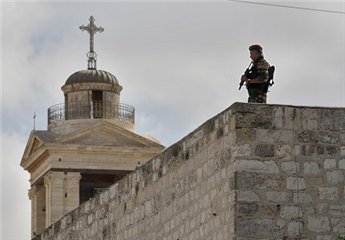
GAZA CITY – A group of Palestinians deported to Gaza after the Nativity Church siege in 2002 on Saturday disputed claims by a former economic adviser that they had signed an agreement to be exiled.
The 26 deportees told Israeli forces during the siege that only Yasser Arafat could negotiate on their behalf, denying claims that they themselves gave their approval to be deported, a statement said.
Muhammad Rashid, former presidential economic adviser to Arafat, on Friday told Al-Arabiya TV channel that the group had agreed to be deported and that he fully accepted responsibility for the agreement, which Arafat had authorized him to negotiate.
The committee appointed by Arafat to negotiate with the Israelis “almost reached an agreement to deport only 6 activists to the Gaza Strip, but other people were carrying out secret negotiations behind the scenes which ended in the deportation of 39 activists to the Gaza Strip and Europe,” the group of Gaza deportees said.
The official PA negotiating committee was headed by Salah Taamari, who was then governor of Bethlehem.
He told Ma’an TV in May that the deportation deal was reached without his knowledge and recalled his shock when Israeli officials told him Palestinians would be exiled.
The deportees urged the Palestinian Authority to expose all details of the 2002 deal, calling on the PA to prove whether there had been a written or verbal agreement between the two sides.
“If there was no written agreement, that would be a serious mistake by Muhammad Rashid, especially since the agreement was monitored by the US, the UK and the EU, and it was applauded by the Vatican,” the group said.
Former detainee and researcher Abdul Nasser Farwaneh said the deportation deal was a clear violation of international law and human rights.
The Palestinian leadership’s acceptance of the deal to send Palestinians into exile set a dangerous precedent and over the last decade Israel has deported hundreds more Palestinians, Farwaneh said in a statement.
On May 10, 2002, Israeli forces ended a 39-day siege on the church after striking a deal with Palestinian leaders to send 39 people given sanctuary in the church to Gaza and Europe.
When Israeli tanks surrounded Bethlehem on April 2, 2002, around 220 locals — including around 40 priests and nuns — took shelter in the church.
Over the next 39 days, eight Palestinians were killed inside the church and 27 others injured.
The siege on the site believed to be Jesus’ birthplace sparked outrage in the Vatican as monks sheltering inside pleaded for international assistance.
May 26, 2012
Posted by aletho |
Civil Liberties, Ethnic Cleansing, Racism, Zionism, Timeless or most popular | Bethlehem, Israel, Palestinian National Authority, Yasser Arafat |
Leave a comment
In his May 25 blog post for Foreign Policy’s The Cable, Josh Rogin provocatively asks, “Did the State Department just create 5 million Palestinian refugees?”
Rogin is referring to a letter Deputy Secretary of State Tom Nides recently wrote to Senator Patrick Leahy expressing State’s strong opposition to an amendment introduced by AIPAC darling Senator Mark Kirk that, in the words of Rogin, “would have required more in-depth reporting on how many UNRWA aid recipients are now living in the West Bank, Gaza, and other countries such as Jordan.” In the letter, Nides notes matter of factly that “UNRWA provides essential services for approximately five million refugees.” However, according to Rogin, “To experts and congressional officials following the issue, that declaration was remarkable because it was the first time the State Department had placed a number — 5 million — on the number of Palestinian refugees.” As Rogin explains:
At the heart of the issue is what constitutes a “refugee.” The entire thrust of the Kirk amendment was to challenge UNRWA’s definition, which includes the descendants of refugees — children, grandchildren, and so on. That has resulted in the number of Palestinian “refugees” skyrocketing from 750,000 in 1950 to the 5 million figure quoted by Nides today.
Revealingly, one of the “experts” Rogin cites as finding State’s 5 million figure “remarkable” is Steve Rosen. Neglecting to mention that Rosen was indicted on espionage charges in 2005, Rogin merely describes him as “a long time senior AIPAC official who now is the Washington director of the Middle East Forum,” and provides him with a platform for the following provocative and offensive statement:
“How many generations does it go?” asked Rosen. “I’m Jewish, and as a grandchild of several refugees, could I make a claim on all these countries? Where does it end? Someday all life on Earth will be a Palestinian refugee.”
May 26, 2012
Posted by aletho |
Ethnic Cleansing, Racism, Zionism, Illegal Occupation, Timeless or most popular | Mark Kirk, Middle East Forum, Palestinian refugee, United Nations Relief and Works Agency for Palestine Refugees in the Near East |
Leave a comment
A question of legitimacy
“For thousands of years, we Jews have been nourished and sustained by a yearning for our historic land. I, like many others, was raised with a deep conviction that the day would never come when we would have to relinquish parts of the land of our forefathers. I believed, and to this day still believe, in our people’s eternal and historic right to this entire land.” –Israeli Prime Minister Ehud Olmert in an address to a joint meeting of the U.S. Congress, May 24, 2006
In 1947, the United Nations arrogantly attempted to give away Palestine by floating the non-binding Resolution 181. Although the resolution was accepted by the General Assembly, it was not accepted by both parties, which was legally necessary for the General Assembly’s recommendations to be implemented.
If it had been implemented it would have prepared the foundation for the creation in Palestine of an Arab state and a Jewish state. However, the Arab nations voted in a block against it and were joined by others. Altogether 13 nations, Afghanistan, Cuba, Egypt, Greece, India, Iran, Iraq, Lebanon, Pakistan, Saudi Arabia, Syria, Turkey, and Yemen voted against it. Ten nations, Argentina, Chile, China, Colombia, El Salvador, Ethiopia, Honduras, Mexico, the United Kingdom, and Yugoslavia abstained.
Following the rejection of the resolution by the Arabs, over 65,000 well-trained Zionist forces led by Jewish terrorist gangs — Irgun, Stern, and others — stormed Palestine armed with $12 million worth of armaments and were met by 25,000 Palestinian militia equipped with antiquated weapons, known as Al Nakba.
Following the take-over of Palestine, U.N. Resolution 194 mandated Israel to accept the Palestinian’s right to return to their homes, and own up to the fact that “compensation should be paid for the property of those choosing not to return and for loss of or damage to property.” That too was ignored and Israel’s legitimacy hung on it.
Later came the Six-Day-War (1967), which resulted in the Occupation — the complete takeover of what remained of historic Palestine — and the fulfillment of the Zionist claim to their so-called 2,000-year-old Biblical birthright.
It is a serious violation of international law to acquire territory by force. Indeed, the case against the Nazis during the Nuremburg Trials asserted that the rationale behind their acquisitions was to acquire territories already inhabited by so-called “racial Germans” and those it needed as additional living space for “racial Germans” — all at the expense of other countries. This indictment echoes the Zionist/Israel defense of its claim to historic Palestine by “racial Jews” and its subsequent actions which include hundreds, if not thousands, of crimes against humanity, such as their nonstop deadly raids into Gaza and the West Bank, hundreds of checkpoints and roadblocks, the illegal construction of the racist, Apartheid Wall and the current ethnic cleansing of Arab-Israeli citizens within the Negev.
The basic fact is Israel was created in violation of international law and remains so. Israel’s illegitimacy is the point that Hamas asserts and which the world is starving and economically boycotting the Palestinians to force them to reject — by demanding they recognize Israel’s right to exist. (These tactics also violate international law — threatening genocide to force Palestinians to accept what is false.)
Has any other nation on the planet gone to such lengths to get a group to recognize their right to exist? If Israel were comfortable with its claim of legitimacy, Hamas’ stance would be a non-issue, a joke to be ignored. But Hamas persists in not recognizing this “right,” which has little to do with “wiping them off the face of the earth,” and everything to do with recognizing their legitimacy.
Israel takes the threat from Hamas so seriously that Olmert is risking what until now has been sacrosanct — Israel’s security — by arming Fateh, the party of their former nemesis, Yasser Arafat. The further irony is that Hamas has posed NO security risk to Israel in over 16 months, since declaring and abiding by the truce which Israel has broken thousands of times with the non-stop shelling of Gaza and its incursions into the West Bank, all of which has resulted in hundreds of Palestinian lives lost and thousands of injuries.
Barring entry into Gaza, depriving Palestinians of food and medicine, enforcing a financial boycott of the government, which have also led to starvation and violence, is another example of Israel’s as well as America’s and the EU’s violation of Article 33 of the Forth Geneva Convention prohibiting collective punishment and attempted genocide. Meanwhile, Fateh continues to lob Quassam rockets into Israel and to create chaos within Gaza and the West Bank. Yet, it is Fateh that is being armed by Israel. So who’s kidding who?
Israel has been “recognized” by nations across the globe but that does not change the fact that it operates outside of international law — as is obvious to all who pay attention. The solution is for Israel to operate within the law through a one state solution. But Zionists reject the obvious solution. Instead they implement the propaganda strategy that emphasizes their so-called Biblical birthright and their god given right to exist as a Jewish state. Somehow, these claims are supposed to convey legitimacy. But it is all a great hoax.
Based on scholarship, widely publicized in books such as Arthur Koestler’s “The Thirteenth Tribe,” historic records demonstrate that the Ashkenazi Jews converted and are not descendants of the ancient Hebrews. This is backed by DNA analysis that has consistently demonstrated that they are not a so-called Diaspora.
One recent study involved over 1,000 Ashkenazi Jews in 67 countries. Over 60 percent had NO Middle Eastern ancestry. The remaining 40 percent showed genetic markers indicating that four women of Middle Eastern descent had entered the Ashkenazi gene pool over a two thousand year period. Four women does not a Diaspora make and given the time period involved they could very well have been Christian or Muslim. Yet, Israeli leaders and too many Jews throughout the world speak of their 3,000-year history, ignoring the Palestinians, whose history they pretend is their own.
Israel was born through the actions of Zionist terrorist organizations. It is still led by criminal elements. Today, the Israeli appetite and trade in marijuana, cocaine, heroine, and hashish may be brushed off as a sign of the times. But Israeli drug lords control the global Ecstasy market, a drug that causes permanent, irreversible brain damage.
In 2000, the Boston Globe reported, “To avoid detection, one Israeli criminal group enlisted ultra-Orthodox Hasidic Jews from Brooklyn and Monsey, N.Y., to bring shipments of Ecstasy into the United States. With their traditional black hats, black coats and locks of hair dangling around their ears, the Hasidic Jews looked like unlikely suspects.”
The Israeli crime rate in human trafficking is among the highest in the world. They are listed by America as “second tier” only because in recent years, there have been marginal efforts to do something about it. Over 10,000 women have been brought into Israel and forced into sexual bondage, according to reports in the BBC (May 18, 2000), the Forward, Ynetnews, the Associated Press and other news organizations.
This industry is reputed to bring in over $1 billion a year. In fact, only a few months ago, in March 2006 the Israeli High Court overturned an Israeli law that facilitated slavery. Granted, if the new law prohibiting slavery is enforced, it should help to offset the prostitution industry in Israel and their international export of sex slaves. Last year, commenting on the sexual slavery market within Israel, an Israeli Parliamentary Inquiry Committee reported, in the words ofYnetnews.com, “some 10,000 such women currently reside in about 300 to 400 brothels throughout the country.”
The Israeli Kav LaOved Newsletter reported in 2004, in an article titled, “The legal battle against the binding arrangement”:
“The state of Israel is involved both directly and indirectly in turning foreign workers — who entered the country legally — into victims of trafficking in persons, as defined in the proposed legislation. The view of migrant workers in Israel as the employers’ property is reflected above all (in) the ‘binding arrangement’ which makes the worker the employer’s slave.
“The binding arrangement is based on Section 6 of the Entry to Israel Law, 1952. Under this section, the Interior Minister has the power ‘to stipulate conditions in a visa or in a residence permit, compliance with which shall be a condition for the validity of the visit or the residence permit.’ As this arrangement is applied by the Interior Ministry, the work permit belongs not to the worker but to the employer; the worker is in fact bound or fettered to the specific employer whose name is stamped in his passport. Such binding to an employer is an imperative condition for the worker’s legal status in Israel.”
In addition to human and drug trafficking, Israel is also replete with maintaining the best politicians that money can buy. Prior to his debilitating stroke, Sharon, and his sons, were plagued by corruption scandals and threats of indictments. Corruption is also frequently linked to Shimon Peres and Olmert to name a few.
Isn’t it time for the world to stop pussyfooting around the basic fact. Israel is not legitimate and will not be until they accept Palestinians as belonging in the whole of historic Palestine with full rights as citizens. Palestinians must also be compensated for the 68 years of theft and bloodshed for which the aggressor — Israel — is responsible.
Although I support a two state solution as realistic until the parties in the conflict can reconcile, only a one state solution would bring a guarantee of peace within the region.
©2006 OhmyNews
May 25, 2012
Posted by aletho |
Ethnic Cleansing, Racism, Zionism, Illegal Occupation, Timeless or most popular | Hamas, Israel, Palestine, Right To Exist, Zionism |
Leave a comment
 A blog visited mainly by UN insiders announces that US Assistant Secretary of State for Near Eastern Affairs Jeffrey Feltman is up for a very important UN job. Former UN Assistant Secretary General for Public Information Samir Sanbar’s blog, UN Forum, notes that UN Secretary General Ban Ki-moon is set to replace B. Lynn Pascoe with Feltman in the post of UN Under-Secretary General for Political Affairs. The office was created in 1992 to help identify and resolve political conflicts around the world. Pascoe ran at least a dozen missions in Africa, Asia and the Middle East, notably in Burundi, Somalia, Iraq, Lebanon and Libya. The longest running mission is in Somalia (since 1995) and the most recent is in Libya (since September 2011). With a budget of $250 million and funds for special political missions that amount, this year, to $1 billion, the post allows its leader to intervene in political crises around the world.
When Secretary General Ban began his second term in January, he promised to reshuffle some of his senior staff. Pascoe’s replacement is part of this process.
Of the proposed new appointment Sanbar writes, “Designating someone with varied field experience, though controversial, and from a substantially senior post, may mean that more issues could be referred to the Security Council.” The UN Security Council’s Secretariat is handled by the Department of Political Affairs, which would be able to have some sway on its agenda. The post is central to the UN bureaucracy.
News of Feltman’s resignation from the State Department next week simply confirmed all the rumors. Another rumor suggests that the UN will announce the appointment on Monday, May 28.
Is Jeffrey Feltman the best person to run such an influential office in the UN? Why did Sanbar believe that this appointment is “controversial.”
Shibley Telhami, the Anwar Sadat Chair for Peace and Development at the University of Maryland and a Senior Fellow at the Brookings Institution, told me that Feltman is “an accomplished and respected American diplomat.” He has been involved in the Arab-Israeli conflict, Iran, Lebanon and Syria, and other hot spots. These bring up “inevitably controversial issues,” Telhami continued. “Feltman would have his share of detractors, including in the Middle East,” he said.
But why would Feltman have these “detractors” and how did he come off on the “controversial issues”?
On one issue Feltman is remarkably consistent. When it comes to the Middle East, Feltman has been outspoken about the threats posed by Iran in the region. Whether in Beirut or Manama, he has publically denounced Iranian “interference” outside its own boundaries. At the same time, Feltman has generously offered US assistance to these same regimes. In other words, US interference is quite acceptable, but Iranian interference is utterly unacceptable. This might be adequate behavior for the diplomat of a country, but it is hardly the temperament for a senior UN official. It raises doubts about Feltman’s ability to be even-handed in his deliberations as a steward of the world’s political dilemmas.
Feltman’s intemperate logic was not of the distant past. It was on display in March 2012 at a Lebanese American Organization’s meeting at the Cannon Office Building in Washington, DC. At this meeting, the former US Ambassador to Lebanon, instructed the Lebanese people as to what they must do in their next election, “The Lebanese people must join together to tell Hezbollah and its allies that the Lebanese state will no longer be hijacked for an Iranian-Syrian agenda.” The people must “use the 2013 parliamentary elections to defeat the remnants of the Syrian occupation, the pillar of which is Hezbollah.”
Indeed, interference by speeches is not the limit of Feltman’s ambitions. On May 3, 2012, he was back in Beirut, meeting former Prime Minister Fouad Siniora, former Finance Minister Mohamad Chatah, Future Movement leader Nader Hariri and others at Hariri’s residence. In the transcript of their meeting (leaked through Al-Akhbar), an older side of US policy making emerges. US Ambassador to Lebanon Maura Connelly is heard saying that the government is “Hezbollah dominated,” to which Feltman says to the Lebanese politicians in the room, “You can bring down the government if Walid [Jumblatt] is with you in the parliament or if Najib [Mikati, the PM] resigns right?” To Siniora, Feltman says, “Would it help if this government is brought down before the elections,” and then he mentions that he is seeing the Prime Minister Najib Mikati later that evening. “This place is very, very weird,” he notes, “weirder than when I left.” This is not a trivial statement. A glance at Feltman’s cables when he was ambassador to Lebanon reveals a fulsome appetite for the weird. The cables betray an obsession with the social lives of the Lebanese elite, their peccadillos and their foibles.
Feltman’s “non-interference” to prevent Iranian “interference” in Lebanon brings to mind another episode in his recent career. When the people’s protest broke out in Bahrain, US Secretary of State Hillary Clinton sent him there at least four, perhaps six, times. He was there on the eve of the Saudi-led invasion into Manama to smash the protests in March 2011. In a visit to Manama on March 3, 2011, just before the crackdown, Feltman praised the King for his “initiatives” and urged him to “include the full spectrum of Bahraini society, without exception.” In the Shia quarters, and amongst the al-Wefaq party activists, this sounded like Feltman was urging the King to take them seriously. In language similar to what he used in Lebanon, Feltman noted that the US wants a “Bahraini process” and urges others “to refrain, as we are, from interference or trying to impose a non-Bahraini solution from outside Bahrain.” The crucial phrase here is as we are, which implies that the US is not intervening in Bahrain. The fact of the 5th Fleet stationed in Manama and of the close cooperation between the Saudi monarch, the Bahraini King and Feltman’s bosses was to be ignored. “We are not naïve,” Feltman said, pointing across the waters at Iran. They cannot be permitted to intervene, but the US, a “critical partner” of the Kingdom, and the Gulf Arab monarchs, “will support Bahrain.”
When events heated up in Bahrain, Feltman and the chairman of the Joint Chiefs of Staff Admiral Mike Mullen went on a tour of the emirates’ capitals, declaring their unconditional support. The US stands for “universal human rights,” Feltman told the emirs, but of course since “every country is unique” these rights would emerge in their own way. Mullen was at hand to “reassure, discuss and understand what’s going on.” The key word here is reassure.
A clear-eyed assessment comes from Karim Makdisi, who teaches at the American University of Beirut. Makdisi recalls Feltman’s role as Ambassador in the area, where he made himself an extremely divisive figure. Feltman pushed for UN Resolution 1559 from 2004, to disarm the Lebanese resistance, he supported the Israeli invasion in 2006, and he provided assistance to the March 14 political party against Hezbollah. In other words, Feltman actively took sides in a divided political landscape. Feltman’s appointment “would be a disaster and send exactly the wrong signal for the UN” to the region. Having recognized its weakness, the US knows that it will be the UN that takes the lead in Syria and elsewhere for the foreseeable future. Makdisi believes that in “anticipating a larger role for the UN,” the US wishes Feltman to be well-placed to “ensure that US interests are maintained as much as possible.” Whatever credibility remains with the UN will whittle in the region with this appointment.
It is likely that Secretary General Ban Ki-moon picked Feltman for an unearned reputation. He is known around the Beltway for his work on the Arab Spring. But in the totality of the Arab world Feltman will not be seen as an open-minded professional. He has already thrown his hat into the camp of the Saudis and their satellites (the Gulf Arabs and the Hariri clan of Lebanon). This will limit Feltman’s ability to move an agenda in the region, least of all on the Arab-Israeli conflict where sober diplomacy is necessary from the UN. When I asked several people who watch the UN’s work in the Arab world carefully about this appointment, most offered me three words, “very bad news”. Not bad news for the Saudis or the US neoconservatives, but certainly bad for the people of the Arab world, whose Spring had them longing not so much for this kind of venal diplomacy but for honesty and good-will.
May 25, 2012
Posted by aletho |
Mainstream Media, Warmongering, Militarism, Timeless or most popular, Wars for Israel | Assistant Secretary of State for Near Eastern Affairs, Ban Ki-moon, Feltman, Jeffrey D. Feltman, Lebanon, Middle East, Shibley Telhami |
Leave a comment
An Ongoing Disaster
The scale of the ongoing tragedy visited on Libya by NATO and its allies is becoming horribly clearer with each passing day. Estimates of those killed so far vary, but 50,000 seems like a low estimate; indeed the British Ministry of Defence was boasting that the onslaught had killed 35,000 as early as last May. But this number is constantly growing. The destruction of the state’s forces by British, French and American blitzkrieg has left the country in a state of total anarchy – in the worst possible sense of the word. Having had nothing to unite them other than a temporary willingness to act as NATO’s foot soldiers, the former ‘rebels’ are now turning on each other. 147 were killed in in-fighting in Southern Libya in a single week earlier this year, and in recent weeks government buildings – including the Prime Ministerial compound – have come under fire by ‘rebels’ demanding cash payment for their services. $1.4billion has been paid out already – demonstrating once again that it was the forces of NATO colonialism, not Gaddafi, who were reliant on ‘mercenaries’- but payments were suspended last month due to widespread nepotism. Corruption is becoming endemic – a further $2.5billion in oil revenues that was supposed to have been transferred to the national treasury remains unaccounted for. Libyan resources are now being jointly plundered by the oil multinationals and a handful of chosen families from amongst the country’s new elites; a classic neo-colonial stitch-up. The use of these resources for giant infrastructure projects such as the Great Manmade River, and the massive raising of living standards over the past four decades (Libyan life expectancy rose from 51 to 77 since Gaddafi came to power in 1969) sadly looks to have already become a thing of the past.
But woe betide anyone who mentions that now. It was decided long ago that no supporters of Gaddafi would be allowed to stand in the upcoming elections, but recent changes have gone even further. Law 37, passed by the new NATO-imposed government last month, has created a new crime of ‘glorifying’ the former government or its leader – subject to a maximum sentence of life imprisonment. Would this include a passing comment that things were better under Gaddafi? The law is cleverly vague enough to be open to interpretation. It is a recipe for institutionalised political persecution.
Even more indicative of the contempt for the rule of law amongst the new government – a government, remember, which has yet to receive any semblance of popular mandate, and whose only power base remains the colonial armed forces – is Law 38. This law has now guaranteed immunity from prosecution for anyone who committed crimes aimed at “promoting or protecting the revolution”. Those responsible for the ethnic cleansing of Tawergha – such as Misrata’s self-proclaimed “brigade for the purging of black skins” – can continue their hunting down of that cities’ refugees in the full knowledge that they have the new ‘law’ on their side. Those responsible for the massacres in Sirte and elsewhere have nothing to fear. Those involved in the widespread torture of detainees can continue without repercussions – so long as it is aimed at “protecting the revolution” – i.e. maintaining NATO-TNC dictatorship.
This is the reality of the new Libya: civil war, squandered resources, and societal collapse, where voicing preference for the days when Libya was prosperous and at peace is a crime, but lynching and torture is not only permitted but encouraged.
Nor has the disaster remained a national one. Libya’s destabilisation has already spread to Mali, prompting a coup, and huge numbers of refugees – especially amongst Libya’s large black migrant population – have fled to neighbouring countries in a desperate attempt to escape both aerial destruction and lynch mob rampage, putting further pressure on resources elsewhere. Many Libyan fighters, their work done in Libya, have now been shipped by their imperial masters to Syria to spread their sectarian violence there too.
Most worrying for the African continent, however, is the forward march of AFRICOM – the US military’s African command – in the wake of the aggression against Libya. It is no coincidence that barely a month after the fall of Tripoli – and in the same month Gaddafi was murdered (October 2011) – the US announced it was sending troops to no less than four more African countries – the Central African Republic, Uganda, South Sudan and the Democratic Republic of Congo. AFRICOM have now announced an unprecedented fourteen major joint military exercises in African countries for 2012. The military re-conquest of Africa is rolling steadily on.
None of this would have been possible whilst Gaddafi was still in power. As founder of the African Union, its biggest donor, and its one-time elected Chairman, he wielded serious influence on the continent. It was partly thanks to him that the US was forced to establish AFRICOM’s HQ in Stuttgart in Germany when it was established in February 2008, rather than in Africa itself; he offered cash and investments to African governments who rejected US requests for bases. Libya under his leadership had an estimated $150 billion of investments in Africa, and the Libyan proposal, backed with £30billion cash, for an African Union Development Bank would have seriously reduced African financial dependence on the West. In short, Gaddafi’s Libya was the single biggest obstacle to AFRICOM penetration of the continent.
Now he has gone, AFRICOM is stepping up its work. The invasions of Iraq and Afghanistan showed the West that wars in which their own citizens get killed are not popular; AFRICOM is designed to ensure that in the coming colonial wars against Africa, it will be Africans who do the fighting and dying, not Westerners. The forces of the African Union are to become integrated into AFRICOM under a US-led chain of command. Gaddafi would never have stood for it; that is why he had to go.
And if you want a vision of Africa under AFRICOM tutelage, look no further than Libya, NATO’s model of an African state: condemned to decades of violence and trauma, and utterly incapable of either providing for its people, or contributing to regional or continental independence. The new military colonialism in Africa must not be allowed to advance another inch.
DAN GLAZEBROOK writes for the Morning Star newspaper and is one of the co-ordinators for the British branch of the International Union of Parliamentarians for Palestine. He can be contacted at danglazebrook2000@yahoo.co.uk
May 25, 2012
Posted by aletho |
Civil Liberties, Ethnic Cleansing, Racism, Zionism, Illegal Occupation, Militarism, Timeless or most popular, War Crimes | Africa, Gaddafi, Great Manmade River, Libya, Muammar Gaddafi, NATO, Tripoli |
Leave a comment

 A blog visited mainly by UN insiders announces that US Assistant Secretary of State for Near Eastern Affairs Jeffrey Feltman is up for a very important UN job. Former UN Assistant Secretary General for Public Information Samir Sanbar’s blog, UN Forum, notes that UN Secretary General Ban Ki-moon is set to replace B. Lynn Pascoe with Feltman in the post of UN Under-Secretary General for Political Affairs. The office was created in 1992 to help identify and resolve political conflicts around the world. Pascoe ran at least a dozen missions in Africa, Asia and the Middle East, notably in Burundi, Somalia, Iraq, Lebanon and Libya. The longest running mission is in Somalia (since 1995) and the most recent is in Libya (since September 2011). With a budget of $250 million and funds for special political missions that amount, this year, to $1 billion, the post allows its leader to intervene in political crises around the world.

 Aletho News

