Pentagon Capitalism and Silicon Valley: Google’s Drone War Project Shows Big Data’s Military Roots
By Elliott GABRIEL | Mint Press News | April 6, 2018
Google — the advertising and search engine monolith that once touted its official commitment, “Don’t be evil” — has thrown its full weight behind the U.S. military-industrial complex’s fast-advancing unmanned drone program – and more than three thousand of its employees will have none of it.
In a letter to Google CEO Sundar Pichai, over 3,100 employees invoked the now-discarded slogan in an appeal demanding that the company not allow its artificial intelligence technology to be used to improve the targeting capabilities of the United States’ deadly drone fleet. Google’s Project Maven is an AI surveillance engine that uses footage captured by the U.S. Armed Forces’ unmanned aerial vehicles to detect and track objects such as vehicles, while combing through, organizing, and feeding the processed data to the Pentagon.
Watch | Project Maven: The Pentagon’s New Artificial Intelligence
The letter, which is fast making the rounds on Google campuses and internal communication servers, demands the cancellation of the project and the public adoption of a policy pledging that neither Google nor its contractors produce technology for warfare. The letter states:
“This plan will irreparably damage Google’s brand and its ability to compete for talent. Amid growing fears of biased and weaponized AI, Google is already struggling to keep the public’s trust. By entering into this contract, Google will join the ranks of companies like Palantir, Raytheon, and General Dynamics. The argument that other firms, like Microsoft and Amazon, are also participating doesn’t make this any less risky for Google. Google’s unique history, its motto Don’t Be Evil, and its direct reach into the lives of billions of users set it apart.”
However, journalist and author Yasha Levine has explained in his new book Surveillance Valley: The Secret Military History of the Internet that Google has long been a leading Silicon Valley vendor to the U.S. repressive state:
“Over the years, [Google] supplied mapping technology used by the U.S. Army in Iraq, hosted data for the Central Intelligence Agency, indexed the National Security Agency’s vast intelligence databases, built military robots, co-launched a spy satellite with the Pentagon, and leased its cloud computing platform to help police departments predict crime. And Google is not alone. From Amazon to eBay to Facebook … Some parts of these companies are so thoroughly intertwined with America’s security services that it is hard to tell where they end and the U.S. government begins.
The grim calculus of remote-controlled warfare
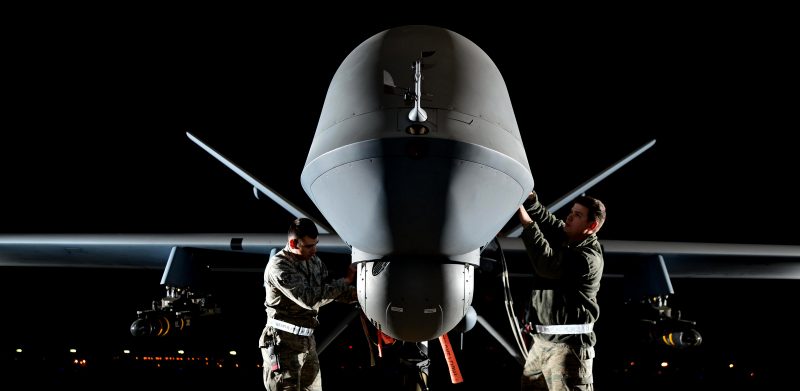
An Air Force RPA reconnaissance drone is retrofitted for use in attack squadron. (Photo: U.S. Air Force)
Thousands of alleged “combatants” have been killed in U.S. drone strikes since the start of the post-9/11 “War on Terror.” Former President Barack Obama ramped up the targeted killing program using drones in 2009, pledging that the use of unmanned aerial platforms was part of a “just war—a war waged proportionally, in last resort, and in self-defense.”
Reports have shown that the use of drones in such locales as Afghanistan, Iraq, Libya, Pakistan, Syria, Yemen and other theaters of operations have claimed a vast number of civilian lives — over 15,000 in 2017, according to surveys. According to New York Times Magazine, which surveyed 150 Coalition drone strikes carried out in Iraq over an 18-month period, one out of every five strikes kills civilians.
Watch | Suffering in Silence: a documentary about the war on terror in Pakistan
The American Civil Liberties Union has denounced the use of such tactics as contrary to international law:
“A program of targeted killing far from any battlefield, without charge or trial … violates international law, under which lethal force may be used outside armed conflict zones only as a last resort to prevent imminent threats, when non-lethal means are not available.
There is very little information available to the public about the U.S. targeting of people far from any battlefield, so we don’t know when, where and against whom targeted killing can be authorized … The secrecy and lack of standards for sentencing people to death, resulting in a startling lack of oversight and safeguards, is one of our prime concerns with this program.”
In 2007 at the height of George W. Bush’s “troop surge” in Iraq, Google enlisted in the “Global War on Terror” in a discrete partnership with Lockheed Martin. While enhanced versions of Google Earth were already at the disposal of government agencies, the tech firm helped to design a Google Earth product for the Pentagon’s National Geospatial-Intelligence Agency that displayed a visual representation of U.S. and Iraqi military bases in Iraq as well as the location of Sunni and Shiite neighborhoods in Baghdad, allowing occupation forces to oversee and manage the bloody fratricidal warfare between the groups as well as the possible location of insurgent organizations within their ranks.
It was during this same year that the development and use of Air Force drones in the Iraqi quagmire dramatically increased, nearly doubling between January and October of 2007.
Google defends its public image (and low-profile military ties)
Claiming that it values the input of its employees as an “important part” of its company culture, Google has promised to address the AI-drone issue without making specific comments on the employees’ demands. In a statement Tuesday, the company said:
“Any military use of machine learning naturally raises valid concerns. We’re actively engaged across the company in a comprehensive discussion of this important topic and also with outside experts, as we continue to develop our policies around the development and use of our machine learning technologies.”
Google has also defended its participation in the Pentagon program with the claim that its usage is specifically for non-offensive purposes and uses open-source object-recognition software based on non-classified data that’s freely available to any users of the Google Cloud, and could in fact save lives while saving labor through the use of AI.
Google’s own top corporate chiefs are quite close to the Pentagon: Google vice president Milo Medin serves on the Department of Defense’s tech advisory body, the Defense Innovation Board, which is also chaired by former Google executive chairman Eric Schmidt, who remains an executive board member at Google’s parent company, Alphabet Inc.
Google itself has long been interested in developing its own line of drone products, including private delivery drones.
The company is also a leader in AI and machine-learning technology. Its subsidiary DeepMind Technologies, Inc. has recently developed a program based on Google Street View that allows AI-based platforms to take part in long-range navigation and cross complicated urban environments. The navigator AI system is capable of steering everything from autonomous, self-driving cars to robotic vacuums and even unmanned drones.
Watch | Eric Schmidt at the Artificial Intelligence and Global Security Summit
Last November in a keynote address on artificial intelligence in warfare before Washington-based think-tank the Center for a New American Security, Schmidt pinned anxiety about his company’s acquisition of DeepMind on “a general concern in the tech community of somehow the military-industrial complex using their stuff to kill people incorrectly, if you will.”
“It comes from a, it’s essentially related to the history of the Vietnam War and the founding of the tech industry,” Schmidt added.

Indeed, Levine argues:
“In the 1960s, America was a global power overseeing an increasingly volatile world: conflicts and regional insurgencies against U.S.-allied governments from South America to Southeast Asia and the Middle East. These were not traditional wars that involved big armies but guerrilla campaigns and local rebellions, frequently fought in regions where Americans had little previous experience. Who were these people? Why were they rebelling? What could be done to stop them? In military circles, it was believed that these questions were of vital importance to America’s pacification efforts, and some argued that the only effective way to answer them was to develop and leverage computer-aided information technology.”
Surveillance capitalism’s military-industrial roots
In a 2014 essay for Monthly Review magazine titled “Surveillance Capitalism: Monopoly-Finance Capital, the Military-Industrial Complex, and the Digital Age,” authors John Bellamy Foster and Robert W. McChesney coined the phrase surveillance capitalism, tracing its origins to the inception of a post-World War II “new Pentagon capitalism” that came to be known as the military-industrial complex.
Under the model – revolutionized by then-Army Chief of Staff and later President Dwight D. Eisenhower – the U.S. technological, scientific research and industrial capacity were to become “organic parts of our military structure” in conditions of national emergency, effectively giving the civilian economy a dual-use purpose. In a 1946 memorandum, Eisenhower noted:
“The future security of the nation… demands that all those civilian resources which by conversion or redirection constitute our main support in time of emergency be associated closely with the activities of the Army in time of peace.”
The model became a permanent feature of the U.S. economy, giving birth to a sprawling military-civilian economic base Eisenhower famously criticized in his 1961 farewell address to the nation. Civilian industry, science, and academia were used alongside an exorbitant and perpetually-expanding war budget to underwrite the Defense Department’s never-ending state of conflict with Cold War enemies and unruly populations, making the world safe for the unchallenged reign of U.S. monopoly capitalism (imperialism) and “pump-priming” the economy whenever an additional surge of “military Keynesian” government spending was required.
Watch | Richard Wolff On Trump’s Defence Spending
According to the popular history of the internet’s origin, it was conceived in 1969 by scientists at the Defense Department’s Advanced Research Projects Agency (ARPA), who sought to create a means of “internetworking” Pentagon-sponsored computer mainframes belonging to government agencies, universities and defense contractors across the United States and NATO bloc. Known as Arpanet, the decentralized system allowed for military nodes – down to a battlefield level – to network and share data quickly and wirelessly. In the event of a nuclear strike or major war where swathes of the network were destroyed, the Arpanet would remain operational.
Levine posits that a primary purpose of conceiving the “information superhighway” was the need for a computerized counterinsurgency tool that could predict and check the “perceived global spread of communism” and provide real-time surveillance of potential threat groups:
“The Internet came out of this effort: an attempt to build computer systems that could collect and share intelligence, watch the world in real time, and study and analyze people and political movements with the ultimate goal of predicting and preventing social upheaval. Some even dreamed of creating a sort of early warning radar for human societies: a networked computer system that watched for social and political threats and intercepted them in much the same way that traditional radar did for hostile aircraft. In other words, the Internet was hardwired to be a surveillance tool from the start. No matter what we use the network for today — dating, directions, encrypted chat, email, or just reading the news — it always had a dual-use nature rooted in intelligence gathering and war.”
The Arpanet system formed the backbone of U.S. military communications from 1969 until 1989, when the World Wide Web was introduced to civilian consumers. The unveiling of the World Wide Web opened the floodgates to the use of the internet by users across the globe, as well as its subsequent commercialization and the resulting dot com boom of the mid-to-late 1990s, when Google was founded.
Watch | Yasha Levine on why we lost our fear of computers as tools of social control
The rapid advance of digital technology has ensured that the U.S. economy — and social life itself — is now dominated by big-data giants like Google, Apple, Facebook and Amazon (GAFA), as well as Microsoft, Intel, Cisco Systems, IBM and Hewlett-Packard. This new technology-dominated market environment, where private user info is parsed, monetized, packaged and sold, has been encapsulated by the well-worn cliché: “data is the new gold.”
Vast strides in biometrics, analytics research, AI, and deep-learning technology – perfected not only by Google but by academic researchers and technology firms across the globe – have vastly boosted the state’s ability to surveil and control populations and police dissent across the globe. Many of the technologies developed by global arms, surveillance, and data-analysis firms are supplied to countries requiring tailor-made solutions to unrest such as India, China, Myanmar, Saudi Arabia, Egypt, Bahrain, and Azerbaijan.
The extent of Silicon Valley’s integration with the U.S. government was laid bare to the public in 2013, when Edward Snowden provided evidence proving that the U.S. National Security Agency (NSA) and Federal Bureau of Investigation (FBI) had direct access to the internal servers of nine major tech firms – AOL, Apple, Facebook, Google, Microsoft, PalTalk, Skype, YouTube, and Yahoo – each of which provided direct access through major internet service providers to the NSA through its secret projects like Boundless Informant and Prism.
Foster and McChesney explained:
“These monopolistic corporate entities readily cooperate with the repressive arm of the state in the form of its military, intelligence, and police functions. The result is to enhance enormously the secret national security state, relative to the government as a whole.
Edward Snowden’s revelations of the NSA’s Prism program, together with other leaks, have shown a pattern of a tight interweaving of the military with giant computer-Internet corporations, creating what has been called a ‘military-digital complex.’ Indeed, Beatrice Edwards, the executive director of the Government Accountability Project, argues that what has emerged is a ‘government-corporate surveillance complex.”
Information superiority and the modern battlefield
At present, the digitalization of the military-industrial complex gives the United States a commanding edge in terms of military technology and high-tech warfare, which is augmented by optical spy satellites capable of capturing remarkably detailed ground-level imagery, successive generations of wireless networking technologies, pattern-recognition and machine-learning systems, and unmanned warfighting platforms.
As a matter of survival, however, all modern militaries – both regular and irregular, large and small – are being forced to adapt to the digitization of warfare. China, Russia, and even non-state actors like Lebanese resistance group Hezbollah are fast making technological advances to keep pace in the informationized battlefield.
The weaponized nature of digital technology is a pandora’s box that may prove impossible to close. Be that as it may, Google’s employees are livid about their participation in these developments:
“We cannot outsource the moral responsibility of our technologies to third parties … Building this technology to assist the U.S. Government in military surveillance – and potentially lethal outcomes – is not acceptable.”
While the tech conglomerate workers’ attempt to decouple Google from the Pentagon may be in vain, one can only applaud their efforts to protest the tech conglomerate’s complicity in the bloodshed wrought by U.S. imperialism through its array of increasingly high-tech implements of death.
Israeli forces pound Beit Lahia in Gaza Strip following false Iron Dome alert
Press TV – March 25, 2018
Israeli forces have pounded the Palestinian town of Beit Lahia after dozens of rocket sirens sounded in southern Israel following light artillery fire from a drill carried out by Hamas’ military arm in the northern Gaza Strip.
The Iron Dome missile system was activated several times late Sunday evening as a result of the artillery fire from the Hamas’ maneuver.
There were no immediate reports on the possible casualties from the attack.
Israeli media reported multiple interceptions launched from Ashkelon following a barrage of rockets fired from Gaza. But the Israeli army later confirmed no rockets had been fired into Israel. It said the Iron dome anti-missile system was activated after heavy machine gun shooting in the Gaza strip.
The Israeli military frequently bombs the Gaza Strip, with civilians being the main target of such attacks.
Israel has also launched several wars on the Palestinian coastal sliver, the last of which began in early July 2014. The military aggression, which ended on August 26, 2014, killed nearly 2,200 Palestinians. Over 11,100 others were also wounded in the war.
The Gaza Strip has been under an Israeli siege since June 2007. The blockade has caused a decline in the standards of living as well as unprecedented levels of unemployment and unrelenting poverty.
The Israeli regime denies about 1.8 million people in Gaza their basic rights, such as freedom of movement, jobs with proper wages as well as adequate healthcare and education.
How Israel and its partisans work to censor the Internet
By Alison Weir | If Americans Knew | March 25, 2018
Students at the Israeli military’s Computing and Cyber Defense Academy. Israel is also “scouring Jewish communities abroad for young computer prodigies willing to join its ranks.”
Numerous well funded, organized projects by and for Israel work to flood social media with pro-Israel propaganda, while blocking facts Israel dislikes. The projects utilize Israeli soldiers, students, American teens and others, and range from infiltrating Wikipedia to influencing YouTube. Some operate out of Jewish Community Centers in the U.S.
[…]
Israeli soldiers paid to “Tweet, Share, Like and more”
Israel and partisans of Israel have long had a significant presence on the Internet, working to promote the Israel narrative and block facts about Palestine, the Israel lobby, and other subject matter they wish covered up.
Opinionated proponents of Israel post comments, flag content, accuse critics of “antisemitism,” and disseminate misinformation about Palestine and Palestine solidarity activists. Many of these actions are by individuals acting alone who work independently, voluntarily, and relentlessly.
In addition to these, however, a number of orchestrated, often well-funded projects sponsored by the Israeli government and others have come to light. These projects work to place pro-Israel content throughout the Internet, and to remove information Israel doesn’t wish people to know.
One such Israeli project targeting the Internet came to light when it was lauded in an article by Arutz Sheva, an Israeli news organization headquartered in an Israeli settlement in the West Bank.
The report described a new project by Israel’s “New Media desk” that focused on YouTube and other social media sites. The article reported that Israeli soldiers were being employed to “Tweet, Share, Like and more.”
The article noted, “It is well known nowadays that what happens on Facebook, Twitter and YouTube has great influence on events as they occur on the ground. The Internet, too, is a battleground.” It was “comforting,” the article stated, to learn that the IDF was employing soldiers whose job was specifically to do battle on it. […]
Israeli media report that the Israeli military “has begun scouring Jewish communities abroad for young computer prodigies” to recruit for its ranks.
An Israeli official described the process: “Our first order of business is to search Jewish communities abroad for teens who could qualify, Our representatives will then travel to the communities and begin the screening process there.”
Israeli Government Ministry backs secret online campaigns

General Sima Vaknin-Gil told Israeli tech developers to “flood the Internet” with pro-Israel propaganda. As Israel’s Chief Censor, she said: ” “We censor information that is critical to our enemies, who have no capabilities like us, do not have a Jewish brain, and therefore our enemy relies to a large extent on open information…”
Israel’s Strategic Affairs Ministry, which is behind this and similar projects, has mobilized substantial resources for online activities.
Israel’s Ynet news reports that the Ministry’s director “sees it as a war for all intents and purposes. ‘The delegitimization against the State of Israel can be curbed and contained through public diplomacy and soft tools,’ she says. ‘In order to win, however, we must use tricks and craftiness.’”
The director, General Sima Vaknin-Gil, told a forum of Israeli tech developers at a forum: “I want to create a community of fighters.” The objective is to “curb the activities of anti-Israel activists,” and “flood the Internet” with pro-Israel content.
An Israeli report in December stated that the ministry has acquired a budget of roughly $70 million to “stand at the forefront of the battle against delegitimization, adopting methods from the fields of intelligence and technology. There is a reason why ministry officials define it as ‘a war on consciousness terrorism.’” [‘Delegitimization’ is a common Israeli term for criticism of Israel. See here for a discussion of the term.]
A Ha’aretz article reports: “The Strategic Affairs Ministry’s leaders see themselves as the heads of a commando unit, gathering and disseminating information about ‘supporters of the delegitimization of Israel’—and they prefer their actions be kept secret.”
The article reports that the Ministry includes a job role entitled “Senior official—new-media realm,” responsible for surveillance and activities “in the digital realm.”
This individual head is responsible for analyzing social media and formulating a social media campaign against sites and activists who are deemed a threat to Israel.
Among the job’s responsibilities are:
“Analysis of the world of social media, in terms of content, technology and network structure, emphasizing centers of gravity and focuses of influence, methods, messages, organizations, sites and key activists, studying their characteristics, areas, realms and key patterns of activities of the rival campaign and formulating a strategy for an awareness campaign against them in this realm and managing crises on social media. That is, surveilling of activities mainly in the digital arena.”
Officials at the ministry are charged with “construction and promotion of creative and suitable programs for new media.”
The unit works to keep its activities secret from the public. For example, a program to train young Israelis for activities on social media was exempted from publishing a public bid for funding. Similarly, the ministry’s special unit against delegitimization, “Hama’aracha” (The Battle), is excluded from Israel’s Freedom of Information Law.
Its activities reportedly include a “24/7 operations room monitoring all the delegitimization activities against Israel: Protests, conferences, publications calling for an anti-Israel boycott and international bodies’ boycott initiatives. The operations room will transfer the information to the relevant people to provide a proper response to these activities, whether through a counter-protest or through moves to thwart the initiative behind the scenes.”
Other programs include a 22-million-shekel project to work among labor unions and professional associations abroad “to root out the ability of BDS entities to influence the unions,” and a 16-million-shekel program focused on student activities throughout the world.
Israel’s UNIT 8200
Another Israeli entity that plays a role in covert Internet activity is the Israeli military’s legendary high-tech spy branch, Unit 8200. This unit is composed of thousands of “cyber warriors” primarily 18 to 21 years of age; some even younger. A number of its graduates have gone on to top positions at tech companies operating in the U.S., such as Check Point Software (where the spouse of the Jewish Voice for Peace head is employed as a solutions architect).
In 2015 Israel’s Foreign Ministry announced plans “to establish a special command to combat anti-Israel incitement on social media.” The command would operate under the foreign ministry’s hasbara [propaganda] department and would especially recruit from graduates of Unit 8200.
An article in the Jewish Press about the new command reports that Unit 8200 “has developed a great reputation for effectiveness in intelligence gathering, including operating a massive global spy network. Several alumni of 8200 have gone on to establish leading Israeli IT companies, including Check Point, ICQ, Palo Alto Networks, NICE, AudioCodes, Gilat, Leadspace, EZchip, Onavo, Singular and CyberArk.”

Check Point Software headquarters in Tel Aviv. Founded by a former Unit 8200 member, it also has offices throughout the U.S. Israeli tech companies sometimes assist in online spying efforts.
Numerous Israeli tech companies, many of them headed by former military intelligence officers, assist in these online spying efforts, sometimes receiving Israeli government funding “for digital initiatives aimed at gathering intelligence on activist groups and countering their efforts.”
According to the ministry’s statement, among the Command’s activities is “finding videos with inflammatory content and issuing complaints to the relevant websites.”
To be clear, this is an occupying military working covertly to achieve censorship of reporting on its atrocities. … Read full article at If Americans Knew
What I Saw As an Official Observer to the Russian Elections
By Gilbert Doctorow | Russia – Insider | March 23, 2018
In this piece, I will share impressions from my mission as an international observer to the Russian presidential election. The event was of historic importance given Russia’s rising standing in the world under the leadership of its front-runner candidate in the election, Vladimir Putin, and it has been covered widely in world media.
What will set this account apart from the rest is firstly the focus on one location, the Crimea, which I visited as monitor within a varied delegation of 43. The Crimea, for its part, had unusually high importance to the Russians and to the world at large, because the election there was rightly viewed as a second referendum on the reunification of Crimea with Russia in 2014, and that reunification or annexation, depending on your point of view, underlies much of the acrimonious confrontation today between Russia and the US-led “international community.”
The author interviewed by RT on election day.
A little remarked fact underscores my argument for the key importance of the Crimean vote: the precise date selected to hold the presidential election across the Russian Federation, 18 March. That is the anniversary of the formal unification, the culmination of the Crimean Spring of 2014, which followed by several days the original referendum approving unification. It will be recalled that the validity of that first referendum has been denied by Russia’s Western detractors, who insist the result was forced by the presence of Russian troops in the streets and an atmosphere of intimidation coming from pro- and anti-Russian demonstrations. The vote in 2018 has taken place in a totally calm situation, which removes all possibility of reservations about validity unless violations at polling stations could be identified. At a minimum, the task of a monitoring group such as mine should have been to watch that issue very closely. How that functioned in practice, what I/we actually saw and did will make up the first part of this essay.
The entire force of international observers who spread out across Russia was quite heterogeneous and I will spend some time in the second half of this essay describing us: who we are, why we and not others were present in Russia for election monitoring work. In this second half, I will also discuss something highly important that other commentators have avoided entirely: the fact that the elections come within the context of an intense political, economic and information war between Russia and the West that has in the past couple of years reached the level of the worst days of the Cold War. Consequently, once we look past the technical aspects of the vote, where there is, among serious professionals, a consensus that these elections were well administered and transparent, we find ourselves back in the midst of tendentious interpretation by both sides to the issue, if not outright propaganda. I will not dodge this question, and I do not expect to receive bouquets from anyone. The task before us will be very simple: to try as best I can to give details about the circumstances of the balloting so that the reader can arrive at an independent conclusion. Without naming names, I will produce my evidence from personal experience on the ground that is missing from media accounts till now given their broad brush approach.
What we saw
The bare facts are that voter turn-out in Crimea was similar to turn-out in Russia at large, coming to about 67% while ballots for Putin exceeded by far the Russian average: about 92% for Putin versus the national average of approximately 77% for Putin.
What I am about to say to flesh out these bare bones comes from our group visits to 10 polling stations over the course of as many hours. The first two were in the city of Yalta. The next two were in small villages situated along the main highway running from Yalta north and west to the provincial capital of Simferopol. And the last six were in the city limits of Simferopol. The distance we covered was 80 kilometers. Given the poor state of repair of even roads of regional importance in Crimea, the time in transit, had we not stopped along the way, would have been nearly two hours.
Our group of about 20 traveling together was split between two mini-buses, one predominantly French speaking and the other predominantly German and English speaking. Each bus had local chaperones who, together with those of us monitors fluent in Russian could assist our linguistically handicapped colleagues.
Except for the very last polling station which was close to where we had lunch and was chosen spontaneously by our group without objection from our chaperones, all the polling places had been selected by our hosts in advance, which obviously is not the random selection you would like ideally to have in such an exercise. In several stations we were met by television film crews who were expecting us.
However, we were let loose in the polling stations and could speak directly not only with the senior administrator but also with voters, with the volunteers manning the registration desks, with the monitors from the local social chambers and representatives of the candidates, if any happened to be where we were, given that they moved around all day. That is to say we had every opportunity to hear complaints, to remark any peculiar goings-on, such as organized groups of voters showing up together. There were none. We heard of no scandals, and we saw no demonstrations or protesters of any kind around the polling stations. Instead what we witnessed was an intermittent flow of voters arriving, being processed efficiently, casting their ballots and departing.
In this connection, I want to stress that our group seemed to take its responsibilities rather seriously. To be sure, when we started out in the morning we descended on our first polling booths like a group of aliens – everyone attached to their mobile gadgets and texting, arranging travel on line for their next destinations and not paying much attention to where we were. However, that phase passed quickly and my colleagues took an interest in the here and now throughout the rest of our rather long work day. We had the usual group photos outside a number of polling stations taken not only for official record but using our own mobile phones to create personal souvenirs. And we gave interviews to the waiting television crews, though that was only a minor diversion.
The polling stations we visited were for the most part secondary schools. Some were in buildings of the local civil administration. All were serviceable and well prepared to receive the public. Many of the buildings had several stairs at their entrances. Among them some had permanent ramps, as is becoming very widespread in Russia to accommodate those in wheelchairs, parents pushing baby carriages and the elderly or infirm. Where no permanent ramp existed, temporary wooden ramps were installed, obviously at considerable expense and effort in what are otherwise quite poor districts. The Crimea obviously received no infrastructure investments during the 23 years when it was ruled by post-independence Ukraine, and is simply a poor region, however promising its future development may be.
This effort to facilitate voting also had another dimension, what I will call ambulatory ballot collection. Each station had a small sealed plexiglass ballot box which was taken out by volunteers on visits to voters who were too frail or too ill to come down to the polling station. The numbers of such voters were not big, something like 50 or 60 out of polling districts numbering between 1800 and 2500 registered voters. But the symbolic message was clear: that each citizen, each vote counts.
A special welcome was being offered at all polling stations to young people, specifically to those who had just turned 18 and were voting for the first time. They were each given a paper diploma issued by the city elders. Again, the numbers of such cases were tiny, running from 5 to 10 in the districts we visited, but the welcoming hand was visible.
I have mentioned measures taken by local volunteers to raise voter participation. The biggest effort to ensure eligible voters registered and easily found a voting station convenient to them was done at the federal level via the internet resources of the Central Election Committee using online registration and sms communications. In this regard, the Crimea was no different from any other region of the Russian Federation.
The single biggest impression from visiting polling stations was their sophisticated equipment to guaranty transparency, to empower the broad public to do citizen monitoring over the internet and to efficiently record the votes.
One of the first things we would see on entering the polling stations was the row of voting booths, with simple standardized assemble-disassemble frames and light cloth draw curtains for privacy. That was the only holdover from the simple past. Each polling station now had two sets of “eyes”: CCTV cameras positioned to oversee the voter registration tables and the ballot boxes. These cameras fed live images to the internet and could be viewed by anyone in Russia online. Still more important for guarantying fair elections were the new electronic ballot boxes that were installed in about half the polling stations we visited, the rest being manual count boxes. The automated ballot boxes are autonomous, meaning they are not connected to the web and so are not subject to hacking. They are topped in effect by self-feeding scanners which automatically record each vote. Unlike purely electronic systems, the new Russian boxes receive and store paper ballots, meaning that if any dispute over the automated count arises, a manual count can always be done later.
A peek into some of the plexiglass ballot boxes on our visits showed up only check marks next to Putin’s name. That was about the only indication, wholly unscientific to be sure, of how sentiment was running.
Otherwise the polling stations were notable for being inviting to the public through their engagement of DJs operating simple loudspeakers blaring pop music at the entrances. One of the tunes that came up in various places was telling: “Crimea and Russia Together Forever!” One polling station had costumed teenage entertainers out in front of the building to amuse and babysit smaller kids while their parents were voting. At another polling station, girls and boys aged 8 – 10 wearing military cadet uniforms greeted each arriving voter and sent off the departing voters with a hearty “goodbye.” In that same station, retro patriotism also came up in another form, which possibly was spontaneous, possibly organized in advance: an eight year old girl reciting quite loudly and with good histrionic training a patriotic poem with the repeated refrain “Russia is Rising!”
Voting day ended in Simferopol on a pronounced patriotic note. There was a free pop concert in the main city square which drew a good-natured crowd of several thousand of all ages and ended in a magnificent fireworks display. During the 10 minutes or so of the fireworks, the orchestra and showmen sang the Russian national anthem, which was lustily supported by the entire audience.
To anyone with a recollection of the Soviet Union, all of this collective jollity and distinctly Russian pop music, which was always rather tame, seems all too familiar. However, it was well-intentioned, and it may be that a substantial part of what was promoted as Soviet models and tradition was always just a variation on Russian national culture.
Our work day ended in a municipal administration building of Simferopol where we held a press conference. Five of us with the best command of Russian, myself included, were assigned places on the dais. There were only a handful of journalists in the room, but questions were pitched to us by a moderator and the proceedings were broadcast live by several television crews. This was in lieu of a group report.
* * * *
International Election Observers: who were we?
Russia’s Central Election Commission reportedly issued accreditation to 1,500 international observers whose nominations were put forward by a variety of sponsors, including Russian NGOs, the State Duma and international organizations. Some monitoring was done by diplomats from foreign embassies who requested accreditation, allowing them to visit polling stations and gather information. These monitors would later report only to their respective governments.
I was invited to Russia by a Moscow-based NGO called the Russian Peace Foundation, which entrusted administration of its allotment to a Warsaw based NGO called the European Council for Democracy and Human Rights. The original intention was to invite and accredit 150 individuals from all over the world. In the end, only about 80 monitors arrived in Moscow via this channel, myself included. On the ground, in our Moscow hotel, I saw about half this number, and I never learned where the others may have been lodged. Out of that number only a couple of us were sent to Crimea, where we joined accredited monitors from other pools. We never discussed among ourselves who came from which sponsor group.
In the Crimea-bound contingent, I was the only American, and, one of the handful of fluent Russian speakers. This put me under the spotlight but also heightened my ability to engage the local electoral officials and voters.
The monitors with whom I came into contact, both in my own pool from the Peace Foundation with whom I associated in Moscow and coming from other pools with whom I associated in the small contingent sent to Crimea were all of mixed backgrounds. Some were academics with think tank affiliation, or professional political analysts like myself. Some were elected legislators in their home countries or members of the European Parliament.
The politics of the elected deputies appeared to be mainly from what is called “far Right.” Specifically, I met with a Bundestag deputy from the Alternativ fuer Deutschland, with a French MEP formerly in the Front National and now in a group cooperating with Brexit campaigner and EU skeptic Nigel Farage. There were also a couple of Italian deputies from the Veneto Region said to be members of the Northern League. Though I did not meet with him on the mission, I was aware of the presence in Moscow of one observer coming from the “far Left” party Die Linke. Centrist parties seemed to be absent. Within the contingent sent to Crimea there were also several who fit none of the descriptions above. I have in mind the representative of the President of Pakistan and the representative of the President of Malaysia.
The politic al convictions of those monitors with whom I spent some time could be characterized as ranging from mildly to extremely pro-Russian. Those who were in the latter category constituted perhaps 10% of the total. From our table talk over lunch, I understood that the several very pro-Russian monitors had a latent conflict of interest : they each made some of their professional income in Russia, or, as was the case with one of the Italians, they are developing businesses in Crimea with local partners. From among this sub-group, two were particularly fluent in Russian and presented their propagandistic observations to the local journalists with whom we met in the polling stations and at the press conference. This is how one Crimean newspaper received the choice quotation which it duly published: that “today Crimea is the most democratic place in the world.” An over-the-top assessment that is frankly embarrassing to read.
I would call this case a distortion of the observer mission that was preconditioned by the general background of political, informational and economic warfare being waged between the West and Russia for the past several years. To my knowledge, the Russian Duma had extended invitations to all Members of the European Parliament, but the major centrist parties there opposed sending any representatives to observe elections which they knew in advance would be a sham because of their own ideological anti-Putin prejudices. Thus, who actually came and took part in the monitoring was the result of a self-sorting process. The MEPs and parliamentarians from national legislatures who came did so in the face of moral pressure from the majority of their peers, and they received strict prohibitions in particular against going to Crimea. I saw how one of the French MEPs initially in our Crimea contingent backed out at the very last minute and remained in Moscow to avoid scandals back home.
Propaganda and information warfare on all sides
The fierce political winds in the West against Putin, against Russia directed mainstream US and European media reports on the Russian election campaign for weeks in advance of the vote. The media denounced the process as fake because of the near certainty of the outcome, the re-election of Vladimir Putin. This mind-set even exerted a discernable influence on the most authoritative foreign observation body to come to the elections, the Organization for Security and Cooperation in Europe (OSCE).
The OSCE contingent was the single largest group of international election observers, receiving 580 accreditations. Within that overall number there was a core group of 60 who were deployed in Russia six weeks before the elections. They met with local election boards, candidates’ representatives and others to build an information base on the elections. Then there were 420 additional short-term observers sent by the OSCE Office for Democratic Institutions and Human Rights. And about 100 accreditations for the election-day mission were issued to the OSCE Parliamentary Assembly, who were nearly all European MPs in their respective countries.
I wish to stress that the OSCE did not send any election observers to the Crimea. In a statement issued by the United States Mission to the OSCE on 22 March, the reasons that evidently also guided the OSCE in its entirety are set out with the crystal clarity of a Cold War blast denouncing Russia’s “invasion and occupation of Crimea,” its staging of “illegitimate elections… [with] frequent and severe abuses, specifically targeting the Crimean Tatar community and others opposed to Russia’s occupation.” Russia is charged with coercing Ukrainian citizens in Crimea to vote in illegitimate elections. The 18 March elections are, per the US Mission, “another attempt by Russia to give its purported annexation of Crimea a semblance of legitimacy.”
Without further ado, I condemn this official US statement as an ignorant, willfully blind rejection of the realities on the ground in Crimea that I and other members of our monitoring team unreservedly established.
As for the OSCE monitoring mission to the rest of the Russian Federation, the various constituent groups mentioned above issued two pages of Press Releases on their findings at a press conference held in downtown Moscow the day after the elections. Given the institution’s credibility, that report has received a good deal of attention in global media.
The general conclusions were summarized at the top of the Releases:
“Russian presidential election well administered, but characterized by restrictions on fundamental freedoms, lack of genuine competition, international observers say.”
On the one hand, the OSCE report gave the Russians, and in particular the Central Election Commission, high marks for the professional administration of the elections as witnessed by their teams in the field on election-day. In particular, the press handout mentions as welcome the accuracy of voter lists and the legal changes that enabled voting in polling stations away from the permanent place of residence, a facility which was used by 5.6 million Russians. Tabulation was also assessed positively.
These bland-sounding compliments have to be put in an historical context to be fully savored.
The background is the 2011 Duma elections which were shown by Russian activists at the time to have been fraudulent due to ballot box stuffing, “carousel voting,” i.e. multiple voting and the shepherding of company employees and civil servants to the polling stations by their superiors. Incidents were reported of voter turnout in some districts exceeding 100% of registered voters. These outrages sparked mass street demonstrations that were fanned by encouragement from Western governments and media at the time. The Kremlin took note and instituted several procedural reforms and widespread implementation of CCTV cameras already the next year for the presidential election, which passed without incident and prepared the way for the extensive measures supporting transparency and fair voting that we saw on 18 March 2018. The government also took measures to protect itself and society from the would-be actors of regime change though mass demonstrations: the rules on foreign-sponsored pro-democracy NGOs were tightened, as were rules on public assembly.
On the other hand, the OSCE Press Releases go far beyond the voting mechanisms, far beyond the specifics of this electoral campaign to challenge the entire Russian political culture.
“Elections are a critical part of democracy, but democracy is not only about elections. …. [I]mproving the real state of democracy in Russia requires full respect for people’s rights between elections as well,” Marietta Tidei, head of the delegation from the OSCE Parliamentary Assembly” is quoted as saying on page one of the handout.
The OSCE spokespersons direct attention in particular to limitations on rights of assembly, on free speech in Russia and to media control by the state, with unequal allocation of air time going to the president that short-changed his challengers
Perhaps the most condemnatory remarks in the OSCE Press Release relate to registration of candidates for the presidential race.
“After intense efforts to promote turnout, citizens voted in significant numbers, yet restrictions on the fundamental freedoms, as well as on candidate registration, have limited the space for political engagement and resulted in a lack of genuine competition…”
This was a thinly veiled reference to the rejection of the candidacy application of the famous blogger and corruption-fighter Alexei Navalny, who from the beginning to end was held up in Western media as the only real opponent to Vladimir Putin. This characterization of who was real opposition and who was a “Kremlin project” was itself a highly politicized issue that outside observers would have done better to side-step entirely.
There are several serious problems with the overarching negative analysis by the OSCE, which slotted very nicely into the predisposition of the Western media to trash the Russian elections. Whether by intent or by ignorance, the OSCE authors of the critique of the electoral campaign circumstances acted as the mouthpieces of the opposition candidates, most particularly the Liberal party candidates among whom Ksenia Sobchak was the most visible and vocal. They did not give any thought to counterarguments, which I will present here.
First, there is the issue of applying double standards and expecting the ideal of fair competition for all candidates to the nation’s highest office, when that standard is very rarely if ever met in the West itself. I would name little, neutral Switzerland as one country with credible civic freedoms, campaign and voting procedures. I was about to name here Finland, another small and relatively homogeneous country which always gets high marks on democratic institutions, but then I recalled that a couple of years ago there was a great scandal over abuse of the newly introduced remote voting facility via the internet. That noisy scandal ended in one parliamentary deputy, a party leader and former Minister of Foreign Affairs, being stripped of her mandate for violations. So there can be problems even in Eden.
Then, at the risk of being accused of “what-aboutism,” I am obliged to mention an egregious and relatively recent case of suppression of mass opposition movements in the United States. I have in mind the case of Occupy Wall Street, which broke out in the midst of the Crash of 2008 and was on the point of achieving political traction when it was brutally crushed by police and court actions that blatantly violated constitutional protection of freedom of assembly and speech. No one has ever paid a price for those abridgements of civil liberties which are still enshrined in law and regulations at the local level.
Let me now address the question of Vladimir Putin’s dominance in air time coming from his status and activities as president, not as candidate or debater, which he did not use at all. The OSCE observers ignore that Putin has this dominance 365 days on 365 because he is one of the most widely traveled, most consequential heads of state in the world against whom most any human being in opposition would have a very difficult time. This is precisely why he had the support of 80% of the population in polls held repeatedly in the year leading to the elections.
His popularity after 18 years in power is explained not only by being hyper active but by being hyper-productive for the vast majority of the population. In that time in office national GDP multiplied several times and take home pay of the broad population rose 10 times. Under Putin the poverty rate was cut in half. And in the past 4 years his government restored the nation’s self-confidence over its place as a global leader thanks to the bloodless takeover of the Crimea in March 2014 through perfectly executed psychological warfare in which 20,000 Russian troops from the Sevastopol naval base overcame an equal number of Ukrainian forces on the peninsula with hardly a shot fired and no fatalities. Then came the successful air war against the Islamic State in Syria from 2015 to 2017 that also had negligible cost in Russian military personnel. And finally in the midst of the election, on 1 March President Putin unveiled Russia’s new, state of the art strategic weapons systems which he claimed restored the country’s nuclear parity with the United States. All of these achievements would leave any opposition candidates, however clever, tongue-tied.
Finally, no criticism of restrictions on freedom of assembly or speech can be made in the abstract. They were introduced by the Kremlin in the context of the political war on the country being conducted by the West with especial intensity since the 2014 reunification with/annexation of Crimea. It is indecent to fault the Russians for imperfect democratic institutions when the result of outside pressure has always been to rally the broad public around its leader and to make life very difficult for any opposition.
For anyone with a few gray hairs and recollection of Soviet days going back to the 1960s, the present situation in Russia and the criticism of authoritarianism brings to mind the issues that surrounded the introduction of the détente policy: hard pressure on the Soviet Union under Leonid Brezhnev was known to result in crackdowns on dissent and the rise in the numbers of political prisoners.
Today’s Russia is a far more humane society than the old Soviet Union, but it is a disservice to opponents of United Russia and Vladimir Putin to impose personal and sectoral sanctions as the US-led West has done since 2012, when it introduced the Magnitsky List or accelerated from 2014 to present under the pretext of Russia’s intervention in Ukraine. What is surprising is that the country has virtually no political prisoners (Ksenia Sobchak could list only 16 dubious cases when she and other candidates met with Putin in the Kremlin on 19 March). During the campaign the candidates were able to express the most outrageous attacks on the government and its policies using false accusations, on live national television without any hint of retribution.
Why was the Russian political landscape devoid of serious challengers? The achievements of the incumbent are only part of the story. Another big factor has been the “vertical of control” that Vladimir Putin implemented at the start of his rule 18 years ago to reestablish state power in the face of disintegration and chaos, in the face of local satrapies run by thieves bearing the title of oligarchs. Without broad reinstatement of self-rule at the regional level through direct election of mayors and governors, there is scant possibility of experienced candidates enjoying popular backing rising to challenge a president. There will be more of the same top-down “parties” and rootless power seekers who ran against Putin in 2018. This question of preparing for democratic succession is the single biggest challenge facing Vladimir Putin in his fourth and last mandate.
My conclusion is that in the discussion about the Russian elections of 18 March everybody is using everybody else to score propaganda points. Nonetheless, even in this reality the monitoring missions served the worthy purpose of keeping the local Russian officials on their toes and encouraging transparency, in the Crimea and surely everywhere else. That is a very good thing in itself.
And I end this report with one more encouraging sign that I heard at our press conference in Simferopol that capped our election monitoring mission. We on the dais were interrupted for a short announcement by the head of the Simferopol government who gave tabulation of voter turnout as of 18.00 o’clock. He ended his recitation with this statement to the audience: “these elections are by and for us, Russians, not for anyone else.” Now that is a tremendous leap forward in Russian self-awareness and national pride. They have stopped looking abroad for validation. They have grown up…
For a brief overview of my findings as election observer in Crimea, see my 19 March interview with RT on Red Square.
Gilbert Doctorow is an independent political analyst based in Brussels. His latest book, Does the United States Have a Future? was published on 12 October 2017.
Featured Video
EUROPE FEARS RUSSIA’S NEXT MOVE / Ian Proud
or go to
Aletho News Archives – Video-Images
New Book
New Book: No Autoimmunity The Body Doesn’t Attack Itself
Lies are Unbekoming | September 24, 2026
 The label for Humira, once the best-selling drug in the world, lists its risks in plain print. One of them, in the label’s own words, is new “autoimmune” disease.
A drug prescribed for a condition labelled autoimmune carries a warning that it can cause a condition labelled autoimmune. That contradiction sits in every box, on a folded paper almost nobody reads.
My new book starts there.
No Autoimmunity: The Body Doesn’t Attack Itself
For seventy years, “your body is attacking itself, and we don’t know why” has ended the conversation for people diagnosed with multiple sclerosis, lupus, rheumatoid arthritis, Hashimoto’s, Type 1 diabetes, Crohn’s and psoriasis. More than eighty conditions now carry the autoimmune label. The diagnosis comes with a prescription for life. It almost never comes with a question about cause.
This book asks the question and answers it from the framework’s own records: its drug labels, its journals, its regulatory filings, and its own experiments. … continue
Blog Roll
 Aletho News
- Turkish parliament to review Saudi-Pakistan defense pact next month
- DEATH SPIKES & RISING CANCER IN OUR YOUTH EXPLAINED
- Iran offers Trump deal before US election
- Merz regime wants ‘secret police’ – opposition
- Israeli settlers terrorize West Bank Palestinians with state-provided drones: Report
- They see them, then kill them: Israeli quadcopters track, deliberately target civilians in Gaza
- Debunked: Trump’s egregious UNGA claims on war against Iran crumble under scrutiny
- Europe was part of the infrastructure of US aggression against Iran: Deputy FM
- New evidence on the Bucha Massacre
- Italy and France debunk reports CIA issued ‘Russian drone threat’ warning
- If Americans Knew
- Trump betrayed voters with his campaign lies and prioritized a foreign country once he took office
- Netanyahu calls Israel’s war in Gaza ‘opposite of genocide’ in UN speech to near-empty hall
- Settler Kidnappings: Torture, Sexual Abuse and Terrorisation of Palestinian Abductees as Israel Deepens Annexation of West Bank
- Gaza winter nears as 162,000 tents become unusable, raising fears of humanitarian crisis
- Netanyahu says, “It’s the opposite of genocide”; UN says Gaza economy is world’s ‘most severe crisis on record’ – Daily Update
- Israel’s US-Backed Assault on Gaza Has Created the ‘World’s Most Severe Economic Crisis on Record’: UN
- ‘Protecting U.S. Citizens’… From Israel
- ‘This is where I live now, the back of a truck’: a day in the life of a grandmother in Gaza
- In UN Speech, Iran’s President Displays Pictures of Children Killed by US, Brings Attention to Israel’s Nuclear Arsenal
- Israel displaces hundreds of Palestinians amid wave of demolitions in West Bank
- No Tricks Zone
- New Study: Earth And Venus Surface Warmth Largely Explained By Convection And Lapse Rate, Not CO2 Or Radiation
- 2025 Nature Paper Claiming Worsening Global Drought Gets RETRACTED …Heavily Flawed
- New Study: ‘Global Drought Shows No Detectable Recent Acceleration Under Climate Warming’
- Economic Masterminds: German Socialists Suggest Taxing Productivity Gains Stemming From Using AI
- The South China Sea Has Not Been Cooperating With The Climate Change Narrative
- Energy Crisis: Germany Enters Heating Season With Historically Low Gas Reserve Fill Levels
- New Study: The Antarctic Ice Sheet Gained Mass From 2020-2024 Due To Staggering Snow And Ice Accumulation
- Study: Ocean Heating Rates From Thousands Of Years Ago ‘Dwarf’ Modern Ocean Heating Rates
- Climate Extremists Target, Attack Large-Scale Power Grid Infrastructure In Germany!
- New Study: Antarctic Ice Melt Has Contributed Less Than 1 Centimeter To Sea Level Rise In The Last 30 Years

