Russian FM Lavrov’s Address Following Downing of Su-24 by Turkey
Sputnik – November 25, 2015
Russian Foreign Minister Sergei Lavrov has addressed journalists following the downing of the Russian Su-24 jet by an air-to-air missile launched from a Turkish F-16.
The Russian minister held a phone conversation with his Turkish counterpart Mevlut Cavusoglu earlier in the day.
“Moscow is not avoiding contacts with Ankara — my phone conversation with the Turkish FM is proof,” Lavrov said.
Turkey’s foreign minister expressed his sincere condolences to Sergei Lavrov, the Russian Foreign Minister said. But the Turkish minister tried to excuse the incident, Lavrov added.
The Turkish minister said that Turkey did not know it was a Russian jet.
“We have serious doubts it was an accident and prepared footage of the jet downing suggests it wasn’t,” Sergei Lavrov said. “It all looks like a planned provocation”.
The incident occurred following the airstrikes by Russian aviation on ISIL oil trucks.
At NATO’s meeting yesterday, strange words concerning Russia’s Su-24 jet tragedy were said. We received no condolences from NATO or the European Union, Sergei Lavrov said.
Let me remind you, Russian warplanes were in Syrian airspace. But even if a Russian jet crosses into Turkish airspace serious questions arise as to why Turkey did not use the emergency communication line with Russia before or after downing the Su-24 bomber jet, the Russian Foreign Minister added.
“I reminded him [Turkish foreign minister] that on Russia’s initiative a hotline between the Russian National Defense Control Center and the Turkish Defense Ministry was established. The line was established at the beginning of the Russian Aerospace Forces operation in Syria, and was used neither yesterday nor before that, which provokes serious questions,” Lavrov told the press.
Ankara has stated it was unaware that the aircraft belonged to Russia.Lavrov also said he recalled a 2012 statement by Turkish President Recep Tayyip Erdogan during the phone talk with Cavusoglu. The Turkish leader said back then that a short violation of airspace was not a pretext to use force.
“I reminded my Turkish colleague of this statement and he could not reply to this either, just repeating that they did not know what kind of aircraft this was,” the Russian minister said.
The minister also wondered if Turkey has coordinated its actions with the United States.
“I wonder whether Turkey consulted the US before downing any jet in the Syrian airspace,” he said.
Russia is still expecting apology from Turkey over the downing of the Russian Su-24 bomber jet over Syria.
“We’re not going to wage a war against Turkey,” Sergei Lavrov said answering a question from a journalist.
According to the Russian foreign minister, “the attitude toward Turkish people has not changed.”
“We have questions only to the current Turkish government,” Lavrov noted.
But Russia will seriously reassess all agreements with Turkey, he added. As for specific measures, we’ve recommended our citizens not to travel to Turkey, Lavrov said.
“In regard to the current level of our relations and agreements that we have concluded with the Turkish government currently in force in Ankara, as the [Russian] president has said, we will seriously reassess and review everything that is going on in our relations taking into count the attack that was delivered against our airplane,” Lavrov said at a press conference.
Too many indicators showing terrorist threats have appeared on Turkish soil, Russian Foreign Minister Sergei Lavrov said Wednesday.
“We cannot leave everything that has happened without a reaction not because we have to respond somehow, that’s not it. Actually there have been too many indicators on Turkish soil that show a direct terrorist threat to our citizens,” Lavrov said at a press conference.
Russia may raise the issue in the UN Security Council of developing an overall understanding on the fight against channels of equipping and financing militants in Syria, Russian Foreign Minister Sergei Lavrov said Wednesday.
“I think that now we will insist on not just a list of members of this group, but also agree on the overall understanding of the channels the terrorists use to get their feedlines and support,” Lavrov said during a press conference.
“We will somehow probably have to deal with certain countries so that this support ends,” Lavrov added.
Russia tried to persuade Turkey to take a more balanced position on the Syrian crisis, Russian Foreign Minister Sergei Lavrov said in an interview with Russian and foreign media.
According to Lavrov, Moscow “did not try to turn a blind eye” to the fact that Islamists are using Turkey as a platform to prepare terrorist acts in Syria and other countries.”We tried to take into account the interests of our Turkish neighbors and tried to explain our positions in a dialogue,” the Foreign Minister said.
“We tried to persuade them to conduct a more balanced policy not aimed only at getting rid of Assad at any cost and thus cooperating with all kinds of extremist groups,” the foreign minister stressed.
Moscow backs the proposal of French President Francois Hollande to close the Turkish-Syrian border, Sergei Lavrov said.
“I think this is the right decision. I hope President Hollande will tell us more about the issue tomorrow. We would be ready to consider all measures that needed for this [closing the border]. By closing the border we will basically thwart the terrorist threat in Syria,” the minister said.
Earlier Russia’s top diplomat cancelled his visit to Turkey after a Russian Su-24 jet was downed over Syria.
“The president clearly stated that this could not but affect Russian-Turkish relations. In this context, it was decided to cancel the meeting between Russia’s and Turkey’s ministers of foreign affairs, which was planned for tomorrow [November 25] in Istanbul,” Sergei Lavrov told journalists on Tuesday.
On Tuesday, a Russian Su-24 jet crashed in Syria. Russian President Vladimir Putin said that the plane was downed over Syrian territory by an air-to-air missile launched by a Turkish F-16 jet, and fell 4 kilometers (2.5 miles) from the Turkish border. Putin described the Turkish attack as a “stab in the back” carried out by “accomplices of terrorists.”
The Su-24 tragedy also claimed the life of a naval infantry soldier, who was killed in the rescue operation, according to the Russian General Staff.
Orwell’s Razor: All of 21WIRE’s predictions come true days after ‘Paris Attacks’
21st Century Wire | November 18, 2015
How predictable is the globalist imperial agenda? We are now witnessing the final stages of a long-term plan to induce another economic recession and erect a new high-tech police state throughout Europe and beyond. All they needed was a pretext.
While the mainstream media performed its normal routine of emotive reporting, stoking general fear and spreading mass hysteria, some smaller independent media outlets were busy plotting the establishment’s latest crisis agenda.
When the Paris Attack news broke last week, 21WIRE’s Patrick Henningsen went on television late Friday evening to comment on the unfolding drama, and also to analyze what was was likely to happen in the coming days and weeks in the wake of this event.
As it turns out, his quick predictions were incredibly accurate…
1. Declaration of a State of Emergency
France declared its first nationwide state of emergency since 1961 (when it attempted a coup d’état during the Algerian colonial war). Initially, this week’s snap passage of the emergency powers law only provides for a 12 day period, but on Monday French ministers confirmed this would be extended to 3 months because they believed that French citizens “had a right to a safe Christmas.” It gets even worse. After closing French borders, President François Hollande then proceeded to accelerate new police state measures after declaring publicly that, “We are a nation at war”, and then called for suspending normal due process by canceling search warrants, imposing curfews, traffic bans, and even authorizing local governments to impose a ban on public demonstrations. It seems the President has traded in his nation’s liberty for security theatre. In addition, over 100,000 police and soldiers have been deployed throughout the country. France is now under Martial Law.
2. Airstrikes by Monday
In predictable knee-jerk fashion, the French government seized upon this opportunity in order to insert more of its military assets into the Syria conflict by launching airstrikes on Sunday night in the area surrounding Raqqa, Syria, allegedly striking a multitude of “ISIS targets”, including command centers, weapons depots, and ISIS ‘Oil Assets’ – all thanks to supposed intelligence provided by the US. However, reports suggest that the impressive display of French air power didn’t actually net any real ISIS casualties. One can only wonder how so many ‘high value targets’, especially ISIS oil assets (we’re told this is so crucial to ISIS funding), could suddenly be made available to the French by a US military that claims to have been conducting round-the-clock airstrikes over this same region… for the last 14 months. This only reinforces many people’s suspicions that the US-led Coalition “Anti-ISIS(ISIL) Campaign” has been nothing more window dressing for a covert agenda, where the US and its allies have actually been working in concert with both ISIS and al Qaeda in Syria in order to achieve a long-held policy of toppling Syria’s government, ala regime change in Damascus.
3. Invoking the Article 5 ‘Mutual Defense’ Clause
To date, Washington’s multi-lateral proxy, NATO (North Atlantic Treaty Organization), has not been able to legally wiggle its way into Syria to help the thousands of foreign fighters and terrorists (like NATO did in Libya in 2010-2011) who have been allowed to flood into that country since 2011. Currently, the US and its allies are engaged in an illegal, undeclared war in Syria, and the US are desperate to find some legitimate avenue to pursue their military ambitions after having failed to cheat their way into Syria via a staged false flag ‘chemical weapons’ event in Aug 2013. According to NATO article 5, an attack on one member state is deemed an ‘attack on all’, and thus automatically triggers a joint military action (war) by the NATO collective against their declared enemy. Already, a number of political figures have cried out for ‘Article 5’ war powers, including former NATO head Anders Fogh Rasmussen who claimed that, “I do believe that the attacks on Paris qualify for an invocation of Article 5.” He added, “It was an attack on an ally and we know who the attacker is.” (certainly, they know the attacker much more than they are letting on). Eager to see a wider military deployment from Washington, US Senator Marco Rubio has called for ‘an Article 5’ too. Absent of any official NATO route, however, France has simply gone ahead and invoked an obscure ‘Mutual Defense’ pact hidden within the EU charter. The clause is called Article 42.7 of the Treaty on European Union which states that, “If a member state is the victim of armed aggression on its territory, the other member states shall have toward it an obligation of aid and assistance by all the means in their power.” Job done. Bombs away.
4. Calls for No Fly Zone
As 21WIRE first reported last year, the ‘No Fly Zone’ meme has been coming out of every available orifice in Washington since 2013, and this popular US tool for military intervention still draws the affectionate gaze of Democratic Party war hawks like Hillary Clinton, as well as the endless column of Republican war hawks who are in the pocket of the military industrial lobby. Whether its Jeb Bush, John McCain, or Lindsey Graham, they never get tired of the No Fly Zone.
5. US Republicans pushing for ‘boots on the ground’
Just like the No Fly Zone, ‘Conservative’ Republican war hawks have been desperate to implement another old chestnut – by throwing thousands of young US men and women at a problem which the US has actually created. War hawks in Washington DC have predictably seized on the Paris Attacks as an opportunity to reignite calls for “boots on the ground” in Syria. Amazingly, they are now claiming that massive deployment of troops “worked really well” in Iraq and Afghanistan.
6. Call for closing freedom of movement across European borders
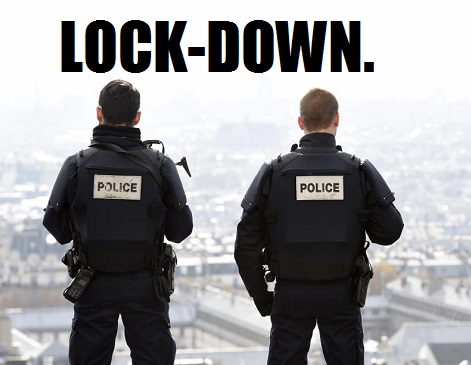
Early Saturday morning, Hollande’s first move was to ‘seal’ France’s borders, supposedly to catch the terrorists. This ’emergency’ move also comes at the height of Europe’s co-called ‘Migrant Crisis’ (a crisis that’s actually been engineered by the US and Europe). Rather conveniently, one of Friday the 13th’s said ‘suicide bombers’ was allegedly carrying a fake Syrian passport, which somehow led the French government and the western media to conclude that the Paris Attacks were a result of the ‘Migrant Crisis’, claiming the terrorists has sneaked into the country as refugees. To date, this only an official conspiracy theory, but that hasn’t stopped politicians and ‘security experts’ from using this crack-pot theory as justification for a European lock-down, prompting some European leaders to call for an end to freedom of movement across Europe.
7. Debate on Govt Spying and Privacy Rights, now off the table
As expected, politicians looking to appear ‘tough on terror’ and the growing gaggle of security lobbyists, and other assorted corporate fascists, have called for something akin to a ‘European Patriot Act’ – an end to the ‘Post-Snowden’ debate over bulk data collection and privacy – covering issues like NSA and GCHQ blanket spying on all citizens, and imposing more regulations and government monitoring of mandatory manufacturer ‘back doors’ for computers, mobile phones, gaming consoles, and also calls to make encryption illegal (except for government of course).
8. Calls for mandatory ID’s, biometric IDs
This hasn’t hit the headlines yet, but you can be sure that the usual gang of security contractors are putting the final touches on their proposals from a new regime of biometric ‘real IDs’. Expect announcements before the week’s end.
The last one is wasn’t very difficult to predict, but it has now been proven accurate nonetheless…

9. Cameron using Paris to Push for Syria War Vote
Back in August 2013, British MPs rejected Cameron’s call for bombing Syrian government forces in a close vote. It turns out that MP’s made the right choice as that war would have been waged on false pretenses. As predicted on Friday last week, David Cameron has now promised a new “comprehensive strategy” to win MP’s Parliamentary votes for an open-ended UK bombing campaign ISIS in Syria and Iraq. Cameron claims he wants to, “do the right thing for our country” (fancy that), and hit the “head of the snake” of ISIS in Raqqa, Syria. What military impact the UK would make in a multi-nation war in the region is debatable, with an air force of about a dozen Typhoon fighters and a handful of operational naval vehicles. Make no mistake about it – the British defense industry would like nothing more than to see this happen tomorrow – along with increased defense spending and procurement. Job done. Bombs away.
We’d rather none of these had come true, especially this quickly, but it only goes to show just how transparent the new world order agenda really has become.
Watch 21WIRE’s Patrick Henningsen and his original analysis from Friday evening, Nov. 13, 2015 on RT International…
Paris Attacks: A Perfect Pretext For NATO To Mobilize in Syria and Iraq
21st Century Wire | November 14, 2015
To anyone who is really paying attention, the real agenda behind this ‘terror’ event in Paris – is a NATO-sponsored intervention in Syria and northern Iraq.
Also, for the time being, the following will now be buried: any talk of preserving privacy rights in the west, any debate on mass surveillance and bulk data collection, any vocal opposition against mandatory biometric ID’s in Europe, any criticism of Israel’s continued squeeze on the West Bank and East Jerusalem, the overdue Iraq War Inquiry in Britain, and of course – any political opposition to an increased western military presence in Syria, Iraq (and any where else).
RT America reports:
Numerous reports are linking the devastating terrorist attacks in Paris, which left over 150 civilians dead in the French capital, to the Islamic State. But what would such a connection mean for France and, potentially, for NATO? Journalist and international analyst Patrick Henningsen (21st Century Wire ) talks with Sean Thomas about the global impact of the Paris attacks…
Featured Video

Death Spikes & Rising Cancer In Our Youth Explained
or go to
Aletho News Archives – Video-Images
From the Archives
Politicians lie
By Mazin Qumsiyeh | Popular Resistance | August 18, 2013
There is no way to say this truth nicely: Politicians lie. That includes Japanese, American, Egyptian, Israeli, and Palestinian politicians! Is there something more common sense than that? Yet, so many citizens around the world believe their own politicians or wistfully acknowledge lies but think it is part of the job needed to run things. They believe even when politicians contradict themselves blatantly. This phenomenon is rather remarkable. It is a dissonance and disconnect from reality that many seem oblivious to. It is very dangerous because it can lead to accepting rationales for going to war. These can be deadly wars that lead to millions of lives lost as happened in what was called World War 1 and WW2. Even when incredible and declassified evidence abound, politicians continue to lie and old mythologies refuse to die. Here are just a few of the countless lies told to us over the past few decades… continue
Blog Roll
 Aletho News
- From Unipolar Universalism to Multipolar Civilizational Distinctiveness
- RSF military group defects, joins Sudanese army: State media
- Ireland goalkeeper refuses to play ‘Israel’ as squad weighs boycott
- China pushes back against US on Cuba, Iran
- Ukrainian Soldiers, Potential Mercenaries: Have Gun, Will Travel!
- Burnham’s UN debut… A masterclass in British disinformation
- Iran flights continue despite US aviation sanctions
- Global Tipping Points Lead the World Into a State of Entropy
- The day-after at the White House: USA and Xi Jinping
- The Geopolitical Balance in the Red Sea: The UAE Being Displaced by New Players
- If Americans Knew
- Deconstructing Netanyahu’s pants-on-fire UN rant – Daily Update
- Trump betrayed voters with his campaign lies and prioritized a foreign country once he took office
- Netanyahu calls Israel’s war in Gaza ‘opposite of genocide’ in UN speech to near-empty hall
- Settler Kidnappings: Torture, Sexual Abuse and Terrorisation of Palestinian Abductees as Israel Deepens Annexation of West Bank
- Gaza winter nears as 162,000 tents become unusable, raising fears of humanitarian crisis
- Netanyahu says, “It’s the opposite of genocide”; UN says Gaza economy is world’s ‘most severe crisis on record’ – Daily Update
- Israel’s US-Backed Assault on Gaza Has Created the ‘World’s Most Severe Economic Crisis on Record’: UN
- ‘Protecting U.S. Citizens’… From Israel
- ‘This is where I live now, the back of a truck’: a day in the life of a grandmother in Gaza
- In UN Speech, Iran’s President Displays Pictures of Children Killed by US, Brings Attention to Israel’s Nuclear Arsenal
- No Tricks Zone
- New Study: Earth And Venus Surface Warmth Largely Explained By Convection And Lapse Rate, Not CO2 Or Radiation
- 2025 Nature Paper Claiming Worsening Global Drought Gets RETRACTED …Heavily Flawed
- New Study: ‘Global Drought Shows No Detectable Recent Acceleration Under Climate Warming’
- Economic Masterminds: German Socialists Suggest Taxing Productivity Gains Stemming From Using AI
- The South China Sea Has Not Been Cooperating With The Climate Change Narrative
- Energy Crisis: Germany Enters Heating Season With Historically Low Gas Reserve Fill Levels
- New Study: The Antarctic Ice Sheet Gained Mass From 2020-2024 Due To Staggering Snow And Ice Accumulation
- Study: Ocean Heating Rates From Thousands Of Years Ago ‘Dwarf’ Modern Ocean Heating Rates
- Climate Extremists Target, Attack Large-Scale Power Grid Infrastructure In Germany!
- New Study: Antarctic Ice Melt Has Contributed Less Than 1 Centimeter To Sea Level Rise In The Last 30 Years

