Aletho News

ΑΛΗΘΩΣ

The Deceptions of the Six Day War 2007 Nova Dutch TV

December 18, 2014 Posted by | Ethnic Cleansing, Racism, Zionism, Illegal Occupation, Timeless or most popular, Video, War Crimes | , , , , | Leave a comment

No donkeys allowed

International Solidarity Movement |December 17, 2014

Hebron, Occupied Palestine – Mohammad Saleh, a sixty-six-year-old Palestinian resident of Tel Rumeida, al-Khalil (Hebron), waited with his mule outside Shuhada checkpoint for nine hours over the course of two days. He spent four hours waiting before being allowed through on Monday (15/12/14) evening.

He then spent five hours Tuesday (16/12/14) attempting to cross in the opposite direction before eventually turning back, after being denied repeatedly by Israeli forces claiming that donkeys, mules, horses, and carts are not permitted to pass through the checkpoint.

Shuhada checkpoint serves as the only clear passage between the H2 (Israeli-controlled) neighbourhood of Tel Rumeida and the H1 (Palestinian Authority-administered) neighbourhood of Bab Al-Zawiye, a route many Palestinians must traverse regularly in the course of their work and daily routines.

Mohammad arrived at the Bab Al-Zawiye side of the checkpoint at 13:40 on Mondayafternoon, his mule laden with empty milk jugs and saddlebags packed with various provisions. Israeli forces refused to let him through, claiming no animals were allowed past the checkpoint – a claim no one, including other international organisations at the scene as well as the Palestinian District Coordination Office for al-Khalil, had ever heard before.

Mohammad explained that he had been allowed pass the checkpoint on Monday morning, with the promise that he would be let back through later in the day. When he returned, he found a new shift of soldiers and no one willing let him pass. The soldier manning the checkpoint claimed he needed permission from his commander to open the gate, which would allow Mohammad to pass with his mule.

An ISM volunteer at the scene later received a call explaining that the Israeli military’s new rule stated that horses, donkeys and mules were not permitted to pass through the checkpoint. No one, however, was able to explain why Mohammad had been allowed through that morning, but denied on his way home. “Look at my ID,” he told the soldier at one point, “I’m in your computer. I go through here all the time.”

He stayed waiting, sitting beside his mule on the cold concrete base of the fence, even as the afternoon turned into evening. The sky grew dark, though the lights from the checkpoint still illuminated the fences,
turnstiles, and barbed wire. Even the soldier seemed concerned, telling him to please go home, as it was cold and late and staying would not help him. But Mohammad had already made it clear he would not leave. About ten minutes later the soldier finally opened the gate, saying it was the “last time” that he would be allowed through. Although Mohammad heard the soldier’s message, it was clear he would not heed it. He intended to continue to resist, no matter what anyone told him.

Sure enough, the following morning he was once again standing outside the checkpoint, this time on the Tel Rumeida side, with full milk jugs tied to the back of his patient mule. The soldiers presented multiple reasons from denying him passage, from a prohibition on taking anything through the checkpoint too large to be carried through the turnstile, to the new rule against allowing donkeys, horses and mules through. ISM volunteers attempted to find a solution, offering to carry the milk jugs around the checkpoint and meet Mohammad and his mule on the other side. The Israeli soldiers manning the checkpoint rejected all suggestions.

“Is the donkey the problem or the milk the problem?” One ISM activist eventually inquired.

“The donkey’s the problem,” a soldier replied.

The animal could have easily passed through the metal detector; only last night ISM activists had witnessed the ludicrous sight of Mohammad’s mule strolling through the concrete structure, empty milk jugs banging against the corners of the gateway. The turnstile served as the only obstacle to the his passage – an obstacle the soldier could easily remove by opening the gate on the other side of the metal detector and letting the mule pass around the turnstile and into Bab Al-Zawiye.

After five hours of waiting, Mohammad’s comment seemed by far the most accurate. “The soldiers are the problem,” he had responded in Arabic.

Barring donkeys, mules, and horses and carts is only the latest in a string of frustrating, humiliating regulations imposed on the people living near the checkpoint, who must pass through to work, study, and shop for essentials such as fresh food. Just a few days earlier a group of elderly Palestinians, ill people, young children, and teachers at a local school had also been forced to wait, some for up to three hours, before being allowed through.

When Israeli forces shut down the checkpoint after it was burnt nearly a month ago , barring most people from passing through for over three weeks, the Palestinians were forced to adapt. Local people know ways around the checkpoint; several paths lead through local families’ yards and over the walls and rubble between Tel Rumeida and Bab Al-Zawiye. These “rabbit runs,” however, are entirely unsuited to traveling through with a mule – as well as for anyone sick, elderly, or carrying large heavy objects.

Since the attempted burning of the checkpoint, the Israeli military rebuilt it larger and with more obstacles for anyone traveling through. One side now has a metal detector, and both sides are equipped with vertical metal turnstiles which are a major impediment to anyone trying to move through with large baggage. Soldiers continue to use the burning of the checkpoint to justify collective punishment imposed on the entire Palestinian population – young and old, men and women, healthy and ill – who live or work near the Shuhada checkpoint.

Any Palestinian might be stopped while attempting pass through. Even with the checkpoint officially open, far too many are. Soldiers regularly search bags and make people remove their belts and empty their pockets before being allowed through. These everyday humiliations accompany frequent ID checks and detentions, serving as an inescapable reminder of the illegal Israeli occupation. Soldiers present at checkpoints routinely cite newly imposed rules and orders from superior officers as reasons for denying people passage, but whether someone passes easily through a checkpoint or must wait for hours often seems to be determined by nothing more than the soldiers’ caprice.

Many Palestinians must pass through Shuhada checkpoint multiple times in a day, carrying items as diverse as fresh vegetables, tubs of oil, and gas for cooking and heating their homes. During the hours ISM volunteers stood waiting with Mohammed, they witnessed multiple people struggle with the cumbersome design of the rebuilt checkpoint. One woman was carrying too many grocery bags to be able to fit into the turnstile. Someone on the other side of the turnstile had to reach a hand between the metal bars and move one bag through, returning it to the woman once she had passed. Another Palestinian, this time a young boy, needed the help of multiple passers-by over several minutes to figure out how to get two tubs of oil and a metal trolley through the turnstiles. Soldiers denied passage outright to boys who wanted to walk through the checkpoint with their bicycles.

At one point on Monday night, a group of off-duty soldiers ran up Shuhada street and stopped near the checkpoint to rest, stretching and laughing, their easy freedom of movement a stark contrast to experiences of Palestinians struggling through Shuhada checkpoint. Almost all of Shuhada street has been closed off to Palestinians, reserved instead for the settlers and soldiers occupying H2. Even Palestinians who manage to get through the checkpoint must pursue long, circuitous routes between the surrounding  areas of al-Khalil. Many, especially the elderly or disabled, are effectively barred from traveling to significant portions of the city their families have lived in for generations.

“I want to resist,” Mohammad told the ISM activists the first day they waited with him. He made sure the man translating said it twice, to make sure the ISM volunteers understood. “I want to resist,” he said, after over three long hours of waiting to be allowed through.

December 17, 2014 Posted by | Ethnic Cleansing, Racism, Zionism, Illegal Occupation, Subjugation - Torture, Timeless or most popular, Video | , , , , | Leave a comment

Israeli crimes continue in al-Quds

Israel continues its widespread crackdown on the Palestinian residents of East Jerusalem al-Quds. The rights groups have dubbed Israel’s crackdown an act of “collective punishment” against the Palestinian population.

More than 1,300 local residents have been arrested since summer, 40 percent of them children, according to the Palestinian Prisoners Club, an advocacy group.

Over the past weeks, the al-Aqsa Mosque has been the scene of clashes between Palestinian worshippers and Israeli settlers and troops.

Israel has tried over the past decades to change the demographic makeup of al-Quds by constructing illegal settlements, destroying historical sites and expelling the local Palestinian population.

December 15, 2014 Posted by | Ethnic Cleansing, Racism, Zionism, Subjugation - Torture, Video | , , , | Leave a comment

No Exit in Gaza

By Jen Marlowe | TomDispatch | December 7, 2014

Rubble. That’s been the one constant for the Awajah family for as long as I’ve known them.

Four months ago, their home was demolished by the Israeli military — and it wasn’t the first time that Kamal, Wafaa, and their children had been through this.  For the last six years, the family has found itself trapped in a cycle of destruction and reconstruction; their home either a tangle of shattered concrete and twisted re-bar or about to become one.

I first met the Awajah family in August 2009, in the tent where they were living. I filmed them as they told me what had happened to them eight months earlier during the military invasion that Israel called Operation Cast Lead and said was a response to rocket fire from the Gaza Strip.

I had no intention of making a film when I went to Gaza, but after hearing the family’s story, I knew I had to.  I returned again in 2012 and have continued to stay in touch in the years since, realizing that the plight of the Awajahs opened a window onto what an entire society was facing, onto what it’s like to live with an interminable war and constant fear.  The Awajahs’ story shines a spotlight on what Palestinians in Gaza have endured for years on end.

What stuck with me most, however, was the demand of the Awajah children regarding the reconstruction of their new home in 2012: they insisted that the house have two doors.

What The Awajahs Saw

In separate interviews in 2009, Wafaa and Kamal Awajah told me the same story, each breaking down in tears as they offered me their memories of the traumatic events that had taken place eight months earlier — a night when they lost far more than a home.  The next day, a still grief-stricken Wafaa walked me through her recollections of that night, pointing out the spot where each incident had taken place.

On January 4th, as Operation Cast Lead’s ground campaign began, the Awajah family was at home.  Wafaa’s eldest daughter, 12-year-old Omsiyat, woke her up at around 2 am.  “Mom,” said Omsiyat, “soldiers are at the door.”  Wafaa jumped out of bed to look. “There are no soldiers at the door, honey,” she reassured her daughter. When Omsiyat insisted, Wafaa looked again, and this time she spotted the soldiers and tanks. She lit candles in the window so that the Israeli troops would know that a family was inside.

Suddenly, the ceiling began to crumble.  Wafaa, Kamal, and their six children fled, as an Israeli military bulldozer razed their home. No sooner had they made it outside than the roof collapsed.  As tank after tank rolled by, the family huddled under an olive tree next to the house. When dawn finally broke, they could examine the ruins of their house.

Just as the Awajahs were trying to absorb their loss, Wafaa heard nine-year-old Ibrahim scream. He had been shot in the side.  As more gunfire rang out, Kamal scooped up the injured boy and ran for cover with the rest of the family. Wafaa was hit in both hips, but she and five of the children managed to take shelter behind a mud-brick wall. From there, she saw Kamal, also wounded, lying in the middle of the road, Ibrahim still in his arms.

Israeli soldiers approached her husband and son on foot, while Wafaa watched, and — according to what she and Kamal both told me — without warning, one of them shot Ibrahim at close range, killing him. He may have assumed that Kamal was already dead. Despite Wafaa and Kamal’s wounds, the family managed to get back to their wrecked home, where they hid under the collapsed roof for four days with no food or clean water, until a passing family with a donkey cart took them and Ibrahim’s body to a hospital in Gaza city.

As far as I know, the Israeli military never investigated the incident.  In fact, only a handful of possible war crimes during Operation Cast Lead were ever investigated by Israel.  Instead of an official inquiry, the Awajahs were left with a dead son, grievous physical wounds that eventually healed, psychological ones that never will, and a home reduced to pile of rubble.

One Family in Gaza, Jen Marlowe’s award-winning short documentary film featuring the Awajah family

(You may also click here to view the video on Vimeo if your browser is having trouble loading the video on this page.)

Life Goes On

When I met them eight months later, the Awajahs were struggling to rebuild their lives.  “What’s hardest is how to offer safety and security for my children,” Kamal told me. “Their behaviors are not the same as before.”

Wafaa pointed to three-year-old Diyaa. “This boy is traumatized since the war,” she said. “He sleeps with a loaf of bread in his arms. If you try to take it from him, he wakes up, hugs it, and says, ‘It’s mine.’”

“What you can’t remove or change is the fear in the children’s eyes,” Kamal continued.  “If Diyaa sees a bulldozer, he thinks it’s coming to destroy a house. If he sees a soldier, whether an Israeli or Arab soldier, he thinks the soldier wants to kill him. I try to keep them away from violence, but what he experienced forces him to release his fear with violence. When he kisses you, you can feel violence in his kiss. He kisses you and then pushes you away. He might punch or slap you. I am against violence and war in any form. I support peaceful ways. That’s how I live and raise my children. Of course, I try to keep my children from violence, and help them forget what happened to them, but I can’t erase it from their memory. The memories of fear are engraved in their blood.”

I thought about Kamal’s words as I filmed Diyaa and his five-year-old sister Hala scrambling onto the rubble of their destroyed home — their only playground — squealing with glee as they rolled bullet casings and shrapnel down the collapsed roof.

What moved me deeply was the determination of Kamal and Wafaa to create a future for their surviving children. “Yes, my home was destroyed, my life was destroyed, but this didn’t destroy what’s inside me,” Kamal said.  “It didn’t kill me as Kamal. It didn’t kill us as a family. We’re living. After all, we must continue living. It’s not the life we wanted, or had, but I try to provide for my children what I can.”

The Fragility of Hope

In 2012, I returned to Gaza and to the tent in which the Awajah family was still living. It was evident that the trauma of their experience in 2009 — along with the daily deprivation and lack of security and freedom that characterize Gaza under siege — had taken a toll. “I had thought that those were the most difficult days of my life,” Kamal said, “but I discovered afterwards that the days which followed were even more difficult.”

In 2009, Kamal told me that the war hadn’t fundamentally changed him. Now, he simply said, “I lost myself. The Kamal before the war does not exist today.”  He spoke of the screams of his children, waking regularly from nightmares.  “The war is still chasing them in their dreams.”

Most painful for Kamal was his inability to help his children heal. His despair and feelings of helplessness had grown to the point where he had become paralyzed with severe depression.  “I tried and I still try to get us out of the situation we are in — the social situation, the educational situation for the children, and the mental situation for me and my family.”  But their situation, he added, kept getting worse.

My 2012 visit, however, came during a rare moment of hope. After nearly four years, the Awajah family was finally rebuilding their home. Trucks were delivering bags of cement; gravel-filled wheelbarrows were being pushed onto skids; wooden planks were being hammered down. In 2009, I had filmed Diyaa and Hala playing on the rubble of their destroyed house.  In 2012, I filmed them climbing and jumping on the foundation of their new home.

“I am building a house. It is my right in life for my children to have a house,” Kamal said.  “I call it my dream house, because I dream that my children will go back to being themselves.  It will be the first step to shelter me and my children, away from the sun and the heat and tents, our homelessness.  The biggest hope and the biggest happiness I have is when I see my children smiling and comfortable… when they sleep without nightmares.”  Kamal added, “I can’t sleep because of my fear over them.”

For Wafaa, while the new home represented hope for their future, its construction also triggered flashbacks to that night of the bulldozer.  As she told me, “Bulldozers and trucks bringing construction material came at night, and, at that moment, it was war again. When I saw the bulldozers and the trucks approaching with big lights, my heart fell between my feet.  I was truly scared.”

Planning for the new house also provided Wafaa and Kamal with a poignant reminder of the fragility of hope in Gaza. “The children say to make two doors to the house,” Wafaa told me.  “One [regular] door and the other door so when the Israelis demolish the house, we can use it to escape.  We try to comfort them and tell them nothing like this will happen, but no, they insist on us making two doors.  ‘Two doors, Daddy, one here and one there, so that we can run away.’”

The Gaza War of 2014

After my 2012 visit, I periodically contacted the Awajah family. Construction was proceeding in fits and starts, Kamal told me, due to shortages of materials in Gaza and their lack of financial resources. Finally, however, in the middle of 2013 the home was completed and as the final step, glass for the windows was installed in February 2014.

Five months later, in July, the most recent Israeli assault on Gaza began. I called the Awajah family right away.

“The children are frightened but okay,” Wafaa told me.

The Israeli army had warned their neighborhood to evacuate and they were now renting a small apartment in Gaza City. During a humanitarian ceasefire, Kamal was able to return to their house: it had been demolished along with the entire neighborhood.

When I spoke to the Awajah family at the end of September, Kamal told me that rent money had run out.  Seeking shelter at a United Nations Relief and Works Agency (UNRWA) school wasn’t a viable option, he said, because there were already so many families packed into each room. The Awajahs were back in a tent next to the rubble of their twice-destroyed home.

Click here to see a larger version

2014: Kamal and his children on the rubble of their twice-destroyed home

The family’s situation is far bleaker than in 2009.  Then they were able to tap into an electricity source and there was a communal outhouse for all the tent-dwelling families in the area. This time, Kamal said, the area near their house was entirely deserted: no water tank, electricity, outhouse, gas, or stove for cooking. Their only possessions were the few items of clothing they managed to take with them when they fled. They were sleeping on the ground, he said, no mattresses or blankets to ward off the cold, only the nylon of the tent beneath them. The children had been walking several kilometers to fill jugs with water until villagers who lived nearby made their wells available for a few hours a day.

Wafaa told me that she was cooking on an open fire, using scrap wood scavenged from the remnants of her house. For the first week, the children returned home from school every day and, surrounded by nothing but rubble, began to cry. Seventeen-year-old Omsiyat briefly took the phone. Her typically warm and open voice was completely flat, no affect whatsoever.

Worse yet, Kamal still owes $3,700 for the construction of their previous house.  Though the home no longer exists, the debt does.  “We are drowning,” Wafaa said.

The Awajah family today

(You may also click here to view the video on Vimeo if your browser is having trouble loading the video on this page.)

Drowning in Gaza

The Awajahs aren’t the only ones in Gaza who are drowning. The true horror of their repeated trauma lies in the extent to which it is widespread and shared. Nine-year-old Ibrahim Awajah was one of 872 children in Gaza killed in the 2009, 2012, and 2014 wars combined, according to statistics gathered by the United Nations Office for the Coordination of Humanitarian Affairs and B’tselem, an Israeli human rights organization. (There was also one Israeli child killed by mortar fire in that period.)

The flat affect in Omsiyat’s voice reflects the assessment of the United Nations Children’s Fund that nearly half of the children in Gaza are in urgent need of psychological help.  And Kamal’s desire not to move into a communal shelter is understandable, given that 53,869 displaced people still remain crowded into 18 UNWRA schools.  According to Shelter Cluster, an inter-agency committee that supports shelter needs for people affected by conflict and natural disaster, the Awajah family’s house is one of 18,080 homes in Gaza that were completely demolished or severely damaged in the 2014 war alone. A further 5,800 houses suffered significant damage, with 38,000 more sustaining some damage.

Shelter Cluster estimates that it will take 20 years for Gaza to be rebuilt — assuming that it does not face yet another devastating military operation. As the last six years indicate, however, unless there is meaningful political progress (namely, the ending of the Israeli siege and ongoing occupation), further hostilities are inevitable.  It is not enough that people in Gaza be able to rebuild their houses yet again.  They need the opportunity to rebuild their lives with dignity.

Kamal Awajah said as much. “I don’t ask anyone to build me a home for the sake of charity. That’s not the kind of help we want. We need the kind of help that raises our value as human beings. But how? That’s the question.”

There seem to be no serious efforts on the horizon to address Kamal’s question, which has at its core an insistence on recognizing the equal value of Palestinian humanity. As long as that question remains unanswered and the fundamental rights of Palestinians continue to be denied, the devastating impact of repeated war will continue for every family in Gaza and the terrifying threat of the next war will always loom.  The Awajah children have every reason to insist that their future home be constructed with two doors.

Jen Marlowe is a human rights activist, author, documentary filmmaker, and founder of donkeysaddle projects. Her books include I Am Troy Davis and The Hour of Sunlight: One Palestinian’s Journey from Prisoner to Peacemaker. Her films include Witness Bahrain and One Family in Gaza. She blogs at View from the donkey’s saddle and tweets at @donkeysaddleorg.

Note: To help the Awajah family rebuild their home, Jen Marlowe set up an Indiegogo campaign on their behalf, which you can visit and share by clicking here.

Copyright 2014 Jen Marlowe

December 9, 2014 Posted by | Ethnic Cleansing, Racism, Zionism, Timeless or most popular, Video, War Crimes | , , , | Leave a comment

Man Killed by LAPD said to be Street Performer with Plastic Prop Knife; Cops Accused of Planting Real Knife

By Carlos Miller | PINAC | December 7, 2014

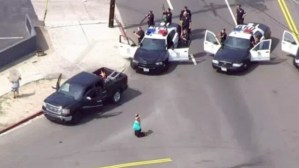
Los Angeles police gunned down a man at a busy Hollywood intersection Friday night, claiming he had been trying to attack them with a knife, causing them to fear for their lives, which is why they fired several rounds, leaving his body laying on a corner as shocked witnesses looked on.

But some locals are saying the man was merely a street performer known as “J” who would pose with tourists holding a prop knife made of plastic.

The area of Hollywood Blvd where he was killed is near the famous Walk of Fame and is renowned for its street performers who dress up in costumes and play roles to the amusement of tourists. Many of the performers dress up as characters from Hollywood movies, who pose with tourists for photos in exchange for tips.

The man shot was said to be impersonating the character from Scream, a 1996 horror movie, about a masked man with a knife who murders teenagers with a knife as pictured below.

Scream

LAPD is not releasing any information on the shooting, except for tweeting a picture of a folding knife laying near the body, perhaps a Swiss Army Knife, carried by boy scouts everywhere.

But some skeptics are saying the knife was planted because it is not clearly visible in the video recorded in the immediate aftermath of the shooting and posted to Facebook.

Hollywood shooting 2

I’ve watched the video several times and cannot make out a knife, but I cannot say with certainty it is not there.

However, the first several minutes of the video, which is posted below, show police clamoring all over the area where the knife was eventually photographed.

And at 4:44, a man dressed in blue wearing gloves bends down and appears to lay something on the ground.

Jordan White, the man who recorded the video, said the man was unarmed.

Screen Shot 2014-12-07 at 10.17.07 PM

So this could potentially be a huge scandal for the scandal-ridden LAPD.

What do you think? Do you see a knife in the first few minutes of the video? If you are a witness or know the man killed, please message me here.

Screen Shot 2014-12-08 at 1.31.25 AM

December 8, 2014 Posted by | Civil Liberties, Video | , , | Leave a comment

Stingray Warrentless Wiretap by Chicago Police on Activists

The Chicago Police were listening to an activist’s phone call(s) to learn about their “movements” in the city.

December 6, 2014 Posted by | Civil Liberties, Deception, Full Spectrum Dominance, Video | , | Leave a comment

US ‘ridiculous’ line on Egypt? Jen Psaki caught on hot mic

RT | December 5, 2014

US State Department spokesperson Jen Psaki has been caught on a hot mic calling one of her prepared statements about the acquittal of Egypt’s ex-leader Hosni Mubarak “ridiculous.”

During a press briefing on Monday, AP journalist Matt Lee asked Psaki to comment on an Egyptian court’s decision to acquit former President Hosni Mubarak of murder.

The State Department spokesperson attempted to dodge the question with a convoluted platitude.

“Generally, we continue to believe that upholding impartial standards of accountability will advance the political consensus on which Egypt’s long-term stability and economic growth depends,” she said on camera.

Reporters, including Lee, did not find that satisfying, but Psaki evaded their questions, saying she would not comment further.

“What does that mean?” a flummoxed voice can be heard asking.

“Wow. I don’t understand that at all,” the bemused Lee pushes. “What you said says nothing. It’s like saying ‘We support the right of people to breathe.’ That’s great, but if you can’t breathe.”

As the conference comes to an end and the lights dim, Psaki — seemingly unaware that her microphone is still on — suddenly goes off script.

“That Egypt line is ridiculous,” she can be heard saying, as Lee guffaws.

CNC reports that Lee also grilled State Department spokesperson Marie Harf on US reaction to the Mubarak trial the next day. Harf reportedly stuck to her talking points and refused to comment on the issue. When Matt Lee expressed frustration, she commiserated—kind of—saying, “I share your pain.”

The US, which supplies Egypt with over one billion dollars in aid annually, has largely steered clear of criticizing Egyptian policy. Mubarak’s acquittal last month prompted hundreds of demonstrators to take to Tahrir Square, the site of the 2011 revolution that led to his ousting. Mubarak had been charged with the killing of 239 protesters during the uprising against him.

December 5, 2014 Posted by | Deception, Video | , | Leave a comment

Ireland takes UK to human rights court over Hooded Men case

RT | December 4, 2014

The Irish government has asked the ECHR to reexamine the 1978 verdict of the Hooded Men Case. The Northern Irishmen involved seek justice after a new set of previously classified documents point to torture by the UK government in the high-profile case.

The case in question involves torture allegations brought by 14 suspects who said they were subjected to suffering during their detention without trial in 1971 at the Ballykelly British Army Base in County Londonderry.

Liam Shannon, one of the protagonists in the Hooded Men Case, told RT’s ‘In the Now’ that his nightmare began on August 9, 1971, when “hundreds of Catholic men” were arrested by the British Army and taken to detention centers all over Belfast, Northern Ireland, at the height of the troubles there.

From hundreds, Shannon says, 14 people were selected for “in-depth interrogation.”

“That took the form of the use of five techniques. ‘Wall standing’ in the stress position, ‘hooding’, white noise, sleep deprivation, food deprivation and continued beatings,” Shannon told RT host Anissa Naouai.

After the men were released, they brought a legal challenge to the European Court, which in 1978 ruled that the evidence against UK authorities did not constitute torture, but instead was ‘inhuman and degrading treatment’. This judgment is now being challenged.

“We never expected that a government would torture its own citizens and that’s exactly what happened,” Shannon says, as he recalled his pain from his detention. “We were hooded from the word go. We were put into helicopters and told that we were hundreds of feet in the air, and thrown out just to find that we were 3 or 4 feet off the ground.”

Calling it a “very frightening experience,” he said ‘hooding’ continued for seven days straight as the “hoods were never taken off except during interrogation,” when he was repeatedly beaten.

“We were kept hooded, we were beaten. If we couldn’t stand against the wall for any longer… and if you attempted to get off the wall you were severely beaten and put back open again,” Shannon recalls.

All men in the case, Shannon says, suffered psychologically as well as physically from the confinement.

“I actually contracted Crohn’s disease afterwards when I was released from prison, which left me very, very ill for quite some time and left me having to take strong medication for a long time. We also all have sleepless nights, nightmares, cold sweats… everything else that goes along with it.”

A statement by the Irish Foreign Minister Charles Flanagan on Tuesday announced the request by Dublin for the European court to revise its judgment. He said that the government had taken seriously the material in the RTÉ documentary ‘The Torture Files’ in June this year.

“On the basis of the new material uncovered, it will be contended that the ill-treatment suffered by the Hooded Men should be recognized as torture,” Flanagan said. […]

RT’s ‘In the Now’ managed to get a hold of Paul O’Conner from the Pat Finucane Centre (PFC), a human rights advocacy and lobbying entity in Northern Ireland which helped initiate RTE’s documentary.

He told RT that PFC’s research in the British National Archives in London led to “literally thousands of documents” that prove UK government was complicit in torturing the hooded men.

“These documents show that the British government has misled the court. They withheld evidence, they withheld witnesses. They have lied to the court. And with that evidence, we went to Irish State television,” O’Conner said.

Now as victims await the torture recognition verdict, Shannon says all they want is justice.

“It will make a massive difference. It will be some justification for all the years and it will be some benefit psychologically for us. We have to remember that three of our number have since died premature deaths. Their loved ones, their families – it will make a massive difference to them, because they know what happened to their loved ones. Their loved ones were tortured to death,” Shannon told RT.

At the same time O’Conner stressed that torture conclusion by the ECHR will change a number of things. First of all, he says it will prompt a police investigation into the allegations of torture.

“That has not happened and yet we know from the documents which have emerged that senior government ministers were named as having ordered the torture, namely Lord Carrington, then Secretary of State for Defence , in the 1970s,” O’Conner told Naouai.

And most importantly, O’Conner claims the 1978 verdict will cease to be used as a precedent to justify the torture of own citizens.

“This very case has been quoted by the Israeli supreme court in cases involving torture of Palestinians. And in the infamous torture memos that were provided to George Bush in the lead up to Iraq War, the memos which led to the establishing of the Guantanamo Bay, they quote this judgment extensively,” O’Conner says.

December 4, 2014 Posted by | Subjugation - Torture, Video | , , , , , | Leave a comment

No Indictment for NYPD Cop Killing Man in Chokehold in Viral Video

By Carlos Miller | PINAC | December 3, 2014

Just over a week after a Missouri grand jury found no probable cause against a Ferguson cop who shot a teen to death, a New York grand jury found no probable cause against the NYPD cop who choked a man to death in a video that went viral in August.

Eric Garner, 43, died after being confronted by undercover cops who accused him of selling untaxed cigarettes.

A protest is scheduled tonight at Rockefeller Center at a time when the nation is already experiencing protests throughout the country after a grand jury failed to indict Ferguson police officer Darren Wilson in the shooting death of Michael Brown, an 18-year-old teenager.

The one difference is that the Garner case was captured on video, leaving little room for speculation as to what took place. In fact, chokeholds have been banned by the NYPD since 1993 because too many suspects died in custody.

But evidently, it was not enough to convince the grand jury there was enough probable cause to charge NYPD officer Danny Pantaleo, who was seen smiling and waving at a camera in the minutes after he killed Garner as you can see in the video below that also shows paramedics ordering Garner’s lifeless body to stand up without making any attempts to revive him.

Garner’s death was ruled a homicide by the medical examiner’s office two weeks after the incident. The decision comes two days after President Obama announced he would seek funding to supply 50,000 body cams to police officers throughout the United States to hold them accountable.

But as we can see here, even with video evidence, it is nearly impossible to charge a cop for killing unarmed citizens.

The man who recorded the incident, Ramsey Orta, was arrested on weapons charges shortly after the video went viral in what many believe was in retaliation. […]

A few weeks after the incident, the New York police union held a press conference explaining that if you don’t comply, you will die. That video is below.

UPDATE: Justice Department to open civil rights investigation in Eric Garner case

December 3, 2014 Posted by | Civil Liberties, Subjugation - Torture, Video | , , | Leave a comment

Illegal settlement agriculture in the Jordan Valley – The case of Carmel Agrexco

Alhaqhr | December 1, 2014

Illegal settlement agriculture in the Jordan Valley – The case of Carmel Agrexco

Virtual Field Visit: Illegal quarrying in the West Bank – The case of Hanson

December 1, 2014 Posted by | Ethnic Cleansing, Racism, Zionism, Illegal Occupation, Video | , , | Leave a comment

Texas Cop Places Woman in Chokehold for Video Recording

UPDATE: Texas Cop Loses Job for Chokehold on Woman, 2nd Cop Disciplined for Ordering Footage Deleted

By Carlos Miller | PINAC | November 30, 2014

A Texas cop placed a woman in a chokehold because she was video recording some type of police activity in the parking lot of what appears to be a fast food restaurant after she refused to provide identification.

It started when Corpus Christi Sergeant J.E. Lockhart stormed up to Lanessa Espinosa, who was standing a good distance away from the investigation, accusing her of interfering – after a nearby cop from another agency accused her of being a “jailhouse lawyer.”

“There is a probable cause for us to be out here,” Lockhart said. “I want to know who you are, so I’m requesting your ID. You fail to ID, I’m going to take you into jail. And that’s law.”

“What’s my charge?

“You’re not being charged with anything.”

“Then I don’t have to show you my ID, sir.”

“You’re involved in an investigation. You want to interfere with an investigation, you’re going to jail for interfering with a police officer in performance of his investigation. Do you understand that? DO YOU UNDERSTAND THAT?”

Espinosa understood that Lockhart was out of line, so she said she was in fear for her safety and took a step back, which was when another cop placed her in a chokehold.

Espinosa turned the camera on herself as she was getting chokehold by the cop from the other agency, whose agency has not been determined because Corpus Christi runs into four counties and I haven’t been able to make the patch out.

That cop then turned her over to Lockhard, who handcuffed her.

Espinosa has not responded for comment from PINAC over the incident, but public records show she was not arrested.

UPDATE:

The video of a Texas woman getting placed in a chokehold and handcuffed for refusing to provide her identification ended up going viral where it was covered by a local television news station at the top of the news hour Monday night.

However, KIII-TV reporter Bill Churchwell finished the segment by providing misinformation about the law when it comes identifying yourself to police, informing viewers that citizens are required to identify themselves whether or not they have been lawfully arrested.

Nothing could be further from the truth.

The Texas Failure to Identify law makes it a crime for people to refuse to identify themselves if they have been lawfully arrested or if the person provides false information if they have been lawfully detained.

However, when news anchor Joe Gazin asked Churchwell about this law, the reporter stated the following:

“Well that is required whether you are a witness or involved in an incident, you are required to  tell officers who you are,” Churchwell said.

Churchwell is most likely getting his information from police without bothering to look at the actual statute, which is a big mistake because we all know police are clueless about the laws they are supposed to enforce.

But that is the norm for mainstream media reporters who don’t want to risk questioning their local police department and therefore lose access to the daily information that enables them to report the news without putting in much effort.

However, it didn’t take long for a viewer to set the record straight on KIII-TV’s Facebook page about the law.

Screenshot 2014-12-01 20.45.23


Blogger ExCop-LawStudent, a former Texas cop turned law student, also elaborated about the law on his blog.

In the video, a police officer with an unknown police department† claims that Lanessa Espinosa is a “jailhouse lawyer” because she actually knows what the law says. She pointed out that she did not have to identify herself unless she was “being charged.” At that point Corpus Christi Senior Officer‡ J.E. Lockhart comes up and demands ID and tells her that he will arrest her if she doesn’t provide ID.

The problem is that § 38.02, Texas Penal Code, does not authorize an arrest for failure to ID on a mere detention unless the person provides a fictitious name. We’ve covered that several times, here, here, here, here (also in Corpus), here, here, here, and here.

There are several things wrong with the video. First, the officer from the unknown department is choking Espinosa with an arm-bar choke hold. If you look at the video at 1:12, you’ll see the officer’s forearm cutting directly over Espinosa’s adam’s apple in the same manner that killed Eric Garner in New York. The arm-bar choke hold is almost universally viewed as deadly force, and completely inappropriate here when the crime is at best, a misdemeanor under the officer’s mistaken idea of the law.

Second, it is a false arrest. Even more so, it is an arrest because she is exercising her right not to provide identification when he knows (or should have known) that the arrest is unlawful, and that he intentionally denied her of her freedom when he knew (or should have known) that his conduct was unlawful. Folks, that the definition of Official Oppression, § 39.03, Texas Penal Code, and is a Class A misdemeanor.††

Some states have what are called “stop and identify” laws, which requires citizens to identify themselves if they have been detained, but Texas is not one of those states, which is why it only requires a citizen to identify themselves if they’ve been arrested.

There is no state where citizens are legally required to provide identification merely because a cop demands it unless the cop has detained you because he had a reasonable suspicion that you committed a crime.

That doesn’t mean cops won’t demand your identification because they do it all the time, many times under intimidating threats of arrest, which is why we must remain recording in these situations.

And if a cop tells you he has the right to ask you for your identification, tell him you have the right not to provide that identification. … Full article

December 1, 2014 Posted by | Civil Liberties, Deception, Mainstream Media, Warmongering, Solidarity and Activism, Subjugation - Torture, Video | , , | Leave a comment

Postcards from Pripyat, Chernobyl

Postcards from Pripyat, Chernobyl from Danny Cooke on Vimeo.

November 30, 2014 Posted by | Nuclear Power, Timeless or most popular, Video | | Leave a comment