Israel ‘deliberately’ pursuing policy of destroying Palestine: Iran
Press TV – March 5, 2024
Iran’s foreign minister has condemned the “unprecedented” crimes Israel has committed in the besieged Gaza Strip over the past five months.
The Israeli hostilities prove the regime is “deliberately” pursuing the policy of destroying Palestine, Hossein Amir-Abdollahian stated.
The Iranian minister was addressing an emergency meeting of the Organization of Islamic Cooperation (OIC)’s foreign ministers in the Saudi city of Jeddah on Tuesday.
The meeting, requested by Iran and some other Islamic countries, was held to review the latest developments in Gaza and to discuss effective measures to halt the Israeli campaign of death and destruction in the besieged Palestinian territory.
“In a situation where we are once again witnessing the inability of the UN Security Council to deal with the oldest and most bitter humanitarian crisis in contemporary history, the consensus of Islamic countries to find practical ways and take more serious measures to support the Palestinian people and help find a way out of the status quo is absolutely urgent and necessary,” Amir-Abdollahian told the OIC meeting.
Warning that the dire humanitarian situation in Gaza as well as atrocities in the occupied West Bank have reached an “unprecedented” level, Iran’s top diplomat said Washington, through its unwavering support for Israel, is practically giving the regime a “green light” to go ahead with a planned military invasion of Rafah, where more than half of Gaza’s population is now crammed into the southern city bordering Egypt.
“It is unfortunate that senior officials of the United States, with their stances, are practically giving the Zionist regime a green light to launch a military attack on Rafah.”
The Iranian foreign minister said Washington’s blatant obstruction of UN Security Council measures to prevent the Israeli aggression in Gaza shows relying on the US to “prevent the ongoing genocide is an illusion and more of a diplomatic joke.”
The US is an accomplice and partner in the crimes of Israel, Amir-Abdollahian said, adding that the “crocodile tears” by certain US officials over the humanitarian situation in Gaza “do not change the reality.”
The foreign minister told the OIC that any economic and financial relations with the Israeli regime amounts to “facilitating the continuation of its heinous behavior” toward the Palestinians.
Calling for a broader boycott of products manufactured by Israeli companies, Amir-Abdollahian said under the current circumstances it is imperative for the OIC to “take decisive and effective practical measures to support the Palestinians.”
“This is our human and Islamic duty towards our Palestinian brothers and sisters. Preventing a new disaster against the Palestinian nation is an immediate necessity,” he said.
The Israeli regime launched the savage campaign in Gaza on October 7 after the Palestinian resistance movement Hamas carried out a surprise operation against the occupying entity in response to the regime’s never-ending atrocities against Palestinians.
The regime has since killed at least 30,600 Palestinians, mostly women and children. Thousands more are also missing and presumed dead under the rubble.
The conflict in the Red Sea and the reaction of the world community
By Viktor Mikhin – New Eastern Outlook – 04.03.2024
During the discussion that took place on 14 February 2024 at the UN Security Council meeting, questions were raised about the unlawful shelling by the US and UK in Yemen in violation of all international laws and regulations. This serious issue was discussed in detail due to the violations of international law and human rights that accompany these shellings. The UNSC participants condemned these actions by the US and the UK as illegal and unacceptable. Despite demagogic statements about the fight against terrorism and alleged support for international security, such shelling by Western powers located tens of thousands of kilometres away from the Red Sea basin only exacerbates the humanitarian situation in Yemen and causes irreparable harm to the lives of civilians, including primarily children and women. At the meeting, the panellists rightly raised the need to put an urgent end to this shelling and to return to negotiations for a peaceful resolution of the conflict. It was noted that another wave of violence by Western countries would only exacerbate the situation in that poor Arab country and hinder the achievement of sustainable peace in the region.
Russia’s and China’s opinion
Russia and China have deemed the US and UK bombing of Yemeni territory illegal and contrary to the United Nations Charter, accusing them of illegally attacking Yemen, whose residents support the Palestinians of the Gaza Strip in the face of the Israeli regime’s bloodbath. Russia’s Deputy Ambassador to the UN Dmitry Polyansky and China’s representative to the UN Zhang Jun stressed that the UN Security Council has never authorised military action against Yemen. For his part, the UN special envoy for Yemen, Western representative Hans Grundberg, said that the US and UK attacks and the American declaration of the Ansar Allah resistance movement in Yemen as a “specially designated terrorist group” were merely “of concern.” And what exactly could this so-called envoy, who is entirely on Washington’s payroll and receives all instructions from White House officials, have said.
Mr Polansky correctly emphasised that the root cause of the current situation is Israel’s war crimes in Gaza, which have provoked angry reactions in West Asia, including from Yemenis. “An immediate ceasefire in Gaza will help stabilise the situation in the Red Sea, and de-escalation will in turn unblock the efforts of Special Envoy Grundberg,” he said. The Chinese envoy also expressed concern over the escalation of tensions in the Red Sea region, in particular “the continuation of military operations by certain countries” against Yemen. He called for an immediate halt to the Yemeni hostilities against merchant shipping and stressed the fact that the UN Security Council has not authorised the use of force against Yemen.
“At this critical moment, China hopes that all parties in Yemen will put the interests of the people first, show determination and resolutely push the political process forward to achieve final results,” Zhang Jun added. He also emphasised that “the most urgent task is to immediately promote a ceasefire in Gaza and take responsible measures to prevent further escalation in the region.”
Aggressive actions of the US and UK
For weeks, the United States and Britain have been waging a fierce bombing campaign on Yemeni territory. The reason is well known – this Arab country has boldly declared its open support for the Palestinians in the besieged Gaza Strip against the Israeli carnage since 7 October last year, in which some 30,000 civilians, especially the elderly, women and children, have already been killed. The US, being one of the leading superpowers and a global factor, has stated its brazen stance on the issue of shelling Yemen. They deny their direct involvement in the conflict, claiming that they are only supporting military assistance and supplies to Saudi Arabia, which in turn is conducting operations to defeat the Houthis. However, human rights advocates and humanitarian organisations have raised accusations of US involvement in human rights and civilian violations during these operations.
Despite strong condemnation of its brutal and aggressive actions, the United States has again “conducted five strikes in self-defence” against areas of Yemen controlled by the Houthi militia, the US Central Command said. It struck three mobile anti-ship cruise missiles, one unmanned underwater vessel and one unmanned surface vessel on 17 February, the statement said. “This is the first observed use of an unmanned aerial vehicle by the Houthis since the attacks began on 23 October,” CENTCOM said in a statement on its X website. Central Command said it had determined the missiles and ships posed “an immediate threat to U.S. Navy ships.” The Houthi attacks in the Red Sea area have been one of the signs of spreading conflict in the Middle East since war broke out between Israel and Hamas after 7 October.
Unlike the US, the UK, its closest ally and most likely a country once with a solid international reputation, chooses not to explicitly support Saudi Arabia, but also does not actively oppose it. Instead, London claims to be providing military assistance centred on training and advice to prepare the Saudi army for its tasks. In these statements, the British demagogically point to the importance of maintaining the stability of the region and fighting terrorism. However, in doing so, they forget to recall that it is they, together with their overseas partners, who are the main disturbers of peace and tranquillity and the main “creators” of the atmosphere of terrorism in the region.
Alongside these states, some delegates from US satellite countries expressed support for the US and UK, arguing that the shelling was in response to acts of terrorism and extremism that threaten world security. They emphasise the need for action to ensure the safety of their citizens and partners. The UN Security Council meeting was by all accounts very tense and controversial, reflecting the complexity of the situation in Yemen and the multifaceted challenges faced by the parties to the conflict. But it was nevertheless called for further discussion and for finding ways to end the violence and restore peace. In conclusion, the UN Security Council meeting emphasised that violators of international law and human rights, including the systematic shelling of Yemen, must be brought to justice and those responsible must be punished accordingly. The decision on further steps and investigations was postponed until all the arguments made during the discussion are recorded, and a relevant document is prepared for further voting.
Ways and means of resolving the conflict in the Red Sea
Human rights advocates and humanitarian organisations object to this position and allege US and UK complicity in human rights and civilian violations in Yemen. Critics also point out that US and UK military aid could be used to commit crimes against humanity and military operations could be disproportionate and indifferent to civilians. The need to resolve the conflict in Yemen is integral to upholding international law and protecting human rights. The world community must continue dialogue, find a political solution and provide humanitarian assistance to end the exclusively military approach and eliminate civilian suffering. So, the position of the US and UK on the shelling of Yemen is causing disagreement and concern among human rights supporters and humanitarian organisations. It is necessary to continue the international discussion in order to achieve peace and stability in the region, calling for respect for international law and the protection of human rights.
Yemen continues to actively target American and other ships that deliver supplies to Israel. The Yemenis’ main argument in favour of shelling ships delivering supplies to Israel is the destruction of Palestinian civilians in the Gaza Strip. In their view, the situation in Palestine remains tense due to Israeli occupation and state policies, leading to regular conflict and violence. In turn, by supporting trade with Israel, American and other ships become indirect contributors to Palestinian suffering. Yemen’s weakened economy and infrastructure put the country in a difficult position. Regular new sanctions and the blockade of the country by international allies make Yemen’s economy extremely vulnerable. For Yemen, the shelling of ships delivering supplies to Israel may be an attempt to gain international attention and launch a dialogue on the Palestinian issue.
In today’s world, the Red Sea remains a key region of geopolitical importance. Along with issues of security and economic stability, emerging conflicts between states and factors in the region regularly attract international attention. However, there are different ways and factors that can play an important role in resolving and preventing conflicts in order to achieve peace and tranquility in the Red Sea.
Above all, the States in which the Red Sea is located must take an active part in finding a way to resolve conflicts peacefully. They should seek dialogue and international cooperation rather than the use of force and military action. Instead of creating tension and threatening security, states should seek common interests and co-operation in the fields of economy, trade, transport and combating international terrorism.
However, in addition to the active role of states, international organisations and forums can play an important role in resolving conflicts in the Red Sea. For example, the United Nations can mediate negotiations and facilitate agreements between states in the region. It can propose mechanisms and strategies to resolve disputes and support dialogue between parties. Also, regional international organisations such as the Arab League or the African Union can contribute to conflict resolution and stability in the Red Sea.
In addition, the role of civil society and non-governmental organisations should not be forgotten. They can play an important role in planting peace and tranquility in the region through engaging in diplomatic efforts, supporting dialogue between the parties and publicly highlighting conflicts. Civil society can give a voice to peace and help to shape public opinion in favour of the peaceful resolution of conflicts.
It is quite clear that conflicts in the Red Sea can and must be resolved in the interests of peace and tranquillity in the region. To that end, the active participation of States, international organisations, civil society and non-governmental organisations is essential. Only through cooperation and dialogue can sustainable peace and tranquillity in the Red Sea be achieved, which will benefit all States and peoples living in the region.
Victor MIKHIN is a Corresponding Member of the Russian Academy of Natural Sciences.
Gaza ‘flour massacre’ textbook case of Israel’s war crimes and cover-ups
By Alireza Hashemi | Press TV | March 4, 2024
In the early hours of Thursday, in line with its genocidal war against Palestinians in the besieged Gaza Strip, Israeli troops opened indiscriminate fire on people waiting for food aid in the southwest of Gaza City.
At least 116 people were killed and more than 760 others injured in what rights groups described as a textbook case of cold-blooded massacre on the Al Rashid street that stretches along the coast of Gaza.
The regime denied involvement in the massacre that came nearly five months into the Israeli genocide in the besieged territory, which has so far claimed the lives of more than 30,400 Palestinians.
The flawed Israeli narrative kept changing and evolving throughout the day, designed to shift the blame on victims, the desperate aid-seekers who were there to get some flour.
The Israeli army claimed they had nothing to do with the incident and blamed a stampede for it. Later, they said trucks carrying aid had run over civilians. Finally, they admitted to having fired at the crowd, but “only targeting the militants trying to sabotage the aid delivery.”
A report by Yediout Aharonot said, “Dozens of Gazans died during a stampede as large crowds descended on humanitarian aid trucks entering northern Gaza, attempting to loot supplies and sparking violent clashes, the IDF reported on Thursday.”
“An initial IDF probe into the incident found that Palestinian gunmen fired at the aid trucks, with most fatalities resulting from trampling and crowding,” the report noted.
Another report by the Times of Israel said it “acknowledged that troops opened fire on several Gazans who moved toward soldiers and a tank at an IDF checkpoint, endangering soldiers, after they had rushed the last truck in the convoy further south.”
Reuters quoted an Israeli official as saying “there had been two incidents”, in one of which “dozens” were “trampled or run over” and in the second “some people” approached troops including a tank who “felt under threat and opened fire” in a “limited response”.
“The soldiers fired warning shots in the air and then fired towards those who posed a threat and did not move away,” Reuters quoted the official as saying.
“This is what we understand. We’re continuing to review the circumstances.”
In the broadest account, the Jerusalem Post, quoting Israeli army sources, said three incidents occurred.
The first one was the stampede that left most of the casualties, the second when the armed Palestinians fired on the trucks and stole supplies, and the third when a large group of Palestinians approached the Israeli forces nearby, who responded with live fire.
The Israeli newspaper, quoting its sources, claimed that “it was unclear if they had aggressive intentions or were civilians caught up in a chaotic moment.”
Later on Thursday, Israeli army spokesman Rear Admiral Daniel Hagari said the military had fired “a few warning shots” to try to disperse a “mob” who had “ambushed” the aid trucks.
“As these vital humanitarian supplies made their way toward Gazans in need, thousands of Gazans [rushed] the trucks, some began violently pushing and trampling other Gazans to death, looting the humanitarian supplies,” he said.
Some accounts identified those targeted as ordinary people and others identified them as a “mob”.
For example, Israel’s far-right minister Itamar Ben Gvir said Israeli soldiers “acted excellently against a Gazan mob that tried to harm them”.
In some versions, the victims were said to have trampled each other and in others, the trucks were believed to have mowed down people.
Israeli regime spokesman Eylon Levy blamed “Gaza truck drivers” for the massacre.
In this age of technology, it is interesting that Israeli accounts are never consistent and the regime officials are always “reviewing” things and struggling to find simple answers.
The regime offered no evidence to back its claims. It released a 100-second, heavily edited drone video as proof, which showed aid seekers surrounding trucks, but no trampling or trucks running over people.
If the Israeli drones recorded the situation, why did the regime not publish the scenes showing the moment when people were “trampled” or “run over”?
Holes in Israeli story
However, the strategy of ‘cover-up’ didn’t work this time. There are several glaring holes in the Israeli version of the incident that demand unraveling.
How did Gazan truck drivers start to kill their own people? Why hasn’t this ever happened before?
Or, why did Israeli troops kill 10 unarmed, starved Palestinians who had approached them? What kind of threat did these people pose to armed-to-the-teeth soldiers and tanks?
And, how scores of people were trampled? In any case, who is to blame for the desperate humanitarian situation that this regime claims was the cause of the incident?
These holes are filled by the Palestinian witness accounts that present a different chain of events.
Palestinians say most of the people present at the scene fell victim to Israeli gunfire, and the stampede occurred only after the Israeli troops started indiscriminately firing at them.
Local journalist Khadeer Al Za’anoun, a reporter for the Palestinian news agency Wafa, who witnessed the incident, said the chaos and confusion were sparked after Israeli forces opened fire, which led to people being hit by aid trucks.
Al-Jazeera journalist Ismail al-Ghoul reported that Israeli tanks “advanced and ran over many of the dead and injured people.”
The acting director of the Al-Awda Hospital said they received 161 wounded patients, most of whom appeared to have been shot.
Also, an initial probe by the Euro-Med Human Rights Monitor showed that the Israeli army gunfire was responsible for most deaths in a massacre of Palestinian civilians.
In a follow-up report, the rights group confirmed the regime’s “full involvement” in the massacre at the Nabulsi roundabout, calling for an “effective international investigation to hold Israeli officials accountable.”
Its field team – present at the time of the incident – “documented Israeli tanks firing heavily towards Palestinian civilians while trying to receive humanitarian aid,” the report noted.
Trying to get away with another massacre
The incident has been widely condemned by governments and organizations. The United Nations Secretary-General Antonio Guterres called for an independent probe into the killing of civilians.
Iran slammed “the barbaric attack by the Zionist regime”. Iranian foreign ministry in a statement said “The wound of Gaza will not be erased from the memory of the free people of the world.”
China said it was “shocked” while Colombia said, “This is called genocide and recalls The Holocaust.”
Even European allies of Israel, including France and Italy, denounced the massacre. Josep Borrell, the EU’s top diplomat, described the incident as a “totally unacceptable carnage”.
It wasn’t the first massacre of Palestinians though. There have been massacres every day in the Gaza Strip since October 7.
On January 26, Gaza’s Health Ministry said Israeli fire struck a crowd of people waiting for humanitarian aid at a roundabout in Gaza City on Thursday, killing at least 20 and wounding 150.
The UN Office for the Coordination of Humanitarian Affairs said on February 4, “a group of people a group of people waiting for humanitarian aid trucks near Al Kuwaiti roundabout in southern Gaza City were reportedly fired at.”
Another report referred to the February 5 attack on an aid convoy at the same place, Al-Rashid Street. That attack forced the UN Agency for Palestinian Refugees to warn it could not carry out its mission and provide humanitarian relief if safety conditions were not met.
A day before the latest attack, on Wednesday, Wafa news agency reported that three Palestinians, who were waiting for aid near Gaza City, were killed after being hit by Israeli artillery fire on al-Rashid Street.
Israel has a long record of massacring Palestinians in cold blood and then trying to cover up their crimes and avoid accountability, say observers. A notable example is the Deir Yassin massacre in 1948 when at least 107 Palestinians were slaughtered by Zionists.
The bloodthirst of the child-murdering regime has only increased over the years.
Scores of Palestinians killed, injured as Israel bombs aid truck in central Gaza
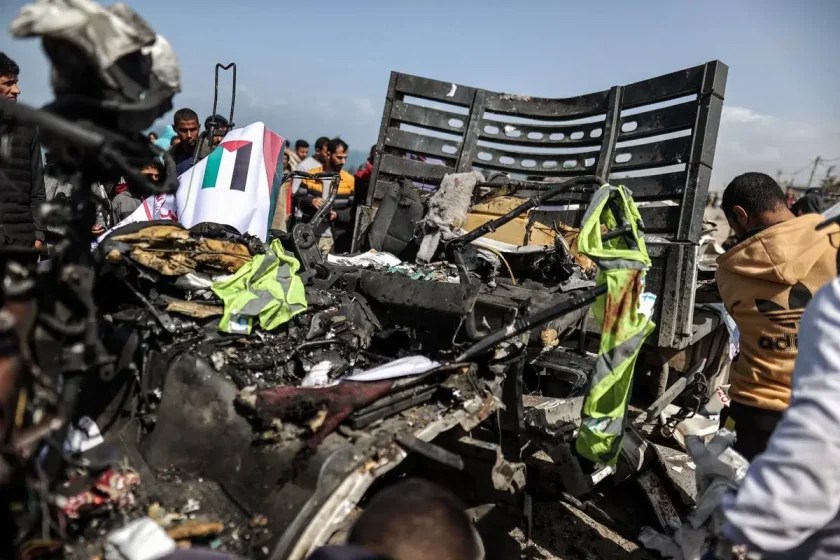
A humanitarian aid vehicle which had been the target of Israeli airstrikes resulting in the death of nine and dozens of injured in Deir Al-Balah of Gaza on March 3, 2024. [Ali Jadallah – Anadolu Agency ]
MEMO | March 3, 2024
Scores of Palestinians were killed and injured when the Israeli army dropped bombs on people collecting humanitarian aid from a truck in Deir al-Balah in the central Gaza Strip on Sunday, Anadolu reports.
This is the second major Israeli attack in the last five days on displaced Palestinians in Gaza who are waiting for humanitarian aid.
Earlier on Thursday, at least 112 Palestinians were killed and 760 others injured when Israeli forces shelled a crowd waiting for humanitarian aid south of Gaza City.
“Many people were killed and others wounded in an Israeli bombing that targeted an aid truck in the city of Deir al-Balah in the central Gaza Strip,” sources in the medical field told Anadolu while requesting anonymity.
So far, the number of casualties from the latest attack is not clear as neither the Health Ministry in the besieged Gaza Strip nor Israeli authorities have issued statements.
Israel has launched a deadly military offensive on the Gaza Strip since an Oct. 7, 2023, cross-border attack led by Hamas, in which nearly 1,200 people were killed.
At least 30,410 Palestinians, mostly women and children, have since been killed in Gaza, and 71,700 others injured amid mass destruction and shortages of necessities.
Israel has also imposed a crippling blockade on Gaza, leaving its population, particularly residents in the north where the Thursday shootings took place, on the verge of starvation.
The Israeli war has pushed 85% of Gaza’s population into internal displacement amid acute shortages of food, clean water, and medicine, while 60% of the enclave’s infrastructure has been damaged or destroyed, according to the UN.
Israel stands accused of genocide at the International Court of Justice. An interim ruling in January ordered Tel Aviv to stop genocidal acts and take measures to guarantee that humanitarian assistance is provided to civilians in Gaza.
Injured survivors of Gaza aid chaos say Israeli forces shot at them
MEMO | March 2, 2024
Divergent accounts
US, UK accused of hindering investigation into UN chief’s plane crash in 1961

UN secretary general Dag Hammarskjöld, who died in a plane crash in Africa in 1961 en route to talks with Katangan rebels. (Photo by REX)
Press TV – March 2, 2024
Scholars have accused the United States and the United Kingdom of impeding a United Nations investigation into the 1961 airplane accident that resulted in the death of UN chief Dag Hammarskjöld.
Hammarskjöld, a Swedish national, was killed in a plane crash, which was allegedly taken down intentionally on September 18, 1961, while en route to mediate a ceasefire between UN peacekeepers in the Congo and separatists from the breakaway Congolese region of Katanga.
During a conference in London, attendees were briefed by Stephen Mathias, the UN assistant secretary general for legal affairs, on the latest developments in the investigation, which aims to obtain archived documentation from member states.
The attendees expressed concerns that both the US and UK were delaying the transfer of potentially crucial information.
“While Belgium, Sweden and Zimbabwe demonstrated serious efforts, the US and UK responses were wholly inadequate and showed contempt for the UN inquiry,” said the organizers of Thursday’s conference, the Institute of Commonwealth Studies at the University of London and the Westminster United Nations Association.
“The most recent general assembly resolution to renew the investigation was co-sponsored by 142 UN member states out of 193 – but not by the US and the UK,” said Susan Williams, a researcher whose 2011 book “Who Killed Hammarskjöld” contributed to the reopening of the UN inquiry.
Paul Boateng, the former UK high commissioner to South Africa, said: “The work must continue because it is part of a wider struggle to support democracy, the international rule of law, and the UN, all under increasing threat.”
“There must be no stone unturned to get at the truth. The suspected murder of a UN secretary general is a crime too grave to be obliterated by time.”
The crash resulted in the death of 15 other passengers, and its first inquiry, which was carried out by Rhodesian authorities, concluded that the crash was the result of a pilot error, but the finding was controversial.
People who witnessed the crash on the ground had claimed that they saw another aircraft apart from the chief’s.
At that time, French and British intelligence officers were reported to be near Ndola, Northern Rhodesia (now Zambia), where the crash took place, while US intelligence officers were monitoring communications from Cyprus and reported hearing communications consistent with the UN plane coming under fire.
Hammarskjöld was killed amidst a contest for resources in Africa during the post-colonial era, during his last journey, he was en route to a clandestine gathering aimed at mediating an end to the civil conflict in the newly liberated Congo, a nation abundant in minerals and teetering on the edge of collapse.
In the year before, the eastern province of Katanga had declared independence in 1960. While being a major contributor to the country’s economy, this region is renowned for its vast ore deposits, including uranium ore used in the atomic bomb, which was dropped on Hiroshima.
What the Nurses Saw — It was Murder
An investigation into systemic medical murders that took place in hospitals during the COVID panic and the nurses who fought back to save their patients
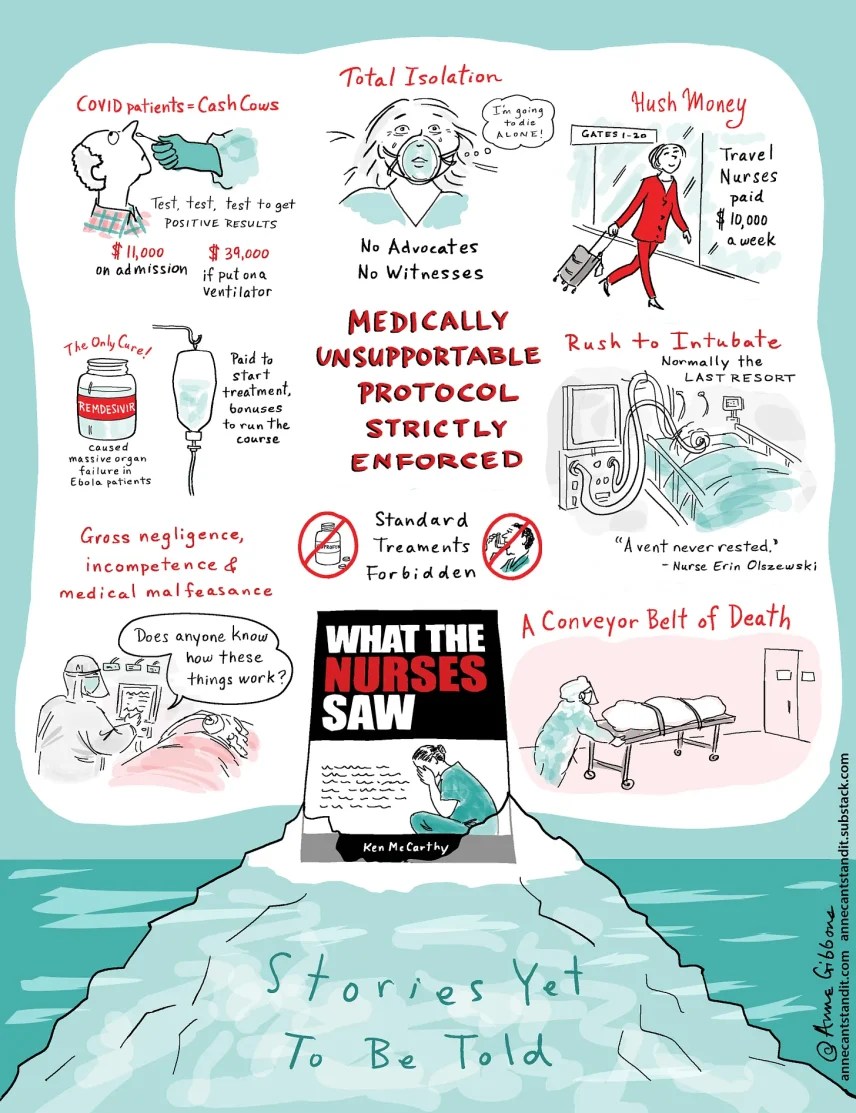
By Ken McCarthy | December 6, 2023
No human activity can ever be free from error, but to be clear, this book is not about the kind of error all human beings are prone to.
As you will learn from the eye-witness accounts and technical information presented in this book, calling the failed COVID protocols “errors” is not accurate.
 These protocols were explicitly ordered by those who took dictatorial control of the medical system early in the Panic (spring of 2020). Further, when they were shown to be demonstrably failing and harming many thousands of people, experienced healthcare professionals who raised informed concerns were silenced through demotion, firing, and organized campaigns of harassment promoted by the news media and enabled by companies like Google, Facebook, Twitter, and TikTok, in some cases in collaboration with the White House and the Department of Justice’s FBI.
If this sounds very bad, it’s because it is.
What the Nurses Saw is documentation of what happens in the real world when bureaucrats, in this case bureaucrats in Washington DC, take literal dictatorial control over the practice of medicine.
On a pure dollar and cents level, one of every five dollars spent in the U.S. is spent on the products of the medical services industry, as is one of every three tax dollars. The U.S., more than any country in the world, and by a large measure, has been colonized by this industry. As part of this process, the industry and its operatives have corrupted and perverted science, academia, and the news media. Now it’s hard at work to weaken and degrade the last pillar that keeps the system even remotely functioning — the integrity of the nursing profession.
If we fail to support our good nurses, help them hold the line, and start aggressively turning things around, there is no practical limit to how far this totalitarian medical dictatorship which we in fact live under will go in its future abuse and exploitation of human beings.
Featuring in-depth interviews with:
Erin Marie Olszewski,
Kevin Corbett Ph.D.,
Kimberly Overton,
Ashley Grogg,
Kristen Nagle,
Sarah Choujounian,
AJ DePriest,
Mark Bishofsky,
and Katie Spence
Please share the link: WhatTheNursesSaw.com
MPs smear Gaza protestors, while others invent scare stories
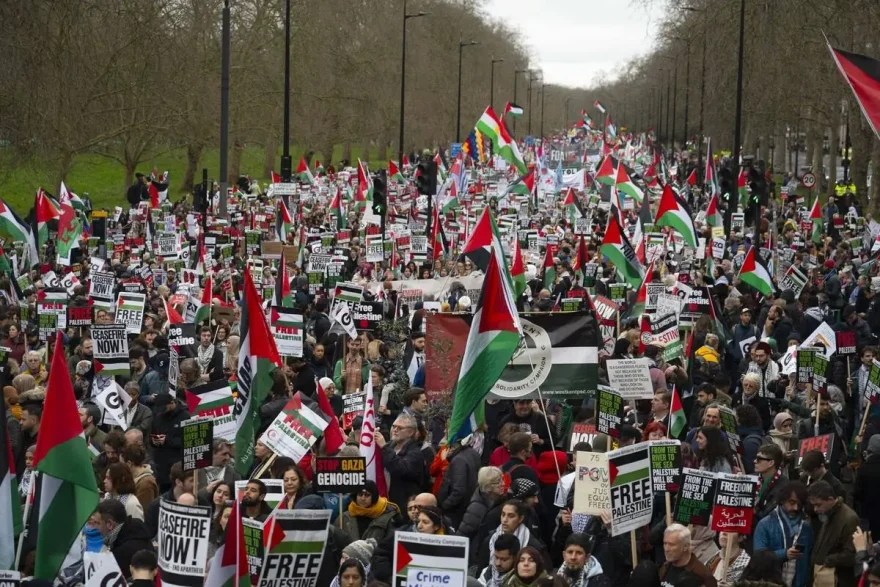
By Yvonne Ridley | MEMO | March 1, 2024
Are the massive pro-Palestine marches in Britain being deliberately targeted and smeared as part of a concerted Zionist effort to use the law to stop people from joining the ranks of the growing anti-war movement? That would certainly explain the furore over MPs’ safety which came to a head last week when Sir Lindsay Hoyle, the Speaker of the House of Commons and a member of the Labour Friends of Israel lobby group, cited threats to politicians in his disastrous handling of a debate on calls for a ceasefire in Gaza.
I pose the question after some extraordinary events have been picked up and anchored in a media campaign which has collectively shown nothing but hostility towards Palestinians in favour of the Zionist Israeli state as the genocidal onslaught in Gaza continues. Throw in some decidedly Islamophobic comments by prominent Conservative MPs, and there is a really toxic atmosphere brewing in advance of this year’s General Election, with Muslims — “Islamists” — cast as the bad guys.
Today, my suspicions were fuelled by none other than British Prime Minister Rishi Sunak who resorted to shameless smears and scare tactics as he warned police chiefs of a “growing consensus that mob rule is replacing democratic rule”. Calling for more robust police action, Sunak used inflammatory language to insist that politicians need to be protected from intimidatory protests outside their homes.
However, the Home Office has nevertheless announced a £31 million package aimed at protecting MPs. It is said to be in response to the impact of the ongoing “Israel-Hamas conflict”.
Meanwhile, in Scotland police were called to investigate bizarre claims that the Glasgow constituency office of Labour Members of the Scottish Parliament was “stormed” by 30 pro-Palestine protesters, with MSP Paul Sweeney criticising officers for taking 27 minutes to respond even though the office staff were left “distressed”.
Police Scotland insist that the storming of the politicians’ shared office never happened as described, and rejected the claims made by Sweeney. According to him, campaigners forced their way into the office that he shares with party leader Anas Sarwar, and fellow MSPs Pam Duncan-Glancy and Pauline McNeil.
“It may well be that this entire furore over alleged threats by protestors is confected,” said Mick Napier, a co-founder of the Scottish Palestine Solidarity Campaign, whose members took part in the protest. Certainly, the example of Sweeney caught flagrantly inventing threats to the staff suggests that this might be the case. Sweeney supports a party leader who endorses Israel withholding water, food and fuel from the entire population of Gaza — not only cruel, but also collective punishment, a war crime — while he complains that people opposing such barbarism raise their voices.
“Although in this case voices weren’t even raised,” explained Napier. “There seems to be something new in the shamelessness with which our politicians lie to the public. Could it be because the mainstream media have given up any pretence of investigating such fabrications?”
Despite repeated attempts to contact Sarwar, McNeil, Duncan-Clancy and Sweeney, none were prepared to offer a comment to me about the incident.
European political analyst Kevin Ovenden wrote about the incident on 22 February: “Two elected politicians have been exposed today for simply lying that they faced violent intimidation when they merely had to deal with democratic lobbying and political pressure. One is the Labour Member of the Scottish Parliament Paul Sweeney. Police in Glasgow refuted his highly charged claim that anti-war protesters stormed his office and intimidated his staff. They did no such thing, as the police concluded, having been present throughout for an orderly protest, without even any civil disobedience, by a small group of middle-aged or older women and men.
“That has not stopped the Speaker of the House of Commons, Lindsay Hoyle (for years a nodding-donkey Labour MP) today smearing the entire anti-war movement as in some way incubating terrorism as justification for his anti-democratic manoeuvres on behalf of [Labour Party leader] Keir Starmer.”
Ovenden blames craven support for Israel by the two main establishment parties, Conservative and Labour, for “not only leading to authoritarianism against public protest and free speech. It is now even crushing the limited democratic avenues available through parliament.”
The streets of London have witnessed some of the largest, peaceful, pro-Palestine demonstrations in the capital’s history, but that did not stop Sunak from calling an urgent meeting in Downing Street for police chiefs on Thursday. He urged them to use all of their existing powers to crack down on the alleged intimidation, disruption and subversion.
“We simply cannot allow this pattern of increasingly violent and intimidatory behaviour which is, as far as anyone can see, intended to shout down free debate and stop elected representatives doing their job,” insisted the prime minister.
Without a hint of irony, the man who has so far given his unconditional support to Israel, currently under investigation for genocide by the International Court of Justice, added: “That is simply undemocratic… I am going to do whatever it requires to protect our democracy, and our values, which we all hold dear.”
Del Babu, a former chief superintendent in London’s Metropolitan Police, said language like “mob rule” was not “helpful”. He told BBC Radio 4’s Today programme that appealing to people to demonstrate less could have “unintended consequences” and potentially lead to more people protesting.
“We will continue to march until there is an immediate ceasefire,” said Shamiul Joarder of Friends of Al-Aqsa. The organisation is part of a coalition of groups organising the marches which have brought world attention to London’s streets.
Members from all six groups, along with Labour MP and former shadow chancellor John McDonnell, and the campaign group Liberty, held a press conference earlier this week in parliament criticising unhelpful language used by politicians. They claim that anti-Muslim “hysteria” and pressure from the government had provoked the Metropolitan Police into heavy-handed and “discriminatory” policing of “peaceful mass protests”.
Home Secretary James Cleverly, meanwhile, told the BBC: “I genuinely don’t know what these regular protests are seeking to achieve. They have made their position clear, we recognise that there are many people in the UK that hold that position.”
Hours later, 104 starving Palestinians in Gaza were massacred — witnesses say that Israeli troops opened fire on them — as they gathered around an aid convoy distributing food. If Cleverly doesn’t understand the point of the street demonstrations then he has the emotional intelligence of a brick and a surname which doesn’t quite match his IQ.
Calls for a ceasefire will continue until Israel’s genocide of the people of occupied Palestine is stopped in its murderous tracks. Which bit of “Stop Killing Civilians” do our politicians not understand?
Washington blocks UNSC statement condemning Israel for ‘Flour Massacre’
The Cradle | March 1, 2024
The US, on 29 February, vetoed a UN Security Council (UNSC) statement that would have condemned Israel for the mass murder of over 100 Palestinian civilians who were awaiting the delivery of humanitarian aid in Gaza City.
“We don’t have all the facts on the ground – that’s the problem,” US deputy ambassador to the UN Robert Wood told reporters on Thursday.
He then claimed there are “contradictory reports” about the Israeli army’s latest massacre and highlighted that Washington was focused on finding “some language that everyone can agree on.”
Thursday’s veto is the fifth time Washington has blocked a UNSC statement or ceasefire resolution that would hold Israel accountable for the atrocities it has committed in Gaza.
According to Riyad Mansour, the Palestinian UN ambassador, 14 of the 15 council members supported the statement advanced by Algeria.
At least 112 Palestinians were killed and more than 750 wounded after Israeli troops opened heavy machine gun and artillery fire on thousands waiting for food on Gaza’s Al-Rashid Street, in what marked the first delivery of food to northern Gaza in several weeks.
“After opening fire, Israeli tanks advanced and ran over many of the dead and injured bodies,” Al Jazeera’s Ismail al-Ghoul reported from the scene.
“We had come here to get our hands on some aid. I have been waiting since noon yesterday. At about 4:30 in the early morning, trucks started to trickle in. The Israelis just opened random fire on us as if it was a trap. Once we approached the aid trucks, the Israeli tanks and warplanes started firing on us,” a witness at the scene told Al Jazeera.
The Israeli aggression triggered a stampede, adding to the chaos.
“We were going to bring flour … then Israeli snipers shot at us,” another person in the area told the Qatari news outlet. “They shot me in the leg. I’m unable to stand up,” he added.
Tel Aviv changed its story multiple times on Thursday, first claiming the majority of victims were killed by the stampede and later saying that soldiers opened fire only after feeling “threatened.” Officials have yet to explain how the crowds of underfed and displaced civilians posed any threat to them.
Featured Video

Death Spikes & Rising Cancer In Our Youth Explained
or go to
Aletho News Archives – Video-Images
From the Archives
Politicians lie
By Mazin Qumsiyeh | Popular Resistance | August 18, 2013
There is no way to say this truth nicely: Politicians lie. That includes Japanese, American, Egyptian, Israeli, and Palestinian politicians! Is there something more common sense than that? Yet, so many citizens around the world believe their own politicians or wistfully acknowledge lies but think it is part of the job needed to run things. They believe even when politicians contradict themselves blatantly. This phenomenon is rather remarkable. It is a dissonance and disconnect from reality that many seem oblivious to. It is very dangerous because it can lead to accepting rationales for going to war. These can be deadly wars that lead to millions of lives lost as happened in what was called World War 1 and WW2. Even when incredible and declassified evidence abound, politicians continue to lie and old mythologies refuse to die. Here are just a few of the countless lies told to us over the past few decades… continue
Blog Roll
 Aletho News
- Ukrainian Soldiers, Potential Mercenaries: Have Gun, Will Travel!
- Burnham’s UN debut… A masterclass in British disinformation
- Iran flights continue despite US aviation sanctions
- Global Tipping Points Lead the World Into a State of Entropy
- The day-after at the White House: USA and Xi Jinping
- The Geopolitical Balance in the Red Sea: The UAE Being Displaced by New Players
- Iraqi resistance group vows to stage airport sit-ins over Iran aerial blockade
- Turkish parliament to review Saudi-Pakistan defense pact next month
- DEATH SPIKES & RISING CANCER IN OUR YOUTH EXPLAINED
- Iran offers Trump deal before US election
- If Americans Knew
- Deconstructing Netanyahu’s pants-on-fire UN rant – Daily Update
- Trump betrayed voters with his campaign lies and prioritized a foreign country once he took office
- Netanyahu calls Israel’s war in Gaza ‘opposite of genocide’ in UN speech to near-empty hall
- Settler Kidnappings: Torture, Sexual Abuse and Terrorisation of Palestinian Abductees as Israel Deepens Annexation of West Bank
- Gaza winter nears as 162,000 tents become unusable, raising fears of humanitarian crisis
- Netanyahu says, “It’s the opposite of genocide”; UN says Gaza economy is world’s ‘most severe crisis on record’ – Daily Update
- Israel’s US-Backed Assault on Gaza Has Created the ‘World’s Most Severe Economic Crisis on Record’: UN
- ‘Protecting U.S. Citizens’… From Israel
- ‘This is where I live now, the back of a truck’: a day in the life of a grandmother in Gaza
- In UN Speech, Iran’s President Displays Pictures of Children Killed by US, Brings Attention to Israel’s Nuclear Arsenal
- No Tricks Zone
- New Study: Earth And Venus Surface Warmth Largely Explained By Convection And Lapse Rate, Not CO2 Or Radiation
- 2025 Nature Paper Claiming Worsening Global Drought Gets RETRACTED …Heavily Flawed
- New Study: ‘Global Drought Shows No Detectable Recent Acceleration Under Climate Warming’
- Economic Masterminds: German Socialists Suggest Taxing Productivity Gains Stemming From Using AI
- The South China Sea Has Not Been Cooperating With The Climate Change Narrative
- Energy Crisis: Germany Enters Heating Season With Historically Low Gas Reserve Fill Levels
- New Study: The Antarctic Ice Sheet Gained Mass From 2020-2024 Due To Staggering Snow And Ice Accumulation
- Study: Ocean Heating Rates From Thousands Of Years Ago ‘Dwarf’ Modern Ocean Heating Rates
- Climate Extremists Target, Attack Large-Scale Power Grid Infrastructure In Germany!
- New Study: Antarctic Ice Melt Has Contributed Less Than 1 Centimeter To Sea Level Rise In The Last 30 Years

