Israel threatens to use nuclear weapons to ‘wipe out’ its enemies
MEMO | August 31, 2018
Standing next to a secretive Israeli atomic reactor earlier in the week, Prime Minister Benjamin Netanyahu threatened to “wipe out” his enemies. In a speech that many will see as the Jewish state breaking its long silence over the possession of nuclear weapons, the Likud leader warned that it has the means to destroy its enemies.
“Those who threaten to wipe us out put themselves in a similar danger, and in any event will not achieve their goal,” he said on Wednesday during a ceremony to rename the complex, near the desert town of Dimona. The site has long been suspected to be the location where Israel has been developing nuclear weapons.
Iran hit back by describing Netanyahu as a “warmonger”. The threat “atomic annihilation” against the Islamic Republic was denounced as “beyond shameless in the gall”.
“Iran, a country without nuclear weapons, is threatened with atomic annihilation by a warmonger standing next to an actual nuclear weapons factory,” Foreign Minister Mohammad Javad Zarif wrote on his official Twitter account.
Zarif also commented on Israel’s nuclear programme saying: “As the world marks Int’l Day against Nuclear Tests, let’s remember that only nuclear bombs in our region belong to Israel and the US; the former a habitual aggressor & the latter the sole user of nukes. Let’s also remember that Iran has called for Nuclear Weapon Free Zone since 1974.”
Israel has never acknowledged possessing nuclear weapons, instead maintaining a policy of “strategic ambiguity”. Foreign reports have put the size of Israel’s nuclear arsenal in the dozens to hundreds of weapons.
Earlier this month a science journal published by Princeton University’s Science and Global Security journal claimed that Israel conducted illegal nuclear test in contravention of international law.
Netanyahu’s remarks came as Israel lobbies world powers to follow the US in exiting a 2015 international deal with Iran that capped the Islamic Republic’s nuclear capabilities.
VIPS Tells Media Support for Brennan is Not Unanimous
Consortium News | August 29, 2018
TO: The Media
FROM: Veteran Intelligence Professionals for Sanity
SUBJECT: Support for Brennan Far From “Unanimous”
As former members of the intelligence community, we feel compelled to add our voice to the public debate surrounding President Trump’s revocation of former CIA Director John Brennan’s security clearance. This action is being falsely portrayed as an assault on Mr. Brennan’s right to free speech.
We note that some of our former colleagues, a number of whom have held prominent intelligence posts, joined the protest against the President’s actions — a phenomenon that provides stark reminder that the United States intelligence community is not a monolith but rather a collection of diverse individuals with a range of opinions on many issues, including what is right and wrong, We the undersigned veteran intelligence professionals agree with President Trump’s decision to strip Mr. Brennan of his clearance.
We also note with irony that several of the former officials protesting the President’s action have themselves been associated with significant misconduct. David Petraeus, who was convicted of sharing highly classified material with his mistress/biographer, is a case in point. As experienced intelligence officers, we believe security clearances should be granted as a sacred trust and not simply a permanent entitlement that comes with a high level job.
Anyone who has read VIPS memos knows we have often expressed opposition to this President’s actions — as we have to those of previous Presidents — on important substantive issues when the intelligence was faulty.
The issue for us is broader than the clearances of Mr. Brennan. We are appalled by the willful misreading by pundits and much of the media of the nature of security clearances. They are certainly not a constitutionally protected right, but a highly conditional privilege. Its granting comes with personal acceptance of restrictions on speech and association: among other things obligating one-time holders to a lifetime pre-publication review of writings that rely on information acquired in performing their official duties.
All of us signed secrecy agreements and accepted the burden of holding a clearance. We surrendered a part of our assumed right to free speech in service of our country’s welfare and safety. Those of us under cover kept secrets from family and friends. We no longer associated freely with foreign nationals; an active clearance carries the requirement to report contacts with them.
Moreover, security classification is provided by Executive Branch authority and is expressed with orders that are subject to change at the will of the current president (the exception to this being the so-called “Q” clearance established by law to protect nuclear weapons secrets, though this is also subject to presidential authority in granting or withdrawing clearance). Federal judges do not have automatic security clearances. Nor do members of Congress. They have access to secret information by virtue of their constitutional office and a presumed “need to know” in order to do their job.
Once a person separates from the intelligence community they can continue to hold a clearance provided they are employed as a contractor working on specific classified programs. There is simply no basis in law entitling anyone to permanent clearance. This includes John Brennan. It goes without saying that individuals who are granted continued clearance out of courtesy to their former high position remain accountable in their conduct, and that the Executive can revoke such clearances at will.
Mr. Brennan’s own record is clearly tarnished. When he was Chief of Station in Saudi Arabia prior to and after the bombing of Khobar Towers in June of 1996, rather than uphold the integrity of existing intelligence he went along with the decision to avoid creating problems with the Saudis. After the attack (which was carried out by Saudi elements linked to Bin Laden and Al Qaeda), Brennan helped push the meme that the culprits were Iran and Hezbollah.
As head of the Terrorist Threat Integration Center in 2003, Mr. Brennan failed to give the State Department complete statistics for terrorist attacks. The initial publication of “Patterns of Global Terrorism” in April 2004 touted a decline in terrorist attacks in 2003 as vindication of Bush Administration policies. The publication later had to be recalled and revised when it was discovered that the CIA had left out a month and a half of data. John Brennan was in charge of that process. Instead of receiving a reprimand, however, he ended up being promoted.
Mr. Brennan has assumed the role of passive spectator in building the fraudulent case to justify the 2003 invasion of Iraq. He has claimed only vague awareness of the CIA’s so-called “enhanced interrogation” program. Physical records tell a different story. Brennan was “cc-ed” on “a minimum of 50 memos” dealing with waterboarding and other torture techniques. Senator Saxbe Chambliss noted that Brennan’s boss, A. B. “Buzzy” Krongard, told the Wall Street Journal that Mr. Brennan had a role in setting the parameters of the program and “helping to seek Justice Department approval for the techniques.”
Mr. Brennan also attempted to cover up the truth about the CIA torture. Senator Mark Udall denounced his actions in a floor speech on December 10, 2014, the day after the Senate Intelligence Committee published the Executive Summary of the conclusions of its four-year investigation of CIA torture based on original CIA documents. The investigation not only revealed almost unbelievably heinous practices, but also demonstrated that senior CIA officials were untruthful in claiming that “enhanced” techniques produced actionable intelligence that could not have been obtained by traditional interrogation practices. With strong support from President Obama, Brennan, who was the CIA Director, aggressively fought publication of the Senate report. Here’s Senator Udall:
“The CIA has lied to its overseers and the public, destroyed and tried to hold back evidence, spied on the Senate, made false charges against our staff, and lied about torture and the results of torture. And no one has been held to account. … There are right now people serving at high-level positions at the agency who approved, directed, or committed acts related to the CIA’s detention and interrogation program.”
Mr. Brennan is now publicly insisting that Russia meddled in the 2016 election. What, however, was CIA Director Brennan saying when the alleged Russian meddling was taking place? Did he warn President Obama? Did he warn the leaders of the Congress? According to press reports Mr. Brennan did brief Democrat Senator Harry Reid on ties between the Trump campaign and the Russian government and Reid then wrote FBI Director James Comey demanding an investigation. However, the chair of the House Intelligence Committee has said he was not given the same briefing as Senator Reid. Introducing the weight of national intelligence into partisan politics, as Mr. Brennan appears to have done in his official capacity, is forbidden activity.
We have all held clearances and deeply believe in the importance of intelligence officers conducting themselves with professional integrity, particularly with regard to remaining unentangled in party politics. VIPS is comprised of men and women of highly diverse political views, from Republican to Democrat to Independent. We agree on one thing: when a professional intelligence officer obtains classified information they accept an obligation to appropriately report facts without regard to political leanings. This is not about being a Democrat or a Republican. It is about doing the job of unbiased intelligence analysis. That is why VIPS has, over the years, written memos challenging the intelligence basis for policies and decisions of George W. Bush and Barack Obama as well as Donald Trump.
For the Steering Group, Veteran Intelligence Professionals for Sanity:
William Binney, Technical Director, NSA; co-founder, SIGINT Automation Research Center (ret.)
Richard H. Black, Senator of Virginia, 13th District; Colonel US Army (ret.); Former Chief, Criminal Law Division, Office of the Judge Advocate General, the Pentagon (associate VIPS)
Philip Giraldi, CIA, Operations Officer (ret.)
Larry C. Johnson, former CIA and State Department Counter Terrorism officer
John Kiriakou, Former CIA Counterterrorism Officer and former senior investigator, Senate Foreign Relations Committee
Clement J. Laniewski, LTC, USA (ret) (associate VIPS)
Edward Loomis, NSA, Cryptologic Computer Scientist (ret.)
Ray McGovern, former US Army infantry/intelligence officer & CIA analyst (ret.)
Elizabeth Murray, Deputy National Intelligence Officer for Near East, CIA and National Intelligence Council (ret.)
Todd E. Pierce, MAJ, US Army Judge Advocate (ret.)
Coleen Rowley, FBI Special Agent and former Minneapolis Division Legal Counsel (ret.)
Sarah G. Wilton, Intelligence Officer, DIA (ret.); Commander, US Naval Reserve (ret.)
Robert Wing, former Foreign Service Officer (associate VIPS)
Veteran Intelligence Professionals for Sanity (VIPS) is made up of former intelligence officers, diplomats, military officers and congressional staffers. The organization, founded in 2002, was among the first critics of Washington’s justifications for launching a war against Iraq. VIPS advocates a US foreign and national security policy based on genuine national interests rather than contrived threats promoted for largely political reasons. An archive of VIPS memoranda is available at Consortiumnews.com.
The Three Musketeers, Poison Gas, and Dead Schoolkids
By Michael Howard | American Herald Tribune | August 23, 2018
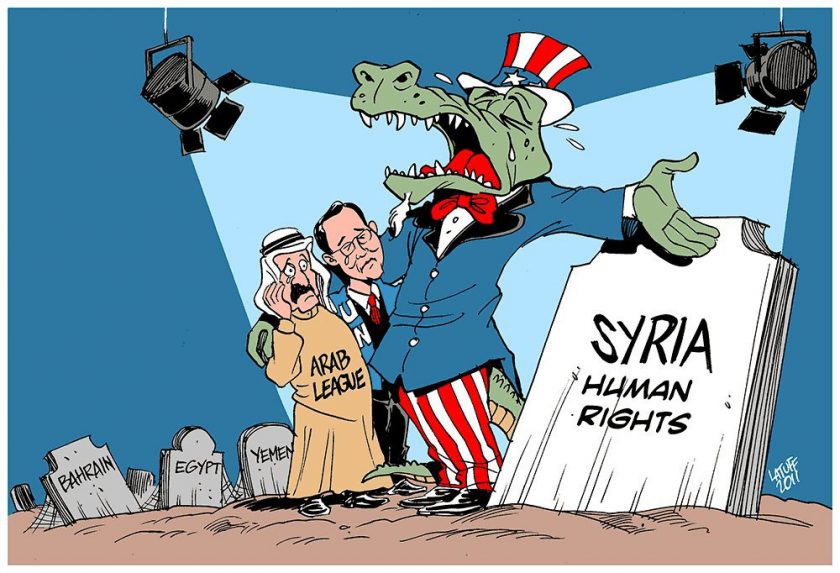
Winking and nodding to the “freedom fighters” hunkered down in the northwestern Syrian province of Idlib, the world’s schoolmarm (formally known as The West) has issued a stern warning to President Bashar al-Assad: don’t use chemical weapons “again,” or else. Said warning came via a joint statement from the US, UK and France (henceforth known as The Three Musketeers), as the Syrian government prepares its offensive to retake the country’s last remaining “rebel” stronghold. The three great and benevolent powers are “gravely concerned,” they said, about the upcoming military campaign, explaining:
We also underline our concern at the potential for further—and illegal—use of chemical weapons. We remain resolved to act if the Assad regime uses chemical weapons again. As we have demonstrated, we will respond appropriately to any further use of chemical weapons by the Syrian regime, which has had such devastating humanitarian consequences for the Syrian population.
Read it again, and take note of the crafty way in which the statement messes around with language to manipulate its target audience (us). The use of chemical weapons is accurately, and superfluously, described, and emphasized with em dashes, as “illegal,” as though there was a soul on this earth to whom this is news. Then, alluding to their coordinated missile strikes against Syria this past April, which were unleashed to much pomp and circumstance, The Three Musketeers pledge to “respond appropriately” to any such illegal action on the part of the Syrian government.
Since they insist on begging questions, we must insist on demanding answers. For instance, how “appropriate” was the aforesaid missile attack? Assuming that, in this context, a direct link exists between appropriate and legal (and only an outlaw could reject that assumption), there was certainly nothing “appropriate” about The Three Musketeers’ unilateral decision to use military force against a sovereign country last April. Quite the reverse.
The missile strike, like the one a year before, was carried out in flagrant violation of the law. There are a total of two circumstances in which the use of military force is legally justified: when greenlit by a UN Security Council resolution, or when done in self-defense, that is to say in response to a direct military attack. Neither condition was met when The Three Musketeers rocketed Syria. On the other hand, Syria is accorded the legal right under international law to strike back at its attackers, and moreover to form a coalition for that purpose. As Chapter VII Article 51 of the UN Charter states:
Nothing in the present Charter shall impair the inherent right of individual or collective self-defense if an armed attack occurs against a Member of the United Nations, until the Security Council has taken measures necessary to maintain international peace and security.
Mildly ironic, then—is it not?—that, in “appropriately” bombing the Syrian government, we granted it the legal right to bomb us back? It’s a crying shame: if only Assad and his allies were sufficiently nihilistic … we could’ve had another exhilarating World War on our hands—the third and last. To borrow a quote from of Trump’s favorite general: “Compared to war, all other forms of human endeavor shrink to insignificance. God help me, I do love it so.” On that note, I think it’s high time we substitute “War” for “God” in our Republic’s official motto. Who besides Rand Paul would vote against the proposal?
All of which is to say nothing of the fact that the alleged chemical attack in Douma, which served as the pretext for The Three Musketeers’ “appropriate” bombing raid, almost certainly didn’t happen. The first chink in the armor came in the form of Robert Fisk’s report, from the actual site of the alleged attack, that quotes a local doctor as saying:
There was a lot of shelling [by government forces] and aircraft were always over Douma at night—but on this night, there was wind and huge dust clouds began to come into the basements and cellars where people lived. People began to arrive here suffering from hypoxia, oxygen loss. Then someone at the door, a “White Helmet”, shouted “Gas!” and a panic began. People started throwing water over each other. Yes, the video was filmed here, it is genuine, but what you see are people suffering from hypoxia—not gas poisoning.
By his own count, Fisk interviewed more than twenty Douma residents; he was unable to find a single person “who showed the slightest interest in Douma’s role in bringing about the Western air attacks. Two actually told me they didn’t know about the connection.” Moreover, many of those he spoke with told him they “never believed in” the chemical weapons narratives promulgated by Western media.
Despite the fact that it squared with the Syrian Observatory For Human Rights’ (the West’s go-to authority on the Syrian conflict) assessment of the event, Fisk’s journalism was easy enough for Western ideologues to ignore or deride. He’s only one person, they countered, and he only spoke to a handful of residents and a single doctor, all of whom probably have a pro-Assad agenda. Therefore, his report is worthless and so is he.
This position grew a little less tenable when, a week after Fisk’s story was published, Russia presented to the Organization for the Prohibition of Chemical Weapons (OPCW), which was holding a conference in the Hague, seventeen eyewitnesses, a mix of residents and doctors, all of whom testified that there had been no chemical attack in Douma. As Jonathan Cook explained (yes, one had to visit his personal blog or some equally marginal source to read about this), “the US, UK and France boycotted the meeting, denouncing Russia for producing the witnesses and calling the event an ‘obscene masquerade’ and ‘theatre’”—not a very surprising reaction from a self-righteous party whose fabricated narrative is coming apart at the seams.
Then came the coup de grâce. On July 6, the OPCW published the conclusion of its fact-finding mission in Douma. Before quoting from it, I’ll jog your memory a bit. According to the Western version of events, Assad used both sarin and chlorine (or perhaps a physical mixture of the two, a nonsensical theory), in his attack on Douma—which, incidentally, had already effectively “fallen,” raising questions as to why Assad would feel compelled to use chemical weapons at all, apart from the sheer sadistic fun of it. Regardless, sarin and chlorine, said the West. Not so, said the OPCW:
OPCW designated labs conducted analysis of prioritized samples. The results show that no organophosphorous nerve agents or their degradation products were detected in the environmental samples or in the plasma samples taken from alleged casualties [my emphasis]. Along with explosive residues, various chlorinated organic chemicals were found in samples from two sites, for which there is full chain of custody. Work by the team to establish the significance of these results is on-going. The FFM team will continue its work to draw final conclusions.
Not a trace of sarin, in other words. Attempting to ascertain why “various chlorinated organic chemicals” were found at the site is a pointless exercise for someone, like myself, who knows nothing of chlorinated organic compounds. The most perfunctory research indicates that such chemicals are used for a variety of non-murderous applications, for example as solvents, and that they stick around for a long time after they’ve been introduced to an environment. The basic point, which hordes of media fixers promptly got to work obscuring, is that the Western narrative was false. The US government, in concert with its unctuous allies, lied. Go figure.
Of course, this isn’t the first time a supposed chemical attack in Syria has been called into question. Those curious about whether Assad used sarin to murder hundreds of civilians in the suburb of Ghouta in 2013, as was, and is, claimed by The West, would do well to read two essays by Seymour Hersh—“The Red Line and the Rat Line” and “Whose Sarin”—both published in the London Review of Books, both available online. Hersh also examined the chemical incident that took place in Khan Sheikhoun in April 2017—also used as a pretext for illegal US military action. This time, however, his reporting was too heretical even for the London Review of Books (not to mention the New Yorker), and so had to be published in Die Welt, which no one in the US has ever heard of, let alone read. That Hersh, the preeminent investigative journalist of his time, has been pushed into no man’s land speaks to how narrow the spectrum of permissible discourse has become in this, our great Republic. The schoolmarm is cracking her whip. At this rate Hersh will soon be relegated to the personal blog.
For other dissident views re: chemical weapons in Syria, do yourself a favor and consult the work of former UN weapons inspector Scott Ritter and MIT professor and munitions expert Theodore Postol, as well as the late journalist Robert Parry of Consortium News, all of whom have written extensively, and cogently, on the subject. Or you can keep reading the Washington Post. You’re free to decide.
But what exactly did The Three Musketeers have in mind when they broadcast their latest threat? It’s a fair question to ask. On its face, the statement appears to reflect a genuine aversion to poison gas, and a genuine hope that the Syrian government will refrain from using any in Idlib. Fair enough. Having said that, how averse could they really be, given that gas attacks provide for them the only remotely plausible excuse to lob more cruise missiles out of the Mediterranean—an activity from which they, and their media sidekicks, derive the utmost pleasure? They are, after all, incorrigible hawks. It must cut them to the bone to have to stand by and watch from the sidelines as a perfectly good war winds down, handcuffed, helpless to effect the desired outcome. How pitiable the plight of the poor impotent imperialist! Flaming warmongers need love too.
Anyway, call me schizophrenic, but when I read the words of The Three Musketeers, I couldn’t help but pick up the faint sound of a dog whistle—aimed straight at the “moderate rebels” holding down the fort in Idlib. Read between the lines, the statement is an assurance to one party dressed up as a warning to another. If there’s a “chemical incident,” we will attack: you have our word. That’s the message sent to, and received by, al-Qaeda (I don’t know what they’re calling themselves these days, and I care less) and its various affiliates. Make no mistake: The Three Musketeers have just invited, oh-so-subtly, bin-Laden’s foot soldiers to stage a chemical atrocity in Idlib (God knows how many “various chlorinated organic chemicals” they’ve got on hand there), the resulting pictures of which will duly splash across every television screen in America so as to whip up … well, you’ve heard this song before.
So here’s a new one: a bunch of kids walk onto a school bus in Yemen. As the bus steers through a crowded marketplace, Saudi Arabia drops a bomb on it, killing forty small children and injuring scores more. The bomb is later identified as a “laser-guided” precision missile (precision being the operative word), manufactured by our very own Lockheed Martin, while the mangled school bus is described by Col. Turki al-Maliki, spokesman for the Saudi-led coalition, as a “legitimate target.” Meanwhile, back in illustrious Washington, Pentagon bureaucrat Rebecca Rebarich is asked to comment on the “legitimate” massacre of forty schoolkids.
“The US has worked with the Saudi-led coalition to help them improve procedures and oversight mechanisms to reduce civilian casualties,” she says. “While we do not independently verify claims of civilian casualties in which we are not directly involved, we call on all sides to reduce such casualties, including those caused via ballistic missile attacks on civilian population centers in Saudi Arabia.”
Translated from vapid officialese: “I don’t really give a shit.”
On the bright side, we’re “gravely concerned” about the coming battle for Idlib, where the babies are beautiful and, most importantly, the bombs that kill them are un-American.
Will the Real John Brennan Please Stand Up?
When will he answer for his war crimes?

By Philip Giraldi • Unz Review • August 21, 2018
The battle between many former intelligence chiefs and the White House is becoming a gift that keeps on giving to the mass media, which is characteristically deeply immersed in Trump derangement syndrome in attacking the president for his having stripped former CIA Director John Brennan of his security clearance. One of the most ludicrous claims, cited in the Washington Post on Sunday, was that the Trump move was intended to “stifle free speech.” While I am quite prepared to believe a lot of things about the serial maladroit moves and explanations coming out of the White House, how one equates removing Brennan’s security clearance to compromising his ability to speak freely escapes me. Indeed, Brennan has been speaking out with his usual vitriol nearly everywhere in the media ever since he lost the clearance, rather suggesting that his loss has given him a platform which has actually served to enhance his ability to speak his mind. He should thank Donald Trump for that.
Indeed, Brennan’s retaining a Top Secret code word clearance had nothing to do with free speech and everything to do with enhancing his market value for those poor sods who actually pay him to mouth off as an “expert” on television and in the newspapers. Are you listening New York Times and NBC? Brennan’s clearance did not mean that he had any real insight into current intelligence on anything, having lost that access when he left his job with the government. It only meant that he could sound authoritative and well informed by relying on his former status, enabling him to con you media folks out of your money on a recurrent basis.
It has sometimes been suggested that free speech is best exercised when it is somehow connected to the brain’s prefrontal lobes, enabling some thought process before the words come out of the mouth. It might be argued that Brennan has been remarkably deficient in that area, which is possibly why he looks so angry in all his photographs. Even John Brennan’s supporters are shy about defending the former CIA Director’s more extravagant claims. James Clapper, the ex-Director of National Intelligence, has described Brennan’s comments as “overheated.”
The John Brennan backstory is important. In 2016 he was Barack Obama’s CIA Director and also simultaneously working quite hard to help Hillary Clinton become president, which some might regard at a minimum as a conflict of interest. After Clinton lost, he continued his attacks on Trump. He apparently played a part in the notoriously salacious Steele dossier, which was surfaced in January just before the inauguration. The dossier included unverifiable information and was maliciously promoted by Brennan and others in the intelligence and law enforcement community. And even after Trump assumed office, Brennan continued to prove to be unrelenting.
In May 2017, Brennan testified before Congress that during the 2016 campaign he had “… encountered and [was] aware of information and intelligence that revealed contacts and interactions between Russian officials and U.S. persons involved in the Trump campaign that I was concerned about because of known Russian efforts to suborn such individuals. It raised questions in my mind whether or not Russia was able to gain the co-operation of those individuals.” Politico was also in on the chase and picked up on Brennan’s bombshell in an article entitled Brennan: Russia may have successfully recruited Trump campaign aides.
What Brennan did not describe, because it was “classified,” was how he developed the information regarding the Trump campaign in the first place. We know from Politico and other sources that it derived from foreign intelligence services, including the British, Dutch and Estonians, and there has to be a strong suspicion that the forwarding of at least some of that information might have been sought or possibly inspired by Brennan unofficially in the first place. But whatever the provenance of the intelligence, it is clear that Brennan then used that information to request an FBI investigation into a possible Russian operation directed against potential key advisers if Trump were to somehow get nominated and elected, which admittedly was a long shot at the time. That is how Russiagate began.
Since that time, Brennan has tweeted President Donald Trump, asserting that “When the full extent of your venality, moral turpitude, and political corruption becomes known, you will take your rightful place as a disgraced demagogue in the dustbin of history.” He has attacked the president for congratulating President Vladimir Putin over his victory in Russian national elections. He said that the U.S. President is “wholly in the pocket of Putin,” definitely “afraid of the president of Russia” and that the Kremlin “may have something on him personally. The fact that he has had this fawning attitude toward Mr. Putin … continues to say to me that he does have something to fear and something very serious to fear.” And he then administered what might be considered the coup de main, saying that the president should be impeached for “treasonous” behavior after Trump stood next to President Vladimir V. Putin of Russia at a news conference in Finland and cast doubt on the conclusion of the intelligence agencies that Moscow interfered in the 2016 presidential election.
Trump’s decision to pull Brennan’s clearance attracted an immediate tweeted response from the ex-CIA Director: “This action is part of a broader effort by Mr. Trump to suppress freedom of speech & punish critics. It should gravely worry all Americans, including intelligence professionals, about the cost of speaking out.” He also added, in a New York Times op-ed, that “Mr. Trump’s claims of no collusion [with Russia] are, in a word, hogwash,” though he provided no evidence to support his claim and failed to explain how exactly one washes a hog. There has subsequently been an avalanche of suitably angry Brennan appearances all over the Sunday talk shows, a development that will undoubtedly continue for the immediate future.
The claim that Trump is a Russian agent is not a new one, having also been made repeatedly by Brennan CIA associate the grim and inscrutable Michael Morell, who flaunts his insider expertise both at The Times and on CBS. Regarding both gentlemen, one might note that it is an easy mark to allege something sensational that you don’t have to prove, but the claim nevertheless constitutes a very serious assertion of criminal behavior that might well meet the Constitutional standard for treason, which comes with a death penalty. It is notable that in spite of the gravity of the charge, Brennan and Morell have been either unable or unwilling to substantiate it in any detail. Even a usually tone-deaf Congress has noted that there is a problem with Brennan’s credibility on the issue, not to mention his integrity. Richard Burr, Chairman of the Senate Intelligence Committee, has observed that,
“Director Brennan’s recent statements purport to know as fact that the Trump campaign colluded with a foreign power. If Director Brennan’s statement is based on intelligence he received while still leading the CIA, why didn’t he include it in the Intelligence Community Assessment released in 2017? If his statement is based on intelligence he has seen since leaving office, it constitutes an intelligence breach. If he has some other personal knowledge of or evidence of collusion, it should be disclosed to the Special Counsel, not The New York Times.”
This behavior by Brennan is no surprise to those who know him and have worked with him. An ambitious crawler with a checkered history, he was strongly disliked by his peers at CIA, largely because of his lack of any sense of restraint and his reputation for over-the-top vindictiveness. He notoriously flunked out of spy training at the Agency, forcing him to instead become an analyst, so he went after the Clandestine Service in his reorganization of CIA after he became Director.
John Brennan has always been a failure as an intelligence officer even as he successfully climbed the promotion ladder. He was the CIA’s Chief of Station (COS) in Saudi Arabia when the Khobar Towers were bombed, killing 19 Americans, a disaster which he incorrectly blamed on the Iranians. He was deputy executive director on 9/11 and was complicit in that intelligence failure. He subsequently served as CIA chief of staff when his boss George Tenet concocted phony stories about Iraqi weapons of mass destruction. He also approved of the Agency torture and rendition programs and was complicit in the destruction of Libya as well as the attempt to do the same to Syria.
Barack Obama wanted Brennan to be his CIA Director but his record with the Agency torture and rendition programs made approval by the Senate problematical. Instead, he became the president’s homeland security advisor and deputy national security advisor for counterterrorism, where he did even more damage, expanding the parameters of the death by drone operations and sitting down with the POTUS for the Tuesday morning counterterrorism sessions spent refining the kill list of American citizens.
After Obama was re-elected in 2012, he was able to overcome objections and appoint Brennan CIA Director. Conniving as ever, Brennan then ordered the Agency to read the communications of the congressional committee then engaged in investigating CIA torture, the very program that he had been complicit in. Brennan then denied to Congress under oath that any such intramural spying had occurred, afterwards apologizing when the truth came out. Moon of Alabama characterizes him as “… always ruthless, incompetent and dishonest.”
So the real John Brennan emerges as an unlikely standard bearer for the First Amendment. He has an awful lot of baggage and is far from the innocent victim of a madman Trump that is being portrayed in much of the media. Indeed, he should be answerable for torture, renditions, extrajudicial killing of foreigners and targeted murder of American citizens. Those constitute war crimes and in the not too distant past Japanese and German officers were hung for such behavior. One has to hope that Brennan’s day of judgment will eventually come and he will have to pay for his multiple crimes against humanity.
SYRIA: The Emerging Reality of the U.S Coalition Regime Change War – On the Ground Reporting

Life and food return to Douma after liberation by SAA from Saudi-backed, UK-promoted Jaish Al Islam terrorists. (Photo: Vanessa Beeley)
By David Macilwain | 21st Century Wire | August 20, 2018
The withdrawal of US coalition support for “rebels” in Syria, portrayed as a failure to achieve noble and humanitarian goals by Western governments and media, should rather be seen as an admission of guilt. The rescuing of violent militants and “White Helmets” from Southern Syria by Israeli forces actually marked the failure of the covert project to forcibly replace Syria’s legitimate government with one of NATO’s choice, regardless of the democratic will and lives of the Syrian people.
Before we can ask “what if?” about the war on Syria, as Ramesh Thakur does in “The Strategist”, republished here on P&I, we need to understand what actually happened during the Western-sponsored seven-year long assault on the Syrian state, as seen from the perspective of those on the receiving end of this attack. Now that the Syrian Arab Army and its allies are finally prevailing in their defence of the country and its citizens, it is also time for Western commentators to stop repeating the same vapid accusations against the Syrian President, and instead start making accusations against their own “mis-leaders”.
Rather it appears that many in the West are entrenching their opposition to the Syrian government at the same time as millions of Syrians are confirming their support for it, and the armies that have fought off their enemies’ chosen alternative.
Ramesh Thakur’s partisan view on the “Syrian civil war” and the benign nature of the West’s intimate involvement in it is evidently shared by the Australian Strategic Policy Institute, and – one would imagine – by many of those in public office who act on its advice. The same innocence could not be assumed for ASPI sponsors, – defence contractors Lockheed Martin and Thales – who profit from that advice, nor presumably for Australian Intelligence agencies and their overseers in the government.
Back in May, and only weeks after the latest US/UK/French missile attack on Syria, I visited Damascus with my partner, and was able to verify the essential truth of reports from Syrian sources on the situation there, both in regard to the recent campaign to liberate Eastern Ghouta from armed militants, and more generally through personal contact with Syrians.
What we found however was both surprising and heartening; here was a country full of hope and passion, finally celebrating its imminent victory against one of the vilest and most devious enemies in history, led and supported by the most powerful and determined regimes in the world, including our own. Despite the harrowing cost to Syrian society, with over 80,000 regular Syrian soldiers killed, the people were strengthened and united behind their defence forces and their President.
In the seemingly endless fight against foreign-backed and foreign-armed insurgents, every Syrian now has a friend, relative or partner who has “died for his country”, killed, injured or tortured by these “barbarian invaders”. Even in Damascus an estimated 11,000 innocent people have been killed by “rebel” mortars and sniper fire from nearby suburbs.
Visiting a Government camp for the displaced residents of those same rebel-occupied Eastern suburbs of Damascus – Eastern Ghouta – brought home to us what this really means. The people sheltered and fed there – 15,000 in mid-May – had many stories to tell of the years they were held under siege in their communities by the violent militants of Jaish al Islam and Faylaq al Rahman, as well as of the behaviour of the so-called “White Helmets” who worked hand in hand with these terrorist groups. My colleague Vanessa Beeley, who visited the same camp a week earlier and conducted many interviews with Douma and Hamouriya residents has written comprehensively on their experiences; alone her report utterly condemns and exposes the lies and misinformation to which Australian and Western audiences have been subject on the “siege of Eastern Ghouta” and its denouement in the criminal Douma “gas attack” provocation.
Beeley had already exposed the incriminating truth of the previous US alliance campaign over East Aleppo, and the cooperation between the US/UK supported White Helmets and Al Qaeda that effectively prevented the city’s liberation for months in 2016.
It was likely at that point that Russia concluded that the US administration was “non-agreement-capable”, – a situation little altered by the subsequent change of US leadership. Progress towards a resolution of the conflict – in Astana – was then only made because the US was excluded, along with those Opposition groups that refused any compromise with the Assad government.
It is the nature of these Opposition groups, still supported by Western powers including Australia as some legitimate alternative to Syrians’ choice of government, which continues to elude most Western commentators. These groups were cultivated primarily by the Saudis, and reflect their extremist Wahhabi vision of ideal government as well as being associated with the worst terrorist groups operating in Syria. Had he not suffered a timely demise at the hands of Syrian security forces, the notorious terrorist and former leader of Jaish al Islam Zahran Alloush would have been in the running for Syria’s new leadership.
It is in this context that we ask “what if?” the Syrian government had been forcibly replaced by one of the West’s choosing; it belies both the intentions and the actions of the NATO – Saudi – Gulf state coalition, who ploughed billions in arms and support to these very immoderate groups to achieve their own objectives – which had nothing whatsoever to do with “humanitarian intervention” or “democratic reforms”.
By contrast, what actually happened in Syria, and in the main stronghold of Jaish al Islam in Douma, was all too easy to see on the ground. Our visit to Douma hospital, scene of the White Helmets’ most recent criminal fabrication, proved shocking even with what we already knew about the situation. Their claims of a chemical weapon attack, and staged “water-hosing” treatment for its alleged victims in the hospital’s emergency ward, continue to be endorsed by Western commentators like Thakur as well as governments, NGOs and the UN, despite being comprehensively exposed as false.
This remains the case even following the testimony of supposed gas victims seen in the staged video, brought to the Hague by Russia, and the findings of the OPCW showing no presence of chemical weapons residues at the site.
Many commentators have evidently now become impregnable bastions of the false Syrian chemical weapons narrative spread by their governments; in a previous article while discussing the Khan Shaikoun “gas attack” a year earlier, Ramesh Thakur quite wrongly concludes that the Syrian government was proven responsible.
While he cites the UNHRC and the UN-OPCW “evidence” as endorsement of this position, both bodies actually relied on second hand information from Opposition sources only, and refused Syria’s invitation to visit and inspect the Shayrat airbase from which they claimed the chemical weapons had come. Their duplicity was exposed when the US coalition sought to reinforce the mandate for the JIM at the Security Council over the Douma incident; Russia rightly vetoed this clearly disingenuous proposal.
In fact there was nothing for such a commission to investigate in Douma, as Russian and Syrian investigators had already found no toxic chemicals at the alleged site, and hospital staff denied knowledge of any such attack. But what proved really shocking to see at Douma hospital was the sophistication and extent of the tunnel system built beneath it. Canadian investigative journalist Eva Bartlett, who visited Douma just before we did, posted this article that includes video of her exploration of this extraordinary tunnel system, as well as corroborating interviews about the fabricated chemical weapons stories from many residents. The tunnel network not only allowed the armed militants of Jaish al Islam and Al Qaeda – along with their White Helmeted “partners” – to enter and take over the hospital whenever they wished, but protected them from Syrian and Russian bombs.
The belief amongst Syrians that these jihadist/terrorist groups were being assisted by foreign Special Forces, not just in constructing and equipping the tunnel system but in directing and coordinating the “underground resistance” was confirmed during the final evacuation of the Douma “jihadists” on buses to Northern Syria; special forces from Britain, Turkey and other countries were reportedly apprehended trying to escape with them. The MOD naturally denied this collusion, but events in Southern Syria last month, when hundreds of foreign fighters and White Helmets were “rescued” by their closest local ally Israel, seem to confirm and reinforce the Russian and Syrian claims.
While the Syrian people are remarkably forgiving, and focused on recovery and reconciliation within their own territory, few would not now lay blame for the death and devastation inflicted on the fabric of their society at the feet of the US-led coalition – of which Australia has been an integral part. Responsibility for the countless atrocities committed by the hundreds of violent sectarian militias, including Al Qaeda and Da’esh/Islamic State, lies squarely with those countries who conspired to assist them with rivers of weaponry and a tide of propaganda, like – in Trump’s words – “the world has never seen”; this was a conspiracy that began long before the “uprising” of March 2011.
Those who ignore the Syrian reality – that stares in the face of those who deign to look – and so allow this mountain of lies to remain even as another Western regime-change scheme gets under way, should also now prepare their defence; ignorance can no longer be an excuse.
***
David Macilwain is an independent observer and writer with a special focus on the war on Syria and its allies. He writes voluntarily for Russia Insider and the American Herald Tribune, from his home in the hills of NE Victoria. He visited Syria in May independently and at his own expense.
Trump Regime Continues Supporting ISIS
By Stephen LENDMAN | August 18, 2018
US support for ISIS is an open dirty secret – undiscussed by media scoundrels, pretending it’s not so.
Washington actively arms, funds, trains, and directs ISIS and other terrorists – backing the scourge they pretend to oppose.
Obama and Trump’s vow to degrade and destroy ISIS was and remains a bald-faced lie, using these and other cutthroat killers as proxy fighters in Syria and other countries where they’re deployed – their presence unjustifiably justifying illegal US occupation of northeast and southwest Syrian territory.
Last November, Russia’s Defense Ministry said the following:
“The Abu Kamal liberation operation conducted by the Syrian government army with air cover by the Russian Aerospace Force at the end of the last week revealed facts of direct cooperation and support for ISIS terrorists by the US-led ‘international coalition.”
“Americans peremptorily rejected to conduct airstrikes over the ISIS terrorists on the pretext of the fact that, according to their information, militants are yielding themselves prisoners to them and now are subject to the provisions of the Convention relative to the Treatment of Prisoners of War.”
US-led “coalition’s aviation tried to create obstacles for the aircraft of the Russian Aerospace Forces in this area to safely shield militants of the Islamic State.”
“There is indisputable evidence that the United States pretends it is waging irreconcilable struggle against international terrorism in front of the international community, while in reality it provides cover for the combat-ready Islamic State groups to let them regain strength, regroup themselves and advance US interests in the Middle East.”
Washington directly aids ISIS and other terrorist fighters, deploying them where Pentagon commanders want them used, relocating them to new conflict zones in Syria and other countries.
Iran has credible documents showing US support for ISIS. Its armed forces deputy chief of staff Major General Mostafa Izadi earlier said “(w)e are facing a proxy warfare in the region as a new trick by the arrogant (US-led) powers against the Islamic Republic,” adding:
“We possess information showing direct support by US imperialism for (ISIS) in the region which has destroyed Islamic countries and created a wave of massacres and clashes.”
Separately, Iranian Parliament Speaker Ali Larijani condemned Washington for “align(ing) itself with ISIS in the region.”
So-called Syrian Democratic Forces (SDF) are infested with ISIS and other terrorists. Washington’s objective in Syria remains regime change – why the Obama regime launched naked aggression in the country, continued by Trump regime dark forces in charge of Washington’s geopolitical agenda.
A new Security Council report showed renewed ISIS strength in parts of Syria controlled by US forces and allies, saying:
ISIS terrorists have “breathing space to prepare for the next phase of its evolution into a global covert network.”
Aided by the Trump regime and allied forces, they control “small pockets of territory in the Syrian Arab Republic on the Iraqi border.”
Russia’s General Staff earlier accused the Pentagon of training ISIS and other terrorists at its illegally established At Tanf base in southwest Syria – calling it a staging ground for US armed struggle against the Syrian government.
ISIS and other terrorists infest the Rukban refugee camp controlled by US Forces, holding tens of thousands of defenseless Syrians hostage, using the camp to recruit anti-government terrorists.
On August 15, AMN News said US-led forces “transported over 250 trucks filled with weapons (and other military hardware) to the Euphrates River Valley this morning” – intended for Syrian Democratic Forces terrorists in Deir Ezzor province, adding:
Washington is “expand(ing) (its) bases and airports in northern and eastern Syria” – indicating US forces will remain in the country, not leave, as Trump earlier said.
Separately on August 18, AMN News said Washington and its allies “sent reinforcements to their military bases in the towns of Tal Tamer, Al-Houl, and Al-Shaddadi.”
Syria’s liberating struggle continues, no end of it in sight as long as US regime change intentions remain unchanged.
Featured Video
Anthrax War – CBC The Passionate Eye
or go to
Aletho News Archives – Video-Images
Book Review
Shattered Dreams: The HPV Vaccine Exposed (2019)
By Christina England – 30 Q&As – Book Review & Summary
Lies are Unbekoming | September 4, 2026
… Gardasil received FDA fast-track approval in 2006, Cervarix followed in 2009, and Gardasil 9 was approved in December 2014 with more than double the aluminium adjuvant content of the original. The commercial context is specific. Merck was about to lose patent protection on Zocor and faced $18 billion in Vioxx injury claims from a cardiovascular drug the company had marketed while suppressing its own data showing a five-times increase in heart attacks. Analysts projected the global HPV vaccine market at $4 billion by 2011, contingent on government-funded national programs for teenage girls. The 1986 National Childhood Vaccine Injury Act had already granted manufacturers complete liability immunity. By 2013, Japan had withdrawn its HPV vaccine recommendation after cataloguing severe adverse reactions in hundreds of girls. No Western government followed. The establishment position across the UK, US, Australia, and most of Europe held, and still holds, that the vaccines are safe and effective, that reported injuries are coincidental, and that cervical cancer prevention justifies the program. The book was published into this position, not against a vacuum.
Shattered Dreams sits alongside Mary Holland’s The HPV Vaccine On Trial and Viera Scheibner’s foundational vaccination work as part of the documented record on what has been done to a generation of teenage girls under the banner of cancer prevention. The full summary unpacks three specific findings: that Merck used the aluminium adjuvant itself as the “placebo” control in 92.5% of trial subjects, making it structurally impossible to detect excess reactions from the adjuvant; that Dr. Sin Hang Lee found HPV DNA fragments bound to aluminium in every one of sixteen Gardasil samples tested, and in the blood and spleen of a New Zealand girl six months after her third dose; and that in every country with high vaccination coverage, including Australia, the UK, Norway, and Sweden, cervical cancer rates have stopped declining and started rising specifically in the vaccinated cohort. Martínez-Lavín’s 2017 calculation puts the number needed to seriously harm with Gardasil 9 at 140, and the number needed to vaccinate to prevent one case at 1,757. Thirteen young women are seriously harmed for every one who benefits. The vaccine was approved on the basis of trials that could not detect what the trials were supposed to detect, and it is still being given to twelve-year-olds today. … Read full review
Blog Roll
 Aletho News
- The Five-Year Fuel Crisis: Why the World Economy Is Paying for a War It Thinks Is Ending
- Trump’s Big Bluff on Iran
- Swiss scammed out of millions by Ukraine-linked call centers – media
- Germany facing potential ‘violent conflict’ with Russia – spy chief
- Ukraine’s EU neighbors reject new plea from Kiev – Politico
- British Transport Police Facial Recognition Trial Scanned 926,912 People With Zero Arrests
- House Bill Would Ban Federal Use of Flock ALPR Data
- Can a Spice Rival a Drug? 10 Head-to-Head Trials Put It to the Test.
- The oil routes around Hormuz face their own chokepoints
- The Saudi-Israeli war on Yemen’s resistance: Intelligence sharing, civilian targets & sectarian propaganda
- If Americans Knew
- Turkish Red Crescent helps elderly Gaza man walk again after Israel confiscates his prosthetic limb
- Four Palestinians Killed in Israeli Attacks in Gaza
- Two Palestinian youths killed and village razed as Israeli attacks on West Bank continue
- Two more Christian women innocent victims of Gaza raids
- Cruelty, Deprivation, Indignity: A Journalist’s 22 Months in Israeli Prison
- New IDF Website Frames Slain Gaza Journalists as Terrorists
- Israeli media: After settlers beat him mercilessly, they stuffed dirt into his mouth
- Americans Are Paying the Price to Preserve Israel’s Nuclear Hegemony
- A U.S. Jewish Fund’s Ambitious Bid to Put a Settler Elite in Control of Israel’s Security
- As genocide drags on, “Zionism is racism” becomes official policy in one UK party – Daily Update
- No Tricks Zone
- Latest European Green Energy Debacle; Portugal’s Largest Flagship Solar Park Insolvent!
- Green Energy Debacle: German Expert Professor Fritz Vahrenholt Warns Of Severe Economic And Social Consequences
- Two More Paleo Reconstructions Affirm Meters-Higher Sea Levels Across Ireland, Brazil 7000-6000 Years Ago
- New Study: Earth And Venus Surface Warmth Largely Explained By Convection And Lapse Rate, Not CO2 Or Radiation
- 2025 Nature Paper Claiming Worsening Global Drought Gets RETRACTED …Heavily Flawed
- New Study: ‘Global Drought Shows No Detectable Recent Acceleration Under Climate Warming’
- Economic Masterminds: German Socialists Suggest Taxing Productivity Gains Stemming From Using AI
- The South China Sea Has Not Been Cooperating With The Climate Change Narrative
- Energy Crisis: Germany Enters Heating Season With Historically Low Gas Reserve Fill Levels
- New Study: The Antarctic Ice Sheet Gained Mass From 2020-2024 Due To Staggering Snow And Ice Accumulation

