ISIS given ‘breathing space’ in parts of Syria under US-backed forces’ control

© Aboud Hamam / Reuters
RT | August 18, 2018
Islamic State managed to regain access to Syrian oil fields and make profits from selling oil, a new UN report reveals. While the UN did not point fingers, the IS reemergence seems to occur in areas held by the US-backed forces.
“Islamic State in Iraq and the Levant [IS, formerly ISIL/ISIS], having been defeated militarily in Iraq and most of the Syrian Arab Republic during 2017, rallied in early 2018. This was the result of a loss of momentum by forces fighting it in the east of the Syrian Arab Republic,” the recent report from the UN Security Council’s Sanctions Monitoring Team reads. The document is dated July 27, but was only released to the public this week.
The slow-down gave IS “breathing space to prepare for the next phase of its evolution into a global covert network.” As of June 2018, the terrorist group has been controlling “small pockets of territory in the Syrian Arab Republic on the Iraqi border,” effectively carrying on with its quasi-state ways.
“[IS] was able to extract and sell some oil, and to mount attacks, including across the border into Iraq,” the reports stated, adding that the terrorist group regained “access to some oil fields in northeastern” Syria.
While the report did not specify which forces exactly were having troubles with “momentum,” northeastern Syria is located on the left bank of the Euphrates river, controlled by the so-called Syrian Democratic Forces (SDF) militia backed by the US-led coalition.
Regaining control of the oil fields allowed IS to yet again make oil profits a significant source of revenue. The report also vaguely stated that IS continues to impose “taxes” on civilians “in areas it controls, as well as in contested areas,” as well as to kidnap local businessmen for ransom.
Apart from strengthening of IS-held “pockets” in northeastern Syria, the report also listed a number of hotspots in Syria, which might be sources of further IS reemergence. Among them, the UN named the Rukban refugee camp, located near the Al-Tanf US military base. Other IS-infested places listed in the report include unspecified locations in the Aleppo province and an area controlled by an IS-affiliated group in the Deraa province. The latter, however, was already eradicated late in July during the Syrian Army offensive in the south-west of the country.
The issue of the Rukban refugee camp has been repeatedly raised by Moscow and Damascus, who repeatedly urged the US to cooperate. Earlier in August, Colonel General Sergey Rudskoy, the head of operations of the Russian General Staff, described Rukban as place where “people are living in harsh conditions and where terrorists find shelter.”
“Our American partners should provide humanitarian access to Rukban as soon as possible, provide passage for the refugees to their home areas and withdraw the base from Al-Tanf,” Rudskoy stated.
Syria Lashes out at Riyadh “Compliance with Washington at Expense of Saudi People”
Al-Manar | August 18, 2018
Syria on Friday denounced Saudi financial support to the US-led international coalition’s role in northern Syria, stressing that such move indicates Riyadh’s compliance with the US administration at the expense of the Saudi people.
Syrian foreign ministry slammed Saudi authorities as “plotters against the interests of the Arab nation,” stressing that the Saudi support is in defiance of the UN Security Council resolutions related to the crisis in Syria.
US State Department announced earlier on Thursday, that Riyadh was offering a $100 million contribution “for ongoing, Coalition-supported stabilization efforts in areas liberated from ISIS in Syria,” referring to the Takfiri ISIL group.
SANA news agency quoted an official at the Syrian foreign ministry as saying: “This flawed Saudi decision comes within the framework of the Saudi authorities’ full compliance with the US administration at the expense of Saudi people who is suffering from poverty and dire economic recession.”
“The US-led coalition has killed thousands of Syrian children and women and attacked positions of the Syrian Arab Army dozens of times to prevent it from fighting Daesh (ISIS) terrorist organization east of Syria and elsewhere, as it destroyed Syrian infrastructure which has cost the Syrian people hundreds of billions of dollars in a direct US support for terrorist organizations,” the Syrian source said.
“The criminal coalition does not deserve this support from any country in the world because its main goal is to fragment the region and impose Zionist hegemony on all its countries.”
Meanwhile, the source stressed that the Saudi support “is morally unacceptable as it comes to prevent the Syrian Arab Army from achieving further victories over terrorism in northern Syria in an exposed attempt to prolong the crisis and support the forces that threaten Syria’s unity and territorial integrity.”
The source concluded by saying: “Syria condemns these despicable policies of the Saudi authorities and demands them to stop these terrible and dangerous policies, adding that “Syria reiterates its call on all the Coalition’s member states to withdraw from it without delay because it serves only terrorists and murderers and threatens security and peace in the region and the world,” according to SANA.
Saudi-US Propaganda by PBS NewsHour in Houthi-held Yemen

By William Boardman | Reader Supported News | July 24, 2018
One of the poorest countries in the Middle East, Yemen’s war has pushed it to the brink of famine. A Saudi blockade has slowed the flow of food and helped push prices up. Markets and businesses are ruined from airstrikes. Millions are destitute. Special correspondent Jane Ferguson smuggled herself across front lines to report on what’s happening inside the world’s worst humanitarian disaster.
— PBS NewsHour summary, July 2, 2018
This is what American tax-supported propaganda looks like when an organization like the PBS NewsHour wants to maintain a semblance of credibility while lying through its intimidated teeth. Yes, Yemen is one of the poorest countries in the world, long dependent on imported food and other life support. But to say “Yemen’s war” is major league deceit, and PBS surely knows the truth: that the war on Yemen is American-backed, initiated – illegally – in March 2015 by a Saudi-led coalition that includes the UAE (United Arab Emirates). The US/Saudi war is genocidal, creating famine and a cholera epidemic for military purposes. These are American and Arab war crimes that almost no one wants to acknowledge, much less confront.
The “Saudi blockade” is also a US Navy blockade. The blockade is a war crime. Starving civilians is a war crime.
The most amazing sentence is: “Markets and businesses are ruined from airstrikes.” Seems rather bland. But this is a tacit admission of more war crimes – Saudi bombing of civilian businesses, as well as civilian hospitals, weddings, and funerals. But PBS makes it sound like the airstrikes sort of come out of nowhere, like the rain. PBS omits the American culpability that makes the airstrikes possible: mid-air refueling, targeting support, intelligence sharing, and the rest. Think of Guernica, the fascist bombing of civilians that inspired Picasso’s painting. Now think of Guernica lasting three years. That’s what the US has supported in Yemen and that’s what PBS helps cover up.
Yes, “Millions are destitute,” and yes, this is “the world’s worst humanitarian disaster.” But an honest news organization might go on to note that the destitution and the disaster are deliberate results of the world’s most relentless war crime.
From a journalistic perspective, getting the perky blonde reporter Jane Ferguson into northern Yemen, where the Houthis have been in control since 2014, is an accomplishment of note. There has been little firsthand reporting from Houthi Yemen, where the worst war crimes have been committed and the worst suffering continues. Ferguson’s presence was certainly an opportunity for serious independent reporting. PBS didn’t allow that. Based on no persuasive evidence, PBS NewsHour host Judy Woodruff framed the report as coming from “territory held by the Iranian-backed Houthi rebels.” There is no credible evidence of meaningful Iranian support for the Houthis. To believe there is, one has to believe the Iranians are consistently getting through the US-Saudi blockade. PBS ignores such realities, as do most Washington policy-makers. Woodruff does acknowledge in her weaselly way that it’s “a brutal war that the United States is supporting through a Saudi-led coalition,” which is still a long way from the truth that it’s a genocidal bombing campaign made possible by the US.
Reporter Ferguson adds to the distraction by focusing on the poverty and suffering as if they came from nowhere:
Life is slipping away from Maimona Shaghadar. She suffers the agony of starvation in silence. No longer able to walk or talk, at 11 years old, little Maimona’s emaciated body weighs just 24 pounds. Watching over her is older brother Najib, who brought her to this remote hospital in Yemen, desperate to get help. The nurses here fight for the lives of children who are starving….
You were never supposed to see these images of Maimona. A blockade of rebel-held Northern Yemen stops reporters from getting here. Journalists are not allowed on flights into the area. No cameras, no pictures.
That last bit of self-dramatization of the daring journalist glosses over a harsh reality: in addition to waging a genocidal war on a trapped population, the US-Saudi axis is also enforcing isolation and censorship on the victim population. It is a US-Saudi blockade that keeps reporters out, preventing firsthand reporting of endless war crimes. Who says? Jane Ferguson says:
The Houthis cautiously welcomed me in and, once I was there, watched me closely.
Ferguson’s coverage of the hunger and starvation is heart-wrenching, journalism at its most moving but least informative. She frames her narrative falsely:
In the midst of political chaos in Yemen after the Arab Spring, Houthi rebels from the north captured the capital, Sanaa, in 2014, before sweeping south and causing the country’s then president to flee. Neighboring Sunni, Saudi Arabia, views the Houthis, from a Yemeni sect close to Shia Islam and backed by rival Iran, as an unacceptable threat along their border.
Political chaos is Yemen is decades if not centuries old, often fomented by the Saudis and other outside powers. The Houthis have been there for thousands of years (as Ferguson later acknowledges) and their dispute with the Saudis is ancient and territorial. The Houthis’ religion is independent. The influence of Iran is largely a Saudi night-fright made increasingly real by the war the Saudis say is supposed to stop Iran. This is contrary to the official story. Ferguson does not acknowledge it.
Ferguson pitches the second part of her three-part series, deceitfully understating American responsibility for the carnage. She doesn’t mention that the war would not have started without a US green light, saying only:
But there is a role played by the U.S. military, one that is sort of more passively behind, not quite as visible. And so we’re going to be looking at that role.
This is the official position of the Pentagon, which has claimed the US is not involved in combat in Yemen. The US role that is “more passively behind, not quite so visible” is still crucial to killing Yemenis on a daily basis. The war on Yemen began with US blessing and continues only because of US political, logistical, and materiel support. Jane Ferguson begins this segment with a reasonably accurate albeit morally numb description:
Inside rebel territory in Yemen, the war rains down from the sky. On the ground, front lines have not moved much in the past three years of conflict. Instead, an aerial bombing campaign by the Saudi-led and American-backed coalition hammers much of the country’s north….
Treating war crimes against defenseless people as a kind of natural disaster is barren of journalistic integrity and gives the war criminals a pass when they need calling out. Ferguson goes on in her antiseptic, no-one’s-responsible manner to illustrate the killing of civilians and the destruction of civilian facilities, including a Doctors Without Borders cholera clinic. She also documents US-made weaponry, including an array of unexploded bombs and a collection of cluster bombs. She doesn’t mention that cluster bombs are banned by most of the world and constitute a war crime in themselves. She does note that cluster bombs often wound civilians, then follows this fact with the gratuitously propagandistic comment: “The Houthis have also targeted civilians, throwing anyone suspected of opposing them in jail.” She has no follow-up, leaving the audience with a false moral equivalence between blowing off a child’s arm and throwing someone in jail. But it gets worse. Ferguson later gets off this political judo move:
Most people here, whether they support the Houthis or not, know that many of the bombs being dropped are American. It provides a strong propaganda tool for the Houthi rebels, who go by the slogan “Death to America.”
What does that even mean, “go by the slogan ‘Death to America’?” Again Ferguson has no follow-up. Later she shows a crowd chanting “Death to America” as if that has relevance. Why wouldn’t the defenseless victims wish death on the country that murders them without surcease? The main purpose of introducing “Death to America” (with all its Iran-hostage resonance) seems propagandistic, to inflame American audiences that remain in denial about their own very real war guilt. American-supported bombing of Yemen is a fact. It is, quite literally, “Death to Yemen.” For Ferguson to call it a “strong propaganda tool” is a Big Lie in classic propaganda tradition. For PBS to broadcast this lie is to engage in propaganda. PBS and Ferguson not only blame the victim, they characterize their very real victimization as if it weren’t true but mere propaganda. At the end of the segment, Ferguson once again engages in false moral equivalence:
Both the Houthis and the Saudi-led coalition have disregarded innocent civilian life in this war. Every bomb that falls on a hospital, office building or home causes more unease about where they come from.
While it may well be true that “both sides” have killed or wounded civilians, there is absolutely no comparison in scale. The US-Saudi coalition comprises mass murderers; the Houthis don’t come close. “Every bomb that falls,” Ferguson should have said, is dropped by the US-Saudi side on the Houthi side. There is no doubt where the bombs come from.
In her third and last PBS segment, Ferguson foregoes any effort to explore the reality of hundreds of years of Houthi-Saudi territorial conflict. Instead, she goes to bed with US propaganda, opening with a crowd of Yemenis chanting “Death to America” and then stating:
These rebels, known as Houthis, seized control of Sanaa City and much of the north of the country in 2014. They are of Yemen’s Zaydi sect and closest to Shia Islam. Their growing power caused alarm across the border in Sunni Saudi Arabia, so the Saudis formed a coalition of Arab countries to defeat them, a coalition backed by the United States.
This is so twisted it amounts to intellectual fraud. Yemen has a long, tortured history of foreign interference. In the years before 2014, Yemen served (without much choice) as a base for US drone bases. At the same time, the international community imposed a Saudi puppet as Yemen’s president (presently in exile in Saudi Arabia). In 2014, the Houthi uprising, widely popular among Yemen’s 28 million people, drove out both the US drone bases and the Saudi puppet president. The Houthis represented something like Yemeni independence, which the US, Saudis, and others opposed with lethal force.
US support for the war in Yemen constitutes an impeachable offense for two American presidents. So do continuing drone strikes, also known as presidential assassinations. The war began because President Obama approved it and the Saudis were willing to bomb a defenseless population. But according to Ferguson:
The Saudis and the United States say the Houthis are puppets for Tehran, a proxy form of Iranian military power right on Saudi Arabia’s doorstep.
This is real propaganda. There is no evidence that the Houthis are anyone’s puppets (which is one reason they need to be oppressed). Historically, the Houthis are an oppressed people who keep rising up again and again to re-establish their own freedom and independence. There is no credible evidence of significant Iranian presence in Yemen. PBS and Ferguson certainly present none, and neither have the US or Saudi governments. American demonization of Iran has been a fixed idea since 1979, rooted in two psychopathologies: American unwillingness to accept responsibility for imposing a police state on Iran and American inability to see the hostage-taking of 1979 as a rational response to past American predation. American exceptionalism is a sickness that punishes others, currently millions of innocent Yemenis.
Ferguson concludes her series with a dishonest use of journalistic balance, first with a quote from Senator Bernie Sanders arguing that the US role in the Yemen war is unconstitutional. Rather than assess that straightforward argument, Ferguson turns to an Idaho Republican, Senator James Reich, who offers fairy dust and lies:
The Iranians are in there and they are causing the difficulty that’s there. If the Iranians would back off, I have no doubt that the Saudis will back off. But the Saudis have the absolute right to defend themselves.
Imaginary Iranians aren’t there now and they weren’t there when the Saudis attacked in 2015. No one attacked Saudi Arabia. The Saudis are not defending themselves, they are waging aggressive war.
By balancing these quotes, Ferguson creates yet another false moral equivalence. There is no meaningful equivalence between Bernie Sanders challenging the president’s right to take the country to war on his own and James Reich using a lie to defend war-making that disregards Congress. PBS should be ashamed. Jane Ferguson offers a fig leaf with another quote from Bernie Sanders:
I don’t know that I have ever participated in a vote which says that the United States must be an ally to Saudi’s militaristic ambitions. This is a despotic regime which treats women as third-class citizens. There are no elections there. They have their own goals and their own ambitions.*
All this is true, but Ferguson has no follow up. Instead she again offers spurious analysis: “American support for Saudi Arabia is a major propaganda tool for the Houthis.” No, it’s not. American support for the Saudis is not propaganda, it’s a lethal reality for the Houthis and a crime against humanity for the world. Ferguson completes her piece with a soppy lament for civilian victims, as if no one is responsible for their suffering. That’s one last lie. There are many people responsible for the horror in Yemen today and leading the list is the US-Saudi coalition. It doesn’t take much intelligence to see that, but apparently it takes more courage than PBS has to report the obvious.
*[Yet Sanders campaigned on using Saudi troops to depose Syria’s legitimate and secular government – Aletho News ]
May, Hunt silent as UK’s best arms customer kills dozens of children in Yemen bus attack
RT | August 11, 2018
After a Saudi-led attack in Yemen killed and injured dozens of children, the public is again questioning London’s arms sales to Riyadh. Officials have kept silent, helped by the MSM which fails to question the UK’s involvement.
According to the International Committee of the Red Cross, the body count from Thursday’s attack sits at 51, including 40 children. Seventy-nine others were also injured in the attack, 56 of whom were children. It is understood that the bus was bringing children home from a picnic when it was attacked.
According to figures compiled by the Campaign Against Arms Trade, the United Kingdom has supplied the Saudi government with approximately £5 billion (US$6.38 billion) worth of arms – weapons, fighter jets, and even air strike training – since the war in Yemen began in March 2015. The UK government sells more arms to Saudi Arabia than any other country in the world.
Spokesman for the Campaign Against Arms Trade Andrew Smith told RT that “UK fighter jets and bombs have played a central role in the ongoing destruction,” and called for a full investigation “into if UK arms have been used in this appalling bombing.”
Foreign Office Minister Alistair Burt took to Twitter to say he was “deeply concerned by reports of yesterday’s attack in Sa’ada, Yemen resulting in tragic deaths of so many children.”
UK Prime Minister Theresa May, Foreign Secretary Jeremy Hunt, and the Foreign Office have issued no statements on the atrocities, and ignored RT when approached for comment. The prime minister’s office refused to accept a list of questions from an RT journalist, or provide an email address for other future queries. Neither the PM, Foreign Secretary, or Foreign Office have provided comment to the media on the Yemen bus attack.
Shadow Foreign Secretary Emily Thornberry condemned the attacks, and lashed out at the Tory government for “arming and advising a Saudi air force that cannot tell or does not see the difference between a legitimate military target and a bus full of children.”
“It is five months to the day since the Crown Prince of Saudi Arabia left London with the fawning praise of Theresa May ringing in his ears, and a renewed commitment from her government to supply the arms to support his disastrous military intervention in Yemen,” Thornberry said on Thursday.
“In those five months, while all sides in this conflict have continued to behave with a wilful disregard for human life, it is the Saudi-led coalition that has inflicted the bulk of civilian casualties… how many more children in Yemen need to be killed by Saudi air strikes or die from malnutrition, cholera or other diseases before Theresa May will stop supporting this catastrophic, murderous war, and start taking action to end it?”
Mainstream media in the United Kingdom have broadly failed to take UK PM Theresa May and Foreign Secretary Jeremy Hunt to task over the government’s hand in the brutal slaying of the 51 Yemenis killed in the attack. Those on social media, however, were quick to question why such a horrific bombing failed to make more headlines across the mainstream press.
Media pundit George Galloway got straight to the point. “Why isn’t the murder of dozens of children in #Yemen by #Saudi war-planes dropping UK and US bombs creating waves in the media today?”
Other Twitter users highlighted the US-UK government’s complicity in the Yemeni war as a potential reason for the lack of coverage from mainstream outlets: “the UK Govt is providing Saudi Arabia with training, intelligence, logistical support and weapons in their war in Yemen yet the BBC decided not to mention any of this in their report of yesterday’s massacre,” one user said, with another adding: “this is a real, verified #Yemen massacre by a US UK ally, and using US UK arms, it’s receiving almost no US UK front page coverage at all.”
Others who were outraged by the tragic slaughter of the Yemeni bus children, many of whom were under 10 years old, attacked the UK’s state-funded broadcaster, the BBC, for omitting the UK government’s complicity in their coverage.
Some jumped on a viral campaign calling out the BBC for alleged media bias and a lack of impartiality with the hashtag #BBCswitchoff. The campaign, organized to highlight the publicly funded broadcaster’s perceived bias against Labour leader Jeremy Corbyn, began at 6pm to coincide with the TV station’s news program. The Twittersphere soon jumped on board to spread their frustration with the lack of coverage from the UK’s state broadcaster.
Israeli minister urges assassination of Hamas leaders
Press TV – August 11, 2018
Israeli culture and sport minister has called for the assassination of the leaders of Hamas Palestinian resistance movement, stressing that Israel should reinstate its policy of targeted assassinations.
Miri Regev told a recent meeting of local leaders of Israeli communities near the Gaza Strip that the Palestinian resistance movement’s senior officials should “live in fear”.
“We must go back to the policy of targeted assassinations of leaders of this murderous terrorist group,” she added, referring to Hamas.
Other Israeli politicians likewise called on the Israeli leadership to come down harder on Hamas, which controls Gaza and has defended the enclave against three Israeli wars.
Leader of Israeli party Zionist Union Avi Gabbay, who was visiting the city of Sderot in the west of Negev Desert, was recently quoted by media as saying that Israel had “a strong army and weak politicians,” who would not intensify the regime’s aggression.
The current regime “doesn’t know how to deter a terrorist organization or to negotiate,” he added.
Israel has assassinated many Hamas figures over the past years.
Last March, it assassinated Mazen Fuqaha, one of the group’s senior figures, in Gaza. The victim was shot with four bullets to his head.
In 2010, Israel had itself embroiled in an international scandal when its operatives used false European and Australian passports to assassinate senior Hamas figure Mahmoud al-Mabhouh in the United Arab Emirates.
Oren Hazan, an Israeli lawmaker from Likud Party, also recently said, “We are not hitting Hamas hard enough for fear of an ongoing conflict, even though we are deep inside one”.
“If we would have hit them, they wouldn’t have allowed themselves to shoot 200 rockets in one day. So enough with the stories that we hit them hard. The public isn’t stupid, and neither is Hamas,” he added.
Besides staying prepared to take the territory under wholesale warfare, Israel regularly strikes Gaza, saying it needs to target Hamas.
Earlier in the week, Israeli raids on the coastal enclave killed three Palestinians who included a pregnant mother and a toddler.
Israel ramped up attacks on March 30, shortly after Gazans began weekly rallies near the territory’s fence in support of their right to return to their homeland.
The demonstrations and Israeli offensives especially hiked on May 14, the anniversary of the Nakba Day in 1948, when Israel claimed existence after a deadly war against Arab territories.
Nearly 160 Palestinians have been killed and some 17,500 others wounded during the Israeli military’s attacks targeting the March of Return protests, the Palestinian Health Ministry says.
When humanitarian aid and rhetoric serve the interests of the Israeli oppressors
By Ramona Wadi | MEMO | August 9, 2018
There has been yet another instance where the UN has preferred to try to predict the future instead of acknowledging the current deterioration in Gaza with the aim of permanently reversing colonialism. Israel has yet again refused the entry of fuel into the enclave which is needed to power emergency generators and provide some relief for the power cuts suffered by the Palestinian people.
The UN Office for the Coordination of Humanitarian Affairs in the occupied Palestinian territories (OCHAoPt) quoted Humanitarian Coordinator Jamie McGoldrick: “The well-being of two million people, half of whom are children, is at stake. It is unacceptable that Palestinians in Gaza are repeatedly deprived of the most basic elements of a dignified life.”
Depletion of basic necessities is edging towards the total absence of such resources. Hospitals are facing closures and patients who rely upon electrical devices are at risk of their treatment being interrupted. Furthermore, OCHAoPt has remarked on the deteriorating funds for emergency fuel, stating that $4.5 million is required “to ensure that a minimum level of essential services can continue to run through the end of the year.”
McGoldrick spoke about the need for “longer-term solutions so we can move past this cycle of repeated or worsening crises, including that Palestinian authorities prioritise provision of fuel for essential services.” Until that happens, he stated, Israel should reverse its restrictions and donors should contribute towards funding emergency fuel.
The difference between UN representatives’ rhetoric and Israel’s calculated oppression makes it impossible to turn towards permanent solutions for Palestinians. International institutions play upon the immediate scenario with the intent of keeping to short-term alleviation each time Israel repeats its violations, or embarks upon a new round. Maintaining this ambiguity has created the dynamics of attempting to repair a sliver of damage while Israel unravels its next step in the colonisation process. In doing so, the correlation between aid and abuse increases to the point of creating a cycle of dependency between both concepts.
Meanwhile, Gaza is forced to manage a situation wherein every decision taken is unlikely to reap any benefit for Palestinians. The illegal blockade on Gaza, which is part of Israel’s colonial strategy, is mentioned towards the end of the OCHAoPt briefing to underscore that it has “raised concerns over collective punishment and human rights violations, alongside an unresolved internal Palestinian political divide.” While the latter is true, it is still only a part of the bigger framework. One must ask why the UN is intent on blurring the lines between Israel and the Palestinian factions. Palestinian Authority collaboration with Israel aside, such merging only serves to eliminate Israeli accountability and cast serious doubts upon the lauding of international law when it serves nothing other than the means through which to determine how far colonial violence can stretch its parameters.
While the UN and Israel are busy perfecting their strategies, Palestinians exist in a realm where remembrance of their plight is tied to a generated, short-term response, as opposed to relating to their humanity. It is not only Israel that has dehumanised Palestinians. In limiting responses to Israel’s violations rather than Palestinian rights, the international community has dehumanised Palestine internationally.
Israel celebrates 40 years of illegal settlement

MEMO | August 10, 2018
Two thousand Israelis yesterday gathered to celebrate the 40th anniversary of the illegal West Bank settlement of Shiloh, south of Nablus.
The celebration was attended by Israel’s Agriculture Minister, Uri Ariel, who is a member of the Religious-Zionist Jewish Home party. According to Arutz Sheva, the head of Israel’s “Binyamin Regional Council”, the group which oversees 42 of Israel’s illegal settlements and outposts in the occupied West Bank, also attended. Israeli Prime Minister, Benjamin Netanyahu, sent a letter of congratulations to the illegal settlers, claiming historic links between the Bible and the modern-day occupied Palestinian territory.
Uri Ariel has a long history of pro-settlement activity, previously serving as head of Beit El council, an illegal Israeli settlement situated north east of Ramallah. Ariel was also previously secretary general of the Yesha council.
In July it emerged that Uri Ariel had previously approved plans to demolish Khan Al-Ahmar, the Palestinian Bedouin village that has been slated for demolition. The plans, which were made in the late 1970s, proposed a “Jewish corridor” of illegal settlements be built on some 100,000 to 120,000 dunams (25,000 to 30,000 acres) of Palestinian land, including the villages of Hizme, Anata, Al-Azariya and Abu Dis on the outskirts of Jerusalem. Demolishing these villages would make way for expanding two illegal settlements – Ma’ale Adumim and Kfar Adumim – situated on the Jerusalem-Jericho road.
Shiloh was one of the first locations targeted for illegal Israeli settlement as early as 1974 by Gush Emunim, the orthodox right-wing settlement movement that rose to prominence in the wake of the 1973 War. Gush Emunim was later succeeded by the Yesha council that Uri Ariel previously affiliated with. During the Oslo Accords of the early 1990s, Shiloh was identified as an example of an area that should be returned to Palestinian control given the high density of Palestinians living in the area.
Illegal settlement in the West Bank has been pursued as a policy by the State of Israel since it occupied the territory in the 1967 Six Day War, along with the Gaza Strip, Jerusalem, the Golan Heights and the Sinai Peninsula. Israeli human rights organisation B’Tselem states that, as of the end of 2015, there were 127 Israeli government-sanctioned settlements in the West Bank (not including occupied East Jerusalem and Hebron). When combined with 100 non-recognised outposts and 15 Israeli neighbourhoods inside the Jerusalem Municipality, these settlements are inhabited by approximately half a million illegal settlers.
Israel strikes Gaza Strip 140 times as fresh war looms
Press TV – August 9, 2018
The Israeli military has carried out over 140 strikes against the Gaza Strip, threatening another full-scale military offensive against the blockaded coastal enclave amid escalating tensions there.
The Israeli army said on Thursday morning that it had pounded more than 140 targets in Gaza belonging to the Palestinian Hamas resistance movement.
The attacks came after around 150 rockets were fired from Gaza into the occupied territories from late Wednesday into Thursday, the Israeli military added.
It further claimed that the Israeli missile system Iron Dome had intercepted 25 rockets out of the 150 rockets, which activated sirens in the occupied territories over 125 times.
Hamas claimed responsibility for the fresh rocket attacks into the occupied territories, saying it was avenging the deaths of two fighters killed in an Israeli tank fire in Gaza on Tuesday.
“In response to Israel’s aggression, the Palestinian resistance has launched a large number of rockets in recent hours at the enemy,” Hamas said. “There was a promise [to respond] and now it has been fulfilled.”
Hamas military wing Ezzeddin al-Qassam Brigades identified the victims of Tuesday’s Israeli strike as Ahmed Murjan and Abdel-Hafez al-Silawi.
Hamas, PA blast Israel
Reacting to the renewed Israeli raids, Hamas spokesman Abd al-Latif al-Qanou said “Israel will bear the responsibility for its aggression against the citizens of Gaza,” he said.
“The Palestinian resistance is in a state of self-defense and Israel will not succeed in forcing us to remain in this state,” he added.
In Ramallah, Palestinian President Mahmoud Abbas called on the UN to make Israel stop its aggression against Gaza.

Israel preparing for war
Meanwhile, a senior Israeli army official told Israeli daily Haaretz on Thursday that Tel Aviv is approaching a new war on Gaza.
“We don’t see the end of the escalation. We are closing in on operation in Gaza,” he said.
Another Israeli official warned Hamas against further escalation in the region.
“The way things continue to play out is significant. Hamas will understand in the coming hours, as in the past months, that this is not the direction it wants to chose,” he was quoted as saying on the army [‘s Twitter account.
At noon on Thursday, Palestinian officials said Gaza-based resistance fighters halted retaliatory rocket fire at the Israeli-occupied territories.
A member of the joint command of resistance movements said, “The current round in Gaza has ended. The resistance responded to the enemy’s crimes in Gaza. The continuation of calm in Gaza depends on (Israel’s) behavior.”
A source with Gaza’s Islamist rulers Hamas confirmed the move, though there was no immediate response from Israel.
Israel carries out regular attacks on Palestinians in Gaza under the pretext of hitting Hamas targets.
The Gaza Strip has been under an inhumane Israeli siege since 2007 and witnessed three wars since 2008.
Tensions have been running high near the Gaza fence since March 30, which marked the start of a series of protests demanding the right to return for the Palestinians driven out of their homeland.
The Gaza clashes reached their peak on May 14, marking the 70th anniversary of Nakba Day (the Day of Catastrophe), which this year coincided with the US embassy relocation from Tel Aviv to occupied Jerusalem al-Quds.
Nearly 160 Palestinians have been killed and some 17,500 others wounded in the fresh wave of violence, according to the latest figures released by the Palestinian Health Ministry.
See Also:
The Israeli Buffer Zone On The Syrian Territory Will Have To Wait
By Khaled AL-KASSIMI | ORIENTAL REVIEW | August 4, 2018
On May 18th 2017, 27 Syrian army vehicles drove within 18 miles of al-Tanf, which breached the U.S.-declared 34-mile radius of the army convoy’s operations resulting in the U.S. forces striking the Syrian Army. It should be noted that al-Tanf (an American military base) operated by U.S. special forces trains a number of rebel groups referred to by the U.S. as Vetted Syrian Opposition (VSO) also known as the Southern front which includes over 50 militant groups such as the Revolutionary Commando Army (RCA). When the U.S struck the Syrian army, the Wall Street Journal’s Yaroslav Trofimov reported that “The U.S. attack at al Tanf is significant not because the U.S. has once again struck Assad’s forces, but because it did so in defense of Syrian rebels”. It is important to remember these past events because on June 24th 2018, the U.S. announced that it will not be backing its proxies on the ground with air force – in contrast to last year. This event highlights that the Syrian Arab Army (SAA) and its allies have made substantial geostrategic gains in the past year.
While the Battle of Daraa is symbolically important – since it is the province where the Syrian (foreign) intervention by proxy first took place in 2011 with the help of Former U.S. ambassador to Syria Robert S. Ford – the Battle for southern Syria should not be analyzed as the “final” battle simply because the U.S. announced “that it will not back up its anti-government proxies in the south”. The SAA and its allies still have a long way to go in liberating areas located in Northern and Eastern Syria which remain under the control of the SDF (Syrian Democratic Forces) and extremist rebel factions – funded and trained by American officers. This is by no means an overstatement considering Major General Igor Konashenkov saying that Russia has intelligence that the Free Syrian Army is going to stage a “chemical attack” in the village of Haql al-Jafara and accuse the Syrian government of conducting it.

According to Syrian government military sources, almost a year ago in July 2017 a group of Israeli military and intelligence personnel travelled to Syria’s West Daraa countryside with the objective of meeting rebel commanders from the Southern Front such as Liwa Jaydour, Jaysh al-Ababil, and the Revolutionary Commando Army (RAC) to discuss future cooperation and collaboration in battles. Another meeting also took place on September 2017 in the Quneitra border town of Rafid between Israeli intelligence personnel and militia commanders concerning the establishment of a 50km buffer zone stretching east of Golan Heights into Syrian (Southern) territory – absorbing Quneitara, As Suwayda and Daraa. The Times of Israel on July 6th 2017 notes “Prime Minister Benjamin Netanyahu called Russian President Vladimir Putin on Thursday as part of ongoing Israeli efforts to convince Russia and the United States to establish a demilitarized buffer zone in southern Syria…Israel is pushing for an agreement that would prevent “Hezbollah or other Iranian-backed militias” from operating in the area, which would extend some 30 miles (48 kilometers) beyond the Israeli-Syrian border [sic] on the Golan Heights”.
On June 26th 2018 Russia declared the ceasefire it brokered on July 2017 between Jordan, Israel, and U.S in Southern Syria (de-confliction/de-escalation zone i.e No Fly Zone) as null since Israel targeted an Iranian weapon depot around Damascus Airport, and mercenaries also targeted a Syrian military command post in Suwayda (southernmost province in Syria). The Russian defense ministry took both of these events as clear action in violation of the agreement. With the ceasefire no longer in place, a Syrian-Russo offensive has begun regaining the southern geographical space of Syria. Recent reports reveal that some rebels are surrendering and that the SAA is making substantive gains in Izraa, Nahitah, Sama Al Hadeidat in Daraa and ongoing advances are underway to take Busra al sham in East Daraa. Questions that remain unanswered concern how long will the IDF “turn a blind eye” to the SAA regaining southern provinces such as Quneitara bordered with Israel and the Golan Heights?; and will the U.S. withdraw from its base in Al Tanf base which Al Muallem and Al Assad have vehemently opposed and categorized as colonialism?.
It should be highlighted that with the U.S. abandoning its proxies in Southern Syria, we can deduce that Israel will have to “pause” its “Greater Israel” ambitions in wanting to absorb Southern Syrian territory, and la pièce de résistance – claim the Golan Heights as Sovereign Israeli territory. During a visit to Israel’s northern border according to the Jerusalem Post (JP) on July 4th 2018, General Eisenkot discussed the readiness of the Northern Command with its commander Maj. Gen. Yoel Strick and the 366th Division’s commander Brig. Gen. Amit Fisher. “The IDF is monitoring the situation in Syria and is prepared for a variety of scenarios to preserve the security on Israel’s border,” read a statement given by the IDF’s Spokesperson’s Unit. On July 1st 2018 the Israeli government reinforced its border with the Golan Heights by positioning armored and artillery forces near the border with Syria in light of a situational assessment by the Northern Command.
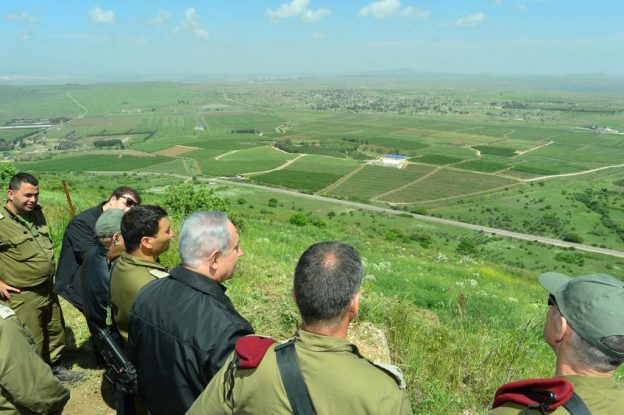
Benjamin Netanyahu is seen during a security tour in the Golan Heights, near Israel’s northern border with Syria
The SAA territorial advancements in the past year highlight that the SAA has the upper hand on the battle field. However, we should also remember that the southern battle is not the final battle, even though it is a vital battle since it includes an offensive that will be combating over 15,000 mercenaries. Contrary to Mr. Robert Fisk’s article in the Independent on June 26th 2018, I think it is too early to state that the battle for southern Syria will go down in history as a moment where “the US has given up on the overthrow of Assad in Syria” because it “abandoned its proxies in southern Syria”. Another battle that should be increasing in intensity in the next few weeks and/or after the southern battle is concluded is the battle to reclaim Northern (East) Syria – a territory under the Syrian Democratic Forces (SDF) and U.S. rebel factions.
The Syrian government including Liwa al-Baqir convened a major meeting of tribal notables from across Syria on June 2 in order to build support for operations against the U.S. in Eastern Syria. Syrian state media claimed the meeting included representatives from seventy clans from Aleppo, Ar-Raqqa, Hasakah, Daraa, and Deir ez-Zor Provinces. According to the Institute for the Study of War unconfirmed reports suggest that the SDF arrested dozens of additional tribal representatives traveling to the meeting from SDF-held Hasaka Province in Northern Syria. Tribal representatives at the meeting denounced the presence of the U.S., France, and Turkey in Syria and called for tribal mobilization to fight them on behalf of Assad. Multiple new pro-regime militia units of unclear size and capability reportedly formed subsequent to the meeting. These units may have joined Liwa al-Baqir with support from Russia and Iran. Not to mention reports released the week of July 15th 2018 highlighting that rebels in Southern Syria are being transported to the Northern part of Syria.
More recent news on July 29th 2018 highlights that the Syrian Democratic Council [the SDF political arm] held a two day meeting with the Syrian government headed by President Bashar Al Assad. Officials belonging to the SDF, which hold large swathes of land in northern Syria discussed the future of the autonomous regions it set up in northern and northeastern Syria. The SDF has made a series of deals with Damascus in recent years, notably in Aleppo when the SAA decimated Syrian Arab rebel groups making a final stand to hold the city. The SDF also came to an agreement with the Syrian government during the Turkish incursion into the then-Kurdish-held Afrin canton in Syria’s north-west corner, allowing Kurdish fighters to cross regime-held territory in a doomed bid to repel Turkish troops and their allies. The SDF, whose military is largely funded by the US as a counter-IS initiative, holds more than 27 percent of the country’s territory, according to the Syrian Observatory for Human Rights. It is still not clear whether rebel troops in northern Syria will be in accord with the SDF and SAA in relinquishing land they have usurped in the past 7 years and have it under the control of Damascus headed by President Bashar Al Assad. Also, according to a statement by SDF spokesperson Leilwa al-Abdullah, SDF forces pushed IS fighters into retreat from an area of 3,100 square-kilometers to a small slither of territory close to the strategic border town of Abu Kamal. A local SDF commander, speaking to Syria Direct said that the “crackdown on the border area” had gone ahead in coordination with Iraqi forces and international coalition airpower.
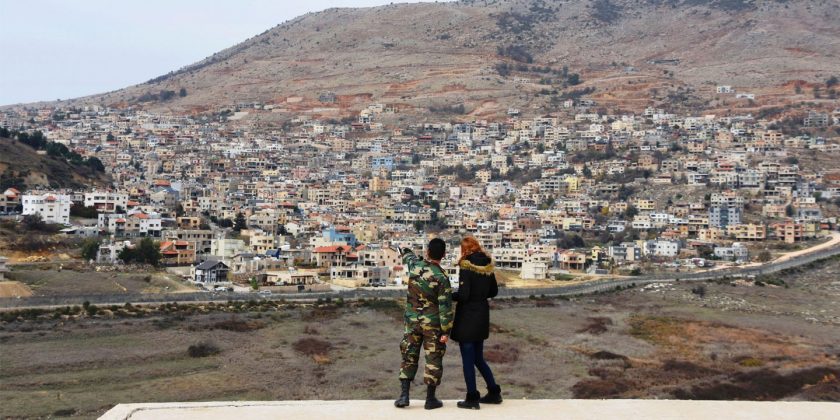
The Golan Heights
Still, recent territorial gains by the SDF may have little bearing on talks with the Syrian government, which could be unwilling to actually cede territorial control or administrative authority to Kurdish-majority forces. Sihanouk Dibo, from the majority-Kurdish leftist Democratic Union Party (PYD), acknowledged that any future talks could be “long and arduous because the Damascus regime is very centralized.” Whether centralized or not, the Syrian Government has historically been committed to the modality of Greater Syria with Damascus being the locus in decision making and autonomous regions conducting provincial policies relating to their provincial preferences. As stated by President Al Assad “Despite the ethnic diversity within each nation, the social fabric of the region by and large is one”. In other words, a region of the historical Bilad Al Sham/Greater Syria space will not be relinquished since the Levant possesses a unified social fabric and most importantly because the Barzani Clan in Iraq is a dangerous example of how U.S. imperialism with its allies can defend decentralization for the sake of geostrategic interest.
Therefore, in regards to the Syrian peace process, peace cannot be implemented when the UNSC resolution 2254 adopted in 2015 – including the P5 – continues to be violated. The delegates meeting at the June 13th U.N-led peace process in Geneva reiterated the importance of the clauses in the resolution which included that a nationwide ceasefire can only occur when member states are serious in halting the funding and training of mercenary entities. The members also reiterated the basis for a Syrian-led and Syrian-owned political transition in order to end the conflict in Syria. The meeting in Geneva did not highlight anything novel that the meetings in Astana or Sochi didn’t already outline. The meeting laid out the so-called four “baskets of reform” for a political settlement of the crisis. They include the drafting of a new constitution, parliamentary elections, the creation of a non-sectarian transitional government and the fight against mercenaries and terrorists. But the talks have made little progress so far as opposition members have failed to find an agreement over the fate of President Bashar al-Assad – a condition that the opposition has long wanted to include in the draft.
It is quite ironic that the Syrian Opposition is adamant in wanting to include a clause that stipulates that the current Syrian president is not allowed to run for president after 2020 and/or practice politics in Syria… it is ironic because while some opposition members discuss the importance of democracy being the foundation for peace in Syria, it is precisely democracy which re-elected President Bashar Al Assad in 2014.
Khaled AL-KASSIMI is a Doctoral candidate in the Department of Political Science at McMaster University in Canada. His research interest relates to the fields and approaches contoured by Critical Security Studies, Development Studies, International Relations, and Decolonial Studies.
Featured Video

Anthrax War – CBC The Passionate Eye
or go to
Aletho News Archives – Video-Images
Book Review
Shattered Dreams: The HPV Vaccine Exposed (2019)
By Christina England – 30 Q&As – Book Review & Summary
Lies are Unbekoming | September 4, 2026
… Gardasil received FDA fast-track approval in 2006, Cervarix followed in 2009, and Gardasil 9 was approved in December 2014 with more than double the aluminium adjuvant content of the original. The commercial context is specific. Merck was about to lose patent protection on Zocor and faced $18 billion in Vioxx injury claims from a cardiovascular drug the company had marketed while suppressing its own data showing a five-times increase in heart attacks. Analysts projected the global HPV vaccine market at $4 billion by 2011, contingent on government-funded national programs for teenage girls. The 1986 National Childhood Vaccine Injury Act had already granted manufacturers complete liability immunity. By 2013, Japan had withdrawn its HPV vaccine recommendation after cataloguing severe adverse reactions in hundreds of girls. No Western government followed. The establishment position across the UK, US, Australia, and most of Europe held, and still holds, that the vaccines are safe and effective, that reported injuries are coincidental, and that cervical cancer prevention justifies the program. The book was published into this position, not against a vacuum.
Shattered Dreams sits alongside Mary Holland’s The HPV Vaccine On Trial and Viera Scheibner’s foundational vaccination work as part of the documented record on what has been done to a generation of teenage girls under the banner of cancer prevention. The full summary unpacks three specific findings: that Merck used the aluminium adjuvant itself as the “placebo” control in 92.5% of trial subjects, making it structurally impossible to detect excess reactions from the adjuvant; that Dr. Sin Hang Lee found HPV DNA fragments bound to aluminium in every one of sixteen Gardasil samples tested, and in the blood and spleen of a New Zealand girl six months after her third dose; and that in every country with high vaccination coverage, including Australia, the UK, Norway, and Sweden, cervical cancer rates have stopped declining and started rising specifically in the vaccinated cohort. Martínez-Lavín’s 2017 calculation puts the number needed to seriously harm with Gardasil 9 at 140, and the number needed to vaccinate to prevent one case at 1,757. Thirteen young women are seriously harmed for every one who benefits. The vaccine was approved on the basis of trials that could not detect what the trials were supposed to detect, and it is still being given to twelve-year-olds today. … Read full review
Blog Roll
 Aletho News
- The Five-Year Fuel Crisis: Why the World Economy Is Paying for a War It Thinks Is Ending
- Trump’s Big Bluff on Iran
- Swiss scammed out of millions by Ukraine-linked call centers – media
- Germany facing potential ‘violent conflict’ with Russia – spy chief
- Ukraine’s EU neighbors reject new plea from Kiev – Politico
- British Transport Police Facial Recognition Trial Scanned 926,912 People With Zero Arrests
- House Bill Would Ban Federal Use of Flock ALPR Data
- Can a Spice Rival a Drug? 10 Head-to-Head Trials Put It to the Test.
- The oil routes around Hormuz face their own chokepoints
- The Saudi-Israeli war on Yemen’s resistance: Intelligence sharing, civilian targets & sectarian propaganda
- If Americans Knew
- David Ellison appoints Israeli to lead merged Paramount-Warner studios
- Turkish Red Crescent helps elderly Gaza man walk again after Israel confiscates his prosthetic limb
- Four Palestinians Killed in Israeli Attacks in Gaza
- Two Palestinian youths killed and village razed as Israeli attacks on West Bank continue
- Two more Christian women innocent victims of Gaza raids
- Cruelty, Deprivation, Indignity: A Journalist’s 22 Months in Israeli Prison
- New IDF Website Frames Slain Gaza Journalists as Terrorists
- Israeli media: After settlers beat him mercilessly, they stuffed dirt into his mouth
- Americans Are Paying the Price to Preserve Israel’s Nuclear Hegemony
- A U.S. Jewish Fund’s Ambitious Bid to Put a Settler Elite in Control of Israel’s Security
- No Tricks Zone
- Latest European Green Energy Debacle; Portugal’s Largest Flagship Solar Park Insolvent!
- Green Energy Debacle: German Expert Professor Fritz Vahrenholt Warns Of Severe Economic And Social Consequences
- Two More Paleo Reconstructions Affirm Meters-Higher Sea Levels Across Ireland, Brazil 7000-6000 Years Ago
- New Study: Earth And Venus Surface Warmth Largely Explained By Convection And Lapse Rate, Not CO2 Or Radiation
- 2025 Nature Paper Claiming Worsening Global Drought Gets RETRACTED …Heavily Flawed
- New Study: ‘Global Drought Shows No Detectable Recent Acceleration Under Climate Warming’
- Economic Masterminds: German Socialists Suggest Taxing Productivity Gains Stemming From Using AI
- The South China Sea Has Not Been Cooperating With The Climate Change Narrative
- Energy Crisis: Germany Enters Heating Season With Historically Low Gas Reserve Fill Levels
- New Study: The Antarctic Ice Sheet Gained Mass From 2020-2024 Due To Staggering Snow And Ice Accumulation

