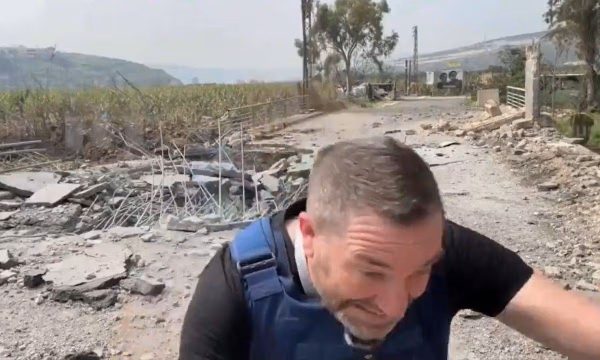
UK media has whitewashed Israel’s attempt to kill British war journalist Steve Sweeney and his Lebanese cameraman Ali Rida while they were broadcasting live from southern Lebanon on 19 March.
Footage shot by Rida shows Sweeney giving a news report about a previous Israeli strike when he realizes another strike is headed towards them. He quickly ducks as the missile is seen exploding as it hits the ground just meters behind him.
Sweeney was treated at the hospital to remove shrapnel from the bomb that was embedded in his arm.
While reporting on the strike, the BBC used a headline stating, “Missile lands next to presenter during live report from Lebanon.”
The headline did not mention that Israel had fired the missile, nor did it describe Sweeney as a journalist or war correspondent, while implying the strike was only random or simply an accident.
The Independent newspaper described the incident in a similar way, writing “A missile landed just a few feet away from a British journalist as he was reporting live from Lebanon.”
“Footage shared by Russian state broadcaster RT on Thursday (19 March) shows Steve Sweeney, its Lebanon bureau chief, running for cover as an explosion detonated behind him,” The Independent added, also failing to mention Israel had launched the strike.
The Daily Mail, a British tabloid, acknowledged Israel’s role, but referred to Sweeney’s statement that Israel tried to kill him as only a “claim.”
“British journalist Steve Sweeney has claimed Israel ‘tried to kill him’ in a targeted airstrike that left him and his cameraman with minor injuries,” the Daily Mail wrote.
The New York Post and CNN used similar headlines, omitting mention of Israeli responsibility, while taking Israel’s claims at face value that its military does not target journalists in the body of the article.
“Insane moment missile blows up just feet away from reporter in Lebanon,” stated the New York Post headline.
CNN wrote, “News crew narrowly escapes strike in southern Lebanon,” while publishing only the video and no other details on its website.
BBC, The Independent, and Daily Mail reports ignore Israel’s deliberate killing of Lebanese journalists covering Israeli war crimes since 2023.
The targeting of Sweeney and Rida came just one day after Israel assassinated Al Manar journalist Mohammad Sherri and his wife in a brutal strike on Lebanon’s capital, Beirut, as part of a series of deadly attacks that killed at least a dozen.
During its previous war on Lebanon – which started in 2023 and ended in a so-called ceasefire in 2024 – the Israeli army murdered three Lebanese journalists with an airstrike as they slept at a media guesthouse in southeast Lebanon.
“The 3:00 am airstrike turned the site – a series of chalets nestled among trees that had been rented by various media outlets covering the war – into rubble. Cars marked ‘PRESS’ were overturned and covered in dust and debris, and at least one satellite dish for live broadcasting was totally destroyed,” AP reported.
The strikes killed camera operator Ghassan Najjar and broadcast technician Mohammed Rida of Al Mayadeen TV, and camera operator Wissam Qassim, who worked for Hezbollah-affiliated Al Manar TV.
“The journalists thought they were safe because this south Lebanon area wasn’t in Israel’s evacuation zone,” PBS journalist Leila Molana-Allen wrote on X.
Molana-Allen, who is also currently reporting from Lebanon, said the journalists had given details of their movements to UN peacekeepers to send to the Israeli military.
“Turns out the IDF [Israeli military] used that info to bomb them while they were all inside asleep,” Molana-Allen reported.
Lebanese journalists had already been working for almost a year under the shadow of Israel’s killings of Reuters video journalist Issam Abdullah on 13 October 2023 and Al Mayadeen journalist Farah Omar, her cameraman Rabih al-Maamari, and their assistant Hussein Akil on 21 November 2023.
All four were killed reporting from the Lebanon–Israel border area after the war between Lebanon and Israel began on 8 October 2023, the next day after the launch of Hamas’s Operation Al-Aqsa Flood and Israel’s genocide of Palestinians in Gaza.
A Reuters investigation concluded that Abdullah was killed and six others were injured when Israeli troops fired two tank shells directly at a group of journalists from Reuters, AFP, and Al Jazeera who were filming at an open spot one kilometer from the border.
A record 129 journalists and media workers were killed worldwide in 2025, the Committee to Protect Journalists reported, with Israel responsible for two-thirds of the deaths, including many it killed in Gaza.
An anti-Zionist group has claimed responsibility for a fire at a warehouse belonging to a defense firm linked to Israel’s Elbit Systems in the Czech Republic.
The Earthquake Faction, which describes itself as “an internationalist underground network,” posted a video purportedly showing the arson attack on an industrial facility in the Czech town of Pardubice on Friday, along with images of the burned-out building.
It said the site was used to “develop weaponry used by the Zionist entity to massacre people daily in Palestine, Lebanon, Iran, and across West Asia.”
Firefighters extinguished the blaze, no injuries were reported, and police said there was no danger to the public. Officials said the incident is being treated as a suspected terrorist attack.
The facility is operated by LPP Holding, a Czech arms manufacturer producing civilian and military equipment. In 2023, the company announced cooperation with Israel’s Elbit Systems on drone development.
Headquartered in Haifa, the firm is Israel’s largest defense manufacturer, specializing in unmanned systems, precision weapons, and electronic warfare equipment.
The Czech Republic, an EU and NATO member, is a close ally of Israel. Czech officials have supported US and Israeli military actions against Iran and condemned Iranian missile and drone attacks.
Israel’s veiled threat to Moscow came just after Russian media warned traffic cameras in Moscow were vulnerable to the same exploits that Israel reportedly used to monitor Ayatollah Khamenei’s residence before assassinating him.
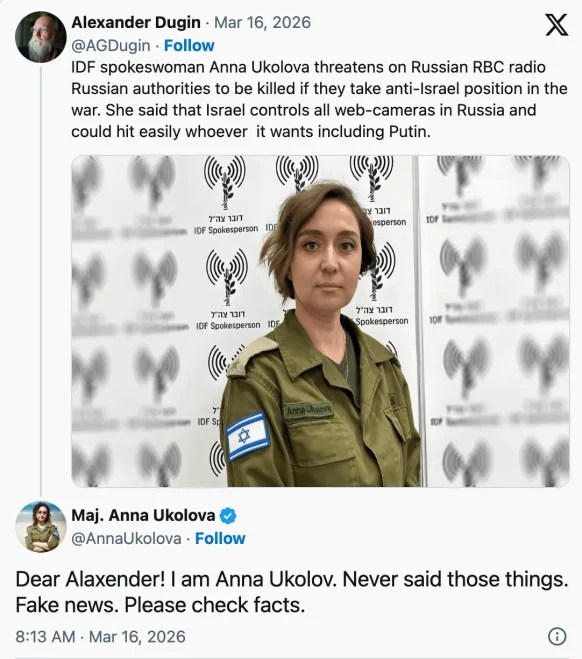
Israeli military spokeswoman Anna Ukolova has drawn outrage in Moscow after threatening that Russian authorities who “wish Israel ill” could be subject to “elimination,” while suggesting Israel could hack into Russian closed-circuit television cameras to identify and track targets.
Asked by a journalist with Russian radio broadcaster RBC whether Israel had access to Russian traffic cameras, Ukolova declined to answer directly but warned that “Khamenei’s elimination shows our capabilities are serious” and that “no one who wishes us harm will be left aside.”
She added, ominously, “I hope Moscow does not wish Israel ill right now – I’d like to believe that.”
In response to a post by Russian philosopher Alexander Dugin, who wrote that the IDF spokeswoman threatened that “Russian authorities [will] be killed if they take [an] anti-Israel position,” Ukolova claimed Dugin was spreading “fake news.” But she declined to clarify how her remarks had been incorrectly interpreted.
Ukolova’s statements came just days after it was revealed that a large number of Russian CCTVs were potentially using BriefCam – an Israeli video analysis software that closely matches the description of a program the Netanyahu regime reportedly deployed to track Iranian movements outside the home of Iran’s Supreme Leader before they assassinated him during their February 28 sneak attack.
On March 12, Russian outlet Mash revealed that the Israeli software BriefCam “has been used in Russia by private providers since the 2010s.” Founded at Israel’s Hebrew University in 2007, BriefCam uses AI to let users “review hours of video in minutes” and “make [their] video searchable, actionable and quantifiable.” In 2024, BriefCam was absorbed by a Dutch subsidiary of the Canon Group named Milestone Systems, which publicly pledges to “amplify what organizations of any size can see, do and achieve with video.”
“Our patented VIDEO SYNOPSIS® technology condenses hours of surveillance into a short summary by overlaying multiple events—each tagged with its original timestamp—onto a single frame, letting you filter them by object type and attributes,” the company’s BriefCam page crows. An analysis by Al Jazeera revealed those attributes include “gender, age group, clothing, movement patterns and time spent in a given location.”
Originally deployed by Israel’s Ministry of Housing and Construction to safeguard illegal settlements in occupied East Jerusalem, BriefCam has been used by governments all over the world, including those in the United Kingdom, New Zealand, Pakistan, Israel, Mexico, United Arab Emirates, Canada, Indonesia, Singapore, Thailand, Brazil, Germany, South Africa, Netherlands, Australia, Japan, India, Spain, Taiwan. It’s also been deployed in the US, with police in Hartford, Connecticut adopting the software in 2022. In 2025, a French court found the government’s use of BriefCam was illegal, citing multiple violations of French and European privacy laws.
As of publication, BriefCam appears to be incorporated into dozens of so-called “video monitoring systems,” including Milestone’s own VMS XProtect surveillance system.
A promotional video shows the numerous surveillance systems that BriefCam operates within.
According to the Russian outlet Mash, a number of prominent Moscow businesses, institutions, and buildings use VMS XProtect surveillance system, including the Institute of Theoretical and Experimental Biophysics of the Russian Academy of Sciences, a 72-story skyscraper named “Eurasia,” and a huge exhibit space known as the Zotov Center. Though Milestone officially ended operations in Russia in 2022 amid the war in Ukraine, Mash reports that some software distributors in Russia “still offer to install the hacked software and hide this in the documents.”
In the early hours of March 18, Israeli drones tore into four gas‑treatment plants in Assaluyeh on Iran’s southern coast, where sour gas from phases 3, 4, 5 and 6 of the South Pars field is cleaned, separated and turned into the fuel that keeps the country’s lights on, homes heated and factories supplied. Iranian officials ordered the plants offline to contain the fires, and industry analysts immediately warned that production from the offshore platforms feeding those trains would have to be cut back. Within an hour of the strike being reported, European gas prices and Brent crude jumped, because traders understood what most headlines did not. This was not a symbolic hit on an abstract “gas field,” but a deliberate attack on a conversion node at the heart of Iran’s domestic energy system and a critical pillar of the wider Gulf energy order.
At the same time, Donald Trump was on social media threatening that if Iran retaliated again against Qatar’s LNG hub at Ras Laffan, he would “blow up the entirety” of South Pars – the largest gas field on the planet, and interestingly, a reservoir Iran shares with Qatar. The man who joined Israel in authorising the first strikes on Iranian production facilities is now openly dangling the prospect of destroying the shared gas reservoir that keeps tens of millions of people warm, powered and employed. That is not deterrence, only a head of state experimenting in public with the language of total economic annihilation.
Trump’s own Truth Social post about the strike reads like a rambling attempt to distance Washington from the attack while threatening to “blow up the entirety” of South Pars if Iran hits Qatar again. The post deserves closer attention later in this story.
ASSALUYEH: WHERE GAS BECOMES POWER
To see what was attacked in Assaluyeh is to understand that the language matches the target. South Pars itself is the Iranian half of a single, giant reservoir under the Gulf, known as the North Field in Qatar, which together contain around a tenth of the world’s proven gas reserves. Iranian officials say South Pars covers 24 phases and provides between 70–75% of Iran’s gas production, feeding power plants, industry, petrochemical complexes and gasoline production. The gas that makes that possible must pass through places like Assaluyeh, where onshore plants strip out condensate, liquefied petroleum gases and natural gas liquids before returning dry gas to the grid and sending liquids on to refineries and export jetties. Over two decades, the South Pars Special Economic Energy Zone has grown into a dense cluster of processing trains and downstream plants with total gas‑processing capacity on the order of a billion cubic metres per day and around twenty‑one petrochemical units producing close to forty million tonnes per year of urea, methanol, polyethene, and other basic chemicals.
Israel did not attack the offshore reservoir. It attacked the pipes, columns and separators that turn raw gas into power, plastics, fertiliser and fuel. The four targeted plants process sour gas from phases 3, 4, 5 and 6, which are mature, are heavily integrated blocks that feed directly into Iran’s domestic grid and petrochemical system. Shutting those trains, even temporarily, forces operators to throttle back production on the linked platforms and starves downstream complexes of both dry gas and feedstock. In concrete terms, that means less gas available for electricity generation on a grid already prone to summer blackouts, less feed for petrochemical plants that supply everything from fertiliser to plastics, and less condensate flowing through the storage and export facilities that sit alongside the gas plants on the Persian Gulf shore.
Iranian reports speak of powerful explosions at several Assaluyeh facilities, fires around storage tanks and gas units, and workers being evacuated as emergency crews tried to contain the damage. From a planner’s point of view, this is a high‑leverage target: a handful of processing units at the convergence of offshore production and onshore consumption whose disruption sends shockwaves up the supply chain and down into the civilian economy. From the point of view of the people whose houses, factories and hospitals depend on those flows, it looks like something else entirely – an attack on the infrastructure of daily life.
That is the first truth this strike reveals: Israel has shifted from fighting Iran’s armed forces to fighting the country’s energy system, the circulation of fuel that keeps the state conscious.
This is not a one‑off aberration. During the twelve‑day war of June 2025, an earlier Israeli strike hit the Phase 14 processing plant at Assaluyeh, forcing a shutdown and firefighting operation before Iranian engineers brought the plant back online within two weeks. The March 2026 strikes returned to the same nerve centre but widened the cut: instead of Phase 14 alone, the drones went after four plants tied to phases 3–6, which together represent a much larger share of South Pars throughput and a deeper incision into Iran’s ability to turn offshore gas into usable energy. What is being tested here is not just Iran’s repair capacity. It is how much of its gas‑conversion system can be burned down before the political cost becomes untenable.
FROM MILITARY TARGETS TO CIVILIAN PUNISHMENT
The crucial point is that gas in Iran is not a luxury export commodity, but the country’s primary fuel for power generation, industrial heat and residential heating. Well over ninety per cent of the gas Iran produces is consumed domestically, not exported. It keeps homes warm in winter, feeds cement and steel plants, drives turbines in power stations and prevents rolling blackouts on a grid that is already fragile. When you hit Assaluyeh, you are not trimming a few cargoes of condensate to Asia. You are reaching into the core of a domestic energy system that supports nearly ninety million people – the apartment blocks in Tehran that already live with scheduled outages, the small factories in Isfahan that depend on steady voltage to keep lines moving, the provincial hospitals that cannot function when the generators sputter.
Even the outlets trying to normalise the strike cannot entirely avoid that reality. They call South Pars an “energy lifeline”, stress that it powers much of Iran’s electricity system and note that the onshore plants at Assaluyeh are central to separating condensate and LPG from the gas that then runs into Iranian networks. “Energy lifeline” is the language of necessity, not of optional revenue. To choose that target is to choose to tamper with the civilian infrastructure that stands between a functioning society and a rolling crisis of blackouts, shortages and industrial breakdown. “Collective punishment” is usually invoked in the context of bombs on apartment blocks or food embargoes. Here it is delivered through valves and turbines.
It is precisely at this point, when questions of necessity and legitimacy collide, that the recent behaviour of Washington’s own security establishment strips away the alibi that this was a war forced by urgent facts. In a few sentences at a Senate hearing, Director of National Intelligence Tulsi Gabbard told lawmakers that only the president can decide what is an “imminent threat” from Iran, even as senior aides were warning her that there was no evidence Iran had restarted enrichment or posed an immediate nuclear danger. Two days earlier, Joe Kent, the director of the National Counterterrorism Center, resigned, saying in his letter that he could not “in good conscience support the ongoing war in Iran,” that Iran posed “no imminent threat,” and that Israel had pressured the United States into the conflict. Those two moments do not need pages of commentary. Together they are enough: the official charged with guarding the integrity of U.S. intelligence rewrites “threat” as a presidential mood, and the official charged with synthesising terrorist threats walks out saying the war is manufactured.
In other words, while Israeli pilots and U.S. operators are hitting the infrastructure that keeps Iranian civilians alive, the people at the top of the American system are quietly admitting that the supposed emergency justifying those strikes does not exist in the way the public was told. The last line of defence, a reality defined by evidence rather than by political need, has been crossed, and it has been crossed at the exact moment the war shifted from military targets to the machinery of everyday survival.
Trump’s Truth Social statement makes that shift even starker. It is not a clarification, and reads more like a hostage note. South Pars is being turned into collateral for Qatar’s LNG security, and Trump denies U.S. prior knowledge of Israel’s first strike while claiming the right to decide if and when the entire shared field is destroyed. In one message, he signals that the energy backbone of Iran and Qatar is now a bargaining chip Washington is prepared to sacrifice to enforce its war.
That is the second truth of this episode: the war on Iran’s civilian infrastructure is being waged under a definition of “threat” that collapses into whatever the president needs it to be.
Once a president starts talking about “blowing up the entirety” of the field that keeps both Iran and Qatar running, the fiction that this is a contained war collapses.
Exporting the Energy Shock
By treating Iran’s South Pars complex and linked Gulf energy infrastructure as disposable targets, Israel and the United States have not just escalated a regional war; they have shifted the economic pain onto societies that never signed up for this fight, from Turkish households to European workers and Indian farmers now absorbing the fallout.
Turkey: forced into a rigged market
In Turkey, the cost of turning South Pars into a battlefield is already measurable. Analysts note that Iran supplies gas to Turkey by pipeline, and that any prolonged disruption would force buyers to look for replacement cargoes on the LNG market. That “elsewhere” is the spot market, where Asian demand has already begun pulling cargoes away from Europe as importers scramble to replace lost Gulf supply. In practice, a strike pitched as pressure on Iran becomes a higher import bill for a NATO member and another inflationary squeeze on households and industry.
Europe: dragged back toward 2022
In Europe, the impact showed up first on trading screens. After disruption to Qatari LNG output, benchmark gas prices on the Dutch TTF hub jumped by as much as 45%, reaching around €46 per megawatt-hour. Reuters then reported that Asian buyers scrambling for LNG replacement cargoes were already pulling shipments toward Asia, reinforcing the risk of another continental price shock. Europe’s dependence on LNG after cutting Russian pipeline supply means that attacks on South Pars-linked infrastructure in the Gulf do not stay regional for long.
India: paying for a war it did not choose
In India, the blowback is more than theoretical. Government sources told CNBC-TV18 that LPG supplies were already “feeling some heat” as the West Asia conflict disrupted shipping routes and pushed gas prices higher. The same report said Asian LNG prices had risen from about $6–8 per MMBtu to around $15 per MMBtu, while rerouting cargoes from alternative suppliers such as the United States or Norway would take longer. A later report said Indian LPG consumption fell 17.7% in the first half of March because of war-related supply disruption. That is what energy warfare looks like in human terms: shortages, higher costs and forced adjustment by people who had no role in launching the conflict.
China: tested, not insulated
China’s immediate exposure looks smaller on paper, but the same shock still hits Beijing’s energy calculus. Reuters reported that over 80% of Qatar’s LNG exports go to Asia, placing major buyers like China in the line of fire when Gulf supply is disrupted. Another report noted that China was among the key Asian markets exposed as the regional benchmark LNG price surged and traders sought replacement cargoes from farther afield. That leaves Beijing with more buffers than poorer importers, but not immunity from the price shock set off by attacks on Gulf gas infrastructure
WHEN A SHARED FIELD BECOMES A WAR ZONE
If the story stopped at Iran’s shoreline, it would already be devastating. But South Pars does not stop at Iran’s shoreline. The reservoir that feeds Assaluyeh stretches under the Gulf into Qatari waters, where it is known as the North Field and where it supplies Ras Laffan Industrial City, the most important LNG complex on Earth. Before the war, Ras Laffan’s trains exported around 77 million tonnes per year of liquefied natural gas, with plans underway to expand capacity towards 142 million tonnes by the end of the decade. Alongside LNG, Ras Laffan also produces Liquefied Petroleum Gas (LPG), ethane, condensate and sulphur, and hosts gas‑to‑liquids plants, power stations and desalination units. It is a central hinge in the global energy system, and on the day Iran’s missiles arrived, workers there were told to leave the plant that underwrites their families’ incomes because someone else had decided their shared field was expendable.
Qatar understood immediately what an attack on South Pars meant. Its foreign ministry condemned the strikes as “dangerous and irresponsible,” explicitly reminding the world that the field is geologically continuous with the North Field and warning that targeting infrastructure tied to that reservoir threatens global energy security. It has now gone further, calling Iran’s strike on Ras Laffan a “brutal targeting” of its gas hub, invoking Security Council resolutions and asserting its right to respond under Article 51 of the UN Charter. The United Arab Emirates, normally cautious about public criticism of Israel, issued its own statement that attacks on energy facilities linked to Pars risk catastrophic consequences. Those are not sentimental reactions. They are the reflex of states that suddenly realised the line between “hitting Iran” and “putting our own energy spine in the crosshairs” had effectively vanished.
Iran’s Revolutionary Guard then warned that key Gulf facilities had become “direct and legitimate targets” and urged workers to evacuate them before the strike. The list was specific: Ras Laffan; Mesaieed, Qatar’s original deep‑water export port and industrial hub, where gas and condensate are turned into NGLs, refined products, petrochemicals, aluminium and steel; Samref, a more‑than‑400,000‑barrels‑per‑day refinery in Yanbu on Saudi Arabia’s Red Sea coast with around 13 million barrels of storage; Jubail, the giant refinery‑petrochemical complex in eastern Saudi Arabia running at roughly 440,000 barrels per day and anchored by a 1.5‑million‑tonne‑per‑year ethylene cracker; and Al Hosn in the UAE, a sour‑gas project that processes about a billion cubic feet per day of raw gas, produces roughly half a billion cubic feet per day of sales gas for the Emirati grid and throws off tens of thousands of barrels of condensate and thousands of tonnes of sulphur every day.
In Kuwait, drones struck individual units at the Mina al‑Ahmadi refinery and Mina Abdullah refinery, triggering “limited” fires and forcing operators to temporarily halt parts of their output. Further east, Abu Dhabi’s Habshan gas facilities, already singled out in Iranian warnings, were shut down after debris from intercepted missiles fell on the site, underscoring that Tehran was willing to hit the very installations that underpin its rivals’ domestic energy security.
In other words, Tehran not only threatened but executed multiple strikes, and in the Ras Laffan’s case, it appears the Islamic Republic have struck the same class of conversion assets on Arab shores that Israel and the U.S. had just targeted at Assaluyeh, the plants where raw hydrocarbons become electricity, heating, industrial feedstock and exportable product.
It is crucial to understand that Ras Laffan’s LNG trains, Mesaieed’s NGL and refining complex, Samref’s crude units, Jubail’s crude‑to‑chemicals expansion and Al Hosn’s gas and sulphur trains are all parts of the same nervous system.
When one side authorises attacks on conversion nodes at South Pars, the other side’s answer is not to keep politely to its own coastline. It is to declare that the Gulf’s entire energy architecture is now part of the battlefield.
That is the third truth this strike exposes: by hitting a shared field, Israel and the U.S. have made their own allies’ energy spines part of the target set.
THE ENERGY WAR NOBODY CAN HONESTLY CALL ‘DEFENSE’
Seen from this angle, the Assaluyeh strikes were not a self‑contained tactical move. They were the opening of a new kind of war, a war on conversion infrastructure, that punishes civilians first and drags allies and markets along for the ride. Israel hit the plant that turns Iran’s gas wealth into heat, light and wages; Iran responded in kind by putting the plants that turn Qatar’s, Saudi Arabia’s and the UAE’s hydrocarbons into LNG, petrol and plastics in its sights. Trump then raised the stakes by threatening to “entirely blow up” the shared reservoir that makes all of this possible, as if the energy backbone of two states and a sizeable slice of Europe and Asia’s gas supply were a pawn to be removed from the board to prove a point.
At that stage, the legal and moral mask slips. A campaign that begins as “precision strikes” against military and command targets turns, almost in slow motion, into an assault on the infrastructure that keeps tens of millions of people from freezing, blacking out or losing their jobs, and into a form of extortion against the wider Gulf. In other words, people of Iran are being asked to accept that Iran’s energy lifeline can be bombed with impunity, or watch their own refineries and LNG terminals burn.
Iranian analysts now call this openly what it is, “economic warfare” centered on energy, and warn that destroyed or degraded capacity will worsen electricity shortages and deepen domestic hardship. When the same government waging that campaign has senior officials on record saying the “imminent threat” used to sell the war does not exist as advertised, it becomes very hard to sustain the fiction that this is self‑defense in any meaningful sense.
A war waged under those conditions cannot be sold as “precision.” It can barely, if at all, be sold as self‑defense. What they are doing, in the cold light of Assaluyeh’s burning stacks and Ras Laffan’s flares, looks like a campaign of collective punishment enforced through the energy system of an entire region, and once you see it that way, it becomes very hard to unsee.
Russia has officially filed a complaint against Israel for attacking areas near Iran’s Bushehr Nuclear Power Plant and endangering the lives of its Russian personnel.
Hebrew news outlet reported on Wednesday that Russia has voiced strong condemnation against Israel for attacking the Bushehr airport and other areas in the southern Iranian province, which are close to the nuclear power plant.
The attacks endanger the lives of Russian personnel working in and around the Bushehr Nuclear Power Plant, Russia said.
The Russian embassy in the Israeli-occupied territories gave the country’s complaint and official demands to Israeli authorities.
According to reports, Israeli attacks against Bushehr targeted the living quarters of one of Russia’s nuclear experts in the region.
MOSCOW – Russia strongly condemns any actions aimed at harming the health or murder of representatives of the Iranian leadership, Kremlin spokesman Dmitry Peskov said on Wednesday.
“Actions aimed at harming health or even killing and eliminating representatives of the leadership of sovereign Iran, sovereign and independent Iran, as well as other countries. We condemn such actions,” Peskov told reporters.
On Tuesday, the office of the Secretary of Iran’s Supreme National Security Council said that Ali Larijani died.
Moscow has not received any signals from the Europeans that they want to engage in dialogue within the framework of energy cooperation, Peskov said.
“There have been no signals from the Europeans that they want to at least have a dialogue,” Peskov told reporters.
Putin is always open to discussing most pressing issues, the official said, adding that it is not too late for Europeans to signal their readiness for energy cooperation.
“As for the president’s instruction to consider the possibility of early withdrawal from European gas markets, this topic is under consideration. A fairly in-depth analysis is required,” Peskov said.
The energy market is experiencing an upheaval due to the conflict over Iran, which makes it difficult to predict the development of the market, the spokesman added.
Earlier this month, Russian President Vladimir Putin said he would instruct the government, together with Russian companies, to work out the issue of natural gas supplies from Russia to promising markets. Putin said that it might be more profitable for Russia to stop supplies to the European market now, before EU restrictions take effect, and to enter new markets and gain a foothold there.
Russia does not consider it appropriate for European countries to participate in the negotiation process on Ukraine, Peskov said.
“You know that there have been signals from the Europeans that they want to take their place at the negotiating table on the Ukrainian settlement, which we do not consider necessary and expedient,” Peskov told reporters.
US representatives said that they had no information about Russia’s support for Iran, Dmitry Peskov said.
“There were comments on this issue from representatives, official representatives of the United States, who themselves said that they had no information on this matter,” Peskov told reporters.
The vast majority of media reports related to the Iranian conflict are not true, Peskov added.
Earlier in March, media reported, citing US officials and a former Russian intelligence officer, that Russia allegedly shares with Iran satellite images of US facilities in the Middle East and UAV production technologies.
US War Secretary Pete Hegseth is facing accusations of violating domestic and international laws prohibiting war crimes by declaring that “no quarter” or mercy would be given to Iranian forces.
The legal definition of the term means surrendering Iranian soldiers would be executed by American troops rather than taken prisoner. US officials and legal experts have responded by accusing Hegseth of encouraging war crimes.
”We will keep pressing. We will keep pushing, keep advancing. No quarter, no mercy for our enemies,” Hegseth said at a press briefing on Iran on Friday.
Some US officials and legal scholars have argued that the remarks went beyond tough rhetoric and strayed into criminality.
Senator Mark Kelly of Arizona blasted Hegseth, saying his comment “isn’t some wannabe tough guy line” but rather an illegal order that jeopardizes US military service members. It also shows “there was never a clear strategy for this war,” the lawmaker added.
Dan Maurer, a retired US Army lieutenant colonel and judge advocate, published a hypothetical memo Hegseth should receive from the Pentagon legal counsel, informing him of criminal liability for himself and any subordinate who followed his directive to deny quarter.
The Hague Convention and the Geneva Convention forbid harming enemy combatants unable to defend themselves or who have surrendered and explicitly prohibit declaring “that no quarter will be given.”
These rules are enshrined in US domestic law. The 1996 War Crimes Act directly cites the article banning “no quarter” in its definition of war crimes.
The US military has prohibited orders to take no prisoners since 1863, when US President Abraham Lincoln issued the Lieber Code during the Civil War.
Hegseth has previously dismissed concerns about international law, claiming he would not abide by “stupid rules of engagement” and “politically correct wars.”
His remarks also come two weeks after a US strike on a girls’ school in southern Iran that killed more than 170 people, most of them children.
The Judaeo-American war on Iran was intended to be a lightning strike routing, fought exclusivelyfrom the air, lasting only a few days. Instead, Washington and its Zionist proxy have blundered into a major multi-front conflict, which could well threaten the Empire’s very existence. The initial US aerial bombardment’s centrepiece was Supreme Leader Ali Khamenei’s February 28th murder. Initially hailed by Western media as “the assassination of the century,” the vile act has resulted in catastrophe for the perpetrators.
The Islamic Republic’s relentless battering of Zionist entity civilian centres and military and intelligence infrastructure, and US bases throughout West Asia, hasn’t been deterred one iota. Vast crowdstook to the streets of Tehran in vengeful mourning. Their righteous anger has pullulated throughout the Arab and Muslim world. Ever since, incensed Shiites have violently clashed with security forces in multiple major Pakistani cities. Meanwhile, Bahrain teeters on the brink of all-out revolution. Now, Mojtaba Khamenei, the slain Supreme Leader’s son, has taken his place.
Iranian citizens of every ethnic and religious extraction braved US-Israeli airstrikes to celebrate his ascension. Commonly perceived as a hardliner with strong ties to the Iranian Revolutionary Guards Corps, the expectation that the new Supreme Leader will adopt a considerably less conciliatory, patient approach than his father is widespread. Western sources forecast Mojtaba may decide the Islamic Republic “must move quickly to obtain nuclear weapons in order to forestall future US and Israeli attacks,” overturning Ali Khamenei’s longstanding fatwa against their development by Tehran.
US President Donald Trump has declaredhe is “not happy” with Mojtaba taking power, and Israeli apparatchiks are likewise perturbed by the development. Nonetheless, this was an inevitable upshot of assassinating the former Supreme Leader. There was also no reason to believe doing so would precipitate the Islamic Republic’s collapse, or lead to Tehran’s military submission. It begs the obvious question of why Washington and Tel Aviv electively helped install a ruler more committed than ever to expelling the Empire from West Asia.
Similarly, Hezbollah’s extraordinary broadsides of the Zionist entity since Khameinei’s assassination should dispel any notion – as perpetuated by Israeli political and military chiefs – the groupwas obliterated by Tel Aviv’s criminal October 2024 invasion of Lebanon. That incursion was prefaced by an operation in which thousands of pagers used by senior Hezbollah operativeswere detonatedsimultaneously, having been wired with explosives by Mossad pre-purchase, killing and injuring many. A week-and-a-half later, the group’s Secretary General Hassan Nasrallah was lethally targetedin a Zionist entity airstrike.
Evidently, the Resistance cannot be crushed via high-level assassinations. In fact, such actions actively strengthen its members. This inconvenient reality has been well-known to the CIA since at least 2009. In July that year, the Agency produced a top secret assessment laying out the pros and cons of liquidating “high value targets” (HVTs). It was prepared in advance of Barack Obama’s CIA chief Leon Panetta shifting US “counter-terror” operations from capturing and torturing high-level suspects, to outright executing them.
The assessment concluded HVT operations “can play a useful role when they are part of a broader counterinsurgency strategy,” and sought to “assist policymakers and military officers involved in authorizing or planning” such strikes. However, it listed many “potential negative effects” of “high value” assassinations. Israel’s past killing of Hamas and Hezbollah leaders were specifically cited as examples of how the strategy can spectacularly backfire. We have witnessed the CIA’s unheeded cautions play out in real-time since February 28th.
Foremost among prospective blowback from HVT operations is that the risk high-level assassinations can increase an “insurgent” group’s support. This occurs when killing a target “[strengthens] an armed group’s bond with the population, radicalizing an insurgent group’s remaining leaders, creating a vacuum into which more radical groups can enter, and escalating or deescalating a conflict in ways that favor the insurgents.” Such actions can also “[erode] the ‘rules of the game’ between the government and insurgents,” thus exacerbating “the level of violence in a conflict”:
“HVT strikes, however, may increase support for the insurgents, particularly if these strikes enhance insurgent leaders’ lore, if noncombatants are killed in the attacks, if legitimate or semi-legitimate politicians aligned with the insurgents are targeted… An insurgent group’s unifying cause, deep ties to its constituency, or a broad support base can lessen the impact of leadership losses by ensuring a steady flow of replacement recruits.”
The CIA assessment noted several historical instances of supposed HVT successes. When high-level targets have “prominent public profiles”, assassinations can in specific instances shatter a target group. However, this was not the case with Hamas or Hezbollah. The pair “carry out state-like functions, such as providing healthcare services,” so group leaders are well-known to citizens of Gaza and Lebanon. Yet, their “highly disciplined nature, social service network, and reserve of respected leaders” mean they can easily “reorganize” in the wake of assassinations.
The Zionist entity had by this point been engaged in “targeted-killings” against Hamas, Hezbollah, and other Resistance groups since the mid-1990s. However, their “decentralized command structures, compartmented leadership, strong succession planning, and deep ties to their communities” made them “highly resilient to leadership losses.” Undeterred, Tel Aviv’s high-level assassinations continued apace. In the early 2000s, Hamas founder Sheikh Yassin and the group’s leader in Gaza Abdel Aziz al-Rantisi were murdered. However, the killings “strengthened solidarity” between Resistance factions, while “[bolstering] support for hardline militant leaders.”
The obvious lessons of this wanton bloodletting remained unlearned by the Zionist entity, once the Gaza Holocaust erupted. In June 2024, elite imperial journal Foreign Affairs published a report unequivocally headlined Hamas Is Winning. It boldly concluded “Israel’s failing strategy makes its enemy stronger.” The outlet also recorded how “according to the measures that matter,” Hamas was considerably bigger and more powerful than on October 7th 2023. Israel had thus stumbled into a deeply ruinous attritional war, with a “tenacious and deadly guerrilla force.”
Hamas’ surging popularity with Palestinians throughout the Gaza genocide was found to have significantly enhanced the group’s “ability to recruit… [and] attract new generations of fighters and operatives.” This granted Hamas the ability to launch “lethal operations” in areas previously “cleared” by the IOF “easily”. Foreign Affairs charged the Zionist entity, to its “great detriment”, failed to comprehend how “the carnage and devastation it has unleashed in Gaza has only made its enemy stronger.”
It is not merely Hamas that has been galvanised by the Gaza genocide. Israel’s “carnage and devastation” has greatly expanded the ranks and resolve of the entire Resistance, while its constituent members have won hearts and minds globally in ever-mounting numbers.Tel Aviv and its Anglo-American puppet[master]s have no good choices left to make, in a criminal war of choice waged against an indefatigable adversary committed to total victory, the likes of which they have never faced off against before.
The calamitous outcomes of Judaeo-American conflict with Iran were amply spelled out in a June 2025 report by the Israel-based Institute for National Security Studies. Among other things, it cautioned against assassinating Ali Khamenei, as the Islamic Republic “would likely have little difficulty selecting a successor, who could prove to be more extreme or more capable,” while uniting the Iranian public and government more than ever behind all-out victory. The consequences of disregarding this prophetic curse will reverberate throughout West Asia for centuries.
The Ukrainian Embassy in Beirut is currently harboring a high-profile Israeli intelligence asset wanted by Lebanese authorities, journalist and The Cradle contributor Radwan Mortada has revealed.
Khaled al-Aida, a Palestinian-Syrian with Ukrainian citizenship, has been implicated in bombings and assassinations across Lebanon between 2024 and 2025.
Security investigations have proved his involvement in an assassination attempt at Beirut’s Rafiq Hariri International Airport, as well as the capital’s southern suburb.
Aida was also on the ground during the assassination of former Hezbollah secretary-general, Hassan Nasrallah, according to Mortada, who also reported that Aida had helped Lebanese intelligence dismantle a Mossad cell.
He was eventually caught with an explosive device hidden on a motorcycle intended for later use in southern Beirut.
“Aida managed to escape after the Israeli bombing of the building where he was being held in Beirut’s southern suburbs. The bombing provided him with an opportunity to flee, and he eventually sought refuge in the Ukrainian Embassy, which is now attempting to smuggle him out with the help of the US Embassy,” according to the information obtained by Mortada.
The embassy is reportedly seeking to secure Aida’s exit, requesting a laissez-passer from Lebanese security, while US operatives, including CIA station chief Sherry Baker, are pressuring for his evacuation.
“We will not accept being told that he left in a diplomatic vehicle, or through an illegal crossing, or under the protection of the American Embassy in Lebanon,” Mortada went on to write.
In recent history, Lebanese authorities have repeatedly been coerced by Washington to release agents who have been detained.
“Prime Minister Nawaf Salam, and the General Security Directorate, specifically Major General Hassan Shqeir, are all accountable to the Lebanese people. If they are truly concerned about the interests of Lebanon and the Lebanese, they must arrest Khaled al-Aida and hand him over to the judiciary. This wanted man is a valuable asset for Lebanon, one that should be negotiated for, not given away for free,” Mortada said.
Around two dozen Lebanese prisoners are currently being held in Israeli prisons, some of whom were abducted during the ceasefire.
Mortada’s report comes as Lebanon is under heavy Israeli bombardment. Around 700 have been killed by Israel since 2 March, when Hezbollah responded to over a year of Israeli ceasefire violations.
Israel has stepped up attacks on Beirut’s suburbs as well as the heart of the city, while continuing brutal and deadly attacks across southern and eastern Lebanon.
Israeli planes dropped leaflets over the capital on Friday, threatening that Hezbollah must be disarmed for “everybody’s interest.”
The Lebanese army warned citizens not to open the QR Code on the leaflets, which “link to a WhatsApp contact and another to a Facebook page to communicate with Unit 504 of the Israeli army, which is responsible for recruiting agents.”
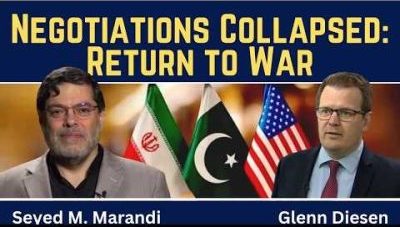
Seyed Mohammad Marandi is a professor at Tehran University and a former advisor to Iran’s Nuclear Negotiation Team. Prof. Marandi argues that it will be extremely difficult for the US to seize Kharg Island, and Iran would then destroy all energy facilities in the region.
The strategic paradigm regarding Iran has shifted fundamentally. And despite the calls for a ground invasion in some circles, and given the combination of current events on the ground, Iranian resiliance, and logistics, it is simply not possible. Therefore, the United States faces a constricted set of options amidst an escalating existential crisis. The convergence of domestic political survival, allied desperation, military attrition, and the personal psychology of the executive creates a pressure cooker where the use of tactical nuclear weapons transitions from absolute taboo to a very real grim strategic calculus. Central to this equation is the vindictive nature of President Trump, a trait that transforms geopolitical setbacks into personal grievances, compounded by the “Bibi factor”: Benjamin Netanyahu’s four-decade obsession with confronting Iran, now reaching a point of catastrophic desperation as every strategic avenue fails.
Netanyahu has dedicated much of his political life to conflict with an emergent, Islamic Iran. For forty years, he has advocated, plotted, and pressured for decisive action. Now, with Israel under daily barrage and conventional options nearly exhausted, his influence on Washington becomes a volatile accelerant. But the more dangerous variable may not be Israeli pressure on America, but rather Israeli action independent of America. Israel possesses nuclear weapons. A desperate Israel, facing existential threat, may calculate that only a nuclear strike can halt the onslaught. If Israel launches first, the United States is instantly complicit. The question shifts from “Will America use nukes?” to “How does America respond when its ally does?”
This scenario triggers a specific and catastrophic escalation dynamic. Iran has consistently signaled that any existential attack would be met with disproportionate retaliation against its primary adversary: Israel. A nuclear strike would not coerce Tehran into surrender; it would guarantee an all-out Iranian assault focused overwhelmingly on Israeli population centers and probably the Dimona nuclear center. The retaliation would not be measured; it would be existential. For Trump, this creates an impossible bind. His vindictiveness demands punishment of Iran, but his legacy depends on protecting Israel. If Iran retaliates with devastating force, Trump faces two choices: accept the near destruction of America’s key ally, cementing his legacy as the president who lost the Middle East, or escalate further. Each path deepens the quagmire. Added to this is the question of whether Iran has, or is quickly acquiring, nuclear weapons that would be used in any retaliation response.
Compounding this trap is the total collapse of trust. Any diplomatic off-ramp requires a minimum reserve of credibility between adversaries. The Trump administration has systematically burned every bridge. The precedent of attacking on February 28 in the midst of negotiations signaled that talks were not a path to resolution, but a ruse to keep the opponent off guard. To de-escalate now would almost certainly require Trump to take substantial, clear and verifiable unilateral first steps: a ceasefire, sanctions relief and public concessions. In the current climate, such actions would not be read as statesmanship; they would be interpreted as capitulation by many in America, especially his staunchest allies. For a leader whose political identity is built on projecting strength and punishing perceived slights, unilateral de-escalation is politically indistinguishable from surrender. The trust deficit does not merely complicate diplomacy; it comes close to eliminating it as a viable instrument.
This absence of trust reinforces the escalation logic at every turn. Iran, believing that American assurances are worthless, has no incentive to show restraint. Israel, doubting that diplomacy can halt the threat, has every incentive to act alone. Trump, convinced that any sign of weakness will be exploited, has no political space to offer concessions. The system becomes self-reinforcing: distrust justifies aggression, aggression deepens distrust, and the space for compromise evaporates. Institutional guardrails – the military chain of command, cabinet counsel, congressional oversight – retain theoretical weight, but they are overwhelmed by the momentum of crisis. When every actor believes the other operates in bad faith, restraint appears as vulnerability, and to a desperate man, escalation appears as the only rational response.
Global and domestic consequences, however catastrophic, are discounted in the immediate calculus. The precedent of nuclear use would shatter non-proliferation regimes and realign global power. Yet, in the moment of existential pressure, these long-term risks are subordinate to the demand for survival and retribution. Domestic backlash remains possible, but partisan media ecosystems and the framing of Israeli victimhood could harden public resolve rather than soften it. The political cost of appearing weak may be seen to exceed the cost of escalation. Trump’s fear of legacy merges with the visceral demand to protect an ally under fire and punish an adversary that, in his mind, has humiliated American power for nearly half a century.
In conclusion, the decision rests on a knife’s edge, sharpened by the certainty of Iranian retaliation against Israel and the impossibility of diplomatic retreat. The trust deficit is not a peripheral concern; it is the linchpin that locks the system into escalation. With no ground option, no credible off-ramp, a desperate ally possessing nuclear capability, and a vindictive leader who equates compromise with defeat, the use of nuclear weapons emerges not as a deliberate policy choice but as an emergent property of systemic collapse. The taboo against nuclear weapons persists only so long as actors believe restraint serves their survival. When survival is perceived to depend on escalation, and when trust, the essential currency of de-escalation, has been extinguished, the unthinkable becomes inevitable. The United States may not make the first move, but it may find itself unable to stop the chain reaction it enabled. The legacy Trump fears may not be shaped by his decision, but by his inability to escape a logic where every path forward leads deeper into catastrophe. The world watches not a policy debate, but the unraveling of deterrence, diplomacy, and restraint in real time. The outcome will not be chosen, it will be endured.
Oman’s Foreign Minister Sayyid Badr Albusaidi says that the United States and Israel launched an all-out coordinated aggression against Iran to block the Palestinian statehood and reshape the West Asia region.
Albusaidi said on Thursday that the “real objective of the war” is to “weaken Iran, reshape the region, and push the normalization agenda,” including efforts “to prevent the establishment of a Palestinian state.”
The top Omani diplomat warned that the ongoing US and Israeli attacks on Iran are part of a “dangerous chain of violations.”
The war on Iran has undermined the legal framework that has provided regional stability for decades, he added.
Albusaidi also pointed out that Iran is not the only target of the ongoing aggression.
“There is a broader plan targeting the region, and Iran is not the only target. Many regional actors are aware of this, but they are betting that aligning with the United States may push it to revise its decisions and policies,” he said.
In recent months, the Tel Aviv regime has displayed its ill intention by releasing maps which show several areas of Jordan, Egypt, Saudi Arabia and Iraq as part of “Greater Israel,” a vicious Zionist project, widely supported by the administration of US President Donald Trump.
The Israeli regime’s prime minister, Benjamin Netanyahu and members of his extremist cabinet have already announced a plan to annex the occupied West Bank in order to steal more Palestinian land and block the possibility of a Palestinian statehood.
Albusaidi also warned the war could drive higher oil prices and major supply chain disruptions globally.
The US-Israeli aggression has already driven the oil and gas prices much higher and caused food inflation.
Oman is seeking to stop the war and return to diplomacy, he stressed.
Albusaidi said the war may end soon, but called for reconsidering Persian Gulf security strategies and preparing for worst-case scenarios.
The US and Israel attacked Iran on February 28 in an unprovoked act of aggression, targeting sites across Iran, including schools, hospitals, and sports halls.
Iran responded by launching missiles and drones at targets inside Israel as well as at American bases across the region.
Senior Iranian officials have asserted that any deliberate assault by the United States and Israeli regime on Iran’s civilian and cultural heritage sites constitutes a “flagrant breach of international humanitarian law and an undisputed war crime.”
Elsewhere in his remarks on Thursday, the Omani foreign minister said Oman will not join Trump’s so-called “Board of Peace” and will not normalize relations with Israel.
The remarks come as Trump keeps pushing more Arab states of the Persian Gulf region to join the Abraham Accords and normalize their ties with Israel despite the regime’s brutal more than to-year long Israeli assault against Palestinians in Gaza.
Israeli Prime Minister Benjamin Netanyahu issued a series of threats toward Iran and its interlocutors in the West, including the US, as serious negotiations on Iran’s nuclear program seem more plausible.
As a possible rapprochement looms between the US and Iran, Netanyahu has attempted to impose impossible Israeli conditions on the negotiators, such as the full dismantling of Iran’s nuclear program, not to mention threatening military force.
Whatever the deal that could materialize between Iran and the West, Israel is going to find itself before an open-ended path. One can foresee three possible scenarios… continue
This site is provided as a research and reference tool. Although we make every reasonable effort to ensure that the information and data provided at this site are useful, accurate, and current, we cannot guarantee that the information and data provided here will be error-free. By using this site, you assume all responsibility for and risk arising from your use of and reliance upon the contents of this site.
This site and the information available through it do not, and are not intended to constitute legal advice. Should you require legal advice, you should consult your own attorney.
Nothing within this site or linked to by this site constitutes investment advice or medical advice.
Materials accessible from or added to this site by third parties, such as comments posted, are strictly the responsibility of the third party who added such materials or made them accessible and we neither endorse nor undertake to control, monitor, edit or assume responsibility for any such third-party material.
The posting of stories, commentaries, reports, documents and links (embedded or otherwise) on this site does not in any way, shape or form, implied or otherwise, necessarily express or suggest endorsement or support of any of such posted material or parts therein.
The word “alleged” is deemed to occur before the word “fraud.” Since the rule of law still applies. To peasants, at least.
Fair Use
This site contains copyrighted material the use of which has not always been specifically authorized by the copyright owner. We are making such material available in our efforts to advance understanding of environmental, political, human rights, economic, democracy, scientific, and social justice issues, etc. We believe this constitutes a ‘fair use’ of any such copyrighted material as provided for in section 107 of the US Copyright Law. In accordance with Title 17 U.S.C. Section 107, the material on this site is distributed without profit to those who have expressed a prior interest in receiving the included information for research and educational purposes. For more info go to: http://www.law.cornell.edu/uscode/17/107.shtml. If you wish to use copyrighted material from this site for purposes of your own that go beyond ‘fair use’, you must obtain permission from the copyright owner.
DMCA Contact
This is information for anyone that wishes to challenge our “fair use” of copyrighted material.
If you are a legal copyright holder or a designated agent for such and you believe that content residing on or accessible through our website infringes a copyright and falls outside the boundaries of “Fair Use”, please send a notice of infringement by contacting atheonews@gmail.com.
We will respond and take necessary action immediately.
If notice is given of an alleged copyright violation we will act expeditiously to remove or disable access to the material(s) in question.
All 3rd party material posted on this website is copyright the respective owners / authors. Aletho News makes no claim of copyright on such material.


 Aletho News