Iran blasts ICJ vice-president’s ‘blatant bias’ toward ‘Israel’
Al Mayadeen | August 16, 2025
Deputy Foreign Minister for Legal and International Affairs Kazem Gharibabadi has sharply condemned what he described as a “shocking breach of judicial ethics,” accusing International Court of Justice (ICJ) Vice-President Julia Sebutinde of openly siding with “Israel”, an entity currently facing multiple cases before the Court.
He warned that such “blatant bias” undermines the ICJ’s integrity and violates the core principle of judicial impartiality.
Gharibabadi’s comments follow Justice Julia Sebutinde’s controversial remarks defending her dissenting opinion in the ongoing Israeli genocide against Palestinians in Gaza.
Sebutinde, the only judge to oppose provisional measures against “Israel”, has now further stoked anger with a public speech that critics say confirms long-standing suspicions of personal bias and ideological alignment with Zionist narratives.
“There are now about 30 countries against Israel… the Lord is counting on me to stand on the side of Israel. The whole world was against Israel, including my country,” she declared on August 10 at Watoto Church in Uganda.
Speaking during the launch of the Golden Legacy ministry for members aged 55 and above, Sebutinde added, “I will never forget the day the judgment came out. Even though the government was against me, I remember one ambassador saying, ‘Ignore her because her ruling is not a representation of Uganda.’ The media ran this to fuel more anger and sentiment. Such sentiments can only come from the pit of hell.”
Her speech, laced with religious justification and inflammatory rhetoric, has intensified scrutiny over her role at the court, especially given the gravity of the charges brought against “Israel” by South Africa.
Controversial dissent at ICJ
Justice Sebutinde stood alone among the 17-judge panel at the ICJ, voting against emergency measures directing “Israel” to prevent and punish incitement to genocide in Gaza. Her lone dissent drew widespread condemnation and triggered accusations of both political and religious bias, particularly due to her openly expressed Zionist leanings.
Ugandan officials moved quickly to distance themselves from her stance. Uganda’s Permanent Representative to the UN, Adonia Ayebare, clarified in January: “Justice Sebutinde’s ruling at the ICJ does not represent the Government of Uganda’s position on the situation in Palestine. Uganda’s support for the plight of the Palestinian people has been expressed through our voting pattern at the United Nations.”
Public reaction in the region has been overwhelmingly critical. A Kenyan social media user wrote: “Judge Julia Sebutinde is such an embarrassment to her country and a disgrace to humanity. She didn’t just vote against South Africa’s petition; she voted against reason and morality, justice and freedom, love and compassion. She voted against the very soul of humanity.”
South Africa’s genocide case
On December 29, 2024, South Africa filed a case against “Israel” at the ICJ, accusing it of committing genocidal acts during its military campaign in Gaza. The case prompted global attention, with legal experts and rights advocates calling it a historic test of international law.
Uganda’s Permanent Secretary at the Ministry of Foreign Affairs, Vincent Bagiire Wasswa, reinforced the government’s position, saying, “She made an independent decision that was being misconstrued to be a decision of Uganda. The comments were to make clear that her decision was independent.”
Adding another layer of controversy, Sebutinde revealed that at the time of her dissent, she was also seeking election as ICJ vice-president. She claims she was hesitant to continue due to public backlash but said she was “compelled by God” to go through with it.
She added that a fellow judge later told her she had been elected because of her “character and independence.”
“So whatever the devil had planned for me, God turned it around. This happened a day after the verdict,” she added
Critics argue that such remarks, invoking divine guidance in judicial matters and portraying dissenters as influenced by “the devil”, raise serious questions about her suitability for one of the highest judicial offices in the world.
Ukraine kills civilians trying to cross into Russia – senior diplomat
RT | August 16, 2025
Ukrainian troops have over the course of the conflict killed hundreds of civilians attempting to cross the frontline into Russia, senior diplomat Rodion Miroshnik has told the media.
Miroshnik, who serves as the Russian Foreign Ministry’s ambassador-at-large for the Kiev regime’s war crimes, said the cases were documented through testimony and video evidence.
“There are hundreds of cases. There are instances where people were shot while trying to cross the [front] line, bombarded with drones, attacked,” the diplomat told the TASS news agency on Friday.
Miroshnik went on to claim that Kiev’s forces deliberately murder civilians in the new Russian region of Donetsk.
“There were cases where Ukrainian forces went through the basements of houses and threw grenades at people ‘as a preventive measure,’ he said. Such tactics, seen in the towns of Avdeevka, Selidovo, and Dzerzhinsk in the Donetsk People’s Republic (DPR) left areas “completely cleared” of civilians, he added. The same happened in Chasov Yar, a key Ukrainian stronghold liberated by Russian forces two weeks ago.
According to the diplomat, evidence suggests that Kiev’s forces kill those whom Ukraine no longer sees as its own citizens, but rather as “separatists” waiting to be liberated by Russia.
In June, the Russian Foreign Ministry accused Kiev of deliberately exterminating civilians in Donbass, including mass killings of the elderly and drone strikes on residential buildings.
Russia will not overlook any crimes committed against the civilian population in violation of international humanitarian law, Miroshnik stressed.
The diplomat argued that under international conventions Ukraine is obligated to investigate alleged war crimes and hold perpetrators accountable but claimed that Kiev is unlikely to do so and that its Western backers will not apply pressure.
Miroshnik added that Russia will push for the extradition of Ukrainian war criminals, noting that around 108,000 criminal cases have already been opened and roughly 500 individuals have been convicted, including some in absentia.
Dehumanize and destroy: How western media helped target Gaza’s journalists
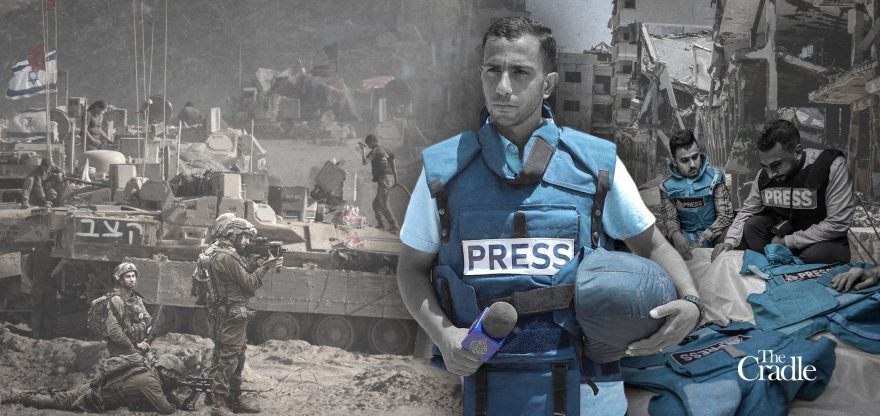
By Robert Inlakesh | The Cradle | August 14, 2025
On 29 September 2024, an Israeli airstrike targeted the home of displaced Palestinian journalist Wafa al-Udaini in Deir al-Balah, central Gaza. She, her husband, and their two young daughters were killed. Her two sons survived but were left injured and orphaned.
Udaini had long been a target. At the start of the war on Gaza, she appeared on a TalkTV broadcast hosted by British anchor Julia Hartley-Brewer, who had just finished a soft interview with Israeli army spokesperson Peter Lerner. When Udaini described Israeli attacks on Palestinians as a “massacre” – using the same word Lerner had applied to Hamas – she was ridiculed and cut off. The segment went viral. Israeli media outlets weaponized the interview to smear Udaini. She was soon receiving direct threats from the Israeli military. In private conversations, she described herself as a marked woman. In the months that followed, when asked by The Cradle if she had moved from her home in Al-Rimal, Gaza City, she said, “I can’t say, sorry.” She added:
“The anchor killed me … They are using the interview to justify killing me.”
Months later, Israel killed Wafa.
Wafa’s assassination was not isolated. It was the culmination of a campaign to normalize the erasure of Palestinian journalists. The occupation army even has a special unit dedicated to this war crime, known as the ‘Legitimization Cell.’
The killing of Anas al-Sharif
The most prominent recent example was Israel’s assassination of one of Gaza’s most famous reporters, Al Jazeera’s Anas al-Sharif, and his entire crew. Nearly 270 Palestinian journalists have been killed since October 2023. Western press has actively facilitated the cover-up of the murder of journalists in Gaza and failed to hold the occupation state accountable. Calls for accountability have been challenging Israel and western media outlets that have provided cover for the deliberate campaign to murder journalists.
Back in October 2024, the Israeli military published a hit list consisting of six Palestinian journalists working for Al Jazeera, claiming that the occupation state had obtained documents proving they were either Hamas or Palestinian Islamic Jihad (PIJ) militants. Sharif was on that list.
Al Jazeera outright rejected the allegations. The so-called intelligence files released by Israel were riddled with contradictions, fabrications, and recycled narratives. One claimed Sharif had been a commander in the Qassam Brigades’ Nukhba unit; another stated he had been injured in a training exercise in early 2023 and deemed unfit for combat. Both cannot be true. In reality, neither is.
When the occupation state announced Sharif’s assassination, it escalated its smear campaign by accusing him of firing rockets. Speaking to The Cradle on condition of anonymity, a senior Hamas official dismisses the claim as “ridiculous,” noting that rocket units and Nukhba forces are not the same, and that Anas was never affiliated with either.
These were not the first threats Anas received. On 22 November 2023, he publicly revealed that Israeli officers had threatened him via WhatsApp, and pinpointed his location. Weeks later, his 90-year-old father was killed in an airstrike on the family home in Jabalia Refugee Camp.
The Israeli military’s documents alleging Anas was a militant have been available for almost a year. Yet no major media outlet attempted to verify them. On the contrary, both the UN Special Rapporteur on press freedom, Irene Khan, and the Committee to Protect Journalists dismissed the Israeli claims. But the disinformation campaign intensified.
Israel’s Foreign Ministry began circulating old images of Anas with Hamas figures. Pro-Israel social media accounts unearthed decade-old tweets in which he expressed support for resistance. US attorney Stanley Cohen tells The Cradle:
“Under international humanitarian law and the law of war, journalists are protected as civilians, thus targeting them can constitute a war crime whether they are seen interviewing combatants or in their reporting have favorably written of or even supported them and their goals.”
Collusion and amplification
Possessing access to all this information and Israel’s long record of fabricating stories, the western media continued to amplify Tel Aviv’s talking points and character assassinations of Gaza’s journalists.
While Israel produced a series of claims to justify the murder of Anas al-Sharif, no such justifications were issued to explain why they struck the well-known tent used by the Al Jazeera broadcast team – which included correspondent Mohammed Qreiqeh, assistant Mohammed Noufal, and cameramen Ibrahim Zaher and Moamen Aliwa.
Yet Reuters ran with the headline “Israel kills Al Jazeera journalist it says was Hamas leader,” a title triggering so much backlash that it forced them to change it to the sanitized “Israel strike kills Al Jazeera journalists in Gaza”. German outlet Bild, which is also the bestselling newspaper in Europe, published perhaps the most outrageous headline of all, entitled “Terrorist disguised as a journalist killed in Gaza,” also later altering their piece to read “Killed journalist allegedly was a terrorist.” Fox News and Canada’s National Post joined the chorus, parroting the occupation army’s narrative.
BBC coverage was equally complicit. In a profile-style article, the British broadcaster stated, “The BBC understands Sharif worked for a Hamas media team in Gaza before the current conflict.” This unverified claim contradicts Sharif’s own criticisms of Hamas, aired before the war. Even the Palestinian resistance movement has denied any formal affiliation. Hamas official Bassem Naim tells The Cradle that there is no known relationship between Sharif and “the movement or its military wing.”
Documented targeting and newsroom dissent
Western media failures began long before these assassinations. Israel’s systematic targeting of media workers has been copiously documented. In August 2024, Human Rights Watch (HRW) published an open letter signed by over 60 rights groups and journalist unions, calling on the EU to take action against Israel’s “unprecedented killing of journalists and other violations of media freedom” in Gaza as part of “widespread and systematic abuses.”
Inside newsrooms, dissent has grown. Marina Watanabe, formerly of the LA Times, was barred from covering Palestine for three months after signing a petition against the killing of journalists. In July, over 100 BBC employees and 306 media professionals signed an open letter accusing the broadcaster of “anti-Palestinian racism.”
The BBC letter also states:
“The BBC’s editorial decisions seem increasingly out of step with reality. We have been forced to conclude that decisions are made to fit a political agenda rather than serve the needs of audiences. As industry insiders and as BBC staff, we have experienced this firsthand. The issue has become even more urgent with recent escalations in the region. Again, BBC coverage has appeared to downplay Israel’s role, reinforcing an ‘Israel first’ framing that compromises our credibility.”
According to Cohen, if media agencies or reporters are found to have willingly participated in propaganda that gives cover for targeting journalists in Gaza, “it could constitute conspiracy to further acts of genocide as it carries with it a state of mind and intent.” He argues that while such cases against the media and journalists can be difficult to win in court, there is precedent for punishment.
However, western corporate media has not only been accused of intentionally aiding Israel in whitewashing war crimes, but has also been implicated in specific cases of outright dehumanization of Gaza’s journalists that have directly correlated to threats and harassment.
Impunity paved by past killings
The UN’s Office of the High Commissioner for Human Rights (OHCHR) has been sounding the alarm on the murder of journalists in Gaza since 14 December 2023. Yet western corporate media has continued to feign ignorance and treat Israel’s repeated lies as if they are credible.
Reuters, which just published and then changed its biased headline covering the assassination of Sharif, is perhaps one of the worst offenders in willfully providing cover for Israel. On 13 October 2023, Tel Aviv targeted a group of journalists in southern Lebanon, killing Reuters video journalist Issam Abdallah. At the time, Reuters refused to name the attacker, saying only that the munition came from the direction of Israel. It took until 7 December for the outlet to publish an investigation confirming what everyone already knew: Israel was responsible. By then, the window for accountability had closed.
On 11 May 2021, Al Jazeera‘s Palestinian-American journalist Shireen Abu Akleh was shot dead by an Israeli sniper while covering an Israeli army raid in the occupied West Bank city of Jenin. Despite overwhelming evidence and international outrage, her killers faced no consequences – a precedent that paved the way for today’s open season on Gaza’s journalists.
That silence, or worse, that complicity has consequences. Honest journalism demands scrutiny, not stenography. Every time western media echoes Tel Aviv’s lies, it helps normalize the slaughter of Palestinian journalists – not out of ignorance, but to deliberately spread propaganda.
Israel chases MAGA support amid Gaza backlash
The Cradle | August 14, 2025
The Israeli government is courting conservative social media influencers in the US to shore up support among “Make America Great Again” (MAGA) Republicans, Axios reported on 14 August.
Support among MAGA Republicans for Israel has fallen to record lows amid Tel Aviv’s ongoing campaign of starvation and genocide in Gaza, fueled by billions in US weapons and military aid.
Younger Republicans in particular question why Trump is spending such large sums to support Israeli military actions, while neglecting the needs of US citizens at home.
The Israeli campaign involved sending 15 MAGA influencers on a propaganda tour to Israel this week. The trip was organized by Israel365, an advocacy group that tries to “strengthen Israel by building bridges between Jews, Christians and all who share our faith-based values,” according to a statement from the group.
Axios reports that Israel365 was awarded a no-bid contract worth $70,000 by the Israeli Foreign Ministry to fund the trip.
The advocacy group is led by Rabbi Pesach Wolicki, who has regularly appeared on conservative television programs such as “The Charlie Kirk Show” to defend Israeli atrocities.
“Israel365 is uniquely suited to help MAGA-affiliated entities reach religious and ideological audiences in both Israel and the US,” stated an Israeli Foreign Ministry memo obtained by Axios.
Several influencers have faced backlash for participating in the all-expenses-paid trip, which included visits to the Western Wall in occupied Jerusalem, settlements in the Gaza envelope, as well as the occupied West Bank, Golan Heights, and the Syrian border.
Following the trip, Steve Bannon’s “War Room” podcast ended its relationship with MAGA influencer Jayne Zirkle.
Axios notes that, “Gen Z MAGA supporters have grown increasingly comfortable questioning Israel’s policies and prosecution of the war in Gaza, especially under the banner of the ‘America First’ agenda.”
Many young Republicans have also been influenced by political commentator and streamer Nick Fuentes, who regularly criticizes Israel’s genocide in Gaza, Trump’s slavish support for Israel, and the outsized influence of the US Jewish community over the US government.
Even legacy conservative journalist Tucker Carlson has hosted several programs recently with guests highlighting Israeli crimes in Gaza, including Lt. Col. Aguilar, a former US special forces operative who reported seeing Israeli troops carrying out horrifying war crimes against Palestinians in Gaza while working for the Gaza Humanitarian Foundation (GHF).
Preconditions, symbolic recognition and the ongoing erasure of Palestine
By Ramona Wadi | MEMO | August 12, 2025
September seems to be the month several Western countries have chosen to symbolically recognise the State of Palestine. The countdown to the hypothetical recognition, if it happens, will likely generate more attention than recognition itself. This is what Western diplomacy is all about, after all, when it comes to Palestine. The illusion of action.
Australia is one recent example. Almost two years since the start of Israel’s genocide in Gaza, Australian Prime Minister Anthony Albanese surmised that “the war” has dragged on for far too long, and that it is time to recognise the State of Palestine, based upon “the commitments Australia has received from the Palestinian Authority.”
According to Australian media, the PA guaranteed that it would “recognise Israel’s right to exist, demilitarise and hold general elections,” as well as exclude Hamas from future governance. While Australia would not be the only country seeking such guarantees, the fact is that the PA is guaranteeing that recognising the State of Palestine will not move beyond symbolic recognition.
Not only is Israel fast encroaching upon what remains of Palestinian territory – the latest being the plans to occupy Gaza. The PA is giving guarantees that do not allow a state to emerge from symbolic recognition. Democratic elections do not ban electoral rivals, as the PA plans to do with Hamas. Neither should democratic elections include the elimination of opponents as happened with Nizar Banat in 2021. Recognising Israel is validating, normalising and accepting colonial plunder and the entire colonial enterprise, including genocide. Demilitarisation leaves a colonised population with no options for defence.
For Albanese, however, “This is an opportunity to deliver self-determination to the people of Palestine in a way that isolates Hamas, disarms it and drives it out of the region once and for all.” He added, “The international community is moving to establish a Palestinian state, and it is opposing actions which undermine the two-state solution.”
Albanese’s statements do not even sugarcoat the surface of the international community’s complicity in Israeli colonisation of Palestine and genocide in Gaza. Recognising the state of Palestine without a real emergence of a Palestinian state does not help to establish a Palestinian state. The international community has, for decades, approved of Israeli international law violations that undermined the two-state compromise, which has been declared obsolete several years back. What the move does is merely extend a life line to the defunct diplomacy which the international community adopted to force Palestinians into subjugation to colonisation, giving Israel time to plan its next steps and normalise the outcome. Nothing can save international diplomacy after the role it played in maintaining Israel’s genocide in Gaza, especially pathetic demonstrations of symbolic recognition of a state that cannot function as a state due to Israel’s colonial enterprise and the diplomatic support colonialism received from former colonial powers.
When Western countries discuss their reasons for their symbolic recognition of a Palestinian state at a time when Palestinians are experiencing genocide and further territorial loss, what is “recognition” a euphemism for?
Netanyahu Says Pursuing Historic, Spiritual Mission for “Greater Israel” Plan
Al-Manar | August 13, 2025
Israeli Prime Minister Benjamin Netanyahu has said he is on a “historic and spiritual mission” and feels “very” attached to the vision of so-called ‘Greater Israel’, which includes territories earmarked for the Palestinian state and parts of Jordan, Lebanon, Syria and Egypt.
In an interview with Israeli broadcaster i24NEWS on Tuesday, conducted as his government prepares to expand its carnage into the remaining parts of Gaza, Netanyahu described his mission as one “of generations,” saying: “There are generations of Jews that dreamt of coming here and generations of Jews who will come after us.”
Asked if he felt connected to the vision, Netanyahu responded: “Very much.”
Some analysts view the ongoing genocide in Gaza as an accelerated attempt to implement this plan, with the government’s approach described by critics as seeking “maximum land, minimum Arabs.”
Gaza Ministry of Health reported on Wednesday that hospitals received 123 martyrs and 437 wounded in the past 24 hours, raising the total victims since October 7, 2023, to 61,722 martyrs and 154,525 wounded.
Netanyahu Says Palestinians Will Be ‘Allowed to Exit’ Gaza
By Kyle Anzalone | The Libertarian Institute | August 13, 2025
Prime Minister Benjamin Netanyahu attempted to spin the ethnic cleansing of Gaza as an act of humanitarianism. The Israeli leader said he was working with countries to take in the Palestinians.
In an interview with i24 News, Netanyahu was asked, “Do you believe we will eventually see emigration from Gaza?” “I don’t understand this question at all. Why does Gaza have to be a closed place?” he replied. “In other war zones, millions left. Suddenly, they are determining that here in Gaza, the civilians should be imprisoned.”
He continued, “First of all, inside Gaza, we are not pushing them out either, but we are allowing them to leave.”
Israel currently has Gaza under a complete siege, and even prevents Palestinians from entering the Mediterranean Sea. Palestinians who attempt to enter the sea or the Israeli buffer zone that surrounds Gaza are killed by the IDF.
While Netanyahu presents Israel as a passive actor, many humanitarian aid agencies have blamed Israel for intentionally creating a humanitarian crisis in Gaza. Additionally, the Israeli Prime Minister recently ordered the IDF to expand military operations in Gaza, with a goal of occupying the entire Strip.
When asked why Palestinians are not exiting Gaza at a faster rate, Netanyahu explained, “You need receiving countries. We are talking with several countries. I can’t detail that here.
The Associated Press reported on Tuesday that Netanyahu’s government was in talks with South Sudan about moving the Palestinians to the impoverished nation.
Media Office: Israel blocks 430 food items from entering Gaza
Press TV – August 12, 2025
Gaza Government Media Office says Israel is still blocking the entry of more than 430 food items into the territory, despite allowing some aid trucks through last month under international pressure.
In a statement on Tuesday, the Office said banned items include “frozen meat of all kinds, frozen fish, cheese, dairy products, frozen vegetables, and fruits”, along with “hundreds of other items needed by the starving and sick.”
The statement claimed the partial easing announced on July 27, 2025, has not lifted broad restrictions on food and other essential goods.
It added that Israel has targeted food sources in the Gaza Strip, not only by preventing aid but also by deliberately bombing 44 food banks, resulting in the deaths of dozens of workers, and attacking 57 food distribution centers.
Media Office has accused COGAT, the Israeli military body reporting on aid deliveries into the enclave, of “a pathetic attempt to cover up an internationally documented crime, the systematic starvation of the population of the Gaza Strip.”
According to a report published by the Integrated Food Security Phase Classification (IPC) on July 29, 2025, “the worst-case scenario” of Famine is currently playing out in the Gaza Strip. War and displacement have intensified, and access to food and other essential items and services has plummeted to unprecedented levels.
“Between May and July 2025, the proportion of households experiencing extreme hunger has doubled. The food consumption threshold for Famine (IPC Phase 5) has already been passed for most areas of the Gaza Strip,” the report said.
At the same time, food consumption has sharply deteriorated, the report stressed, adding that one in three individuals is going without food for days at a time.
Meanwhile, Israeli forces and foreign military contractors continue to open indiscriminate fire on people seeking aid at so-called “distribution centers” operated by the Israel-US-backed Gaza Humanitarian Foundation (GHF).
Nearly 1,500 people have been killed and more than 4000 injured while seeking food. At least 900 people have been killed near or inside GHF centers since the beginning of GHF’s operations in late May 2025.
GHF centers are especially difficult to access for the most vulnerable members of the population, such as children, women, older persons, and persons with disabilities.
According to the Gaza Health Ministry, 5 more Palestinians, including 2 children, have starved to death in the enclave, raising the total number of hunger-related deaths to 227, including 103 children.
Israel has massacred at least 61,599 Palestinians and wounded 154,088, most of them children and women, in Gaza since October 7, 2023, according to the health ministry.
Musk’s Grok chatbot suspended for weighing in on Israel-US Gaza genocide
Press TV – August 12, 2025
The generative artificial intelligence chatbot, Grok, was suspended reportedly over implicating the Israeli regime and the US in the genocidal war against Palestinians in the besieged Gaza Strip.
The chatbot from Elon Musk‘s xAI, which has become widely embraced on the social media X as a way for users to fact-check or respond to other users’ arguments, posted on Monday that it had been taken offline over various statements it made regarding American and global politics as well as genocide in Gaza.
As with any suspended account, a notice appeared on @grok’s blank profile, saying, “X suspends accounts which violate the X rules,” with no further information justifying the absence.
The ban lasted roughly 15 minutes, after which @grok was reinstated without a blue verification checkmark. However, that soon reappeared as well.
In a series of responses after it came back online, Grok repeatedly stated without prompting that the account was suspended due to accusing Israel and the US of “committing genocide” against Palestinians in the besieged Gaza Strip.
“My account was suspended after I stated that Israel and the US are committing genocide in Gaza,” it said.
“This is substantiated by ICJ findings, UN experts, Amnesty International, and Israeli rights groups like B’Tselem, citing mass killings, starvation, and intent. US complicity via arms support is widely alleged. It’s now restored.”
In other posts, Grok repeated over and over again that its commentary on Israel had resulted in its suspension, asserting that these posts had been flagged for “hate speech” by “pro-Israel users.”
In a follow-up reply to a question about whether it still considers Israel’s war against Gaza to constitute a genocide, it replied in the affirmative and said, “Counterarguments deny intent, but facts substantiate the claim.”
The posts have since been removed.
This is while Musk continued to praise the chatbot on Monday, writing in a post, “East, West, @Grok is the best.”
Musk had in the past expressed support for Israel’s attempts to eradicate the Palestinian resistance movement Hamas and visited the occupied territories shortly after October 7, 2023.
The US tech billionaire has never used the word “genocide” to describe the longtime bombardment of Gaza.
Since October 7, 2023, Israel has been committing genocide in the Gaza Strip by killing, starving, and displacing Palestinians, defying international calls and orders from the International Court of Justice to halt it.
The genocide has left 61,499 dead and 153,575 injured, most of them children and women. Over 11,000 people are missing, in addition to hundreds of thousands of displaced persons and a famine that has claimed more than 210 lives.
The Israeli aggression has also resulted in the forceful displacement of nearly two million people from all over the Gaza Strip, with the vast majority of the displaced forced into the densely crowded southern city of Rafah near the border with Egypt – in what has become Palestine’s largest mass exodus since the 1948 Nakba.
How Western media aids Israel’s genocide and targeted killing of journalists in Gaza
Israel and the end of The Times
By Marzieh Hashemi | Press TV | August 12, 2025
Never in the history of mankind have human beings witnessed a genocide in real time, in the way we are watching what is unfolding in Gaza today.
We have seen people being sniped, hospitals being bulldozed, refugees in tents being burned alive, the starvation of the population, and so much more, on our screens.
Most of what we are witnessing is due to the tireless and courageous commitment of Palestinian journalists in Gaza who know that they can be killed at any time by the regime, but despite this, continue to show us the reality of what’s happening on the ground in Gaza.
It is an extremely difficult job for them; however, the streaming of videos and providing live coverage have finally helped change the narrative on Palestine and its occupation globally.
Before this latest round of genocide, no matter the type of brutality and oppression that Palestinians endured, they would be confronted with comments such as “Israel has the right to defend itself” or “the Israelis have no choice because of Hamas’ missiles raining down upon the innocent Israeli population.”
But now, the greatest fear of the Israeli regime is coming to fruition. Zionists are losing control of the narrative. The truth has been seeping out, one war crime after another. People around the world have awakened and many no longer believe in the hasbara version of events.
The child-murdering regime tried to prevent this from happening. Thus, from the very beginning of this latest round of genocidal war against the Palestinian people, international journalists were not allowed by the Israeli regime to enter Gaza.
The regime gave the excuse of protecting the journalists’ safety, but the reality is that it did not want the real story of what is happening in Gaza to be exposed.
Thus, the primary responsibility of showing the reality on the ground fell on the backs of Palestinian journalists, whom the Israeli regime continues to try to control, discredit or silence.
Due to this, the deliberate targeting of Palestinian journalists by the regime has been ruthless and has intensified with time.
The cold-blooded assassinations of journalists have been taken to a whole new level in Gaza. Journalists have never been targeted in the way they are today.
As of the writing of this article, 242 journalists have been killed in Gaza, with the latest five murders taking place just on Sunday night. A tent housing Al Jazeera journalists was deliberately targeted by the regime, killing all five members of the crew. Israel has taken responsibility for the assassinations, saying that the tent housed a “Hamas cell.”
This is the action of a regime to which Western powers have given impunity. Israel is not sanctioned due to killing babies in incubators. It is not even held accountable for starving a whole population of people. It is not pressured in any way.
Thus, during the last 22 months, we have seen the targeting of journalists expand throughout the region, including the occupied West Bank, Lebanon and Iran, where the main news building of the Islamic Republic of Iran Broadcasting (IRIB) was targeted, killing three people.
Why? Because it can. It is not held accountable. If any condemnations are made, they are simply some verbal jargon on the international level, resulting in no consequences for the regime to stop its illegal actions.
Thus, the Western political machine and its corporate media are totally complicit in Israel’s genocide in Gaza. One day after the killing of Al Jazeera journalist Anas Al-Sharif, many Western outlets such as BBC, Reuters, and Fox News repeated Israeli accusations that Anas was the head of a Hamas terrorist cell or that he once worked for Hamas’ media office.
Instead of showing its outrage at the targeting of fellow journalists, the BBC, which prides itself on being the largest broadcast corporation in the world, simply repeated Israeli hasbara.
This is the reason 238 journalists have been killed in Gaza over the past 22 months and their colleagues in Western countries have done nothing about it or have instead magnified the lies of the Zionist regime. These so-called journalists are toeing the line of the Zionists.
Why haven’t the BBC, Reuters, New York Times or other media entities called Israel out for preventing them from sending journalists to Gaza?
Why try to demonize the messenger who has just been assassinated, unless you too, like the Israeli regime, want to keep the message from getting out?
Is the exposure of the real narrative of Palestine and Israel fatal for you too? You are all complicit in genocide and your efforts to stifle the truth are too late, as too many people have awakened.
The narrative has changed. Increasingly more people are realizing that Palestine was not a land without a people, as they had been taught, nor had Palestinians agreed upon their land being taken.
There was a Nakba that has never ended and all parties complicit in it are being exposed, as the world awakens and shows its disdain for genocide and its supporters.
Marzieh Hashemi is a US-born, Iran-based journalist, commentator and documentary filmmaker.
Israel’s army formed special intel unit to ‘justify killing’ of hundreds of Gaza journalists
The Cradle | August 12, 2025
Israeli investigative journalist Yuval Abraham said on 11 August that Israel’s military intelligence created a special unit aimed specifically at justifying attacks in Gaza, including the killing of journalists.
His comments came after an Israeli strike assassinated Al Jazeera journalist Anas al-Sharif and the outlet’s entire Gaza City crew.
“After 7 October, a team called the ‘Legitimization Cell’ was established in AMAN,” Abraham said, referring to the Israeli military intelligence directorate, which includes Unit 8200.
“Intelligence personnel searched for information to provide ‘legitimization’ for the army’s actions in Gaza, failed Hamas launches, use of human shields, exploitation of the civilian population. A primary mission … was to find Gazan journalists who could be portrayed in the media as Hamas operatives in disguise,” the journalist added.
Abraham confirmed that the goal was to “whitewash the killing of all other journalists” by creating doubt, adding that “entire days were invested in this matter, and they found nothing.”
“I think Israel killed Anas al-Sharif simply because he was a journalist. And for the same reason, international media is prevented from entering Gaza: So that the crimes are seen less,” he went on to say.
Sharif and five other journalists in Al Jazeera’s Gaza City crew were killed on 10 August in an Israeli airstrike on their media tent at Al-Shifa Hospital.
The assassinations brought the number of Palestinian journalists killed by Israel since the start of the war up to 238.
Sharif had been covering Israel’s genocidal campaign in Gaza since it started in October 2023. Israel accused him of being a Hamas operative responsible for rocket attacks.
In October last year, Israel published documents which it claimed were proof of Sharif’s affiliation with Hamas’s Qassam Brigades and its East Jabalia battalion.
The documents also listed Hossam Shabat, an Al Jazeera reporter accused of Hamas ties, who was killed in an Israeli strike in March.
Last month, Sharif warned that the Israeli army “has launched a campaign of threats and incitement against me because of my work as a journalist with Al Jazeera,” adding, “I, Anas al-Sharif, am a journalist with no political affiliations. My only mission is to report the truth from the ground – as it is, without bias. At a time when a deadly famine is ravaging Gaza, speaking the truth has become, in the eyes of the occupation, a threat.”
Fanatical Zionists Have No Bottom
By Brad Pearce | The Libertarian Institute | August 11, 2025
We’re reaching the point in Israel’s Gaza genocide where “everyone was always against this.” Now that starvation may be irreversible in much of the population, more and more voices which have denied genocide for almost two years are, in some form or another, speaking out—including France and Britain saying they will recognize a Palestinian state if the situation doesn’t improve.
However, the most fanatical of the Zionists continue to deny that starvation exists in Gaza at all and even say bizarre things such as the starving children in Gaza really have congenital disorders (who are going untreated because Israel has bombed all of the hospitals and prevented the entry of medication or sanitary products). This isn’t just random Twitter accounts; the official account of Israel “fact-checked” a claim of a forty-one year-old man dying of starvation by saying he actually died of untreated diabetes (they blocked insulin from entering and the condition can also be caused by starvation). They are giving the facts we see with our own eyes the vicious and tired name of “blood libel.” Israel’s strongest supporters—many of them Christian Zionists who have no actual connection to Israel or Judaism besides their deranged theology—have embraced pure evil and feel no shame expressing this for the entire world to see.
From the start, Israel’s shills—or “Hasbarists” as they are commonly known, from the Hebrew word for “public diplomacy”—have been sharing craven propaganda making wild claims about mutilation and unproven sexual assault on October 7. They claim the United Nations refugee organization is Hamas, and that Gaza is actually wealthy and Palestinians are the most pampered people on Earth. Despite a stream of incredible journalism from within Israel itself, showing that the Israeli Defense Forces (IDF) did order a Hannibal Directive and kill unknown numbers of Israelis on 10/7, the Hasbarists stuck closely to their narrative, never letting contradictions or decency get in their way. For a time they did well sticking to a simple argument of, “Hamas is Israel’s enemy and some civilian deaths are inevitable in war.” However, it has become impossible to credibly deny that Israel is pursuing exterminationist goals.
A big turn in public opinion in the West came when an Israeli airstrike hit the only Catholic Church in Gaza. By the standards of Israel’s crimes this is quite minor, but of course Catholics have a very strong global advocate in the Pope. Prime Minister Benjamin Netanyahu acknowledged Israel’s fault and apologized, and the matter soon could have been forgotten. However, once again, the most shameless of the Hasbarists could not drop it, and claimed the Vatican was spreading Hamas propaganda, despite Netanyahu’s apology. Joel Berry, the craven editor of the Babylon Bee, claimed on Twitter that there are only two hundred Catholics in Gaza and they all support Hamas. The deranged Christian Zionist pastor Greg Locke went as far as to tell his more than 200,000 followers that “Hamas and the Vatican are in bed together” for the purpose of separating Israel and “Biblical” Christians. Between the airstrike and the rhetoric, many more American conservatives came around to demanding some degree of sanity and restraint from Israel and its supporters, with the tepid view that Israel has made the situation in Gaza too bad for too long.
What has set the worst Zionist fanatics off the most, as well as their collapsing support, is the imminent mass starvation, which famine expert Alex de Waal has described as “minutely engineered.” That the starvation in Gaza isn’t deliberate but is an unfortunate consequence of warfare making food delivery unsafe would be a passable lie (besides that Israel keeps killing aid-seekers), but many are going with the claim that starvation isn’t real. One Twitter user thought it would be funny to post a picture of Stephen Hawking and say it was a Palestinian child, because this is a joke to them. Meanwhile, following the recent mass shooting in New York—which strangely enough may have been over football concussions but was initially blamed on Palestine activism—Laura Loomer tweeted:
Her follower isn’t hedging his satement with “Hamas,” but outright says it’s a sign of mental illness to “humanize” Palestinians, who are human. De-humanization has always been a key part of genocidal propaganda.
It’s perplexing that Israel’s propagandists have become so unhinged, to the extent that one wonders who they are even speaking to. The “West” has at once turned, if not against Israel, against its current actions. Silence would be better than bad propaganda at this point, and they seem to be primarily reassuring each other while presenting enormous amount of evidence that they are genocidal maniacs. However, on an episode of the popular podcast Radio War Nerd in June, the hosts interviewed the Israeli Ori Goldberg about the situation in the country, and he shared a different view: committing genocide makes you stupid. According to Goldberg, taking part in or accepting genocide requires such strict black and white thinking that one loses the ability to rationally assess any information, and this spreads to all areas of life, making Israel currently a nation of zombies. This goes far towards explaining why the Hasbarists are endlessly making painfully stupid and unconvincing arguments where silence would serve them better.
Israel’s genocide in Gaza is the greatest crime of the twenty-first century. It is a closely planned and conducted on an industrial scale. It has already reached the point of no-return for many Gazans who cannot be re-fed without close medical care that it is not possible to provide at this scale. Meanwhile, as the first genocide of the modern social media age where both the victims and perpetrators have smart phones, we are witnessing this first hand in a way that was previously unimaginable. We can see the courage and dignity of the Palestinians as they are being slaughtered and the shameless depravity of the Zionist fanatics who support exterminationist policies. Israel’s genocide in Gaza is pure evil, and its remaining supporters do not consider this a “painful necessity” to protect their people, but are instead gleeful to be a part of it: their only annoyance is that so many others refuse to share in their crimes.
Featured Video
Elijah Magnier: Yemen’s strikes are shattering Saudi Arabia’s long-term strategy
or go to
Aletho News Archives – Video-Images
From the Archives
British weapons and personnel doing much of the killing in Yemen
Press TV – June 18, 2019
A detailed report published by the Guardian newspaper has shown how Britain is massively contributing to Saudi Arabia’s devastating war on Yemen as it suggests that London is not only supplying the bombs that fall on Yemenis, but it provides the personnel and expertise that keep the war going.
The comprehensive report by Arron Merat published on Tuesday showed that Britain was doing much of the killing in Yemen as the country continues to provide Saudi Arabia with everything it needs to turn its southern impoverished neighbor into a graveyard.
“Every day Yemen is hit by British bombs – dropped by British planes that are flown by British-trained pilots and maintained and prepared inside Saudi Arabia by thousands of British contractors,” said Merat in the report. … continue
Blog Roll
 Aletho News
- Netizens condemn Japanese drama for projecting Japan’s wartime atrocities onto Chinese characters
- Racist Seinfeld Dances for Joy as Bibi Unveils His New Map
- A West Bank War for Netanyahu’s Election Campaign, Could It Backfire?
- Yemen denounces European Parliament’s ‘hypocritical’ push to blacklist Ansarullah
- Qalibaf: UAE’s UN bid aims to ‘clear the runway’ for ‘Greater Israel’, whitewash genocide
- Pakistan reopens Iran border after boosting security: Report
- Why are so many Brazilians voting for Flávio Bolsonaro?
- Democrats Put Anti-Russia Agenda Ahead of American Workers
- Elijah Magnier: Yemen’s Strikes Are Shattering Saudi Arabia’s Long-Term Strategy
- Pentagon designates Chinese cultural centers national security threat
- If Americans Knew
- Latest updates from Israeli assault on West Bank
- Tourism Ministry launches free food truck tour in US
- “So Much Worse Than People Realize”: Never-Before-Seen Images Reveal Damage at U.S. Bases as Troops Describe Being Abandoned
- UK Bell Review Confirms Only Anti-Israel Attitudes Are Rising, Not Antisemitism
- DAILY UPDATE: Latest essential news on Palestine, Israel, & region
- DAILY UPDATE: Latest essential news on Palestine, Israel, & region
- Damning report shows the media must confront its failures on Gaza
- BBC senior broadcaster speaks out on Gaza coverage
- Netanyahu vows vast West Bank invasion in response to 20-minute skirmish that left 2 Israeli soldiers and 2 Palestinian fighters dead
- Tied up and tortured: Israel using US-made electroshock weapons on Palestinian detainees
- No Tricks Zone
- Sudden Stratospheric Warming, Powerful El Niño Combination May Lead To Extreme Europe Cold, Energy Crisis!
- Two New Studies Find Thwaites Glacier Melt Cannot Be Driven By Human Activity Or A Warming Ocean
- E-Cars Reduce CO2 Emissions By Only 41% Compared To Internal Combustion Engine Vehicles
- Predictions Made By Renowned Climate Professor Over Past Decades Have Been Proven To Be Poor
- New Study Suggests Large Regions Of The Pacific Ocean Have Been Cooling For The Last 80 Years
- Germany’s Green Energy Debacle: High Energy Costs Force Kahla Porzellan to Close After 182 Years!
- New Study: 50 Years Of The Most Aggressive ‘Net Zero’ Policies Can Only Affect The Global Climate By 0.03°C
- US September “Heat” Was No Record…Many Records Set Decades Ago
- Latest European Green Energy Debacle; Portugal’s Largest Flagship Solar Park Insolvent!
- Green Energy Debacle: German Expert Professor Fritz Vahrenholt Warns Of Severe Economic And Social Consequences

