Iran Red Crescent says 6,668 civilian sites targeted in US-Israeli attacks
MEMO | March 7, 2026
The Iranian Red Crescent Society said that 6,668 civilian locations have been targeted in attacks carried out by the US and Israel, including thousands of homes and dozens of public service facilities, Anadolu reports.
In a statement, the Iranian aid organization said that the attacks by the US and Israel struck a wide range of civilian infrastructure across the country.
According to the statement, 5,535 residential buildings, 1,041 commercial units, 14 health centers, 65 schools, and 13 facilities affiliated with the Red Crescent were among the locations hit.
The organization also reported that numerous aid and rescue vehicles were damaged during the attacks, while several relief workers and Red Crescent staff members were injured.
The statement emphasized that the attacks by the US and Israel targeting civilians violate the Geneva Conventions.
“International institutions, humanitarian aid organizations, and human rights defenders are expected to take urgent and effective measures to protect civilian lives, ensure the safety of aid workers, and guarantee respect for the rules of international humanitarian law,” it added.
Iran warns of consequences after US strike on water plant
Al Mayadeen | March 7, 2026
Iran’s foreign minister has accused the United States of striking a freshwater desalination plant on Qeshm Island, warning that the attack has disrupted water supplies to dozens of villages.
In a post on social media, Iranian Foreign Minister Abbas Araghchi condemned the incident, describing it as a serious violation and warning of potential consequences.
“The US committed a blatant and desperate crime by attacking a freshwater desalination plant on Qeshm Island,” Araghchi wrote. “Water supply in 30 villages has been impacted.”
“US set this precedent”: Araghchi
The minister added that targeting civilian infrastructure could have significant repercussions. “Attacking Iran’s infrastructure is a dangerous move with grave consequences. The US set this precedent, not Iran,” he stressed.
It is worth noting that Qeshm Island, located in the Strait of Hormuz, relies on desalination facilities to convert seawater into drinking water, making such plants critical for local communities. According to Iranian officials, the facility supplies water to around 30 villages in the area.
Trump’s war on Iran unjustified, violates int’l law: Legal experts
The United States has insisted that the aggression against Iran was launched to curb “direct threats” that they claim the Islamic Republic posed. However, legal experts say the reasons cited by Washington do not justify the war under international law.
US and Israeli attacks targeted Iran on February 28 in a large-scale aggression to allegedly “limit Tehran’s nuclear and missile capabilities,” despite ongoing mediated talks between Washington and Tehran, which sought to de-escalate tensions through a potential deal.
The strikes also targeted senior leadership and government facilities, including the Leader of the Revolution and the Republic, Martyr Sayyed Ali Khamenei. US President Donald Trump later demanded Iran’s “unconditional surrender”, which Iran categorically rejects.
It is worth noting that Iran had been engaged in indirect talks with the US and expressed hope for a deal that would resolve the nuclear issue peacefully. However, as reports indicated that a possible settlement was near, the aggression was launched.
The myth of military ‘decapitation’
By Lucas Leiroz | Strategic Culture Foundation | March 5, 2026
The recent escalation in the Middle East has brought back to the center of strategic debate a recurring concept in Western military doctrine: the so-called “decapitation strike.” The idea is simple in appearance and politically seductive – eliminate the leadership of an adversary state in order to trigger institutional collapse, military disorganization, and ultimately regime change. However, historical reality shows that such an approach is far from the magic solution its proponents often imagine.
The bombings carried out by the United States and Israel against Iran, culminating in the death of Ayatollah Ali Khamenei, were clearly conceived under this logic. The expectation seemed to be that by removing the main political and religious authority of the Islamic Republic, the system would either collapse outright or face sufficient internal unrest to enable a forced transition. At the same time, it was assumed that Iran’s response would remain limited, as in previous confrontations.
That calculation proved mistaken. Instead of disintegration, there was internal consolidation. Thousands of Iranians took to the streets across the country, even under bombardment, to support the Islamic Republic and chant “death to America.” Moreover, there was no strategic paralysis among Iranian decision-makers, who promptly responded by striking targets throughout the Middle East.
This gap between expectation and reality stems from a structural characteristic of contemporary Western military thinking. Washington, accustomed to rapid interventions against fragile states, has consolidated a culture of short-duration warfare, marked by overwhelming initial destructive power followed by swift disengagement. Tel Aviv, due to its territorial dimensions and demographic limitations, developed a doctrine based on preventive strikes and the rapid neutralization of enemy leadership. However, this model tends to fail when applied against states with national cohesion, solid institutional frameworks, and mobilization capacity.
Iran is not a collapsed state, nor a fragmented tribal structure. With more than 90 million inhabitants and a political order consolidated since 1979, the country built mechanisms of succession and redundancy within its command structure. Khamenei’s advanced age had already made the question of transition an internal matter. Thus, the “decapitation” attempt did not strike at the functional core of Iranian power. On the contrary, it strengthened patriotic sentiment and expanded popular support for the government.
The strategic lesson is clear: complex political systems do not depend exclusively on a single individual. When institutions are deeply rooted and chains of command are distributed, eliminating a symbolic figure may generate martyrdom and cohesion rather than collapse.
This understanding helps explain why Russia did not adopt, in its conflict with Ukraine, a systematic policy of targeted assassinations against the political leadership in Kiev. Since the beginning of the special military operation, Moscow has demonstrated technical capacity to strike command centers and critical infrastructure. Even so, it has not prioritized the physical elimination of President Vladimirr Zelensky or other central figures of the Ukrainian government.
This choice does not stem from incapacity, but from strategic calculation. First, Zelensky’s removal could have produced the opposite of the intended effect, transforming him into an international symbol and further consolidating Western support for Kyiv. Second, the Ukrainian state structure – sustained by intense NATO assistance – does not depend exclusively on one individual leader. A replacement could occur rapidly without fundamentally altering the conflict’s dynamics.
Furthermore, Russian strategy has been characterized by a prolonged war of attrition focused on the gradual degradation of the adversary’s military and logistical capacity. This model stands in direct contrast to the logic of decapitation. Moscow appears to understand that in conflicts between organized states, victory is rarely achieved through a single spectacular blow, but rather through the systematic erosion of the enemy’s material conditions.
The myth of decapitation persists because it offers a simplified and politically marketable narrative: remove the “head,” and the body will fall. Yet recent experience demonstrates that this assumption ignores the resilient nature of modern states. Leaders can be replaced; institutions, when consolidated, tend to endure.
Ultimately, the obsession with decapitation strikes reveals more about the strategic limitations of those who execute them than about the vulnerability of those who suffer them. Recent history suggests that wars between powers or structured states are not decided by dramatic gestures, but by prolonged processes in which internal cohesion and industrial capacity weigh more heavily than the elimination of individual figures.
Zelensky issues military threat to Orban
RT | March 5, 2026
Ukraine’s Vladimir Zelensky has issued an apparent military threat to Hungarian Prime Minister Viktor Orban over his blocking of EU aid for Kiev.
Orban last month vetoed Brussels’ planned €90 billion ($106 billion) emergency loan for Kiev in response to Ukraine preventing Russian oil supplies to Hungary via the Druzhba pipeline.
Speaking at a press conference in Kiev on Thursday, Zelensky stated: “We hope that one person in the EU will not block the €90 billion… Otherwise, we will give the address of this person to our armed forces, to our guys, so that they call him and communicate with him in their own language.”
The diplomatic dispute between Hungary and Ukraine has escalated in recent weeks, spilling over into personal barbs. Zelensky launched a string of attacks against Orban, including fat-shaming him during the Munich Security Conference last month.
The Hungarian prime minister has long opposed Ukraine’s push to join the EU, and has repeatedly refused to send it weapons or approve EU military aid, calling for diplomacy instead.
Orban, meanwhile, has taken to social media to issue his own warning.
“There will be no deals, no compromise. We will break the Ukrainian oil blockade by force,” he wrote on X on Thursday, adding that oil will soon flow to Hungary again through the Druzhba pipeline.
The Soviet-era pipeline, part of which runs through Ukraine, went offline in January after Kiev claimed it had been damaged by Russian strikes – accusations Moscow denies. Hungary and Slovakia, both heavily reliant on Russian energy, have accused Kiev of deliberately cutting them off for political reasons and inventing obstacles for restarting oil flows.
Is the International Norm Against Assassination Dead?
By Sophie Duroy and Luca Trenta – Verfassungsblog – March 2, 2026
On 28 February 2026, the United States and Israel assassinated the supreme leader of Iran, Ali Khamenei. The joint operation marked the first time either state has directly killed a sitting head of state. As with the US’s January 2026 operation against Nicolás Maduro, what stands out is not only the gravity of the act but the manner in which it was justified. Public statements emphasised Khamenei’s record and the sophistication of US-Israeli intelligence cooperation, but they did not articulate a credible legal basis for the strike.
Khamenei’s assassination represents a new stage in the erosion of the international norm against assassination. This norm has long been understood as part of a broader framework protecting sovereignty and prohibiting the use of force outside armed conflict. Under international law, the killing of a state official outside an armed conflict will almost invariably violate the prohibition on the use of force, state sovereignty, and/or international human rights law. In an influential piece written two decades ago, Ward Thomas observed that “the directly targeted killing of foreign adversaries, once rejected as beyond the pale, has become a prominent issue in debates over U.S. security policy”. For Thomas, the shortsighted policies driving the US’s so-called “global war on terror” were undermining the norm and risked spilling over to justify the killing of state officials. Yet, in 2005, he wrote with some relief that “the word ‘assassination’ itself still carries a considerable stigma”. In the wake of Khamenei’s assassination, this statement no longer seems to hold true.
Since the early 2000s, the gradual normalisation of state-sponsored assassination has lessened the stigma attached to the practice to the point that assassinating a sitting head of state without any legal justification has now become a reality. While the international norm against assassination may not yet be fully dead, its recent trajectory offers little hope for its restoration.
A gradual normalisation of assassination
The norm’s erosion was already visible in the January 2020 killing of Qassem Soleimani. The Trump administration initially invoked self-defence and imminence, before shifting to claims that Soleimani had “American blood on his hands”. International reactions were limited: a joint statement by France, Germany, and the United Kingdom focused on regional stability without directly condemning (or indeed mentioning) the killing. Subsequent cases reinforced this pattern. The Biden administration justified the 2022 killing of Ayman al-Zawahiri with the assertion that “justice has been delivered”, without any articulation of its compatibility with international law.
This apparent normalisation of assassination as a tool of statecraft rests on two interrelated mechanisms: routinisation and legitimation. Prior to the attacks of 11 September 2001, the United States was a vocal critic of Israel’s practice of assassinating Palestinian activists. After 9/11, however, it quickly adopted the practice and slowly began to legitimate it. With the US adoption of the practice, now strategically renamed “targeted killings”, assassination became increasingly routinised as a tool of statecraft.
Today, both democratic and authoritarian states employ it, and targets have expanded beyond suspected terrorists to include scientists, political opponents, bloggers, journalists, state officials, and sitting heads of state during armed conflict. Alongside covert poisoning and car bombs, methods have evolved to include drone strikes and AI-assisted targeting. The practice now spans objectives of counterterrorism, deterrence, regime security, and strategic signalling. What was once treated as an exceptional and contested measure has been bureaucratised and normalised as a tool of policy within self-proclaimed liberal democracies such as the United States and Israel. The definitional move from “assassination” to “targeted killing” facilitated this process by situating such operations within the vocabulary of armed conflict after 9/11.
In parallel, legitimation has become possible through a reinterpretation of the applicable legal framework. Since the early 2000s, the United States and Israel have been more vocal in advancing expansive readings of self-defence, imminence, and the existence of non-international armed conflicts beyond traditional battlefields to justify targeting individuals that could not be regarded as lawful targets under stricter legal interpretations. The lack of strong condemnation by other states allowed the legal justifications, however implausible, to provide a precedent for further action.
As this effort at legal justification provided a veneer of legitimacy for the routinised assassination of suspected terrorists, it became increasingly easy to rely on the newfound legitimacy of the practice to assassinate other “enemies of the state”, such as nuclear scientists or state officials like Soleimani, as well as to abandon legal justification altogether, as for al-Zawahiri.
The assassination of Khamenei as a rupture
The assassination of Ali Khamenei differs from the killings of the past two decades insofar as sitting heads of state have historically occupied a distinct normative category. As explained by Thomas, as early as the seventeenth century, “a complex combination of material and ideational factors contributed to the rise of the norm against assassinating foreign leaders” in wartime and, a fortiori, in peacetime. Even when states plotted against foreign leaders during the Cold War (for instance, the US repeatedly attempted to assassinate Fidel Castro), they always did so covertly and rarely acknowledged responsibility when exposed. In later decades, when the US targeted foreign leaders such as Muammar Gaddafi and Saddam Hussein, it was careful to claim that their deaths would have been an inadvertent consequence of a strike undertaken in self-defence. Such was the stigma against targeting heads of state that, as late as 2022, some authors argued that the norm erosion triggered by targeted killings would remain “compartmentalised” to the targeting of non-state actors.
It must therefore be emphasised that the US-Israeli strike of 28 February 2026 deliberately targeted and killed the sitting head of state of a sovereign state. In addition, Khamenei’s killing was publicly embraced, and its justification was framed in moral rather than legal terms.
Despite repeated violations of the international norm against assassination, its resilience depended on states either concealing their involvement or defending their conduct through appeals to legal exemptions such as self-defence or combatant status. Both practices signalled that assassination remained normatively problematic in the international order.
When assassination is openly acknowledged and only minimally justified in legal terms, as was recently the case with Soleimani, al-Zawahiri, Haniyeh, or Nasrallah, that signal weakens. The threshold then shifts from whether the act can be legally justified to whether the target is sufficiently “bad” to warrant elimination. Whether the targets of recent assassinations “deserved” their fate is, however, less important than the implication of this shift from legality to morality for the international order. While legal arguments can be rebutted, moral claims about worthiness are less susceptible to meaningful contestation.
Alongside Jeremy Waldron, one may therefore begin to ask:“Do we want [assassination] to become a permanent capability available in principle to any of the 192 [now 195] sovereign states in the world that think of themselves as having particular persons as enemies?”
Is the international norm against assassination dead?
The systemic effects of recent assassinations, from drone strikes in Yemen to the assassinations of Soleimani and Nasrallah, are cumulative. Each muted reaction by states that style themselves as the guardians of the “international rule-based order” lowers the political cost of the next strike; each public acknowledgement unaccompanied by legal argument lowers the justificatory threshold for other states and future assassinations. Combined with the widespread availability of drone and long-range strike technologies, assassination becomes both politically easier to defend and materially easier to replicate. As a result, the practice of state-sponsored assassination, which once required covert modalities and plausible deniability, is increasingly conducted openly.
This does not mean that the norm is formally extinguished. Even under the most expansive readings of international law, as advocated by the US and Israel in recent decades, the “targeted killing” of a state official outside an armed conflict still violates the prohibition on the use of force, state sovereignty, and international human rights law. Many states continue to denounce assassination when they consider themselves as victims, and legal scholarship remains largely sceptical of expansive doctrines of imminence or “globalised armed conflict” that would render such killings lawful.
The more difficult question is whether the norm still meaningfully constrains powerful states. Norms do not disappear simply because they are violated. They erode when violations become routine, when justificatory standards decline, and when adverse reactions diminish. The 28 February 2026 assassination of Ali Khamenei features as the culmination of these three dynamics. It suggests that, at least for some states, assassination has moved from a covert and contested practice to an overt, politically defensible, and even desirable instrument of policy.
Should other states emulate this model, and should international responses remain muted, the norm will continue to hollow out. Conversely, sustained contestation, coordinated sanctions, and renewed insistence on legal justification could restore its constraining force. As such, whether the norm against assassination will effectively disappear depends less on the existence of prohibitive rules than on future practice.
Reactions by other states to Khamenei’s assassination will be decisive for the norm’s future trajectory. At present, however, that trajectory points much less toward a restoration of the stigma than toward a full normalisation of assassination as a tool of statecraft.
Dr. Sophie Duroy is a Lecturer at Essex Law School and Human Rights Centre, University of Essex.
Dr. Luca Trenta is Associate Professor of International Relations at Swansea University.
Report- U.S. and Israel Are Targeting ‘Hospitals, Residential Buildings And Schools Across Tehran’
The U.S. and Israel Are Repeating The Gaza Strategy In Iran
The Dissident | March 4, 2026
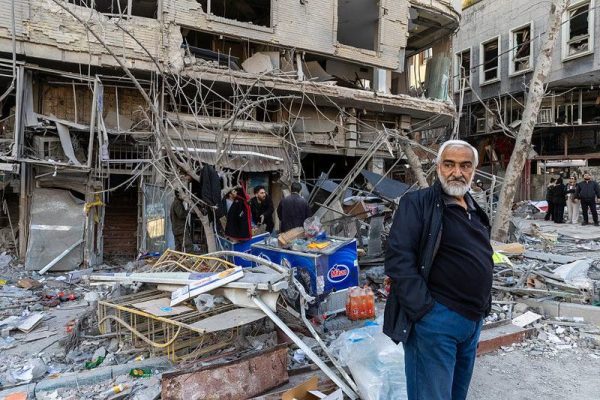
Failing to achieve regime change, the U.S. and Israel are bombing civilian areas in Tehran, in an attempt to destroy Iran as a nation.
A report in the Telegraph, a mainstream British newspaper, wrote , “Tehran an ‘apocalypse’ of hospitals in flames and children buried beneath rubble”.
The report noted, “American and Israeli aircraft bombed hospitals, residential buildings and schools across Tehran on Tuesday in what residents described as ‘an apocalypse’” adding, “Millions of civilians are trapped under relentless bombardment as food and medical supplies dwindle and the death toll mounts.”
One resident of Tehran told the paper, “They have been bombing us without pause today, and the sound of explosions never stops. They don’t care where they are hitting. I have felt the shockwaves several times already”.
He added, “They are striking buildings where families live. After each explosion, people rush to help – and then another bomb hits the same area.”
The report added:
Families ration meals to make supplies last. Children go to bed hungry. Elderly residents with medical conditions cannot find their medications.
Diabetics run out of insulin. Parents water down milk to make it stretch further. Some families have not eaten in two days. Bakeries that remain open face long lines.
It went on to write:
Areas around Revolution Square in central Tehran were struck on Tuesday, causing extensive damage to residential homes in one of the capital’s most densely populated districts.
The Haft-e-Tir neighbourhood, also in central Tehran, was hit. Video footage showed destroyed apartment buildings and rescue workers digging through rubble.
A hospital in southern Bushehr was destroyed, with emergency workers frantically evacuating newborn babies as the building was struck.
Kamran ( Tehran resident) said: “Many people are trapped under the rubble. Hospitals are filled with injured patients, and staff are overwhelmed. They are even striking hospitals where the wounded are being treated.”
The scene echoed strikes on Gandhi Hospital in Tehran and multiple other medical facilities across the country.
The destruction of hospitals means the wounded have nowhere to go. Nurses carry premature infants through smoke-filled corridors as bombs fall on maternity wards.
Burn victims lie on floors because all beds are full. Surgeons operate by torchlight when electricity fails.
Medical staff work until they collapse from exhaustion, then wake and work again. Some doctors have not left their hospitals in three days, sleeping in supply closets between emergency procedures.
Millions remain trapped in Tehran, a city under sustained aerial assault.
The report added, “‘An apocalypse is unfolding here,’ said Ashkan, another Tehran resident. ‘Today has been the worst day. Those who had cars fled. Those of us without cars are left here under the bombs.’”
It went on to note:
The strikes have created a humanitarian crisis that casualty figures do not fully convey.
Food supplies have become scarce in several parts of the city as distribution networks break down and stores close.
‘I don’t know if any of my relatives are dead or alive,’ Ashkan said. ‘One kilo of potatoes is now 200,000 tomans. That was 30,000 tomans last week.’
The report also documented the repeated use of “double tap” strikes on rescue workers, writing:
The Red Crescent said more than 100,000 rescue and relief workers across the country are on full alert, but residents said help often arrives too late or cannot reach victims at all.
“By the time rescuers arrive, another bomb falls on the same place,” Kamran said, describing what appeared to be “double-tap” strikes where initial attacks are followed by secondary strikes targeting first responders – a tactic that violates international humanitarian law.
Middle East Eye reported that the U.S./Israeli slaughter 165 children at the school for girls in Minab was also the result of a “double tap” strike, writing, “The girls’ school in Iran, where 165 people were killed by an apparent US-Israeli attack, was hit with two strikes, with the second missile killing sheltering survivors, two first responders and the parent of a slain child have told Middle East Eye.”
One Red Crescent member told the outlet, “When the first bomb hit the school, one of the teachers and the principal moved a group of students to the prayer hall to protect them. The principal called the parents and told them to come and pick up their children. But the second bomb hit that area as well. Only a small number of those who had taken shelter survived.”
The father of one victim told the outlet that, “his daughter survived the first strike and was moved to the prayer hall. The second strike hit before he could reach her.”
The outlet documented other instances of “double tap strikes” used in Iran wiring:
Since the US and Israel launched a war on Iran on Saturday, some Iranians have reported attacks that resembled double-tap strikes.
A video circulating on social media shows one woman in central Tehran in distress saying: “They dropped one bomb, people went inside, then they bombed again. They killed people.”
Another shows two men on a motorcycle, with one of them describing a near-death experience.
“We went to drag out people from under the rubble, and then the jet returned twice and pounded the same location four more times. We would have been dead if we weren’t still under the rubble,” he says.
A resident of Tehran who left for Turkey told Reuters , “We saw a lot of buildings destroyed, especially on the way leaving the country. There were a bunch of buildings, a bunch of cars and streets were destroyed. People are panicking to leave the country. They don’t know what to do”.
According to the Western group “Human Rights Activists News Agency, “the total number of reported civilian deaths stands at 1,114, including 181 children”.
As academic Glenn Diesen noted, referring to this report , “The US and Israel are bombing hospitals, schools, residential buildings, and Mehrabad international airport in Tehran. Having failed to regime change Iran, the new objective appears to be terror-bombing Iran into submission”.
The murder of Iranian schoolchildren cannot be whitewashed
By Eva Bartlett | RT | March 4, 2026
In Iran, under ongoing US-Israeli attacks, a mass funeral took place today for 168 Iranian schoolgirls aged 7-12, killed by an Israeli airstrike on February 28.
The strike hit the Shajareh Tayyebeh girls’ primary school in Minab, southern Iran, in broad daylight, when the children were at school. Fourteen teachers were also killed in the bombing. The bombing occurred as part of US-Israeli attacks sadistically dubbed ‘Operation Epic Fury’, attacks which have to date targeted schools, hospitals, residential areas and other civilian infrastructure.
It was a scene all too familiar to Palestinians: grief-stricken parents collapsing sobbing at the site of their daughters’ murders, clutching bloodstained backpacks, pulling out schoolbooks and personal items of their slain daughters. Children’s desks covered in debris from the bombing. A child’s shoe in the rubble. Death where life had flourished.
None of this is being conveyed by Western legacy media – only ghoulish gloating over the US-Israeli bombardment of Iran and the murder of Ayatollah Ali Khamenei, Iran’s supreme leader, and his young granddaughter and children.
On March 2, Iranian Foreign Minister Abbas Araghchi posted a photo of the graves being dug on X, noting, “These are graves being dug for more than 160 innocent young girls who were killed in the US-Israeli bombing of a primary school. Their bodies were torn to shreds. This is how “rescue” promised by Mr. Trump looks in reality. From Gaza to Minab, innocents murdered in cold blood.”
At the time of this writing, 69 of the murdered girls remain unidentified.
International reaction: Silence
If the bombed school had been in Israel or Ukraine, news of it would have been plastered on front pages of Western media for days, with widespread demands for retaliation, or at least for justice and accountability. Back in 2016, Western media alleged Syria or Russian planes had injured Aleppo boy Omran Daqneesh. His photo went viral, for weeks, even years. A CNN news anchor fake-sobbed for the boy. In 2017, in his home, his father told me their home was not hit in an airstrike, but rather terrorists shelled it and used the boy in a cynical, and effective, photo op.
Footage shared on Telegram and on X clearly show horrific scenes of some of the young girls torn apart in the US-Israeli bombing of their school. But just like the untold thousands of Palestinian children killed by Israel, as well as the half a million Iraqi children killed by US sanctions, these Iranian children’s lives don’t merit Western media outrage. Instead, they produce cynical reports that not only lack any semblance of empathy, but suggest that Iran is either lying about or is to blame for the murders.
Take the BBC’s report, which describes the massacre as a “reported” strike on a school, which “Iran has blamed the US and Israel” for. Casting doubt is standard for legacy media whitewashing the US and Israel’s crimes. The US is “looking into reports.” Israel is “not aware.” Just one of those mysterious unknown strikes.
The BBC then overtly blamed the Iranian government as untrustworthy, writing, “Deep mistrust of the Iranian regime, however, makes official reports difficult for many to accept, and some Iranians directly blamed the regime for the attack.”
The BBC did similarly dishonest and deceptive journalism in 2014 in Damascus after terrorists in eastern Ghouta had shelled an elementary school, killing one child and injuring over 60. The BBC later reported: “the government is also accused of launching [mortar strikes] into neighborhoods under its control.” The BBC could have easily learned about the trajectory of mortars and from where the strike in question could only have come: the terrorist “moderates” east of Damascus.
The New York Times also got the memo, likewise omitting Israel from the headline and implying Iran is lying. But when it comes to blaming Iran for its retaliation, the NYT has no problem stating whose missile strike it was. And there is no “Israel says.”
CNN ran the headline “A girls’ elementary school was hit in Iran. Here’s what we know.” Its video report not only doesn’t mention the US or Israel, but insinuates Iranian blame: In an Israel-like tactic (recall Israel’s claiming Gaza’s Shifa hospital was a “Hamas base”, and staging weapons as “proof”), CNN claims the children’s school could be connected to an Iranian Revolutionary Guards (IRGC) base. But The Cradle noted that the school had operated independently as a civilian institution for over a decade, with separate entrances, playgrounds, and classrooms.
CNN’s report did, at least, debunk online claims that the school was hit by a failed missile launch by Iran, noting the photo shared online as “proof” of the claim was actually taken 800 miles from Minab. But, hello? If it wasn’t a failed Iranian missile there is clearly one remaining explanation: the schoolgirls were killed by US-Israeli bombing.
Most Western media cite The US military’s Central Command (Centcom) as saying it was “looking into reports of the incident,” and the Israeli army as saying it was “not aware of any IDF operations in the area.” Ah yes, the guilty shall investigate themselves. Right.
Even if you set aside the actual culprit of the school bombing, legacy media reports are devoid of any concern for the slaughtered children: no details, no empathy, no mention that they were murdered in the Muslim holy month of Ramadan. The tone would be radically different were the children Israeli, Ukrainian or American. We would see names, ages, stories about them. They would be humanized – if only they were not Iranian (or Palestinian, or Lebanese, or Syrian).
Since the February 28 Minab school massacre, US-Israeli strikes have attacked still more civilian infrastructure, killing and injuring more Iranian civilians.
One man recounted to RT how after the bombing of central Tehran’s Enghelab Square he’d seen a decapitated person in front of his café. Walking around showing the destruction, RT’s Tehran bureau chief Hami Hamedi pointed out residential buildings, cars, shops, damaged and destroyed in recent bombings where a police station was among those targeted.
This was the same tactic which Israel used on December 27, 2008, when it unleashed over 100 bombs nearly simultaneously on Gaza, targeting police stations, police academies, universities and more, destroying and damaging shops and residential buildings around them.
I was in Gaza at the time and saw the immediate aftermath of the initial bombings, the chaos and destruction in every direction. Shifa hospital, Gaza’s main hospital, was an endless circuit of cars and ambulances bringing the dead and injured.
That was 17 years ago, and Israel has repeated this brutal tactic over and over again in Gaza, Lebanon and now Iran. We’ve seen this US-Israeli strategy of terrorizing the people by widely attacking civilian infrastructure repeatedly in Gaza, Lebanon, Iraq, to list only some of the targeted regions – as well as being replicated by the Kiev regime in the Donbass. The intent is always destabilization and instigation of fear in hopes of causing the people to turn against their government. It never works, but it invariably kills countless innocent civilians and flattens infrastructure.
To add further insult, days after the girls’ school massacre, Melania Trump presided over a UN Security Council meeting on children in conflict. You can’t make this insanity up. The wife of a US president who is co-waging a war on children in Iran feigns concern over children in conflict.
The US and its bought media have so little regard for Iranian lives that they don’t even bother to try to explain, much less apologize for, the murders of the 168 schoolgirls. Outrageously, it is as if they simply never existed to Western media.
But it is true that every war crime, every murdered child, fuels support not only to their government but to resistance in general. And Iran is resisting and retaliating in ways that will make the US wish it hadn’t co-started this war on the people of Iran.
Eva Bartlett is a Canadian independent journalist. She has spent years on the ground covering conflict zones in the Middle East, especially in Syria and Palestine (where she lived for nearly four years).
Ukraine blocks EU mission to inspect Russian oil pipeline – FT
RT | March 4, 2026
Ukraine has rejected a proposed EU mission to inspect the Soviet-era pipeline that transports Russian oil through Ukrainian territory to Central Europe, the Financial Times reported on Tuesday, citing diplomats and officials.
Hungary and Slovakia have accused Ukraine of deliberately blocking the flow through the Druzhba pipeline, while Ukraine said the infrastructure was damaged by Russian strikes in January.
The EU is pressuring Ukraine to restore the operation of the Soviet-era pipeline that transports Russian oil through Ukrainian territory to Central Europe, the Financial Times reported on Tuesday, citing diplomats and officials.
Hungary and Slovakia have accused Ukraine of deliberately blocking the flow through the Druzhba pipeline, while Ukraine claimed the infrastructure was damaged by Russian strikes in January.
According to FT, some pro-Ukrainian EU member states and the European Commission are now asking Kiev to allow a visit to demonstrate that it is working to restore oil flows. Last week, European Commission President Ursula von der Leyen and European Council President Antonio Costa personally requested access to the pipeline for inspection but were denied, FT said.
One of the newspaper’s sources argued that by blocking the inspection, Ukraine scored an “own goal” and gave Hungary an excuse to veto the planned $106 billion emergency loan for Ukraine and the EU’s 20th round of sanctions against Russia.
In a post on X on Tuesday, Hungarian Prime Minister Viktor Orban said he had sent a letter to von der Leyen calling for enforcement of the EU-Ukraine Association Agreement, which “obliges Ukraine to allow oil shipments to Hungary.”
“As confirmed by recently published satellite evidence, there is no technical or operational reason preventing the pipeline from reverting to normal operations immediately,” Orban stated.
Orban said that Hungary and Slovakia had proposed dispatching a “fact-finding mission” to inspect the pipeline, but their “efforts were rejected.”
In August, Hungary imposed sanctions on Ukraine’s top drone commander Robert Brovdi after attacks on sections of the Druzhba pipeline in Russia. Ukrainian leader Vladimir Zelensky has called on Hungary to stop purchasing energy from Russia.
Reuters reported on Tuesday that some EU members, including France and Germany, oppose the idea of granting Ukraine fast-tracked accession to the bloc, citing “rampant corruption.”
Ukrainian drone attacked Russian LNG tanker in Mediterranean Sea
RT | March 4, 2026
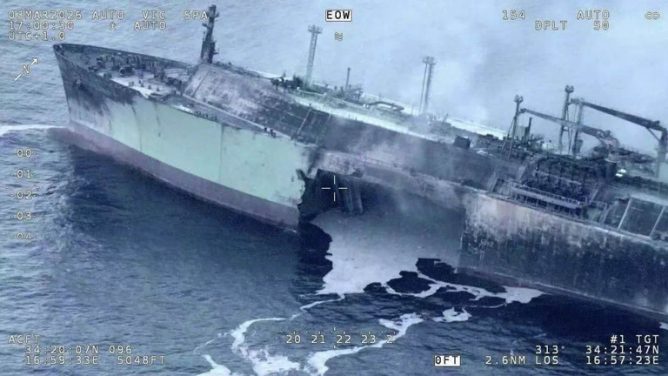
Ukraine has carried out a drone attack on a Russian liquefied natural gas (LNG) tanker in the central Mediterranean off the coast of Malta, the Transport Ministry in Moscow has said.
Kiev has for months been attempting to target Russia-linked shipping both in the Black Sea and beyond, with Moscow accusing Kiev of “terrorism.” The attack on the tanker in Mediterranean waters represents a clear escalation in Ukraine’s war on Russian shipping.
In a statement on Wednesday, the ministry confirmed the raid on the Russia-flagged Arctic Metagaz vessel, which had been en route from Murmansk “with cargo processed according to all international rules” when Ukrainian unmanned boats launched from the Libyan coast struck the vessel.
All 30 Russian crew members abandoned the ship and were saved thanks to a rescue operation mounted by Russian and Maltese emergency services.
“We believe the incident to be an act of international terrorism and maritime piracy, a gross violation of the fundamental norms of international maritime law,” the ministry said.
It suggested that such “criminal actions” had been committed in part because EU members had turned a blind eye to Ukrainian policies, adding that they “should not remain without assessment by the international community.”
The explosions following the impact on the 277-meter Arctic Metagaz in international waters, were visible for some 40 nautical miles, images show.
The strike was apparently the first instance of Ukraine targeting an LNG instead of an oil-laden tanker. While a complete destruction of a gas carrier could produce less long-term environmental impact, an LNG blast would likely result in pool fires with far greater heat radiation than oil blazes – along with the risk of vapor cloud explosions capable of causing casualties at considerably greater distances.
Ukraine has for months sought to undermine Russia’s oil trade. In December 2025, Kiev acknowledged striking the Qendil, a Russia-linked and Omani-flagged oil tanker, in the eastern Mediterranean off Libya’s coast. At the time, Euronews cited a Ukrainian intelligence source describing the attack as “an unprecedented special operation.”
Kiev’s Western backers have also sought to crack down on Russia-linked vessels. In January 2026, the French navy boarded the oil tanker Grinch in the western Mediterranean. In light of the crackdown, Russian officials have accused NATO of seeking to impose an illegal maritime blockade, warning of potential countermeasures.
Brazilian mercenaries say they learned ‘guerrilla warfare’ in Ukraine
By Lucas Leiroz | Strategic Culture Foundation | March 3, 2026
The proxy war being fought in Eastern Europe is beginning to produce direct side effects on public security in Brazil. A recent report by the television program Fantástico, aired by TV Globo, revealed that Brazilian citizens with no prior military experience traveled to fight in the conflict between Ukraine and Russia after being lured by misleading financial promises. Upon returning, they bring with them practical knowledge of irregular combat learned on the battlefield – knowledge that, in a country already marked by heavily armed criminal factions, can easily be absorbed by organized crime.
The case of Marcos Souto, a businessman from the state of Bahia who adopted the codename “Corvo” (“Crow”), is emblematic. Having never served in the Brazilian Armed Forces, he claims to have learned everything he knows about guerrilla warfare in Ukraine. His account highlights two central elements: the precarious recruitment of foreign fighters and the brutality of the operational environment. According to him, combatants were attracted by promises of a salary of “50,000” – a figure many interpreted as Brazilian reais, but which in practice corresponded to 50,000 hryvnias, a much smaller amount. Upon reaching the front lines, they encountered not only extreme combat conditions but also internal coercion. Souto reports that those who attempted to abandon their positions were detained and tortured.
This is not an isolated episode. Other Brazilians mentioned in the report describe hunger, logistical abandonment, and even clashes with Ukrainian soldiers during escape attempts. Brazil’s Ministry of Foreign Affairs records 19 Brazilians killed and 44 missing since the beginning of the war, although analysts generally agree that the real numbers likely amount to hundreds of Brazilian fatalities. Even so, four years after the start of the conflict, new mercenaries continue to enlist.
The central issue, however, is not merely humanitarian. The strategic concern lies in the return of these individuals to Brazilian territory. Unlike conventional conflicts, the war in Ukraine is characterized by the intensive use of irregular, modern warfare tactics: operations with drones, urban ambushes, use of improvised explosive devices, infrastructure sabotage, and decentralized coordination in small units. The government in Kiev has long since lost much of its regular operational capacity and is compelled to rely on guerrilla tactics to continue fighting. It has become a contemporary laboratory of unconventional warfare.
When individuals without formal military training acquire this type of practical knowledge in a real combat environment and return to Brazil, the risk of diffusion of these techniques is evident. The country already faces structural challenges with criminal organizations that exert territorial control in urban areas and dominate international drug and weapons trafficking routes. The introduction of tactics learned in an active war theater could raise the operational level of these factions.
Historically, Brazilian organized crime has demonstrated a capacity for rapid adaptation. Factions have incorporated restricted use weapons, encrypted communication technologies, and sophisticated money-laundering methods. Absorbing knowledge about drone warfare, construction of improvised explosive devices, or urban fortification techniques would not require large structures to implement. The presence of just a few trained individuals willing to share their experience would suffice.
There is also a relevant psychological component. Combatants return after prolonged exposure to extreme violence, often without any state monitoring or social reintegration. The combination of trauma, financial frustration, and contact networks established abroad may facilitate involvement in illicit activities.
The Ukrainian embassy in Brazil states that it does not formally recruit Brazilians and that those who enlist assume the same duties as Ukrainian citizens. However, the existence of intermediaries, vague financial promises, and the absence of monitoring mechanisms in Brazil reveal a regulatory gap. There is no clear policy for dealing with citizens who participate in foreign conflicts and return with irregular military training.
The phenomenon should not be treated as a media curiosity but as a matter of national security. Brazil is not formally involved in the conflict in Eurasia, yet it is beginning to absorb its indirect effects. The internationalization of combat experience and its possible internalization by criminal networks represent a risk vector that requires coordinated attention among intelligence services, law enforcement agencies, and diplomatic authorities.
Ignoring this dynamic may mean allowing techniques developed in one of the most intense conflicts of the present day to be reconfigured within Brazil’s urban context. A distant war ceases to be an external event and begins to produce concrete consequences for the country’s social structures and internal stability.
Netanyahu Again Uses Genocidal Rhetoric And Compares Iranians To ‘Amalek’
The Dissident | March 2, 2026
Israeli Prime Minister Benjamin Netanyahu is using the same genocidal rhetoric towards Iranians as he did towards Palestinians in Gaza.
At the site of an Iranian missile attack in Israel, Benjamin Netanyahu said, “If this regime of terror obtains nuclear weapons, they will threaten all of humanity. Therefore, we went out in order to remove that danger first and foremost from ourselves, but we are acting here together with the United States, in the name of and for the sake of all humanity,” adding, “We read in this week’s Torah portion, ‘Remember what Amalek did to you.’ We remember, and we act”.
By comparing Iranians to the Amalek, Benjamin Netanyahu is signalling to genocidal hardline religious zealots in the IDF that Iranian civilians are fair targets.
For context, the UN’s report on the Genocide in Gaza documented that Netanyahu comparing the Palestinians to “Amalek” before the genocide in Gaza was seen as a green light by the IDF to slaughter civilians in reference to the Hebrew bible passage which states, “Now go and attack Amalek, and utterly destroy all that they have; do not spare them, but kill both man and woman, child and infant, ox and sheep, camel and donkey”.
The UN report documented:
On 3 November 2023, Prime Minister Netanyahu published a letter to the Israeli soldiers and commanders in the war, in which he wrote, “Remember what Amalek did to you… This is a war between the sons of light and the sons of darkness…We constantly remember the sights of the horrific massacre on that Simchat Torah Shabbat, October 7, 2023.”
The descendants of Amalek, the Amalekites, were enemies of the Israelites in the Hebrew bible. In the Book of Samuel, God tells the Israelites, ‘Now go and attack Amalek, and utterly destroy all that they have; do not spare them, but kill both man and woman, child and infant, ox and sheep, camel and donkey.’
The Commission notes that, in invoking Amalek in his speech, Netanyahu strengthened the idea that Israel’s war in Gaza is akin to the holy war of total annihilation commanded against the Amalekites.
This would be familiar to and compelling for the many thousands of Israeli military personnel who are religious Zionists, especially for those in military units whose personnel are wholly or predominantly ultra-orthodox. Indeed, such sentiment was referred to by many following the statement of Netanyahu, including the Israeli Finance Minister, Bezalel Smotrich and Israeli soldiers who yelled and chanted direct references to Amalek as they launched attacks in Gaza.
The report noted that, “The invocation of Amalek had particular resonance for religious Zionist military personnel, of whom there are now many thousands in the Israeli security forces.”
Indeed, religious members of the IDF often invoked the comparison of the Palestinians to “Amalek” to justify killing Palestinians civilians and the comparison was often used alongside the openly genocidal statement that there are “no innocents” in Gaza.
South Africa’s report on Israel’s genocide in Gaza documented that the IDF released “video of soldiers chanting that there are ‘no uninvolved citizens’ in Gaza and that they will ‘wipe off the seed of Amalek’”.
The report also noted that Israeli, “Parliamentarians have stated ‘[w]e must not forget that even the ‘innocent citizens’ — the cruel and monstrous people from Gaza took an active part . . . there is no place for any humanitarian gesture — the memory of Amalek must be protested’”.
Daniel Raab, an American sniper in the IDF, while boasting about killing Palestinians civilians, said , “Gaza is like Sodom and those who live there are similar to the Amalek and this population is really Amalek”.
Yet again, Netanyahu is comparing Iranians to the “Amalek” so members of the IDF believe it is justified to “kill both man and woman, child” in an attempt to justify the continuation of war crimes such as the American/Israeli strike on a girls’ school in Iran that killed 175 children.
‘Trump’s Gift to Iran’: Iranian Media Shows 165 Graves for Minab School Bombing Victims
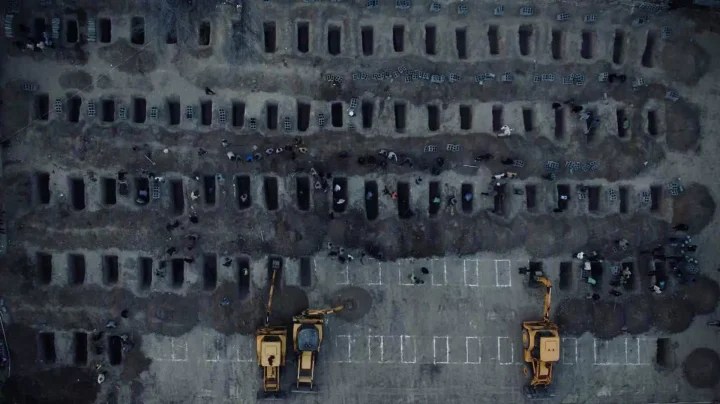
‘Trump’s Gift to the people of Iran’
Sputnik – 02.03.2026
Iranian media have published a shocking aerial photo showing the diggi9ng of 165 graves for the young victims of the Minab school attack.
The victims, girls aged between seven and 12, were killed in a devastating attack by US and Israeli forces.
The photo is captioned: “Trump’s gift to the people of Iran.”
The school in Hormozgan province was hit on Saturday morning in the first wave of US-Israeli missiles.
Iran has condemned the attack as a brutal act of terror, accusing the US and Israel of committing war crimes by targeting innocent children.
The attack has drawn widespread condemnation within Iran, with many calling it a violation of international law and a stab at the very heart of Iranian society.
Featured Video
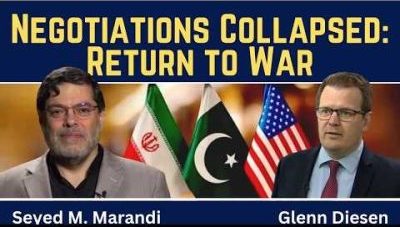
Seyed M. Marandi: Negotiations Collapsed – Return to War
or go to
Aletho News Archives – Video-Images
From the Archives
The US-Iran Scenario That Most Scares Israel
By Ali Haydar | Al-Akhbar | October 9, 2013
Israeli Prime Minister Benjamin Netanyahu issued a series of threats toward Iran and its interlocutors in the West, including the US, as serious negotiations on Iran’s nuclear program seem more plausible.
As a possible rapprochement looms between the US and Iran, Netanyahu has attempted to impose impossible Israeli conditions on the negotiators, such as the full dismantling of Iran’s nuclear program, not to mention threatening military force.
Whatever the deal that could materialize between Iran and the West, Israel is going to find itself before an open-ended path. One can foresee three possible scenarios… continue
Blog Roll
 Aletho News
- UK, Spain reject Trump’s new scheme to blockade Hormuz Strait
- Russian frigate ‘resurfaces’, chases off NATO pirates days after Kiev ‘sank’ it
- Ukraine Targets Russian Merchant Fleet With NATO Intel Support – Presidential Aide
- Russia’s ‘shadow fleet’ makes mockery of UK naval power
- Ukraine plans to attack Russian ships with Norwegian support
- US’s ‘Very Foolish’ Double Blockade of Hormuz Strait Makes Absolutely No Sense: Here’s Why
- China issues rules on countermeasures against foreign states’ unlawful extraterritorial jurisdiction
- Seyed M. Marandi: Negotiations Collapsed – Return to War
- Tomorrow’s naval blockade showdown
- ‘Israel’ attacks civilians to hide its embarrassing military failures & out of pure sadism
- If Americans Knew
- Critical shortages in Gaza, Lebanon in ruins, “piracy” in Iran – Daily Update
- US-Iran ceasefire negotiations make zero progress – Daily Update
- Pro-Israel ‘Thinktanks’ and Individuals who Influence U.S. Foreign Policy
- Mearsheimer reveals how Israel dictates US policies on Iran, Gaza – video
- After killing 350+, Israel still has a “score to settle” with Lebanon before ceasefire – Daily Update
- Military aid to Israel emerges as the latest political litmus test for Democrats
- The only Palestinian children’s rights organization closes following years-long Israeli campaign against it
- ‘I Can’t Forget the Smell’: Lebanese Reel After Israel Kills Over 300 in Single Day
- DNC Shoots Down Resolutions Calling Out AIPAC and Limiting Arms to Israel
- TCN: Is Israel Blackmailing President Trump?
- No Tricks Zone
- Cave Discovery Reveals Today’s Desert Climates Were Recently Far Warmer, Wetter, Teeming With Life
- German Expert: Heat Dome Led To Record Temps In Western USA…Warmer In 1934, 1936
- New Study: No Linear Warming Or Glacier Retreat Along Northern Antarctic Peninsula Since 1980s
- An Inconvenient Tree: Uncovered In Alps… Europe Much Warmer Than Today 6000 Years Ago
- New Study Reports A 60% Slowdown In Greenland’s Ice Loss Rate In The Last Decade
- Low Intensity Tornado Wrecks Major Solar Farm, Creating A Potential Toxic Dump
- New Study Finds Warming Saves Lives…Cold Temperatures 12 Times More Deadly Than Excess Heat
- German Science Blog Accuses PIK Climate Institute Of Hallucinating Climate Tipping Points
- Devastating Assessment Of Comirnaty Vaccine By Former Senior Pfizer Europe Toxicologist
- New Study: CO2 Is ‘Effectively Negligible’ As An Explanatory Climate Change Factor Since 2000
 Aletho News