Taliban: Foreign forces’ interpreters have nothing to fear if ‘show remorse’
Press TV – June 7, 2021
The Taliban militant group says Afghans who used to work with foreign forces as interpreters have nothing to fear after the withdrawal of troops if they “show remorse.”
The Taliban made the announcement after many Afghan translators working alongside US and NATO troops demonstrated in the capital, Kabul, demanding foreign forces and embassies that they worked with help them leave the country a head of US President Joe Biden’s September 11 withdrawal deadline.
The Afghan translators said they were afraid the Taliban would “take revenge” on them since they were seen as US agents and spies.
“They shall not be in any danger on our part,” the Taliban said in a statement.
The militant group “would like to inform all the above people that they should show remorse for their past actions and must not engage in such activities in the future that amount to treason against Islam and the country,” the statement added.
The Taliban went on to say that while Afghan translators were viewed as foes when they worked with foreign forces, they will not face any issues “when they abandon enemy ranks and …should not remain fearful.”
Dozens of Afghan translators have over the past two decades been killed in attacks claimed by the Taliban.
Meanwhile, the Taliban said last week that they would provide a “safe environment” for foreign embassies to work in Afghanistan even after foreign troops leave the country.
The assurance by the militant group came after Australia closed its mission in Kabul and said it will not be able to guarantee security once foreign troops pull out.
The embassy said an “increasingly uncertain security environment” had made it too unsafe for embassy staff to be based in Afghanistan.
The US and its allies overthrew the Taliban regime shortly after the 2001 invasion of Afghanistan. But US forces have remained bogged down there through the presidencies of George W. Bush, Barack Obama, Donald Trump, and now Joe Biden.
All foreign troops were supposed to have been withdrawn by May 1, as part of an agreement that the US had reached with the Taliban in the Qatari capital last year. But Biden last month pushed that date back to September 11.
The Taliban warned that the passing of the May 1 deadline for a complete withdrawal “opened the way for” the militants to take every counteraction they deemed appropriate against foreign forces in the county.
Pakistan rejects US request for military bases
By Javed Rana | Press TV | May 27, 2021
Islamabad – As the US is negotiating with countries in Central and South Asia to set up its military bases in the region to carry out possible airstrikes on Afghanistan after later this year withdrawal from the country, Pakistan says it won’t ink any similar agreement with the US once again.
The US is fast pulling out its troops from Afghanistan under a peace deal with Afghan Taliban. However, before completing its withdrawal by September 11 this year, Washington is desperately negotiating with regional countries in Central and South Asia to set up military bases to retain its political clout in this part of the world.
The US used Pakistan’s military bases for years to carry out over 57,000 sorties on Afghanistan which killed tens of thousands of Afghan civilians. Similarly as many as 4,000 Pakistani civilians were killed in the bordering region with Afghanistan in US drone attacks most of which were carried out from the secret southern locations of Pakistan.
Not long ago, under public pressure Pakistan shut down the US military bases. Now the US is once again struggling hard to be allowed to have military bases in this part of the world.
Prime Minister Imran Khan’s government, which won the 2018 general elections partially exploiting anti-American sentiments, has vowed not to allow the US to have military bases again in Pakistan.
Earlier the Foreign Office denied the presence of any US military or air base in Pakistan, stating that any speculation is “baseless and irresponsible” and should be avoided.
If nothing works, the Pentagon says it can use its aircraft carriers already stationed in the West Asia and Persian Gulf to carry out any possible airstrike on Afghanistan in future.
Despite shutting down the US military bases in Pakistan, the Pentagon continues to use air corridors of Pakistan to support its shrinking military presence in Afghanistan. And Pakistan has yet to clarify on whether or not it would allow the US to retain its air space facility for any possible airstrike in Afghanistan after the US completely exits from Afghanistan later this year.
Liz Cheney Lied About Her Role in Spreading the Discredited CIA “Russian Bounty” Story
By Glenn Greenwald | May 14, 2021
In an interview on Tuesday with Fox News’ Bret Baier, Rep. Liz Cheney (R-WY) denied that she spread the discredited CIA “Russian bounty” story. That CIA tale, claiming Russia was paying Taliban fighters to kill U.S. troops in Afghanistan, was cooked up by the CIA and then published by The New York Times on June 27 of last year, right as former President Trump announced his plans to withdraw troops from Afghanistan. The Times story, citing anonymous intelligence officials, was then continually invoked by pro-war Republicans and Democrats — led by Cheney — to justify their blocking of that troop withdrawal. The story was discredited when the U.S. intelligence community admitted last month that it had only “low to moderate confidence” that any of this even happened.
When Baier asked Cheney about her role in spreading this debunked CIA story, Cheney blatantly lied to him, claiming “if you go back and look at what I said — every single thing I said: I said if those stories are true, we need to know why the President and Vice President were not briefed on them.” After Baier pressed her on the fact that she vested this story with credibility, Cheney insisted a second time that she never endorsed the claim but merely spoke conditionally, always using the “if these reports are true” formulation. Watch Cheney deny her role in spreading that story.
Liz Cheney, as she so often does, blatantly lied. That she merely spoke of the Russian bounty story in the conditional — “every single thing I said: I said if those stories are true” — is completely and demonstrably false. Indeed, other than Rep. Adam Schiff (D-CA), there are few if any members of Congress who did more to spread this Russian bounty story as proven truth, all in order to block troop withdrawal from Afghanistan. In so doing, she borrowed from a pro-war playbook pioneered by her dad, to whom she owes her career: the former Vice President would leak CIA claims to The New York Times to justify war, then go on Meet the Press with Tim Russert, as he did on September 8, 2002, and cite those New York Times reports as though they were independent confirmation of his views coming from that paper rather than from him:
MR. RUSSERT: What, specifically, has [Saddam] obtained that you believe would enhance his nuclear development program? …..
VICE PRES. CHENEY: Now, in the case of a nuclear weapon, that means either plutonium or highly enriched uranium. And what we’ve seen recently that has raised our level of concern to the current state of unrest, if you will, if I can put it in those terms, is that he now is trying, through his illicit procurement network, to acquire the equipment he needs to be able to enrich uranium to make the bombs.
MR. RUSSERT: Aluminum tubes.
VICE PRES. CHENEY: Specifically aluminum tubes. There’s a story in The New York Times this morning this is — I don’t — and I want to attribute The Times. I don’t want to talk about, obviously, specific intelligence sources, but it’s now public that, in fact, [Saddam] has been seeking to acquire, and we have been able to intercept and prevent him from acquiring through this particular channel, the kinds of tubes that are necessary to build a centrifuge. And the centrifuge is required to take low-grade uranium and enhance it into highly enriched uranium, which is what you have to have in order to build a bomb.
So having CIA stories leak to the press that fuel the pro-war case, then having pro-war politicians cite those to justify their pro-war position, is a Cheney Family speciality.
On July 1, the House Armed Services Committee, of which Rep. Cheney is a member, debated amendments to the National Defense Authorization Act, the bill that authorized $740.5 billion in military spending. One of Cheney’s top priorities was to align with the Committee’s pro-war Democrats, funded by weapons manufacturers, to block Trump’s plan to withdraw all U.S. troops from Afghanistan by the end of 2020 and to withdraw roughly 1/3 of the 34,000 U.S. troops in Germany.
To justify her opposition, Cheney — contrary to what she repeatedly insisted to Baier — cited the CIA’s Russian bounty story without skepticism. In a joint statement with Rep. Mac Thornberry (R-TX), ranking member of the House Armed Services Committee, that Cheney published on her website on June 27 — the same day that The New York Times published its first story about the CIA tale — Cheney pronounced herself “concerned about Russian activity in Afghanistan, including reports that they have targeted U.S. forces.” There was nothing conditional about the statement: they were preparing to block troop withdrawal from Afghanistan and cited this story as proof that “Russia does not wish us well in Afghanistan.”
After today’s briefing with senior White House officials, we remain concerned about Russian activity in Afghanistan, including reports that they have targeted U.S. forces. It has been clear for some time that Russia does not wish us well in Afghanistan. We believe it is important to vigorously pursue any information related to Russia or any other country targeting our forces. Congress has no more important obligation than providing for the security of our nation and ensuring our forces have the resources they need.
An even more definitive use of this Russia bounty story came when Cheney held a press conference to explain her opposition to Trump’s plans to withdraw troops. In this statement, she proclaimed that she “remains concerned about Russian activities in Afghanistan.” She then explicitly threatened Russia over the CIA’s “bounty” story, warning them that “any targeting of U.S. forces by Russians, by anyone else, will face a very swift and deadly response.” She then gloated about the U.S. bombing of Russia-linked troops in Syria in 2018 using what she called “overwhelming and lethal force,” and warned that this would happen again if they target U.S. forces in Afghanistan:
Does this sound even remotely like what Cheney claimed to Baier? She denied having played a key role in spreading the Russia bounty story because, as she put it, “every single thing I said, I said: if those stories are true.” She also told him that she never referred to that CIA claim except by saying: “if these reports are true.” That is false.
The issue is not merely that Cheney lied: that would hardly be news. It is that the entire media narrative about Cheney’s removal from her House leadership role is a fraud. Her attacks on Trump and her party leadership were not confined to criticisms of the role played by the former president in contesting the validity of the 2020 election outcome or inciting the January 6 Capitol riot — because Liz Cheney is such a stalwart defender of the need for truth and adherence to the rule of law in politics.
Cheney played the key role in forming an alliance with pro-war Democrats on the House Armed Services Committee to repeatedly defeat the bipartisan anti-war minority [led by Ro Khanna (D-CA), Rep. Tulsi Gabbard (D-HI) and Rep. Matt Gaetz (R-FL)] to prevent any meaningful changes promised by Trump during the 2016 campaign to put an end to the U.S. posture of Endless War. As I reported about the House Armed Services Committee hearing last July, the CIA tale was repeatedly cited by Cheney and her allies to justify ongoing U.S. troop presence in Afghanistan.
Cheney is motivated by power, not ethics. In 2016, Trump ran — and won — by explicitly inveighing against the Bush/Cheney foreign policy of endless war, militarism and imperialism that Liz Cheney, above all else, still vehemently supports. What she is attempting to do is reclaim the Republican Party and deliver it back to the neocons and warmongers who dominated it under her father’s reign. She is waging an ideological battle, not an ethical one, for control of the Republican Party.
That will be a debate for Republican voters to resolve. In the meantime, Liz Cheney cannot be allowed to distance herself from the CIA’s fairy tale about Russians in Afghanistan. Along with pro-war Democrats, she used this conveniently leaked CIA story repeatedly to block troop withdrawal from Afghanistan. And just as her father taught her to do — by example if not expressly — she is now lying to distance herself from a pro-war CIA script that she, in fact, explicitly promoted.
Horrific bombing in Kabul part of US plot to cover up failures in proxy, Takfiri wars: Iran military chief
Press TV – May 13, 2021
Iran’s military chief has condemned a terrorist attack that recently targeted a girls’ school in the Afghan capital, saying the “horrific crime” committed by mercenaries of the US is part of America’s plots to cover up two decades of its failures in the Asian country and the region.
“This horrific crime is in fact part of a series of the Americans’ overt and covert measures to cover up the defeat of their policies in Afghanistan during 20 years of disgraceful presence [in Afghanistan] and also their failure in the proxy and Takfiri wars in the region,” said Chairman of the Chiefs of Staff of the Iranian Armed Forces Major General Mohammad Baqeri in a statement on Friday.
At least 85 people, mostly schoolgirls, lost their lives in explosions caused by a car bomb and mortar shells targeting a school in the Shia majority neighborhood of Dasht-e-Barchi in western Kabul on Saturday.
The Afghan government blamed the Taliban for the bloody attack, but the militant group has denied any role. Analysts say the incident bears the hallmark of attacks by Daesh terrorists, who have gained a foothold in the country by taking advantage of the mayhem caused by the US-led military intervention.
Baqeri further said the US had organized and sent the remnants of Daesh terrorists and other Takfiri groups from Syria and Iraq to Afghanistan as a pretext to prepare the ground for halting the pullout of the American forces from the war-stricken state and to justify the claim that the presence of its troops there would prevent violence.
“The brutal crime committed by mercenaries of the terrorist regime in the US… showed that the hated and evil rulers of this country consider it permissible to commit any crime against humanity, specially Muslims, to achieve their evil goals and intentions,” Baqeri said.
He extended his condolences to the prudent Afghan people, especially the bereaved families of the victims, and expressed hope that the brave nation would neutralize the vicious plots of the US and its regional and trans-regional allies through their vigilance.
The top Iranian commander also expressed hope that the perpetrators of the terrorist crime would be identified, and that Afghanistan and other Muslim nations in the West Asia region would witness sustainable independence, stability, security and tranquility.
Just two days after the Kabul attack, a bus explosion in Afghanistan’s Zabul Province’s Shahr-e Safa District killed or injured as many as 25 people.
The rise in such acts of violence follows a decision announced by the United States for the withdrawal of its forces from the country.
Some observers view as suspicious the circumstances surrounding the terrorist attacks and the fact that no group has yet claimed them.
They cite the precedence of Washington’s refusal of acting on its pledge of withdrawal from the regional countries, saying such incidents could be used as pretexts to prolong the presence of America and its allies.
Will Biden Have Blood on His Hands in Afghanistan?
By Jacob G. Hornberger | FFF | May 6, 2021
President Biden has announced that America’s forever war in Afghanistan is finally coming to an end. He says that U.S. forces will exit the country by next September 11.
That’s a good thing. And it is long overdue.
But there is one big problem with Biden’s timetable: It violates an agreement that the U.S. government entered into with the Taliban to exit the country by May 1 of this year.
Under that agreement, the Taliban agreed not to attack U.S. troops prior to their scheduled departure on May 1. With Biden’s decision to deliberately violate the agreement by unilaterally extending the withdrawal to September 11, he is knowingly placing the lives of the 3,500 American servicemen still in Afghanistan at risk.
In fact, the Taliban has implied as much. According to the Washington Post, a Taliban spokesman declared back in April, “If the agreement is breached and foreign forces fail to exit the country on the specified date, problems will certainly be compounded and those whom failed to comply with the agreement will be held liable.”
 What’s the point of extending the departure? Is an extension to September so important that it’s worth risking the lives of American servicemen still in Afghanistan? If some soldiers are killed or maimed because Biden cavalierly decided to violate the agreement, will their sacrifice have been worth it? What about the lives of innocent Afghan civilians caught in a crossfire or in a bomb explosion designed to kill U.S. troops?
Take a look at this article in USA Today. It’s by a quadruple amputee who lost his arms and legs in Afghanistan. He says it’s time to leave. He says, “I don’t need any soldier to honor me by doing the same thing.”
But that’s exactly what Biden is risking by intentionally, knowingly, and deliberately violating an agreement that the U.S. government willingly entered into.
Moreover, as Elliot Ackerman, a former Marine and intelligence officer who served five tours in Iraq and Afghanistan, pointed out in an article in the New York Times,
[R]emoving the 3,500 American troops from Afghanistan is, in military terms, what’s called a “fighting withdrawal,” in which an army leaves the field while still in contact with the enemy. Of all the maneuvers an army can perform (advance, flank, defend, etc.), it is widely accepted that a fighting withdrawal is the most complex and difficult because you are neither attacking nor defending, and so are exceedingly vulnerable.
Unlike the withdrawal from Iraq, in which U.S. troops could drive through the desert into Kuwait as they did in 2011, and unlike the Soviet withdrawal in 1989, in which they could drive across a then-shared border, U.S. troops are currently marooned in Afghanistan, reliant on three principal U.S.-controlled airstrips (Bagram, Jalalabad, Kandahar), making their journey home all the more perilous.
If the Taliban decide to attack U.S. troops from now until September, Biden will have their blood on his hands. He should never have breached the agreement that U.S. officials willingly entered into with their enemy.
Interventionist Hypocrisy on U.S. Deaths in Afghanistan
By Jacob G. Hornberger | FFF | April 21, 2021
I’m always fascinated by the sacrificial mindset that interventionists have toward the lives of U.S. soldiers who they want to do the intervening. A recent example is Brett Stephens, a columnist for the New York Times. In an op-ed entitled “Abandoning Afghanistan Is a Historic Mistake,” Stephens writes:
The U.S. has lost fewer than 20 service members annually in hostile engagements in Afghanistan since 2015. That’s heartbreaking for those affected, but tiny next to the number of troops who die in routine training accidents worldwide.
Yes, it’s heartbreaking and the number of deaths might be “tiny” compared to other things but the point that Stephens is making, whether he realizes it or not, is that it’s worth sacrificing the lives of those 20 men every year for the indefinite future.
The important question is: What are those soldiers being sacrificed for? According to Stephens, they are being sacrificed to prevent the Taliban from retaking control over Afghanistan. He points out that if the Taliban end up winning Afghanistan’s civil war, that will mean tyranny for the Afghan people.
Is the prevention of tyranny for the Afghan people worth sacrificing 20 U.S. soldiers per year indefinitely into the future? Indeed, is it worth sacrificing even one U.S. soldier to accomplish that goal?
Stephens would say yes. He says the prevention of a Taliban victory is that important.
But there is one big problem with Stephens’s reasoning: his own personal commitment to the cause. After all, if preventing a Taliban victory is so important, what is Stephens doing here at home? There is nothing to prevent him from traveling to Afghanistan and offering his services to the Afghan government to assist it in prevailing over the Taliban.
Stephens is only 47 years old. There are plenty of men in the Afghan army that are that age. Why does he choose to remain here at home living a cushy life writing for the New York Times instead of traveling to Afghanistan and helping the U.S.-installed regime prevail in the conflict?
There is one simple reason: Stephens places a higher value on his cushy life here at home than he does on preventing a Taliban victory over there. He’s not willing to give up what he has here at home to risk his life by traveling to Afghanistan and offering his services in order to prevent a Taliban victory.
But when it comes to the lives of those 20 soldiers a year, that’s a different story. In Stephens’s internal ranking of values, the lives of those soldiers are of secondary value compared to preventing a Taliban victory.
We saw this interventionist mindset, of course, during the Vietnam War, when more than 58,000 American men were sacrificed to prevent the communists in North Vietnam from prevailing in that country’s civil war. Interventionists said (and still say) that sacrificing those 58,000-plus American men sacrifice was worth it. In fact, if interventionists had had their way, American soldiers would still be in South Vietnam today, being sacrificed to prevent a communist takeover of South Vietnam.
There are lots of bad things that happen around the world. But that doesn’t mean that American soldiers should be sacrificed to prevent them. If interventionists are outraged over bad things that happen in the world, let’s just let them travel overseas to risk their lives to right the wrongs.
My hunch is that Stephens is one of those people who exhorts everyone to thank the troops for their service and sacrifice. I wonder how many U.S. soldiers can see through this interventionist hypocrisy, especially after 20 years of official lies and deception surrounding the U.S. war on Afghanistan.
Why Can’t We ‘Just March Out’ Of Afghanistan?
By Ron Paul | April 19, 2021
Last week President Biden announced a “full” US withdrawal from Afghanistan – the longest war in US history – by the 20th anniversary of the 9/11 attack on the United States. While this announcement is to be welcomed, the delayed US withdrawal may result in Americans and Afghans dying needlessly for good PR optics back home. We all remember how many Americans died after President Bush’s “Mission Accomplished” stunt in Iraq.
The war has been a disaster from day one. So why wait to end it?
The previous Trump Administration had negotiated an agreement for the US to be out of Afghanistan by the first of May, but in its obsession with tossing out anything associated with Trump, President Biden will continue to keep US troops in harm’s way in this pointless war.
The Taliban have kept their end of the “Doha Agreement” signed under then-President Trump: no Americans have been killed in Afghanistan for more than a year. However, the US side under President Biden will formally violate the Agreement by keeping US troops in-country after May 1st. The Taliban has announced that it will hold the US “liable” for remaining in-country after the agreed-upon departure date. That means more Americans may be killed.
The outcome of the war will not be altered in the slightest by keeping US troops in Afghanistan four additional months. The withdrawal is already announced and no one paying attention expects the corrupt US-backed Kabul government to survive. It is another Saigon moment, proving that the intellectually bankrupt US foreign policy and military established has learned absolutely nothing from history. So if another American is killed, who is going to explain to the grieving family why their loved one had to remain in harm’s way for a good 9/11 photo-op?
A recent article in the Military Times lays out the massive disaster of the US two-decade war on Afghanistan: more than two trillion dollars spent – much of it going to fund crooked practices in Afghanistan and here at home. And even worse, the Cost of War Project has estimated that a quarter of a million people have been killed in the war.
We do applaud President Biden’s decision to ignore the demands of all the neocons who have flocked to support his Administration, but as is most often the case, when it comes to Washington you have to really read the fine print when something sounds too good to be true. In this case, the fine print is that the US will not actually be leaving Afghanistan at all. As a recent article in The Grayzone points out, the Afghan war will continue with US special forces, CIA paramilitaries, and guns-for-hire taking the place of US soldiers. The war is not going to end, it’s just going to be “privatized.”
My philosophy has always been simple: we just marched in, so we can just march out. As we have learned recently, that is exactly what President Trump tried to do in the final days of his presidency, only to get cold feed after his military and national security “experts” told him it was a terrible idea. When the history of the Trump Administration is written, it will sadly be filled with stories of Trumps’ excellent instincts tossed aside by his inability to demand that those working for him follow his orders. It’s tragic.
We need to be completely out of Afghanistan. Yesterday.
Copyright © 2021 by RonPaul Institute
Trump Condemns Biden’s Delay in Ending Afghan War to 9/11
Sputnik – 18.04.2021
Former US secretary of state Mike Pompeo signed the peace agreement with the Afghan Taliban on behalf of the Trump administration on February 29, 2020. But new president Joe Biden has already broken the terms of the deal by delaying the US troop pull-out until September 11, the 20th anniversary of the terror attacks that prompted the US invasion.
Former US president Donald Trump has laid into his successor Joe Biden’s delay in withdrawing troops from Afghanistan to September 11 this year.
In a statement issued on Sunday, the property tycoon laid out his reasons why postponing the pull-out was a mistake.
“First, we can and should get out earlier. Nineteen years is enough, in fact, far too much and way too long,” Trump said.
“I made early withdraw possible by already pulling much of our billions of dollars of equipment out and, more importantly, reducing our military presence to less than 2,000 troops from the 16,000 level that was there,” he stressed.
Native New Yorker Trump also objected to Biden conflating the solemn 20th anniversary of the World Trade Centre suicide airliner attacks by Saudi al-Qaeda terrorists with the “wonderful and positive” peace deal.
“September 11th represents a very sad event and period for our Country and should remain a day of reflection and remembrance honoring those great souls we lost. Getting out of Afghanistan is a wonderful and positive thing to do,” he said.
Trump also criticised his successor for reneging on the peace treaty his own administration agreed with the Taliban, under which all US forces were meant to leave the country by May 1st this year.
“I planned to withdraw on May 1st, and we should keep as close to that schedule as possible,” he insisted.
Biden claimed at his belated first press conference as president in March that sticking to the May 1 deadline would be “tough” — even as new Defence Secretary Lloyd Austin focuses on purging right-wingers from the military.
Pentagon spokesman John Kirby said on Friday that the US might actually deploy more forces to Afghanistan ahead of the delayed pull-out, while a senior government official told the media that Washington will maintain enough “military and intelligence capabilities” in and around the country to strike at the al-Qaeda terrorist group if it re-emerges.
But the Taliban has warned it will cease to observe the ceasefire and resume attacks on foreign troops if they stay beyond May 1.
The Yankees Are Coming Home: The Taliban Won. Get Over It
By Philip Giraldi | Strategic Culture Foundation | April 8, 2021
It hardly made the evening news, but the New York Times reported last week that after twenty years of fighting, the Taliban are confident that they will fully control Afghanistan before too long whether or not the United States decides to leave some kind of residual force in the country after May 1st. The narrative is suggestive of The Mouse that Roared, lacking only Peter Sellers to put the finishing touches on what has to be considered a great humiliation for the U.S., which has a “defense” budget that is larger than the combined military spending of the next seven countries in order of magnitude. Those numbers include both Russia and China. The Taliban, on the other hand, have no military budget to speak of. That enormous disparity, un-reflected in who has won and lost, has to nurture concerns that it is the world’s only superpower, admittedly self-proclaimed, which is incapable of actually winning a war against anyone.
In fact, some recent wargaming has suggested that the United States would lose in a non-nuclear conflict with China alone based on the obsolescence of expensive and vulnerable weapons systems that the Pentagon relies upon, such as carrier groups. Nations like China, Iran and Russia that have invested in sophisticated and much cheaper missile systems to offset U.S. advantages have reportedly spent their money wisely. If the Biden foreign policy and military experts, largely embroiled in diversifying the country, choose to take on China, there may be no one left around to pick up the pieces.
Those who are warning of the apparent ineffectiveness of the U.S. armed forces in spite of their global presence in more than one thousand bases point most commonly to the historical record to make their case. Korea, fought under United Nations auspices, was a stalemate, with the peninsula divided to this day and a substantial American military force continuing to be a presence along the DMZ to enforce the armistice that not quite ended the war. Vietnam was a defeat, resulting in more than 58,000 Americans dead as well as an estimated 3 million Vietnamese, most of whom were civilians. The real lesson learned from Vietnam was that fighting on someone else’s turf where you have no real interests or stake in the outcome is a fool’s game, but the Pentagon instead worked to fix the mechanics in weapons and training at great cost without addressing why people fight wars in the first place. The other lesson was that the United States’ military was perfectly willing to lie to the country’s civilian leadership to expand the war and keep it going, a performance that was repeated in 2001 with the “Iraq is supporting terrorists and will have nuclear weapons” lies and also with the current crop of false analogies used to keep thousands of Americans in Afghanistan and the Middle East.
As a veteran of the Vietnam War army, I can recall sitting around with fellow enlisted men reading “Stars & Stripes,” the exclusive in-house-for-the-military newspaper that was covering the war. The paper quoted a senior officer who opined that the Soviets (as they were at that time) were really envious of the combat experience that the United States Army was obtaining in Vietnam. We all laughed. That same officer probably had a staff position away from the fighting but we draftees knew well that the war was a very bloody mistake while he may have tested his valor post-retirement working for Lockheed-Martin. The “Soviets” in any event demonstrated just how much they envied the experience of combat when they fought in Afghanistan in the 1980s, eventually withdrawing with their tails between their legs just as the U.S. had done in Vietnam after they lost 15,000 men. The “Grave of Empires,” indeed.
Since Vietnam there have been a number of small wars in places like Panama and Grenada, but the global war on terror has been a total disaster for American arms. Afghanistan, as it was for the Russians, is the ulcer that keeps on bleeding until it ends as a major defeat for the United States with the Taliban fully in control, as they are now predicting. Likewise, the destruction of a secular Iraq, regime change in Libya, and a continuing war against a non-threatening Syria have all failed to make Americans either safer or more prosperous. Iran is next, apparently, if the Joe Biden Administration has its way, and relations with major adversaries Russia and China have sunk even lower than they were during Donald Trump’s time as president. The White House has recently sent a shipload of offensive weapons to Kiev and the Ukrainian government has repeated its intention to retake Crimea from Russia, a formula for a new military disaster that could easily escalate into a major war. What is particularly regrettable is the fact that the United States has no compelling national interest in encouraging open warfare between Moscow and Kiev, a conflict that it will be unable to avoid as its is supplying Ukraine with weaponry.
There was almost no discussion of America’s wars during the recent election. One should take note, however, of a recent article by former Assistant Secretary of Defense Lawrence Korb that appeared on National Review which seeks to provide an explanation for “The Real Reason the U.S. Can’t Win Wars Anymore” in spite of the fact that it is “the most powerful country in the history of the world.” To be sure, Korb largely blames the policymakers for the defeat in Vietnam, aided and abetted by a culture of silence in the military where many officers knew that the Gulf of Tonkin incident, which escalated the conflict, was a fraud but chose to say or do nothing. He also observes that the war itself was unwinnable for various reasons, including the observation by many working and middle class Americans that they were little more than cannon fodder while the country’s elites either dodged the draft or exploited their status to obtain national guard or reserve commissions that were known to be mechanism to avoid Vietnam. Korb notes that “… the four most recent presidents who could have served in Vietnam avoided that war and the draft by dubious means. Bill Clinton pretended to join the Army ROTC; George W. Bush used political connections to get into the Air National Guard, when President Johnson made it clear that the reserve component would not be activated to fight the war; Donald Trump, of course, had his family physician claim he had bone spurs, (Trump himself cannot remember which foot); and Joe Biden claimed that the asthma he had in high school prevented him from serving even though he brags about his athletic exploits while in high school.”
Korb also reveals how America’s presumed prowess on the battlefield has distorted its “democracy building” endeavors to such an extent that genuine national interests have been ignored. When the U.S. invaded Afghanistan, success in overthrowing the Taliban was derived from critical assistance from Iran, which correctly regarded the extremist Sunni group as an enemy. But the Bush White House, far from showing gratitude, soon thereafter added Iran to its “axis of evil” list. A golden opportunity was wasted to repair a relationship which has poisoned America’s presence in the Middle East ever since.
One might add something else to Korb’s assessment of failure at war. Most American soldiers have been and are proud of their service and consider it an honor to defend their country but the key word is “defend.” There was no defending going on in Vietnam nor in Afghanistan, which did not attack the U.S. and was willing to turn over Osama Bin Laden if the White House could provide evidence that he was involved in 9/11. Nor was there anything defensive about Obama’s destruction of Libya and the decades long “secret” wars to overthrow the Syrian and Iranian governments. Soldiers are trained to fight and obey orders but that does not mean that they can no longer observe and think. Twenty years of “Reconstruction” duty in Afghanistan is not defending the United States and the morale of American soldiers in the combined Democratic and Republican Parties’ plan to reconstruct the world is not a sufficient motivator if one is being asked to put one’s life on the line. Sure, American soldiers can still win wars, but it has to be a real war where there is something genuine at stake, like protecting one’s home and family. That is what the people who run Washington, very few of whom are veterans and most of whom first ask “But what’s in it for me?” fail to understand.
Featured Video
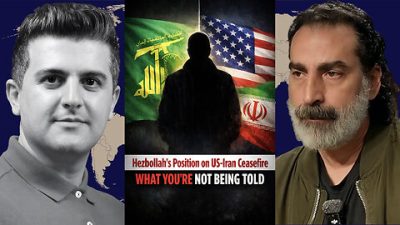
Laith Marouf: Hezbollah’s position on US-Iran ceasefire
or go to
Aletho News Archives – Video-Images
From the Archives
Is Israel to blame for the Iraq War?
American Goy | March 10, 2008
I am so tired of this old canard that “Israel had nothing to do with USA’s war with Iraq – in fact, it officially advised America against it”.
Bullshit. … continue
Blog Roll
 Aletho News
- Laith Marouf: Hezbollah’s position on US-Iran ceasefire: What you’re not being told
- Israel’s priority lies in destroying chances of peace between Iran, US: Ex-UN nuclear chief
- Ceasefire for all or for none: Iran shuts Hormuz over Lebanon attacks
- Strait of Hormuz is Iran’s ‘nuclear weapon’ that forced US retreat: Medvedev
- Energy crisis will last for months – Kremlin envoy
- Europe’s quiet role in the war on Iran
- Forty days that shook the Empire: How Iran turned the tables on US and prevailed
- Netanyahu unilaterally declares Lebanon outside of ceasefire deal
- Israeli leaders: ‘Not a single goal’ achieved in war with Iran
- What on earth just happened? Trump, Iran, and the unlikely ceasefire
- If Americans Knew
- Gazans face a triple crisis: severe shortages of water and bread, healthcare in tatters
- NY Times reports how Netanyahu took the US into Iran War
- A sigh of relief over Iran, but Gaza and Lebanon in dire straits – Daily Update
- Thousands dead and neighborhoods razed to the ground: Aid agencies fear southern Lebanon is becoming the new Gaza
- The war the US is fighting for Israel could cost trillions
- ‘Cigarette Burns, Nail Wounds’: Toddler Tortured in Gaza to Coerce Father
- Trump Says US Sent ‘a Lot of Guns’ to Protesters in Iran
- Israeli forces destroy 17 UN peacekeeper cameras in south Lebanon
- US-Israeli strikes ‘completely destroy’ synagogue in Tehran
- Archbishop for US Military Says Iran War Is Unjust Under Catholic Teaching
- No Tricks Zone
- An Inconvenient Tree: Uncovered In Alps… Europe Much Warmer Than Today 6000 Years Ago
- New Study Reports A 60% Slowdown In Greenland’s Ice Loss Rate In The Last Decade
- Low Intensity Tornado Wrecks Major Solar Farm, Creating A Potential Toxic Dump
- New Study Finds Warming Saves Lives…Cold Temperatures 12 Times More Deadly Than Excess Heat
- German Science Blog Accuses PIK Climate Institute Of Hallucinating Climate Tipping Points
- Devastating Assessment Of Comirnaty Vaccine By Former Senior Pfizer Europe Toxicologist
- New Study: CO2 Is ‘Effectively Negligible’ As An Explanatory Climate Change Factor Since 2000
- Former Pfizer Toxicologist Dr. Helmut Sterz Tells Bundestag Hearing Pfizer Vaccine Should Have Never Been Approved
- Energy Expert: Germany’s Nuclear Phaseout Was A “500 Billion Euro Mistake”
- New Research: South Australia’s Mid-Holocene Sea Surface Temperatures Were 4°C Warmer Than Today
 Aletho News