Hamas congratulates Afghan people on liberating their land
Palestine Information Center – August 16, 2021
OCCUPIED JERUSALEM – The Hamas Movement has congratulated the Muslim Afghan people on liberating their land from the American occupation.
In a press release on Monday, Hamas said that the victory that was achieved by the Taliban Movement and its courageous leadership came as a culmination to its long struggle against the American occupation over the past 20 years.
Hamas said that the ousting of the US occupation and allies from Afghanistan proved that victory is the destiny of every occupied nation struggling for the liberation of its homeland.
Finally, the Movement has wished the Afghan people and its leadership every success in achieving unity, stability and prosperity in their liberated land.
The U.S. Government Lied For Two Decades About Afghanistan
By Glenn Greenwald | August 16, 2021
“The Taliban regime is coming to an end,” announced President George W. Bush at the National Museum of Women in the Arts on December 12, 2001 — almost twenty years ago today. Five months later, Bush vowed: “In the United States of America, the terrorists have chosen a foe unlike they have faced before. . . . We will stay until the mission is done.” Four years after that, in August of 2006, Bush announced: “Al Qaeda and the Taliban lost a coveted base in Afghanistan and they know they will never reclaim it when democracy succeeds. . . . The days of the Taliban are over. The future of Afghanistan belongs to the people of Afghanistan.”
For two decades, the message Americans heard from their political and military leaders about the country’s longest war was the same. America is winning. The Taliban is on the verge of permanent obliteration. The U.S. is fortifying the Afghan security forces, which are close to being able to stand on their own and defend the government and the country.
Just five weeks ago, on July 8, President Biden stood in the East Room of the White House and insisted that a Taliban takeover of Afghanistan was not inevitable because, while their willingness to do so might be in doubt, “the Afghan government and leadership . . . clearly have the capacity to sustain the government in place.” Biden then vehemently denied the accuracy of a reporter’s assertion that “your own intelligence community has assessed that the Afghan government will likely collapse.” Biden snapped: “That is not true. They did not — they didn’t — did not reach that conclusion.”
Biden continued his assurances by insisting that “the likelihood there’s going to be one unified government in Afghanistan controlling the whole country is highly unlikely.” He went further: “the likelihood that there’s going to be the Taliban overrunning everything and owning the whole country is highly unlikely.” And then, in an exchange that will likely assume historic importance in terms of its sheer falsity from a presidential podium, Biden issued this decree:
Q. Mr. President, some Vietnamese veterans see echoes of their experience in this withdrawal in Afghanistan. Do you see any parallels between this withdrawal and what happened in Vietnam, with some people feeling —
THE PRESIDENT: None whatsoever. Zero. What you had is — you had entire brigades breaking through the gates of our embassy — six, if I’m not mistaken.
The Taliban is not the south — the North Vietnamese army. They’re not — they’re not remotely comparable in terms of capability. There’s going to be no circumstance where you see people being lifted off the roof of an embassy in the — of the United States from Afghanistan. It is not at all comparable.
When asked about the Taliban being stronger than ever after twenty years of U.S. warfare there, Biden claimed: “Relative to the training and capacity of the [Afghan National Security Forces] and the training of the federal police, they’re not even close in terms of their capacity.” On July 21 — just three weeks ago — Gen. Mark Milley, Biden’s Chairman of the Joint Chiefs of Staff, conceded that “there’s a possibility of a complete Taliban takeover, or the possibility of any number of other scenario,” yet insisted: “the Afghan Security Forces have the capacity to sufficiently fight and defend their country.”
Similar assurances have been given by the U.S. Government and military leadership to the American people since the start of the war. “Are we losing this war?,” Army Maj. Gen. Jeffrey Schloesser, commander of the 101st Airborne Division, asked rhetorically in a news briefing from Afghanistan in 2008, answering it this way: “Absolutely no way. Can the enemy win it? Absolutely no way.” On September 4, 2013, then-Lt. Gen. Milley — now Biden’s Chairman of the Joint Chiefs of Staff — complained that the media was not giving enough credit to the progress they had made in building up the Afghan national security forces: “This army and this police force have been very, very effective in combat against the insurgents every single day,” Gen. Milley insisted.
None of this was true. It was always a lie, designed first to justify the U.S’s endless occupation of that country and, then, once the U.S. was poised to withdraw, to concoct a pleasing fairy tale about why the prior twenty years were not, at best, an utter waste. That these claims were false cannot be reasonably disputed as the world watches the Taliban take over all of Afghanistan as if the vaunted “Afghan national security forces” were china dolls using paper weapons. But how do we know that these statements made over the course of two decades were actual lies rather than just wildly wrong claims delivered with sincerity?
To begin with, we have seen these tactics from U.S. officials — lying to the American public about wars to justify both their initiation and continuation — over and over. The Vietnam War, like the Iraq War, was begun with a complete fabrication disseminated by the intelligence community and endorsed by corporate media outlets: that the North Vietnamese had launched an unprovoked attack on U.S. ships in the Gulf of Tonkin. In 2011, President Obama, who ultimately ignored a Congressional vote against authorization of his involvement in the war in Libya to topple Muammar Qaddafi, justified the NATO war by denying that regime change was the goal: “our military mission is narrowly focused on saving lives . . . broadening our military mission to include regime change would be a mistake.” Even as Obama issued those false assurances, The New York Times reported that “the American military has been carrying out an expansive and increasingly potent air campaign to compel the Libyan Army to turn against Col. Muammar el-Qaddafi.”
Just as they did for the war in Afghanistan, U.S. political and military leaders lied for years to the American public about the prospects for winning. On June 13, 1971, The New York Times published reports about thousands of pages of top secret documents from military planners that came to be known as “The Pentagon Papers.” Provided by former RAND official Daniel Ellsberg, who said he could not in good conscience allow official lies about the Vietnam War to continue, the documents revealed that U.S. officials in secret were far more pessimistic about the prospects for defeating the North Vietnamese than their boastful public statements suggested. In 2021, The New York Times recalled some of the lies that were demonstrated by that archive on the 50th Anniversary of its publication:
Brandishing a captured Chinese machine gun, Secretary of Defense Robert S. McNamara appeared at a televised news conference in the spring of 1965. The United States had just sent its first combat troops to South Vietnam, and the new push, he boasted, was further wearing down the beleaguered Vietcong.
“In the past four and one-half years, the Vietcong, the Communists, have lost 89,000 men,” he said. “You can see the heavy drain.”
That was a lie. From confidential reports, McNamara knew the situation was “bad and deteriorating” in the South. “The VC have the initiative,” the information said. “Defeatism is gaining among the rural population, somewhat in the cities, and even among the soldiers.”
Lies like McNamara’s were the rule, not the exception, throughout America’s involvement in Vietnam. The lies were repeated to the public, to Congress, in closed-door hearings, in speeches and to the press.
The lies were repeated to the public, to Congress, in closed-door hearings, in speeches and to the press. The real story might have remained unknown if, in 1967, McNamara had not commissioned a secret history based on classified documents — which came to be known as the Pentagon Papers. By then, he knew that even with nearly 500,000 U.S. troops in theater, the war was at a stalemate.
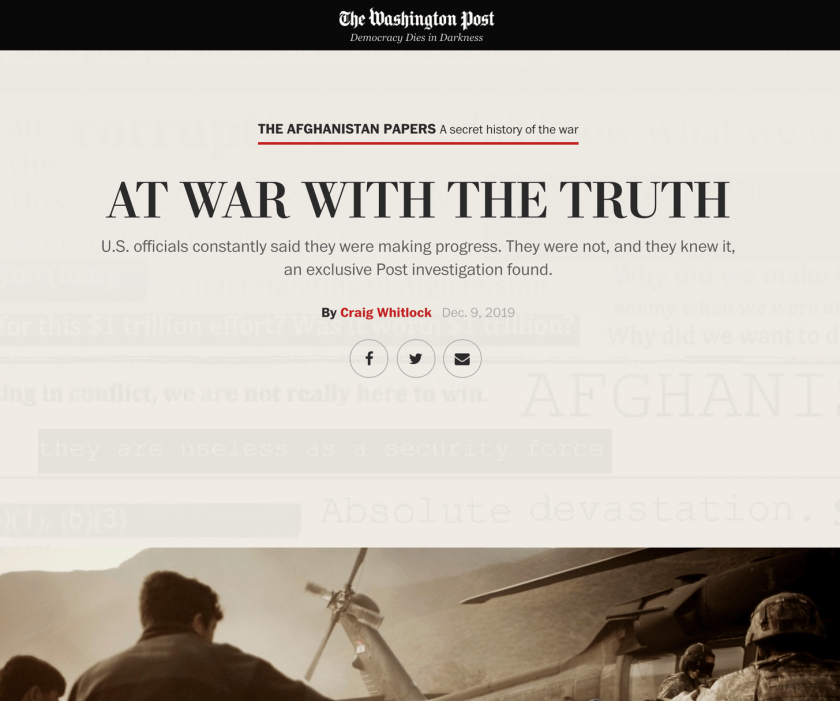
The pattern of lying was virtually identical throughout several administrations when it came to Afghanistan. In 2019, The Washington Post — obviously with a nod to the Pentagon Papers — published a report about secret documents it dubbed “The Afghanistan Papers: A secret history of the war.” Under the headline “AT WAR WITH THE TRUTH,” The Post summarized its findings: “U.S. officials constantly said they were making progress. They were not, and they knew it, an exclusive Post investigation found.” They explained:
Year after year, U.S. generals have said in public they are making steady progress on the central plank of their strategy: to train a robust Afghan army and national police force that can defend the country without foreign help.
In the Lessons Learned interviews, however, U.S. military trainers described the Afghan security forces as incompetent, unmotivated and rife with deserters. They also accused Afghan commanders of pocketing salaries — paid by U.S. taxpayers — for tens of thousands of “ghost soldiers.”
None expressed confidence that the Afghan army and police could ever fend off, much less defeat, the Taliban on their own. More than 60,000 members of Afghan security forces have been killed, a casualty rate that U.S. commanders have called unsustainable.
As the Post explained, “the documents contradict a long chorus of public statements from U.S. presidents, military commanders and diplomats who assured Americans year after year that they were making progress in Afghanistan and the war was worth fighting.” Those documents dispel any doubt about whether these falsehoods were intentional:
Several of those interviewed described explicit and sustained efforts by the U.S. government to deliberately mislead the public. They said it was common at military headquarters in Kabul — and at the White House — to distort statistics to make it appear the United States was winning the war when that was not the case.
“Every data point was altered to present the best picture possible,” Bob Crowley, an Army colonel who served as a senior counterinsurgency adviser to U.S. military commanders in 2013 and 2014, told government interviewers. “Surveys, for instance, were totally unreliable but reinforced that everything we were doing was right and we became a self-licking ice cream cone.”
John Sopko, the head of the federal agency that conducted the interviews, acknowledged to The Post that the documents show “the American people have constantly been lied to.”
Last month, the independent journalist Michael Tracey, writing at Substack, interviewed a U.S. veteran of the war in Afghanistan. The former soldier, whose job was to work in training programs for the Afghan police and also participated in training briefings for the Afghan military, described in detail why the program to train Afghan security forces was such an obvious failure and even a farce. “I don’t think I could overstate that this was a system just basically designed for funneling money and wasting or losing equipment,” he said. In sum, “as far as the US military presence there — I just viewed it as a big money funneling operation”: an endless money pit for U.S. security contractors and Afghan warlords, all of whom knew that no real progress was being made, just sucking up as much U.S. taxpayer money as they could before the inevitable withdraw and takeover by the Taliban.
In light of all this, it is simply inconceivable that Biden’s false statements last month about the readiness of the Afghan military and police force were anything but intentional. That is particularly true given how heavily the U.S. had Afghanistan under every conceivable kind of electronic surveillance for more than a decade. A significant portion of the archive provided to me by Edward Snowden detailed the extensive surveillance the NSA had imposed on all of Afghanistan. In accordance with the guidelines he required, we never published most of those documents about U.S. surveillance in Afghanistan on the ground that it could endanger people without adding to the public interest, but some of the reporting gave a glimpse into just how comprehensively monitored the country was by U.S. security services.
In 2014, I reported along with Laura Poitras and another journalist that the NSA had developed the capacity, under the codenamed SOMALGET, that empowered them to be “secretly intercepting, recording, and archiving the audio of virtually every cell phone conversation” in at least five countries. At any time, they could listen to the stored conversations of any calls conducted by cell phone throughout the entire country. Though we published the names of four countries in which the program had been implemented, we withheld, after extensive internal debate at The Intercept, the identity of the fifth — Afghanistan — because the NSA had convinced some editors that publishing it would enable the Taliban to know where the program was located and it could endanger the lives of the military and private-sector employees working on it (in general, at Snowden’s request, we withheld publication of documents about NSA activities in active war zones unless they revealed illegality or other deceit). But WikiLeaks subsequently revealed, accurately, that the one country whose identity we withheld where this program was implemented was Afghanistan.
There was virtually nothing that could happen in Afghanistan without the U.S. intelligence community’s knowledge. There is simply no way that they got everything so completely wrong while innocently and sincerely trying to tell Americans the truth about what was happening there.
In sum, U.S. political and military leaders have been lying to the American public for two decades about the prospects for success in Afghanistan generally, and the strength and capacity of the Afghan security forces in particular — up through five weeks ago when Biden angrily dismissed the notion that U.S. withdrawal would result in a quick and complete Taliban takeover. Numerous documents, largely ignored by the public, proved that U.S. officials knew what they were saying was false — just as happened so many times in prior wars — and even deliberately doctored information to enable their lies.
Any residual doubt about the falsity of those two decades of optimistic claims has been obliterated by the easy and lightning-fast blitzkrieg whereby the Taliban took back control of Afghanistan as if the vaunted Afghan military did not even exist, as if it were August, 2001 all over again. It is vital not just to take note of how easily and frequently U.S. leaders lie to the public about its wars once those lies are revealed at the end of those wars, but also to remember this vital lesson the next time U.S. leaders propose a new war using the same tactics of manipulation, lies, and deceit.
Taliban seek peaceful transfer of power in ‘next few days’: Spokesman
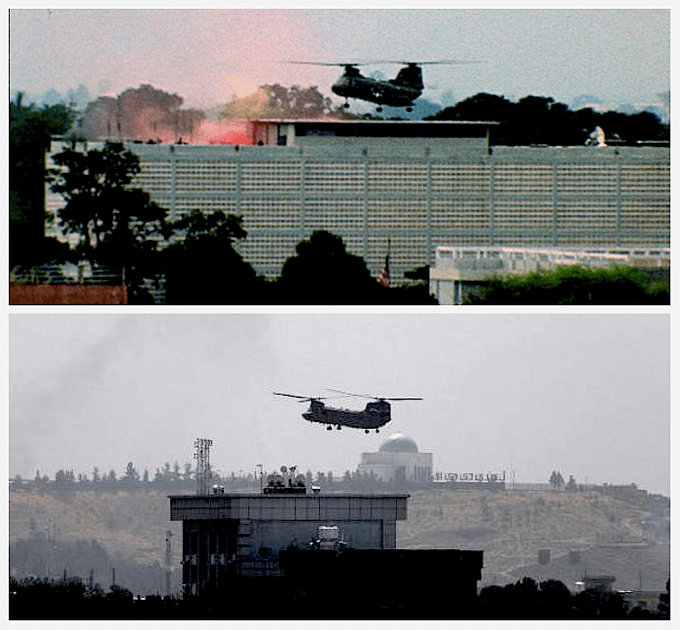
A US military helicopter is pictured flying above the US embassy in Kabul on August 15, 2021. (Photo by AFP) Top photo – Saigon, 1975.
Press TV – August 15, 2021
A Taliban spokesman says the group expects a “peaceful transition of power” in the next few days after the militants entered Afghanistan’s capital Kabul with little resistance amid evacuation of US diplomats from its embassy by helicopter.
“We are awaiting a peaceful transfer of power” as soon as possible, Suhail Shaheen said in an interview with BBC on Sunday, adding the Taliban expected that to happen in a matter of days.
The spokesman added that the group is in talks with the Afghan government “for a peaceful surrender” of Kabul, calling on President Ashraf Ghani and other leaders of Afghanistan “to work with us.”
He emphasized that the group would protect the rights of women, who “will be allowed to leave homes alone,” as well as freedoms for media workers and diplomats.
Shaheen said media would be allowed to criticize anyone but should not indulge in character assassination.
“We assure the [Afghan] people, particularly in the city of Kabul, that their properties, their lives are safe,” the Taliban spokesman said.
He added that the group seeks to establish an inclusive Afghan government in which all Afghans will be represented.
The spokesman said the Taliban have no intension of taking revenge on anyone, adding that all those who have served the government and military will be forgiven.

The Taliban capture Afghanistan’s key eastern city of Jalalabad
The Taliban spokesman called on Afghan civilians to stay in their country and do not leave due to fear.
Meanwhile, Mohammad Naeem, a spokesman for the Taliban’s political bureau, rejected as “mere rumor” reports that Mullah Abdul Ghani Baradar, the political chief of Taliban, has travelled to Kabul, saying he is in the Qatari capital city of Doha.
Afghan state sources denied reports about the presence of a Taliban delegation in the presidential palace.
Afghan President Ghani leaves country for Tajikistan: Interior ministry official
Later on Sunday, a senior official at Afghanistan’s Interior Ministry said the country’s President Ashraf Ghani has left the capital Kabul for the neighboring Tajikistan.
Asked for comment, the president’s office said it “cannot say anything about Ashraf Ghani’s movement for security reasons.”
A top Afghan foreign ministry official said separately that Ghani had left Afghanistan, but that it was not clear which country he was heading for.
Afghanistan’s top peace negotiator, Abdullah Abdullah, also confirmed Ghani’s exit from the country, saying in a video posted on his Facebook page, “”The former Afghan president has left the nation.”
Abdullah blamed President Ghani for the current situation in the war-ravaged country.
The new revelation came as a representative of the Taliban said the group was checking on Ghani’s whereabouts.
Taliban forces ordered to enter Kabul to prevent looting after police desert posts
The Taliban spokesman released a statement on Sunday afternoon, saying that the group has ordered its forces to enter the Afghan capital Kabul to prevent looting after local police deserted their posts.
The statement by Zabihullah Mujahid came shortly after it was announced that President Ashraf Ghani had left the country.
Kabul handover will be peaceful: Afghan acting interior minister
In a related development, Afghan acting Interior Minister Abdul Sattar Mirzakwal also said on Sunday that the “power will be peacefully transferred to a transitional government.”
“It is agreed that power will be transferred in a peaceful manner to a transitional administration,” Mirzakwal said in a televised message broadcast in local media.
“People should not worry about the safety and security in Kabul. The security of the city has been guaranteed. There will be no attack on the city,” he added.
The official emphasized that the big city of Kabul and the power will be handed over to a temporary third party and called on the people not to be “victim” of Taliban propaganda.
Russia: No plan to evacuate Kabul embassy
Meanwhile, Russia announced on Sunday that it does not plan to evacuate its embassy in Kabul as Taliban fighters reached the outskirts of the Afghan capital, a Russian Foreign Ministry official, Zamir Kabulov, told Russian news agencies.
“No evacuation is planned,” Kabulov said, adding that he was “in direct contact” with Moscow’s ambassador in Kabul and that Russian embassy employees continued to work “calmly,” AFP reported.
According to the RIA Novosti agency, Kabulov also said that Russia is among countries that have received assurances from the Taliban that their embassies would be safe.
“We received these guarantees a while ago. It was not only about Russia,” RIA Novosti quoted Kabulov as saying.
“The situation in Kabul is a bit tense, but there is no war in the city,” a spokesman for the Russian embassy in Kabul was quoted by TASS news agency as saying.
The spokesman was also cited by the Interfax news agency as saying that Moscow is ready to cooperate with Afghanistan’s interim government, adding that Russia is taking part in political contacts in Afghanistan.
TASS also quoted a Taliban official as saying, “We have good relations with Russia and our policy, in general, is to ensure safe conditions for operations of the Russian and other embassies.”
The Russian Foreign Ministry, however, was quoted by RIA state news agency as saying that Moscow does not yet recognize the Taliban militants as Afghanistan’s new lawful authority.
The ministry also told RIA that Afghanistan’s President Ashraf Ghani was unlikely to head to Russia after leaving his country.
Afghan delegation to meet Taliban in Qatar on Sunday
An Afghanistan peace negotiator said later on Sunday that a delegation representing the Afghan government, including senior official Abdullah Abdullah, will travel to Qatar the same day to meet with representatives of the Taliban.
Fawzi Koofi, a member of the Kabul negotiating team, confirmed to Reuters the delegation would meet with the Taliban in the Persian Gulf state after the militant group earlier entered Kabul.
A source familiar with the matter told Reuters the Afghan delegation and Taliban representatives would discuss a transition of power, adding that US officials would also be involved.
Pope voices ‘concern’ over Afghanistan, calls for ‘dialogue’
In a related development, Pope Francis expressed his “concern” Sunday over the conflict in Afghanistan, calling for dialogue so that the “battered population” can live in peace.
“I join in the unanimous concern for the situation in Afghanistan,” the pontiff said during the weekly Angelus at the Vatican, Reuters reported.
“I ask all of you to pray with me to the God of peace so that the clamor of weapons might cease and solutions can be found at the table of dialogue.
“Only thus can the battered population of that country – men, women, elderly and children – return to their own homes, and live in peace and security, in total mutual respect.”
Political solution in Afghanistan ‘more urgent than ever’: NATO
Meanwhile, the North Atlantic Treaty Organization (NATO) military alliance said on Sunday that finding a political solution to Afghanistan conflict was more pressing “than ever” as the Taliban stood poised to take power on the outskirts of Kabul.
“We support Afghan efforts to find a political solution to the conflict, which is now more urgent than ever,” an official at the 30-nation alliance told AFP.
The official said “NATO is constantly assessing developments in Afghanistan,” adding, “We are helping to maintain operations at Kabul airport to keep Afghanistan connected with the world.”
“We also maintain our diplomatic presence in Kabul. The security of our personnel is paramount, and we continue to adjust as necessary,” the NATO official added.
Taliban show off US-made war spoils in Kandahar
The Taliban released footage showing captured US-made Afghan military helicopters at the key Kandahar airport in southern Afghanistan, which has until recently one of the most important US bases in the country.
The militants have been quick to show off their war spoils in the city, which is generally considered as their spiritual birthplace.
The Taliban posted footage on their social media accounts on Saturday, showing a militant walking around a US-made Black Hawk military helicopter, which is in brown-green camouflage with Afghan Air Force markings, purportedly at a Kandahar airport hangar.
He then walked out and another Black Hawk was seen in the distance on the tarmac.
The Black Hawk inside the hangar was seemingly in storage, with a black sheet covering its windshield and its left engine apparently missing.
Two Russian military helicopters are also seen as another person is heard saying “Mashallah” — an Islamic term of praise. However, it was not clear if any of the helicopters were airworthy.
The helicopters outside the hangar were missing their blades, with a sheet covering the front of one airframe.
It is heard that one of the militants is claiming there are five military helicopters at the airport and several jets.
Washington supplied much of that hardware to the Afghan military, to the tune of $88 billion since 2002.
An Afghan government official confirmed on Friday that Kandahar, the most important city in the south, was under the control of the Taliban as foreign occupying forces complete their withdrawal.
Taliban capture 6th provincial capital weeks after rejecting reports of a ceasefire, amid US withdrawal
RT | August 9, 2021
The Taliban have seized control of its sixth provincial capital in Afghanistan within a matter of days, according to a spokesperson for the group, as the militants continue to secure territory after America’s military withdrawal.
The military victory for the Taliban was confirmed by the deputy governor of Samangan Province, home to the city of Aibak. Speaking to AFP, Afghanistan official Sefatullah Samangani declared that “the Taliban have captured the city of Aibak and have complete control over it.”
The Taliban formally took control of the city on Monday, after a “senator surrendered” and asked Afghanistan to withdraw its forces from the area to avoid further conflict.
Taliban spokesperson Zabihullah Mujahid declared on Twitter that the city center was completely under its control, while the governor, the police chief, the intelligence department, and all its affiliates were cleared.
The capture of Aibak comes days after Taliban militants seized control of the provincial capital of Sar-e Pul and the region’s fifth-largest city. All major government buildings in the two locations have been secured by Taliban fighters, although Afghan soldiers were reportedly trying to retain control of the Kunduz airport.
The continued military advance of the Taliban throughout Afghanistan follows the group’s rejection of reports that a ceasefire deal had been reached with the country’s government in return for the release of 7,000 prisoners.
Since America’s withdrawal from the region earlier this year, the Taliban claims to have secured 85% of the territory in Afghanistan. Afghan officials dispute this figure, however, claiming it has been exaggerated by the group.
Taliban overruns most of Kunduz as Afghan military clings to strategic city’s airport – reports
RT | August 8, 2021
Taliban militants have captured another provincial capital, Sar-e Pul, and most of the fifth-largest city of Kunduz, according to local officials. Afghan special forces have been deployed in a bid to re-take the latter.
The militants seized all the key government buildings in the two cities overnight, pushing the government troops to military installations on their outskirts. The troops are currently clinging onto the airport in Kunduz, in the north of the country.
“Heavy clashes started yesterday afternoon. All government headquarters are in the control of the Taliban. Only the army base and the airport is with ANDSF [Afghan security forces] from where they are resisting the Taliban,” provincial lawmaker Amruddin Wali told Reuters.
Footage circulating online shows the militants roaming the city streets en masse, with the group’s flags hoisted on multiple military vehicles.
Kunduz’s market was destroyed in the fighting, with disturbing footage purporting to show the whole location on fire. It was not immediately clear how exactly the market was obliterated, with some reports suggesting it was targeted by American warplanes supporting the Afghan troops. On Saturday, the US military launched airstrikes against the Taliban in a bid to halt its offensive, sending in B-52 Stratofortress strategic bombers and AC-130 Spectre gunships.
Although the Taliban claimed it was in full control of Kunduz, the government said it had re-deployed special forces units to the city and was trying to push back the militants. A short video released by Afghan military spokesperson Fawad Aman shows special forces troops advancing through the streets, firing at unseen adversaries.
The situation in the northwestern city of Sar-e Pul appears to be similar to that in Kunduz. Its key locations have been overrun by the militants, with government forces retreating to a military base on its fringes.
“Government headquarters, including the governor’s house, police command, and the National Directorate of Security compound, are captured by the Taliban,” Mohammad Noor Rahmani, a Sar-e Pul provincial council member, told Reuters.
Over the past few days, the Taliban has put the government troops under heavy pressure, apparently switching the focus of its offensive from rural areas to major cities. Two provincial capitals, Zaranj in the southwest and Sheberghan in the north, have already fallen into the hands of the militant group.
Taliban takes first provincial capital in Afghanistan as city of Zaranj falls into group’s hands
RT | August 6, 2021
Taliban insurgents have captured the city of Zaranj, the capital of Afghanistan’s southwestern Nimroz province. The city is the first provincial capital to fall amid the ongoing Taliban offensive against government troops.
The militants entered the city on Friday afternoon, according to media reports corroborated by footage circulating online. The development was confirmed to Reuters by Nimroz’s police spokesperson, with the official, who remained anonymous for security reasons, blaming the fall of the city on a lack of reinforcements from Afghanistan’s central government.
Footage shared online purports to show Taliban militants entering the city en-masse, on foot as well as riding atop a column of captured government armored vehicles.
The militants reportedly also broke into a local prison, freeing inmates from the facility.
The city apparently fell into hands of the Taliban largely without fighting, imagery from the scene suggests. It was not immediately clear whether the local security forces fled or defected to the Taliban.
In recent weeks, the resurgent group has launched a fresh major offensive against government forces, capturing large swaths of territory and establishing control over multiple border crossings.
The Islamist militants have also put pressure on several provincial capitals, including such major cities as Kandahar in the south and Herat in the west. Before the capture of Zaranj, however, the Taliban’s territorial gains primarily occurred in sparsely-populated rural areas.
Why Americans No Longer Trust the Biden Administration
By Ron Paul | August 2, 2021
For libertarians – and even many non-libertarians – it’s not shocking to discover that a US Administration lies and deceives the electorate. For government on all levels, lying to the American people is as American as apple pie. Sometimes the liars are held to account for their deception, but most often they are not.
Watching these early months of the Biden Administration it’s hard not to think that lying, deceiving, and manipulation is rising to a whole new level.
Take “ending the endless war” in Afghanistan. President Biden was cheered for achieving what even Donald Trump could not deliver: an end to the pointless 20 year – and several trillion dollar – war in Afghanistan. By the 20th anniversary of 9/11, we were told, the war would be over.
The only people furious about this decision were the bombmakers at Raytheon and the rest of the military-industrial complex and the laptop warriors in the Beltway think tanks. It turns out, they really didn’t need to worry.
The US is not finally leaving the Afghan people alone to run their country as they see fit. Just this week, Gen. Frank McKenzie, head of US Central Command (CENTCOM) announced that the US is increasing – not ending – its airstrikes on Afghanistan. The US would be pulling regular military troops out of the country (though likely keeping CIA, Special Forces, and mercenaries on the ground), but it would continue to bomb Afghanistan using “over the horizon” facilities from the Persian Gulf.
I’m sure that makes Afghan victims of US bombs feel much better.
Then last week Biden announced an “end of the US combat mission” in Iraq by the end of the year. While we’ve heard that line before, still it seemed like good news. However, as usual, the devil was in the details. While the “mission” was over, the US troops would remain in-country in an “advisory role.” This is despite the fact that the Iraqi Parliament formally requested last year that US troops leave the country.
Biden has bombed anti-ISIS militias supported by the Iraqi government twice this year (so far).
The 900 US troops illegally occupying Syrian territory would also remain in-country, the Biden Administration announced last week.
Also, just over a week ago President Biden told us that if we got the vaccine we would not get Covid. Then a few days later his own CDC released data from a Massachusetts study showing that 78 percent of the people who caught Covid were fully vaccinated. Is it any wonder Americans have lost all faith in “the science” as it pours forth from the politicized “scientists” in charge of US public health institutions?
The US mainstream media has morphed into a de-facto arm of the Biden Administration, however, covering up for all of these lies and word-games and holding precisely no one in government accountable. So much for a free media acting as a check on government power.
In fact, any “enemy” country overseas with such a subservient press would be targeted for a State Department color revolution.
Governments lie. We understand that. It is the nature of politics and power. In the absence of independent institutions to hold government accountable, however, such lies become indistinguishable from facts, and soon “freedom” itself becomes slavery, as Orwell wrote. Let’s hope more of America wakes up soon.
Copyright © 2021 by RonPaul Institute
US Used Military Bases in Afghanistan to Keep Watch on Entire Region, Russian Diplomat Says
Sputnik – 22.07.2021
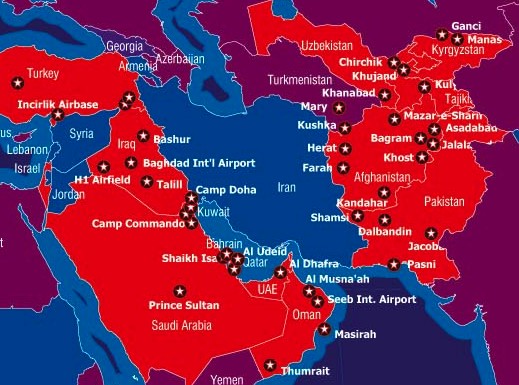
MOSCOW – Russia’s special presidential envoy for Afghanistan, Zamir Kabulov, said on Thursday that nearly half of the US military bases in Afghanistan were used to keep strategic tabs on the wider region.
“Of the 19 [US bases] that we know of, somewhat about seven or eight had nothing to do with Afghanistan and had nothing to do with the situation there”, Kabulov told the Echo of Moscow radio station.
The diplomat emphasised that the American contingents were conveniently placed in Afghanistan to be closer to the Middle East, Russia, Central Asia and China.
“[The US military] kept an eye on the Pakistani and Indian nuclear arsenal”, Kabulov added.
The United States and NATO began pulling their ground forces out of Afghanistan on 1 May. The withdrawal resulted in a flare-up of tensions between the government forces and the Taliban. The radical movement stepped up the territorial advances and is believed to have captured large rural areas in the country’s north.
Whither Afghanistan? Getting Out Is Harder Than Getting In
By Philip Giraldi | Strategic Culture Foundation | July 22, 2021
The inability of the United States to comprehend what it was becoming involved in when, in the wake of 9/11, it declared a Global War on Terror, has to be reckoned one of the singular failures of national security policy over the past twenty years. Not only did the wars in Afghanistan and Iraq make bad situations worse, but the fact that no one is Washington was able to define “victory” and think in terms of an exit strategy has meant that the wars and instability are still with us. In their wake has been hundreds of thousands of deaths and trillions of dollars spent to accomplish absolutely nothing.
As a result, Iraq is unstable and leans more heavily towards America’s adversary Iran than it does to Washington. The Iraqi Parliament has, in fact, asked U.S. forces to leave the country, a request that has been ignored both by Donald Trump and Joe Biden. Trump actually threatened to freeze Iraqi bank assets to pressure the Iraqis into accepting the continued U.S. occupation. At the same time, American troops illegally present in neighboring Syria, continue to occupy that country’s oil fields to deprive the government in Damascus of much needed resources. Neither Iraq nor Syria threatens the United States in any way.
Given that history, it should be no surprise that the withdrawal from the twenty year-long nation building project in Afghanistan, long overdue, is not quite going as smoothly as the Pentagon and White House apparently planned. U.S. forces pulled out of their principal base in the country, Bagram Air Base, in the middle of the night without informing the incoming Afghan base commander. A frenzy of looting of the left behind equipment followed.
The Taliban are racking up victory after victory against U.S. and NATO trained Afghan government forces who have the disadvantage of having to defend everywhere, making them vulnerable to attacks on an opportunity basis. The Taliban now plausibly claim to control 85% of the countryside, to include crossing points into Pakistan and several important towns and provinces. They recently shocked observers by executing 22 Afghan Army commandos who had run out of ammunition and surrendered. The U.S. government is quietly expecting a similar fate for the thousands of Afghans who collaborated with the regime installed by Washington and is hurriedly arranging for visas to get the most vulnerable out, eventually seeking to resettle them in friendly Middle Eastern countries as well as in the U.S..
By one estimate as many as 18,000 Afghans worked for U.S. forces and they also have families that will have to go with them. There is particular concern that former interpreters, who would have been privy to decision making by Washington, will be most particularly targeted. The Biden White House has responded finally to the urgency of the issue – lives are at stake – by approving special flights to remove the most vulnerable to a third country for processing before determining if they can be allowed to take up residence in the United States or elsewhere.
To be sure, the struggle to rid the world of the wrong kind of terrorists has left the United States weaker and more unfocused than it was in 2001. China, Russia and Iran are already maneuvering to fill the impending power vacuum in Central Asia by coming to terms with the likely Taliban takeover, which might come sooner than Joe Biden expects. If some kind of Afghan coalition government does emerge, it will belong to Russia and China, not the U.S..
Meanwhile, the U.S. military itself, under the Biden Administration, is weaker and more riven by controversy than ever before. A recent 23-page report suggests that since Defense Secretary Lloyd Austin’s February order to “stand down” the entire U.S. military for commanders to address “extremism” in its ranks morale has sunk and many top soldiers have either retired or quit in disgust. During his confirmation hearings, Austin pledged that he would “rid our ranks of racists and extremists” but the reality is quite different, with the witch hunt in the ranks and endless promotion of diversity even hurting normal military readiness training.
By next month the U.S. military presence in Afghanistan will be reduced to a battalion of infantry to guard the Embassy and CIA station in Kabul, which is itself not sustainable unless some kind of workable Afghan government coalition can be achieved. Given the recent Taliban successes, that outcome appears to be increasingly unlikely. Maintaining the Embassy will also require a viable lifeline to the city’s airport and talks are underway with Turkey to determine if Ankara will be willing to base a stay behind battalion to maintain the air link. The Taliban have already announced that a Turkish presence at the airport will be unacceptable and warned Turkey that there would be revenge attacks against any remaining NATO troops after the U.S. pulls out. Their spokesman issued a statement declaring that “The continuation of Turkey’s occupation will provoke feelings of hatred and enmity in our country towards Turkish officials, and will harm bilateral relations.”
The U.S. is also seeking an over the horizon offensive capability once the military has formally left Afghanistan. The intention would be to be able to strike targets in Afghanistan if a new government forms any alliances with terrorist groups that potentially threaten the United States, as unlikely as that might be. At the present time, there are few options as the U.S. would not be able to launch cruise missile or airstrikes through the neighboring countries that surround Afghanistan to the south, east and west, though a long-distance strike from warships in the Persian Gulf is technically possible.
To the north there are, however, former Soviet central Asian states, the so-called “‘Stans,” that might be suitable for hosting some arrangement to base American equipment, aircraft and a caretaker force. Tajikistan, Kazakhstan, or Uzbekistan might be amenable to such a development, but both Tajikistan and Kazakhstan are members of the Russian-led Collective Security Treaty Organization (CSTO). On Monday, Russian Foreign Minister Sergey Lavrov said that any U.S. presence in a CSTO country would need the approval of the alliance, which the Kremlin will veto. One might suggest that there is mistrust about the reliability of Joe Biden and company as a strategic partner, even though there is widespread concern that Afghanistan might become a rogue state. Nevertheless, Washington’s bullying in Iraq, Syria and also against Iran has failed to convince anyone that the U.S. Air Force would make a good neighbor.
So getting out of Afghanistan will be a lot trickier than going in. The U.S. clearly wants to have some ability to intervene using air resources if the Taliban take over and misbehave, but that just might be a fantasy as the door is closing on options while China is waiting for its own door to open to bring the Afghans into their New Silk Road. And there is no escaping the fact that the entire Afghan adventure was one hell of a waste of lives and resources. Next time, maybe Washington will hesitate to charge in, but given the lack of any deep thinking going on in the White House, I suspect we Americans could easily find ourselves in yet another Afghanistan.
Taliban Claim Control of Some 90% of Afghanistan’s Border Areas
Sputnik – 22.07.2021
The Taliban controls approximately 90% of Afghanistan’s border with neighbouring countries, Zabiullah Mujahid, the movement’s spokesman, told Sputnik on Thursday.
“The borders of Afghanistan with Tajikistan, Uzbekistan, Turkmenistan, Iran — about 90% of the borders are under our control … The border with Turkmenistan and the border with Iran are completely under our control. The borders of Pakistan (with the exception of a few small sections) are also under our control”, Mujahid said.
The statement comes after Moscow noted earlier in the day that the hasty US withdrawal from Afghanistan had resulted in a major shift, with the Taliban taking almost complete control of the Tajik border.
The war-torn nation has been witnessing major clashes between the Taliban movement and government forces in recent months. The militants gained momentum as American troops started pulling out on 1 May, in accordance with an agreement that the Taliban and the United States struck in Doha in February 2020.
According to the Taliban, its forces are now in control of nearly 85 percent of Afghanistan.
Featured Video
Seyed M. Marandi: US-Iran War Inevitable: Kuwait and Bahrain May Fall
or go to
Aletho News Archives – Video-Images
From the Archives
Oil and the Israel Lobby
Reknowned economist M. Shahid Alam offers this excellent critique of Noam Chomsky’s defective analysis of the relative influence of Oil versus the Israel lobby over US foreign policy: … continue
Blog Roll
 Aletho News
- ICC ignored ‘very well-documented’ NATO crimes – ex-Libyan minister
- SNSC secretary dismisses US response to Iran’s conditions as ‘inadequate’
- Sanaa says Taiz roads open, secure for residents, warns Saudi forces
- Iraqi resistance group urges Saudi leadership to admit defeat, lift Yemen siege
- Trump’s Retreat: How Al-Aqsa Flood Took Down the US Empire
- Israel’s Military Actions in Lebanon Grossly Violate International Law — Lavrov
- Seyed M. Marandi: US-Iran War Inevitable: Kuwait and Bahrain May Fall
- Leaders Condemn Ansarallah Attack on Saudi Arabia While Ignoring Illegal War Against Yemen
- Leaked: Britain’s Covert Iraqi Psyops Network
- Yemeni Armed Forces Warn Airlines Against Using Saudi Airports, Exempt Mecca and Medina
- If Americans Knew
- After Oct 7, IDF policy allowed civilian casualties for even the lowest-ranking targets
- Israel’s Destruction of Southern Lebanon Intensified After the Cease-Fire
- The Last-Minute Decision That Gave Israel Its Name
- The American Conservative: How Trump Made the World Go Nuclear
- Meet the US generals and admirals advancing Israeli policy
- Opinion: Why news organizations should boycott Israel
- The Israeli witch hunt of Sami Abu Shehadeh exposes the lie of the ‘Jewish and democratic’ state
- No state has a ‘right’ to exist – least of all Israel
- Testimonies about Gaza’s civilian death toll expose Israel’s atrocities – Daily Update
- How Israel Conquered the Latin American Right
- No Tricks Zone
- New Study Suggests Large Regions Of The Pacific Ocean Have Been Cooling For The Last 80 Years
- Germany’s Green Energy Debacle: High Energy Costs Force Kahla Porzellan to Close After 182 Years!
- New Study: 50 Years Of The Most Aggressive ‘Net Zero’ Policies Can Only Affect The Global Climate By 0.03°C
- US September “Heat” Was No Record…Many Records Set Decades Ago
- Latest European Green Energy Debacle; Portugal’s Largest Flagship Solar Park Insolvent!
- Green Energy Debacle: German Expert Professor Fritz Vahrenholt Warns Of Severe Economic And Social Consequences
- Two More Paleo Reconstructions Affirm Meters-Higher Sea Levels Across Ireland, Brazil 7000-6000 Years Ago
- New Study: Earth And Venus Surface Warmth Largely Explained By Convection And Lapse Rate, Not CO2 Or Radiation
- 2025 Nature Paper Claiming Worsening Global Drought Gets RETRACTED …Heavily Flawed
- New Study: ‘Global Drought Shows No Detectable Recent Acceleration Under Climate Warming’

