The subject of Israeli hegemony over US must be addressed

By Walt Peretto | Press TV | December 25, 2020
It’s pardon season for President Trump. The likely outgoing president has issued 15 pardons that include two members of the Russian investigation and four convicted murderers who worked for the private security firm Blackwater.
These four were convicted of murdering 14 Iraqi civilians in 2007. Private security corporations such as Blackwater (since renamed Academi) have played a major role in war zones since the invasions of Afghanistan and Iraq after the false flag events of 9/11/2001. They are also suspected of participation in other domestic false flag events that include the Boston Marathon event in 2013.
These pardons by Trump will facilitate the use of private security firms in the near future both domestically and abroad. Further lockdowns in the US and crushing strains on small business may create unrest which could overwhelm municipal law enforcement and the federal government may choose to hire private security to deal with such occurrences. Overseas, tensions may increase in Syria as the new Democratic president may resurrect the goal of toppling President Assad which would likely be carried out by hiring private mercenaries which the West has done in the past.
I think these pardons by Trump send a signal to private security firms that their actions will not be hampered by long prison sentences for employees who engage in murder. Similar to municipal policing in which cops that murder are virtually never convicted. If the US does rededicate itself to regime change in Damascus, it’s hired security forces and clandestine paid terrorists don’t want restraints like convictions of murder in the courts.
Trump’s pardon of two people involved with the Russiagate fiasco makes sense since Russian collusion was never proven and the whole story was really a distraction for 4 years designed to take people’s eyes off of leaked emails involving Hillary Clinton, the Podesta brothers, Barack Obama and others that were quite damning if they were thoroughly investigated.
For four years the left-leaning media in the United States filled the news with accusations of Russian collusion in US elections and other illegal and immoral interactions between Russian officials and the Trump administration.
This also kept the eye off the elephant in the room called Israel which has seized control of the presidency, the Congress, the Judiciary, the economy through the FED, and the mainstream media.
China has provided another useful distraction from Israeli influence in America. If one honestly examines recent US presidential administrations — don’t strain to find any Chinese or Russian nationals in positions of power in the US federal government. Dual US/Israeli citizens are abundant and ubiquitous in the Trump administration and it will be similar in the Biden administration if he makes it to the White House. The subject of Israeli hegemony over the United States is a subject no one seems to want to address.
Judging from the proposed COVID Stimulus Package which allocates billions of dollars to other countries, this proves that the globalist intention is to bleed the United States dry until it submits wholly to the international cabal of psychopaths that includes Klaus Schwab and his World Economic Forum who are attempting to reset the world into a one-world system led by global organized psychopathy.
Congress moves to block US troop pullout from Afghanistan, Germany
Press TV | December 6, 2020
US President Donald Trump’s controversial move to pull out 2,000 American troops out of Afghanistan and 12,000 more from Germany would be blocked by the major defense policy bill, a report has said.
One provision of the National Defense Authorization Act (NDAA) for fiscal 2021 “would block funding for reducing the number of US troops in Afghanistan from 4,500 to 2,500 by January 15, as ordered by Trump, until the Defense and State Departments verify that it was in the national interest,” Military.com news outlet reported Saturday.
Another provision of the NDAA, it added, essentially urges the incoming Biden administration to take a second look at Trump’s executive order to withdraw 12,000 American troops from Germany.
According to the bill, troop levels in Germany should remain at 34,500 until 120 days after the secretary of defense submitted cost estimates and assessments of the impact of a withdrawal on allies and military families.
The final draft of the NDAA — released Thursday night — underlines that Afghanistan pullout orders, announced by the newly-appointed Acting Defense Secretary Christopher Miller on November 17, “gave Congress no estimate of the national security implications.”
According to the report, the Trump administration has so far failed to clarify how a troop withdrawal was “in the national security interests of the United States to deny terrorists safe haven in Afghanistan, protect the United States homeland.”
Trump’s announcement last June that he wanted 9,500 troops out of Germany after years of battling with NATO allies to spend more for defense has also drawn opposition from both ruling political parties in the US Congress.
On July 29, then-Defense Secretary Mark Esper declared plans to carry out Trump’s order that increased the number of US soldiers to be withdrawn from Germany to 12,000.
Some of those troops would return to the US, while others would be transferred to Poland and the Baltic states in a shift eastward to enhance NATO’s purported deterrence against Russia, Esper claimed at the time.
The report further pointed out that the NDAA provision on Germany “means that final decisions on a troop withdrawal could go to Michele Flournoy, a former undersecretary of Defense for Policy who is considered a frontrunner for defense secretary in the Biden administration.”
Flournoy, the report added, has already stated that pulling thousands of troops out of Germany would likely cost more than leaving them in place. He also underlined in an Aspen Security Forum in August that “Our allies were completely surprised by this punitive troop withdrawal from Germany.”
Moreover, once Biden is inaugurated on January 20, he would have the authority to issue his own executive order reversing Trump’s withdrawal mandate.
Acting US Def Sec Miller Formally Announces Plans to Cut Troops in Afghanistan, Iraq to 2,500 Each
By Daria Bedenko – Sputnik – 17.11.2020
Earlier on Monday, CNN reported, citing two US officials, that Pentagon anticipated President Donald Trump to issue an order this week regarding troop withdrawal from Iraq and Afghanistan by 15 January.
Acting Defence Secretary Christopher Miller announced on Tuesday that President Trump will cut the number of American troops in Iraq and Afghanistan to 2,500 each by 15 January 2021.
“By 15 January, 2021, our forces, their size in Afghanistan will be 2,500 troops. Our force size in Iraq will also be 2,500 by that same day,” Miller told reporters during a Defence Department briefing.
The decision falls in line with Trump’s intention to finish “endless wars”, as Miller said the moves were announced to “bring the wars in Afghanistan and Iraq to a successful and responsible conclusion and to bring our brave service members home”.
“This is consistent with our established plans and strategic objectives, supported by the American people, and does not equate to a change in US policy or objectives”, Miller outlined.
Reaction to Troop Reduction Announcement
Shortly after the decision was announced, White House national security adviser Robert O’Brien said Trump hopes to bring all US troops from Iraq and Afghanistan home “safely and in their entirety” by May.
Republican Senate Majority Leader, Mitch McConnel, reacted to the announcement moments later, warning against any major changes in the US foreign or defence policy, including the troops drawdowns, in the coming months.
“It is extremely important here in the next couple of months not to have any earthshaking changes in regard to defense or for policy”, McConnell said.
Reports about the order to reduce troops in Afghanistan and Iraq emerged earlier on Monday, saying that a “warning order” to start planning the troops reduction was already released by Pentagon, despite warnings by then-Defence Secretary Esper against rapid withdrawal of the US forces from the countries.
Esper was replaced with Director of the National Counterterrorism Center Christopher Miller by Trump earlier this month.
Trump vs ‘Endless Wars’
It has been one of the key Trump’s pledges in his campaign to put an end to American “endless wars” in foreign countries, as he vowed to reduce the number of the US military forces in Iraq and Afghanistan.
In October, Trump tweeted that all US troops should be home by Christmas, with US National Security Adviser Robert O’Brien later saying that thousands of American servicemen were “on path” to, on the contrary, remain there.
In Iraq, there are estimated 3,000 US troops, and roughly 4,500 American military forces are stationed in Afghanistan.
After Washington reached a deal with the Taliban* in February, Trump began to withdraw troops from the country, with further withdrawal coinciding with September peace talks between the Taliban and the Afghan government in Qatar.
Pakistan Makes A Compelling Case That India Is A State Sponsor Of Terrorism
By Andrew Korybko | One World | November 15, 2020
This year’s Diwali celebration got off to a very symbolic start after Pakistan shined some light on the dark activities that it accused India of carrying out in the region. Islamabad released a detailed dossier during a press conference on Saturday strongly making the case that India is a state sponsor of terrorism whose intelligence services have weaponized this phenomenon as part of the proxy war that they’re fighting with respect to the UNSC-recognized international Kashmir dispute and against the China-Pakistan Economic Corridor (CPEC), the flagship project of Beijing’s Belt & Road Initiative (BRI). These claims aren’t anything new, but what’s novel is the amount of detail devoted to proving them this time around.
According to Pakistan, Indian diplomatic facilities in Afghanistan are being used to coordinate the training of various terrorist groups on that landlocked country’s territory, including efforts to unite relevant Baloch and Pashtun ones as well as create a new ISIS branch dedicated to attacking Pakistan. Islamabad mentioned names, dates, bank accounts, phone numbers, and other identifying information such as exposing the Indian mastermind of these regionally destabilizing activities to make its case that India is a rogue state whose behavior should be investigated by the international community, which might find it fitting to sanction the country through the Financial Action Task Force (FATF) and other related bodies.
Pakistan’s diplomatic masterstroke puts India in a very uncomfortable position because it had hitherto been the latter making such claims about the former and not the reverse. The comparatively muted reaction from the international community in the 24 hours since the dossier was revealed suggests that they feel uncomfortable about the accusations and aren’t too sure how to respond. India is a close military and economic partner of a growing number of influential players such as the US and “Israel” who might now be embarrassed for so closely associating with a country that’s been convincingly accused of such rogue behavior. At the same time, however, “birds of a feather flock together”, as they say.
For reasons of self-interest, it might turn out that the international community as a whole doesn’t react the same way to Pakistan’s accusations as they’ve done in the past whenever India made similar but much less detailed ones. Nevertheless, what’s most important to pay attention to is how these revelations might shape Chinese-Indian relations considering their clashes along the Line of Actual Control this summer and ongoing state of ever-intensifying cold war. The grand strategic interests of the People’s Republic are directly threatened by India’s Hybrid War of Terror on Pakistan, which aims to destabilize CPEC’s northern and southern access points in Gilgit-Baltistan and Balochistan respectively.
In fact, the timing of this dossier’s release might have been connected to those two countries’ rivalry. To explain, India was handily defeated by China during their clashes over the summer, which might be why it’s doubling down on its proxy war of terrorism against Pakistan in response. After all, Islamabad warned that New Delhi would soon seek to intensify its terrorist efforts in the coming future, so the dossier might have been intended to preemptively thwart that by exposing these plans in order to put pressure on India to reconsider its actions. Of course, it also took plenty of time to assemble all the details that were disclosed, but the timing was at least very convenient from the Pakistani perspective even if it was ultimately coincidental.
All told, the dossier heralds the advent of a new phase of Pakistani diplomacy where Islamabad confidently exposes India’s Hybrid War of Terror on the world stage. Since it can be assumed that China considers these claims credible considering the fact that its interests are directly threatened irrespective of the country’s public reaction (or potential lack thereof in line with its diplomatic traditions), the conclusion can thus far be made that this report already had a significant impact. It might very well end up being the case that Chinese-Indian relations will never return to their former friendliness, especially if Beijing begins to wonder whether Washington might be tacitly supporting New Delhi’s proxy war on CPEC.
Andrew Korybko is an American political analyst.
‘Coup’ preparation, or move to stop endless wars? What’s behind Trump’s Pentagon purge
By Nebojsa Malic | RT | November 11, 2020
Democrats and their allies are alarmed that President Donald Trump’s firing of top Pentagon officials could be preparation for a military coup. What looks more likely is that US troops might finally pull out from Afghanistan.
In addition to Defense Secretary Mark Esper, whom Trump “terminated” on Monday, Esper’s chief of staff Jennifer Stewart, acting policy chief James Anderson, and intelligence undersecretary Joseph Kernan have also been shown the door. They were replaced by National Security Council counter-terrorist chief Christopher Miller, former NSC aide Kash Patel, General Anthony Tata, and another former NSC aide Ezra Cohen-Watnick, respectively.
The purge and the appointment of the officials widely described in mainstream media as “Trump loyalists” has led to Democrats and neoconservatives warning that a “coup” might be in the works against Joe Biden, who has claimed victory in the November 3 election.
4. Who knows whether intentions are mostly petty, or domestic election interference, or unimpeded decisions in foreign policy (latter could range from military force to military withdrawals, and from pro-Putin to pro-MBS). But, I’m told, both Esper and Milley are truly worried.
— Bill Kristol (@BillKristol) November 11, 2020
Allowing for the possibility that Trump could just be acting out of spite against people who were disloyal to him, The Nation’s Michael Klare noted that Miller had been involved in covert operations in urban settings of Iraq and Afghanistan with US Special Forces.
Democrats should look for any evidence that the Pentagon purge “signals a covert White House plan to use the US military in support of an illegal drive to subvert democracy and install Trump as dictator,” Klare warned.
Wednesday’s appointment of retired Army Colonel Douglas Macgregor as Miller’s senior adviser, however, points in an entirely different direction. First reported by Axios, it was confirmed by the Pentagon later in the day, with a statement noting that Macgregor’s “decades of military experience will be used to assist in the continued implementation of the President’s national security priorities.”
While that sounds like properly vague Pentagonese, Macgregor is well known for his advocacy of a speedy US withdrawal from Afghanistan – something Trump said last month he wished to see by Christmas this year, ahead of the 2021 timeline envisioned in the peace agreement the US have struck with the Taliban.
The Intercept’s Lee Fang quoted an anonymous Pentagon official who basically confirmed that the Pentagon purge is aimed at overcoming resistance by career bureaucrats and the military-industrial complex to Trump’s policies.
Trump official claims the rapid personnel changes are designed to end the “forever wars” in Afghanistan, withdraw troops by Christmas, which many Pentagon leaders opposed. Others argue moves are designed only to award loyalty and punish dissent.
— Lee Fang (@lhfang) November 11, 2020
“The president is taking back control of DOD. It’s a rebirth of foreign policy. This is Trump foreign policy,” said the official.
“This is happening because the president feels that neoconservatism has failed the American people,” he added.
Trump campaigned in 2016 on ending the ‘endless wars’ in the Middle East. Within a few months, however, he allowed himself to be persuaded by the Pentagon to ramp them up instead, bombing Afghanistan and launching missiles at Syria. Once all the territory held by Islamic State (IS, formerly ISIS) terrorists was liberated, however, he pushed hard for withdrawal from Syria, Afghanistan and Iraq – running into resistance from the Pentagon.
His first Defense Secretary Jim Mattis resigned over Syria at the end of 2018. Most US troops there were withdrawn by October 2019. Some troops were also pulled out of Iraq this year, citing concerns over the coronavirus, though many still remain. A peace treaty with the Taliban was signed in February this year, after nearly 20 years of war that perfectly defined “mission creep.”
There is no denying that the present political situation in Washington, with Biden claiming he won the election and Trump disputing that citing irregularities in key states, is fraught with peril. Whatever the outcome, unless everything is handled above board and with transparency, half the country is going to feel cheated and disenfranchised.
There are two things to keep in mind, however. Whatever one thinks of him, Trump has kept his word, implementing his electoral promises – by working through the system – despite the obstacles thrown before him by the administrative apparatus, legislators and the courts. So far, the current flurry of activity at the Pentagon seems to point towards a withdrawal from the Middle East, rather than a coup at home.
Secondly, it was actually the Democrats – Joe Biden himself – who first brought up the notion of using the US military to forcibly remove Trump from the White House, should he lose but refuse to concede. That was in June, long before the election and its controversies. What did Biden know at the time to make him say that, nobody knows – because nobody in the mainstream US media has bothered to ask, preferring to entertain partisan fantasies based on conjecture instead.
Australia’s War Crimes and Culture of impunity
By Ramona Wadi | Strategic Culture Foundation | November 8, 2020
There is yet no reckoning for Australia’s SAS war crimes in Afghanistan, although details of horrendous atrocities are coming to light. A 2016 report detailing the extent of torture and extrajudicial killings by the Australian SAS forces in Afghanistan have been described as “fuelled by blood lust”, and compared on a scale to the infamous torture and murder practices at Abu Ghraib in Iraq.
The 2016 report which has recently been seen by two leading Australian news outlets, was compiled by sociologist Dr Samantha Crompvoets. Testimonies of war crimes, accompanied by the normalisation of such action and recurring impunity, have been characterised by a reliability in narration among different participants, pointing towards routine practices that escalated over time.
Notably, the report points towards an adulation of violence. The Australian special forces working alongside British and US counterparts held up the latter as the pinnacle of violence to emulate. However, the torture and killing of Afghan civilians by the Australian SAS is held on a par in terms of desensitisation and normalisation. A report earlier in March this year, which is based upon the witnessing of an execution of an Afghan man, states, “The visual image to me was, the guy had his hands up and then it was almost like target practice for that soldier.”
Human rights organisations in Australia and Afghanistan have called upon the Australian government to release the inquiry report into war crimes committed by the SAS, which commenced in 2016, in a manner which would hold the country accountable to upholding International Humanitarian Law. The open letter makes an important point that resonates even in relation to other countries subject to foreign intervention and impunity for the perpetrators. It states, “The Afghan people have remained trapped in an unbroken cycle of a 40 year long conflict which is profoundly rooted in a culture of impunity, with many actors operating in total disregard of local and international laws and norms in the firm belief that nobody will ever hold them accountable.”
Under the guise of foreign intervention and the democracy narrative which is used to sell war to the public, impunity for human rights violations is being cultivated. The lack of accountability is related to several processes, including policy, leadership failure, and dysfunctional communication between divisions; the latter amounting to secrecy that develops further possibilities for impunity.
One story featured in Australian media in March this year detailed the killing of an Afghan man who posed no threat to soldiers, and whose corpse was chewed upon by an assault dog. In another case captured on camera, another Afghan man, again posing no danger, is shot three times at point blank range – for no other reason than abuse of power, as indicated by the perpetrator.
Democracy and war crimes go hand in hand when it comes to foreign intervention and the bloody trail they leave behind. In an investigation by the Australian Defence Forces (ADF), the soldier who killed the Afghan man in a field was exonerated and is still serving in the Australian special forces; the narrative being that the victim had been seen with a radio, despite evidence to the contrary.
Such coverups are a regular occurrence which serve to perpetrate additional human rights violations. It is possible that the Australian government, as indicated by Defence Minister Linda Reynolds, will agree to publish parts of the report for “transparency” this month. The so-called War on Terror has unleashed a brand of state terror on targeted countries which so far has been met with an ingrained reticence from leaders to investigate accusations of war crimes. Between the bureaucratic delays of the International Criminal Court, and opposition to the institution by world leaders intent on saving the culture of impunity, there is little chance of implementing justice unless the international justice system is pressured to work against the globalisation of war.
‘Psychos’ fueled by ‘blood lust,’ Australian special forces tortured and executed prisoners in Afghanistan – report
RT | October 28, 2020
A disturbing new report blows the lid on the shameful conduct of Australian special forces soldiers in Afghanistan, accusing them of waging a campaign of torture and murder across the war-torn country, and hiding the evidence.
When Australia’s elite SAS soldiers would raid villages in Afghanistan, they brought terror and death with them, a report seen by Melbourne newspaper The Age alleges. The special forces “would take the men and boys to these guest houses and interrogate them, meaning tie them up and torture them,” the report states.
By the time the SAS units left, “the men and boys would be found dead, shot in the head, sometimes blindfolded and throats slit. These are corroborated accounts,” it continues, comparing the alleged war crimes to the My Lai massacre of the Vietnam War, and to the US’ mistreatment of detainees in Iraq’s Abu Ghraib prison.
The report was commissioned by then-Army chief Angus Campbell in 2016, and an upcoming Inspector-General report into war crimes by senior judge Paul Brereton has confirmed many of its findings, The Age claimed. Compiled by defense consultant Samantha Crompvoets, the report is based on interviews with soldiers and whistleblowers, who told Cormpvoets some grizzly tales of “competition killing and blood lust.”
In one instance, two “14-year-old boys suspected of being Taliban sympathisers had their throats slit … the bodies were bagged and thrown into a nearby river.” In others, unarmed Afghans were shot in the back as they ran away.
According to the report, war crimes allegations made by NGOs and SAS staff were quashed by the special forces leadership in Afghanistan. Soldiers involved in these crimes allegedly covered them up, and expected their comrades to keep quiet. Meanwhile, the perpetrators “gloated about” their killings.
“Soldiers would do bad stuff to fit in. It becomes part of the banter,” one witness recalled. Another stated: “guys just had this blood lust. Psychos. Absolute psychos. And we bred them.”
Despite the gruesome details revealed in the report, the Australian operators were envious of their British and American counterparts, one informant told Crompvoets.
“Whatever we do, though, I can tell you the Brits and the US are far, far worse. I’ve watched our young guys stand by and hero worship what they were doing, salivating at how the US were torturing people,” the informant said.
Crompvoets’ report alleges that the majority of crimes were committed by a small group of patrol commanders. Brereton’s inquiry found the same, The Age reported. The newspaper said that Brereton will make war crimes referrals to the Australian Federal Police for a number of these soldiers, charges that will be contested by the Department of Defence.
Australian troops have been deployed in Afghanistan since 2001, with combat operations ceasing in 2014. Around 150 Australian soldiers and civilian staff remain in the country in support and advisory roles.
US Military Evacuates Largest Base in Afghanistan

Al-Manar | October 13, 2020
The US forces started evacuating their largest base in Afghanistan, according to media reports which added that it lies to the north of the capital, Kabul.
An administrative official in the Afghan Senate said that the US forces began demolishing the buildings at Bagram air base and moving their equipment to Pakistan.
The Afghan Senate harshly criticized the US forces for demolishing the buildings, demanding that they hand over the military equipment in the base to the Afghani forces.
NATO refuses to commit to withdrawal from Afghanistan
Press TV – October 9, 2020
NATO has dismissed US President Donald Trump’s surprise announcement to pull out all of US forces from Afghanistan by the end of the year, saying that members of the military alliance will decide together on when to withdraw forces from the war-ravaged country.
Trump announced on Twitter on Wednesday that he was going to bring all US troops home from Afghanistan by Christmas.
NATO Secretary General Jens Stoltenberg reacted to the president’s remarks on Thursday, saying that the military alliance will end its mission in Afghanistan only when conditions on the ground permit.
“We decided to go into Afghanistan together, we will make decisions on future adjustments together, and when the time is right, we will leave together,” Stoltenberg said at a news conference.
NATO deployed forces to Afghanistan following the 2001 US-led invasion to topple the Taliban-run government, on the pretext of fighting terrorism following the September 11 attacks in New York.
Afghanistan has been gripped by insecurity since the US and its allies invaded the country as part of Washington’s so-called ‘war on terror’ 19 years ago. Many parts of the country remain plagued by militancy despite the presence of US-led foreign troops.
American forces have since remained bogged down in the country through the presidencies of George W. Bush, Barack Obama, and now, Donald Trump.
In an interview on Thursday Trump also said that US forces are “down to 4,000 troops in Afghanistan. I’ll have them home by the end of the year. They’re coming home, you know, as we speak. Nineteen years is enough.”
Analysts say Trump, trailing in polls just weeks ahead of the November 3 presidential election, made the withdrawal announcement to show he is making good on his 2016 promise to end “endless wars.”
Stoltenberg, however, said NATO would only leave Afghanistan when it could do so without the risk of the country once again becoming a haven for militants.
“We will make decisions based on the conditions on the ground, because we think it is extremely important to continue to be committed to the future of Afghanistan, because it is in our interest to preserve the long-term security of Afghanistan,” he added.
Trump’s announcement was, however, welcomed by the Afghan Taliban militant group on Thursday.
A spokesman for the group, Mohammad Naeem, described Trump’s announcement as “a positive step towards the implementation of [the] Doha agreement.”
In a deal reached between the US and the Taliban earlier this year in the Qatari capital, Doha, the United States promised to pull out all its troops by mid-2021 in return for the Taliban to stop their attacks on US-led occupation foreign forces in Afghanistan.
Some 4,500 American troops are currently on the ground in Afghanistan, reduced from over 12,000 when the deal was signed in February.
The Taliban also agreed to negotiate a permanent ceasefire and a power-sharing formula with the Afghan government.
The Afghan government and Taliban last month opened peace talks in Qatar, even as key differences, including over a ceasefire, remain between the two sides.
NATO’s recent refusal to commit to withdrawal, according to observers, puts the complicated peace negotiations in jeopardy at a time when Afghanistan continues to suffer from a series of attacks — claimed either by the Taliban or the Daesh terrorist group — which took dozens of civilians’ lives.
In the meantime, Daesh has also been securing a foothold in Afghanistan.
The US has been largely blamed for relocating remnants of the terrorist group to Afghanistan following their defeat in Iraq and Syria.
The US-led military alliance and NATO are also blamed for turning Afghanistan into one of the world’s main opium producers over the last two decades, as opium has become a source for terrorist financing in the war-ravaged country.
According to the United Nations, more than 80 percent of the world’s opium is produced in Afghanistan and that the bulk of narcotics produced in the country is destined for European states.
A high-ranking Iranian official said earlier this year that the production of narcotic drugs has seen a fifty-fold increase over a span of 17 years in Afghanistan.
Director general of the Iran Drug Control Headquarters, Eskandar Momeni, said American planes as well as those belonging to the US-led military alliance and NATO are engaged in transporting illicit drugs.
Iran, located at the crossroad of international drug smuggling from Afghanistan, has long been fighting armed drug smugglers in its eastern and southeastern borders. Thousands of Iranian security forces have lost their lives in the clashes.
Analysts believe Washington, which has repeatedly named Iran, Russia and China as its enemies, intends to create insecurity and trouble on the borders of these countries through Afghanistan.
India’s overture to Taliban comes too late
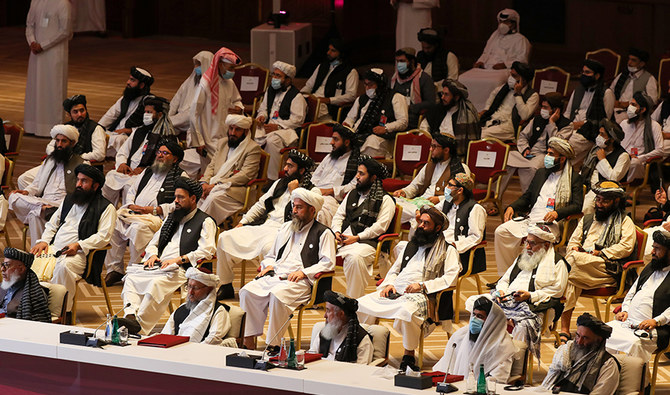
The Taliban delegation at the opening ceremony of intra-Afghan talks, Doha, Qatar, September 12, 2020
By M. K. BHADRAKUMAR | Indian Punchline | September 15, 2020
The US Special Representative for Afghanistan Reconciliation Zalmay Khalilzad was roundly criticised by Indian commentators when he last passed through Delhi in May and advised the officials he met with an earthy sense of realism and foreboding that it’s high time they got down from the high horse to try and begin a conversation with the Taliban.
The advice was well-meaning and pragmatic but the sense of urgency was lacking in Delhi which was rooted in the belief that the peace talks were aeons away. Indeed, the Afghan peace process was struggling to be born at that time but it was already clear that the US was determined to push for the proverbial light at the end of the tunnel of the forever war in time for President Trump to make some grand announcement on the eve of the November election.
Incidentally, a poll conducted by the New York-based Eurasia Group Foundation this week shows that two-thirds of Americans support Trump’s deal with the Taliban to extricate the US from the 19-year war in Afghanistan — and, only 10-15% favour continued military deployment.
Instead of rationally applying their mind, the Indian officials reportedly made a litany of pre-conditions to Khalilzad — the issue of terror emanating from Pakistan impacting peace in Afghanistan, “protection of rights of all sections of the Afghan society, including Afghan Hindus and Sikhs,” and so on.
The Indian readout said, “It was emphasised (to Khalilzad) that putting an end to terrorist safe havens and sanctuaries is necessary for enduring and sustainable peace and stability in Afghanistan.” It added that India also expressed its deep “concern at the upsurge in violence” and extended support for a “call for an immediate ceasefire” and need to “assist the people of Afghanistan in dealing with coronavirus pandemic.”
Simply put, our chaps were hanging tough. Suffice to say, when Khalilzad arrives in Delhi later today for yet another stopover, he is sure to get a pleasant surprise. After much huffing and puffing, the Indian establishment has calmed down and is doing precisely what he told them to do in May.
On top of External Affairs Minister S. Jaishankar addressing the Doha forum virtually on September 12, a senior officer from his ministry was rushed to Qatar to be in the conference hall for the opening ceremony of the intra-Afghan talks. A senior Indian official has since claimed, “There is no ambiguity on the Indian position vis-à-vis engagement with Afghan parties as Indian delegation sat on the same table as the Afghan government as well as the Taliban. The host nation Qatar could have only made this possible after talking to all principal stake-holders in the Afghan dialogue.”
The unconditional U-turn in India’s Taliban policy is so complete that the Indian establishment is overnight celebrating the retreat as a grand historic success of diplomacy. Oh, what an ecstatic moment — to be able to sit around a big table with the Taliban!
The high probability is that Indians will have to settle for the shade for quite a while. From this point onward, the advantage goes to the Taliban — and Pakistan. The Taliban has reestablished control over many Afghan districts and killed tens of thousands of US-backed Afghan forces. With dwindling American support, Afghan forces’ capacity to withstand Taliban attacks will be significantly reduced in the period ahead.
That means the Taliban is set to gain control of even more territories unless it agrees to an immediate ceasefire, which seems unlikely. Just look at today’s developments — a district governor in Logar province reported that the Taliban attacked his residence killing one of his brothers and a personal bodyguard, wounding another brother; an intelligence agency officer and three others were wounded in Jalalabad city when the vehicle of the spy agency was ambushed in broad daylight with an improvised explosive device.
The main problem for India is that it stands in abject isolation today apropos the Afghan situation. Its ability to influence the course of the intra-Afghan negotiations is nil. None of the demands that Indian officials made to Khalilzad in May have been fulfilled. The Taliban maintains a strategic ambivalence on where it stands on a host of contentious issues such as the form of future government, women’s rights, new constitution and so on.
Alas, the Modi government remained the pillion rider on the Harley-Davidson bike all the way through the past decade and a half, but the bike is about to speed away to the far horizon heading for North America. Paradoxically, India’s best option today might be to act as a “spoiler”, but then, with the protracted standoff with China in Ladakh and with the LOC and J&K in a state of tension, a military deployment to Afghanistan is simply beyond India’s reach.
This is where the recent reshuffle of the Taliban delegation at the Doha talks assumes significance. Much speculation surrounds the appointment of the hardline cleric Mawlawi Abdul Hakim Haqqani as the Taliban’s chief negotiator for peace talks.
So far, all we know is that the ultraconservative Mawlawi Haqqani who replaces the previous “moderate” leadership of Sher Mohammad Abbas Stanekzai and Mullah Baradar is a close associate of the Taliban supremo Haibatullah Akhunzada, and his appointment could be an attempt by the core leadership to reassert its direct control over the upcoming negotiations in Qatar.
But the big question is about Mawlawi Haqqani’s standing with Pakistan. The cleric cannot be a stranger to the Pakistani security establishment, since he had spent years lying low in Quetta, where the Afghan Taliban leadership has been based since the US invasion in 2001, and until recently he ran a madrasah from where he led the Taliban’s judiciary and headed a powerful council of clerics that issued religious edicts to regulate the ideology of the Islamic Emirate.
The point is Mawlawi Haqqani, who is in his early 60s, has been propelled into the spotlight and appointed the Taliban’s chief negotiator for peace talks just when the last hurdle of exchange of prisoners was overcome and the stage was being set in Doha for the curtain to rise.
Who stands to gain? China is actively promoting the extension of the China-Pakistan Economic Corridor to Afghanistan. And Pakistan just tightened its grip on the peace talks. The crunch time has come. Pakistan holds a veto card and is determined to use it to marginalise India from the Afghan peace process. Given the Modi government’s hostility toward Pakistan and China, nothing else needs be expected.
The assassination attempt on First Vice-President Amrullah Saleh a week ago should be taken as a stark warning. India has lost the proxy war and this is how victorious Afghan groups have always entered the home stretch. At the very least, our pathway to the Taliban preferably should have run parallel with an overture to Pakistan. Khalilzad cannot do much to help us now.
Featured Video
Laith Marouf: Hezbollah’s position on US-Iran ceasefire
or go to
Aletho News Archives – Video-Images
From the Archives
The Dirty Little Secret behind the “Global Terrorism Index”
The Omission of Israeli Terrorism in the Occupied Palestinian Territories
By Karin Brothers | Global Research | December 6, 2014
… The Israeli settlements — all of which are illegal – have been identified as a major impediment to peace. The refusal of a major “global” terrorism report to name the Israeli settlers as one of the groups most responsible for terrorism not only misrepresents a major source of regional violence but exposes the Global Terrorism Index as a propaganda tool that supports a U.S. agenda.
In recent years, governments have been attempting to thwart terrorism by blocking supportive fund-raising. When it comes to Israeli settlements, however, the US and Canada actually encourage fund-raising by giving organizations (such as Christian Friends of Israeli Communities (CFOIC) and the Jewish National Fund) financial support in the form of donor tax-deductions.
Charities which provide funds for the Israeli settlements should be regarded as terror-financing organizations. They should not only lose their tax-deductible status, but they should be banned because they support the violation of international humanitarian law. The terror-financing laws that are being strictly enforced for Muslim charities should be applied to Christian and Jewish charities as well. … Read full article
Blog Roll
 Aletho News
- How UK Regulator Ofcom Quietly Bypassed International Law to Police American Speech
- The Black Cube Files: How Former Mossad Operatives Flipped a Nation
- Laith Marouf: Hezbollah’s position on US-Iran ceasefire: What you’re not being told
- Israel’s priority lies in destroying chances of peace between Iran, US: Ex-UN nuclear chief
- Ceasefire for all or for none: Iran shuts Hormuz over Lebanon attacks
- Strait of Hormuz is Iran’s ‘nuclear weapon’ that forced US retreat: Medvedev
- Energy crisis will last for months – Kremlin envoy
- Europe’s quiet role in the war on Iran
- Forty days that shook the Empire: How Iran turned the tables on US and prevailed
- Netanyahu unilaterally declares Lebanon outside of ceasefire deal
- If Americans Knew
- Gazans face a triple crisis: severe shortages of water and bread, healthcare in tatters
- NY Times reports how Netanyahu took the US into Iran War
- A sigh of relief over Iran, but Gaza and Lebanon in dire straits – Daily Update
- Thousands dead and neighborhoods razed to the ground: Aid agencies fear southern Lebanon is becoming the new Gaza
- The war the US is fighting for Israel could cost trillions
- ‘Cigarette Burns, Nail Wounds’: Toddler Tortured in Gaza to Coerce Father
- Trump Says US Sent ‘a Lot of Guns’ to Protesters in Iran
- Israeli forces destroy 17 UN peacekeeper cameras in south Lebanon
- US-Israeli strikes ‘completely destroy’ synagogue in Tehran
- Archbishop for US Military Says Iran War Is Unjust Under Catholic Teaching
- No Tricks Zone
- An Inconvenient Tree: Uncovered In Alps… Europe Much Warmer Than Today 6000 Years Ago
- New Study Reports A 60% Slowdown In Greenland’s Ice Loss Rate In The Last Decade
- Low Intensity Tornado Wrecks Major Solar Farm, Creating A Potential Toxic Dump
- New Study Finds Warming Saves Lives…Cold Temperatures 12 Times More Deadly Than Excess Heat
- German Science Blog Accuses PIK Climate Institute Of Hallucinating Climate Tipping Points
- Devastating Assessment Of Comirnaty Vaccine By Former Senior Pfizer Europe Toxicologist
- New Study: CO2 Is ‘Effectively Negligible’ As An Explanatory Climate Change Factor Since 2000
- Former Pfizer Toxicologist Dr. Helmut Sterz Tells Bundestag Hearing Pfizer Vaccine Should Have Never Been Approved
- Energy Expert: Germany’s Nuclear Phaseout Was A “500 Billion Euro Mistake”
- New Research: South Australia’s Mid-Holocene Sea Surface Temperatures Were 4°C Warmer Than Today
 Aletho News