Pakistan Makes A Compelling Case That India Is A State Sponsor Of Terrorism
By Andrew Korybko | One World | November 15, 2020
This year’s Diwali celebration got off to a very symbolic start after Pakistan shined some light on the dark activities that it accused India of carrying out in the region. Islamabad released a detailed dossier during a press conference on Saturday strongly making the case that India is a state sponsor of terrorism whose intelligence services have weaponized this phenomenon as part of the proxy war that they’re fighting with respect to the UNSC-recognized international Kashmir dispute and against the China-Pakistan Economic Corridor (CPEC), the flagship project of Beijing’s Belt & Road Initiative (BRI). These claims aren’t anything new, but what’s novel is the amount of detail devoted to proving them this time around.
According to Pakistan, Indian diplomatic facilities in Afghanistan are being used to coordinate the training of various terrorist groups on that landlocked country’s territory, including efforts to unite relevant Baloch and Pashtun ones as well as create a new ISIS branch dedicated to attacking Pakistan. Islamabad mentioned names, dates, bank accounts, phone numbers, and other identifying information such as exposing the Indian mastermind of these regionally destabilizing activities to make its case that India is a rogue state whose behavior should be investigated by the international community, which might find it fitting to sanction the country through the Financial Action Task Force (FATF) and other related bodies.
Pakistan’s diplomatic masterstroke puts India in a very uncomfortable position because it had hitherto been the latter making such claims about the former and not the reverse. The comparatively muted reaction from the international community in the 24 hours since the dossier was revealed suggests that they feel uncomfortable about the accusations and aren’t too sure how to respond. India is a close military and economic partner of a growing number of influential players such as the US and “Israel” who might now be embarrassed for so closely associating with a country that’s been convincingly accused of such rogue behavior. At the same time, however, “birds of a feather flock together”, as they say.
For reasons of self-interest, it might turn out that the international community as a whole doesn’t react the same way to Pakistan’s accusations as they’ve done in the past whenever India made similar but much less detailed ones. Nevertheless, what’s most important to pay attention to is how these revelations might shape Chinese-Indian relations considering their clashes along the Line of Actual Control this summer and ongoing state of ever-intensifying cold war. The grand strategic interests of the People’s Republic are directly threatened by India’s Hybrid War of Terror on Pakistan, which aims to destabilize CPEC’s northern and southern access points in Gilgit-Baltistan and Balochistan respectively.
In fact, the timing of this dossier’s release might have been connected to those two countries’ rivalry. To explain, India was handily defeated by China during their clashes over the summer, which might be why it’s doubling down on its proxy war of terrorism against Pakistan in response. After all, Islamabad warned that New Delhi would soon seek to intensify its terrorist efforts in the coming future, so the dossier might have been intended to preemptively thwart that by exposing these plans in order to put pressure on India to reconsider its actions. Of course, it also took plenty of time to assemble all the details that were disclosed, but the timing was at least very convenient from the Pakistani perspective even if it was ultimately coincidental.
All told, the dossier heralds the advent of a new phase of Pakistani diplomacy where Islamabad confidently exposes India’s Hybrid War of Terror on the world stage. Since it can be assumed that China considers these claims credible considering the fact that its interests are directly threatened irrespective of the country’s public reaction (or potential lack thereof in line with its diplomatic traditions), the conclusion can thus far be made that this report already had a significant impact. It might very well end up being the case that Chinese-Indian relations will never return to their former friendliness, especially if Beijing begins to wonder whether Washington might be tacitly supporting New Delhi’s proxy war on CPEC.
Andrew Korybko is an American political analyst.
‘Coup’ preparation, or move to stop endless wars? What’s behind Trump’s Pentagon purge
By Nebojsa Malic | RT | November 11, 2020
Democrats and their allies are alarmed that President Donald Trump’s firing of top Pentagon officials could be preparation for a military coup. What looks more likely is that US troops might finally pull out from Afghanistan.
In addition to Defense Secretary Mark Esper, whom Trump “terminated” on Monday, Esper’s chief of staff Jennifer Stewart, acting policy chief James Anderson, and intelligence undersecretary Joseph Kernan have also been shown the door. They were replaced by National Security Council counter-terrorist chief Christopher Miller, former NSC aide Kash Patel, General Anthony Tata, and another former NSC aide Ezra Cohen-Watnick, respectively.
The purge and the appointment of the officials widely described in mainstream media as “Trump loyalists” has led to Democrats and neoconservatives warning that a “coup” might be in the works against Joe Biden, who has claimed victory in the November 3 election.
4. Who knows whether intentions are mostly petty, or domestic election interference, or unimpeded decisions in foreign policy (latter could range from military force to military withdrawals, and from pro-Putin to pro-MBS). But, I’m told, both Esper and Milley are truly worried.
— Bill Kristol (@BillKristol) November 11, 2020
Allowing for the possibility that Trump could just be acting out of spite against people who were disloyal to him, The Nation’s Michael Klare noted that Miller had been involved in covert operations in urban settings of Iraq and Afghanistan with US Special Forces.
Democrats should look for any evidence that the Pentagon purge “signals a covert White House plan to use the US military in support of an illegal drive to subvert democracy and install Trump as dictator,” Klare warned.
Wednesday’s appointment of retired Army Colonel Douglas Macgregor as Miller’s senior adviser, however, points in an entirely different direction. First reported by Axios, it was confirmed by the Pentagon later in the day, with a statement noting that Macgregor’s “decades of military experience will be used to assist in the continued implementation of the President’s national security priorities.”
While that sounds like properly vague Pentagonese, Macgregor is well known for his advocacy of a speedy US withdrawal from Afghanistan – something Trump said last month he wished to see by Christmas this year, ahead of the 2021 timeline envisioned in the peace agreement the US have struck with the Taliban.
The Intercept’s Lee Fang quoted an anonymous Pentagon official who basically confirmed that the Pentagon purge is aimed at overcoming resistance by career bureaucrats and the military-industrial complex to Trump’s policies.
Trump official claims the rapid personnel changes are designed to end the “forever wars” in Afghanistan, withdraw troops by Christmas, which many Pentagon leaders opposed. Others argue moves are designed only to award loyalty and punish dissent.
— Lee Fang (@lhfang) November 11, 2020
“The president is taking back control of DOD. It’s a rebirth of foreign policy. This is Trump foreign policy,” said the official.
“This is happening because the president feels that neoconservatism has failed the American people,” he added.
Trump campaigned in 2016 on ending the ‘endless wars’ in the Middle East. Within a few months, however, he allowed himself to be persuaded by the Pentagon to ramp them up instead, bombing Afghanistan and launching missiles at Syria. Once all the territory held by Islamic State (IS, formerly ISIS) terrorists was liberated, however, he pushed hard for withdrawal from Syria, Afghanistan and Iraq – running into resistance from the Pentagon.
His first Defense Secretary Jim Mattis resigned over Syria at the end of 2018. Most US troops there were withdrawn by October 2019. Some troops were also pulled out of Iraq this year, citing concerns over the coronavirus, though many still remain. A peace treaty with the Taliban was signed in February this year, after nearly 20 years of war that perfectly defined “mission creep.”
There is no denying that the present political situation in Washington, with Biden claiming he won the election and Trump disputing that citing irregularities in key states, is fraught with peril. Whatever the outcome, unless everything is handled above board and with transparency, half the country is going to feel cheated and disenfranchised.
There are two things to keep in mind, however. Whatever one thinks of him, Trump has kept his word, implementing his electoral promises – by working through the system – despite the obstacles thrown before him by the administrative apparatus, legislators and the courts. So far, the current flurry of activity at the Pentagon seems to point towards a withdrawal from the Middle East, rather than a coup at home.
Secondly, it was actually the Democrats – Joe Biden himself – who first brought up the notion of using the US military to forcibly remove Trump from the White House, should he lose but refuse to concede. That was in June, long before the election and its controversies. What did Biden know at the time to make him say that, nobody knows – because nobody in the mainstream US media has bothered to ask, preferring to entertain partisan fantasies based on conjecture instead.
Australia’s War Crimes and Culture of impunity
By Ramona Wadi | Strategic Culture Foundation | November 8, 2020
There is yet no reckoning for Australia’s SAS war crimes in Afghanistan, although details of horrendous atrocities are coming to light. A 2016 report detailing the extent of torture and extrajudicial killings by the Australian SAS forces in Afghanistan have been described as “fuelled by blood lust”, and compared on a scale to the infamous torture and murder practices at Abu Ghraib in Iraq.
The 2016 report which has recently been seen by two leading Australian news outlets, was compiled by sociologist Dr Samantha Crompvoets. Testimonies of war crimes, accompanied by the normalisation of such action and recurring impunity, have been characterised by a reliability in narration among different participants, pointing towards routine practices that escalated over time.
Notably, the report points towards an adulation of violence. The Australian special forces working alongside British and US counterparts held up the latter as the pinnacle of violence to emulate. However, the torture and killing of Afghan civilians by the Australian SAS is held on a par in terms of desensitisation and normalisation. A report earlier in March this year, which is based upon the witnessing of an execution of an Afghan man, states, “The visual image to me was, the guy had his hands up and then it was almost like target practice for that soldier.”
Human rights organisations in Australia and Afghanistan have called upon the Australian government to release the inquiry report into war crimes committed by the SAS, which commenced in 2016, in a manner which would hold the country accountable to upholding International Humanitarian Law. The open letter makes an important point that resonates even in relation to other countries subject to foreign intervention and impunity for the perpetrators. It states, “The Afghan people have remained trapped in an unbroken cycle of a 40 year long conflict which is profoundly rooted in a culture of impunity, with many actors operating in total disregard of local and international laws and norms in the firm belief that nobody will ever hold them accountable.”
Under the guise of foreign intervention and the democracy narrative which is used to sell war to the public, impunity for human rights violations is being cultivated. The lack of accountability is related to several processes, including policy, leadership failure, and dysfunctional communication between divisions; the latter amounting to secrecy that develops further possibilities for impunity.
One story featured in Australian media in March this year detailed the killing of an Afghan man who posed no threat to soldiers, and whose corpse was chewed upon by an assault dog. In another case captured on camera, another Afghan man, again posing no danger, is shot three times at point blank range – for no other reason than abuse of power, as indicated by the perpetrator.
Democracy and war crimes go hand in hand when it comes to foreign intervention and the bloody trail they leave behind. In an investigation by the Australian Defence Forces (ADF), the soldier who killed the Afghan man in a field was exonerated and is still serving in the Australian special forces; the narrative being that the victim had been seen with a radio, despite evidence to the contrary.
Such coverups are a regular occurrence which serve to perpetrate additional human rights violations. It is possible that the Australian government, as indicated by Defence Minister Linda Reynolds, will agree to publish parts of the report for “transparency” this month. The so-called War on Terror has unleashed a brand of state terror on targeted countries which so far has been met with an ingrained reticence from leaders to investigate accusations of war crimes. Between the bureaucratic delays of the International Criminal Court, and opposition to the institution by world leaders intent on saving the culture of impunity, there is little chance of implementing justice unless the international justice system is pressured to work against the globalisation of war.
‘Psychos’ fueled by ‘blood lust,’ Australian special forces tortured and executed prisoners in Afghanistan – report
RT | October 28, 2020
A disturbing new report blows the lid on the shameful conduct of Australian special forces soldiers in Afghanistan, accusing them of waging a campaign of torture and murder across the war-torn country, and hiding the evidence.
When Australia’s elite SAS soldiers would raid villages in Afghanistan, they brought terror and death with them, a report seen by Melbourne newspaper The Age alleges. The special forces “would take the men and boys to these guest houses and interrogate them, meaning tie them up and torture them,” the report states.
By the time the SAS units left, “the men and boys would be found dead, shot in the head, sometimes blindfolded and throats slit. These are corroborated accounts,” it continues, comparing the alleged war crimes to the My Lai massacre of the Vietnam War, and to the US’ mistreatment of detainees in Iraq’s Abu Ghraib prison.
The report was commissioned by then-Army chief Angus Campbell in 2016, and an upcoming Inspector-General report into war crimes by senior judge Paul Brereton has confirmed many of its findings, The Age claimed. Compiled by defense consultant Samantha Crompvoets, the report is based on interviews with soldiers and whistleblowers, who told Cormpvoets some grizzly tales of “competition killing and blood lust.”
In one instance, two “14-year-old boys suspected of being Taliban sympathisers had their throats slit … the bodies were bagged and thrown into a nearby river.” In others, unarmed Afghans were shot in the back as they ran away.
According to the report, war crimes allegations made by NGOs and SAS staff were quashed by the special forces leadership in Afghanistan. Soldiers involved in these crimes allegedly covered them up, and expected their comrades to keep quiet. Meanwhile, the perpetrators “gloated about” their killings.
“Soldiers would do bad stuff to fit in. It becomes part of the banter,” one witness recalled. Another stated: “guys just had this blood lust. Psychos. Absolute psychos. And we bred them.”
Despite the gruesome details revealed in the report, the Australian operators were envious of their British and American counterparts, one informant told Crompvoets.
“Whatever we do, though, I can tell you the Brits and the US are far, far worse. I’ve watched our young guys stand by and hero worship what they were doing, salivating at how the US were torturing people,” the informant said.
Crompvoets’ report alleges that the majority of crimes were committed by a small group of patrol commanders. Brereton’s inquiry found the same, The Age reported. The newspaper said that Brereton will make war crimes referrals to the Australian Federal Police for a number of these soldiers, charges that will be contested by the Department of Defence.
Australian troops have been deployed in Afghanistan since 2001, with combat operations ceasing in 2014. Around 150 Australian soldiers and civilian staff remain in the country in support and advisory roles.
US Military Evacuates Largest Base in Afghanistan

Al-Manar | October 13, 2020
The US forces started evacuating their largest base in Afghanistan, according to media reports which added that it lies to the north of the capital, Kabul.
An administrative official in the Afghan Senate said that the US forces began demolishing the buildings at Bagram air base and moving their equipment to Pakistan.
The Afghan Senate harshly criticized the US forces for demolishing the buildings, demanding that they hand over the military equipment in the base to the Afghani forces.
NATO refuses to commit to withdrawal from Afghanistan
Press TV – October 9, 2020
NATO has dismissed US President Donald Trump’s surprise announcement to pull out all of US forces from Afghanistan by the end of the year, saying that members of the military alliance will decide together on when to withdraw forces from the war-ravaged country.
Trump announced on Twitter on Wednesday that he was going to bring all US troops home from Afghanistan by Christmas.
NATO Secretary General Jens Stoltenberg reacted to the president’s remarks on Thursday, saying that the military alliance will end its mission in Afghanistan only when conditions on the ground permit.
“We decided to go into Afghanistan together, we will make decisions on future adjustments together, and when the time is right, we will leave together,” Stoltenberg said at a news conference.
NATO deployed forces to Afghanistan following the 2001 US-led invasion to topple the Taliban-run government, on the pretext of fighting terrorism following the September 11 attacks in New York.
Afghanistan has been gripped by insecurity since the US and its allies invaded the country as part of Washington’s so-called ‘war on terror’ 19 years ago. Many parts of the country remain plagued by militancy despite the presence of US-led foreign troops.
American forces have since remained bogged down in the country through the presidencies of George W. Bush, Barack Obama, and now, Donald Trump.
In an interview on Thursday Trump also said that US forces are “down to 4,000 troops in Afghanistan. I’ll have them home by the end of the year. They’re coming home, you know, as we speak. Nineteen years is enough.”
Analysts say Trump, trailing in polls just weeks ahead of the November 3 presidential election, made the withdrawal announcement to show he is making good on his 2016 promise to end “endless wars.”
Stoltenberg, however, said NATO would only leave Afghanistan when it could do so without the risk of the country once again becoming a haven for militants.
“We will make decisions based on the conditions on the ground, because we think it is extremely important to continue to be committed to the future of Afghanistan, because it is in our interest to preserve the long-term security of Afghanistan,” he added.
Trump’s announcement was, however, welcomed by the Afghan Taliban militant group on Thursday.
A spokesman for the group, Mohammad Naeem, described Trump’s announcement as “a positive step towards the implementation of [the] Doha agreement.”
In a deal reached between the US and the Taliban earlier this year in the Qatari capital, Doha, the United States promised to pull out all its troops by mid-2021 in return for the Taliban to stop their attacks on US-led occupation foreign forces in Afghanistan.
Some 4,500 American troops are currently on the ground in Afghanistan, reduced from over 12,000 when the deal was signed in February.
The Taliban also agreed to negotiate a permanent ceasefire and a power-sharing formula with the Afghan government.
The Afghan government and Taliban last month opened peace talks in Qatar, even as key differences, including over a ceasefire, remain between the two sides.
NATO’s recent refusal to commit to withdrawal, according to observers, puts the complicated peace negotiations in jeopardy at a time when Afghanistan continues to suffer from a series of attacks — claimed either by the Taliban or the Daesh terrorist group — which took dozens of civilians’ lives.
In the meantime, Daesh has also been securing a foothold in Afghanistan.
The US has been largely blamed for relocating remnants of the terrorist group to Afghanistan following their defeat in Iraq and Syria.
The US-led military alliance and NATO are also blamed for turning Afghanistan into one of the world’s main opium producers over the last two decades, as opium has become a source for terrorist financing in the war-ravaged country.
According to the United Nations, more than 80 percent of the world’s opium is produced in Afghanistan and that the bulk of narcotics produced in the country is destined for European states.
A high-ranking Iranian official said earlier this year that the production of narcotic drugs has seen a fifty-fold increase over a span of 17 years in Afghanistan.
Director general of the Iran Drug Control Headquarters, Eskandar Momeni, said American planes as well as those belonging to the US-led military alliance and NATO are engaged in transporting illicit drugs.
Iran, located at the crossroad of international drug smuggling from Afghanistan, has long been fighting armed drug smugglers in its eastern and southeastern borders. Thousands of Iranian security forces have lost their lives in the clashes.
Analysts believe Washington, which has repeatedly named Iran, Russia and China as its enemies, intends to create insecurity and trouble on the borders of these countries through Afghanistan.
India’s overture to Taliban comes too late
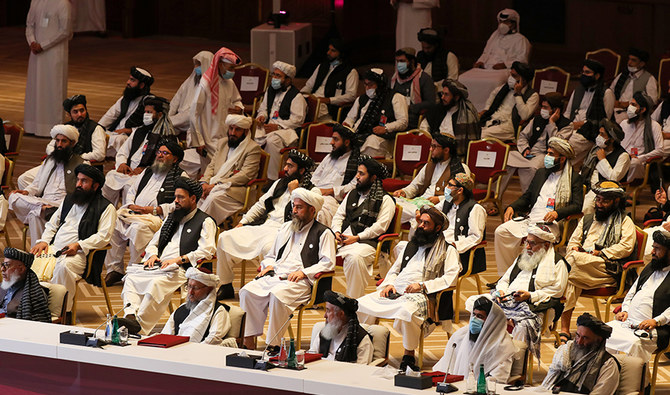
The Taliban delegation at the opening ceremony of intra-Afghan talks, Doha, Qatar, September 12, 2020
By M. K. BHADRAKUMAR | Indian Punchline | September 15, 2020
The US Special Representative for Afghanistan Reconciliation Zalmay Khalilzad was roundly criticised by Indian commentators when he last passed through Delhi in May and advised the officials he met with an earthy sense of realism and foreboding that it’s high time they got down from the high horse to try and begin a conversation with the Taliban.
The advice was well-meaning and pragmatic but the sense of urgency was lacking in Delhi which was rooted in the belief that the peace talks were aeons away. Indeed, the Afghan peace process was struggling to be born at that time but it was already clear that the US was determined to push for the proverbial light at the end of the tunnel of the forever war in time for President Trump to make some grand announcement on the eve of the November election.
Incidentally, a poll conducted by the New York-based Eurasia Group Foundation this week shows that two-thirds of Americans support Trump’s deal with the Taliban to extricate the US from the 19-year war in Afghanistan — and, only 10-15% favour continued military deployment.
Instead of rationally applying their mind, the Indian officials reportedly made a litany of pre-conditions to Khalilzad — the issue of terror emanating from Pakistan impacting peace in Afghanistan, “protection of rights of all sections of the Afghan society, including Afghan Hindus and Sikhs,” and so on.
The Indian readout said, “It was emphasised (to Khalilzad) that putting an end to terrorist safe havens and sanctuaries is necessary for enduring and sustainable peace and stability in Afghanistan.” It added that India also expressed its deep “concern at the upsurge in violence” and extended support for a “call for an immediate ceasefire” and need to “assist the people of Afghanistan in dealing with coronavirus pandemic.”
Simply put, our chaps were hanging tough. Suffice to say, when Khalilzad arrives in Delhi later today for yet another stopover, he is sure to get a pleasant surprise. After much huffing and puffing, the Indian establishment has calmed down and is doing precisely what he told them to do in May.
On top of External Affairs Minister S. Jaishankar addressing the Doha forum virtually on September 12, a senior officer from his ministry was rushed to Qatar to be in the conference hall for the opening ceremony of the intra-Afghan talks. A senior Indian official has since claimed, “There is no ambiguity on the Indian position vis-à-vis engagement with Afghan parties as Indian delegation sat on the same table as the Afghan government as well as the Taliban. The host nation Qatar could have only made this possible after talking to all principal stake-holders in the Afghan dialogue.”
The unconditional U-turn in India’s Taliban policy is so complete that the Indian establishment is overnight celebrating the retreat as a grand historic success of diplomacy. Oh, what an ecstatic moment — to be able to sit around a big table with the Taliban!
The high probability is that Indians will have to settle for the shade for quite a while. From this point onward, the advantage goes to the Taliban — and Pakistan. The Taliban has reestablished control over many Afghan districts and killed tens of thousands of US-backed Afghan forces. With dwindling American support, Afghan forces’ capacity to withstand Taliban attacks will be significantly reduced in the period ahead.
That means the Taliban is set to gain control of even more territories unless it agrees to an immediate ceasefire, which seems unlikely. Just look at today’s developments — a district governor in Logar province reported that the Taliban attacked his residence killing one of his brothers and a personal bodyguard, wounding another brother; an intelligence agency officer and three others were wounded in Jalalabad city when the vehicle of the spy agency was ambushed in broad daylight with an improvised explosive device.
The main problem for India is that it stands in abject isolation today apropos the Afghan situation. Its ability to influence the course of the intra-Afghan negotiations is nil. None of the demands that Indian officials made to Khalilzad in May have been fulfilled. The Taliban maintains a strategic ambivalence on where it stands on a host of contentious issues such as the form of future government, women’s rights, new constitution and so on.
Alas, the Modi government remained the pillion rider on the Harley-Davidson bike all the way through the past decade and a half, but the bike is about to speed away to the far horizon heading for North America. Paradoxically, India’s best option today might be to act as a “spoiler”, but then, with the protracted standoff with China in Ladakh and with the LOC and J&K in a state of tension, a military deployment to Afghanistan is simply beyond India’s reach.
This is where the recent reshuffle of the Taliban delegation at the Doha talks assumes significance. Much speculation surrounds the appointment of the hardline cleric Mawlawi Abdul Hakim Haqqani as the Taliban’s chief negotiator for peace talks.
So far, all we know is that the ultraconservative Mawlawi Haqqani who replaces the previous “moderate” leadership of Sher Mohammad Abbas Stanekzai and Mullah Baradar is a close associate of the Taliban supremo Haibatullah Akhunzada, and his appointment could be an attempt by the core leadership to reassert its direct control over the upcoming negotiations in Qatar.
But the big question is about Mawlawi Haqqani’s standing with Pakistan. The cleric cannot be a stranger to the Pakistani security establishment, since he had spent years lying low in Quetta, where the Afghan Taliban leadership has been based since the US invasion in 2001, and until recently he ran a madrasah from where he led the Taliban’s judiciary and headed a powerful council of clerics that issued religious edicts to regulate the ideology of the Islamic Emirate.
The point is Mawlawi Haqqani, who is in his early 60s, has been propelled into the spotlight and appointed the Taliban’s chief negotiator for peace talks just when the last hurdle of exchange of prisoners was overcome and the stage was being set in Doha for the curtain to rise.
Who stands to gain? China is actively promoting the extension of the China-Pakistan Economic Corridor to Afghanistan. And Pakistan just tightened its grip on the peace talks. The crunch time has come. Pakistan holds a veto card and is determined to use it to marginalise India from the Afghan peace process. Given the Modi government’s hostility toward Pakistan and China, nothing else needs be expected.
The assassination attempt on First Vice-President Amrullah Saleh a week ago should be taken as a stark warning. India has lost the proxy war and this is how victorious Afghan groups have always entered the home stretch. At the very least, our pathway to the Taliban preferably should have run parallel with an overture to Pakistan. Khalilzad cannot do much to help us now.
President Ghani says Afghan government fulfilled all commitments for Taliban peace talks
Press TV – September 2, 2020
Afghanistan’s President Ashraf Ghani says the government has fulfilled all its commitments for peace negotiations with the Taliban.
“The government has fulfilled all its commitments in the peace process that the international community had hoped for,” the president said at a meeting with a team of government-backed negotiators at the presidential palace on Wednesday, his office reported.
On Monday, Kabul resumed the release of Taliban prisoners, a pre-condition to negotiations.
“The release of Taliban prisoners is a clear demonstration of the government’s commitment to peace.”
Afghanistan’s Loya Jirga, or grand assembly of elders, has already approved the release of 400 imprisoned Taliban militants, who had been involved in serious crimes in Afghanistan, for the sake of peace talks.
A senior government official, who asked not to be named, told AFP on Wednesday that at least 200 inmates have been freed since Monday and the process “will continue today too.”
In return, the Taliban have freed four Afghan commandos and are expected to release two more on Wednesday, according to a Taliban official.
Meanwhile, Ghani’s spokesman Sediq Sediqqi said in a posting on Twitter, “We expect the Taliban to live up to their commitments on the release of the remaining captives.”
The prisoner swap was agreed to in a deal between the Taliban and the United States. The agreement was signed in the Qatari capital, Doha, on February 29.
Under the deal, the Taliban agreed to halt their attacks on international forces in return for the US military’s phased withdrawal from Afghanistan and the prisoner exchange with the government in Kabul.
The Afghan government, which was not a signatory to the accord, was required to release up to 5,000 Taliban prisoners. The militants, for their part, were obliged to free 1,000 government captives.
Ghani said a “critical stage of peace” had been reached, noting that the talks would help reduce violence and finalize a permanent ceasefire.
Meanwhile, Kabul has dispatched a “small technical team” to Qatar to prepare for negotiations.
Najia Anwari, spokeswoman for the State Ministry for Peace Affairs, told AFP that the government’s negotiators will also leave for Doha “very soon.”
A Pakistani Olive Branch Extended In Efforts to End the Afghani Conflict
By Vladimir Odintsov – New Eastern Outlook – 30.08.2020
In the face of the obvious failure of US policy in Afghanistan, Pakistan has stepped up its efforts to peacefully resolve the Afghani conflict.
On August 24, at the invitation of Pakistani Foreign Ministry, a delegation of the Taliban (movement banned in the Russian Federation – ed.), headed by Mullah Abdul Ghani Baradar arrived from Doha, capital of Qatar, to meet both civilian and military representatives of Pakistan. Its purpose was to discuss the latest developments in the peace process in Afghanistan and further steps in this direction, improving the security situation for civilians in Afghanistan as well as trade between the two neighboring countries, as confirmed by Taliban spokesman Suhail Shaheen on his Twitter.
This meeting was already the third of its kind: previously the parties met in October 2019 at the Pakistani Foreign Ministry and in February this year in Doha. This third visit of the Taliban delegation, as intended by those behind it, should contribute to resolving the contradictions that have arisen in recent days on the eve of the intra-Afghan peace talks that did not start on August 20 and were postponed to a later date, and were part of the agreement signed in Doha in February between the Taliban and the United States. Pakistani Foreign Minister Shah Mahmood Qureshi emphasized in his statement that Islamabad invited the Taliban to emphasize the importance of negotiations, adding that negotiations are “the only way forward” in Afghanistan. “It is the Afghanis who need reconciliation, and our task is mediating,” he said. “The main goal is to ensure peace, and the next stage should be the beginning of an intra-Afghan dialogue.”
In a statement in connection with this meeting, the Pakistani Foreign Ministry highlighted Islamabad’s positive contribution to the peace and reconciliation process in Afghanistan, which culminated in the signing of a peace agreement between the US and the Taliban in Doha on February 29, 2020. Therefore, Pakistani officials are confident that Afghani stakeholders must seize this historic opportunity to secure a comprehensive political negotiated solution to the Afghani conflict. Islamabad called on the international community to step up its participation in the reconstruction and economic development of Afghanistan, by creating the necessary economic opportunities and conditions conducive to the return of Afghani refugees to their homeland.
Islamabad leaping to action in the peaceful resolution of the Afghani crisis is in part due to Washington’s unrelenting criticism of Pakistan for “insufficient efforts to counter Afghani anti-government forces,” which the US State Department has repeatedly noted in its reports. In particular, the United States emphasizes how Pakistan failed to prevent a number of attacks by militants from its territory against Afghanistan, and makes minimal efforts to suppress the activities of terrorist organizations. At the same time, it is especially clear Islamabad only conducted anti-terrorist operations against those militants who carried out attacks specifically on Pakistani territory. This critical position has been repeatedly voiced by the current Afghani authorities close to the United States, accusing Islamabad of supporting the Taliban and other militants operating in the weakly defended border, indicating, in particular, that Taliban leaders are based in cities along the Pakistani-Afghani border, including Quetta and Peshawar.
Washington’s latest accusations against Islamabad were voiced in the annual report on terrorism published by the US State Department on June 24. In it, in particular, it was noted that Pakistan is a haven for terrorists and terrorist groups operating in South Asia, such as the Haqqani Network, Lashkar-e-Tayyiba and aysh-e-Mohammad (all banned in the Russian Federation), and the government of Prime Minister Imran Khan and the Pakistani army have been accused of inaction. In addition, the State Department’s Trafficking in Persons Report indicated that religious minorities and children are frequent victims of the slave trade in Pakistan.
For these reasons and for alleged “insufficient support by the Pakistani authorities for the American strategy on South Asia” in 2018, the United States refused to provide financial assistance to Islamabad in the amount of $300 million. This has already caused Islamabad’s harsh discontent with such assessments of Washington’s actions by Pakistan, since the indicated amount was supposed to be not help, but compensation for funds already spent by this country on countering terrorism.
However, today everyone is already well aware that Washington’s criticism of Pakistan in recent years is primarily due to the desire of the current American authorities to shift the blame for the apparent failure of their policy in Afghanistan to a third party, including the deaths here of more than two thousand American soldiers as well as over 20 thousand injuries, hundreds of billions of dollars worthlessly spent on goals incomprehensible to the public, which was more than enough to have long ago made Afghanistan a flourishing state in many ways. An important factor in such attacks by the Donald Trump administration on the Pakistani authorities is also the establishment of closer bilateral relations between Pakistan and China, as a result of which the traditional ties between America and Pakistan have all but disintegrated.
Although it is still early to speak into the results of the third meeting of Pakistani representatives and the Taliban, it is nevertheless obvious that the negotiations that took place in the current situation were very necessary in hopes to settle the Afghani conflict. And once again it was Islamabad who extended the olive branch in an effort to achieve peace in Afghanistan.
US Forced to Flee Afghanistan, Iraq and Now Syria
By Valery Kulikov – New Eastern Outlook – 28.08.2020
Multiple missile strikes carried out in recent weeks on American military facilities and overseas bases in Afghanistan, Iraq, and Syria indicate that a growing number of people living in countries that have endured American military invasions have had enough of America’s intervention and are fed up with Washington’s policy.
The level of dissatisfaction among the Afghan people with the US military presence in Afghanistan has already received extensive coverage in the media, and US Secretary of State Mike Pompeo has even been forced to declare that the US will pull all of its troops out of Afghanistan by May 2021.
Outside Afghanistan, anti-American sentiment has long prevailed among people living in Syria and Iraq, which has not only been voiced through peaceful means, such as holding anti-American protests or appealing to the UN to demand the American troops be withdrawn.
Powerful explosions sparked a raging fire in the late hours of July 28 at the Majid al Tamimi Airbase in Iraq, where both Iraqi and American soldiers are stationed. This was the second strike to be carried out within the space of the same day. In an attack earlier that day, three rockets were launched on the territory of the US Camp Taji base located north of Baghdad.
On August 10, an explosion near the Iraqi border with Kuwait hit convoys supplying US-led coalition forces with military equipment. On the same day, another rocket attack struck near the US Embassy in Baghdad. The actual territory of the American Embassy was hit by missiles on July 5, and after another attack on the embassy on June 11, Washington was forced to negotiate reducing the US military presence in Iraq with Baghdad.
The Iraqi media notes that attacks on American military facilities are carried out on almost a weekly basis in Iraq, and although there are no casualties or people left injured in many of these attacks according to official data, the infrastructure of the military facilities has suffered material damage. At the same time, the threat of far more serious attacks being carried out in the near future has not been dismissed by the US.
According to the al-Hadath TV channel based in Dubai, Iraq and the United States came to an agreement on August 22 in response to the significant increase in the number of protests being held in Iraq against the US military presence in the country, agreeing to relocate American troops and equipment from Camp Taji north of Baghdad to Erbil — the capital of the Kurdistan Region in northern Iraq. Almost all the troops are now known to have been moved to the military base in Erbil, in what was the largest withdrawal of US troops from an American military base in the Middle East.
There are also more and more reports coming from Syria about missile attacks on US military bases, especially in the northeast of the country in the al-Hasakah and Deir ez-Zor governorates. The Syrian Al-Watan newspaper reported that one of these attacks targeted a US military base in the town of al-Shaddadah, the administrative center of the al-Hasakah governorate in northeastern Syria, which was hit by rockets in early August. In May, the Syrian Arab News Agency (SANA) reported that another armed attack was carried out on the US military using machine guns and grenades, in which at least eight people were injured.
In some articles, observers claim that the American facilities targeted in these attacks are being used as infrastructure to protect oil fields and for the illegal production of Syrian oil. For instance, one of these attacks carried out in mid-August targeted an American military base near the Conoco gas field (north of the Deir ez-Zor governorate), which is controlled by the US and Kurdish armed groups. As anti-American sentiment gains momentum, and with periodic attacks being carried out on American targets in Syria, the United States has already begun drafting a special combat unit in Syria to protect oil fields east of the Euphrates. According to local sources, this special unit includes ethnic Arabs drafted from the ranks of the militia fighters in the Washington-backed Syrian Democratic Forces (SDF), which is militarily led by the People’s Protection Units (YPG), a mainly Kurdish militia which forms the backbone of the SDF. However, local tribes are increasingly taking a stand against the presence of American armed forces and their SDF henchmen in Syria. According to Al-Masdar News, one of these clashes took place on August 17, when fighters from the Al-Baggara tribe reportedly drove SDF forces out of the village of Jadid Baggara in a rural part of Deir ez-Zor governorate in eastern Syria. It is indeed the eastern regions of Syria where numerous protests are being held against military occupation and new US sanctions, which are trying to put the Syrian government in a difficult position to prevent Damascus and its allies from working together to rebuild their vision of Syria.
Given these circumstances, US President Donald Trump has been repeating his intention to withdraw troops from Afghanistan, Iraq and Syria more and more frequently. Donald Trump made another remark about withdrawing US troops from Iraq at a press briefing on August 19 that was streamed on the White House Twitter account. In Trump’s opinion, the US army should never have gone into the Middle East, and he recalled that the United States is continuing to reduce the number of American troops stationed in Afghanistan.
It should not be forgotten that during a speech Donald Trump gave on June 13, addressed to graduates of the United States Military Academy (USMA) in West Point, New York, he said: “We are restoring the fundamental principles that the job of the American soldier is not to rebuild foreign nations […].” In Trump’s own words, there is now “a renewed, clear-eyed focus on defending America’s vital interests.”
However, on June 9, Donald Trump informed members of Congress from both the Senate and the House of Representatives that Washington will continue operations against DAESH, al-Qaeda, the Taliban and other related groups listed as terrorist organizations and based in Afghanistan, Iraq, Syria, Yemen, Jordan, Lebanon, Turkey, Somalia, Kenya, Djibouti and Niger.
Yet considering how people living in Afghanistan, Iraq and Syria have railed against the presence of US troops and military bases in their countries, one could expect to see similar acts of protest in the very near future in other countries around the world where more than 600 US military bases are hosted.
Democrats’ election platform demands end to ‘forever wars’ — most of which were launched last time Biden held office
By Helen Buyniski | RT | August 17, 2020
The Democratic Party’s 2020 electoral platform includes a call to end the US’ “forever wars” – which sounds great, except that a Democratic president started many of those wars and the party has stonewalled efforts to end them.
“Democrats know it’s time to bring nearly two decades of unceasing conflict to an end,” the platform, released in draft form on Monday and expected to be approved by Democratic leaders later this week, reads.
It’s a relatively uncontroversial statement in itself: at nearly 19 years and counting, the US war in Afghanistan is the longest conflict in American history. The various satellite wars that have sprung up as part of the “War on Terror” have devastated large swathes of the Middle East – and the US itself, which has spent upwards of $6 trillion on fighting them while much of the country slid into a permanent recession – over the past two decades.
However, the responsibility for many of those satellite conflicts lies with Democrat Barack Obama’s administration, which liberally bombed Syria, Libya, Pakistan, Yemen, and Somalia in addition to Afghanistan and Iraq, turning the already-disastrous two-front War on Terror of his predecessor George W. Bush into a regional quagmire. Democratic candidate Joe Biden was Obama’s vice president, cheering those wars on and defending his boss’ decisions. Now, the party wants Americans to believe only he can put an end to them.
The 2020 platform promises a “durable and inclusive political settlement in Afghanistan” along with an end to US support for the Saudi-led war in Yemen and a repeal of the threadbare 2001 Authorization for Use of Military Force (AUMF) that has been repeatedly (mis)used to excuse US interventions in the Middle East under the guise of fighting terrorism. All great ideas, but the party has been here before.
Despite receiving the Nobel Peace Prize shortly after his inauguration, Obama didn’t bring the peace he promised in his 2008 campaign – he just made war more palatable to the liberals who had previously protested against it. By dramatically expanding the US drone program and cloaking murderous airstrikes in the warm fuzzy rhetoric of spreading democracy and “responsibility to protect,” Obama, his Secretary of State Hillary Clinton, and the Democrats in his administration took the wars out of sight, and out of mind for the average American.
Even while taking credit for “ending” the war in Iraq, launched in 2003 on the fraudulent pretext that leader Saddam Hussein was amassing weapons of mass destruction and/or was somehow involved in the 9/11 terror attacks, Obama subsequently returned US troops to Iraq under the pretext of fighting the Islamic State terror group (IS, ISIS/ISIL). However, IS is widely considered an outgrowth of the US’ botched Iraq policy, which destabilized the region by flooding the country with many of the suddenly-unemployed (but still well-armed) remnants of Saddam Hussein’s military. At the same time, the CIA has a long history of supporting terror groups that dovetail with its political aims, from arming and training al-Qaeda’s predecessors to fight the Soviets in Afghanistan to arming and training so-called “moderate rebels” whose tactics are often indistinguishable from ISIL or al-Qaeda to take out the Syrian government. Terrorism has thrived amid the war “against” it.
That the Democrats should campaign in 2020 on ending forever wars suggests they might have learned something from 2016, when then-candidate Donald Trump pledged to do just that, luring disaffected liberals who couldn’t bring themselves to vote for notorious warmonger Hillary Clinton. Her flippant dismissal of the brutal murder of Libyan leader Muammar Gaddafi – “We came, we saw, he died!” – remains chilling years after she helped reduce the country with the highest standard of living on the African continent to a failed state where slaves are sold in open markets.
But while Trump has profoundly failed to keep his end-the-wars promise, instead increasing the number of drone strikes beyond Obama’s sky-high levels, even Trump’s minimal efforts to withdraw troops from Syria and Afghanistan have been ferociously opposed by the Democrats.
Indeed, the only foreign policy acts the self-styled #Resistance has praised from their political nemesis have been his bombings of Syria in response to extremely dubious reports of gas attacks by the Assad government. CNN’s Fareed Zakaria claimed the strike represented the day Trump “became president of the United States.”
The disingenuous call to end the military quagmires is far from the only lofty pledge embedded in the Democrats’ platform, which alternates between eye-rolling social-justice pandering and common-sense measures with broad appeal.
The party has also pledged to “end the Trump Administration’s politicization of the armed forces,” improve healthcare for veterans, “root out systemic racism from our military justice system,” and “prioritize more effective and less costly diplomatic, intelligence and law enforcement tools” over military invasions in conducting foreign policy.
It remains to be seen which, if any, of those promises they will keep.
Helen Buyniski is an American journalist and political commentator at RT. Follow her on Twitter @velocirapture23
Featured Video
Seyed M. Marandi: US-Iran War Inevitable: Kuwait and Bahrain May Fall
or go to
Aletho News Archives – Video-Images
From the Archives
Oil and the Israel Lobby
Reknowned economist M. Shahid Alam offers this excellent critique of Noam Chomsky’s defective analysis of the relative influence of Oil versus the Israel lobby over US foreign policy: … continue
Blog Roll
 Aletho News
- ICC ignored ‘very well-documented’ NATO crimes – ex-Libyan minister
- SNSC secretary dismisses US response to Iran’s conditions as ‘inadequate’
- Sanaa says Taiz roads open, secure for residents, warns Saudi forces
- Iraqi resistance group urges Saudi leadership to admit defeat, lift Yemen siege
- Trump’s Retreat: How Al-Aqsa Flood Took Down the US Empire
- Israel’s Military Actions in Lebanon Grossly Violate International Law — Lavrov
- Seyed M. Marandi: US-Iran War Inevitable: Kuwait and Bahrain May Fall
- Leaders Condemn Ansarallah Attack on Saudi Arabia While Ignoring Illegal War Against Yemen
- Leaked: Britain’s Covert Iraqi Psyops Network
- Yemeni Armed Forces Warn Airlines Against Using Saudi Airports, Exempt Mecca and Medina
- If Americans Knew
- After Oct 7, IDF policy allowed civilian casualties for even the lowest-ranking targets
- Israel’s Destruction of Southern Lebanon Intensified After the Cease-Fire
- The Last-Minute Decision That Gave Israel Its Name
- The American Conservative: How Trump Made the World Go Nuclear
- Meet the US generals and admirals advancing Israeli policy
- Opinion: Why news organizations should boycott Israel
- The Israeli witch hunt of Sami Abu Shehadeh exposes the lie of the ‘Jewish and democratic’ state
- No state has a ‘right’ to exist – least of all Israel
- Testimonies about Gaza’s civilian death toll expose Israel’s atrocities – Daily Update
- How Israel Conquered the Latin American Right
- No Tricks Zone
- New Study Suggests Large Regions Of The Pacific Ocean Have Been Cooling For The Last 80 Years
- Germany’s Green Energy Debacle: High Energy Costs Force Kahla Porzellan to Close After 182 Years!
- New Study: 50 Years Of The Most Aggressive ‘Net Zero’ Policies Can Only Affect The Global Climate By 0.03°C
- US September “Heat” Was No Record…Many Records Set Decades Ago
- Latest European Green Energy Debacle; Portugal’s Largest Flagship Solar Park Insolvent!
- Green Energy Debacle: German Expert Professor Fritz Vahrenholt Warns Of Severe Economic And Social Consequences
- Two More Paleo Reconstructions Affirm Meters-Higher Sea Levels Across Ireland, Brazil 7000-6000 Years Ago
- New Study: Earth And Venus Surface Warmth Largely Explained By Convection And Lapse Rate, Not CO2 Or Radiation
- 2025 Nature Paper Claiming Worsening Global Drought Gets RETRACTED …Heavily Flawed
- New Study: ‘Global Drought Shows No Detectable Recent Acceleration Under Climate Warming’

