No decision on any NATO withdrawal from Afghanistan: Stoltenberg
Press TV – February 18, 2021
NATO Secretary-General Jens Stoltenberg says defense ministers from the Western military alliance made no decision at a recent meeting in Brussels on whether or when to pull out of war-torn Afghanistan.
“At this stage, we have made no final decision on the future of our presence,” Stoltenberg said after a video conference with allied defense ministers on Thursday.
The defense ministers met to discuss the possibility of staying in Afghanistan beyond the May withdrawal deadline agreed between the Taliban militant group and the United States under the administration of former US President Donald Trump.
Key on the agenda at the two-day virtual conference in Brussels was the future of the US-led forces in the war-torn country.
The NATO chief said US Defense Secretary Lloyd Austin promised to consult with partners on the way forward.
“As the May 1 deadline is approaching, NATO allies will continue to closely consult and coordinate in the coming weeks. We are faced with many dilemmas, and there are no easy options,” Stoltenberg said.
“If we stay beyond the first of May, we risk more violence, more attacks against our own troops … But if we leave, then we will also risk that the gains that we have made are lost.”
The administration of President Joe Biden is reviewing whether to stick to the looming deadline to withdraw or risk a bloody backlash from the Taliban.
Other NATO members have signaled a desire within the alliance to stay in Afghanistan beyond the deadline. They are willing to remain in Afghanistan if Washington does so.
German Defense Minister Annegret Kramp-Karrenbauer said on Wednesday that the Taliban must do more to meet the terms of a 2020 agreement with Washington on the withdrawal of US.forces to allow a pullout of the foreign troops.
“We can already say that we are not yet in a position to talk about the withdrawal of international forces from Afghanistan,” the German minister said as she arrived for the meeting.
“This also means a changed security situation, an increased threat for the international forces, also for our own forces. We have to prepare for this, and we will certainly discuss this.”
Nearly two decades after the US-led invasion, Trump struck a deal with the Taliban in the Qatari capital of Doha early last year.
The former White House tenant reached the accord in February 2020, under which the US and its NATO allies are expected to withdraw all troops in 14 months in exchange for the Taliban to halt attacks on foreign forces.
President Biden, however, has said his administration would not commit to a full withdrawal by May.
The United Nations says more than 100,000 civilians have been killed or injured over the past decade across Afghanistan.
Why Victoria Nuland Is Dangerous and Should Not be Confirmed
By Rick Sterling | Global Research | February 11, 2021
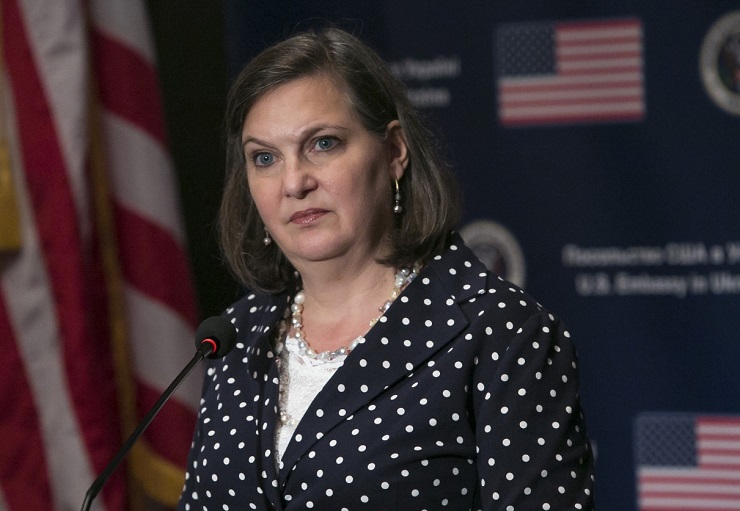
Victoria Nuland exemplifies the neocons who have led US foreign policy from one disaster to another for the past 30 years while evading accountability. It is a bad sign that [proclaimed] President Joe Biden has nominated Victoria Nuland for the third highest position at the State Department, Under Secretary for Political Affairs.
As a top-level appointee, Victoria Nuland must be confirmed by the US Senate. There is a campaign to Stop her confirmation. The following review of her work shows why Victoria Nuland is incompetent, highly dangerous and should not be confirmed.
Afghanistan and Iraq
From 2000 to 2003, Nuland was US permanent representative to NATO as the Bush administration attacked then invaded Afghanistan. The Afghan government offered to work with the US remove Al Qaeda, but this was rejected. After Al Qaeda was defeated, the US could have left Afghanistan but instead stayed, established semi-permanent bases, split the country, and is still fighting there two decades later.
From 2003 to 2005 Nuland was principal foreign policy advisor to Vice President Dick Cheney who “helped plan and manage the war that toppled Saddam Hussein, including making Bush administration’s case for preemptive military actions based on Iraq’s alleged weapons of mass destruction.” The foreign policy establishment, with Nuland on the far right, believed that removing Saddam Hussein and installing a US “ally” would be simple.
The invasion and continuing occupation have resulted in over a million dead Iraqis, many thousands of dead Americans, hundreds of thousands with Post Traumatic Stress Disorder at a cost of 2 to 6 TRILLION dollars.
From 2005 to 2008 Victoria Nuland was US Ambassador to NATO where her role was to “strengthen Allied support” for the occupations of Afghanistan and Iraq.
On the 10th anniversary of the invasion, when asked about the lessons learned Nuland responded “Compared to where we were in the Saddam era, we now have a bilateral security agreement … We have deep economic interests and ties. We have a security relationship. We have a political relationship.” Nuland is oblivious to the costs. Nuland’s loyalties are to the elite who have benefitted from the tragedy. According to online google, “One of the top profiteers from the Iraq War was oil field services corporation, Halliburton. Halliburton gained $39.5 billion in ‘federal contracts related to the Iraq war.’ Nuland’s boss, Vice President Dick Cheney, was the former the CEO of Halliburton.
In January 2020, seventeen years after the US invasion, the Iraqi parliament passed a resolution demanding the US troops and contractors leave. Now, over one year later, they still have not left.
Libya
In spring 2011, Victoria Nuland became State Department spokesperson under Hillary Clinton as she ramped up the “regime change” assault on Moammar Ghaddafi of Libya. UN Security Council resolution 1973 authorized a “No Fly Zone” for the protection of civilians but NOT an air assault on Libyan government forces.
That summer, as US and others bombed and attacked Libyan forces, she dismissed the option of a peaceful transition in Libya and falsely suggested the UN Security Council required the removal of Ghaddafi.
The campaign led to the toppling of the Libyan government and killing of Ghadaffy. Commenting on the murder and bayonet sodomizing of Ghaddafi, Nuland’s boss Hillary Clinton chortled “We came, we saw, he died.”
Before the overthrow, Libya had the highest standard of living in all of Africa. Since the US led assault, Libya has become a failed state with competing warlords, huge inflation, huge unemployment, and exploding extremism and violence that has spread to neighboring countries. Most of the migrants who have crossed the Mediterranean trying to reach Europe, or drowned trying to, are coming from Libya. By any measure, the goal of “protecting” Libyan civilians has failed spectacularly.
Syria
One reason that Clinton and hawks such as Nuland wanted to overthrow Ghaddafi was to get access to the Libyan military arsenal. That way they could funnel arms to insurgents seeking to overthrow the Syrian government. This was confirmed in secret DOD documents which state: “During the immediate aftermath of, and following the uncertainty caused by, the downfall of the ((Qaddafi)) regime in October 2011 and up until early September of 2012, weapons from the former Libya military stockpiles located in Benghazi, Libya were shipped from the port of Benghazi, Libya to the ports of Banias and the Port of Borj Islam, Syria”
In January 2012, Nuland claimed the US is “on the side of those wanting peaceful change in Syria.” While saying this, the US was supplying sniper rifles, rocket propelled grenades, and 125 mm and 155 mm howitzer missiles to the “peaceful” protestors.
The US “regime change” strategy for Syria followed the pattern of Libya. First, claim that the protestors are peaceful. Then claim the government response is disproportionate. Put pressure on the target government to paralyze it, while increasing support to proxy protesters and terrorists. As documented, there were violent Syrian protesters from the start. During the first days of protest in Deraa in mid-March 2011, seven police were killed. As spokesperson for the State Department, Nuland was a major figure promoting the false narrative to justify the “regime change” campaign.
Ukraine
In September 2013 Victoria Nuland was appointed Assistant Secretary of State for European and Eurasian Affairs. The uprising in the central plaza known as the Maidan began soon after her arrival. To underscore the US support for the protests, Nuland and Senator John McCain passed out bread and cookies to the crowd.
Protests continued into January 2014. The immediate issue was whether to accept a loan from the International Monetary Fund which was going to require a 40% increase in natural gas bills or to accept a loan from Russia with the inclusion of cheap oil and gas. The opposition wanted the Yanukovych government to take the EU/IMF loan. The opposition was comprised of different factions, including the neo-Nazi Svoboda Party and Right Sector.
In early February 2014, an audio recording of Victoria Nuland talking the US Ambassador to Ukraine, Geoffrey Pyatt, was leaked to the public. The 4-minute conversation was a media sensation because it included Victoria Nuland saying, “Fuck the EU.”.
But Nuland’s cursing was a distraction from what was truly significant. The recording showed that Nuland was meddling in domestic Ukraine affairs, had direct contacts with key opposition leaders, and was managing the protests to the extent she was deciding who would and would not be in the post-coup government! She says, “I don’t think Klitsch [Vitaly Klitschko] should go into government…… I think Yats [Arseniy Yatseniuk] is the guy… “
The reason she wanted to “Fuck the EU” was because she did not approve the EU negotiations and compromise. Nuland and Pyatt wanted to “midwife” and “glue” the toppling of the Yanukovych government despite it being in power after an election that was observed and substantially approved by the OSCE (Organization for Security and Co-operation in Europe).
Over the next few weeks, the protests escalated. The President of the American Chamber of Commerce in Kiev, Bernard Casey, described what happened next. “On February 18-20, snipers massacred about 100 people [both protestors and police] on the Maidan …. Although the US Ambassador and the opposition blamed the Yanukovych Administration, the evidence points to the shots coming from a hotel controlled by the ultranationalists, and the ballistics revealed that the protestors and the police were all shot with the same weapons.”
The Estonian Foreign Minister later said the same thing: “behind the snipers it was not Yanukovych, but it was somebody from the new (opposition) coalition”.
President of the American Chamber of Commerce President for Ukraine, Bernard Casey, continues: “On February 20, 2014 an EU delegation moderated negotiations between President Yanukovych and the protestors, agreeing to early elections – in May 2014 instead of February 2015…. Despite the signing of an agreement … the ultranationalist protestors, and their American sponsors, rejected it, and stepped up their campaign of violence.”
The coup was finalized over the coming days. Yanukovych fled to for his life and Yatsenyuk became President after the coup as planned.
One of the first acts of the coup leadership was to remove Russian as an official state language, even though it is the first language of millions of Ukrainians, especially in the south and east. Over the coming period, the “birth” of the coup government, violence by ultranationalists and neo-Nazis was prevalent. In Odessa, they attacked people peacefully protesting the coup. This video shows the sequence of events with the initial attack followed by fire-bombing the building where protestors had retreated. Fire trucks were prevented from reaching the building to put out the fire and rescue citizens inside. Forty-two people died and a 100 were injured.
A bus convoy heading back to Crimea was attacked with the anti-coup passengers beaten and some killed.
In the Donbass region of eastern Ukraine, protests against the coup were met by deadly force.
Victoria Nuland claims to be a “victim” because her conversation was leaked publicly. The real victims are the many thousands of Ukrainians who have died and hundreds of thousands who have become refugees because of Nuland’s crusade to bring Ukraine into NATO.
The audio recording confirms that Nuland was managing the protests at a top level and the results (Yats is the guy) was as planned. Thus, it is probable that Nuland approved the decision to 1) deploy snipers to escalate the crisis and 2) overturn the EU mediated agreement which would have led to elections in just 3 months.
Why were snipers deployed on February 18? Probably because time was running out. The Russian leadership was distracted with the Sochi Olympic Games ending on February 23. Perhaps the coup managers were in a hurry to “glue” it in advance.
Russia
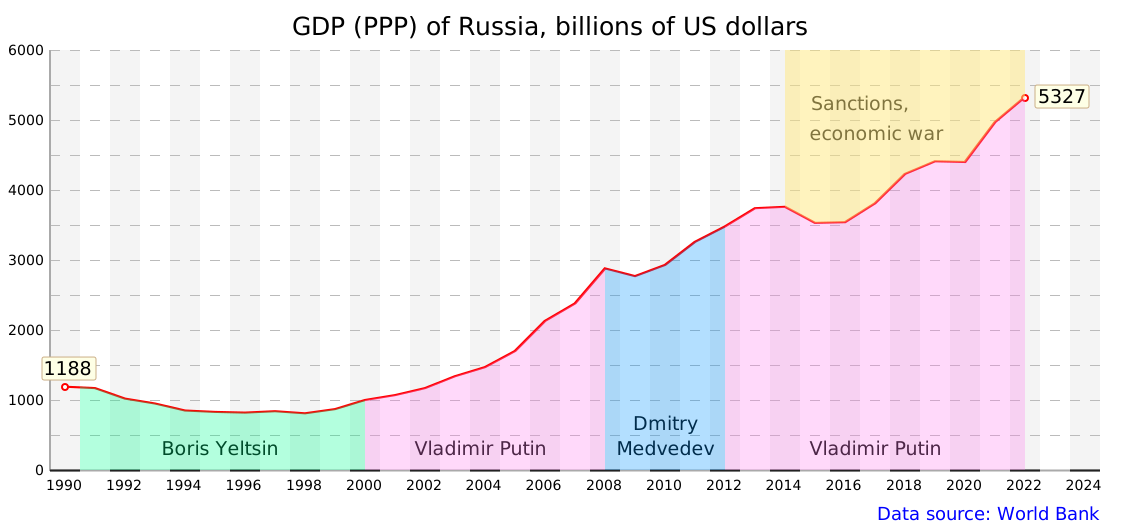
During the 1990’s, Nuland worked for the State Department on Russia related issues including a stint as deputy director for former Soviet Union affairs. The US meddled in Russian internal affairs in myriad ways. Time magazine proudly proclaimed “Yanks to the rescue: the secret story of how American advisors helped Yeltsin win.” The Yeltsin leadership and policies pushed by the US had disastrous consequences. Between 1991 and 1999, Russian Gross Domestic Product decreased by nearly 50% as the social safety net was removed. The Russian economy collapsed, oligarchs and lawlessness arose. Nuland was part of the US group meddling in Russia, deploying economic “shock therapy” and causing widespread social despair.
Meanwhile, the U.S. reneged on promises to Soviet leader Gorbachev that NATO would not expand “one inch” eastward. Instead, NATO became an offensive pact, bombing Yugoslavia in violation of international law and then absorbing Poland, Hungary, Bulgaria, Romania, the Baltic states, the Czech Republic, Albania, Croatia and more.
Coming into power in 2000, Putin clamped down on the oligarchs, restored order and started rebuilding the economy. Oligarchs were forced to pay taxes and start investing in productive enterprises. The economy and confidence were restored. Over seven years, GDP went from $1300 billion (US dollars) to $2300 billion. That is why Putin’s public approval rating has been consistently high, ranging between 85% and a “low” approval rating of 60%.
Most Americans are unaware of these facts. Instead, Putin and Russia are persistently demonized. This has been convenient for the Democratic Party establishment which needed a distraction for their dirty tricks against Bernie Sanders and subsequent loss to Donald Trump. The demonization of Russia is also especially useful and profitable for the military industrial media complex.
Victoria Nuland boosted the “Steele Dossier” which alleged collaboration between Russia and Trump and other salacious claims. The allegations filled the media and poisoned attitudes to Russia. Belatedly, the truth about the “Steele Dossier” is coming out. Last summer the Wall Street Journal reported “the bureau (FBI) knew the Russia info was phony in 2017” and that “There was no factual basis to the dossier’s claims”.
While promoting disinformation, Victoria Nuland is pushing for a more aggressive US foreign policy. In an article titled “Pinning Down Putin”, she says “Russia’s threat to the liberal world has grown”, that Washington should “deter and roll back dangerous behavior by the Kremlin” and “rebuff Russian encroachments in hot spots around the world.”
The major “hot spots” are the conflicts which Victoria Nuland and other Washington neocons promoted, especially Syria and Ukraine. In Syria, the US and allies have spent hundreds of BILLIONS of dollars promoting the overthrow of the Assad government. So far, they have failed but have not given up. The facts are clear: US troops and military bases in Syria do not have the authorization of the Syrian government. They are actively stealing the precious oil resources of the Syrian state. It is the US not Russia that is “encroaching”. The dangerous behavior is by Washington not Moscow.
Conclusion
Victoria Nuland has promoted a foreign policy of intervention through coups, proxy wars, aggression, and ongoing occupations. The policy has been implemented with bloody and disastrous results in Afghanistan, Iraq, Libya, Syria, and Ukraine.
With consummate hypocrisy she accuses Russia of spreading misinformation in the US, while she openly seeks to put “stress on Putin where he is vulnerable, including among his own citizens.” She wants to “establish permanent bases along NATO’s eastern border and increase the pace and visibility of joint training exercises.”
Victoria Nuland is the queen of chicken hawks, the Lady Macbeth of perpetual war. There are hundreds of thousands of victims from the policies she has promoted. Yet she has not received a scratch. On the contrary, Victoria Nuland probably has profited from a stock portfolio filled with military contractors.
Now Victoria Nuland wants to provoke, threaten and “rollback” Russia. A quick look at a map of US military bases shows who is threatening whom.
Victoria Nuland is dangerous and should not be confirmed.
*
Rick Sterling is an investigative journalist in the SF Bay Area. He can be reached at rsterling1@protonmail.com.
US forces ‘transporting by choppers’ Daesh terrorists in Afghanistan: Taliban
Press TV – February 1, 2021
The Taliban says the US occupation forces in Afghanistan are engaged in “transporting by their choppers” members of the Daesh Takfiri terrorist group in the war-torn country’s east.
Senior members of a Taliban delegation, who are on an official visit to Iran for talks on the Afghan peace process and relevant topics, made the assertion in a news conference in Tehran on Monday, saying that the US forces in Afghanistan are assisting the Daesh terrorists to escape the areas that are coming under the Taliban control.
“Daesh were in Nangarhar and Kunar; they existed in those areas. They were eliminated by the Taliban there but their members were transferred by choppers,” Suhail Shaheen, a negotiating member of the Taliban told reporters, adding, “When the Taliban laid a siege on them, we saw that only American choppers could fly as the Afghan airspace is fully under the control of Americans.”
The senior Taliban member also referred to the escalation of violence in Afghanistan after the US-Taliban deal last February and said the US forces were to blame as they defaulted on their obligation to end their occupation and resumed the assault.
“After the signing of the agreement, we gave a chance to the Americans to withdraw their troops from Afghanistan and we were committed not to launch any attacks, so if they terminated the occupation we were committed to refrain from any assaults or attacks so it would pave the way for intra-Afghan talks but unfortunately new attacks were launched against us and we were forced to defend ourselves and they even tried to capture our region and they conducted nightly attacks,” he said.
“We have no access to the media but they have. They attribute violence to us and that is not true. They start the violence. They start the violent action and that’s still continuing.”
During the news conference, the Taliban negotiator said the group was after an “inclusive system and establishment” in Afghanistan and not after “monopolizing power,” adding that they would reconsider the agreement with US if foreign forces failed to withdraw from Afghanistan.
“We have resisted the occupation of Afghanistan for 20 years and we will continue resistance against occupation if foreign forces remain in the country,” the senior Taliban member said.
Last week, the Taliban political delegation arrived in Tehran at the invitation of the Iranian Foreign Ministry, the latest of such visits that have been paid several times over the past months.
Iran strongly supports the realization of peace and stability in Afghanistan, which has been embroiled in decades of militancy fueled by foreign military intervention.
The intra-Afghan talks started after the United States agreed to withdraw 12,000 US troops from Afghanistan in exchange for the Taliban’s halting of their attacks on international forces under a deal between the two sides in February 2020.
The deal was intended to result in the reduction of bloodshed, but violence continues to take a heavy toll on the country.
In recent months, deadly attacks and high-profile assassinations have seen a rise in Afghanistan. The Taliban have denied responsibility for the killings, but Afghan and US officials have pinned the blame on the group.
Despite the ongoing talks between Kabul and the Taliban, the administration of US President Joe Biden has said it would review the peace deal reached last year.
The US first invaded Afghanistan in 2001 under the banner of fighting “terrorism.” The invasion toppled the Taliban, but the group has never stopped its attacks, citing the foreign military presence as one of the main reasons behind its continued militancy.
Since the US invasion of Afghanistan, Washington has spent more than two trillion dollars for the war on the impoverished country, according to some estimates. Over 2,400 US soldiers and tens of thousands of Afghan civilians have been killed.
Biden Regime Puts The Brakes On Trump’s Germany Troop Draw Down
By Tyler Durden | Zero Hedge | January 29, 2021
Perhaps as expected, it didn’t take long for the Biden administration to begin putting the brakes on Trump’s previously ordered troop draw downs which occurred in the last two months of his presidency, particularly in Germany, Iraq, and Afghanistan.
The defense analysis and news site Military.com is reporting that new defense secretary under the Biden administration Lloyd Austin is reviewing the withdrawal of 12,000 US troops from Germany:
Defense Secretary Lloyd Austin has voiced his commitment to shoring up close ties with NATO ally Germany that were strained under the Trump administration, and suggested that the plan to withdraw 12,000 U.S. troops from the country is open to discussion.
The prior Trump plan to cut nearly one-third of total American military personnel from the country was predictably fought from Congressional corners known for being hawkish on Russia, with even some American and European security officials having called the move a “gift to Putin”.
Later in December the 2021 National Defense Authorization Act attempted to override the draw down order, and according to German officials early this year there’s yet to be significant movement of troops from the country.
Defense Secretary Lloyd Austin this week held phone calls with NATO allied officials in Europe. The Military.com report continues:
In a phone call to his German counterpart, Defense Minister Annegret Kramp-Karrenbauer, Austin “expressed his gratitude to Germany for continuing to serve as a great host for U.S. forces, and expressed his desire for a continued dialogue on U.S. force posture in Germany,” according to a Pentagon readout of the call released Wednesday.
He also sought “to reinforce the value the United States places on the bilateral defense relationship with one of our closest NATO Allies,” the readout from Pentagon Press Secretary John Kirby states.
By all appearances the some 36,000 total American troops in Germany have gone nowhere despite the plan initiated under Esper.
Recent polling of the German public also suggests half or more want to see US troops gone, after being there since World War II.
As the report concludes of Defense Secretary Austin’s phone call, it is “the latest sign of the Biden administration’s intent to reverse or water down the policies of former President Donald Trump, who repeatedly questioned NATO’s worth to the U.S. and rattled allies with demands for more defense spending.”
6 Warning Signs from Biden’s First Week in Office
By Kit Knightly | OffGuardian | January 27, 2021
It’s been a busy first week for the 46th President [sic] of the United States, there are the 20,000 troops occupying the capitol city to organise, as well as the totally unprecedented show-trial of his immediate predecessor.
You know, usual democracy type stuff.
On top of that, Biden has now signed at least 37 executive orders in his first week. The record for any President, and more than the previous four presidents combined.
What do these orders, or any of his other moves, tell us about the future plans of the recently “elected” administration? Nothing good, unfortunately.
1. VACCINATION PASSPORTS
I still remember people claiming the introduction of vaccination passports (or immunity passes or the like) was just a “conspiracy theory”, the paranoid fantasy of fringe “covidiots”. All the way back in December, when they were getting fact-checked by tabloid journalists who can’t do basic maths.
These days they are rebranded as “freedom certificates” which are “divisive, politically tricky and probably inevitable”.
Many countries are already preparing to roll it out, including Iceland the UK and South Africa. Biden’s “Executive Order on Promoting COVID-19 Safety in Domestic and International Travel” adds the US to this list:
International Certificates of Vaccination or Prophylaxis. Consistent with applicable law, the Secretary of State, the Secretary of HHS, and the Secretary of Homeland Security (including through the Administrator of the TSA), in coordination with any relevant international organizations, shall assess the feasibility of linking COVID-19 vaccination to International Certificates of Vaccination or Prophylaxis (ICVP) and producing electronic versions of ICVPs.
2. CABINET APPOINTMENTS
Biden’s cabinet is praised as the “most diverse” in history, but will hiring a few non-white people really change the decades-old policies of US Imperialism? It certainly doesn’t look like it.
His pick for Under Secretary of State is Victoria Nuland, a neocon warmonger and one of the masterminds of the Maidan coup in Ukraine in 2014. She is married to Robert Kagan, another neocon warmonger, co-founder of the Project for a New American Century and senior fellow at the Brookings Institute and one of the masterminds behind the 2003 invasion of Iraq.
The incoming Secretary of State, Antony Blinken, is also an inveterate US Imperialist, arguing for every US military intervention since the 1990s, and criticised Trump’s decision to withdraw from Syria.
Biden’s pick for Defence Secretary is the first African-American ever appointed to this role, but former General Lloyd Austin is hardly going be some kind of “progressive” voice in his cabinet. He’s a career soldier who retired from the military in 2016 to join the board of Raytheon Technologies, an arms manufacturer and military contractor.
As “diverse” as this cabinet may be in skin colour or gender… there is most certainly no “diversity” of opinion or policy. There are very few new faces and no new thoughts.
So, it looks like we can expect more of the same in terms of foreign policy. A fact that’s already been displayed in…
3. IRAQ…
Despite heavy resistance from the military and Deep State, Donald Trump wanted to end the war in Iraq and pledged to pull American troops out of the country. This was one of Trump’s more popular policies, and during the campaign Biden made no mention of intending to reverse that decision.
Then, on the very day of Biden’s inauguration, ISIS conducted their deadliest suicide bombing for over three years, and suddenly the situation was too unstable for the US to leave, and Biden is being forced to “review” Trump’s planned withdrawal.
The Iraqi parliament has made it clear it wants the US to take its military off their soil, so any American forces on Iraqi land are technically there illegally in contravention of international law. But that never bothered them before.
4. … AFGHANISTAN…
Turns out the US can’t withdraw from Afghanistan either. Last February Trump signed a deal with the Taliban that all US personnel would leave Afghanistan by May 2021.
Joe Biden has already committed to “reviewing” this deal. Sec. Blinken was quoted as saying that Biden’s admin wanted:
“to end this so-called forever war [but also] retain some capacity to deal with any resurgence of terrorism, which is what brought us there in the first place”.
As a great man once said, nothing someone says before the word “but” really counts. The US will not be withdrawing from Afghanistan, and if there is any public pressure to do so, the government will simply claim the Taliban broke their side of the deal first, or stage a few terrorist attacks.
5. … AND SYRIA
Far from simply continuing the on-going wars, there are already signs Biden’s “diverse” team will look to escalate, or even start, other conflicts.
Syria was another theatre of war from which Donald Trump wanted to extricate the United States, unilaterally ordering all US troops from the country in late 2019.
We now know the Pentagon ignored those orders. They lied to the President, telling Trump they had followed his orders… but not withdrawing a single man. This organized mutiny against the Commander-in-Chief of the US Armed Forces was played for a joke in the media when it was finally revealed.
There will be no need for any such duplicity now that Biden is in the Oval Office, he was a vocal critic of the decision to withdraw, claiming it gave ISIS a “new lease of life”. Indeed, within two days of his being sworn in a column of American military vehicles was seen entering Syria from Iraq.
6. DOMESTIC TERRORISM
We called this before the inauguration. They made it just too obvious. Before the dirty footprints had been cleaned from Nancy Pelosi’s desk it was clear where it was all going.
Within 24 hours of being sworn in as president, Biden had ordered a “review of the threat posed by domestic terrorism”.
As usual, the press are laying down the covering fire for this. Talking heads have been busily comparing MAGA voters to al Qaida in television interviews. The Washington Post and New Yorker journal have cut-and-paste pieces about this supposed threat. Politico published an article titled “Biden vowed to defeat domestic terrorism. The how is the hard part”, which outlines what Biden could do:
Direct the Justice Department, FBI and National Security Council to execute a top-down approach prioritizing domestic terrorism; pass new domestic terrorism legislation; or do a bit of both as Democrats propose a crack down on social media giants like Facebook for algorithms that promote conspiracy laden posts.
That last part is key. The “crack down on social media” part, because the anti-Domestic Terrorism legislation will likely be very focused on communication and so-called “misinformation”.
Alexandra Ocasio-Cortez has publicly called for a congressional panel to “rein in” the media:
We’re going to have to figure out how we rein in our media environment so you can’t just spew disinformation and misinformation,”
And who will be the target of these crack downs and new legislations? Well, according John Brennan (ex-head of the CIA and accomplished war criminal), practically anybody:
They’re casting a wide net. Expect “extremist”, “bigot” and “racist” to be just a few of the words which have their meanings totally revised in the next few months. “Conspiracy theorist” will be used a lot, too.
Further, they are moving closer and closer toward the “anyone who disagrees with us is literally insane” model. With many articles actually talking about “de-programming” Trump voters. The Atlantic suggests “mental hygiene” would cure the MAGA problem.
Again AOC is on point here, clearly auditioning for the role of High Inquisitor, claiming that the new Biden government needs to fund programs that “de-radicalise” “conspiracy theorists” who are on the “spectrum of radicalisation”.
*
As I said at the beginning, it’s been a busy week for Joe Biden, but you can sum up his biggest policy plans in one short sentence: More violence overseas, less tolerance of dissent and strict clampdowns on “misinformation”.
How progressive.
Iran-Turkey railway aims for 1M tons of cargo in 2021
MEMO | January 27, 2021
Roughly 1 million tons of cargo are to be transported via rail between Turkey and Iran this year, Turkish authorities said Tuesday, reports Anadolu Agency.
The Transport and Infrastructure Ministry said in a statement that a recent memorandum of understanding signed in a gathering of railway representatives in Turkey’s capital Ankara on January 12-13 would open a new era for the transit railway.
Despite the novel coronavirus pandemic, three train services were run daily between Turkey and Iran in 2020, transporting 564,000 tons of cargo, according to the statement.
The statement also announced that freight trains would also run between Turkey and Pakistan via Iran on a common tariff between the three countries. It added that talks are still ongoing to set this tariff.
With a recently completed railway between Iran and Afghanistan, it will now also be possible to transport freight between Turkey and Afghanistan.
“After the railway connection between Iran and Afghanistan was completed on December 10, 2020, it became possible for a wagon loaded in Turkey to transit Iran to Afghanistan.”
The railway administrations of Turkey, Iran, and Afghanistan will come together in the coming months to set a course for rail transport between Turkey and Afghanistan.
The statement added that efforts were underway for a cargo transportation corridor through Iran between Europe and China.
Iran has prepared initial plan for gas exports to Afghanistan
Press TV | November 9, 2020
Head of the National Iranian Gas Company (NIGC) says the country has a plan in place for launching gas exports to neighboring Afghanistan.
“The initial plan has been prepared and diplomatic negotiations are ongoing,” said Hassan Montazer Torbati on Monday as he briefed reporters on the latest situation of Iran’s gas exports to neighboring countries.
Torbati said gas exports to Afghanistan would be commissioned to private contractors although he insisted that the government has already provided the full infrastructure needed for transfer of gas to its eastern neighbor.
Afghanistan is increasingly relying on Iran for its energy needs as the landlocked country moves to expand economic activity through opening a new trade route that passes through Iran to the Indian Ocean.
However, Iranian energy supplies, including electricity, are mostly available to western parts of Afghanistan where the security of transfer infrastructure can be properly guaranteed.
Iran has increased both the output and exports of natural gas in recent years despite a series of US sanctions that have specifically targeted the country’s energy sector.
Nearly a tenth of Iran’s current output of more than 700 million cubic meters of gas is exported, mainly through pipelines to Turkey and Iraq.
On exports to Turkey, where authorities have touted the discovery of a new gas reserves in the Black Sea, Torbati said Ankara would still need to import gas from Iran to respond to its growing energy demand.
He said talks on renewing a 25-year export agreement with Turkey that is set to expire in several years’ time would start in the near future.
The subject of Israeli hegemony over US must be addressed

By Walt Peretto | Press TV | December 25, 2020
It’s pardon season for President Trump. The likely outgoing president has issued 15 pardons that include two members of the Russian investigation and four convicted murderers who worked for the private security firm Blackwater.
These four were convicted of murdering 14 Iraqi civilians in 2007. Private security corporations such as Blackwater (since renamed Academi) have played a major role in war zones since the invasions of Afghanistan and Iraq after the false flag events of 9/11/2001. They are also suspected of participation in other domestic false flag events that include the Boston Marathon event in 2013.
These pardons by Trump will facilitate the use of private security firms in the near future both domestically and abroad. Further lockdowns in the US and crushing strains on small business may create unrest which could overwhelm municipal law enforcement and the federal government may choose to hire private security to deal with such occurrences. Overseas, tensions may increase in Syria as the new Democratic president may resurrect the goal of toppling President Assad which would likely be carried out by hiring private mercenaries which the West has done in the past.
I think these pardons by Trump send a signal to private security firms that their actions will not be hampered by long prison sentences for employees who engage in murder. Similar to municipal policing in which cops that murder are virtually never convicted. If the US does rededicate itself to regime change in Damascus, it’s hired security forces and clandestine paid terrorists don’t want restraints like convictions of murder in the courts.
Trump’s pardon of two people involved with the Russiagate fiasco makes sense since Russian collusion was never proven and the whole story was really a distraction for 4 years designed to take people’s eyes off of leaked emails involving Hillary Clinton, the Podesta brothers, Barack Obama and others that were quite damning if they were thoroughly investigated.
For four years the left-leaning media in the United States filled the news with accusations of Russian collusion in US elections and other illegal and immoral interactions between Russian officials and the Trump administration.
This also kept the eye off the elephant in the room called Israel which has seized control of the presidency, the Congress, the Judiciary, the economy through the FED, and the mainstream media.
China has provided another useful distraction from Israeli influence in America. If one honestly examines recent US presidential administrations — don’t strain to find any Chinese or Russian nationals in positions of power in the US federal government. Dual US/Israeli citizens are abundant and ubiquitous in the Trump administration and it will be similar in the Biden administration if he makes it to the White House. The subject of Israeli hegemony over the United States is a subject no one seems to want to address.
Judging from the proposed COVID Stimulus Package which allocates billions of dollars to other countries, this proves that the globalist intention is to bleed the United States dry until it submits wholly to the international cabal of psychopaths that includes Klaus Schwab and his World Economic Forum who are attempting to reset the world into a one-world system led by global organized psychopathy.
Congress moves to block US troop pullout from Afghanistan, Germany
Press TV | December 6, 2020
US President Donald Trump’s controversial move to pull out 2,000 American troops out of Afghanistan and 12,000 more from Germany would be blocked by the major defense policy bill, a report has said.
One provision of the National Defense Authorization Act (NDAA) for fiscal 2021 “would block funding for reducing the number of US troops in Afghanistan from 4,500 to 2,500 by January 15, as ordered by Trump, until the Defense and State Departments verify that it was in the national interest,” Military.com news outlet reported Saturday.
Another provision of the NDAA, it added, essentially urges the incoming Biden administration to take a second look at Trump’s executive order to withdraw 12,000 American troops from Germany.
According to the bill, troop levels in Germany should remain at 34,500 until 120 days after the secretary of defense submitted cost estimates and assessments of the impact of a withdrawal on allies and military families.
The final draft of the NDAA — released Thursday night — underlines that Afghanistan pullout orders, announced by the newly-appointed Acting Defense Secretary Christopher Miller on November 17, “gave Congress no estimate of the national security implications.”
According to the report, the Trump administration has so far failed to clarify how a troop withdrawal was “in the national security interests of the United States to deny terrorists safe haven in Afghanistan, protect the United States homeland.”
Trump’s announcement last June that he wanted 9,500 troops out of Germany after years of battling with NATO allies to spend more for defense has also drawn opposition from both ruling political parties in the US Congress.
On July 29, then-Defense Secretary Mark Esper declared plans to carry out Trump’s order that increased the number of US soldiers to be withdrawn from Germany to 12,000.
Some of those troops would return to the US, while others would be transferred to Poland and the Baltic states in a shift eastward to enhance NATO’s purported deterrence against Russia, Esper claimed at the time.
The report further pointed out that the NDAA provision on Germany “means that final decisions on a troop withdrawal could go to Michele Flournoy, a former undersecretary of Defense for Policy who is considered a frontrunner for defense secretary in the Biden administration.”
Flournoy, the report added, has already stated that pulling thousands of troops out of Germany would likely cost more than leaving them in place. He also underlined in an Aspen Security Forum in August that “Our allies were completely surprised by this punitive troop withdrawal from Germany.”
Moreover, once Biden is inaugurated on January 20, he would have the authority to issue his own executive order reversing Trump’s withdrawal mandate.
Acting US Def Sec Miller Formally Announces Plans to Cut Troops in Afghanistan, Iraq to 2,500 Each
By Daria Bedenko – Sputnik – 17.11.2020
Earlier on Monday, CNN reported, citing two US officials, that Pentagon anticipated President Donald Trump to issue an order this week regarding troop withdrawal from Iraq and Afghanistan by 15 January.
Acting Defence Secretary Christopher Miller announced on Tuesday that President Trump will cut the number of American troops in Iraq and Afghanistan to 2,500 each by 15 January 2021.
“By 15 January, 2021, our forces, their size in Afghanistan will be 2,500 troops. Our force size in Iraq will also be 2,500 by that same day,” Miller told reporters during a Defence Department briefing.
The decision falls in line with Trump’s intention to finish “endless wars”, as Miller said the moves were announced to “bring the wars in Afghanistan and Iraq to a successful and responsible conclusion and to bring our brave service members home”.
“This is consistent with our established plans and strategic objectives, supported by the American people, and does not equate to a change in US policy or objectives”, Miller outlined.
Reaction to Troop Reduction Announcement
Shortly after the decision was announced, White House national security adviser Robert O’Brien said Trump hopes to bring all US troops from Iraq and Afghanistan home “safely and in their entirety” by May.
Republican Senate Majority Leader, Mitch McConnel, reacted to the announcement moments later, warning against any major changes in the US foreign or defence policy, including the troops drawdowns, in the coming months.
“It is extremely important here in the next couple of months not to have any earthshaking changes in regard to defense or for policy”, McConnell said.
Reports about the order to reduce troops in Afghanistan and Iraq emerged earlier on Monday, saying that a “warning order” to start planning the troops reduction was already released by Pentagon, despite warnings by then-Defence Secretary Esper against rapid withdrawal of the US forces from the countries.
Esper was replaced with Director of the National Counterterrorism Center Christopher Miller by Trump earlier this month.
Trump vs ‘Endless Wars’
It has been one of the key Trump’s pledges in his campaign to put an end to American “endless wars” in foreign countries, as he vowed to reduce the number of the US military forces in Iraq and Afghanistan.
In October, Trump tweeted that all US troops should be home by Christmas, with US National Security Adviser Robert O’Brien later saying that thousands of American servicemen were “on path” to, on the contrary, remain there.
In Iraq, there are estimated 3,000 US troops, and roughly 4,500 American military forces are stationed in Afghanistan.
After Washington reached a deal with the Taliban* in February, Trump began to withdraw troops from the country, with further withdrawal coinciding with September peace talks between the Taliban and the Afghan government in Qatar.
Featured Video
Seyed M. Marandi: US-Iran War Inevitable: Kuwait and Bahrain May Fall
or go to
Aletho News Archives – Video-Images
From the Archives
Oil and the Israel Lobby
Reknowned economist M. Shahid Alam offers this excellent critique of Noam Chomsky’s defective analysis of the relative influence of Oil versus the Israel lobby over US foreign policy: … continue
Blog Roll
 Aletho News
- ICC ignored ‘very well-documented’ NATO crimes – ex-Libyan minister
- SNSC secretary dismisses US response to Iran’s conditions as ‘inadequate’
- Sanaa says Taiz roads open, secure for residents, warns Saudi forces
- Iraqi resistance group urges Saudi leadership to admit defeat, lift Yemen siege
- Trump’s Retreat: How Al-Aqsa Flood Took Down the US Empire
- Israel’s Military Actions in Lebanon Grossly Violate International Law — Lavrov
- Seyed M. Marandi: US-Iran War Inevitable: Kuwait and Bahrain May Fall
- Leaders Condemn Ansarallah Attack on Saudi Arabia While Ignoring Illegal War Against Yemen
- Leaked: Britain’s Covert Iraqi Psyops Network
- Yemeni Armed Forces Warn Airlines Against Using Saudi Airports, Exempt Mecca and Medina
- If Americans Knew
- After Oct 7, IDF policy allowed civilian casualties for even the lowest-ranking targets
- Israel’s Destruction of Southern Lebanon Intensified After the Cease-Fire
- The Last-Minute Decision That Gave Israel Its Name
- The American Conservative: How Trump Made the World Go Nuclear
- Meet the US generals and admirals advancing Israeli policy
- Opinion: Why news organizations should boycott Israel
- The Israeli witch hunt of Sami Abu Shehadeh exposes the lie of the ‘Jewish and democratic’ state
- No state has a ‘right’ to exist – least of all Israel
- Testimonies about Gaza’s civilian death toll expose Israel’s atrocities – Daily Update
- How Israel Conquered the Latin American Right
- No Tricks Zone
- New Study Suggests Large Regions Of The Pacific Ocean Have Been Cooling For The Last 80 Years
- Germany’s Green Energy Debacle: High Energy Costs Force Kahla Porzellan to Close After 182 Years!
- New Study: 50 Years Of The Most Aggressive ‘Net Zero’ Policies Can Only Affect The Global Climate By 0.03°C
- US September “Heat” Was No Record…Many Records Set Decades Ago
- Latest European Green Energy Debacle; Portugal’s Largest Flagship Solar Park Insolvent!
- Green Energy Debacle: German Expert Professor Fritz Vahrenholt Warns Of Severe Economic And Social Consequences
- Two More Paleo Reconstructions Affirm Meters-Higher Sea Levels Across Ireland, Brazil 7000-6000 Years Ago
- New Study: Earth And Venus Surface Warmth Largely Explained By Convection And Lapse Rate, Not CO2 Or Radiation
- 2025 Nature Paper Claiming Worsening Global Drought Gets RETRACTED …Heavily Flawed
- New Study: ‘Global Drought Shows No Detectable Recent Acceleration Under Climate Warming’