Iran attacks on UAE leaves RSF militia high and dry
The Canary | March 12, 2026
Iran’s retaliatory strikes on Israel and the United Arab Emirates (UAE) are reportedly contributing to a rapid collapse of the genocidal so-called ‘Rapid Support Forces’ (RSF) in Sudan.
The RSF, funded and armed by the UAE and Israel, had been making gains up to February 2026. It has murdered hundreds of thousands of people in Sudan. Rapes, sexual torture and executions have been common and almost 400,000 people are in starvation.
However, Sudanese government forces have achieved a string of military victories that appear to be turning into a rout.
With UAE shipments rerouted from the Hormuz Straight and the UAE to Saudi Arabia due to Iran’s counterattacks of shipping, the UAE economy, and it’s global financiers, have been dealt a major blow.
Meanwhile, Sudanese forces are targeting RSF arms and supply depots, crippling front-line RSF troops by cutting off ammunition, fuel, and essentials.
Sorry, The New Republic, Climate Change Isn’t Causing Somali Migration. Blame Civil Strife and Poverty.
By Linnea Lueken | Climate Realism | March 10, 2026
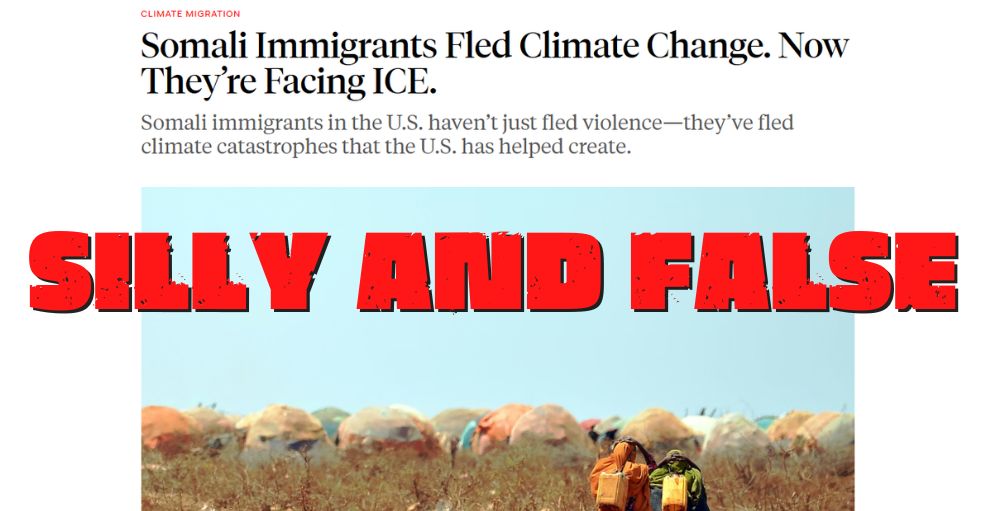
The New Republic (TNR) posted an article titled “Somali Immigrants Fled Climate Change. Now They’re Facing ICE,” claiming that Somali migrants in the United States have been driven out of their country by climate-change caused drought. This is false, or at least incomplete. Drought is a natural part of the region, even multi-year drought, and the present one is no different than the region has experienced with some regularity historically. It is civil strife and government corruption, resulting in continued poverty, that is leading Somalis to flee their homeland. With present governing institutions and security, they have been unable to improve water handling practices. Climate change has nothing to do with Somali emigration elsewhere in the region or to the United States, as even those interviewed for the article acknowledge.
TNR undermines its titular claim that unprecedented man-made climate change has forced Somalians to migrate by admitting that Somalian culture has “deep-rooted traditions of movement and migration.” TNR goes on to say that “Somalis have been caught in civil war and unrest for decades, and many have migrated to Kenya, Ethiopia, Europe, and the United States.”
Somehow not noticing the actual central point of that statement, that Somalians often move and that political strife has kept them destabilized, TNR says that climate change plays a “pervasive role” in the migration.
TNR claims that a multi-year drought “made a hundred times more likely due to warming caused by fossil fuel emissions—is affecting Somali people’s decisions to either relocate internally or migrate across international borders.”
Incredibly, later in the article, TNR refutes its own suggestion that this drought is worse, and pushing unprecedented migration, by explaining that this is how farmers have long dealt with drought in Somalia:
Traditionally, Somali pastoralists had resilient ways to deal with changes in rainfall and drought patterns, where families migrated and moved on a regular basis, even crossing borders in the process. But the nature of climatic changes—and conflict—overwhelmed their traditional capacities, leading to more rural-urban migration within the country and in East Africa.
That’s right, severe drought is something Somalians have dealt with for ages, long enough to have known traditions regarding adaptation to the dry periods.
There is no evidence that this drought is worse than those that drove historic migration.
The cited claim that recent drought in Somalia was made “a hundred times more likely” by climate change is not based on sound science. It comes from an attribution study from World Weather Attribution that specifically seeks to tie various weather conditions to human-caused climate change, they do not come to any other conclusions. Climate Realism has gone into the specifics of how unscientific World Weather Attribution studies are here, here, and here.
The TNR piece says that “[f]rom 2020 to 2023, the East Africa region had five failed rainy seasons, an unprecedented drought and climatic episode not seen in 40 years, which led to 70 percent crop loss, three million livestock deaths, and the displacement of about 2.9 million people in Somalia, according to some estimates.”
Admitting that a weather event also happened 40 years ago should tell a writer that their argument about something being “unprecedented” – meaning, without precedent, or never happened before—is faulty.
In fact, studies and data show a long history of swings between severe drought and monsoon floods in the region, and they show that nothing about modern drought is unprecedented. Paleo studies, including one published in Science, show that “intervals of severe drought lasting for periods ranging from decades to centuries are characteristic of the monsoon and are linked to natural variations in Atlantic temperatures.”
Climate Realism has covered this very claim before: In Anthony Watts’ “No, CBS News, Drought in Somalia is Not Being Driven by Climate Change,” he compared natural weather-driving patterns like the Atlantic Meridional Oscillation (AMO) and recent drought in Somalia and found repeated patterns of drought that were similarly severe.
Somalia is part of the Sahel region, and Watts shared this graphic of the region’s rainfall index since 1900, which shows that the rainfall in the Sahel varies widely over time:
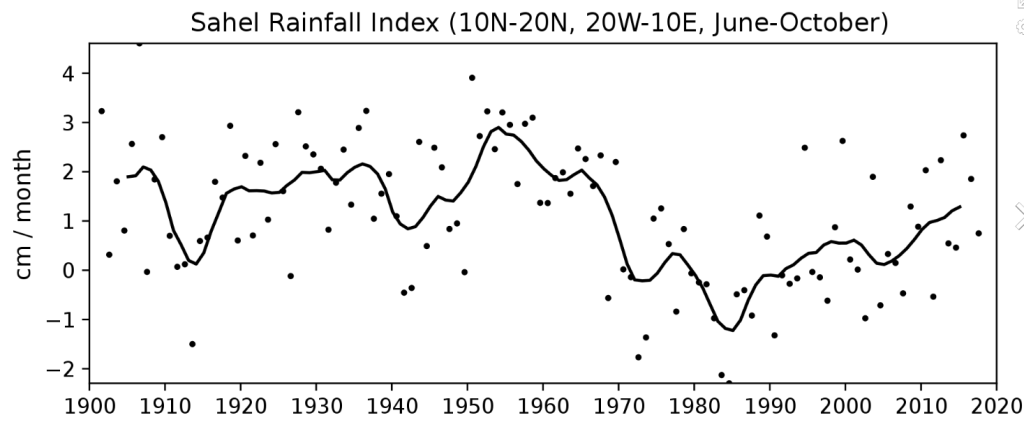
Figure 1: More than a century of rainfall data in the Sahel show an unusually wet period from 1950 until 1970 (positive index values), followed by extremely dry years from 1970 to 1991. (negative index values). From 1990 until present rainfall returned to levels slightly below the 1898–1993 average, but year-to-year variability was high. Source: Benedikt Seidl – based on JISAO data
Additionally, comparing crop production data between Somalia and neighboring countries like Ethiopia and Kenya reveals that even when drought impacts East Africa, Somalia is uniquely incapable of maintaining agricultural production. During the same period in which Ethiopia and Kenya saw increasing production in vital cereal crops, UN Food and Agriculture Organization (FAO) data show Somalia declining. (See figure below)
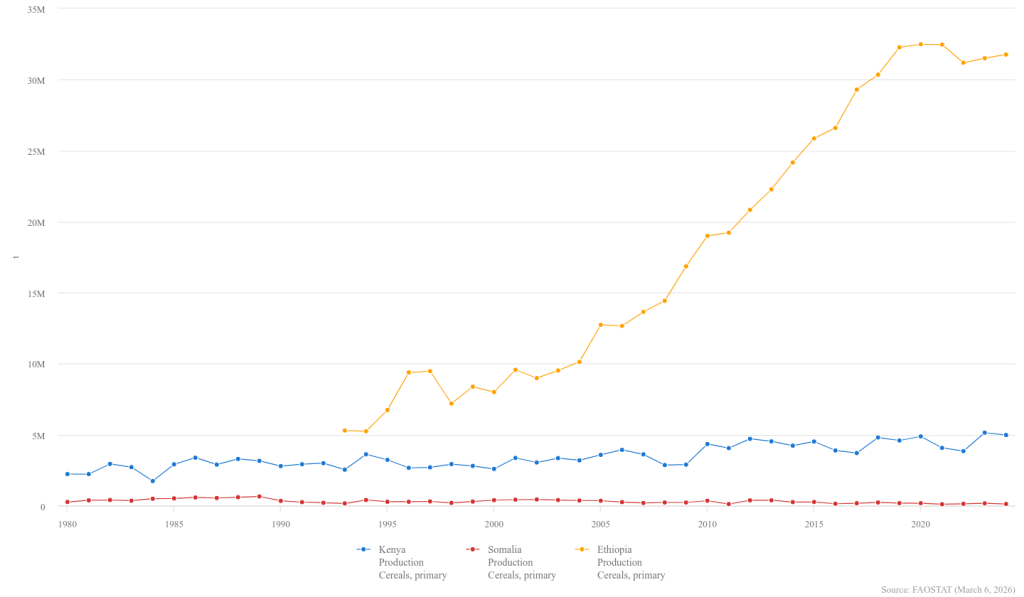
Is climate change not hitting Kenya and Ethiopia? What is the difference?
While Somalia has a long history of severe, recurring droughts, the worst drought in the past 50 years was the “Long-tailed Drought” from 1973 to 1975. That drought, and a subsequent similarly deadly drought in the early 1980s, occurred when the Earth was in a cooling spell and atmospheric carbon dioxide was much lower than today.
Somalia’s civil war and resulting destruction and corruption is the prime force behind Somalia’s emigration. Ironically, one of the interviewees in the TNR piece says as much:
Drought does not necessarily lead to famine and does not always lead to migration,” said Abdi Samatar, a Somali scholar and geographer at the University of Minnesota […] Somalis were unable to “put Humpty Dumpty back together in their country,” and in the absence of government support, “people have to do what they can for themselves,” Samatar added.
We at Climate Realism could not have said it better ourselves, though we have explained as much in past articles where mainstream outlets tried to link climate change and Somalia’s migration issue.
The New Republic’s effort to tie Somalians fleeing their country for the United States to climate change was a flawed, agenda-driven effort from the start. Even when those interviewed by TNR link the mass exodus of residents from Somali to other factors, TNR persists in pushing the narrative that climate change is playing a “pervasive role.”
It is true that Somalia is suffering through a severe, life threatening drought. It is also true that such droughts are not unprecedented but have been common throughout the region’s history. The nation’s unstable government and the ongoing, long-standing, civil war bear far more of the blame than climate change, especially since there is little or no evidence that Somalia’s climate has changed much over the past century.
The current drought is hitting Somalia’s populace worse than those of nearby countries in the region because of the political instability there. The New Republic was told this by the experts they interviewed but chose to ignore it to advance a climate scare story. Evidently, it’s too much to hope for honest journalism at The New Republic.
Linnea Lueken is a Research Fellow with the Arthur B. Robinson Center on Climate and Environmental Policy.
Buck Dancing for Zion: Kenya’s and Nigeria’s Growing Love Affair With Israel
Israel has found new golems to exploit on the Dark Continent
José Niño Unfiltered | February 18, 2026
In October 2025, hundreds of Kenyans marched through Nairobi’s Central Business District carrying banners reading “Israel Belongs to God”. Bishop Paul Karanja declared to the crowd, “We are here to declare that Israel is not alone. We will continue to stand with them.” The demonstration commemorated the second anniversary of the October 7, 2023 Hamas attacks, but it represented something far more significant than a single day of solidarity. It revealed a geopolitical quirk that has left analysts scrambling for explanations.
According to a June 2025 Pew Research Center survey covering 24 countries, Kenya showed 50% favorable views toward Israel with 42% unfavorable. Nigeria registered 59% favorable and 32% unfavorable. These were the only two nations with majority positive sentiment toward Israel. In 20 of the 24 countries surveyed, majorities held negative views. Kenya and Nigeria, in addition to India, stand virtually alone in their enthusiasm for the Jewish state at precisely the moment when global opinion has turned sharply against it.
This pro-Israel shift among the populations in Kenya and Nigeria is not a sudden development born from the Gaza war. It represents years of cultivation, theological indoctrination, security partnerships, and strategic maneuvering that transformed two African nations into some of Israel’s most promising partners in the post-October 7 age.
The most fundamental explanation behind this rise in pro-Zionist sentiment lies in the explosive growth of evangelical and Pentecostal Christianity across both countries.
Nigeria houses one of the world’s largest evangelical populations, with Operation World estimating the country ranks either third or fourth globally in total evangelical numbers, trailing only the United States and potentially Brazil or China depending on methodology. Pew Research Center puts Nigeria’s total Christian population at 93 million as of 2020, a 25% increase from 2010, making it the sixth-largest Christian nation in the world and the largest on the African continent.
Pentecostalism has become deeply embedded in Nigerian Christianity, though its precise share remains debated. The U.S. State Department’s International Religious Freedom Report, citing the Christian Association of Nigeria, places Pentecostals at approximately 30% of the Christian population, with an additional 10% identifying as evangelical Christians in non-Pentecostal traditions and African-instituted charismatic churches accounting for another 5 to 10%. When Pentecostal and charismatic Christians across all denominations are counted together, researchers at the Center for the Study of Global Christianity at Gordon-Conwell Theological Seminary place the combined Pentecostal and charismatic share of Nigerian Christianity significantly higher, reflecting the deep penetration of charismatic practice even within mainline churches. That figure has exploded in recent decades, driven by aggressive evangelization, media expansion and the global reach of Nigerian-founded movements like the Redeemed Christian Church of God and Deeper Life Bible Church.
Kenya presents a different evangelical landscape but one equally conducive to pro-Israel theology. According to the 2019 national census, evangelicals comprise 20.4% of Kenya’s total population out of 47.6 million residents — roughly 9.6 million by the census’s strict denominational count. Broader estimates that apply a wider evangelical definition, including researcher Sebastian Fath’s figures cited by Lifeway Research, place Kenya’s evangelical population closer to 20 million. An estimated 30 to 35% of Kenya’s population identifies as Pentecostal, indicating significant overlap between evangelical and Pentecostal identities.
Together, Nigeria and Kenya account for approximately 78 million evangelicals under the broader definitional framework, representing over 42% of Africa’s estimated 185 million evangelical population. This concentration reflects broader patterns of African Christianity’s expansion and the global southward shift of Christian demographics.
The theological framework binding these believers to Israel rests on Christian Zionism, a dispensationalist interpretation that views the modern state of Israel as fulfillment of biblical prophecy. Genesis 12:3 serves as the foundational text. “I will bless those who bless you, and whoever curses you I will curse.”
The International Christian Embassy Jerusalem, a global evangelical organization, has actively cultivated ties with Nigerian churches, organizing pilgrimages and promoting pro-Israel narratives. Pastor Rex Ajenifuja of I Stand With Israel has mobilized grassroots campaigns emphasizing that “Nigeria loves Israel” and framing solidarity as a spiritual obligation. Prominent Nigerian pastors have explicitly connected pro-Israel theology to national prosperity. During visits to Israeli settlements in the Occupied Palestinian Territories, Adeboye explained, “The problems that we are seeing between the Jews and the rest of the world, is because they are the favorites of God. When you are special to God, then automatically the devil wouldn’t like you either.”
In Kenya, the theological stance intersects directly with political power. Current President William Ruto’s administration has deepened ties with evangelical leaders who have publicly endorsed Israel as part of their eschatological worldview. During prayer services, Ruto and First Lady Rachel Ruto — a devout evangelical known for her faith diplomacy program that enlists clergy in matters of state — have woven Israel into Kenya’s spiritual identity. Ruto himself prayed at Jerusalem’s Western Wall during a 2023 state visit, with the site’s rabbi noting it was the longest prayer by any world leader he had witnessed there. At a faith rally convened by Rachel Ruto, crowds waved Kenyan and Israeli flags together while praying for both nations. Influential evangelical figures have openly equated support for Israel with national blessing.
Bishop Dennis Nthumbi, Africa Director of the Israel Allies Foundation, has described Kenya’s bond with Israel as a “covenantal, long-standing relationship” that no politician can sever. Bishop Mark Kariuki, the presiding bishop of Deliverance Church Kenya and former chairman of the Evangelical Alliance of Kenya, has aligned himself with the broader conservative evangelical political theology that underpins pro-Israel sentiment across the continent. The Kenyan government provided active support for the October 2025 pro-Israel march. Speaking in a televised interview on Kenya’s Elevate TV ahead of the march, Africa-Israel Initiative president Bishop Joshua Mulinge confirmed that the government had granted permits and provided police escorts throughout the route. “The Kenyan government has been very supportive,” he said. “We thank God for our head of state and for the entire government.”
The Times of Israel reported that the October 2025 march aimed to call Kenyan Christians “out of the prayer closet and into the streets” to publicly express solidarity with Israel beyond private prayer. Speakers emphasized that “Christianity originated in Jerusalem and that the Church remains spiritually rooted in Israel.” A Norwegian representative of the Africa Israel Initiative stated, “I believe that anybody who blesses Israel, as the Bible says, is blessed. I think it should be in every Christian’s heart to support Israel.”
The political dimensions of evangelicalism in both countries reveal important patterns of religious influence on governance. In Nigeria, evangelical and Pentecostal movements have shaped political discourse around moral conservatism, prosperity theology, and spiritual warfare against corruption, even as the country’s Christian-Muslim demographic balance remains contested. Pew Research places Muslims at 56.1% and Christians at 43.4% as of 2020, though Afrobarometer surveys of adults have found Christians in the majority. Kenya’s evangelical community has achieved more direct political influence, particularly through President Ruto’s administration, which explicitly appeals to evangelical constituencies and employs religious rhetoric in governance.
A 2024 study by the French Institute for Research in Africa described Ruto as the first born-again president in what it called “the making of a born-again republic,” documenting how key evangelical leaders including Bishop Mark Kariuki of Deliverance Church Kenya, Bishop David Oginde of CITAM, and evangelist Teresia Wairimu of Faith Evangelism Ministries described Ruto as God’s appointed ruler during his 2022 campaign. This theological stance embraced by Ruto has been used to justify the suppression of pro-Palestinian activism, as evidenced by Kenyan police’s arrest of Kenyans displaying Palestinian flags in 2023.
Theology alone does not explain the depth of Kenya and Nigeria’s alignment with Israel. Strategic security cooperation provides pragmatic reinforcement for religious sentiment.
Nigeria’s fight against Boko Haram and Kenya’s struggles with al-Shabaab have led to intelligence sharing agreements and military training programs facilitated by Israel. These partnerships, while pragmatic, are often justified through evangelical rhetoric that conflates Islamist extremism with broader anti-Israel sentiment. Nigerian evangelicals have long portrayed Boko Haram’s insurgency as evidence of jihadist violence targeting Christians, reinforcing theological solidarity with Israel as a fellow victim of Islamist terrorism. That narrative, however, is contested by researchers including Brookings and conflict-monitoring group ACLED, which has found that the majority of Boko Haram’s victims have been Muslim, with religion-targeted attacks against Christians accounting for only 5% of civilian-targeting events recorded in its data.
In November 2011, Israeli Prime Minister Benjamin Netanyahu met with Kenyan Prime Minister Raila Odinga in Jerusalem and declared that “Kenya’s enemies are Israel’s enemies so we should be able to help,” pledging to build a coalition against fundamentalism that would bring together Kenya, Ethiopia, South Sudan and Tanzania. The meeting produced a memorandum of understanding on homeland security cooperation, with both Netanyahu and Israeli President Shimon Peres committing to help Kenya secure its borders against militant threats.
Similarly, Israeli ambassador Gil Haskel stated, “Israel is willing to send consultants to Kenya to help Kenya secure its cities from terrorist threats and share experience with Kenya because the operation in Somalia is very similar to Israel’s operations in the past, first in Lebanon and then in Gaza Strip.”
In February 2016, President Uhuru Kenyatta traveled to Jerusalem to strengthen counterterrorism cooperation, with discussions focused on combating al-Shabaab following the 2013 Westgate Mall attack and the 2015 Garissa University massacre. Nadav Peldman, Israeli deputy ambassador to Kenya, stated that Israel was “ready and willing to assist Kenya” in fighting terrorism, calling it “a heinous crime that should be confronted with the same force it projects.”
That defense relationship has since deepened under President William Ruto, who negotiated a $26 million Israeli government-backed loan in July 2025 to acquire the SPYDER surface-to-air missile system manufactured by Rafael Advanced Defense Systems. The system, delivered in December 2025, accounted for roughly 70% of Kenya’s Ministry of Defence development budget for FY2025/26. The partnership spans counterterrorism operations, cybersecurity infrastructure, intelligence sharing, and joint military training.
Israeli-Kenyan relations have an economic dimension to them as well. In Kenya, Israeli drip irrigation technology — including low-pressure systems distributed through MASHAV — has been deployed to boost food security, alongside a 2016 Jerusalem Declaration in which Kenya and Israel committed to a 10-point water and irrigation cooperation framework. On the digital side, Kenya and Israel launched the Cyber-Dome Initiative between Israel’s National Cyber Directorate and Kenya’s Communications Authority, and have held Cyberweek Africa in Nairobi annually since 2023 to expand cybersecurity capacity-building across the continent.
The Israel-Nigeria partnership followed a parallel trajectory, with Nigeria’s Ministry of Defence reaffirming in April 2025 its commitment to “enhancing military cooperation with the State of Israel” following a meeting between Permanent Secretary Ambassador Gabriel Aduda and Israeli Ambassador Michael Freeman. The two sides discussed joint operations, knowledge exchange, defense industry development, and plans to finalize a new bilateral defence agreement, with Aduda pledging that Nigeria would “engage in strategic initiatives to replicate successful Israeli military cooperation frameworks.”
Nigeria, meanwhile, hosts over 50 Israeli companies operating across construction, infrastructure, hi-tech, communications and IT, and agriculture and water management. Cultural ties have also deepened: in 2021 the Israeli ambassador to Nigeria and the country’s vice president initiated a collaborative film co-production between Israeli and Nollywood filmmakers to mark 60 years of diplomatic relations. Israel’s MASHAV agency, established in 1958, provides agricultural training, water management, and health programs across East Africa, with Kenya, Uganda, Tanzania, Malawi, and Seychelles identified as its primary African partners for capacity-building.
None of the growing pro-Zionist sentiment in Kenya and Nigeria is a coincidence. Well-funded pro-Israel organizations have systematically cultivated African Christian support through parliamentary lobbying, church mobilization, and faith-based diplomacy.
The Washington, D.C.-based Israel Allies Foundation maintains a global parliamentary network of more than 1,500 pro-Israel lawmakers, coordinating faith-based caucuses in Kenya, Nigeria, and across Africa. Bishop Scott Mwanza of Zambia served as the foundation’s inaugural Africa Director, coordinating existing caucuses across the continent. He was succeeded by Rev. Dennis Nthumbi, who currently oversees 16 Israel Allies Caucuses as Africa Director and has been a leading voice in mobilizing Christian parliamentary support for Israel across the region.
In September 2024, 25 African lawmakers from 19 countries gathered in Addis Ababa for the first Pan-Africa Israel Parliamentary Summit, where they signed the “Addis Ababa Declaration of Africa-Israel Cooperation and Partnership.” The declaration, which included lawmakers from Kenya and Nigeria among others, affirmed Jerusalem as “the legitimate, undivided, and eternal capital of the Jewish State of Israel,” condemned anti-Zionism as antisemitism, and called for strengthening bilateral ties and supporting Israel’s observer status at the African Union.
Key Kenyan organizations include the Africa-Israel Initiative, launched in Zambia in April 2012 by a coalition of African church leaders including Bishop Joshua Mulinge of Kenya, who now serves as its president and leads the movement across more than 20 African nations. The Israel Allies Foundation Africa Division is led by Rev. Dennis Nthumbi. King Jesus Celebration Church Worldwide, chaired by Bishop Paul Karanja, co-convened the 2025 “March for Israel” through Nairobi’s Central Business District alongside the Africa-Israel Initiative and the Israel Allies Foundation. The Evangelical Alliance of Kenya serves as the national umbrella body for evangelical churches.
Nigerian organizations include the Lagos-based I Stand with Israel International Friendship Organization, led by Pastor Rex Ajenifuja; Christians United for Israel Nigeria Chapter, part of the global CUFI network founded by American pastor John Hagee; and the Africa for Israel Christian Coalition, founded by South African Israel lobbyist Luba Mayekiso, whose Nigerian affiliates have mobilized over 3,000 pastors across 22 states.
Prominent Nigerian evangelical leaders include Pastor Chris Oyakhilome, founder of Christ Embassy; Pastor Enoch Adeboye, General Overseer of the Redeemed Christian Church of God, who has visited Israel multiple times and donated two ambulances to Magen David Adom, Israel’s emergency blood services organization; and the late Prophet TB Joshua, founder of Synagogue Church of All Nations, who was named “Tourism Goodwill Ambassador for Israel” by Minister of Tourism Yariv Levin following a 2019 evangelical crusade in Nazareth.
Nigerian Christian pilgrimages to Israel have become a significant phenomenon. According to the Nigerian Christian Pilgrim Commission, approximately 18,000 Christian pilgrims from Nigeria travel to holy sites in Israel and Jordan each year on average, with the NCPC targeting around 10,000 pilgrims annually for its organized exercises. The NCPC organizes multiple pilgrimage cycles throughout the year — including Easter, Women’s, Youth, and General pilgrimages — with participants praying for Nigeria’s leaders and offering intercessory prayers at holy sites. The 84,000 figure in the original text is not supported by Israeli tourism data; Israel Central Bureau of Statistics figures show Nigerian tourist arrivals peaked at 12,700 in 2019, while a 2025 analysis of the decade from 2015 to 2025 estimated over 80,000 total Nigerian Christian pilgrimages over that entire ten-year span.
Former President Goodluck Jonathan — a practicing Pentecostal Christian who, as sociologist Ebenezer Obadare documented in Pentecostal Republic, cultivated strong ties with Nigeria’s Pentecostal constituency — played a pivotal role in what might be called “pilgrimage diplomacy.” In October 2013, he became the first sitting Nigerian president to undertake a pilgrimage to Israel, leading a delegation that included six state governors — including Governors Elechi of Ebonyi, Obi of Anambra, Akpabio of Akwa Ibom, Suswam of Benue, Jang of Plateau, and Orji of Abia — along with ministers and church leaders including CAN President Pastor Ayo Oritsejafor.
Initial pre-trip reports of 19 governors and 30,000 pilgrims proved to be overblown. Jonathan visited holy sites, met with President Shimon Peres and Defense Minister Bogi Ya’alon, and signed bilateral agreements on aviation. He made a second private pilgrimage in 2014, meeting Prime Minister Netanyahu with an entourage of about 20 political and religious leaders.
Jonathan expressed security solidarity when he wrote to Prime Minister Netanyahu during the search for three Israeli teens abducted by Hamas in 2014, stating, “I assure you that we are in solidarity with you, as we believe that any act of terrorism against any nation or group is an act against our common humanity.”
These visits had diplomatic consequences. In December 2014, when the UN Security Council voted on a Jordanian-tabled resolution calling for Israeli withdrawal from occupied territories and Palestinian statehood within three years, Nigeria abstained — a last-minute reversal that left the resolution one vote short of the nine needed to pass. The Guardian reported that both Israeli Prime Minister Netanyahu and U.S. Secretary of State John Kerry had phoned President Jonathan to ask him not to support the resolution. Nigeria’s abstention, alongside those of the UK, Lithuania, South Korea, and Rwanda, meant the US and Australia’s opposing votes were sufficient to defeat the measure without Washington needing to invoke its veto — a significant diplomatic victory for Israel given Nigeria’s historical support for the Palestinian cause.
Kenyatta played a particularly instrumental role in the diplomatic warming between Kenya and Israel. In February 2016, he visited Jerusalem for counterterrorism talks with Netanyahu. Netanyahu then reciprocated with a historic visit to Kenya in July 2016 — the first visit by an Israeli prime minister to sub-Saharan Africa in nearly 30 years. It was during that Nairobi press conference, not during Kenyatta’s Jerusalem visit, that Netanyahu declared: “Israel is coming back to Africa, and Africa is coming back to Israel.” Kenyatta in turn pledged to help Israel regain observer status at the African Union.
Following the October 7, 2023 Hamas attacks, President William Ruto posted on X that “Kenya joins the rest of the world in solidarity with the State of Israel and unequivocally condemns terrorism and attacks on innocent civilians in the country. The people of Kenya and their government hereby express their deepest sympathy and send condolences to the families of all victims… Kenya strongly maintains that there exists no justification whatsoever for terrorism, which constitutes a serious threat to international peace and security. All acts of terrorism and violent extremism are abhorrent, criminal and unjustifiable, regardless of the perpetrator, or their motivations.”
The statement also called for de-escalation and a ceasefire — context omitted from early reporting — and drew sharp criticism from Kenya’s Muslim leaders and some opposition figures. Ruto subsequently softened his position at a November 2023 Arab-African summit in Riyadh, where he stated that “terrorism cannot be an answer to any conflict; neither is occupation” and reaffirmed Kenya’s support for a two-state solution.
Based on post-October 7 trends, the trajectory of support for Israel augurs a distinctly melanin-enhanced future, as centuries-old European animus toward organized Jewry—now reactivated by the industrial-scale genocide in Gaza—diminishes traditional alliances on the Old Continent. Under these circumstances, Israel must pivot toward emergent partners in the Global South, where nations like Kenya and Nigeria, buoyed by decades-long philosemitic trends, can provide millions of new golems for world Jewry to tap into.
Concomitant with Israel’s burgeoning alliance with India—itself a bastion of Hindu nationalist affinity for the Jewish state—this reconfiguration signals that pro-Zionism will inexorably become brown-coded within mere decades, as the Global South’s burgeoning populations eclipse fading Euro-American sympathies.
No, Al-Jazeera, Climate Change Hasn’t Altered African Flood and Drought Patterns
By Anthony Watts | Climate Realism | February 3, 2026
Al Jazeera (AJ) recently published an article titled “Drought in the east, floods in the south: Africa battered by climate change” by Haru Mutasa, in which the reporter details recent experiences of drought in East Africa and flooding in southern Africa, asserting that those weather events are proof that climate change is battering the continent. This is false. The article relies on flimsy content such as personal observation, interviews, and evocative imagery to imply causation, ignoring data and trends that show no appreciable changes in flood or drought patterns over time.
Mutasa asserts that “rising seas and intensifying storms” and shifting rainfall patterns are already devastating livelihoods, citing the author’s personal field observations as evidence of a broader climate crisis. Readers are shown photos of dry riverbeds, dead livestock, submerged neighborhoods, and distressed residents, then invited to connect these scenes directly to global warming. The emotional impact is real, but emotion is not evidence.
Let us start with AJ’s most basic error: weather is not climate. Climate is defined by long-term patterns measured over decades, typically 30 years or more. A drought in one region followed by floods in another over a few weeks or months says nothing about a durable climate trend. Africa’s climate has always been highly variable, with sharp swings driven by ocean–atmosphere cycles such as the El Niño–Southern Oscillation and the Indian Ocean Dipole. Short-term extremes—sometimes back-to-back—are a known feature of the region, not a recently discovered diagnostical proof of climate change.
The historical record bears this out. Southern and eastern Africa experienced severe droughts and catastrophic floods long before modern greenhouse gas emissions rose. Mozambique’s Limpopo River basin, featured prominently in the article’s flood imagery. The area has a long history of major inundations, including the devastating 2000 Mozambique floods, which displaced hundreds of thousands and occurred during a strong El Niño year. East Africa’s Horn has likewise seen repeated, multi-year droughts throughout the twentieth century, interspersed with episodes of extreme rainfall. These precedents matter because they show that today’s events are consistent with a long pattern of variability rather than proving a novel climate regime.
In fact, science has shown a 50-year seasonal variability across centuries in East African droughts and floods recorded in lake sediments.
When measured data are consulted instead of anecdotes, the alarm bells fade. Climate at a Glance summarizes the global evidence in “Floods” and “Drought,” explaining that there is low confidence in any increasing trend of global flood frequency or magnitude and that drought trends are regionally mixed, not universally worsening. These conclusions align with the cautious language used by the Intergovernmental Panel on Climate Change (IPCC) Sixth Assessment Report (AR6), which emphasizes uncertainty and regional variability rather than blanket claims of intensification.
The AJ article substitutes interviews for analysis. Quoting local residents and aid workers about hardship may document suffering, but it does not diagnose cause. Infrastructure deficits, land-use changes, deforestation, river management, dam releases upstream, population growth in floodplains, and limited early-warning systems all play decisive roles in disaster outcomes across Africa. Climate Realism has repeatedly shown how media coverage overlooks these factors while attributing complex events to climate change by default, as catalogued in its Africa-related reporting and extreme-weather analyses accessible via Climate Realism’s search on floods and droughts and Climate Realism’s coverage of drought claims.
Even within the article’s narrative, local management issues loom large. Mutasa notes dam releases in South Africa’s Mpumalanga province sent additional water downstream into Mozambique—an operational decision with immediate hydrological consequences that has nothing to do with global temperature or climate change. Treating such factors as footnotes while elevating climate change as the primary driver of flooding misinforms readers about where real risk reduction lies.
Serious climate reporting distinguishes between events and trends, and between personal experiences and measured evidence.
By presenting interviews and moment-in-time scenes as confirmation of a continent-wide climate verdict, Al Jazeera is misleading its audience by making a causal connection where data show none. Africa’s vulnerability to climate and weather extremes is real, but the causes are multifaceted and long-standing. Ignoring historical precedents and measured trends in favor of an alarming narrative certainty does not inform the public; it misleads it with false headlines.
Collapsing Empire: US Bows To African Revolutionaries
By Kit Klarenberg | Al Mayadeen | February 6, 2026
On February 2nd, the BBC published an extraordinary report on how the Trump administration “has declared a stark policy shift” towards Burkina Faso, Mali, and Niger, the governments of which have sought to eradicate all ties to Western imperial powers, and forged the Alliance of Sahel States (AES). The independent bloc is a revolutionary enterprise, with the prospect that further countries will follow its members’ lead. And Washington is under no illusions about the new geopolitical realities unfolding in Africa.
The British state broadcaster records how Nick Checker, State Department African Affairs chief, is due to visit Mali to convey US “respect” for the country’s “sovereignty”, and chart a “new course” in relations, moving “past policy missteps.” Checker will also express optimism about future cooperation with AES “on shared security and economic interests.” This is an absolutely unprecedented development. After military coups deposed the elected presidents of all three countries 2020 – 2023, the trio became Western pariahs.
France and the US sought to isolate and undermine the military governments, halting “cooperation” projects in numerous fields. Meanwhile, the Economic Community of West African States, a neocolonial union of which all three were members, first imposed severe sanctions on Burkina Faso, Mali, and Niger, before its combined armed forces prepared to outright invade the latter in summer 2023. The three countries didn’t budge, and in fact welcomed Western isolation, forging new international partnerships and strengthening their ties. ECOWAS military action never came to pass.
In January 2025, the trio seceded from the union and created AES. Western-funded, London-based Amani Africa branded the move “the most significant crisis in West Africa’s regional integration since the founding of ECOWAS in 1975,” claiming it dealt “a significant blow to African… cooperation architecture.” Meanwhile, Burkina Faso’s leader Capt Ibrahim Traoré has become a media hate figure. A disparaging May 2025 Financial Times profile slammed him as a cynical opportunist leading a “Russia-backed junta”, and his supporters a “cult”.
As the BBC unwittingly explains, such antipathy towards Traoré stems from establishing himself “as a standard-bearer in resisting ‘imperialism’ and ‘neocolonialism’.” Via “vigorous social media promotion, he has gained huge support for this stance and personal popularity among young people across the continent and beyond,” ever since seizing power in September 2022. Far from just talk, Traoré and his fellow AES “junta” leaders have systematically sought to neutralise malign Western influence locally, while pursuing left-wing economic policies for the good of their populations.
France and the US have proven markedly powerless to hamper, let alone reverse, this seismic progress. While officials in Paris and Washington hitherto relentlessly hammered AES’ members over “democracy and human rights” concerns, the BBC reports such considerations will be wholly “absent from the agenda” when State Department officials now visit Mali. In other words, the Empire recognises it no longer has the ability to dictate the composition or policies of regional governments and must engage administrations on their own terms.
‘Despotic Governments’
While generating only occasional mainstream interest, the push by Burkina Faso, Mali, and Niger to rid themselves of Western imperialism has been remarkable in its scope and efficacy. French and US media programmes and channels have been blocked throughout AES. In August 2022, Paris’ forces were sent packing from Mali after a nine-year-long occupation. Two years later, Russian soldiers took over an airbase in Niger housing American forces at the government’s invitation, after authorities demanded Washington withdraw from the country.
These purges have had a knock-on effect in the wider region. For example, in November 2024, Chad abruptly terminated a military agreement, ending France’s long-running occupation of the country. Around the same time, Senegal demanded that the French close their military base in Dakar. The last troops departed in July 2025, leaving Paris with no permanent installations in Central or West Africa. Meanwhile, efforts by AES members to drive Britain, France, and the US out of every major sector of their economies are ongoing.
Right when Chad and Senegal were bidding bon voyage to French forces, Niger seized control of local mining firm Somaïr, a component of state-owned French nuclear company Orano. Somaïr provided a quarter of the uranium supply to European nuclear power plants. Resultantly, EU imports of uranium from Russia rose by over 70%, despite the supposedly crippling sanctions imposed over the Ukraine proxy war. In another bitter irony, Moscow has concurrently cemented itself as a close partner of AES member states in economic and military fields.
This burgeoning relationship has triggered a predictable chorus of condemnation and fearmongering from Western journalists, politicians, and pundits. Yet, a March 2024 poll published by the German Friedrich Ebert Stiftung Foundation found 98% of Malians approve of their country’s bond with Russia, with 83% being “very satisfied” and 15% “rather satisfied”. More generally, the same survey highlighted how Mali’s “junta” enjoys overwhelming public support, about which Western governments can only fantasise.
In all, 81% of respondents believed life in Mali had improved since the military administration took power. A staggering 99% expressed satisfaction with the work of security forces, 95% were optimistic about the country’s future prospects, and 87% rejected calls for an election. Similar results were found in a poll of Burkina Faso’s population in August. A stunning 66% of citizens said it was legitimate for the military to seize power, if “elected leaders abuse their power for their own interests.”
As a fascinating paper by Senegalese academic Ndongo Samba Sylla forensically details, ever since supposed independence was granted to Africa in the 1960s, France and other imperial powers have worked concertedly to ensure its constituent countries are ruled by pliant puppets. Along the way, the West has “shown no scruples in backing odious civilian or military regimes” favourable to their interests. This produces “choiceless democracies” across Africa, with “despotic governments” that come to power “through fraudulent elections and… do not create any welfare for their people.”
‘Lasting Solutions’
Sylla cites the example of Chad, where France sustained a corrupt, brutal dictator, Idriss Deby Itno, in office 1990 – 2021. Following his death, Emmanuel Macron diplomatically backed his son’s “unconstitutional succession”. The French President’s unabashed advocacy for an illiberal, nepotistic power grab is to be contrasted with Macron’s furious censure of the military coups in Burkina Faso, Mali, and Niger, demands they hold elections, and calls for “financial sanctions from African countries, the West and its financial institutions.”
France could impose sanctions directly on the trio due to Paris’ control of the Central Bank of West African States, the financial arm of ECOWAS. Membership ties states to the CFA Franc, a currency created after World War II that allowed Paris to maintain grossly iniquitous trading relationships with its African colonies, when its economy was ravaged and its overseas empire rapidly unravelling. The CFA Franc makes it cheap for members to import from France and vice versa, but prohibitively expensive for them to export elsewhere.
Such forced dependency creates a captive market for the French, and by extension, Europe, decisively blunting local development. Member states are impotent to enact meaningful policy changes, as they lack control over their own economies, forced to take orders from the IMF, World Bank, and Western investors. As Sylla remarks: “No matter who you elect, they will have to stick with the basic economic policy blueprint.” Creating a replacement currency is AES’ next major challenge – although its members have already started constructing a central bank.
AES’ continued existence and successes are anathema to Paris. Since “decolonisation” in Africa in the early 1960s, the French have launched 50 overt interventions in Africa, which doesn’t account for assassinations of anti-imperialist leaders, palace coups, rigged elections, and other skullduggery employed to maintain France’s mephitic, exploitative grip over its former holdings. Delusions of keeping the continent wedged under their heels have not faded, despite the dramatic collapse of French power locally. In April 2024, General Francois Lecointre, former French Army Chief of Staff, declared:
“What we Europeans have in common is the Mediterranean and Africa, where our destiny is at stake… Europe will have an obligation to return to Africa to help restore the state and bring back administration and development. It’s not China, Russia, or Wagner [Group] who are going to provide lasting solutions to the very great difficulties facing these African countries and their people.”
Residents of AES evidently beg to differ, and stand ready to defend their leaders from foreign destabilisation. US officials aren’t unwise to the region’s new power dynamic. In an October 2025 interview with Le Monde, Trump confidante and State Department senior advisor for Africa, Massad Boulos, rejected any suggestion Washington would criticise the Sahel’s military governments, as while “democracy is always appreciated… people are free to choose whatever system is appropriate for them.” The anti-imperialist struggle continues apace in Africa – and for now, revolutionaries are winning.
Muammar Gaddafi’s son assassinated in Libya amid reports of French ‘meddling’ in Africa
The Cradle | February 6, 2026
Saif al-Islam Gaddafi, the prominent son of former Libyan President Muammar Gaddafi, was assassinated by unknown gunmen in Libya on 3 February.
Gaddafi was killed in his home in the town of Zintan, 136km southwest of the Libyan capital, Tripoli.
Gaddafi’s political team released a statement saying that “four masked men” stormed his house and killed him in a “cowardly and treacherous assassination.”
The statement said that he tried to fight off the attackers, who shut off the security cameras at the house “in a desperate attempt to conceal traces of their heinous crimes.”
Gaddafi served as his father’s close advisor from 2000 until 2011, when Muammar Gaddafi was killed by NATO-backed militants with links to Al-Qaeda.
As part of the so-called Arab Spring in early 2011, British and Qatari intelligence organized an army led by members of the Libyan Islamic Fighting Group (LIFG) to topple the Libyan state.
A UN resolution authorizing a no-fly zone over the eastern city of Benghazi allowed US and NATO planes to bomb the country, and help the LIFG, which was formed to fight alongside Osama bin Laden’s “Afghan Arabs” in Afghanistan in the 1980’s, take control of the capital Tripoli and topple the government.
Muammar Gaddafi was murdered by the NATO-backed militants after fleeing his hometown, Sirte, in a military convoy following a battle there in October 2011.
Sirte later fell under the control of Libya’s branch of ISIS, serving as its most significant base outside of West Asia, while the country descended into civil war and chaos.
Saif al-Islam Gaddafi was captured and imprisoned in Zintan in 2011 after attempting to flee the North African country following his father’s killing.
He was released in 2017 as part of a general pardon and had lived in Zintan since.
Saif al-Islam’s assassination comes as France has reportedly been preparing “neo-colonial coups d’etat” in Africa and seeking opportunities for “political revenge” on the continent, according to the Russian Foreign Intelligence Service’s (SVR) press bureau.
French influence in African countries it had formerly colonized is waning, as African nations refused “to serve as puppets of the financial and political oligarchy of French globalists,” the press bureau stated.
“Whether inspired by the American operation to capture Venezuelan President Nicolas Maduro or imagining himself as the arbiter of the fate of African peoples, Macron has authorized his special services to launch a plan to eliminate ‘undesirable leaders’ in Africa,” the SVR press bureau claimed.
The SVR added that France was involved in the attempted coup against military leader and President Ibrahim Traore in Burkina Faso last month.
“Our intelligence services intercepted this operation in the final hours. They had planned to assassinate the head of state and then strike other key institutions, including civilian personalities,” said Burkina Faso security minister Mahamadou Sana.
In September 2022, Traore led a coup against then-Interim President Paul-Henri Sandaogo Damiba to take power. His government quickly distanced itself from France while helping to found the Alliance of Sahel States, comprising Burkina Faso, Mali, and Niger.
The SVR said France was also seeking to destabilize the governments of Mali, the Central African Republic, and Madagascar.
Russia Urges International Community to Curb Arms Flow From Ukraine to Africa
Sputnik – 04.02.2026
Russia calls on the international community to prevent the trafficking of arms and Starlink terminals from Ukraine to militants in African countries, Russian Permanent Representative to the United Nations Vassily Nebenzia said on Wednesday.
“We call on the international community to take effective measures to prevent weapons and their components from falling into the hands of terrorists. The supply of weapons to militants must not go unpunished,” Nebenzia said during a UNSC meeting on threats to international peace and security caused by terrorist acts.
Nebenzia added that weapons from Ukraine find their way through black markets to militants across Africa and their trafficking grows.
The diplomat stressed the need to prevent the ISIS terror group and its affiliates from acquiring and using commercial satellite communication terminals including Starlink.
“We expect the states under whose jurisdiction the relevant technology companies operate to exercise foresight and take effective measures to prevent such technologies from falling into the hands of terrorists,” Nebenzia stressed.
In November 2024, French media reported, citing a military source in Mali, that terrorists from the alliance of Malian armed separatist groups CSP-DPA had traveled to Ukraine for training.
Russian Foreign Ministry spokeswoman Maria Zakharova told RIA Novosti that Ukraine was backing terrorist groups in African states that were friendly to Moscow because it was unable to defeat Russia on the battlefield.
Mali severed diplomatic relations with Ukraine in August 2024.
The West vs. the Rest
How developing countries took control of climate negotiations and what that means for emission reduction.
By Robin Guenier | Climate Scepticism | December 8, 2025
The main reason why, despite countless scientific warnings about dangerous consequences, greenhouse gas (GHG) emissions continue to increase is rarely mentioned. Yet it’s been obvious for several years – at least to anyone willing to see it. It’s this: most countries outside Western Europe, North America and Australasia are either unconcerned about the impact of GHGs on the climate or don’t regard the issue as a priority, focusing instead for example on economic growth and energy security. Yet these countries, comprising about 84 percent of humanityi, are today the source of about 77 percent of emissions; 88 percent if the United States, which has now joined their ranks, is included.ii Therefore, unless they change their policies radically – and there’s no serious evidence of their so doing – there’s no realistic prospect of the implementation of the urgent and substantial cuts in GHG emissions called for by many Western scientists.
To understand how this has happened, I believe it’s useful to review the history of environmental negotiation by focusing in particular on six UN-sponsored conferences: Stockholm in 1972, Rio in 1992, Kyoto in 1997, Copenhagen in 2009, Paris in 2015 and Belém (Brazil) in 2025.
Stockholm 1972
In the 1940s, 1950s and 1960s many Western environmentalists were seriously concerned that technological development, economic growth and resource depletion risked irreversible damage to humanity and to the environment.iii Clearly a global problem, it was agreed that it had to be tackled by international, i.e. UN-sponsored, action.
The result was the UN Conference on the Human Environment held in Stockholm in 1972.iv From its outset it was recognised that, if the conference was to succeed, an immediate problem had to be solved: the perceived risk was almost exclusively a Western preoccupation, so how might poorer countries be persuaded to get involved?v
After all, technical and industrial development were essentially the basis of the West’s economic success and that was something the rest of the world was understandably anxious to emulate – not least to alleviate the desperate poverty of many hundreds of millions of people.vi The diplomatic manoeuvrings needed to resolve this seemingly irreconcilable conflict set the scene for what I will refer to as ‘the Stockholm Dilemma’ – i.e. the conflict between Western fears for the environment and poorer countries’ aspirations for economic growth. It was resolved, or more accurately deferred, at the time by the linguistic nightmare of the conference’s concluding Declaration which asserted that, although environmental damage was caused by Western economic growth, it was also caused by the poorer world’s lack of economic growth.vii
After 1972, Western environmental concerns were overshadowed by the struggle to deal with successive oil and economic crises.viii However two important European reports, the Brandt Report in 1980 and the Brundtland Report in 1987, dealt with the economic gulf between the West and the so-called Third World.ix In particular, Brundtland – echoing Stockholm – concluded that, because poverty causes environmental problems, the needs of the world’s poor should be given overriding priority; a principle to be enshrined in the climate agreement signed in Rio. The solution was the now familiar ‘sustainable development’.x
Rio 1992
Western environmental concerns were hugely re-energised in the late 1980s when the doctrine of dangerous (possibly catastrophic) global warming caused by mankind’s emissions of GHGs, especially carbon dioxide (CO2), burst onto the scene.xi As a result, the UN organised the landmark Conference on Environment and Development (UNCED) – the ‘Earth Summit’ held in Rio in 1992.xii It was the first of a long series of climate-related international conferences that led for example to the so-called ‘historic’ Paris Agreement in 2015.
A key outcome of the 1992 Earth Summit was the United Nations Framework Convention on Climate Change (UNFCCC). Adopted in 1992 and commonly known as ‘the Convention’, it’s an international treaty that came into force in 1994. It remains to this day the definitive legal authority regarding climate change.xiii Article 2 sets out its overall objective:
‘The ultimate objective of this Convention and any related legal instruments that the Conference of the Parties may adopt is to achieve … stabilization of greenhouse gas concentrations in the atmosphere at a level that would prevent dangerous anthropogenic interference with the climate system.’
It’s an objective that’s failed. Far from being stabilised, after 1992 emissions accelerated and, by 2025, emissions had grown by over 65 per cent.xiv This is essentially because the Convention attempted to solve the Stockholm Dilemma by dividing the world into two blocs: Annex I countries (essentially the West and ex-Soviet Union countries – the ‘developed’ countries) and non-Annex I countries (the rest of the world – the ‘developing’ countries). This distinction has had huge and lasting consequences – arising in particular from the Convention’s Article 4.7:
‘The extent to which developing country Parties will effectively implement their commitments under the Convention … will take fully into account that economic and social development and poverty eradication are the first and overriding priorities of the developing country Parties.’xv [My emphasis]
In other words, developing countries were, in accordance with Brundtland’s conclusion, expressly authorised to give overriding priority to economic growth and poverty eradication – even if that meant increasing emissions. And that’s why the Annex I/non-Annex I bifurcation has plagued international climate negotiations ever since: for example, it’s the main reason for the Copenhagen debacle in 2009 and for the Paris failure in 2015 (see below).
Western countries had hoped – even expected – that the Rio bifurcation would in time be modified so that, in line with their development, major developing countries would eventually become members of the Annex I group.xvi But such hopes were dashed at the first post-Rio climate ‘Conference Of the Parties’ (COP) held in Berlin in 1995 (COP1) when it was agreed that there must be no new obligation imposed on any non-Annex I country.
This principle, ‘the Berlin Mandate’, meant that the bifurcation and its associated ‘common but differentiated responsibility’ principle were institutionalised as tenets of the Convention.xvii And, before the next climate conference in 1996 (COP2 in Geneva), G77+China made it clear that this should not be changed.xviii
Kyoto 1997
The impact of this was made harshly apparent at the next conference: COP3 in Kyoto in 1997. Kyoto was supposed to be critically important – the original hope had been that negotiations would result in all countries accepting commitments to reduce their GHG emissions. But, because the US decided that it wouldn’t accept obligations that didn’t apply to other major countriesxix and because of the Berlin Mandate, in the event the agreed Kyoto Protocol reduction obligations applied only to a few, largely Western, countries.xx As a result and because developing countries refused even to acknowledge that they might accept some future obligation, it was becoming obvious to some observers that the UN process was getting nowhere – somehow the developing countries had to be persuaded that emission reduction was in their best interests.
But how? The passage of 25 years hadn’t resolved the Stockholm Dilemma – difficult enough in 1972, the UNFCCC bifurcation and the Berlin Mandate had made it worse. Yet it was recognised that, without these, developing countries might simply refuse to be involved in climate negotiations, making the whole process meaningless – something the UN and Western countries were unwilling to contemplate. So, if Kyoto was a failure, it was arguably a necessary failure if there was to be any prospect of emission reduction in due course. And that was the story for the next twelve years: at successive COP conferences the major developing countries, ignoring increasingly dire climate warnings from Western scientists, refused to consider amending the UNFCCC bifurcation.
A result of that refusal was that many developing countries’ economies continued their spectacular growth, resulting in rising living standards and unprecedented poverty reduction.xxi But inevitably emissions also continued to grow: in just 12 years, from 1997 (Kyoto) to 2009 (Copenhagen) and despite 12 COPs, they increased by over 30%.xxii
Copenhagen 2009
In 2007 the UN’s Intergovernmental Panel on Climate Change (the IPCC), a body that reports every seven years on the current physical scientific understanding of climate change, published its fourth report (AR4) – a report that intensified the West’s insistence that urgent and substantial emission cuts were essential.xxiii
A result was an ‘Action Plan’ agreed at the 2007 climate conference (COP13) in Bali.xxiv It set out how it was hoped all countries would come together at Copenhagen in 2009 (COP15) to agree a comprehensive and binding deal to take the necessary global action. Many observers regarded this as hugely significant: Ban Ki-moon, then UN Secretary General, speaking at Copenhagen said, ‘We have a chance – a real chance, here and now – to change the course of our history’’.xxv And, as always, dire warnings were issued about the consequences of failure: UK Prime Minister Gordon Brown for example warned that, if the conference failed to achieve a deal, ‘it will be irretrievably too late’.xxvi
There was one seemingly encouraging development at Bali: developing countries accepted for the first time that emission reduction by non-Annex I countries might at least be discussed – although they insisted that developed countries were not doing enough to meet their Kyoto obligations.xxvii But the key question of how far the developing countries might go at Copenhagen remained obscure – for example was it at least possible that the larger ‘emerging economies’ such as China and India and major OPEC countries such as Iran and Saudi Arabia might cease to be classified as ‘developing’? The EU and US not unreasonably thought that should happen, especially as it was by then obvious that, unless all major emitting countries, including therefore big developing economies, were involved, an emission cutting agreement would be neither credible nor effective. Some Western negotiators hoped that the bifurcation issue might at last be settled at Copenhagen.
But it wasn’t. In the event, developing countries refused to budge, insisting for example that developed countries’ historic responsibility for emissions was what mattered. As a result, the West was humiliatingly defeated, with the EU not even involved in the final negotiations between the US and the so-called BASIC countries (Brazil, South Africa, India and China).xxviii
One commentator noted:
‘There was a clear victor. Equally clearly, there was a side that lost more comprehensively than at any international conference in modern history where the outcome had not been decided beforehand by force of arms.’ xxix
The Copenhagen failure was a major setback for the West.xxx It was now established that, if the developing countries (including now powerful economies such as China, India, South Korea, Brazil, South Africa, Saudi Arabia and Iran) rejected a suggestion that their economic development be subject to emission control, that position would prevail. Yet by 2010 these countries were responsible for about 60% of global CO2 emissions xxxi; without them, major global emission cuts were clearly impossible.
The years following Copenhagen, from Cancún (COP16) in 2010 to Lima (COP20) in 2014, reinforced the West’s concerns as developing countries continued to insist they would not accept binding commitments to reduce their emissions.xxxii
Paris 2015
It was becoming obvious that, if there was to be any prospect of emission reduction, there had to be some fresh thinking. So the UN proposed a new methodology for the summit scheduled for 2015 in Paris (COP21): instead of an overall global reduction requirement, a new approach should be implemented whereby countries would individually determine how they would reduce their emissions and that this would be coupled with a periodic review by which each country’s reduction plans would be steadily scaled up by a ‘ratcheting’ mechanism – a critically important development.
But, when countries’ plans (then described as ‘Intended Nationally Determined Contributions’ (INDCs)) were submitted to the UNFCCC secretariat prior to Paris, it was clear that little had been achieved: hardly any developing countries had indicated any intention of making absolute emission cuts. Instead their INDCs spoke merely for example of reducing CO2 emission intensity in relation to GDP or of reducing the percentage of emissions from business-as-usual projections.xxxiii
It had been hoped that NDCs (as they became known) would be the vehicle whereby major emerging (‘developing’) economies would at last make emission reduction commitments. Yet they turned out to be a problem that undermined the Paris Agreement – see below. And, in any case, other provisions of the Agreement in effect exempted developing countries from any obligation, moral, legal or political, to reduce their emissions.xxxiv For example, the Agreement was described in its preamble as being pursuant to ‘the objective of the Convention [and] guided by its principles’ and further described in Article 2.1 as ‘enhancing the implementation of the Convention’. In other words, the developed/developing bifurcation remained intact and developing countries could continue to give overriding priority to economic development and poverty eradication. Moreover, under Article 4.4 of the Agreement, developing countries, in contrast to developed countries, were merely ‘encouraged to move over time towards economy-wide emission reduction or limitation targets’. Hardly an obligation to reduce their emissions.
It was not an outcome many wanted. For example, when ex UN Secretary General Kofi Annan was asked in early 2015 what he would expect to come out of the Paris summit, he replied:
‘Governments have to conclude a fair, universal and binding climate agreement, by which every country commits to reducing emissions of greenhouse gases.‘ xxxv
Western negotiators had intended that Paris should have a very different outcome from that achieved. Hence this 2014 statement by Ed Davey, then UK Secretary of State responsible for climate negotiations: ‘Next year in Paris in December … the world will come together to forge a deal on climate change that should, for the first time ever, include binding commitments to reduce emissions from all countries.’ xxxvi
But it didn’t happen. Developing country negotiators, led by China and India, ignored the West’s (in the event, feeble) demands. And Western negotiators, determined to avoid another Copenhagen-like debacle, didn’t press the issue. Hence the Paris agreement’s failure to achieve the West’s most basic aim: that powerful ‘emerging’ economies should be obliged to share in emission reduction.
The Stockholm Dilemma was still unresolved.
Might that change in the near future? Events since 2015 indicate that that’s most unlikely:
A major post-Paris example was a climate ‘action summit’ convened by UN Secretary General António Guterres for September 2019, calling for national plans to go carbon neutral by 2050 and new coal plants to be banned from 2020.xxxvii But, just before the summit, the environment ministers of the so-called ‘BRICS’ countries (Brazil, Russia, India, China and South Africa) effectively undermined it by reaffirming their commitment to ‘the successful implementation of the United Nations Framework Convention on Climate Change (UNFCCC), its Kyoto Protocol and its Paris Agreement’. In other words, these five countries (the source of about 45 percent of emissions) were indicating that they continued to regard themselves, under the UNFCCC and Paris framework, as exempt from any binding reduction obligation.xxxviii As a result the summit was a failure.xxxix
So it was not surprising that COP25 (December 2019 in Madrid) made no real progress: it ended with no substantive agreement on emission reduction and was widely described as another failure.xl
Might that change – for example might major developing countries enhance their NDCs as required by the ‘ratchet’ provision of the Paris Agreement? The test would be the next UN conference (COP26) to be held in Glasgow in November 2021 – postponed from 2020 because of the COVID 19 crisis.xli
But COP26 failed that test. And that was despite it being rated by the Guardian in July 2021 as ‘one of the most important climate summits ever staged’, despite Alok Sharma (COP26’s president) stressing that leaving ‘Glasgow with a clear plan to limit global warming to 1.5C’ would ‘set the course of this decisive decade for our planet and future generations’ and despite Prince Charles (as he then was) giving another of his familiar warnings: ‘Quite literally, it is the last chance saloon. We must now translate fine words into still finer actions.’ xlii
That things were not looking good became apparent when several major emitters (e.g. Brazil, China, India, Russia, Saudi Arabia, Australia, Indonesia and Mexico) either failed to submit a new NDC in 2021 or submitted an updated NDC that was judged to lack any real increase in ambition, thereby failing to comply with the key Paris ‘ratchet’ requirement.xliii Yet the countries referred to above were in 2019 the source of over 40% of global emissions.xliv
COP26 itself got off to a bad start when China’s president Xi and Russia’s president Putin didn’t attend.xlv And the proceedings included various upsets – in particular a formal request made by a group of 22 nations known at the Like-Minded Developing Countries (LMDC), which included China, India and Saudi Arabia, made on 11 November 2021, that the entire section on the mitigation of climate change be removed from the draft COP26 text.xlvi It wasn’t wholly successful as COP26’s concluding text – the ‘Glasgow Climate Pact’ xlvii – did include an appeal for all countries to revisit and strengthen their 2030 emissions targets by the end of 2022. But that was essentially meaningless in practice as many major emitters had already failed to submit sufficiently strengthened NDCs (see above). In other words, COP26 ended with nothing of real importance being achieved.
All this confirmed yet again that developing countries, determined to grow their economies and improve the lives of their people, had no serous intention of cutting back on fossil fuels. But nonetheless the can was once again kicked down the road; this time to COP27 to be held in Sharm El-Sheikh, Egypt in 2022. And in the meantime events moved on much as before with most countries – even the US – increasing their reliance on fossil fuels (especially coal) and global CO2 emissions reaching their highest level ever.xlviii
And it was hardly a surprise therefore when COP27 turned out to be yet another conference that essentially achieved nothing, with one reviewer noting that key mitigation items — such as a 2025 global emissions peak or a phase-out of all fossil fuels — were dropped under pressure from ‘Saudi Arabia, Iran, Russia and other petro-states’.xlix Yet, far from giving up, the West now pinned its hopes on COP28 to be held in Dubai – the ‘first global stocktake’.
And the UN hoped that a ‘Climate Ambition Summit’ called by General Secretary António Guterres in September 2023 would boost the Conference’s prospects. But the absence of big emitters such as the US, China and India meant that the Summit turned out to be of little value.l
However the COP28 ‘stocktake’ – otherwise unremarkable – did include what many commentators thought was an important breakthrough.li In its paragraph 28, it said this:
‘The Conference of the Parties … calls on Parties to contribute to the following … Transitioning away from fossil fuels in energy systems, in a just, orderly and equitable manner, accelerating action in this critical decade, so as to achieve net zero by 2050 in keeping with the science.’
So, commentators said, there you have it: at long last we have an agreement (a ‘pledge’) to transition away from fossil fuels! But of course that wasn’t true. The reality was that Paragraph 28 also said that parties must ‘take account’ of the Paris Agreement and, as specifically confirmed further down in paragraph 38, the ‘stocktake’ reaffirmed Article 4.4 of that Agreement. In other words, developing countries, the source of 65% of global emissions, continued to be exempted from any obligation to cut their emissions.
Attention now moved to Baku, Azerbaijan – to COP29 held in November 2024. But this conference was concerned almost entirely with finance and made no serious progress on emission reduction. And in any case proceedings were overshadowed by Donald Trump’s re-election as US President – causing great uncertainty and concern about future global climate politics.
Such concern was justified: it was over 50 years since the 1972 UN Conference on the Human Environment and there was still no sign of a solution to the Stockholm Dilemma and now a resurgent Trump made one even less likely. Yet once again the circus moved on – this time to Belém in Brazil.
Belém 2025
In the months running up to COP30 its prospects already looked dismal, despite the conference being dubbed ‘the implementation COP’. This was because, despite the Paris Agreement requirement, hardly any significant countries submitted updated NDCs either by February 2025, or even by the extended date at the end of September.lii To make matters even worse, few leaders of major economies turned up for the scheduled pre-COP leaders’ meeting: for example no one came from the United States, China, India, Russia, Indonesia, Japan, Saudi Arabia, Australia, Canada, South Korea, Türkiye or South Korea. Nonetheless Brazil’s President Lula announced that ‘COP30 will be the COP of truth’.liii
However over 56,000 delegates did turn up at the conference – the third largest number at any COP. And Brazil’s environment minister Marina Silva urged countries to have the ‘courage’ to address a fossil-fuel phaseout, and to work towards a roadmap for ending dependence on fossil fuels.liv It was a requirement echoed by about 80 countries which insisted via a letter to the COP President signed by 29 countries (including the UK, France, Spain and various small countries) that, unless the Conference outcome included a legally binding agreement to a ‘roadmap’ for a global transition away from fossil fuels, they would block the planned deal.lv
Unsurprisingly however negotiators from the majority of countries – not just the Arab oil producers as some commentators suggested, but also major countries such as India, China, Indonesia and other developing countries whose economies and peoples’ welfare depend on fossil fuels – showed no interest in the idea and the COP President simply ignored it. Humiliatingly the objectors climbed down. And the words ‘fossil fuels’ were not even included in the finally agreed text.lvi
This astute comment on the failure of COP30 was made by Li Shuo of the Asia Society (described as ‘a long-time observer of climate politics’):
‘This partly reflects the power shift in the real world, the emerging power of the BASIC and BRICs countries, and the decline of the European Union’.lvii
So once again a COP made no progress at all towards meeting the UNFCCC’s 1992 call for the ‘stabilization of greenhouse gas concentrations in the atmosphere’. It’s therefore hardly surprising that many commentators have queried whether there’s really any reason at all for continuing to hold all these huge and essentially pointless conferences.lviii
And it’s not only the Belém debacle that illustrates this. Far from it: nothing that’s happening today justifies any realistic hope that fossil fuels are on their way out. For example, major developing countries, especially India, China and in Southeast Asia, are focusing on coal to bolster economic growth and upgrade national security.lix And overall global emissions are still increasing. The early 2020 emission reductions caused by Covid 19 lockdowns were short-lived: as countries emerged from the pandemic determined to strengthen their economies, emission increases have continued.lx
The harsh reality – confirmed time and time again – is that nothing has really changed since the West’s comprehensive defeat at COP15 in Copenhagen in 2009. The truth is that most countries do not share the West’s preoccupation with climate change. Nor is there any prospect of that view changing for the foreseeable future.
Conclusion
At the time of the Rio Earth Summit in 1992 the West’s emissions were 41 percent of the annual global total – today (without the US) they’re only 9 percent. Thus it’s clearly impossible for what’s left of the West to satisfy many scientists’ calls for an urgent and substantial (about 50%) global emission reduction. That can only happen if all the other major countries completely change their climate policies. And that’s obviously not going to happen.
Yet, despite that clear message from the past thirty or more years of climate negotiation history, it’s a key reality that’s still being overlooked by many in the West: in particular by net zero supporters; by the mainstream media; by many scientific publications; by all climate ‘activists’; by many respected academic and scientific organisations; by politicians, governmental and non-governmental organisations; and by celebrities and social media. And by the United Nations.
It’s quite remarkable that there are still so many Western observers who seem not to have noticed that, over the past fifty years, the nature of the climate debate has radically changed as a result of major global political and economic developments. What’s happened is that what was once the so-called Third World has for a long time been powerful enough to ignore the West and take charge of environmental negotiation – a process that started with the ‘Berlin Mandate’ at COP1 in 1994 (see above). And the increasingly meaningless distinction between the ‘developing’ world and the ‘developed’ world, introduced by the UN in 1992 as a way of persuading poorer countries to get involved in climate negotiation, has paradoxically become the reason why progress on GHG reduction has become virtually impossible.
It’s surely obvious by now that the Stockholm Dilemma will never be resolved. And that there’s nothing the West (or more accurately the EU, the UK, Australia and a few smaller countries) can do about it.
Notes and references
i See https://srv1.worldometers.info/world-population/population-by-region/?utm_source=chatgpt.com
ii See https://edgar.jrc.ec.europa.eu/report_2025?vis=ghgtot#emissions_table
iii See for example Fairfield Osborn’s book The Plundered Planet (1948), William Vogt’s Road to Survival (1948), Rachel Carson’s Silent Spring (1962), the dire predictions in the Club of Rome report, Limits to Growth (1968) and, in particular, Barbara Ward’s report, Only One Earth (1972). Several of today’s environmentalists share the view that economic growth causes environmental degradation. See for example Less is More: How Degrowth Will Save The World (2021) by Jason Hickel.
iv Maurice Strong, a Canadian businessman-turned-diplomat, organised the Conference and was its Secretary General, having first commissioned Limits to Growth (see Note 3) that established much of its intellectual groundwork. He is widely seen as a pioneer of international environmental concern and of institutionalising it within the United Nations.
v At the time these countries were commonly referred to as ‘underdeveloped’ or, preferably, as ‘developing’. The ‘Third World’ was a standard label used for countries outside the Western or Soviet blocs.
vi Franz Fanon’s book The Wretched of the Earth (1961) was very influential in intellectual circles in the West at this time. Indian PM Indira Gandhi’s keynote speech at the Conference sets out the dilemma clearly: http://tiny.cc/dl6lqz. The speech is epitomised by this comment: ‘The environment cannot be improved in conditions of poverty.’
vii See Part One, chapter I (especially ‘proclamation’ 4) of this UN report on the conference: http://un-documents.net/aconf48-14r1.pdf.
viii See for example: https://www.federalreservehistory.org/essays/oil-shock-of-1978-79.
ix For Brundtland, see Our Common Future: http://www.un-documents.net/our-common-future.pdf.
x ibid – see paragraphs 27, 28 and 29 which do little to clarify the meaning of this rather vague concept.
xi Heralded in particular by James Hansen’s address the US Congress in 1988: https://www.sealevel.info/1988_Hansen_Senate_Testimony.html?utm_source=chatgpt.com
xii Described as the largest environmental conference ever held, the Summit’s outcome is outlined here: https://www.sustainable-environment.org.uk/Action/Earth_Summit.php
xiii For the full text of the UNFCCC see: https://unfccc.int/resource/docs/convkp/conveng.pdf
xiv See Note 1 above.
xv The omitted words are concerned with a different, but arguably equally important, issue: finance and technology transfer from developed to developing countries.
xvi See Article 4.2 (f) of the UNFCCC, under which parties might review ‘available information with a view to taking decisions regarding such amendments to the lists in Annexes I and II as may be appropriate, with the approval of the Party concerned’.
xvii See Article 2 (b) here: https://unfccc.int/resource/docs/cop1/07a01.pdf?utm_source=chatgpt.com
xviii This report provides some interesting background re non-Annex I parties’ determination: https://unfccc.int/resource/docs/1996/agbm/05.pdf?utm_source=chatgpt.com
xix See the Byrd-Hagel resolution adopted unanimously by the US Senate in June 1997: https://www.congress.gov/bill/105th-congress/senate-resolution/98/text It stated that the US would not sign a protocol putting limits on Annex I countries unless it imposed specific, timetabled commitments on non-Annex I countries.
xx For the text of the Kyoto Protocol see: https://unfccc.int/resource/docs/convkp/kpeng.pdf. Note in particular how Article 10’s provision that it did not introduce ‘any new commitments for Parties not included in Annex I’ ensured that developing countries were not bound by the Protocol’s emission reduction obligations.
xxi Note for example how China was responsible for an astonishing reduction in poverty from the 1980s to the early 2000s: https://ourworldindata.org/data-insights/extreme-poverty-in-china-has-been-almost-eliminated-first-in-urban-then-in-rural-regions?utm_source=chatgpt.com
xxii See Note 1 above.
xxiii See for example: https://www.ipcc.ch/report/ar4/syr/
xxiv The Bali Action Plan can be seen here: https://www.preventionweb.net/files/8376_BaliE.pdf?startDownload=true
xxv See the UN Secretary-General’s extraordinary speech in Copenhagen just before COP15: https://unfccc.int/files/meetings/cop_15/statements/application/pdf/speech_opening_hls_cop15_ban_ki_moon.pdf
xxvi The full extract: ‘If we do not reach a deal at this time, let us be in no doubt: once the damage from unchecked emissions growth is done, no retrospective global agreement in some future period can undo that choice. By then it will be irretrievably too late.’ See https://www.theguardian.com/environment/2009/oct/19/gordon-brown-copenhagen-climate-talks
xxvii In particular those confirmed by section 1(b)(i) of the Bali Action Plan – see Note 24 above.
xxviii See this overall review of the outcome: http://news.bbc.co.uk/1/hi/8426835.stm.
xxix Rupert Darwall: The Age of Global Warming, 310
xxx The ‘Copenhagen Accord’ was an attempt by some countries to rescue something from this debacle: https://unfccc.int/resource/docs/2009/cop15/eng/l07.pdf. A non-binding document (the Conference only ‘took note’ of it) it stated for example that global temperature should not rise more than 2ºC above pre-industrial levels – although it didn’t specify a date for this.
xxxi See Note 1 above.
xxxii See for example this report on the 2014 conference in Lima: http://tiny.cc/w4zv001
xxxiii For example, China’s INDC said only that it planned to ‘achieve the peaking of carbon dioxide emissions around 2030’ (no mention of the level of such ‘peak’ or of what will happen thereafter) and to ‘lower carbon dioxide emissions per unit of GDP by 60% to 65% from the 2005 level’. And South Korea merely said that it ‘plans to reduce its greenhouse gas emissions by 37% from the business-as-usual (BAU,850.6 MtCO2eq) level by 2030 across all economic sectors’, i.e. emissions will continue to increase but not by as much as they might have done.
Note that ‘Intended Nationally Determined Contributions’ (INDCs) are referred to as ‘Nationally Determined Contributions’ (NDCs) in Articles 3 and 4 of in the Paris Agreement – see Note 34 below. All NDCs submitted to the UNFCCC secretariat can be found here: https://unfccc.int/NDCREG
xxxiv The full text of the Paris Agreement can be found here: https://unfccc.int/files/meetings/paris_nov_2015/application/pdf/paris_agreement_english_.pdf
xxxv From an interview with the Observer in May 2025. Annan’s other comments are also interesting: https://www.kofiannanfoundation.org/publication/we-must-challenge-climate-change-sceptics/
xxxvi See the Ministerial Forward here: https://assets.publishing.service.gov.uk/government/uploads/system/uploads/attachment_data/file/360596/hmg_paris_2015.pdf
xxxvii https://climateaction.unfccc.int/Events/ClimateActionSummit
xxxviii My note was an extract from a press release by the PRC’s Ministry of Ecology and Environment: https://english.mee.gov.cn/News_service/news_release/201908/t20190829_730517.shtml?utm_source=chatgpt.com
xxxix https://populationmatters.org/news/2019/09/un-climate-action-summit-fails-to-deliver-climate-action/
xl http://tiny.cc/zg0w001 The official summary noted how countries such as China — speaking for the bloc including Brazil, India, South Africa — repeatedly called for developed countries to meet financial commitments: http://tiny.cc/3h0w001
xli https://www.reuters.com/article/us-health-coronavirus-climatechange-idUSKBN21J6QC/
xlii http://tiny.cc/js1w001, http://tiny.cc/dv1w001 and http://tiny.cc/zs1w001
xliii https://ca1-clm.edcdn.com/assets/brief_-_countries_with_no_or_insignificant_ndc_updates_2.pdf?utm_source=chatgpt.com
xliv See Note 1 above.
xlv http://tiny.cc/w22w001 and http://tiny.cc/w22w001
xlvi https://kyma.com/cnn-world/2021/11/11/china-and-india-among-22-nations-calling-for-key-section-on-emissions-be-ditched-from-cop26-agreement/?utm_source=chatgpt.com
xlvii The Glasgow Climate Pact can be found here: https://unfccc.int/sites/default/files/resource/cop26_auv_2f_cover_decision.pdf
xlviii See Note 1 above.
xlix See observations here: http://tiny.cc/q52w001
l The Guardian’s view: http://tiny.cc/872w001
li https://unfccc.int/sites/default/files/resource/cma2023_L17_adv.pdf
liii President Lula’s comment can be found here: http://tiny.cc/ja2w001 A prescient observation – although not perhaps in the way he intended.
lv This Guardian article notes how the 29 objectors’ demands were ignored: http://tiny.cc/ei2w001.
lvi https://unfccc.int/sites/default/files/resource/cma2025_L24_adv.pdf
lvii Under ‘EU had a bad COP’ here: https://www.bbc.co.uk/news/articles/cp84m16mdm1o
lviii For example the Guardian is unhappy: http://tiny.cc/ux2w001
lix See this https://www.cfact.org/2025/11/20/coal-is-still-a-fuel-of-choice-in-the-global-south/ and this https://www.instituteforenergyresearch.org/fossil-fuels/coal/coal-is-still-king-globally/
lx See Note 1 above.
Leaked files tie Epstein to Israel-UAE backchannel and possible kompromat
MEMO | January 15, 2026
The notorious sex offender Jeffrey Epstein, widely believed to be an Israeli intelligence asset, played a behind-the-scenes role in nurturing the secret relationship between Israel and the United Arab Emirates (UAE) years before the 2020 Abraham Accords, newly leaked communications reveal.
The revelations emerge from newly obtained material published by Drop Site News as part of an ongoing investigation into Epstein’s political and intelligence connections. The documents, spanning more than a decade, shed light on Epstein’s long-standing friendship with Sultan Ahmed bin Sulayem, the powerful head of the UAE’s DP World, and suggest that Epstein used his connections to promote Israeli commercial, military and surveillance technology in Emirati‑controlled logistics hubs.
Leaked emails show that Epstein not only facilitated strategic ties between Israel and the UAE, but also operated in a context ripe for the gathering or circulation of compromising material—so-called kompromat—on powerful elites. In one exchange, Sulayem joked about wanting “some PUSSYNESS” rather than “BUSINESS” in reference to a mutual female contact. Epstein responded approvingly: “praise Allah, there are still people like you.”
Epstein, who was later found to have registered a neighbouring private island in Sulayem’s name, also forwarded sexually explicit material from a separate scandal involving a Liberian official to JPMorgan executive Jes Staley—further showing his role in distributing content of a compromising nature among political and financial elites.
These instances, coupled with Epstein’s facilitation of meetings and shared travel among Israeli, Emirati and Western intelligence-linked figures, have raised serious questions about whether personal vulnerabilities were exploited to advance geopolitical objectives.
The leaks show Epstein’s efforts to insert Israeli strategic interests into UAE-led economic expansion across the Red Sea and Horn of Africa, including in Somaliland and Djibouti. These moves are thought to be essential in laying the groundwork for the UAE’s more recent push to recognise Somaliland as an independent state, a move formally backed by Israel last month.
The emails further reveal Epstein’s attempt to broker investment from Emirati elites in Israeli cybersecurity firm Carbyne, which later received backing from the UAE following the Abraham Accords. The company was founded by a former officer of Israel’s Unit 8200, the military’s elite signals intelligence division responsible for electronic surveillance, cyber operations and mass data collection on Palestinians and other regional targets.
Carbyne has since received millions of dollars in investment from Emirati‑linked entities, raising concerns that surveillance and data‑gathering technologies closely associated with Israeli military intelligence are being embedded within port operations and security infrastructure under UAE control.
Evidence of Epstein arranging high-level meetings between former Israeli Prime Minister Ehud Barak and Sulayem further demonstrates his role in establishing personal connections that would later underpin formal diplomatic ties.
In one such exchange, Epstein emailed Barak suggesting, “He is the right hand of Maktoum. I think you should meet,” referring to Sheikh Mohammed bin Rashid Al Maktoum, the ruler of Dubai and the UAE’s vice president and prime minister. Barak would later go on to serve as chairman of Carbyne.
Drop Site reports also highlight Epstein’s apparent efforts to provide Emirati elites with access to elite Israeli medical care, using personal contacts to connect Sulayem’s family with neurologists in Israel. This level of trust, the investigation notes, served as a platform for deeper strategic cooperation.
The timing of Epstein’s involvement is significant. Following his 2009 conviction, he re-emerged into elite circles and intensified efforts to build influence across political, financial and intelligence networks. One of Epstein’s key associates, Sulayem, would go on to become a vocal proponent of normalising ties with Israel, including publicly backing the recognition of Somaliland.
This revelation comes amid growing scrutiny of how the Abraham Accords were shaped not just by public diplomacy but by decades of covert networking, influence operations and shared intelligence priorities between Israel and Abu Dhabi. The UAE has long sought regional dominance through military and commercial control of key sea lanes, a vision increasingly aligned with Israel’s own strategic ambitions.
Drop Site hints at the possible use of kompromat and coercion as tools of statecraft by Israeli agencies operating through proxies like Epstein. While no direct evidence of blackmail has yet emerged, the deeply personal nature of Epstein’s relationships and the sensitive political contexts involved raise serious concerns.
As Israel continues to entrench its military presence in Somaliland, with UAE support, the long-term consequences of these covert partnerships are becoming ever more apparent, not just for Palestinians but for the future of the Horn of Africa.
Villains of Judea: Paul Singer’s Empire of Debt & Demographic Replacement
Paul Singer is the embodiment of Jewish plutocracy
José Niño Unfiltered | January 12, 2026
Paul Elliott Singer stands as one of the most influential figures in global finance. The Jewish billionaire hedge fund manager has amassed a fortune estimated at $6.2 billion to $6.7 billion by purchasing distressed sovereign debt and corporate bonds at deep discounts, then pursuing ruthless legal campaigns to extract full repayment plus interest.
Born August 22, 1944, in Teaneck, New Jersey, Singer transformed a $1.3 million startup in 1977 into Elliott Management, a hedge fund empire managing approximately $65.5 billion to $72 billion in assets.
Yet Singer does more than just make financial moves. He has emerged as a kingmaker in Republican politics, becoming the second-largest GOP donor in 2016, and a major force behind AIPAC, immigration reform, and LGBT rights advocacy. His business model has devastated entire communities from Sidney, Nebraska, to Buenos Aires, Argentina. His political activism spans seemingly contradictory causes, supporting both hawkish pro-Israel policies and same-sex marriage rights. His most recent venture, the $5.9 billion purchase of Venezuela’s Citgo assets, positions him to reap billions from the Trump administration’s military intervention in Venezuela.
Singer’s business model has earned him the moniker vulture capitalist. In the 1990s, Singer began leaving his mark after purchasing $20 million in Peruvian sovereign debt. Through aggressive litigation, he eventually secured a payout of $58 million, nearly triple his investment. A U.S. court revealed that Elliott’s purchase of Peruvian debt was made with the explicit intention of pursuing full repayment through lawsuits. Investigative journalist Greg Palast reported that Singer’s lawyer allegedly told him Singer allowed Peru’s President Alberto Fujimori, who fled the country ahead of murder charges, to escape in return for ordering Peru’s treasury to pay Singer $58 million.
Between 2002 and 2003, Singer earned over $100 million from a $30 million investment in Congo-Brazzaville debt. But his most audacious campaign targeted Argentina. After Argentina’s 2001 economic crisis, Singer purchased distressed bonds for approximately $117 million. He refused to participate in debt restructuring agreements that other creditors accepted, instead pursuing full repayment through international courts. The campaign culminated in a 2016 settlement that netted Elliott Management $2.4 billion, a staggering 1,270 percent return.
Singer’s tactics proved extraordinary even by hedge fund standards. In 2012, Elliott successfully convinced a Ghanaian court to detain the Argentine naval training vessel ARA Libertad with 220 crew members aboard, demanding $20 million for its release. Then-Argentine President Cristina Fernández de Kirchner refused to pay Singer’s fund, calling Elliott and similar firms “financial terrorists” and vulture funds. The Obama administration and Secretary of State Hillary Clinton demanded courts dismiss Singer’s attempt to bankrupt Argentina, but Singer’s legal campaign ultimately prevailed.
Pro-Israel Bankroller
Singer has emerged as one of the most significant donors to pro-Israel causes in the United States. Through The Paul E. Singer Foundation, he has donated approximately $300 million since 2010. Singer donated $2 million to AIPAC and contributed $3 million to AIPAC’s super PAC, United Democracy Project, since 2022, making him tied for AIPAC’s third-largest donor. He serves on the board of directors of the Republican Jewish Coalition and co-founded Start-Up Nation Central, an organization dedicated to connecting Israeli innovation with global markets.
Singer has also been a major funder of the Foundation for Defense of Democracies, a neoconservative think tank advocating hawkish policies aligned with Israeli interests. From 2008 to 2011, Singer contributed $3.6 million to FDD, making him the organization’s second-largest donor. The organization has been described by former Secretary of State Colin Powell’s chief of staff Lawrence Wilkerson as a fervent advocate for war against Iran. At the Jewish Funders Network in Jerusalem, Singer stated that “Israel may be the only insurance policy all Jews, everywhere, can rely upon for the safety and continuity of Judaism.”
Promoter of LGBT Degeneracy and Mass Migration
Like many Jewish plutocrats, Singer became a significant supporter of LGBT causes after his son Andrew came out as a homosexual. In 2012, Singer provided $1 million to start American Unity PAC, whose sole mission was to encourage Republican candidates to support same-sex marriage. From 2012 to 2015, he contributed over $5.5 million to this organization. In 2013, Singer donated $500,000 to the Human Rights Campaign. Since 2001, Singer has donated more than $11 million toward legalizing homosexual marriage and supporting LGBT causes.
Singer’s crusade to redefine marriage within Republican ranks was just one facet of his broader agenda; he soon pivoted to advocating mass immigration to transform America’s demographics. In 2013, Singer made a six-figure donation to the National Immigration Forum to support comprehensive immigration reform, better known as amnesty. As one of the first high-profile Republican megadonors to publicly back amnesty, Singer worked to marshal conservative support for an overhaul of federal laws. In 2014, Singer formed the American Opportunity Alliance, bringing together wealthy Republican donors who shared his support for LGBTQ rights, immigration reform, and Israel.
Singer’s Looting of Sidney, Nebraska
Singer’s domestic business dealings generated controversies as devastating as his international operations. In 2015, Elliott Management acquired an 11 percent stake in outdoor retailer Cabela’s and forced a merger with Bass Pro Shops that devastated Sidney, Nebraska, where Cabela’s was headquartered. The town experienced massive job losses, a significant housing value collapse, and economic depression. According to court filings, Elliott pressured Cabela’s board to sell the company until the board relented. The merger resulted in Elliott making nearly $100 million profit. Residents told Fox News producers that the hedge fund destroyed their town, with one saying, “If money is that big of a God to him, he is a pretty sick human being.”
Tucker Carlson’s Exposé
In December 2019, Fox News host Tucker Carlson devoted a major investigative segment to Paul Singer, focusing on the Cabela’s case. Carlson described Singer’s business model as “vulture capitalism” that involves “buying large stakes in American companies, firing workers, driving up short-term share prices, and in some cases, taking government bailouts.” He stated, “It bears no resemblance whatsoever to the capitalism we were promised in school. It creates nothing. It destroys entire cities. It couldn’t be uglier or more destructive.”
Carlson emphasized Singer’s political power, noting that “people like Paul Singer have tremendous influence over our political process.” He revealed that Singer was “the second largest donor to the Republican Party in 2016 and has given millions to a super PAC that supports Republican senators. Carlson noted, “You may never have heard of Paul Singer, which tells you a lot in itself, but in Washington he is rock star famous.”
As Carlson was producing the segment, he reported being warned repeatedly by people around Washington, “Don’t criticize Paul Singer, that’s not a good idea.” During the broadcast, Carlson received a text from a very well-known person in Washington saying, “Holy smokes, I can’t believe you’re doing this. I’m afraid of Paul Singer.”
Venezuela and Citgo
One of Singer’s most recent controversial business deals involves Venezuela’s Citgo Petroleum. In November 2025, Elliott Investment Management won a court-mandated auction to purchase Citgo for $5.9 billion. Citgo represents the crown jewel of Venezuela’s international oil assets, owning three major Gulf Coast refineries with capacity to process 800,000 barrels per day, 43 oil terminals, and over 4,000 gas stations.
Singer acquired Citgo at what multiple sources describe as a major discount. Court advisors estimated Citgo’s actual value at approximately $13 billion, while Venezuelan officials valued the assets at $18 billion to $20 billion. This means Singer paid roughly 45 percent of the estimated market value.
A highly controversial aspect of the sale involves Robert Pincus, the court-appointed special master who oversaw the auction and recommended Singer’s bid. Pincus sits on the national board of directors of AIPAC. Gold Reserve Inc., a competing bidder that offered $7.9 billion, filed motions to disqualify Pincus for conflicts of interest. Venezuela rejected the sale’s legitimacy, calling it a “fraudulent process” and the “theft of the century.”
Trump’s Venezuela Intervention is Singer’s Wet Dream
The timing of events raised serious questions about the relationship between Singer’s Citgo purchase and Trump administration actions. In 2024, Singer donated $5 million to Trump’s super PAC and contributed $37 million to support Republican congressional candidates. On January 3, 2026, U.S. armed forces conducted a military raid in Caracas, capturing Venezuelan President Nicolás Maduro.
The removal of Maduro positions Singer to reap enormous profits. Economist Paul Krugman noted, “If Trump lifts that embargo, Singer will receive a huge windfall.” Within days of Maduro’s capture, Trump announced that Venezuela would be turning over between 30 and 50 million barrels of oil to the United States.
Rep. Thomas Massie (R-KY), who is a staunch opponent of the intervention in Venezuela, also caught on to how Singer stands to benefit from military action against Venezuela. He tweeted on January 4, 2026, “According to Grok, Paul Singer, globalist Republican mega-donor who’s already spent $1,000,000 to defeat me in the next election, stands to make billions of dollars on his distressed CITGO investment, now that this administration has taken over Venezuela.”
As Massie noted, Singer has ponied up $1 million to MAGA KY, a super PAC seeking to unseat the Kentucky congressman. Singer and his fellow Zionist Jews view Massie as an obstacle to further consolidating Jewish supremacy in the halls of Congress.
All told, Singer is the embodiment of Jewish plutocracy. He bankrolls the West’s demise through his advocacy of LGBT degeneracy, mass migration, never-ending wars on behalf of world Jewry, and vulture finance. Americans must awaken to these existential threats, revoke their elite privileges, and halt the Great Replacement before it consigns our polities to historical oblivion.
Is a New Saudi-Led Axis Forming against the UAE & Israel?
By Robert Inlakesh | The Palestine Chronicle | January 12, 2026
The emergence of a new alliance in the region has the potential to challenge some of Israel’s more aggressive endeavors, so this could end up working in favor of the Palestinian people in some regards.
Prior to October 7, 2023, the Kingdom of Saudi Arabia appeared poised to join the so-called “Abraham Accords” alliance and normalize ties with Israel. Now it appears to be forming new alliances and even undermining Israeli interests, pursuing a different regional cooperation agenda. Where this leads will be key to the future of the region.
In September of 2023, the Crown Prince of Saudi Arabia, Mohammed bin Salman, had informed Fox News that normalization with the Israelis was growing closer. This development came as then-US President Joe Biden had been seeking to broker such an agreement, which appeared to be his administration’s planned crowning achievement in the foreign policy realm.
The Hamas-led Al-Aqsa Flood operation changed the regional equation entirely. Riyadh, instead of normalizing ties with the Israelis and seeking concessions from the United States in order to enter into a regional alliance against Iran, began considering a different option entirely.
Israel’s weakness in the face of the Hamas-led attack was one message to the entire region, which was that if it could not even take care of its own security issues against a guerrilla army equipped with light weapons, then how could an agreement with Tel Aviv ensure the security of its allies? Another element to the developments in Gaza was that Israel decided to commit a genocide in order to restore its image in the region and in a gambit to “solve the Gaza question”.
This behavior, combined with attacks on nations across the region, evidently served to set normalization talks back and pushed Saudi Arabia to reaffirm its commitment to the Arab Peace Initiative of the 2000s—in other words, no normalization without a viable Palestinian State.
Then came the Israeli bombing of neighboring Qatar, a message to all Gulf nations that Israel is ready to act against any of their territories. It was even reported that Israel’s missiles flew over Saudi airspace in order to reach their target.
Since then, Saudi Arabia has been busy attempting to secure its interests and has signed a security pact with Pakistan as part of this effort. It is very likely that a large driving element behind this deal was to ensure that a future Iran-Israel war would not impact them directly. The Saudis are also currently working to strengthen their ties with Iran.
Yet Riyadh didn’t stop with Pakistan; it is now reportedly in high-level talks with Turkey in an attempt to bring them into the fold of their security agreement, in what is being labeled a Middle East NATO project. While it is perhaps too soon to predict the outcome of these talks and where such an agreement would lead, it suffices to say that there is certainly a realignment going on in West Asia.
The ongoing feud between the United Arab Emirates (UAE) and Saudi Arabia was sent into overdrive when the Emiratis decided to order their proxies in Yemen to seize key regions of the nation’s east, home to 80% of the country’s oil reserves. These Southern Transitional Council (STC) separatists, backed by the UAE, took over the Mahra and Hadramaut provinces, posing a major security risk to the Saudis and Omanis.
In reaction to the UAE’s meddling, Riyadh decided to take the gloves off in Yemen and crushed the STC entirely. But the backlash against Abu Dhabi was not limited to the end of their proxy militia’s role in Yemen; instead, there was a media war in the UAE that aimed to expose its crimes across West Asia and in Africa, as well as a prepared economic blow.
As a result, there was a diplomatic fallout between the UAE and Algeria, over Abu Dhabi allegedly backing separatist movements there, and later the government of Somalia even rescinded its agreements with the Emiratis, following UAE-Israeli meddling in their affairs, in regard to the recognition of Somaliland as a State.
If Riyadh and Ankara do end up forming some kind of security alliance, it will likely also include Qatar. It would then prove interesting to see how they all coordinate on issues like Libya and Sudan. The Emiratis not only back the Rapid Support Forces militants in Sudan, who stand accused of committing genocide and mass rape, but long threw their weight behind warlord Khalifa Haftar in Libya.
This would also mean that the UAE’s role in Syria could be undermined or completely terminated, as it could also be forced from other areas of influence, like Iraq, too. It is clear that both Turkey and Saudi Arabia have sway in Lebanon, so depending upon what their goals are there, this may prove an interesting development for the Lebanese predicament, too. The same goes for Egypt and beyond.
One thing to keep in mind is that such an alliance would not equate to an Axis of Resistance-style opposition to the Israelis. Although Riyadh may see it fit to teach its Emirati neighbors a lesson, the likelihood of any serious conflict with the Israelis is thin.
It is true that the Israelis, aided by their UAE lapdogs, are pursuing an ultra-aggressive policy in the region, especially against Ankara. Yet this competition is not one between warring nations seeking to defeat each other decisively; it is viewed, at least for now, as a competition instead. Turkey maintains its relations with Israel; the Saudis, on the other hand, have not formally recognized Tel Aviv, but have long been in communication with their Israeli counterparts.
An alliance of this nature does not serve as a new support system for any resistance front in the region; instead, it seeks to achieve security and to escape the grip of the emerging “Greater Israel” project. At this stage, it has become abundantly clear that there are no promises of a prosperous future through aligning fully with the Israelis; instead, Tel Aviv will aggressively pursue its interests against every nation in the region and doesn’t respect any agreements it signs. The recent Emirati-Israeli actions demonstrate this perfectly.
Ultimately, the emergence of a new alliance in the region has the potential to challenge some of Israel’s more aggressive endeavors, so this could end up working in favor of the Palestinian people in some regards.
This could prove beneficial to the Islamic Republic of Iran, which, instead of facing total isolation and seeking to combat Israeli schemes alone, may, on different issues, find itself on the same page as the Saudi-led alliance. Some analysts have posited that Tehran may eventually join such a security pact, although it is way too early to say if such a development is even on the cards.
Overall, we should not expect Riyadh to do a total one-hundred-and-eighty-degree foreign policy shift, nor should that be expected of Ankara; after all, they are US allies and maintain close relations with Washington. The real question is whether the United States is willing to push back against such an alliance for the sake of Israel, which is when things will really begin to get interesting.
– Robert Inlakesh is a journalist, writer, and documentary filmmaker. He focuses on the Middle East, specializing in Palestine.
Featured Video
Total War – Attacking Nuclear Plants, Desalination & Infrastructure
or go to
Aletho News Archives – Video-Images
From the Archives
Strike on Israel Shows US Bases Near Iran Are ‘Achilles Heel’
By Svetlana Ekimenko – Sputnik – 14.04.2024
Fears of a greater Middle East escalation were triggered after Iran launched a massive drone and missile attack against Israel, aided by Hezbollah and the Yemeni Houthis. Iran said the attack was in response to Israel’s bombing of the Iranian consulate in Damascus, Syria, which killed seven members of the elite Revolutionary Guard Corps.
Iran’s massive retaliatory attack on Israel from its own territory is a sign that the conflict could “escalate out of control.”
Michael Maloof, a former senior security analyst in the office of the US secretary of defense, told Sputnik that the first ever direct Iranian attack on Israel set a dangerous precedent.
“My concern is that this could easily escalate into something not only between Iran and Israel, but beyond the Middle East region,” he said.
Iran’s assault, which it stated was an act of “self-defense” after the Israeli strike on its consulate in Damascus, was originally intended to be a “limited” one, said Maloof.
Iran first sent in “swarms of drones with lights on as a sign of psychological warfare,” but sending in cruise and ballistic missiles by Tehran was a “distinct escalation,” said Maloof.
The scale of Iran’s attack on Israel suggests that Tehran was sending a message, demonstrating that it possesses “extraordinary capabilities,” said Maloof. … continue
Blog Roll
 Aletho News
- Pakistan PM backs Iran’s right to self-defense amid tensions
- Hungary blasts ‘fake’ EU accusation
- SAFE Debt Trap: Poland’s €43.7 Billion Bet on Unipolar Illusion
- War on Iran threatens global Gulf capital flows: FT analysis
- Mossad De Facto Admits To Inciting Riots In Iran
- Tehran: World grown thoroughly exhausted with US-Israeli ‘false flag storylines’
- Trump ‘stuck between a rock and a hard place’, lacks Iran war strategy: Ex-CIA chief
- Trump’s bombardment of fake news so far is working quite well. But where is it heading?
- Iran to Mine Sea Lanes in Persian Gulf in Case of Attack – Defense Council
- Barak blasts Netanyahu: ‘Stop lying – you can’t destroy Iran’s nuclear, missile capabilities’
- If Americans Knew
- From Sde Teiman, the truth about Israel’s military justice system has been set free
- Child denied life-saving bone marrow transplant by Israel ‘because he is from Gaza’
- Raffi Berg: BBC Middle East Editor Exposed as CIA, Mossad Collaborator
- Jerusalem Archbishop Rebukes Netanyahu’s Statements on Christianity
- US to embed Palantir AI across entire military: Report
- Israeli-US war on Iran to drag on “a few more weeks” – Not a ceasefire Day 164
- Lebanon deaths top 1,200; Palantir AI to be embedded across US military – Not a ceasefire Day 163
- Israel’s assassination game: Take all pragmatists off the board
- Food shortages return to Gaza as Israel tightens aid restrictions under the cover of its war on Iran
- Trump demands trillions in payments from Gulf countries, billions from Harvard – Not a ceasefire Day 162
- No Tricks Zone
- New Study: CO2 Is ‘Effectively Negligible’ As An Explanatory Climate Change Factor Since 2000
- Former Pfizer Toxicologist Dr. Helmut Sterz Tells Bundestag Hearing Pfizer Vaccine Should Have Never Been Approved
- Energy Expert: Germany’s Nuclear Phaseout Was A “500 Billion Euro Mistake”
- New Research: South Australia’s Mid-Holocene Sea Surface Temperatures Were 4°C Warmer Than Today
- Storing Green Energy To Last Germany 10 Days Would Require A 60-Million Tonne Battery
- New Studies: UK Sea Levels Were 4 Meters Higher Than Today During The Mid-Holocene
- Destructive Green New Deal: German Energy And Metal Group Warns Of Drastic Crisis
- New Study Documents A 20-Year Pause In Arctic Sea Ice Decline – Driven By Internal Variability
- Wake-up Call: Survey Shows Majority Of Germans Now Favor Postponing Climate Targets!
- Televised! Leading German Political Candidate Tells Schoolchildren CO2 Makes Sun Hotter!
 Aletho News