BRICS+ Series: Why the Egypt-UAE Energy Partnership Signals a New Phase for the Global South

By Chloe Maluleke and Dr Iqbal Survé | IOL | July 3, 2026
The latest discussions between Egypt and the United Arab Emirates on expanding natural gas production in the Nile Delta represent more than another investment agreement in the energy sector. They illustrate a broader transformation underway across the Middle East and North Africa (MENA), where energy security, technological capability and regional capital are increasingly being mobilised from within the Global South rather than relying exclusively on Western financing and expertise.
For decades, energy partnerships in the MENA region largely followed a familiar pattern. Resource-rich states exported hydrocarbons while multinational energy companies from Europe and North America supplied technology, finance and operational expertise. That model is gradually evolving. Today’s agreements increasingly reflect cooperation between emerging economies that possess complementary strengths and shared strategic interests.
Egypt occupies a unique position in this transition. It is simultaneously an African, Arab and Mediterranean nation, giving it significant geopolitical value. While its domestic gas production has fluctuated in recent years because of declining output from mature fields and rising domestic consumption, Cairo remains determined to restore its status as a regional energy hub. The country’s existing liquefied natural gas (LNG) export infrastructure, strategic location along the Suez Canal and established pipeline connections position it as a gateway linking African producers with European and Asian markets.
The UAE, meanwhile, has become one of the Global South’s most influential sources of investment capital. Emirati sovereign wealth funds and state-backed energy companies are increasingly deploying finance across Africa and the wider Middle East, extending beyond traditional oil investments into renewable energy, logistics, ports and advanced extraction technologies. This reflects Abu Dhabi’s long-term strategy of securing energy assets while diversifying its international investment portfolio.
The proposed expansion of geological exploration in Egypt’s Nile Delta therefore serves multiple strategic purposes. It seeks to increase Egypt’s domestic gas output, reduce reliance on costly imports and strengthen export capacity. Equally important, it demonstrates how regional investors are assuming greater responsibility for financing critical energy infrastructure within their own neighbourhood.
For the MENA region, such cooperation strengthens economic resilience during a period of heightened geopolitical uncertainty. Conflicts across the Middle East, disruptions to shipping routes and volatile commodity prices have reinforced the importance of reliable regional supply chains. Expanding domestic production reduces vulnerability to external shocks while allowing countries greater flexibility in balancing domestic demand with export commitments.
The initiative also reflects the growing importance of technological modernisation in hydrocarbon production. Advanced drilling techniques, digital reservoir management and improved recovery methods are enabling countries to maximise output from existing fields without relying solely on new discoveries. Technology transfer has become as strategically valuable as financial investment, particularly for countries seeking to optimise mature energy assets.
The implications extend well beyond North Africa. Across the Global South, governments are increasingly pursuing development strategies centred on South-South cooperation. Rather than depending exclusively on traditional development partners, countries are building networks of investment, expertise and infrastructure with fellow emerging economies. This approach aligns with a broader effort to reshape international economic governance around more diversified partnerships.
For BRICS, the Egypt-UAE partnership reinforces several long-standing objectives. Egypt’s accession to BRICS expanded the grouping’s presence in Africa and the Arab world, strengthening its representation across key energy-producing regions. Although the UAE is not geographically located within North Africa, its growing investment footprint across the continent complements BRICS’ broader emphasis on infrastructure financing, industrial development and economic integration among developing economies.
The partnership also supports BRICS’ vision of enhancing energy security through diversified production and investment channels. As global energy markets become increasingly fragmented by geopolitical tensions, emerging economies are seeking to reduce exposure to concentrated supply chains and external political risks. Regional cooperation between BRICS members and partner economies helps create a more distributed and resilient energy architecture.
However, challenges remain. Expanding natural gas production requires sustained investment, regulatory certainty and environmental stewardship. Natural gas is frequently presented as a transition fuel capable of supporting economic development while renewable energy capacity expands, yet long-term climate commitments will continue to shape investment decisions. Egypt and the UAE will therefore need to balance immediate energy security objectives with growing international pressure to accelerate decarbonisation. [emphasis added]
Ultimately, the significance of the Egypt-UAE energy discussions lies not simply in additional gas wells or increased reserves. They reflect a deeper shift in how emerging economies are organising capital, technology and political partnerships. As the Global South assumes a more active role in financing its own development, regional cooperation is becoming an increasingly important pillar of economic resilience. In that sense, the Nile Delta may represent not only a source of natural gas, but also a symbol of a changing global economic order in which the future of energy is being shaped as much by cooperation within the Global South as by traditional centres of power.
Dr Iqbal Survé is a past chairman of the BRICS Business Council and co-chairman of the BRICS Media Forum and the BRNN.
Chloe Maluleke is an Associate at BRICS+ Consulting Group, Russia & Middle East Specialist.
Mafia buying up some of 800,000 weapons missing from Ukraine – Italian prosecutors
RT | July 30, 2026
The Italian mafia is seeking to buy up some of the 800,000 firearms reportedly missing or stolen from Ukraine since 2022, including drones and other advanced arms, senior prosecutors have warned.
Some 780,465 items sent to Ukraine have reportedly disappeared since the escalation of the conflict, including around 149,000 during the first five months of 2026. The Il Fatto Quotidiano newspaper reported on Wednesday that much of the arsenal consisted of European military supplies intended for Kiev.
The outlet noted that European law enforcement authorities have struggled to track the flow of these arms, given that Western governments conceal the details of their extensive military shipments to Ukraine.
The weapons have since reportedly ended up on the European black market and are now said to have attracted the attention of Cosa Nostra, the Sicilian Mafia, which would like to upgrade its arsenal with military-grade systems.
Palermo chief prosecutor Maurizio de Lucia told Italy’s parliamentary Anti-Mafia Commission this week that the criminal organization was trying to build a “quality arsenal” and has already obtained access to AK-47 rifles and powerful explosives.
De Lucia said that the mafia is also trying to obtain more advanced weaponry, such as mine-dropping drones, warning that Italian security services are not prepared to deal with such weapons systems.
Concerns over weapons leaking from Ukraine into European criminal networks have persisted since the early months of the conflict. Europol reported back in 2022 that arms were being trafficked into the EU for organized crime groups, with several countries, including Finland, Denmark, Sweden, the Netherlands, and Spain, having since stated that weapons sent to Kiev had reached local criminals.
The latest report comes amid repeated corruption scandals involving Ukraine’s military and state institutions. Recent investigations have uncovered millions of dollars in illicit sales of military equipment and theft from military repair contracts and drone funds, alongside wider schemes involving defense procurement and foreign donations.
Commenting on the Italian prosecutor’s warning, Russian Foreign Ministry spokeswoman Maria Zakharova said Moscow had long warned that Western weapons sent to Kiev would spread through illicit markets and eventually threaten Ukraine’s European sponsors.
Zakharova explained that some of the weapons supplied to Kiev never actually reach their stated destination because of corruption, while those that do arrive are divided between the front, black-market buyers, and armed groups in other regions.
Russian officials have also accused Ukraine of supplying weapons and drone expertise to militants in Africa, while Mali has alleged that Kiev provided kamikaze drones to terrorist organizations operating in the Sahel.
Chad announces withdrawal from International Criminal Court Treaty
MEMO | July 28, 2026
Chad announced on Monday that it is withdrawing from the Rome Statute, the founding treaty of the International Criminal Court (ICC), saying it has formally notified the United Nations of its decision.
In a statement, Chad’s Ministry of Foreign Affairs said the ICC had become “a politicised and biased tool” against countries in the Global South, particularly in Africa, and argued that the court lacked balance and effectiveness in addressing cases from different regions.
The ministry said the court’s focus on African cases prompted the government to reassess its membership in the Rome Statute.
According to the statement, the decision followed what the government described as a comprehensive review of the ICC’s performance since its establishment in 2002. While criticizing the court’s effectiveness, Chad said it remained committed to promoting justice and protecting human rights through national and regional institutions.
Under Article 127 of the Rome Statute, a state’s withdrawal takes effect one year after formal notification is received by the United Nations. The treaty also provides that withdrawal does not exempt a state from obligations arising before the withdrawal becomes effective, including cooperation with investigations and proceedings already underway.
Chad’s announcement follows similar moves by several other countries. According to the Chadian government, Mali, Niger, and Burkina Faso submitted notices of withdrawal earlier this month, while Venezuela has also announced plans to begin the withdrawal process, citing concerns over what it describes as bias within the court.
The announcement also comes amid developments within the ICC itself. Member states recently voted to remove Prosecutor Karim Khan from office following allegations of misconduct. The allegations have received international attention, and the proceedings have taken place under the court’s internal governance procedures.
France planning third attack on former colony – African leader
RT | July 27, 2026
French intelligence services are preparing a third attack on Niger’s main airport after two assaults on the facility this year, the West African nation’s transitional leader, General Abdourahamane Tchiani, has said.
Tchiani made the allegation in an interview on state-owned RTN on Saturday to mark the third anniversary of the transitional authorities taking power following the ouster of French-aligned President Mohamed Bazoum. France condemned the July 2023 coup, refused to recognize the new authorities, and demanded Bazoum’s reinstatement.
“The June 18 attack was not the last because we are already tracking [them], since the objective has not been achieved. French intelligence is currently working to attempt a third attack,” Tchiani said.
Gunmen launched an assault on Diori Hamani International Airport in Niger’s capital Niamey on June 18, killing 13 people, including 11 security personnel and two civilians, according to the Sahel state’s Defense Ministry. At least 22 assailants were neutralized and about 20 suspects arrested. Al-Qaeda-linked Jama’at Nusrat al-Islam wal-Muslimin (JNIM) claimed responsibility for the attack.
The airport, which also hosts a military airbase and the headquarters of the joint Niger-Burkina Faso-Mali force, was previously attacked in January. Islamic State claimed responsibility for that assault, during which officials said 20 militants were killed and 11 arrested. Gen. Tchiani accused France, Benin, and Ivory Coast (Cote d’Ivoire) of sponsoring the violence. Paris and the two neighboring countries have denied the allegations.
On Saturday, the Nigerien leader accused French intelligence of assembling, training, and equipping militants from JNIM who were behind last month’s offensive. He said the operation was intended to simultaneously target the airport, the presidential palace, and an officer-training center in Tondibia, on the outskirts of Niamey.
Tchiani linked the attack to the withdrawal of at least 4,000 foreign troops from the Niamey airbase. He claimed France sought to portray their presence as essential to Niger’s security and their departure as a cause of permanent instability.
Niger and its neighbors Mali and Burkina Faso have battled jihadist violence for more than a decade. The three former French colonies formed the Alliance of Sahel States (AES) in 2023 to jointly combat the insurgency after severing defense ties with Paris over alleged French aggression and its failure to contain the militants.
The AES leaders have jointly condemned what they described as a “cowardly and perfidious aggression” supported by “foreign state sponsors” against their countries.
British Army faces Kenya setback amid row over troops’ crimes
RT | July 24, 2026
The UK has canceled a major army exercise in Kenya after the two countries failed to resolve a dispute over Nairobi’s powers to prosecute British soldiers accused of committing crimes in the East African nation.
The planned Exercise Haraka Storm, involving the 1st Battalion and The Duke of Lancaster’s Regiment, was reportedly scheduled to begin in September in central Kenya’s Laikipia County. It will instead be held outside Kenya, the British Ministry of Defence said on Thursday, according to The Guardian. Kenya’s Standard newspaper reported that the training would be moved to neighboring Tanzania.
“It is with regret that the necessary licences required to allow training to take place in Laikipia later this year have not been forthcoming,” a Ministry of Defence spokesperson said.
The African state hosts a permanent British Army training support unit, known as BATUK, in Nanyuki, about 200km (125 miles) north of the capital, Nairobi. British troops have trained there since Kenya’s independence in 1963, conducting infantry exercises, as well as engineering and medical deployments under a bilateral defense cooperation agreement.
Kenyan lawmakers have, however, withheld approval for a renewed bilateral defense agreement amid demands for greater jurisdiction over serious offenses committed by British troops. Funding for BATUK is also reportedly under negotiation.
The unit has faced widespread allegations of misconduct, including murder, rape, and environmental pollution. A two-year Kenyan parliamentary investigation report released last December accused British soldiers of murder, sexual assault, torture, and forcibly evicting residents near Nanyuki. It also documented claims involving civilian deaths and injuries from unexploded ordnance, pollution, toxic-waste disposal, and damage to wildlife habitats.
Former serviceman Robert Purkiss has been charged in Kenya with the 2012 murder of 21-year-old Agnes Wanjiru. He is contesting extradition from Britain. Wanjiru’s body was found in a septic tank near a Nanyuki hotel after she was last seen with British troops. Purkiss denies the charge.
Last year, Britain agreed to pay £2.9 million ($3.9 million) to more than 7,700 Kenyans and an environmental group over a 2021 wildfire accidentally started by British troops. The blaze destroyed more than 12,000 acres of the Lolldaiga Hills and reportedly caused one death.
The Ministry of Defence said it remained committed to its defense partnership with Kenya and would continue talks aimed at resuming training.
Nelson Koech, chairman of the Kenyan parliament’s defense committee, said Nairobi is seeking stronger accountability measures, greater protection for local communities, and implementation of the BATUK inquiry’s recommendations.
The two governments are “actively engaging to address these outstanding issues,” The Guardian quoted Koech as saying.
Red Sea tensions rise as French report claims military base is being built in Somaliland
MEMO | July 7, 2026
A report published by the French newspaper Le Monde says satellite image analysis indicates the gradual construction of a military base in the city of Berbera in the self-declared region of Somaliland.
According to the report, the project is being supported by the United Arab Emirates and is intended to serve the interests of the United States and Israel.
Le Monde said satellite images reviewed by the newspaper showed continued expansion of Berbera Airport since October 2025, including infrastructure development. The newspaper said the work suggests a new military facility is being built at a strategically important location near the southern entrance to the Red Sea.
The report said Berbera has attracted growing interest from regional and international powers because of its location on the Gulf of Aden, close to the Bab el-Mandeb Strait, one of the world’s most important maritime routes.
It linked the reported developments to increasing competition for influence in the Horn of Africa and the Red Sea, amid regional security tensions and efforts to protect international shipping lanes.
According to the newspaper, the report included no official comment from the UAE, the United States or Israel. There has also been no official response from the authorities in Somaliland or the Somali federal government to the claims.
Berbera occupies a strategic position on the Gulf of Aden near the Bab el-Mandeb Strait, through which a significant share of global trade and energy supplies passes between Asia and Europe. Its location has made the area a focus of military and economic competition among regional and international powers.
The UAE has invested in Berbera Port for several years through DP World, which is responsible for developing and operating the port. The UAE previously used facilities in Berbera for logistical and military purposes during its operations in Yemen before announcing a reduction in its military presence there.
West African states begin withdrawal from ICC
MEMO | July 3, 2026
Burkina Faso, Mali and Niger have officially begun a one-year process to withdraw from the International Criminal Court (ICC), the court has announced.
The three West African countries previously said they would leave the ICC, describing it as “a tool of new colonial oppression,” according to Reuters.
The presidency of the ICC’s governing body confirmed that Burkina Faso, Mali and Niger had submitted formal notices of withdrawal, triggering a one-year process to leave the Rome Statute, the treaty that established the court.
In a statement, the presidency said the move could weaken global efforts to end impunity and undermine the pursuit of justice. It urged the three countries to remain committed to the Rome Statute.
The statement also stressed that withdrawal does not release a state from any obligations arising during its membership of the Rome Statute.
Extremists attack five Malian towns in coordinated dawn attack
Al Mayadeen | July 4, 2026
Mali’s army announced on Saturday that insurgents launched attacks before dawn against its positions in Aguelhok, Anefis, Gao, Sévaré, and Kenieroba, spanning the country’s north and center. Fighting in the different locations began around 5 am local time.
The army says the assaults were attempted strikes on its positions, according to a statement carried on state television.
In Gao, a local official told Reuters that gunfire and rocket fire had targeted a military camp since before dawn. Explosions were also reported in Sévaré, with aircraft later spotted flying over the area, a security source told AFP.
In Kenieroba, roughly 74 kilometers from Bamako, a major prison complex holding extremist prisoners came under attack. There were no immediate reports of casualties.
FLA claims gains in Anefis
The Azawad Liberation Front (FLA), a Tuareg-led separatist movement, confirmed it carried out the assault on Anefis, in the northeastern Kidal region.
For his part, spokesperson Mohamed Elmaouloud Ramadane told Reuters that several army positions in the town had fallen and that clashes were ongoing inside it.
A resident reached by AFP said armed fighters had entered the town but that the army camp had not yet fallen, and government forces were still resisting.
JNIM, the al-Qaeda-linked coalition that has also operated alongside the FLA, had not issued a claim as of Saturday.
Anefis and Aguelhok are the only locations in the Kidal region where Malian troops have maintained a presence since the collapse of government control there in late April, when FLA and JNIM fighters seized the city of Kidal itself.
Russian forces, deployed to Anefis after that offensive, are also stationed in the area, making it a focal point for both Bamako and Moscow’s regional military presence.
Part of a broader pattern since April
Saturday’s attacks come just over two months after JNIM and the FLA carried out a coordinated wave of strikes on military and administrative targets across Mali, including in Bamako, Kati, Gao, Sévaré, and Kidal.
That offensive killed Defense Minister Sadio Camara, whose responsibilities were temporarily transferred to President Assimi Goïta, and led to the withdrawal of Malian and Russian forces from Kidal and other northern towns.
Russia’s Defense Ministry described the April events as a foiled coup attempt involving roughly 12,000 fighters, it said were trained with Western support.
Explainer: Which foreign delegations attended the funeral of martyred Leader of the Islamic Revolution?
Press TV – July 4, 2026
The funeral ceremony for the martyred Leader of the Islamic Revolution, Ayatollah Seyyed Ali Khamenei, brought together one of the largest gatherings of foreign dignitaries in Iran in recent decades, with representatives from across Asia, Africa, Europe, the Americas, and major international organizations attending the event in Tehran.
The delegations included presidents, prime ministers, parliamentary speakers, foreign ministers, senior government officials, political leaders, and representatives of religious organizations and resistance movements, underscoring the broad international participation in the ceremony.
Asia
Asia accounted for the largest share of official delegations.
From West Asia, Iraq sent one of the largest delegations, including Kurdistan Region President Nechirvan Barzani, Parliament Speaker Mahmoud al-Mashhadani, senior officials, and representatives of the Popular Mobilization Forces (PMF).
Saudi Arabia was represented by Deputy Foreign Minister Waleed Al-Khuraiji, while Oman sent the chairman of its State Council and Qatar was represented by Parliament Speaker Hassan bin Abdullah Al Ghanim.
Shia community representatives also attended from Bahrain and several other Persian Gulf countries.
Lebanon dispatched Defense Minister Michel Menassa alongside senior delegations from Hezbollah and the Amal Movement.
Yemen was represented by Vice President Mahmoud al-Junaid and an Ansarullah delegation.
Palestinian groups also attended, including senior Hamas leaders and Islamic Jihad Secretary-General Ziyad al-Nakhalah.
From the wider Asian region, Pakistan sent one of the highest-level foreign delegations, headed by Prime Minister Shehbaz Sharif and Army Chief Field Marshal Syed Asim Munir. The delegation also included the Senate speaker, senior government officials, and religious leaders.
Afghanistan was represented by delegations from the Taliban administration and the Afghan resistance.
India sent a special government envoy at the deputy foreign minister level.
China was represented by He Wei, Vice Chairman of the Standing Committee of the National People’s Congress.
Tajik President Emomali Rahmon attended the ceremony in person, while Armenia was represented by Prime Minister Nikol Pashinyan. Georgia sent President Mikheil Kavelashvili along with a Muslim delegation.
Türkiye dispatched Vice President Cevdet Yılmaz, together with political and party representatives.
Turkmenistan was represented by Gurbanguly Berdimuhamedow, Chairman of the People’s Council and National Leader.
Among other participants were Azerbaijan’s parliament speaker, Kazakhstan’s foreign minister; the parliamentary speakers of Kyrgyzstan, Uzbekistan, Bangladesh, and Sri Lanka; Thailand’s deputy prime minister; Malaysia’s agriculture minister; Myanmar’s special envoy; and official delegations from South Korea and North Korea.
Africa
Several African governments were represented by ministerial- or cabinet-level delegations.
Egypt sent its Senate speaker.
South Africa, Burkina Faso, the Democratic Republic of the Congo, Namibia, Tanzania, and Tunisia all sent official representatives.
Nigeria and Senegal also dispatched delegations to participate in the funeral ceremonies.
Europe and the Americas
Russia sent Dmitry Medvedev, Deputy Chairman of the Russian Security Council, as President Vladimir Putin’s special representative.
Belarus was represented by its parliament speaker, while Serbia sent its communications minister. Bulgaria also dispatched parliamentary and political representatives.
Germany was represented by members of the country’s Shia community.
From Latin America, Cuba sent its higher education minister as a special representative, while Nicaragua was represented by Foreign Minister Valdrack Jaentschke.
International organizations
The ceremony also drew senior representatives of several international organizations.
The Shanghai Cooperation Organization (SCO) was represented by Secretary-General Nurlan Yermekbayev, while the Organization of Islamic Cooperation (OIC) sent Deputy Secretary-General Tariq Ali Bakheet.
The D-8 Organization for Economic Cooperation and the Economic Cooperation Organization (ECO) were represented by their respective secretaries-general.
UAE fuelling African conflicts while evading accountability, SWP finds
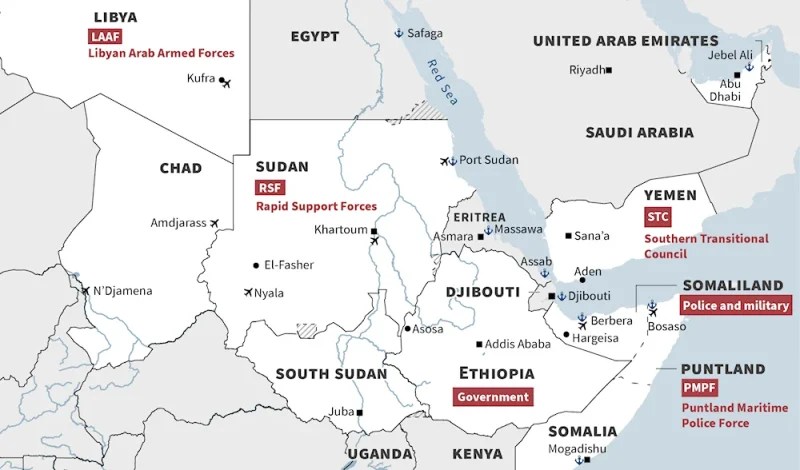
Al Mayadeen | May 17, 2026
A newly published report by the German Institute for International and Security Affairs (SWP) has delivered a critical assessment of the United Arab Emirates’ role in African conflicts, describing Abu Dhabi as a systematic spoiler that arms proxy forces, manipulates diplomatic processes, and bears significant responsibility for some of the world’s worst humanitarian crises, all while facing virtually no political consequences from its Western partners.
The report, authored by researchers at one of Europe’s most influential foreign and security policy think tanks, which directly advises the German government and Bundestag, calls on Berlin and its European partners to fundamentally reassess their relationship with the UAE.
Sudan: The clearest case
The report presents Sudan as the most devastating example of Emirati interference. The UAE is identified as the most important military, logistical, and financial backer of the Rapid Support Forces (RSF), the paramilitary group whose war against the Sudanese Armed Forces has produced what the UN reports as the world’s largest humanitarian crisis, with 33.7 million people dependent on aid, over 15 million displaced, and widespread extreme hunger.
The RSF’s conduct has been particularly brutal. The report details targeted violence against non-Arab minorities, including sexual violence, mass killings, attacks on medical facilities, and hostage-taking, primarily directed at groups such as the Masalit and Zaghawa.
When the RSF captured El-Fasher in North Darfur in October 2025, a UN fact-finding mission described its actions against the civilian population as bearing the hallmarks of genocide.
Emirati support for the RSF continued even after Iranian strikes on the UAE, with numerous cargo flights departing from Emirates airports to Ethiopia, apparently to ferry supplies across the border to RSF positions.
A UN panel of experts documented 458 flights involving heavy transport aircraft from Emirati military airports or the transhipment hub of Bosaso to eastern Libya between October 2024 and the end of 2025, 239 of them bound for Kufra, a key hub for RSF resupply, in likely violation of UN arms embargoes on both Libya and Darfur.
A proxy model built on plausible deniability
The UAE rarely deploys its own forces. Instead, it operates through a carefully constructed network of local proxies, private military contractors, and logistical intermediaries. Beyond the RSF in Sudan, its partners include Khalifa Haftar’s Libyan Arab Armed Forces, the Puntland Maritime Police Force in Somalia, and, in a departure from the pattern, the Ethiopian government during its war against the Tigray people.
The report details how the UAE recruited and deployed hundreds of Colombian mercenaries to Sudan via an Emirati security firm, with the US government noting in 2025 that these fighters had served as infantry, artillery personnel, drone pilots, and even trained children for combat.
Supplies to the RSF have been routed through LAAF-controlled Libya, Chad, Kenya, Uganda, and Rwanda, with Abu Dhabi deploying financial leverage to secure cooperation, including a 1.5 billion dollar loan to Chadian President Idriss Déby in 2023.
The UAE also profits from gold smuggling networks in conflict zones, with members of the ruling family reported to have personal ties to both Haftar and RSF commander Mohamed Hamdan Dagalo.
Why the UAE intervenes
SWP identifies several overlapping motives. Economic interests are central, as state-owned logistics giants DP World and AD Ports Group have port and infrastructure projects across the continent, and military interventions serve to protect access to trade routes and strategic resources.
But economics alone do not explain the pattern. The report points to the UAE’s drive to outcompete Saudi Arabia for regional influence, a rivalry that has only sharpened since Riyadh forced Abu Dhabi out of southern Yemen.
Ideological opposition to the Muslim Brotherhood also shapes policy, with the UAE consistently backing actors who suppress Islamist movements. Personal enrichment through resource networks and ruling family ties to conflict actors adds a further layer.
Diplomatic manipulation
The report scrutinises the UAE’s use of diplomatic engagement as cover, whereby Abu Dhabi participates in international peace processes while simultaneously intensifying support for belligerents.
In September 2025, the UAE joined the Sudan Quad format alongside Egypt, Saudi Arabia, and the United States, signing joint commitments to end external support for conflict parties. According to US intelligence reporting, however, the UAE was actively intensifying support for the RSF at the same time.
The UAE also pledged 200 million dollars at a February 2025 humanitarian conference and a further 500 million dollars at a US conference in 2026, while contributing only around 33 million dollars to the UN-coordinated humanitarian plan.
In November 2025, Emirati Minister of State Lana Nusseibeh spent four days meeting with Members of the European Parliament in Brussels. Nusseibeh’s endeavor was successful, as a Parliament resolution on Sudan adopted at the same time made no mention of the UAE’s support for the RSF, following opposition from the European People’s Party to amendments tabled by left-wing parliamentary groups.
The same pattern played out during the Berlin Libya Process in 2019-20, when the UAE pledged to halt arms transfers to Libyan conflict parties but continued them regardless. Transport aircraft flew from the Emirates to eastern Libya on the very day of the Berlin conference in January 2020.
European silence, eroded accountability
The report stresses that Western governments, including Germany, have consistently refused to name the UAE publicly in international forums, despite substantial documented evidence of its role in fuelling conflicts. No UN Security Council member has explicitly raised Emirati support for the RSF in formal meetings, either.
This reluctance, SWP argues, is not incidental but reflects a broader calculation in which trade ties, security cooperation, the UAE’s close relationship with “Israel,” and the strategic goal of preventing Abu Dhabi from drifting further toward China or Russia have consistently outweighed accountability concerns.
The UAE’s open disregard for the UN embargo on Libya from 2014 onward, the report notes, likely encouraged other states to adopt a similar approach, with the same dynamic now being repeated in Sudan.
Five recommendations
SWP outlines five concrete steps for Germany and its European partners:
- First, Abu Dhabi should be named explicitly in international forums rather than referenced in vague language about “external actors.”
- Second, EU financial sanctions should be expanded and applied more consistently where Emirati actors have documented embargo violations.
- Third, German arms export policy toward the UAE requires a fundamental review, given the documented transfer of German-chassis military equipment to conflict zones.
- Fourth, anti-money-laundering enforcement should be tightened, with greater focus on Emirati financial centres as hubs for conflict economies and sanctions evasion.
- Fifth, the strategic partnership Germany has maintained with the UAE since 2004 should, at a minimum, be suspended unless Abu Dhabi demonstrably reorients its policy toward de-escalation.
The report concludes that the war on Iran, mounting tensions with Saudi Arabia, and growing reputational vulnerabilities have made the UAE more susceptible to European pressure than at any previous point, and that this window should not go unused.
France’s Shadow War in Mali
By Freddie Ponton | 21st Century Wire | May 11, 2026
France did not really leave Mali. It changed tactics and found new hands to carry the gun. After being pushed out by a military government that turned toward Russia, China, and the wider Global South, Paris appears to have re-entered the war through Ukrainian military intelligence channels, long-standing Tuareg networks, and a battlefield configuration in which separatist rebels and Al-Qaedaʼs Sahel branch were hitting the same state enemy at the same time.
The late-April attacks in Mali said something larger about the Sahel. A former colonial power that had been shown the door was suddenly back in the frame, leaning on intermediaries and the momentum of jihadist advances to weaken a government that had chosen Russian support, Chinese weapons, and the language of anti-colonial independence over its old dependence on Paris.
Paris returns through the back door
The sequence is clear. On 25 April, coordinated attacks struck Kati, Gao, Kidal, Sévaré and other strategic points in Mali. Defense Minister Sadio Camara, one of the central figures in Bamako’s post-French realignment and often described as Moscow’s man in the junta, was killed in an attack on his residence. The capital was shaken, roads toward Bamako came under pressure, and in the north, the insurgents advanced as Russian fighters and Malian forces lost ground. Four days later, while the government was still counting its dead, Mohamed Elmaouloud Ramadane, spokesman for the Azawad Liberation Front, or FLA, surfaced in Paris and met French security and defence representatives while demanding that Russian forces leave Mali. That alone should have set off alarms from Bamako to Brussels.
French media then supplied the missing bridge. Radio Télévision Luxembourg, RTL, reported that France was relying on French-speaking Ukrainian soldiers, including former Foreign Legion personnel, to provide operational support on the ground in Mali in coordination with Tuareg rebels. The report was explicit enough to describe a French effort to avoid direct cooperation with jihadists linked to Al-Qaeda by using Ukrainian relays instead. The same investigation recalled that at the beginning of 2025, Ukrainian military intelligence had presented a detailed plan to French authorities to help dislodge the juntas in the Sahel region and roll back Russian influence. Paris supposedly hesitated at first on security grounds. From where things stand now, the April operation feels less like an improvised response than the delayed execution of that proposal.
For readers unfamiliar with Mali, one fact matters more than any other. This is a large Sahel state that was once a core part of France’s post-colonial sphere of influence. After coups in 2020 and 2021, the new authorities pushed out French troops, challenged the old Françafrique order, and brought in Russian security support while deepening ties with non-Western partners. That made Mali a test case in Africa’s attempt to break with inherited dependency. Seen from that angle, the April offensive was more than just local tensions between armed factions. In fact, it was part of a wider struggle over who gets to decide the political future of the Sahel.
The offensive that exposed the convergence
The April 25 offensive laid bare the forces converging against Bamako. Jama’at Nusrat al-Islam wal-Muslimin (JNIM), better known as JNIM, claimed major attacks around the south and center. The FLA and allied Tuareg formations pushed in the north. Together they created the sense of a government under siege, with one arm of the offensive squeezing the capital and another unravelling the junta’s hold on strategic northern towns. JNIM is not a vague insurgent label. It is Al-Qaeda’s official branch in the Sahel, born from a 2017 merger that brought together Ansar Dine, AQIMʼs Sahara branch, al-Murabitoon and the Macina Liberation Front under the leadership of Iyad Ag Ghali, a veteran Tuareg commander now wanted by the International Criminal Court.
That reality becomes significant, especially when the Azawad Liberation Front (FLA) is so often presented in softer terms, as if it were merely a separatist front pursuing legitimate local grievances. The FLA, founded in late 2024 in Tinzaouaten from a reorganization of Azawad movements, draws on a long history of Tuareg rebellions in northern Mali. Its public face is political and diplomatic, and its battlefield behaviour tells a much sharper story. In the April assault, it moved in the same strategic rhythm as JNIM, benefiting from the firepower, shock value, and confusion generated by Al-Qaeda’s Sahel network.
The north was especially revealing. Kidal, the symbolic heart of Tuareg politics and rebellion, fell back under FLA control after Russian Africa Corps contractors and Malian forces withdrew. Accounts describe negotiated departures, seized matériel, and a humiliating loss for Bamako and its Russian backers. Africa Corps units left behind vehicles and equipment while seeking safe passage out of a town they had retaken from Tuareg groups only a few years earlier. In Bamako’s orbit, meanwhile, JNIM tightened pressure with threats to block access roads and attacks designed to create the perception of a capital edging toward siege. To supporters of the insurgency, the junta looked fragile, but to anyone watching external interference, the alignment of interests was impossible to ignore.
Much of Western coverage flattened this into a familiar story about state weakness and local instability. That framing leaves out the politically explosive part. These attacks came after two years of mounting accusations from Mali and its Sahel allies that Ukraine was aiding anti-state armed factions and that France had never fully abandoned its northern networks. Put next to Ramadane’s Paris visit and RTL’s reporting on French support through Ukrainian channels, the April offensive starts to read less like a sudden collapse than the military expression of a proxy design that had been taking shape for some time.
Ukraine’s war spills into the desert
Ukraine’s place in this story is not incidental. It is one of the clearest windows into how the war with Russia has spilled into Africa. In 2024, reporting from Le Monde described Ukrainian links with northern Malian rebels and said Ukrainian operatives had trained Tuareg fighters to use drones. That reporting was reinforced by statements from Tuareg figures themselves, who acknowledged contacts with Ukrainians, and by later accounts of drone know-how and explosive FPV tactics moving into the Sahel theatre. Mali cut diplomatic ties with Ukraine in August 2024 after comments from a Ukrainian intelligence spokesman were interpreted in Bamako as an admission of involvement in the Tinzaouaten ambush that killed large numbers of Wagner and Malian personnel.
In that July 2024 ambush near Tinzaouaten, Tuareg separatists claimed to have killed 84 Wagner operatives and 47 Malian soldiers. Ukraine’s own military intelligence spokesman then boasted that its services had supplied the “essential intelligence, and not just intelligence” that made the operation possible.
Tinzaouaten already carried the shape of what came later, and showed that Russian assets in Mali could be hit through a combination of local insurgents, drone warfare, and outside intelligence support, leaving Moscow’s contractors exposed far from their main war. By 2026, those methods had grown more polished. Reports on rebels’ use of FPV systems, including fibre-optic drones that resisted jamming and adapted commercial platforms, pointed to a battlefield increasingly shaped by techniques honed over eastern Ukraine. Russian and Malian convoys were taking fire from above in areas where state air superiority had once seemed secure.
Regional coverage and Sahel sources have since pointed to Algeria as the state that might have helped make that Ukrainian support physically possible long before the April offensive. Niger had already moved into Russia’s security orbit by then, which suggests Algerian territory and networks as the only realistic corridor for covert assistance to reach Tuareg fighters in northern Mali. The same Algeria that has spent years mediating Tuareg affairs, hosting peace talks and cultivating influence over Iyad Ag Ghali’s environment, seems to be quietly repairing relations with both Paris and Washington.
For Kyiv, the logic is straightforward. Russia’s Africa Corps is both a military instrument and a geopolitical symbol, securing mining sites and political partnerships across a belt of African states. Hitting it in Mali weakens Moscow’s position abroad while demonstrating that Ukraine can impose costs on Russia beyond Europe. For France, Ukrainian projection in the Sahel has a different value; primarily because it opens a way to hurt Russia’s African network and destabilize the junta without visibly redeploying French troops or sitting down with jihadist commanders.
RTL’s report on French-speaking Ukrainian ex-Legionnaires operating as intermediaries is powerful precisely because it solves a practical problem. Paris can guide and assist operations that serve its interests while insisting that no French soldier is on the ground. The Ukrainians provide deniability, military expertise, and a shared anti-Russian mission. The Tuareg rebellion provides local cover and established terrain knowledge, while JNIM provides the battlefield weight that neither France nor Ukraine could openly supply themselves. Taken together, the result is a war in which Malian sovereignty and Russian presence are being tested by actors who will never stand behind the same podium but who are clearly useful to one another on the ground.
France’s long shadow and the new division of labour
The events of this year did not emerge in a vacuum. Across Mali and the wider Sahel, accusations that France manipulates armed Islamist-adjacent networks have circulated for years. Some claims are stronger than others, while some remain allegations. However, put together, they form a political memory that explains why Bamako and its allies quickly read the April offensive as more than a domestic insurgent wave.

French president Emmanuel Macron visits the troops of France’s Barkhane counter-terrorism operation in Africa’s Sahel region in Gao, northern Mali, 19 May 2017
One of the hardest facts in that longer history is the ransom trail. A decade ago, a major New York Times investigation found that European governments had pumped large sums into Al-Qaeda-linked groups through ransom arrangements and that France was among the major payers. French and other European hostages taken in the Sahara and Sahel were released after opaque deals in which governments denied paying, but local intermediaries and US officials said otherwise. Reporting from the same period described France as one of the champions of ransom payments to Al-Qaeda affiliates in North and West Africa. The practical outcome pointed towards networks that abducted Western nationals gained money, leverage, and survivability from transactions tied directly or indirectly to French state interests.
In Bamako, those revelations sit on top of a thicker layer of suspicion. The Malian outlet L’Aube accused Paris of effectively financing JNIM through ransom payments, alleging that France paid between 12 and 13 million euros for the release of Olivier Dubois and Jeffrey Woodke and that the money was used by the group to buy arms and ammunition. Niger‘s authorities later levelled similar charges, with General Abdourahamane Tchiani accusing France of pouring several billion CFA francs into armed groups across the Sahel and using Nigerian intelligence channels for training, equipment and financing linked to terrorism. Against that backdrop, RTL’s talk of a new hierarchy of enemies in Mali lands with much greater force. France avoids direct contact with Al-Qaeda’s men by working through Ukrainian and Tuareg intermediaries, yet accepts a configuration that strengthens the jihadists on the ground.
Then came the accusations from Mali itself. In 2021, Prime Minister Choguel Maïga told Russian media that France had created an enclave in Kidal, barred the Malian army from entering, and taken deputies of Ansar Dine’s leader to form a new armed group trained by French officers. Although those claims were denied and never fully proven in public, they reflected a widespread belief in Mali that France’s northern policy was always selective, that some armed actors were enemies only until they became useful, and that counterterrorism language had long concealed a hierarchy of interests. When RTL later explained that France now limits its operational support to Ukrainian relays to avoid direct contact with jihadists linked to Al-Qaeda, it gave that older suspicion a fresh and chilling plausibility.
A new division of labour is also coming into view across the Sahel battlefield. JNIM supplies most of the foot soldiers and carries out the suicide car bombings and complex ground assaults that the Tuareg front alone could not manage. The FLA offers a separatist banner, a political vocabulary tied to Azawad and Tuareg grievances, and a face that Western actors can present as more acceptable than open jihadism. Ukrainian intelligence, drawing on ex-Foreign Legionnaires and years of experience under fire, interfaces directly with Tuareg commanders and delivers modern drone and ambush tactics. France coordinates with the Ukrainians and leans on its long history of intelligence work with Tuareg elites, but keeps just far enough away from open jihadist contact to preserve a legal and political alibi. Algeria appears to be sitting in the background as facilitator and fixer, a state that has repeatedly handled Tuareg files, mediated peace accords, and is now edging back toward closer ties with Paris and Washington. Above all of this sits the United States, rolling out a new counterterrorism strategy that asks European allies to take more responsibility for African theatres and to shoulder more of the burden of rolling back Russian influence worldwide.
Furthermore, it is acceptable to draw parallels with Syria, which offers the clearest precedent for what is emerging in Mali, where Western powers are claiming a war on terror while tolerating or working around Al‑Qaeda‑linked formations when they serve a shared objective on the battlefield. In Syria, Western powers tolerated, rebranded or worked around Al-Qaeda-linked formations when those forces were useful against the Syrian state. Mali is not a carbon copy, but the political reflex is familiar. France appears to have accepted a battlefield reality in which its preferred anti-junta channel moved alongside, and benefited from, Al-Qaeda’s own assault on the Malian state. That is enough to strip away the moral language of the so-called war on terror and expose a pattern that keeps resurfacing whenever Western influence is under threat.
Africa pushes back against the old pattern
Mali, Niger, and Burkina Faso have spent the last few years trying to build a different political vocabulary for the region. Their Alliance of Sahel States, or AES, is not simply a club of juntas, and should be seen also as a rebellion against the old script in which Paris decided security priorities, Western diplomats managed legitimacy, and African governments were expected to accept permanent tutelage in exchange for nominal stability. That rebellion is messy, militarized, and far from pure, which explains why Bamako’s turn toward Russia, China, and Turkey carries such symbolic weight across the Global South.
The response to the April offensive grew from that new landscape. AES partners launched joint military actions, including airstrikes in Malian territory, after the attacks on Gao, Ménaka and Kidal. Moscow has made clear that it does not intend to abandon Bamako. Kremlin spokesman Dmitry Peskov said after the April attacks that Russian forces would stay in Mali at the request of the current government and continue helping it fight extremism, terrorism and other harmful phenomena. Russian military statements added that Africa Corps units had helped prevent a change of power and inflicted irreparable losses on the attackers.
This is not a symbolic presence. Reporting has described a Russian deployment of roughly 2,000 to 2,500 Africa Corps personnel in Mali, supported by repeated shipments of armoured vehicles, artillery and electronic warfare equipment. China had already been supplying new defence systems, including short-range air defences designed to help deal with the very drones that had become a weapon of choice for jihadist and Tuareg militias. Turkey emerged as another important arms partner through the supply of combat drones to the Malian state. Each of those relationships tells the same story. Mali is trying to diversify away from Paris and anchor its survival in a more multipolar world.
Pressure is building from the other side of the chessboard. Nigeria has warned that the rebel and jihadist advance in Mali threatens the wider region and hinted that it could intervene again, echoing its role in supporting the last French military operation there more than a decade ago. Almost at the same time, Washington published a new counterterrorism strategy urging Europe to assume greater responsibility for its own security, explicitly including counterterror operations in Africa. Together, those signals sketch the outline of a tomorrow in which the same states accused of secretly feeding the fire in Mali can present themselves once more as firefighters.
That is the wider fight behind the headlines. If France can return through covert channels, Ukrainian intermediaries, and a tolerated overlap with jihadist momentum, then the message to the rest of Africa is brutally simple. Expelling the old colonial power does not free a country from its reach. It only drives its methods deeper into the shadows.
The anger in Bamako, Niamey and Ouagadougou did not come from nowhere. It was built over years of lectures about democracy from governments that armed the neighbourhood, years of foreign troops sold as protection while insecurity spread, years of counterterrorism campaigns that left ordinary people poorer, less mobile, and less safe. That memory sits behind every cheer for sovereignty in the Sahel. The old order still has embassies, media networks, military bases, and intelligence contacts. What it no longer has is the automatic right to be believed.
France once marched into Mali under the guise of rescue. Now it seems to be edging back in through a side door, behind Ukrainian handlers, Tuareg envoys, and Al-Qaeda gunmen who happen to be shooting at the same enemy. If JNIM ever reaches the gates of Bamako, nobody should call it a mystery born from the desert. The road to that disaster is already being paved through a proxy system that weakens Mali in the name of saving it and then prepares to market the resulting collapse as the reason for another intervention.
What advances on Bamako today is more than JNIM and a Tuareg front. It is a proxy machinery in which Western states and their partners are willing to ride jihadist momentum, break a government they cannot control, and then market the ruins as proof that Africa still needs their protection.
UAE provides $100m for US-backed Gaza police force vetted by Shin Bet
The Cradle | May 8, 2026
The UAE has sent $100 million to US President Donald Trump’s Board of Peace to fund the training of a new Palestinian police force for Gaza, the Times of Israel reported on 8 May, citing a US official and a diplomat from West Asia.
Setting up a security force to control Gaza on Israel’s behalf will reportedly allow Tel Aviv to sideline Hamas while reducing the presence of the Israeli army, which is suffering from manpower shortages.
The police force is being organized under the umbrella of the National Committee for the Administration of Gaza (NCAG), a panel of Palestinian technocrats tasked by the Board of Peace and Israel to administer the Strip.
Though the NCAG was created three months ago, its members have not yet entered the Strip, reportedly due to a lack of funding and security.
“No money is currently available,” Board of Peace envoy Nickolay Mladenovas privately acknowledged, according to a Palestinian official familiar with the matter speaking with Reuters.
The proposal envisions the new police force seizing weapons in Gaza as part of the effort to disarm Hamas.
Nevertheless, Hamas has yet to agree to disarm, as Israel has not adhered to the terms of the US-sponsored ceasefire that was signed in October 2025.
According to the ceasefire agreement, Israel was required to withdraw their forces to areas near the border, dismantle all military sites and installations, allow displaced Palestinians to return to their homes in the north of the Strip, open the Rafah crossing, and allow humanitarian aid to enter freely.
Israel has also killed over 800 Palestinians in Gaza since the ceasefire took effect.
In February, the NCAG began recruiting for the new 27,000-strong police force. Recruits will be vetted by Israel’s internal security service, the Shin Bet, according to an Arab diplomat who spoke with the Times of Israel in March.
An Emirati security firm will train the recruits in Egypt and Jordan before dispatching them to Gaza.
In February, US President Donald Trump announced $17 billion in pledges for the Board of Peace at a donor conference. He also demanded that world leaders contribute $1 billion each for a seat on the board, which he said would rival the UN.
However, the $100 million contribution from the UAE is the largest pledged amount the board has received so far. The board has not received the billions in contributions initially pledged by the UAE, Qatar, Saudi Arabia, and Kuwait.
One source with direct knowledge of the peace board’s operations told Reuters that Washington and Tel Aviv’s war of aggression against Iran “affected everything.”
The Board of Peace is also working to establish and deploy a proposed International Stabilization Force (ISF) in Gaza, which is expected to include soldiers from several foreign countries. This move would enable the Israeli army to further outsource its ethnic cleansing efforts.
Indonesia, Albania, Kazakhstan, and Kosovo have each pledged troops to the ISF, but so far none have been deployed or begun training, amid fears they may have to use violence to disarm Hamas on Israel’s behalf.
The UAE has supported Israel not only in Gaza but also in its war with Iran.
The New York Times reported on Friday that the UAE has “doubled down on its alliances with Israel and the United States,” despite Iranian drone and missile strikes targeting the Emirates in retaliation for their support for the US-Israeli war on the Islamic Republic.
“There is a trust premium that Trump will do the right thing,” said Nadim Koteich, an Emirati-Lebanese commentator who is close to the Emirati government. “What suits his legacy and what suits the American interests suits us.”
The UAE has also partnered with Israel and Somaliland to create a new “strategic axis” in the Horn of Africa and the Red Sea in a bid to project power into Africa and counter the Ansarallah-led Yemeni Armed Forces.
Featured Video

Racist Seinfeld Dances for Joy as Bibi Unveils His New Map
or go to
Aletho News Archives – Video-Images
TV Drama Review
Japanese drama projects Japan’s wartime atrocities onto Chinese characters

Global Times | October 25, 2026
By portraying Chinese characters as perpetrators of ruthless violence while casting Japanese Self-Defense Forces (SDF) intelligence operatives as defenders, the season 2 of the Japanese drama Vivant has recently drawn criticism from Chinese netizens, who argue that its depiction turns historical reality on its head while ignoring Japan’s wartime atrocities.
The TBS drama series – a spy suspense story in which an alleged unofficial intelligence unit of the SDF operates across the globe — has attracted a passionate fanbase. Its currently airing season 2 opened with a household rating of 18.8 percent, the highest for a TV drama this year, according toa commentary article by Japanese media Toyo Keizai.
What draws attention is the portrayal of the enemies in the series, the article noted. Scenes in which the Chinese organization subjects kidnapped members of the SDF unit to brutal torture are repeated with unrelenting intensity.
It is rare for Japanese TV dramas to explicitly portray a real-life country as the enemy, the article noted.
Japanese Prime Minister Sanae Takaichi also made a reference to the drama, saying that she has been recording Vivant and hopes to binge-watch it over the year-end and New Year holidays, according to Japanese media outlets.
China’s CCTV News report on Sunday revealed that the drama features scenes in which Chinese personnel cut off the fingers of and stab Japanese intelligence operatives in the abdomen. Such acts bear striking similarities to the torture inflicted on Chinese nationals by invading Japanese troops during the World War II.
The drama distorts the truth by attributing these atrocities to modern Chinese characters. Beneath the surface, it subtly glorifies Japan’s cross-border overseas operations, blurs the functional boundaries of the SDF and implicitly promotes an expansionist narrative, per CCTV News. … continue
Blog Roll
 Aletho News
- Up in arms… Koreans reject U.S. empire’s plan to make South Korea the next Ukraine
- Iran, Turkey, Pakistan, Saudi Arabia could advance region-led security framework in Tehran: FM spox
- Netizens condemn Japanese drama for projecting Japan’s wartime atrocities onto Chinese characters
- Racist Seinfeld Dances for Joy as Bibi Unveils His New Map
- A West Bank War for Netanyahu’s Election Campaign, Could It Backfire?
- Yemen denounces European Parliament’s ‘hypocritical’ push to blacklist Ansarullah
- Qalibaf: UAE’s UN bid aims to ‘clear the runway’ for ‘Greater Israel’, whitewash genocide
- Pakistan reopens Iran border after boosting security: Report
- Why are so many Brazilians voting for Flávio Bolsonaro?
- Democrats Put Anti-Russia Agenda Ahead of American Workers
- If Americans Knew
- An error has occurred; the feed is probably down. Try again later.
- No Tricks Zone
- Sudden Stratospheric Warming, Powerful El Niño Combination May Lead To Extreme Europe Cold, Energy Crisis!
- Two New Studies Find Thwaites Glacier Melt Cannot Be Driven By Human Activity Or A Warming Ocean
- E-Cars Reduce CO2 Emissions By Only 41% Compared To Internal Combustion Engine Vehicles
- Predictions Made By Renowned Climate Professor Over Past Decades Have Been Proven To Be Poor
- New Study Suggests Large Regions Of The Pacific Ocean Have Been Cooling For The Last 80 Years
- Germany’s Green Energy Debacle: High Energy Costs Force Kahla Porzellan to Close After 182 Years!
- New Study: 50 Years Of The Most Aggressive ‘Net Zero’ Policies Can Only Affect The Global Climate By 0.03°C
- US September “Heat” Was No Record…Many Records Set Decades Ago
- Latest European Green Energy Debacle; Portugal’s Largest Flagship Solar Park Insolvent!
- Green Energy Debacle: German Expert Professor Fritz Vahrenholt Warns Of Severe Economic And Social Consequences

