Nigerian Minister Says Russian Investors Interested in Financing African Gas Mega-Pipeline

Samizdat | May 4, 2022
The EU has been wooing Nigeria in recent weeks as one of the nations whose natural gas could help replace Russian supplies amid the bloc’s spat with Moscow over Ukraine. The charm offensive comes after years of efforts by the West to starve Sub-Saharan Africa of financing for gas projects.
Russian investors have expressed an interest in financing a massive gas pipeline from Nigeria to Morocco, Nigerian Minister of Petroleum Resources Timipre Sylva has announced.
“The Russians were with me in the office last week. They are very desirous to invest in this project and there are lots of other people who are also desirous to invest in the project,” Sylva said, speaking to reporters in Abuja, Nigeria on Monday.
The prospective 5,600 km+ long pipeline project, agreed to by Nigeria and Morocco in 2016, would run along the west coast of Africa, connecting to the Ivory Coast, Liberia, Sierra Leone, Guinea, Guinea-Bassau, Gambia, Senegal, and Mauritania along the way and serve as a major potential catalyst for regional economic development. It could also be used to pipe Nigerian gas to Europe via Spain. Six years after being agreed, the project still lacks the necessary financing for implementation.
The infrastructure would extend an existing pipeline pumping gas from southern Nigeria to neighbouring Benin, Togo and Ghana. “We want to continue that same pipeline all the way to Morocco down the coast. Right now, we are still at the level of studies and of course, we are at the level of securing funding for this project and a lot of people are indicating interest,” the oil minister said.
Sylva did not provide any further details on the eager Russian investors, or the project’s total expected cost, but said Abuja has yet to identify the “investors that we want to go with” for the ambitious infrastructure scheme.
Russia’s reported interest in the gas mega-pipeline is unclear, given that it could theoretically provide the same European countries threatening to halt the purchase of Russian natural gas and oil with a cost-effective Sub-Saharan African alternate.
European officials have flocked to Nigeria – the world’s 12th largest producer of natural gas, and 15th largest producer of oil, in recent weeks to try to secure additional energy from the African nation amid unprecedented tensions with Moscow over Ukraine. Last month, ambassadors from the European Union, Portugal, Spain, Italy and France met with Nigerian National Petroleum Company officials to discuss a “strengthened partnership” in the energy sector. No agreements were announced at the conclusion of the meeting.
On Monday, Bloomberg reported on an EU energy plan document which mentioned Nigeria, Senegal and Angola as nations with ‘largely untapped potential for liquefied natural gas’.
Nigeria has over 206 trillion cubic feet of proven gas reserves valued at hundreds of trillions of dollars, but has long been starved of capital for developing these resources amid a raft of problems ranging from corruption and inter-ethnic strife to pipeline vandalism.
On top of that, before the Ukraine crisis began, Europe largely ignored Nigeria’s gas potential. Last year, Nigerian environment minister Mohammad Mahmood Abubakar blasted developed countries for what he said was their deliberate policy of defunding African national gas projects.
“Many [wealthier nations] are now limiting financing to gas projects for domestic use in Sub-Saharan Africa, a region responsible for 0.55% of global carbon emissions that still needs to industrialize and grow. The defunding of gas projects by most financing organizations is a threat to achieving a global energy transition that is equitable, inclusive, just, leaving no one behind,” Abubakar said, speaking at a virtual ministerial event hosted by the United Nations last June.
The European Investment Bank stopped financing fossil fuels projects at the end of 2021. The same year, the Western cash-dominated World Bank indicated that it would shift resources to “combating climate change,” and limit assistance for natural gas projects except for rare exceptions.
Despite its vast wealth in energy resources, about 43 percent of Nigeria itself still lacks access to grid electricity.
World food prices hit new high – UN
Samizdat | April 10, 2022
Global food prices surged to a historic high last month on grain and edible oil supply woes brought about by the conflict in Ukraine, the UN Food and Agriculture Organization (FAO) said on Friday.
“World food commodity prices made a significant leap in March to reach their highest levels ever, as war in the Black Sea region spread shocks through markets for staple grains and vegetable oils,” the FAO said in a statement.
The FAO’s food price index rose by 12.6% to a record 159.3 points in March against February’s high of 141.4 points, “making a giant leap to a new highest level since its inception in 1990.” The index represents a measure of the monthly change in international prices of a basket of food commodities.
The current surge includes new all-time highs for vegetable oils, cereals, and meats, the agency said, noting that prices of sugar and dairy products “also rose significantly.”
The FAO also recently warned that food and feed prices could further jump by up to 20% as a result of the Russian-Ukrainian conflict and lead to a surge in global malnourishment.
Russia and Ukraine are the globe’s largest exporters of wheat, corn, barley, and sunflower oil. Ukrainian exports have been stalled, and sanctions placed on Russia may affect its own deliveries as Black Sea ports used to ship grain remain blocked. Industry analysts fear the planting season in Ukraine may also be affected by the current crisis.
The situation could lead to famine and food rioting in poor countries, especially in Africa, the head of the World Trade Organization (WTO), Ngozi Okonjo-Iweala, warned earlier this month. She specified that food imports from the Black Sea region were crucial for the survival of 35 African nations.
Meanwhile, the FAO also lowered the projection of global wheat production in 2022 to 784 million tons from last month’s forecast of 790 million, citing the possibility that at least 20% of Ukraine’s winter crop area would not be harvested. It also cut its forecast of global cereals trade in the current marketing year due to disruptions in Black Sea exports. The agency noted, however, that larger exports from India, the EU, Argentina and the US could somewhat offset the trend.
India, US have different priorities
BY M. K. BHADRAKUMAR | INDIAN PUNCHLINE | MARCH 23, 2022
An extraordinary week has passed for the Modi government’s dalliance with the Quad. Call it a defining moment, a turning point or even an inflection point — it has elements of all three.
The last week saw a 2-day visit to Delhi by Japanese prime minister Fumio Kishida, virtual summit between Prime Minister Narendra Modi and Australian PM Morrison, and foreign ministry level consultations with the visiting US Undersecretary for Political Affairs Victoria Nuland. The leitmotif was the situation around Ukraine.
Biden has since taken a jab that India has a “somewhat shaky” stance on Ukraine. Who would have imagined that the geopolitics of Ukraine was going to shake up Quad?
Certainly, India had a premonition. The Indian foreign-policy establishment has had no misconceptions about what began unfolding in Ukraine in the last week of February. It had spotted as far back as November/December at least, like Elijah in the Bible, a small cloud like the palm of a hand coming up from the sea.
Unlike the Indian media, academia or think tanks at large, the Indian leadership could sense that an epochal global struggle for ascendancy by the US and its western allies versus Russia and China was breaking out in Ukraine. Modi sensed that there would be collateral damage to India unless it saddled up to get down from the mountain, as the sky began to grow black with wind-driven clouds, before the huge cloudburst of rain arrived.
There is a background to it. Any perceptive observer would have noticed that Modi has been in a reflective mood as regards foreign affairs for the past several months. His participation in the Summit for Democracy last December discernibly had a fin-de-siècle air about it — the closing of one era and onset of another. One could attribute it to the sobering effect of the pandemic.
The point is, India struggled with the pandemic all by itself. No matter the hype about it, India realised that it has no real partnership with the US or EU, that it was a mere transactional relationship — and that in the final analysis, India lived in its region.
Indeed, India handled the pandemic far better than most countries. International experts acknowledge it today, and those who threw stones at that time grudgingly accept it, too.
However, with the economy ravaged beyond recognition, the government is picking up the pieces and staggering forward. There is still so much of uncertainty in the air about yet another “wave” of the pandemic stealthily advancing to drown all ceremonies of repair and reconstruction of life.
Succinctly put, the big-power struggle in faraway Europe, precipitated by the Biden administration for geopolitical purposes to isolate and weaken Russia, erupted at a most critical juncture when India has been increasingly sceptical about American policies and statesmanship. The picture that the US is presenting of itself is far from convincing either: a battleground of tribalism and culture wars, an ageing superpower in decline with dwindling influence globally.
In the Indian economy’s tryst with destiny, the US is of no help. On the other hand, the waning multilateralism and the new constraints imposed on growth by the US’ growing propensity to weaponise the dollar, threaten to blight the shoots of post-pandemic growth in the Indian economy.
On Monday, Biden celebrated a Business Roundtable with the CEOs of the largest corporations in the American economy. He boasted: “6.7 million jobs last year –- the most ever created in one year; more than 7 million now. 678,000 created just last month, in one month. Unemployment down to 3.8 percent. Our economy grew at 5.7 percent last year, and the strongest in nearly 40 years… We reduced the deficit by $360 billion last year… And we’re on track to reduce it by over $1 trillion this year.”
Biden is understandably thrilled beyond words. Yet, when he deliberately orchestrated a confrontation with Russia at this juncture, it didn’t occur to him what crippling impact and downstream consequences his draconian “sanctions from hell” against a major G20 economy would have on the developing economies.
A UNCTAD report on March 16, titled The Impact on Trade and Development of the War in Ukraine, concludes, “The results confirm a rapidly worsening outlook for the world economy, underpinned by rising food, fuel and fertiliser prices, heightened financial volatility, sustainable development divestment, complex global supply chain reconfigurations and mounting trade costs.
“This rapidly evolving situation is alarming for developing countries, and especially for African and least developed countries, some of which are particularly exposed to the war in Ukraine and its effect on trade costs, commodity prices and financial markets. The risk of civil unrest, food shortages and inflation-induced recessions cannot be discounted…”
Does Biden even know that at least 25 African countries depend on Russia for meeting more than one-third of their wheat imports? Or, that Benin actually relies 100% on Russia for its wheat imports? And that Russia supplies wheat at concessional prices for these poor countries?
Now, how do these meek and wretched countries of the planet import from Russia when Biden and EU chief Ursula Gertrud von der Leyen join hands to block the banking channels for trading with Russia? Can Delaware find a solution?
The cruelty and cynical complacency with which the Biden Administration and the EU conduct their foreign polices is absolutely stunning. And, mind you, all this is happening in the name of “democratic values” and “international law”!
India cannot agree with the US and EU’s reckless attempt to weaponise global economic links. The fact of the matter is that the US and EU may not even win this war in Ukraine. Russia has almost completed 90 percent of its special operations. Unless Biden allows Kiev to agree to a peace settlement, the division of Ukraine along the Dnieper river is in the cards.
The US is destabilising the European security order while the western sanctions are destabilising the global economic order. The US and EU must bear responsibility for this collateral damage. The West is in panic that the world is living in the Asian century already.
“One reason for the optimism across the heart of Asia is the immense natural resources of the (Asian) region,” writes the famous Oxford historian Peter Frankopan in his recent book The New Silk Roads: The Present and Future of the World. For, the Middle East, Russia and Central Asia account for almost 70% of global proven oil reserves, and nearly 65% of proven natural gas reserves.
Prof. Frankopan writes: “Or there is the agricultural wealth of the region that lies between the Mediterranean and the Pacific… which account for more than half of all global wheat production… (and) account for nearly 85% of global rice production.”
“Then there are elements like Silicon, which plays an important role in microelectronics and in the production of semiconductors, where Russia and China alone account for three-quarters of global production; or there are rare earths like yttrium, dysprosium and terbium that are essential for everything from super magnets to batteries, from actuators to laptops — of which China alone accounted for more than 80% of global production… Resources have always played a central role in shaping the world… This makes the control of the Silk Roads more important than ever.”
The West still seems to want to “return to ‘normal’”, Frankopan writes, “and expects the newcomers to resume their old positions in the world order.” Clearly, India, an erstwhile British colony, understands the real agenda behind Washington and Brussels’ geopolitical struggle with Russia. Principally, India is looking in all directions — Russia and China included — for partnerships.
If the Chinese news website Guancha is correct, which it mostly is, “China-India diplomatic relations will significantly ease and enter a recovery period. China and India will realise the exchange of visits of diplomatic officials in a relatively short time. Chinese officials will go to India first, and Indian Foreign Minister Jaishankar will come to China.”
This is good news. Modi’s unique stature in Indian politics enables him to take difficult decisions. The renewed mandate he secured from the heartland puts him in a position to break fresh ground in foreign policy.
Oil price hikes hit poor countries the hardest
By Vijay Jayaraj | American Thinker | March 13, 2022
The fighting in Ukraine has intensified with Russian forces showing no signs of retreating and residents are fleeing cities.
What does this have to do with the lives of billions of people living far away from the war? Oil price increases.
The conflict has caused an increase in international oil prices, which have now crossed $130 per barrel, a 13-year high. As a result, gas prices at pumps across the globe are set to rise even further.
Being the largest consumers of automobile fuels, motorists in the U.S. and Europe are feeling significant economic pain. However, the situation is far more serious for populations of developing countries who have a much smaller buffer against life-threatening deprivation.
Take Nigeria, for example, the largest economy in Africa with $514 billion GDP. Neither the size of the economy nor the presence of crude reservoirs was sufficient to protect the country from the price shock. Nigerians already were grappling with a month-long fuel shortage due to quality-related import restrictions. While government subsidies soften the effect on users of gasoline, there is no such support for diesel.
Diesel is selling for 625 naira per liter in Lagos and Abuja, 30 percent higher than two weeks ago. Diesel prices are expected to touch 650 soon and are disrupting everyday lives. Nigeria is infamous for its energy poverty, with only 40 percent of the country’s 193 million population having access to electricity. The rising fuel costs will force many more millions into energy poverty.
In the neighboring West African country of Ghana, which is a net exporter of oil, fuel prices have risen dramatically in the first quarter and are affecting all kinds of businesses. For a country that is already in an ongoing economic crisis caused by debt distress, rising gasoline and diesel prices have become a nightmare.
Though Ghana exports high-quality crude, it has inadequate refinery capacity to convert domestic oil into finished petroleum products. Like Nigeria, it depends on imports of refined products. Currently, 80 percent of all finished petroleum products are imported. Inflation rates will be driven up by fuel prices that may increase by 6 percent, sending households into further chaos in what was originally supposed to be the fastest growing major economy in Africa.
In Asia, less-developed economies that were caught up with the decade-long green movement failed to invest in fossil-fuel technology and now face extraordinary import bills due to the rise in international crude prices.
Last month, Thailand’s inflation rose to its highest level in 13 years at 5.28 percent. Speaking to Al Jazeera, the chairman of the Thai National Shippers Council said: “The geopolitical situation, global inflation, the pandemic – Thailand still has a high number of cases – and freight costs are still very high. All of that is certain to damage our growth.”
Neighboring Philippines is in murky waters as well, with gasoline prices set to rise by 11 Phillipine pesos and eventually increase by a further 20 pesos by the end of March. A record high of 100 pesos per liter for gasoline will send small businesses and households into great distress.
In the abstract, the victims of higher energy prices are economic growth and the long-running fight against poverty, which translates into harder lives for billions of people struggling to fend off malnutrition and disease.
A simple solution would be to reverse anti-fossil fuel policies that cause shortages and to make the well-being of citizens the first priority.
Vijay Jayaraj is a Research Associate at the CO2 Coalition, Arlington, Va., and holds a Master’s degree in environmental sciences from the University of East Anglia, England. He resides in Bengaluru, India.
Somali court: Money confiscated from UAE plane in 2018 will not be returned
MEMO | January 31, 2022
A Somali court yesterday ruled that millions of dollars confiscated from an Emirati civilian plane in 2018 will not be returned, local media outlets reported.
According to reports, the Banadir Regional Court instructed the Central Bank not to release $9.6 million found in three unmarked bags aboard a Royal Jet plane that arrived at Mogadishu airport in April 2018.
The extent of the court’s jurisdiction on the government’s pledge to return the money is not clear and there has been no official comment from authorities.
The court’s decision coincides with the visit of the Somali caretaker Prime Minister, Mohamed Hussein Roble, to the UAE where he will hold talks with Emirati officials on bilateral relations.
It is unclear whether the money was intended for the military or to buy political leverage. Somalia’s relations with the UAE have been unsettled since June 2017 when the Emirates – along with Saudi Arabia, Egypt and Bahrain – launched a blockage on Qatar. Somalia was pressured to support one of two camps.
Somalia, initially supported Qatar, but officially decided to ally with the UAE and Saudi Arabia in September last year after extensive lobbying by Abu Dhabi.
But last month, Somalia rejected a UAE port deal with Ethiopia and the self-declared state of Somaliland, claiming that it undermines its unity, sovereignty and constitution. Saudi Arabia offered to mediate between Somalia and the UAE but no diplomatic moves were made.
Uninvited foreign troops must leave, African nation says
RT | January 24, 2022
Denmark must “immediately withdraw” some 90 troops it deployed to Mali last week “without [the government’s] consent and in violation of the protocols” allowing European nations to intervene in that African country, the government in Bamako said on Monday.
Some 91 Danes from the Jaeger Corps special forces arrived in Mali on January 18, as part of Task Force Takuba, a French-led counter-terrorism mission in the West African country. According to the Danish defense ministry, their job will be to reinforce the border with Niger and Burkina Faso, train Malian Armed Forces, and provide medical services to the peacekeepers.
While the government of Mali is grateful to “all its partners involved in the fight against terrorism,” it stressed “the need to obtain the prior agreement of the Malian authorities” before sending any troops to the country, says the communique signed by Colonel Abdoulaye Maiga, spokesman for the Ministry of Administration and Decentralization.
Announcing the deployment of the force last week, the government in Copenhagen said it had been scheduled in April 2021, as France sought to withdraw some of its troops from Mali.
Their objective was “to stabilize Mali and parts of the border triangle between Mali, Niger and Burkina Faso, and to ensure that civilians are protected from terrorist groups,” the Danish military said.
The Jaegers are also experienced in “training and educating” local militaries, a job they have previously performed in Afghanistan and Iraq. They were sent shortly after Sweden withdrew its contingent from Mali. The French-led operation also involves forces from Belgium, Czechia, Estonia, Hungary, Italy, the Netherlands, Portugal and Sweden.
Task Force Takuba has operated in Mali since March 2020, when Paris decided to wrap up the previous Operation Barkhane. France has maintained a military presence in its former West African colony since 2013, to help the government in Bamako deal with a Tuareg rebellion in the northwest of the country and subsequent terrorist insurgency loyal to Islamic State (IS, formerly ISIS).
Relations between Bamako and Paris have grown chilly since the latest military takeover in Mali in 2021, and France has since closed three of its military bases there, in Kidal, Tessalit, and Timbuktu.
Neocolonialism haunts Horn of Africa
BY M. K. BHADRAKUMAR | INDIAN PUNCHLINE | JANUARY 5, 2022
Chinese foreign ministers have traditionally marked the new year by visiting the African continent. Wang Yi’s 2022 African tour begins with Eritrea against the backdrop of the US strategy in the Horn of Africa to gain control of the strategically vital Red Sea that connects Indian Ocean with the Suez Canal.
Eritrea and China are close friends. China was a supporter of the Eritrean liberation movement since the 1970s. Eritrean President Isaias Afewerki, the veteran revolutionary who led the independence movement, had received military training in China. More recently, Eritrea was one of the 54 countries backing China’s Hong Kong policy (against 39 voicing concern in a rival Western bloc) at the UN General Assembly in October 2020.
Last November, Eritrea signed an MoU with China to join the Belt And Road Initiative. Neighbouring Djibouti is already a major participant in the BRI. So is Sudan along the Red Sea coastline.
Central to regional cohesion in the Horn of Africa is the relationship between Ethiopia and Eritrea. It has been a conflict-ridden troubled relationship but China, which also has close ties with Ethiopia, is well-placed to meditate reconciliation.
One common view is that Ethiopian Prime Minister Abiy Ahmed pulled off a stunning victory in the conflict with US-backed Tigray Peoples Liberation Front (TPLF) with the help of armed drones supplied by the United Arab Emirates, Turkey and Iran. But civil wars are won on the ground. And the politico-military axis between Ethiopia and Eritrea to take on the TPLF proved to be the decisive factor. China encouraged the rapprochement between Addis Ababa and Asmara.
Effectively, the two leaderships understood that they have a congruence of interests in thwarting the TPLF which is an American proxy to destabilise their countries and trigger regime changes. (Read the analysis in CounterPunch titled Ethiopia Conflict by US Design.)
Washington is mighty displeased that China’s influence in Djibouti is on the rise and resents that the Marxist regime of Isaias Afewerki keeps the US at arm’s length.
The Horn of Africa is of great strategic importance, and Ethiopia sits at its heart. Destabilise Ethiopia and impact the whole region; install a dictatorial expansionist ethnocentric regime (TPLF); sow division and poison the atmosphere of mutual understanding and cooperation that is being built within the region — this is the neocolonial agenda.
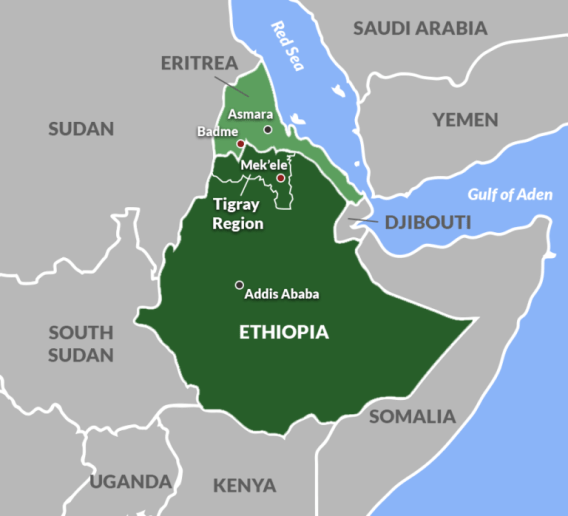
President Uhuru of Kenya, speaking at Ethiopian Prime Minister Abiy Ahmed’s inauguration had said, “Ethiopia is the Mother of African independence… for all of us on the continent, Ethiopia is our Mother… As we know, if the Mother is not at peace, the family cannot be at peace.”
The US is going for the jugular veins of the Mother of post-colonial Africa. An analogy would be destabilising India to gain control of the South Asian region, the difference being that Ethiopia is the only African country never to have been colonised.
The widespread revulsion among Afghans all over the continent is palpable over the US using its TPLF proxy to destabilise Ethiopia. Their collective cry is “No more” — no more colonialism, no more sanctions, no more disinformation, no more lies by the CNN, BBC, etc. The cry resonates widely amongst the Ethiopians, Eritreans, Sudanese, Somali, Kenyan, and friends of Ethiopia.
The paradox is, Ethiopia today has a democratically elected government after decades of thuggery under the TPLF that ruled with an iron fist for over 30 years with US backing. The Tigray people actually add up to only 5% of Ethiopia’s population but such details were irrelevant to Washington so long as the government in Addis Ababa obeyed its diktat.
There is also a religious sub-text. The Tigray people are Christians whereas the largest ethnic group in Ethiopia is the Oromo, native to the region of Ethiopia and Kenya. They are a Cushitic people who have inhabited the East and Northeast Africa since at least the early 1st millennium. The Oromo people have a glorious history of forced resistance to religious conversion, primarily by European explorers, Catholic Christians missionaries.
Broadly, the resistance ideology is embedded in the Oromo collective memory. Abiy Ahmed is the first ethnic Oromo to become prime minister. Nobel laureate Abiy Ahmed is an extraordinary politician, far-sighted and deeply committed to his country’s plural identity national sovereignty.
In geopolitical terms, Washington would see many advantages in the destabilisation of Ethiopia as it would trigger a multi-vector regional conflagration, as happens when multi-ethnic nations unravel — such as the former Yugoslavia or today’s India or Russia. And neighbouring countries would be inevitably sucked into ethnic wars such as Sudan, Eritrea, Djibouti, Somalia and Kenya — and even Egypt and Persian Gulf states.
The fact that the UAE, Turkey and Iran — improbable allies — are supporting Abiy’s desperate effort to preserve Ethiopia’s sovereignty and national cohesion and helped boost his military campaign to ward off another attempt by the US-backed TPLF to capture power speaks volumes.
In this matrix, while the US aims to dominate the hugely strategic Horn of Africa, “Plan B” will be to be the spoiler by throwing the region into turmoil so that China is also a loser. The point is, the Western world has no answer to China’s BRI.
China and Ethiopia have a strong political affinity and deep economic bonds, and Ethiopia is one of China’s top five investment destinations on the African continent. Beyond investment, relations extend to trade, infrastructure finance and other areas. Economic engagement with China has provided Ethiopia with many opportunities.
Curiously, even prior to the advent of the BRI, China was already a major financier of Ethiopia’s infrastructure. Chinese investment in the manufacturing sector — incidentally, one of the Abiy government’s focus areas currently — has contributed to the country’s economic transformation and diversification and to job creation.
A recent report by the well-known London-based global think-tank ODI titled The Belt and Road and Chinese Enterprises in Ethiopia estimates that China’s BRI “has the potential to open up new development pathways through infrastructure development, stimulating investment and job creation and promoting economic transformation… BRI can be an engine for growth and development. However, this is not a given…”
The ODI report, dated August 2021, concludes, “Chinese investors are concerned regarding economic and political uncertainty in Ethiopia. Political uncertainty has to do with domestic conflict and political instability, which may affect not only investors’ profitability, but also their personal safety and the safety of their assets. The economic challenges relate to high production and transport costs and the difficulties of accessing foreign exchange, which is a problem for virtually all Chinese businesses in the country. The challenges identified by Chinese investors could pose a threat to the sustained development of China–Ethiopia economic cooperation.”
Simply put, if there is mayhem in Ethiopia, the locomotive of China’s BRI in the vast regions of the Horn of Africa and East Africa can be potentially slowed down if not derailed. That is the least the US can do faced with the grim prospect that it has no alternative offer to make to the African nations to counter the BRI.
If the BRI locomotive chugs along unimpeded, the entire Western neocolonial project in Africa in the 21st century is threatened with extinction. The existential angst shows in the Biden Administration’s announcement on New Year’s Eve terminating Ethiopia’s access to the US duty-free trade program under the U.S. African Growth and Opportunity Act (AGOA “amid the widening conflict in northern Ethiopia.”
President Biden had threatened in November already that Ethiopia would be cut off from the AGOA because of alleged human rights violations in the Tigray region. Biden spoke up in sheer despair in anticipation of Wang Yi’s working visit to Ethiopia on December1!
Belgium complicit in killing of popular African leader, book claims
New evidence shows Belgium turned a blind eye as its officials plotted the assassination of Burundian PM Prince Louis Rwagasore in 1961

PM Prince Louis Rwagasore led Burundi to independence from Belgium © AFP / BELGA
RT | January 5, 2022
Belgium has “overwhelming responsibility” for the killing of Prince Louis Rwagasore, the popular Burundian leader who sought to unite the country’s ethnic groups as it gained freedom from the colonial power, new evidence shows.
Weeks after being elected prime minister in a landslide, Rwagasore, the 29-year-old son of a former king, was assassinated in October 1961. The governing Belgian elite masterminded the shooting while Brussels turned a blind eye, according to archived records uncovered by Flemish sociologist Ludo De Witte.
Although the shooter, a Greek national, and five accomplices were executed, De Witte said that probes by the Belgian colonial court, the government of independent Burundi, and the UN all neglected Belgium’s role in the killing, which led to decades of war, ethnic tensions, and instability.
Publishing his findings in a book titled ‘Murder In Burundi’, De Witte noted that then-Belgian governor Roberto Regnier had told a post-election crisis meeting of senior Belgian officials and allies in the Belgium-friendly Christian Democrat party (CDC) that “Rwagasore must be killed.”
According to the author, the CDC saw his words as an invitation. Regnier’s remarks were apparently confirmed by four people at that meeting to a 1962 inquiry by prosecutors in Brussels. But that report had not been published until De Witte unearthed it during a five-year investigation into the murder.
It also appears the UK was at least aware of the danger faced by Rwagasore, with Britain’s then-ambassador James Murray writing in a 1962 dispatch that influential Belgians had “an almost pathological hatred” of the charismatic leader, who they believed would harm Belgian-Burundian relations. Murray noted that Regnier’s “words… go very far in the direction of incitement to murder,” according to De Witte.
The book also accuses then-Belgian foreign minister Paul-Henri Spaak – today celebrated as a founding father of the EU – of ignoring Regnier and other conspirators on a “war footing” with Rwagasore. It also finds fault with King Baudouin, who “moved heaven and earth” to commute the assassin’s death sentence to life imprisonment.
Last October, a special commission into Belgium’s colonial past admitted it paid “limited attention” to Burundi and Rwagasore’s killing. De Witte attributed this to a “reticence” among the country’s elite to “confront the reality” of colonization.
Meanwhile, a Belgian Foreign Ministry spokesperson did not respond to the book’s charges, but told The Guardian that the government was waiting for parliamentary recommendations before adopting a policy position.
COVID Jabs: Ineffective, Oppressive and Dangerous
By Iain Davis | OffGuardian | December 23, 2021
There is no moral, legal or logical argument for mandatory vaccination. The only logical argument, from a public health perspective, would be either to reduce the spread of infection or reduce the impact on health services via some other mechanism.
We will explore the evidence which shows that the COVID-19 supposed “vaccines” are incapable of achieving either.
That didn’t stop the UK parliament voting to allow the government to mandate vaccination for NHS staff. In doing so, they laid the path clear for a wider, national mandate.
Prior to the vote, the British Medical Journal published the protestation of concerned medical professionals who highlighted that there is insufficient evidence to support a mandate.
UK MPs apparently decided that the doctors and nurses didn’t know what they were talking about and were not interested in the scientific evidence they cited. While this illustrates that decision making is not led by science, perhaps this is not the primary concern.
Whatever the political or popular opinion may be, to insist that an individual must submit to injection against their will is to deny them their inalienable right of bodily integrity.
This right was described by Professor David Feldman in Civil Liberties and Human Rights In England and Wales:
A right to be free from physical interference. [This] covers negative liberties: freedom from physical assaults, torture, medical or other experimentation, immunization and compelled eugenic or social sterilization, and cruel or degrading treatment or punishment. It also encompasses some positive duties on the state to protect people against inference by others.”
Both the European Convention on Human Rights (Article 3) and the Universal Declaration of Human Rights (Articles 1 & 3) allegedly guarantee the integrity of the person.
However, these are “Human Rights” written on pieces of paper by politicians and lawyers. As such, they can be overruled by governments and other politicians and lawyers. Human Rights are not rights, they are government permits and permits can be rescinded.
More importantly, in the UK, there is a clear legal precedent for the concept of bodily integrity. In Montgomery vs Lanarkshire Health Board the Supreme Court ruled:
An adult person of sound mind is entitled to decide which, if any, of the available forms of treatment to undergo, and her consent must be obtained before treatment interfering with her bodily integrity is undertaken.”
If society decrees that the population no longer has a right to bodily integrity then the people become the slaves of that society. A society that advocates mandatory vaccinations equally advocates slavery. Those who advocate mandatory vaccination support slavery in principle. None of the justifications they offer negate this fact.
The legal definition of ownership is the “exclusive legal right to possession.” A vaccination mandate decrees that the individual no longer has legal possession of their own body. It removes the individual’s legal right to ownership of their physical being and hands it over to the state. This constitutes slavery.
Slavery is defined as:
The condition of being legally owned by someone else and forced to work for or obey them”
There are those who suggest that the “common good” warrants slavery. They state, based upon assumption and ignorance, that when a person refuses COVID-19 vaccination they are putting others at risk and behaving in a way that jeopardises the common good.
They maintain that society should have the right to violate the bodily integrity of its slaves.
As pointed out by many, a mandate differs from law. However, a government mandate is something the state uses to claim the non-existent right to force people to obey. Individuals can be punished–fined or even imprisoned–for failing to abide with a state mandate. The right to bodily integrity is denied by mandate and all citizens are made slaves by virtue of it.
Some anti-rationalists have argued that a mandate does not constitute “force.” This is a ridiculous contention.
Threatening to fine people is coercion and warning of potential imprisonment is the threat of violence. This is the literal definition of the use of force:
Coercion or compulsion, especially with the use or threat of violence.”
Where violence is defined as:
Extremely forceful actions that are intended to hurt people or are likely to cause damage”
Those who believe in the concept of the common good, debating the point at which it overrides individual sovereignty, accept that some group they choose to empower has the right to force others to obey.
Regardless of whatever rationale they claim, by ultimately insisting that no citizen has the right to bodily integrity, they promote slavery, including their own.
Some people are a bit squeamish about admitting their support for slavery and prefer to pretend that forcing compliance through other means is not slavery.
The head of Ryan Air, Michael O’Leary, apparently thinks that denying people access to society, employment, food and medical treatment is not a “mandate” and therefore forcing them to take the vaccine through this mechanism doesn’t amount to slavery.
O’Leary’s suggestion is that those who decline the vaccine should be punished for their disobedience. He thinks that threatening people with poverty, starvation and a shorter life expectancy is perfectly acceptable in order to force them do as he wishes. He believes that, if this isn’t officially mandated, doing so will somehow protect their rights:
[A mandate] is an infringement of your civil liberties. But you simply make life so difficult. Or [make it that] there are lots of things that you can’t do unless you get vaccinated”
Proponents of the “common good,” who insist that getting vaccinated is the “right thing” and therefore not complying is wrong, cannot both proclaim society’s alleged authority to ignore the inalienable right of bodily integrity and simultaneously pretend they oppose slavery.
If, as a society, we allow the government to mandate or if, like O’Leary, we choose to enforce vaccination by other means, then we have collectively consented to live in a slave state where we are all slaves.
If we go down this path we condemn future generations to slavery. Yet somehow those who decline the offer of slavery, who oppose it in principle, are considered to be selfish by wider society.
The supporters of slavery justify this to themselves because they believe the extremely limited public health impact of a low mortality respiratory disease is more important than human freedom.
This opinion is informed by the flawed and irrelevant assumption that the jabs protect others. The efficacy and safety of the vaccines is immaterial. To deny an individual’s right to bodily integrity is slavery. It does not matter what the claimed justification is.
There are already many slaves being traded, exploited and abused in the UK. While the experience of those who suffer the daily hell of modern slavery is in no way comparable to merely being forcibly injected with a drug once or twice a year, the principle of slavery is the same. It seems odd that the suggested “common good” doesn’t demand freedom for those currently living as slaves. Perhaps society no longer cares.
Putting aside the lack of moral and legal legitimacy, there are other reasons why we should reject any notion of a vaccine mandate. Primarily that the so-called vaccines don’t work and are dangerous.
THE JAB BASICS
The word “infection” is defined as:
“The state produced by the establishment of one or more pathogenic agents (such as a bacteria, protozoans, or viruses).”
If you had looked at the medical definition of “vaccine” in 2019 you would have understood a vaccine to be:
A preparation of killed microorganisms, living attenuated organisms, or living fully virulent organisms that is administered to produce or artificially increase immunity to a particular disease”
Where immunity was defined as:
The quality or state of being immune; especially: a condition of being able to resist a particular disease especially through preventing development of a pathogenic microorganism or by counteracting the effects of its products.”
A vaccine was a drug that “especially” reduced infection. It could theoretically stop a pathogenic agent, such as a bacteria, protozoans, or virus from establishing itself in a biological system. Thus reducing the incidents of disease and subsequent transmission of the pathogen.
However, in the wake of the pseudopandemic, that is not what the changed definition of “vaccine” has come to mean today. The only thing an alleged, so-called vaccine is required to demonstrate is immunogenicity:
A preparation that is administered (as by injection) to stimulate the body’s immune response against a specific infectious agent or disease”
Purely by changing the definition, a “vaccine” is now a drug that stimulates an immune response. It says nothing about how effective or safe that immune response is. Inflammation is an immune response and it is potentially lethal.
Absent the ability to protect against infection, most people would consider a drug which only reduces the severity of disease to be a treatment, not a vaccine.
While it is true that language constantly evolves and definitions change all the time, where that change fundamentally redefines the commonly accepted meaning of a word, everyone needs to be aware of the new interpretation. If not, they could accept an implied meaning that no longer exists.
For example, people could easily be fooled into believing a COVID-19 “vaccine” stops infection. To draw a distinction between what most people imagine “vaccine” to mean and what it now means, we will refer to the alleged COVID-19 “vaccines” as jabs.
THE JABS HAVE NOT COMPLETED & DO NOT NEED TO COMPLETE ANY CLINICAL TRIALS
Unlike every vaccine that preceded them, the jabs have not completed clinical trials prior to being given to more people than any other vaccine in history.
At the time of writing there are no results posted for the NCT04614948 trial of the Pfizer-BioNTech mRNA jab; none for the NCT04516746 Astrazeneca jab; there are no results from Moderna’s NCT04470427 trial nor any from J&J’s NCT04368728 trial of their Jansen jab.
When the UK medicines regulators, the MHRA, said that they “carried out a rigorous scientific assessment of all the available evidence of quality, safety and effectiveness,” prior to allowing the jabs’ Emergency Use Authorisation (EUA,) they did not mean they had studied the results of any clinical trials. They couldn’t, because there aren’t any.
What they meant is that they had received interim reports from the manufacturers and their sponsors (UK Research and Innovation, National Institutes for Health Research (NIHR), Coalition for Epidemic Preparedness Innovations (CEPI), Bill & Melinda Gates Foundation, Lemann Foundation etc.) The MHRA, as other regulators around the world, based their decision to grant the EUAs on these interim reports, not upon the results of any clinical trials.
This enables the mainstream media to report news agency statements which mislead the public:
Massive coronavirus vaccine trials involving tens of thousands of participants have so far surfaced no signs of serious side effects.”
The continual impression given is that the jabs are clinically proven to be safe and effective. In reality, few adverse reactions have been reported in the trials because no trial results have been posted.
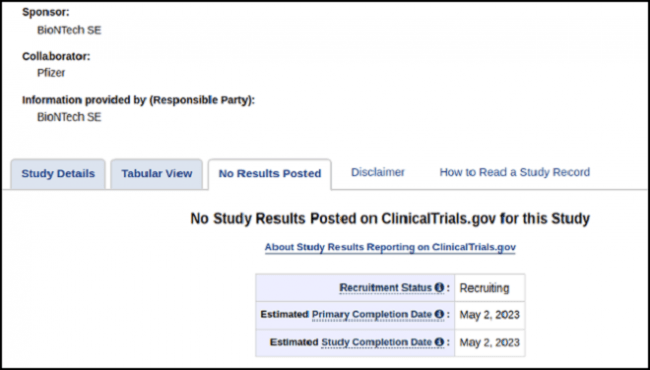
The trials were designed to be blind Randomised Control Trials (RCTs.) As they were trialling the first proposed vaccines for a novel disease, the standard RCT approach to determine the safety and efficacy of the jabs was to compare the long term health outcomes of jab recipients to those of a placebo group. These would be “blinded,” meaning that the trial participants were not told if they had been jabbed or received a placebo.
The secondary outcomes for the trials were designed to assess the effects of the vaccines. This including assessment of any adverse drug reactions (ADRs) for up to 2 or more years after the final dose. So far, none of the secondary outcomes have been measured because we are more than a year away from the end of the minimum trial periods.
There is now no chance that these clinical trials will ever reveal any meaningful results. As reported in the British Medical Journal both J&J and Moderna have “unblinded” their trials by giving their jab to their placebo groups. They have abandoned the secondary outcomes, years before the trials are complete. When asked, neither Astrazeneca nor Pfizer-BioNTech denied doing the same.
In any event, it appears their trials were poorly designed and lacked scientific credibility. It is strongly alleged that Pfizer-BioNTech, at least, falsified data, unblinded their study, failed to adequately train staff and were reluctant to follow up on reported adverse events.
When independent researchers used a Freedom of Information request (FoIR) to ask UK regulator, The Medicines and Healthcare products Regulatory Agency (MHRA), why the Pfizer-BioNTech NCT04614948 clinical trial hadn’t assessed the vaccine’s impact upon pregnant women, the MHRA stated:
The above trial was not conducted in the UK, the MHRA did not assess its content and are therefore not in a position to answer specific questions relating to it.”
Not bothering to consider the primary clinical trial doesn’t appear to be a very “rigorous scientific assessment.” Rather, it seems the MHRA are among a group of regulators who unquestioningly accepted whatever the manufacturers claim without genuinely scrutinising anything.
The MHRA have now formally adopted this laissez-faire approach to future jab regulation. Having aligned themselves with the Access Consortium of regulators (Australia, Canada, Singapore and Switzerland), the MHRA are among those who see no reason for any further regulatory scrutiny prior to the approval of new jabs.
The Consortium believe new iterations, responding to allegedly new variants of COVID-19, can effectively be waved through automatically. This is based upon the impossible.
The MHRA assert that their initial EUA reflected their appraisal of the “pivotal clinical trials,” for which there are no posted results. Having authorised the jab roll-outs without any substantiating evidence, the MHRA now claim that, for all tweaked future versions:
Clinical efficacy studies prior to approval are not required. Regulatory Authorities request bridging data on immunogenicity from a sufficient number of individuals”
This speeds up the process of getting jabs straight out of the corporate labs and into the arms of a broadly misinformed public. Whatever tweaks the manufacturers choose to make will just be rubber stamped by the Consortium as long as the pharmaceutical corporations submit the appropriate immunogenicity claims.
The issuance of an EUA is not the same as regulatory approval of a medicine. As explained by the U.S. regulator, the Food and Drug Administration (FDA,) an EUA is a temporary authorisation of an investigational medication:
An EUA for a COVID-19 vaccine may allow for rapid and widespread deployment for administration of the investigational vaccine to millions of individuals”
The FDA also state that an investigational drug, still in trials, is an experimental drug:
An investigational drug can also be called an experimental drug.”
The current COVID-19 jabs are still in trials and are “experimental drugs.” So-called fact checkers have been dispatched to mislead the public into believing this is not the case.
For example Full Fact, the UK based political activists who work with policy makers to market their own business, claimed:
The three Covid vaccines currently approved for use in the UK have already been shown to be safe and effective in clinical trials.”
This was a factually inaccurate statement. In terms of issuing EUAs, all that was known from the phase 3 trials was the interim results.
These reported what little data was available from the first two months of phase 1. This was merely a claim that the jabs were relatively safe for a small cohort of fit and healthy, predominantly younger people. We will shortly discuss why even this assertion is false.
All we can say at this juncture is that there is no perceptible regulation of the jabs. They are effectively unregulated.
The trials have yet to demonstrate that the jabs are either safe or effective. The exclusion criteria for all the trials ruled out trialling the jabs on those most vulnerable to COVID-19. The interim reports from phase 1 only claim efficacy and safety among those least susceptible to apparent COVID-19 risks. Now those trials will never be completed.
The interim trial reports claimed efficacy in terms or relative instead of absolute risk reduction. This enabled the manufacturers to claim a 95%+ reduction in mortality (efficacy.) This was then reported to the public who were swayed by this reporting bias.
The claimed absolute risk reduction (efficacy) was typically less than 1%. Had this been reported to the public the people would have been less enthusiastic and perhaps more sceptical about the jabs, which is why it wasn’t.
The EUAs, on both sides of the Atlantic, also came with immunity from prosecution for the manufacturers. In the UK, the Human Medicines (Coronavirus and Influenza) (Amendment) Regulations 2020 extended the liability protection offered to administering medical practitioners to the pharmaceutical corporations.
Immunity from prosecution is an apparent deal breaker for the drug companies. In early 2021 the managing director of the World Bank, David Malpass, reported that some jab manufacturers would not distribute their jabs to countries that did not fully indemnify them against prosecution:
The immediate problem is indemnification. Pfizer has been hesitant to go into some of the countries because of the liability problems, they don’t have a liability shield. So we work with the countries to try to do that.”
There is no doubt that the jabs are experimental drugs that have not completed any clinical trials. As such the population who have received them are part of a global medical experiment. In partnership with government, that experiment is being conducted by global pharmaceutical corporations which have no liability for any harm they may cause.
This fact is then covered up by the global media corporations and appointed fact checkers, who also work in partnership with government.
Statements from the NHS such as “The COVID-19 vaccines are the best way to protect yourself and others” or “any side effects are usually mild and should not last longer than a week” are not based upon any clinical trial evidence. They are speculative, misleading and potentially dangerous proclamations.
Unless, before being jabbed, recipients were explicitly made aware of these facts they cannot possibly have given informed consent.
In each and every instance, despite the fact free denials of the comically misnamed fact checkers, this constitutes a breech of the Nuremberg Code.
BLAMING THE UNJABBED
Following the comments of the health secretary, Sajid Javid, the MSM dutifully reported that there are around 5M “unvaccinated” people in the UK. This figure appears to be only partially accurate.
According to figures released by the UK Health Security Agency (UKHSA), by mid December 2021, with the booster roll-out well underway, of the approximate 44.6M adults in England, around 38.6M had received at least two doses and were therefore temporarily deemed to be “fully vaccinated.”
This means that currently about 6M adults in England alone are officially “unvaccinated.” England represents approximately 84% of the UK population. Assuming similar vaccine distribution figures for the whole of the UK, this suggests that at least 6.9M adults are officially unvaccinated. This represents nearly than 13% of the adult UK population.
The size of the unvaccinated population is set to grow. The UK government have already said that a booster will be needed for the NHS COVID Pass (certificate) for international travel.
Initially the UK government said that they didn’t intend to extend this to the domestic vaccine passport but they also repeatedly denied that they would introduce vaccine passports.
Subsequent comments from the Health Secretary clarified the government’s intention to continually shift their definition of “fully vaccinated.” To be fully vaccinated the slave must always agree to the next jab.
With the jab sales force insisting that boosters will be needed for years to come, it seems “fully vaccinated” status will last for about 6 month.
The MSM, on behalf of the government who fund them, have propagandised the nation into believing that it is the unvaccinated who are “overwhelming” health services. With headlines like ICU is Full Of The Unvaccinated – My Patience With Them Is Wearing Thin, it is no wonder that the jabbed majority are turning their hate towards the people who don’t want the jabs. It is extremely common to read social media comments such as:
Unvaccinated people are taking beds from other sick people, some of whom become sicker as a result. Not being vaccinated during a pandemic is an act of selfishness hiding behind the facade of individual liberty.”
The “ICU is Full” Guardian article was from an anonymous source. No one was willing to put their name to it. It was primarily an appeal to emotion and offered no evidence to back up any of its claims. This is because the evidence does not support any aspect of the published story. The only apparent reason for the article was to incite hatred.
Real journalists, like Kit Knightly from the OffGuardian, which is censored by the social media platforms, have been willing to put their name to the reporting of the facts.
As he shows, ICUs are not overwhelmed at all. They are quite busy, as usual, but they are certainly not overrun with COVID-19 “cases,” as the Guardian and others have deceptively claimed.
Currently there are 4330 critical care beds in England. On December 14th 2021, 925 were occupied by so-called COVID-19 patients, a COVID-19 ICU bed occupancy rate of 21.4%. There were 775 (17.9%) unoccupied ICU beds with 2657 beds (61.4%) taken by patients who had not tested positive for the selected COVID-19 nucleotide sequences.
In their Week 50 Vaccine Surveillance Report UKHSA state that, for the preceding 4 week period, 2965 alleged COVID-19 adult hospital patients had not received a jab and 4557 had received at least one. Therefore UKHSA claim that the un-jabbed represent 39.4% of total COVID-19 hospital admissions.
For the same 4 week period, UKHSA also reported that 715 of the 3083 total adult deaths, within 28 days of a positive test, were people who were not jabbed. This represents 23.2% of alleged COVID-19 deaths. With 28 deaths attributed to those with an unknown jab status, the remaining 2340 were jabbed. The jabbed represent 76% of all alleged COVID-19 deaths.
Similar data for Wales also belies the false claim that it is the unjabbed who are “overwhelming” health services. In November 2021 12.8% of hospital inpatients were “unvaccinated.” The “vaccinated” accounted for 84.5% of hospital inpatients with 2.7% of unknown jab status.
The anonymous claims reported in the Guardian weren’t even remotely accurate. The tale was a propagandist disinformation. It was “fake news.”
Yet the politicians are desperate to peddle the same lie, with the assistance of their compliant MSM. Once again, the Guardian reported the comments of the Health Secretary as if they were realistic. Speaking about the people who have considered the evidence and have decided not to take the jab, Javid said:
They must really think about the damage they are doing to society. They take up hospital beds that could have been used for someone with maybe a heart problem, or maybe someone who is waiting for elective surgery.”
At no point did the fearless journalists at the Guardian inform the public that what he was saying was total nonsense. Instead, they doubled-down on the lies with added disinformation of their own, claiming that “nine out of 10 of those needing the most care in hospital are unvaccinated.” Yet another example of absolute fake news, intended to deceive the public.
As we will discuss shortly, it is the seeming clamour to “get boosted,” incessantly pushed by the MSM and the politicians, effectively shutting down primary healthcare, that presents a far greater risk to public health. The mendacity of Javid’s disinformation was breathtaking.
The people who are queuing for their jabs aren’t selfish, just misinformed. However, the 13% of adult the population who don’t want one aren’t selfish either.
The MSM and the politicians persistently try to drive a wedge between the jabbed and the unjabbed. They seek to cause divisions based upon disinformation, lies and propaganda.
The reason for this is clear. Just like all tyrannical regimes throughout history, the current UK dictatorship wish to scapegoat a minority in order to avoid wider public attention turning on them. They do this to reduce the chance of the people questioning the tyrants who are enslaving them. It is nothing more complex than divide and rule.
THE JABS DON’T WORK
Speaking in October, the current UK Prime Minister, Boris Johnson, effectively admitted that the jabs are not “vaccines.” They do not function like any vaccines we are familiar with. Apparently, they are much more like a treatment:
Double vaccination provides a lot of protection against serious illness and death but it doesn’t protect you against catching the disease, and it doesn’t protect you against passing it on.”
Johnson’s observation was partially accurate. Recent research from the US found that there was no difference in viral load between the vaccinated and the unvaccinated. These findings appear to be corroborated by a study from Singapore, which strongly advocated the jabs for their claimed ability to reduce mortality, but also noted:
PCR cycle threshold (Ct) values were similar between both vaccinated and unvaccinated groups at diagnosis, but viral loads decreased faster in vaccinated individuals […] viral load indicated by PCR Ct values was similar between vaccinated and unvaccinated patients.”
For the jabs to function as a vaccine, in the traditional sense, the higher the jab rate the lower disease prevalence should be. This is an obvious point, but seemingly one that needs to be stressed as the wider public appear to be largely unaware of this.
There is no statistical correlation between population jab rates, infection rates and disease prevalence. A joint U.S. and Canadian study, which assessed statistical reports from 68 countries and 2947 US counties found:
At the country-level, there appears to be no discernable relationship between percentage of population fully vaccinated and new COVID-19 cases in the last 7 days. In fact, the trend line suggests a marginally positive association such that countries with higher percentage of population fully vaccinated have higher COVID-19 cases per 1 million people.”
Yet, somewhat contrary to their own findings, the researchers still promoted the jabs as part of broader approach to disease mitigation using non pharmaceutical interventions, including wearing face-masks, lockdowns and social distancing. As we will discuss shortly, promoting the official narrative is now a prerequisite for peer review and publication.
Presumably, to stay within the permitted boundaries of the official scientific consensus, the researchers maintained the new definition of “vaccine,” describing a drug incapable of reducing infection rates that acts like a treatment:
Vaccinations offers protection to individuals against severe hospitalization and death.”
The peninsula of Gibraltar, with a population of around 34,000, was delighted to declare that it had achieved a 100% jab rate. Thereafter it suffered a surge in reported cases.
In the Republic of Ireland, the city of Waterford has a 99.7% jab rate and the highest case rate in Ireland.
In Israel, where the definition of “fully vaccinated” means someone received two initial jabs and a booster (3 jabs,) there have been 67 recorded cases of the Omicron variant. Of these 54 (nearly 81%) were fully jabbed. Of the remaining 13 cases we don’t know if any of them were genuinely unjabbed. They could have received one or two jabs and still be categorised as not “fully vaccinated.”
If we look at a recent map of vaccine coverage provided by CNN we can identify some interesting comparisons.
Brazil, with jab coverage of 150 jabs per 100 people, has more than 103,000 COVID cases per million people (CPM). Neighbouring Bolivia, with 77 jabs per 100, has a case rate of just under 47,000 CPM. Paraguay has a slightly higher jab rate of 88 and a slightly higher case rate of 64,000 CPM. Argentina, with the highest jab rate of all, at 220 per 100, also has the highest CPM of all, at just over 117,000.
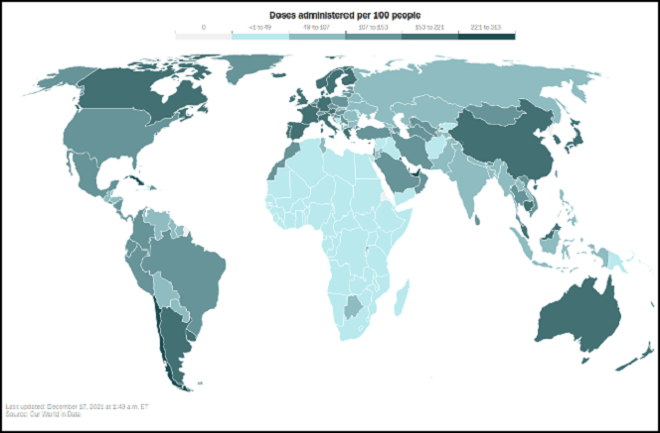
The most striking feature of the CNN map is the very low vaccinations rates in Africa. Nigeria, Tanzania and Zambia, for example, have less than 10 jabs per 100. They are among the countries with the lowest case rates in the world. Zambia has just over 11,000 CPM and Nigeria and Tanzania much less. By contrast Botswana, with a relatively high African vaccination rate of 62 per 100 people, has a CPM of nearly 82,000.
Some scientists are apparently mystified by the low rates of COVID-19 in Africa as a whole. They offer a range of possible explanations. They point towards a younger population or early border closures, some suggest lower urban density or perhaps more outdoor activity to account for the obvious anomaly.
Calling it a “mystery” Prof. Wafaa El-Sadr, global health lead at Columbia University, said:
Africa doesn’t have the vaccines and the resources to fight COVID-19 that they have in Europe and the US, but somehow they seem to be doing better.”
African nations are certainly doing better than the U.S. With approximately 4% of the World’s population and a vaccine rate of 147 per 100 people, the U.S. account for more than 36% of the current 27,586,743 active global cases.
In fact, the list of the top 20 nations with the highest case rates around the world is predominantly composed of the countries with the highest vaccination rates.
Scientists are looking at all the variables to try and figure out what could possibly explain the African mystery. The only factor they aren’t considering is the most obvious one.
Despite most African nations having no first wave, the global scientific and medical authorities are hell-bent on preventing the second with the jabs. Prof. Salim Abdool Karim from the South Africa’s University of KwaZulu-Natal said:
We need to be vaccinating all out to prepare for the next wave.”
Professor Karim was invited to join the World Health Organisation’s (WHO) science council in April 2020. The WHO have made jabbing African populations its next priority.
There are multiple studies which demonstrate that natural immunity derived from infection is considerably better than any imparted by the jabs. A recent Israeli investigation suggests that natural immunity, following infection, is up to 27 times more robust than any conferred by the jabs.
Regardless of scientific debates about antigens, T-cells and immunogenicity etc., which all relate to how the jabs supposedly function, very basic statistical analysis is sufficient to clearly demonstrate that they do not work as vaccines.
The only remaining claim for the jabs efficacy is that they reduce hospitalisation and death. Unfortunately, there is a lot of evidence which casts doubt upon this claim too.
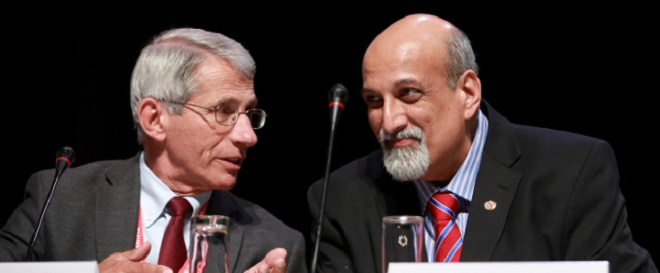
Anthony Fauci (left) & Salim Abdool Karim (right)
If the jabs are incapable of stopping infection and transmission and serve only to reduce natural immunity, there is no possible public health rationale for a jab mandate. An uninfected individual is no more likely to catch COVID-19 from an unjabbed person than they are from a jabbed citizen. According to the official definition of a COVID-19 case, the statistics show that the jabs don’t make any difference whatsoever to the spread of disease.
In his more recent address to the nation, pushing the unregulated booster jabs, Boris Johnson said:
Over the past year we have shown that vaccination is the key to beating Covid and that it works […] It is now clear that two doses of vaccine are simply not enough to give the level of protection we all need […] we must urgently reinforce our wall of vaccine protection to keep our friends and loved ones safe […] As we focus on boosters […] it will mean some other appointments will need to be postponed until the New Year […] If we don’t do this now, the wave of Omicron could be so big that cancellations and disruptions, like the loss of cancer appointments, would be even greater next year”
Johnson’s speech was utterly incoherent. On the one hand the vaccines work but on the other they don’t and a booster is required. To fend off a wave of cases, defined by a test that can’t identify cases, apparently trivial health interventions, like cancer screening appointments, need to be cancelled for the benefit of the nation’s health and the common good.
Shortly following Johnson’s plea to “get boosted now” the UK government clarified that GP surgeries across the land would focus upon jabs and emergency appointments only.
By declaring a “national mission” to jab as many people as possible, primary care has practically been suspended in the UK. This has been done in the winter, in the middle of an alleged respiratory disease pandemic. The Health impact from this will be disastrous.
The British Medical Association has already warned that the reconfiguration of the NHS, first into a COVID-19 only service and now a jab only service, has terrible public health consequences.
Just in the 3 month period following the first lockdown there were up to 1.5M fewer elective admissions to hospital; first time patient attendance, for all conditions, dropped by 2.6M; urgent cancer referrals were down by an alarming 280,000, with up to 26,000 fewer patients starting treatment, of which 15,000 would normally have first come to light via a GP referral.
Yet, knowing all this, the government would have you believe that their intention is to save life. This claim is not credible.
THE JABS ARE DANGEROUS
Further evidence from Israel suggests that the the period between the first and second jab, and shortly thereafter, increases the COVID-19 mortality risk. Vulnerability to disease is significantly greater during this 3 to 5 week period.
Prof. Dr. Seligmann (Ph.D) and his research partner calculated the base rate likelihood of COVID-19 mortality for different age groups prior to being jabbed. For example, for those over 60, it was 0.00022631% per day. He then contrasted this with the official Israeli data for mortality immediately post jab.
During the 13 day period after the first dose of the Pfizer jab, the COVID-19 daily mortality risk for the over 60’s was 14.5 times higher at 0.003303% per day. After 13 days this risk increased to 0.005484% per day, more than 24.2 times greater. This rose further, up to 6 days after the second dose, to 0.006076% per day, representing a 26.85-fold increased risk of COVID-19 mortality for the jabbed.
Prof. Seligmann found similarly huge increases in the COVID-19 mortality risk for all the jabs during what he called the “period of vaccination.” Once the recipients were “fully vaccinated” Seligmann found some benefit for the jabbed, as they afforded a marginal reduction in COVID-19 mortality risks when compared to those of the unjabbed.
He calculated that, for this benefit to outweigh the massive increase in risk during the “period of vaccination,” the jabs would have to provide near 100% protection for more than two years just to offset the initial health cost of being jabbed. This benefit is not seen in the data.
A recent Swedish study is one among many to show that any possible COVID-19 benefit, once fully jabbed, wanes quickly. Unable to protect those most vulnerable to COVID-19 after 6 months, Dr Seligmann’s research indicates that there is no COVID-19 health benefit associated with the jabs.
Official risk/benefit analysis suggests that being fully jabbed provides some marginal protection against hospitalisation. There is also a barely discernible statistical signal suggesting that they also reduce mortality, to a very limited degree.
Prof. Seligmann found the same. However, this only related to the COVID-19 statistics and they are based upon non-diagnostic RT-PCR test results. Official claims take no account for the additional “period of vaccination” risk identified by Seligmann.
Prof. Selligman and Dr. Spiro P. Pantazatos, assistant Professor of Clinical Neurobiology at Columbia University, subsequently undertook further evaluation of the all cause mortality risk following the jabs.
Their research showed an estimated U.S. Vaccine Fatality Rate (VFR) of 0.04%, suggesting that the CDC declared VFR of 0.002% underestimates mortality caused by the jabs by a factor of 20. The scientists found that the data indicated U.S. jab related deaths of between 146,000 and 187,000 for the period between February to August 2021.
Pantazatos and Seligmann also identified a significant increase in the all-cause mortality risk in the first 5-6 weeks following the first jab. Again, demonstrating that the initial risk of being jabbed is not offset by the short-lived benefit once “fully vaccinated.”
There is little reason to accept the officially reported statistics.
The attribution of COVID-19 to mortality is spurious. Death within 28 or 60 days of a positive RT-PCR test is used, depending on whose statistics you look at. This is not “proof” that COVID-19 was the cause of death.
Attribution of COVID-19 to hospital admissions is equally weak. Research by independent auditors shows that people with a range of non-COVID related presentations, such as limb or head injuries, are often admitted to hospital as supposed COVID-19 patents.
The researchers found that, in more than 90% of alleged COVID-19 admissions, there was no clinical reason to describe them as such.
All alleged benefits of the jabs are based upon these woolly definitions and questionable statistical assertions. Consequently, if we truly want to understand the possible benefits of the jabs, we need to look at all cause mortality.
This can be considered more reliable because it is simply an anaylisis of all registered deaths, irrespective of the cause.
If the jabs work and are safe, then a difference in all cause mortality between the the jabbed and the unjabbed should be observed. While the jabbed aren’t protected against other causes of death, they are supposedly protected against COVID-19 and this should be detectable in the data.
A team of statisticians from Queen Mary University London conducted a study of all cause mortality data in England. They examined the vaccine surveillance monitoring reports issued by the Office of National Statistics (ONS).
They noted that initially, as we’ve discussed, these official reports seem to show a benefit from the jabs. However, they identified a series of anomalies in the data.
They found that non-COVID-19 mortality patterns, for the supposedly unjabbed, had peaks that correlated with the jab rollouts. After the “period of vaccination” the Non COVID-19 mortality for both the jabbed and allegedly unjabbed cohorts remained similar and relatively stable. Further, in general, the unjabbed appeared to have unusually high non-COVID-19 mortality while the jabbed seemingly had unusually low non-COVID-19 mortality.
They also looked at the different categories of jabbed people. These were “within 21 days of first dose,” “at least 21 days after first dose,” and “second dose.”
They found a consistent but large variation in the mortality figures between these groups. “Second dose” non-COVID-19 mortality was persistently below baseline mortality, while “within 21 days” mortality was always far above baseline.
Most striking was the different patterns in mortality between the three studied age groups. Historical data shows that for those in the 60-69, 70-79 and 80+ age groups, while all cause mortality increases with age, the three groups always shared the same mortality distribution pattern, typically with a peak in the winter months. This is often referred to as “excess winter mortality.”
Yet in 2021, not only did the three groups have separate periods of peak mortality, dispersed unseasonably throughout the year, for the unjabbed that mortality corresponded directly with the jab rollouts in each age group. Nor did these peaks in unjabbed mortality corrolate to supposed waves of COVID-19. They followed the jab rollouts.
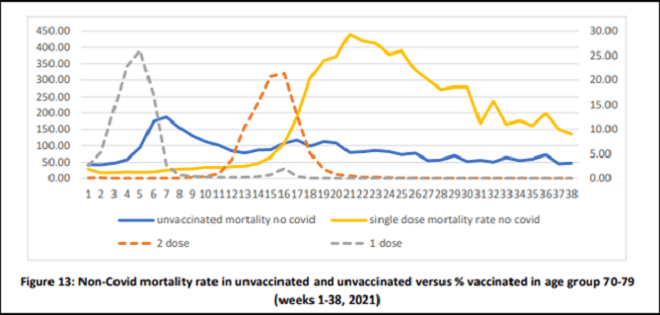
The researchers concluded:
Whatever the explanations for the observed data, it is clear that it is both unreliable and misleading […] we believe the most likely explanations are systematic miscategorisation of deaths between the different groups of unvaccinated and vaccinated; delayed or non-reporting of vaccinations; systematic underestimation of the proportion of unvaccinated [and] incorrect population selection for Covid deaths. With these considerations in mind we applied adjustments to the ONS data and showed that they lead to the conclusion that the vaccines do not reduce all-cause mortality, but rather produce genuine spikes in all-cause mortality shortly after vaccination.”
The head of the research team, Prof. Dr. Norman Fenton, gave a radio interview where he explained why his paper had not been peer reviewed or submitted to a journal for publication:
The unvaccinated seem to be dying after not getting the first dose and the single dose are dying after not getting the second dose […] the vaccinated are dying within 14 days of vaccination and are simply being categorised as unvaccinated […] There is no evidence for their efficacy when it is measured by the only sensible way to measure it, which is all cause mortality […] When we first started doing research on this we had no problem getting our work into peer reviewed papers, because we weren’t challenging the narrative […] As soon as it became clear, you know, with the sort of mass testing of asymptomatic people, that the potential for false positives for asymptomatics was inflating case numbers and COVID so-called hospitalisations and deaths, as soon as we started raising those concerns in our work, as soon as we submitted it for publication, it was being rejected without review. Something I have never had before.”
Rejecting science, because it doesn’t abide by the official narrative, is not a new problem but it is “anti-science” and suggests a coordinated effort to deceive. The work of Prof. Seligmann and others, looking at both COVID-19 and all cause mortality, appears to independently corroborate the finding of Queen Mary team.
There is no doubt that the jabs can kill. There have been a number of inquests that have found that death was caused by complications following the jabs.
Causes of death have included venous infarction thrombosis, intracerebral haemorrhage, anaphylaxis, vaccine-induced thrombosis & thrombocytopenia and “unrecognised consequences of elective COVID-19 vaccines,” to name a few. The only question is the scale of the mortality caused by the jabs.
US researchers found a 19 fold increase in myocarditis (heart inflammation) among the 12 – 15 year olds which directly correlated with the jab roll-out. The study was peer reviewed and then published, before being withdrawn by journal editors without explanation.
Myocarditis is extremely serious for young people and often requires a heart transplant in later life, significantly reducing their life expectancy.
Just as some in the scientific community are mystified by the almost perfect correlation between jab and COVID-19 “case” rates, so the medical profession are similarly bewildered by the marked rise in cardiac emergencies in Scotland. These too followed the jab rollout for the impacted age groups.
Apparently doctors haven’t got the faintest idea what the cause could possibly be. They are not investigating if it could be the jabs.
Why they aren’t could be seen as yet another mystery, because the statistical evidence indicates that the jabs are lethal. If we look at statistics from the ONS it is evident that, between January and October 2021, the jabbed under 60’s in England were dying at approximatly double the rate of the unjabbed.
This is not an insignificant fact but comes with important caveats. Prof. Fenton and his team did not analyse this age group because it is too broad. Depending on the progress with the jab rollouts, with older people jabbed first, the jabbed cohort is likely have a higher baseline mortality risk than the jabbed.
Taken in isolation this statistic doesn’t reveal much. It is more telling in context with a German study which also found a clear correlation between the jabs and mortality.
Together these add further corroboration the other statistical findings we’ve discussed. The German scientists, Prof. Dr. Rolf Steyer and Dr. Gregor Kappler, concluded:
The higher the vaccination rate, the higher the excess mortality. In view of the forthcoming policy measures aimed at reducing the virus, this figure is worrying and needs to be explained if further policy measures are to be taken with the aim of increasing the vaccination rate.”
The only rationale that can explain how the ONS, MHRA, EMA, FDA and other official bodies around the world are maintaining the lie that the jabs save lives is that they have chosen, or have been ordered, to release disinformation that knowingly endangers public health. There is yet more evidence from the clinical trials that this is the case.
The FDA, MHRA, EMA and other supposed regulators granted EUA’s for the Pfizer/BioNTech jab based upon 2 months of extremely limited, interim trial data. Research by the Canadian COVID Care Alliance has exposed this wholly untrustworthy process. There was no mention in the original, interim trial data, submitted by Pfizer, of the scale of the ADRs caused by their product.
Using relative risk they claimed their jabs were amazing and nearly everyone, including the regulators, simply took their word for it. Those who didn’t were vilified as “covid deniers” or “anti-vaxxers.”
Six months into the jab rollout Pfizer released more data with another interim study. They made more claims about the efficacy and safety of their BNT162b2 jabs:
BNT162b2 continued to be safe and have an acceptable adverse-event profile. Few participants had adverse events leading to withdrawal from the trial.”
However, this wasn’t true at all. In their released report, published by “respected journals” like the Lancet, they forgot to analyse the supplementary evidence concerning ADRs, also contained within their findings.
This revealed a consistent elevated risk of Adverse Events (AEs) for the jabbed. For example, “related events” are adverse health events that are deemed to be caused by the jab. For the jabbed the related risk ratio was 23.9, for the unjabbed it was 6. This is nearly a 300% increase in the risk of health harm if you take the Pfizer jab.
Serious adverse events are likely to put you in hospital. For the jabbed the risk was 0.6, for the unjabbed it was 0.5. In other words the jab increases your risk of being hospitalised by 10%.
A drug that increases illness in the population is not an “effective vaccine.” Reducing “case numbers” for one ailment is an utterly pointless exercise if population levels of illness and hospitalisation increase as a result. It gets worse.
Prior to unblinding their own trials, thereby ending the supposed RCTs years before completion, jabbed and unjabbed cohorts were equal in size. 15 people died in the jabbed cohort and 14 died in the unjabbed cohort. Following unblinding a further 5 jabbed people died, including 2 who were previously unjabbed.
The jab increases the mortality risk. This is precisely as observed by Seligmann, Fenton, Steyer, Kappler, Pantazatos and many other scientists and statisticians.
Pfizer were eager to report the 100% reduction in COVID-19 mortality in the main body of their study. Of the 21,926 people in the jabbed cohort only 1 died with a positive RT-PCR confirmed COVID-19 “case.” Whereas 2 of the 21,921 placebo group died. Hence Pfizer’s 100% improvement claim of efficacy.
They failed to mention that their product doubled the chance of you suffering a cardiovascular event and they definitely shied away from the most unpallatable reality of all. There were 4 heart attack deaths among the jabbed compared to 1 in the placebo group. A 300% increased risk of fatal heart failure following the jab.
If the objective of the jabs is to “save life” then it is impossible to understand how they ever received EUAs.
Fully indemnified against prosecution and with carte blanche from the regulators to do whatever they like, the pharmaceutical corporations are fully committed to jabbing all our children, including infants.
This is something our governments and the majority of the population wholeheartedly approve of. If you question it you are selfish.
THE REGULATORS SEEMING EFFORTS TO HIDE THE TRUTH ABOUT THE JABS
It is common to read claims from the regulators, and everyone else who advocates the jabs, that the benefits of the vaccines outweigh the risks.
This is based on the alleged risk of COVID-19, which is practically impossible to assess due to the massive corruption of the data, and an apparent blank refusal to consider any risks from the vaccines.
At first glance, the safety profiles for the jabs look appalling. So far, in the UK alone, there are 1,822 possible jab related deaths recorded via the MHRA yellow card scheme.
In response to a Freedom of Information Request (FOIR,) the MHRA revealed that they had received:
“[…] a total of 404 UK spontaneous suspected ADR reports for any vaccine between 01/01/2001 – 25/08/2021 associated with a fatal outcome.”
With more than 1,800 suspected fatalities reported for the COVID jabs already, currently they potentially account for three and half times more fatalities than all other vaccines combined over the last two decades. This is a statistical pattern repeated in every nation that has rolled them out.
We also know that the vast majority of possible ADRs remain unreported. A 2018 survey study of paediatric healthcare professionals found that 64% had not reported known ADRs. Of the total surveyed 16% didn’t even know the Yellow Card system existed and 26% didn’t know how to use it, with only 18% having undertaken any relevant training.
So it is not at all surprising that the MHRA state:
“It is estimated that only 10% of serious reactions and between 2 and 4% of non-serious reactions are reported.”
There is no evidence that the MHRA have done anything to improve yellow card reporting. Apparently they have promoted the Yellow Card Scheme, it is just that no one noticed. With nearly 400,000 COVID jab ADR reports on the system already, it is likely that the true figure is in excess of 10 million and possible UK deaths caused by the jabs could certainly exceed 18,000.
This is necessarily speculative to a degree, because the MHRA have not investigated any of the recorded ADRs. They have no idea how many people have been killed by the jabs and have shown no interest in finding out.
While they claim their role is to investigate potential ADRs, to provide an “early warning system” for possible vaccine harm, they also say:
The suspected ADRs described in this report are not interpreted as being proven side effects of COVID-19 vaccines.”
This is reasonable if those reports are then investigated. That is not what the MHRA do. Their position and their statements are wholly unreasonable.
To date, they have provided nothing that proves these reports are not evidence of ADRs. Their given interpretation, that these reports provide no proof, is meaningless. Nothing can ever be proven if you don’t bother to examine the evidence.
There is no commitment from the MHRA that they will ever investigate any Yellow Card reports for the jabs. All they will do is highlight possible safety issues, note the reports, and maybe discuss these with other national regulators. There is no expressed intention to question the manufacturer’s claims for the jabs at all.
The UK’s MHRA claim that a dedicated team look for “signals” in the data and where a signal is found they will discuss this with some selected experts.
Given that they acknowledge both the under-reporting and that current monitoring suggests the jabs have a mortality rate orders of magnitude worse than any vaccine, you would imagine that the MHRA would have identified a very concerning “signal.” Indeed they admit:
Yellow Cards in isolation are sufficient to allow signal detection.”
Yet they choose not to use the Yellow Cards as an “early warning.” There is no record of them following up on any Yellow Card reports. Instead they first apply a number of relative risk calculations to see if the signal is worthy of further discussion.
In particular, they use the MaxSPRT (Sequential Probability Ratio Test). This compares reported ADRs to the general population, or background, risk of the same adverse event. If the likelihood ratio test (LRT) indicates that the risk is higher following a jab, then a signal has been identified. However, dishonesty lurks within this approach.
MaxSPRT is based upon a series of assumptions about the data. Specifically that it is constantly monitored in real time and that there is a matched exposure between the jabbed and the unjabbed to contrast incident rates.
When we are talking about 40M jabbed compared to 7M injabbed adults, the disparity between and the size of the jabbed and the unjabbed cohorts invalidates this methodology.
Many biostatiticians have pointed out the limitations of using MaxSPRT for large volume database analysis:
This particular LRT, which conditions on the total number of events, is designed for the rare event case in which only one event is expected to be observed per exposure […] However, when events are not extremely rare, or when the probability within a stratum of more than one event occurring is not small, the assumptions of this LRT are violated.”
In other words the MHRA appraisal is highly sensitive to extremely rare ADRs but is likely to hide, rather than reveal, the more common side effects that are killing people. The MHRA are using a system that will obscure serious problems with the jabs. The only signals their dedicated team might discuss with experts will be “extremely rare.”
They won’t see any signals for more common adverse events and can therefore overlook the obvious and ignore the danger.

MHRA – Dedicated Team
Presumably this is why the MHRA have chosen not to use the “Yellow Cards in isolation.” The raw data clearly indicates huge reason for concern. It has to be reworked and remodelled in order to ignore the glaringly evident. Again, this is a common feature of all jab safety monitoring (pharmacovigilance) systems, which scientists have described as “utterly inadequate.”
Correlation does not prove causation, yet where correlation is persistent and pronounced the chance of it not demonstrating causation diminishes rapidly. Wherever we look, the jabs appear to be causing severe ADRs on an alarming scale.
COVID JABS: INEFFECTIVE, OPPRESSIVE AND DANGEROUS
There is no evidence to substantiate any official or MSM claims about COVID-19 jab efficacy or safety. They are experimental drugs with unknown risk profiles that are being forced upon people without offering them any opportunity to give their informed consent. The jab roll-outs breech numerous international conventions including the Nuremberg Code.
What data does exist is alarming, to say the least, and all the indications are that the jabs are extremely dangerous. There is no doubt that they can kill. Those who support a jab mandate are advocating that people should be forced to take a potentially lethal injection. Those who are aware of this, understandably, do not wish to take them.
For this they are being demonised by government, the MSM and a large percentage of those who have elected to be jabbed. If they try to raise any concerns they are dismissed by the same as anti-vaxxers, conspiracy theorists, covid-deniers or dangerous refuseniks and are accused of being selfish. Despite that fact that it is the jab obsession that is destroying public health and medical services.
There is clear evidence of obfuscation and denial to hide the dangers of the jabs from the public. This seems to cross the threshold of criminality in nearly every nation state where the jabs are deployed. National populations are clearly under attack by their own governments and their partners.
However, perhaps the most insidious aspect of the jabs is their central role within a new system of governmental authority that is enslaving humanity. Our jab status is the required license to participate in a technocratic, behavioural control and surveillance grid. Not only will our vaccine passport (app) monitor and report where we go, who we meet and what we are allowed to do, it will also determine what services we can access.
Those who think the jabs are essential to protect themselves and others, against a low mortality respiratory virus, have either not been given, or choose to ignore, the information required to make this judgement. They believe that they are free because they can now register to use the services that hitherto were freely available to all. They have accepted that they need permission from the government simply to conduct normal, everyday activities.
They are committed to take whatever drugs are given to them for the rest of their lives. If they wish to retain their societal permits, this is not negotiable. Their imaginary freedom is conditional upon their continued compliance.
They do not own their own body and are no longer, in any sense, free. They are elective slaves and are seemingly content to condemn future generations, including their own children, to the same fate.
You can read more of Iain’s work at his blog In This Together or on UK Column. His new book Pseudopandemic, is now available, in both in kindle and paperback, from Amazon and other sellers. Or you can claim a free copy by subscribing to his newsletter.
Shameless BBC hosts Big Pharma’s drive to get Africa hooked on Covid vaccine
By Rusere Shoniwa | TCW Defending Freedom | December 23, 2021
AT the end of November, a piece of BBC agitprop to stoke up fervour for vaccinating Africa went viral. As a British citizen of African descent living in London, I was disgusted by it.
I am concerned that people in Africa may ‘get it’ even less than the average Westerner and I really want to try to reach a few Africans who might be wondering what Covid could mean for them.
So let’s start by imagining if Big Pharma were to run a modestly honest advertisement to recruit dealers for pushing Covid ‘vaccines’ in Africa.
It might read something like this: ‘International drug cartel requires Western-educated Black face to front our public campaign to push experimental and unnecessary Covid vaccines on the impoverished African continent.
‘This is a tough market, highly suspicious of the product and not without good reason. Smile and dial merchants need not apply, as you must bypass the consumer to target the decision-maker.
‘Successful applicants must display the ability to rail melodramatically at the “racist vaccine-hoarding” injustices perpetrated by the West against Africa, appealing to the woke sensibilities of those in positions of power within key Western institutions. African leaders will then be expected to do as they’re told.’
I must confess that I reverse-engineered that ad after watching the successful applicant going through the motions like a performing seal on a BBC World News slot set aside for just such agitprop.
Following the latest Covid variant hype, the co-chair of the African Union’s Vaccine Delivery Alliance, Dr Ayoade Alakija, announced on the UK’s flagship propaganda organ: ‘What is going on right now (the emergence of the Omicron Variant) is inevitable.
‘It’s a result of the world’s failure to vaccinate in an equitable, urgent and speedy manner. It is a result of hoarding by high-income countries of the world and quite frankly it is unacceptable. These travel bans are based in politics and not science. It is wrong.’
Abandoning any pretence at journalism, the BBC presenter, Philippa Thomas, played the role of therapist by responding: ‘I hear your anger about the immediate reaction and the lack of action beforehand.’
The stage direction becomes even more obvious and cringeworthy as Thomas then pauses, providing a cue for the good doctor to glance at her script and resume the televised amateur dramatics: ‘So this is hopefully a dress rehearsal because until everyone is vaccinated no-one is safe … why are the Africans unvaccinated? It’s an outrage because we knew we were going to get here.
‘We knew this is where the hoarding, the lack of IP (intellectual property rights) waivers, the lack of co-operation on sharing tech and sharing know-how, we knew this was the crossroads it was going to bring us to. To a more dangerous variant.’
The only valid question she raises concerns the swift travel bans placed on Southern African countries: ‘Why are we locking away Africa when this virus is already on three continents? Nobody is locking away Belgium, nobody is locking away Israel.’
This is an emotional ploy to gain the trust of the small handful of privileged Africans watching this drivel. She is saying to them: ‘I am right-on, woke, one of you.’ She quickly jumps back on board the Covid cult train with a policy ‘nudge’ that must have African leaders reaching for their sickbags.
‘Something needs to be done to everywhere. My recommendation is to have a co-ordinated global shutdown of travel, for the next month if you want, but don’t single out Africa.’
And then back to the greedy, vaccine-hoarding West: ‘The Botswana government ordered 500,000 doses of vaccines at 29 dollars per dose, much higher than the rest of the world paid. They did not get those vaccines because other people jumped ahead in the queue. Moderna supplied to other countries … and so now we have a variant.’
Not a single grain of this guerrilla marketing campaign was challenged by the BBC journalist.
The obvious starting point for a presenter with half an ounce of journalistic integrity would be to explore whether the ‘vaccines’ are working and whether they would indeed have prevented a variant. After all, the fact that they do not halt transmission and infection is no longer controversial.
No sales pitch involving an illness would be complete without recourse to fear-based marketing tactics. Enter the Omicron narrative.
Despite Dr Alakija’s claim that we now have ‘a more dangerous variant’, there was no evidence that this variant would make any difference to disease severity at the time she was invited by the BBC to make her vaccine sales pitch for Africa. (Nor is there proof that vaccination prevents variants from arising in the first place).
Since then, the evidence emerging is that Omicron is less severe than previous variants and more contagious – the ideal combination for hastening herd immunity with minimal population health impact.
Telling medium-sized lies and half-truths with a straight face has always been the minimum qualification for political office, but Covid has raised the bar to a new height – the ability to swim in a pool of one’s own metaphorical vomit without flinching.
The BBC ‘discussion’ might have turned to safety, to tease out how much personal risk Africans will be expected to bear in submitting to a vaccine that doesn’t perform the primary function of a vaccine.
The word ‘safety’, however, was not permitted to impinge in any way on the protestations of the injustice of depriving Africans of the wondrous medical treatments emanating from the hallowed laboratories of Western science.
The reticence about safety is understandable from a marketing perspective since, by any objective measure, these ‘vaccines’ are the most dangerous mass medications rolled out in modern history.
Perhaps Dr Alakija should have been quizzed about how Africans might react to the drug manufacturers’ lack of confidence in the safety of their own products in light of their refusal to distribute it to countries who refuse to provide blanket immunity from liability for injury.
Not a single word of safety information was explored, even in the vaguest terms, in the BBC report. Nothing. Juxtapose studies highlighting the risk of dangerous heart inflammation for young males following Covid vaccination against Africa’s far younger population, with a median age of around 20.
You’d think this safety risk might get a passing mention. Yet neither of the two stooges saw fit to broach the prospect that many young Africans – whose risk of dying from Covid is so small that it is hard to measure – may die following vaccination.
The callousness of this omission is standard operating procedure in Western liberal discourse, a key function of which is to drape a ‘humanitarian’ cloak over policies that enrich corporate interests in the West while harming and exploiting the poor.
Unveiling the farce of the BBC plug for Africa’s vaccination allows us to consider a game in which we imagine what other doctors might say if the BBC were to air credible dissenting voices – a practice that was once regarded as the bread and butter of journalism, but which would now be a radical act of rebellion.
It’s not a difficult game to play. In fact, no imagination is required, because the actual statements of credible dissenting doctors are available on other independent media news channels, as reported in TCW Defending Freedom on December 8.
A new channel based in Austria, AUF1, gives a platform to those medical professionals who refuse to go along with the official narrative.
Typical is Dr Heiko Schöning, who says: ‘The corona panic is a stage-managed production. It’s a confidence trick. It is now urgent that we understand we are now in the grip of a worldwide Mafioso-style criminal enterprise. We can see we are dealing here with organised crime. So what do we do? We don’t play along any longer. Here and now we have to draw the red line.’
Had Dr Schöning just finished watching the two stooges on BBC World News when he described ‘the corona panic’ as ‘a stage-managed production’?
Whether these doctors are right or wrong is irrelevant to the journalistic duty to present credible dissenting voices to the public. The failure to do so goes a long way to meeting the criteria for propaganda.
The question in relation to Dr Alakija’s BBC guerrilla marketing campaign is: Do enough Africans know that there are alternative credible narratives to challenge the mainstream BBC vaccine narrative and how would they respond if these competing narratives were presented?
Does Africa, or anywhere else for that matter, need mass vaccination? Almost two years into this global nightmare, with evidence showing that up to 80% of South Africans (how similar for other African nations?) may have already been exposed to the virus, less than 6% of Africa vaccinated, and a death toll a fraction of that in the ageing populations of the West (Africa’s Covid deaths are 3% of the global total), it is clear that Africa has already learnt to live with the virus.
Had Africans succeeded in applying the same level of rigorous lockdown stupidity that was achieved in the West, it would not have made the slightest difference, as real science is conclusively demonstrating not just the futility of lockdowns but their positive destructiveness.
Despite looser lockdowns (perhaps partly because of this) Africa fared much better than the illiberal West in health outcomes.
No doubt there are other variables at play, but cheap, effective early treatments in some parts of Africa were used to good effect and should continue to be the focus of attention.
Africa and the entire planet would get far more bang for their buck from policies addressing human health holistically rather than with expensive experimental ‘vaccines’ which will continue for as long as human beings are prepared to, or more likely forced to, surrender their bodies to Big Pharma and authoritarian governments.
It must be patently obvious to African leaders that the Covid crisis is a manufactured one, but that does not make it any less of a crisis.
Western liberal democracy is being dismantled at breakneck speed under the cover of Covid containment policies.
The criminality, coercion, censorship, propaganda and blatant negligence all signal the logical conclusion to a brutal colonial mindset – the attempted colonisation of the entire globe to serve the interests of a global elite which has successfully captured Western governments and supranational organisations.
The psychopaths whose aim is to introduce a technocratic global system of human control understand only too well that shutting off travel for economies that rely on tourism is a far bigger killer of economies, and therefore lives, than this virus has ever been.
The message being sent by the sadistic controllers to Africa’s leaders is a simple one: Get serious about imposing vaccines and the technocratic population control measures for which which vaccines are the delivery system … or else.
Covid containment policies represent a desperate authoritarian response to permanent decline. This cannot end well for the West and if the West is a sinking ship, then Africa must not blindly tether itself to this Titanic disaster.
Featured Video

More Iran War fallout: Maritime insurance industry shifts from London to China
or go to
Aletho News Archives – Video-Images
From the Archives
The Biggest Threat to Peace in Middle East
By Dr. Elias Akleh* | Sabbah Report | May 24, 2010
A build up of heightened tension in the Middle East is escalating in the last few weeks. American and Israeli postures towards Lebanon, Syria, and Iran have become more threatening. Listening to speeches of political leaders one hears talks only about war not peace. Iranians and Israelis are continuously training hard for a possible showdown. Both sides are conducting extensive war games every month. This led Syrians to claim that Israel is preparing for a soon-to-come another war. The Jordanians also are warning that current stalemate of the peace process is an indication of a war breaking out this summer. The Russian President and his army chief hinted, a few months ago, that the US and Israel were planning for an attack on Iran.
Indeed Iran is, as it has been for last few years, the target of most of the threats and accusations of supporting terrorism. Escalating incitement against Iran the American Defense Department sent last month (April) to Congress a report on Iran’s military claiming Iran could develop intercontinental ballistic missiles capable of reaching the US by 2015.
Ignoring the fact that N. Korea, India, Pakistan, and Israel are proven to have nuclear weapons while Iran does not, the US Secretary of State Hillary Clinton chose in her speech, to the nuclear Non-Proliferation Treaty review conference at the UN, to focus on Iran’s alleged nuclear ambitions putting the whole world at risk as she put it. According to Clinton Iran’s acquisition of nuclear weapons, rather than Israel’s more than 200 nuclear bombs, is destabilizing the Middle East. She called on the world’s nations to rally around US efforts to hold Iran, not other nuclear countries, to account.
The accusation that Usama Bin Laden is living comfortably in Iran had received a boost after the broadcast of a documentary called “Feathered Cocaine”. This echoed the June 2003 claims of the Italian newspaper Corre de la Sierra that Bin Laden was in Iran according to some intelligence report, and according to Richard Miniter’s book “Shadow War”. … continue
Blog Roll
 Aletho News
- Iran mobilizing one million soldiers to ‘create hell’ for any US ground assault: Report
- The coming military and psychological unravelling?
- Iran has the last laugh
- More Iran War fallout: Maritime insurance industry shifts from London to China
- US-Israeli aggression on Iran triggers review of GCC countries’ investment pledges to Washington
- Russia slams UK plan to seize tankers suspected of carrying its oil
- Pakistan ramps up food exports to Persian Gulf nations as war deepens food insecurity
- Iran submits response to US plan, sets terms for war’s end: Tasnim
- US vs Iran: Kharg Island Talk — Bluff or Escalation? Ex-Military Officer Weighs In
- Zelensky unnecessarily involves Ukraine in the Middle East crisis
- If Americans Knew
- ‘No Innocent Children’: Far-right Israeli Lawmaker Defends Killing of Palestinian Family
- Mossad’s promises helped Netanyahu convince Trump that Iran could be toppled
- US Arms Control Official Refuses To Comment When Asked If Israel Has Nuclear Weapons
- Veterans warn US landing could be ‘more Gallipoli than Vietnam’
- Israel may be committing war crimes in Lebanon – Not a ceasefire Day 167
- In the West Bank, life is a constant battle – 3 articles
- Jacob Reses, one of the most powerful pro-Israel operatives in Trump’s Washington
- Israeli-US assaults kill or injure 87 children a day – Not a ceasefire Day 166
- ‘Forever live by the sword’: Understanding Israelis’ massive support for Iran war
- UN’s special rapporteur on human rights says Israel is systematically torturing Palestinians
- No Tricks Zone
- Devastating Assessment Of Comirnaty Vaccine By Former Senior Pfizer Europe Toxicologist
- New Study: CO2 Is ‘Effectively Negligible’ As An Explanatory Climate Change Factor Since 2000
- Former Pfizer Toxicologist Dr. Helmut Sterz Tells Bundestag Hearing Pfizer Vaccine Should Have Never Been Approved
- Energy Expert: Germany’s Nuclear Phaseout Was A “500 Billion Euro Mistake”
- New Research: South Australia’s Mid-Holocene Sea Surface Temperatures Were 4°C Warmer Than Today
- Storing Green Energy To Last Germany 10 Days Would Require A 60-Million Tonne Battery
- New Studies: UK Sea Levels Were 4 Meters Higher Than Today During The Mid-Holocene
- Destructive Green New Deal: German Energy And Metal Group Warns Of Drastic Crisis
- New Study Documents A 20-Year Pause In Arctic Sea Ice Decline – Driven By Internal Variability
- Wake-up Call: Survey Shows Majority Of Germans Now Favor Postponing Climate Targets!
 Aletho News