An American Oligarch‘s Dirty Tale of Corruption
By F. William Engdahl – New Eastern Outlook – 12.06.2015
Rarely does the world get a true look inside the corrupt world of Western oligarchs and the brazen manipulations they use to enhance their fortunes at the expense of the public good. The following comes from correspondence of the Hungarian-born billionaire, now naturalized American speculator, George Soros. The hacker group CyberBerkut has published online letters allegedly written by Soros that reveal him not only as puppet master of the US-backed Ukraine regime. They also reveal his machinations with the US Government and the officials of the European Union in a scheme where, if he succeeds, he could win billions in the plunder of Ukraine assets. All, of course, would be at the expense of Ukrainian citizens and of EU taxpayers.
What the three hacked documents reveal is a degree of behind-the-scene manipulation of the most minute details of the Kiev regime by the New York billionaire.
In the longest memo, dated March 15, 2015 and marked “Confidential” Soros outlines a detailed map of actions for the Ukraine regime. Titled, “A short and medium term comprehensive strategy for the new Ukraine,” the memo from Soros calls for steps to “restore the fighting capacity of Ukraine without violating the Minsk agreement.” To do the restoring, Soros blithely notes that “General Wesley Clark, Polish General Skrzypczak and a few specialists under the auspices of the Atlantic Council [emphasis added—f.w.e.] will advise President Poroshenko how to restore the fighting capacity of Ukraine without violating the Minsk agreement.”
Soros also calls for supplying lethal arms to Ukraine and secretly training Ukrainian army personnel in Romania to avoid direct NATO presence in Ukraine. The Atlantic Council is a leading Washington pro-NATO think tank.
Notably, Wesley Clark is also a business associate of Soros in BNK Petroleum which does business in Poland.
Clark, some might recall, was the mentally-unstable NATO General in charge of the 1999 bombing of Serbia who ordered NATO soldiers to fire on Russian soldiers guarding the Pristina International Airport. The Russians were there as a part of an agreed joint NATO–Russia peacekeeping operation supposed to police Kosovo. The British Commander, General Mike Jackson refused Clark, retorting, “I’m not going to start the Third World War for you.” Now Clark apparently decided to come out of retirement for the chance to go at Russia directly.
Naked asset grab
In his March 2015 memo Soros further writes that Ukrainian President Poroshenko’s “first priority must be to regain control of financial markets,” which he assures Poroshenko that Soros would be ready to assist in: “I am ready to call Jack Lew of the US Treasury to sound him out about the swap agreement.”
He also calls on the EU to give Ukraine an annual aid sum of €11 billion via a special EU borrowing facility. Soros proposes in effect using the EU’s “AAA” top credit rating to provide a risk insurance for investment into Ukraine.
Whose risk would the EU insure?
Soros details, “I am prepared to invest up to €1 billion in Ukrainian businesses. This is likely to attract the interest of the investment community. As stated above, Ukraine must become an attractive investment destination.” Not to leave any doubt, Soros continues, “The investments will be for-profit but I will pledge to contribute the profits to my foundations. This should allay suspicions that I am advocating policies in search of personal gain. “
Anyone familiar with the history of the Soros Open Society Foundations in Eastern Europe and around the world since the late 1980’s, will know that his supposedly philanthropic “democracy-building” projects in Poland, Russia, or Ukraine in the 1990’s allowed Soros the businessman to literally plunder the former communist countries using Harvard University’s “shock therapy” messiah, and Soros associate, Jeffrey Sachs, to convince the post-Soviet governments to privatize and open to a “free market” at once, rather than gradually.
The example of Soros in Liberia is instructive for understanding the seemingly seamless interplay between Soros the shrewd businessman and Soros the philanthropist. In West Africa George Soros backed a former Open Society employee of his, Liberian President Ellen Johnson Sirleaf, giving her international publicity and through his influence, even arranging a Nobel Peace Prize for her in 2011, insuring her election as president. Before her presidency she had been well-indoctrinated into the Western free market game, studying economics at Harvard and working for the US-controlled World Bank in Washington and the Rockefeller Citibank in Nairobi. Before becoming Liberia’s President, she worked for Soros directly as chair of his Open Society Initiative for West Africa (OSIWA).
Once in office, President Sirleaf opened the doors for Soros to take over major Liberian gold and base metals assets along with his partner, Nathaniel Rothschild. One of her first acts as President was to also invite the Pentagon’s new Africa Command, AFRICOM, into Liberia whose purpose as a Liberian investigation revealed, was to “protect George Soros and Rothschild mining operations in West Africa rather than champion stability and human rights.”
Naftogaz the target
The Soros memo makes clear he has his eyes on the Ukrainian state gas and energy monopoly, Naftogaz. He writes, “The centerpiece of economic reforms will be the reorganization of Naftogaz and the introduction of market pricing for all forms of energy, replacing hidden subsidies…”
In an earlier letter Soros wrote in December 2014 to both President Poroshenko and Prime Minister Yatsenyuk, Soros openly called for his Shock Therapy: “I want to appeal to you to unite behind the reformers in your government and give your wholehearted support to a radical, ‘big bang’ type of approach. That is to say, administrative controls would be removed and the economy would move to market prices rapidly rather than gradually… Naftogaz needs to be reorganized with a big bang replacing the hidden subsidies…”
Splitting Naftogaz into separate companies could allow Soros to take control of one of the new branches and essentially privatize its profits. He already suggested that he indirectly brought in US consulting company, McKinsey, to advise Naftogaz on the privatization “big bang.”
The Puppet-Master?
The totality of what is revealed in the three hacked documents show that Soros is effectively the puppet-master pulling most of the strings in Kiev. Soros Foundation’s Ukraine branch, International Renaissance Foundation (IRF) has been involved in Ukraine since 1989. His IRF doled out more than $100 million to Ukrainian NGOs two years before the fall of the Soviet Union, creating the preconditions for Ukraine’s independence from Russia in 1991. Soros also admitted to financing the 2013-2014 Maidan Square protests that brought the current government into power.
Soros’ foundations were also deeply involved in the 2004 Orange Revolution that brought the corrupt but pro-NATO Viktor Yushchenko into power with his American wife who had been in the US State Department. In 2004 just weeks after Soros’ International Renaissance Foundation had succeeded in getting Viktor Yushchenko as President of Ukraine, Michael McFaul wrote an OpEd for the Washington Post. McFaul, a specialist in organizing color revolutions, who later became US Ambassador to Russia, revealed:
Did Americans meddle in the internal affairs of Ukraine? Yes. The American agents of influence would prefer different language to describe their activities — democratic assistance, democracy promotion, civil society support, etc. — but their work, however labeled, seeks to influence political change in Ukraine. The U.S. Agency for International Development, the National Endowment for Democracy and a few other foundations sponsored certain U.S. organizations, including Freedom House, the International Republican Institute, the National Democratic Institute, the Solidarity Center, the Eurasia Foundation, Internews and several others to provide small grants and technical assistance to Ukrainian civil society. The European Union, individual European countries and the Soros-funded International Renaissance Foundation did the same.
Soros shapes ‘New Ukraine’
Today the CyberBerkut hacked papers show that Soros’ IRF money is behind creation of a National Reform Council, a body organized by presidential decree from Poroshenko which allows the Ukrainian president to push bills through Ukraine’s legislature. Soros writes, “The framework for bringing the various branches of government together has also emerged. The National Reform Council (NRC) brings together the presidential administration, the cabinet of ministers, the Rada and its committees and civil society. The International Renaissance Foundation which is the Ukrainian branch of the Soros Foundations was the sole financial supporter of the NRC until now…”
Soros’ NRC in effect is the vehicle to allow the President to override parliamentary debate to push through “reforms,” with the declared first priority being privatization of Naftogaz and raising gas prices drastically to Ukrainian industry and households, something the bankrupt country can hardly afford.
In his letter to Poroshenko and Yatsenyuk, Soros hints that he played a key role in selection of three key non-Ukrainian ministers—Natalia Jaresko, an American ex- State Department official as Finance Minister; Aivras Abromavicius of Lithuania as Economics Minister, and a health minister from Georgia. Soros in his December 2014 letter, referring to his proposal for a “big bank” privatization of Naftogaz and price rise, states, “You are fortunate to have appointed three ‘new Ukrainian’ ministers and several natives (sic) who are committed to this approach.”
Elsewhere Soros speaks about de facto creating the impression within the EU that the current government of Yatsenyuk is finally cleaning out the notorious corruption that has dominated every Kiev regime since 1991. Creating that temporary reform illusion, he remarks, will convince the EU to cough up the €11 billion annual investment insurance fund. His March 2015 paper says that, “It is essential for the government to produce a visible demonstration (sic) during the next three months in order to change the widely prevailing image of Ukraine as an utterly corrupt country.” That he states will open the EU to make the €11 billion insurance guarantee investment fund.
While saying that it is important to show Ukraine as a country that is not corrupt, Soros reveals he has little concern when transparency and proper procedures block his agenda. Talking about his proposals to reform Ukraine’s constitution to enable privatizations and other Soros-friendly moves, he complains, “The process has been slowed down by the insistence of the newly elected Rada on proper procedures and total transparency.”
Soros suggests that he intends to create this “visible demonstration” through his initiatives, such as using the Soros-funded National Reform Council, a body organized by presidential decree which allows the Ukrainian president to push bills through Ukraine’s legislature.
George Soros is also using his new European Council on Foreign Relations think-tank to lobby his Ukraine strategy, with his council members such as Alexander Graf Lambsdorff or Joschka Fischer or Karl-Theodor zu Guttenberg, not to mention former ECB head, Jean-Claude Trichet no doubt playing a subtle role.
George Soros, now 84, was born in Hungary as a Jew, George Sorosz. Soros once boasted in a TV interview that he posed during the war as a gentile with forged papers, assisting the Horthy government to seize property of other Hungarian Jews who were being shipped to the Nazi death camps. Soros told the TV moderator, “There was no sense that I shouldn’t be there, because that was–well, actually, in a funny way, it’s just like in markets–that if I weren’t there–of course, I wasn’t doing it, but somebody else would.”
This is the same morality apparently behind Soros’ activities in Ukraine today. It seems again to matter not to him that the Ukrainian government he helped bring to power in the February 2014 US coup d’etat is riddled with explicit anti-semites and self-proclaimed neo-Nazis from the Svoboda Party and Pravy Sektor. George Soros is clearly a devotee of “public-private-partnership.” Only here the public gets fleeced to enrich private investors like Mr. Soros and friends. Cynically, Soros signs his Ukraine strategy memo, “George Soros–A self-appointed advocate of the new Ukraine, March 12, 2015.”
Survivors tell of France’s ‘dirty war’ for Cameroon independence
Press TV – December 28, 2019
The Cameroonian war of independence was a “dirty war” waged by French colonial troops but it never made headlines and even today goes untold in school history books.
The brutal conflict unfolded in Cameroon, which on January 1 marks its 60th anniversary of independence — the first of 17 African countries that became free from their colonial masters in 1960.
Many decades on, those who witnessed the violence recall events which shaped countless lives in the central African country yet remain unchronicled today.
“My life was overturned,” Odile Mbouma, 72, said in the southwestern town of Ekite.
On the night of December 30, 1956, French troops arrived in the town and slaughtered dozens of people, perhaps as many as a hundred, she recalls.
“We were sitting under a tree when we suddenly heard the crackle of gunfire,” she said. “It was everyone for themselves.”
Taking to her heels, the seven-year-old found herself jumping over bodies. “They were everywhere.”
The troops were looking for independence fighters — members of the Union of the Peoples of Cameroon (UPC), a nationalist movement established in 1948 that faced repression first by the French and later by Cameroonian soldiers.
French authorities labeled the UPC “communist” and cracked down on them from 1955, driving the movement underground, though its charismatic founder Ruben Um Nyobe preached non-violence.
Buried in cement
In September 1958, Um Nyobe — nicknamed Mpodol (for “he who brings the word” in the Bassa language) — was killed by French troops.
“His body was dragged around and displayed so that everybody (saw the corpse) of a man who was considered immortal,” said Louis Marie Mang, UPC activist in Eseka, where Um Nyobe is buried in a Protestant graveyard.
“To prevent traditional rites from being held, he was put in a block of cement and buried (without) a coffin.”
The conflict continued long beyond independence, for repression of the nationalists continued under Cameroon’s first president, Ahmadou Ahidjo, who also banned public references to the UPC and to Um Nyobe.
The violence “passed unnoticed, wiped from memories,” according to Thomas Deltombe, Manuel Domergue and Jacob Tatsitsa, authors of “La guerre du Cameroun” (“Cameroon’s War”), published in 2016.
They estimate that between 1955 and 1964, tens of thousands of people, including civilians as well as UPC members, were killed.
In Ekite, a wreath of flowers lies on the soil of a scrubland field at the end of a dirt track. “The Nation will remember your sacrifice,” says a memorial notice.
“This is one of the mass graves where the nationalists were buried,” said Jean-Louis Kell, a UPC militant.
A second ditch was apparent a dozen meters away, and “a third was discovered not long ago,” said Benoit Bassemel. He was seven during the French massacre and has tears in his eyes when he tells how his father was murdered.
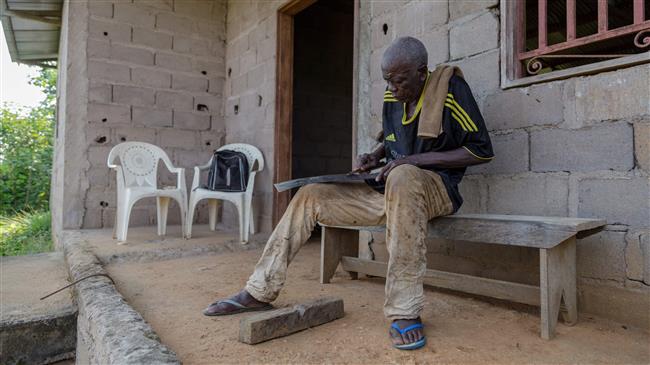
Benoit Bassemel, who’s father was killed during the massacre on the night of December 31 1956, files his machete at his home in Edéa, on December 11, 2019. (Photo by AFP)
‘Free like the others’
UPC nationalists believe that the independence granted on January 1, 1960, was not what they fought for.
They view the country’s two post-independence presidents, Ahidjo and Paul Biya, who has been in office since 1982, as working hand-in-hand with France.
“We wanted to be free like the other countries. We no longer wanted white people to subjugate us,” said 80-year-old Mathieu Njassep, in his tiny family apartment in Petit Paris, a poor district of Douala, the economic capital.
In 1960, aged 21, Njassep joined the Cameroon National Liberation Army (ALNK), the UPC’s armed wing.
After two years of fighting, he was appointed secretary to Ernest Ouandie, a leading figure in the movement. He was sentenced to death but escaped the firing squad, unlike Ouandie, who was executed in 1971.
“We had almost nothing to wage a war with,” Njassep said. “We carried out ambushes with machetes, sticks and homemade guns. If we had had enough weapons, we would have beaten them.”
At the time, the ALNK had established its headquarters in the village of Bandenkop, on the land of the main western tribal group, the Bamileke. Fighting was fierce between the nationalists and the French army.
In the rugged valley from which ALNK commanders led operations, there is no sign of human life today and the only sound is that of a bubbling stream.
“This whole zone was regularly bombed” by the French air force, said Michel Eclador Pekoua, a former UPC official.
Pekoua and other nationalists say French planes dropped napalm. France has neither confirmed nor denied the use of the notorious incendiary weapon.
Decapitations
On a road 30 kilometers to the north, in Bafoussam, a roundabout is known as the “crossroads of the guerrillas,” for it was where the decapitated heads of nationalists were placed on show, said Theophile Nono, head of a historical association, Memoire 60.
The regime’s methods “ranged from the arrest and arbitrary imprisonment of any Cameroonian suspected of ‘rebellion’ to systematic torture, with extrajudicial summary executions,” Nono said.
For many years the conflict mostly remained taboo in Cameroon. It was in the 1990s, when the authorities came under mounting pressure for democratic change, that people began to consider the historic past.
Biya, in a speech in 2010, paid tribute to “people who dreamed of (independence), fought to obtain it and sacrificed their lives for it… Our people should be eternally grateful to them.”
After years of French silence, then president Francois Hollande in 2015 became his country’s first head of state to speak of “a repression” of Cameroonian nationalists leading to “tragic episodes”.
For many survivors, this is not enough.
“France must accept its responsibility,” Nono said. “It must undertake to compensate victims of the dirty war, which has been carefully concealed by both the French side and the Cameroonian side.”
ICC Prosecutor Bensouda ‘Biased In Favour Of Israel – Unwilling to Deliver Justice for Palestine’
By Iqbal Jassat | Media Review Network | December 17, 2019
Whoever has any suspicion that the ICC’s reluctance to prosecute Israel for war crimes is due to pro-Israel bias by its prosecutor, have been spot on.
In a timely intervention, South Africa’s highly respected jurist Professor John Dugard, has called for an urgent investigation into the fitness of Fatou Bensouda to continue holding her position as the Prosecutor at the International Criminal Court (ICC).
Speaking at an event at an Assembly of State Parties to the Rome Statute, The Hague, Dugard raised a number of crucial concerns about Bensouda’s pro-Israeli bias.
Dugard is no push over. As Emeritus Professor of Law at the universities of Leiden and the Witwatersrand he served as Special Rapporteur on the Human Rights Situation in the Occupied Palestinian Territory, from 2001 to 2008. And as a former Judge ad hoc at the International Court of Justice; and a member of the Advisory Board of The Rights Forum, his opinions are highly regarded.
In his presentation, Dugard said it’s become abundantly clear that the Office of the Prosecutor (OTP) is determined not to open an investigation into crimes committed by Israel in Palestine and against the Palestinian people.
He pointed out that despite ten years of preliminary examinations and overwhelming evidence, he found it strange that Bensouda has found no basis to proceed to the next stage of the investigation.
Dugard alluded to the fact that Bensouda refused to do so in the midst of four Human Rights Council’s independent fact-finding mission reports, an advisory opinion of the International Court of Justice, resolutions of the Security Council and General Assembly, numerous Israeli, Palestinian and international NGO reports, extensive TV coverage and video recordings depicting and testifying to war crimes and crimes against humanity.
Shockingly, despite overwhelming grounds for prosecution, Bensouda in her latest report, fails to give a straight and reasoned explanation for her failure to commence an investigation. Though her persistent refusal to proceed makes no sense, Dugard is satisfied that there is more than sufficient evidence to support a finding that Israel has committed war crimes by using excessive and disproportionate force and violence against civilians in Gaza and the West Bank.
In his submission, Dugard said he is convinced the evidence is clear that Israel’s settlement enterprise constitutes apartheid and has resulted in the forcible displacement and transfer of thousands of Palestinians from their homes, meaning that it “has committed crimes against humanity”.
He explained that the law is clear on the crime of the transfer by an Occupying Power – Israel – of parts of its civilian population into the occupied territories of the West Bank and East Jerusalem. He emphatically insisted that due to both the law and facts being clear, there existed no possibility whatsoever of dispute or debate.
Dugard spelled out the relevant imperatives of the Rome Statute which render Israel’s conduct as war crimes. In addition he cited articles of the Fourth Geneva Convention as well as provisions of customary international law. And in setting out the facts, Dugard reminded his audience that 700,000 Jewish Israeli settlers live in about 130 settlements in the West Bank and East Jerusalem. These settlements are clearly within Occupied Palestinian Territory – as held by the International Court of Justice.
Thus if the evidence clearly provides a reasonable basis to believe that a crime within the jurisdiction of the Court has been committed, “culpable failure to take steps to suppress a crime when under a duty to do so makes the Prosecutor complicit in the commission of the crime”, claimed Dugard. “There is overwhelming authoritative support for the conclusion that Israel’s settlements are illegal under international law.”
The International Court of Justice unanimously held the settlements have been established in breach of international law. Likewise the UN Security Council has condemned settlements as illegal, most recently in 2016 in Resolution 2334. And Dugard reiterated that even Israel’s own legal adviser Theodor Meron advised that they were illegal when Israel embarked upon this colonial enterprise.
The conclusion drawn by Dugard on why Besouda refuses to indict Israel is that non-legal, political factors have guided her decision. Clearly a stinking rebuke and damning indictment of the OTP, unambiguously accusing Bensouda of ignoring legal imperatives.
Why would Fatou Bensouda be in dereliction of her duty?
In his own words Dugard explained as follows:
“As I see it, there are two possibilities: a deliberate collective decision by the Prosecutor, her deputy and senior officers not to prosecute; or in articulated factors that have led the Prosecutor and her staff to a bias in favour of Israel.”
And unsurprisingly the most likely reason for it would be fear of retaliation from Israel and the United States. Or as Dugard further explained, it might be sensitivity to the widespread view prevalent among European states that the ICC is too fragile an institution to withstand the backlash that might follow such an investigation.
In an interesting background check on Bensouda, Dugard advanced additional factors in what he referred to as her “life-history, particularly in The Gambia” to provide some indication of unarticulated reasons for her decision to protect Israel. During the repressive reign of Yahya Jammeh in The Gambia, Bensouda served as Minister of Justice.
“Repression was the order of the day as human rights vigorously suppressed. The Minister of Justice (Bensouda) could not remain aloof from this. That she was involved in this process of repression has become clear from evidence before The Gambian Truth, Reconciliation and Reparations Commission.”
These shocking facts certainly make a compelling case to have Bensouda removed from her position. Its unimaginable to have the ICC tainted by having its Prosecutor implicated in torture, detention without trial and denial of legal representation during her term in the cabinet of Gambia’s brutal dictator.
It is inexplicable that the world has been silent on the extremely compromised position of Bensouda, limiting her ability to deliver justice for the Palestinian people. Her failure to do so is a tragic reflection of the pervasive levels of injustice that have polluted not only the ICC but most if not all international platforms entrusted to dispense justice.
Iqbal Jassat
Exec Member
Media Review Network
Johannesburg
South Africa
Sudan closing Hamas, Hezbollah offices to rebuild US ties
MEMO | December 17, 2019
In an attempt to re-establish ties with the US and to lift sanctions imposed on it, Sudan is set to shut the offices of the Hamas and Hezbollah resistance movements in the country, both defined as terrorist organisations by America, according to a source cited by Middle East Eye (MEE).
The decision follows Sudanese Prime Minister Abdallah Hamdok’s visit to Washington earlier in the month. Hamdok became the first leader of Sudan to visit America since 1985 and he held talks aimed at bridging the relationship between the two states after years of sanctions and international isolation, especially with Sudan being placed on the US list of states sponsors of terrorism after hosting former Al-Qaeda leader Osama bin Laden in the nineties.
Post-revolutionary Sudan witnessed the ousting of long-term President Omar Al-Bashir who is currently serving a two-year sentence on charges of corruption, and the inauguration of the country’s first civilian prime minister in three decades. Hamdok has argued for the necessity of Sudan being removed from the US’ blacklist citing the need to improve the economic situation, which is edging towards hyperinflation leaving Sudan among the countries with the highest inflation in the world. The economic crisis is primarily what brought protestors out onto the streets last year. Addressing the UN General Assembly in September, Hamdok said that the revolution aimed at ending Sudan’s pariah status, reiterating that Sudan inherited international sanctions and that “it was the former regime that supported terrorism”, not Sudan’s people.
The Sudanese source who spoke to MEE said: “The government will close the offices of Hamas and Hezbollah and any other Islamic groups designated as terrorist groups that has presence in Sudan, because Sudan has nothing actually to do with these groups and the interests of Sudan are above everything.”
However, the office closures are likely symbolic in nature, said Cameron Hudson, senior fellow at the Atlantic Council Africa Centre, given that operations of both organisations have been dormant in the country for years. “The announcement that they are formally closing the offices suggests to me that they were essentially dormant, although not formally closed,” he said.
Nevertheless, the move is interpreted by some as a gradual alignment of Khartoum with the interests of the US and its regional allies. In 2016 Sudan ended diplomatic ties with Iran in the wake of the attacks by protestors on the Saudi embassy in Tehran which was in response to the execution of the Saudi Shia cleric and activist Sheikh Nimr Al-Nimr. Two months prior to the severing of ties with Tehran, Sudan reportedly received $2.2 billion for taking part in the Saudi and UAE-led coalition in Yemen, although Sudan is now scaling back its military involvement in the conflict.
Israel for its part had accused Sudan of channelling arms from Iran to Hamas in the Gaza Strip via Egypt’s Sinai desert and is alleged to have bombed Sudanese munitions warehouses and factories in the past.
Sudan has also sought Qatar’s support in its efforts to be removed from the US list of state sponsors of terrorism, which it expressed at a reception hosted by Qatar’s Ambassador to Khartoum, ahead of Qatar’s National Day.
US gatecrashes into Libyan endgame. But Russia stands in the way
By M. K. BHADRAKUMAR | Indian Punchline | November 29, 2019
The United States has alleged that Russia’s presence in Libya is having an “incredibly destabilising” impact. Washington is stepping out of the shade and making way to the centre stage of the Libyan conflict.
David Schenker, the State Department’s assistant secretary for near eastern affairs said Tuesday in Washington, “The United States is committed to a secure and prosperous future for the people of Libya. For this to become a reality, we need real commitments from external actors… In particular, Russia’s military interference threatens Libya’s peace, security, and stability.”
Schenker explained, “Russian regulars and the Wagner forces are being deployed in significant numbers on the ground and support of the LNA [Libyan National Army]. We think this is incredibly destabilising. And the way this organisation, the Russians in particular, have operated before raises the spectre of large-scale casualties in civilian populations.”
Schenker spoke only days after a delegation of US civilian and military officials led by the high-flying US Deputy National Security Advisor Victoria Coates met with Khalifa Haftar, the supremo of the LNA. A state department readout said Coates expressed serious concern to Haftar over Russia’s “exploitation of the conflict” at the expense of the Libyan people.
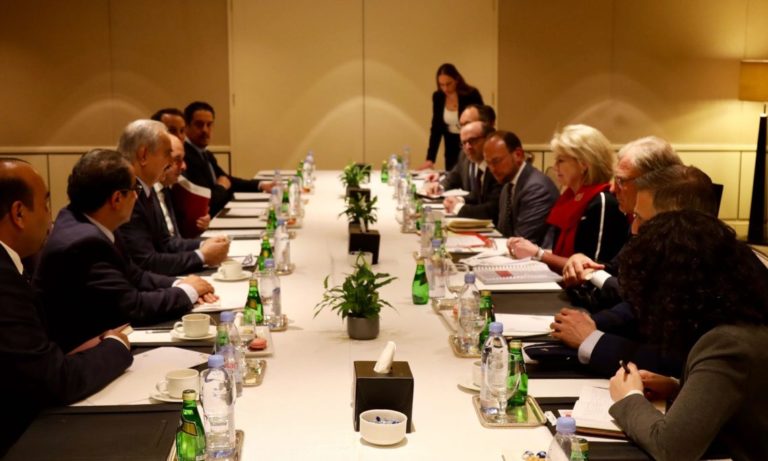
US Delegation meeting with General Khalifa Haftar, Nov 24, 2019
Libya becomes the third theatre after Ukraine and Syria where Washington has locked horns with Moscow in a Cold War-style proxy war. Up until last weekend, two EU members were supposedly conducting a proxy war in Libya over control of Africa’s largest oil and gas resources — France and Italy.
Actually, the alignments in Libya do not warrant a US-Russia standoff, as disparate external powers largely pursue self-interests. Italy, Turkey and Qatar have backed the Government of National Accord (GNA) in Tripoli (also supported by Germany and the UN), while France, Egypt, UAE, Saudi Arabia and Russia backed LNA.
The fight against terrorist groups is a stated common objective of all protagonists, but there are sub-plots too — Libya’s oil and gas (France, Italy, Turkey and Russia); political Islam (Turkey, Qatar, Egypt, UAE); France’s military operations in the five Sahel countries (Mauritania, Mali, Niger, Burkina Faso and Chad), which can end only with the stabilisation of Libya; the migration issue; and geopolitical interests (France, Italy, Russia and Turkey).
Although Haftar was a CIA “asset” for over three decades, Washington largely kept contacts with him under the radar and seemingly watched the struggle between GNA and LNA from the sidelines even after Haftar launched a determined push in April to capture Tripoli. The US policies were incoherent. President Trump apparently viewed Haftar as a factor of stability, while Washington officially pitched for a UN-mediated political settlement in Libya, although that is easier said than done, given the fragmentation in the country.
Washington was marking time, unsure whether Haftar’s military campaign would succeed. Moscow too took a back seat, but in recent months the Kremlin began weighing Haftar’s prospects positively. Moscow (like Cairo) counts on Haftar’s impeccable credentials in the fight against terrorist groups.
Russian military support has decisively helped Haftar’s campaign, which took big leaps lately. Haftar controls something like 80 percent of Libya, whereas, GNA is reduced to a mere rump confined to Tripoli.
Enter Washington. Washington feels alarmed that in the Libyan endgame, with Haftar inexorably gaining the upper hand, thanks to Moscow’s help, the vista opens for cascading Russian influence over the new regime.
Nonetheless, it isn’t easy to find fault with Russia’s military role to stabilise Libya, since NATO intervention in 2011 that wrought havoc and such colossal destruction had enjoyed the backing of Obama Administration. Washington is on weak moral grounds. Geopolitics is dictating its policy trajectory.
Washington’s policy is driven by the project to make Libya the headquarters of the United States Africa Command, one of the eleven unified combatant commands of the United States Armed Forces (which is presently based in Stuttgart, Germany.) Clearly, the rollback of Russian presence and influence in Libya becomes a prerequisite of the US project.
The backdrop, of course, is the big-power struggle erupting over Africa and its vast untapped resources. China has been rapidly expanding its presence in Africa and Russia too is stepping up. Importantly, as the recent Russia-Africa summit in Sochi (October 23-24) signalled, military cooperation is Moscow’s priority.
Russia and China’s growing presence creates space for African leaderships to negotiate with the Western powers. It is a sign of the times that the South African Navy’s first-ever multinational maritime exercise (November 25-30) is exclusively with Russia and China.
Fan Guanqing, the captain of the PLA Navy frigate Wei Fang, said in Cape Town last weekend, “We hope that the exercises will allow China, Russia and South Africa to work together and make an improvement through co-operation and exchanges. This exercise is historical and the first of its kind for these three countries.” Captain Fan said the maritime exercise should help maintain world peace and stability and would also be the starting point of a relationship between the three countries.”
Libya is the perfect gateway for NATO to penetrate the African continent. But a willing government in Tripoli could give the Russian Navy access to the eastern Libyan ports of Sirte and Benghazi on the Mediterranean. If Russia gets ensconced in Libya (in addition to Syria), NATO presence in the Mediterranean is affected. Russia and Libya also have a history of close political, military and economic ties dating back to the Soviet era.
Russia had a traditional presence in Libya’s armaments market and Soviet troops were deployed in Libya. Today, Libya’s reconstruction is the real prize for Moscow in terms of infrastructure (roads, railways, cities). Russia lost heavily due to the NATO-led regime change in Libya in 2011. Moscow had billions of dollars in investments in Libya during Moammar Gadhafi’s rule.
It remains to be seen how far the US pressure tactic on Haftar to sever his links with Russia will work. Russia, France and Egypt are on the same page in helping Haftar militarily. All three countries also bond together. While Moscow’s politico-military relations with Cairo are deepening, France is decoupling from the US’ Russia policies. Washington will be hard-pressed to isolate Russia in Libya. The big question is where indeed Haftar himself stands.
Denmark announces increased military contributions and NATO support in Syria and beyond
By Sarah Abed | September 9, 2019
Denmark is recognized as one of the most socially and economically developed countries in the world, which enjoys a high standard of living as well as high metrics in national performance, protection of civil liberties, and the lowest perceived level of corruption in the world, has announced that it will be boosting military contributions to missions around the world, including joining the United States in its illegal and unauthorized deployment in northeastern Syria.
The sovereign and proud nation of Syria has neither invited nor does it accept any foreign invaders on its land and has repeatedly demanded that all foreign forces leave on their own before they are forced out. Syria is highly committed to liberating every inch of its land from terrorist control whether that be domestic or foreign, and protecting its territorial integrity.
On Friday, U.S. Department of Defense Chief Pentagon Spokesperson, Jonathan R. Hoffman provided the following statement on Denmark’s deployment to Syria:
“The United States welcomes the announcement by the Danish Government to make a military deployment to Syria in support of Operation Inherent Resolve and to continue to share the burden and responsibilities of this important mission. As a founding member of the Global Coalition to Defeat ISIS, this deployment demonstrates Denmark’s continued commitment to working with our partners, to include the SDF, to ensure ISIS cannot re-emerge. Our Danish partners will work with the residual U.S. military force in northeast Syria to support stability and security. We look forward to working with our Danish ally to continue our shared mission of achieving ISIS’s enduring defeat-in Syria and wherever else the group may operate.”
The Nordic nation, along with its NATO allies; the United States, France, Britain, Turkey etc. do not have authorization by the Syrian government nor the UN Security Council to even be in Syria, let alone carry out any military operations.
With the exception of Turkey, these foreign troops are seen as illegal invaders supporting a Kurdish-led separatist movement in northeastern Syria which is closely aligned with and supported by Israel and has even employed Daesh-like tactics during the war. The so called Syrian Democratic Forces (SDF) is simply a rebranding by the US of the People’s Protection Units (YPG), a Syrian offshoot of the Turkish based Kurdistan Workers Party (PKK) which is recognized as a terrorist organization by the United States and other NATO members, and has been in conflict with the Turkish government since 1984.
The US-led coalition has killed at least 1,319 civilians during its unauthorized operations in Syria and Iraq since 2014, by its own admission, although the actual number is most likely higher.
On Friday, Denmark’s Foreign Minister Jeppe Kofod stated that Denmark must lift its share of the burden as a member of NATO. Danish Minister of Defense Trine Bramsen said that she was proud that the country will be contributing to peace and stability in one of the world’s hotspots.
Ironically, Syria would not have become a “hotspot” if the US and their allies didn’t support terrorist factions and weren’t committed to “regime-change” for the past eight years.
In addition to sending support to the “Global Coalition against Islamic State” in northeast Syria, the Danish military will also be sending support to the United Nations peacekeeping mission in Mali, France’s mission in the Sahel, and a U.S. aircraft carrier group in the north Atlantic and Mediterranean seas, as well as increasing its contributions to NATO and as if that wasn’t enough there’s also talks of a possible deployment to an international maritime effort in the Strait of Hormuz. In response to calls from the U.K. and France for a “European-led maritime mission” in the Persian Gulf region which would probably be in addition to an increased U.S. presence.
“When we make new military contributions in the Sahel region and in Syria to the fight against ISIL, it is about more than immediate firefighting,” Danish Foreign Minister Kofod said Friday. Kofod also said, “We are working across several fronts to create security, stability, and – in the long term – a positive development in the immediate neighborhoods of Europe.”
The aforementioned “military contributions” including sending a “helicopter contribution of up to 70 people and one-to-two staff officers” to France’s Operation Barkhane in sub-Saharan Africa’s Sahel region, for the first time. As well as, sending a medical team consisting of fourteen members including doctors, nurses, therapists, and support staff to provide trauma care at a coalition base in northeastern Syria.
Denmark will also be sending a C-130J transport aircraft along with approximately 65 personnel as well as a staff contribution of up to 10 to MINUSMA, the United Nations stabilization mission in Mali.
Also, to strengthen NATO’s deterrence and defense profile Denmark will be sending around 700 personnel to NATO missions, including a combat battalion, a “larger warship” and four fighter aircraft.
A frigate will be sent by Denmark to accompany a U.S. Navy carrier group for three months on an upcoming deployment in the Mediterranean and North America as well. It appears that building a closer and stronger cooperation with the U.S. is a priority for Denmark, maybe even more so than their supposed mission to strengthen maritime security.
Last December, U.S. President Trump announced the withdrawal of American troops from Syria, stating we had won against ISIS and called on other nations to step in. His plans were derailed and currently there exists a fair amount of British and French troops in addition to U.S. Special Operations Forces who have trained and advised the SDF in the northeastern region. France and the U.K have stated during the past few months, that they will increase their presence.
Some are questioning whether Denmark’s surprise announcement to deploy troops to Syria is an attempt to make amends with President Donald Trump. After refusing to sell him Greenland, Trump canceled his trip to Denmark.
Sarah Abed is an independent journalist and analyst.
How Israel is sowing the seeds of war in South Sudan
MEMO | September 6, 2019
In 2015 – two years after a devastating civil war broke out in South Sudan that pushed millions to the brink of starvation – the South Sudan government launched a multi-million dollar agricultural project called Green Horizon. The aim of the project was to develop farms so that South Sudan could feed its people and produce surplus for export.
The tender for the much-needed project was awarded to Israel Ziv, a former Israeli army operations director who touted Israeli experience in agricultural development. It was Ziv’s sole such venture anywhere in the world.
Rather than fighting hunger, however, Green Horizon was instead used to fuel the deadly conflict between President Salva Kiir and his former deputy and fellow rebel leader, Riek Machar.
In July, Juba-based investigative journalist, Sam Mednick, reporting for the Organised Crime and Corruption Reporting Project (OCCRP), revealed how Ziv transferred at least $140 million to South Sudan’s central bank for the sale of Israeli weapons to the government. Ziv used his contacts within South Sudan’s Defence and Agricultural Ministries, the Israeli Ministry of Defence, and commodity trading firm, Trafigura. The weapons included rifles, grenade launchers and shoulder-fired rockets.
![Israel Ziv, a former Israeli army operations director [Wikipedia]](https://i0.wp.com/www.middleeastmonitor.com/wp-content/uploads/2019/09/Israel_Ziv.jpg?resize=461%2C562&quality=75&strip=all&ssl=1)
Former Israeli army operations director Israel Ziv [Wikipedia]
Ziv’s dirty history
In 2016, Israeli media revealed that Ziv was helping President Kiir whitewash his reputation after the UN found his government permitted soldiers to use rape as a weapon of war.
Another investigation showed how Ziv’s company had been involved in security deals in South Sudan, as opposed to agricultural projects as he maintained.
In December 2018, the US Treasury Department imposed sanctions on Ziv for his role in extending a conflict that has claimed 400,000 lives and left four million displaced.
Weapons as diplomacy
Ziv’s shady dealings and dirty history is representative of Israel’s approach to diplomacy in Africa. “For decades, Israel has invested very little in its formal diplomacy in the continent and has instead relied on various private entrepreneurs and intermediaries to sustain its relationships with African leaders,” says Yotam Gidron, whose forthcoming book, “Israel in Africa”, focuses on Israel’s relationships with African countries.
Arms exports to African countries are a fundamental component of Israel’s diplomacy on the continent and its attempt to counter criticism of its brutal occupation of Palestine, says Gidron. Ziv is the personification of the middle-man approach to diplomacy that Israel has employed on the continent.
Cultivating conflict
Israel has a long, bloody history in South Sudan.
Since South Sudan gained its independence in 2011, Israel has continuously sold it weapons, surveillance technology and provided military training and homeland security – most of which have ultimately been used to commit war crimes.
In 2015, the UN Security Council adopted a ban on weapons sales to the warring sides. A committee, established to monitor the implementation of the ban, found thatboth sides in the country’s civil war were managing to buy arms despite the weapons ban.
The damning report showed photographic evidence of Israel’s ACE assault rifles in the arsenal of South Sudan’s government and opposition forces.
Israel also sold wiretapping equipment to South Sudan after the civil war broke out. This equipment was used to identify and arrest opponents of the government and journalists. According to Israeli attorney and activist, Eitay Mack, Israel not only installed the listening equipment for the South Sudanese government, but also continued to operate it via Israeli technicians stationed in South Sudan.
Israeli officials assured the UN that Israel would suspend transfers of lethal equipment to any party in South Sudan. Yet, the Defence Export Control Agency (DECA) at the Israeli Ministry of Defence continued to grant export licenses to Israeli weapons companies to sell lethal weapons through Ziv and Green Horizon – in violation of EU, US and UN embargoes. In a throwback to its arming of apartheid South Africa, Israel showed that it had no problem arming a regime that had been universally shunned.
Israel’s secret arms industry
In 2017, Mack, along with 54 Israeli activists, filed a petition with the Israeli High Court seeking an investigation into Israel’s exporting of arms to South Sudan. Israeli courts imposed gag orders on the case, maintaining the secrecy and murkiness around Israel’s arms export licensing process. Several freedom of information requests filed with Israel’s Defence Ministry have also been denied.
Israel recognises the economic benefits and diplomatic importance of exporting arms (that have been field-tested on Palestinians) to African countries. This is why the Israeli government fiercely protects weapons exports to Africa by stonewalling activists’ efforts at achieving greater transparency and public oversight of Israel’s military exports.
Israel’s lethal aid to Africa
While Israel’s Africa-based diplomats widely market Tel Aviv’s offers of water and agricultural technology that promise to liberate the continent from drought and food scarcity, they carefully conceal another, more lethal, aspect to Israel’s assistance to Africa: Israel has armed the most murderous regimes on the continent.
In the 1990’s, Israel violated the international arms embargo, and supplied the Hutu-dominated Rwandan government forces, as well as the rebel army led by Paul Kagame, with bullets, rifles and grenades as genocide was under way in that country. Israel also trained the Rwandan military and paramilitary forces in the years leading up to the bloodbath.
Israel also trains units guarding oppressive presidential regimes in Cameroon, Togo and Equatorial Guinea.
![UN forces seen in South Sudan on 1 May 2018 [UNMISS/Flickr]](https://i1.wp.com/www.middleeastmonitor.com/wp-content/uploads/2019/09/un-forces-in-south-sudan.jpg?resize=933.5%2C622&quality=75&strip=all&ssl=1)
UN forces seen in South Sudan on 1 May 2018 [UNMISS/Flickr]
Israel and South Sudan: a special relationship
Israel’s current involvement in South Sudan is “exceptional” in its history of military exports says Mack. “This goes way beyond greed. Israel is currently fighting over the viability of a project that it has invested much in over the years.”
Although South Sudan is less than a decade old, its friendly relationship with Israel goes back to the 1960’s, when Mossad first provided military support to southern Sudanese rebels fighting for independence, says Yotam Gidron. Mossad even produced propaganda materials on behalf of the southern Sudanese rebel group, Anya-Nya, between 1969 and 1971.
Israel recognised South Sudan just 24 hours after it declared independence in 2011.
“For Israel, ties with South Sudan represented an avenue for curbing Arab and Iranian influence in the Horn of Africa, particularly since Sudan used to be Iran’s most important ally in this region. For South Sudan, close ties with Israel helped secure and maintain American sympathy and support, which partly explains why it continues to have one of the most pro-Israeli voting records in the UN of all African nations,” explains Gidron.
According to Eitay Mack, Israel must completely halt all military and security-related exports to South Sudan to guarantee that it is not complicit in war-crimes and crimes against humanity in Africa.
Given Israel’s own long history of war-crimes against Palestinians and violations of international law in the occupied Palestinian territories, it is unlikely that Israel will do the right thing and stop feeding South Sudan’s conflict.
As the weapons and military training flow, so too will the blood.
READ ALSO:
Israel firm meddled in Africa, Asia and Latin America elections
Euro-Med urges Switzerland not to yield to Israeli pressure
Palestine Information Center – September 5, 2019
GENEVA – The Euro-Mediterranean Human Rights Monitor called on the Swiss federal parliament not to bow to Israeli pressure to suspend Swiss criminal legislation authorizing the country’s courts to prosecute Israeli politicians and military figures involved in war crimes against Palestinians.
The Euro-Med said in a statement that it views the visit with a great concern the Israeli delegation’s visit to Switzerland, headed by Foreign Minister Yisrael Katz and accompanied by a legal team to pressure the authorities to suspend a criminal legislation allowing bringing lawsuits against Israeli commanders and soldiers involved in violations of human rights in the Palestinian territories.
According to the Monitor, Switzerland was one of the first countries to include in its domestic legislation legal provisions allowing for the prosecution of perpetrators of major crimes if they were not tried by the International Criminal Court.
The law, passed by the Swiss National Council in 2009, aims to strengthen the exercise of universal jurisdiction in the country by making the Rome Statute of the International Criminal Court a national law. The step, by then, aimed to strengthen the fight against impunity of perpetrators of war crimes, genocide and crimes against humanity.
The Swiss law is based on the principle of universal jurisdiction, which is the most flexible of judicial principles, since it does not require the existence of a close link between the suspect and the state in order to initiate the investigation. If a person violates the legal rules of the Rome Statute of the International Criminal Court, they will prosecuted.
The Swiss domestic law allows the arrest of any suspect once entering the Swiss territory even if this person is not a resident or does not own property there.
Mohammed Imad, a legal researcher at the Euro-Med Monitor, said the visit of the Israeli delegation aims to face the rising human voices within a number of European countries calling for including in their countries’ legislation legal provisions that allow domestic courts to prosecute leaders and soldiers of the Israeli army involved in violations that may amount to war crimes, which were committed during attacks in the Palestinian Territories.
Imad urged the Swiss authorities to uphold their humanitarian legal stance against the Israeli violations targeting Palestinians and to reject any pressure that would affect the principle of criminal prosecution applied in the country.
Euro-Med pointed to several examples initiated by the Swiss judiciary, on the basis of its law that is based on universal jurisdiction. For instance, several human rights organizations concerned with the rights of Palestinians in Switzerland filed a lawsuit against former Israeli prime minister Ehud Olmert for war crimes during the 2008-2009 Israeli attack on the Gaza Strip.
As a result, Olmert canceled his trip to Switzerland, which was scheduled in July after warnings received from the Israeli attorney general that he might be arrested because of lawsuits against him.
In another example, a federal criminal court decided to detain the former Gambian interior minister, Osman Sonko, who sought refuge in Switzerland in 2017. He was believed to have personally supervised the torture of citizens during his tenure as interior minister between 2006 and 2016. He was arrested on the pretext of a report by an international organization accusing him of forming a torture group in Gambia.
Sonko is still being held to this moment in the Swiss prisons after rejecting claims that he had no links to torture in the Gambia.
Euro-Med called on the Swiss authorities to uphold their position regarding the prosecution of Israeli war criminals and urged the legislative authorities in the country to not bow to Israeli pressure.
The Euro-Med called on all European countries to follow the footsteps of Switzerland and include in their domestic legislation provisions that allow the prosecution of those involved in violations in conflict areas in contravention of international law and the Rome Statute of the International Criminal Court.
US Air Force launches surveillance flights in newly-built airfield in Niger
Press TV – August 17, 2019
US Air Force has launched flying operations from a recently constructed remote air base in the West African country of Niger in efforts to carry out intelligence gathering missions over the impoverished region.
“This joint-use runway allows for a better response to regional security requirements and provides strategic access and flexibility,” said commander of US Air Forces in Europe-Air forces Africa (USAFE-AFAFRICA), Gen. Jeff Harrigian in a statement as quoted Friday in a report by the US-based Stars and Stripes military news outlet.
“Air Base 201 gives Niger and the US incredible capability in a challenging region of the world,” Harrigian added, referring to the 6,200-foot runway built by American forces in the southern Sahara Desert in Niger.
The USAFE-AFAFRICA commander further praised the American troops for completing the largest-ever, airmen-led construction project in Air Force history.
According to the report, Niger’s government granted authority to the US military for conducting armed drone flights over the country back in 2018, shortly after the ambush killing of four American soldiers in the country by alleged ISIL-linked militants in October 2017.
Citing a USAFE-AFAFRICA spokesman, the report further noted that construction on Niger’s Air Base 201 is still continuing, with full flying operations expected to begin later this year.
Air Force C-130 cargo planes and other aircraft on resupply missions, in coordination with the Nigerien air force and the country’s civil aviation authorities, began flying limited Visual Flight Rule (VFR) operations into and out of the air base on August 1, added a USAFE-AFAFRICA statement as cited in the report.
It further noted that VFR operations are conducted without instruments to assess an airfield before full flight operations begin, including drone missions.
The report also cited the US Air Force as saying that the $110-million airfield in Niger “is the most austere location from which the Air Force has attempted to operate,” noting that it was finished earlier this summer following delays caused by the challenges of working in a remote desert, “including sandstorms, locust swarms and difficulties in transporting supplies to the base in central Niger.”
US Africa Command says several militant groups operate in the border area between Niger, Nigeria and Chad, including ISIL in West Africa, which has emerged as a priority for the American forces in the region.
Featured Video
More Iran War fallout: Maritime insurance industry shifts from London to China
or go to
Aletho News Archives – Video-Images
From the Archives
The Biggest Threat to Peace in Middle East
By Dr. Elias Akleh* | Sabbah Report | May 24, 2010
A build up of heightened tension in the Middle East is escalating in the last few weeks. American and Israeli postures towards Lebanon, Syria, and Iran have become more threatening. Listening to speeches of political leaders one hears talks only about war not peace. Iranians and Israelis are continuously training hard for a possible showdown. Both sides are conducting extensive war games every month. This led Syrians to claim that Israel is preparing for a soon-to-come another war. The Jordanians also are warning that current stalemate of the peace process is an indication of a war breaking out this summer. The Russian President and his army chief hinted, a few months ago, that the US and Israel were planning for an attack on Iran.
Indeed Iran is, as it has been for last few years, the target of most of the threats and accusations of supporting terrorism. Escalating incitement against Iran the American Defense Department sent last month (April) to Congress a report on Iran’s military claiming Iran could develop intercontinental ballistic missiles capable of reaching the US by 2015.
Ignoring the fact that N. Korea, India, Pakistan, and Israel are proven to have nuclear weapons while Iran does not, the US Secretary of State Hillary Clinton chose in her speech, to the nuclear Non-Proliferation Treaty review conference at the UN, to focus on Iran’s alleged nuclear ambitions putting the whole world at risk as she put it. According to Clinton Iran’s acquisition of nuclear weapons, rather than Israel’s more than 200 nuclear bombs, is destabilizing the Middle East. She called on the world’s nations to rally around US efforts to hold Iran, not other nuclear countries, to account.
The accusation that Usama Bin Laden is living comfortably in Iran had received a boost after the broadcast of a documentary called “Feathered Cocaine”. This echoed the June 2003 claims of the Italian newspaper Corre de la Sierra that Bin Laden was in Iran according to some intelligence report, and according to Richard Miniter’s book “Shadow War”. … continue
Blog Roll
 Aletho News
- US Tells Allies That Ukraine-Bound Arms Could be Sent to Middle East
- Organized terrorism: Iran condemns killing of its diplomats in Lebanon
- Why could Gaza enter the regional war?
- Hamas official rejects Mladenov Plan linking disarmament to Gaza reconstruction
- Two Primary Elections for the Soul of ‘America First’
- Japan Clings to US Vassalage Despite Energy Crunch Caused By Iran War
- US Seeks Control Over Global Energy Infrastructure – Kremlin
- US senators target Orban government for standing up to Zelensky
- The deep-rooted culture of corruption in Ukraine
- Iran mobilizing one million soldiers to ‘create hell’ for any US ground assault: Report
- If Americans Knew
- Researchers at Human Rights Watch Resign Over Blocked Report on Palestinian Refugee Return
- Jewish Groups Are Backing a War Americans Don’t Want
- Eric Fingerhut Thinks He’s the President of the Jews
- Top Jewish Philanthropists, Rabbis Urge Israeli President to Take Action Against ‘Jewish Extremists’
- Don’t Be Fooled. Zionist Leaders Have Always Wanted to Control Southern Lebanon
- Israel’s widespread use of torture is a core element of its genocide against the Palestinian people
- In Israel’s War on Iran, Many Middle East US Bases Rendered “All But Uninhabitable”
- ‘Burn the lawn’: Israel pursues ‘Rafah model’ in southern Lebanon
- A genocide here, an amputation there
- Reports: Iran mobilizing 1M fighters, Israel-US run low on ammo, Israeli army faces shortage – Not a ceasefire Day 168
- No Tricks Zone
- Devastating Assessment Of Comirnaty Vaccine By Former Senior Pfizer Europe Toxicologist
- New Study: CO2 Is ‘Effectively Negligible’ As An Explanatory Climate Change Factor Since 2000
- Former Pfizer Toxicologist Dr. Helmut Sterz Tells Bundestag Hearing Pfizer Vaccine Should Have Never Been Approved
- Energy Expert: Germany’s Nuclear Phaseout Was A “500 Billion Euro Mistake”
- New Research: South Australia’s Mid-Holocene Sea Surface Temperatures Were 4°C Warmer Than Today
- Storing Green Energy To Last Germany 10 Days Would Require A 60-Million Tonne Battery
- New Studies: UK Sea Levels Were 4 Meters Higher Than Today During The Mid-Holocene
- Destructive Green New Deal: German Energy And Metal Group Warns Of Drastic Crisis
- New Study Documents A 20-Year Pause In Arctic Sea Ice Decline – Driven By Internal Variability
- Wake-up Call: Survey Shows Majority Of Germans Now Favor Postponing Climate Targets!
 Aletho News