Niger broke military pact with US after being ‘warned’ about Iran, Russia ties
Press TV – March 19, 2024
Niger’s junta decided to suspend a military agreement with the United States after a delegation of senior US military officials visited the Western African country and “expressed concerns” about its growing relations with Russia and Iran.
The Pentagon said on Monday that the officials traveled to the Nigerien capital Niamey last week to discuss the matter with the country’s military leadership, seeking clarification about the way ahead.
Pentagon spokesperson Sabrina Singh asserted that the US government had “direct and frank” conversations in Niger, and was continuing to communicate with the country’s ruling military council – known as the National Council for the Safeguard of the Homeland (CNSP).
“The US delegation was there to raise a number of concerns. … We were troubled (about) the path that Niger is on. And so these were direct and frank conversations, to have those in person, to talk about our concerns and to also hear theirs.
“US officials expressed concern over Niger’s potential relationships with Russia and Iran,” Singh said.
Niger’s junta announced on Saturday that it had canceled a 2012 defense cooperation agreement with the US.
“The government of Niger, considering the aspirations and interests of its people, responsibly decides to denounce with immediate effect the agreement that permitted US military personnel and civilian employees from the American Department of Defense on Niger’s territory,” Nigerien government spokesman Amadou Abdramane said in a statement on national television.
The move followed a visit to Niamey by a delegation of senior US military officials led by Under Secretary of State for African Affairs Molly Phee.
Abdramane accused US officials of not following diplomatic protocol and not informing Niger about the composition of the delegation.
He added that Niger regretted the “intention of the American delegation to deny the sovereign Nigerien people the right of choosing their partners and partnerships capable of truly helping them fight against terrorism.”
High-level Russian military officials, including Deputy Defense Minister Yunus-bek Yevkurov, have visited Niger and met with the country’s military leadership.
The prime minister of the ruling junta, Ali Mahamane Lamine Zeine, visited Iran in January.
Foreign Minister of Niger, Bakary Yaou Sangare, visited Tehran in October 2023 to explore opportunities for strengthening political and economic ties, as well as boosting cooperation in scientific and technological sectors between the two countries.
Commending Iran’s skills in various economic, scientific, and technological sectors, the Nigerien diplomat underscored that Iran’s capabilities are well-matched to cater to Niger’s requirements in the energy and industrial domains.
Latest European Propaganda: Russia Is Flooding Europe With Illegal Migrants
By Robert Bridge | Strategic Culture Foundation | March 5, 2024
Western media is in full-blown hysteria mode, asserting that Vladimir Putin is ‘weaponising’ the flow of migrants in an effort to destabilize upcoming European elections.
Right up there with ridiculous claims of “little green men” and “tractor protests from Moscow,” Europe is now accusing Russia of fielding paramilitary forces and private mercenaries for the purpose of directing waves of migrants from Africa across the Mediterranean Sea and into the heart of Europe, an apparent effort to ratchet up the spring fever just in time for general elections across the continent.
With no loss of irony, Western propagandists are disseminating allegations that the Kremlin is in the process of agitating those African nations that for so long suffered from European colonial rule, namely Burkina Faso, Mali, Sudan, Ghana, Central African Republic and Libya, a formerly highly developed country that was destroyed by a U.S.-led attack in 2011.
The Telegraph would have its British readers believe it has “seen” intelligence documents detailing plans for “Russian agents” to create a “15,000-man strong border police force” comprising former militias in Libya to control the flow of migrants. Anyone hoping to review something like photographic evidence of this massive army would be advised not to hold their breath. Apparently, the thousands of Russian recruits are so technologically advanced they are invisible to spy satellites.
While it stands to reason that millions of desperate refugees from these turbulent nations would seek shelter in Europe, or possibly even in the United States, risking a trans-Atlantic journey to reach the wide-open U.S.-Mexican border, Brussels simply hopes to deflect attention away from its immigration failures onto Moscow, a sham that is transparent to anyone with even a half-functioning brain.
Let’s not forget that we’ve heard such allegations before.
Without so much as a single apprehended trespasser, Moscow was accused of trying to foment a refugee crisis by transferring asylum seekers to its border with Finland, thus prompting the new NATO lackey to close its land crossings with Russia in contravention of all diplomatic norms. The truth of the matter is that Helsinki was aggravating Russophobia to make the bitter pill of increased spending on Western-made (read: American) armaments go down smoother for Nordic voters.
Belarus, Russia’s closest ally, has also been accused – once again, without a shred of evidence – of sending immigrants from the Middle East and North Africa to its borders with Poland, Lithuania and Latvia.
The latest wave of Russophobia to strike the European capitals comes at a time when migration is set to be a key issue in general elections on the continent, as well as in the UK, where the drumbeat about Russian-sponsored migrant invasion parties resonates the loudest.
An unidentified security source reportedly told the Telegraph : “If you can control the migrant routes into Europe then you can effectively control elections, because you can restrict or flood a certain area with migrants in order to influence public opinion at a crucial time.”
“A failure to control the number of migrants coming to the UK is already seen as a major weakness for Rishi Sunak who is struggling to push through a scheme to deport illegal migrants to Rwanda to stop the flow of small boats across the Channel,” the British daily continued.
Sunak made “stopping the boats” one of his top priorities as Prime Minister, though a survey of British sentiment earlier this year showed that three-quarters of voters believe the pledge has not gone well.
Since June 2023, over 52,000 illegal migrants were recorded as entering the UK, up 17 percent on the previous year. Data released last month revealed that the number of illegal migrants granted asylum in the UK hit a record high in 2023 as border guards waved through thousands of applications “in an attempt to clear a huge post-pandemic backlog.” What is even more laughable, albeit totally predictable, is that the people doing the “waving through” were British border officials, not secret “Russian agents.”
With EU elections in June, the European parliament looks set to shift hard to the right, with migration already proving to be a key issue for voters. Who best to blame for this approaching debacle? Certainly not Angela Merkel, who is personally responsible for much of the mess. Once again, Russia serves as a convenient bogeyman for the blockheaded decision-making processes coming out of the EU, and we’ve heard such accusations before.
In February 2016, one year after Merkel opened the floodgates to some 2 million migrants, many of them Muslims from Syria, U.S. General Philip Breedlove, Head of NATO forces in Europe, blamed Russia for working to exacerbate the refugee flows in a dastardly ploy to destabilize and destroy the EU. In a testimony before the House Armed Services Committee, he said, “Together, Russia and the Assad regime are deliberately weaponizing migration from Syria. In an attempt to overwhelm European structures and break European resolve.”
Nearly a decade later, the same reckless utterances are being made, although this time around the European public, more skeptical about ‘Russia the enemy’ narrative following the Nord Stream fallout, is prepared to express its anger at the ballot box come June during elections for European Parliament. Far-right populist parties are polling well in several EU countries, notably in Austria, Germany, Italy and the Netherlands. This terrifies Brussels, as the threat of a right-wing takeover appears imminent, and Europe has only itself to blame for that.
US, UK accused of hindering investigation into UN chief’s plane crash in 1961

UN secretary general Dag Hammarskjöld, who died in a plane crash in Africa in 1961 en route to talks with Katangan rebels. (Photo by REX)
Press TV – March 2, 2024
Scholars have accused the United States and the United Kingdom of impeding a United Nations investigation into the 1961 airplane accident that resulted in the death of UN chief Dag Hammarskjöld.
Hammarskjöld, a Swedish national, was killed in a plane crash, which was allegedly taken down intentionally on September 18, 1961, while en route to mediate a ceasefire between UN peacekeepers in the Congo and separatists from the breakaway Congolese region of Katanga.
During a conference in London, attendees were briefed by Stephen Mathias, the UN assistant secretary general for legal affairs, on the latest developments in the investigation, which aims to obtain archived documentation from member states.
The attendees expressed concerns that both the US and UK were delaying the transfer of potentially crucial information.
“While Belgium, Sweden and Zimbabwe demonstrated serious efforts, the US and UK responses were wholly inadequate and showed contempt for the UN inquiry,” said the organizers of Thursday’s conference, the Institute of Commonwealth Studies at the University of London and the Westminster United Nations Association.
“The most recent general assembly resolution to renew the investigation was co-sponsored by 142 UN member states out of 193 – but not by the US and the UK,” said Susan Williams, a researcher whose 2011 book “Who Killed Hammarskjöld” contributed to the reopening of the UN inquiry.
Paul Boateng, the former UK high commissioner to South Africa, said: “The work must continue because it is part of a wider struggle to support democracy, the international rule of law, and the UN, all under increasing threat.”
“There must be no stone unturned to get at the truth. The suspected murder of a UN secretary general is a crime too grave to be obliterated by time.”
The crash resulted in the death of 15 other passengers, and its first inquiry, which was carried out by Rhodesian authorities, concluded that the crash was the result of a pilot error, but the finding was controversial.
People who witnessed the crash on the ground had claimed that they saw another aircraft apart from the chief’s.
At that time, French and British intelligence officers were reported to be near Ndola, Northern Rhodesia (now Zambia), where the crash took place, while US intelligence officers were monitoring communications from Cyprus and reported hearing communications consistent with the UN plane coming under fire.
Hammarskjöld was killed amidst a contest for resources in Africa during the post-colonial era, during his last journey, he was en route to a clandestine gathering aimed at mediating an end to the civil conflict in the newly liberated Congo, a nation abundant in minerals and teetering on the edge of collapse.
In the year before, the eastern province of Katanga had declared independence in 1960. While being a major contributor to the country’s economy, this region is renowned for its vast ore deposits, including uranium ore used in the atomic bomb, which was dropped on Hiroshima.
Diplomatic Cables: Biden’s Support for Israel Has Poisoned Allies’ Attitudes Toward US
By Ilya Tsukanov – Sputnik – 17.02.2024
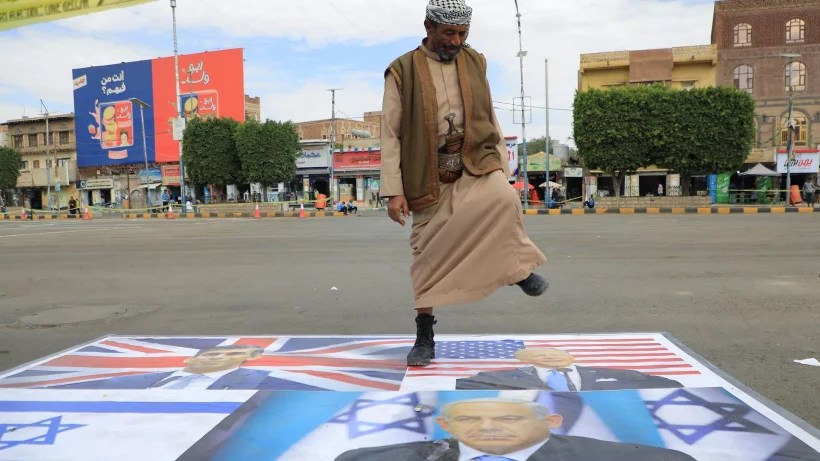
The Biden administration has offered unequivocal support for Israel’s punitive operations in spite of international condemnation of Tel Aviv and calls for an urgent ceasefire. Top US allies in the Middle East have taken or threatened to take serious steps to distance themselves from Washington amid the crisis.
US diplomats stationed in Middle Eastern countries have been sending warning signals to Washington about the lasting anti-American sentiment stirred up in the region thanks to the Biden administration’s stubborn support for Tel Aviv’s military actions in Gaza.
The warnings, collected by the State Department over recent weeks and seen by ABC News, reportedly prompted a meeting between officials and US intelligence services to evaluate just how much damage had been done.
A cable from the US diplomatic mission in Morocco, for example, indicated that pro-US “collaborators” in the Northwest African country felt that ties with the US were now “toxic” thanks to the “blank check” Biden gave Israeli Prime Minister Benjamin Netanyahu for Israel’s Gaza operations.
“Criticism of the US position has proven unshakable despite significant adjustments to US messaging to highlight the need to protect civilian lives,” the cable, marked ‘sensitive’, warned, complaining that US messaging about sending “aid into Gaza or diplomatic pressure for Israel to avoid civilian casualties” were falling on deaf ears in the Moroccan press. The Embassy’s social media accounts have been targeted by “waves of unfollows or negative and abusive comments,” according to the cable.
An anonymous official told the network that the issue has spread beyond the Middle East to other Muslim majority countries, including Indonesia. Meanwhile, the “enduring hit to US popularity” in the Mideast is said to pose a threat to US plans for post-conflict diplomacy, as well as Washington’s long-standing push for normalization with Israel.
US intelligence agencies reportedly believe the negativity will blow over in the long term, while State Department officials fear it could take up to a “generation” to reestablish frayed ties.
The diplomatic downturn abroad has also been matched at home, with the administration quietly reaching out to American Muslim communities in battleground states like Michigan amid fears that they could stay home come November instead of coming out to reelect Joe Biden.
Biden’s handlers have sought to balance his comments on the Palestinian-Israeli crisis in recent weeks, but despite the posturing, the US is reportedly proceeding with plans to supply Israel with additional weapons, including Joint Direct Attack Munition (JDAM) guidance kits and bomb fuses, while simultaneously calling publicly for a temporary ceasefire.
Washington’s duplicity has threatened to unravel decades of US diplomacy in the region. Last week, officials warned that Egypt is considering suspending its landmark 1978 Camp David peace agreement with Israel – the keystone to US normalization strategy.
Meanwhile, the foreign ministers of former regional arch adversaries Saudi Arabia and Iran vowed on Friday to expand their bilateral cooperation, while jointly blasting Israel over its “crimes” against the Palestinian people in Gaza and the West Bank. Saudi Arabia welcomed Iran’s proposal for an emergency meeting of the Organization of Islamic Cooperation’s foreign ministers to stop Israel’s “genocide.”
The latest escalation of the 75-year-old Palestinian-Israeli crisis began on October 7 after Hamas carried out surprise raids into southern Israel, catching the military off guard and taking hundreds of hostages. Over 1,450 Israelis and nearly 29,000 Palestinians in Gaza have been killed in the conflict to date, with some 1.9 million of Gaza’s 2.1 million residents displaced in the fighting.
Arab world calls US top security threat, sees no prospect of peace with Israel: Poll
The Cradle | February 9, 2024
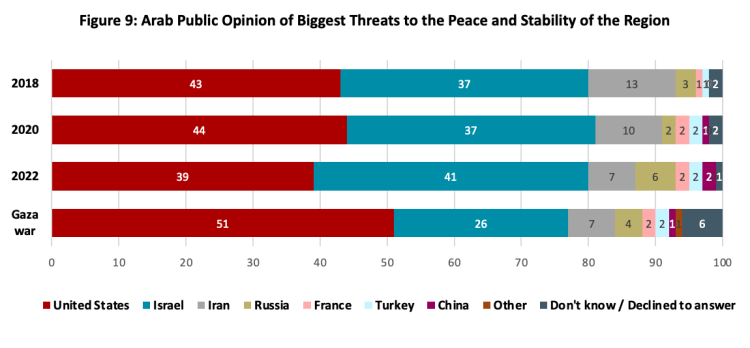
A new opinion poll conducted in 16 Arab countries shows that Washington’s continued support for Israel’s campaign of genocide in the Gaza Strip has dramatically hurt its image across West Asia and North Africa, as 94 percent of respondents describe the US position as “bad.” At the same time, more than half say the US poses the biggest threat to regional security.
Other western states fared almost as poorly, with more than three-quarters of those polled saying the position of the UK, France, and Germany in relation to Gaza is “bad” or “very bad.”
In contrast, Iran received a surge in recognition, with 48 percent of respondents expressing a positive view of the Iranian position, while 37 percent held a negative view. Despite Ankara’s increasing trade ties with Tel Aviv, Turkiye got a similar response – 47 percent perceived the country’s position positively, and 40 percent perceived it negatively.

To make matters worse for Washington, 51 percent of respondents agree that the US is currently the biggest threat to peace and stability in the region – marking a 12-point jump from 2022. Israel trails behind with 26 percent, a 15-point drop from 2022.
The survey, conducted by the Arab Center Washington DC (ACW) in cooperation with The Arab Center for Research and Policy Studies (ACRPS), also asked respondents their opinions on prospects for peace with Israel in the wake of the war in Gaza.
Fifty-nine percent answered with certainty that there can be no possibility for peace with Israel, while 14 percent reported having serious doubts, and nine percent said they did not believe in the possibility of peace with Israel in the first place.

Furthermore, 89 percent of Arab citizens say they oppose official recognition of Israel, with only four percent favoring it. This marks the lowest level of recognition since the question was first asked in 2011.
When asked what actions regional leaders must take to stop the mass murder of Palestinians in Gaza, 36 percent said governments should suspend relations or normalization agreements with Israel, 14 percent said aid must be delivered to Gaza regardless of Israeli approval, and 11 percent said oil exports should be used to put pressure on Israel and its western backers.
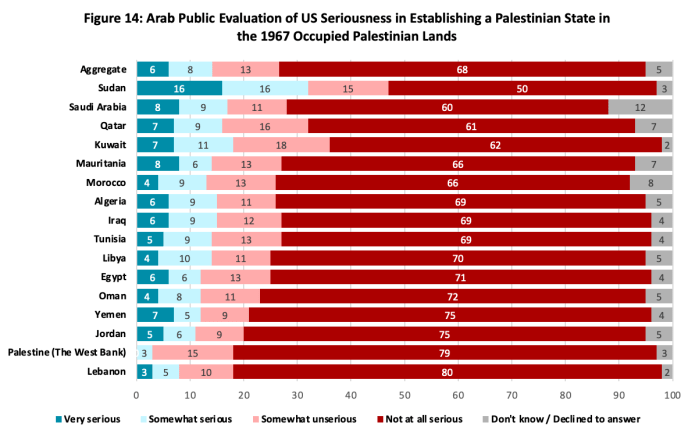
A large majority of respondents also agreed that the US is not serious about working to establish an independent Palestinian state under the 1967 borders with occupied Jerusalem as its capital.
“This is a historic moment in some very important ways,” Shibley Telhami, a professor at the University of Maryland, said at an event presenting the survey findings on Thursday. “The scale of what we have seen and the role the US has played in this deeply painful crisis has been so large and been perceived to be so large that it’s going to leave an imprint on the consciousness of a generation in the region that is going to outlast this administration and outlast this crisis.”
Questions about Washington’s alleged commitment to democracy and regional stability have been growing steadily in the Arab world for several years. According to a Gallup poll conducted in April 2023, a great majority of citizens in 13 countries across West Asia and North Africa said they did not trust US claims about “encouraging the development of democracy” or about “improving the economic lot of people.”
A few months earlier, the ACRPS revealed the results of the largest opinion survey conducted in the Arab world, showing that 84 percent of Arabs reject recognizing Israel for political and cultural reasons.
Canceled US Joint Exercises in Africa Shows Washington’s Influence Abroad Slipping
Sputnik – 28.01.2024
Retired CIA intelligence officer and State Department official Larry Johnson told Sputnik the move may be related to internal pressure not to work alongside “troops associated with coup governments.”
The United States military leadership has scrapped plans to hold joint exercises with several African states such as Sudan, Mali, Niger, Ethiopia, Eritrea and Burkina Faso.
According to the Washington Post, the Pentagon’s change of plans was, “at least in part,” the result of US Democrats pressuring the Biden administration to bar “troops associated with coup governments” from participating in US-led military exercises.
Exercises such as these are usually planned many months in advance, so the decision to scrap these plans means “there’s an issue with the governments that were supposed to participate,” said retired CIA intelligence officer and State Department official Larry Johnson.
Describing the military exercises’ cancellation as a “significant” development, Johnson told Sputnik that this move by the Pentagon may have also been prompted by the decision of the host African governments not to participate.
“In any event, I think what it does signify is that US influence over other countries, its ability to basically tell countries what to do and compel countries to follow US policy, is slipping, that the US influence in areas like Africa is growing weaker, not stronger,” he remarked.
Johnson also suggested that the decision by Niger, Mali and Burkina Faso to withdraw from the Economic Community of West African States (ECOWAS) may be related to this development, considering that ECOWAS is primarily regarded as an entity “under Western influence.”
According to him, the fact that these countries chose to part ways with ECOWAS and pursue “bilateral agreements among themselves” does seem like signs of them “distancing themselves from US control.”
Rwanda, Congo deny claims of talking with Israel to take in displaced Gazans
Press TV – January 6, 2024
Rwanda, Congo and Chad have refuted claims that they have engaged in any discussions with Israel concerning the potential acceptance of Palestinians displaced from the war-torn Gaza Strip.
Citing the latest fake news campaign from Israel, the Rwanda foreign ministry circulated a “disinformation alert” against the Zman Yisrael, an Israeli news outlet and The Times of Israel’s Hebrew sister site, that had claimed on Friday that “Israel is in talks with Chad and Rwanda to accept thousands of Palestinians from Gaza.”
“No such discussion has taken place either now or in the past, and the disinformation should be ignored,” the statement from the Rwanda foreign ministry read on X, formerly Twitter.
Earlier, Congo and Chad also denied holding talks with Israel about the forced displacement of Palestinians from Gaza.
Contrary to what is reported in some media, there has “never been any form of negotiation, discussion or initiative” between Kinshasa and Israel on the alleged reception of Palestinian migrants on Congolese soil, the Congolese government spokesperson, Patrick Muyaya, said in a statement late Thursday.
In its report, The Times of Israel asserted that Congo is willing to take in Palestinians. Quoting from a senior source in the security cabinet, it claimed that Congo “will be willing to take in migrants, and we’re in talks with others.”
“Prime Minister Benjamin Netanyahu’s coalition is conducting secret contacts for accepting thousands of immigrants from Gaza with Congo, in addition to other nations,” the report read.
Meanwhile, The Times of Israel published another report on Thursday, stating that Israel has denied that it is in talks with other countries about absorbing Gazan immigrants, and that the senior official pushed back on Zman Yisrael’s report.
“It’s a baseless illusion in my opinion. No country will absorb 2 million people, or 1 million, or 100,000, or 5,000. I don’t know where that idea came from,” said the official in a briefing to Israeli journalists, on condition of anonymity, as the report stated.
According to reports, the Israeli regime is adopting the “voluntary” resettlement of Palestinians from Gaza as an official policy.
Earlier, Benjamin Netanyahu said he supports the idea but needs to find countries that are willing to “absorb” Gazans. “We are working on it,” he said.
While quoting a senior Israeli official, the report from Zman Yisrael also stated that whoever volunteers for migration would be handed over a “generous financial grant” and “extensive aid” to the receiving country.
“The principle is to give a generous financial grant to any Palestinian who expresses a desire to emigrate from Gaza, along with extensive aid to the receiving country, including military aid,” the report read.
On Wednesday, despite criticisms from the United States, Israeli finance minister Bezalel Smotrich, the leader of the Religious Zionism Party, doubled down on a call for “voluntary emigration” from Gaza once the current war on Gaza ends.
Itamar Ben-Gvir, the so-called national security minister, this week issued a call “to encourage the migration of Gaza residents” as a “solution” to the humanitarian crisis.
Josep Borrell, the EU’s top foreign policy official, condemned both Smotrich and Ben Gvir for their calls to resettle Palestinians living in Gaza as “inflammatory and irresponsible” on Wednesday.
“Forced displacements are strictly prohibited as a grave violation of [international humanitarian law] and words matter,” Borrell said on X.
A spokesperson for the United Kingdom foreign office said: “Gaza is Occupied Palestinian Territory and will be part of a future Palestinian state. The UK firmly rejects any suggestion of the resettlement of Palestinians outside of Gaza.”
Furthermore, the Spanish government also offered its own rebuke Wednesday, saying the administration rejects recent statements by Israeli authorities evoking population movements in Gaza that would be contrary to international law.
Israel has launched relentless air and ground attacks on the Gaza Strip since a cross-border attack by the Palestinian resistance group Hamas on Oct. 7.
Since the beginning of the war, at least 22,600 Palestinians have since been killed and 57,910 others injured, according to Gaza’s health authorities.
The relentless attacks have caused extensive devastation in Gaza, resulting in 60% of the region’s infrastructure being either damaged or completely destroyed.
This has led to the displacement of nearly 2 million residents, who now face severe shortages of essential resources such as food, clean water, and medicine.
Expansion of US Drone Ops in Africa Comes Amid Rising Opposition to Foreign Military Presence
Sputnik – 04.01.2024
Nearly two and a half years after the United States’ campaign in Afghanistan ended in an inglorious rout, the US seems poised to expand its military operations in another part of the globe.
The United States is attempting to convince several West African states to allow them to use their airfields to carry out drone operations, according to a report by the Wall Street Journal.
This move is ostensibly aimed at curbing the spread of Islamist terrorist groups in Ghana, Benin and the Ivory Coast, the media outlet claimed, adding that US drones might purportedly “conduct aerial surveillance of militant movements along the coast and provide over-the-shoulder tactical advice to local troops during combat operations.”
The United States’ drone initiative, however, takes place amid a “shift in public sentiment and attitude” in African states “against foreign military presence,” argued Ovigwe Eguegu, a Nigerian policy adviser at the Development Reimagined consultancy.
“The attitude that we are seeing that is very much against foreign military presence, particularly of major power like the US, is because of the concern that we’re now in an era of good power competition and the risk of proxy conflict is quite high,” Eguegu said. “Citizens knowing what happened during the Cold War [are] very much averse to foreign troops present.”
He also observed that the US and French military missions in Africa, as well as the UN MINUSMA peacekeeping force, did little to improve the security situation in the countries they were deployed in, while the “successes that are being achieved in counterterrorism” in the region were primarily achieved by the Multinational Joint Task Force comprised of military units from Niger, Nigeria, Chad, Cameroon and Benin.
“While there is room for foreign military cooperation, there is no need for foreign military presence on the continent, because that is what regional armies are there for in the first place,” Eguegu remarked.
He also suggested that further “militarization of security solutions” is unlikely to improve the security situation in Africa and argued for a different approach.
According to Eguegu, the “solution to the Africa security challenges, in West Africa in general, can come in the form of funding support,” where the foreign support essentially amounts to providing weapons and training to local forces and does not necessarily involve “direct military operations” by foreign forces.
EU ‘Overpaid’ €185 Bln for Gas Due to Russia Sanctions
By Svetlana Ekimenko – Sputnik – 06.12.2023
Disruption of Russian gas supplies due to Western sanctions on Moscow over Ukraine have left Europe grappling with spiraling inflation and surging energy bills, with the costs of liquefied natural gas (LNG) exports from the US adding to the pressures on European households’ budgets.
The European Union has been forced to overpay some €185 billion for gas imports since it imposed self-harming sanctions against Russia over Ukraine, according to Sputnik’s calculations based on Eurostat data.
Since February 2022, when Brussels first started to levy restrictions on Moscow, the EU’s average monthly gas import expenditures have risen to €15.2 billion. Of this, €7.7 billion has been spent on liquefied natural gas (LNG), while the remaining €7.5 billion has gone to pipeline gas. Meanwhile, during the year before the introduction of sanctions, European countries paid an average of €5.9 billion for gas (€3.6 billion for pipeline gas; €2.3 billion for liquefied gas).
Thus, it is estimated that EU member states over the course of 20 months spent a total of €304 billion on gas imports, while previously such expenses were accrued over several years. For example, from April 2017 to the end of 2021, the EU spent €186 billion on gas imports, and from 2013 to 2021 the value of such imports was at €292 billion.
While Europe has been reeling from the fallout from the backfiring sanctions, the United States has been raking in profits estimated to be worth €53 billion. Other countries that have benefited from the EU’s struggle to find alternatives to Russian energy are the UK (€27 billion), Norway (€24 billion), and Algeria (€21 billion).
Russia, on the other hand, despite the reduction in supply volumes, has received an additional €14 billion due to surging prices. The EU’s shortsighted crusade to limit Moscow’s energy-related income has resulted in Qatar earning the same amount – an additional €14 billion, while Azerbaijan brought in a bonus worth €12 billion. A look at some of the other beneficiaries of this EU gas policy revision shows that Angola banked €5 billion, Egypt – €4 billion, and Trinidad and Tobago – €3 billion. An additional €2 billion were received by Nigeria and Cameroon, and another billion each by Libya, Oman and Equatorial Guinea. Another 12 countries earned relatively small sums, totaling almost €2 billion.
Before the Ukraine crisis and the sanctions unleashed against Moscow over its special military operation in the neighboring country, Europe received approximately 40 percent of the gas it consumed from Russia. Ever since the Ukraine conflict escalated, Brussels has been cobbling together package after package of sanctions targeting Russia. However, to anyone with a clear understanding of the energy needs of the 27-member bloc, it was evident that it was backing itself into a corner by opting to “wean itself” off Russian gas. The Ukraine conflagration and the punitive restrictions have led to disruptions of supply chains and a surge in energy prices worldwide. Furthermore, the Nord Stream pipeline sabotage added to the continent’s woes.
The Nord Stream pipelines, built to deliver gas under the Baltic Sea from Russia to Germany, were hit by explosions on September 26, 2022. Denmark, Germany, and Sweden left Russia out of their investigations into the attack, prompting Moscow to launch its own probe with charges of international terrorism. In the absence of any official results so far, Pulitzer Prize-winning US investigative journalist Seymour Hersh published a report in February 2023 alleging that the blasts were organized by the US with Norway’s support. Washington has denied any involvement.
Western countries and their allies were left facing an energy crisis and struggling to fill their gas reserves. Overall, the sanctions have triggered in the West everything from raging inflation, recession fears, to looming deindustrialization, with Germany being hit the hardest.
At the same time, oil and gas revenues of the Russian budget have been significantly outpacing those of the last year since September despite external pressure, Russian Prime Minister Mikhail Mishustin said earlier in the autumn.
Furthermore, the World Bank reported in August that by the end of 2022, Russia’s wealth in purchasing power parity (PPP) terms had exceeded $5 trillion for the first time — putting it ahead of Western Europe’s three biggest economies, namely, France, financial giant the United Kingdom, and industrial powerhouse Germany.
Featured Video

Daniel Davis: China & Russia Will Defend Iran
or go to
Aletho News Archives – Video-Images
From the Archives
Sugar: Killing us Sweetly
Staggering Health Consequences of Sugar on Health of Americans
By Dr. Gary Null | Global Research | February 3, 2014
In September 2013, a bombshell report from Credit Suisse’s Research Institute brought into sharp focus the staggering health consequences of sugar on the health of Americans. The group revealed that approximately “30%–40% of healthcare expenditures in the USA go to help address issues that are closely tied to the excess consumption of sugar.”[1]The figures suggest that our national addiction to sugar runs us an incredible $1 trillion in healthcare costs each year. The Credit Suisse report highlighted several health conditions including coronary heart diseases, type II diabetes and metabolic syndrome, which numerous studies have linked to excessive sugar intake.[2]
Just a year earlier in 2012, a report by Dr. Sanjay Gupta appearing on 60 Minutes featured the work of Dr. Robert Lustig, an endocrinologist from California who gained national attention after a lecture he gave titled “Sugar: The Bitter Truth” went viral in 2009. Lustig’s research has investigated the connection between sugar consumption and the poor health of the American people. He has published twelve articles in peer-reviewed journals identifying sugar as a major factor in the epidemic of degenerative disease that now afflicts our country. The data compiled by Lustig clearly show how excessive sugar consumption plays a key role in the development of many types of cancer, obesity, type II diabetes, hypertension, and heart disease. His research has led him to conclude that 75% of all diseases in America today are brought on by the American lifestyle and are entirely preventable.[3]
Until the airing of this program, no one in the “official” world acknowledged anything wrong with sugar, here is a sampling of some the latest research available to them if they chose to look… continue
Blog Roll
 Aletho News
- Lebanon: Between sovereignty and the mirage of normalization
- Ukraine Given $43Bln in Proceeds From Russian Assets Frozen by G7 Since 2024 – Estimates
- The military is babying F-35s to hide their true cost to taxpayers
- Ukrainian military analyst praises use of drones against ‘Russian-Hungarian-Slovak friendship’
- Von der Leyen warns Hungary: We have ways of making you talk
- EU manipulating polls in bid to oust Orban – German opposition leader
- Daniel Davis: China & Russia Will Defend Iran
- The US’ self-directed ‘China nuclear threat’ will only be a waste of effort: Global Times editorial
- Female Iranian academic sentenced to 4 years in prison in France over protesting Israel’s genocide in Gaza
- US university cancels Palestine conference citing sanctions concerns
- If Americans Knew
- Israeli leaders want to buy global legitimacy – Not a ceasefire Day 140
- Israel warns of a Ramadan escalation — while doing everything to provoke one
- Democrats Should Release Their 2024 Election Autopsy – and Stop the Gaza Denial
- Israel responsible for 2/3 of press killings worldwide – Not a ceasefire Day 139
- Are the Jews indigenous to Palestine?
- AIPAC Wants to Kill a Bill that would Ensure Israel Complies with Ceasefire
- Former Israeli PM, in Epstein Files, Dreamed of Israeli Eugenics and Pretty Converts
- Israeli settlers join ‘safari’ tour of Palestinian prisoners
- Flooding in Gaza amid rumors of war; fire in West Bank – Not a ceasefire Day 138
- Fourteen Countries Condemn Huckabee’s Support for Israel Taking Over Most of the Middle East
- No Tricks Zone
- Surprising Discovery: Sahara Is Greening…Billions Of Trees Where Once Thought To Be Barren
- New Research Reaffirms Clouds, Aerosols, And Surface Solar Radiation Are ‘Driving The Climate System’
- Germany: Electric Car Catches Fire At Charging Station, Sets Off Local “Inferno”, Widespread Damage
- New Study: Canada’s New Brunswick Was 1°C Warmer Than Today During The Medieval Warm Period
- Coal Power Back In Trend As Globe Tries To Keep Pace With Growing Demand For Power
- New Study: A 4°C Warmer Beaufort Sea Had ‘No Sea Ice’ 11,700 – 8200 Years Ago
- Unfudging The Data: Dutch Meteorological Institute Reinstates Early 20th Centruy Heat Waves It Had Erased Earlier
- German Gas Crisis…Chancellor Merz Allegedly Bans Gas Debate Ahead of Elections!
- Pollen Reconstructions Show The Last Glacial’s Warming Events Were Global, 10x Greater Than Modern
- Germany’s Natural Gas Storage Level Dwindles To Just 28%… Increasingly Critical
 Aletho News