Foreign investors disappear from US Treasury auctions, as China borrows at the lowest rates ever
Inside China Business | August 10, 2025
A staggering $11 trillion in US government debt needs to be borrowed or refinanced over the next 12 months.
Treasury Department officials are faced with painful choices, whether to borrow at very high rates, locked in for ten years or longer? Or instead borrow for one year or less, but at massive volumes?
Foreign governments and pension funds are also showing far less interest in absorbing new US government bonds, and are demanding ever-higher yields to compensate for inflation and policy risk.
China’s government, however, can borrow at far below half the rate Washington pays, across all maturities. And Chinese companies are paying the lowest interest rates in their history to access new capital. That represents a long-term structural advantage to Chinese policymakers and industry.
Closing scene, Hong Kong South China Morning Post, China cuts US Treasury holdings for third month amid trade war, debt ceiling fears https://www.scmp.com/economy/china-ec…
Zerohedge, Yields Spike After Very Ugly, Tailing 30Y Auction Sparks Steepening Fears https://www.zerohedge.com/markets/yie…
ZH, Very Ugly, Tailing 10Y Auction Sees Slide In Foreign Demand, Plunge In Bid To Cover https://www.zerohedge.com/markets/ver…
ZH, Ugly, Tailing 3Y Auction Sees Worst Foreign Demand Since 2023 https://www.zerohedge.com/markets/ugl…
Managing Risk in the Face of Historic U.S. Debt Refinancing https://www.tradingcentral.com/market…
What Is Happening with Mortgage Interest Rates? https://www.schwab.com/learn/story/wh…
How the Federal Reserve Actually Affects Mortgage Rates https://www.cnet.com/personal-finance…
Wall Street Journal, Trump and Bessent Bring New Style to Managing America’s Debt https://www.wsj.com/finance/investing…
Banking on the Belt and Road: Insights from a new global dataset of 13,427 Chinese development projects https://docs.aiddata.org/ad4/pdfs/Ban…
China 10-Year Government Bond Yield https://tradingeconomics.com/china/go…
What do falling Chinese yields tell us? https://www.dws.com/insights/cio-view…
X, Corporate borrowing costs in the US have never been lower than China’s today https://x.com/UnHedgedChatter/status/…
In numbers: Arab people don’t want to normalize with ‘Israel’

Al Mayadeen | July 27, 2025
Almost 80 years after Israeli occupation of Palestine, the great majority of the Arab public refuses to normalise with “Israel”, with fresh polling data revealing a dramatic decline in support for normalization after the Israeli war on Gaza following October 7, 2023.
According to the latest Arab Barometer surveys conducted between 2023 and 2024, support for Arab normalization with the Israeli regime has plummeted to historic lows. In none of the eight surveyed West Asian and North African countries did public backing exceed 13%.
The Arab Barometer’s Wave VIII surveys, which covered Iraq, Jordan, Kuwait, Lebanon, Mauritania, Morocco, Palestine, and Tunisia, showed a consistent regional downturn in normalization sentiment. Morocco saw a drop from 31% in 2022 to 13% post-October 7; Lebanon from 17% to 12%; Iraq from 14% to 13%; Mauritania from 8% to 4%; and Jordan from 5% to 3%.
Prior to the 2020 normalization accords, support for normalization with “Israel” was already limited. In a 2018–2019 survey, Sudan recorded the highest level at 32%, while Yemen had the lowest at 5%.
‘Israel’ is the primary regional threat
Across the region, “Israel” was most frequently cited as the leading threat to regional stability. Lebanon had the highest perception at 79%, followed by Palestine at 63%, Egypt at 54%, Jordan at 42%, and Morocco at 27%.
In Egypt and Jordan, younger respondents were notably less likely to see “Israel” as the main threat, while in Palestine, the younger demographic showed heightened concern.
Protest movements
Public sentiment against normalization translated into protest activity across the region, per Foreign Affairs. In April 2025, Morocco’s largest labor union urged the government to prohibit the entry of such ships into Moroccan waters and organized a series of protests in solidarity with Gaza.
Jordan experienced daily protests since October 7, with authorities recalling their ambassador from “Israel” and enforcing a ban on the Muslim Brotherhood.
In Kuwait, where protests were restricted, 84% of citizens boycotted pro-Israel companies, 62% donated to Gaza, and many shared solidarity messages online.
Low favorability of ‘Israel’s’ allies, too
Public sentiment toward Western allies of “Israel” deteriorated sharply. Approval of the United States dropped by 23 points in Jordan and 19 in Mauritania. France’s favorability fell 20 points in Lebanon and 17 in Mauritania.
The United Kingdom experienced the steepest decline in Morocco, with a 38-point drop. In contrast, China saw a significant boost in public opinion: 16 points in Jordan, 15 in Morocco, 10 in Iraq, and 6 in Lebanon.
The Arab Barometer Wave VIII data was collected across nine countries between September 2023 and July 2024, with most surveys completed by March 2024. This timing means the findings do not capture Arab public opinion following several significant regional developments, including “Israel’s” war on Lebanon and later on Iran, and the Israeli aggression on Syria.
The survey data therefore represents public sentiment during the initial nine months following October 7, 2023, but predates these subsequent escalations that may have further influenced regional attitudes toward “Israel.”
Russian Cybersecurity Gains Traction in Global South and East – Deputy Foreign Minister
Sputnik – 01.06.2025
Russian cybersecurity solutions have become increasingly sought after by countries in the Global South and East amid the growing discreditation of most leading Western IT firms, Russian Deputy Foreign Minister Sergey Vershinin told Sputnik.
“In the field of information and communication technologies, we possess significant capabilities — from legislation and law enforcement practices to extensive experience and developments in ensuring ‘digital sovereignty,’” he said.
According to the senior diplomat, Russian companies are offering cybersecurity solutions that are in high demand among nations in the Global South and East.
“This is largely due to the fact that many leading Western IT corporations have discredited themselves,” Vershinin noted.
He pointed out that there have been recurring revelations about Western companies ignoring the laws of the countries in which they operate, embedding hidden “backdoors” in their products — often for the benefit of intelligence agencies — and carrying out politically motivated directives from Western governments.
“All of this is, of course, being noticed by our partners in developing countries, who are increasingly leaning toward supporting our depoliticized and impartial approaches and initiatives in the ICT sphere on multilateral platforms,” he emphasized.
Senegal to expel all foreign troops – PM
RT | May 21, 2025
Senegalese Prime Minister Ousmane Sonko has declared that all foreign military personnel stationed in the country must withdraw by the end of July.
French troops remain the only foreign military presence in Senegal, operating under a 2012 defense partnership agreement. As part of a phased withdrawal, France officially transferred control of the Rear Admiral Protet naval base in Dakar to Senegalese authorities on May 15. This follows the earlier handover of the Marshall and Saint-Exupéry facilities in March. The remaining bases are scheduled to be transferred in subsequent phases.
Speaking to Burkina Faso’s national broadcaster RTB on Monday, Sonko said that since his administration came to power nearly a year ago, it had taken a number of steps to assert national sovereignty.
“We have notified all countries that have military bases in Senegal that we demand a complete withdrawal. There will be no more foreign military bases on Senegalese territory,” he stated.
According to the prime minister, the withdrawal process is already underway. He confirmed that one foreign military base was vacated just two days prior to the interview and stressed that the handover of another facility would be completed by the end of July.
Sonko framed the move as a normal assertion of sovereignty, stating that Senegal has “a national army, defense and security forces. We think we are able to ensure our own safety.” He also called on other African nations to take greater control of their own destinies.
In November 2023, Senegalese President Bassirou Diomaye Faye called the presence of French troops “incompatible” with national sovereignty. His newly elected administration has taken a firm stance on scaling back France’s military footprint in the country.
Several West African nations, including Burkina Faso, Mali, and Niger, have severed all military ties with France in recent years, citing frustration with French-led counterterrorism efforts and a desire to seek out alternative partners like Russia.
Net Zero Fades As the Deluded Cling to Its Fantasy
By Vijay Jayaraj | Townhall | May 9, 2025
The grand vision of “Net Zero” initiatives – by which emissions of carbon dioxide magically balance with expensive and futile capture and storage systems – have long been sold as the redemption arc for humanity’s profligate modern ways. Yet, like a poorly scripted dystopian thriller, the holes in this plot are glaring.
Net Zero was always a fragile concept. It rested on shaky and illogical assumptions: that wind turbines, solar panels and “green” hydrogen could reliably replace fossil fuels, that governments could redesign economies without unintended consequences, that voters would accept higher costs for daily necessities, and that developing countries would sacrifice growth for climate targets they had no hand in creating.
None of those fantasies held. Countries did not decarbonize nearly at the speed promised, even though climate bureaucracies clung to the illusion. Long-range targets, five-year reviews and international pledges lacked common sense and defied physical and economic realities. The result? An unaccountable machine pushing impractical policies that most people never voted for and are now beginning to reject.
If Net Zero were a serious endeavor, its architects would confront the undeniable: China and India are more than delaying their decarbonization timelines – they’re burying them. Why has this been ignored?
China and India – responsible for more than 40 percent of global CO2 emissions in the last two decades – are accelerating fossil fuel use, not phasing it out. In Southeast Asia, coal, oil and natural gas continue to dominate. Vietnam, Indonesia and the Philippines are building new electric generating power plants using those fuels. These countries understand that economic growth comes first.
Africa, too, is pushing back. Leaders in Nigeria, Ghana and Senegal have criticized Western attempts to block fossil fuel financing. African nations are investing in exploitation of the oil and gas reserves.
If Asia represents the global rejection of Net Zero, Germany and the U.K. are poster children of the West’s self-inflicted wounds. Both nations, once hailed as Net Zero pioneers, are grappling with the harsh realities of their green ambitions. The transition to “renewables” has been plagued by economic pain, energy insecurity and political backlash, exposing the folly of policies divorced from facts. When the war in Ukraine cut off energy supplies, Germany panicked. Suddenly, coal plants were back online. The Green Dream died a quiet death.
Trump funding cuts likely will accelerate the fall of Net Zero’s house of cards. The president’s decisions to slash financing for international and domestic green programs has severed the lifeline for global climate initiatives, including the United Nations Environment Program. Trump also vowed to redirect billions from the Inflation Reduction Act – Biden’s misnomered climate law – toward fossil fuel infrastructure.
The retreat of Net Zero interrupts the flow of trillions of dollars into an agenda with questionable motives and false promises. Climate finance had developed the fever of a gold rush. Banks, asset managers and consulting firms hurried to brand themselves as “green.” ESG (Environmental, Social, Governance) investing promised to reward “climate-friendly” firms and punish alleged polluters.
The fallout was massive market distortions. Companies shifted resources to meet ESG checklists at the expense of fiduciary obligations. Now the tide is turning. The Net Zero Banking Alliance comprising top firms globally has been abandoned by America’s leading institutions. Similarly, a Net Zero investors alliance collapsed after Blackrock’s exit.
Perhaps the fundamental failure of Net Zero was political. Permission was never sought from taxpayers and consumers who would pay the costs and suffer the consequences of an always ill-fated enterprise. Climate goals were set behind closed doors. Policies were imposed from above. Higher utility bills, job losses and diminished economic opportunity became the burdens of ordinary families. All while elites flew private jets to international summits and lectured about the need to sacrifice.
A certain lesson in the slow passing of Net Zero is this: Energy policy must serve people, not ideology. That truth was always obvious and remains so.
Yet, some political leaders, legacy media and industry “yes-men” continue to blather on about a “green” utopia. How long the delusion persists remains to be seen.
Vijay Jayaraj is a Science and Research Associate at the CO2 Coalition, Fairfax, Virginia. He holds an M.S. in environmental sciences from the University of East Anglia and a postgraduate degree in energy management from Robert Gordon University, both in the U.K., and a bachelor’s in engineering from Anna University, India.
Sights set on Somaliland: The threat of a total US–UK–Israeli takeover
By Kit Klarenberg – The Cradle – April 3, 2025
In recent weeks, Somaliland has drawn unprecedented attention from western media. As Israeli and US officials scramble to find a destination to forcibly relocate Gaza’s population, the globally unrecognized breakaway territory is increasingly floated as a potential solution.
Multiple mainstream reports suggest Tel Aviv and Washington are making quiet overtures to Hargeisa. On 14 March, the Financial Times revealed:
“A US official briefed on Washington’s initial contacts with Somaliland’s presidency said discussions had begun about a possible deal to recognize the de facto state in return for the establishment of a military base near the port of Berbera on the Red Sea coast.”
Somaliland’s President Abdirahman Mohamed Abdullahi has made international recognition his central foreign policy objective. Since the territory declared independence in 1991, no country has recognized it as a sovereign state. But late last year, before entering the White House, US President Donald Trump made the surprise announcement that he intended to officially recognize Somaliland, which would make Washington the first foreign capital to do so.
For the internationally isolated statelet, the prospect of a permanent US military footprint, which would shield the East African statelet from Somalia’s endemic instability, is no doubt enormously appealing, especially as it would be attached to official recognition of statehood by a major global power.
Search for a new ‘Nakba’
From Washington’s perspective, the deal would yield far more than just a convenient dumping ground for displaced Palestinians, evicted to make way for Trump’s fantasized “Gaza-Lago.” Somaliland’s strategic location on the Red Sea makes it an ideal staging post for operations against Yemen.
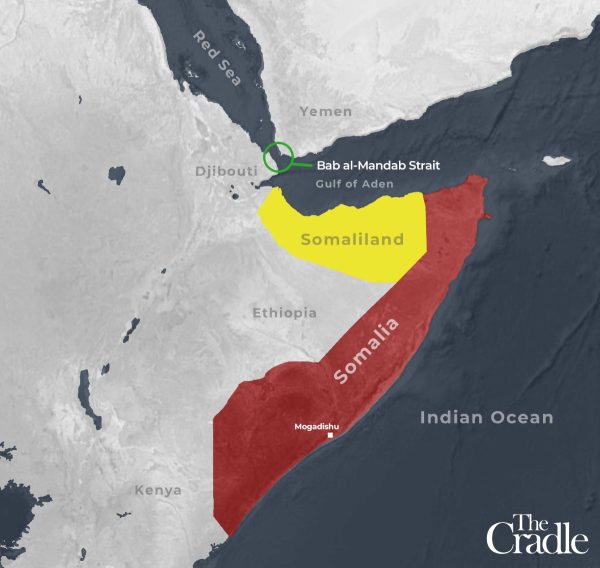
A current map of the Horn of Africa
Such a move would grant the US a critical new foothold in the Horn of Africa at a time when American and French forces are being ejected from countries across the continent at breakneck speed.
It could also serve as a counterweight to China and Russia’s expanding presence in northern Africa. Beijing established its first overseas military base in neighbouring Djibouti in 2017, and has since emerged as an aggressive critic of western policies in the region – while also welcoming Iranian naval vessels at its ports.
The strategic utility of recognizing Somaliland is not lost on Washington’s foreign policy architects. Project 2025 – a sprawling, right-wing policy blueprint by the Heritage Foundation, intended as a roadmap for Trump’s second term—explicitly advocates “[countering] malign Chinese activity” in Africa. It specifically recommended “the recognition of Somaliland statehood as a hedge against the US’s deteriorating position in Djibouti.”
Another neocolonial outpost
Keep in mind that Trump’s interest in the territory was made public well before Somaliland was floated as a relocation site for Gaza’s 2.4 million Palestinians. In November 2024, former British defence secretary Gavin Williamson announced he had held “really good meetings” with Trump’s “policy leads” on the matter, expressing confidence that recognition was on the horizon.
Williamson has long been an ardent advocate of Somaliland’s independence, regularly undertaking all-expenses-paid trips to the breakaway territory, and receiving honorary citizenship for his lobbying efforts.
Williamson’s interest exposes a rarely acknowledged truth: Somaliland is, in practice, a modern British colony. Though it claimed independence from Somalia in 1991 and was formally granted independence by Britain in 1960, the territory remains under London’s shadow.
Should Palestinians be forcefully relocated there, they would be trapped in yet another open-air prison – under the watchful eye of British-trained security forces with a long history of violent repression.
‘ASI Management’
In April 2019, British government contractor Aktis Strategy abruptly declared bankruptcy, leaving staff unpaid and suppliers out of pocket, despite having secured tens of millions of pounds from the UK’s Foreign Office for “development” programs across Africa and West Asia.
The Somaliland Chronicle published a detailed exposé on the company’s collapse, which came while it was overseeing a “justice and security sector reform project” in the statelet.
Official records reveal that between 2017 and 2022, London allocated over £18 million (around $23.5 million) to that project alone. It was one of many UK-financed schemes in the breakaway region that placed Somaliland’s state architecture – government, military, judiciary, prisons, police, intelligence – under effective British management.
Internal files reviewed by The Cradle lay bare the extent of this control.
One document details how notorious British intelligence cutout Adam Smith International (ASI) provided “ongoing training and mentoring” to Somaliland’s National Intelligence Agency and Rapid Response Unit, while managing the territory’s forensics services, border surveillance, and even prosecution procedures via the Attorney General’s Office. The British-created Counter-Terrorism Unit was established in 2012 with Foreign Office funds – “under ASI management.”
Elsewhere, ASI boasts of its “proven history of establishing close professional relationships” with senior government, armed forces, police, “security sector,” and Ministry of Defense officials. One file notes the contractor “deployed ex-UK military advisers” to train Somaliland’s army and coastguard intelligence units, “[mentoring] senior officers in leadership, management, and military doctrine,” and even drafted legislation later adopted as law.
Meanwhile, British contractor Albany Associates focused on teaching Somaliland’s leaders the mechanics of propaganda and information warfare. Its mission: to train ministers and senior officials to generate a “steady flow of information” and proactively manage the media, in order to counter independent outlets.
It was noted that “unsatisfied public demand for information” from the government “on nationally significant events” gave independent information sources significant influence locally, which was to be countered at all costs.
In Somaliland, public distrust of their government was fueled by frequent arrests of journalists and media shutdowns, so Albany’s role was to consolidate state control over information – ensuring one narrative, “one voice,” no dissent.

An official document reviewed by The Cradle
A prison camp in waiting
While ASI touted its reforms, documents from another contractor – Coffey International – presented a more candid picture. Somaliland’s military, the files noted, was “the largest and most costly institution of state,” yet evaded oversight, with its funds likely diverted for opaque ends. Accountability for military abuses was virtually nonexistent.
The police, meanwhile, had “a history of applying disproportionate force,” and no “dedicated public order unit.” Coffey proposed creating one within the Special Protection Unit – a paramilitary force protecting foreign organizations and their staff. At the time, the unit had no mandate for crowd control or responding to peaceful protests.
That July 2015 document recommended Somaliland police be trained in the UK by the National Police, covering human rights, crowd engagement, and first aid. The aim: instill “proportionality, lawfulness, [and] accountability” throughout Somaliland’s police forces. Yet if this training occurred, it had no visible impact.
In late 2022, mass protests erupted in the contested city of Las Anod. Somaliland forces responded with lethal force, killing dozens. The crackdown escalated, and in 2023, Somaliland’s military indiscriminately shelled the city. Amnesty International described the attack as “indiscriminate,” targeting schools, hospitals, and mosques, displacing hundreds of thousands and killing scores.
This is the context in which Somaliland appeals to Israel and its western patrons: a brutal, British-run security apparatus capable of extinguishing any form of dissent – ergo, the perfect dumping ground for Gazan refugees. If Washington establishes a base to launch strikes on Yemen, Palestinians could also be held hostage – literal human shields – to deter reprisals from the Ansarallah-aligned armed forces.
One can only hope this depraved plan collapses as swiftly as earlier US–Israeli schemes to expel Gazans to Egypt or Jordan.
The real question now is whether Somaliland’s leaders are desperate enough for international recognition to trade their 34 years of independence for total US–UK–Israeli military, political, and security hegemony.
Trump’s Foreign Aid Suspension Unnerves Washington, not Recipients. Part 1
By Simon Chege Ndiritu – New Eastern Outlook – April 2, 2025
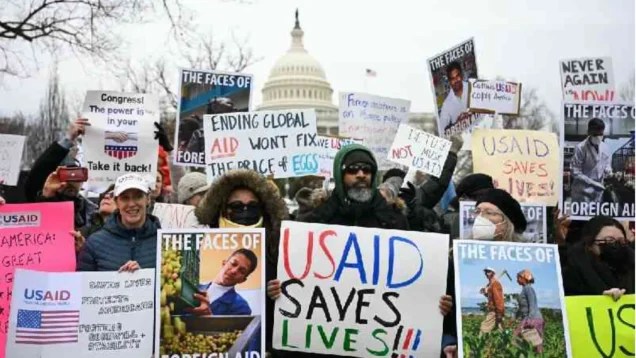
On January 20th, 2025, Donald Trump paused US foreign assistance for 90 days. This move was followed by the suspension of the United States Agency for International Development (USAID), through which most US foreign assistance was channeled.
The ‘Donor’ Protesting
Surprisingly, the recipients ignored this suspension, leaving Washington to protest it, which shows that parties in Washington have been the chief beneficiaries of this aid. Meanwhile, some in the recipient countries do not perceive the suspended assistance as worth bemoaning but replacing and moving on. While Trump has repeatedly accused other countries of ripping off the US through aid, using the term ‘development assistance’ to refer to this money that is never used to build roads, bridges, power plants, or buildings is quite ironic. It shows that ‘development’ means something else to Washington. According to USAID’s localization report released in 2023, over 90% of its money went to its international partners in and around Washington.
Therefore, only 10% reaches targeted communities, and some end up funding opium production and pedophile-run children’s orphanages, among others. The US and Western Europe frame Africa as surviving on aid, which is only a colonial ploy. In response to Trump’s suspension, some Kenyans recognized that America’s foreign aid helps Washington and that the US is an unreliable partner. Surprisingly, Kenyan media coverage recognizes the need to move on from Washington’s posturing and find sustainable funding sources.
Trump’s Cutting Funds for Contractors in Washington
Some Kenyans have been baffled by Trump’s suspension of aid, noting how it gave Washington unsolicited influence. For instance, an opinion sent to Kenya’s Daily Nation after Trump’s suspension revealed that the sender was baffled by the White House, since the aid gave the US soft power and influence. The opinion email proceeded to suggest that Trump’s America is cash-strapped due to its senseless tariff war with China. Noteworthy, the US received funds from Europeans before passing the bulk of it to Washington-based contractors, emphasizing the importance of this aid to America. It has been an open secret that Western aid helps the donors and not the recipients. Trump’s move will adversely affect American businesses, even as noted by an FP article from May 2022, which revealed that foreign aid was funding a bubble in Washington.
Therefore, his suspension runs against his America First Policy; this drastic move must be informed by a more significant concern for the US empire, such as China. An article authored by Nicholas Okumu, a Kenyan orthopedic surgeon for the Star Newspaper, steered clear of Trump’s actions, and their motivations and focused on how Kenya should respond. Okumu observed that American aid has always been a tool for political leverage and economic self-interest, insisting that Kenya should seek sustainable ways of funding its projects instead of relying on Washington’s unpredictable and ineffective assistance. US aid only yields minimal tangible benefits for Africans, as it is fashioned to prioritize American commercial interests, for instance, by awarding contracts to US firms and undermining industries in recipient countries.
US Aid’s Vicious Cycle
Issuing the US development assistance, including the part disbursed through USAID, starts by leading the audience into a tunnel vision of how the country is planning an extensive (supposedly) altruistic program to alleviate pressing challenges in poor countries. At this stage, audiences are not informed that Washington created the challenge or wants to enrich its contractors without addressing the problem. For instance, details that Washington’s Pentagon had bombed Al-Shifa pharmaceutical manufacturing company in Sudan in 1998, hence preventing millions from accessing health supplies, are hidden. The aid ends with money being spent in Washington and nothing being achieved for recipient communities, even while a justification for an enormous investment is created. Washington does not care if people access medical supplies, but whether its contractors can benefit from purporting to supply them.
A good example may include the repeated cycle of USAID’s Global Health Supply Chain Cycle. The first cycle, conceived in 2015 and worth $9.5 billion, ended without substantial results and was used in 2024 to justify a new one worth $17 billion. In the beginning, Washington’s media machine told audiences how USAID planned the Global Health Supply Program, which was designed to solve the problem of lifesaving health supplies being inaccessible to poor countries. The empty hype in this endeavor may have been detected in the statement that the project was supposed to “shake up global health contracting,” meaning the primary interest was not to alleviate supply problems but to award a massive contract to the main contractor, Chemonics International.
The project’s value of $9.5 billion had been dispensed three years later and was spent on fraud and inefficiencies. After 2017, the main contractor received a deadline extension and an additional $2 billion without delivering substantial results. An investigative report found that Chemonics International’s procurement reviewers had made up figures to report that 80% of the contracts had been delivered. Thirty-nine people had been indicted with fraud, but the main contractor escaped with a slap on the wrist by paying only $3.1 million to the justice department. Therefore, Washington’s aid benefited a contractor who used a façade of delivering aid to other countries. To attest to the failure of the first project cycle, which started in 2015, USAID launched a similar $17 billion project, dubbed NextGen, by signing contracts for delivering ‘lifesaving supplies around the globe.’ It is Ironic for anyone to think that Washington, which bombed a pharmaceutical factory in Sudan in 1998 and a trauma hospital in Afghanistan in 2015, really cares whether people can access medical suppliers. Noteworthy, most countries are unable to produce medical supplies because America’s big Pharma monopolizes them through patents.
Going Forward
USAID has always been tied to procuring from the US, making recipient countries fail to develop industries that can organically respond to local challenges. For instance, American laws mandate that food aid be purchased from American farmers and delivered using American-flagged vessels, which means farmers in the recipient countries lose business. Similarly, other industries that receive aid from the US can also collapse, which limits Africans’ development. The deleterious effects of the US aid programs can explain the donors’ insistence on issuing them out, meaning that Africans should not view Trump’s suspension of aid as a tragedy. Instead, it is an opportunity for reflection on how American aid should be replaced, since it is ineffective and unreliable. The US will permanently halt its aid when it does not stand to gain. Therefore, African governments must seek ways to finance their projects without relying on Western aid.
WikiLeaks Exposes Internews: USAID-Funded Media Machine Behind Global Influence
Sputnik – 08.02.2025
The infamous US agency USAID funneled nearly half a billion dollars to Internews Network, a non-profit deeply involved in media operations all over the world, WikiLeaks has revealed.
In 2023 alone, Internews Network collaborated with 4,291 media outlets, produced 4,799 hours of broadcasts reaching 778 million people, and trained over 9,000 journalists. Operating in 30+ countries, it has key offices in the US, London, Paris, and regional HQs in Kiev, Bangkok, and Nairobi. But there’s more to the story:
- Founded in 1982, Internews claims to help media outlets achieve financial sustainability and promote “trustworthy information” – a mission it pursues with hefty US government funding.
- By 2023, the organization had partnered with nearly 4,300 media outlets, trained thousands of journalists, and simultaneously supported social media censorship initiatives.
- USAID alone poured $472.6 million into Internews, though the organization also received funding from AOL-Time Warner Foundation, the Bill & Melinda Gates Foundation, and other private donors.
- Grants include $10.7 million from USAID to support “high-quality responsible journalism” in Liberia and $11 million for “media enabling democracy” in Moldova, per datarepublican.com.
- The US State Department chipped in $1.48 million to establish “safe, accessible, and life-saving information services” in South Sudan.
- Another $19.5 million USAID grant was issued to Internews to “position Jordanian society to effectively advocate for citizen-driven interests”.
- Adding to the intrigue, Internews CEO Jeanne Bourgault and other key figures recently had their bios scrubbed from the organization’s website — but WikiLeaks, noticing the move, helpfully provided archived copies.
Russian media reach soars as NATO eyes countermeasures – report
RT | January 30, 2025
A fresh NATO report highlights a sharp increase in the reach of Russian state media outlets RT and Sputnik, particularly in Africa and the Middle East, where the news outlets have gained millions of new followers.
The report, published on Tuesday by the NATO Strategic Communications Centre of Excellence (StratCom COE), examines how Russian media operations have expanded their influence after the escalation of the Ukrainian conflict in early 2022. With Russian state-backed media subjected to blanket bans in the West, the outlets diverted their resources elsewhere.
According to the report, RT Arabic saw its audience grow by ten million users since the breakout of fighting between Ukraine and Russia. Sputnik Arabic also significantly increased its content output, posting 30–35% more frequently, while the news agency’s engagement on social media surged by 80%. Russian embassies in Africa also saw a 41% rise in social media followers, reflecting a broader trend of growing Russian media influence in non-Western regions, the report notes.
It also claims the outlets have been capitalizing on “anti-colonial narratives” and overall frustration with Western policies, particularly in Africa, and blames this on historical ties to the Soviet Union that still shape public perceptions there. In some cases, the narratives have resonated strongly with audiences already skeptical of Western institutions like the International Monetary Fund and the International Criminal Court, the report notes.
While StratCom COE projected its findings to the entirety of the Global South, the report actually examined the work of Russian media – as well as social media activities it had linked to Russia without any solid evidence – in Egypt, Mali, Kenya, South Africa and the UAE.
The authors of the report appeared to struggle with terminology, rejecting the ‘Global South’ over an “increasing pushback” against the name, and shot down the term ‘majority countries,’ claiming it has been promoted by assorted “malign actors” to push their agenda. Instead, the report uses the term ‘Multi-aligned Community,’ vaguely defining it as “states existing outside of the Western environment who have exhibited a preference for aligning or partnering with chosen states depending on specific spheres or issues.”
In response to the expanding reach of Russian media, the NATO report proposes new countermeasures aimed at reducing Moscow’s ever-growing influence. One recommendation is to establish a NATO-led initiative to engage with audiences in Africa and the Middle East, improving direct communication and addressing concerns about Western policies.
The report also suggests that NATO should work with local media outlets to “counter disinformation” and to bankroll local “independent journalism.” It also calls for stronger partnerships with civil society organizations to promote diverse viewpoints and counter what it describes as “one-sided narratives” from Russian state media.
Mussolini Was Not a Dictator
Tales of the American Empire | January 16, 2025
One goal of this channel is to teach people that much of what they learned in school and from news media is false. A good example is propaganda that Italian leader Benito Mussolini was a dictator. This is false, Italy’s dictator during World War II was Victor Emmanuel III who appointed Mussolini as prime minister in 1922 then dismissed and arrested him in 1943. He was king of Italy and part of European royalty so was excused from blame for bloody events. His commoner henchman Benito Mussolini was deemed responsible and characterized as an evil dictator. Victor Emmanuel was never charged with war crimes and this axis dictator remained king of Italy until 1946 when he retired to live in luxury in British held Alexandria.
_____________________________
“Was Fascism the Height of Abomination”; Pierre Simon; Unz.com; March 28, 2024; https://www.unz.com/article/was-fasci…
“The Machinery of Fascism Revisited”; Jeffery Tucker; Brownstone Institute; May 5, 2024; https://brownstone.org/articles/the-m…
Related Tale: “The Anglo-American War on France”;  • The Anglo-American War on France
Related Tale: “Blundering General Mark Clark”; • Blundering General Mark Clark
Russian oil product exports shoot up – Bloomberg
RT | January 17, 2025
Russia’s refined fuel exports have surged to their highest level in nearly a year, even as the US imposed new sanctions on the country’s energy sector last week, Bloomberg reported on Thursday.
Seaborne shipments of Russian petroleum products hit an 11-month high, averaging 2.5 million barrels per day (bpd) in the first ten days of January, the outlet said, citing data from analytics firm Vortexa. The surge marks a 12% increase compared to December’s daily average and represents the highest level since February 2024, according to the report.
The US slapped a new round of sanctions on Russia last week in coordination with the UK. The measures targeted major Russian oil companies such as Gazprom Neft and Surgutneftegas, as well as dozens of vessels allegedly used to transport Russian oil in defiance of Western restrictions, which the US has described as a ‘shadow fleet’.
Moscow has condemned the sanctions, calling them “illegal,” with Kremlin spokesman Dmitry Peskov warning that they could destabilize global energy markets.
The latest round of sanctions targets more than 180 tankers allegedly involved in Russian trade, primarily focusing on crude oil shipments. However, only about 4% of petroleum products exported between January 1 and 10 were transported on sanctioned tankers, data from Vortexa, showed. Additionally, there has been no deviation observed in the voyages of these vessels.
The recent surge in Russia’s petroleum products exports is primarily driven by surging shipments of diesel and fuel oil, the outlet said. Revenue gains from fuel exports in December exceeded the decline in crude oil earnings, supported by soaring gasoil flows and higher prices, Bloomberg said citing the International Energy Agency (IEA).
Diesel and gasoil exports, which make up about 40% of Russia’s refined-fuel shipments, jumped 17% from December levels to 1.08 million bpd, the highest since last February. Shipments from Baltic ports rose by over 50%, contributing to the growth, data showed.
Fuel oil flows also increased, reaching 792,000 bpd which represented a 19% increase and the highest level since July 2023. Volumes to Africa saw the most significant rise.
Featured Video
Racist Seinfeld Dances for Joy as Bibi Unveils His New Map
or go to
Aletho News Archives – Video-Images
TV Drama Review
Japanese drama projects Japan’s wartime atrocities onto Chinese characters

Global Times | October 25, 2026
By portraying Chinese characters as perpetrators of ruthless violence while casting Japanese Self-Defense Forces (SDF) intelligence operatives as defenders, the season 2 of the Japanese drama Vivant has recently drawn criticism from Chinese netizens, who argue that its depiction turns historical reality on its head while ignoring Japan’s wartime atrocities.
The TBS drama series – a spy suspense story in which an alleged unofficial intelligence unit of the SDF operates across the globe — has attracted a passionate fanbase. Its currently airing season 2 opened with a household rating of 18.8 percent, the highest for a TV drama this year, according toa commentary article by Japanese media Toyo Keizai.
What draws attention is the portrayal of the enemies in the series, the article noted. Scenes in which the Chinese organization subjects kidnapped members of the SDF unit to brutal torture are repeated with unrelenting intensity.
It is rare for Japanese TV dramas to explicitly portray a real-life country as the enemy, the article noted.
Japanese Prime Minister Sanae Takaichi also made a reference to the drama, saying that she has been recording Vivant and hopes to binge-watch it over the year-end and New Year holidays, according to Japanese media outlets.
China’s CCTV News report on Sunday revealed that the drama features scenes in which Chinese personnel cut off the fingers of and stab Japanese intelligence operatives in the abdomen. Such acts bear striking similarities to the torture inflicted on Chinese nationals by invading Japanese troops during the World War II.
The drama distorts the truth by attributing these atrocities to modern Chinese characters. Beneath the surface, it subtly glorifies Japan’s cross-border overseas operations, blurs the functional boundaries of the SDF and implicitly promotes an expansionist narrative, per CCTV News. … continue
Blog Roll
 Aletho News
- EU facing trillion-euro debt hole while seeking more cash for Kiev
- How US, Europe, Persian Gulf states exhausted missile stockpiles, splurged billions to defend Israel
- Up in arms… Koreans reject U.S. empire’s plan to make South Korea the next Ukraine
- Iran, Turkey, Pakistan, Saudi Arabia could advance region-led security framework in Tehran: FM spox
- Netizens condemn Japanese drama for projecting Japan’s wartime atrocities onto Chinese characters
- Racist Seinfeld Dances for Joy as Bibi Unveils His New Map
- A West Bank War for Netanyahu’s Election Campaign, Could It Backfire?
- Yemen denounces European Parliament’s ‘hypocritical’ push to blacklist Ansarullah
- Qalibaf: UAE’s UN bid aims to ‘clear the runway’ for ‘Greater Israel’, whitewash genocide
- Pakistan reopens Iran border after boosting security: Report
- If Americans Knew
- An error has occurred; the feed is probably down. Try again later.
- No Tricks Zone
- Sudden Stratospheric Warming, Powerful El Niño Combination May Lead To Extreme Europe Cold, Energy Crisis!
- Two New Studies Find Thwaites Glacier Melt Cannot Be Driven By Human Activity Or A Warming Ocean
- E-Cars Reduce CO2 Emissions By Only 41% Compared To Internal Combustion Engine Vehicles
- Predictions Made By Renowned Climate Professor Over Past Decades Have Been Proven To Be Poor
- New Study Suggests Large Regions Of The Pacific Ocean Have Been Cooling For The Last 80 Years
- Germany’s Green Energy Debacle: High Energy Costs Force Kahla Porzellan to Close After 182 Years!
- New Study: 50 Years Of The Most Aggressive ‘Net Zero’ Policies Can Only Affect The Global Climate By 0.03°C
- US September “Heat” Was No Record…Many Records Set Decades Ago
- Latest European Green Energy Debacle; Portugal’s Largest Flagship Solar Park Insolvent!
- Green Energy Debacle: German Expert Professor Fritz Vahrenholt Warns Of Severe Economic And Social Consequences

