Two Primary Elections for the Soul of ‘America First’
By Alan Mosley | The Libertarian Institute | March 27, 2026
Political slogans are cheap. Governing is not. “America First” is not a bumper-sticker philosophy. It is a testable claim about priorities: How much debt will we pile up, how many wars will we drift into, and how often will elected officials treat Congress as a ceremonial prop rather than a constitutional branch.
Midterm elections are where slogans go to trial. Primaries, especially, are where interests that cannot reliably win a general election try to win the nomination. They do it with money, with media saturation, and with the oldest trick in politics: framing obedience as unity.
This year, two Republican races show the fork in the road. In northern Kentucky, Rep. Thomas Massie is fighting a primary that has become a national vendetta project. In South Carolina, Senator Lindsey Graham is seeking a fifth term while publicly linking his political identity to a foreign-policy crusade, and treating dissent at home as a moral failing.
If Massie survives and Graham falls, it signals that Republican voters still have room for independence, constitutional friction, and skepticism toward overseas commitments. If Massie loses and Graham wins, it signals the reverse: the slogan becomes a mascot for power, not a restraint on it.
Thomas Massie’s case is straightforward: he acts like Congress matters.
That is not a rhetorical compliment. It is a job description. Legislators are not hired to be studio analysts for executive decision-making after the fact. They are elected to vote, to demand records, and to treat spending as something more than a press release. Above all, they are meant to represent the voters of their district.
Massie has built a voting record that major conservative scorekeepers rate highly. Conservative Review’s Liberty Score gives Massie a 96% A-rating for his consistent conservative record. Club for Growth rates him at 92 for 2024 and 93 lifetime, and labels him a “Defender of Economic Freedom.” These scorecards are not holy writ, but they are a consistent signal: Massie votes against the spending reflex that has turned the federal government into a debt machine.
Recent actions match that pattern. Federal records show Massie raised about $2.45 million in 2025, with roughly $840,000 coming in unitemized contributions, the classic signature of small-dollar fundraising rather than a donor class writing checks in neat, report-friendly chunks. He also voted against President Donald Trump’s marquee tax-and-spending package, a bill that passed the House by a single vote, 215–214.
Then there is the achievement that infuriates people who prefer secrecy to law. Massie used a discharge petition process to force a House vote on the Epstein Files Transparency Act, which passed 427–1. He and Senate partners later pressed the Justice Department to brief lawmakers on implementation of that law. In plain English, he pushed Congress to demand documents from the executive branch. That is not radical. That is what should come standard for any elected official: constitutional oversight.
Massie’s opponent is Ed Gallrein, a Trump-endorsed challenger who leans into being the president’s chosen foil for Massie and says he is fighting for “the America First agenda.”
The Trump factor is not ambiguous. Reuters reported that Trump endorsed Gallrein as Massie continued pressing for release of files related to Jeffrey Epstein, and as Massie criticized the administration’s handling of that issue. CBS reported Trump has crusaded against Massie and predicted he would be remembered as the “WORST Republican Congressman” in history.
But the most important part of the Gallrein candidacy is not biography. It is the machinery behind him.
By March 11, outside groups had already spent more than $5 million aiming to unseat Massie in the May primary. A super PAC linked to the Republican Jewish Coalition directed more than $2.8 million into the contest since late February, with the group “MAGA KY” spending around $2.7 million this cycle. Those numbers matter because they establish what this contest is: a safe-seat nomination being nationalized by outside spenders.
What is the glue holding this coalition together? Foreign policy, especially Israel-related aid and posture.
Much like the antiwar congressional hero Dr. Ron Paul before him, Massie has taken lonely stands, including voting against funding tied to Israel’s Iron Dome system. That is not a minor detail. It explains why “America First” branding is being used to sell a campaign that is bankrolled by groups whose defining priority is unwavering support for Israel-focused policy.
Long before the current burst of spending, reporting showed that pro-Israel megadonors were flowing money toward the anti-Massie effort. Donors backing Israel were funneling money to denounce Massie with ad buys in his district, and identified major donors associated with that effort. Senior Republicans expected the American Israel Public Affairs Committee (AIPAC) to target Massie ahead of the 2026 primary, as they had done the same in prior spending runs against him.
The result is a familiar Washington pattern where a member votes against the foreign-policy consensus, and the donor class tries to end his career in a low-turnout election where ads can substitute for local affection.
A movement that cannot tolerate this kind of internal dissent is not a movement. It is a hierarchy.
Where Massie’s story is conflict with the foreign-policy consensus, Lindsey Graham’s story is partnership with it.
Graham filed for reelection in March with a campaign operation that looks financially impregnable. Federal Election Commission data show $19.6 million in total receipts through the end of 2025 and $13.4 million cash on hand. In a state where incumbency already carries heavy weight, that kind of bankroll makes a primary challenger’s job close to impossible.
But money is not the core issue. The issue is what Graham says he is for.
In an Associated Press report from March 16, 2026, Graham described the war posture toward Iran with blunt certainty: “We’re crushing them.” Graham was also quoted making an Israel-centered argument in which he said Iran would “kill all the Jews, and we’re next,” and then added that he would put his efforts to ensure the military has what it needs to win “ahead of anybody in the United States Senate.” That is not a senator describing prudence. That is a senator describing priority.
The rhetorical line that detonated online came from cable news. In remarks reported by Newsweek, Graham said, “I’m not with you, I’m with Israel,” and pledged to be with Israel “to our dying day.” In the same reported segment, he said he was going back to South Carolina to ask people to “send their sons and daughters into the Mid East.”
When a senator tells his own state, in effect, that the dissenters are beneath contempt, and the sacrifice is owed, he is not practicing representation. He is brazenly announcing to the world that his true constituency lies in a foreign nation.
That posture is consistent with Graham’s official communications. On his Senate website in January 2026, Graham praised Trump and Israeli Prime Minister Benjamin Netanyahu as a “duo” for the security and prosperity of both countries, described enhanced weapons cooperation with Israel as a potential “21st century ‘Manhattan Project,’” and insisted “failure is not an option.” That is language designed for permanent emergency, not constitutional restraint.
Even AP’s reporting framed Graham as having “everything he could ever want,” including Trump’s ear and the war he has long advocated, while critics compared his posture to a child on Christmas morning. His energy for more war would make even the late John McCain blush.
None of this requires conspiracy theories. American campaign-finance law makes the incentives plain.
Now place AIPAC and allied pro-Israel groups into that structure. FEC data show AIPAC has raised $34.3 million in receipts from January 1, 2025, through February 28, 2026, and disbursed $32.3 million in that period, including over $30.5 million in contributions to other committees. That is not marginal money. It is an industrial operation.
Major outlets have documented how Israel-related outside spending has surged in the 2026 cycle, including efforts in key primaries where advertising often avoids overt mention of Israel while targeting candidates critical of Israel policy. The Washington Post described AIPAC’s role in super PAC spending this cycle and the use of affiliated committees with benign names. When accounting for other associated organizations, upwards of $200 million has been spent on 361 congressional candidates who pledge to support a pro-Israel agenda.
Against that backdrop, the contrast between Massie and Graham becomes obvious.
Massie is punished for crossing the line against an imperial presidency. Graham is rewarded for enforcing it, in public, with contempt for “isolationists,” and with calls for deeper military involvement.
This is why the “America First” label is now contested terrain. A slogan that can be used to sell both constitutional restraint and open-ended war is not a philosophy. It is a marketing asset, and marketing assets are purchased.
Massie’s primary is not simply a question of whether he will hold a House seat. His district is reliably Republican and not expected to be competitive in the general election. The real decision is whether a Republican electorate will allow an independent lawmaker to keep office when national money and presidential ego demand submission.
Graham’s race is not simply a question of whether he will win reelection. It is whether South Carolina Republicans will ratify a posture that treats foreign conflict as a defining purpose, and treats constituents as a manpower pool, rather than citizens with rights and limits on what government may demand.
If “America First” means anything beyond applause, it means the country is not obligated to bankrupt itself, or bleed itself, to prove its virtue to donors, allies, or television audiences. It means wars are debated and authorized by Congress, and that military force is not a lifestyle. It means elected officials remember that “ally” is not a synonym for “master,” and that patriotism is not measured by willingness to sign blank checks.
That is why these two primaries matter as a pair. One man is being targeted for saying no. The other is being rewarded for never saying no, and for mocking those who do.
A party can choose restraint, or it can choose appetite. It cannot choose both and keep its soul intact.
Instagram suspends Track AIPAC, watchdog tracking pro-Israel lobby spending
MEMO | February 11, 2026
Instagram has suspended the account of Track AIPAC, a widely followed watchdog project that tracks political spending by the American Israel Public Affairs Committee (AIPAC) and related pro-Israel lobbying groups. The social media giant cited alleged violations of the platform’s intellectual property and trademark rules. The suspension places the account at risk of permanent deletion unless successfully appealed within 180 days.
Track AIPAC — also known as AIPAC Tracker — was launched in 2024 by Cory Archibald and Casey Kennedy as a transparency and advocacy platform documenting AIPAC’s political donations, endorsements and influence on US elections. The project publishes Federal Election Commission data on pro-Israel political spending, highlights which lawmakers receive the most support, and endorses opponents of candidates reliant on AIPAC funding.
The watchdog has become a prominent source for voters and activists seeking to make AIPAC funding “politically toxic” and to hold elected officials accountable for their ties to the pro-Israel lobby.
In a post announcing the suspension, Track AIPAC said Instagram had removed its account, which had amassed more than 137,000 followers, for alleged trademark violations, without clear explanation of what specific content triggered the action. The group said it plans to appeal the decision while shifting its engagement to its website and its X presence.
Supporters of Track AIPAC decried the suspension as a double standard on free speech and accountability. On X, critics argue that transparency about political influence is being stifled while lobbying groups with deep pockets continue to operate without similar oversight.
Commentators noted that the suspension comes at a time when AIPAC’s influence in US politics is increasingly being challenged. Since Israel’s genocide in Gaza began, there has been a steady shift among Democratic voters and some candidates away from accepting pro-Israel lobby funding.
Once considered politically untouchable, AIPAC is now viewed by many as a liability, with candidates distancing themselves from its donations amid growing public anger over Israel’s policies and its role in the genocide.
Polling suggests that a significant portion of Democratic voters now oppose candidates who accept pro-Israel lobby funding, reflecting a shift in grassroots sentiment.
This shift has been evident in recent elections and legislative cycles, with some lawmakers returning AIPAC donations or refusing further support, and others publicly criticising the lobby’s priorities. For instance, US Congressman Seth Moulton announced that he would return AIPAC funds and no longer accept the lobby’s support, citing concerns about its alignment with current Israeli government policy, a move that underlines how AIPAC’s brand has become fraught within its once-traditional political base.
The suspension comes at a time when AIPAC’s political spending is facing heightened scrutiny and growing resistance from segments of the Democratic base. As some candidates increasingly distance themselves from pro-Israel lobby funding, the removal of a watchdog account dedicated to tracking those donations has added to debate over transparency and accountability in US politics.
Trump’s war posturing against Iran traces back to Bush’s infamous 2002 ‘axis of evil’ speech
By Ivan Kesic | Press TV | January 31, 2026
On January 29, 2002, US President George W. Bush’s State of the Union Address infamously branded Iran as part of an “axis of evil,” marking a rhetorical escalation that hardened a decades-long policy of confrontation and laid the groundwork for the persistent crises that continue to threaten regional stability today.
The twenty-fourth anniversary of Bush’s “axis of evil” speech came this week amid a starkly familiar backdrop: US naval “armada” massing in the Persian Gulf and renewed threats of military action from Bush’s successor, Donald Trump.
This moment is not an aberration but the continuation of a sustained, multi-decade strategy aimed at isolating and pressuring the Islamic Republic of Iran.
The policy did not originate with Bush but in the sanctions regimes of the 1990s, significantly shaped by pro-Israeli lobbying efforts within the United States.
It hardened with the rise of neoconservative thinkers who favored regime change over containment – a doctrine vividly applied to Iraq.
Throughout a campaign of disinformation and propaganda regarding weapons of mass destruction, the leveraging of exiled terrorist groups, and a consistent narrative of Iranian threat have been employed to maintain the so-called “maximum pressure.”
As history echoes in January 2026, with a Republican administration again aligning with an Israeli Likud regime to confront Iran, the patterns of the past illuminate the perilous present.
Defining Speech: January 29, 2002
Bush’s State of the Union address fundamentally reshaped the US posture toward Iran in ways that his predecessors had deliberately avoided.
In that speech, Iran was labeled a nation that “aggressively pursues these weapons and exports terror, while an unelected few repress the Iranian people’s hope for freedom.”
By grouping Iran with Iraq and North Korea as part of an “axis of evil,” the infamous and widely condemned declaration decisively rejected any tentative diplomatic outreach that had briefly flickered after the September 11 attacks.
During that period, symbolic gestures, such as candlelight vigils in Tehran, and behind-the-scenes communication channels suggested Iran’s conditional cooperation in Afghanistan.
However, the “axis of evil” label extinguished these nascent contacts. It signaled that the hostile administration in Washington would view Iran not as a potential partner, even tactically, but as a permanent adversary and a primary target in the global “war on terror.”
Crafted within a circle of advisors known for their overt pro-Israeli leanings, the phrase was immediately and enthusiastically embraced by the Israeli regime, which saw it as a long-sought alignment of US rhetoric with its own strategic goals.
The speech institutionalized a framework of hostility that would dictate policy for years, replacing the previous administration’s fluctuating approach with one of unambiguous confrontation.
Dual containment and the sanctions regime
Long before the “axis of evil” rhetoric, the framework for isolating Iran was carefully constructed during the Bill Clinton administration under the policy of “dual containment,” which targeted both Iran and Iraq.
From its inception, this policy was heavily influenced by pro-Israeli lobby groups in Washington. Even as Clinton’s foreign policy team was forming, concerns arose about appointees from the Carter administration who were deemed insufficiently sympathetic to these interests.
Warren Christopher, who was appointed Secretary of State, was initially viewed with caution but ultimately became a key architect of a hardened stance toward Iran.
Christopher, who had served as chief negotiator of the Algiers Accords and was criticized by some Iranian officials, developed a personal animosity toward Iran.
He publicly labeled Iran an “outlaw nation,” a “dangerous country,” and one of the “principal sources of support for terrorist groups worldwide.”
This rhetoric provided a public rationale for an escalating series of economic sanctions designed, in his words, to “squeeze Iran’s economy.”
A powerful proponent of this policy was Martin Indyk, former research director at the American Israel Public Affairs Committee (AIPAC)-affiliated Washington Institute for Near East Policy, who served on the National Security Council and later as Ambassador to Israel.
Under his guidance, the threefold accusations of sponsoring terrorism, opposing regional peace efforts, and pursuing weapons of mass destruction became the unwavering justification for punitive measures against the Islamic Republic.
A fierce competition emerged in Congress to demonstrate increasing hostility toward Iran, with figures like Senator Alfonse D’Amato pushing for ever-tighter sanctions – often propelled by direct lobbying from AIPAC, which acted as the “locomotive” behind the legislation.
This culminated in the Iran and Libya Sanctions Act (ILSA) of 1996, which aimed to penalize foreign companies investing in Iran’s energy sector. Later reports revealed that the explicit goal of the act was regime change in Iran.
Neoconservatives and the preference for military solutions
The arrival of the Bush administration marked a significant shift in the philosophy underlying US foreign policy – though not in its ultimate objective.
By the late 1990s, while the corporate world and some pragmatic diplomats began questioning the efficacy of unilateral sanctions, a new faction with immense influence pushed for a more radical and hard-nosed approach.
This neoconservative wing, closely aligned with Likudist ideology in the occupied Palestinian territories, viewed sanctions and containment as too slow and unreliable.
They regarded military force as a faster, more effective means of dealing with hostile states.
Key figures such as Paul Wolfowitz, Richard Perle, and Douglas Feith – all with longstanding ties to pro-Israeli think tanks and advocacy groups – assumed senior roles within the Pentagon and advisory boards.
Their worldview was crystallized in the 1996 policy paper A Clean Break: A New Strategy for Securing the Realm, prepared for Israeli Prime Minister Benjamin Netanyahu, which advocated attacking Iraq to reshape the regional landscape.
For these strategists, patient pressure through sanctions was secondary to the transformative potential of direct military action and regime rollback.
While initially focused on Iraq, Iran remained a firm subsequent target.
They argued that only the forceful removal of threatening regimes could guarantee American and Israeli security, a belief that came to define the administration’s response after the September 11, 2001 attacks.
Iraqi precedent: Destruction as a model
The neoconservative doctrine found its first full-scale application in Iraq. The 2003 invasion, premised on bogus claims of weapons of mass destruction that were later proven false, fulfilled a long-held goal to eliminate the Saddam Hussein-led Ba’athist regime.
The architects of the invasion were not satisfied with only regime change but aimed for the comprehensive degradation of Iraqi power.
After two major wars and over a decade of crippling sanctions, Iraq’s state apparatus and military-industrial base were utterly destroyed.
Some proponents openly described the objective as returning Iraq “to the pre-industrial era,” a stark admission that the goal extended beyond disarmament to eliminating Iraq’s capacity to function as a modern, sovereign regional counterweight.
The devastating consequences – civil strife, the rise of takfirism, and immense human suffering – were regarded as collateral damage within a broader strategic vision.
For those advocating confrontation with Iran, the Iraqi campaign served as both a template and a warning. It demonstrated the overwhelming military power the US could deploy to dismantle a state, while also exposing the catastrophic instability that could follow.
Nevertheless, the ability to reduce a perceived enemy to a state of permanent weakness was noted, informing the maximalist pressure later applied to Tehran.
Propaganda arsenal: Lies and manipulations
Building and sustaining public and international support for relentless pressure on Iran required a sustained campaign of allegations and propaganda.
The core accusations remained consistent: pursuit of nuclear weapons, support for terrorism, and an implacable hostility to peace in the region.
These charges were amplified through a symbiotic network of government officials, pro-Israeli lobbying organizations, sympathetic media outlets, and designated “experts.”
Sensational – and fabricated – stories were regularly fed to the press. In the early 1990s, reports frequently citing unnamed intelligence sources or anti-Iran groups aboad claimed that Iran had purchased nuclear warheads from Kazakhstan or was on the verge of developing a bomb, claims repeatedly debunked by international inspectors and the countries involved.
Media outlets with particular editorial stances published alarming estimates, suggesting Iran was only years or even months away from nuclear capability – deadlines that continually receded as each passed without incident.
The language used was deliberately inflammatory, with senior officials referring to Iran’s “evil hand” in the region and describing it as a “rogue state.”
This ecosystem ensured that any Iranian attempt at diplomatic outreach or confidence-building was overwhelmed by a pre-existing narrative of deceit and malign intent, making substantive dialogue politically untenable in Washington.
Useful tool: MKO role in anti-Iranian propaganda
A particularly revealing aspect of the propaganda and pressure campaign has been the relationship with the Mujahedin-e Khalq Organization (MKO), a terror cult with offices scattered across Europe and the US.
Designated by the US State Department as a terrorist organization due to its history of violent attacks, including against Americans in the 1970s, Iranian officials and civilians in the 1980s, and its alliance with Saddam Hussein during the Imposed War, the terror group nonetheless found influential supporters and was eventually de-listed by Hillary Clinton.
Despite its cult-like structure and lack of popular support inside Iran, the MKO managed to gain an active lobbying and public relations operation in the United States and Europe.
Senior members of the US Congress, especially those with strong pro-Israeli records, championed the group, inviting its representatives to testify and attending its rallies, arguing it represented a “democratic alternative” to the Islamic Republic.
The MKO’s utility was cynically acknowledged; one Congressman stated, “I don’t give a s*** if they are undemocratic… They are fighting Iran, which is… a terrorist state. I say let’s help them fight each other.”
This usefulness peaked in August 2002, when an MKO front held a press conference in Washington to “reveal” the existence of two secret nuclear facilities in Iran at Natanz and Arak.
While these facilities were not in violation of Iran’s safeguards agreement at the time, the revelation – intelligence reports suggest originating with Israeli intelligence and channeled through the exiles – provided the perfect pretext to demand intrusive new inspections and escalate international pressure.
Thus, the MKO served as a deniable cut-out for disinformation and a persistent amplifier of the baseless and sham accusations against the Iranian government.
Unbroken chain: Policy sustained to the present day
The strategic imperative to confront Iran has proven remarkably durable, transcending individual US administrations and enduring significant geopolitical shifts.
This hostile and bellicose policy remains intact today. In January 2026, the situation closely mirrors earlier cycles of tension between Tehran and Washington, dating back to decades of US hostility and a failed “regime change” project.
US President Donald Trump and Israeli Prime Minister Benjamin Netanyahu, leading a Likud-dominated coalition, are once again employing military threats against Iran after failing miserably in June last year to dismantle the Islamic Republic of Iran.
The US military has reportedly amassed naval and air forces around Iran’s perimeter, announced by Trump himself, a show of force reminiscent of previous escalations.
This military posture is accompanied by an intensification of a long-standing economic stranglehold, as the Trump administration enforces so-called “ultimate pressure” sanctions with renewed vigor, targeting critical sectors and aiming to sever Iran’s access to the global financial system entirely.
The foundational grievances remain unchanged: allegations of building a “nuclear weapon,” despite Iran’s continued adherence to the Joint Comprehensive Plan of Action (JCPOA) framework after its earlier collapse, and support for regional allies.
Last month, Trump and Netanyahu backed deadly riots and terrorism in Iran, and then threatened to attack Iran if “lethal force” was used against the rioters, arsonists and terrorists. After the riots ended, the focus shifted back to the non-existent “nuclear weapon.”
The tools have expanded beyond diplomatic isolation and covert pressure. Recent reports from within Iran detail how externally backed groups, employing tactics and rhetoric similar to the MKO terrorist cult, sought to exploit domestic unrest by spreading incendiary propaganda and inciting violence, apparently aiming to destabilize the country.
The alignment between the Trump administration and the Likud regime in Tel Aviv remains as close as ever, with both viewing the other as a vital partner in a long-term struggle.
Just as in 2002, diplomatic overtures from Tehran aimed at easing tensions are dismissed or met with increased demands.
The legacy of the “axis of evil” speech has created a foreign policy paradigm that has locked the US and Iran into a perpetual cycle of confrontation, where the mechanisms of pressure – economic warfare, military threat, and the use of terrorist groups – have proven easier to sustain than to dismantle, continually pushing the region toward the brink of war.
What Trump is doing today is simply a continuation of Bush’s policy, which was also carried forward by Bill Clinton, Barack Obama, and Joe Biden. The policy remains unchanged.
Who Are the US Candidates Refusing AIPAC Money?
By Robert Inlakesh | Palestine Chronicle | October 28, 2025
The litmus test for whether a politician is truly interested in representing the people who elect them to power is becoming their stance on Palestine, more specifically, Gaza.
As American public opinion continues to shift against Israel, the US political landscape is also undergoing a dramatic transformation. AIPAC, once viewed as an asset to aid in election races, is now becoming a liability, giving birth to a new generation of politicians who are demonstrating their sincerity through a refusal to be bought by the Israel Lobby.
While New York Mayoral candidate Zohran Mamdani has perhaps received the most attention for his pro-Palestinian stances, he is in no way alone. In fact, he is joined by countless others who use their anti-genocide stances as a means of connecting with their voter bases.
All authoritative polling data suggests the majority of Democratic Party supporters currently hold a more favorable view of the Palestinians than Israel. According to a recent Gallup poll, 92 percent of all Democrats said they oppose the war in Gaza. Yet, the ability of candidates to reject funding from the Israel Lobby and freely speak their mind on the issue transcends a simple agreement with constituents on a single foreign policy issue.
Instead, refusing to take AIPAC money is rapidly becoming a prerequisite in order to be viewed as authentic, and it drives belief amongst the public that any given candidate will actually work to achieve key campaign promises. In other words, AIPAC equals corruption, and being pro-Palestinian equates to authenticity.
One of the most successful campaigns, coming from this new generation of politicians, is that of Graham Platner, who is a Democrat running for a seat in the US Senate for Maine. In his campaign ads, he promotes a “Mainers First” mentality, centering the working class and also explicitly opposing Washington’s support for the genocide in Gaza. He has publicly rejected funds from AIPAC, as opposed to Senator Susan Collins, who has taken at least $647,758 from the Israel Lobby.
Platner is a Marine Corps veteran who did four combat tours and also worked as an Oysterman. Despite countless attempts, from within the Democratic Party establishment and the Israel Lobby, to stir up controversies and undermine his campaign, the progressive candidate is still polling above his Democratic primary opponent and Maine Governor, Janet Mills.
Although the uptick in pro-Palestinian sentiment is more prominent amongst Democrats, there is also a notable shift amongst Republicans. Pew Research polling data shows that, while unfavorable views amongst Republicans overall stand at around 23 percent, amongst those aged 18-49, a whopping 50 percent said they viewed Israel unfavorably.
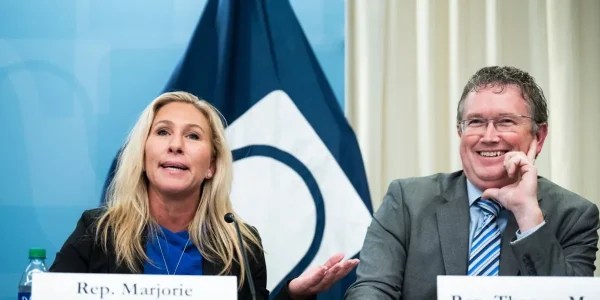
Harnessing the energy of the shift, the likes of Rep. Marjorie Taylor Greene, Rep. Thomas Massie, and Rep. Matt Gaetz have all explicitly come out in opposition to AIPAC. Their messaging around the issue is to assert that they are “America First”, as opposed to their Republican colleagues, whom they accuse of being “Israel First”. These representatives align themselves with popular conservative commentators like Candace Owens and Tucker Carlson, amongst others, who also carry the same rhetoric.
Ultimately, the idea of America First and slogans like Mainers First transcend partisan lines. The idea of prioritizing Americans above the interests of Israel has long been taboo, yet we saw this collapse during the Democratic primary campaign for the Mayor of New York.
When Zohran Mamdani was asked where he would first visit as Mayor, he answered calmly that “I would stay in New York City. My plans are to address New Yorkers across the five boroughs and focus on them.” Although he was then challenged repeatedly and asked to recognize Israel as a Jewish State, which he refused to do based upon opposition to systems of ethnic or religious hierarchy, the clip of his answer went viral, receiving broad agreement amongst both Democrats and Republicans.
Other politicians running for Congress, who are explicitly anti-AIPAC, include the following candidates:
Robb Ryerse for Arkansas’s Third District, who is seeking to unseat Steve Womack, funded to the tune of $142,030 by the Israel Lobby. In California, there is Chris Bennet running for the Sixth District, Mai Vang for the Seventh District, Saikat Chakrabarti for the Eleventh District, Chris Ahuja for the Thirty-Second District, as well as Angela Gonzales-Torres for the Thirty-Fourth District.
In Colorado, there is Melat Kiros for the First District, as well as John Padora for the Fourth District. Within Florida, there is also Bernard Taylor running for the Twenty-First District, Elijah Manley for the Twentieth District, Marialana Kinter for the Seventh District, and Oliver Larkin for the Twenty-Third District.
Running in Illinois, there is Robert Peters for the Second District, Junaid Ahmed for the Eighth District, Morgan Coghill for the Tenth District and Dylan Blaha for the Thirteenth District. Meanwhile, in Indiana, there is Jackson Franklin, who is running for Congressional District Five and, in Massachusetts, Jeromie Whalen is running for the First District.
Seeking to win Maryland’s Fourth District is Jakeya Johnson, while Donavan McKinney is running for Michigan’s Thirteenth District and Kyle Blomquist is competing for its First District. Crossing over to Missouri, there is a well-known progressive candidate, Cori Bush, for its First District and Hartzell Gray for Missouri’s Fourth District.
For New Hampshire’s First District, Heath Howard is in the running, while, in New Jersey, Katie Bansil is running for the Sixth District. Meanwhile, there is James Lally running for Nevada’s Third District, Aftyn Behn for Tennessee’s Seventh District and Zeefshan Hafeez for Texas’s Thirty-Third District.
Also contending for Washington’s Ninth District is Kshama Sawant, while Aaron Wojchiechowski is running for Wisconsin’s Fifth District and Brit Aguirre is contesting for West Virginia’s First District.
Meanwhile, Abdul El-Sayed is running for Senate in Michigan, and Karishma Manzur is a Senate Candidate in New Hampshire, both of whom reject AIPAC funding and oppose the ongoing genocide.
It is important to note that new projects, like AIPAC Tracker, are also now promoting candidates who refuse to take funding from the Israel Lobby and have set up a page whereby citizens can donate to these anti-AIPAC politicians. AIPAC Tracker has played a particularly important role in educating the public, through graphics, showing how much the Israel Lobby has given to individual politicians.
Despite the majority of the anti-AIPAC campaigns being led by progressive Democrats, it is clear that the infamy of the Israel Lobby is having a major impact on mainstream Democrats, too.
For example, earlier this month, AIPAC appeared to be experiencing an existential crisis following an announcement from prominent lawmaker, Seth Moulton, who declared he would not receive funds from the Lobby group and would even be returning their contributions.
In an official statement, Moulton claimed to be making his move due to AIPAC’s alignment with the Israeli government of Benjamin Netanyahu, in particular. For such a right-leaning Democrat, on foreign affairs, to be publicly disavowing AIPAC, it signaled the toxicity of its brand more than anything.
Back in 2024, AIPAC claimed victory after it managed to unseat progressive Democratic Party Representative, Jamaal Bowman, over his pro-Palestinian stances, in the “most expensive House primary ever” in US history. At the time, AIPAC had spent at least $14.5 million on anti-Bowman ads through its PAC, United Democracy Project, alone.
Just over a year later, it appears as if the Israel Lobby had forked out tens of millions for what can be labeled, in hindsight, as a pyrrhic victory. Although the Zionist Lobby groups have injected unprecedented funding into continuing their purchase of American elected officials, their strategy appears to be collapsing.
Over time, more and more Americans from across the aisle are beginning to correlate support for Israel with political corruption. The litmus test for whether a politician is truly interested in representing the people who elect them to power is becoming their stance on Palestine, more specifically, Gaza.
The more Israel interferes in American domestic affairs, demands free speech crackdowns, unconstitutional legislation, billions in taxpayer dollars to fund their wars of aggression, unlawful deportations of Israel critics and drags the US into more conflict overseas, the more the American opposition to the Israel Lobby grows.
Recently, Illinois-based journalist Matthew Eadie uncovered that AIPAC is now employing new tactics to get around its own toxic brand, by “driving donations without any transparency” through Unique ID campaigns.
One series of “AIPAC secret campaigns” has been in support of Minority Leader of the US House, Hakeem Jeffries, nicknamed “AIPAC Shakur” by popular radio-show host, ‘Charlamagne tha god’, whereby certain links to donate were shared and will not pop up as direct AIPAC contributions, yet are still traceable by the Israel Lobby and directed by them.
Social media activists are not letting these tactics slip and are actively pointing out what they claim to be deceptive tactics, only fuelling more anger at the Lobby, in general. Yet, such tactics appear to prove desperation on AIPAC’s behalf, especially amidst growing calls for them to register as a foreign agent.
Nearly half of Democrats reject AIPAC-backed candidates, poll finds
Al Mayadeen | October 21, 2025
As discontent with “Israel” deepens among Democratic voters after more than two years of genocide in Gaza, a new internal poll suggests that financial support from the pro-“Israel” lobby may now be a liability rather than an asset for Democrats competing in primary races.
The survey, conducted by Democratic firm Upswing Strategies, polled 850 registered Democratic voters across competitive congressional districts in Illinois, Michigan, Minnesota, and Pennsylvania. Participants were asked about their views on the “Israel”-Palestine struggle and their perceptions of lobbying groups such as the American-Israel Public Affairs Committee (AIPAC).
AIPAC, one of Washington’s most powerful lobbying groups, backed 152 Democratic candidates during the 2024 elections, spending more than $28 million, and played a significant role in unseating several progressive lawmakers, including former Representatives Cori Bush of Missouri and Jamaal Bowman of New York.
48% of Democratic voters ‘could never support’ AIPAC-funded congressional candidate
According to the Upswing poll, nearly half of Democratic voters (48%) in these battleground districts said they “could never support” a congressional candidate funded by AIPAC or similar pro-“Israel” organizations. More than a quarter (28%) expressed this view strongly. By contrast, only 40% said they “could see” themselves supporting a candidate linked to AIPAC if they agreed with their positions on other issues, though only 10% felt that way strongly.
The poll’s findings, shared on social media by Illinois reporter Matthew Eadie of Evanston Now, have reportedly circulated among Democratic campaign operatives in multiple competitive districts since early September. Eadie noted that the results are “circulating among Democrats in over a half-dozen competitive primaries in mostly Illinois.”
With Senator Dick Durbin’s seat opening in 2026, several Illinois representatives are expected to run, setting off a scramble for their House seats, including some who have enjoyed long-standing support from pro-“Israel” donors. Representative Raja Krishnamoorthi, for instance, received more than $63,000 from pro-“Israel” groups in the 2023–24 cycle and roughly $269,000 since his first campaign in 2016. Representative Robin Kelly has taken in about $109,000 from such groups since 2012.
Half a century of political norms unravels before our eyes
Pro-“Israel” organizations are also expected to once again target the Chicago-based district of Representative Danny Davis, who has repeatedly faced primary challenges from progressive activist Kina Collins. During the 2024 race, AIPAC’s affiliated political action committee, the United Democracy Project, spent roughly half a million dollars on ads attacking Collins, who had described “Israel’s” blockade of Gaza as a “war crime”.
Another Illinois progressive, Representative Delia Ramirez, who has called “Israel’s” campaign in Gaza a “genocide” and introduced legislation to suspend US military aid to “Israel”, was the target of over $157,000 in digital ads and mailers from the Democratic Majority for “Israel” in 2022. However, by 2024, pro-“Israel” groups opted not to challenge her re-election bid, calculating that her local support base was too strong.
Similar dynamics are unfolding beyond Illinois. Representative Ilhan Omar of Minnesota, a long-time AIPAC target, faced no major challenge in 2024 due to her enduring popularity. Meanwhile, in Pennsylvania, Representative Haley Stevens, one of the House’s most outspoken defenders of “Israel”, received more than $5.4 million from AIPAC and allied groups in 2024 to help defeat progressive Jewish incumbent Andy Levin, whom AIPAC’s former president once labeled “the most corrosive member of Congress to the US-Israel relationship.”
Although Upswing’s data did not specify district-level results, the findings point to a significant mood shift among Democratic voters. In an era defined by “Israel’s” genocide in Gaza, support from the “Israel” lobby appears increasingly out of step with the Democratic base. The changing tide was illustrated recently by Representative Seth Moulton of Massachusetts, who announced he would return AIPAC donations, saying, “I’m a friend of Israel, but not of its current government, and AIPAC’s mission is to back that government.”
The poll also reinforced broader trends showing a collapse in sympathy for “Israel” among Democrats. Respondents expressed overwhelmingly positive views of Palestine and international organizations such as the United Nations and Doctors Without Borders, while describing “Israel” and its Prime Minister Benjamin Netanyahu in sharply negative terms.
While issues like accountability for President Donald Trump and cost-of-living concerns remained top priorities, 53% of Democratic voters rated “putting pressure on the Israeli government to end the humanitarian crisis in Gaza” as a 10 out of 10 in importance, and 72% rated it at least an 8.
Peter Beinart, editor-at-large of Jewish Currents, summarized the shift bluntly, saying, “It’s astonishing how quickly the politics are moving.” He added that Democrats “don’t fear AIPAC. They fear being associated with AIPAC. The political rules of the last almost half-century are changing before our eyes.”
The Israel Lobby Wants Thomas Massie Gone. Will Voters Obey?
By Jose Alberto Nino | The Occidental Observer | September 29, 2025
The knives are out for Rep. Thomas Massie (R-KY), and his political survival could prove whether Congress still answers to American voters or to a foreign lobby with limitless cash.
Pro-Israel Republican megadonors recently set up the MAGA Kentucky super PAC with $2 million specifically to oust Massie. Paul Singer contributed $1 million, John Paulson added $250,000, and Miriam Adelson’s Preserve America PAC provided $750,000. The Republican Jewish Coalition has promised “unlimited” campaign spending if Massie runs for Senate, with CEO Matt Brooks declaring that “if Tom Massie chooses to enter the race for US Senate in Kentucky, the RJC campaign budget to ensure he is defeated will be unlimited.”
President Donald Trump has also jumped into the fray, branding Massie a “pathetic loser” who should be dropped “like the plague.” Overall, a constellation of pro-Zionist forces is mobilizing at full force to unseat Congress’s most principled non-interventionist politician since Ron Paul retired in 2013. In many respects, Massie has taken up Paul’s mantle of foreign policy restraint — a political agenda that has never sat well with organized Jewry. Massie’s legislative track record on foreign policy speaks for itself.
Massie’s Long Track Record of Voting Against Foreign Policy Interventionism
Throughout his congressional career, Massie has established himself as Congress’s most consistent opponent of the neoconservative/neoliberal foreign policy consensus. His principled opposition to endless wars and foreign entanglements has earned him the nickname “Mr. No” — similar to his predecessor Ron Paul — for frequently casting lone dissenting votes against military interventions.
In 2013, Massie introduced the War Powers Protection Act to “block unauthorized U.S. military aid to Syrian rebels.” He argued that “since our national security interests in Syria are unclear, we risk giving money and military assistance to our enemies.” When Obama sought to arm Syrian rebels in 2014, Massie voted against the plan, declaring it “immoral to use the threat of a government shutdown to pressure Members to vote for involvement in war, much less a civil war on the other side of the globe.”
Massie consistently opposed U.S. involvement in Yemen’s civil war, co-sponsoring multiple bipartisan resolutions to invoke the War Powers Resolution and “remove United States Armed Forces from unauthorized hostilities in the Republic of Yemen.” He stated that “Congress never authorized military action in Yemen as our Constitution requires, yet we continue to fund and assist Saudi Arabia in this tragic conflict.”
His opposition to NATO expansion proved equally consistent. In 2017, Massie was one of only four House members to vote against a pro-NATO resolution, explaining that “the move to expand NATO in Eastern Europe is unwise and unaffordable,” and such expansion contradicted Trump’s campaign assertion that “NATO is obsolete.”
Regarding the Russo-Ukrainian war, Massie maintained his non-interventionist stance, receiving an “F” grade from Republicans for Ukraine. He opposed the Ukraine Democracy Defense Lend-Lease Act, multiple aid packages, and efforts to strip Ukraine funding. Massie argued that supporting Ukraine aid was “economically illiterate and morally deficient,” declaring that “the American taxpayers have been conscripted into making welfare payments to this foreign government.”
Most recently, in June 2025, Massie introduced a bipartisan War Powers Resolution with Rep. Ro Khanna to “prohibit United States Armed Forces from unauthorized involvement” in the Israel-Iran conflict. After Trump’s strikes on Iranian nuclear facilities, Massie criticized the action as “not Constitutional,” remaining the only Republican co-sponsor of the war powers resolution.
Massie’s Anti-Zionist Streak
Massie’s most politically dangerous positions involve his consistent opposition to pro-Israel legislation, earning him the distinction of being the lone Republican opposing numerous Israel-related measures.
In July 2019, Massie cast the sole Republican vote against a resolution opposing the Boycott, Divestment, and Sanctions movement. The resolution passed 398-17, but Massie defended his position by stating he does not support “federal efforts to condemn any type of private boycott, regardless of whether or not a boycott is based upon bad motives” and that “these are matters that Congress should properly leave to the States and to the people to decide.”
In September 2021, Massie was the only Republican to vote against $1 billion in funding for Israel’s Iron Dome defense system. He explained that “my position of ‘no foreign aid’ might sound extreme to some, but I think it’s extreme to bankrupt our country and put future generations of Americans in hock to our debtors.” This vote prompted AIPAC to run Facebook ads stating “When Israel faced rocket attacks, Thomas Massie voted against Iron Dome.”
Perhaps most controversially, on May 18, 2022, Massie cast the lone vote against a resolution condemning antisemitism, which passed 420-1. The American Jewish Committee criticized him, stating that “while Democrats and Republicans united, Rep. Massie, who has also opposed bills on Holocaust education and Iron Dome funding, decided that combating rising hatred is not important.” Massie defended his vote by tweeting that “legitimate government exists, in part, to punish those who commit unprovoked violence against others, but government can’t legislate thought.”
In October 2023, Massie opposed a $14 billion aid package for Israel, proclaiming that “if Congress sends $14.5 billion to Israel, on average we’ll be taking about $100 from every working person in the United States. This will be extracted through inflation and taxes. I’m against it.” When AIPAC criticized him, Massie responded that “AIPAC always gets mad when I put America first. I won’t be voting for their $14+ billion shakedown of American taxpayers either.”
On October 25, 2023, Massie was the sole Republican to vote against a resolution affirming Israel’s right to defend itself following the October 7 Hamas attacks. A month later, on November 28, 2023, he became the only member of Congress to oppose a resolution affirming Israel’s right to exist and equating anti-Zionism with antisemitism, which passed 412-1.
The most explosive moment came in December 2023 when Massie posted a meme of the rapper Drake contrasting “American patriotism” with “Zionism,” implying Congress prioritized the latter. Senate Majority Leader Chuck Schumer called the post “antisemitic, disgusting, dangerous” and demanded he remove it. The White House labeled it “virulent antisemitism.” Republican Jewish Coalition CEO Matt Brooks condemned it, stating “Shame on you @RepThomasMassie. You’re a disgrace to the US Congress and to the Republican Party.”
Massie vs. Trump
Trump’s escalating attacks on Massie reveal the extent to which the sitting president serves pro-Israel interests rather than pursuing genuine ideological differences. The timing and intensity of Trump’s criticism align suspiciously with Massie’s most vocal challenges to Israeli influence in Congress.
In June 2025, after Massie criticized Trump’s Iran strikes as “not Constitutional,” Trump unleashed a scathing Truth Social response calling Massie “not MAGA” and declaring that “MAGA doesn’t want him, doesn’t know him, and doesn’t respect him.” Trump branded Massie a “simple-minded ‘grandstander’ who thinks it’s good politics for Iran to have the highest level Nuclear weapon” and concluded that “MAGA should drop this pathetic LOSER, Tom Massie, like the plague!”
This vitriol represents a dramatic shift from Trump’s 2022 endorsement, when he called Massie a “Conservative Warrior” and “first-rate Defender of the Constitution.” The transformation occurred precisely as Massie intensified his criticism of Israeli influence and foreign aid. Trump’s attacks escalated further after Massie’s explosive June 2024 Tucker Carlson interview where he revealed that “everybody but me has an AIPAC person. … It’s like your babysitter, your AIPAC babysitter who is always talking to you for AIPAC.”
Massie elaborated that “I have Republicans who come to me and say that’s wrong what AIPAC is doing to you, let me talk to my AIPAC person… I’ve had four members of Congress say I’ll talk to my AIPAC person and like it’s casually what we call them my AIPAC guy.” This revelation exposed the systematic nature of Israeli influence over Congress, prompting immediate backlash from pro-Israel organizations and likely contributing to increased donor funding against his re-election campaign.
The pattern makes clear that Trump’s hostility toward Massie stems less from policy disagreements than from his deference to powerful Jewish donors. Although he often claims to oppose “endless wars,” Trump’s attacks on Massie — the most consistent non-interventionist in Congress — expose where his true loyalties lie in advancing the agenda of Jewish supremacist interests rather than pursuing an independent foreign policy. House Speaker Mike Johnson has signaled that GOP leadership will abandon Massie, stating that “he is actively working against his team almost daily now and seems to enjoy that role. So he is, you know, deciding his own fate.”
AIPAC is on the Hunt
AIPAC’s 2024 electoral victories demonstrate the lobby’s willingness to spend unprecedented sums to eliminate critics of Israeli policy. The organization’s success in defeating progressive Democrats and protecting establishment Republicans reveals a coordinated strategy to purge Congress of independent voices. AIPAC will look to replicate its successes against the likes of Israel critics such as Massie.
Against Rep. Jamaal Bowman in New York’s 16th District, AIPAC’s United Democracy Project (UDP) spent $14.5 million opposing Bowman while also propping up challenger George Latimer. Independent media outlet Sludge reported that “the $14.5 million AIPAC’s super PAC has spent in the NY-16 Democratic primary is more than any outside group has ever spent on a single House of Representatives election race.”
The spending was fueled by Republican megadonors channeled through AIPAC, with WhatsApp founder Jan Koum donating $5 million to UDP. Responsible Statecraft noted that “AIPAC effectively acted to launder campaign funds for Republican megadonors into the Democratic primary, where the spending was generally identified in media as ‘pro-Israel,’ not ‘Republican.’” By election day, Latimer-aligned groups had outspent Bowman’s backers by over seven-to-one.
Against Rep. Cori Bush in Missouri’s 1st District, UDP spent over $8.5 million to attack her record on Israel and support her pro-Zionist challenger Wesley Bell. The Bush-Bell primary became one of the most expensive House primaries ever with over $18 million in total ad spending. Bush called it “the second most expensive congressional race in our nation’s history, $19 million and counting” funded by “mostly far-right-funded super PACs, against the interests of the people of St. Louis.”
Even in Republican primaries, AIPAC intervened to protect establishment allies. To defend moderate Rep. Tony Gonzales against challenger Brandon Herrera in Texas’s 23rd District, UDP spent $1 million opposing Herrera in a “two-week ad buy.” The Republican Jewish Coalition added $400,000 in attack ads against Herrera. Combined AIPAC and RJC spending totaled approximately $1.4-1.5 million, helping Gonzales narrowly defeat Herrera by just 354 votes with 50.6% to 49.4%.
These victories came as part of AIPAC’s broader $100+ million spending cycle, with Common Dreams noting that “AIPAC money has already made a significant impact, helping a pair of pro-Israel Democrats defeat progressive Reps. Jamaal Bowman (D-N.Y.) and Cori Bush (D-Mo.)—two of Congress’ most vocal critics of Israel’s assault on Gaza—in recent primary contests.”
How Massie’s Race Could Determine the Israel Lobby’s Actual Power
Massie’s 2026 primary represents the ultimate test of whether any politician can survive the full force of pro-Israel opposition. The Kentucky race will determine if AIPAC’s previous victories represent sustainable power or pyrrhic victories that expose the lobby’s long-term vulnerabilities.
Massie’s unique position may prove more defensible than Bowman’s or Bush’s urban districts. His rural Kentucky constituency shows less susceptibility to urban media campaigns and maintains stronger skepticism of foreign entanglements. Moreover, his local roots provide credibility that transcends typical political attacks. The Kentucky representative’s ability to frame opposition as foreign interference rather than domestic policy disagreements could resonate with voters increasingly suspicious of the pro-Israel establishment that dominates Washington’s political scene.
The financial strain of AIPAC’s previous victories may also constrain future spending. The organization’s $100+ million commitment across multiple races represents an unsustainable pace that could face donor fatigue. Each expensive victory exposes the lobby’s methods to greater scrutiny and potential backlash. Progressive groups increasingly highlight AIPAC’s role in primary defeats, potentially mobilizing opposition that limits future effectiveness.
Massie’s survival would demonstrate that principled politicians can withstand pro-Israel pressure through constituent loyalty and grassroots support. His defeat would confirm that no elected official can challenge Israeli interests regardless of their domestic support. The Kentucky race thus represents a pivotal moment in determining whether American foreign policy serves American interests or remains subordinate to foreign influence.
If Massie withstands the assault, it will mark the first crack in the façade of Zionist invulnerability; if he falls, it will prove that American politicians can be bought and buried by World Jewry’s limitless stockpiles of cash.
Another Canadian Antisemite
By David Skrbina | The Occidental Observer | September 19, 2025
As a small break from the tedium of the Charlie Kirk fiasco, here’s a little news item from Canada that didn’t quite make its way into the broader MSM. On Monday September 15, CBC Radio broadcast a French-language television program Sur le Terrain (‘On the Ground’), hosted by Christian Latreille, that covered Marco Rubio’s latest visit to Israel. Their correspondent in Washington was a female reporter, Elisa Serret, who has served as a national correspondent for the CBC for over 10 years. By all accounts, she is an experienced and well-respected journalist.
At one point in the program, Latreille asked Serret why Americans “have such difficulty distancing themselves from Israel, even in the most difficult moments”—such as in the midst of an ongoing genocide. She replied:
My understanding, and that of multiple analysts here in the United States, is that it is the Israelis, the Jews, that heavily finance American politics. There is a big machine behind them, making it very difficult for Americans to detach themselves from Israel’s positions. It is really the money here in the United States. The big cities are run by Jews. Hollywood is run by Jews.
Well. What impudence: to speak some truth, live, to a national television audience. Predictably, the Canadian Jewish Lobby jumped all over this incident. The Centre for Israel and Jewish Affairs (CIJA) declared that “antisemitism is absolutely unacceptable” and called for “immediate and unequivocal condemnation from all relevant [Canadian] leaders.” In an online statement, the group said that “Antisemitism is corroding the fabric of society”; they demanded that the CBC “take concrete steps to ensure that neither such comments—nor the systemic issues that enabled them to be aired—are ever allowed again on Canadian airwaves.” The B’nai Brith of Canada said it was “deeply irresponsible and dangerous,” calling her remarks “textbook antisemitic conspiracy theories.” They demanded an on-air retraction stating that the comments were “false, hateful, and unacceptable.”
Also predictably, Canadian authorities immediately caved in to pressure. Writing on X, Heritage Minister Steven Guilbeault said “The words used last night were pernicious antisemitic tropes and have absolutely no place on Canadian airwaves.” A few hours later, the CBC released a statement saying that Serret’s analysis “led to stereotypical, antisemitic, false, and harmful allegations against Jewish communities.” Conservative deputy leader and Jewish lesbian Melissa Lantsman called for her to be fired. Serret was, of course, promptly “relieved of her duties until further notice.” The Canadian Jewish Lobby, it seems, has nearly as much power internally as the US Jewish Lobby has here.
We can understand the Lobby’s reaction—it definitely makes things look bad for the Jews. “Antisemitic” (yes, thankfully), “harmful” (yes), “hurtful” (yes)… but “false”? That is, was she wrong? Did Serret speak some actual truth, or was it all just “trope”? Let’s walk through each of her assertions.
First: “Israelis/Jews heavily finance American politics.” This is undeniably true. According to a 2020 report by Jewish researcher Gil Troy, American Jews provide a huge proportion of political donations: around 25% for Republicans and 50% or more for Democrats. Indeed, the Democrats are particularly captive to Jewish money; other sources claim that their Jewish share runs “as much as 60%,” “over 60%,” up to 70% of “large contributions,” and perhaps as high as 80-90% for certain elections.[1] Such figures are surely underestimates, given how much dark money and laundered donations make their way into politicians’ pockets.
But Republicans are obviously not free from such influence. Trump received considerable funding from wealthy Jews, including the likes of Bernie Marcus (deceased), Miriam Adelson (Sheldon Adelson’s wife; Adelson is deceased), Carl Icahn, Paul Singer, Robert Kraft, Steve Witkoff, Howard Lutnik, Jacob Helberg, Bill Ackman, Ron Lauder, and Marc Rowan. Most notably, in the latter phases of last year’s election, Miriam Adelson made good on her pledge of $100 million to Trump’s campaign.
Let there be no doubt: Jews are the dominant donors in American politics for both parties, and this is a key factor underlying the subservient compliance of our elected officials.
Second: “a big machine.” The US Jewish Lobby is indeed a big machine, centered on the American Israel Public Affairs Committee, or AIPAC. AIPAC has its own political action committee (the “AIPAC PAC”) to make donations, and its own super-PAC, the United Democracy Project (UDP); jointly, these two components spent at least $125 million in the last election cycle. AIPAC has minders or staff members in the offices of nearly every Congressman, and it works to defeat unfriendly legislators—most recently, Cori Bush and Jamaal Bowman. Other influential Jewish groups include the American Jewish Committee (AJC), the Anti-Defamation League (ADL), the Council of Presidents (COP), the Union for Reform Judaism (URJ), the Orthodox Union (OU), and the Jewish Agency for Israel (JAFI). Other groups such as the Southern Poverty Law Center (SPLC) receive considerable Jewish funding and thus work to serve Jewish interests. Additionally, we have “liberal” Jewish organizations like Jewish Voices for Peace (JVP) and J-Street that work to advance Jewish aims. A big machine indeed.
Third: “very difficult for Americans to detach.” Most Americans, especially the young, are increasingly moving toward anti-Israel and even anti-Jewish views. US approval for Israeli actions in Gaza recently hit a new low of 32%, down from 50% early in the conflict. Only 9% of those 18-34 approve of the actions, showing a notable “detachment” among American youth. A recent poll showed that 30% of Americans believe that “Jews have too much power.” And perhaps most notoriously, a 2023 survey found that 20% of American youth believe that the Holocaust was “a myth.” The American people, especially the youth, do not find it very hard to detach from the Israeli megalith.
American politicians, however, are another story. Having been heavily funded, and even pre-selected, to be pro-Israel and pro-Jewish, Congressmen routinely vote 80%, 90%, even 100% in favor of Jewish interests. Apart from a few renegades in the US House, like Thomas Massie and Rashida Tlaib, Congress is thoroughly unable to detach from Jewish interests. The two major parties, who disagree on nearly every other point, readily find common ground when it comes to Jewish and Israeli concerns.
The only real “detachment” problem in the US today is the one from Jewish money in politics. Excluding such money would be obvious in any rational governmental system. Unfortunately today in the US, we are governed by an irrational system, one in which the process of change is corrupted and blocked by the same money that creates the problem in the first place. In other words, wealthy Jews, who now effectively control Congress and the Executive branch, will naturally stop any efforts to reform the system in such a way that might decrease their power. They control both the system and the means to change the system; this is political corruption beyond belief, and it suggests that only governmental collapse or civil war will improve things.
Fourth: “it is really the money.” Yes, as noted above. American Jews own or control as much as 50% of the $175 trillion in total personal wealth in this country. They comprise half or more of the richest Americans, including the new #1, Larry Ellison, who recently clocked in at $390 billion[2] and is now buying up media. If the 6 million or so Jewish-Americans own or control, say, $90 trillion, this yields a staggering average of $15 million in assets for every Jewish man, woman, and child. The average Jewish family of four thus holds about $60 million in wealth. Little wonder that they can afford such hefty political donations.
Fifth: “the big cities are run by Jews.” Serret has overreached here a bit. Of the 50 largest cities in the US, only three have Jewish mayors: San Francisco (Daniel Lurie), Louisville (Craig Greenberg), and Minneapolis (Jacob Frey). But several other large cities have significant Jewish populations and thus are certainly run in accord with their interests, including New York (10.8% Jewish, for the larger metropolitan area), Miami (8.7%), Philadelphia (6.8%), Boston (5.2%), Los Angeles (4.7%), Washington DC (4.7%), and Baltimore (4.1%). (I would note that, based on empirical and anecdotal evidence, for any demographic unit in which Jews exceed even 1%, they certainly dominate political and economic activities.) Additionally, there are a number of Jewish governors, and they clearly have influence over the major cities in their respective states: Jared Polis (Colorado); J. B. Pritzker (Illinois); Josh Green (Hawaii); Josh Shapiro (Pennsylvania); Josh Stein (North Carolina); and Matt Meyer (Delaware). On the other hand, there are large cities with relatively few Jews, including Indianapolis, Memphis, and Austin. Thus, it is something of a mixed bag, but Jewish interests unquestionably dominate in New York, LA, Miami, DC, Philly, San Francisco, and Boston.
Sixth: “Hollywood is run by Jews.” Nothing more need be said. Actually, it would have been better if Serret had said, “American media is run by Jews”; we can infer that this is what she meant. One need only look at the largest media conglomerates: Disney/ABC, run by Bob Iger, Alan Horn, and Alan Braverman; Warner Discovery, run by David Zaslav; NBC/Universal, run by Mark Lazarus, Bonnie Hammer, and via Comcast, Brian Roberts; and Paramount, run by Shari Redstone. Furthermore, the new Skydance/Paramount corporation will be run by billionaire Larry Ellison’s son, David, and his new management team includes Jeff Shell, Josh Greenstein, and Dana Goldberg. Case closed. This lock on American media, which includes news and entertainment, explains why most Americans are utterly unaware of the situational dominance by Jews. Very little truth slips out; and when it does, as in this case, the censors and “editors” step in to squelch the story and contain the damage.
Elisa Serret is a heroine. We owe her much gratitude for her few seconds of truth-telling on a national media stage. For now, the Jews have black-bagged her, but we can only hope that she reemerges stronger than before—perhaps as a new media star in North America, perhaps as a new, strong voice in defense of truth, honesty, and justice.
David Skrbina, PhD, is a retired professor of philosophy. For more on his work and writings, see www.davidskrbina.com
Notes
[1] Cited in Washington Post (13 Mar 2003, p. A1); Jewish Power in America (2008) by R. Feingold, p. 4; The Hill (30 Mar 2004, p. 1); Passionate Attachment (1992) by Ball and Ball, p. 218—respectively.
[2] Ellison regularly swaps places with Elon Musk, depending on the vagaries of the stock market. If one man owns nearly half a trillion dollars, we can easily see how 6 million Jews might own $80 or $90 trillion.
Trump aides pushed war on Iran with Mossad-fed intel, ignoring dissent
Al Mayadeen | June 22, 2025
The CIA and US Central Command are being used as tools by “Israel’s” Mossad to push the United States toward a full-scale war with Iran, a senior official in US President Donald Trump’s administration told The Grayzone.
According to the official, CIA Director John Ratcliffe and CENTCOM Commander Gen. Michael Kurilla regurgitated Israeli briefings, without disclosing their origin, to influence Trump directly.
The official described Ratcliffe as “Mossad’s stenographer”, arguing that Israeli intelligence shaped White House perceptions through intermediaries who bypass standard US intelligence vetting.
This manipulation completely sidelined dissenting voices, including Director of National Intelligence Tulsi Gabbard and her deputy, Joe Kent, who have raised concerns about the consequences of escalation.
This April, The Grayzone published audio of AIPAC CEO Elliott Brandt boasting about his long-standing influence over Ratcliffe, calling him a “lifeline” inside the Trump administration. The recording detailed how AIPAC cultivated not only Ratcliffe but also Marco Rubio and Mike Waltz, both later appointed to key national security posts.
Waltz, according to The Grayzone, was forced out of his NSC role in May after being exposed for secretly coordinating an Iran strike plan with Israeli occupation Prime Minister Benjamin Netanyahu.
The Grayzone also revealed that Rubio, now serving as acting National Security Director, holds more influence over cabinet-level operations than any official since Henry Kissinger.
Push for regime change, assassination
The Trump official also emphasized that Mossad and Israeli military briefers are singularly focused on regime change, not nuclear diplomacy. During meetings, they reportedly lobbied for the assassination of Iran’s leader, Sayyed Ali Khamenei.
The official added that Israeli briefings often emphasized apocalyptic scenarios, including unverified claims that Iran could hand off a nuclear weapon to Ansar Allah in under a week.
While Trump’s Iran envoy, Steve Witkoff, reportedly urged the president to maintain diplomatic channels, Israeli escalation strategies appeared calculated to collapse the negotiation process entirely, said The Grayzone.
Gabbard and Kent, both critical of unilateral military action, have reportedly been frozen out of meetings by Chief of Staff Suzie Wiles. Ratcliffe and Kurilla now dominate the president’s briefings. The CIA director has been accused of parroting Israeli memos, while Kurilla, dubbed “Israel’s” “favorite general”, has relentlessly made the case for direct US engagement in Iran.
As of June 13, Tel Aviv launched unilateral strikes on Iran, reportedly rushing to act before Kurilla’s retirement in July. Some former Pentagon officials suggested Kurilla’s presence was a deciding factor for Israeli timing.
Hiroshima-like horrors if US joins war
As reported by The Grayzone, at a June 8 Camp David meeting, Ratcliffe reportedly used a clumsy football metaphor to argue Iran was just “one yard away” from developing a nuclear bomb. Two days later, Gabbard released a video warning of Hiroshima-like horrors if warmongers pushed the US into conflict with an allegedly nuclear-capable state. Trump was said to be enraged.
By June 20, Gabbard publicly reaffirmed loyalty to Trump, though her assessment of Iran’s nuclear capability remained unchanged, claiming that while Iran could assemble a bomb in weeks or months, it had not yet done so.
Vice President JD Vance has reportedly held parallel Iran briefings, but Trump’s exposure remains largely confined to Fox News and advisors aligned with Israeli policy, according to The Grayzone.
According to former Trump advisor Steve Bannon, Fox has effectively become “a 24/7 commercial for war on Iran,” prompting him to call for a Foreign Agent Registration Act investigation.
As Trump returns to Washington, the former official told The Grayzone, “The party is on,” suggesting the president had already decided to act on Tel Aviv’s behalf, which, in fact, materialized early June 22, with the US conducting airstrikes on Iran’s nuclear facilities.
Why AIPAC Must Register Under FARA: Exposing Israel’s Influence in Washington
Track AIPAC
For decades, the American Israel Public Affairs Committee (AIPAC) has served as Israel’s unofficial arm in Washington, shaping U.S. policy to favor Israeli interests while avoiding the transparency required by the Foreign Agents Registration Act (FARA). This evasion hides AIPAC’s role as a foreign proxy and undermines American democracy.
What Is FARA?
Enacted in 1938 to counter Nazi and Soviet influence, FARA mandates that anyone acting as an “agent of a foreign principal”—engaging in political activities in the U.S. at the direction or request of a foreign government—register with the Department of Justice. This means disclosing contacts, activities, and funding. FARA focuses on whose agenda is being pushed, not the source of the money. AIPAC’s mission, to align U.S. policy with Israel’s goals, fits this definition exactly. Yet it cloaks itself as an “American” lobby, a claim that doesn’t withstand scrutiny.
AIPAC: Israel’s Proxy in Washington
AIPAC’s mission is to steer U.S. policy toward Israel, functioning as a coordinated extension of Israeli interests. It invests millions in U.S. elections with its political action committee, AIPAC PAC, and through its super PAC, United Democracy Project, to support Israel First candidates and oppose anyone who speaks out against Israel’s crimes. It pushes anti-BDS laws mirroring Israeli priorities and secures billions in annual aid, often at the expense of U.S. needs. Through its nonprofit arm, the American Israel Education Foundation (AIEF), it funds frequent congressional trips to Israel—the number one destination for privately sponsored foreign travel by members of the House and their aides—where they meet Israeli leaders and adopt their narrative.
The connections are undeniable: AIPAC has operated a Jerusalem office since 1982, a direct link to Israeli leadership. Its leaders frequently visit Israel, host Israeli officials at policy summits, and align U.S. policy with Israel’s agenda. In 2015, AIPAC strongly opposed a UN resolution condemning Israeli settlements, mirroring Israel’s defiance, and launched a significant lobbying effort, spending a reported $30 million, to support Netanyahu’s campaign against the Iran nuclear deal. In 2023, it briefed Congress on Israel’s Gaza operations, echoing military talking points. In 2024, it pushed $14.1 billion in emergency aid for Israel, matching Netanyahu’s demands, and followed through on Foreign Minister Israel Katz’s request to secure congressional sanctions against the International Criminal Court. If a group lobbying for Russia maintained a Moscow office, funded trips there, and parroted Kremlin lines, we’d call it foreign influence. AIPAC’s U.S. funding doesn’t alter its role as Israel’s conduit.
A History of Dodging Accountability
AIPAC’s ties to Israel are deep-rooted. Its predecessor, the American Zionist Council (AZC), was ordered to register under FARA in 1962 after funneling millions from Israel’s Jewish Agency to lobby Congress. Instead, Isaiah Kenen relaunched it as AIPAC in 1963, dodging the law by using U.S. donors. Declassified 1984 FBI files reveal AIPAC’s early collaboration with Israel’s Ministry of Economics, using stolen U.S. trade data to shape the U.S.-Israel Free Trade Agreement; an act of espionage, not advocacy. In 2005, AIPAC staffers Steven Rosen and Keith Weissman passed classified Pentagon data to Israeli officials, though charges were later dropped. Leaked 2018 Israeli Justice Ministry documents show Jerusalem’s worry that AIPAC’s advocacy could trigger FARA scrutiny, prompting plans to conceal ties with a U.S. nonprofit. If AIPAC’s work is truly domestic, why does Israel fear exposure?
Transparency, Not Prohibition
FARA doesn’t prohibit lobbying, it requires openness. Registration would compel AIPAC to reveal its meetings with Israeli officials, spending details, and directives. If it’s merely Americans supporting Israel, why resist this disclosure? Refusing transparency raises questions about whose interests it truly serves.
The Stakes for Democracy
AIPAC’s unchecked influence skews U.S. policy. General David Petraeus warned in 2010 that Israel’s actions, amplified by AIPAC, put U.S. troops in the Middle East at risk. Billions flow to Israel each year, while domestic crises like healthcare languish. Without FARA, we remain blind to how much Israel shapes these decisions or what AIPAC is hiding.
TrackAIPAC demands that lawmakers, regulators, and the public compel AIPAC to register under FARA. Transparency is the first step to dismantling foreign influence in U.S. policy.
AIPAC leader boasts of special ‘access’ to top Trump natsec officials in leaked audio
By Max Blumenthal | The Grayzone | April 9, 2025
During an off-the-record panel, AIPAC’s CEO detailed his organization’s grooming of Trump’s top national security officials, and how his group’s “access” ensures they continue to follow Israel’s agenda.
The Grayzone has obtained audio of an off-the-record session from the 2025 Congressional Summit of AIPAC, the main US lobbying arm of the state of Israel. Recorded by an attendee of the panel discussion, the audio features AIPAC’s new CEO, Elliott Brandt, describing how his organization has cultivated influence with three top national security officials in the Trump administration – Secretary of State Marco Rubio, National Security Director Mike Waltz, and CIA Director John Ratcliffe – and how it believes it can gain “access” to their internal discussions.
Joining Brandt on the panel was Dana Stroul, formerly the highest ranking civilian overseeing Middle East issues in the Biden administration’s Department of Defense. Stroul made it clear that defending Israel’s strategic imperatives from within the US government was a top priority, arguing that Washington should deepen its “mutually beneficial” special relationship with its “strong partner” in Tel Aviv.
Stroul dismissed the bloodbath in Gaza as the result of supposed Hamas tactics which supposedly aim to maximize the amount of children killed by Israel. At the same time, she and her fellow Israel lobbyists fretted about the impact of the post-October 7 war on public support for the self-proclaimed Jewish state. She was particularly troubled by Sen. Bernie Sanders’ attempts to force votes on military aid packages to Israel which, in her view, should never be debated in the open. Another unidentified AIPAC panelist worried that pro-Palestinian academics could eventually influence AI knowledge systems, leading to a dangerous shift in national security policy unless they were decisively suppressed.
The Congressional Summit was permeated with anxiety, as AIPAC leaders told rank-and-file members to hide their badges when they left the Marriott Hotel for fear they would be confronted by anti-genocide protesters. Other than a handful of sessions, such as a keynote address by Israeli PM Benjamin Netanyahu, the conference was strictly off-the-record.
With the cameras off, AIPAC leadership provided unusually candid details of their activities. In one revealing admission, Brandt explained how he and his lobbying organization groomed the future CIA director and other top Trump officials as pro-Israel assets.
AIPAC’s “lifelines” on the Trump national security team
Elliot Brandt was promoted to Executive Director of AIPAC in 2024, making him one of the most powerful lobbyists in Washington. Though he is largely unknown to the American public, Brandt has spent around three decades building relationships on Capitol Hill. This was the key, he suggested, to cultivating the future leaders of America’s national security state as loyal servants of Israel.
Referring to Trump’s Secretary of State Marco Rubio, his National Security Director Mike Waltz, and Elise Stefanik, whose nomination to serve as the US ambassador to the United Nations was suddenly withdrawn to preserve the GOP’s majority in the House of Representatives, Brandt explained to AIPAC members, “Those three people have something in common: they all served in Congress.”
After relying heavily on pro-Israel donors to fuel their campaigns for office, “they all have relationships with key AIPAC leaders from their communities,” said the AIPAC CEO. “So the lines of communication are good should there be something questionable or curious, and we need access on the conversation.”
Brandt’s comments corroborate Representative Thomas Massie’s claim that each member of Congress is expected to answer to an “AIPAC person.”
The AIPAC director’s reference to his organization’s “access” to presumably internal national security discussions contains ominous echoes of past espionage scandals in which AIPAC employees were accused of forking classified information over to Israeli intelligence. In 2004, for example, the FBI arrested a Pentagon researcher named Larry Franklin, who had provided classified documents related to Iran to two AIPAC staffers, Keith Weissman and Steve Rosen, who then delivered the information to Israeli intelligence. That December, the FBI raided AIPAC’s offices and seized a computer belonging to Brandt’s predecessor, Howard Kohr. (In the end, Franklin received a slap on the wrist from the government while Weissman and Rosen were fired by AIPAC.)
In his remarks to the AIPAC Congressional Summit, Brandt also pointed to CIA Director John Ratcliffe as an important point of contact. “You know that one of the first candidates I ever met with as an AIPAC professional in my job when he was a candidate for Congress was a guy named John Ratcliffe,” he recalled. “He was challenging a long time member of Congress in Dallas. I said, this guy looks like he could win the race, and, we go talk to him. He had a good understanding of issues, and a couple of weeks ago, he took the oath as the CIA director, for crying out loud. This is a guy that we had a chance to speak to, so there are, there are a lot – I wouldn’t call them lifelines, but there are lifelines in there.”
Top Pentagon veteran comes out as Israel lobbyist
Dana Stroul works as director of research at the Washington Institute for Near East Policy, a neoconservative think tank that was originally founded as the research arm of AIPAC. Stroul previously served as deputy assistant secretary of defense for the Middle East in the Biden administration’s Pentagon, presiding over policy toward Iran, Syria and virtually every other issue of importance to Israel.
In a closed session at the Marriott hotel, seated before an audience of AIPAC members, Stroul sounded more like a veteran Israel lobbyist than a US national security expert, arguing at length that any and all US military aid packages to Israel provided a net benefit to American empire, while dismissing well-documented Israeli atrocities in the besieged Gaza Strip as the result of “clever” Hamas human shield tactics.
According to an attendee of the AIPAC Congressional Summit, Stroul began her remarks by recalling the frantic hours after she received word of the October 7, 2023 attacks. Personally summoned to work by then-Defense Secretary Lloyd Austin, Stroul described how she rushed her child to the Pentagon’s in-house daycare center so she could get to the work of surging munitions to the Israeli military. She said she worked continuously for the next 48 hours, helping the Pentagon transfer weapons from its own stockpiles to Israeli bases. (The AIPAC attendee was unable to capture audio of these comments by Stroul).
Even as she worked to ensure that Israel had all it needed to transform Gaza into a moonscape, Stroul privately acknowledged that the Israeli military might be committing war crimes, according to a series of emails leaked to Reuters. On October 13, 2023, Stroul fired off an email to top White House, State Department, and Pentagon officials about a phone call she had just held with the International Red Cross Committee’s (ICRC) Middle East director, Fabrizio Carboni. “ICRC is not ready to say this in public, but is raising private alarm that Israel is close to committing war crimes,” Stroul wrote. “Their main line is that it is impossible for one million civilians to move this fast.”
Since recognizing the likelihood of Israeli atrocities, Stroul has apparently kept her conscience clear by blaming Hamas for the over 50,000 civilians Israel has killed in Gaza. “I think if you’re in Iran, or you are the Houthis or any of these other proxy terrorist groups, and frankly, probably the Russians and the Chinese,” she told AIPAC members at the 2025 congressional summit, “you’re looking at the ways in which the international community so quickly moved on from October 7 and what happened to Israel and why Israel is at war, and you’re probably taking away that a great tactic in wars to put as many civilians on the front lines as possible so that they can just get killed. And so, the Hamas tactic had strategic effects, because Israel finds itself isolated on the international stage. And it’s a tactic by Hamas to both terrorize on the global stage, and number two, [for] propaganda and disinformation.“
Stroul went on to suggest that the Israeli military was superior in ways to the US military. “This is a mutually beneficial relationship. This is not just about what the United States gives Israel,” the former Pentagon official declared. “This is a partner that has flipped the script on what can be accomplished with military force in a way the United States military never conceived of doing against Iran and Iran’s proxies across the Middle East. We get as much intelligence from Israel, as we give to Israel. They are using our F-35 more than we are using it…”
In her view, Israel also served as an important proxy of the US by applying violence and taking casualties against its supposed enemies: “One thing that you hear that I think is common on the far right and the far left is that they don’t want young men, American men and women, service members going to war in the Middle East, or anywhere. So the way to not have young Americans on the line anywhere is to actually invest in strong partners who can defend themselves. That’s Israel.”
One month after Stroul delivered her comments to AIPAC, President Donald Trump restarted the US military assault on Yemen’s Ansarullah movement in order to protect Israeli shipping from its blockade of the Red Sea. The war has by now cost US taxpayers at least one billion dollars, but has failed to achieve freedom of navigation.
Like the other AIPAC panelists, Stroul was consumed with anxiety about Israel’s image among the American public. She singled out Sen. Bernie Sanders’ efforts to suspend military aid to Israel as a particular source of concern, though not necessarily because she believed they would be successful.
“What do I worry about? I think everyone who’s a supporter of this relationship needs to be wary of the manner in which sometimes it’s not going to be about – Israel is going to be about congressional versus legislative tussling, but Israel is going to be caught in the crosshairs. And I’m worried about that with these executive holds,” Stroul proclaimed.
I’m worried about it with things like the [Bernie] Sanders joint resolutions of disapproval, even if he doesn’t force a vote this time, we’re not getting through four years without him forcing a vote. And it is not good for Israel and for this relationship to make members constantly have to vote on it, even if they pass. That’s not the point. The point is to not have to debate every time.”
Fear of a pro-Palestine AI system
Asked about his greatest concern, an AIPAC panelist whom The Grayzone has not been able to identify pointed to academia and social media. According to the clearly seasoned Israel lobbyist, Israel was losing “the war of ideas” to a collection of professors and influencers with outsized influence among the future generation of America’s intelligentsia.
“Imagine five years from now, a staff, a congressional staffer, types into AI Claude, GBT, at that one. GBT, 14, whatever says, ‘Is supporting Israel bad for American national security?’ The answer that they get back is going to be informed by the information that’s on the internet today, which is why punching back in the information sphere becomes so important,” the Israel lobbyist urged.
“When you disengage, you leave an open playing field for precisely that sort of information that’s going to inform national security decisions five years from now. And by the way, Congress is not immune, because if a member of Congress, if his or her elector, is increasingly being read that type of information, it will skew how they pressure him or her to vote, or even to throw him or her out of office and pick somebody else. Right?… I mean, it starts in academia, but it doesn’t end there, right?”
AIPAC did not respond to The Grayzone’s request for comment about statements made during the off-the-record panel.
Featured Video
Theodore Postol: Iran’s Missiles & Drones Were Underestimated
or go to
Aletho News Archives – Video-Images
From the Archives
What is the Israeli Lobby in Australia Doing in Interfaith Dialogue?
By Ali Kazak | Dissident Voice | October 11, 2015
For years Israel and its lobby around the world have been trying to normalise their relations with Arabs and Muslims without solving the Palestine Question.
One of the methods they resorted to in the last few years is using human rights and community organizations such as interfaith dialogue and Multiculturalism to achieve this objective and to: isolate the Palestinians, marginalise the Palestine question, end Israel’s isolation, and prevent criticism of Israel, knowing that these organisations will be the first to stand against Israel’s violations, racial and religious discrimination.
The group responsible for this task in Australia is The Australia/Israel & Jewish Affairs Council (AIJAC); its Director of International & Community Affairs, Jeremy Jones is in charge of lobbying religious community organizations, specifically Muslims and Christians. Consequently he convened the Faith Communities for Reconciliation, founding participant in the Australian Partnership of Religious Organisations and the Australian National Dialogue of Christians, Muslims & Jews.
AIJAC is a private political propaganda group. It is recognised as the main Israeli lobby in Australia. It coordinates its activities and works intimately with the Israeli embassy in Canberra and different institutions in Israel. It is privately funded by some Jewish businessmen. It monitors closely Australian politicians, the media, ethnic and religious groups, (especially Arabs and Muslims), unions and academics on their stands towards Israel and the Palestine question. … continue
Blog Roll
 Aletho News
- The Most Important Bet You’ve Never Heard Of
- The killing of three Indonesian soldiers in Lebanon should remind Jakarta that Israel does not want peace
- Defeated and delusional: Netanyahu’s remarks reveal $80bn war failure, says analyst
- Iran’s friends are about to make life much more difficult for Israel and the US
- The war of liberation of the Arab and Islamic peoples expands across the Gulf
- Envoy warns UN on Trump’s threat to ‘obliterate’ Iran’s civilian infrastructure
- The Larak Corridor: Iran’s Rial Gate With No US, No Israel, and No Way Around
- ‘Economic terrorism’: Steel facilities hit again in US-Israeli strike
- ‘War Crime’: Iran condemns attacks on Arak, Ardakan nuclear sites
- Two-thirds of Americans want quick end to Iran war even if goals unmet
- If Americans Knew
- Gaza families reunite years after babies evacuated amid Israel’s war
- International Rescue Committee warns Gaza’s children face grave protection risks
- Iran’s Alleged 47-Year War on America: Debunking the 1,050 American Deaths Canard
- Israel wants US to bomb more of Iran’s civilian structures (113,000 is not enough) – Not a ceasefire Day 173
- Ann Coulter Rips Into Fox News for Iran War Coverage
- Joe Kent Urges Americans To Call White House and Congress To Object To Sending Troops Into Iran
- DNC Resolution to Reject AIPAC Funding Puts Democratic Leaders in the Hot Seat
- Swedish foundation to build 400 schools as over 650,000 Gaza children remain without education for 2 years
- Israeli army admits photshopping image of slain Lebanese journalist
- This is how Israel is systematically killing health workers under the cover of war in Lebanon
- No Tricks Zone
- New Study Finds Warming Saves Lives…Cold Temperatures 12 Times More Deadly Than Excess Heat
- German Science Blog Accuses PIK Climate Institute Of Hallucinating Climate Tipping Points
- Devastating Assessment Of Comirnaty Vaccine By Former Senior Pfizer Europe Toxicologist
- New Study: CO2 Is ‘Effectively Negligible’ As An Explanatory Climate Change Factor Since 2000
- Former Pfizer Toxicologist Dr. Helmut Sterz Tells Bundestag Hearing Pfizer Vaccine Should Have Never Been Approved
- Energy Expert: Germany’s Nuclear Phaseout Was A “500 Billion Euro Mistake”
- New Research: South Australia’s Mid-Holocene Sea Surface Temperatures Were 4°C Warmer Than Today
- Storing Green Energy To Last Germany 10 Days Would Require A 60-Million Tonne Battery
- New Studies: UK Sea Levels Were 4 Meters Higher Than Today During The Mid-Holocene
- Destructive Green New Deal: German Energy And Metal Group Warns Of Drastic Crisis
 Aletho News