The Neocon Lament
Nobody wants them in Trump’s Washington
By Philip Giraldi • Unz Review • January 24, 2017
There is no limit to the hubris driven hypocrisy of America’s stalwart neoconservatives. A recent Washington Post front page article entitled “‘Never Trump’ national-security Republicans fear they have been blacklisted” shares with the reader the heartbreak of those so-called GOP foreign policy experts who have apparently been ignored by the presidential transition team seeking to staff senior positions in the new administration. Author David Nakamura describes them as “some of the biggest names in the Republican national security firmament, veterans of past GOP administration who say, if called upon by President-elect Donald Trump, they stand ready to serve their country again.”
“But,” Nakamura adds, “their phones aren’t ringing.” And I wept openly as he went on to describe how they sit forlorn in a “state of indefinite limbo” in their law firms, think tanks and university faculty lounges just thinking about all the great things they can do for their country. Yes, “serve their country,” indeed. Nothing personal in it for them. Nothing personal when they denounced Trump and called him incompetent, unqualified, a threat to the nation and even joined Democrats in labeling him a racist, misogynist, homophobe, Islamophobe and bigot. And they really got off when they explained in some detail how The Donald was a Russian agent. Nothing personal. It’s was only business. So let’s let bygones be bygones and, by the way, where are the jobs? Top level Pentagon or National Security Council only, if you please!
And yes, they did make a mistake about some things in Iraq, but it was Obama who screwed it up by not staying the course. And then there was Libya, the war still going on in Afghanistan, getting rid of Bashar and that funny business in Ukraine. It all could have gone better but, hey, if they had been fully in charge for the past eight years to back up the greatly loved Vicki Nuland at the State Department everything would be hunky dory.
Oh yeah, some of the more introspective neocons are guessing that the new president just might be holding a grudge about those two “Never Trump” letters that more than 200 of them eventually signed. Many now believe that they are on a blacklist. How unfair! To be sure, some of the language in the letters was a bit intemperate, including assertions about Trump’s personality, character and intelligence. One letter claimed that the GOP candidate “lacks self-control and acts impetuously,” that he “exhibits erratic behavior,” and that he is “fundamentally dishonest.” Mitt Romney, who did not sign the letters but was nevertheless extremely outspoken, referred to Trump as a “phony” and a “fraud.”
One of the first anti-Trump letter’s organizers, Professor Eliot Cohen described presidential candidate Trump as “a man utterly unfit for the position by temperament, values and policy preferences.” After the election, Cohen even continued his scathing attacks on the new president, writing that “The president-elect is surrounding himself with mediocrities whose chief qualifications seem to be unquestioning loyalty.” He goes on to describe them as “second-raters.”
Cohen, who reminds one of fellow Harvard bombast artist Alan Dershowitz, might consider himself as “first rate” but that is a judgment that surely might be challenged. He was a prominent cheerleader for the Iraq War and has been an advocate of overthrowing the Iranian government by force. He opposed the nomination of Chuck Hagel as Secretary of Defense because Hagel had “made it clear that he [did] not want to engage in a confrontation with Iran.” Cohen, a notable Israel Firster in common with many of his neocon brethren, has aggressively condemned even well-reasoned criticism of the Israel Lobby and of Israel itself as anti-Semitism. Glenn Greenwald has described him as “extremist a neoconservative and warmonger as it gets.”
One has to wonder at the often-professed intelligence and experience of Cohen and his neocon friends if they couldn’t figure out in advance that backing the wrong horse in an election might well have consequences. And there is a certain cynicism intrinsic in the neoconservative whine. Many of the dissidents like Cohen, Robert Kagan, Max Boot, Eric Edelman, Kori Schake, Reuel Gerecht, Kenneth Adelman and Michael Morell who came out most enthusiastically for Hillary Clinton were undoubtedly trimming their sails to float effortlessly into her anticipated hawkish administration. Gerecht, who has advocated war in Syria, said of the Democratic candidate that “She’s not a neoconservative, but Hillary Clinton isn’t uncomfortable with American power.”
That the defeat of Hillary was also a defeat of the neoconservatives and their alphabet soup of institutes and think tanks is sometimes overlooked but was a delicious dish served cold for those of us who have been praying for such a result. It was well worth the endless tedium when watching Fox News on election night to see Bill Kristol’s face when it became clear that Trump would be victorious. Back to the drawing board, Bill!
And there may be yet another shocker in store for the neocons thanks to Trump. The fact that the new administration is drawing on the business world for staffing senior positions means that he has been less interested in hiring think tank and revolving door academic products to fill the government bureaucracies. This has led Josh Rogin of the Washington Post to warn that the death of think tanks as we know them could be on the horizon. He quotes one think-tanker as opining that “the people around Trump view think tanks as for sale for the highest bidder. They have empowered other centers of gravity for staffing this administration.” Rogin adds “If the Trump team succeeds in diminishing the influence of Washington think tanks and keeping their scholars out of government, policy-making will suffer. Many of these scholars hold the institutional knowledge and deep subject matter expertise the incoming administration needs.”
Rogin, who is himself a neocon who has been an associated “expert” with the American Israel Public Affairs Committee (AIPAC) affiliated Washington Institute for Near East Policy (WINEP), is peddling bullshit. The record of the geniuses who have been guiding U.S. foreign policy ever since the Reagan Administration has not been exactly reassuring and can be considered downright disastrous if one considers Afghanistan, Iraq, Libya and Syria. Think tanks have agendas that in most cases actually work against the public interest. Their designation of staff as “scholars” is a contrivance as their scholarship consists of advocacy for specific causes and ideologies. They should be seen for what they are and what they are is not very pretty as they are into endless self-promotion. Fear mongering Danielle Pletka, who is vice president for foreign policy at the American Enterprise Institute, has supported every war coming out of the past two Administrations and has called repeatedly for more of the same to close the deal on Syria and Iran. Like Cohen, Rogin, Kagan, Gerecht and many other neocons she is both Jewish and an Israel Firster. And her annual salary is reported to be $275,000.
It is a pleasure to watch the think tanks begin thinking of their own demises. It is also intriguing to speculate that Trump with his populist message might just take it all one step farther and shut the door on the K Street lobbyists and other special interests, which have symbiotic relationships with the think tanks. The think tanks sit around and come up with formulations that benefit certain groups, individuals and corporate interests and then reap the rewards when the cash is handed out at the end of the year. How fantastic it would be to see lobbies and the parasites who work for them put out of business, particularly if our much beloved neoconservatives are simultaneously no longer calling the shots on national security policy and their think tanks are withering on the vine. What a wonderful world it would be.
Overthrowing the Syrian Government: a Joint Criminal Enterprise

Photo by Jordi Bernabeu Farrús | CC By 2.0
By Diana Johnstone | CounterPunch | October 4, 2016
Everyone claims to want to end the war in Syria and restore peace to the Middle East.
Well, almost everyone.
“This is a playoff situation in which you need both teams to lose, but at least you don’t want one to win — we’ll settle for a tie,” said Alon Pinkas, a former Israeli consul general in New York told the New York Times in June 2013. “Let them both bleed, hemorrhage to death: that’s the strategic thinking here.”
Efraim Inbar, director of the Begin-Sadat Center for Strategic Studies, stressed the same points in August 2016:
“The West should seek the further weakening of Islamic State, but not its destruction… Allowing bad guys to kill bad guys sounds very cynical, but it is useful and even moral to do so if it keeps the bad guys busy and less able to harm the good guys… Moreover, instability and crises sometimes contain portents of positive change… The American administration does not appear capable of recognizing the fact that IS can be a useful tool in undermining Tehran’s ambitious plan for domination of the Middle East.”
Okay, not exactly everyone.
But surely the humanitarian website Avaaz wants to end the war and restore peace.
Or does it?
Avaaz is currently circulating a petition which has gathered over a million signatures and is aiming at a million and a half. It is likely to get them, with words like this:
“100 children have been killed in Aleppo since last Friday.
“Enough is enough!”
Avaaz goes on to declare: “There is no easy way to end this war, but there’s only one way to prevent this terror from the skies — people everywhere demanding a no-fly zone to protect civilians.”
No-fly zone? Doesn’t that sound familiar? That was the ploy that served to destroy Libya’s air defenses and opened the country to regime change in 2011. It was promoted zealously by Hillary Clinton, who is also on record as favoring the same gambit in Syria.
And when the West says “no-fly”, it means that some can fly and others cannot. With the no-fly zone in Libya, France, Britain and the United States flew all they wanted, killing countless civilians, destroying infrastructure and allowing Islamic rebels to help themselves to part of the country.
The Avaaz petition makes the same distinction. Some should fly and others should not.
“Let’s build a resounding global call to Obama and other leaders to stand up to Putin and Assad’s terror. This might be our last, best chance to help end this mass murder of defenseless children. Add your name.”
So it’s all about mass murder of defenseless children, and to stop it, we should call on the drone king, Obama, to end “terror from the skies”.
Not only Obama, but other “good” leaders, members of NATO:
“To President Obama, President Erdogan, President Hollande, PM May, and other world leaders: As citizens around the globe horrified by the slaughter of innocents in Syria, we call on you to enforce an air-exclusion zone in Northern Syria, including Aleppo, to stop the bombardment of Syria’s civilians and ensure that humanitarian aid reaches those most in need.”
The timing of this petition is eloquent. It comes exactly when the Syrian government is pushing to end the war by reconquering the eastern part of Aleppo. It is part of the massive current propaganda campaign to reduce public consciousness of the Syrian war to two factors: child victims and humanitarian aid.
In this view, the rebels disappear. So do all their foreign backers, the Saudi money, the Wahhabi fanatics, the ISIS recruits from all over the world, the U.S. arms and French support. The war is only about the strange whim of a “dictator”, who amuses himself by bombing helpless children and blocking humanitarian aid. This view reduces the five-year war in Syria to the situation as it was portrayed in Libya, to justify the no-fly zone: nothing but a wicked dictator bombing his own people.
For the public that likes to consume world events in fairy tale form, this all fits together. Sign a petition on your computer and save the children.
The Avaaz petition does not aim to end the war and restore peace. It clearly aims to obstruct the Syrian government offensive to retake Aleppo. The Syrian army has undergone heavy losses in five years of war, its potential recruits have in effect been invited to avoid dangerous military service by going to Germany. Syria needs air power to reduce its own casualties. The Avaaz petition calls for crippling the Syrian offensive and thus taking the side of the rebels.
Wait – but does that mean they want the rebels to win? Not exactly. The only rebels conceivably strong enough to win are ISIS. Nobody really wants that.
The plain fact is that to end this war, as to end most wars, one side has to come out on top. When it is clear who is the winning side, then there can be fruitful negotiations for things like amnesty. But this war cannot be “ended by negotiations”. That is an outcome that the United States might support only if Washington could use negotiations to impose its own puppets – pardon, pro-democracy exiles living in the West. But as things stand, they would be rejected as traitors by the majority of Syrians who support the government and as apostates by the rebels. So one side has to win to end this war. The least worst outcome would be that the Assad government defeats the rebels, in order to preserve the state. For that, the Syrian armed forces need to retake the eastern part of Aleppo occupied by rebels.
The job of Avaaz is to get public opinion to oppose this military operation, by portraying it as nothing but a joint Russian-Syrian effort to murder civilians, especially children. For that, they call for a NATO military operation to shoot down (that’s what “no-fly” means) Syrian and Russian planes offering air support to the Syrian army offensive.
Even such drastic measures do not aim to end the war. They mean weakening the winning side to prevent it from winning. To prolong a stalemate. It means – to use the absurd expression popular during the Bosnian war – creating an “even playing field”, as if war were a sports event. It means keeping the war going on and on until nothing is left of Syria, and what is left of the Syrian population fills up refugee camps in Europe.
As the New York Times reported from Jerusalem in September 2013, “The synergy between the Israeli and American positions, while not explicitly articulated by the leaders of either country, could be a critical source of support as Mr. Obama seeks Congressional approval for surgical strikes in Syria.” It added that “Israel’s national security concerns have broad, bipartisan support in Washington, and the American Israel Public Affairs Committee, the influential pro-Israel lobby in Washington, weighed in Tuesday in support of Mr. Obama’s approach.” (This was when Obama was planning to “punish President Bashar al-Assad for using chemical weapons without seeking to force him from power” – before Obama decided to join Russia in disarming the Syrian chemical arsenal instead, a decision for which he continues to be condemned by the pro-Israel lobby and the War Party.) AIPAC’s statement “said nothing, however, about the preferred outcome of the civil war…”
Indeed. As the 2013 report from Jerusalem continued, “as hopes have dimmed for the emergence of a moderate, secular rebel force that might forge democratic change and even constructive dialogue, with Israel, a third approach has gained traction: Let the bad guys burn themselves out. ‘The perpetuation of the conflict is absolutely serving Israel’s interest,’ said Nathan Thrall, a Jerusalem-based analyst for the International Crisis Group.”
The plain truth is that Syria is the victim of a long-planned Joint Criminal Enterprise to destroy the last independent secular Arab nationalist state in the Middle East, following the destruction of Iraq in 2003. While attributed to government repression of “peaceful protests” in 2011, the armed uprising had been planned for years and was supported by outside powers: Saudi Arabia, Turkey, the United States and France, among others. The French motives remain mysterious, unless linked to those of Israel, which sees the destruction of Syria as a means to weaken its arch rival in the region, Iran. Saudi Arabia has similar intentions to weaken Iran, but with religious motives. Turkey, the former imperial power in the region, has territorial and political ambitions of its own. Carving up Syria can satisfy all of them.
This blatant and perfectly open conspiracy to destroy Syria is a major international crime, and the above-mentioned States are co-conspirators. They are joined in this Joint Criminal Enterprise by ostensibly “humanitarian” organizations like Avaaz that spread war propaganda in the guise of protecting children. This works because most Americans just can’t believe that their government would do such things. Because normal ordinary people have good intentions and hate to see children killed, they imagine that their government must be the same. It is hard to overcome this comforting faith. It is more natural to believe that the criminals are wicked people in a country about which they really understand nothing.
There is no chance that this criminal enterprise will ever arouse the attention of the prosecutors at the International Criminal Court, which like most major international organizations is totally under U.S. control. For example, the United Nations Undersecretary General for Political Affairs, who analyses and frames political issue for the Secretary General Ban Ki Moon, is an American diplomat, Jeffrey Feltman, who was a key member of Hillary Clinton’s team when she was carrying out regime change in Libya. And accomplices in this criminal enterprise include all the pro-governmental “non-governmental” organizations such as Avaaz who push hypocrisy to new lengths by exploiting compassion for children in order to justify and perpetuate this major crime against humanity and against peace in the world.
 Diana Johnstone is the author of Fools’ Crusade: Yugoslavia, NATO, and Western Delusions. Her new book is Queen of Chaos: the Misadventures of Hillary Clinton. She can be reached at diana.johnstone@wanadoo.fr
Team Clinton Focuses on the Demise of Hezbollah
By Franklin Lamb | CounterPunch | August 8, 2016
Tel Hara, on the Golan Plain, Syria – The likely next American President, Hilary Clinton is fielding an array of foreign policy advisers, a few being sort of table scraps from the Bush administration and others having resigned from Obama’s. They are today preparing white papers on all manner of “adjustments” to what the presumed 45th American President reportedly believes was a weak and wrongheaded Obama Middle East policy, particularly with respect to the Syrian crisis and Hezbollah.
This according to sources at the Democratic National Committee’s (DNC) Judicial Council on which this observer served representing his State of Oregon many moons ago. One staffer reports that the Neocon-Zionist lobby has a Middle East Policy deal with the Clinton campaign as a linchpin of her pledge to “eternally cover Israel’s back.” The Clinton camp, which appears to be gaining adherents within the CIA, the State Department and the Pentagon, believes that the Obama administration’s policy toward Russia and Syria is badly flawed partly because, so they claim, Obama wrongly assumes that Russia wants to limit its involvement in Syria. Clinton advisers claim that, on the contrary, Putin’s key objectives include demonstrating that Russia is winning in Syria, that the US has become a paper tiger in the region, and that the Arab states best follow Russia’s lead as it dramatically returns to the region a la the former USSR.
To set the stage for the her administration, some would-be Clinton advisers such as WINEP’s Dennis Ross, are counseling that she must increase political pressure now, as the clock runs out on the Obama administration, to dramatically beef up what they view as Obama’s weak “truce agreement” between Washington and Moscow. This as former Defense Secretary and Clinton adviser, Leon Panetta, is advocating that the next president increase US Special Forces in Syria and launch air strikes to shore up “moderates” fighting the Syrian government. Others are urging that after Clinton is sworn-in the US must pounce on all “truce violations” with drones and cruise missiles and target Syrian airbases and artillery positions, while simultaneously setting up safe areas for civilians, and if deemed necessary, no-fly zones.
Still others, including a dissenting internal memo last month signed by 51 State Department diplomats advocated attacks on Syrian government forces especially Hezbollah to end aggression against the country’s civilian population, to alter the military balance and bring about a negotiated political settlement. As Clinton’s Syrian policy is being formed, details will likely be kept out of the Presidential campaign, at least from her side, so as not to alienate the crucial Obama camp before November 8th.
There is reportedly one aspect of Clinton’s Middle East policy that has been detailed and is ready for implementation following her inauguration once details are coordinated with Israel, NATO and the six-member Gulf Cooperation Council (GCC). It is being advocated by AIPAC on Capitol Hill and among Clinton operatives at the DNC and details how the Clinton administration “must destroy Hezbollah and cut off Tehran’s anti-Arab, anti-Sunni and anti- Christian hegemonic lifeline for its rapidly escalating domination of the Middle East.”
Clinton’s Middle East foreign policy shift reportedly will focus on the complete destruction of Hezbollah. Rather than merely containment as Obama insists at meetings of his National Security Council. John Kerry, a rumored Clinton cabinet member refers to Hezbollah solely as “Iran’s Basij in Lebanon/Syria/Iraq/Yemen/Bahrain and you name it.” History may soon record whether the Clinton administration, breaking sharply with the Obama administration, is able to “reshape the region” as Israel’s Netanyahu is squeezing her to do, and destroy Hezbollah, and if necessary, Iran’s IRGC-Al Quds Force. The latter, according to Clinton’s advisers and US allies are active in all the countries on Kerry’s list and far beyond.
Destroying or severely crippling Hezbollah is also being advocated as a cheap throw-away ‘crowd-pleaser’ for the incoming Clinton administration, both in Congress where both sides of the aisle, Democrats and Republicans, would very likely applaud attacks on Hezbollah as part of a rejuvenated “manned-up” and expanding US-led War on Terrorism. The Israel lobby is expressing confidence on Capitol Hill that relentlessly targeting Hezbollah militarily and economically will please and embolden Washington’s friends who remain chagrined by Obama’s containment policy in Syria while this needed policy shift will be discomfiting to US adversaries. It is also being argued that the six GCC monarchies will welcome tough Clinton administration action and can be expected to redouble their funding to shore up the Syrian opposition while at the same time the Clinton administration will also demonstrate US resolve to renew Washington’s commitment to holding Hezbollah accountable for its claimed terrorism. All the above it is claimed would hasten an end to the war here in Syria and make a political settlement more likely.
One “emeritus” Clinton adviser is Amos Yadlin, Israel’s former Military Intelligence chief. Recently Yadlin has been arguing that Israel and the US need to intervene in Syria more actively with a policy, that leads to the defeat of the “our most bitter enemies: “Iran and Hezbollah.” Yadlin makes no secret of the fact that Israel will destroy Hezbollah ‘next time’ in Lebanon and that only the approaching date will not be revealed in advance.
Clinton supports the Hizbullah International Financing Prevention Act, signed by Obama this past April. The U.S. Treasury Department’s Office of Foreign Assets Control, (OFAC) issued regulations aimed at implementing act. The latest U.S. regulations target those “knowingly facilitating a significant transaction or transactions for” Hezbollah and those “knowingly facilitating a significant transaction or transactions of a person identified on the List of Specially Designated Nationals (SDN’s) and Blocked persons.” OFAC’s list includes names of officials, businessmen and institutions that the U.S. says are linked to Hezbollah such as the group’s al-Manar TV and Al-Nour Radio. Clinton advisers argue that even more has to be done targeting Hezbollah.
Several hundred pages of ‘selling points’ circulating Capitol Hill and among EU countries are designed to build “an unshakable global commitment to destroy Hezbollah” according to one staffer on the Senate Foreign Relations Committee. Also being distributed on Capitol Hill are “research papers” from a Iranian opposition group called Naame Shaam. One is titled “Iran in Syria: From an Ally of the Regime to an Occupying Force.” The 200-page report analyzes various aspects of the military, political and economic role played by Hezbollah and Iran since March 2011, following the outbreak of the Syrian conflict.
An Israeli Embassy brief targeting Hezbollah includes the following excerpt on the subject of claimed Hezbollah crimes against humanity and urges the US and the EU to intensify sanctions: “Contrary to claims by Hezbollah’s Sec-General Hassan Nasrallah and Iran’s “Supreme Leader” Ali Khameini, Hezbollah entered Syria in large numbers by April 2011 and started sniping at demonstrators and Syrian army soldiers who refused to shoot children. A July 2012 video taken by Hezbollah and published in July 2011 shows heavily armed Hezbollah fighters and a number of tanks in Horan near Deraa, the city where the uprising started. A report in January of 1212 by The Times, documented large numbers of Hezbollah and Iranian snipers were deployed “to shoot anti-regime protesters.” These reports were confirmed by scores of Deraa residents who have confirmed more than 200 eyewitness reports that Iran deployed Hezbollah fighters “to stand behind Syrian troops and kill Syrian soldiers immediately, if they refused to open fire on demonstrators.” Local residents have confirmed these reports as have some of the more three dozen Iranian and Hezbollah snipers who participated. Three months after the start of the March 2011 civilian protests, the first clashes were reported in June 2011 in al-Qusayr, in the countryside of Homs. By May 2012 Hezbollah, overran 10 of the 23 (Syria-Lebanon) border villages and established fortified bases exclusively for its use, at time expelling Syrian army troops in “their” area which led to the Syrian army killing of three Al Manar journalists at Ma’loula.”
The document, which includes satellite photos, continues, “Nasrallah explained to Lebanese media that ‘Hezbollah did not tell them what to do and this has nothing to do with the fighting in Syria. He omitted to mention that historically this area has been the main route for Iranian arms entering Lebanon and is located near Hezbollah arms depots in Lebanon’s Bekaa Valley.”
Another handout reads: “From the spring of 2011 until today, the Hezbollah’s siege, starving and slaughter of innocent women and children across Syria has continued to intensify despite, until recently, denial after denial. Hezbollah crimes have been extensively documented in an undisclosed European country by the Independent International Commission of Inquiry on the Syrian Arab Republic, established on 22 August 2011 by the Human Rights Council through resolution S-17/1 adopted at its 17th special session with a mandate to investigate all alleged violations of international human rights law since March 2011 in the Syrian Arab Republic. Also gathering and documenting hundreds of cases of individuals committing crimes against humanity is the Commission for International Justice and Accountability.”
As the intense anti-Hezbollah campaign gets organized in Washington, Israel reportedly considers itself the winner to date in Syria, and expects to have much more influence and a green-light to destroy Hezbollah in a Clinton administration than was the case with Obama’s. Tel Aviv has to date been content to bide its time and simply deter Hezbollah in southern Syria/Lebanon and along the Golan Plain while recently occupying another roughly 20 by 12 miles strip of Syria territory. This latest land confiscation was done with impunity as UNDOF observers watched with binoculars. One reason UNDOF was impotent during the Israeli land grab was that a majority of them had relocated from the Syrian side to the Israeli side of the Golan ceasefire line in September 2014. UNDOF will not return until the Syrian war ends, if then.
Israel has made clear via its new Defense Minister, Avigdor Lieberman, leader of the fascist Yisrael Beiteinu party, that Israel will not return one centimeter of its recently occupied Syrian territory “until we sign a peace agreement with the new government of Syria. All Muslims must know that we Israelis are their friends and that we are on the right side of this Syrian war.”
Meanwhile Israel has an understanding with various rebel groups in Southern Syria including the newly re-named Jabhat al Nusra (The Front for the Defense of the Syrian People) now calling itself – Jabhat Fatah al-Sham (the Front for the Conquest of the Levant), giving food and medical treatment to anyone asking for assistance within its new zone. Israel is also reportedly recruiting ‘operatives’ from southern Syria militia around Quneitra, the largely destroyed and abandoned capital of the Quneitra Governorate. Similar recruitment from the local population to what its army undertook during its 22-year occupation of South Lebanon before it was liberated by Hezbollah. Israel is reportedly paying up to $1000 per month, “salaries”, (compared to the average monthly salary in Syria these days of approximately of $100). Israel offers even more for “special services” targeting Hezbollah. Israel is in the process of occupying, in one way or another, parts of southern Syria. And one can feel it in the air.
Whatever success the Clinton team will have with its goal of destroying Hezbollah and however one evaluates Obama’s policy, this region appears headed for yet more prolonged violence and many more deaths of innocent civilians.
Franklin Lamb is a visiting Professor of International Law at the Faculty of Law, Damascus University and volunteers with the Sabra-Shatila Scholarship Program (sssp-lb.com).
Bakari Sellers: Hitman for Israel, Hillary and Wall Street

By Glen Ford | Black Agenda Report | July 6, 2016
Bakari Sellers, the 31 year-old former South Carolina state lawmaker who became a paid CNN shill for Hillary Clinton in 2015, following the Charleston massacre, is also a longtime operative for AIPAC, the deep-pocketted, cutthroat lobby for Israel. In a letter to Democratic Party officials, last month, Sellers claimed to have gathered the signatures of 60 “lifelong” Black Democrats urging rejection of any changes to the party’s slavishly pro-Israel 2012 platform positions, denouncing as “anti-Semitic” the global movement against Israeli oppression of Arabs in Palestine and the nearly 50-year-long occupation of the West Bank. “Since the last platform was approved, anti-Semitism has been on the rise and it has taken a new form – the boycott, divestment and sanctions movement known as BDS,” said the letter, much of which consisted of quotes from Hillary Clinton, including, “In Israel’s story, we see our own.” Clinton’s vision is clear, in one respect: the U.S. was once the largest of the world’s apartheid states; today, Israel is the last one standing.
Clinton’s minions on the platform committee brushed aside Bernie Sanders delegates’ planks on Israel, as well as the TPP pro-corporate trade deal, single payer healthcare, a carbon tax, and linking a $15 an hour minimum wage to inflation.
The names on Sellers’ list have not yet been made public, but there is no shortage of Black apologists for Israel. In 2014, the entire Congressional Black Caucus joined in a unanimous U.S. House resolution affirming the Zionist state’s right to “defend itself” – even as Israeli bombs were slaughtering over 2,100 men, women and children in Gaza.
Despite his relative youth, Bakari Sellers is a veteran operative for AIPAC, the American Israel Political Action Committee, Israel’s strong-arm lobby. According to the web site Electronic Intifada, Sellers was recruited back in 2004, when AIPAC had just begun a massive campaign at historically Black colleges and among even younger students of color, nationwide. Sellers was a real catch for AIPAC; not only had he just been elected student body president, he is also the son of Cleveland Sellers, a former leader of SNCC, the Student Non Violent Coordinating Committee, who was wounded in the 1968 Orangeburg Massacre when state police killed three Black college students protesting segregation. The elder Sellers is now president of Voorhees College. SNCC’s stand in solidarity with Palestinians in 1967, the year of Israel’s Six Day War and its seizure of Arab East Jerusalem and the West Bank, is widely believed to mark the beginning of the deepening between Black political activists and Zionism.
Bakari Sellers’ service to AIPAC is a repudiation and perversion of SNCC’s internationalist and humanitarian values. He has eagerly deployed himself as one of Zionism’s Black up-and-coming political stars. In return, AIPAC has helped bankroll his political career. “The way I’m able to communicate, the exposure, the people that I’ve met – a lot of people I’ve met at the AIPAC policy conference became a huge part of my fundraising base,” Sellers told an AIPAC leadership seminar for college students, in 2008.
Sellers has found that AIPAC money and Wall Street funding go hand in hand – and he’s in it up to his elbows. “Looking forward to giving the address tonight @Aipac Annual Wall Street Dinner in Manhattan,” he tweeted, mentally scooping up cash with both hands.
A prime duty of white people’s – or Zionist’s – Black surrogates, is to act as torpedoes against troublesome Black activists. Sellers’ assignment is to be a counterpoint to anti-corporate, anti-imperialist critics of Israeli policy, like Dr. Cornel West, one of Bernie Sanders’ delegates on the platform committee. When CNN trotted Sellers out to defend Clinton’s 1990s record of spreading racist hysteria against Black male “super-predators,” West admonished him to remember “the legacy of your blessed father… look at his example. He was not just fighting against racism – he was fighting against a class system as well,” said West. “You can’t do that as a Wall Street Democrat.”
Sellers looked beaten, but he could not be shamed, because he and the rest of his Black Misleadership Class are utterly shameless in their relentless pursuit of favor from the rich and powerful. As Dr. West told Sellers, the Black political elite “confuses the gravy train with the freedom train.”
Back in the early 2000s, when the BAR team was working at The Black Commentator, we toyed with the idea of creating a Trojan Horse Watch to keep track of the growing number of Black politicians that were succumbing to the siren song of the Wall Street wing of the Democratic Party, the Democratic Leadership Council. The flood of corporate money into grassroots Black electoral politics – a new phenomenon – had not yet turned into a tsunami. One guy stood out above the rest: Cory Booker, the 31 year-old, one-term Newark, New Jersey, city councilman who was mounting his first challenge to Mayor Sharpe James. Booker made his national debut at a power luncheon of the Manhattan Institute, a star think tank in the right-wing, corporate constellation. He would sometimes arrive at campaign stops in a caravan of Hasidic Jews, although there was no significant Hasidic community in Newark. On deeper examination, it became clear that Booker was not your ordinary Black politician, grubbing for money as best he could, from whoever was giving it. Booker was a true zealot for Zionism, and a hard core corporate ideologue. The decades of leadership by a Black political class that chose the “gravy train” over the “freedom train” had produced a new breed of Black political striver that is totally at home with corporatism, imperialism and Zionism, and is eager to be deployed by his masters as a political weapon.
Bakari Sellers is part of this crop: fruit of the poisoned tree.
Glen Ford can be contacted at Glen.Ford@BlackAgendaReport.com.
#IsraelSaudi: A Match Made in Hell
By Alli McCracken and Raed Jarrar | CounterPunch | May 6, 2016
For decades, Saudi Arabia has been a stalwart advocate of Palestinian statehood rights and a voracious critic of the Israeli occupation of the West Bank and Gaza. Saudi Arabia’s commitment to Palestine has defined the geopolitical contours of the Middle East for decades. But now that the Iran nuclear deal has been struck and as the war in Syria ravages on, those political lines are being redrawn, bringing together unexpected bedfellows: Saudi Arabia and Israel.
Marketed as a “pathbreaking public dialogue between senior national security leaders from two old adversaries,” May 5, 2016 will feature a high-profile meeting in Washington DC between officials from Saudi Arabia and Israel. Prince Turki bin Faisal, Saudi Arabia’s former intelligence chief and one-time ambassador to Washington, and retired Israeli Defense Forces (IDF) Major General Yaakov Amidror, former national security advisor to Prime Minister Benjamin Netanyahu, will be speaking together at the Washington Institute for Near East Policy, a pro-Israel organization funded by AIPAC donors, staffed by AIPAC employees, and located down the hall from AIPAC Headquarters.
Saudi Arabia has never engaged in diplomatic relations with Israel since the Nakba in 1948, and at one point even led efforts to boycott the state of Israel. And although this is not the first meeting of its kind (Saudi Arabia and Israel had a former official speak at a Council on Foreign Relations panel last year), it is definitely the highest profile meeting and it is taking place.
While having like-minded human rights abusers such as Saudi Arabia and Israel mingle and meet publicly might come as no surprise to most of us, this event is still bad news: it signals a new era of normalization by the official sponsor of the Arab Peace Initiative.
The Arab Peace initiative, also known as the “Saudi Initiative”, is a 10-sentence proposal for an end to the Arab–Israeli conflict. It was endorsed by the Arab League in 2002 and re-endorsed in 2007, and it is supported by all Palestinian factions, including Hamas. The initiative calls for normalizing relations between the Arab world and Israel in exchange for a complete withdrawal by Israel from the occupied territories (including East Jerusalem). Until now, it has been the most viable blueprint for a two-state solution. The deal also addressed the issue of Palestinian refugees and called for a “just settlement” based on UN Resolution 194.
So, at this political moment when Netanyahu is not showing any willingness to withdraw from the Occupied Palestinian Territory and some of his ministers are calling for the official annexation of the West Bank, Saudi Arabia seems to be giving up on its historic commitments. By normalizing relations with Israel without demanding a just solution to the Israeli-Palestinian conflict, Saudi Arabia is diminishing its leverage in negotiating a two-state solution.
In a way, this meeting marks the official demise of the Arab Peace Initiative, but more importantly, as the last standing mechanism for a regionally negotiated resolution, it is yet another indicator that a two-state solution is officially dead.
Alli McCracken is co-director of the peace group CODEPINK based in Washington DC. Raed Jarrar is an Arab-American political advocate based in Washington DC.
Pro-Israel Billionaire Haim Saban Drops $100,000 Against Donna Edwards in Maryland Senate Race
By Zaid Jilani | The Intercept | April 25, 2016
IN THE FINAL DAYS leading up to Maryland’s Democratic voters going to the polls on Tuesday to choose their U.S. Senate nominee, Rep. Donna Edwards has been barraged by ads and mailers from the Super PAC backing her opponent, Rep. Chris Van Hollen, called the Committee for Maryland’s Progress.
A television ad assails Edwards as “one of the least effective members of Congress,” contrasting her career with Van Hollen’s legislative record. It mentions no foreign policy issues, despite the dominant issue motivating one of the Super PAC’s largest funders.
Recently released disclosures reveal that $100,000 — a sixth of what the Super PAC has raised —comes from a single source: a donation by pro-Israel billionaire Haim Saban.
A “One-Issue Guy”
Saban, who made his fortune in the media and entertainment industry, has spent millions of dollars influencing the foreign policy establishment, including by sponsoring the Brookings Institution’s Saban Center for Middle East Policy and funding the American Israel Public Affairs Committee (AIPAC). He is also one of the largest donors to Hillary Clinton’s Super PACs. In a 2010 interview with the New Yorker, he described himself as a “one-issue guy, and my issue is Israel.”
Last year, he briefly teamed up with GOP megadonor Sheldon Adelson to sponsor an effort to counter university boycotts and divestment from Israel’s occupation. “When it comes to Israel, we are absolutely on the same page,” he said of Adelson. “When it comes to this, there is no light between us at all.”
Following the Paris terrorist attacks, Saban called for “more scrutiny” of Muslims. “You want to be free and dead? I’d rather be not free and alive. The reality is that certain things that are unacceptable in times of peace — such as profiling, listening in on anyone and everybody who looks suspicious, or interviewing Muslims in a more intense way than interviewing Christian refugees — is all acceptable [during war],” he told The Wrap. “Why? Because we value life more than our civil liberties and it’s temporary until the problem goes away.”
Days later, he walked back his remarks, saying he “misspoke” and that all “refugees coming from Syria” should “require additional scrutiny,” regardless of religion.
A Maryland Divide Over Israel and the Palestinians
Last week, Sheryl Gay Stolberg of the New York Times wrote that the Maryland Senate race involves “slight differences in policy.” But on Israel and the Palestinians, Edwards has significantly departed from the status quo in votes and statements in ways that her opponent has not.
During “Operation Cast Lead,” the sustained bombing campaign of Gaza that began in late 2008 and lasted through the middle of January 2009, 390 members of Congress, including Van Hollen, voted in favor of a one-sided resolution affirming support for Israel’s conduct during the war; Edwards voted “present.”
In November of 2009, the House of Representatives voted 344 to 36 to call on the administration to oppose endorsement of the United Nations’ “Goldstone Report,” which described war crimes by both Israel and Hamas during the previous year’s war. Van Hollen voted with the majority, and Edwards was one of the few who voted no.
Following the 2010 deaths of activists aboard a Gaza-bound flotilla carrying humanitarian aid to the territory under Israeli blockade, Israeli officials and right-wing supporters of the government there denied that there was a growing humanitarian crisis in the territory.
“I think all international institutions have acknowledged a humanitarian crisis in Gaza,” Edwards told me at the time. “I have long said that I don’t think the blockade is really sustainable for the people of Gaza.” Van Hollen’s statement on the event — highlighted on AIPAC’s website — was more muted; it did not condemn the embargo but affirmed that the “U.S. must also continue to make sure humanitarian assistance is able to reach the people of Gaza.”
In November 2015, all but one member of the Maryland congressional delegation signed onto a House letter written to Palestinian Authority President Mahmoud Abbas condemning the “recent wave of Palestinian violence in Israel and the West Bank.” By mid-October seven Israelis had been killed in stabbings and similar incidents, and dozens had been wounded. In the same time frame, almost 30 Palestinians had been killed by Israeli military attacks and nearly 2,000 had been injured.
Van Hollen signed the letter, Edwards did not. Asked by Washington Jewish Week why she did not sign the letter, she gave a brief statement condemning the violence as a whole, not just one side’s attacks:
I condemn the violence affecting the lives of Israelis and Palestinians, and urge both sides to return to the negotiating table to seek peace. It is critical that we ensure the State of Israel as a secure Jewish democratic state by making a two-state solution a reality, with the recognition of an independent Palestinian state that respects and recognizes the State of Israel.
“If you take their records side by side, she’s in the bottom 5 percent of the class and he’s up there, among the top,” Morris J. Amitay, a former AIPAC executive director, said in comments to the Baltimore Sun. “I’ve never seen such a disparity.”
Would a Clinton Win Mean More Wars?
By Robert Parry | Consortium News | April 10, 2016
The Democratic Party establishment seems determined to drag Hillary Clinton’s listless campaign across the finish line of her race with Bernie Sanders and then count on Republican divisions to give her a path to the White House. But – if she gets there – the world should hold its breath.
If Clinton becomes President, she will be surrounded by a neocon-dominated American foreign policy establishment that will press her to resume its “regime change” strategies in the Middle East and escalate its new and dangerous Cold War against Russia.
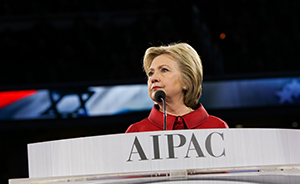
Hillary Clinton (Photo credit: AIPAC)
If Bashar al-Assad is still president of Syria, there will be demands that she finally go for the knock-out blow; there will pressure, too, for her to ratchet up sanctions on Iran pushing Tehran toward renouncing the nuclear agreement; there are already calls for deploying more U.S. troops on Russia’s border and integrating Ukraine into the NATO military structure.
President Clinton-45 would hear the clever talking points justifying these moves, the swaggering tough-guy/gal rhetoric, and the tear-jerking propaganda about evil enemies throwing babies off incubators, giving Viagra to soldiers to rape more women, and committing horrific crimes (some real but many imagined) against defenseless innocents.
Does anyone think that Hillary Clinton has the wisdom to resist these siren songs of confrontation and war, even if she were inclined to?
President Barack Obama, who – for all his faults – has a much deeper and subtler intellect than Hillary Clinton, found himself so battered by these pressures from the militaristic Washington “playbook” that he whined about his predicament to The Atlantic’s Jeffrey Goldberg, himself a neocon war hawk.
The Washington foreign policy establishment is now so profoundly in the hands of the neocons and their “liberal interventionist” sidekicks that the sitting President presumably couldn’t find anyone but a neocon to give those interviews to, even as he complained about how the U.S. capital is in the hands of warmongers.
Given this neocon domination of U.S. foreign policy – especially in the State Department bureaucracy, the major media and the big think tanks – Clinton will be buffeted by hawkish demands and plans both from outside of her administration and from within.
Already key neocons, such as the Brookings Institution’s Robert Kagan, are signaling that they expect to have substantial influence over Clinton’s foreign policy. Kagan, who has repackaged himself as a “liberal interventionist,” threw his support to Clinton, who put him on a State Department advisory board.
There is also talk in Washington that Kagan’s neocon wife, Assistant Secretary of State for European Affairs Victoria Nuland, another Clinton favorite and the architect of the “regime change” in Ukraine, would be in line for a top foreign policy job in a Clinton-45 administration.
Neocons Back in Charge
So, Clinton’s election could mean that some of the most dangerous people in American foreign policy would be whispering their schemes for war and more war directly into her ear – and her record shows that she is very susceptible to such guidance.
At every turn, as a U.S. senator and as Secretary of State, Clinton has opted for “regime change” solutions – from the Iraq invasion in 2003 to the Honduras coup in 2009 to the Libyan air war in 2011 to the Syria civil war since 2011 – or she has advocated for the escalation of conflicts, such as in Afghanistan and with Iran, rather than engaging in reasonable give-and-take negotiations.
Though her backers tout her experience as Secretary of State, the reality was that she repeatedly disdained genuine diplomacy and was constantly hectoring President Obama into adopting the most violent and confrontational options.
He sometimes did (the Afghan “surge,” the Libyan war, the Iran nuclear stand-off) but he sometimes didn’t (reversing the Afghan escalation, finally negotiating a nuclear deal with Iran after Clinton left, rejecting a direct U.S. military assault on the Syrian government, and working at times with the Russians on Iran and Syria).
In other words, Obama acted as a register or brake restraining Clinton’s hawkishness. With Clinton as the President, however, she would have no such restraints. One could expect her to endorse many if not all the harebrained neocon schemes, much as President George W. Bush did when his neocon advisers exploited his fear and fury over 9/11 to guide him into their “regime change” agenda for the Middle East.
The neocons have never given up their dreams of overthrowing Mideast governments that Israel has put on its enemies list. Iraq was only the first. To follow were Syria and Iran with the idea that by installing pro-Israeli leaders in those countries, Israel’s close-in enemies – Lebanon’s Hezbollah, Hamas and other Palestinian militant groups – could be isolated and crushed.
After Bush’s Iraq invasion in 2003, Washington’s neocons were joking about whether Iran or Syria should come next, with the punch line: “Real men go to Tehran!” But the Iraq War wasn’t the “cakewalk” that the neocons had predicted. Instead of throwing flowers at the U.S. troops, Iraqis planted IEDs.
As it turned out, a lot of “real men” and “real women” – as well as “real children” – died in Iraq, including nearly 4,500 American soldiers and hundreds of thousands of Iraqis.
So the neocon timetable took a hit but, in their view, only because of Bush’s incompetent follow-through on Iraq. If not for the botched occupation, the neocons felt they could have continued rolling up other troublesome regimes, one after another.
Professionally, the neocons also escaped the Iraq disaster largely unscathed, continuing to dominate Washington’s think tanks and the op-ed pages of major American news outlets such as The Washington Post and The New York Times. Barely missing a beat, they set about planning for the longer haul.
An Obama Mistake
Although they lost the White House in 2008, the neocons caught a break when President-elect Obama opted for a Lincoln-esque “team of rivals” on foreign policy. Instead of reaching out to Washington’s marginalized (and aging) foreign policy “realists,” Obama looked to the roster of the neocon-dominated establishment.
Obama recruited his hawkish Democratic rival, Sen. Hillary Clinton, to be Secretary of State and kept Bush’s Defense Secretary Robert Gates. Obama also left in place most of Bush’s military high command, including neocon favorite, General David Petraeus.
Obama’s naïve management strategy let the neocons and their “liberal interventionist” pals consolidate their bureaucratic control of Washington’s foreign policy bureaucracy, even though the President favored a more “realist” approach that would use America’s power more judiciously — and he was less enthralled to Israel’s right-wing government.
The behind-the-scenes neocon influence became especially pronounced at Clinton’s State Department where she tapped the likes of Nuland, a neocon ideologue and an adviser to Vice President Dick Cheney, to become the department’s spokesperson and put her on track to become Assistant Secretary of State for European Affairs (although the appointment wasn’t finalized until after Clinton left in 2013).
The neocon/liberal-hawk bias is now so strong inside the State Department that officials I know who have gone there reemerge as kind of “pod people” spouting arrogant talking points in support of U.S. intervention all over the world. By contrast, I find the CIA and the Pentagon to be places of relative realism and restraint.
Perhaps the best example of this “pod people” phenomenon was Sen. John Kerry, who replaced Clinton as Secretary of State and suddenly became the mouthpiece for the bureaucracy’s most extreme war-like rhetoric.
For instance, Kerry advocated a retaliatory bombing campaign against Syria’s military in August 2013, ignoring the intelligence community’s doubts about whether President Bashar al-Assad’s regime was responsible for a sarin-gas attack outside Damascus.
Instead of listening to the intelligence analysts, Kerry fell in line behind the neocon-driven “group think” pinning the blame on Assad, the perfect excuse for implementing the neocons’ long-delayed Syrian “regime change.” The neocons didn’t care what the facts were — and Kerry fell in line. [See Consortiumnews.com’s “What’s the Matter with John Kerry?”]
But Obama didn’t fall in line. He listened when Director of National Intelligence James Clapper told him that there was no “slam dunk” evidence implicating the Syrian military. (Ultimately, the evidence would point to a provocation carried out by Islamic extremists trying to trick the U.S. military into intervening in the war on their side.)
Obama also got help from Russian President Vladimir Putin who persuaded President Assad to surrender all his chemical weapons (while Assad still denied any role in the sarin-gas attack). Putin’s assistance infuriated the neocons who soon recognized that the Obama-Putin cooperation was a profound threat to their “regime change” enterprise.
Targeting Ukraine
Some of the smarter neocons quickly identified Ukraine as a potential wedge that could be driven between Obama and Putin. Carl Gershman, president of the National Endowment for Democracy, called Ukraine “the biggest prize” and a potential first step toward driving Putin from power in Russia.
It fell to Assistant Secretary of State Nuland to shepherd the Ukraine operation to fulfillment as she plotted with U.S. Ambassador to Ukraine Geoffrey Pyatt how to remove Ukraine’s pro-Russian President Viktor Yanukovych. Nuland and Pyatt were caught in an intercepted phone call discussing who should take over.
“Yats is the guy,” Nuland said referring to Arseniy Yatsenyuk who indeed would become the new prime minister. Nuland and Pyatt then exchanged ideas how to “glue this thing” and how to “midwife this thing.” This “thing” became the bloody Feb. 22, 2014 coup ousting elected President Yanukovych and touching off a civil war between Ukrainian “nationalists” from the west and Ukraine’s ethnic Russians in the east.
As the “nationalists,” some of them openly neo-Nazis, inflicted atrocities on ethnic Russians, Crimea voted by 96 percent to leave Ukraine and rejoin Russia. Resistance to the new Kiev regime also arose in the eastern Donbas region.
To the State Department – and the mainstream U.S. news media – this conflict was all explained as “Russian aggression” against Ukraine and a “Russian invasion” of Crimea (although Russian troops were already in Crimea as part of the Sevastopol naval base agreement). But All the Important People agreed that the Crimean referendum was a “sham” (although many polls have since confirmed the results).
When citizen Clinton weighed in on the Ukraine crisis, she compared Russian President Putin to Hitler.
So, today the neocon/liberal-hawk Washington “playbook” – as Obama would call it – calls for massing more and more U.S. troops and NATO weapons systems on Russia’s border to deter Putin’s “aggression.”
These tough guys and gals also vow to ignore Russia’s warnings against what it views as military threats to its existence. Apparently “real, real men” go to Moscow (perhaps riding a nuclear bomb like the famous seen from “Dr. Strangelove.”).
Ian Joseph Brzezinski, a State Department official under President George W. Bush and now a foreign policy expert for the Atlantic Council, a NATO think tank, has co-authored an article urging NATO to incorporate Ukrainian army units into its expansion of military operations along Russia’s border.
“High-level Ukrainian national security officials have urged the international community to be bolder in its response to Russia’s provocative military actions,” wrote Brzezinski (son of old Cold Warrior Zbigniew Brzezinski) and Ukrainian co-author Markian Bilynskyj.
“The deployment of a battle tested, Ukrainian infantry company or larger unit to reinforce the defense of NATO territory in Central Europe would be a positive contribution to the Alliance force posture in the region.”
Following the Playbook
This kind of tough-talking jargon is what the next President, whoever he or she is, can expect from Official Washington. From Obama’s interview in The Atlantic, it’s clear that he feels surrounded and embattled by these warmongering forces but takes some pride in resisting – from time to time – the Washington “playbook.”
But how would President Hillary Clinton respond? When she appeared before the American Israel Public Affairs Committee on March 21 – at a moment when it appeared she had all but nailed down the Democratic nomination – Clinton showed what you might call her true colors, fawning over how loyal she would be to Israel and promising to take the very cozy relationship between the U.S. and Israel “to the next level.”
By reviewing Clinton’s public record, one could reasonably conclude that she is herself a neocon, both in her devotion to Israel and her proclivity toward “regime change” solutions. She also follows the neocon lead in demonizing any foreign leader who gets in their way. But even if she isn’t a full-fledged neocon, she often bends to their demands.
The one possible deviation from this pattern is Clinton’s personal friendship with longtime adviser Sidney Blumenthal, who was an early critic of the neoconservatives as they emerged as a powerful force during the Reagan administration. Blumenthal and his son Max have also dared criticize Israel’s abusive treatment of the Palestinians.
However, the Israel Lobby appears to be taking no chances that Sidney Blumenthal’s voice might be heard during a Clinton-45 administration. Last month, a pro-Zionist group, The World Values Network, bought a full-page ad in The New York Times to attack Blumenthal and his son and declared that “Hillary Clinton must disavow her anti-Israel advisors.”
Though Clinton might not publicly disassociate herself from Sidney Blumenthal, the preemptive strike pushed him further toward the margins and helped clear the path for the Kagan/Nuland faction to rush to the center of Clinton’s foreign policy.
Indeed, Clinton’s primary focus if she gets elected is likely to be ensuring that she gets reelected. As a traditional politician, she would think that the way to achieve reelection is to stay on the good side of the Israeli leadership. Along those lines, she promised AIPAC that, as President, she would immediately invite Prime Minister Benjamin Netanyahu to the White House.
So, what would happen if Clinton takes the U.S.-Israeli relationship “to the next level”? Presumably that would mean taking a super-hard line against Iran over last year’s nuclear deal. Yet, already Iran is questioning whether its acceptance of extraordinary constraints on its nuclear program was worth it, given the U.S. unwillingness to grant meaningful relief on economic sanctions.
A belligerent Clinton approach – decrying Iran’s behavior and imposing new sanctions – would strengthen Iran’s hard-line faction internally and might well lead to Iran renouncing the agreement on the grounds of American bad faith. That, of course, would please the neocons and Netanyahu by putting the “bomb-bomb-bomb Iran” option back in play.
A Stunning Reversal
Clinton may have viewed her AIPAC speech as the beginning of her long-awaited “pivot to the center,” but afterwards she suffered a string of primary and caucus defeats at the hands of Sen. Bernie Sanders, most by landslide margins.
Besides those stunning defeats, Clinton’s campaign clearly has an “enthusiasm gap.” Sanders, the 74-year-old “democratic socialist” from Vermont, draws huge and excited crowds and wins younger voters by staggering percentages. Meanwhile, Clinton confronts polls showing high negatives and extraordinary public distrust.
If she gets the Democratic nomination, she may have little choice but to engage in a fiercely negative campaign since — faced with the lack of voter enthusiasm — her best chance of winning is to so demonize her Republican opponent that Democrats and independents will be driven to the polls out of fear of what the crazy GOP madman might do.
Right now, many Clinton supporters see her as the “safe” — not exciting — choice, a politician whose long résumé gives them comfort that she must know what’s she’s doing. African-American voters, who have been her most loyal constituency, apparently feel more comfortable with someone they’ve known (who has also served in the Obama administration) than Sanders who is unknown to many and is seen as someone whose ambitious programs appear less practical than Clinton’s small-bore ideas.
But a look behind Clinton’s résumé, especially her reliance on “regime change” and other interventionist schemes in the Middle East and Eastern Europe, might give all peace-loving voters pause. [See Consortiumnews.com’s “Is Hillary Clinton ‘Qualified’?”]
Savvy neocons, like Robert Kagan, have long understood that Clinton could be their Trojan Horse, pulled into the White House by Democratic voters. Kagan told The New York Times, “I feel comfortable with her on foreign policy. If she pursues a policy which we think she will pursue it’s something that might have been called neocon, but clearly her supporters are not going to call it that; they are going to call it something else.”
The same Times article noted that Clinton “remains the vessel into which many interventionists are pouring their hopes.” However, if she is that “vessel” carrying a neocon foreign policy back into the White House, this “safe” choice might prove dangerous to America and the world.
Investigative reporter Robert Parry broke many of the Iran-Contra stories for The Associated Press and Newsweek in the 1980s. You can buy his latest book, America’s Stolen Narrative, either in print here or as an e-book (from Amazon and barnesandnoble.com).
Featured Video

Iran’s Next Strike May Not Explode. It Could Shut You Down
or go to
Aletho News Archives – Video-Images
From the Archive
Zionism’s Violent Legacy
By Donald Neff | Washington Report On Middle East Affairs | January 1996
On January 4, 1948, Jewish terrorists drove a truck loaded with explosives into the center of the all Arab city of Jaffa and detonated it, killing 26 and wounding around 100 Palestinian men, women and children.[1] The attack was the work of the Irgun Zvai Leumi – the “National Military Organization,” also known by the Hebrew letters Etzel – the largest Jewish terrorist group in Palestine. The Irgun was headed by Revisionist Zionist Menachem Begin and had been killing and maiming Arabs, Britons and even Jews for the previous ten years in its efforts to establish a Jewish state.
This terror campaign meant that at the core of Revisionist Zionism there existed a philosophical embrace of violence. … continue
Blog Roll
 Aletho News
- Trump’s Iran war is on an Israeli leash
- Saudi oil boss issues global supply warning
- Riyadh Says Its Oil System Is Intact. The Numbers Say Otherwise.
- Trump and Netanyahu Want to “Finish the Job” on Iran
- US ‘one-sided dictation’ not Iran’s beliefs makes rational talks impossible: Baghaei
- Iran’s Next Strike May Not Explode. It Could Shut You Down /Col Doug Macgregor
- Iran: US political targets legitimate if assassinations return
- Iraq shuts key border crossing with Iran under US pressure: Report
- Undersea Internet cables could be targeted in retaliation for attacks on Iran: IRGC deputy chief
- EU sending ‘biased’ observers to interfere in Serbian election – president
- If Americans Knew
- The Israel Lobby’s Changing Fortunes
- AIPAC has become such a political liability that it’s shifting to a more “nimble” approach to buying politicians
- At least 160 Israeli settler attacks in 2 weeks
- Will Gaza’s Ancient Christian Community Disappear Forever?
- Israel’s vision of regional security rests on keeping Arab states weak
- Heidi Levine recounts how Palestinian youths helped save her in settler attack
- DAILY UPDATE: Latest essential news on Palestine, Israel, & region
- Trump’s Intensifying Sabotage of the ICC, for Israel’s Sake
- Israeli military detain US and UK volunteers in West Bank including Democratic NY politician Brad Lander
- Americans at National Conservatism Conference held in Israel this year criticize Israel
- No Tricks Zone
- E-Cars Reduce CO2 Emissions By Only 41% Compared To Internal Combustion Engine Vehicles
- Predictions Made By Renowned Climate Professor Over Past Decades Have Been Proven To Be Poor
- New Study Suggests Large Regions Of The Pacific Ocean Have Been Cooling For The Last 80 Years
- Germany’s Green Energy Debacle: High Energy Costs Force Kahla Porzellan to Close After 182 Years!
- New Study: 50 Years Of The Most Aggressive ‘Net Zero’ Policies Can Only Affect The Global Climate By 0.03°C
- US September “Heat” Was No Record…Many Records Set Decades Ago
- Latest European Green Energy Debacle; Portugal’s Largest Flagship Solar Park Insolvent!
- Green Energy Debacle: German Expert Professor Fritz Vahrenholt Warns Of Severe Economic And Social Consequences
- Two More Paleo Reconstructions Affirm Meters-Higher Sea Levels Across Ireland, Brazil 7000-6000 Years Ago
- New Study: Earth And Venus Surface Warmth Largely Explained By Convection And Lapse Rate, Not CO2 Or Radiation

