Large quantities of US weapons lost, stolen in Iraq, Syria: Report

The Cradle – March 31 2023
Hundreds of thousands of dollars in US artillery equipment, unspecified “weapons systems,” and specialized ammunition meant for US forces in Syria and Iraq have been stolen in recent years, The Intercept reported on 30 March.
According to criminal investigations files obtained under the Freedom of Information Act by The Intercept, at least four large-scale thefts and one loss of US equipment valued at some $200,000 have occurred in Iraq and Syria between 2020 and 2022. The lost items include 40mm high-explosive grenades stolen from US Special Forces.
The losses continue a previous pattern. The Intercept notes further that a 2020 audit by the Pentagon’s inspector general found that Special Operations Joint Task Force–Operation Inherent Resolve, the main unit that partners with the Kurdish-led Syrian Democratic Forces (SDF) to illegally occupy northeast Iraq, did not properly account for $715.8 million of equipment purchased for the SDF.
The recent failure to prevent the theft of, and account for, US-supplied weapons is concerning because this previously played a key role in the rise of Al-Qaeda affiliated groups, including the Nusra Front and ISIS, in Iraq and Syria.
In the spring of 2015, an extremist coalition led by the Nusra Front successfully conquered Syria’s Idlib governorate, in large part thanks to US-manufactured and supplied TOW anti-tank missiles. The missiles were originally supplied to Free Syrian Army (FSA) groups working with closely with Nusra.
When Russia intervened in the Syria conflict to prevent the fall of the government to Al-Qaeda groups – including Nusra, ISIS, and Ahrar al-Sham – a few months later, in September 2015, US officials drastically escalated TOW missile shipments to FSA units working with these groups.
When journalist Sharmine Narwani asked why US-supplied weapons allegedly meant for FSA groups were showing up in the hands of the Nusra Front, CENTCOM spokesman Lieutenant Commander Kyle Raines responded: “We don’t ‘command and control’ these forces – we only ‘train and enable’ them. Who they say they’re allying with, that’s their business.”
ISIS was also a major beneficiary of US-supplied weapons. Conflict Armament Research (CAR), a UK-based organization that tracks the supply of weapons into conflict-affected areas, reported that “Unauthorised retransfer – the violation of agreements by which a supplier government prohibits the re-export of materiel by a recipient government without its prior consent – is a significant source of [ISIS] weapons and ammunition. The US and Saudi Arabia supplied most of this material without authorization, apparently to Syrian opposition forces.”
By way of example, CAR noted that it had recovered US-supplied anti-tank missiles used by ISIS in Ramadi in February 2016. CAR confirmed that the missiles had been exported from the United States in December 2015. This indicates that the weapons were diverted to ISIS “in a matter of days or weeks after their supply.”
Yemeni officials assess damage to ancient sites bombed by Saudi-led coalition
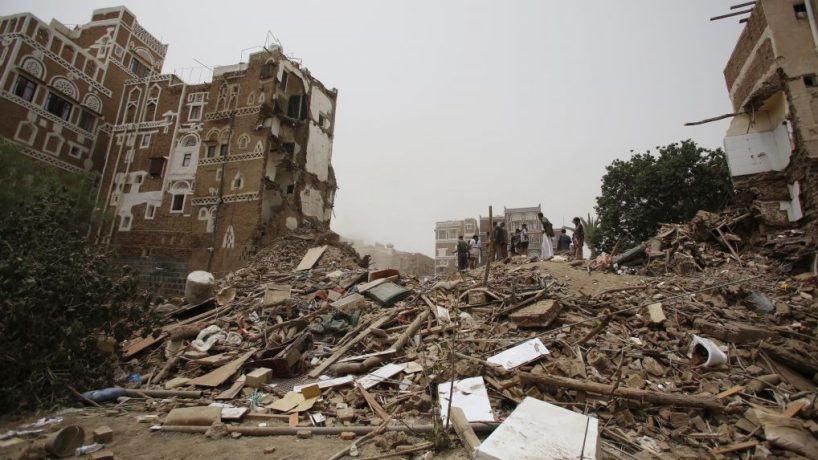
The Cradle | February 20, 2023
The head of Yemen’s General Authority for Antiquities, Manuscripts, and Museums, Dr. Obbad bin Ali Al-Hayyal, visited several historical and archeological sites in the provinces of Marib and Jawf on 18 February to assess the damages caused to them by the Saudi-led coalition airstrikes, SABA news agency reported.
Hayyal and his team visited the ancient city of Baraqish in Marib’s Mazjar district, the Rusf Temple in Al-Jawf, and several other archeological sites.
According to SABA, they received briefings from local authorities on the damages to ancient columns, inscriptions, and structures due to “Saudi and Emirati warplanes,” as well as the “looting and theft” of antiquities and artifacts by coalition forces from museums across the country.
During the visit, Hayyal stressed the importance of “integrating official and popular efforts” to protect these sites from ‘vandalism and looting.’
Since the start of the Saudi-led war against Yemen in 2015, coalition airstrikes have posed a significant threat to the country’s archeological sites and historical monuments.
In May 2015, coalition airstrikes struck the ancient Sabaean ruins of the Great Marib Dam, which date back to the seventh century BC.
That year, the Saudi-led coalition bombarded the ruins of the ancient city of Baraqish, several ancient temples, and an entire museum filled with countless precious artifacts – which was “reduced to piles of shattered stone,” according to a 2015 report by US media outlet The Intercept.
The Saudi-led bombing also decimated sections of the capital Sanaa’s Old City, which is listed as a UNESCO World Heritage site and dates back 2,500 years.
Several ancient buildings and structures have since collapsed from weakened foundations. Until October 2019, over 237 archeological sites had been directly targeted by the coalition in what has been described as a systematic campaign aimed at deliberately erasing Yemeni culture and history.
Aside from bombing, several ancient sites and museums have been looted and stripped of valuable artifacts by UAE-backed mercenary groups, whose ranks are filled with ISIS and Al-Qaeda militants.
In 2019, a member of Yemen’s Supreme Political Council, Mohammad Ali al-Houthi, said about UAE-backed groups: “The mercenaries are antiquity thieves. Where did the antiquities of the Marib Museum go? … Where are the monuments from the rest of the museums in the occupied governorates? … The mercenaries are committing historical, social, and cultural crimes.”
Saudi Arabia is well-known for its destruction of heritage, particularly within its borders, where many of the ancient cities, towns, and sites dating back to the birth of Islam have been wiped out as part of a campaign motivated by the kingdom’s Wahhabi ideology.
Douma locals, medical personnel deny veracity of 2018 ‘chemical weapons attack’
The Cradle | February 2, 2023
Locals and medical personnel from the Syrian city of Douma in the Damascus countryside confirmed on 2 February during a press conference in the country’s Foreign Ministry headquarters that the alleged 2018 chemical attack on the city was, indeed, staged.
This follows the release of a new report by the Organization for the Prohibition of Chemical Weapons (OPCW) on 27 January, which once again renewed the accusation that Damascus was behind a 2018 chlorine gas attack on civilians in Douma.
“I live 400 meters from the place of the alleged incident, and I only learned of its occurrence the next day through social media,” Syrian lawyer Muhammad al-Naasan said during the press conference.
Another testimony is that of Dr. Hassan Oyoun, an ambulance worker at Douma Hospital, who claimed that “information was published a day before the alleged incident that it was necessary to prepare for an event that would result in a large number of injuries.”
This confirms that “prior preparations” were underway for the staging of the attack, Oyoun said, referring to the incident as a “fabricated play that was filmed.”
“What the terrorists announced about 800 injuries from chemical substances is incorrect, and the number of people who visited the hospital that day did not exceed 35,” he added.
According to Dr. Mumtaz al-Hanash, a Douma local, Douma Hospital announced just one day after the alleged attack that no chemically induced deaths were recorded whatsoever. He went on to say that the “photographed cases” did not provide evidence that chlorine, or any other weaponized chemical, was used.
An imam and preacher at a local mosque, Sheikh Ratib Naji, said: “We did not see with our own eyes any injured or dead, as they claimed, and those whom the terrorists claimed were dead, their bodies did not appear, and when we demanded them, they assaulted us.”
Syria’s permanent representative at the Hague-based chemical weapons watchdog, Milad Attiya, affirmed that Damascus does not recognize the OPCW investigation team’s third and latest report, as it rejected the last two. Attiya added that the report relies heavily on western sources, as well as groups such as Hayat Tahrir al-Sham (HTS) and the White Helmets, an Al-Qaeda affiliated rescue organization with links to organ trafficking networks in Syria.
Since 2013, armed groups in Syria have attempted to pin chemical attacks on the government to instigate internationally-led regime change operations against it. This comes in the form of staged attacks, or actual false-flag chemical attacks which leave many dead and are designed to implicate Damascus – as was the case in Ghouta in 2013 and in Khan Sheikhoun in 2017.
On 28 January, the Syrian government released a statement rejecting the OPCW report, which it said ignored “objective information which was provided by some … experts … and former OPCW inspectors with knowledge and expertise,” referring to the fact that the organization suppressed the findings of its initial report on Douma, as revealed by WikiLeaks in 2019.
Russia, Syria reopen airbase after providing it with AD systems
The Cradle | January 24, 2023
Russia and Syria have restored the Al-Jarrah military airbase in northern Syria, Russia’s Defense Ministry announced on 23 January. The airbase, which had been destroyed during the Syria conflict, will now host both Russian and Syrian warplanes.
Russian forces have also deployed Buk M2E and Pantsir S1 air defense systems inside the airbase, with the aim of defending Syria’s northern border and closing Syrian airspace to Israeli warplanes, which have regularly bombed Syria since 2013.
The opening ceremony of the airbase was attended by the commander of the Russian armed forces in Syria, General Andrey Serdyukov, and the Syrian Minister of Defense, General Ali Mahmoud Abbas, in addition to military personnel and guests of honor from both countries.
During the ceremony, planes and helicopters of the Russian Aerospace Forces and the Syrian Air Force demonstrated their combat capabilities, while Syrian special forces carried out parachute drops from helicopters and carried out simulated surround and destroy exercises.
The Al-Jarrah airbase, which lies in Manbij, between Aleppo and Raqqa, was first captured by US and Saudi-backed militants from an Al-Qaeda affiliated Salafist militia, Ahrar al-Sham, in February 2013. The operation to capture Al-Jarrah was part of a broader Al-Qaeda led push, known as the “War of the Airports,” to capture Syria’s major military airbases, including Taftanaz, Wadi al-Deif, and Menagh.
According to Abu Abdallah Minbij, an Ahrar al-Sham commander, the 2013 capture of Al-Jarrah cut off Syrian army supply lines to the east and made it difficult for the army to send reinforcements to Raqqa province. Raqqa city fell to Al-Qaeda led forces, including Ahrar al-Sham and the Nusra Front, a month later, in March 2013.
In April 2013, the Nusra Front and Islamic State of Iraq (ISI) split with ISI and became ISIS. Many Nusra fighters and commanders pledged allegiance to the organization. This allowed ISIS to establish a foothold in Raqqa. ISIS then expelled its jihadist rivals and took full control of Raqqa city in January 2014, making the city its Syrian capital.
ISIS captured Al-Jarrah airbase from Ahrar al-Sham in January 2014 as well.
With Russian assistance, the Syrian army recaptured the airbase in 2017, in a bloody battle led by the Syrian Major General Suheil al-Hassan’s Tiger Forces. Some 3,000 ISIS militants were killed and wounded in the fighting.
The joint restoration of the Al-Jarrah airbase by Syria and Russia represents an increase in Russian presence in the country, as well as the recent surge in military cooperation between the two states.
‘No place’ for independent Russia in Western mindset – Moscow
RT | January 10, 2023
The secretary of Russia’s national security council has lashed out at the West, pointing to their habit of creating global threats, including numerous terrorist groups, in pursuit of their interests.
Nikolay Patrushev also claimed, in an interview published by news outlet Argumenti i Fakti, that Washington’s decision to withdraw troops from Afghanistan was a prelude to NATO’s proxy war against Russia in Ukraine.
“The events in Ukraine are not a confrontation between Moscow and Kiev. It’s a military confrontation of NATO – the US and England first and foremost – with Russia,” the top security official said in a newspaper interview. “They fear a direct standoff, so NATO instructors push Ukrainian guys toward their certain deaths.”
Patrushev argued that, while Western nations claim to be “defending civilization against barbarism” in Ukraine, they are actually motivated by selfish interests and won’t “save any lives at the expense of their enrichment and ambitions.”
He said there is an established pattern of the US creating threats that it later ostensibly fights against, he continued, citing terrorist organizations Al-Qaeda, the Taliban and Islamic State (IS, formerly ISIS) as examples. Washington may occasionally show off the killing of individual terrorist leaders like Osama Bin Laden, but continue “training and arming a hundred others” at the same time, he added.
NATO’s mission in Afghanistan resulted “in the creation of multibillion-dollar corruption schemes” and a surge in illegal drug production, Patrushev claimed. And the US withdrawal from the country in 2019 was to a large degree about “focusing on Ukraine” and confrontation with Russia, he said.
The security official cited remarks made last month by US Secretary of State Antony Blinken, who admitted that, with the country’s military presence in Afghanistan finally ended, the administration of President Joe Biden had more opportunities to funnel arms to Kiev.
Patrushev believes that, in the wider picture, the interests of the US as a nation state are subservient to the interests of transnational corporations, which ultimately dictate the policies of many governments. Those unaccountable forces have inherited the colonialist approach that allowed Western nations to become wealthy and powerful, but they are no longer vested in national interests, he said.
Russia “has no place” in their schemes, since it “irritates the handful of world masters because of its natural riches, vast territories, and smart, self-sufficient people who love their country, its traditions and history,” he added.
Weapons shipped to Ukraine being sold in black markets
By Uriel Araujo | June 20, 2022
The same way sanctions are not working and are backfiring, Western massive arms transfers to Kiev have been a disaster, from anyone’s perspective. In an interview to US “National Defense”, Ukrainian Army Brigadier General Volodymyr Karpenko has admitted his country lost almost 50% of all weaponry and equipment it received. Some of it got destroyed, but that is not the whole story.
Russian Channel One reported on how the Ukrainian military abandons weapons as they retreat. The abandoned US-made Javelins and German anti-tank mines were filmed. Moreover, weaponry sent to Ukraine is ending up in black markets and is being sold in the so-called darknet and deep web platforms. There, one can buy Javellin anti-tank systems for about $ 30,000 or British NLAW systems for half the price. There is a demand for that, of course. Terrorists and criminal gangs are the buyers.
This situation has alarmed the Interpol and other international and European bodies. Already on May 28, Europol director Catherine De Bolle voiced her concerns about the war increasing the inpourring of arms into the continent’s black markets. Such weapons could reach political players in the Middle East involved in local conflicts, and spread all over the region, even reaching currently unstable locations such as Somalia, Sudan, Yemen, and Egypt. Arms shipments to Bosnia, Kosovo and Albania are in fact being investigated and such can aggravate the security problem in the Balkans – and in the Sahel also.
The so-called Islamic State or ISIS, the terrorist organization also known as the Daesh, is reorganizing itself this time in the Sahel, according to Victoria Nuland herself (the US Under Secretary of State for Political Affairs), who has stated so in May. There are reports that criminal groups in Albania and Kosovo are selling arms to ISIS.
Russian Foreign Ministry Spokesperson Maria Zakharova stated on June 9 that “arms shipment to Ukraine will lead to the emergence of an arms black market, especially in Western Europe.” Interpol Secretary General Jurgen Stock has voiced similar concerns about Africa and the Balkans becoming the destination of Western arms supplied to Kiev, as reported by Le Figaro news. He said: “The wide availability of weapons during the current conflict will lead to the proliferation of illicit weapons in the post-conflict phase.” Actually, this is already happening, as seen in the dark web.
It is a well known fact that the Ukrainian armed forces are incredibly corrupt. Ukraine has long been believed to be one of the major arms trafficking markets in Europe. It has also emerged as an import transit destination for drugs such as heroin. It has the third highest criminality score of 33 countries in Europe. In today’s world, illict trade plays a major role in the financing of terrorist and extremist networks globally.
In November last year a club in Kiev was the target of a homophobic terrorist attack. It was stormed by masked men and later an explosive device was thrown at the building. Centuria, a Ukrainian paramilitary group with links to the Azov Regiment (formerly known as the Azov Battalion) seems to be behind the crime. No one was killed, but this ultra-nationalist group already patrols Ukraine’s cities. With the war, the migration crisis and the black market, Europe could see armed groups and terrorist attacks such as these spreading to its capitals.
In 2019 a senior Daesh leader, Al-Bara Shishani, was arrested in Ukraine and Azov leaders are known to sympathize with the group, even adopting some of its tactics. As early as 2015, collaboration between Islamic radicals and Ukrainian militias has been reported.
In December 2021, before the current crisis, I wrote that should a war ensue, Ukraine would be defeated by Russia (for a number of reasons), but far-right Ukrainian groups – aided and armed by NATO and possibly by Turkish ultra-nationalist networks – could remain active in sabotage and terrorism operations, thus turning the “post-conflict” phase into a long nightmarish “frozen conflict” scenario of counter-insurgency and irregular warfare.
Amid the humanitarian catastrophe, I wrote, the European continent should expect an increase in terrorism and crime amid an increasing migration crisis. Of course most of the refugees are law-abiding families escaping the tragedy of war, but paramilitary men and extremists can make their way into Western Europe too – and Ukrainian Neo-Nazism has been largely white-washed. European far-right militias already cooperate with Ukraine’s nationalists, and the country is already a new hub for far-right activity. Isaac Kfir, a Charles Sturt University Professor and part of the International Institute for Justice and the Rule of Law advisory board, has warned that Ukraine has the potential to become “the Syria of the extreme right”.
In the same way US-led Western policies – directly or indirectly – aided both the Al-Qaeda and the Daesh, there is every reason to believe that in a few years Europe will be haunted by a new kind of far-right terror reminiscent of the infamous Gladio Operation, when Washington funded European far-right groups as a secret anti-Soviet army during the Cold War.
One can only wonder why European leaders would be so ready to accept these risks. This is the true reason countries such as Germany, Greece, Hungary, and even Israel have at times been reluctant to further arm Kiev or to allow weapons transit. It appears that from an American perspective Europe itself is but another US proxy.
Uriel Araujo is a researcher with a focus on international and ethnic conflicts.
What happens if US designates Russia ‘a state sponsor of terrorism’?
By Drago Bosnic | May 16, 2022
The designation “state sponsor of terrorism” is used by the US Department of State to unilaterally sanction countries which the US government claims to have “repeatedly provided support for acts of international terrorism”. The State Department is required to maintain the controversial list under special acts passed by the Congress, imposing various restrictions aimed at the economies and international trade relations of the targeted countries.
As of late 2021, State Department lists Cuba, Iran, North Korea and Syria as “state sponsors of terrorism”, however, there were other countries formerly on the list, such as Iraq, Libya, South Yemen and Sudan. Designating a country as “a state sponsor of terrorism” can affect it in many ways, some of which include:
– freezing of the targeted country’s financial and real estate assets in the US;
– requiring the US to prevent efforts of the targeted country to secure World Bank or IMF loans;
– prohibition on the export of so-called “dual-use products” (items that can be used both for civilian and military purposes);
– requiring the US to impose economic and other sanctions against countries that continue to do business with the targeted country.
Since Russia started its special military operation in Ukraine, the more hawkish members of the US and NATO establishment have been insisting on the inclusion of Russia on this list. Some, such as the Baltic states, infamous for their virtually endemic Russophobia, already designated Russia as the “state sponsor of terrorism”. Luckily, actions taken by such microstates are largely inconsequential. However, what would happen if some of the larger and more significant NATO and EU members were to take the same course of action?
Considering the controversial designation is aimed not just against the targeted country, but also any third party doing business with it, this would effectively force member states to sanction each other, since many EU and NATO members simply cannot function without trading and dealing with Russia. This includes countries like Hungary, Austria and even Germany, the EU’s largest economy and arguably the most powerful member state. Without Russia’s oil, gas, food, rare earth metals and nonmetals, heavy machinery and many other commodities, these countries would collapse, economically and otherwise.
The designation also directly affects relations within NATO. In case the Congress was to add Russia to the list, possible sanctions wouldn’t just affect the aforementioned EU member states, but also some of the largest and most powerful NATO members, such as Turkey. Ankara has already been sanctioned for the purchase of Russia’s top-of-the-line S-400 surface-to-air missile system. However, the sanctions in the context of trading and dealing with a country designated “a state sponsor of terrorism” would be much more severe. Thousands of private Turkish companies are present in Russia, many of them in the construction business, which directly affects the troubled Turkish economy, currently dealing with enormous inflation and unemployment.
In terms of global relations and trade, such a move would affect the world in ways which are difficult to predict in the long term. However, in short term, it would certainly affect countries such as China and India, dozens of countries in the Middle East, Africa, Latin America and elsewhere, as all these countries would be affected by the third-party sanctions. In doing so, the US would effectively sanction around 80% of the world. This would lead to an uncontrollable escalation of economic collapse in many of these countries, especially in the Middle East and Africa. It would force the US to either implement sanctions on a case-by-case basis, or change the law completely, effectively blunting the effects of sanctions. This would also exponentially accelerate the process of dedollarization, as countries would seek other ways to do business with Russia without US interference.
However, the far-reaching consequences for the global economy would pale in comparison to the resulting security issues. Officially deeming a country with over 6,000 nuclear weapons “a terrorist state” pushes the planet to a brink of a world-ending conflict, as such a designation eases legal restrictions on the use of the US military against the targeted country. Such moves have resulted in rising tensions with North Korea and Iran in previous years. Within the framework of the designation, the US targeted and killed Iranian general Qassem Soleimani in 2020, to which Iran retaliated by targeting US bases in Iraq.
Even at the height of the Cold War, the US did not sanction the USSR with this designation, which is what makes this move even less logical, since the strategic military situation is still virtually unchanged, with both Russia and the US still relying on the mutually assured destruction (MAD) doctrine. Also, Russia is not without options for a reciprocal response, as it could easily designate the US itself as a state sponsor of terrorism. This designation would hardly just be a (geo)political one, as the US has been providing ample support to a wide range of terrorist actors from at least the 1980s to this very day. Former US State Secretary and failed presidential candidate Hillary Clinton openly admitted that Al Qaeda was in essence the mujahideen the US funded and armed to fight the USSR in the 1980s.
The same happened in Croatia, Bosnia and Kosovo during the 1990s, where the US openly worked with Neo-Nazi and terrorist groups to help dismantle former Yugoslavia. During the Arab Spring color revolution which swept through the Middle East and North Africa, the US directly supported dozens of terrorist groups, resulting in the destruction of Syria, Libya and Iraq. US and NATO attempts to rebrand these groups as the so-called “moderate democratic opposition” failed miserably as the terrorists exposed themselves by allying with the Islamic State and even posting videos of gruesome crimes against civilians and POWs. In short, the US should take a long, hard look in the mirror before it even begins contemplating the idea to designate anyone “a state sponsor of terrorism”.
Drago Bosnic is an independent geopolitical and military analyst.
Washington moves to annex north-east Syria by proxy
By Vanessa Beeley | May 14, 2022
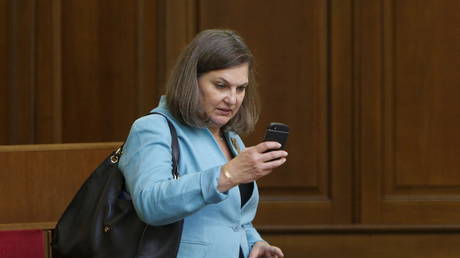
Under cover of media focus on the NATO proxy war in Ukraine and the Zionist assassination of Al Jazeera senior correspondent Shireen AbuAkleh, Washington is making moves to annex Syrian territory.
On May 11th during the meeting of the “global coalition against Islamic State” in Marrakech, Morocco the U.S acting assistant Secretary of State, Victoria Nuland, made an extraordinary move that has largely gone under the radar of even independent media. Everyone is distracted by events in Ukraine and the Palestinian Occupied Territories.
Nuland who famously exclaimed “Fuck the EU” during recorded conversations that exposed the US State Department involvement in the 2014 coup in Ukraine and the subsequent massacre in Odessa by the Washington’s Nazi Contras is now turning her attention to Syria’s north-eastern territory.
Nuland has announced that the US will allow foreign investment in north-east Syria under the control of the Kurdish Separatists, another US Coaliton proxy in Syria. These investments will not be affected by the unprecedented sanctions that are effectively blockading Syria.
The most savage of these economic measures were introduced under the Trump administration – the Caesar sanctions that are designed to inhibit any external assistance for Syria from within the Syrian alliance, including Russia and Iran.
The Caesar Syrian Civilian Protection Act is also fraudulent by claiming to “protect civilians”. In reality, it is punishes and hurts the vast majority of 17 million persons living in Syria. It will result in thousands of civilians suffering and dying needlessly. – Rick Sterling
Needless to say that the de-facto unilateral sanctions being applied as a collective punishment for the entire Syrian population living in areas protected by the Syrian government are illegal. To extend those sanctions to sovereign nations providing assistance to rebuild Syrian infrastructure is barbaric and a deliberate attempt by the US to ensure that Syria cannot recover from the eleven year war waged against it.
The correlation between economic and military coercion in Syria was made clear by previous Secretary of State, Mike Pompeo’s point-man on Syria, Ambassador James Jeffrey, who not only described Al Qaeda as a “US asset” in Syria but also bragged openly about the misery that sanctions had brought to the Syrian people:
And of course, we’ve ratcheted up the isolation and sanctions pressure on Assad, we’ve held the line on no reconstruction assistance, and the country’s desperate for it. You see what’s happened to the Syrian pound, you see what’s happened to the entire economy. So, it’s been a very effective strategy….
Journalist Rick Sterling also pointed out the illegality and brutality of the Caesar sanctions:
The US has multiple goals. One goal is to prevent Syria from recovering. Another goal is to prolong the conflict and damage those countries who have assisted Syria. With consummate cynicism and amorality, the US Envoy for Syria James Jeffrey described his task: “My job is to make it a quagmire for the Russians.”
Nuland said Washington would issue a general licence, which frees companies from U.S. sanctions restrictions in north-east Syria.
“The United States intends in the next few days to issue a general license to facilitate private economic investment activity in non-regime held areas liberated from ISIS in Syria.”
The irony here of course is that ISIS is in reality another proxy of the US Coalition that had benefitted from the oil resource revenue prior to the occupation of the oil fields by the Kurdish Contras. There is also a degree of collaboration mired in corruption between the Kurdish Separatists and ISIS both focused on the ethnic cleansing of the north-east to make way for an “autonomous region” effectively controlled by Washington, London and Israel. As Syrian researcher, Ibrahim Wahdi, wrote back in February 2022:
We can clearly see that the largest organized smuggling and mass transfer of ISIS militants towards the Syrian Badia connected with the Iraqi border north of Al-Tanf region, which coincided with the Ukraine crisis and the negotiations of the Iranian nuclear deal, aims to trigger chaos by CIA and Israeli intelligence through reviving ISIS to keep it as a pretext for the US occupation of Syrian lands.
Nuland’s claims that investment in areas “previously held” by ISIS are “needed to prevent a resurgence of Islamic State by allowing it to recruit and exploit local grievances” is hypocrisy of the highest order. Washington and London are recruiting, arming and equipping ISIS terrorists and embedding their fighters in areas of the Badia desert (East of Homs) where they can do the most damage to Syrian Arab Army installations and convoys – this includes the disruption of the meagre oil supply to Damascus from the north-east. As Wahdi pointed out:
The danger of the ISIS card lies in the large numbers distributed among 9 prisons in the US-backed SDF-controlled areas, which are potential targets for similar attacks [to release ISIS terrorists], especially the “Kamba Al-Bulgar” prison, east of Al-Shaddadi city in the southern countryside of Hasaka, which includes 5,000 ISIS militants.
In addition to Al-Sina’a prisons, Al-Shaddadiyah, Derek/ Al-Malikiyah, Al-Kasra, Al-Raqqa Central Prison, Rmelan and Nafker in the Qamishli city, from which 60 ISIS militants were transferred to a prison in Al-Hasakah last September.
Both ISIS and the Kurdish Contras are responsible for the theft of oil from Syria. Al Qaeda has the monopoly of the processing of the stolen oil via its WATAD organisation. The US Coalition has a vested interest in bringing the Syrian population to its knees and to stir up dissent against the Syrian government that has trashed the Coalition military plans for regime change.
The war against Russia in Ukraine is also revenge for Russia’s role in genuinely fighting ISIS in Syria and forcing the terrorist entity to withdraw to the north-east and Iraq where it is equally responsible for the destruction of civilian infrastructure in particular electrical installations to further punish any Iraqi resistance to US occupation.
Nuland and Washington are deliberately enflaming local grievances and enabling ISIS recruitment and expansion.
Not only will these sanction-free licences apply to the Kurdish Contras but the Turkish backed militia occupying the northern border zones of Syria will also be included in the deal. This means that Syrian territory will be de-facto annexed by these NATO-member-state proxies including Al Qaeda (Turkey) and affiliates.
According to a diplomat who has discussed the issue extensively with U.S officials, the licence will apply to agriculture and reconstruction work but not to oil. I guess there is no need to include oil as that is already considered a U.S benefit of the war they started in 2011. After all Trump said very clearly “we’re keeping the oil – I’ve always said that — keep the oil. We want to keep the oil, $45 million a month. Keep the oil. We’ve secured the oil.”
If the licence will apply to reconstruction and agriculture, this will legitimise the building of settlements and the continued theft (by the Kurds) of Syrian agricultural produce in the region, the occupation of the wheat storage centers and the reduction in supply to Damascus of these essential resources. Essentially doubling down on the siege of the Syrian people who are already suffering severe food insecurity, poverty, fuel and energy deprivation on a terrible scale.
The act of withholding means of sustaining life to innocent civilians in order to coerce an entire nation into submission to foreign agendas in the region must surely qualify as economic terrorism. The destruction of essential civilian infrastructure is a war crime, the withholding of essential resources or occupation of those resources is also a war crime. One could argue that the US Coalition is responsible for genocide in Syria under Genocide Convention article II (e) – deliberately inflicting on the group, conditions of life calculated to bring about its physical destruction in whole or in part”.
When Washington talks about “stabilisation” activities in the areas its “allies” took from Islamic State they are lying. Its “allies” are being led to believe they will benefit from cooperation with the U.S. In reality they are useful tools to facilitate the U.S and Israeli agenda in the region – to balkanise Syria and above all to secure the illegal US Al Tanf military base in the south-east (bordering Jordan) to prevent the linking of the Resistance Axis from Iran to Lebanon and ultimately Palestine. To protect “Israeli security” in the region.
The organised smuggling and transfer of ISIS terrorists towards the Syrian Badia connected with the Iraqi border north of Al Tanf is to maintain the CIA/MI6/Israeli chaos strategy in Syria and to justify US occupation of Syrian territory under the faux ISIS pretext.
What Nuland is proposing is a step forward for Washington in the annexation of Syria’s most resource rich territory. It is annexation by proxy. Turkey will also benefit from these licence schemes and will further embed its Al Qaeda-led militia in the northern border areas thus ensuring permanent insecurity for Syria to the north.
Arabs, Assyrians and Armenians will necessarily be ethnically cleansed from these zones to make way for these US-sanctioned settlements and it is common knowledge that the Kurdish Contras have been preparing for this for some time – banning the Syrian curriculum in schools and razing Arab houses in the area while forcing conscription onto local communities, running campaigns of kidnapping and detention.
Nuland informed coalition members in Marrakech that “Washington wanted to raise $350 million for these alleged “stabilisation” activities in north-east Syria during 2022. Iraq is also the target of the same “stabilisation” campaign. What Nuland really means is that Washington under cover of Ukraine will move to secure permanent violation of Syria’s territorial integrity while feigning outrage that Russia is violating the sovereignty of Ukraine already occupied by NATO and little more than Washington’s satellite vassal state on the border with its arch enemy Russia.
Why is the US Hyping Up the Threat of ISIS in Afghanistan?
By Valery Kulikov – New Eastern Outlook – 16.11.2021
To justify its interventionist actions in the Middle East, the United States, following the now cliched example, actively uses its alleged commitment to fighting against terrorism, focusing on countering such well-known terrorist formations as Al Qaeda and ISIS. The same goes for the actions of the USA in Afghanistan. However, Washington didn’t take any accountability before the rest of the world about the results of this fight against terrorists in Afghanistan during its 20 years of abysmal military intervention.
At the same time, the Russian presidential envoy to Afghanistan Zamir Kabulov and foreign ministry spokeswoman Maria Zakharova mentioned several times that Russia has sufficient facts backing the claims about the USA’s cooperation with the ISIS militants in the northern part of Afghanistan. In particular, since 2017, unmarked helicopter flights have been recorded within areas of ISIS militant activity, not without the explicit knowledge of US and NATO forces in their area of responsibility, especially in northern Afghanistan… According to Afghan sources, these aircraft have been used to deliver manpower, weapons, and ammunition to ISIS militants. Moreover, there were recorded instances of surgical strikes by the US Air Force not against terrorists, but positions of radical Taliban fighters engaged in combat against ISIS.
After the termination of the US military intervention in Afghanistan in August this year under the pressure of the international public and Americans themselves, certain American politico-military circles, clearly dissatisfied with this step, started to spin the propaganda campaign about the allegedly intensified in recent months “danger of ISIS activity in Afghanistan” through their lackey media. With the apparent hope of triggering a new international armed aggression in Afghanistan, again under “US patronage.”
Thus, on September 28 this year, General Mark A. Milley, Chairman of the Joint Chiefs of Staff, announced the supposedly obvious danger of strengthening of Al-Qaeda and ISIS positions in Afghanistan: “And we must remember that the Taliban was and remains a terrorist organization, and they still have not broken ties with al-Qaeda. I have no illusions about who we are dealing with.” “A reconstituted al-Qaeda or Daesh/ISIS with aspirations to attack the US is a very real possibility,” General continued.
The allegedly growing threat of ISIS in Afghanistan has recently been actively picked up by the American media, handy to the current military and political elite. In particular, recently The New York Times began to scare the world with stories that, since the Taliban came to power, ISIS militants in Afghanistan have intensified, their terrorist attacks are exhausting the new government and raising fears among Western powers of a potential revival of the group. During his speech in Congress, US Undersecretary of Defense for Policy Colin Kahl admitted that the ability of Afghan authorities to combat the Islamists “has yet to be determined.” However, he did not say anything about who and when will determine the results of 20 years of fighting them by the United States itself.
The New York Times acknowledged that, after its disgraceful flight from Afghanistan in August, Washington had lost reliable access to intelligence. Limited drone flights now provide only partial information given the distance they need to travel to reach Afghanistan, and its established network of informants has been destroyed.
However, the real reason behind Washington’s new propaganda wave regarding the allegedly heightened threat of ISIS from Afghanistan becomes apparent in one of the final paragraphs of the article published by this newspaper. It states that the Taliban “refuse to cooperate with the United States in fighting ISIS by fighting the war on their terms.”
As for the organization of today’s fight against ISIS, Dr. Bashir, head of the Taliban’s intelligence services, has directly pointed out that such work is constantly being done, and his men have adopted the methods of this fight from their predecessors. Moreover, they even rely on Western equipment to intercept messages and radio communications. He insists, however, that the Taliban have something the past government and the Americans did not have: widespread local support that can alert authorities to attacks and militant positions, something that has always been hard to detect in the past.
As for some Western propagandists who attempt to use the thesis about the alleged merger of the Taliban with ISIS terrorists at the instigation of Washington, keep in mind that ISIS does not have such a strong influence in Afghanistan as the Taliban, and they are seen as antagonists in the country. The fact is that ISIS relies on Salafi ideology, while most Afghans identify themselves with the Hanafi school of fiqh. Therefore, the organization is a foreign body in the structure of Afghan society, which undoubtedly limits its growth of influence and popularity in the country.
As you know, ISIS announced the formation of the group in Iraq in 2014. Then came the ISIS affiliate in Pakistan. As for Afghanistan, a branch of ISIS emerged here in January 2015 under the Islamic State – Khorasan Province, which later the Tehrik-e Taliban Pakistan joined with. In 2015, several regional media reports revealed that the National Directorate of Security (NDS), under complete US control, had helped ISIS gain a foothold in Nangarhar province. There have also been reports that some leaders of the Afghan branch of ISIS, including Sheikh Abdul Rahim Muslim Dost (a former Guantanamo Bay detainee!), traveled in Afghan intelligence vehicles and lived in guesthouses belonging to Afghan intelligence agencies. Therefore, some analysts accuse US intelligence services of involvement in creating and strengthening ISIS in Afghanistan.
At a certain point, the Taliban viewed ISIS as temporary “allies” fighting against US intervention within Afghanistan. However, after ISIS demanded that Taliban leaders swear allegiance to Abu Bakr al-Baghdadi, clashes broke out between the Taliban and ISIS, especially in Nangarhar province. Notably, after such clashes broke out, government helicopters rescued ISIS fighters besieged by the Taliban in some areas, such as Jawzjan province. In particular, Afghan army helicopters supported by US forces evacuated ISIS fighters and their families and housed them in guesthouses in Sheberghan, Jawzjan province, belonging to Afghan intelligence. Afghan intelligence agencies implicitly acknowledged this.
The estimated number of ISIS fighters in Afghanistan is 5,000. A UN report released in mid-July said the number of ISIS fighters in Afghanistan ranges from 500 to 1,500. Currently, ISIS does not possess heavy weapons, guns, and tanks, even though such equipment was abandoned in large numbers by the US army after fleeing Afghanistan, and has no centers, headquarters, or open fronts on Afghan soil. In these circumstances, ISIS can gain a foothold in Afghanistan only if some foreign patrons support it with people, arms, and money to use this organization to weaken the Taliban’s power and turn Afghanistan into a new breeding ground for terrorism. And here, one cannot rule out such actions precisely on the part of the United States and its Western allies. For example, Washington has done it before by supporting al-Qaeda in Afghanistan in its confrontation with the Soviet Union.
In a sense, former Afghan army and Afghan intelligence officers trained in the United States, who had already joined ISIS in Afghanistan in August after the US fled Afghanistan, could be used by the United States to manipulate ISIS. Their numbers, as admitted by The Wall Street Journal, “are still relatively small, but they are growing, according to those who know these people, and also according to Afghan and Taliban intelligence agencies.”
Today, the Taliban control the entire country and view ISIS as a foreign group to be fought and wholly expelled from Afghanistan. As for the restraints the Taliban has towards carrying out joint counter-terrorist actions against ISIS, confirmed by the Taliban on October 11 at the meeting with the Americans in Doha, one cannot rule out that it was Washington’s former ties with ISIS that could lie behind such a position of the current rulers of Afghanistan.
Russia’s about-face on Syria’s Idlib is the opening gambit of a larger diplomatic chess game
By Scott Ritter | RT | July 17, 2021
The Russian vote at the UN Security Council in favor of extending a humanitarian air corridor into Syria has been touted by the US government as a victory of American diplomacy. Moscow might have other ideas.
In a rare display of diplomatic cooperation, the US and Russia agreed last week on a one-year extension of the UN Security Council authorization for humanitarian aid supplies to reach northern Syria through the Bab al-Hawa crossing on the border with Turkey.
The Biden administration had made the extension of this authorization its highest priority when it came to US-Syrian policy. For its part, Russia had long been hesitant to allow such an extension, insisting it should be replaced by cross-line humanitarian deliveries.
It’s been alleged that the Bab al-Hawa crossing point was being used to resupply Islamic militant groups opposed to the Syrian government of President Bashar Assad that are operating inside Idlib province, which borders Turkey.
Russia’s vote in favor of the extension for up to 12 months took many observers by surprise, given Moscow’s past objections.
The US media called it a victory for the Biden administration, underscoring the importance of the June summit meeting between the US president and his Russian counterpart, Vladimir Putin, in Geneva, Switzerland. The US made Syria, and in particular the issue of continued access by humanitarian organizations to refugee camps located in Idlib, a high priority at that meeting. The fact that Moscow and Washington have reached a compromise on the operation of the Bab al-Hawa crossing, from the perspective of Russia, was a clear sign regarding the efficacy of the Geneva process.
“We hope that it might be a turning point that is indeed in line with what Putin and Biden discussed in Geneva,” Russia’s UN Ambassador Vassily Nebenzia told reporters after the vote.
The situation, however, is far more complicated than the zero-sum diplomatic game being promoted in the US mainstream media. Idlib isn’t just a repository of internal refugees from the decade-long civil conflict that has wracked Syria since 2011 – it is the final redoubt of foreign-backed Islamic militants who have been waging a bloody fight against the Russian-backed Syrian government. The Islamic militant groups, many of which are allied with Al-Qaeda, once controlled much of the Syrian countryside and were operating in the suburbs of the Syrian capital of Damascus.
The decision by the Russian government to intervene militarily on the side of Assad in September 2015 helped turn the tide against the Islamic militant forces. Over the course of the next three years, the Syrian army, backed on the ground by Hezbollah and pro-Iranian militias, and in the air by the Russian Air Force, was able to recapture all of the militant-held territory save for the last remaining bastion in Idlib.
The situation inside Idlib is complex, with the various factions among the Islamic militants fighting among themselves to establish primacy. Many of these groups, including Al-Qaeda affiliate Hayat Tahrir al-Sham (HTS), are reportedly reliant upon foreign support for their survival and have been linked to both Turkey and the US in terms of serving as an anti-Assad proxy force. Recent claims by the exiled Turkish mafia leader Sedat Peker regarding the alleged shipment of “billions of dollars” worth of military equipment disguised as humanitarian aid to HTS and other anti-Assad groups operating inside Idlib only reinforced the concerns of the opponents to keeping the Bab al-Hawa crossing open.
There is a real humanitarian crisis ongoing inside Idlib, where millions of Syrian citizens remain housed in refugee camps that are little more than tent cities erected in open fields. The refugees are totally dependent upon international aid groups for the essentials of life, including food, water, shelter and medicine. With the restoration of central government control over much of Syria, however, and the willingness on the part of the Syrian government to resettle these refugees back in their original homes without any threat of retribution or retaliation, there is a growing sentiment among the Russian and Syrian government that the refugees have become little more than political pawns used by Syria’s many enemies, including Turkey and the US, to create the perception of a despotic regime while fostering continued instability inside Idlib that serves as an engine to motivate and recruit new anti-Assad fighters.
This reality served as the core argument underpinning the Russian objection to keeping the Bab al-Hawa crossing open. There is another reality, however, which also guided the Russian decision, namely the lack of a viable military solution to the problem of Idlib. Russia and the Syrian government are committed to a course of action that has the Syrian government asserting control over the totality of Syrian sovereign territory – including Idlib.
While Russia and Syria continue to conduct airstrikes against Islamic militant positions inside Idlib, and the Syrian army and its allies likewise exert pressure on Islamic militant forces on the ground, the feeling in both Moscow and Damascus is that the problem of Idlib cannot be resolved through force of arms unless one is willing to unleash a bloodbath that would cause more problems than it would solve.
The key to a solution in Idlib is for both Turkey and the US to recognize the futility of continuing to use it as a base of anti-Assad activity, and to finally give up on their dreams of regime change in Damascus. Such a policy change, however, will not happen overnight and will require considerable diplomatic cooperation on the part of all parties involved – including Russia. The Russian agreement to keep the Bab al-Hawa crossing open for another year, when seen in this light, represents the opening round of a lengthy diplomatic battle over the future of Idlib, Syria and the Middle East as a whole.
Scott Ritter is a former US Marine Corps intelligence officer and author of ‘SCORPION KING: America’s Suicidal Embrace of Nuclear Weapons from FDR to Trump.’ He served in the Soviet Union as an inspector implementing the INF Treaty, in General Schwarzkopf’s staff during the Gulf War, and from 1991-1998 as a UN weapons inspector.
Biden Forces Steal 32 Additional Trucks Loaded with Syrian Wheat
Syria News | June 20, 2021
Biden forces operating illegally in northeastern Syria stole an additional quantity of wheat loaded in 32 trucks and smuggled it into neighboring Iraq through an illegal border crossing, yesterday, Saturday 19 June 2021.
This new theft comes less than a week after another convoy of dozens of trucks loaded with stolen Syrian wheat, the Syrians are harvesting their wheat and Biden is stealing it to feed his ISIS terrorists in Iraq, the terrorist organization that was created under Biden’s watch during the 8 years term of Obama and saw its growth where his secretary of state Kerry back then said they wanted to use it to pressure the Syrian President Bashar Assad into submission.
Biden taking the food of the Syrian people out of the mouths of their children and sending in killing machines and terrorists instead, in the past week alone the US Army stealing Syrian oil and wheat entered two columns of trucks and military vehicles on the 14th and 17th of this month, the first convoy comprised of 55 different rucks and empty oil tankers to siphon Syrian oil, and the second comprised of 33 military and logistics vehicles.
Cross borders activities without the sovereign country’s approval is a serious breach of international law, stealing food and oil from a country especially when its people are facing economic hardship and is fighting terrorist groups is a war crime, creating terrorist groups and separatist armed militia and using them against a sovereign country is nothing less than a declaration of war. All US Army troops are liable to prosecution under international law, those killed of them are no heroes and do not die ‘defending their country and its values’, they get killed while stealing and are a disgrace for their families and their people.
Ironically, during a meeting with his Russian counterpart President Putin in Geneva on the 17th of the month, the head of the most diverse and inclusive US junta Biden asked Putin to help in obtaining approval from Damascus to open new border crossings into regions occupied by Al Qaeda in the north and northwest of Syria!
Featured Video
or go to
Aletho News Archives – Video-Images
From the Archives
Israel Would Have No Qualms About USS Liberty-Style FALSE FLAG If Iran Campaign Falters – Analysts
By Ilya Tsukanov – Sputnik – 18.06.2025
Donald Trump is mulling whether or not to join Israel’s aggression against Iran as Tel Aviv faces problems sustaining its defenses against growing counterstrikes, and apparently lacks a realistic game plan for an end to hostilities after failing to achieve its goals. Analysts told Sputnik how the US could be ‘nudged’ into the conflict.
“The US is already assisting Israel with supplies, intel, refueling support, etc. One of the many US posts in the region could be attacked for a casus belli,” former Pentagon analyst Karen Kwiatkowski explained.
“If Trump doesn’t comply with Israel’s demand” and join its aggression voluntarily, “a false flag may be needed” to drag the US in, Kwiatkowski, retired US Air Force Lt. Col.-turned Iraq War whistleblower, fears.
Netanyahu has a diverse array of options at his disposal, according to the observer, including:
- a false flag against US assets abroad blamed on Iran or one of its Axis of Resistance allies, like the Houthis
- a US domestic attack or assassination blamed on Iran
- Iranian air defenses ‘accidentally’ hitting a civilian jetliner carrying Americans
- use of a dirty bomb or nuclear contamination somewhere in the region blamed on Iran
- even blackmailing by threatening to use nukes against Iran if the US doesn’t join the fight
Kwiatkowski estimates that Israel probably has “enough blackmail power” against President Trump and Congress to avoid the necessity of a false flag operation, but a “USS Liberty-style” attack, targeting the soon-to-be-retired USS Nimitz supercarrier that’s heading to the Middle East, for example, nevertheless cannot be ruled out entirely, she says. … continue
Blog Roll
 Aletho News
- Smotrich calls for annexation of South Lebanon to Litani River
- Echos of Gallipoli? Hormuz and the Geography of Hubris
- Pakistan PM backs Iran’s right to self-defense amid tensions
- Hungary blasts ‘fake’ EU accusation
- SAFE Debt Trap: Poland’s €43.7 Billion Bet on Unipolar Illusion
- War on Iran threatens global Gulf capital flows: FT analysis
- Mossad De Facto Admits To Inciting Riots In Iran
- Tehran: World grown thoroughly exhausted with US-Israeli ‘false flag storylines’
- Trump ‘stuck between a rock and a hard place’, lacks Iran war strategy: Ex-CIA chief
- Trump’s bombardment of fake news so far is working quite well. But where is it heading?
- If Americans Knew
- From Sde Teiman, the truth about Israel’s military justice system has been set free
- Child denied life-saving bone marrow transplant by Israel ‘because he is from Gaza’
- Raffi Berg: BBC Middle East Editor Exposed as CIA, Mossad Collaborator
- Jerusalem Archbishop Rebukes Netanyahu’s Statements on Christianity
- US to embed Palantir AI across entire military: Report
- Israeli-US war on Iran to drag on “a few more weeks” – Not a ceasefire Day 164
- Lebanon deaths top 1,200; Palantir AI to be embedded across US military – Not a ceasefire Day 163
- Israel’s assassination game: Take all pragmatists off the board
- Food shortages return to Gaza as Israel tightens aid restrictions under the cover of its war on Iran
- Trump demands trillions in payments from Gulf countries, billions from Harvard – Not a ceasefire Day 162
- No Tricks Zone
- Devastating Assessment Of Comirnaty Vaccine By Former Senior Pfizer Europe Toxicologist
- New Study: CO2 Is ‘Effectively Negligible’ As An Explanatory Climate Change Factor Since 2000
- Former Pfizer Toxicologist Dr. Helmut Sterz Tells Bundestag Hearing Pfizer Vaccine Should Have Never Been Approved
- Energy Expert: Germany’s Nuclear Phaseout Was A “500 Billion Euro Mistake”
- New Research: South Australia’s Mid-Holocene Sea Surface Temperatures Were 4°C Warmer Than Today
- Storing Green Energy To Last Germany 10 Days Would Require A 60-Million Tonne Battery
- New Studies: UK Sea Levels Were 4 Meters Higher Than Today During The Mid-Holocene
- Destructive Green New Deal: German Energy And Metal Group Warns Of Drastic Crisis
- New Study Documents A 20-Year Pause In Arctic Sea Ice Decline – Driven By Internal Variability
- Wake-up Call: Survey Shows Majority Of Germans Now Favor Postponing Climate Targets!
 Aletho News