Argentina to Freeze Gas and Electricity Rates
teleSUR | December 18, 2019
The Government of Alberto Fernández sent the draft law on Social Solidarity and Productive Reactivation to Congress on Tuesday morning, which, among other matters, plans to freeze gas and electricity rates for six months.
The bill also contemplates a “reduction of the real tariff burden on households and businesses by the year 2020”, a policy that will reverse the tariffs imposed since the Mauricio Macri regime took over.
The rates of these two basic services will be frozen for 180 days, while the executive branch begins a “renegotiation process of the current Comprehensive Rate Review” or “an extraordinary revision”.
Likewise, the bill authorizes the Argentine Government to intervene in the National Electricity Regulatory Entity (ENRE) and the National Gas Regulatory Entity (Enargas), for a period of one year.
The Solidarity Law seeks “the rate restructuring of the energy system with criteria of distributive equity and productive sustainability”, as well as “reorder the operation of the regulatory entities of the system”.
This latest bill is one of the first major moves by the Fernandez government to reverse the neoliberal policies of the previous regime.
Fernandez Government Incorporating ‘Peronism’ to End Poverty, Misery – Argentine Lawyer
By Ekaterina Blinova – Sputnik – 11.12.2019
On 10 December, Alberto Fernandez was sworn in as the new president of Argentina. Gonzalo Fiore Viani, a lawyer and political analyst, outlines the major economic and foreign policy challenges faced by the new “Peronist” government.
Argentine Peronist leader Alberto Fernandez, who won the October presidential elections with 47.9% of the vote, unveiled his new cabinet on 6 December announcing that Martin Guzman, a 37-year old protege of prominent US economist and Nobel laureate Joseph Stiglitz, will become the country’s next economy minister. Guzman will have to deal with Argentina’s galloping inflation, rising unemployment and a $100 billion debt.
How Fernandez Gov’t Will Deal With Argentine Economic Crisis
Last year the dire economic situation prompted Fernandez’ predecessor, Mauricio Macri, to request a $56-billion IMF loan. As of yet, about $45 billion has been disbursed to the recession-hit country. While the loan fell short of breathing new life into Argentina’s economy, this year the country has to start repaying its debts. There are fears that Buenos Aires is teetering on the verge of a new sovereign default.
Guzman, a vocal critic of the IMF’s policies, is expected to hold talks with creditors to restructure Buenos Aires’ financial obligations.
“By 2020, Argentina has to face the fulfilment of obligations for almost $55 billion dollars”, says Gonzalo Fiore Viani, a lawyer and political analyst from Cordoba, Argentina. “Therefore the payment of capital and interest commitments must necessarily be suspended for a while. Martin Guzman, the new minister of economy, is a specialist in sovereign debt, so he can manage the central problem of the Argentine economy, taking into account the proposed suspension of payments, both due and due for two years.”Viani says that Argentina today has a liquidity and solvency problem, that is, shortages of pesos and dollars to face the payment of the debt amid the economic slowdown.
“Currently, inherited debt represents 90 percent of the gross domestic product (GDP), in addition to a financial deficit that implies 5 percent of GDP,” he says.
Yet another issue the Fernandez government is going to deal with is poverty. According to the Catholic University of Argentina, about 40 percent of Argentines are considered poor. “The social situation is so serious that the government must act first in that regard”, the political analyst underscores referring to Fernandez’ idea of “ethics solidarity” to end poverty and misery in the country.
To solve these issues, Guzman is seeking to revive the country’s economic growth and boost production in the export sector. He argues against pouring the IMF’s money to service Argentina’s bonds and implementing the organisation’s austerity scheme. According to him, the IMF programme does not work while the deepening of austerity policies is only leading to greater recession.
According to Viani, Peronism, a political doctrine based on legacy of former President Juan Peron and sometimes described as “right-wing socialism,” is making a comeback in Argentina.
“Peronism returns with a heterogeneous coalition of government, with all its internal lines represented, I think it is a return to what was the first government of Nestor Kirchner. And Alberto Fernandez can become the new Kirchner, or even the new Raul Alfonsin,” the political analyst believes.
One Should Expect New Shift in Argentina’s Foreign Policy
Apart from upcoming changes in domestic policy, Viani also expects a shift in Argentina’s foreign strategy under Fernandez: “I think the international politics of the new government will be totally opposite to the one that Macri had,” he says. “Relations with Russia, almost inexistent during the Macri administration, will be now stronger”.
He highlights that “the election of Felipe Sola, a man with no diplomatic background but a very skilled politician, as foreign minister, has to do with the importance of international relations in a very complex world.”
Meanwhile, the centre-left takeover in Argentina has seemingly chilled relations between Buenos Aires and Brasilia with Jair Bolsonaro not attending Fernandez’ inauguration and then sending his vice president to the ceremony. Viani suggests that right-wing politician Bolsonaro’s move was driven by “ideological reasons.”
“But besides that, Bolsonaro wants to have a major role in the region, becoming the indisputable leader of Latin America, but that is impossible having a progressive government in Argentina,” the political analyst remarks.
Why Buenos Aires Needs Working Relations With Both China & US
Viani foresees that Buenos Aires will further strengthen economic cooperation with Beijing. The two countries have maintained close ties for quite a while despite political changes in Argentina.
Under Macri, the People’s Republic of China provided loans to Argentina and extended bilateral currency swap collaboration launched in 2009 by then President Cristina Fernandez de Kirchner. Additionally, the country’s telecom sector is continuing cooperation with China’s tech giant Huawei, that has recently found itself in the cross hairs of the Trump administration.
Washington is obviously displeased with China’s growing influence in the region which the US has for many decades considered its backyard. In October 2018 US Secretary of State Michael Pompeo warned Latin American states: “When China comes calling it’s not always to the good of your citizens”, while commenting on the Beijing-led Belt and Road Initiative (BRI).
Assessing the prospects of Argentine-American ties, the analyst opines that while “Fernandez and Trump’s relationship seemed to have started off with the right foot but quickly tensed due to cross-statements about the coup in Bolivia”.
To add to the controversy, on 2 December, Trump tweeted that he was going to restore steel and aluminium tariffs on Argentina and Brazil.
“With regard to Argentina, the rise in tariffs worries because it can serve as an advance for a tightening in US trade policy and in the renegotiation of the debt with the IMF”, the political analyst says. “In addition one of the big problems that the next government will face is the lack of dollars”.
According to Viani, while pursuing independent foreign and domestic policy Buenos Aires still needs to maintain working relations with Washington to solve the external debt problem.
“I believe that with a pragmatic policy, the new government can have good relations with the United States but also to maintain sovereign external policy to contribute to the development of the country,” he says.
Alberto Fernandez Wins Argentine Presidential Election
Sputnik – 28.10.2019
BUENOS AIRES – Incumbent president of Argentina, Mauricio Macri, congratulated on Sunday his rival, opposition leader Alberto Fernandez, on winning the presidential election.
With 91.21 percent of ballots counted, Fernandez has 47.83 percent of the vote, Macri has 40.66 percent.
“I want to congratulate President-elect Alberto Fernandez,” Macri said, addressing the citizens.
He added that he had invited Fernandez to a meeting on Monday.
According to Argentine legislation, the victory in the first round is secured for the candidate who will gain either more than 45 percent of the vote, or more than 40 percent with a 10 percentage points lead over the closest opponent.
Besides the presidential election Argentina held the parliamentary voting on Sunday. The Argentine voters had to elect 130 out of 257 members of the Chamber of Deputies, 24 out of 72 members of the Senate as well as four governors.
Argentina: Cristina Fernandez Goes to Trial Again Amid Campaign
teleSUR | September 21, 2019
Spanish Judge Baltasar Garzon: “Like Lula and Correa, Cristina Fernandez de Kirchner is being the object of a clear political persecution because she defends the people and faces immeasurable power structures.”
Federal Judge Claudio Bonadio on Friday asked Argentine’s Senate to take away Cristina Fernandez de Kirchner’s legislative immunity in order to put the lawmaker in preventive detention for alleged connections to the “Notebooks” corruption case.
For the second time in less than a year, former president Fernandez (2007-2015) must appear in federal court for her alleged connections to irregular public spending during her administration.
The judge’s decision comes just as Fernandez de Kirchner is running for vice president alongside Alberto Fernandez for the Oct. 27 elections, and polls and primaries show them as the favorites to win.
Prosecutor Carlos Stornelli accuses Fernandez de Kirchner of being the “boss” of an illicit ring of politicians who raised money from private companies in exchange for granting them public contracts. A ledger ‘notebook’ supposedly lists all the transactions. A former chauffeur of Fernandez de Kirchner allegedly recorded the sums of money that the former president and her husband, Nestor Kirchner, also a former head of state, received.
More than 170 people have already been processed in the Notebooks case, among them are the owners of large private businesses who have already been released.
During the previous legal proceedings related to the case, Fernandez de Kirchern’s lawyers denounced several irregularities, including biased statements made by other defendants, indiscriminate detentions, burned evidence and other constitutional and due process violations.
According to Judge Bonadino, the vice presidential candidate should appear at an oral trial in the near future, but his request for Cristina’s preventive detention cannot be executed until the Argentinian legislative removes Fernandez de Kirchner’s legal immunity as a sitting legislator.
If this were to happen before the next elections on Oct. 27, Argentina would experience an unprecedented political crisis, amid growing popular mobilizations which are being carried out in rejection of President Mauricio Macri’s neoliberal policies, rising unemployment, poverty and hunger.
Argentina’s Alberto Fernandez & Cristina Kirchner crush President Macri in ‘preliminary elections’

Presidential candidate Alberto Fernandez and his running mate former President Cristina Fernandez de Kirchner © Reuters / Agustin Marcarian
RT | August 12, 2019
Argentinian President Mauricio Macri has conceded defeat in the primary elections after suffering a massive loss to the center-left nominee Alberto Fernandez and his running mate, former president Cristina Kirchner.
“We’ve suffered a bad election,” right-wing Macri said on Sunday night, but vowed to “redouble” his efforts to secure the ‘real’ elections in October.
The nationwide primary election, introduced in Argentina in 2011, is held simultaneously for all parties and serves as a good indication of how the presidential race would swing when people cast their vote in the general election on October 27. The Sunday vote landed the incumbent president with 32.36 percent of support, while Fernandez obtained 47.22 percent. Center-right Roberto Lavagna came in third with 8.39 percent.
Fernandez, who served as the chief of the Cabinet of Ministers during Nestor Kirchner’s presidency, vowed to create a “new” Argentina. “Argentinians realized we are the change, not them,” Fernandez said during his victory speech in Buenos Aires, promising “to end this time of lies and give a new horizon.”
Fernandez’s running mate, former head of state Cristina Kirchner, feels optimistic about their chances of winning the general election and their ability to improve the socioeconomic situation in Argentina.
“We know of the difficult moment that the country is going through, of millions of Argentines who have lost their jobs, we have talked with so many, we know what it is. This gives us the responsibility that we have to reach everyone to give them absolute peace of mind,” she said.
Argentina’s economy continues to sink, with inflation rising to 55 percent and poverty levels increasing to 32 percent, from around 26 percent the previous year. The massive $57 billion deal Macri secured last year with the International Monetary Fund has so far failed to improve the situation.
US Imposes Sanctions on Hezbollah Senior Leader Over 1994 Terror Attack in Argentina
Sputnik – July 19, 2019
Hezbollah’s top figure, Salman Raouf Salman, stands accused of the bombing of a Jewish centre perpetrated 25 years ago in Argentina’s capital Buenos Aires.
The United States has introduced sanctions on a senior Hezbollah leader, a Colombian-born Lebanese national Salman Raouf Salman, over his complicity in terrorist attacks, according to the US Treasury. The top Hezbollah operative is accused of coordinating the bombing of a Jewish community centre in Argentina’s capital, Buenos Aires in 1994.
The Treasury’s Office of Foreign Assets Control (OFAC) said it added Salman Raouf Salman to its specially designated nationals list.
Treasury undersecretary of terrorism and financial intelligence Sigal Mandelker stated that Salman has continued to orchestrate terrorist operations in the Western Hemisphere for Hezbollah since the attack in Buenos Aires.
On Thursday, Argentina’s authorities designated the Lebanese-based Hezbollah movement as a terrorist organisation and decreed a freeze of all financial assets belonging to the group.
The move coincided with the 25th anniversary of the violent attack on the Mutual Israelite Association of Argentina community centre in Buenos Aires in 1994 that left 85 people dead and hundreds injured. Hezbollah denied any role in the attack.
“The Owner”: The Rise of Eduardo Elsztain and the Coming End of Argentina’s Democracy
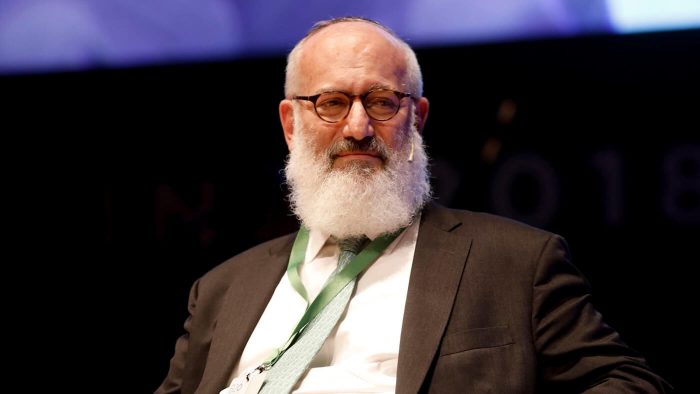
Eduardo Elsztain, president of Grupo IRSA and Banco Hipotecario. Santiago Filipuzzi | La Nacion
By Whitney Webb | MintPress News | April 5, 2019
BUENOS AIRES, ARGENTINA – It seemed like a longshot, but anything was possible in the mind of an ambitious, 30-year-old Eduardo Elsztain. Elsztain, then living in New York, had landed a meeting with the wealthy Hungarian-American financier George Soros, a meeting that the bulk of media reports covering Elsztain’s rise to prominence claim was arranged purely by chance. Though Elsztain was inexperienced and unknown at the time, Soros saw something he liked in the ambitious Argentine, so much so that he gave him $10 million without a second thought.
According to Elsztain’s recollection, “We talked for an hour or so, and then he asked how much money I thought I could handle. I told him I could manage $10 million.” Soros, as Elsztain remembers it, simply said “Okay, no problem.” Soros later explained his seemingly impulsive investment by saying that Elsztain “knew when to sell and when to buy.”
Soros’ investment not only changed Elsztain’s fate, but Argentina’s. With that $10 million in newly secured funding, Elsztain and his close associate Marcelo Mindlin transformed Elsztain’s grandfather’s company Inversiones y Representaciones S.A. (“Investments and Brokerage, Inc.”, better known by its Spanish acronym IRSA) into Argentina’s largest business empire. Indeed, through IRSA, Elsztain has become not only the country’s largest landowner and real estate developer, but also the dominant force in the country’s massive beef and agriculture industry, its gold mining industry, and its banking system. As a result, he has been dubbed by the Argentine press as simply “The Landowner.”
In recent years, Elsztain’s business empire has extended far beyond South America and into Israel, where he owns the majority stake in one of Israel’s largest conglomerates, IDB, as well as important stakes in several other notable Israeli companies. Israeli media frequently refers to Elsztain as “South America’s richest Jew.” These business interests have made him one of the most powerful oligarchs in both Argentina and the Zionist state.
Yet — much like British billionaire Joe Lewis, whose activities in Argentina are described in detail in Part I of this series — a litany of crimes, schemes and conspiracies lie beneath Elsztain’s sprawling business empire and his carefully crafted image of a “self-made man” devoted to Jewish charity and religious causes. Notably, Elsztain’s massive business empire is also connected to that of Lewis through Elsztain’s longtime associate and partner Marcelo Mindlin, who co-owns Argentina’s largest private power company with Lewis.
Yet, while Elsztain and Mindlin are supremely powerful and influential in their own right, they often act as the Argentine faces for policies promoted by the global oligarchy, to which they are both well connected. Indeed, Elsztain and Mindlin are connected to elite groups managed by well-known and controversial billionaire families like the Rockefellers, Rothschilds and Bronfmans, through their membership and leadership roles in groups like the Council of the Americas as well as powerful international Zionist organizations.
These connections to global oligarchy and global Zionism have recently prompted Elsztain to orchestrate a policy that, if enacted, would utterly gut Argentina’s democracy and would amount to a “bloodless coup” of a country that has long been in the sights of the global elite.
This article is Part II of a multi-part investigative series examining the efforts of the global elite, as well as powerful elements of the global Zionist lobby and the government of Israel, to create an independent state out of Argentina’s southern Patagonia region in order to plunder its natural resources and to fulfill long-standing Zionist interest in the territory that dates back to the “founding father” of Zionism, Theodore Herzl. Part I, which focuses on the de facto “parallel state” created by British billionaire Joe Lewis in Argentina’s Patagonia, can be read here. Part II focuses on Eduardo Elsztain — one of Argentina’s wealthiest businessmen, who is deeply connected to the global elite and global Zionist lobbies — and his role in a scheme to undercut Argentina’s democracy by hijacking its voting system.
Starting “small,” Elsztain gets “golden advice”
Inversones y Representaciones S.A. (IRSA), now Argentina’s largest real estate company, had humble beginnings, growing slowly after its founding in 1943 by Eduardo Elsztain’s grandfather Isaac Elsztain, a Russian-Jewish immigrant who arrived in Argentina in 1917. After his uncle’s unexpected death in 1981 and soon after Elsztain had returned from a year abroad in Israel, Elsztain took over the management of the firm, dropping out of university to do so.
When Elsztain took over most of IRSA’s management, the firm was struggling and worth barely $100,000. In order to buy IRSA shares and definitively take control of the company, Elsztain turned to his friend Marcelo Mindlin, borrowing $120,000 from him to buy stock in the company. The Mindlin-Elsztain partnership would turn spectacularly lucrative and was once called “one of the most successful business marriages of menemismo,” a reference to the presidency of Carlos Menem that oversaw the privatization wave of the 1990s.
However, it was not until Elsztain’s fateful meeting with Soros that IRSA was to become the behemoth it is today, now valued at $11.6 billion. Yet, there was another meeting that also helped Elsztain secure his future fortune, one that has received decidedly less coverage.
While he lived in New York from 1989 to 1990, prior to meeting Soros, Elsztain made another “life changing” meeting, with the Lubavitcher Rebbe, Menachim Mendel Schneerson of the New York-based Chabad-Lubavitch movement, often simply referred to as Chabad. Chabad is arguably one of the most influential Orthodox, Hasidic Jewish organizations at the international level — the Times of Israel once called it “one of the most powerful forces in world Jewry” — and Schneerson was its most prominent and final leader.
Schneerson has been touted by followers as a “prophetic visionary and pragmatic leader, synthesizing deep insight into the present needs of the Jewish people with a breadth of vision for its future,” who also “charted the course of Jewish history” in the post-World War II era. Among other things, Schneerson controversially taught that “the entire creation [of a non-Jew] exists only for the sake of the Jews” and was implacably hawkish in regards to Israel’s military occupation of Palestine.
Elsztain himself has characterized his meeting with Schneerson as being equally, if not more, important to his future business success as his meeting with Soros. According to an account of the meeting published in Haaretz, “the rabbi advised him to sell his holdings on the stock exchange and focus on real estate, a suggestion that turned out to be well timed.” Haaretz concluded that the “success of the Lubavitcher Rebbe’s golden advice is possibly what drives Elsztain today.”
Elsztain’s deep ties to the Chabad movement, as well as the long-standing interests in Argentina of Zionists within and outside of Chabad — particularly regarding control of the country’s land and resources, with an emphasis on Patagonia — will be discussed in detail in a subsequent installment of this series. For now, it is worth noting that Chabad’s website states that Elsztain “is honorary president of Chabad of Argentina, and in that capacity has been a crucial partner for all Chabad activities in the country and even globally.”
Another important point regarding the beginnings of IRSA, and with it Elsztain and Mindlin’s sprawling business empire, is what really inspired George Soros to part with $10 million during that “happenstance” meeting with a young Argentine of no renown. Though the official story goes that Elsztain secured his meeting with Soros purely by chance, Argentine newspaper La Nación has revealed that this is merely a myth that has been used to create the impression that Elsztain’s fortune was “self-made.”
Indeed, despite the “legend” that Elsztain’s core business IRSA has tirelessly promoted of a “chance” Soros meeting, La Nación — one of Argentina’s most prestigious papers — wrote:
The real story is a bit less spectacular. Elsztain found himself face to face with Soros thanks to his contacts that he had been developing inside the Jewish community in Buenos Aires, who were responsible for opening the doors of the powerful businessman [to Elsztain].”
Another myth involves the claim that Soros was making a personal investment in Elsztain specifically. Instead, as a 1998 New York Times article reveals, Elsztain — during that fateful meeting — persuaded Soros to drop $10 million, not on IRSA or his own financial brilliance per se, but after convincing him “that new policies of the Argentine government intended to deregulate and privatize the economy were worth a gamble.” In fact, Soros had seen an opportunity not necessarily in Elsztain as an individual, but rather to plunder Argentina’s public resources via the coming wave of privatization.
Frontmen for the “free-enterprise” revolution
Soros — through his powerful connections to the international global elite and multinational corporations — was able to ensure that several lucrative privatizations fell into his lap. Elsztain and his partner Marcelo Mindlin as well became top beneficiaries of this crony capitalism as a result of their role as Soros’ Argentine frontmen for the duration of their decade-long partnership. By the time the partnership ended, at least publicly, in the early 2000s, Soros made at least $500 million in profits from his investments in partnership with Elsztain and Mindlin.
Indeed, after just eight years of “Menemismo,” Elsztain and his associates, including his brother Alejandro and Mindlin, had become “the darlings of Wall Street’s emerging-market gurus and Argentina’s free-enterprise revolutionaries.” Elsztain and Mindlin currently continue this role as frontmen but, after outgrowing Soros in the early 2000s, became Argentine frontmen for the global elite — even after splitting up their legendary partnership, as will be described in a subsequent section of this article.
After Domingo Cavallo, a Harvard-educated economist who served as president of Argentina’s Central Bank during the country’s military dictatorship, became economy minister in 1991 during Carlos Menem’s first presidential term, a wave of privatizations took place that were intended to align Argentina with the so-called “Washington Consensus” promoted by the George H.W. Bush administration. Many of those privatizations were handled by just a handful of law firms, one of which was Zang, Bergel and Viñes.
As researcher and author Fabian Spollansky has noted, Zang, Bergel and Viñes was “one of the motors of the great privatization machine” and, having been hired as “consultants” by the Menem-led government, helped oversee the privatizations of key state assets, including Córdoba Waters (Aguas de Córdoba) and state oil company YPF. During many of these privatizations, two of the firm’s partners, Saúl Zang and Ernesto Viñes, were also working for IRSA — then run by the partnership formed by Elsztain, Mindlin and Soros — and Elsztain was among the firm’s top clients.
The overlap generated many conflicts of interest, particularly in the privatization of the National Savings and Insurance Bank (Caja Nacional de Ahorro y Seguro), in the course of which Zang, Bergel and Viñes’ consultant contract with the government was canceled when it was revealed that the firm sought to sell the firm to Elsztain, who was also a client of the firm and employing Zang and Viñes separately through IRSA. This bank, now known as Caja S.A., was instead privatized and sold off to an Italian company and Argentina’s Werthein Group. The Wertheins are closely linked to Elsztain through their leadership roles in the international Zionist organization the World Jewish Congress, and their ties to Elsztain will be expanded upon in a forthcoming installment of this series.
Starting in 1987, the World Bank began to lobby Argentina’s government, then led by Raúl Alfonsín, to either privatize or close Banco Hipotecario Nacional, or the National Mortgage Bank, which was dramatically restructured in 1992 under Menem’s presidency. The bank had traditionally been used to provide extended, low-interest loans to Argentines, particularly those of lower income, and to finance the construction of both private and public works. Despite the World Bank’s efforts, the bank’s executives and employees, along with many Argentines, strongly resisted privatization efforts.
As a consequence, under the presidencies of Alfonsín and his successor Carlos Menem — whose policies, along with those of his economy minister, Domingo Cavallo, were found to have been directly responsible for the collapse of Argentina’s economy in the early 2000s — the bank underwent a “deep restructuring” that led it to dramatically reduce its staff, resulting in the closure of around 60 percent of its total branches. In addition, according to author and researcher Fabián Spollansky, the state-run bank’s coffers were manipulated for a variety of purposes that ultimately — and, as Spollansky argues, intentionally — resulted in a major crisis at the bank that led to its transformation into a wholesale bank in 1992 and to the appointment of Pablo Espartaco Rojo as its president in 1994. Espartaco Rojo had been serving as sub-secretary of deregularization and economic organization of the economy ministry, headed by Domingo Cavallo, prior to taking over control of the bank.
Espartaco Rojo spent his time as the bank’s top executive paving the way for the bank’s eventual privatization in 1997, when Elsztain’s IRSA became the top shareholder in the bank, after paying $1.2 billion that came not from IRSA but from George Soros. The price to buy the bank was astoundingly low considering that the bank’s value, according to Espartaco Rojo, was much higher — and as high as $6 billion according to some. Notably, one of the consultants hired by Espartaco Rojo to aid in the bank’s privatization process was Zang, Bergel and Viñes.
As president of the bank, Espartaco Rojo had sold the bank’s privatization to the country and to its Congress by asserting that he would receive, at minimum, $3 billion for the bank’s privatization, funds that would then be placed in a new Federal Fund for Regional Infrastructure that would finance the building of public works throughout the country — a promise that was never fulfilled, as only $1.2 billion was received and the fund did not build any public works.
Overseeing the privatization, along with Espartaco Rojo, was then-Economy Minister Roque Fernández, a neoliberal “Chicago Boy” who was also a former World Bank and IMF official. Calls were later made to investigate Fernández and Espartaco Rojo and other parties involved in the “highly irregular” privatization of the bank, but went nowhere. One of the key people accused of involvement in illegal activities that led to the bank’s privatization is Daniel Marx, who was chief negotiator of Argentina’s external debt from 1989 to 1993 and is closely linked to the global financial elite through his investment bank, Quantum Finanzas.
After the privatization, Espartaco Rojo stayed on as the bank’s president until 2000. The president of the bank after Espartaco Rojo was Miguel Kiguel who had been undersecretary of finance and chief advisor to the minister of the economy of Argentina under Menem and, most crucially, chief economist at the World Bank at the very time that the World Bank was pressuring Argentina’s government to privatize Banco Hipotecario.
After the bank’s privatization, many of Elsztain’s associates were rewarded with positions on the bank’s board, including Saúl Zang and Ernesto Viñes, as well as Mario Blejer, who is the bank’s vice president. Blejer was a senior adviser to the IMF for decades, as well as a former president of Argentina’s Central Bank. As president of the Central Bank, he attempted to force the dollarization of the Argentine economy during its collapse and debt default, a crisis engineered by Menem and Cavallo’s policies. Blejer is also a long-time associate of Elsztain and a member of IRSA’s board of directors, as well as a former adviser to the Bank of England, and was considered a front-runner to head Israel’s Central Bank in both 2013 and 2018.
Another notable director at the bank was Jacobo Julio Driezzen, former alternate executive director of the IMF, sub-secretary of finances at the Economy Ministry during the lead-up to Argentina’s economic collapse, and executive director of Galicia Capital Markets, a subsidiary of Banco Galicia, one of Argentina’s largest private banks.
As will be shown in an upcoming article in this series, the privatization of Banco Hipotecario was just one of many “irregular” privatizations during the presidency of Carlos Menem. That article will also reveal how Menem’s policies, as well as those of his economy ministers, directly resulted in the economic crisis Argentina faced in the early 2000s, in which the global elite — including controversial figures connected to Eduardo Elsztain, Henry Kissinger, the Rockefellers, and others — sought to use this engineered crisis to pressure Argentina’s government to “swap” their debt for the entirety of Patagonia.
That effort was ultimately unsuccessful. However, a similar collapse is now being engineered under the current presidency of Mauricio Macri — a close ally of Elsztain and Mindlin — with Patagonia again in the crosshairs.
As was noted in Part I of this series, the global elite, and particularly powerful elements of the global Zionist lobby, have long sought to create an independent state out of Patagonia for several reasons, with the goal of dominating its rich natural resources, freshwater and oil among them.
A dizzying flow-chart of tentacles
Elsztain’s acquisition of Banco Hipotecario was just one of the many moves made by him, in partnership with Soros and Mindlin, that have resulted in his multi-billion dollar net worth and the “largest business empire in Argentina.” Yet, as has been shown, none of that would have been possible without Elsztain’s connections to the elite and to Argentina’s government.
Today IRSA, under Elsztain’s reign, has become a true corporate behemoth and the country’s largest real estate company. Its portfolio encompasses nearly all of Argentina’s top shopping centers — including Alto Palmero, Abasto and Patio Bullrich, among others — as well as real estate in high-demand areas throughout Buenos Aires and a slew of rented offices and homes, and luxury hotels and resorts throughout the country
However, IRSA is but a part of Elsztain’s empire, a key component of which is the agricultural commodities company, Cresud, originally founded in 1937. Elsztain began buying Cresud shares in 1992 and then purchased a majority stake in 1994, paying around $25 million for control of the company. After the purchase, Soros put nearly $62 million into the company, which then went public with Soros’ backing on the New York Stock Exchange. IRSA then became owned by Cresud, with Elsztain retaining control of both.

Eduardo Elsztain celebrates the 20th anniversary of IRSA’s listing on the NYSE. Twitter | NYSE
According to a Haaretz profile on Elsztain, “It is not known whether, or to what extent, he leveraged (i.e., borrowed funds at a lower rate of interest than he expected to make) − for the purpose of acquiring control in Cresud, in which he has a 38 percent stake.” Today, Cresud — run by Elsztain’s brother Alejandro Elsztain — is one of the country’s top producers of beef and grain and dominates Argentine agribusiness organizations.
After his acquisition of Cresud — with the help of Soros and Mindlin — Elsztain “became only more aggressive in his pursuit of both urban and rural properties” after the Mexican economic crisis in 1994 and 1995, which “paid off,” according to the New York Times. As was noted in Part I of this series, that economic crisis in Mexico — the effects of which spread throughout Latin America, including Argentina — was partly due to the currency speculation conducted by another Soros associate — British billionaire Joe Lewis, who had “broken the Bank of England” with Soros just a few years prior using similar tactics — spurring the crisis from which Elsztain benefited via Cresud and IRSA. Lewis is the co-owner of Argentina’s largest private electricity company, Pampa Energía, with the other co-owner being long-time Elsztain associate Marcelo Mindlin.
Cresud is believed to be one of the largest, if not the largest, landowners in Argentina, possessing an estimated 2.5 million acres, in addition to even more farmland that it leases. It has been the driving force behind the destruction of family farms in Argentina; the mass planting of GMO soybeans; and the introduction of corn-fed beef feedlots, undermining Argentina’s long-standing reputation of providing high quality, grass-fed beef. Tellingly, the New York Times praised Cresud, under Elsztain’s management, for “smashing the nation’s quaint tradition of inefficient, underfinanced family farms and ranches.” Many of Cresud’s land holdings can be found in Argentina’s Patagonia.
Aside from Cresud’s and IRSA’s sizeable land holdings and business interests in Patagonia, Elsztain owns an estimated 100,000 hectares (247,000 acres) near San Carlos de Bariloche while Mindlin owns around 40,000 hectares (98,800 acres) just a few miles away from the similarly large property of Joe Lewis, whose “parallel state” in this area of Patagonia was the subject of Part I of this series.
Cresud’s control over land and agribusiness extends far beyond Argentina and into other South American nations such as Brazil, Paraguay and Bolivia through BrasilAgro, in which Cresud bought a controlling stake. Cresud also holds a major stake in the Elsztain-controlled bank, Banco Hipotecario, as well as another massive Argentine real estate company, APSA.
The spectacular growth of Elsztain’s business empire led the New York Times to write that his “fortunes are increasingly intertwined with the fortunes of [the] nation.” At the time, Soros held “about one-quarter of the shares of both companies [IRSA and Cresud],” according to the Times, though Elsztain eventually severed his business ties with Soros in 2000 and took complete control of the now-massive business empire.
Yet, this empire of Elsztain’s had been built with much more than help from Soros. Indeed, other key shareholders of IRSA who helped finance the acquisition of Cresud, BrasilAgro and other key holdings of Elsztain’s were three North American billionaires all known for their Zionist activism: Sam Zell, American real estate magnate; Michael Steinhardt, legendary hedge fund manager and chairman of Genie Energy’s Strategic Advisory Board; and Edgar Bronfman, whose fortune was made by the Seagram distilleries and Universal Studios, among others. Bronfman — former president of the World Jewish Congress, who was known for his closeness to the Clintons — had known Elsztain long before, as the two had previously met in Israel.
In addition to the help provided by powerful billionaires, the growth of Elsztain’s empire was notably aided by the government of Argentina on my occasions, not only during Menem’s presidency but also under the presidencies of Nestor Kirchner, his wife and successor Cristina Fernández de Kirchner, and — more recently — Mauricio Marci.
One clear example of this government-furnished aid is the fact that Argentina’s Social Security Administration (ANSES), which funds the majority of Argentina’s recently gutted social programs, is heavily invested in and has been used to buy shares of a raft of Elsztain and Mindlin-owned companies, including IRSA, Cresud, Alto Palmero SA, Pampa Energia, Edenor and Petrobras Argentina. In at least two cases, ANSES has been used by both Elsztain and Mindlin to fraudulently acquire companies and expand their business empires.
Elsztain and Israel
In 2012, Elsztain made a gamble to begin building a new business empire, not in Argentina but in Israel. His leap into Israel’s market took many by surprise, not for his decision to invest in the country, but where and with whom he had decided to invest. That September, news broke that Elsztain had offered embattled Israeli businessman Nochi Dankner $25 million to keep the latter’s sprawling business empire — IDB, Israel’s largest holding company — afloat. Not only that, but he promised to infuse an additional $75 million in the near future, to the shock of Israel’s financial sector and even IDB shareholders, who had increasingly lost faith in Dankner.
Elsztain’s reasons for investing so heavily and seemingly out of nowhere to prop up a controversial Israeli tycoon and prop up IDB led to considerable speculation in Israeli media. Notably, Haaretz asserted that it was likely linked to Elsztain’s long-standing “Zionist activism” as well as a “religious-spiritual element” stemming from his closeness to the New York-based Chabad movement. Indeed, Elsztain had been introduced to Dankner by Chabad Rabbi Yoshiyahu Pinto, whose father-in-law, Shlomo Ben Hamo, is the chief rabbi of Argentina. Pinto has been an important figure in past investments of Elsztain and his role — as well as those of other Chabad rabbis in Elsztain’s business activities, including the unscrupulous — will be discussed in a subsequent article in this series.
Haaretz further noted that the $25 million gamble would likely cause controversy in Elsztain’s home country of Argentina given that the money originated from Elsztain’s IRSA, in which ANSES is heavily invested. Thus, the Israeli paper stated:
Elsztain is taking the money that Argentine … workers have invested in his companies for their future retirement for his own speculative investment, the object of which is to salvage Dankner’s control of the IDB group.”
Elsztain’s promise of investing $75 million more in Dankner’s Ganden Holdings, through which he owned IDB, had fallen flat by July 2013, a decision Elsztain had made just a matter of days after becoming IDB’s deputy chairman. Though Elsztain backtracked on his plans to help Dankner maintain his hold on the company, Elsztain had no plans to abandon his ultimate goal of influence over IDB’s business empire and joined forces with a relatively unknown Israeli businessman, Moti Ben-Moshe.
By the end of the year, and with help from the Israeli court system, Elsztain and Ben-Moshe had wrested control of the massive holding company from Dankner and become its new owners. Then, just two years later, Elsztain ousted Ben-Moshe and became the sole controlling shareholder of the megacompany. Elsztain’s total investment in IDB through IRSA and IRSA affiliates is now believed to surpass $420 million.
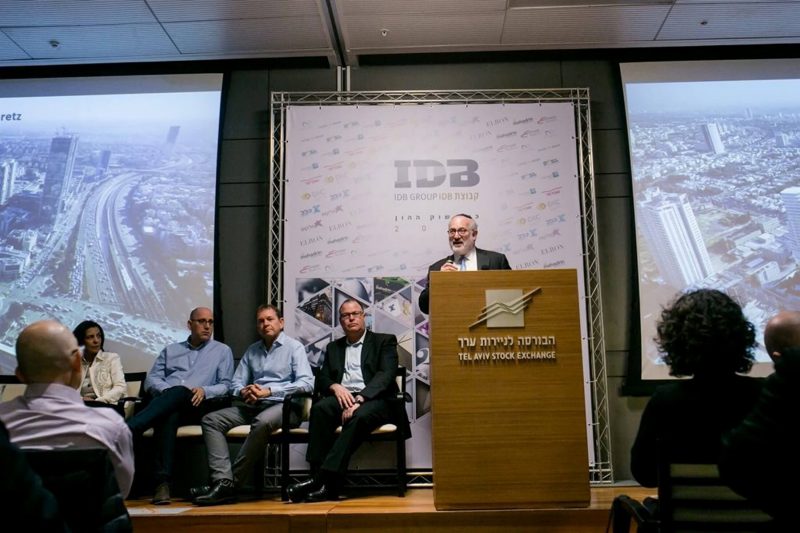
Eduardo Elsztain speaks at an IDB event in Tel Aviv, Israel, March 23, 2017. Photo | Shai Shachar
IDB is one of Israel’s largest companies and among its holdings are Israel’s largest chain of supermarkets, Shufersal (sometimes written as Super-sol); the cornerstone of the Israeli tech industry and parent company of Elbit weapon systems, Elron Electronics; Israel’s fourth largest airline, Israir; Israeli kosher dairy giant Mehadrin; and one of Israel’s largest internet providers, CellCom; among others.
Soon after Elsztain acquired control over IDB, prominent Elsztain allies took top positions at IDB subsidiaries. For instance, Matthew Bronfman — who is in business with the Rothschilds and is the son of Elsztain ally and associate Edgar Bronfman — became a top shareholder in Shufersal, while Saúl Zang — Elsztain’s longtime lawyer and an IRSA executive — became vice chairman of Elron Electronics. Elsztain’s sister Diana, who has long lived in Israel, was also placed on IDB’s board. Another person placed on the IDB board by Elsztain is Giora Inbar, who used to chair TAT technologies, an Israeli company with U.S. subsidiaries whose clients include Boeing, Lockheed Martin and the U.S. Army. In addition, Benjamin Gantz — presidential candidate in upcoming Israeli elections and former IDF chief of staff during the 2014 war with Gaza, was on the board of directors of Elron Electronics, whose chairman is Elsztain, until just this past week.
Aside from IDB, Elsztain has also — through a separate company, Dolphin Netherlands BV — increased his holdings in several other Israeli companies. These include Nova Measuring Instruments — which focuses on artificial intelligence, big data and is a key company in global circuit manufacturing — as well as Paz Oil, Israel’s largest oil and gas company. Another Israeli company in which Elsztain has sizable holdings is Magic Software, which now plays a key role in Argentine elections and will be treated in detail in a subsequent section of this article.
Though his massive Israel-based business empire is beginning to rival his Argentine empire in size and influence, Elsztain has shown in recent years that he desires to continue expanding his business interests in the Zionist state. Last January, news broke that Elsztain sought to acquire Bezeq, Israel’s largest telecommunications company, after its owner Eurocom, controlled by Israeli businessman Shaul Elovitch, was “pressured” to give up the company by some of Israel’s largest banks, including Israel Discount Bank. Notably, the controlling stake of Israeli Discount Bank is owned by Matthew Bronfman, who is also a main stakeholder in IDB company Shufersal and whose father was a close associate of Elsztain in IRSA and at the World Jewish Congress, where Matthew Bronfman has also held prominent roles.
Despite his friends in high places, Elsztain has encountered difficulty after difficulty in his efforts to acquire Bezeq as a result of Israel’s anti-centralization laws — laws that ironically had helped him take control of IDB from its previous owner. Elsztain has tried to sell off IDB’s CellCom subsidiary — Bezeq’s main rival — in order to acquire Bezeq, but without success. He has since turned his efforts to buying Eurocom’s subsidiaries piece by piece, starting with Spacecom, an Israeli satellite operator. It remains to be seen if Bezeq’s recent financial difficulties have given Elsztain cold feet or are part of a behind-the-scenes effort to weaken and then acquire the company. Given his history, both are equally plausible.
Elsztain’s ties to and influence in Israel will become increasingly important in subsequent installments of this series, as Israel’s government, as well as prominent elements of the Zionist lobby to which Elsztain is connected, have been and are involved in past and current efforts to force Argentina’s governments to relinquish Patagonia.
Elsztain representing Rockefeller, Rothschild interests in Argentina
As Argentine newspaper La Nación noted in 2005:
[Elsztain is] the Argentine businessman with the greatest [international] contacts in the business world … and, like no other Argentine, has a direct channel to many of the world’s wealthiest men, who in many cases become his [Elsztain’s] partner in local projects.”
Indeed, Elsztain and his associates are often the avenue through which international oligarchs insert themselves into Argentina’s economy and politics, first for Soros and now for much more powerful figures.
The Council of the Americas (COA) was originally founded in 1963 by David Rockefeller as the Business Group for Latin America, which two years later became known as the Council for Latin America and then the Center for Inter-American Relations before undergoing a final name change. From its founding to its current state, the COA has been the voice of the multinational corporations (and the oligarchs behind them) that represent the vast majority of U.S.-based private investment in Latin America. The organization is often described as the Latin American equivalent of the Council on Foreign Relations (CFR), which was chaired by David Rockefeller for several decades and has long been heavily funded by the Rockefeller Foundation. David Rockefeller founded the COA while serving as CFR chairman.
Rockefeller was the COA chairman from 1981 to 1992 and was honorary chairman until his death in 2017. The vast majority of the directors on COA’s board are executives of Latin American operations of major European and U.S. multinational corporations such as Shell Oil, JP Morgan, PepsiCo, Chevron, Boeing, Citigroup and Microsoft. One of the group’s chairmen after Rockefeller was John Negroponte, who was involved in the Reagan era cover-up of U.S. support for Latin American death squads and was deeply involved in the creation of the North American Free Trade Agreement (NAFTA), which was the “brainchild” of COA. Negroponte also served as U.S. ambassador to Iraq and later deputy secretary of state under George W. Bush and was the first Director of National Intelligence (DNI). Negroponte is currently COA chairman emeritus and on its board of directors.
The current COA chairman is Andrés Gulski, a former IMF official and Santander bank executive who is currently CEO and President of AES power company, which — alongside Mindlin and Lewis’ Pampa Energia — is one of the top electricity producers in Argentina. Gulski also served in Venezuela’s ministry of finance in the U.S.-backed, pre-Chávez government and more recently was on Barack Obama’s Export Council. COA’s current president and CEO is Susan Segal, a former JP Morgan executive who “was actively involved in the Latin American debt crisis of the 1980s and early 1990s, sitting on many Advisory Committees as well as serving as chairperson for the Chilean and Philippine Advisory Committees” while the former country was ruled by a brutal, U.S.-backed military dictatorship. She also received an award from Colombia’s then-President Alvaro Uribe, who once led Colombia’s right-wing narco-death squads.
While COA has long been formed and funded by Western multinational corporations, among the handful of Latin American-based companies that are both “elite” members and sponsors of the organization are IRSA and Pampa Energia. Other prominent COA sponsors include Citigroup, JP Morgan, and Soros’ Open Society Foundations. Elsztain and Mindlin are also both members of COA and are regular speakers at the annual Argentina Investment Conference that COA jointly hosts with Blackrock, the world’s largest investment management corporation. Mindlin and Elsztain also serve on COA’s International Advisory Council.
In addition to COA, Elsztain is a regular attendee of the World Economic Forum (WEF or “Davos”), as is Marcelo Mindlin. Elsztain is also a member of the Group of 50 (G50), which describes itself as “a select group of business leaders who head some of the most significant and forward-looking enterprises in Latin America.”

Eduardo Elsztain, left, with Argentine President Mauricio Macri on the sidelines of the 2016 Davos summit. Photo | Twitter
Membership is by invitation only. The G50 was founded in 1993 by Moses Naím, former director of Venezuela’s Central Bank and Venezuela’s minister of trade and industry in the 1990s, as well as former executive director of the World Bank. Naím, who still chairs G50, is also on the board of directors of Soros’ Open Society Foundations. G50 was originally founded with funding from the Carnegie Endowment for International Peace, which itself is funded by the Rockefeller Brothers Fund, the Open Society Foundations, and the U.S. and U.K. governments, among others. Naím is also on the board of directors of AES, whose president and CEO is also current COA Chairman Andrés Gulski.
While Elsztain and Mindlin are both well-connected to both George Soros and the Rockefeller-founded Council of Americas, Elsztain, for his part, shares ties with other well-known families of oligarchs: the Rothschilds and the Bronfmans. Elsztain’s close ties with the Bronfmans and the Rothschilds have largely manifested through his prominent positions at the global Zionist lobby organization, the World Jewish Congress (WJC), whose long-time president from 1981 to 2007 was Edgar Bronfman, the Seagram billionaire who was also a close friend of Elsztain and himself a key shareholder in Elsztain’s IRSA. Elsztain served previously as treasurer and chairman and is currently a vice president of the WJC and chair of the WJC business council. The WJC is currently chaired by David de Rothschild.
In addition to his connections to the Bronfmans through IRSA and WJC, Elsztain also serves on the board of Endeavor Argentina — the Argentine branch of Endeavor Global, whose chairman is Edgar Bronfman Jr.
The role of the Rothschilds, Bronfmans and WJC in the events currently unfolding in Argentina — as well as the roles of other pertinent elements of the global Zionist lobby — will be explored in detail in a subsequent installment of this series. However, it is worth pointing out that the fortunes of the Rothschilds have become increasingly intertwined with those of the Rockefellers — particularly after RIT Capital Partners bought 37 percent of Rockefeller Financial Services in 2012 — as well as those of the Bronfmans, after the 2013 creation of Bronfman E.M. Rothschild E.L. LLC.
As these powerful oligarch dynasties move closer together, the links between these families and Elsztain should be cause for concern, in light of his role and the roles of his associates in bringing economic upheaval to Argentina and then directly profiting from that upheaval. Indeed, as investigative journalist and researcher Vanessa Beeley told MintPress, Elsztain’s — as well as Mindlin’s — connections to these groups and clans of oligarchs betrays their role as the Argentine faces of these powerful individuals who seek to claim and exploit Argentina’s resources:
Elsztain and Mindlin’s close connections to a merging network of some of the most powerful globalists in the world today suggest their role to be one of sniffing out the opportunities and laying the groundwork for hostile take-over of resources and infrastructure by these elite scavengers who prey upon target nations, protected from view by the likes of Elsztain and Mindlin, who are little more than mafia outreach agents.”
Getting their hooks into the voting machines
As the influence of Elsztain, Mindlin and their associates has expanded in Argentina as well as in Israel, this small, close-knit group of powerful billionaires has now set its sights on consolidating political power in Argentina for themselves and their even more powerful backers. Though the presidency of Macri has seen their influence grow in new and troubling ways, new evidence shows that Elsztain, with the backing of the Rothschild banking family, has set his sights on Argentina’s voting system.
For the past few years, Macri’s government has been heavily promoting the need for electronic voting systems in Argentina, which it argues are needed to modernize the country’s current paper-ballot system. However — as has been seen in other countries, including the U.S., where such systems have been implemented — the results of elections run on electronic voting systems can be easily manipulated and such manipulations are effectively impossible to detect.
Election forensics specialist Jonathan Simon, author of CODE RED: Computerized Elections and the War on American Democracy, had this to say about the vulnerability of such voting systems to interference:
They’re often rushed into use with great promises of speed, convenience, and accuracy, but these fully computerized voting systems — particularly those that provide no paper record of votes cast — have turned out to be problematic, to say the least, everywhere they have turned up, including the U.S. and several European countries. In fact the trend now is to ditch them in favor of return to paper-based systems. Ireland literally turned its voting computers into landfill; Norway, Germany, The Netherlands, and gradually the U.S. have all taken them out of service.
The reason is simple: as computers, this voting equipment is vulnerable not only to outsider hacking but to insider manipulation. It is trivial to program them to add, subtract, switch votes — and this is true whether or not they are hooked up to the internet. The worst part is that there is absolutely no way of verifying or validating the election results spit out by this equipment. All the hardware and software has been ruled ‘proprietary’ — corporate property, and off-limits to inspection by anyone, including governments.”
Simon also told MintPress that electronic voting machines, in contrast to making the voting system more “transparent” as Macri has claimed, instead can be used by politicians who wish to remain in power but unaccountable for their actions while in office:
If I wanted to take over a country — stay in power despite doing things that would surely get me voted out — I could stage a coup and roll tanks down the streets of the capital. Or I could install an electronic voting system — as Macri is trying to do in Argentina and as the right wing managed to do in 2002 in the U.S. — and achieve the same result without firing a shot, without provoking outrage or resistance, and without altering people’s perception that they lived in a democracy.
When you see politicians and powerful figures in a nation pushing such concealed and unverifiable systems for vote counting, the first thing you want to do is look past the marketing campaign — the talk of ‘transparency,’ which is nonsense, speed, convenience, etc. — and ask one very simple question: ‘Why?’”
Concerns about manipulation only increase when the manufacturers and programmers of those voting systems have troubling connections to oligarchs or foreign governments. Unfortunately for Argentina, the electronic voting machines being promoted by Macri have many such troubling connections.
Since his 2015 presidential campaign, Macri has pushed for the implementation of electronic voting nationwide, calling it necessary for creating “a more transparent voting system.” By 2017, Macri’s “comprehensive” voting reform legislation, which called for electronic voting nationwide, was passed by Argentina’s Congress — only to remain essentially frozen in its implementation, as holdovers from the previous administration in the government’s bureaucracy have worked to block the nationwide shift to digitized voting. Notably, a recent poll conducted in Argentina found that 60% of respondents would never consider voting for Macri in future elections.
Though the voting systems were not implemented nationwide, they are already being used in many areas of Argentina, including the city of Buenos Aires (population 2.89 million) and the provinces of Salta (1.2 million), Córdoba (3.3 million), Chaco (1 million), Tucumán (1.4 million), Santa Fe (3.2 million), and the Patagonian province of Neuquén (0.5 million). As a consequence, despite the lack of a nationwide system, more than 25 percent of Argentina’s population already votes using electronic machines, all of which are incidentally manufactured by a single company, Magic Software Argentina (MSA).
Concerns over MSA were voiced early-on in Argentine media, such as a report published in Letra P that noted that MSA had developed a close relationship with members of Macri’s inner circle and his political party in prior years, suggesting a conflict of interest. In addition, just last week, a man attempting to use an electronic voting machine in the Nequén province filmed how the MSA-made voting machine printed out a result that was entirely different from the one he had chosen, prompting him to ask to vote again for his chosen candidate, a request that was initially denied. After the incident, several machines were found to be working improperly.
Though such reports are troubling, they barely scratch the surface of MSA and the more likely and troubling reasons why this company was given control over the democratic processes in many Argentine provinces and, if Macri gets his way, the entire country.
Magic Software Argentina was created in 1995 by Sergio Osvaldo Orlando Angelini and Alejandro Poznansky and, as noted by the Argentine outlet El Disenso, specializes in “importing, adapting and commercializing informatic systems in Argentina as well as representing and being the national face of foreign business like Magic Software Enterprises,” MSA’s parent company.
Magic Software Enterprises (MSE) was originally known as Mashov Software Export and is an Israeli software company headquartered in Or Yehuda. In 1991, the company changed its name and became the first Israeli software company to be listed on the Nasdaq. MSE has long had a close relationship with Israel’s military, the Israel Defense Forces (IDF), which was reaffirmed in 2010 when MSE was tasked with upgrading software systems for the IDF and Israel’s military police.
El Disenso noted in 2017 that MSE, as a result of having its headquarters in Israel as well as a branch in the United States, “is subject to the jurisdiction of Israel as well as North American [i.e., U.S.] courts… both countries impose strict security protocols that permit their national government[s] practically unlimited access to [company] information.”
While concerns about undue influence or meddling by either the U.S. and/or Israel are valid, an examination of the power behind MSA and its parent company MSE reveals something much more troubling, as well as just how influential Eduardo Elsztain has become.
MSE’s largest shareholders are IDB Development Corp Ltd and Clal Insurance Enterprises Holdings Ltd., and smaller shareholders include the Rothschild banking family through the firm Edmond de Rothschild Holdings. As previously mentioned, IDB Development Corp was acquired by Eduardo Elsztain in 2015. In addition, a majority stake in Clal Insurance Enterprises — MSE’s second largest shareholder — is owned by Dolphin Netherlands B.V., which incidentally is a subsidiary of IRSA, and Elsztain is chairman of its board. In other words, the most powerful and influential shareholder in both Magic Software Enterprises, and its Argentine subsidiary Magic Software Argentina, is none other than Eduardo Elsztain.
Devouring Argentina: a capitalist feast in many courses
In summary, through political connections, corruption and white-collar crime, this network of billionaires — the most visible of whom is Eduardo Elsztain — has essentially taken control of not only the bulk of Argentina’s resources — its electricity, its land, its agriculture, its water, its financial system — but also its voting system.
Yet, far from being purely an effort of powerful Argentine billionaires like Elsztain and Mindlin, control over Argentina’s economy, government, industry and land has long been a goal of powerful oligarchs dating back at least 70 years. Those very figures successfully engineered Argentina’s economic collapse in the early 2000s and then — through intermediaries close to Henry Kissinger, the IMF and the world’s largest banks — greatly pressured its government to relinquish Patagonia in exchange for “debt relief” from the economic chaos they had created.
The next installment of this investigative series will focus on Marcelo Mindlin and the interests of the Mindlin-Elsztain network in oil and gas in Argentina’s Patagonia, as well as in the contested Falkland Islands.
Whitney Webb is a MintPress News journalist based in Chile. She has contributed to several independent media outlets including Global Research, EcoWatch, the Ron Paul Institute and 21st Century Wire, among others. She has made several radio and television appearances and is the 2019 winner of the Serena Shim Award for Uncompromised Integrity in Journalism.
The Dark Secret Behind a British Billionaire’s “Parallel State” In Argentina’s Patagonia
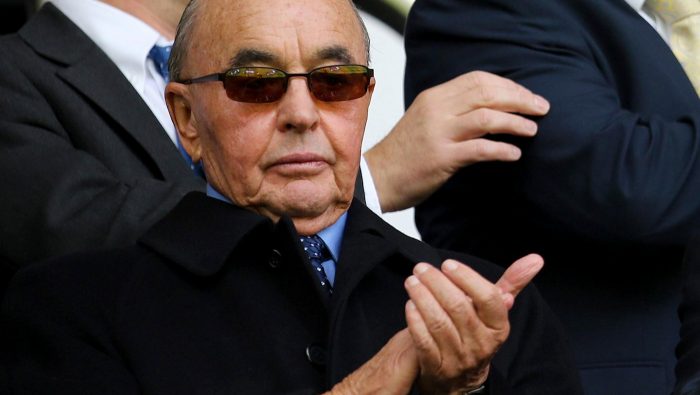
By Whitney Webb | Mint Press News | March 11, 2019
EL BOLSÓN, ARGENTINA – At the “end of the world,” spanning the southernmost regions of Argentina and Chile, lies the land of Patagonia, much of which remains a pristine wilderness that has inspired countless naturalists and would-be adventurers with its dramatic landscapes and natural beauty. For many, it is a place that still feels remarkably untouched and removed from the chaos of the modern world.
Yet, it is these very qualities, as well as the region’s great oil and gas potential and its abundance of glacier-fed freshwater reserves, that have placed it in the crosshairs of predators — predators armed with billions of dollars, powerful influence over Argentine politics and the country’s press, as well as alliances with controversial international financial organizations and key elements of the global Zionist lobby.
Coveted for its still largely unplundered resources, Patagonia has become the target of a close-knit network of notorious billionaires and global elites, who have spent much of the last two and a half decades seeking to transform this area into their own independent state.
Indeed, though several of these billionaires have already created de facto private states where they enjoy near-total impunity within Argentine Patagonia, others have been behind major efforts that have pushed for the territory’s secession. Still others have pushed Argentina’s government to exchange its claim to Patagonia for “debt relief” as a way of easing Argentina’s economic plight that, incidentally, was largely created by this very same group of billionaires. The International Monetary Fund (IMF), whose connections to this billionaire network are considerable, has had an outsized role in this effort.
Yet this appears to be more than just a venture on the behalf of notable oligarchs and the global elite, as prominent elements of the international Zionist lobby are intimately involved, as is the state of Israel, though the extent of the involvement of the latter is subject to debate. Their interest revolves around claims that date back to the founding of Zionism in the 19th century, when revered Zionist figures like Theodore Herzl discussed Argentina as a potential homeland for a Jewish ethno-state.
Since then, other notable Zionists, including past Israeli ambassadors to Argentina, have argued that Israel is for “European Jews” while “American Jews” must take Argentina for themselves. Notably, the method suggested by Herzl as a means of creating a Zionist state in his seminal work “The Jewish State” involves the exchange of debt for territory.
In the first part of this investigative series, MintPress explores the de facto independent state that has been created by British billionaire and Zionist Joe Lewis, a long-time associate of controversial Hungarian-American financier George Soros. Lewis has essentially bought out the local, regional and even national government of Argentina, allowing him to operate with impunity while he acquires more and more territory through land purchases of dubious (if any) legality, intimidates and threatens locals, usurps crucial water and energy resources from local towns, and operates his own international private airport that no one but he controls.
Subsequent reports in this series will examine the other key players in this effort to create a Patagonian state, namely Argentine oligarchs Marcelo Mindlin and Eduardo Elsztain, who are both deeply connected to the global Zionist lobby and the Rockefeller-founded Americas Society, and are also both close Soros associates. Finally, the role of these individuals and their associates in efforts to use IMF debt slavery to pressure the Argentine government to swap debt for territory will be revealed, as will the role of the Zionist lobby and prominent figures in the global elite.
The town that fought back
The quaint mountain town of El Bolsón, nestled among the picturesque rocky peaks of Argentina’s Patagonia and famed for its local legends of gnomes and elves, may seem an unlikely epicenter in a nationwide battle that has pitted locals against powerful foreign billionaires — billionaires who are not only plundering the country’s rich resources but eroding its national sovereignty through backdoor deals with Argentina’s most powerful, and most corrupt, political leaders.
Yet, however unlikely the role of this sleepy town in Argentina’s Río Negro province may seem, for over a decade many locals have used every tool at their disposal to oppose one billionaire’s effort to turn the town and much of Río Negro into his own personal fiefdom. This struggle has seen massive demonstrations in El Bolsón against British billionaire Joe Lewis, with some attracting as many as 15,000 participants – nearly 80 percent of the town’s entire population.
Lewis, worth an estimated $5.2 billion according Forbes, is best known in the West for owning the British Tottenham Hotspur football club, his sprawling luxury estates and golf resorts in the Bahamas and Florida, and owning well-known brands including Puma sportswear and Vans shoes. He is often described as a “self-made” billionaire, having been born to a poor Jewish family in London, who worked his way up to become one of England’s richest men.
Since the mid-1990s, Lewis has been building an empire in Patagonia, having become the owner of extensive properties north of El Bolsón — which, among other things, contain almost all of the town’s water reserves, as well as those of the nearby farming community, Mallín Ahogado — and the de facto power behind Pampa Energía, the company controlling most of Argentina’s electricity production. Part Two of this series will focus on Lewis’ role at Pampa Energía, as well as that of his associate, Marcelo Mindlin.
The “self made” man made by Soros
Long before his venture into Argentina, Lewis was a controversial figure owing to his close association with controversial Hungarian-American financier George Soros. Indeed, the bulk of Lewis’ massive fortune derives from his decision to “team up” with Soros to bet against the British pound in 1992, a day popularly known as Black Wednesday.
Soros’ and Lewis’ bet against the pound actually led to the pound crashing, after Soros ordered his hedge fund to “go for the jugular” and aggressively trade against the currency, thereby prompting its sharp devaluation. Though Soros is often called “the man who broke the Bank of England” as a result of the $1 billion in profits he made on that fateful day, Lewis is said to have made an even larger profit than Soros, according to several reports.
While Soros became a financial celebrity after Black Wednesday, Lewis opted to stay out of the limelight even though, just three years later, he would repeat what he helped do to the British pound with the Mexican peso, reaping yet another massive profit. While the Mexican peso crisis made Lewis even wealthier, it led to a massive jump in poverty, unemployment and inequality in Mexico and left its government beholden to the International Monetary Fund (IMF) through a loan package arranged by then-U.S. President Bill Clinton.
Between 1995 and 1996, the severe economic recession that followed the Mexican peso crisis spread throughout the Americas and “severely affected” the economies of other Latin American countries like Argentina. As fresh economic havoc arrived and took hold in Argentina, Lewis decided to take advantage of the troubled regional economic climate that he himself had helped create and began developing his interests in Patagonia.
As will be explored later in this investigative series, Soros and two of his Argentine associates who are also connected to Lewis — Eduardo Elsztain and Marcelo Mindlin — took advantage of this economic crisis and subsequent crises to buy major stakes in several banks as well as massive tracts of Argentine real estate, particularly in Patagonia.
How to build an empire
In 1996, Joe Lewis returned to Argentina after initially visiting the country in 1992 at the invitation of Australian media tycoon Kerry Packer. Lewis, apparently inspired by his first visit, had decided to buy property in the area. According to regional media outlet El Patagónico, Lewis’ dream was not just owning his piece of paradise, but creating “his own state in Patagonia.”
Lewis soon came into contact with Nicolás Van Ditmar, who would not only facilitate Lewis’ initial and subsequent land purchases in Argentina’s Patagonia but would also do so for several other foreign oligarchs. Van Ditmar had previously arranged massive land sales farther south to the Benetton Group, the family company run by the Italian oligarchs of the same name, best known as the owners of the United Colors of Benetton clothing company.
Van Ditmar, after learning of what Lewis hoped to acquire, spoke to him of the property of the Montero family, which encircled a pristine mountain lake known as Lago Escondido (Hidden Lake). Most of the members of the Montero family agreed to sell their collective property of around 14,000 hectares (~34,549 acres) to Lewis for $7 million. However, one of the Montero brothers, Irineo Montero, had refused and he, along with his wife María Ortiz and their employee José Matamala, were all found dead under mysterious circumstances.
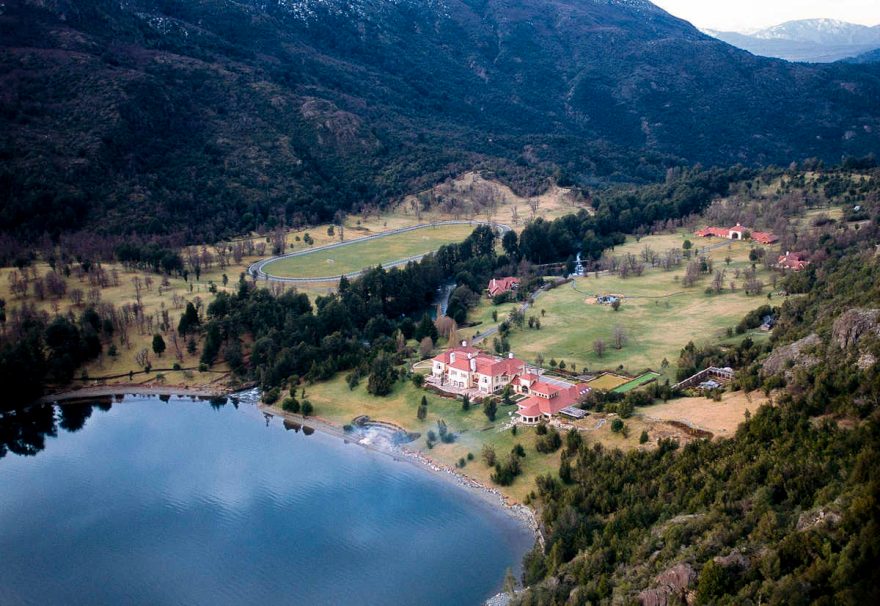
An aerial photograph Joe Lewis’ ranch on Hidden Lake, March 1, 2010 in southern Patagonia, Argentina. Francisco Bedeschi | dpa
Whether or not Lewis or his “right hand man” Van Ditmar were somehow involved in Irineo’s death and those of his wife and employee, there is no denying that their mysterious yet grisly endings cleared the way for Lewis’ purchase of Lago Escondido and the surrounding area. However, Lewis’ acquisition of this property, irrespective of the remaining Montero siblings’ willingness to sell, should never have been allowed for several reasons.
First, as per Argentine law, the sale of the property that Lewis has owned since 1996 is prohibited to a foreign citizen on national security grounds, given that the property is just 20 km from the Chilean border and thus, in foreign hands, could represent a grave national security risk. Second, it violates a local law dating back to 1969 that caps the maximum amount of land that any individual – Argentine citizen or foreigner – may own at around 70 hectares (~172 acres).
Third, it violates a provincial law passed in 1994 that created a protected natural area called the Río Azul Lago Escondido Natural Protected Area (ANPRALE), which included a significant portion of the land that Lewis would later buy from the Monteros. However, that law was amended in 1998, a few years after Lewis’ purchase, to remove the portion of his land that had previously been named a protected area under the control of the state. Federico Soria noted that the way in which the 1994 law was amended was blatantly unconstitutional.
One would think that the law would have prevented Lewis’ acquisition of the land long before Van Ditmar had first approached the Monteros about Lewis’ interest in the land. However, he was explicitly allowed to do so, despite the illegal nature of the purchase, owing to the general laxity of the local, regional and federal authorities towards wealthy foreigners looking to acquire Argentine land. As Lewis himself said in an interview with Gonzalo Sanchez in 2004, “I bought what they let me buy and here we are.”
The two-term presidency of Carlos Menem in the 1990s marked the reversal of more than 50 years of keeping and protecting areas of national importance and deemed strategic to natural security by permitting foreigners to buy a larger percentage of land than had been allowed since the passage of a 1944 law intended to preserve the territorial integrity of Argentina. Notably, when that law was created, the government of Edelmiro Farrell and Juan Perón expropriated several strategic properties owned by foreigners.
Yet, Menem’s presidency — which was thoroughly aligned with the “Washington consensus” — began, according to critics, violating the spirit of this 1944 law by issuing approvals of several million hectares to foreigners. Menem’s policies favoring foreign land purchases in rural areas have since been expanded by the presidency of Cristina Fernandez de Kirchner as well as that of the current president of Argentina, Mauricio Macri. Both of them have “friendly” relationships with Lewis and his associates, with the Macri a regular visitor of Lewis’ lakeside property in Patagonia.
Locals in El Bolsón have claimed that Lewis’ purchase of the Lago Escondido property – despite the legal obstacles – was the direct result of Menem’s policies. A member of El Bolsón’s community radio station FM Alas, who chose to remain anonymous owing to his father’s personal involvement in Lewis’ regional businesses, told MintPress that Lewis “had negotiated the purchase of the [Lago Escondido] property in meetings at the Casa Rosada [Pink House],” the Argentine equivalent of the White House, during Menem’s presidency.
MintPress was unable to confirm whether Lewis or his associates had visited the Casa Rosada while negotiating the property’s purchase. Yet Lewis has stated in interviews that “Menem sent us greetings and his best wishes when we opened [Lewis’ Lago Escondido mansion]” (Sanchez interview, pg. 61). Furthermore, Lewis has a notable habit of building close relationships with powerful Argentine politicians, including Macri. Macri has called Lewis “a friend,” defended him repeatedly, and even personally vacationed at Lewis’ Lago Escondido property.
The battle for Lago Escondido
Ever since his arrival to the area caused concern among some locals, Lewis has sought to win the good graces of the people of El Bolsón by acting as their benefactor — donating hospitals, building soccer fields and hosting annual activities and sporting competitions for locals at his property. This altruism is either embraced or rejected by locals, depending on whom you talk to. In keeping with the image that he has sought to cultivate among the townspeople, Lewis is often referred to as “Uncle Joe,” though it is spoken with either respect and admiration or derision and disgust.
Felicitas Libano, a member of the Assembly for the Defense of Water and Land (ADAT), told MintPress that Lewis has “integrated himself into nearly all the function of the city,” including its firefighters, police and other areas of the municipal government, and has “always tried to position himself as a benefactor.” According to Guido Augello, a member of local community radio station FM Alas, the townspeople are divided somewhat evenly into “people that like ‘Uncle Joe,’ people who hate him and people who don’t care.”
Lewis has also won over a portion of the townspeople and local businessmen through his patronage of select local services and his occasional hosting of small groups of locals for invitation-only sporting events and holiday celebrations. However, some have contended that Lewis receives many foreign guests, particularly from Israel.
According to the research of former French intelligence officer turned journalist Thierry Meyssan, Lewis has been inviting thousands of Israel Defense Forces (IDF) soldiers to his territory annually. In late 2017, Meyssan alleged:
Since the Falklands War, the Israeli army has been organizing ‘holiday camps’ in Patagonia for its soldiers. Between 8,000 and 10,000 of them now come every year to spend two weeks on Joe Lewis’ land.”
It is unclear if Meyssan’s information was the result of his time in France’s exterior intelligence service DGSE or independent research he conducted since becoming a journalist, as MintPress’ efforts to contact Meyssan were unsuccessful. Locals, journalists and researchers interviewed by MintPress could not confirm Meyssan’s claims. Yet, many of these locals and researchers said they had heard of those claims from other sources within Argentina, but also noted that they were speculative, given that no one but Lewis or his employees knows who visits the property beyond the aforementioned events where select locals are invited to attend.
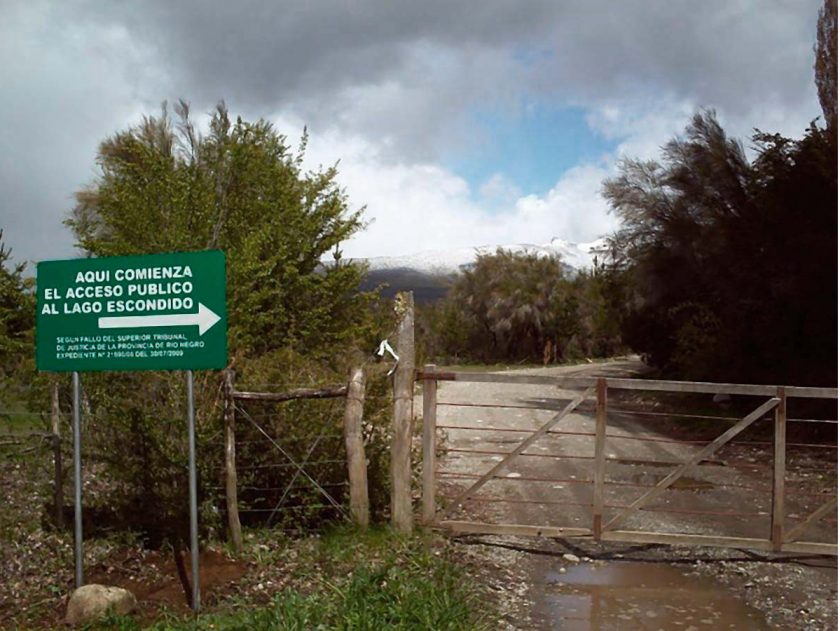
Tacuifi road leading to Lago Escondido, now blocked to public access, lies off of Argentina’s Route 40. The sign notes the 2009 Supreme Court ruling demanding the still-closed road be opened to the public. Photo | Revista Anfibia
Beyond the alleged IDF “vacations” on Lewis’ land, his presence in the area has been controversial for other reasons, namely for concerns that he sought to usurp key regional resources. Indeed, journalist Gonzalo Sanchez noted in his 2004 book Patagonia Sold: The New Owners of the Land :
In El Bolsón, there are more than a few locals and city council members that believe that, behind his [Lewis’] generosity, there are other hidden objectives, like the possible control of the water reserves of this part of Patagonia (pg. 50).”
Inklings of the truth in relation to these concerns were evident as soon as Lewis acquired the property surrounding Lago Escondido. This large mountain lake, which Lewis’ property surrounds, is the water basin for two important regional rivers, the Manso and Puelo, which later unite in Chile and drain into the Pacific. It is also the lake which feeds other nearby lakes including the Soberanía Lakes and Montes Lake, among others. Lago Escondido itself is estimated to contain as many as 400 billion liters (~105 billion gallons) of freshwater.
In Argentina, as is also the case in neighboring Chile, water – whether in lakes, rivers or seas – is a public right and public access to all bodies of water is guaranteed by law. This legal concept — likely foreign to Lewis and other Westerners, whose home countries often enshrine private property rights over the public’s right to vital resources — has been the most visible way in which tensions between Lewis and locals have manifested. It was also the first real test of Lewis’ resolve to carve out his “independent state” in Patagonia and keep locals out.
Lewis closed off the public road from the highway to the lake and also closed the private road he built at a separate point from public access. According to several locals interviewed by MintPress who had tried to enter the area, private security in civilian clothing prevent people from using the roads either by vehicle or on foot. Federico Soria, who has himself tried to enter the area on several occasions, described the guards to MintPress as “intimidating” and “aggressive” and also said that the Montero family, the old owners of the land, block one of the roads before it enters Lewis’ property and are “heavily armed.”
The only remaining path is a steep – and in places, dangerous – mountain path that takes at least two days in each direction to traverse. The path is poorly marked and maintained and is only usable in summer, as it is blocked by snowfall in other seasons. Every person interviewed by MintPress who had seen or traversed the path described it as being suitable only for “experienced mountaineers.”
In 2009, Lewis suffered his first major defeat in his efforts to keep locals out of his “parallel state” when the regional court ruled that the Tacuifi road — which connects the lake to the main highway, Route 40, and crosses Lewis’ property — be opened. The ruling stated that this must be done in order to “ensure access to Lago Escondido with appropriate signaling and ensuring transability.” The court gave Lewis 120 days to comply.
However, he didn’t comply and instead his regional associates began openly threatening any who tried to visit “his” lake. The clearest threat came from Van Dittmar himself in 2011, when he publicly stated that he and other Hidden Lake S.A. employees would defend Lewis’ private property by “fighting with blood, if we have to.” Van Ditmar also said that he would keep locals from accessing the lake “with a Winchester [rifle] in hand, with blood if necessary.”
In 2012, the region’s Supreme Court upheld the 2009 ruling, as did Argentina’s national Supreme Court a year later. However, Lewis and Van Ditmar refused to open the Tacuifi road, Van Ditmar saying that the treacherous but “very pretty” mountain path should instead be used to access the lake. Argentine President Macri also stepped in and echoed Van Ditmar, stating that the lake is even more accessible than before Lewis bought the property.
The court battle continues to today, after the Supreme Court of Río Negro in 2016 withdrew its previous ruling and ordered that a new hearing with different judges issue a new ruling. Critics accused Lewis of using extreme “political pressure” at the regional and local level in order achieve this very surprising ruling.
Despite that, locals continue to fight for public access to Lago Escondido and defend Argentina’s sovereignty over Lewis’ private empire. The main manifestation of this effort is an annual “March for Sovereignty,” the most recent of which took place in early February of this year. The march is organized by the Foundation for the Cultural Integration and Promotion of Water (FIPCA), which is run by former Argentine marine Julio Cesár Urien. Like the prior marches of the same name, its participants walked for nearly three days on foot over the mountain trail to arrive on the shore of the lake, which – as mentioned above – they were within their legal rights to do.
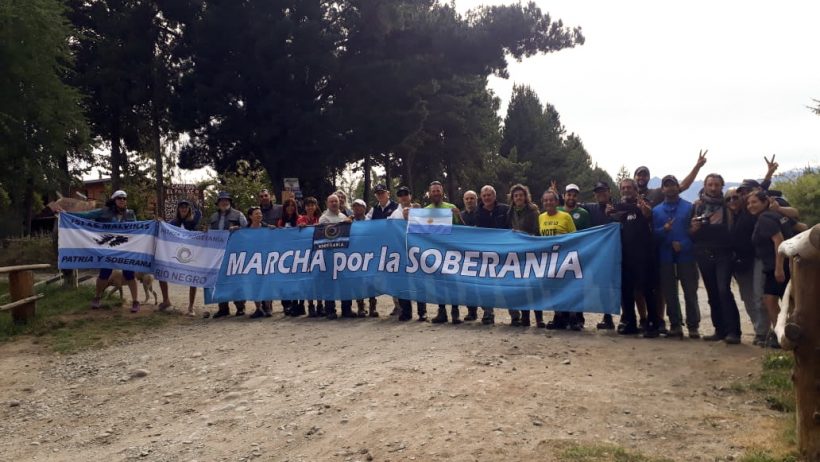
Participants in the 2019 “March for Sovereignty” pose for a picture at the beginning of their several-day journey to reach Lago Escondido by foot. Photo | FIPCA PRENSA
Upon arriving, they were met by Lewis’ private security as well as members of the Río Negro police, who cornered them and told them that they couldn’t even go to the bathroom without fear of arrest for trespassing, even though lakeshores are also legally considered public spaces. Guillermo Martín Caviasc — a journalist for Barricada TV, who was present at the demonstration — called the combination of local police and private security Lewis’ “private army” and remarked that the police officers present were “in a situation of subordination like if they were visiting a foreign state controlled by Lewis.”
Two participants in the march, Andrea Gatabria and David Ramallo, mounted inflatable kayaks with the intention of placing an Argentine flag in a small island in the middle of the lake, itself technically a public space. Before they made it to the island, two speedboats belonging to Hidden Lake S.A. circled the kayaks in an effort to capsize them while taunting them, asking “Do you know what it’s like to die from hypothermia?”
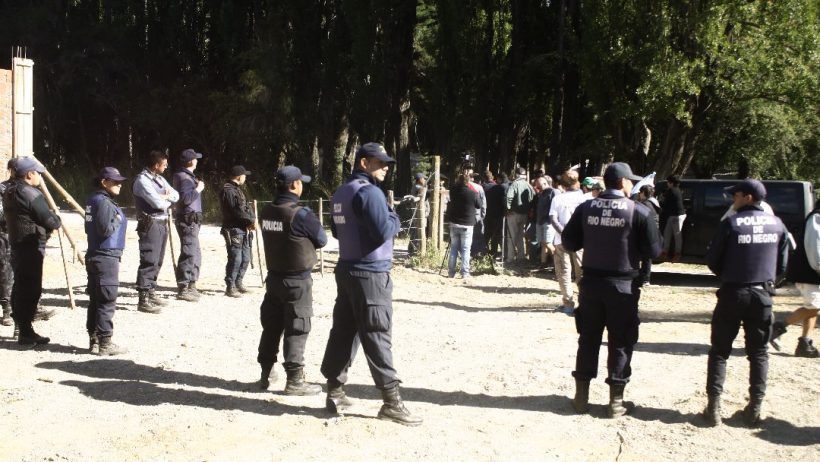
Participants in the 2019 “March for Sovereignty” pose for a picture at the beginning of their several-day journey to reach Lago Escondido by foot. Photo | FIPCA PRENSA
After half an hour of taunts that seemed more like death threats, Lewis’ private security knocked over the kayaks, leaving Gatabria and Ramallo floating in the freezing water. After several minutes, several witnesses stated that one of the security guards told the two kayakers “Well, now do you see what it’s like to die of hypothermia?” Gatabria and Ramallo were, after some time, lifted into the guard boats, but had spent so much time in the frigid water that both had to be hospitalized.
National Senator for Río Negro, Magdalena Odarda, demanded accountability for the actions of Lewis’ private security and local police and FIPCA has begun legal action against Hidden Lake S.A. for threatening the lives of march participants. Neither Hidden Lake S.A. nor Lewis’ Tavistock Group, which oversees his business interests in Argentina and elsewhere, responded to MintPress inquiries regarding the incidents against march participants.
While Argentines have routinely experienced intimidation and aggression when attempting to access the lake, some foreigners have had very different experiences. Take, for instance, Scott Leahy*, an American now living in Chile, who, during a past trip to El Bolsón, was able to waltz right through onto Lewis’ Lago Escondido property when he was in the company of two ex-IDF soldiers who had been there before.
Leahy told MintPress that when he was backpacking through Argentine Patagonia in 2010 with a Chilean friend, he had met and become friends with two young Israelis who had recently finished their service in the IDF and were staying at the same youth hostel. One day, these two Israelis offered to take Leahy and his friend to what they called a “secret beach” nearby.
They all piled into a car and, upon taking a gravel road off of Route 40, arrived at a gate that Leahy confirmed to MintPress was the Tacuifi road entrance to Lewis’ Lago Escondido property (seen in an image earlier in this report). Leahy was unsure about continuing, given that the gate was closed and, as a foreigner, he was unfamiliar with the area. However, the Israelis urged him on, saying that they had been there before and knew where they were going.
When the group of backpackers encountered Hidden Lake S.A. employees and guards, the Israelis explained that they were from Israel and wanted to bring their friends to the beach. The Lago Escondido employees told the pair that the group was not officially allowed to enter the property, but they could pass. Leahy didn’t think anything of it at the time, and told MintPress that he had assumed the pair knew the owner, though the Israelis never mentioned Lewis at all and they showed no interest in meeting with him either. This suggests that they were not personal friends of Lewis, but also shows that they knew that they could access the lake without problem, even in the absence of a formal invitation.
While this anecdote suggests that the claims of Lewis hosting thousands of IDF soldiers annually may indeed have something to them, it also serves as a very troubling comparison to the way Argentines have been treated when trying to access the very same lake. Indeed, if foreigners, Israelis in this case, were amicably waved through despite no invitation from Lewis or Hidden Lake S.A., why are Argentines who try to do the same met with such violence and aggression, particularly when they have a legal right to do so?
Stealing El Bolsón’s resources for his own use
Though public access to Lago Escondido has been a major issue of contention between Lewis and the people of El Bolsón since the late 1990s, concerns that the British billionaire was intent on controlling the region’s water supply multiplied when firms connected to Lewis began to move forward with what is often referred to as simply the “Laderas project.”
As early as 2004, a man named Cipriano Soria started telling his neighbors that he had “sold” his land in an area known as Pampa de Ludden (Ludden’s Plain) to Lewis. However, Soria did not technically own the land, which was a publicly-owned nature reserve, but was granted an easement by the provincial government of Río Negro to use its meadows to graze his livestock as long as he paid a “grazing license.” Despite the fact that it was neither legally nor properly sold to Lewis, Lewis began to make plans for the land — plans that ignored the fact that the area was and technically remains under several legal protections due to its ecological and strategic importance to the region.
Lewis intended to use this land to build a private airport in the area but was met by strong local resistance in 2005, including from the local group Assembly for the Defense of Water and Land (ADAT). Several members of ADAT live in Mallín Ahogado next to Pampa de Ludden, which provides the adjacent farming community of 2,000 with nearly all of its water. Felicitas Libano, who lives in Mallín Ahogado, told MintPress that the importance of this area as a critical water resource — as well as its ecological importance as an old-growth native forest — led it to be named a nature reserve that was supposed to be prevented from falling into private hands.
ADAT’s eforts were successful and Lewis’ plan for the area seemed to have been defeated or, at least, put on hold. Then, in 2009, the town voted on Lewis’ private airport, with more than 79 percent of voters opposing it. However, unluckily for the people of El Bolsón, Lewis had much bigger plans than just an airport and he wasn’t planning on letting local democracy get in his way.
From 2006 to 2009, legal arrangements were made between the ski center’s owner, the Club Andino Piltriquitrón, and the provincial government that opened up the local ski center at the Perito Moreno mountain to “third party” management.
Then, in 2009, Mirta Soria, Cipriano’s daughter, “inherited” the land from her father — land that he technically did not own yet was somehow granted permission to purchase from the state, along with another protected territory between Pampa de Ludden and the ski center, even though the state was forbidden from doing so by regional and local laws. Just six months after she bought this territory and sold more than half of it to Van Ditmar’s brother-in-law Samy Mazza. This new and very large area under Van Ditmar/Lewis control is where El Bolsón’s, in addition Mallin Ahogado’s, water reserves are located.
Soon after the land purchase occurred, two businesses appeared — Laderas of Perito Moreno Association S.A. and Laderas of Parallel 42, both of which are directly connected to Lewis and were given ownership of the lands in Pampa de Ludden and the other area recently purchased by Van Ditmar’s relative. That same year, both of these linked businesses proposed a “lottery” whereby the provincial government would select a private company to manage the local ski center. Laderas of Parallel 42 won the lottery.
Subsequently, the other Laderas company, Laderas of Perito Moreno, began plans to transform the land illegally acquired by Van Ditmar’s brother-in-law, Samy Mazza, as well as the portion still owned by Mirta Soria into a luxury subdivision of more than 1,000 luxury homes for wealthy Argentines and foreigners, along with a golf course, shopping centers, an artificial lake, and a private airport. This planned venture was subsequently promoted by pro-Lewis businessmen and media outlets as necessary for the successful development and improvement of the ski center.
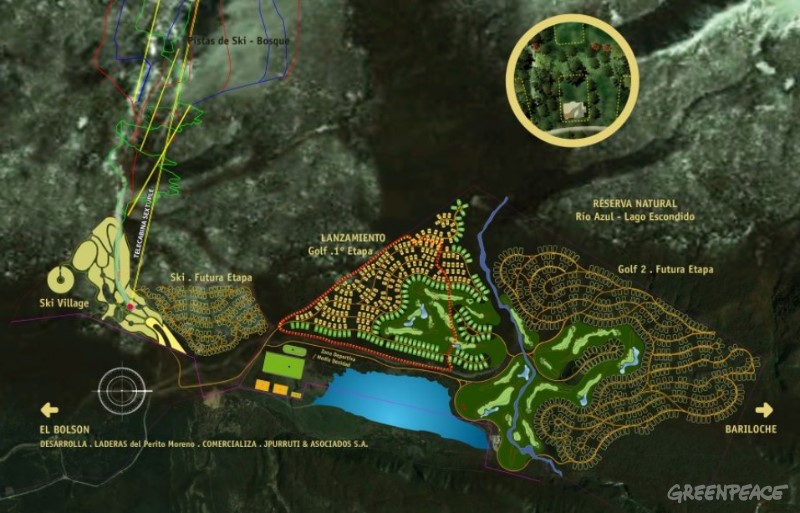
Proposed plan for the Laderas project, a 1,000-home luxury subdivision complete with an artificial lake and a golf course. Lewis’ firm plans to place the private airport (not shown in this image) south of the lake. The project, located right in the center of a nature reserve, is connected to Lewis’ Lago Escondido property and sits atop El Bolsón’s water reserves.
With the court battle underway and the project still lacking approval from El Bolsón’s city council, the regional governor, Alberto Weretilneck – a well-known Lewis ally – teamed up with Lewis-associated local businessmen in an effort to strongly pressure El Bolsón’s mayor at the time, Ricardo García, to sign a pledge that, once legal issues were resolved, the project would be fast-tracked for approval. García refused and Weretilneck along with other Lewis associates in the area began to push for his resignation. However, local protests kept García in power and, before leaving his post as mayor, García issued a decree that temporarily prohibited the Laderas project from advancing.
Clearly unhappy with this turn of events, the Laderas firms challenged the suspension of the project in court. Around this same time, members of local groups that had opposed the Laderas project reported several incidents of violence and intimidating acts, including threatening phone calls, their cars being set on fire, and the burning of a radio station as well as a community center in Mallín Ahogado.
In the case of architect and local politician Luis Martin, he was threatened with “lynching” by two Lewis associates – local businessmen Juan Carlos Martínez and Fabián Tornero – and his home was later broken into by armed thugs, one of whom accidentally cut himself with his machete and later fled the scene. Before escaping, the man had told Martin, “They have you targeted, they are going to kill you.”
In a 2011 article in Tiempo Argentina, Martínez referred to Lewis as “my friend” and was noted as a regular participant in meetings with Van Ditmar. The same article goes on to note that, in those meetings with Van Ditmar, Tornero is “influential” and further notes that Tornero is a known associate of Lewis.
In 2015, after García’s decree was challenged in court by Lewis’ firms, a judge ruled that the decree was legal but had not been written properly and therefore cancelled it. Soon after, a new pro-Lewis mayor and city council took charge and quickly signed a legal agreement with the Laderas companies, allowing them to build a “smaller project,” while claiming that any attempt to block the project – as García had done – could lead to another costly, lengthy legal battle that the municipal government just couldn’t afford. However, as Guido Augello told MintPress, this was hardly accurate, given that the local government could have appealed the decision regarding the decree, suggesting that this was just a convenient excuse to fast-track the project.
A few months after signing this agreement with the Laderas firms, the city council held a public hearing at which the vast majority of attendees from the community overwhelmingly rejected and criticized the project. Not getting the response it had hoped for, the council held a “secret” extraordinary meeting — secret because they declined to give the public the required notice needed to register to attend and participate in the meeting. With no one having registered, Pogliano decided to keep the meeting “closed” and placed police officers at the entrances to keep the townspeople out by force. The council subsequently decided to approve the Laderas project. Angry locals moved to occupy local government buildings in response, where they were targeted by riot police with tear gas.
The move generated several large-scale protests in El Bolsón, which started in 2016 and continued into 2017. Local resistance to the actions taken by the city council and mayor in relation to the Laderas project included a citizen occupation of the main plaza for three months, which was subject to police intimidation and violence, as well as three major protests, including the largest in El Bolsón’s history. That march against the Laderas project attracted an estimated 10,000 to 15,000 participants — quite a feat considering that the town’s urban and rural population boasts little more than 25,000 total inhabitants.
The reason for this mass mobilization, according to Augello, was that “even many of the people that like Lewis or believe his ‘Uncle Joe’ image oppose the Laderas project” and its associated airport. It’s not hard to understand why, considering that electricity and water intended for the townspeople of El Bolsón could soon be diverted to the wealthy outsiders who buy homes in “Lewislandia,” a derogatory term used to describe the Laderas project by some locals.
Yet, not only does Lewis intend to privatize El Bolsón’s water reserves, he and those developing his Laderas project also plan to divert the tourism that keeps its economy alive by instead diverting traffic from the main highway (Route 40) into his newly planned “city,” according to Federico Soria, a member of the Union of Patagonian Assemblies who has extensively researched Lewis’ local businesses. In an extensive 2016 article on the Laderas project and other Lewis-linked ventures, Soria wrote:
It is the intention of the developers of Laderas to unite the complex to Route 40 through two paved roads that they plan to build north and south of El Bolsón…. The Laderas variant road would be an advantageous shortcut [around El Bolsón].… [This] would benefit Lewis but economically endanger the community of El Bolsón…”
Furthermore, in 2016, Lewis completed a hydroelectric plant on the Escondido River — in the name of another of his local firms, Patagonia Energía — which passes through his property and feeds into the lake of the same name. However, he was granted permission to do so only if he connected the plant to El Bolsón in order to help the town resolve its ongoing and highly problematic electricity shortages. Once the plant was connected to El Bolsón, Lewis would become the main electricity provider to El Bolsón, as its current, aging diesel generators would be shut down.
Yet, instead of following the planned route for the power line that would give power to El Bolsón, it was diverted to the planned zone for the Laderas project, where it has remained “stopped” for years, even though his license to use the river for electricity production expired in 2015 owing to his company’s failure to connect the plant to El Bolsón in the time allotted by the license. As in so many other cases, Lewis and his companies have suffered no repercussions and continue to use the river for private power production. This situation has led some locals to speculate that Lewis has no intention of ever providing hydroelectric power to El Bolsón and it is instead a resource being guarded especially for his planned Laderas villa.
In effect, Lewis and his local representatives are working the resources they have acquired — water, electricity and tourism traffic — away from the town of El Bolsón and to the new “luxury” town of Laderas they hope to build to its north, a town that is an extension of Lewis’ own “independent” state. If this project is allowed to be completed, the people of El Bolsón will face a new troubling reality of resource insecurity and see its economy falter, as a crucial stream of revenue is diverted to the personal pet project of a foreign and predatory billionaire.
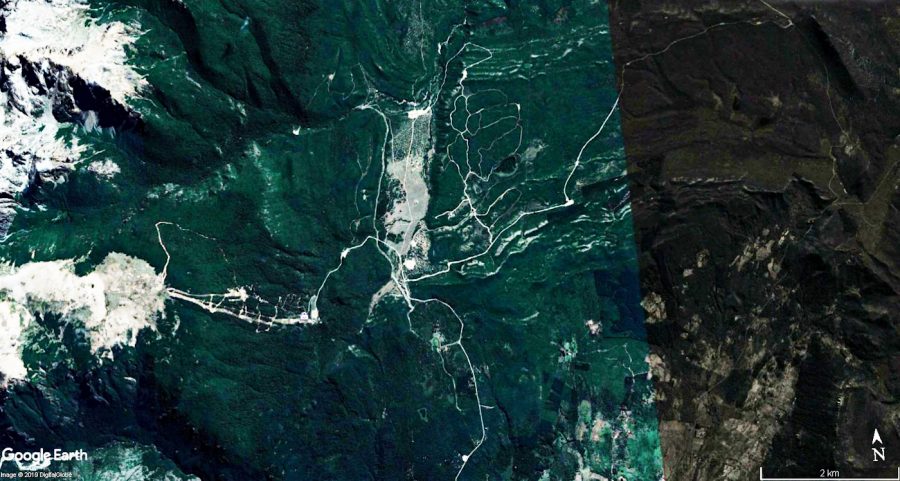
A satellite image taken last August shows land owned by the Laderas companies (center of photo) Roads for the planned “mini-city” are already being built, despite the fact that the companies are still not legally authorized to begin construction due to ongoing litigation. The already present ski center is seen on the left. Photo | Radio FM Alas, El Bolsón, Argentina via Google Earth
Yet, though Lewis won that particular battle in 2017, he is far from winning the war. Soon after the scandalous way in which the project was approved, the project again found itself challenged in court — placing it in legal limbo, unable to advance. Though the project is supposed to be blocked from moving forward until the conclusion of this latest legal battle, satellite images taken last August and shared with MintPress by local radio station FM Alas (shown above) reveal that Lewis’ businesses have already begun construction on the Laderas project, a clear indication that Lewis and his associates expect their impunity to continue.
Lewis’ Tavistock Group did not respond to MintPress inquiries about the Laderas project or the satellite images shown above.
The Joe Lewis “International Airport” — off-the-radar (literally)
Lewis’ “irregular” acquisition of Lago Escondido, the Laderas property, and his use of private security to block civilian access to the lake that is — by law — public property have long been decried as flagrant affronts to Argentina’s national sovereignty. Yet, while Lewis’ activities in and around Lago Escondido certainly do undermine existing Argentine laws, it is another Lewis-linked property in the Río Negro province that has done far more to erode Argentina’s national sovereignty.
Though Lewis’ plan to build an airport in Lago Escondido was technically approved but has not been able to move forward, Lewis – through his foreman Van Ditmar – purchased a sizeable property at the same latitude as Lago Escondido, but hours away on the Atlantic Coast. The property would soon become the site of Lewis’ private airport as well as a beachfront mansion. That airport, located south of Playas Doradas, was completed in February of 2008 and local media noted that its construction was “systemically hidden” from the public and was not subject to environmental impact assessments as normally required by law.
Most notably, however, there has never been any presence of Argentine customs or any other form of Argentine government control over what or who flies into or out of that airport, even though the airport is capable of receiving international flights. This point is particularly concerning in light of allegations that Lewis receives thousands of IDF soldiers annually on his property.
Joe Lewis’ private airport as seen on Google Maps
Furthermore, the Defense Ministry of Argentina has confirmed that not only is there no formal state control over what lands or takes off from this private airport, but that there are no radars in the area that even allow Argentine authorities to track nearby flight movements, including those of international flights. This means that no one but Lewis and his associates knows for sure how many flights land or take off from this area or where these flights originate or their intended destinations.
More shocking still, in 2010 then-Defense Minister Nilda Garré, in responding to a complaint from local politicians over the flagrant illegality of the airport, defended the airport’s presence by stating that it “could be used to facilitate rapid assistance of the state to locals in the event of disasters or emergencies.” To date, in the more than 10 years of its operation, it has never been used for any such purpose, according to those interviewed for this report.
The airport in Playas Doradas is roughly the same size as the airport in San Carlos de Bariloche (though some say it is larger), and is capable of receiving at least two large commercial-size passenger planes at a time. Much as with Lago Escondido, public access to the airport is denied, owing to the fact that the sprawling 15,000 hectare (~37,065 acres) property surrounding the airport is privately owned by a front company called Bahía Dorada S.A., which itself is legally owned by Lewis’ “foreman” Van Ditmar. However, the airport itself is owned by Westwind Aviation S.A. (formerly owned by Tavistock Aviation Argentina S.A., a subsidiary of Lewis’ Tavistock Group. Westwind Aviation S.A. is based at Lewis’ Lago Escondido property, as is Bahía Dorada S.A.. Neither Westwind Aviation S.A. nor the Tavistock Group responded to inquiries from MintPress regarding the lack of Argentine government oversight over the airport.
In order to realize the project, Van Ditmar – an Argentine citizen – had to be the owner of the property, as the area where the airport is built falls within a “National Security Zone” that prohibits land in that zone from being owned by foreigners on the basis of national security interests. In addition, the airport and the surrounding property, much like Lago Escondido, has a large and sophisticated private security presence.
The airport is estimated to have cost $20 million and Van Ditmar has publicly justified the airport’s existence by stating that Lewis not only “had the money” to build the complex but that it also made his ability to travel to his Lago Escondido property “easier.” This latter point is hard to believe given that the existing airport in San Carlos de Bariloche, which receives both private and commercial planes, is several hours closer to Lewis’ property than is his private airport in Playas Doradas. The notable difference between the two is that the private airport has no Argentine government oversight while the Bariloche airport does.
Few knew of the existence of the airport or the fact that access to the beach in that area had been effectively cut off by the Lewis/Van Ditmar project until a local woman, Elvira Linares, went on the television program “Documentos América,” hosted by Argentine journalist Facundo Pastor. On that program, Linares shared her experience of trying to pass through the now-private territory, noting that access to the ocean had been illegally blocked off. She also shared video footage she had taken of the massive, yet largely unknown to the public, private airport.
Mere hours after the program aired, Linares’ home was filled with bullet holes by still unknown assailants in what local media described as a blatant act of intimidation that led National Senator for Río Negro, Magdalena Odarda, to request that the government extend its protection to Linares, whose life was in danger. Efforts to contact Linares for comment for this report were unsuccessful.
Senator Odarda has arguably been the most well-known figure to demand accountability regarding the numerous irregularities surrounding the private airport. Odarda has, with limited success, repeatedly denounced the airport, on the basis of the fact that there is “no state control” over what or who passes through the airport.
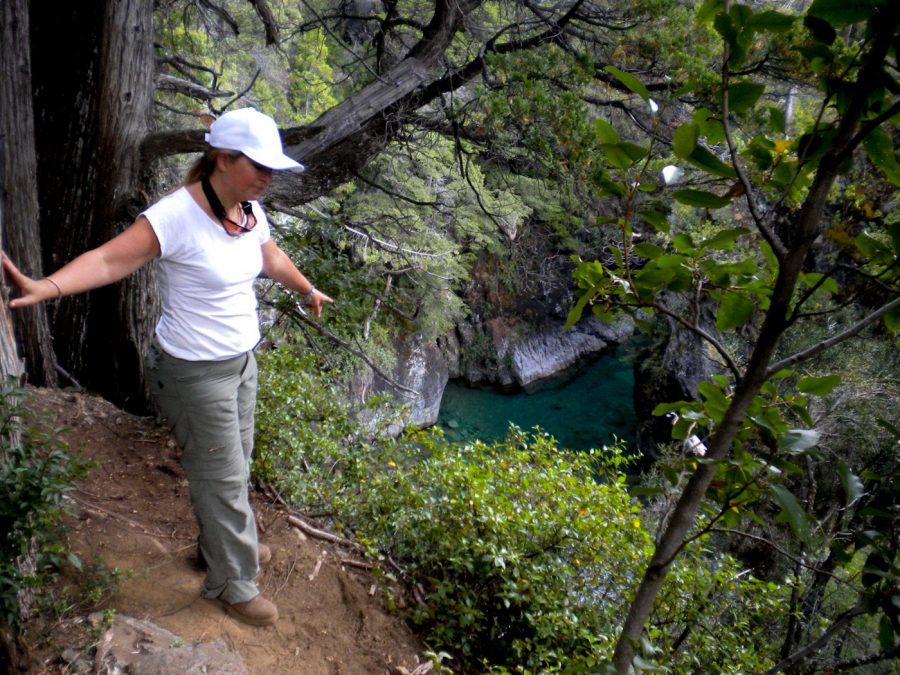
Senator Magdalena Odarda tours the publicly accessible road to Lago Escondido. Photo | Facebook
Odarda has also noted that the area where the airport is constructed is highly “strategic,” which poses a danger given that it is exclusively controlled by a foreigner, an Englishman. Odardo has pointed out that the airport is located on the important 42° parallel, which divides the regions of Río Negro and Chubut, and is only two hours away by plane from the disputed Falkland Islands, which are controlled by the United Kingdom but also claimed by Argentina. This dispute dates back to the 19th century and was the principal factor behind the Falklands War between Argentina and the U.K. in the 1980s, which many Argentines remember quite bitterly for the peace treaty Argentina signed after its defeat by England. Many Argentines have compared the document to the Treaty of Versailles that ended World War I.
Notably, there has been considerable evidence that Lewis’ airport has received planes from the Falkland Islands, which was the subject of a formal complaint made in 2010 to Argentina’s defense minister by then-governor of Argentina’s Tierra del Fuego province, Fabiana Ríos.
A well-oiled machine
Given the numerous laws that Lewis’ activities in Río Negro have broken at both the local and federal level, one would expect that somebody in the government – at least the local government – would hold him accountable. While some politicians like Magdalena Odarda and others have tried, the lack of impunity surrounding Lewis’ activities largely owes to his “friendships” with local and regional politicians as well as the country’s president.
One of the innumerable examples is Sergio Plunket. Plunket, who is in charge of Vial Rionegrina Sociedad del Estado (VIARSE), the regional body in charge of controlling public roads including the road leading to Lago Escondido, also works as a private “ecological consultant” for Lewis’ Hidden Lake S.A. Plunket also authorized the construction of Lewis’ Playas Doradas airport. Another clear example is Bruco Pogliano, El Bolsón’s current mayor, who is also Lewis’ long-time accountant in Argentina.
Another example that Gonzalo Sanchez noted (pp. 50-51) in his book, Patagonia Sold , is how Pablo Verani, ex-governor of Río Negro, started a long tradition of politicians making regular visits to Lago Escondido for Lewis-financed barbeque feasts, when he celebrated his win as the 1997 regional governor on the shores of the magnate’s privatized lake.
In addition to his undeniable influence among key local, regional and even national politicians, Lewis also enjoys considerable influence in the regional press and several former employees of his have become important figures in local and regional media. For example in 2016, according to local media, Dalila Pinacho, who long served as a lawyer and spokeswoman for Lewis’ Lago Escondido firm Hidden Lake S.A., became the director of the Nequén branch of Argentina’s National Radio, apparently through her “close” connections to local politicians.
Another journalist, Julio Álvarez — who described himself, to Gonzalo Sanchez in 2004 at an event in Lago Escondido, as Lewis’ “spokesman” — now works at a radio station in Viedma, Argentina, and was previously the El Bolsón correspondent for the regional newspaper Río Negro. Lewis also funds the local newspaper Ruta 40 and has stakes in other local newspapers such as El Cordillerano, Bolsón Web Patagonia, and El Ciudadano in Bariloche. Eliana Almonacid, who used to work for Ruta 40, told the national outlet Tiempo Argentina in 2014 that the Ruta 40’s director Nancy Aleuy, who also works for Hidden Lake S.A., told her that “Lewis had bought all the media outlets” in the region.
Lewis’ “Parallel State” is just the beginning
Lewis’ control over the local authorities and local press in Río Negro, and the complete impunity of his actions and those of his associates, have made it clear that in Argentina there is a de facto different legal system for oligarchs like Lewis and for the vast majority of Argentina’s citizens. This fact — in combination with the control Lewis and his associates exercise over the region’s key resources, including its water and energy production — has led to the creation of what some like Federico Soria have called a “parallel state” within Patagonia. However, this “parallel state” is, in reality, a microcosm of a much larger project currently underway that is aimed at the domination of the entirety of Argentine Patagonia by predatory oligarchical interests, the majority of which are directly connected to Lewis and his associates.
As will be explored in Part Two of this series, the Soros-led oligarch network, of which Lewis is a part in Argentina, has expanded its efforts to control Patagonia’s vast and strategic resources, including the region’s oil and gas wealth in addition to the domination of its freshwater resources and hydroelectricity production. Subsequent articles will then show that this effort is just the beginning, as this network and its close ties to the International Monetary Fund are being used to transfer ownership of vast state lands to their control in exchange for “debt relief.” The ultimate endgame appears to be the expansion of this “parallel state” — which Lewis has already helped to create in Río Negro and beyond, and which is controlled by small number of mostly foreign oligarchs — into a full-scale operation for extracting the region’s riches and exploiting its people.
Note: An sterisk (*) after a name indicates that a person’s real name was not used after they requested that MintPress not use their real name in this report.
Top Photo | This undated photo shows British billionaire, Joseph C. Lewis, at a Tottenham Hotspurs football game in the United Kingdom. Photo | Reuters
Whitney Webb is a MintPress News journalist based in Chile. She has contributed to several independent media outlets including Global Research, EcoWatch, the Ron Paul Institute and 21st Century Wire, among others. She has made several radio and television appearances and is the 2019 winner of the Serena Shim Award for Uncompromised Integrity in Journalism.
Argentina: Milagro Sala to Run for Governor of Jujuy in 2019
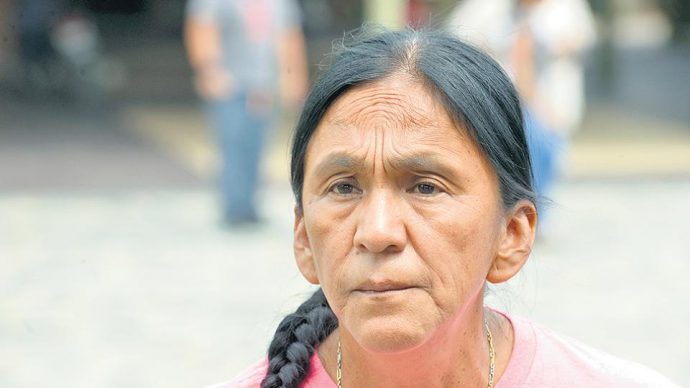
teleSur | December 28, 2018
Sala was recently acquitted of attempted murder, an accusation she claims is politically motivated.
Activist and Indigenous leader Milagro Sala, now in detention, has announced she will run in the 2019 regional elections for governor of Jujuy province, northern Argentina.
“I have the intention of competing against Gerardo Morales in the elections,” said Sala during a radio interview on Thursday.
Sala said she wants to improve the living conditions of the people of Jujuy, where she says there’s “no democracy or freedom, only hunger.”
The activist was unanimously acquitted of attempted murder on Thursday in the ‘Shooting of Azopardo’ case, from October 27, 2007. Sala celebrated the verdict and thanked the judges for not succumbing to government pressure.
Morales, Jujuy’s incumbent governor, described the court’s decision to acquit the activist as “shameful.”
“The ruling acquitting two criminals such as Milagro Sala and Beto Cardozo is shameful,” Morales wrote on Twitter.
“If there’s something that the people of Jujuy know about is the violence they committed and how much they stole. The struggle against impunity continues.”
Sala is one of the founders and leaders of the Tupac Amaru Neighborhoods’ Organization, providing housing and other services to informal workers and working-class sectors since 1999.
She is also being investigated for alleged illicit association, fraud and extortion, crimes she was charged with days after being detained in early 2016 for allegedly instigating violence during a protest against Jujuy Governor Gerardo Morales, which she didn’t attend.
The case is known as the “Pibes Villeros” and Sala claims it’s political persecution “to discipline the leaders and the opposition,” as she told teleSUR in October.
Tupac Amaru Neighborhoods’ Organization claims the persecution against Sala is “politically motivated.”
The activist has expressed multiple times her intentions to participate in the regional elections in Jujuy. In 2017, while she was under house arrest, Sala said she would like to run against Morales “as equals, not from prison while he is ruling over everything here in Jujuy.”
Sala served as an Argentine legislator between 2013 and 2015 and was later elected to Mercosur’s Parliament (Parlasur), prior to her arrest in 2016 for allegedly instigating violence against the state.
Israel scores painful own goal in run-up to the World Cup
By James M. Dorsey | The Turbulent World of Mideast Soccer | June 6, 2018
Argentina’s cancellation of a friendly against Israel because of Israeli attempts to exploit the match politically is likely to reverberate far beyond the world of soccer and spotlights the risks of Israeli efforts to persuade the international community to recognize Jerusalem as its capital.
The Argentinian decision suggests that despite the fact several countries, including East European nations, are debating whether to follow US President Donald J. Trump’s decision earlier this year to recognize Jerusalem as the capital of the Jewish state and move the US embassy to the city, Israel is likely to find it difficult to capitalize on the US move in ways that convincingly project widespread international support.
Even worse, the decision illustrates that efforts to force recognition could backfire.
The Argentinian move has buoyed the grassroots Boycott, Divestment Sanctions (BDS) campaign that seeks to isolate Israel in non-violent defense of Palestinian rights after Israel has made countering the movement one of its top foreign policy objectives.
“The cancellation of Israel’s ‘friendly’ match with Argentina is a boost to the Red Card Israel campaign, which has called on FIFA to expel Israel – as it expelled apartheid South Africa – due to its violations against Palestinian football and its disregard for FIFA statutes,” BDS said in a statement.
The cancellation is BDS’s greatest success to date. Before that, it had only persuaded a small number of artists and organizations to boycott Israel.
An online campaign late last year convinced New Zealand singer-songwriter Lorde to cancel a planned concert in Israel. She followed other artists who have cancelled performances, including Elvis Costello, Lauryn Hill and Gorillaz.
The Argentinian decision has prompted concern that it could become the model for similar efforts in the future. One immediate target could be Israel’s scheduled hosting next year of the Eurovision song contest.
Argentina decided to cancel the match in the run-up to this month’s World Cup in Russia after Israel insisted on moving it from the Mediterranean port city of Haifa, home to Israel’s best stadium, to Jerusalem as part of the Jewish state’s 70th anniversary celebrations. Tickets for the Jerusalem match had sold out quickly.
The Israeli embassy in Buenos Aires and Argentinian media said the decision was in response to a series of unidentified “threats and provocations” against star player Lionel Messi and his wife.
“Since they announced they would play against Israel, various terror groups have been sending messages and letters to players on the Argentina national team and their relatives, including clear threats to hurt them and their families. These included video clips of dead children,” said hard-line Israeli Culture and Sports Minister Miri Regev, whom many hold responsible for Israel’s public relations fiasco.
Ms. Regev was referring to video clips that had been circulated by the Islamic State, including pictures of Mr. Messi in an orange jumpsuit and ones that insinuated his beheading. A Palestinian campaign against playing the match in Jerusalem involved images of Mr. Messi’s white and sky-blue striped jersey stained with red paint resembling blood and threats to burn Messi posters.
The Palestine Football Federation (PFF) had early called on its Argentinian counterpart to cancel the match because of the move to Jerusalem, which it described as a violation of world soccer body FIFA’s principle of a separation of sports and politics.
PFF president Jibril Rajoub also urged Palestinian fans to burn pictures of Messi and replicas of his shirt if he played in the match in Jerusalem.
“He’s a big symbol so we are going to target him personally, and we call on all to burn his picture and his shirt and to abandon him. We still hope that Messi will not come,” Mr Rajoub said after talks with Argentinian diplomats based in the West Bank city of Ramallah prior to the cancellation.
It was FIFA’s ban on political interference in soccer that persuaded Argentine President Mauricio Macri to reject a request by Israeli Prime Minister Benyamin Netanyahu to pre-empt the cancellation of the match.
The Israeli failure to have the match played in Jerusalem strengthens not only the BDS movement.
It also boosts Mr. Rajoub’s so far unsuccessful effort to persuade FIFA and the International Olympic Committee to impose sanctions against Israel because of the Israeli settlements in occupied territory and travel restrictions on Palestinian players and other allegedly security-related measures that hinder the development of Palestinian soccer.
Mr. Rajoub and a liberal Israeli newspaper put responsibility for the soccer fiasco at the doorstep of Ms. Regev.
“She’s the main culprit for legitimizing Argentina’s decision not to come… Beyond squandering millions in taxpayer money, in forcing the game to move to Jerusalem, Regev displayed gross intervention… If the game had stayed in Haifa, it would have happened… There’s a saying that a thousand wise men can’t rescue a coin thrown into a well by a fool…. All it takes is one fool to burn down a forest,” said Haaretz reporter Uzi Dann in an article entitled, Who Needs BDS: Israel Scores Spectacular Own Goal in Argentina Soccer Fiasco.
“Instead of soccer, Miri Regev wanted politics and she got politics… It’s a great farce that gives immense momentum to the BDS campaign against Israel”, added Itzik Shmuli, a centre-left member of the Israeli parliament.
Israeli President Reuven Rivlin appeared to echo the sentiment by saying that “the politicization of the Argentinean move worries me greatly” even if he blamed the Argentinians for involving politics by cancelling the match.
Assertions by Israeli officials that the Argentinian decision had handed a victory to terrorism may go down well with hard-line public opinion in Israel as well as supporters of Israel across the globe but is unlikely to help Israel forge bridges to opponents of its policies or facilitate its efforts to get a broader international buy-in of its insistence that Jerusalem is the undivided capital of the Jewish state.
Israeli opposition leader Avi Gabbay pinpointed the potential fall-out of the cancellation of the match when he warned on Twitter: “We just absorbed a shot in the face. This is not just sports. This, unfortunately, could start an international tsunami.”
Dr. James M. Dorsey is a senior fellow at the S. Rajaratnam School of International Studies, co-director of the University of Würzburg’s Institute for Fan Culture, and co-host of the New Books in Middle Eastern Studies podcast. James is the author of The Turbulent World of Middle East Soccer blog, a book with the same title as well as Comparative Political Transitions between Southeast Asia and the Middle East and North Africa, co-authored with Dr. Teresita Cruz-Del Rosario, Shifting Sands, Essays on Sports and Politics in the Middle East and North Africa, and the forthcoming China and the Middle East: Venturing into the Maelstrom
Israel’s red card and own goal
By Yvonne Ridley | MEMO | June 7, 2018
Rotem Kamer, the vice president of the Israeli Football Association, has accused Palestinians of waging “football terror” after Argentina called off a friendly match in Jerusalem. Argentina’s move came after global protests fuelled by the killing and wounding of thousands of Palestinians taking part in the Gaza Strip’s Great Return March protests.
“We are seeing it as crossing a red line and we cannot accept it,” blustered Kamer, without a hint of irony. He and other key figures in the Zionist regime are outraged at the cancellation, especially after tickets for Saturday’s match against Israel sold out within 20 minutes. Criticising human rights and pro-Palestinian protesters, IFA Chairman Ofer Eini stormed, “The aim was to harm our country through soccer.” In fact, the aim of such civil action is to reverse Israeli apartheid and colonial oppression of the people of Palestine.
Israel’s President Reuven Rivlin described the news as “a sad morning for fans” and added his concern about the “politicisation” of Argentina’s decision. Prime Minister Benjamin Netanyahu, meanwhile, tried in vain to salvage the game in a telephone call to Argentinian President Mauricio Macri. His appeal was unsuccessful. Far-right Defence Minister Avigdor Lieberman accused Argentina of folding to “Israeli-hating anti-Semitic terrorist supporters.”
Netanyahu’s government is fuming after being denied the chance to showcase Jerusalem as its “undivided capital”. The decision by Netanyahu to switch the game from Haifa to the Teddy Kollek Stadium built on the site of an ethnically-cleansed Palestinian village, Al-Malha, clearly backfired. It was the switching of venues that many believe prompted Argentina to step back and cancel the match. Culture and sports minister Miri Regev lashed out at critics by claiming ludicrously that, “This is the same terrorism that caused the Munich massacre.”
However, Hugo Moyano, Second Vice President of Argentina’s Football Association (AFA), called the cancellation positive: “It was the right thing to do, it was not worth it,” he told Argentina’s Radio 10. “What happens in these places where so many people are killed cannot be accepted by any human being.” The decision was also welcomed by Argentine striker Gonzalo Higuain, one of the country’s highest-profile players, in an interview with the ESPN television network on Tuesday.
It must now be sinking in with Netanyahu, Rivlin, Eini, his sidekick Kamer and Regev that the Zionist State’s murderous policies have created this massive own goal. Furthermore, their self-righteous indignation and the absurd description of the cancellation as “terrorism” (Israel crying wolf again) conveniently overlooks the fact that Israel has itself crossed many red lines and introduced real terror on many levels when it comes to football, no matter whether it’s the professional game we are talking about, amateur matches or simply a knockabout among friends on the beach. Its murderous acts deserve much more than a paltry red card.
Here are just a few incidents to refresh Israeli memories of what real terror in football means:
13 January, 2009: Three Palestine national team players were killed in separate attacks during Israel’s military offensive against civilians in Gaza called Operation Cast Lead. Targeted within 72 hours of each other, Ayman Alkurd, who also played for his club Falasteen Al-Ryadi, was the first to be killed. Like his team-mates, his home was hit in an air strike. Fellow footballers Wajeh Moshtahe and Shadi Sbakhe, were killed in later Israeli strikes.
30 January 2013: Dzhabrail Aslanbekovich Kadiyev and Zaur Umarovich Sadayev were signed by the notorious Israeli club Beitar Jerusalem. Angry racist fans who regularly chant “Death to all Arabs” torched the club’s offices in protest at the Muslim signings. The club’s fans boast loudly that it has no Arab players. It has also changed its name to “Beitar Trump Jerusalem” in recognition of the US President’s controversial decision to move the US Embassy to the city and recognise it as the capital of Israel.
31 January 2014: Adam Jamous and Jawahar Halbiyeh live in Abu Dis in occupied Jerusalem. As they headed home after football practice they were shot in the legs without warning. Jawahar was shot seven times in his left leg, three times in his right leg, and once in the hand, while Adam was shot three times: twice in his left thigh, and another in his right. Doctors confirmed that neither of them will ever play football again.
9 July 2014: Avid football fans gathered at a beachside cafe in the Al-‘Izbeh area of Khan Younis to watch a FIFA World Cup qualifier between Argentina and the Netherlands. Israel had launched yet another war on Gaza two days earlier, blitzing 750 targets, but this area was not classed as a military zone and the young Palestinians settled down to watch the match in the belief that they were safe. Half an hour later, at 11.30pm, the cafe was shelled. Those killed were: Ahmed Astal, 18; Suleiman Astal, 16; Musa, 16, a cousin of the Astals; Mohammed Ganan, 24; Ibrahim Ganan, 25; Hamdi Sawalli, 20; Ibrahim Sawalli, 28; Salim Sawalli; 23 and Mohammed Fawana, 18.
16 July 2014: Just after 4pm and in the space of 40 seconds, four boys who had been playing football on the beach in Gaza City were killed after an Israeli gunboat fired two shells at them. Aged between seven and 11, two were named Mohammad, one was Zakaria and the youngest was Ahed. All were members of the extended Bakr family. Three others were also injured and given first aid by international journalists who witnessed the atrocity. Hamad Bakr, aged 13, had shrapnel in his chest; his cousin Motasem, 11, suffered head and leg injuries; and Mohammad Abu Watfah, 21, was hit by shrapnel in his stomach.
31 March 2018: This was the day when Israeli snipers killed 17 peaceful protesters at the Great Return March in the Gaza Strip and injured hundreds more. Those wounded included Palestinian footballer Mohammad Khalil whose career was ended after he was shot by an Israeli soldier in both legs. A player for Al-Salah FC, he was shot in his knee by a so-called butterfly bullet which exited one leg and hit his other knee, breaking the bone. He will never play another game of football again and is likely to be bedridden for months.
13 April 2018: Young footballer Attallah Fayoumi, 17, suffered a devastating leg injury after being shot. The wounds required urgent surgery but Israeli forces refused him permission to leave Gaza for a West Bank or Israeli hospital. As the seriousness of his condition worsened doctors were forced to amputate his leg, shattering his dreams of ever becoming a professional footballer.
There are those who believe that Israel deliberately targets Palestinian footballers and other athletes who draw favourable, international attention to Palestine as ambassadors of their sport. Whether traveling abroad from Gaza or moving across the West Bank they are subjected to Israeli interrogations at checkpoints and boundary crossings. In addition to movement restrictions, Israeli forces are suspected of deliberately targeting Palestinian footballers with live ammunition; the evidence is, indeed, mounting.
The Israel Defense Forces boasted during the Great Return March that, “Nothing was carried out uncontrolled; everything was accurate and measured, and we know where every bullet landed.” The army then quickly deleted its incriminating tweet as more evidence of war crimes by its soldiers came to light, but not before a copy was made by the human rights group B’Tselem.
According to Sami Abu Sneima, head of surgery at the European Hospital in the southern Gaza Strip, footballer Attallah Fayoumi is not the only case of a leg amputation since the peaceful protests began at the end of March. “Many people who were shot with live ammunition have had to have their upper or lower limbs amputated,” he explained.
The Ministry of Health in Gaza says the majority of injuries being attended to are in the lower limbs, and while most of the wounds are considered serious, hospitals run on a case-by-case basis. So far, 123 protesters have been killed, with more than 14,000 wounded, according to Palestinian hospital staff. At least 32 people, many of them below 25 years old, have had limbs amputated.
So while Israeli FA chief Ofer Eini claims that the move to get the Argentinian match cancelled was a deliberate attempt to harm the Zionist State he should reflect that no one was killed or injured in the process, unlike the heroic Palestinians taking part in the peaceful resistance of the Great Return March. If he and the thousands of Israeli football fans who’ve lost out really want to vent their anger and frustration at anyone at all, it should be Benjamin Netanyahu and his government’s inhumane treatment of the Palestinian people.
Featured Video
Theodore Postol: Iran’s Missiles & Drones Were Underestimated
or go to
Aletho News Archives – Video-Images
From the Archives
Wars for Israel: A reminder of who’s giving the marching orders
By Damian Lataan | February 7, 2012
As the West prepares to march off to yet another war in the Middle East, we should perhaps remind ourselves of who is giving the West their marching orders.
In February 2003, just weeks before the US and their allies launched their attack on Iraq and her peoples, a delegation of US congressmen, together with the US Ambassador to the United Nations, John Bolton, a well known pro-Zionist and neoconservative war-hawk, were in Israel at the invitation of the Israeli government then led by Israeli Prime Minister Ariel Sharon.
Addressing the congressmen, Sharon told them ‘that Iran, Libya and Syria should be stripped of weapons of mass destruction after Iraq’. Later, Sharon told John Bolton ‘that Israel was concerned about the security threat posed by Iran, and stressed that it was important to deal with Iran even while American attention was focused on Iraq’. … continue
Blog Roll
 Aletho News
- Wave 90: IRGC strikes US-linked industrial sites in Gulf
- Iran Says US-Israeli Claims of Its Military Strength Are Wrong
- Trump’s April Fools’ Address to the nation
- The Most Important Bet You’ve Never Heard Of
- The killing of three Indonesian soldiers in Lebanon should remind Jakarta that Israel does not want peace
- Defeated and delusional: Netanyahu’s remarks reveal $80bn war failure, says analyst
- Iran’s friends are about to make life much more difficult for Israel and the US
- The war of liberation of the Arab and Islamic peoples expands across the Gulf
- Envoy warns UN on Trump’s threat to ‘obliterate’ Iran’s civilian infrastructure
- The Larak Corridor: Iran’s Rial Gate With No US, No Israel, and No Way Around
- If Americans Knew
- Gaza families reunite years after babies evacuated amid Israel’s war
- International Rescue Committee warns Gaza’s children face grave protection risks
- Iran’s Alleged 47-Year War on America: Debunking the 1,050 American Deaths Canard
- Israel wants US to bomb more of Iran’s civilian structures (113,000 is not enough) – Not a ceasefire Day 173
- Ann Coulter Rips Into Fox News for Iran War Coverage
- Joe Kent Urges Americans To Call White House and Congress To Object To Sending Troops Into Iran
- DNC Resolution to Reject AIPAC Funding Puts Democratic Leaders in the Hot Seat
- Swedish foundation to build 400 schools as over 650,000 Gaza children remain without education for 2 years
- Israeli army admits photshopping image of slain Lebanese journalist
- This is how Israel is systematically killing health workers under the cover of war in Lebanon
- No Tricks Zone
- New Study Finds Warming Saves Lives…Cold Temperatures 12 Times More Deadly Than Excess Heat
- German Science Blog Accuses PIK Climate Institute Of Hallucinating Climate Tipping Points
- Devastating Assessment Of Comirnaty Vaccine By Former Senior Pfizer Europe Toxicologist
- New Study: CO2 Is ‘Effectively Negligible’ As An Explanatory Climate Change Factor Since 2000
- Former Pfizer Toxicologist Dr. Helmut Sterz Tells Bundestag Hearing Pfizer Vaccine Should Have Never Been Approved
- Energy Expert: Germany’s Nuclear Phaseout Was A “500 Billion Euro Mistake”
- New Research: South Australia’s Mid-Holocene Sea Surface Temperatures Were 4°C Warmer Than Today
- Storing Green Energy To Last Germany 10 Days Would Require A 60-Million Tonne Battery
- New Studies: UK Sea Levels Were 4 Meters Higher Than Today During The Mid-Holocene
- Destructive Green New Deal: German Energy And Metal Group Warns Of Drastic Crisis
 Aletho News