Israel scores painful own goal in run-up to the World Cup
By James M. Dorsey | The Turbulent World of Mideast Soccer | June 6, 2018
Argentina’s cancellation of a friendly against Israel because of Israeli attempts to exploit the match politically is likely to reverberate far beyond the world of soccer and spotlights the risks of Israeli efforts to persuade the international community to recognize Jerusalem as its capital.
The Argentinian decision suggests that despite the fact several countries, including East European nations, are debating whether to follow US President Donald J. Trump’s decision earlier this year to recognize Jerusalem as the capital of the Jewish state and move the US embassy to the city, Israel is likely to find it difficult to capitalize on the US move in ways that convincingly project widespread international support.
Even worse, the decision illustrates that efforts to force recognition could backfire.
The Argentinian move has buoyed the grassroots Boycott, Divestment Sanctions (BDS) campaign that seeks to isolate Israel in non-violent defense of Palestinian rights after Israel has made countering the movement one of its top foreign policy objectives.
“The cancellation of Israel’s ‘friendly’ match with Argentina is a boost to the Red Card Israel campaign, which has called on FIFA to expel Israel – as it expelled apartheid South Africa – due to its violations against Palestinian football and its disregard for FIFA statutes,” BDS said in a statement.
The cancellation is BDS’s greatest success to date. Before that, it had only persuaded a small number of artists and organizations to boycott Israel.
An online campaign late last year convinced New Zealand singer-songwriter Lorde to cancel a planned concert in Israel. She followed other artists who have cancelled performances, including Elvis Costello, Lauryn Hill and Gorillaz.
The Argentinian decision has prompted concern that it could become the model for similar efforts in the future. One immediate target could be Israel’s scheduled hosting next year of the Eurovision song contest.
Argentina decided to cancel the match in the run-up to this month’s World Cup in Russia after Israel insisted on moving it from the Mediterranean port city of Haifa, home to Israel’s best stadium, to Jerusalem as part of the Jewish state’s 70th anniversary celebrations. Tickets for the Jerusalem match had sold out quickly.
The Israeli embassy in Buenos Aires and Argentinian media said the decision was in response to a series of unidentified “threats and provocations” against star player Lionel Messi and his wife.
“Since they announced they would play against Israel, various terror groups have been sending messages and letters to players on the Argentina national team and their relatives, including clear threats to hurt them and their families. These included video clips of dead children,” said hard-line Israeli Culture and Sports Minister Miri Regev, whom many hold responsible for Israel’s public relations fiasco.
Ms. Regev was referring to video clips that had been circulated by the Islamic State, including pictures of Mr. Messi in an orange jumpsuit and ones that insinuated his beheading. A Palestinian campaign against playing the match in Jerusalem involved images of Mr. Messi’s white and sky-blue striped jersey stained with red paint resembling blood and threats to burn Messi posters.
The Palestine Football Federation (PFF) had early called on its Argentinian counterpart to cancel the match because of the move to Jerusalem, which it described as a violation of world soccer body FIFA’s principle of a separation of sports and politics.
PFF president Jibril Rajoub also urged Palestinian fans to burn pictures of Messi and replicas of his shirt if he played in the match in Jerusalem.
“He’s a big symbol so we are going to target him personally, and we call on all to burn his picture and his shirt and to abandon him. We still hope that Messi will not come,” Mr Rajoub said after talks with Argentinian diplomats based in the West Bank city of Ramallah prior to the cancellation.
It was FIFA’s ban on political interference in soccer that persuaded Argentine President Mauricio Macri to reject a request by Israeli Prime Minister Benyamin Netanyahu to pre-empt the cancellation of the match.
The Israeli failure to have the match played in Jerusalem strengthens not only the BDS movement.
It also boosts Mr. Rajoub’s so far unsuccessful effort to persuade FIFA and the International Olympic Committee to impose sanctions against Israel because of the Israeli settlements in occupied territory and travel restrictions on Palestinian players and other allegedly security-related measures that hinder the development of Palestinian soccer.
Mr. Rajoub and a liberal Israeli newspaper put responsibility for the soccer fiasco at the doorstep of Ms. Regev.
“She’s the main culprit for legitimizing Argentina’s decision not to come… Beyond squandering millions in taxpayer money, in forcing the game to move to Jerusalem, Regev displayed gross intervention… If the game had stayed in Haifa, it would have happened… There’s a saying that a thousand wise men can’t rescue a coin thrown into a well by a fool…. All it takes is one fool to burn down a forest,” said Haaretz reporter Uzi Dann in an article entitled, Who Needs BDS: Israel Scores Spectacular Own Goal in Argentina Soccer Fiasco.
“Instead of soccer, Miri Regev wanted politics and she got politics… It’s a great farce that gives immense momentum to the BDS campaign against Israel”, added Itzik Shmuli, a centre-left member of the Israeli parliament.
Israeli President Reuven Rivlin appeared to echo the sentiment by saying that “the politicization of the Argentinean move worries me greatly” even if he blamed the Argentinians for involving politics by cancelling the match.
Assertions by Israeli officials that the Argentinian decision had handed a victory to terrorism may go down well with hard-line public opinion in Israel as well as supporters of Israel across the globe but is unlikely to help Israel forge bridges to opponents of its policies or facilitate its efforts to get a broader international buy-in of its insistence that Jerusalem is the undivided capital of the Jewish state.
Israeli opposition leader Avi Gabbay pinpointed the potential fall-out of the cancellation of the match when he warned on Twitter: “We just absorbed a shot in the face. This is not just sports. This, unfortunately, could start an international tsunami.”
Dr. James M. Dorsey is a senior fellow at the S. Rajaratnam School of International Studies, co-director of the University of Würzburg’s Institute for Fan Culture, and co-host of the New Books in Middle Eastern Studies podcast. James is the author of The Turbulent World of Middle East Soccer blog, a book with the same title as well as Comparative Political Transitions between Southeast Asia and the Middle East and North Africa, co-authored with Dr. Teresita Cruz-Del Rosario, Shifting Sands, Essays on Sports and Politics in the Middle East and North Africa, and the forthcoming China and the Middle East: Venturing into the Maelstrom
Israel’s red card and own goal
By Yvonne Ridley | MEMO | June 7, 2018
Rotem Kamer, the vice president of the Israeli Football Association, has accused Palestinians of waging “football terror” after Argentina called off a friendly match in Jerusalem. Argentina’s move came after global protests fuelled by the killing and wounding of thousands of Palestinians taking part in the Gaza Strip’s Great Return March protests.
“We are seeing it as crossing a red line and we cannot accept it,” blustered Kamer, without a hint of irony. He and other key figures in the Zionist regime are outraged at the cancellation, especially after tickets for Saturday’s match against Israel sold out within 20 minutes. Criticising human rights and pro-Palestinian protesters, IFA Chairman Ofer Eini stormed, “The aim was to harm our country through soccer.” In fact, the aim of such civil action is to reverse Israeli apartheid and colonial oppression of the people of Palestine.
Israel’s President Reuven Rivlin described the news as “a sad morning for fans” and added his concern about the “politicisation” of Argentina’s decision. Prime Minister Benjamin Netanyahu, meanwhile, tried in vain to salvage the game in a telephone call to Argentinian President Mauricio Macri. His appeal was unsuccessful. Far-right Defence Minister Avigdor Lieberman accused Argentina of folding to “Israeli-hating anti-Semitic terrorist supporters.”
Netanyahu’s government is fuming after being denied the chance to showcase Jerusalem as its “undivided capital”. The decision by Netanyahu to switch the game from Haifa to the Teddy Kollek Stadium built on the site of an ethnically-cleansed Palestinian village, Al-Malha, clearly backfired. It was the switching of venues that many believe prompted Argentina to step back and cancel the match. Culture and sports minister Miri Regev lashed out at critics by claiming ludicrously that, “This is the same terrorism that caused the Munich massacre.”
However, Hugo Moyano, Second Vice President of Argentina’s Football Association (AFA), called the cancellation positive: “It was the right thing to do, it was not worth it,” he told Argentina’s Radio 10. “What happens in these places where so many people are killed cannot be accepted by any human being.” The decision was also welcomed by Argentine striker Gonzalo Higuain, one of the country’s highest-profile players, in an interview with the ESPN television network on Tuesday.
It must now be sinking in with Netanyahu, Rivlin, Eini, his sidekick Kamer and Regev that the Zionist State’s murderous policies have created this massive own goal. Furthermore, their self-righteous indignation and the absurd description of the cancellation as “terrorism” (Israel crying wolf again) conveniently overlooks the fact that Israel has itself crossed many red lines and introduced real terror on many levels when it comes to football, no matter whether it’s the professional game we are talking about, amateur matches or simply a knockabout among friends on the beach. Its murderous acts deserve much more than a paltry red card.
Here are just a few incidents to refresh Israeli memories of what real terror in football means:
13 January, 2009: Three Palestine national team players were killed in separate attacks during Israel’s military offensive against civilians in Gaza called Operation Cast Lead. Targeted within 72 hours of each other, Ayman Alkurd, who also played for his club Falasteen Al-Ryadi, was the first to be killed. Like his team-mates, his home was hit in an air strike. Fellow footballers Wajeh Moshtahe and Shadi Sbakhe, were killed in later Israeli strikes.
30 January 2013: Dzhabrail Aslanbekovich Kadiyev and Zaur Umarovich Sadayev were signed by the notorious Israeli club Beitar Jerusalem. Angry racist fans who regularly chant “Death to all Arabs” torched the club’s offices in protest at the Muslim signings. The club’s fans boast loudly that it has no Arab players. It has also changed its name to “Beitar Trump Jerusalem” in recognition of the US President’s controversial decision to move the US Embassy to the city and recognise it as the capital of Israel.
31 January 2014: Adam Jamous and Jawahar Halbiyeh live in Abu Dis in occupied Jerusalem. As they headed home after football practice they were shot in the legs without warning. Jawahar was shot seven times in his left leg, three times in his right leg, and once in the hand, while Adam was shot three times: twice in his left thigh, and another in his right. Doctors confirmed that neither of them will ever play football again.
9 July 2014: Avid football fans gathered at a beachside cafe in the Al-‘Izbeh area of Khan Younis to watch a FIFA World Cup qualifier between Argentina and the Netherlands. Israel had launched yet another war on Gaza two days earlier, blitzing 750 targets, but this area was not classed as a military zone and the young Palestinians settled down to watch the match in the belief that they were safe. Half an hour later, at 11.30pm, the cafe was shelled. Those killed were: Ahmed Astal, 18; Suleiman Astal, 16; Musa, 16, a cousin of the Astals; Mohammed Ganan, 24; Ibrahim Ganan, 25; Hamdi Sawalli, 20; Ibrahim Sawalli, 28; Salim Sawalli; 23 and Mohammed Fawana, 18.
16 July 2014: Just after 4pm and in the space of 40 seconds, four boys who had been playing football on the beach in Gaza City were killed after an Israeli gunboat fired two shells at them. Aged between seven and 11, two were named Mohammad, one was Zakaria and the youngest was Ahed. All were members of the extended Bakr family. Three others were also injured and given first aid by international journalists who witnessed the atrocity. Hamad Bakr, aged 13, had shrapnel in his chest; his cousin Motasem, 11, suffered head and leg injuries; and Mohammad Abu Watfah, 21, was hit by shrapnel in his stomach.
31 March 2018: This was the day when Israeli snipers killed 17 peaceful protesters at the Great Return March in the Gaza Strip and injured hundreds more. Those wounded included Palestinian footballer Mohammad Khalil whose career was ended after he was shot by an Israeli soldier in both legs. A player for Al-Salah FC, he was shot in his knee by a so-called butterfly bullet which exited one leg and hit his other knee, breaking the bone. He will never play another game of football again and is likely to be bedridden for months.
13 April 2018: Young footballer Attallah Fayoumi, 17, suffered a devastating leg injury after being shot. The wounds required urgent surgery but Israeli forces refused him permission to leave Gaza for a West Bank or Israeli hospital. As the seriousness of his condition worsened doctors were forced to amputate his leg, shattering his dreams of ever becoming a professional footballer.
There are those who believe that Israel deliberately targets Palestinian footballers and other athletes who draw favourable, international attention to Palestine as ambassadors of their sport. Whether traveling abroad from Gaza or moving across the West Bank they are subjected to Israeli interrogations at checkpoints and boundary crossings. In addition to movement restrictions, Israeli forces are suspected of deliberately targeting Palestinian footballers with live ammunition; the evidence is, indeed, mounting.
The Israel Defense Forces boasted during the Great Return March that, “Nothing was carried out uncontrolled; everything was accurate and measured, and we know where every bullet landed.” The army then quickly deleted its incriminating tweet as more evidence of war crimes by its soldiers came to light, but not before a copy was made by the human rights group B’Tselem.
According to Sami Abu Sneima, head of surgery at the European Hospital in the southern Gaza Strip, footballer Attallah Fayoumi is not the only case of a leg amputation since the peaceful protests began at the end of March. “Many people who were shot with live ammunition have had to have their upper or lower limbs amputated,” he explained.
The Ministry of Health in Gaza says the majority of injuries being attended to are in the lower limbs, and while most of the wounds are considered serious, hospitals run on a case-by-case basis. So far, 123 protesters have been killed, with more than 14,000 wounded, according to Palestinian hospital staff. At least 32 people, many of them below 25 years old, have had limbs amputated.
So while Israeli FA chief Ofer Eini claims that the move to get the Argentinian match cancelled was a deliberate attempt to harm the Zionist State he should reflect that no one was killed or injured in the process, unlike the heroic Palestinians taking part in the peaceful resistance of the Great Return March. If he and the thousands of Israeli football fans who’ve lost out really want to vent their anger and frustration at anyone at all, it should be Benjamin Netanyahu and his government’s inhumane treatment of the Palestinian people.
Ex-Argentine President to Be Tried for Alleged Jewish Center Bombing Cover-Up
Sputnik – 07.03.2018
Former Argentinian President Cristina Kirchner and 11 other senior members of her government will face a public trial over their alleged involvement in covering up Iran’s role in the 1994 bombing of a Jewish community center in Buenos Aires, Argentina, Federal Judge Claudio Bonadio ruled on Monday.
According to Bonadio, the investigative phase of the case has been completed and it has been referred to a higher level court. Although no trial date has yet been set, at least four of those accused have already been detained, Al-Jazeera reported.
The Argentine-Israelite Mutual Aid (AMIA) organization was a community center established in Buenos Aires in 1984 to safeguard the values of the Jewish community in Argentina. On July 18, 1994, a van filled with 300 kg of explosives rammed into the center and exploded, killing 85 people and injuring more than 300.
Kirchner, along with former Foreign Minister Hector Timerman and other members of the 2007-2015 administration, are accused of abuse of power and obstruction for their signing of a 2013 agreement with the government of Iran to allegedly conceal the role of Iranian officials in the 1994 bombing. Kircher and other members of her government signed a memorandum of understanding with Iran that, it is alleged, promised to cancel the establishment of a “truth commission” to probe the bombing in exchange for trade deals on oil and other resources.
The case against Kirchner and others was opened in January 2015 by prosecutor Alberto Nisman, who was looking into the incident at the time and claimed that the memorandum signed between Kirchner’s government and Iranian officials was an effort to hide the involvement of Iran and Hezbollah in the deadly attack.
The memorandum of understanding signed between Argentina and Iran to jointly investigate the bombing is officially called the “Memorandum of understanding between the Government of Argentina and the Government of Islamic Republic of Iran on the issues related to the terrorist attack against AMIA headquarter in Buenos Aires on July 18, 1994.” The memorandum was voided in December 2015, after the inauguration of current Argentine President Mauricio Macri.
Four days after Nisman opened the case, he was discovered dead in his apartment with a bullet wound in his head. Last year, an investigation led by Argentina’s border police agency asserted that Nisman was murdered, challenging earlier assertions that Nisman had committed suicide, the New Jersey Herald reported.
Kirchner has repeatedly denied the accusations made against her and has welcomed a public trial to prove the “arbitrariness of the accusation,” the New Jersey Herald reported. Iran has also denied allegations that it was involved in the bombing.
This isn’t the only legal case in which Kirchner is embroiled right now.
In December 2016, Kircher was indicted on fraud and corruption charges over the “deliberate seizure of funds” intended for public road works. According to the ruling, the defendants are accused of conspiring to illegally take taxpayer dollars meant for public works projects between 2003 and 2015. She has denied the charges and has accused Macri of using the courts to persecute her. No arrest warrant has been issued yet.
Argentina: Fernandez Brands ‘Iranian Pact’ Allegations ‘Arbitrary,’ Demands Immediate Trial
teleSUR | February 20, 2018
Argentine senator and former president Cristina Fernandez de Kirchner has requested a public trial be held “immediately” to “expose the arbitrariness of the accusation (against her) to the whole society.” Fernandez is being prosecuted for an alleged cover-up of Iranian officials and citizens accused of perpetrating a terror attack in 1994.
In July 1994 the Asociacion Mutual Israelita Argentina (AMIA), a Jewish community center, was attacked with a car bomb killing 85 people and injuring 300 more.
In a legal recourse sent Monday to judge Claudio Bonadio by Fernandez’s lawyers, Alejandro Rua and Graciana Peñafort, they demand the investigation be elevated to a public trial.
Judge Bonadio prosecuted the former head of state and other former government officials, including Minister of Foreign Affairs Hector Timerman, for concealment and treason.
The treason charge was dropped in a second instance hearing, but the National Chamber of Criminal and Correctional Appeals confirmed the prosecution of the defendants for concealment arguing they covered up Iranians accused of the AMIA attack through a Memorandum of Understanding with Mahmoud Ahmadinejad’s government.
The memorandum, which would have created a Truth Commission to investigate the case, was never applied because it wasn’t ratified by the Iranian parliament.
The case against Fernandez was opened after federal prosecutor Alberto Nisman formally accused her and other politicians in 2013 of covering up Iranian suspects. Nisman was found dead in 2015, before testifying.
A federal judge dismissed the case arguing the minimum conditions to launch a criminal investigation were not met. According to Pagina 12, a local newspaper, five prominent Argentine jurists agreed that there was no crime in Nisman’s accusation. However, the dismissal was revoked last year after an appeal by the Delegation of Israeli Argentine Associations.
In the document elevated to the court by Fernandez’s lawyers, they claim Bonadio’s conclusions “are false and are contradicted by the collected proof,” and clarify they will not request the dismissal because their client “does not expect Justice” from Bonadio’s court.
US To Build New Military Base in Northern Argentina
teleSUR | February 11, 2017
Argentine President Mauricio Macri is also letting in more DEA, FBI, and U.S. military forces to control narcotrafficking and terrorism within the country.
Argentina is allowing the U.S. to build a new military base at its northern border with Brazil and Paraguay. Officials of the South American country also announced that it will work with Drug Enforcement Administration (DEA) at the triple border “to analyze where drugs are coming from.”
Argentina’s Minister of Security, Patricia Bullrich announced in Washington that the Mauricio Macri administration is going to allow the U.S. to build a military base in Posadas, Misiones, bordering Brazil and Paraguay.
Bullrich says her government is creating “an analysis center with Paraguay and Brazil (and the U.S.) to figure out where, how and with whom narco traffickers operate” at the triple border region.
This “task force,” as its being called, will operate in conjunction with the DEA, the Department of Homeland Security (DHS), and the U.S. Southern Command, which watches over U.S. operations in Latin America and the Caribbean.
This will be the second task force against drug trafficking in Argentina. The first one was installed in Salta province located near the borders with Bolivia and Chile during the Barack Obama administration.
Bullrich told the press that the DEA initially wanted Argentine officials to send drug samples to the U.S. so the agency could analyze them for their origin. She said this would be against Argentine law and that officials within the country would analyze the drugs.
The U.S. and Argentine functionaries also discussed the suspected presence of Lebanese Hezbollah, an organization the U.S. government considers a terrorist group, at the border shared by Argentina, Brazil and Paraguay.
“It’s important for our government to collaborate (with the U.S.) and that they collaborate with us. We’re going to work together at the triple border regarding terrorism. We think we’ll have DEA and other agencies there to better understand what’s happening in the region,” Bullrich assured the press.
The minister of security also met with Federal Bureau of Investigation (FBI) and the Department of Homeland Security (DHS) officials in Washington to discuss their training of Argentine Federal Police.
After leaving Washington Bullrich flew to Miami to meet with the chief of U.S. Southern Command, Admiral Kurt W. Tidd and the Defense Minister of Argentina, Oscar Aguad.
Admiral Tidd was recently in Colombia meeting with its military forces.
Human rights organizations are protesting the increased U.S. military presence in Latin American and the Caribbean.
The former Argentine ambassador to Venezuela and the United Kingdom, Alicia Castro, tweeted of Bullrich’s proposed policies, “Do you want to see how the U.S. … ‘combats terrorism’? Look at the Middle East devastated. And ‘combating narcotrafficking’? Look at the cartels and assassinations in Colombia y Mexico, the places where the DEA intervenes.”
Fernandez Appeals Trial Over Alleged Bomb Attack Cover Up
teleSUR – January 8, 2018
In December, a judge called on Fernandez de Kirchner to testify in an investigation on the alleged cover-up of a 1994 bombing of a Jewish center in Buenos Aires, a move Fernandez said is politically motivated.
Former President Cristina Fernandez appealed on Monday her trial and the preventive prison ordered against her in December after she was accused of covering up Iran’s alleged role in the bombing of a Buenos Aires Jewish center in 1994.
Preventive detention was eventually not applied in the case of Fernandez, because of her position as a senator, but it was in the case of former Foreign Minister Hector Timerman, also facing similar charges, Graciana Peñafort, Fernandez’ lawyer, told EFE.
Fernandez and 14 others were called to testify on Oct. 26, four days after the country’s legislative elections, in which she’s running for a Senate seat. The judge has also restricted them from leaving the country.
They are accused of covering up Iran’s alleged role in the bombing of the Argentine Israelite Mutual Association in Buenos Aires, AMIA, on July 18, 1994, which left 85 people dead.
The prosecutor who initially made the accusation, Alberto Nisman, alleged that this was done to protect growing trade relations between Argentina and the Islamic Republic and to clinch a grains-for-oil deal with Tehran.
Nisman was found shot dead in the bathroom of his apartment, in what many claimed to be a suicide, on the day he was scheduled to address the country’s Senate on the investigation.
In 2015, Nisman’s accusations were dismissed as baseless and his findings proved to have major loopholes. Courts have repeatedly dismissed allegations of conspiracy and haven’t found evidence to formally investigate the former president.
Fernandez, whose late husband, former President Nestor Kirchner, ordered the investigation into the AMIA bombing, has alleged that Jaime Stiusso, a former spy at the now-disbanded Intelligence Secretariat, fed Nisman false information to undermine her government.
She said she has been a victim of “an evident judicial prosecution” by the current government that has issued “indiscriminate complaints” against her. Despite these attacks, she said she does not fear a prison sentence.
Fernandez’s government said Nisman was murdered by agents from the Intelligence Secretariat — a holdover institution from Argentina’s Dirty War era — which was dissolved immediately after his death. A report by Reuters, however, revealed that President Mauricio Macri’s government wants to revive the agency, sparking fears of a return to authoritarian rule in the country.
Meanwhile, Nisman’s former wife, Sandra Arroyo Salgado, insists that the prosecutor was killed by his colleague, Diego Lagomarsino, over a money dispute.
Argentina: Milagro Sala Gets More Jail Time While Convicted Torturer Gets House Arrest
teleSUR – January 6, 2018
Just hours after 21 simultaneous raids on the home of Argentine Indigenous leader Milagro Sala, a provincial court ordered Friday a one-year extraordinary extension of her pre-trial detention. Sala is 21 days short of serving two years in prison.
The political leader is being investigated for alleged illicit association, fraud and extortion, crimes she was charged with days after being detained for allegedly instigating violence during a protest she didn’t attend.
Sala was initially arrested on Jan. 16, 2016 for an “escrache”, a form of protest that seeks to publicly shame someone by congregating around their homes, against the province governor of Jujuy, an ally of President Mauricio Macri. Shortly after on Jan. 29 of that same year Sala was cleared of the instigation charges, but the judge determined that she would remain in detention over new charges of illicit association, fraud and extortion, which she is currently facing.
According to Sala’s lawyer the main reason for the extension is that her defense presented “innumerable” appeals and nullities. “This lacks sense,” her lawyers contended because “everything presented is within the framework of the right to legal defence.”
The one-year extension is not the first arbitrary decision made by Jujuy’s judiciary. In October 2016, the United Nations Working Group on Arbitrary Detention qualified her detention as arbitrary, a decision backed by the Inter-American Commission on Human Rights, which urged Argentina’s government to release her.
The Organization of American States and human rights’ groups like Amnesty International and Human Rights Watch have also demanded her immediate release to no avail.
Milagro Sala is a renowned activist who is seen as President Macri’s first political prisoner. She created the Organization Tupac Amaru, which provides housing and other services to informal workers and popular sectors, she served as an Argentine legislator between 2013 and 2015, and was later elected by the Front for Victory Party, led by former President Cristina Fernandez de Kirchner, to Mercosur’s Parliament.
News of the one-year extension to Sala’s illegitimate imprisonment were accompanied by news of thousands of Argentines protesting the federal ruling that granted house arrest for convicted murderer and torturer Miguel Etchecolatz, who was sentenced to life in prison for crimes against humanity when he worked as a top police officer under the brutal military dictatorship of the 1970s.
He is not the only one. According to Argentina’s Office of Crimes Against Humanity, 549 of people convicted for crimes against humanity in Argentina are currently under house arrest.
Social leaders and opponents of the current right wing government argue that in Macri’s Argentina social and political activists are repressed, prosecuted, and disappeared while those who repress and abuse their power are granted favors.
NYT’s Argentina Op-Ed Fails to Disclose Authors’ Financial Conflict of Interest
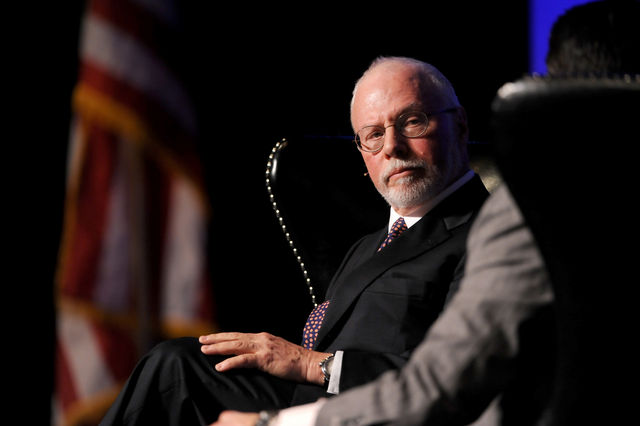
Photo: Paul Singer
By Eli Clifton | LobeLog | December 13, 2017
On Tuesday, Mark Dubowitz and Toby Dershowitz, two executives at the hawkish Foundation for Defense of Democracies (FDD), took to the op-ed pages of The New York Times to celebrate last week’s announcement that Argentina’s former president, Cristina Fernández de Kirchner, would face treason charges for her alleged role in covering up Iran’s alleged involvement in the 1994 bombing of a Jewish community center in Buenos Aries, killing 85 people.
But their op-ed fails to disclose a serious financial conflict of interest underpinning their attacks on Kirchner. One of FDD’s biggest donors financed a multi-year public diplomacy campaign against Kirchner all while attempting to collect $2 billion in debt from Argentina.
Indeed, legitimate questions exist about the bombing and suspicious 2015 death of Argentine Special Investigator Alberto Nisman who claimed in 2006 that Iran ordered the bombing. But Kirchner’s supporters fear that Argentina’s President Mauricio Macri is using judicial reforms and charges against Kirchner to remove his political opposition.
FDD has been eager to promote Nisman’s work. The group also runs AlbertoNisman.org “to honor the legacy of late Argentine Prosecutor Natalio Alberto Nisman and his tireless pursuit of justice.” FDD continues this work despite serious questions about large unexplained deposits to Nisman’s bank account.
Moreover, their rush to denigrate Kirchner omits a major conflict of interest in Dubowitz and Dershowitz’s funding. Between 2007 and 2011, hedge-fund billionaire Paul Singer contributed $3.6 million to FDD. That coincided with his battle to force Argentina to repay the full amount of the sovereign debt held by Singer’s firm, Elliott Management, a payout that Kirchner rejected. Ninety-three percent of Argentina’s creditors accepted losses, but Singer was one of the few holdouts. Having bought up Argentina’s defaulted bonds at pennies on the dollar, he had then sued the country for payment in full.
Singer embarked on a 15-year legal battle to collect on Argentina’s debt payments by attempting to seize Argentine government assets around the world, including a 100-meter three-masted tall ship when it docked in Ghana). After financing public diplomacy campaigns against Kirchner, Singer’s firm walked away with approximately 75 percent of what he was owed, $2.4 billion. The deal, finalized last year, was largely credited to Mauricio Macri, Kirchner’s successor.
Groups receiving Singer’s donations kept up a steady drumbeat of attacks on Kirchner and sought to tie her to Iran and Nisman’s suspicious death. “We do whatever we can to get our government and media’s attention focused on what a bad actor Argentina is,” Robert Raben, executive director of the American Task Force Argentina (ATFA) explained to The Huffington Post.
ATFA, a group created by Singer and other hedge fund holdouts, spent at least $3.8 million dollars over five years in its efforts attacking Argentina.
“Argentina and Iran: Shameful Allies” was the headline of one ATFA ad that ran in Washington newspapers in June 2013 as the Obama administration was weighing whether to file an amicus brief with the U.S. Supreme Court in Argentina’s favor. The ad featured side-by-side photos of Kirchner and then-Iranian President Mahmoud Ahmadinejad connected by the question, “A Pact With the Devil?” That same spring, FDD release an English-language summary of a new “ground-breaking” report by Nisman detailing “Iran’s extensive terrorist network in Latin America.”
This was followed by a flood of op-eds by FDD fellows and a series of hearings held by the House Homeland Security Subcommittee. According to FDD’s vice president, Toby Dershowitz, the report, which contains serious flaws and leaps of logic (detailed by Jim Lobe here and here), provided:
[A] virtual road map for how Iran’s long arm of terrorism can reach unsuspecting communities and that the AMIA attack was merely the canary in the coal mine. … The no-holds-barred, courageous report is a ‘must read’ for policy makers and law enforcement around the world and Nisman himself should be tapped for his guidance and profound understanding of Iran’s terrorism strategy.
Singer’s largesse also extended to the American Enterprise Institute (AEI) where he contributed $1.1 million in 2009. AEI Fellow Roger Noriega, who received $60,000 directly from Elliott Management in 2007 to lobby on the issue of “Sovereign Debt Owed to a U.S. Company,” published an article on the group’s website—“Argentina’s Secret Deal with Iran?”—citing secret documents about an alleged nuclear cooperation agreement between Tehran and Buenos Aires “brokered and paid for” by then-Venezuelan President Hugo Chávez.
In 2013, Noriega and Jose Cardenas, a contributor to AEI’s “Venezuela-Iran Project,” co-authored a seven-page policy report—“Argentina’s Race to the Bottom”—charging that Kirchner’s government was “casting its lot with rogue governments like those in Venezuela and Iran.”
Singer also gave $500,000 to The Israel Project (TIP) in 2007 and $1 million in 2012. By May 2015, the group’s magazine, The Tower, published no fewer than 48 articles that mentioned Argentina and 40 that cited Nisman and the 1994 bombing.
Neither AEI, TIP, nor FDD has bothered to disclose its funding from Singer when publishing work that advanced his public pressure campaign against Kirchner. Indeed, there is no public record of why Singer chooses to fund these organizations. But his funding poses a conflict of interest, especially when The New York Times publishes Dershowitz and Dubowitz without any public acknowledgement that their criticism of Kirchner conveniently follows the narrative and financial interests of one of the duo’s biggest financial donors.
Argentina’s Cristina Fernandez Faces Pretrial Detention

Former Argentine President Cristina Fernandez de Kirchner
teleSUR | December 7, 2017
An Argentine judge has ordered that former Argentine President Cristina Fernandez de Kirchner be put in pretrial detention.
Federal judge Claudio Bonadio alleges that Fernandez committed crimes against the state in trying to “conceal” the possible involvement of five Iranian officials in Argentina in the bombing of the Israeli Argentine Mutualist Association, AMIA, building in Buenos Aires in 1994.
Eighty-six people were killed in the explosion. The bombing remains unsolved.
The judge claims that in signing a memorandum of understanding with Iranian officials in Argentina in 2013, Fernandez agreed to not investigate possible Iranian involvement in the attack, “aggravating” the inquiry and granting the alleged bombers impunity.
The 2013 memorandum was never legally enacted in Iran, but was by the Argentine Congress. However, an Argentine judge ruled the memorandum unconstitutional.
If convicted, Fernandez could face up to 10 to 25 years of jail time or even life in prison.
Fernandez, along with all other 23 newly-elected senators, are set to take up their congressional post this Sunday, Dec. 10. She and the other senators were sworn in last week.
Bonadio also ordered the arrest of former Argentine government official Hector Timerman. Already arrested for alleged involvement in the memorandum is former Secretary General Carlos Zannini, who served under Fernandez. He was questioned about the memorandum by Bonadio in October and denied any wrongdoing.
Also arrested today in the early morning were activists Luis D’Elia and Jorge “Yussuf” Khalil. As officials arrested D’Elía, he yelled “stop the Macri dictatorship!” alluding to current President Mauricio Macri.
Up to 12 other former government officials are suspected of playing a part in the so-called “cover up,” but are not being detained.
Fernandez says the memorandum attempted to advance the investigation and called for the creation of an international commission to investigate the bombing. She says the commission had orders of extradition pending for Interpol to deliver several accused who reside in Iran to Argentina. These extradition orders were never carried out.
An investigation into the memorandum was first ordered by a former attorney general in 2015, but was denied by a federal court in 2016.
Argentine ‘death flight’ pilots get life for 100s of junta opponents thrown into ocean
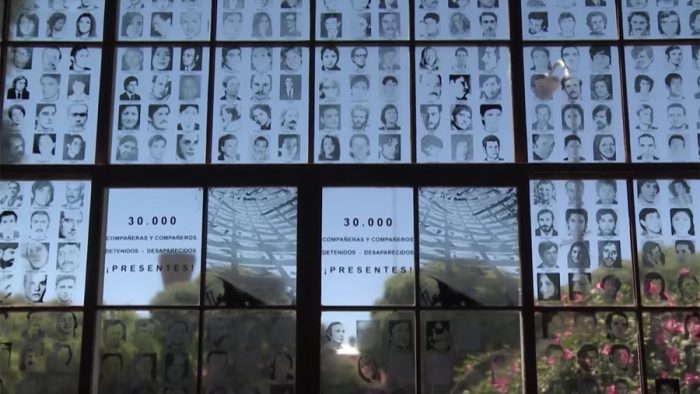
Images of junta victims at ESMA Museum in Buenos Aires © espaciomemoria / YouTube
RT | November 30, 2017
Judges in Argentina have given life sentences to the former ‘death flights’ pilots after hundreds of people opposing the country’s 1976-83 military junta – including a close friend of Pope Francis – were thrown into the ocean.
A major ruling on Wednesday marked the “first” such Argentinian judgment against pilots involved in the notorious ‘death flights,’ local media reports. During the operations, opponents of Argentina’s military regime that ruled the country from 1976 until 1983 were thrown into the waters of the Atlantic.
According to the verdict, the announcement of which lasted almost four hours, 29 former service members were sentenced to life imprisonment, 19 were sentenced to eight to 25 years, and six were acquitted, local media report.
There are 54 defendants in the major trial. It also involves cases of 789 victims of a secret detention center – known as the Navy Mechanics Higher School (ESMA) – where up to 5,000 people opposing the repressive junta regime are believed to have been vanished.
The five-year trial – called the ‘mega cause’ in Argentina – exposed the chilling practices of systematic torture and the killing of thousands of people, including left-wing opponents of the regime and members of Argentina’s urban guerrilla groups, but also human rights activists and relatives of those forcibly disappeared by junta forces.
In a series of hearings, it emerged that numerous victims were drugged, loaded onto ‘death flight’ aircraft, and thrown into the freezing waters of the southern Atlantic Ocean. Among ESMA victims was Esther Careaga, a close friend of Jorge Bergoglio, who later became Pope Francis. Careaga was thrown to her death from a plane one night in December 1977, along with two French nuns and nine others.
“Careaga was a good friend and a great woman,” Beroglio said when the body was identified in 2003. The future pontiff met Careaga, a biochemist and his boss at the time, when he worked as an apprentice at a pharmaceutical laboratory in Buenos Aires in the early 1950s.
Featured Video
BRITAIN’S WARNING: PREPARE FOR WAR
or go to
Aletho News Archives – Video-Images
From the Archive
How Ukraine Tortured and Slaughtered Donbass
By Kit Klarenberg | Al Mayadeen | July 11, 2024
Almost immediately after the proxy war erupted, ISIS-tier footage of the torture and murder of Russians in Ukrainian custody emerged.
On July 6th, the New York Times published an astonishing investigation: In Ukraine, Killings of Surrendering Russians Divide an American-Led Unit. The article documents in grim detail how Chosen Company, an international volunteer battalion for Kiev, routinely executes Russian prisoners of war. It is the very first mainstream admission that this practice – a brazen breach of the Geneva Conventions, and a grave war crime – is widespread among Ukraine’s fighters, both foreign and homegrown. … continue
Blog Roll
 Aletho News
- Israel Demolishes Home Of Lebanese Journalist Whose Viral Film Exposed Pager Attack
- Record Oil, Empty Tanks: The UAE’s Miracle Recovery
- Burnham tackles Britain’s poverty with aggression in Yemen
- Peace in Ukraine: the easy way – or the hard way
- Trump & the Rrrrussians
- US taxpayer money laundered back through Ukraine – Musk
- Before COVID, an NIH lab chief proposed making a SARS-like bat virus more infectious
- Gates, Bourla on Trial in Netherlands Accused of ‘Great Reset’ Scheme at Vaccine Injury Hearing
- BRITAIN’S WARNING: PREPARE FOR WAR
- “Historic Russia”: The Land Putin Will Not Give Back
- If Americans Knew
- An error has occurred; the feed is probably down. Try again later.
- No Tricks Zone
- Two New Studies Find Thwaites Glacier Melt Cannot Be Driven By Human Activity Or A Warming Ocean
- E-Cars Reduce CO2 Emissions By Only 41% Compared To Internal Combustion Engine Vehicles
- Predictions Made By Renowned Climate Professor Over Past Decades Have Been Proven To Be Poor
- New Study Suggests Large Regions Of The Pacific Ocean Have Been Cooling For The Last 80 Years
- Germany’s Green Energy Debacle: High Energy Costs Force Kahla Porzellan to Close After 182 Years!
- New Study: 50 Years Of The Most Aggressive ‘Net Zero’ Policies Can Only Affect The Global Climate By 0.03°C
- US September “Heat” Was No Record…Many Records Set Decades Ago
- Latest European Green Energy Debacle; Portugal’s Largest Flagship Solar Park Insolvent!
- Green Energy Debacle: German Expert Professor Fritz Vahrenholt Warns Of Severe Economic And Social Consequences
- Two More Paleo Reconstructions Affirm Meters-Higher Sea Levels Across Ireland, Brazil 7000-6000 Years Ago

