Anti-nuclear MPs debate Trident, call renewal ‘waste of money’
RT | January 20, 2015
The future of Britain’s nuclear deterrent was debated in Parliament on Tuesday, hours after a Scottish opinion poll found nearly half of Scots oppose renewing the Trident program.
Parliament’s debate on Trident comes weeks after the Ministry of Defence (MoD) published a report revealing the cost of the program’s “assessment phase” will increase by an additional £261 million this year.
Renewal of Trident, which is based just 25 miles west of Glasgow, is expected to cost £20 billion.
The cost of the overall program over the next 25 years, however, is estimated to be £80 billion.
Tuesday’s debate was called by the Scottish National Party (SNP), Green Party, and Welsh national party Plaid Cymru, with the intention of demonstrating “opposition to Trident renewal in Westminster.”
It was boycotted by most members of the Labour Party, which officially supports Trident renewal.
Tuesday’s poll, conducted by Survation and commissioned by SNP, found that 47 percent of Scots oppose Trident renewal, 32 percent support it, and 21 percent “don’t know.”
The results, along with revelations of Trident’s rising costs, will boost SNP confidence, as the party pledges to oppose nuclear weapons ahead of May’s general election.
Angus Robertson MP, a member of the SNP, opened the debate in the House of Commons.
“Today’s debate is an opportunity to show there is opposition to Trident renewal in Westminster,” he said.
Robertson emphasized the ethical case for scrapping nuclear weapons.
“Each warhead [on Trident submarines] has an explosion eight times the power of the atomic bomb dropped on Hiroshima in 1945,” he said.
He also cited recent debates on austerity and food banks, saying “there is an alternative.”
In a press statement, the SNP criticized Labour’s boycott of the debate given the party’s support for austerity.
“Labour’s refusal to take part in the debate on Trident comes less than one week after the party voted along with the Tories for a further £30 billion of austerity cuts,” the SNP said.
“That Scottish Labour MPs support wasting another £100 billion on weapons of mass destruction while foodbank use is rocketing, and more and more children are being pushed into poverty, is simply indefensible,” they added.
A handful of Labour MPs did attend the debate, however. Speaking to the Commons, rogue Labour MP Dame Joan Ruddock supported scrapping Trident.
The former chair of the Campaign for Nuclear Disarmament (CND) asked how Britain can justify trident renewal “when we cannot raise millions out of poverty or fund our precious National Health Service.”
Ruddock described proponents of Trident renewal as being stuck in “Cold War thinking.”
“The threats that were part of the Cold War scenario are very different from the threats we face today,” she said.
“Real security lies in nuclear disarmament,” she added.
Her comments echo those of current CND General Secretary Kate Hudson.
“[Trident] is the wrong answer to the security challenges facing the UK. And when that wrong answer comes with a £100 billion price-tag, it’s no wonder it’s deeply unpopular with the British public,” Hudson said.
“[Prime Minister] David Cameron claims it’s the ultimate insurance policy – but even the former head of the Armed Forces has conceded that it is ‘completely useless’ to [sic] the threats we face.”
“It’s time the government recognized the colossal waste of money that Trident constitutes, and committed instead to investing the money in health, jobs and education,” she added.
Defence Secretary Michael Fallon defended the planned renewal of Britain’s nuclear weapons program, calling it “the ultimate guarantor of our freedom and independence.”
“Whether we like it or not, there remain approximately 17,000 nuclear weapons globally,” he said.
“We cannot gamble with our country’s national security, we have to plan for a major, direct nuclear threat to this country or to our NATO allies,” he added.
Fallon cited Russia, North Korea and Iran as potential nuclear threats given their desire to build or maintain nuclear weapons programs.
Parliament will vote on whether to upgrade Britain’s nuclear weapons program in 2016.
A mass demonstration against replacing Trident will take place in London on Saturday, January 24.
Organized by CND, the protest will begin at 12pm outside the Ministry of Defence on Horseguards Avenue.
READ MORE:
Nuclear ultimatum: Scottish National Party challenges Labour on Trident
‘Ticking time bomb’: Watchdogs slam UK nuclear weapons maker over safety practices
US plans to deploy armored brigade to Europe ‘pre-date’ Ukraine hostilities
By Robert Bridge | RT | December 31, 2014
By the end of next year, Washington plans to station about 150 tanks and armored vehicles in Europe, according to a US military commander, who said the decision was made before the Ukrainian crisis strained Russia-US relations.
Although no official announcement has been made as to where the armored tanks and vehicles will be stationed, possible locations include Poland, Romania or the Baltic States, Lieutenant-General Ben Hodges, commander of the US Army in Europe, told Reuters.
Hodges confirmed that around 150 pieces of assorted US military armor would be permanently stationed in Europe.
“By the end of … 2015, we will have gotten all the equipment for a heavy brigade, that means three battalions plus a reconnaissance squadron, the artillery headquarters, engineers, and it will stay in Europe,” Hodges said.
“You are talking about 150-ish, maybe 160 M1 tanks, M2 Bradley fighting vehicles, 24 self-propelled Howitzers.”
Hodges, who said he believes renewed hostilities will occur between pro-Kiev and rebel forces in the east of the country, said plans to send an armored brigade to Europe was first proposed two years ago, before the Ukrainian crisis erupted in January 2014.
Russia has firmly rejected Western accusations that it has sponsored military activities in Ukraine.
The move on the part of Washington will certainly provoke a reaction from Moscow, which has just agreed on a new military doctrine that lists the 28-member North Atlantic Treaty, which has been steadily encroaching on Russia’s borders since the collapse of the Soviet Union, and the United States, which has undertaken a series of military offensives deemed unconstitutional even by its own people, as “major foreign threats.”
The doctrine lists among major foreign military threats “the creation and deployment of global strategic anti-ballistic missile systems that undermines the established global stability and balance of power in nuclear missile capabilities, the implementation of the ‘prompt strike’ concept, intent to deploy weapons in space and deployment of strategic conventional precision weapons.”
Hodges said he expected the deployment of US armored vehicles to Europe to continue throughout 2015 and into 2016.
At least one-third of the armored vehicles will be stationed at US military bases in Germany, the US commander said.
The United States, despite recent breakdowns in its relations with its European allies – including a spy scandal that revealed the National Security Agency was tapping the personal mobile phone of German Chancellor Angela Merkel, as well as other high-ranking EU officials – continues to field some 30,000 Army troops on European soil, and about the same number of Air Force, Navy and Marine personnel, Hodges said.
The US commander said he hoped the number of US soldiers and military bases based in Europe – despite budgetary pressures from home – would stay at their current levels.
READ MORE: There to stay: US troops keep Poland, Baltic deployment for 2015
‘US military hardware will cause more bloodshed in Ukraine’ – Russian senator
RT | December 29, 2014
The possible relocation of US hardware from Afghanistan to Ukraine suggested by President Obama will only lead to more casualties, a senior Russian lawmaker has stated.
“Russia cannot be content with such plans as they would increase the tensions near our borders and also inevitably cause more casualties in Donbass,” the head of the Upper House Committee for Foreign Relations, Konstantin Kosachev, told reporters on Monday.
The senator added that such a step by the United States would be an open interference into the conflict, which would definitely lead to further aggravation both in Russian-American relations and within the security situation in Eastern Europe as a whole.
Kosachev also gave a critical appraisal to the allied mission in Afghanistan that is being wrapped up this year. The Russian lawmaker called the result of Western military presence in the country disappointing, noting that the military mission did not solve any problems in the region – but rather created a few new ones.
Earlier on Monday, a Russian Lower House MP also criticized Washington’s decision to transfer military hardware from Afghanistan to Ukraine, promising reciprocal actions from Russia. A member of the State Duma Committee for Defense and the chairman of the Russian Union of Afghanistan War Veterans, Frants Klintsevich (United Russia party) told reporters that he would use all his powers to initiate an official State Duma address to President Putin, seeking to start the supplies of Russian military hardware to the Lugansk and Donetsk republics.
In early December, MP Mikhail Yemelyanov of the leftist Fair Russia party said the US Senate’s decision to arm the Kiev regime should prompt “adequate measures” from Russia, such as deploying military force on Ukrainian territory before the threat becomes too high.
Yemelyanov also noted that in his opinion, the US Senate’s decision to arm Ukraine has revealed that Washington is not interested in the de-escalation of the Ukrainian conflict. “In a few years, Ukraine will turn into a poor and hungry country with an anti-Russian government that will teach its population to hate Russia. They will be armed to the teeth, and Ukraine and US reluctance to recognize the Russian Federation within its current borders would always provoke conflicts,” the MP noted.
On March 1 2014, the Upper House of the Russian Parliament – the Federation Council – approved a resolution allowing the president to use military force on the territory of Ukraine “until the normalization of the social and political situation in that country.” The resolution was adopted in accordance with the first part of Article 102 of the Constitution of the Russian Federation.
However, on June 25, the Federation Council voted to repeal the legislation following a request from Vladimir Putin. The Russian president instigated the move from a desire to alleviate tensions in view of the three-party talks on a peaceful settlement in the east and southeast of Ukraine.
Nuclear ultimatum: Scottish National Party challenges Labour on Trident
RT | December 16, 2014
The Scottish National Party (SNP) will only support a Labour government in a hung parliament after the May 2015 general election if they agree to scrap Britain’s nuclear weapons program, Scottish First Minister Nicola Sturgeon said.
Sturgeon ruled out a formal coalition with Labour, but suggested the SNP would support the party if they agreed to some “hard conditions.”
A recent YouGov poll highlights the SNP’s growing popularity in Scotland following September’s independence referendum, while Labour support in its historic heartland appears to be dwindling.
While the SNP currently have only five MPs in the House of Commons in Westminster, the party’s surge in support could see them playing a key role in making or breaking a government if no party gains a majority in the May election.
Sturgeon was speaking at a press conference on Monday following face-to-face talks with Prime Minister David Cameron. During the talks Cameron agreed to allow the Scottish Parliament to lower the voting age to 16 in time for the election.
Sturgeon told assembled press she remains staunchly opposed to nuclear weapons on principle, but also argues it makes no economic sense to pursue Trident in the future.
“You add into that at the moment this economic lunacy at a time when services are under pressure, you’re facing the extent and scale of public sector cuts over the next few years, to be spending £100 billion on a new generation of nuclear weapons that even many military experts now say are not required.”
Speaking alongside the leaders of the Green Party and Welsh nationalists Plaid Cymru, Sturgeon also attacked the Westminster parties for continuing austerity policies which hit the vulnerable hardest.
“But despite the deeply damaging impacts of failed austerity, the Tories and Labour have made crystal clear their determination to carry on regardless.
“And after four years propping up the Tories, the Lib Dems have no credibility. It is time for a new approach to UK politics – and for our parties to use our influence to bring about progressive change at Westminster,” she said.
Sturgeon was elected SNP leader and First Minister in November following Alex Salmond’s resignation. During the build up to the independence referendum Sturgeon served as Deputy First Minister and has served as an SNP member of the Scottish Parliament since 1999.
The SNP ultimatum will be an added challenge for Scottish Labour’s new leader Jim Murphy, who was elected to the position on 13 December. Increasing support for the SNP means Murphy’s own seat could be vulnerable, SNP Deputy Leader Stewart Hosie told STV News.
“Mr Murphy spent two years campaigning side by side with the Tories in Scotland, and in that sense he is part of Labour’s problem in Scotland, not the solution,” Hosie said.
With Labour unlikely to abandon Trident as a condition of a shared power arrangement, the party faces an uphill battle to secure seats in a nation which appears to be turning its back on them.
Ready-to-fire nuclear weapons pose ‘accidental launch’ risk – former defense chiefs
RT | December 8, 2014
Cross-border action to lower the risks posed by an intentional or accidental nuclear attack is “insufficient,” international military, political and diplomatic officials have warned.
Ready-to-use nuclear arms leave states vulnerable to accidental nuclear strikes, while insecurely stored stockpiles could potentially be targeted and stolen by terrorists, the European Leadership Network said.
In a letter written in the run up to the Vienna Conference on the Humanitarian Impact of Nuclear Weapons, UK signatories collectively called upon states across the globe to eradicate nuclear arms.
Former home secretary Charles Clarke, former chief of defense staff, Lord Richards and former defense secretaries Lord Browne and Lord King joined other signatories in urging states across the globe to “redouble efforts to work toward a world without nuclear weapons.”
The risks posed by nuclear weapons and current global dynamics that could prompt their deployment are underestimated and poorly understood by world leaders, the signatories warned.
In a post-Cold War era, a proliferation of nuclear arms across the globe that are ready to fire at any moment, greatly amplifies the chance of an accident, they added.
This scenario leaves world leaders who face an imminent threat of attack an insufficient period to liaise with one another and act prudently, the signatories stressed.

Former US general, James Cartwright. (Image from wikipedia.org)
Other high profile figures who supported the call included retired US general James Cartwright, former French prime minister Michel Rocard, former vice-chairman of the joint chiefs of staff, and delegates from Russia, China and India.
The warning comes in the wake of reports that Islamic State (IS, formerly ISIS) had stolen uranium compounds from Mosul University in Iraq earlier this year.
Writing to UN Secretary-General Ban Ki-moon on July 8, Iraqi UN Ambassador Mohamed Ali Alhakim said 88 pounds of uranium used for scientific research at the university had been looted.
Two days later, however, a spokesperson for the UN International Atomic Energy Agency (IAEA) said the material was “low grade” and “would not present a significant safety, security or nuclear proliferation risk.”
The Vienna Conference on the Humanitarian Impact of Nuclear Weapons began on Monday, and is due to come to a close on Tuesday evening.
The conference follows recent talks between Iran and six western governments. Although the group failed to negotiate a satisfactory deal on Iran’s nuclear program, the talks have been extended for a further seven months.
There are currently thought to be approximately 16,300 nuclear weapons in nine different states across the world.
Global negotiators are concerned that Iranian authorities are using the state’s nuclear development program as a covert means of developing arms, and have imposed sanctions on the Middle Eastern state.
But the Iranian government denies this, and argues the state is only interested in developing peaceful nuclear projects such as the production of power.
Commenting on the recent round of nuclear talks, Russian Foreign Minister Sergei Lavrov said “considerable progress” had been made despite the fact no final agreement was reached. He added he expected the “basic principles” of a final agreement to surface within three or four months.
Reflecting on the negotiations, British Foreign Secretary Philip Hammond agreed “significant progress” had been achieved.
In late November, it emerged Iran had reduced its stockpile of low-enriched uranium gas to comply with the terms of an interim nuclear agreement signed with six world powers in 2013.
As talks are set to continue next month, Tehran’s access to $700 million per month by way of sanctions relief remains intact.
Earlier this month, the UN General Assembly passed an Arab-introduced resolution calling on Israel not to develop, produce or possess nuclear arms. The resolution also criticized the Israeli administration for not being part of the international Treaty on the Non-Proliferation of Nuclear Weapons (NPT).
Read more: UN urges Israel to renounce nuclear arms, join non-proliferation treaty
Is Washington training a rebel army to “Occupy” Syria?
RT | November 27, 2014
Is the US planning the occupation of Syria by training an unconventional insurgent invasion force?
Think regime change in Syria is off the drawing board? Think again. The bombing of the ISIL or ISIS in Syria is part of a brinkmanship campaign leading up to a potential non-conventional invasion, parallel to the re-introduction of the US military to Iraq.
The ISIL and the other anti-government forces in Iraq and Syria are not the only ones to disregard the Iraqi-Syrian border drawn by the British and French by Sykes-Picot in 1916. The US also disregarded the border and international law when it began to illegally bomb Syria.
The bombing campaign was not enough for some in the US Congress. In a joint statement on September 23, the arch-hawks US Senators John McCain and Lindsey Graham called for US troops to be sent into Syria too. Both of them praised the Pentagon’s illegal airstrikes in Syria and then argued for US ground troops as well.
Although McCain and Graham went out of their way to say that this would not be an occupation of either Syria or Iraq, this is almost exactly what they were calling for when they said that the military campaign had to also be directed against the Syrian government.
Since, and even before the calls for an invasion of Syria by McCain and Graham different suggestions have circulated about an invasion of Syria.
The dilemma is that Washington does not want the Pentagon to directly invade Syria itself. It wants to pull the strings while another force does the work on the ground. Candidates for an outsourced invasion of Syria include the Turkish military or other US regional allies. There, however is also an impasse here as Washington’s allies are also afraid of the consequences of an invasion of Syria.
This is where a third opinion comes into the picture: the construction of a multinational insurgent army by the US.
Using non-state actors to invade and occupy Syria
While there seems to be no consensus on a Syrian strategy within the US political, intelligence, and military establishments, the objective of regime change is universally adhered to across the board. Regardless of the existence of a consensus, the US is moving ahead with the creation of an anti-government invasion force.
The third option is slowly emerging.
A few days after the US began the bombing of Syria, the Chairman of the Joint Chiefs of Staff General Martin Dempsey made it clear that the Pentagon also planned on creating a viable anti-government army in Syria consisting of 12,000 to 15,000 insurgents.
There also seems to be a growing consensus among the realists and neocons for US President Obama’s preference of using a rebel army to invade Syria. The Brookings Institute has been a major cheerleader for this.
During this same timeframe, the Brookings Institute released an opinion piece clearly calling for US intervention. The text, authored, by former CIA analyst for monitoring the Persian Gulf and US National Security Council official Kenneth Pollack, stipulated that Washington’s “strategy cannot require sending U.S. troops into combat. Funds, advisers, and even air power are all fair game — but only insofar as they do not lead to American boots on the ground.”
Pollack played an influential role in getting support for the illegal 2003 invasion of Iraq. He worked at the Council of Foreign Relations as its director of national security studies. He made the above statement as the director of research for the Saban Center for Middle East Policy and goes well beyond it by publishing a drawn-out October 2014 proposal for creating a US-made rebel invasion force as a means of taking over Syria and eventually conducting regime change in Damascus.

Brookings Institution in Washington, D.C.. (Image from wikipedia.org)
The Brookings Institute proposal suggests that a rebel Syrian army “is best not done in Syria itself. At least not at first” (p.9). The report points to the US and NATO success in “covertly” creating armed forces around the world, including the assembly of a Croat military, and deduces that these experiences would make it “entirely realistic for the United States to build a new Syrian opposition army” (p.8). It also says that the ideology of the fighters does not matter by stating the following: “A great many of those recruited may well be religious, even highly religious, including Salafist. That is not the issue” (p.9).
Welcome to the Brookings Institute and its Saban Center
What is the Brookings Institute exactly and why do suggestions from this think tank and others like it, matter?
The Brookings Institute is an influential think tank that has a revolving door of personnel with the US government and major corporations. All that one needs to do is look at its trustees and executives, which include interlocked directorships with the Carlyle Group, Goldman Sachs, and JP Morgan Chase.
Brookings also has ties to Israel and a full branch dedicated to Washington’s Middle East strategies and policies called the Saban Centre for Middle East Policy. Martin Indyk – the former US ambassador to Israel, a former high-level lobbyist for the American Israel Public Affairs Committee (AIPAC), and the founder of AIPAC’s research arm (the Washington Institute for Near East Policy) – is the Director of the Saban Center for Middle East Policy at Brookings. Like Indyk, Kenneth Pollack was involved in shaping the Middle East policies of the Clinton Administration.
It is also worth noting that the Brookings Institute’s Saban Center is named after US-Israeli businessman and media mogul Haim Saban. Saban himself is on the board of trustees for Brookings.
There is a Qatari connection too. One may remember that Washington was hostile towards Al Jazeera when it first emerged as a news broadcaster, because of its coverage of US actions in the Middle East.
Saban tried to buy half of the Al Jazeera network from Qatar in 2004 and 2009, but failed. In the same timeframe as the 2003 Anglo-American invasion of Iraq, the first set of negotiations happened when he went to Qatar with Bill Clinton in 2003.
It is possible that Brookings may have played a role in pacifying Al Jazeera. In 2009, the Institute setup an overseas branch in Qatar called the Brookings Doha Center. The new chapter in Doha included Qatar’s ruling Al-Thani family alongside people like Madeleine Albright, Zbigniew Brzezinski, and Fareed Zakaria as chairs and advisors.
It was in the same year that the Brookings Institute published a report, which included Pollack and Indyk as authors, called Which Path to Persia? The report outlined a map for confronting Iran and alluded to the neutralization of Syria, in one way or another (including the procurement of a peace agreement with Damascus by Israel), to “mitigate blowback” from Lebanon’s Hezbollah and the Palestinians, specifically Hamas, as a prerequisite for an enabling an attack on Iran.
All in all, the ideas that come out of the Brookings Institute are discussed at the highest levels within policy-making and corporate circles.
Is the Syrian Invasion Force Slowly Emerging?
Is a rebel invasion force emerging to attack Syria? In no uncertain terms, Brookings argues that it is.
Pollack’s report stipulates the following: “Adopting such a strategy would mean first and foremost that Washington would have to commit itself to building a new Syrian army that will rule Syria when the war is over. Although [Obama’s] description of his new Syria policy was more modest and tepid than his explanation of the Iraq piece of the strategy, he does appear to have committed the United States to just that course. More than that, it will mean putting the resources, prestige and credibility of the United States behind this effort. The $500 million now appropriated is a good start, but it is only a down payment on a much larger project” (p.8).
The US goal of training rebels in Saudi Arabia and Turkey is an indication of this too. On September 10, about two weeks before it started bombing Syria, Washington declared that Saudi Arabia had given it the green light to train a rebel army in the Arabian Peninsula. “We now have the commitment from the Kingdom of Saudi Arabia to be a full partner in this effort — the train-and-equip program — to host that program,” one official was quoted as saying by the New York Times.
The Brookings Institute in its proposal for an invasion of Syria claims: “The Saudi offer to provide facilities to train 10,000 Syrian opposition fighters is one of reasonable possibility, although one of Syria’s neighbors would probably be preferable. Jordan already serves as a training ground for America’s current training program and it would be an ideal locale to build a real Syrian army. However, Turkey could also conceivably serve that purpose if the Turks were willing” (p.10).
About two months later, in November, after US Vice President Joe Biden met with Turkish President Recep Tayyip Erdogan in Istanbul, it was announced that Kirsehir would be used by Turkey to train Syrian anti-government forces that the US would equip against Damascus.
The report also makes it clear that building the new opposition army “should not mean bolstering the existing ‘Free Syrian Army’” (p.10). Instead, the existing US-backed insurgent groups will slowly be swallowed or destroyed by the new opposition force that the US and its allies are constructing.
In mid-November, the Pentagon also presented a proposal to the US Congress, saying that it wants to arm Iraqi tribesmen with Kalashnikov rifles, rocket propelled grenades, and mortars. What is omitted is the cross-border dispersion of these tribes in both Iraq and Syria and the possibility that these weapons could be used in an attack on the Syrian government.
What moderates?
The talk about supporting “moderates” is very misleading. It is already clear that the ideology of the proposed insurgent army is not a key issue in practice for many US officials. There is also enough evidence to show that the Free Syrian Army, Al-Nusra, the ISIL, and the other insurgent forces are also collaborating and trading fighters.
The Telegraph, for example, had this to say on November 10 about Saddam Jamal, a US-backed Free Syrian Army commander that became an ISIL commander: “Before joining ISIL, Jamal had been a drug dealer, then a commander in the western-backed Free Syrian Army, claiming contacts in the CIA.”
It is also clear that religion is a mask for the ISIL too. The same British article writes the following testimony from Saddam Jamal’s body guard about his massacre of a Syrian family: “The ISIL commander felt no remorse for killing this Syrian family, his bodyguard said, nor did he believe he was fulfilling a God-given creed: for him being a member of the extremist group was a matter of business, not religion.”
In the end the ISIL may be used to incubate fighters or collapse, like the Free Syrian Army, into the proposed invasion force to occupy Syria.
Invasion army or armies?
General Dempsey said that “the anti-ISIL campaign could take several years to accomplish.” Leon Panetta, the former head of the CIA and Pentagon, has also claimed that this war will turn into a thirty-year US military project that will extend to North Africa, West Africa, and the Horn of Africa.
According to Brookings: “At some point, such a new Syrian army would have to move into Syria, but only when it was ready. Only when a force large enough to conquer and hold territory – something on the order of two to three brigades -were ready should it be sent in” (p.11).
A war of attrition that that will take years of fighting is underway. This matches up with the ideas about training an insurgent invasion force over the years.
In their joint statement Senators McCain and Graham said that President Bashar Assad will not stop fighting the so-called “moderate” US-backed insurgents “that remain committed to his ousting- especially when the United States and [its] partners still, correctly, share the same goal and will now be arming and training Assad’s moderate opponents.” In other words, the US-trained Syrian forces will ultimately target the Syrian government.
Mahdi Darius Nazemroaya is a sociologist, award-winning author and geopolitical analyst.
Neocon propagandist frets over Russia’s ‘weaponization of information’
By Maidhc Ó Cathail | RT | November 26, 2014
There was a strong whiff of hypocrisy in the Washington air on November 13 when the National Endowment for Democracy (NED) hosted a discussion of a report entitled ‘The Menace of Unreality: How the Kremlin Weaponizes Information, Culture, and Money’.
The Menace of Unreality is co-authored by Michael Weiss, editor-in-chief of the Interpreter, and Peter Pomerantsev, author of a forthcoming book asserting that Putin’s Russia is a post-modern dictatorship.
Introducing the discussion, NED’s Christopher Walker noted that the US Congress-funded Endowment hadn’t been involved in the production of the report but that it does have “close ties” to Weiss’s online journal and the New York-based think tank that funds it, the Institute of Modern Russia (IMR).
In the course of their report’s self-righteous criticism of the widespread “opaqueness” about who funds think tanks, Weiss and Pomerantsev disclose, in an aside, that their work is “funded by a think tank that receives support from the family of Mikhail Khodorkovsky.” Their critique of the weaponization of money, however, neglects to mention its funder’s conviction for embezzlement and money laundering.
In Washington, Weiss and Pomerantsev were joined in the discussion of their “counter-disinformation” report by an analyst from the Foreign Policy Initiative, a neoconservative advocacy group founded by Robert Kagan and William Kristol, whose earlier Project for a New American Century had played a key role in pushing the lies that led to the US invasion of Iraq.
Inside the report’s cover, which features a reader oblivious to the fact that the broadsheet he’s reading is going up in flames, the Interpreter says it “aspires to dismantle the language barrier that separates journalists, Russia analysts, policymakers, diplomats and interested laymen in the English-speaking world from the debates, scandals, intrigues and political developments taking place in the Russian Federation.”
The similarity between the Interpreter’s stated aspirations and those of the pro-Israel Middle East Media Research Institute (MEMRI) may be more than coincidental. As the liberal Jewish blogger Richard Silverstein observed about a blog in the Telegraph by the Interpreter’s editor-in-chief, “a number of Weiss’claims are based on the notoriously unreliable MEMRI,” which itself claims to bridge “the language gap between the West and the Middle East and South Asia.”
The bio that precedes that June 2011 Weiss blog describes him as “the Research Director of The Henry Jackson Society, a foreign policy think tank, as well as the co-chair of its Russia Studies Centre.”
In addition to a who’s who of neocon luminaries like Kagan and Kristol, the Henry Jackson Society’s international patrons include Ambassador Dore Gold, former permanent representative of Israel to the United Nations, and Natan Sharansky, chair of the executive of the Jewish Agency for Israel.
Weiss’s previous employment at the UK-based, pro-Israel advocacy organization, however, is conspicuously absent from the lengthy “About the Authors” section at the end of the IMR-published, anti-Russia report.
His updated bio, however, reveals that Weiss’ concerns haven’t changed much since his HJS days.
“Weiss has covered the Syrian revolution from its inception, reporting from refugee camps in southern Turkey and from the frontlines of war-torn Aleppo,” the IMR report notes.
As a profile of the neocon Henry Jackson Society observes, its members have been “active proponents of Western intervention in Syria’s civil war.” It singles out a March 2012 piece in the New York Times by Weiss advocating that the US “begin marshaling a coalition for regime change in Syria consisting of countries” like “Britain, France, Qatar, Saudi Arabia and Turkey.”
In an interview with the Jerusalem Post last year, Israel’s previous ambassador to the US Michael Oren admitted that Tel Aviv “always wanted [President] Bashar Assad to go.”
Likewise, one suspects that Weiss’ “set of modest recommendations” on how the West should confront Russia’s supposed “weaponization of information” is motivated at least in part by the challenge Russian media such as RT poses to the monopoly over the narrative of the Syrian conflict coveted by his interventionist friends in the Western media.
Maidhc Ó Cathail is a widely-published writer and political analyst. He is also the creator and editor of the Passionate Attachment blog, which focuses primarily on the US-Israeli relationship.
The myth of Assad, ISIL and extremism
By Sharmine Narwani | RT | October 7, 2014
Who is to blame for the proliferation of extremist groups in Syria? The West often points a finger at Assad and his allies, but two secret US documents tell a different story.
It is difficult to find US officials directly claiming that Syrian President Bashar al-Assad is in league with the Islamic State of Iraq and the Levant (ISIL), but you will find plenty who will allude to it using specious reasoning:
US Secretary of State John Kerry is one of many who have sought to encourage this narrative:
“There is evidence that Assad has played footsie with them (ISIL), and he has used them as a tool of weakening the opposition. He never took on their headquarters, which were there and obvious, and other assets that they have. So we have no confidence that Assad is either capable of or willing to take on ISIL.”
That logic forms the basis of several key arguments used by Syria’s opponents to suggest a covert and symbiotic relationship between the Syrian government and Islamist extremists. They go something like this:
• Assad encouraged the growth of militants to create an either-or dilemma for Syrians who want him deposed, but who fear “what comes next.”
• Assad released militants from prison in 2011 so that they would overwhelm secular moderates.
• Proof of this is that the Syrian Army does not attack ISIL targets.
• Assad has a close history with militants – he sent hundreds over the border into Iraq to join the insurgency against US forces and is now suffering blowback.
But as a global confrontation with ISIL mounts, an entirely different picture has begun to emerge. The US-led coalition’s five Arab Sunni partners are providing little less than fig-leaf cover for airstrike operations. NATO has been unable to wrest – to date – a commitment from Turkey to enforce serious border security to stop militants from crossing over into Iraq and Syria. In recent weeks, Western media has unleashed a flurry of articles pointing to Qatar’s role in funding extremists.
Clearly, America’s Sunni Arab and Turkish allies are approaching the “ISIL Project”’ with something less than enthusiasm.
On Thursday, US Vice President Joe Biden let the cat out of the bag. During a speech at Harvard University, Biden told his audience:
“Our allies in the region were our largest problem in Syria. The Turks… the Saudis, the Emiratis, etc. What were they doing? They were so determined to take down Assad and essentially have a proxy Sunni-Shia war, what did they do? They poured hundreds of millions of dollars and tens, thousands of tons of weapons into anyone who would fight against Assad except that the people who were being supplied were al Nusra and al Qaeda and the extremist elements of jihadis coming from other parts of the world … we could not convince our colleagues to stop supplying them.”
He, of course, failed to mention Washington’s own arming, training and funding activities coordinated with these very same allies. Predictably, Biden was forced to “apologize” for his undiplomatic comments over the weekend.
But just last month, during a hearing in the US Senate for Chairman of the Joint Chiefs of Staff General Martin Dempsey, Senator Lindsey Graham asked: “Do you know of any major Arab ally that embraces ISIL?”
To the surprise of many, Dempsey countered: “I know of major Arab allies who fund them.”
The revelations keep flowing from once tight-lipped Western sources. According to US news reports, current and former officials now say wealthy Gulf donors are the source of early funding:
“These rich individuals have long served as ‘angel investors’ for the most violent militants in the region, providing the ‘seed money’ that helped launch ISIS and other jihadi groups… Former U.S. Navy Admiral and NATO Supreme Commander James Stavridis says the cash flow from private donors is significant now and was even more significant in the early fund-raising done by ISIS and al Qaeda’s affiliate in Syria, the al-Nusra Front,” NBC’s Robert Windrem wrote in an article.
And on Saturday, the UK’s former Assistant Chief of the Defense Staff General Jonathan Shaw, who specialized in counter-terrorism and security policy and retired in 2012, told The Telegraph :
“This is a time bomb that, under the guise of education, Wahhabi Salafism is igniting under the world really. And it is funded by Saudi and Qatari money and that must stop.”
The ‘Assad-has-encouraged-extremism’ argument
Has the Syrian government exploited extremism while at the same time fighting a three-year nationwide military campaign to thwart it? Perhaps. Politics are opportunistic by nature.
But the narrative about Assad encouraging Islamist militancy has always failed to note the historic role of armed Islamists in Syrian “rebellions.”
A US Defense Intelligence Agency (DIA) document that was declassified in 2012 provides a starkly different reading of events leading up to the controversial “Hama massacre” of 1982. It tells a story remarkably similar to events in Syria beginning in early 2011. Here is a montage of quotes from the document:
“In early 1979, encouraged by the Islamic Revolution in Iran, the Syrian Muslim Brotherhood developed a plan to trigger a similar popular revolution in Syria to oust (Hafez) Assad. The massacre of 50 Alawite cadets, on 16 June 1979 at the Artillery School in Aleppo, signaled the start of the MB offensive.”
The Syrian MB regroups for a “new round of fighting” in late 1980, announces the formation of an “Islamic Front”’ and increases cooperation with the Sunni (Baathist) government of Iraq which had helped the MB covertly in 1979-80 to oust Assad.
“The plan, apparently developed by the leadership of the Syrian MB and probably coordinated with Iraq, centered on two complementary actions. The first was a full-scale revolt by the city of Hama, a traditional Brotherhood stronghold and the location of its covert headquarters in Syria. Once this rebellion was unleashed, similar uprisings were to take place in Aleppo, Damascus and other major cities, accompanied by a general strike designed to paralyze Syria…”
“Simultaneously, a sophisticated worldwide propaganda campaign was to be launched supporting the rebellion and emphasizing its victories and the wholesale desertion of Army units to the rebel side. Press releases were to be made in Europe and the US, while propaganda broadcasts against Syria were to be carried by the Phalange-controlled Voice of Lebanon and the Iraqi-controlled Voice of Arab Syria.”
“At least 100 militants were transported from Jordan, where they had taken refuge, into Iraq where they probably received training prior to their movement into Syria… Sometime after this, the infiltration of ‘Secret Apparatus’ militants began from staging areas in Iraq, and to a lesser degree from Turkey, where others had fled. During the interim period, a number of terrorist bombings and shootings took place in Syria to demonstrate the Brotherhood/dissident Alawites ability to strike at the government.”
“As a result of Syrian security actions, the MB was forced to prematurely unleash the Hama rebellion with the hope that it might spark widespread fighting in other cities… The rebellion would also force the Damascus government to become even more oppressive. The Brotherhood leadership believed this would, in turn, cause greater alienation of the Assad government from the Sunni Muslim majority and within the Alawite community.”
“On February 2, following a clash between the MB and Syrian security forces, the loudspeakers atop the mosque minarets in Hama called on the people to begin a Jihad (Holy Struggle) against the government. The appeal also told the people that arms were available at specified mosques. At about the same time, teams of the MB’s ‘Secret Apparatus,’ some in army uniforms, moved to attack preselected government targets in the city.”
“Despite the propaganda reporting, the uprising in Syria had never spread outside of Hama, although some limited bombings had taken place in Damascus and elsewhere… The total casualties for the Hama incident probably number about 2,000. This includes an estimated 300-400 of the Muslim Brotherhood’s elite ‘Secret Apparatus’… The Syrian dissidents’ modus operandi will continue to be terrorism, particularly bombings and assassinations.”
WikiLeaks: Syria’s government and terrorism
On February 24, 2010, a Cable classified as ‘Secret’ was dispatched from the US Embassy in Damascus to the CIA, DIA, National Security Council, Joint Chiefs of Staff, Office of Homeland Security and a smattering of key US embassies in the Middle East and Europe.
It details the communications between Syria’s General Intelligence Director (GID) Ali Mamlouk who dropped in on a meeting between Syria’s Vice Foreign Minister Faisal al-Miqdad and a US delegation, headed by State Department Coordinator for Counterterrorism Daniel Benjamin.
The participants discuss possible future security and intelligence cooperation on issues related to terrorism, particularly on the Syria-Iraq border.
What is notable about this US-framed communiqué is that the American delegation does not take any of the Syrian officials in the room to task for “encouraging and coordinating” the passage of extremist fighters from Syria into Iraq to participate in an insurgency against US forces. This accusation has become a key narrative advanced by Washington in recent years, so why not challenge the Syrians face-to-face when the opportunity is there?
According to the Cable, Benjamin says “the two countries should still work to cooperate on immediate threats facing both the U.S. and Syria, including the proliferation of takfiri groups in the region, such as al-Qaeda, and stopping the flow of foreign fighters into Iraq.”
The Syrian response? According to the US Cable:
“Mamlouk said the foreign fighters come from a large number of Arab and Muslim countries and that the Syrians detain ‘large numbers plus their local facilitators.’ As an example, Mamlouk said he handed over 23 Saudis detained in Syria to Saudi Prince Muqrin last year.”
The US delegation even acknowledges the fact that the Syrians have been helpful:
“Benjamin commended Mamlouk on reducing the flow of foreign fighters, while encouraging further progress.”
And the Syrians offer additional cooperation, provided that Damascus takes the lead in these efforts:
“Miqdad interjected that the issue of foreign fighters using Syrian soil is a matter of national security for Syria. ‘We have zero tolerance,’ he said. Miqdad said Syria needs the cooperation of other countries, namely those from which the terrorists are coming. ‘If we can close this circle – with us, you, and other countries – we will succeed,’ he concluded.”
The Cable does reveal some interesting information about Syrian strategies in dealing with terrorism, which Mamlouk says differs considerably from the American approach:
“The GID Director said Syria had been more successful than the U.S. and other countries in the region in fighting terrorist groups because ‘we are practical and not theoretical.’ He stated Syria’s success is due to its penetration of terrorist groups. ‘In principle, we don’t attack or kill them immediately. Instead, we embed ourselves in them and only at the opportune moment do we move.’ Describing the process of planting embeds in terrorist organizations as ‘complex,’ Mamlouk said the result had yielded been the detention of scores of terrorists, stamping out terror cells, and stopping hundreds of terrorists from entering Iraq.
Mamlouk acknowledged some terrorists were still slipping into Iraq from Syria. ‘By all means we will continue to do all this, but if we start cooperation with you it will lead to better results and we can better protect our interests,’ he concluded.”
War of words
The tactics described by Mamlouk explain, in part, why Syrian forces today do not typically launch assaults on terrorist groups unless there is an immediate and direct threat to its military strategy of maintaining control over key areas and disrupting rebel supply lines.
While groups like ISIL are viewed as a security threat, they have not always posed an imminent one.
For the better part of the Syrian conflict, ISIL has not controlled the “priority zones” of the Syrian Army.
Those areas have always been Damascus, Aleppo, Homs, Hama and their surrounding countryside (Rif), with Quseir and Qalamoun, Daraa, Tal Kalakh and other border towns playing an important role. When ISIL fighters have been present in those areas, the Syrian Army has fought them – as in Qalamoun and the Damascus suburbs.
In early 2014, pro-opposition writer and researcher A.J. Tamimi questioned in detail accusations of collaboration between the Syrian government and ISIL/al Nusra. Among his many points, Tamimi notes:
“One must ask what the regime would gain strategically by constantly bombing ISIS strongholds in Raqqa province, or ISIS strongholds elsewhere, for that matter, located far beyond the frontlines. As in the wider east of Syria, the regime lacks ground forces to launch an offensive to retake any territory in Raqqa province, and must depend on airlifts from elsewhere to maintain its remaining airbases. Hence, the regime is focusing its airstrikes where it has some real expectations of advancing: most notably in Aleppo city.”
Nevertheless, the Syrian air force did take immediate action when ISIL escalated in Mosul in June, which changed the geopolitical dynamic well beyond the Syrian-Iraqi border. Kerry is misleading when he suggests that Assad will not strike ISIL headquarters: this is about timing and gains from both a military and political perspective – not necessarily a response that trigger-happy Americans can understand.
As for accusations that the Syrians have released militants from their prisons to “populate” ideologically extremist rebel groups that will make Assad look like an angel… You can’t have it both ways – political prisoner releases were initiated to defuse conflict and demonstrate leniency. Were some of these prisoners “extremists” of the variety that man Islamist rebel groups? Almost certainly. But that was the Sunni constituency that the Syrian government was also trying to placate in the early days.
Even today, after grueling “reconciliation” negotiations, the Syrian government is allowing these very rebels to “go free” after they lay down their arms – this, according to volunteers involved in negotiations from Homs to Rif Damascus. What is to stop these same “reformed rebels” from hopping over to al-Raqqa and taking up bigger arms? Should the Syrian government kill them instead? How does one win in a situation like this?
Critics of Syria’s prisoner releases should be reminded of the “Big One” carried out by the Americans in 2009 when they allegedly freed future ISIL ‘Caliph’ Abu Bakr al-Baghdadi from an Iraqi prison.
Does anyone have the right to point fingers after that monumental gaff? The fact is – from Saudi Arabia to Qatar, from Turkey to the United States, from Iraq to France – there appears to be plenty of complicity in fueling ISIL and the jihadi phenomenon. Is Syria complicit too? It depends who is asking – and why.

Sharmine Narwani is a commentator and analyst of Middle East geopolitics. She tweets @snarwani
‘Anti-nuclear’ Obama plans to spend $1 trillion on nukes
RT | September 22, 2014
Despite campaigning on a platform that endorsed having “a nuclear-free world” in the not so distant future, United States President Barack Obama is overseeing an administration that’s aim has taken another path, the New York Times reported this week.
On Sunday, journalists William Broad and David Sanger wrote for the Times that a half-decade of “political deals and geopolitical crises” have thrown a wrench in the works of Obama’s pre-White House plans, as a result eviscerating his previously stated intentions of putting America’s — and ideally the world’s — nuclear programs on ice.
According to the Times report, an effort to ensure that the antiquated nuclear arsenal being held by the US remains secure has since expanded to the point that upwards of $1 trillion dollars is now expected to be spent on various realms of the project during the next three decades, the likes of which are likely to keep the trove of American nukes intact and do little to discourage other nations from doing likewise.
“The original idea was that modest rebuilding of the nation’s crumbling nuclear complex would speed arms refurbishment, raising confidence in the arsenal’s reliability and paving the way for new treaties that would significantly cut the number of warheads,” the journalists wrote. “Instead, because of political deals and geopolitical crises, the Obama administration is engaging in extensive atomic rebuilding while getting only modest arms reductions in return.”
Shortly after he first entered the oval office in early 2009, the Nobel Peace Prize commission awarded Pres. Obama with its highest award for, among other factors, taking a strong stance against international nuclear procurement.
“I’m not naïve,” Obama said that year. “This goal will not be reached quickly — perhaps not in my lifetime. It will take patience and persistence.”
After speaking with analysts, however, the Times journalists — both Pulitzer winners — now raise doubts that the commander-in-chief’s campaign goals will come to fruition anytime soon.
“With Russia on the warpath, China pressing its own territorial claims and Pakistan expanding its arsenal, the overall chances for Mr. Obama’s legacy of disarmament look increasingly dim, analysts say,” they wrote. “Congress has expressed less interest in atomic reductions than looking tough in Washington’s escalating confrontation with Moscow.”
Indeed, international disputes have without a doubt raised concerns in recent years over the nuclear programs of other nations. The Washington Post reported this week that Pakistan is working towards achieving the capability to launch sea-based, short-range nuclear arms, and concurrently the Kremlin confirmed that Russia is set to renew the country’s strategic nuclear forces by 100 percent, not 70 percent as previously announced.
As those countries ramp up their nuclear programs on their own, the Times report cites a recent study from the Washington, DC-based Government Accountability Office to show that the US is making more than just a minor investment with regards to America’s nukes. According to that report, 21 major upgrades to nuclear facilities have already been approved, yet in the five years since Obama took office, “the modernization push” to upgrade the nukes has been “poorly managed and financially unaccountable.”
“It estimated the total cost of the nuclear enterprise over the next three decades at roughly $900 billion to $1.1 trillion,” the journalists noted. “Policy makers, the [GAO] report said, ‘are only now beginning to appreciate the full scope of these procurement costs.’”
‘Deterrence not arms race’: Russia hints it may develop rival to US Prompt Global Strike
RT | September 11, 2014

Russia could use ballistic missiles, such as the Yars , with conventional warheads to counter CPGS. (RIA Novosti / Vadim Savitskii)
A highly-placed Defense Ministry official says that Russia may be forced to match the US Conventional Prompt Global Strike (CPGS) doctrine, which prescribes that a non-nuclear US missile must be able to hit any target on Earth within one hour.
“Russia is capable of and will have to develop a similar system,” Deputy Defense Minister Yuri Borisov said during a public discussion of the Russian rearmament program for the decade of 2016 through 2025.
“But mostly we will concentrate on countering CPGS, as our military doctrine is a defensive one.”
But the official denied that the Kremlin was setting off for another Cold War-style arms race with the West.
“This is not in these plans, and I hope will never happen,” said Borisov. “We simply want to protect our civilian population from outside threats.”
While Prompt Global Strike is often treated as a futuristic super-weapon, it is simply a system that ensures that strike areas of existing technologies cover the entirety of the planet. The concept of CPGS was first explicitly stated in official US documents during the first George W. Bush administration, and in more than a decade on, it has gone through various iterations, from ones that would see kinetic weapons fired at targets on the ground from space, to hypersonic missiles, to conventional solutions of placing short and medium range missiles around the world. There is no deadline for the program’s official completion, which is just as much subject to budget constraints as other articles of the defense budget, or consistent status updates on whether its aims may have already been achieved through existing armaments.
Despite its vague remit and gradual implementation, the program has caused considerable consternation in Moscow and Beijing. A previous US study showed that up to 30 percent of enemy nuclear launchers could be taken out with conventional weapons that would form part of the CPGS. Russian officials have said that together with the missile defense system the US is deploying around the world, this could mean that the current nuclear balance could be undermined.
This was clearly on Vladimir Putin’s mind when he spoke of creating new “assault capabilities, including maintaining a guaranteed solution to the task of nuclear deterrence” at the same Wednesday meeting.
But most experts agreed that Russia’s current abilities are already sufficient to withstand CPGS, even if it lacks the same attack capabilities.
“We already have a system of swift retaliation,” said Yuri Baluyevsky, former Chief of the General Staff of the Russian Armed Forces. The retired general is helping to develop the Kremlin to develop a new military doctrine by the end of the year, in the face of geopolitical changes in Ukraine, NATO’s increased presence in Eastern Europe, and the NATO missile shield.
“Russia has missiles, such as the long-range, air-based X-101 strategic cruise missile, which is able to strike at distances of 5,000 kilometers (about 3,100 miles),” the president of the Academy of Geopolitical Problems, Konstantin Sivkov, told RIA news agency.
“It also has high-precision ballistic missiles that could strike ground targets, providing they had normal warheads. These are the two main elements of a rapid long-range strike, That is, it can be done now. Basically, existing long-range aviation would be sufficient.”

Another expert suggested that Russia’s air defense systems – which cost considerably less than launches of ballistic missiles to operate – should form the backbone of the country’s response to CPGS.
“To create an adequate aerospace defense system it is important to develop interceptor systems, such as the S-500. It is capable of hitting targets not only in the air but also in near space at an altitude of 200 kilometers above the Earth, which are moving at a speed of up to 8 kilometers per second,” said Igor Korotchenko, editor-in-chief of National Defense magazine.
The unveiling of CPGS has not only bred stiff resistance around the world, but also doubts at home in the US itself. A Carnegie Center study from last year said that the system held some of the same risks as a nuclear attack, and was much more likely to be used. Within the allocated 60-minute time frame, incoming conventional missiles could be mistaken for nuclear warheads, their trajectory could be misunderstood, or they could simply hit the wrong target – all situations that may unleash a rapid response, which Russia and China, at the very least, appear to be very capable of already.
Pentagon: Missile defense ‘kill vehicle’ still plagued with problems after years of failure
RT | September 9, 2014
A Pentagon investigation of the “kill vehicle” warhead, part of a weapons system plagued with years of failed tests, found dozens of quality control problems, according to a new report.
The Pentagon’s inspector general said in the report released Monday that the “kill vehicle,” a warhead meant to intercept missiles, fell short of quality standards in 48 specific cases, including issues with software testing, supply chain demands, and design changes, making the kill vehicle “susceptible to quality assurance failures.”
The warhead, known as the Exoatmospheric Kill Vehicle (EKV) is built by Raytheon Co. and is part of the Ground-based Midcourse Defense (GMD) system led by Boeing Co. EKVs are launched by a Ground Based Interceptor (GBI), “which is designed to engage high-speed ballistic missile warheads in space,” according to Raytheon. The current procurement cost for each GBI is around $75 million, said Missile Defense Agency Director Vice Admiral James Syring in July 2013.
The inspector general report, the first of two on the EKV, said the US Missile Defense Agency has agreed with concerns over the interceptor warhead and has started to address 44 of the 48 issues identified.
The GMD missile defense system was deployed in 2004 even before it completed testing to be able to counter what the George W. Bush administration claimed was a looming missile threat from North Korea.
The EKV finally conducted its first successful missile intercept in June after years of failed attempts.
“A combination of cost constraints and failure-driven program restructures has kept the program in a state of change. Schedule and cost priorities drove a culture of ‘use-as-is’ leaving the EKV as a manufacturing challenge,” the report said.
“With more than 1,800 unique parts, 10,000 pages of work instructions, and 130,000 process steps for the current configuration, EKV repairs and refurbishments are considered by the program to be costly and problematic and make the EKV susceptible to quality assurance failures,” it added.
The Pentagon inspector general wrote that most quality management systems on the weapons program were in compliance, but problems were evident. The report found 15 major and 25 minor quality problems with Raytheon’s EKV work. Boeing’s work on the entire system had six major and one minor problem.
Most of the issues identified in the report have been corrected, the inspector general said, but Raytheon is still working on four issues.
Raytheon has a $636 million development and sustainment contract to produce the EKV, though the Pentagon is seeking one of the major defense contracting firms to develop a more reliable, second generation EKV, Reuters reported. Weapons giants Boeing, Raytheon and Lockheed Martin Corp. are all in the running.
Liberals’ darling Elizabeth Warren defends Israeli attacks on Gaza schools and hospitals
RT | August 29, 2014
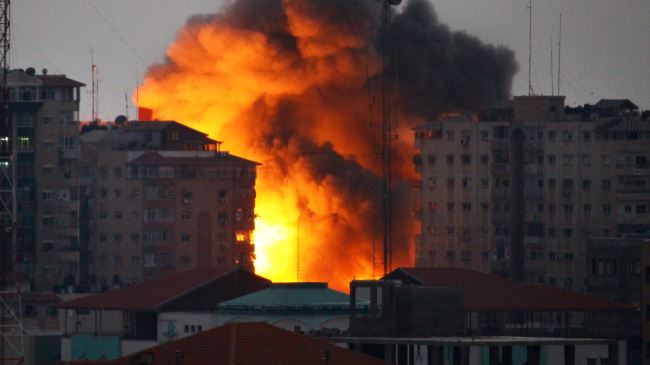
Israel has the right to shell Palestinian hospitals and schools out of self defense as long as Hamas stores rocket launchers next to them, US Sen. Elizabeth Warren said during a town hall meeting in Massachusetts this week.
Warren, darling du jour of American liberals, defended her vote to send more defense funding to Israel in the middle of its recent fierce offensive on Gaza, saying she believes civilian casualties are the “last thing Israel wants,” according to the Cape Cod Times.
“But when Hamas puts its rocket launchers next to hospitals, next to schools, they’re using their civilian population to protect their military assets. And I believe Israel has a right, at that point, to defend itself,” she said.
Israel and Palestinian authorities reached a long-term ceasefire agreement this week after Israel started its campaign in Gaza on July 8. The death toll from the Gaza conflict has reached at least 2,120 people, of which 577 are children, according to the Palestinian Health Ministry.
During the conflict, Israel targeted schools and hospitals in Gaza, claiming that rockets and militant fighters were nearby. The United Nations Relief and Works Agency criticized both Hamas for storing rockets in two schools and Israel for attacks on separate schools.
Attacks on hospitals are prohibited by the Geneva Convention’s Protection of Civilian Persons in Time of War “unless they are used to commit, outside their humanitarian duties, acts harmful to the enemy.” Even then, civilian hospitals can only be targeted “after due warning has been given, naming, in all appropriate cases, a reasonable time limit and after such warning has remained unheeded.”
Warren said Hamas has attacked Israel “indiscriminately.” Thanks to Israel’s vaunted Iron Dome defense system, though, those rockets have “not had the terrorist effect Hamas hoped for.”
Warren supported Israel’s military aggression, justifying its use of force based on America’s “very special relationship with Israel.”
“Israel lives in a very dangerous part of the world, and a part of the world where there aren’t many liberal democracies and democracies that are controlled by the rule of law,” she said. “And we very much need an ally in that part of the world.”
Warren also expressed unease with conditioning future US funding for Israel on the cessation of Israeli settlements in the West Bank.
“I think there’s a question of whether we should go that far,” Warren said.
Last month, UN High Commissioner for Human Rights said Israel may have committed war crimes in Gaza. Navi Pillay said house demolitions and the killing of children raise the “strong possibility” that Israel is violating international law.
More than 17,000 homes in Gaza were destroyed or damaged beyond repair, making around 100,000 Palestinians homeless, since the war began, according to UN estimates.
According to a senior UN Children’s Fund (UNICEF) official, 373,000 Palestinian children are in need of “immediate psychosocial first aid” due to the onslaught of Israeli strikes.
“The impact has truly been vast, both at a very physical level, in terms of casualties, injuries, the infrastructure that’s been damaged, but also importantly, emotionally and psychologically in terms of the destabilizing impact that not knowing, not truly feeling like there is anywhere safe place to go in Gaza,” Pernilla Ironside said last week.
UNICEF estimated that at least 219 schools have been damaged by Israeli airstrikes, while 22 were completely destroyed.
To demonstrate the extent of the damage in Gaza, Ironside estimated that it could take up to 18 years to rebuild the 17,000 housing units that were damaged in the conflict and in light of the ongoing blockade of the region limiting the movement of goods and people.
Israel has also barred major human rights organizations from entering Gaza territory.
Meanwhile, back in the United States, US Sen. Bernie Sanders, American liberals’ other favorite among establishment progressive politicians, has also defended US funding and arms for Israel. At a recent tense town hall in his native Vermont, Sanders condemned Israeli targeting of civilians, but then defended Israel “in a situation where Hamas is sending missiles into Israel” sent from “populated areas.”
“This is a very depressing and difficult issue. This has gone on for 60 bloody years,” he said. “If you’re asking me, do I have a magical solution? I don’t. And you know what, I doubt very much that you do.”
Featured Video

Now everyone is dumping US government bonds
or go to
Aletho News Archives – Video-Images
From the Archives
Experts Warned For Years That A War With Iran Would Happen This Way
By Caitlin Johnstone | April 3, 2026
… It’s so wild how we keep seeing reports that Iran’s retaliation caught the US off guard. For all the years I’ve been paying attention to this issue I’ve been reading experts and analysts saying if the US attacks Iran, Iran can close the Strait of Hormuz and strike US bases and the energy infrastructure of US allies in the region.
A few examples:
A 2006 Oxford Research Group paper titled “Iran: Consequences of a War” warned that Iran has numerous options at its disposal in the event of a US attack, and that the “most significant of these would be any possible retaliatory Iranian action to affect the transport of oil and liquefied natural gas through the Straits of Hormuz,” adding that stopping Iran from doing this “would be difficult if not impossible to achieve, leading to a fear of attack which alone would have a formidable impact on oil markets.”
A 2007 Cato Institute paper titled “The Iraq War and Iranian Power” warns that “Iran possesses the largest ballistic-missile inventory in the Persian Gulf — missiles which can reach Israel, Saudi Arabia and US military bases in Iraq,” and that “experts argue Iran could also use the ’oil weapon’: blocking the 34km-wide Strait of Hormuz and conducting submarine and anti-ship missile attacks against ports and oil facilities in Saudi Arabia, Kuwait and other Gulf Cooperation Council states.”
A 2012 NPR article titled “Can Iran Close The World’s Most Important Oil Route?” features then-chairman of the Joint Chiefs of Staff acknowledging that Iran absolutely can block the Strait of Hormuz, saying Tehran has “invested in capabilities” which specifically enable them to do so.
A paper from the Columbia Center on Global Energy Policy and the Center for a New American Security titled “IN DIRE STRAITS? IMPLICATIONS OF US-IRAN TENSIONS FOR THE GLOBAL OIL MARKET” warns of a potential scenario “that includes damage to Gulf oil infrastructure and a temporary closure of the Strait of Hormuz.”
These weren’t a bunch of keffiyeh-wearing peaceniks making these assessments, they were deeply entrenched swamp monsters entirely loyal to the US empire. They opposed war with Iran not because it would be an evil act of unforgivable mass murder, but because it would be bad for the imperial power structure. … Full article
Blog Roll
 Aletho News
- US dismantling international law in its war against Iran while claiming ‘false’ victory: Legal scholar
- One martyr, 5 injuries in US attack on Iraqi border crossing with Iran
- ‘This war is Israel’s war’: World facing ‘security breakdown’, says Qalibaf
- IRGC decries attack on US embassy in Riyadh, says executed by ‘Israel’
- Iran blasts EU hypocrisy as EU invokes international law over Hormuz
- There is no military solution to Strait of Hormuz
- NATO’s structural collapse – the outcome of deviation from reality
- Poll finds world views China better than US
- One Of America’s Leading Neo-Cons Has Turned Against The Iran War And Israel
- Attack in the Bosphorus exposes NATO weaknesses and tensions among allies
- If Americans Knew
- US loses planes over Iran, Israel downgrades Lebanon war goals – Daily Update
- Israel Is Blocking Palestinians from Easter at Church Where Jesus Resurrected
- Plot to assassinate Palestinian activist follows harassment campaign promoted by Zionist groups and elected officials
- Prominent New York synagogue hosts presentation on why U.S. Jews should support the ethnic cleansing of Gaza
- Tapper vs. Piker: Is the CNN Anchor Auditioning for David Ellison?
- Shouldn’t Democrats Be Able to Condemn Genocide?
- Israel-US kill negotiators, destroy civilian structures, but Iran’s military capabilities still largely intact – Daily Update
- ‘War crime’: Global condemnation as Israeli ministers celebrate death penalty law targeting Palestinian prisoners
- 7 Ways Israel Is Turning Lebanon Into Gaza
- World’s Leading Football Bodies Under Fire Over Israel Policies
- No Tricks Zone
- New Study Reports A 60% Slowdown In Greenland’s Ice Loss Rate In The Last Decade
- Low Intensity Tornado Wrecks Major Solar Farm, Creating A Potential Toxic Dump
- New Study Finds Warming Saves Lives…Cold Temperatures 12 Times More Deadly Than Excess Heat
- German Science Blog Accuses PIK Climate Institute Of Hallucinating Climate Tipping Points
- Devastating Assessment Of Comirnaty Vaccine By Former Senior Pfizer Europe Toxicologist
- New Study: CO2 Is ‘Effectively Negligible’ As An Explanatory Climate Change Factor Since 2000
- Former Pfizer Toxicologist Dr. Helmut Sterz Tells Bundestag Hearing Pfizer Vaccine Should Have Never Been Approved
- Energy Expert: Germany’s Nuclear Phaseout Was A “500 Billion Euro Mistake”
- New Research: South Australia’s Mid-Holocene Sea Surface Temperatures Were 4°C Warmer Than Today
- Storing Green Energy To Last Germany 10 Days Would Require A 60-Million Tonne Battery
 Aletho News