US-Russia Intermediate-Range Nuclear Forces Treaty lapsing: Cui bono?
RT | July 30, 2014
The US has accused Moscow of violating a 1987 INF Treaty banning short and medium range ballistic and cruise missiles. Experts speculate whether Washington is nudging Moscow to pull out of a treaty to create a new ‘nuke bogey’ and offer aegis to the EU.
Washington says Russia has tested a prohibited ground-launched cruise missile thus breaching the Intermediate Range Nuclear Forces Treaty signed by the US and the Soviet Union nearly 30 years ago, banning all ground-based nuclear-capable missiles with range from 500 to 5,500 kilometers, the New York Times cited.
READ MORE: US claims on nuclear missiles treaty unfounded, Russia has questions too
Though no Western media outlet has mentioned the name of the missile, there are probably only two candidates for the role of the “peace breaker.”
The first is Russia’s RS-26 Rubezh (Frontier) ICBN “ABM-killer” complex. According to a top military official, it was tested several times at distances ranging from 2,000 km to 5,700 km, RBC Daily reports.
However, Rubezh is technically out of suspicion, according to member of the Academy of Sciences, Aleksey Arbatov, as under the treaty the ballistic missile’s range is estimated as the maximum range it was tested at.
The second candidate for the role is the R-500, a cruise missile which can be used with ground-based 9K720 Iskander launcher. Its range is a delicate issue, said Arbatov as cited by RBC Daily. Though it has an officially announced range below 500 kilometers, its exact characteristics remain top-secret and could be argued.
According to military experts, the R-500 is a modification of the old Soviet 3M10 Granat with an estimated range of 2,600 km that was initially designed for submarine launch. All land-based Granat missiles were destroyed under the INP Treaty. However, the treaty did not apply to naval missiles.
Earlier the US already complained about suspected Russian treaty violations, presumably about the R-500 and its land-based tests that reportedly had to be conducted due to lack of funding. Moscow’s explanations did not satisfy Washington, noted Arbatov adding that such decisions and arguments are usually discussed during the meeting of working groups – while now the issue has reached the presidential level.
At the same time Russian Air Force possesses a unique X-101 cruise missile – that could be adopted for surface launch – with some reports indicating its maximum range to be over 5,500 kilometers, in which case this missile would not fall under conditions of the INF Treaty either.
Timing is everything?
The situation in the world has greatly changed over the years and today Moscow and Washington remain the world’s only capitals that imposed restrictions on themselves in this regard. In the meantime Russia has several nuclear states in proximity to its borders that already have such medium-range missiles (China, India, Pakistan and probably Iran and North Korea) that can potentially strike Russian territory, whereas the US has no such neighbors.
The New York Times broke to the world on Monday that President Barack Obama sent a letter to Vladimir Putin, in which Russia is accused of testing a surface-to-surface cruise missile with an excessive range.
The first tests of those missiles were conducted back in 2008, the report suggests, and it took the Obama administration 3 years to conclude that they were a compliance concern. But the question of possible treaty violation was raised by the State Department’s arms control officials only in 2013.
When reports of Russia’s ground-based tests re-emerged in January 2014, the US administration wasn’t ready to comment on the issue or draw any conclusions and media attention to the issue at that particular time.
The US is obviously trying to force Russia out of the INF Treaty to have a pretext for further augmentation of its military presence in Europe, expert of the Institute of International Security Problems, Valery Fenenko shared with RIA news agency.
“A lukewarm conflict between Russia and the US has been drawing on since 2007. In my opinion, Americans are pushing Russia to step out of the treaty,” Fenenko opined.
He believes that the accusations of the INF Treaty violation is a part of American strategy of spreading anti-ballistic missile defense shield in Europe.
“Some American and Russian analysts expected Russia to respond to the imposed sanctions with threatening rhetoric towards the EU, and an obvious and harsh step of quitting the INF Treaty but that never happened,” explained Fenenko, adding that now Washington wants to fulfill the aim in a different manner.
“If Russia re-deploys medium and short range missiles that would be a direct threat to EU member states, both Eastern and Western European countries,” the expert concluded.
Fenenko specifically stressed that both Russia and the US never stopped development of such missiles because the INF Treaty does not prohibit this.
“Americans are in a much easier situation in this regard. They have allies France and the UK that haven’t signed the INF Treaty. These countries have cruise missile projects of their own that could be easily be transformed into surface-to-surface missiles,” Fenenko said.
Russia could try to impose a moratorium on the Treaty until France and UK sign the document, “but there is no chance they would sign, so that would be the end of the treaty,” Fenenko concluded.
Washington uses the alleged INF Treaty violation to boost global tensions in the background of the Ukrainian crisis and sanctions imposed on Russia, Andrey Koshkin told RT, military political analyst at Plekhanov Academy in Moscow.
“This is interconnected with the crisis situation being created by the Americans themselves,” estimated Koshkin, adding that Washington is launching a political assault on Moscow from every direction “to hype up the tensions.”
“They try to blame Russia every morning, every evening, every night – this is a salvo of accusations. They try to get western public accustomed to blaming Russia,” Willy Wimmer, the former State Secretary of the German Ministry of Defense, told RT.
Ukraine to use science funding for weapons production – Poroshenko
RT | July 9, 2014
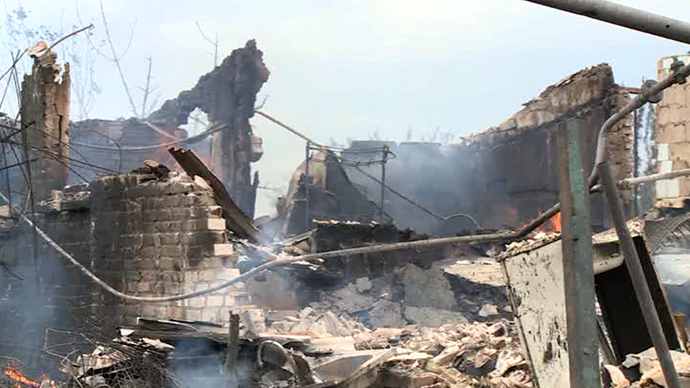 Ukrainian President Petro Poroshenko said he will reduce the country’s “useless” science programs to finance the production of drones and precision weapons.
“There will be no more spending of billions of people’s money, taxpayers’ money on useless research programs, which were used as a tool for theft,” said a statement published on the president’s website early on Wednesday.
“Today, Ukrainian production will be busy making precision weapons systems, Ukrainian drones, everything Ukrainian army needs, starting with bullet proof vests and ending with thermographic cameras,” he said.
The president added that the army’s experience in fighting against self-defense forces in the east of the country will be used when making production decisions.
The Ukrainian military has been fighting against anti-Kiev forces in the east since April.
Some of the latest developments include Ukrainian President Petro Poroshenko confirming plans to “liberate” the eastern cities of Lugansk and Donetsk, the two biggest towns in the country’s east controlled by self-defense forces.
Last week, the army shelled the village of Kondrashovka, killing 12 civilians including a five-year-old.
NATO arming Ukraine with Soviet weapons
RT | July 4, 2014
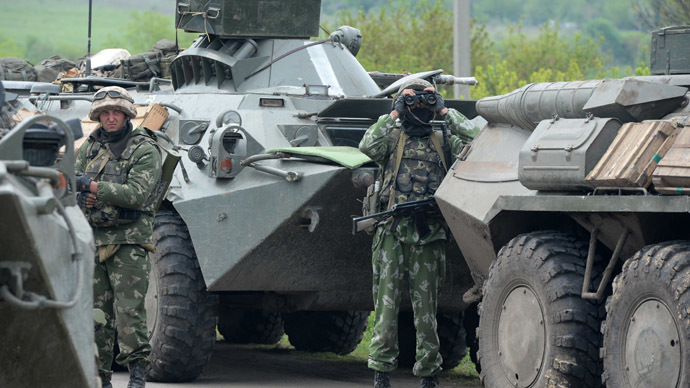
NATO’s newest Eastern European members are handing over their Soviet arms stockpiles to the Ukrainian army, Russia’s Deputy PM Dmitry Rogozin says, adding that the alliance is in danger of pouring gasoline on the flames of that country’s civil war.
Rogozin, who supervises the Russian military industry, has tweeted that NATO is asking its newest members to get rid of operable Soviet military equipment and send it to Ukraine, to aid the miserable state of the country’s military hardware.
“In turn, the US is ready to compensate for the “losses” of the newly co-opted NATO member states. The American military-industrial complex must be happy,” Rogozin wrote in his Twitter account.
“By the way, this is NATO’s commonplace to put out civil wars’ fire with aviation kerosene,” Rogozin added.
Over the months of Ukraine’s hot political crisis, NATO member states, primarily the US, announced they are planning non-lethal aid to Ukrainian troops, supplying uniforms and tents, and even promising to deploy a number of military instructors to train the Ukrainian army to fight the adherents of federalization of the country in Eastern Ukraine.
Political commentator Mikhail Rostovsky told RIA Novosti news agency that the “US and EU are thinking not about Ukraine but about the neutralization of Russia.”
Rostovsky compared the current policies of the European and American leaders with that of British PM Margaret Thatcher and French President François Mitterrand towards the reunification of East and West Germany in 1990.
Speaking loudly about “the European choice for Ukraine,” the EU and US politicians are essentially seeking ways to drive a wedge between Moscow and Kiev to neutralize what they regard as Russia’s possible “imperial ambitions,” Rostovsky said. “We’re dealing with politics dictated by fear: God forbid the Kremlin’s imperial instincts got awakened! This is a matter of principle to deny the Kremlin such an opportunity and break Ukraine away from Russia.”
Rostovsky said he fully agreed with German Foreign Minister Frank-Walter Steinmeier, who told Der Spiegel in late April that Europe has slid “into the worst crisis since the end of the Cold War.”
“Those who can remember the fall of the Berlin Wall know what we’ve accomplished over the past 25 years. The gains we’ve made almost everywhere in Europe in terms of peace, freedom and prosperity are now at risk,” Steinmeier said, adding that that it was important to take “every measure to prevent things [in Ukraine] from getting worse.”
‘Welcome to Police Industrial Complex’ – former Philly commissioner
RT | June 16, 2014
Dangerous, alienating, and sociopathic: the policy of arming police to the teeth with military-grade gear shows a fundamental misunderstanding of how crime is solved and what it means for a cop to walk the beat, former Captain Ray Lewis told RT.
Nine-foot tall, 55,000 pound, Mine-Resistant Ambush Protected (MRAP) armored-fighting vehicles rolling through the streets of America.
Millions of dollars’ worth of military gear being distributed to local police forces on an annual basis.
Drones, M-16s and so many other hand-me-downs from over a decade of war making their way from US forces abroad to a local police force near you.
If you really believe any of this is making you safer, Lewis, who spent 24 years on the force, says you should think again. Endangering lives, alienating communities, turning minority neighborhoods into occupied territory and compromising the very ability for police to do their jobs; these are just a few of the reasons the former commissioner believes main street is being sold down the river for power-hungry cops and ruthless corporate interest.
RT: Why is this considered to be a good idea, bringing these high caliber weapons into US streets?
Ray Lewis: I don’t think it’s a good idea. High caliber weapons are extremely dangerous. They have a very high ricocheting velocity, and that means that innocent people are going to get killed and injured. They can go through doors, they can go through cinder block, they can go through metal car doors, and this type of velocity is not necessary. I spent 24 years in the Philadelphia Police Department.We upgraded our Smith and Wessons to Glocks, which are a very powerful pistol that work very well. There is no reason to have anything stronger than that, except in exigent circumstances, in which your SWAT team does have that type of weapon. For anyone else, they’re not necessary and they’re dangerous.
RT: You know Captain, one might ask, will this equipment not obscure the line between soldier and police officers, especially in those small communities where they’re already being distributed?
RL: Yes, it will obviously obscure the line between the military and the police. But I’m not at all concerned with small communities that you mentioned. I’m concerned with the large cities, where you have large minority populations living in economically depressed areas. That’s where you’re going to have problems. You bring this type of equipment into a minority area, you are going to make those people feel as if they are living in an occupied territory. You’re going to alienate them.
What happens is, you get a halo effect. A halo effect means that that alienation transfers to all the other officers in that department. That alienation transfers to the officers in the patrol cars, the officer on the foot beat, the officers in the community relations division. So bringing that type of equipment is going to alienate people from all parts of the police department. What people don’t know is that input from community members is one of the most important ways crimes are solved. They know the bad guys in the area, they hear the rumors, they hear the gossip, they know what’s going on in their communities. Too many people think that crime is solved through high-tech forensic labs or exemplary investigative work. Not true, although these two come in very handy in many cases, most of your information about crimes comes from the community. You bring this military type of mindset into the community, you’re not going to get the interaction from the members of that community.
RT: Some police officers have said it is necessary to have this type of equipment, especially if you’re covering a protest and it gets out of hand, where police officers can get injured or shot. Isn’t it a good idea, in some ways, to have such equipment at your disposal?
RL: That is the worst idea I could think of, to have high caliber weapons at a protest. Think of Kent State, where they shot and killed so many innocent people. And they were not high caliber weapons. Can you imagine the massacre that would take place if officers had high caliber weapons? I spent a year in New York City supporting the Occupy [Wall Street] message. I was arrested down there for civil disobedience and never did I see any type of behavior from those protesters that would ever need any type of weapon, let alone high caliber. If anything, it was the protesters that would have needed high caliber weapons.
RT: Let me talk about the gear itself. It’s been used in certain war zones and then come back home, as there’s no longer any need for it there. What should they do with this type of equipment if they can’t distribute it to local police forces? What happens if people come out and say, ‘actually, we don’t want these types of vehicles on our streets. We have kids, we can’t have them here, we’d much rather go back to a much more local form of policing that we’re more comfortable with?’
RL: Obviously, you have to listen to the community. The police serve the community; they don’t serve us, we serve them. If they want to go back to a more conventional police force that they feel comfortable with, then that’s what has to be done. It’s imperative.
RT: So what happens to the equipment then, at that point?
RL: It can be sold to other countries or destroyed. I’d have no problem with them destroying that equipment whatsoever instead of using it in this country. See, that equipment can be very dangerous if it falls into the wrong hands. Let me explain.
There are three types of people who join the police department, basically: one joins because of a need for a job that can give him or her a comfortable lifestyle; the second person joins because they want to serve and protect the public; the third type of person joins because they love the power and the control. When you have a person that joins because they love the power and control, how do they get more power and control? They move up the chain of command until they reach police commissioner. Now once they reach police commissioner, how do they gain more power and control? And this is a sociopathic tendency by the way. It’s insatiable; they can never get enough power and control, just like a billionaire can never get enough money.
So, you reach the top rung of the ladder, you’re a police commissioner, and you want to gain more power. How do you do it? You acquire all of this military weaponry, the semi-tanks, the MRAPs, the spy drones, and what not. And I guarantee you, once you purchase them, they’re not going to sit in a warehouse. That police commissioner is going to use them. And I’m very fearful of these types of police commissioners using that equipment. Let me give you the perfect example of what I’m talking about.
The Philadelphia Police Commissioner Charles Ramsey, he was not commissioner when I worked there, but when I attended the Occupy movement and was arrested for civil disobedience, several days later I received an unbelievably threatening letter from him. He told me, he informed me to stop wearing my uniform. It was an order. I’d retired 10 years previously; he had no power over me. Yet he was so power and control hungry, he tried to order me to stop wearing that uniform. What was most egregious about this letter, I have it for proof, is he informed me that if I continued to wear the uniform, he would take any and all necessary action to stop me. That is the epitome of a sociopath whose desire for power and control is insatiable. I am fearful of this type of police chief getting this type of equipment.
RT: Okay Captain, last question. Shootings at schools, shopping malls, movie theatres, we’ve seen those headlines all around America and internationally. Will this type of equipment be able to stop such crimes from taking place?
RL: Absolutely not. These crimes are committed by people who never would think, ‘oh wait, should I not do this because the police have high caliber weapons?’ No. That doesn’t stop those mass killings at all. Number one, they know most likely they will be killed by the police, or they take their own lives. So this type of equipment will never stop that. Lastly, I want you to know that corporate America is involved in this. This is a major money market that will sell this high (grade) equipment, repair and maintenance for it will come from taxpayers’ money. Corporate America will make billions off of this equipment. You’ve heard of the prison industrial complex, you’ve heard of the military industrial complex, corporate America now wants to make a police industrial complex, where they’ll makes billions off of police departments.
Nuclear bomb nearly detonated after falling on North Carolina – declassified report
RT | June 11, 2014
 In a scenario that could’ve been extremely devastating, the United States narrowly averted a nuclear disaster in 1961 when an atomic bomb nearly detonated after falling out of a B-52 bomber that broke up in the sky.
According to the Washington Post, the incident took place on January 21, 1961 – less than 20 years after nuclear bombs were dropped on Hiroshima and Nagasaki – and is explained further in a recently declassified report published by the National Security Archives.
When the US Air Force aircraft went into a tailspin and broke up, the two bombs fell towards Goldsboro, North Carolina. The parachute for one of the weapons failed to deploy, and the plane crash had actually pushed the bomb into “armed” mode by the time it hit the ground. Luckily for North Carolina, the plane’s destruction also damaged the switch necessary to trigger detonation.
“The report implied that because Weapon 2 landed in a free-fall, without the parachute operating, the timer did not initiate the bomb’s high voltage battery (“trajectory arming”), a step in the arming sequence,” wrote Bill Burr of the National Security Archives.
“For Weapon 2, the Arm/Safe switch was in the “safe” position, yet it was virtually armed because the impact shock had rotated the indicator drum to the “armed” position. But the shock also damaged the switch contacts, which had to be intact for the weapon to detonate.”
Burr noted in his report just how fine the line was and is between safety and destruction.
“Perhaps this is what Secretary of Defense Robert McNamara had in mind, a few years later, when he observed that, ‘by the slightest margin of chance, literally the failure of two wires to cross, a nuclear explosion was averted,” he wrote.
These details are just the latest to surface about the incident, which was first revealed by nuclear weapons expert Eric Schlosser last year in a book titled, “Command and Control.” Through a Freedom of Information Act request, Schlosser was able to obtain documentation regarding the incident for the first time, and helped shed light on just how close the Air Force came to witnessing an atomic bomb explode on US soil.
As RT reported last year, the documents revealed that three of the four safety switches on the other bomb failed to work properly, meaning, as Schlosser noted, that only “one simple, dynamo-technology, low voltage switch stood between the United States and a major catastrophe.” The parachute on this one deployed, but when the bomb struck the ground the final firing signal triggered, only to be halted by that fourth safety switch.
The bombs contained a payload of four megatons each and could have generated explosions 260 times more powerful than the one that occurred in Hiroshima.
Before the documents related to the Goldsboro incident surfaced, the US government had denied that its nuclear weapons stockpile had ever put the nation at risk.
“The US government has consistently tried to withhold information from the American people in order to prevent questions being asked about our nuclear weapons policy,” Schlosser told the Guardian. “We were told there was no possibility of these weapons accidentally detonating, yet here’s one that very nearly did.”
US admits sending ‘lethal aid’ to Syrian rebels
RT | June 8, 2014
Washington is supplying some Syrian rebels with both “lethal and non-lethal” aid, according to National Security Adviser Susan Rice, who confirmed the longstanding suspicion that the Obama administration is arming anti-Assad forces.
The US is “the single largest contributor of humanitarian assistance, providing over $1.7 billion” in assistance, Rice told CNN.
“That’s why the United States has ramped up its support for the moderate vetted opposition, providing lethal and nonlethal support where we can to support both the civilian opposition and the military opposition,” she said.
Previously, American officials claimed that the US sent only non-lethal aid to Syrian rebels, saying they were concerned that if US arms, especially sophisticated ones like portable anti-aircraft missiles, were sent to Syria, they might end up in the hands of terrorists. Media reports, however, suggested that the CIA was secretly involved in training rebel groups and assisting Saudi Arabia and Qatar in smuggling arms to the rebels fighting to topple Syrian President Bashar Assad.
Rice emphasized Washington’s desire to play a more pro-active role in the Syrian conflict by getting Congress approval for more assistance to the rebels in the war that has been ongoing for three years and claimed upward of 160,000 lives.
The aid of hundreds of millions of dollars given by the US since the start of the civil war in 2011 has all gone toward humanitarian assistance, she insisted.
Although details about the specifics of aid and training provided to opposition forces are usually avoided by US officials in interviews, President Barack Obama announced his Syria plans in a foreign policy speech at West Point military academy in late May.
Rebels “offer the best alternative to terrorists and brutal dictators,” the president said. Now it’s up to Congress to support the idea of and green-light more aid, as is stipulated in the War Powers Act.
In mid-May, Obama met with the leader of the Turkey-based opposition Syrian National Coalition, Ahmad Jarba, and boosted US aid to the Syrian opposition by $27 million.
In the interview, Rice defended the president’s foreign policy, which some critics in the US believe to be passive and overcautious. She insisted that Washington retains strong ties with partner nations and a strong global position.
“I think the fact of the matter is we’re living in complex times, there are many different challenges that the United States and the world faces. But our leadership is unmatched. Our role is indispensable,” she said.
The confirmation of America’s lethal aid to the Syrian opposition comes on the heels of the delivery of F-16 fighter jets to Iraq, a country torn apart by raging sectarian violence, which takes dozens of lives daily.
Syria has suffered greatly in the three-year civil war, but its government remains stable and its military is gaining ground in the fight against various opposition forces, many of them foreign Islamists.
France refuses to block Mistral warship deal with Russia
RT | May 12, 2014
The French government has said that it will go ahead with 1.2 billion euro ($1.6 billion) contract to supply Russia with two Mistral helicopter carriers because cancelling the deal would harm Paris more than Moscow.
In the wake of the crisis in Ukraine, the United States had been pressing France as well as Britain and Germany to take a tougher line against Russia and cancel the Mistral contract.
But France refuses to link the helicopter carrier deal to the US/EU debate over tougher sanctions against Russia.
A French government official travelling with President Francoise Hollande in Azerbaijan Sunday, who asked not be named, told reporters that the contract was too big to cancel and that if France didn’t fulfill the order it would be hit with penalties.
“The Mistrals are not part of the third level of sanctions. They will be delivered. The contract has been paid and there would be financial penalties for not delivering it.
“It would be France that is penalized. It’s too easy to say France has to give up on the sale of the ships. We have done our part,” the official said.
President Hollande also said earlier on Saturday that the contract will go ahead.
“This contract was signed in 2011, it will be carried out. For the moment it is not in question,” President Hollande said on Saturday during a visit to German Chancellor Angela Merkel’s electoral district.
The Russian defense ministry warned Paris in March that it would have to repay the cost of the contract plus additional penalties if it cancelled the deal.
EU foreign ministers met in Brussels Monday and expanded their sanctions over Russia’s stance on the Ukrainian crisis, adding two Crimean companies and 13 people to the bloc’s blacklist, EU diplomats said.
They have threatened a further widening of sanction if the Ukrainian presidential elections do not go ahead on May 25.
US Secretary of State Victoria Nuland expressed concern over the deal on May 8 after US lawmakers had demanded more pressure be put on France to stop the contract.
“We have regularly and consistently expressed our concerns about this sale, even before we had the latest Russian actions, and we will continue to do so,” Nuland told the House Foreign Affairs Committee.
US Secretary of State John Kerry is due to meet the French Foreign Minister Laurent Fabius in Washington Tuesday and President Barak Obama is expected to raise the issue during a visit to France next month to commemorate the D-Day Normandy landings.
US officials have suggested France could sell the ships to another buyer or sell them without the advanced technology, although it is not at all clear at this late stage who the other buyer could be.
The French deal was Moscow’s first foreign arms purchase since the end of the Cold War and was hailed by then President Nicholas Sarkozy has an important step forward in French-Russian relations. The contract has created some 1,000 jobs in French shipyards.
The first of the two ships, the Vladivostok, is due to be delivered by November this year and the second, called Sevastopol, will arrive in St Petersburg for further fitting out with Russian weapons systems in November 2015 and will join the Pacific fleet in the second half of 2016.
The Mistral can carry up to 16 attack helicopters such as Russia’s Kamov Ka-50/52, more than 40 tanks or 70 motor vehicles and up to 700 troops. The ships for Russia have been modified from the version used by the French navy to operate in northern altitudes and ice covered seas.
The Russian navy will fit the ships with air defense systems and rapid fire artillery guns to allow them to go on combat missions with fewer escort vessels.
US Congress secretly approves sending small arms to ‘moderate’ Syrian rebels
RT | January 28, 2014
Congressional lawmakers have quietly authorized sending small arms, an assorted variety of rockets, and financial backing to so-called “moderate” rebels fighting in Syria’s civil war, according to a new report.
American and European security officials told Reuters that the US will provide anti-tank rockets, but nothing as deadly as shoulder-launched surface-to-air missiles (known as MANPADs), which can be used to bring down military or civilian aircraft.
Legislators voted in closed-door meetings to fund the opposition forces through September 30, the end of the US government’s fiscal year. The decision is an about-face from congressional debates last year, in which the same committees were reluctant to supply arms over concerns that American weapons would wind up in the hands of radical Islamists fighting in the region, the Al-Qaeda-backed Al-Nusra being the most well known.
Now, though, those concerns appear to have lessened. Exactly when Congress approved the funding is not known, yet the sources speculated that it was signed in a classified section of a defense appropriations bill that was approved in December.
“The Syrian war is a stalemate,” said Bruce Riedel, a former CIA analyst and current foreign policy advisor to US President Obama with the Brookings Institution. “The rebels lack the organization and weapons to defeat Assad; the regime lacks to loyal manpower to suppress the rebellion. Both sides’ external allies…are ready to supply enough money and arms to fuel the stalemate for the foreseeable future.”
Despite the uncertainty remaining around the conflict, Western officials have asserted in recent weeks that “moderate” rebels have strengthened their positions in the south of Syria and have begun excluding Al-Qaeda sympathizers. Extremists are known to be in control of rebel forces in the north and east, however.
US and British officials temporarily suspended “non-lethal aid” (a category that includes communications equipment and transportation vehicles) in December, although officials now say they hope to resume providing assistance to the Supreme Military Council (SMC), which oversees rebel forces favored by the West.
“We hope to be able to resume assistance to the SMC shortly, pending security and logistics considerations,” one source told Reuters. “But we have no announcement at this time.”
News of the funding comes as the Syrian government and the external opposition in Geneva have reached an agreement that would see humanitarian aid enter the besieged city of Homs, and would allow women and children to leave its war-ravaged areas.
What makes the deal dubious, however, is that it’s not yet clear how it will be implemented on the ground. Currently, the Syrian government is promising – voiced on Sunday by Deputy Foreign Minister Faisal Mekdad – that women and children can leave Homs safely. Another question is how rebels inside the city besieged by the army will react.
“If the armed terrorists in Homs allow women and children to leave the old city of Homs, we will allow them every access. Not only that, we will provide them with shelter, medicines and all that is needed,” he said, as cited by Reuters. “We are ready to allow any humanitarian aid to enter into the city through the arrangements made with the UN.”
US State Department spokesman Edgar Vasquez said that an evacuation is not a legitimate option because of how dire the need for aid is.
“We firmly believe that the Syrian regime must approve the convoys to deliver badly needed humanitarian assistance into the Old City of Homs now,” Vasquez said. “The situation is desperate and the people are starving.”
The results of a meeting in Geneva, Switzerland – where government officials sat across the negotiating table from representatives of the opposition on Monday – is so far unclear. Each side pledged its willingness to continue discussions, though progress so far has been nearly nonexistent.
United Nations envoy Lakhdar Brahimi told reporters after the meeting Monday that even though the talks “haven’t produced much,” another session was scheduled for Tuesday.
“Once again, I tell you we never expected any miracle, there are no miracles here,” he said in a news conference. “My expectation from this conference is that the unjust war will stop. But I know this is not going to happen today or tomorrow or next week.”

US tested biological weapons in Japan’s Okinawa in the 60s – report
RT | January 12, 2014
The American army conducted experiments with biological weapons aimed at destroying rice crops on the Japanese island of Okinawa in the 60s, Kyodo news agency reports. The alleged target of the tests was the China and Southeast Asia region.
Citing classified US documents, Japanese news agency Kyodo said the US military carried out experiments on their sovereign territory between 1961 and 1962. At this time Japan’s southern island of Okinawa was still under post-WWII, US jurisdiction. The US did similar tests in Taiwan and the American mainland, notes Kyodo.
The American army experimented with rice blast fungus – a plant pathogen – which infects rice crops with disastrous effects. The pathogen latches onto the rice plant as a spore and produces lesions and spots all over the rice plant and then reproduces.
A single lesion can generate a thousand spores in one night alone, while an entire cycle – lasting about a week – can have a devastating effect on rice crops.
Kyodo reports that tests were conducted over a dozen times, and mentions test sites, Nago and Shuri, in Okinawa. The US army reported some success in their experiments and the gathering of “useful data”.
“Field tests for stem rust of wheat and rice blast disease were begun at several sites in the (US) Midwest and south and in Okinawa with partial success in the accumulation of useful data,” wrote Kyodo, citing its documents.
The US government discarded all its biological weapons in 1969 and discontinued testing, after a leak of chemical weapons made 20 American soldiers stationed on the island sick. Moreover, residents had to be evacuated from the surrounding area and were reported to still be suffering the effects of the toxins two years after the leak.
In response to public outrage, the US government was forced to launch Operation Red Hat – a mission to remove all the biological weapons stored on Okinawa.
Six years later in 1975, Washington signed the international convention against production and possession of biological weapons.
Okinawa came back under Japanese jurisdiction in 1972, but the US still keeps a military presence of around 50,000 troops on the island.
Their presence is a constant source of tension with local populations due to crimes committed by servicemen, disruptions caused by military flights and land use by the US military.
Greece intercepts mystery ship with 20,000 Kalashnikovs on board
RT | November 10, 2013
The Greek Coastguard has intercepted a Sierra Leone-flagged cargo ship with around 20,000 Kalashnikov assault rifles on board. The intended destination of the vessel, halted near the Imia islets in the eastern Aegean, remains unknown.
The cargo ship Nour M, intercepted on Thursday night, was taken to the island of Symi the following morning under the escort of Coastguard vessels, where it was soon thereafter led to the island of Rhodes.
The vessel’s Turkish captain and seven crew members, two of whom were Turkish and five of whom were Indian, were placed under arrest, coastguard sources told the Athens-Macedonian News Agency (ANA-MPA).
The cargo was both larger than that declared on the ship’s manifest, and the ship did not have the proper UN documents to deliver cargo to a conflict zone. The Greek Coastguard issued a statement saying attempts to catalogue the firearms and munitions on board were ongoing.
“The exact destination of the arms and ammunition has yet to be verified,” the coastguard statement read. Apart from the large quantity of firearms, the ship was also allegedly carrying a “large” quantity of explosives. A probe determined the ship had previously been used for drug trafficking.
Sources told ANA-MPA that the vessel had set sail from Ukraine, although the ship’s final destination remains unclear. Although the ports of Tartus in Syria and Tripoli in Libya had both been declared as destination ports to marine traffic systems, the Turkish Mediterranean port city of Iskenderun was declared as the destination port by the ship’s captain.
Ukraine’s Foreign Ministry said they are attempting to determine if the Nour departed from the country.
Maritime expert Mikhail Voitenko told Ukraine’s Vesti that the ship likely picked up its cargo in Istanbul.
“I think it was there for no other purpose than to get the weapons. It is also strange that it took the ship two weeks to get from Nikolaev [Ukraine] to Greece when the trip takes a maximum of five days. What it was doing and where it was doing it at the time: that is the question.”
Voitenko said the vessel was likely detained as the result of a tip-off.
“That we have this ship sailing through the Black Sea is strange, but through Greek [territorial] waters it went in a straight line, so police had no reason to detain the ship,” he said.
Featured Video
US JET SHOT DOWN OVER IRAN /Lt Col Daniel Davis & Nima Alkhorshid
or go to
Aletho News Archives – Video-Images
From the Archives
Experts Warned For Years That A War With Iran Would Happen This Way
By Caitlin Johnstone | April 3, 2026
… It’s so wild how we keep seeing reports that Iran’s retaliation caught the US off guard. For all the years I’ve been paying attention to this issue I’ve been reading experts and analysts saying if the US attacks Iran, Iran can close the Strait of Hormuz and strike US bases and the energy infrastructure of US allies in the region.
A few examples:
A 2006 Oxford Research Group paper titled “Iran: Consequences of a War” warned that Iran has numerous options at its disposal in the event of a US attack, and that the “most significant of these would be any possible retaliatory Iranian action to affect the transport of oil and liquefied natural gas through the Straits of Hormuz,” adding that stopping Iran from doing this “would be difficult if not impossible to achieve, leading to a fear of attack which alone would have a formidable impact on oil markets.”
A 2007 Cato Institute paper titled “The Iraq War and Iranian Power” warns that “Iran possesses the largest ballistic-missile inventory in the Persian Gulf — missiles which can reach Israel, Saudi Arabia and US military bases in Iraq,” and that “experts argue Iran could also use the ’oil weapon’: blocking the 34km-wide Strait of Hormuz and conducting submarine and anti-ship missile attacks against ports and oil facilities in Saudi Arabia, Kuwait and other Gulf Cooperation Council states.”
A 2012 NPR article titled “Can Iran Close The World’s Most Important Oil Route?” features then-chairman of the Joint Chiefs of Staff acknowledging that Iran absolutely can block the Strait of Hormuz, saying Tehran has “invested in capabilities” which specifically enable them to do so.
A paper from the Columbia Center on Global Energy Policy and the Center for a New American Security titled “IN DIRE STRAITS? IMPLICATIONS OF US-IRAN TENSIONS FOR THE GLOBAL OIL MARKET” warns of a potential scenario “that includes damage to Gulf oil infrastructure and a temporary closure of the Strait of Hormuz.”
These weren’t a bunch of keffiyeh-wearing peaceniks making these assessments, they were deeply entrenched swamp monsters entirely loyal to the US empire. They opposed war with Iran not because it would be an evil act of unforgivable mass murder, but because it would be bad for the imperial power structure. … Full article
Blog Roll
 Aletho News
- US dismantling international law in its war against Iran while claiming ‘false’ victory: Legal scholar
- One martyr, 5 injuries in US attack on Iraqi border crossing with Iran
- ‘This war is Israel’s war’: World facing ‘security breakdown’, says Qalibaf
- IRGC decries attack on US embassy in Riyadh, says executed by ‘Israel’
- Iran blasts EU hypocrisy as EU invokes international law over Hormuz
- There is no military solution to Strait of Hormuz
- NATO’s structural collapse – the outcome of deviation from reality
- Poll finds world views China better than US
- One Of America’s Leading Neo-Cons Has Turned Against The Iran War And Israel
- Attack in the Bosphorus exposes NATO weaknesses and tensions among allies
- If Americans Knew
- US loses planes over Iran, Israel downgrades Lebanon war goals – Daily Update
- Israel Is Blocking Palestinians from Easter at Church Where Jesus Resurrected
- Plot to assassinate Palestinian activist follows harassment campaign promoted by Zionist groups and elected officials
- Prominent New York synagogue hosts presentation on why U.S. Jews should support the ethnic cleansing of Gaza
- Tapper vs. Piker: Is the CNN Anchor Auditioning for David Ellison?
- Shouldn’t Democrats Be Able to Condemn Genocide?
- Israel-US kill negotiators, destroy civilian structures, but Iran’s military capabilities still largely intact – Daily Update
- ‘War crime’: Global condemnation as Israeli ministers celebrate death penalty law targeting Palestinian prisoners
- 7 Ways Israel Is Turning Lebanon Into Gaza
- World’s Leading Football Bodies Under Fire Over Israel Policies
- No Tricks Zone
- New Study Reports A 60% Slowdown In Greenland’s Ice Loss Rate In The Last Decade
- Low Intensity Tornado Wrecks Major Solar Farm, Creating A Potential Toxic Dump
- New Study Finds Warming Saves Lives…Cold Temperatures 12 Times More Deadly Than Excess Heat
- German Science Blog Accuses PIK Climate Institute Of Hallucinating Climate Tipping Points
- Devastating Assessment Of Comirnaty Vaccine By Former Senior Pfizer Europe Toxicologist
- New Study: CO2 Is ‘Effectively Negligible’ As An Explanatory Climate Change Factor Since 2000
- Former Pfizer Toxicologist Dr. Helmut Sterz Tells Bundestag Hearing Pfizer Vaccine Should Have Never Been Approved
- Energy Expert: Germany’s Nuclear Phaseout Was A “500 Billion Euro Mistake”
- New Research: South Australia’s Mid-Holocene Sea Surface Temperatures Were 4°C Warmer Than Today
- Storing Green Energy To Last Germany 10 Days Would Require A 60-Million Tonne Battery
 Aletho News