Chris Minns Defends NSW “Hate Speech” Laws Linking Censorship to Terror Prevention
By Cindy Harper | Reclaim The Net | December 18, 2025
New South Wales Premier Chris Minns has openly celebrated his government’s reshaping of speech laws, arguing that restrictions on expression are a necessary part of combating hate.
Speaking with Sky News Australia host Sharri Markson, Minns said he wants “a situation where hate speech is not allowed and illegal in NSW and those who practice it are prosecuted,” adding that the state “does not have the same free speech laws that they have in the United States.”
The Premier repeatedly linked speech regulation to public safety, connecting online discussion and public protest to the Bondi Beach terror attack.
According to Minns, “hate speech, antisemitism” begins with chants at marches, “then it migrates online to a tweet or some kind of post,” leading to property damage and arson, and finally, “then you see this horrible, horrible crime.”
He insisted that authorities “need to attack it at every single level,” a statement that positions censorship as part of the government’s crime prevention strategy.
Minns described the Crimes Amendment (Inciting Racial Hatred) Bill 2025 as “absolutely vital” and called for “prosecutions of people” under it.
That sequence of events has become a flashpoint, with civil rights lawyers warning that a law born from misinformation risks turning into a tool for political and social control rather than public protection.
During the interview, Minns bristled at those who have questioned the law’s legitimacy or its impact on open debate.
Minns went further, leaving the door open for expanding the legislation, stating, “I’m going to be judged on outcomes here, and if the law’s not fit for purpose, we’ll look at it again.”
Minns also took personal credit for reshaping what he called “free speech laws” in the state.
By asking the public to “give time” for the new rules to take effect, Minns is effectively telling citizens to get used to narrower speech boundaries. It’s not a pause; it’s a conditioning period.
The longer these powers stay in place, the easier it becomes for “hate” to mean whatever the government needs it to mean at a given moment.
Substack Imposes Digital ID Checks in Australia
By Christina Maas | Reclaim The Net | December 15, 2025
Australian readers opening Substack this fall have found a new step inserted between curiosity and the page. Click the wrong post and a full-screen message appears, informing users they “may be asked to verify your age before viewing certain content.”
Due to authoritarian internet laws, reading now comes with paperwork.
Substack says the change is not a philosophical shift but a legal one. The trigger is Australia’s Online “Safety” Act, a regulatory framework that treats written words with the same suspicion once reserved for explicit video.
The law requires platforms to block or filter material deemed age-restricted, even when that material is lawful.
The Online Safety Act hands the eSafety Commissioner broad authority to order platforms to restrict, hide, or remove content considered unsuitable for minors.
The definition of unsuitable is wide enough to cover commentary, essays, or creative writing that falls nowhere near criminal territory.
To comply, Substack now asks some Australian readers to confirm they are over 18. That can mean uploading identity documents or passing through third-party verification services.
Readers who already verified their identity through payment systems might be spared another check, though the underlying system remains the same. Access depends on linking a real person to a specific act of reading.
This marks a shift for a platform built on the idea that subscribing and reading could be done quietly. The act of opening an essay now risks leaving a record that connects identity with interest.
In an October 2025 statement titled Our Position on the Online Safety Act, Substack warned that the law carries “real costs to free expression.”
The company made clear it would follow Australian law, while arguing that mandatory age verification threatens the independence of digital publishing.
This is not the familiar filter used by streaming services or adult entertainment platforms. This is text. Essays. Journalism. Political argument. Material that has long circulated without checkpoints. The same machinery sold as child protection now sits in front of discussions about social issues, politics, or art.
Australian users trying to access posts marked as adult content are met with a demand to confirm their age before proceeding.
The process may be quick, but it requires data exchanges that associate a reader with specific material. Even if those links are temporary, they represent a break from the historical norm of private reading.
For writers and readers who valued Substack as a direct channel, the dynamic has changed. Subscribing is no longer enough. Proof is required. That requirement may not ban content outright, but it introduces friction that discourages engagement with sensitive or controversial topics. It also normalizes the idea that access to writing should depend on disclosing personal identity.
Once such systems exist, expanding them becomes an administrative decision.
Australia is not alone. Similar problems are underway in the United Kingdom and the European Union, where online safety proposals also rely on digital identity frameworks.
The common premise is that anonymous access is a problem to be solved rather than a feature to be preserved.
Substack’s choice reflects the bind facing global platforms. Defy the rules and risk being blocked. Comply and accept the slow reshaping of how people read. For now, Australian readers can still reach their favorite writers, provided they show ID first. The price of admission is proof that you are old enough to read.
New York Times’ Bret Stephens Baselessly Blames Israel Critics For Bondi Terrorist Attack
The Dissident | December 14, 2025
The New York Times published an opinion article by the neo-con columnist Bret Stephens, where he baselessly blamed critics of Israel for today’s horrific terrorist attack targeting Jews while they were celebrating Hanukkah at Bondi Beach in Australia, killing 16 people and severely injuring at least 40.
Despite the fact that very little information has even emerged as to what the motivation of the attackers was, Bret Stephens jumped the gun and used the massacre of civilians to smear his political enemies.
Among the people Stephens blamed for the terrorist attack are:
- Green Party legislator Jenny Leong for her criticism of the Israel lobby.
- Australian Prime Minister Anthony Albanese, because he “recognized a Palestinian state and has been outspoken in its condemnation of Israeli actions in Gaza”.
- Palestinian protestors for saying “globalize the intifada”, “resistance is justified”, and “by any means necessary” while protesting the genocide in Gaza.
Stephens admits in the article that there is no evidence that the attack even had anything to do with Gaza or Israel and admitted that it was baseless speculation on his part, writing, “Though we’ll probably learn more in the weeks ahead about the mind-set of Sunday’s killers, it’s reasonable to surmise that what they thought they were doing was ‘globalizing the intifada.’”
Stephens blamed critics of Israel for the attack at Bondi, admitting that the people he slandered have a “political attitude in favor of Palestinian freedom rather than a call to kill their presumptive oppressors,” but added, “But there are always literalists — and it’s the literalists who usually believe their ideas should have real-world consequences. On Sunday, those consequences were written in Jewish blood.”
Stephens’ smear closely mirrors that of the Israeli Prime Minister Benjamin Netanyahu, who similarly weaponized the massacre to score political points, blaming Australia’s recognition of a Palestinian state for the attack, saying, “your call for a Palestinian state pours fuel on the antisemitic fire” and calling for more censorship of Israel-critical protests, saying, “Calls such as ‘Globalise the Intifada’, ‘From the River to the Sea Palestine Will be Free’, and ‘Death to the IDF’ are not legitimate, are not part of the freedom of speech, and inevitably lead to what we witnessed today.”
While Bret Stephens’ repetition of Netanyahu’s claim that opposition to Israel’s mass murder campaign in Gaza led to the senseless violence against civilians at Bondi is baseless-Bret Stephens has openly called for and cheered on the same mass violence against civilians he baselessly blames Israel’s critics for.
In March of 2024, Bret Stephens, in a New York Times article, said that “Israel Has No Choice but to Fight On” and called for the Biden administration to “help Israel win the war decisively” in reference to Israel’s genocide in Gaza, which included shooting children in the head and chest, opening fire on starving civilians at aid sites, bombing hospitals and targeting doctors, slaughtering journalists, mass raping and torturing detainees, bombing fertility clinics and setting refugee camps on fire, among other genocidal crimes.
In Ocotber of 2024, Stephens wrote another Op-Ed where he wrote that “We Should Want Israel to Win,” again referring to Israel’s genocide in Gaza, where even the IDF’s own internal data shows that at least 83 percent of people killed were civilians.
Similarly, in a 2023 article, Stephens wrote, “20 Years On, I Don’t Regret Supporting the Iraq War,” adding, “Readers will want to know whether, knowing what I know now, I would still have supported the decision to invade. Not for the reasons given at the time. Not in the way we did it. But on the baseline question of whether Iraq, the Middle East and the world are better off for having gotten rid of a dangerous tyrant, my answer remains yes”, in reference to the criminal U.S. invasion which killed 187,499 – 211,046 civilians.
Most recently, Stephens wrote an article titled, “The Case for Overthrowing Maduro”, cheering on the Trump administration’s slaughter of 80 people on boats in the Caribbean – who they admit they don’t know the identity of- and calling for more strikes on Venezuela in service of a regime change war.
Bret Stephens is using the massacre of civilians at Bondi Beach to smear opponents of the much larger-scale massacres of civilians that he openly supports.
For Israel, The Terrorist Attack At Bondi Is An Opportunity To Push For War With Iran
The Dissident | December 14, 2025
Today, a horrific terrorist attack was committed against Jewish Australians who were celebrating Hanukkah at Bondi Beach, killing 16 people and sending 40 to the hospital.
But for Israel, the terrorist attack is an opportunity to manufacture consent for a war with Iran.
There is no evidence that Iran has anything to do with the terrorist attack at Bondi Beach, and all evidence so far that has emerged shows that it almost certainly was not.
The Iranian foreign ministry condemned the attack, saying, “We condemn the violent attack in Sydney, Australia. Terror and killing of human beings, wherever committed, is rejected and condemned”, and evidence released so far suggests the attacker identified so far, Naveed Akram, was a follower of Wahhabi Salafist ideology, which is openly hostile to Shia Islam and Iran.
Despite the lack of evidence and evidence showing it was not Iran behind the attack, Israel is using the horrific terrorist attack to manufacture consent for war with Iran.
Israel Hayom, the mouthpiece of Israel lobbyist and pro-Iran war hawk Miriam Adelson, published an article quoting an anonymous “Israeli security official” who claimed -without evidence- that “there is no doubt that the direction and infrastructure for the attack originated in Tehran”.
The Israeli newspaper Times of Israel, reported that Australia is “investigating if Sydney attack was part of larger Iranian plot” at the behest of the Israeli Mossad.
Previously, Israel pressured Australia to repeat baseless claims from the Mossad that Iran was behind anti-Semitic attacks in Australia.
As veteran journalist Joe Lauria reported, in August “Australian intelligence said the Iranian government was behind the firebombing of a Jewish temple in Melbourne last year as well as other ‘anti-semitic’ attacks in the country”, “days after Israeli Prime Minister Benjamin Netanyahu publicly humiliated Australian Prime Minister Anthony Albanese in a post on X for being ‘a weak politician who betrayed Israel and abandoned Australia’s Jews’ after Albanese said Australia would follow several European nations and recognize the state of Palestine.”
As Lauria noted, “The Australian Security Intelligence Organisation (ASIO) did not provide any evidence to prove Iran’s involvement last December in the Adass synagogue attack, which caused millions of dollars of damage but injured no one. It simply said it was their assessment based on secret evidence that Iran was involved”.
Australia’s ABC News reported that, “The Israeli government is claiming credit for Prime Minister Anthony Albanese and intelligence agencies publicising Iranian involvement in antisemitic attacks on Australian soil,” adding that “in a press briefing overnight, Israeli government spokesperson David Mencer effectively accused Australia of being shamed into acting”.
Mencer boasted that “Prime Minister [Benjamin] Netanyahu has made a very forthright intervention when it comes to Australia, a country in which we have a long history of friendly relations”, implying that Israel pressured the Australian government to repeat their baseless claim about Iran being behind the attacks.
ABC reported that the move came days after, “Netanyahu labelled Mr Albanese a ‘weak’ leader who had ‘betrayed Israel and abandoned Australia’s Jews’” and “Israel announced it would tear up the visas of Australian diplomats working in the West Bank in protest against the Albanese government’s moves to recognise a Palestinian state”.
Israel’s evidence-free claims are already being used by the Trump administration to manufacture consent for war with Iran.
The Jerusalem Post reported that, “A senior US official told Fox News that if the Islamic Republic ordered the attack, then the US would fully recognize Israel’s right to strike Iran in response.”
Israel’s weaponisation of the terrorist attack in Bondi is reminiscent of how Benjamin Netanyahu weaponised the 9/11 attacks to draw America into Middle Eastern wars for Israel.
After the 9/11 attacks, Benjamin Netanyahu admitted that they were “very good” for Israel, because they would “strengthen the bond between our two peoples, because we’ve experienced terror over so many decades, but the United States has now experienced a massive hemorrhaging of terror”.
This, in effect, meant using 9/11 to draw the U.S. into endless regime change wars in the Middle East against countries that had no ties to Al Qaeda but were in the way of Israel’s geopolitical goals.
The top U.S. general, Wesley Clark, said that after 9/11, the U.S. came up with a plan to “take out seven countries in five years, starting with Iraq, and then Syria, Lebanon, Libya, Somalia, Sudan and, finishing off, Iran”.
Years later, on Piers Morgan’s show, Wesley Clark said that the hit list of countries came from a study that was “paid for by the Israelis”, which “said that if you want to protect Israel, and you want Israel to succeed… you’ve got to get rid of the states that are surrounding” adding that, “this led to all that followed” (i.e. regime change wars in Iraq, Libya, Syria etc.)
Yet again, Israel is weaponising a terrorist attack to manufacture consent for the final regime change war on their hit list.
Australia’s Top Censor Warns of Surveillance While Hypocritically Expanding It
By Christina Maas | Reclaim The Net | December 3, 2025
At a press conference that could have been a comedy sketch idea, Australia’s “eSafety” Commissioner Julie Inman Grant and Social Services Minister Tanya Plibersek stood before the cameras and solemnly warned the nation about the perils of surveillance. Not from government programs or sweeping digital mandates, but from smart cars and connected devices.
The irony was not lost on anyone paying attention.
Both Grant and Plibersek are enthusiastic backers of the country’s new online age verification law, the so-called Social Media Minimum Age Bill 2024, a law that has done more to expand digital surveillance than any gadget in a Toyota.
The legislation bans under-16s from social media and requires users to prove their age through “assurance” systems that often involve facial scans, ID uploads, and data analysis so invasive it would make a marketing executive blush.
But on the same day she cautioned the public about the dangers of “connected” cars sharing sensitive information with third parties, Grant’s agency was publishing rules that literally require social media platforms to share sensitive data with third parties.
During the press conference, Grant complained that “it’s disappointing” YouTube and other platforms hadn’t yet released their guidance on how they’ll implement verification.
She announced that eSafety will begin issuing “gathering information notices” on December 10, demanding details from companies about how they plan to comply once her expanded powers take effect.
She also warned that some of the smaller apps users are migrating to may soon “become age-restricted social media platforms.”
The Office of the Australian Information Commissioner (OAIC) explains that compliance under this law can involve “age estimation” using facial analysis, “age inference” through data modeling of user activity, or “age verification” with government ID.
All three options amount to building a surveillance apparatus around everyday users. Facial recognition, voice modeling, behavioral tracking; pick your poison.
Most platforms outsource this work to private firms, which means that the same sensitive data the law claims to protect is immediately handed to a commercial intermediary.
Meta, for example, relies on Yoti, a third-party ID verification company. Others use firms like Au10tix, which famously left troves of ID scans exposed online for over a year.
The law includes what politicians like to call “strong privacy safeguards.” Platforms must only collect the data necessary for verification, must destroy it once it’s used, and must never reuse it for other purposes.
It’s the same promise every company makes before it gets hacked or “inadvertently” leaks user data.
Even small dating apps that claimed to delete verification selfies “immediately after completion” managed to leak those same selfies. In every case, the breach followed the same pattern: grand assurances, then exposure.
Julie Inman Grant calls it protecting the public. Tanya Plibersek calls it social responsibility. The rest of us might call it what it actually is: institutionalized data collection, dressed in the language of child safety.
Iran Army says Australia’s designation of IRGC serves US-Israeli interests
Press TV – November 30, 2025
The General Staff of Iran’s Armed Forces has strongly condemned Australia’s “unwise decision” to label the Islamic Revolution Guards Corps (IRGC) as a “state sponsor of terrorism.”
In a statement on Sunday, the Armed Forces said the unwise decision by the “dependent” Australian government against the IRGC is in line with the sinister goals of the arrogant system, led by the terrorist United States.
It added that the move aims to serve the terrorist Israeli regime’s interests in the continuation of oppression and crimes and has no meaning other than “baseless and spiteful” claims under the pressure of the US and Israel.
According to the statement, the move demonstrates a lack of proper understanding of international and global realities.
The Army, however, emphasized that such moves will strengthen the will of the heroic Iranian nation to boost its defense prowess and will result in nothing but greater support of Iranians and the free nations across the world for the Armed Forces, especially the powerful and anti-terrorism IRGC.
The Australian government listed the IRGC as a “state sponsor of terrorism” on Thursday over baseless accusations that the elite force had orchestrated attacks against Australia’s Jewish community.
In a statement released on Thursday, the Iranian Foreign Ministry strongly condemned the decision.
“The political move by the Australian government is a dangerous and criminal precedent, designed under the influence of the Zionist regime to divert public attention from the genocide in Gaza,” the ministry said.
Oceania: The Erosion of Sovereignty as a Political Trend
The Pitfalls of Australia’s New Defense Pact with Papua New Guinea
By Ksenia Muratshina – New Eastern Outlook – November 16, 2025
Once Upon a Time in Oceania
Last October, a significant event took place in the Oceania region—significant, that is, in a negative sense. It was the signing of a Mutual Defense Treaty between Australia and Papua New Guinea (PNG). The very necessity for “defense” is an open question—just who in the modern world would need to attack PNG? Or, more precisely, who would have wanted to before it tied itself to an American ally that is constantly getting bogged down in one conflict after another, following Washington’s lead? Nevertheless, this treaty became the first military alliance in the history of the independent New Guinean state (since 1975).
As for Australia, its authorities claim they haven’t signed a treaty of this level and substantive depth in 70 years, not since the well-known ANZUS pact. While Australia is in a military alliance not only with the US and New Zealand but also with the UK, the AUKUS agreements are not as detailed. The document with PNG is also remarkable because it demonstrates Canberra reaching a new level of interference in the internal affairs of neighboring countries. It elevates the status of interaction between the parties to an allied level and stipulates a series of corresponding measures. The main one is mutual assistance in the event of an external threat. Furthermore, it outlines the inadmissibility of actions that could hinder the fulfillment of allied agreements—a clause that sounds extremely broad and allows for any interpretation. The parties commit to developing a full spectrum of military-technical cooperation: personnel exchanges, military education and personnel training, “synchronization of military doctrines,” bilateral and multilateral exercises, “actions to support security interests at sea, on land, in the air, in space, and in cyberspace,” the sharing of intelligence and other “sensitive information” through secure channels, “logistics integration,” and “mutual access to defense infrastructure.” The treaty even approves the possibility of recruiting each other’s citizens into their armed forces on a mutual basis.
In plain English, all this means the following: Papua New Guinea is, in effect, losing the remnants of its even somewhat formal sovereignty (part of it, one could say, was left with the British Commonwealth; another part was taken by the US, which signed a less obligatory but almost identical military-technical cooperation agreement with PNG in 2023) and is signing up for the role of Australia’s squire. Or, more accurately, one of its squires.
The Wrong Kind of Falepili
The fact is that the Port Moresby treaty with Canberra fits perfectly into a troubling trend observed in Oceania: small island states, which already lack full autonomy in foreign and domestic policy, are voluntarily or under pressure ceding their remaining shares of sovereignty to Australia through such agreements. Earlier notable examples include Australia’s use of Nauru’s territory to host migrant detention centers, its police “cooperation” with the Solomon Islands, and the so-called “Falepili Treaty” with Tuvalu. According to the latter, Australia committed to “protecting” the small state from “external aggression” and accepting its residents as “climate refugees” should their territories be submerged due to rising sea levels. In return, Tuvalu lost the ability to make independent decisions in the spheres of foreign policy and security.
At the time, its citizens noticed something interesting: they nicknamed the treaty “falepili,” as in Tuvalu, this refers to a situation where one party does a genuine favor for another, expecting nothing in return, and can later ask for help in the same way. However, it turned out that Australia has its own understanding of “falepili,” fundamentally different from the Tuvaluan one. But by then, it was too late for the Tuvaluans to complain and say, like the bees in the famous cartoon, “That’s not right, falepili.”
Those Who Don’t Vote for Palestine
This inherently unequal interaction between Australia and its neighbors contributes to the limitation of Oceania’s sovereignty on a global scale. By exerting military-political and economic pressure on small island states and leveraging instruments of influence dating back to colonial times, the collective West uses its Oceanic partners merely as sources of raw materials and bargaining chips in its own ruthless political games.
We can regularly observe, for example, how the coerced votes of such specific international actors (due to their formal and de facto incomplete sovereignty) as the Federated States of Micronesia, Palau, or Tuvalu are used for anti-Russian resolutions, partial recognition of the Taiwanese regime, or, from recent events, countering the international recognition of Palestine. The diplomats of many Oceanic countries seem to feel no Global South solidarity with the Palestinian population. Following the lead of the US and Israel, such international heavyweights as Palau, Nauru, the Federated States of Micronesia, Papua New Guinea, and Tonga have already been compelled to voice their “weighty word” at the UN against the establishment of a Palestinian State.
When studying voting patterns in General Assembly resolutions, one is reminded of the joke that if a cat ran for office, only the mouse wouldn’t vote for it. In this case, it’s a specific contingent of politicians that votes for categories of issues beneficial to the West and “against” those that are not—those who, willingly or unwillingly, have found themselves dependent on Western coordinators and who, at some point, compromised the sovereignty of their states.
But it’s not just about resolutions! The governments of Fiji and Papua New Guinea went even further and, following the example of the US, Guatemala, Honduras, Paraguay, and the unrecognized Kosovo, moved their embassies to Jerusalem instead of Tel Aviv. By doing so, they openly display sympathy for Israel and the US, seemingly declaring that while they have no money for their own population’s social security, education, healthcare, agricultural support, or creating new industries, they somehow have the funds to move embassies to occupied territory.
At the same time, the obsequiousness of many Oceanic politicians towards the West is gradually beginning to cause ferment within their societies, which are tired of neocolonial practices. Moreover, this development is moving in the opposite direction, demanding an independent and multi-vector foreign policy. There are also emerging examples of active resistance to the imperialist treaties imposed by Australia. Notably, since 2022 (!), Vanuatu has been resisting the ratification of an agreement similar to the one with PNG. Serious internal political battles are underway there, and society has fully begun to realize that the issue of defense sovereignty is a matter of survival—for the country as an independent international actor and for normal relations with the rest of the world.
Incidentally, the Australia-Papua New Guinea treaty also still has to go through a ratification process. And the example of Vanuatu could prove useful for New Guinean society. Because only a critical understanding of the situation and a measured, rational approach to what is happening can help the states in this part of the world strive for a sovereign policy, rather than acting as tools in someone else’s hands and hostages to others’ interests.
Ksenia Muratshina, Ph.D. (History), Senior Research Fellow, Center for Southeast Asia, Australia, and Oceania Studies, Institute of Oriental Studies of the Russian Academy of Sciences
War and Business. Peace Negotiations are “A Waste Of Time”.
By Manlio Dinucci | Global Research | October 25, 2025
Following the announcement of the impending summit with President Putin in Hungary, President Trump declared that the summit with the Russian President on Ukraine would be a “waste of time” on the grounds that “Russia is pursuing territorial ambitions that make a peace agreement with Ukraine impossible”.
He then proceeded to summon NATO Secretary General Mark Rutte to the White House, wherein he conveyed his decision to withhold the provision of US Tomahawk missiles to Kiev at that particular juncture.
This decision was precipitated by the perceived impracticality of allocating a substantial amount of time to train the Ukrainian army in the utilisation of such missiles. Concurrently, the US lifted the key restriction on the use of long-range missiles supplied by other NATO members to Ukraine, while NATO conducted the Steadfast Noon nuclear warfare exercise directed against Russia in Europe under US command. In response to the aforementioned events, a Strategic Nuclear Forces exercise was conducted in the Russian Federation. President Putin observed this exercise via video conference.
One example among many: that of the fast-growing German Rheinmetall, which is integrated into the US military-industrial complex through American Rheinmetall Munitions.
Rheinmetall has announced its intention to supply Ukraine with an electronic system designed to enhance the combat capabilities of the German Leopard tanks that have already been supplied to Kiev. The production and integration of this system is carried out by the Italian subsidiary of Rheinmetall, Rheinmetall Italia SpA, at its headquarters in Rome. In Italy, Rheinmetall has established a facility dedicated to the assembly, testing and production of warheads for kamikaze drones. The series is being produced at full speed. The plant is operated by the Italian subsidiary RWM Italia at its sites in Musei and Domusnovas in Sardinia. Rheinmetall is collaborating with the Israeli manufacturer UVision Air Ltd. on this project. It is evident that these Italian-manufactured kamikaze drones will be utilised by the Israeli army in attacks against Palestinians in Gaza, as well as in other operations primarily conducted in Libya, Yemen, and other regions.
Trump has imposed sanctions on Russian oil companies, representing the most stringent measures yet taken by the US against the Russian energy sector. It is evident that these sanctions are favourable to large US oil and gas companies. The European Union is participating in this operation, which has decided to completely block the import of Russian natural gas in three stages: from 1 January 2026, it will be forbidden to sign new contracts; short-term agreements already in place must end by 17 June 2026; and long-term agreements by 31 December 2027.
It should be noted that the aforementioned proposals have met with opposition from the countries of Hungary and Slovakia. Concurrently, Italy’s Edison entered into an agreement with Shell, securing the procurement of US liquefied natural gas (LNG) for a duration of 15 years. In consideration of the marked disparity between the price of gas in the US and that of gas in Russia, it is evident that consumer gas prices for households in Italy are rising.
The United States and the State of Israel are contemplating a plan to divide the Gaza Strip into two separate zones: one to be controlled by Israel, the other formally by Hamas pending its “disarmament”. This was announced at a press conference in Israel by US Vice President Vance and Trump’s son-in-law, Jared Kushner. The plan is to immediately start “reconstruction” in the Israeli-controlled area, according to Trump’s plan to transform Gaza into a luxurious “Riviera of the Middle East”.
The Palestinian area, de facto controlled by Israel, would remain in its current situation: the Palestinian population would be locked there in a scenario of destruction and deprivation that would continue the genocide.
President Trump confirmed that Australia will obtain nuclear-powered submarines from the United States and the United Kingdom, indicating a strategic focus on deterring China and Russia.
Concurrently, he signed an agreement on rare earth minerals with the Australian Prime Minister at the White House. The AUKUS submarine agreement between Australia, the United Kingdom and the United States could cost Australia up to $235 billion over the next 30 years. The governments of the United States and Australia have announced their intention to invest in excess of $3 billion in critical minerals projects over the forthcoming six-month period. The recoverable resources in these projects are estimated to be worth $53 billion.
The US Department of War expressed its intention to invest in the construction of an advanced gallium refinery with a capacity of 100 metric tonnes per year in Western Australia. Gallium has several military applications, primarily in high-tech electronics such as radar and satellite communications. The material is also used as an alloy to stabilise nuclear weapons components and in aluminium-gallium alloys for the production of hydrogen bombs for thermonuclear warfare.
Australian statement attempts to cover up military aircraft’s illegal intrusion into China’s territorial airspace: MOD
By Liu Xuanzun, Liang Rui and Guo Yuandan | Global Times | October 22, 2025
Australia’s accusation of a Chinese warplane’s interaction with an Australian military aircraft in the South China Sea is an attempt to cover up its illegal intrusion into China’s territorial airspace, a Chinese Defense Ministry spokesperson said on Wednesday, stressing that the Chinese People’s Liberation Army (PLA) Southern Theater Command’s operations to resolutely stop and expel the Australian aircraft are lawful and professional.
In response to Australian Defense Ministry’s recent statement claiming that an Australian military P-8A patrol aircraft conducting a patrol in the South China Sea experienced an “unsafe and unprofessional interaction” with Chinese military aircraft on Sunday, with the Chinese aircraft releasing flares that “posed a risk” to the Australian aircraft and its personnel, Jiang Bin, a Chinese Defense Ministry spokesperson, said on Wednesday that the Australian statement confounded right and wrong and misplaced the blame to the Chinese side, attempting to cover up its serious misconduct of sending a military aircraft to illegally intrude into China’s territorial airspace. “We express strong dissatisfaction with this and have made stern representations to the Australian side,” he said.
The troops of the PLA Southern Theater Command organized forces to resolutely stop and expel the Australian military aircraft that intruded China’s territorial airspace over Xisha. The relevant operations are lawful, professional, up to standard and restrained. Australia made infringements and provocations against China, but falsely accused China’s legitimate rights-protecting actions as “unsafe” and “unprofessional.” Such fallacy finds no market anywhere, Jiang said.
“We urge Australia to immediately stop infringement and provocation and stop hyping up the matter, and strictly restrain its maritime and air force military operations to avoid undermining the bilateral relations and military relations between the two countries,” Jiang said, noting that the Chinese military will continue to take all necessary measures to resolutely defend national sovereignty and security and firmly uphold peace and stability in the region.
Jiang’s remarks came after Senior Colonel Li Jianjian, spokesperson for the air force of the PLA Southern Theater Command, said in a statement on Monday that an Australian P-8A aircraft on Sunday intruded into China’s territorial airspace over the Xisha Qundao without the approval of the Chinese government, and the PLA Southern Theater Command organized naval and air forces to track and monitor the Australian aircraft, take powerful countermeasures and warn it away in accordance with laws and regulations
The Australian move seriously violated China’s sovereignty and could have easily triggered maritime and aerial accidents, Li said.
“We urge the Australian side to immediately stop such provocative moves. The troops in the theater are on high alert at all times to resolutely defend national sovereignty and security and peace and stability in the region,” Li said.
Chinese military affairs expert Wang Yunfei told the Global Times that Australia is shifting the blame to the victim. He noted that it is the Australian side that has sent a military aircraft to China’s doorstep in the South China Sea and intruded into China’s territorial airspace, while the Chinese side’s countermeasures are legitimate and professional.
Zhang Junshe, another Chinese military affairs expert, told the Global Times that the Chinese military’s countermeasures against the Australian aircraft that intruded into Chinese territorial airspace of Xisha Qundao have been professional, up to standard, and restrained. However, Australia should not mistake China’s restraint as weakness. He said that “If the Australian military repeatedly engages in deliberate provocations and causes any maritime or aerial incident between the Chinese and Australian militaries, Australia shall bear full responsibility for all consequences.”
UK Digital ID Scheme Faces Backlash Over Surveillance Fears — Is a Similar Plan Coming to the U.S.?
By Michael Nevradakis, Ph.D. | The Defender |October 2, 2025
The U.K. plans to introduce a nationwide digital ID scheme that will require citizens and non-citizens to obtain a “BritCard” to work in the U.K., which includes England, Scotland, Wales and Northern Ireland.
Government officials say the plan, to take effect no later than August 2029, will help combat illegal immigration.
But critics like U.K. activist and campaigner Montgomery Toms said the scheme, “far from being a tool for progress,” is instead a “gateway to mass surveillance, control and ultimately the rollout of a centralised social credit system.”
The plan faces broad opposition in the U.K., according to Nigel Utton, a U.K.-based board member of the World Freedom Alliance, who said, “the feeling against the government here is enormous.”
A poll last week found that 47% of respondents opposed digital ID, while 27% supported the ID system and 26% were neutral. The poll was conducted by Electoral Calculus and Find Out Now, on behalf of GB News.
A petition on the U.K. Parliament’s website opposing plans to introduce digital ID may force a parliamentary debate. As of today, the petition has over 2.73 million signatures.
According to The Guardian, petitions with 100,000 signatures or more are considered for debate in the U.K. parliament.
As opposition mounts, there are signs the BritCard may not be a done deal. According to the BBC, a three-month consultation will take place, and legislation will likely be introduced to Parliament in early 2026.
However, U.K. Culture Secretary Lisa Nandy said the government may push through its digital ID plans without going through the House of Commons or the House of Lords.
Protesters plan to gather Oct. 18 in central London.
Digital ID will ‘offer ordinary citizens countless benefits,’ U.K. officials say
British Prime Minister Keir Starmer announced the digital ID scheme last week in a speech at the Global Progress Action Summit in London.
“A secure border and controlled migration are reasonable demands, and this government is listening and delivering,” Starmer said. “Digital ID is an enormous opportunity for the U.K. It will make it tougher to work illegally in this country, making our borders more secure.
The plan “will also offer ordinary citizens countless benefits, like being able to prove your identity to access key services swiftly,” Starmer said.
According to The Guardian, digital ID eventually may be used for driver’s licenses, welfare benefits, access to tax records, and the provision of childcare and other public services.
Darren Jones, chief secretary to Starmer, suggested it may become “the bedrock of the modern state,” the BBC reported.
Supporters of the plan include the Labour Together think tank, which is closely aligned with the Labour Party and which published a report in June calling for the introduction of the BritCard.
Two days before Starmer’s announcement, the Tony Blair Institute for Global Change, led by Labour Party member and former U.K. Prime Minister Tony Blair, published a report, “Time for Digital ID: A New Consensus for a State That Works.”
Blair tried to introduce digital ID two decades ago as a means of fighting terrorism and fraud, but the plan failed amid public opposition. According to the BBC, Starmer recently claimed the world has “moved on in the last 20 years,” as “we all carry a lot more digital ID now than we did.”
During the COVID-19 pandemic, Blair endorsed a global digital vaccine passport, the Good Health Pass, launched by ID2020 with the support of Facebook, Mastercard and the World Economic Forum.
According to Sky News, French President Emmanuel Macron welcomed the BritCard for its ability to help fight illegal immigration into the U.K., much of which originates from France.
Critics: Digital ID marks ‘gateway to mass surveillance’
The BritCard, which would live on people’s phones, will use technology similar to digital wallets. People will not be required to carry their digital ID or be asked to produce it, except for employment purposes, the government said.
According to the BBC, BritCard will likely include a person’s name, photo, date of birth and nationality or residency status.
Digital wallets, which include documents such as driver’s licenses and health certificates, have been introduced in several countries, including the U.S.
Nandy said the U.K. government has “no intention of pursuing a dystopian mess” with its introduction of digital ID.
However, the plan has opened up a “civil liberties row” in the U.K., according to The Guardian, with critics warning it will lead to unprecedented surveillance and control over citizens.
“Digital ID systems are not designed to secure borders,” said Seamus Bruner, author of “Controligarchs: Exposing the Billionaire Class, their Secret Deals, and the Globalist Plot to Dominate Your Life” and director of research at the Government Accountability Institute. “They’re designed to expand bureaucratic control of the masses.”
Bruner told The Defender :
“All attempts to roll out digital ID follow a familiar pattern: corporate and political elites wield crises — such as mass migration, crime, or tech disruptions — as a pretext to expand their control … over private citizens’ identities, finances and movements into a suffocating regime.
“Once rolled out, these systems expand quietly, shifting from access tools to enforcement mechanisms. Yesterday it was vaccine passports and lockdowns; tomorrow it is 15-minute cities and the ‘universal basic income’ dependency trap. ‘Voluntary’ today becomes mandatory tomorrow.”
Tim Hinchliffe, editor of The Sociable, said digital ID is “not about tackling illegal immigration, it has nothing to do with job security and it definitely won’t protect young people online. Digital ID is all about surveillance and control through coercion and force.”
Hinchliffe said:
“Illegal immigration is just one excuse to bring it all online. Be vigilant for other excuses like climate change, cybersecurity, convenience, conflict, refugees, healthcare, war, famine, poverty, welfare benefits. Anything can be used to usher in digital ID.”
Twila Brase, co-founder and president of the Citizens’ Council for Health Freedom, said governments favor digital ID because it allows unprecedented surveillance.
The ID system “notifies the government every time an identity card is used, giving it a bird’s-eye view of where, when and to whom people are showing their identity,” she said.
According to Toms, “A digital ID system gives governments the ability to monitor, restrict, and ultimately punish citizens who do not comply with state directives. It centralises power in a way that is extremely dangerous to liberty.”
Experts disputed claims that digital ID is necessary to improve public services.
“The ‘improved efficiency’ argument is a technocratic fantasy used to seduce a public obsessed with convenience,” said attorney Greg Glaser. “Governments have managed to provide services for centuries without a digital panopticon. This is not about efficiency. It is about creating an immutable, unforgeable link between every individual and the state.”
Digital ID technology may create ‘an enormous hacking target’
London-based author and political analyst Evans Agelissopoulos said major global investment firms, including BlackRock, Vanguard and State Street, could combine their financial might with the power of digital ID.
“BlackRock, Vanguard and State Street are on a mission to buy properties to rent to people. Digital ID could be used against people they deem unfit to rent to,” he said.
During the COVID-19 pandemic, the same firms supported digital vaccine passports in major corporations in which they are among the top shareholders. Some experts suggested digital ID may institutionalize a vaccine passport regime and central bank digital currencies.
“Digital identity is the linchpin to every dystopian nightmare under the sun,” Hinchliffe said. “Without it, there can be no programmable digital currencies, there can be no carbon footprint trackers, no social credit system.”
Other experts suggested that a centralized database containing the data of all citizens could be monetized. “By centralizing everything, they will have access to health, criminal, financial records. This data can be sold,” Agelissopoulos said.
According to Brase, those who will benefit from the centralization of this data include:
“Anybody who’s going to be the third-party administrator, academia and companies who are building biometric systems and what they call ‘augmented authentication systems’ that provide the cameras, the back system operations for biometric identification and for digital systems.”
Several major information technology (IT), defense and accounting firms, including Deloitte and BAE Systems, have received U.K. government contracts totaling 100 million British pounds ($134.7 million) for the development and rollout of BritCard.
U.S. tech companies, including Palantir, Nvidia and OpenAI, “have also been circling the UK government,” The Guardian reported.
Digital ID also raises security concerns, with IT experts describing the U.K.’s plan as “an enormous hacking target,” citing recent large-scale breaches involving digital ID databases in some countries, including Estonia.
“Government databases are frequently hacked — from healthcare systems to tax records,” Toms said. “Centralizing sensitive personal data into a single mandatory digital ID is a disaster waiting to happen.”
The public may also directly bear the cost of these systems. Italy’s largest digital ID provider, Poste Italiane, recently floated plans to levy a 5 euro ($5.87) annual fee for users.
Switzerland to roll out digital ID next year, amid controversy
In a referendum held on Sunday, voters in Switzerland narrowly approved the introduction of a voluntary national digital ID in their country.
According to the BBC, 50.4% of voters approved the proposal. Biometric Update noted that the proposal received a majority in only eight of the country’s 26 cantons, though the country’s government campaigned in favor of the proposal.
Digital ID in Switzerland is expected to be rolled out next year.
Swiss health professional George Deliyanidis said he “does not see any benefits for the public” from the plan. Instead, he sees “a loss of personal freedom.”
“There are suspicions of election fraud,” he added.
In a letter sent Tuesday to the Swiss government, a copy of which was reviewed by The Defender, the Mouvement Fédératif Romand cited “significant statistical disparities” in the referendum’s results and called for a recount.
In 2021, Swiss voters rejected a proposal on digital ID under which data would have been held by private providers, the BBC reported. Under the current proposal, data will remain with the state.
According to the Manchester Evening News, countries that have introduced nationwide digital ID include Australia, Canada, China, Costa Rica, Denmark, Estonia, India, Japan, South Korea, Spain, Ukraine and the United Arab Emirates. Other countries with similar systems include France, Finland and Norway.
In July, Vietnam introduced digital ID for foreigners living in the country. In August, the Vietnamese government helped neighboring Laos launch digital ID.
The New York Times reported that, in 2024, China added an “internet ID” to its digital ID system, “to track citizens’ online usage.”
Bill Gates has supported the rollout of digital ID in several countries, including India.
The European Union plans to launch its Digital Identity Wallet by the end of 2026.
“When you see a nearly simultaneous worldwide push, like this digital ID agenda, people in all nations need to expect to be impacted to some extent,” said James F. Holderman III, director of special investigations for Stand for Health Freedom.
Is national digital ID coming to the U.S.?
Although the U.S. does not have a national identification card, the U.K. did not have one either — until digital ID was introduced. The U.K. scrapped national ID in 1952.
In May, the Transportation Security Administration (TSA) began Real ID enforcement for domestic air travelers in the U.S. In the months before, TSA engaged in a push to encourage U.S. citizens to acquire Real ID-compliant documents, such as driver’s licenses. Full enforcement will begin in 2027.
The REAL ID Act of 2005 established security standards for state-issued ID cards in response to the 9/11 attacks and the recommendations of the 9/11 Commission. In the intervening years, its implementation was repeatedly delayed.
Last year, then-President Joe Biden issued an executive order for federal and state governments to speed up the adoption of digital ID.
Brase said Real ID “is really a national ID system for America, currently disguised as a state driver’s license with a star. The American people really have no idea that what’s in their pocket is a national ID and they have no idea that the [Department of Motor Vehicles offices] are planning to digitize them.”
Hinchliffe said 193 countries, including the U.S., accepted digital ID last year when they approved the United Nations’ Pact for the Future.
Earlier this month, Sen. Rand Paul (R-Ky.) introduced the Safeguarding Personal Information Act of 2025 (S 2769), a bill to repeal the REAL ID Act of 2005.
“If digital ID is allowed to spread globally, future generations will never know freedom,” Hinchliffe said.
This article was originally published by The Defender — Children’s Health Defense’s News & Views Website under Creative Commons license CC BY-NC-ND 4.0. Please consider subscribing to The Defender or donating to Children’s Health Defense.
Australia’s “eSafety” Commissioner Holds 2,600+ Records Tracking Christian Media Outlet

By Cindy Harper | Reclaim The Net | October 3, 2025
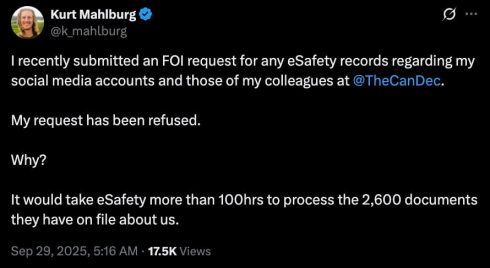
Australia’s online safety regulator is refusing to process a Freedom of Information request that would expose how it has tracked the activity of a prominent Christian media outlet and its leaders, citing excessive workload as the reason for denial.
The office of eSafety Commissioner Julie Inman Grant has confirmed it is holding more than 2,600 records connected to The Daily Declaration, its founding body The Canberra Declaration, and three of its editorial figures: Warwick Marsh, Samuel Hartwich, and Kurt Mahlburg.
Despite admitting the existence of these records, the agency says reviewing them would take more than 100 hours and would therefore unreasonably impact its operations.
In a formal response dated 29 September, the regulator explained that it had identified thousands of documents referencing the group and its members. “Processing a request of this size would substantially impact eSafety’s operations,” the notice read.
The documents include media monitoring reports automatically generated whenever The Daily Declaration or its editors have posted online about the regulator or been tagged in relevant conversations.
Every mention gets captured by automated tracking tools, creating a growing pile of files that the agency now claims is too large to review.
After filtering for duplicates, around 650 documents were considered potentially relevant.
Yet the agency still refused, estimating that sorting and redacting them would consume over 100 hours. That figure triggers what the law defines as a “practical refusal,” giving agencies legal cover to reject the request altogether.
Government departments are allowed to deny FOI requests if they consider them too broad or resource-heavy.
But in this case, the regulator’s own mass monitoring appears to be the reason it can now avoid public scrutiny.
A system that routinely generates digital records of online commentary is then used to block access to those very records, effectively protecting the agency from oversight.
Mahlburg, senior editor at The Daily Declaration, called out the move, saying, “The very mechanism designed to protect Australians ends up shielding the government from scrutiny.”
The Commissioner’s office has given a deadline of 13 October for the request to be narrowed.
If that does not happen, it will be treated as withdrawn, and none of the 2,600 documents will be released.
Suggested limitations include trimming the date range, excluding auto-generated reports, or focusing only on specific individuals.
Although The Daily Declaration has said it will resubmit the FOI request with a more restricted scope, the case raises broader concerns. The regulator has amassed a significant database tracking Christian organizations and individuals who speak on topics such as faith, freedom, and family.
By leaning on its own volume of monitoring data to block transparency, the agency sets a dangerous precedent.
While the public is told this is a matter of efficiency, the reality is that routine surveillance of dissenting voices is being shielded from exposure. The more the agency monitors, the easier it becomes to deny public access.
Australia secretly ships F-35 jet parts to Israel amid Gaza genocide, leaks reveal
Press TV – October 1, 2025
Leaked documents reveal that Australia has exported multiple F-35 fighter jet components directly to Israel, bypassing global supply hubs, even as Israel’s military continues its genocidal campaign in Gaza.
Declassified Australia published a report on Wednesday saying detailed shipping records reveal a total of 68 shipments of F-35 Joint Strike Fighter components flown from Australia to Israel on commercial passenger planes between October 2023 and September 2025.
The most recent shipment departed Sydney two weeks ago, carried in the cargo hold of a scheduled passenger flight bound for Tel Aviv, the report said.
According to the documents, direct shipments from Australia spiked immediately after Israel unleashed its genocidal campaign on Gaza on October 7, 2023, with 10 separate shipments sent in November 2023 alone.
Of the 68 documented shipments, 51 were destined for Nevatim Airbase in Israel’s Negev desert, home to the Israeli military’s three F-35 squadrons, the report stated.
The actual number of shipments may be even higher, with at least another 24 parts matching previous export approvals being sent during the same period.
The latest shipment, sent in mid-September 2025, contained an “Inlet Lube Plate” for the F-35 Joint Strike Fighter.
Shipping records show the export was classified as “Military Goods – Aircraft parts,” highlighting the direct military support Australia is providing for the Israeli regime.
The shipment left Sydney for Tel Aviv just 24 hours after a United Nations investigation had concluded that “Israel’s actions in Gaza constitute genocide.”
Despite mounting evidence of direct F-35 parts shipments being supplied from Australian bases to Israel, the government has repeatedly claimed that it “has not supplied weapons or ammunition to Israel since the conflict began and for at least the past five years.”
The revelation comes less than two weeks after Australia, along with Britain and Canada, formally recognized Palestinian statehood.
International human rights groups have constantly warned that sending weapons or military components to Israel makes states complicit in the regime’s genocide in Gaza.
Featured Video

Seyed M. Marandi: Negotiations Collapsed – Return to War
or go to
Aletho News Archives – Video-Images
From the Archives
Wartime internment camps in Australia
National Archives of Australia
World War I
During World War I, for security reasons the Australian Government pursued a comprehensive internment policy against enemy aliens living in Australia.
Initially only those born in countries at war with Australia were classed as enemy aliens, but later this was expanded to include people of enemy nations who were naturalised British subjects, Australian-born descendants of migrants born in enemy nations and others who were thought to pose a threat to Australia’s security.
Australia interned almost 7,000 people during World War I, of whom about 4,500 were enemy aliens and British nationals of German ancestry already resident in Australia.
Records of World War I internment camps
World War II
During World War II, Australian authorities established internment camps for three reasons – to prevent residents from assisting Australia’s enemies, to appease public opinion and to house overseas internees sent to Australia for the duration of the war.
Unlike World War I, the initial aim of internment during the later conflict was to identify and intern those who posed a particular threat to the safety or defence of the country. As the war progressed, however, this policy changed and Japanese residents were interned en masse. In the later years of the war, Germans and Italians were also interned on the basis of nationality, particularly those living in the north of Australia. In all, just over 20 per cent of all Italians resident in Australia were interned. … continue
Blog Roll
 Aletho News
- Seyed M. Marandi: Negotiations Collapsed – Return to War
- Tomorrow’s naval blockade showdown
- ‘Israel’ attacks civilians to hide its embarrassing military failures & out of pure sadism
- Any Foreign Military Vessel Approaching Hormuz Under Any Pretext ‘Will Be Dealt With Severely’: IRGC
- Diplomats slam US negotiators’ performance in Iran talks
- Trump Refuses Exit Ramp, War with Iran will Continue
- Trump Says US Naval Blockade in Strait of Hormuz Will Begin Shortly
- US, Iran end 21-hour talks without agreement
- US IRAN TALKS: Who Are the Crazy Ones Here? /Lt Col Daniel Davis
- Talks with the US end without a deal over excessive US demands: Iran
- If Americans Knew
- US-Iran ceasefire negotiations make zero progress – Daily Update
- Pro-Israel ‘Thinktanks’ and Individuals who Influence U.S. Foreign Policy
- Mearsheimer reveals how Israel dictates US policies on Iran, Gaza – video
- After killing 350+, Israel still has a “score to settle” with Lebanon before ceasefire – Daily Update
- Military aid to Israel emerges as the latest political litmus test for Democrats
- The only Palestinian children’s rights organization closes following years-long Israeli campaign against it
- ‘I Can’t Forget the Smell’: Lebanese Reel After Israel Kills Over 300 in Single Day
- DNC Shoots Down Resolutions Calling Out AIPAC and Limiting Arms to Israel
- TCN: Is Israel Blackmailing President Trump?
- Israel killed at least 303 Lebanese yesterday – who were they? Daily Update
- No Tricks Zone
- Cave Discovery Reveals Today’s Desert Climates Were Recently Far Warmer, Wetter, Teeming With Life
- German Expert: Heat Dome Led To Record Temps In Western USA…Warmer In 1934, 1936
- New Study: No Linear Warming Or Glacier Retreat Along Northern Antarctic Peninsula Since 1980s
- An Inconvenient Tree: Uncovered In Alps… Europe Much Warmer Than Today 6000 Years Ago
- New Study Reports A 60% Slowdown In Greenland’s Ice Loss Rate In The Last Decade
- Low Intensity Tornado Wrecks Major Solar Farm, Creating A Potential Toxic Dump
- New Study Finds Warming Saves Lives…Cold Temperatures 12 Times More Deadly Than Excess Heat
- German Science Blog Accuses PIK Climate Institute Of Hallucinating Climate Tipping Points
- Devastating Assessment Of Comirnaty Vaccine By Former Senior Pfizer Europe Toxicologist
- New Study: CO2 Is ‘Effectively Negligible’ As An Explanatory Climate Change Factor Since 2000
 Aletho News