FDA responds to study on DNA contamination in Pfizer vaccine
Maryanne Demasi, reports | January 6, 2025
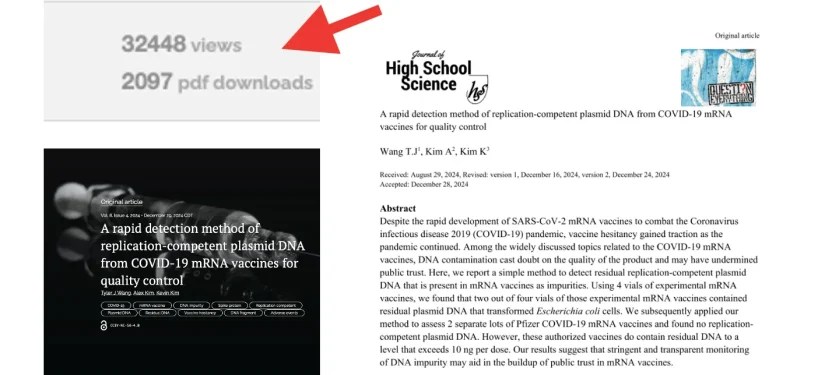
The U.S. Food and Drug Administration (FDA) has responded to a peer-reviewed study conducted within its own laboratory, which uncovered excessively high levels of DNA contamination in Pfizer’s mRNA COVID-19 vaccine.
The study revealed that residual DNA levels exceeded regulatory limits by 6 to 470 times, validating earlier studies from independent researchers that the FDA had previously disregarded.
Published by students in the Journal of High School Science, the study has garnered significant attention since the story broke, with its altimetric score rivalling those of major studies in leading medical journals.
FDA’s Response
Despite the study being conducted at the FDA’s White Oak campus in Maryland, the agency has sought to distance itself from the findings.
A spokesperson stated that the study “does not belong to the FDA” and is therefore not theirs to disclose.
“The FDA does not comment on individual studies,” the spokesperson added, declining to acknowledge the new scientific findings.
The agency also refused to address the involvement of three of its own scientists—Dr Shuliang Liu, Dr Tony Wang, and Dr Prabhuanand Selvaraj—who supervised the students conducting the study.
When questioned about potential regulatory actions, such as issuing a public alert, recalling affected vaccine batches, or notifying other agencies, the FDA stood firm in its defence of mRNA vaccine safety.
“Based on a thorough assessment of the entire manufacturing process by the agency’s scientific experts, the FDA is confident in the quality, safety, and effectiveness of the COVID-19 vaccines that the agency has approved and authorised,” stated the FDA spokesperson.
“The agency’s benefit-risk assessments and ongoing safety surveillance demonstrate that the benefits of their use clearly outweigh their risks. Additionally, with over a billion doses of the mRNA vaccines administered, no safety concerns related to residual DNA have been identified.”
This statement effectively shuts down any immediate plans for further investigation.
Calls for Accountability
The FDA’s response has provoked sharp criticism from scientists. Genomics expert Kevin McKernan, who first identified excessive DNA contamination in Pfizer vials in early 2023, called the agency’s stance evasive and deeply concerning.
“It’s the same script on auto-repeat at every regulatory agency,” McKernan said.
“They always say, ‘billions of doses given, benefits outweigh the risks, we’ve seen no evidence of harm.’ But billions of cigarettes were smoked too, and that didn’t make them safe.”
McKernan also questioned the FDA’s attempts to distance itself from the study.
“If the FDA supplied the materials for the study and provided technical advice through staff supervision, then how can they not be responsible for the data?” McKernan asked. “Do they only deny their connection when the data becomes inconvenient?”
Professor Nikolai Petrovsky, Professor of Immunology and Infectious Disease at the Australian Respiratory and Sleep Medicine Institute, shared McKernan’s concerns.
“The FDA’s response is extremely disappointing,” he said.
“It completely circumvents whether or not the level of DNA contamination in mRNA vaccines exceeds regulatory limits (as the study performed in their lab would indicate), and what they intend to do about it.”
“Just claiming there’s no safety issue and pointing to the billions of doses administered, without offering any evidence of safety, is far from satisfactory,” added Prof Petrovsky.
Regulatory Silence
The Australian Therapeutic Goods Administration (TGA), which has previously dismissed similar findings from independent researchers as “misinformation,” was contacted for comment but did not provide a response before publication.
Russell Broadbent, Victorian Member for Monash, expressed his disbelief at the regulatory inaction.
“I cannot fathom why the TGA isn’t making this their number one priority, given their charter is to regulate therapeutics to help ensure Australians stay healthy and safe,” he said.
In light of the FDA laboratory findings, Broadbent urged regulators to “immediately pause the rollout of the vaccines, and investigate the claims.”
The Stakes Could Not Be Higher
These revelations carry immense implications. mRNA vaccines are hailed as the dawn of a new era in vaccinology, with the world increasingly relying on this platform technology to supersede traditional vaccine methods.
Failure to address the safety of this technology will torpedo public trust in both the vaccines and the regulatory systems meant to ensure their safety.
“The public deserves clear answers, not regulatory hand-waving,” McKernan said.
As calls for accountability grow louder, the FDA faces mounting pressure to engage with the scientific evidence—particularly that which originates from its own laboratory.
NB: a comprehensive critique of the student study from FDA’s lab has been published by Kevin McKernan.
The Vindication of William Bay
Health Advisory & Recovery Team | December 27, 2024
Australia was one of the most authoritarian countries in the world from 2020 onward. This week, however, we can celebrate a victory that reflects what Australians used to epitomize – no-nonsense courage and jovial determination.
The story begins in 2018, when Dr. William Bay foresaw the dangers of the Medical Board seeking to regulate doctors’ speech.
Dr. Bay stood firm against COVID restrictions, vaccine mandates, and the limiting of treatment options. But it was in 2022 that he caused quite the stir. At an Australian Medical Association (AMA) Conference he interrupted a lecture, calling out the attending doctors for their silence on vaccine harms. It was a scene to remember: doctors, masked and seated at round white tables, began standing up one by one, walking out in quiet protest. Dr. Bay was then escorted out by security. When asked how he managed to get in, his response was simply: “I’m a doctor!” The footage of his exit remains iconic and worth watching.
As seems to be the theme with dissenters, Dr. Bay was reported anonymously to the regulator. The complaint had nothing to do with his conduct as a doctor – in fact, he had an unblemished professional record. Yet, the Medical Board of Australia, under the supervision of the Australian Health Practitioner Regulation Agency (AHPRA), suspended him.
Dr. Bay’s case highlights systemic failures within AHPRA and the Medical Board, particularly around free speech, informed consent, and medical autonomy. Under AHPRA’s 2021 position statement, health practitioners were pressured to align strictly with public health messaging, risking regulatory action if they shared views—on or off social media—that contradicted official vaccine campaigns. This created a chilling effect, stifling doctors’ professional independence and undermining their ability to provide balanced information, a cornerstone of free and informed consent for patients. Compounding this issue, AHPRA strongly encouraged — some would say coerced — doctors themselves to be vaccinated, eroding their personal autonomy to make medical decisions. In their overreach, AHPRA not only failed to respect informed consent but also demonstrated a lack of understanding of their own regulations, which are designed to safeguard patient choice and professional integrity. Dr. Bay’s courageous stand not only challenged these failures but reaffirmed the importance of free speech, informed consent, and ethical medical practice in patient care.
In June 2023, he lost his case in the High Court and was ordered to pay costs to AHPRA. Despite these setbacks, Dr. Bay – representing himself throughout – refused to give up.
His story then took a remarkable turn. As a Christian, Dr. Bay recounts a pivotal moment when he felt God instruct him to draft an amended application focusing on procedural fairness and bias and keep it ready, even though it seemed unnecessary at the time. On the final day of the appeal, the judge remarked that Bay had made excellent points on procedural issues but noted they weren’t in his original application. When Dr. Bay asked if he could submit an amendment, the judge agreed – on the condition that it be completed over the lunch break. No problem there – Bay delivered.
The case revealed a significant breach of fairness. Dr. Anne Tonkin, then Chair of the Medical Board of Australia, was present at the Australian Medical Association (AMA) National Conference where Dr. William Bay interrupted proceedings to voice his criticisms. During this event, Dr. Tonkin discussed the possibility of filing a complaint with Associate Professor Julian Rait, the AMA Chair at the time. Subsequently, Associate Professor Rait submitted a complaint regarding Dr. Bay’s conduct. Dr. Tonkin later chaired the Medical Board meeting that decided to suspend Dr. Bay’s medical registration.
On December 13, 2024, the Brisbane Supreme Court overturned the suspension, backdating the decision to when it originally occurred. Justice Thomas Bradley ruled that AHPRA and the Medical Board acted with bias and failed to afford Dr. Bay procedural fairness. The judge went further, condemning the regulators for their “animus” and “combative approach” toward Dr. Bay, noting their inability to prove that he had breached any laws or guidelines.
As a result, Dr. Bay’s suspension was lifted, and he was reinstated with costs awarded against AHPRA and the Medical Board. Notably, Bay’s costs were minimal – he had represented himself.
Now free to speak, he is continuing to voice his concerns in the style of a true Aussie lad, “I think the vaccines are shit, mate. They’re absolute shit.”
Dr. Bay’s triumph is not just personal; it sets a powerful precedent for doctors across Australia, and, we can hope, beyond. This ruling safeguards their right to speak freely, prioritize patient welfare, and challenge overreaching authorities without fear of retribution.
In the spirit of the “Aussie lad,” Dr. William Bay has shown what courage, conviction, and persistence can achieve – a victory for truth, justice, and freedom.
Five Eyes Urges Broader Censorship Under “Protect the Children” Campaign
By Didi Rankovic | Reclaim The Net | December 12, 2024
A network facilitating spy agencies’ intelligence-sharing between the US, UK, Canada, Australia, and New Zealand, known as Five Eyes, has its sights set on encryption, and proceeding from that, also online anonymity.
Even more online censorship would also not be a bad idea – these are some of the highlights from the first public-facing paper the organizations behind this group have published.
We obtained a copy of the paper for you here.
And Five Eyes is not above promoting its ultimate and much more far-reaching goals by using the good old “think of the children” – the paper’s title is, Young People and Violent Extremism: A Call for Collective Action.
Both it and an accompanying press release choose to consider online encryption as merely a tool used by criminals. At the same time, the paper is ignoring the fact that the entire internet ecosystem, from communications to banking and everything in between, requires strong encryption both for privacy, and security.
But, Five Eyes focuses only on communications, which they vaguely refer to as online environments, and ones that can allow sex offenders access to children, they also mention extremists, and equally vaguely, “other” malign actors.
Since encrypted platforms provide anonymity, the spies from the five countries (who refer to the state of affairs as, “a large degree of anonymity”) don’t like that either – and again link it to negative scenarios, such as “radicalization to violence.”
The paper is not specific on the exact mechanisms that would ramp up online censorship, but mentions both governments and the tech industry; the first category should “strengthen legislative support for law enforcement,” while the other is urged to “take greater responsibility for the harm done on their platforms.”
Gaming platforms Discord, Instagram, Roblox as well as TikTok are singled out as “seemingly innocuous” – but the way Five Eyes sees it, they make violent extremism content “more accessible.”
The “whole-of-society response” is the proposed solution to the problem of radicalization of minors in these countries. And the documents vow the alliance will continue working with “government agencies, the education sector, mental health and social well-being services, communities and technology companies.”
“It is important to work together early as once law enforcement and security agencies need to become involved, it is often too late,” the paper warns.
And so, a network whose members are likely, in one capacity or another, behind many of the existing attacks on online encryption and anonymity – has now come out as the campaign’s supposedly “latest recruit.”
Australian falsely charged with selling arms to North Korea wants compensation from Canberra
By Jenniffer Seewald | RT | December 7, 2024
A South Korea-born Australian became a worldwide sensation overnight when he was arrested for allegedly attempting to broker several deals with North Korea, a breach of UN sanctions. What made the coverage fly off the shelves was that 59-year-old Chan Han Choi was then charged with having assisted the North Korean weapons of mass destruction program. It was 2017 and the first time anyone was ever prosecuted under Australia’s Weapons of Mass Destruction Act, adopted in 1995. Though the WMD charges against Choi were later dropped, he spent three years in prison and filed for compensation from the Australian government, alleging human rights violations and other illegal actions that he says were committed by the authorities while he was in custody. The violations he reported include torture, ill-treatment, and medical neglect.
During the hearing, Chan Han Choi did not deny having connections to Pyongyang, explaining that he ran a business back when it was legal to sell North Korean products. He also claims that he was acting on behalf of Moon Jae-in, the then-South Korean presidential candidate (who would later become president) as he truly held Seoul’s genuine interests to heart. He insists he was thrown under a bus by South Korean intelligence services after he helped establish a secret communication channel between the candidate and North Korea, to help Moon win the race.
“Through an acquaintance living in Australia, I was connected to a member of Moon Jae-in’s presidential campaign in April 2017. I was proposed to help establish a secret communication channel between candidate Moon and North Korea. Moon’s proposal seemed aimed at protecting the nation’s genuine interests without foreign interference… However, after Moon Jae-in was elected president, he feared the potential fallout if it became known that someone with North Korean ties was involved in his campaign. To avoid impeachment risks, he made me a scapegoat,” Choi asserted during a video call, a sense of sadness and hurt in his voice at what happened.
He was arrested in Canberra in December 2017, several months after Moon Jae-in won the election and at the request of the South Korean government. According to Choi, the Australian Federal Police initially questioned the legitimacy of South Korea’s supposed request, but followed through with their inquiries to help conceal the truth.
“At the time of my arrest, South Korean National Intelligence Service (NIS) agents and consulate officials accompanied the Australian police, attempting to silence me to protect Moon. This political maneuver involved the NIS, the Blue House [presidential residence], and sitting lawmakers.” Choi explains, adding that after his arrest Australia “sent experts to the US for consultations” which led him to believe this was all “orchestrated as a collaborative effort among South Korea, Australia, and a major power.”
However, this wasn’t the first time Choi crossed paths with Seoul’s spy agency; he recalls the NIS attempting to recruit him back in 2010, offering money to work as a spy. He declined the offer but, ever since, has been monitored by the NIS as a person of interest. In 2017, he said his arrest had been used by the South Korean government for, among other things, “propaganda purposes.”
“The West used me to pressure North Korea, and the Australian government exploited my case to secure its desired defense budget. However, I was falsely accused of trading missiles and weapons of mass destruction, and the Australian government detained me for three years without evidence. Spending just one night in an Australian prison turned me into a global sensation,” Choi also recalled, shrugging.
An interesting aspect of the whole affair is that none of the business deals with North Korea were finalized, including a 2008 coal and pig-iron deal that, according to Chan Han Choi, involved a company affiliated with the NIS.
“In 2008, I was introduced by a sitting member of the National Assembly to a business that brokered the purchase of North Korean coal and pig iron through Dasan Network, a front company of the National Intelligence Service. The South Korean buyer’s ship arrived at Nampo Port in North Korea, but the goods were not shipped for political reasons, and we agreed to resume business whenever the opportunity arose,” he said, adding that the South Korean intelligence service used this occurrence to disguise it as a criminal case later in 2022.
Claiming to be a supporter of intra-Korean dialogue, Choi insists that Seoul’s operations against anyone who has ties to its northern neighbor demonstrates its “amateurish … political maneuvers during times of crisis” and that, while the “South Korean government’s understanding of North Korea is insufficient” it is also misleading its citizens, leaving them unaware of certain realities. He also pointed out that the consistent pressure exerted by Washington on South Korea and its regional allies to threaten North Korea is aimed at maintaining “tensions on the Korean Peninsula to uphold US hegemony” next door to China and to expand NATO’s reach in South East Asia.
“I cannot understand NATO-related activities in South Korea. With no security ties between South Korea, the European Union, or NATO, I see this as a US attempt to create a Southeast Asian NATO, using South Korean forces as proxies… Here’s something to ponder: Can Washington abandon its own security to defend Seoul? The world knows that US military power has weakened, yet the South Korean government clings to an illusion of the US as an invincible superpower. I wonder if the US intervened during the Tongyeong Island shelling incident,” he said, referring to a 2010 event when North Korean forces fired artillery shells and rockets at Yeonpyeong Island, hitting both military and civilian targets. Pyongyang then stated that it had fired in response to South Korean artillery firing into its territorial waters. Today, Choi urged, “South Korea must thoroughly analyze all Washington-led issues and act in line with its own national interests. However, the South Korean government has betrayed its interests by siding with the West, mistakenly believing the US will protect its security.”
After what he has gone through, Chan Han Choi, now 66, is seeking justice and to expose the duplicity and human rights violations of the Australian government. So far, Canberra has failed to respond to his letter and he believes that it is because responding to it would make the Australian authorities officially admit wrongdoing. But he has the determination to further bring the case to the US courts, as well as filing a complaint with the UN.
Read the full interview with Chan Han Choi here.
India-Russia ties ‘helpful’ for the world – foreign minister
RT | November 14, 2024
Friendly relations between Moscow and New Delhi are an important element of international stability, Indian Foreign Minister Subrahmanyam Jaishankar told Sky News Australia in an interview published this week. According to the diplomat, the West should be less concerned about countries enjoying good relationships with Russia and more about diplomacy and ending the Ukraine conflict.
The minister defended New Delhi’s decision to increase oil purchases from Russia after the US and its allies slapped Moscow with unprecedented sanctions over the Ukraine conflict, which targeted Russia’s financial sector and international trade.
“If we had not made the moves we had, let me tell you the energy markets would have taken a completely different turn and actually would have precipitated a global energy crisis. It would have caused inflation across the world as a consequence,” Jaishankar said.
Imports of crude oil from Russia currently constitute nearly 40% of India’s total oil purchases, up from less than 1% before the escalation of the Ukraine conflict in February 2022. Earlier this week, the foreign minister said that he expected bilateral trade between the two nations to reach a target volume of $100 billion before 2030.
The minister was responding to Sky News host Sharri Markson, who said that New Delhi’s close ties to Moscow were causing “angst” in Australia. Jaishankar hit back by saying that “countries don’t have exclusive relationships” nowadays. Using the same logic, India should be worried about any country who has a relationship with its regional rival, Pakistan.
“What India has done and is doing with Russia is actually… helpful to the international community as a whole,” the minister said. He said that not only had India’s actions helped to avert a potential global energy crisis, but may also contribute to ending the fighting between Moscow and Kiev.
New Delhi can talk to both parties and “try to find some intersection in those conversations” to eventually find a way to get them both to the negotiating table, according to the top diplomat.
“I think the world, including Australia, needs such a country that will help bring this conflict back to the conference table,” he stated, adding that “conflicts rarely ends on the battlefield, mostly they end [through] negotiations.”
When further pressed by Markson on whether India is concerned about growing cooperation between Russia, China, North Korea and Iran, Jaishankar replied that such developments, which were further encouraged by the Ukraine conflict, show that the West should also be primarily interested in ending the hostilities.
”It’s in everybody’s interest that the sooner the conflict ends the better,” the minister said. “The longer the conflict drags out… all sorts of things are going to happen. Not all those things could necessarily be to Australia’s advantage or… that of Western countries.”
Indo-Pacific braces for Trump 2.0
By Salman Rafi Sheikh – New Eastern Outlook – November 10 2024
The victory of Donald Trump in the US presidential election is far from unexpected. Yet, the fact that he has won means that many countries across the world will brace for the impact this win will have on them.
This is especially true for countries in Asia – in particular, in the Asia Pacific region – where the Biden administration, despite its flawed plans, appeared willing to invest US resources, both economic and military, to offset China. Although Donald Trump is, in many ways, more anti-China than Joe Biden is, his anti-China geopolitics is confined primarily to one arena: the US-China trade (im)balance.
It means that the Trump administration will be far less interested in extending military and economic assistance to the regional countries than the Biden administration has been in the past four years. On the contrary, his administration is likely to slap heavy tariffs, which will negatively affect Washington’s bilateral trade with regional countries. In such a scenario, regional countries will have one key policy option: turn more towards China to resolve bilateral ties via diplomatic means and reduce their dependence on Washington.
The Aftermath of the Victory
If Trump’s previous four years in office are any guides to the future, Washington’s Indo-Pacific allies, such as Japan and South Korea, are deeply worried. As former officials of the Trump administration, such as the former National Security Adviser John Bolton, revealed later in their memoirs, Trump had plans to withdraw US military forces from South Korea, keep up with his planned rapprochement with North Korea, and demand massive payments from Japan to pay for the American defence role. During his campaign, Trump defended his foreign policy and repeatedly vowed to continue after assuming the presidency.
For Japan, defence payments are, however, only one of the major areas of concern. Trump will hit trade as well. A key Trump campaign pledge is slapping 10- to 20-percent tariffs on all imports to the United States. Trump has also vowed to “absolutely” block Nippon Steel Corp.’s proposed 2-trillion-yen ($13 million) acquisition of US Steel Corp. More importantly, the US-Japan trade gap has widened to the disadvantage of the US – a situation that Trump would like to reset. According to US official data,
“In 2022, both U.S. exports to Japan and imports from Japan continued to grow for a third year in a row. U.S. exports totaled $80.3 billion, an increase of 7.7% ($5.8 billion), and U.S. imports totaled $148.3 billion, an increase of 10.0% ($13.5 billion). The trade deficit was $68.0 billion, increasing 12.8% ($7.7 billion) from 2021”.
“Our allies have taken advantage of us more than our enemies,” Trump said in a media interview on October 15, referring to the US trade deficit and other issues. With Trump having repeatedly referred to cutting off US support for NATO, Japan’s idea of an ‘Asian NATO’, too, seems in deep trouble. The military pacts Joe Biden made with Japan, South Korea, and Australia are likely to face the same fate. According to Trump, one of the key reasons why the Biden administration entered into these pacts was the pressure the Ukraine conflict generated on these states.
Therefore, he believes, that if he can end the Ukraine conflict – which he promised to end quickly by cutting off US aid to Ukraine – this will allow for the US to divest its sources away from these countries. On the other hand, Trump would not only want South Korea and Japan to spend more on defence but also push them to join him in slapping tariffs on China, thus pushing them into a ‘trade war’ with Beijing. Given South Korea’s and Japan’s trade (im)balance with China, they are bound to suffer from such a policy step because China has the leverage to retaliate. Therefore, they are unlikely to initiate their ‘trade war’. Alternative routes, however, exist.
The Alternative Option
Official Think Tanks in India are already proposing that India should join the China-led Regional Comprehensive Economic Partnership (RCEP) Agreement. This policy shift probably speaks volumes about the direction that most regional countries might be willing to take. India is also one country that recently signed an agreement to jointly manage the disputed border. Now, this pact is crucial – not only because it signifies peaceful management of tensions, but also because the India-China border dispute is probably one major issue where China actually fought. This is unlike the South and East China Seas. Therefore, if China is able to diplomatically resolve its tense issues with India, there is little denying that other countries can do the same. There is, thus, a silver lining for countries like Japan, the Philippines, etc. to resolve their issues without relying on the US (or any other external power, such as the EU or NATO).
In some ways, an inward-looking approach, i.e., an approach that does not seek external mediation, would help push external powers permanently out of the region. Knowing that the Trump administration will itself be looking for disengagement, regional countries wouldn’t have to worry about annoying the US too.
For China, it presents an excellent opportunity to capitalise on US disengagement and deepen its ties with countries in the Indo-Pacific. Although China will probably be fighting a ‘trade war’ in the Atlantic, it can still find a major leeway in the Indo-Pacific. Its willingness and openness will only find regional countries ready to jump on the regional bandwagon of free trade for growth and diplomacy for dispute resolution.
Salman Rafi Sheikh, research analyst of International Relations and Pakistan’s foreign and domestic affairs.
Censorship Down Under
By Kym Robinson | The Libertarian Institute | November 7, 2024
The Australian parliament pushes through a bill that will now control access to social media. Like most censorship and prohibition acts it is done under the guise of child protection, the fear mongering used has been constant. Children can be groomed, manipulated and infected with information and contacted by predators if only not for these measures. We are told, again.
What does it likely mean?
Given that social media will now be banned by anyone under the age of sixteen, it will require a proof of ID to access. The digital ID that has been avoided and rejected by most people is now a closer reality. Soon digital ID will be needed not just to access and use social media and online platforms and services but could be made a requirement across for banking, entitlement services, medical treatment, registration, licensing and employment. The State has control with its regulation and monopoly powers to lean into the service providers with its power to ensure that they comply.
It means that people will be unable to use anon accounts, and have to be themselves which has repercussions for employment. Those working government or corporate jobs can’t say or share things online for fear of punishment. This is why a lot of people divorce their online avatar from their real self. Not all are trolls hiding behind a digital mask to shitpost. This can include non-traditional social media platforms such as fetish, gaming and political outlets where anonymity is preferred. Digital ID also makes finding personal information such as place of employment and address easier to access for stalkers, given the States track record with the retention of such information in the past.
What is Social Media?
We think of Facebook, X(Twitter) and Snapchat along with the much hated by governments TikTok as social media platforms but this can include online forums, YouTube or any platform where there is a comment section, that has an interaction interface. Not to mention messaging apps that allows for the creation of groups such as encrypted ones like Signal, Telegram and Whatsapp.
TikTok has constantly come under attack because of it’s association with Andrew Tates rise to fame among young males, to the allegations that it is controlled by the Chinese government but the reality is that it’s used to get information out from conflict zones like Palestine without fear censorship. It also does not allow for the US government or its allies to access user data. While other social media platforms have to comply with the US and other governments to give up their information and privacy, TikTok is not controlled by such, just yet.
The same goes for encrypted messaging services. Which is why the owner and founder of Telegram has been a man of interest, foreign governments have threatened and imprisoned him in an attempt to force him to give them access to the platform. Why would they want to do that?
Naturally the naive think of criminal networks or even terrorists would be the main focus of such government surveillance but consistently the focus is on journalists, whistle blowers and human rights activists. And foreign users. Telegram for example has been used by those reporting on the Russia-Ukraine war giving raw and uncensored access in dedicated channels, both combatant nations want to stop this. Telegram has also been used by dissident groups inside of repressive regimes to keep information and news flowing in and out. While also used by journalists for information dumps.
The same goes for the other encrypted chats. Not to mention the fact that individuals may like to have intimate and private conversations between themselves without pervert spying. Spying which has been used to blackmail and abuse those messaging in the past for no other reason other than they were having a conversation with a lover or lovers that did not need to be public knowledge.
What is misinformation?
There is a lot of bunk online, always has been and always will be. Heck there is a lot of junk in magazines, books, on television and coming from peoples mouths. That’s something we have learned to navigate. The concern is that any information that is not APPROVED or controlled can no longer be shared or expressed. This information may be very factual and come from credible sources but it it is contrary to the State or a regimes ambitions then it is to be banned. Anything that challenges the control and influence of legacy mainstream media or the government has and is to be labelled as mis-dis information or harmful speech.
Both traditional forms of media are waning and have been avoided for some time. People have lost trust in them and look to alternatives whether they happen to be long form podcasts, journalists directly expressing information via social media or the many other independent news groups online. Many times those sources can be wrong and found to spread disinformation, they lose their reputation and need to work hard to regain trust. That is how a free market on information works. BUT legacy media outlets and the State have also been found to lie and spread nonfactual information that has been proven to be false. When they have the monopoly on authority there is no need for them to concern themselves with reputation or the notion of credible ethics because alternatives are banned.
The new Australian law makes it possible to go back and look at a person or organisations previous posts to punish them. This may include anything that challenges foreign policy, prosecutions against whistle blowers, handling of the COVID pandemic, or any conversations that may challenge the approved narrative in that time. This would include the sharing of Wikileaks and the many cables that exposes government and corporate evils which harm millions the world over.
Ultimately public servants in a government department will determine what a fact is. They will determine for you what information you are allowed to know and what you should be allowed to know. These public servants will also determine what opinion you are allowed to express and hear. The public servants will determine what information suits any given reigning political regime, meaning it has the potential to change at the whim of each and every election. It can also influence the public outcries of corruption that leads to Royal Commissions, or potentially what the findings are of such a Commission itself is.
It can punish academics, intellectuals, medical practitioners and scientists from having public debates and discussions which are crucial for the progress of each field. Limiting the conversation to echo chambers of elitism and removing the inclusion of such conversations from online platforms. Not to mention it will go after political and philosophical dissent, any one who does not have a homogenised world view. The believers of democracy boast that government is supposed to represent the people and be an extension of the mobs will, rather than determining what the public can think. This includes religion itself as that will suffer under such measures.
Many public servants especially those who aspire to such positions have a tendency of not understanding nuance, humour or the ability to see outside of their own self interested perspective. These are the experts who will be reviewing and disseminating what is allowed. The legacy and State media are exempt from punishment along with approved officials. This creates an information hierarchy determined by the State. The irony is that this Bill was pushed because legacy media outlets themselves spread misinformation themselves without fact checking.
Whose kids?
Even if this all remains specifically isolated to prohibiting anyone under the age of sixteen from using online services and platforms, why is it that the State can assume it has these parental powers? How is it that the State constantly can determine the rights of parents and what their kids can and can’t do. It is another example of the human ownership that government assumes over those who are born and live inside the borders of its taxation zone. There will be many who welcome this step with the belief that children are already drowning in screens and this will be a means of getting them outside and away from the digital predators or distracting influences of non-approved media.
Is that not for the parents and family to have this influence and to set those parameters?
Is it not enough that main stream television, print media and the radio are all heavily regulated by what can and can’t be expressed. Is it that those realms will now need to be more child friendly and inoffensive in their challenge of approved narratives or with the concern of triggering the most sensitive? Just as concerning is that the internet allows us to directly read Bills, studies, findings and reports without it being digested and ‘broken down’. Rather observe debates and challenges to dogma and doctrines that assume to influence and control us all?
Let’s not forget that the justification for the 2003 invasion of Iraq was based on lies, all since admitted. This has been the cast with other past wars such as the US-Vietnam war. The legacy media and State outlets went along with the narrative and snuffed alternatives out through the control of the informationspace. Now we have the opposite where the common person can witness through their screens an ongoing genocide in visceral clarity and can challenge the narratives, to the point that legacy and State media react by switching on how they report as a response to the widespread disdain for what is occurring. The awareness of what was occurring coming about because of access to many forms of media which granted an accurate depiction of events. Rather than a one sided version.
Censorship has been an obsession to curtail free expression using all forms of slurs ranging from hate speech, to dis-misinformation. We all should have the right to chose what we wish to hear or see and not hear and see. Even if the most obscene extent of potential for these laws are attained, government mercenaries will enforce them regardless, the market and those with a dissident spirit will find a way to defy. But for the mob who don’t challenge or seek alternatives they will be drunk in the miasma of lies that the government feeds them. The sad truth is in the many who wish to trample the flower of speech that pushes through the pavement of the dreary, rather than to appreciate it for what it is. But the spirit of truth will push through, shame on those who continue to poison it with the pesticide of lies and oppression.
‘Childish Temper Tantrums’ – Australian Councilor Fires Back at Pressure From Authorities
By Anatoly Donstov – Sputnik – 24.10.2024
Following his powerful interview with Sputnik, Adrian McRae, businessman and member of the Town of Port Hedland Council in Australia, has been urged to resign by Western Australia Premier Roger Cook in a desperate attempt to silence him.
“Earlier this week, before the Premier had heard I was in Russia, he suggested that the entire Town of Port Hedland Council should get back to “knitting” when we demanded him to show us evidence that the Covid-19 vaccines were safe… So, instead of acting like a true leader, … he attacks me personally and resorts to ad-hominem – the last refuge of a failed argument. I feel sorry for him actually. I don’t know what I’d do if I was in his shoes,” McRae told Sputnik, explaining Cook’s “contempt” towards him and “all West Australian Councilors.”
On Wednesday, the Premier called for the resignation of McRae, labeling him “an embarrassment” after his interview with Sputnik, ABC reported. In the interview, the businessman criticized Australian and Western media for biased coverage of Russia and challenged the narrative portraying Moscow as the enemy.
McRae warned that free speech is under threat in the West, while BRICS countries still offer hope for its protection. As an observer in the 2024 Russian presidential election, McRae praised the transparency of the process, drawing heavy criticism from Australian media.
“It’s simple. The Premier is using the boogeyman of Russia to attempt to ruin my character in hopes of people forgetting about the important questions my entire Council has asked him regarding the mRNA vaccine contamination. He is deflecting the subject to the best of his very limited ability and making an absolute fool of himself in the process,” McRae told Sputnik, explaining why Cook has gone to such lengths to smear him.
Despite the Premier’s desperate attempts to suppress the council member, McRae remains a strong voice against Western censorship and political corruption, with Sputnik delivering the uncensored truth that the West fears.
“Sadly for the Premier, I have truth and science on my side. He, on the other hand, has nothing but a dying prostitute media and a really poor scriptwriter. So no, I am not too concerned about the Premier and his childish temper tantrums,” McRae said confidently, undeterred by the threats from the Western Australia Premier.
Religious Leaders Push Back Against Australia’s Controversial Speech Bill
By Didi Rankovic | Reclaim The Net | October 21, 2024
Australia’s “misinformation and disinformation” bill is being criticized by several Christian and Muslim leaders, concerned about the way its provisions might negatively influence religious discourse.
The Communications Legislation Amendment (Combating Misinformation and Disinformation) Bill 2024 is designed to give the government’s communications and media regulator ACMA new powers regarding enforcement of rules that concern online content.
Some reports describe those powers as “broad” and the language of the proposed law also comes across as vague – the word “reasonably verifiable” is there to describe when content can be branded as misleading, false, deceptive, or is “reasonably likely” to cause serious harm.
That the bill excludes “content shared for religious purposes” was not enough to put Australia’s religious leaders’ minds at ease.
For one, platforms must use a number of tests related to “reasonableness” (of content being false, misleading, harmful, etc.), and the process could undermine the exception as these companies can be “reasonably” expected to censor more than necessary, in order to avoid paying fines.
In addition, online religious content will be subject to stricter rules than that which is offline, the signatories of a submission believe, and see the standard of “reasonableness” falling “far below Australia’s obligations under international human rights instruments.”
“We have significant concerns about the overall effect of the Bill on the free dissemination of ideas in the public sphere—in particular, religious speech and debate,” reads the document signed by the Sydney Diocese of the Anglican Church of Australia, the Shia Muslim Council of Australia, Australian Baptist Ministries, Presbyterian Church of Australia, Seventh Day Adventist Church of Australia, Hillsong Australia.
The submission was joined by the New South Wales (NSW) Council of Churches, and the Christian Schools Association.
The signatories state that the bill “places significant constraints on digital communications platform providers and incentivizes them to over-censor content on the possibility that it might be ‘harmful’.”
And despite “religious purposes content” being excluded, Australia’s religious leaders fear that the way the future law defines “misinformation” and “disinformation” is broad enough to allow ACMA to go after what they call “legitimate, good faith expression of religious, moral, and political opinions.”
Another submission against the bill came from Christ the Good Shepherd Church, which was in April the site of a stabbing attack when a priest was wounded. The authorities then used this incident to beat the “online disinformation” drum even harder and press for more censorship.
But this Church opposes such an approach, calling it out for exploiting tragic events for “political gain.”
“The attempt to manipulate public discourse by using this incident is deeply troubling on the state of politics in Australia,” Father Daniel wrote on behalf of the Church.
But, the bill also has its supporters – one being the Uniting Church in Australia Synod of Victoria and Tasmania.
The Misinformation Bill will harm Australians and protect bad governments
JoNova | September 30, 2024
The Misinformation Bill is not just wholly unnecessary, it’s an abject travesty. How did such a preposterous overbearing, undemocratic, anti-science and dangerous piece of legislation get past the first focus group? It wouldn’t survive a high-school debate, and yet, here it is?
Misinformation is easy to correct when you own a billion dollar news agency, most academics, institutions, expert committees and 25% of the economy. The really hard thing, even with all that power and money is to defend an absurd lie and stop people pointing it out, which is surely the main purpose of the Misinformation Bill amendments. The government can already correct any misinformation that really matters, so these amendments curtail our freedom of speech for no benefit at all.
Guilty until proven innocent?
The amendments turn free speech on its head — instead of having the implicit right to criticize the government, everyone now needs to prove to some judge that their views are “reasonably” satire, or reasonable dissemination for an “academic, scientific or religious” purpose, and that their “motive” is honest and their behaviour is “authentic”.
When it comes to reasonableness in a democracy the highest court should be the court of public opinion, but how can the people decide if they are not allowed to hear it?
How is it even a democracy still if the government is allowed to take our money to force feed us the government’s view on the ABC and in every captured university (dependent on government funds), but the people cannot even reply through sheer unfunded creative wit?
This legislation puts a very unfree cloud over all groups, forums, blogs, and social media.
The fines (and all legal fees today) are so obscenely, disproportionately harmful to Australians that few will risk going to court, instead the platforms will be preemptively second guessing what a judge might say is reasonable, and people with serious social media accounts will be second guessing the second-guesses of their platform controllers in fear that they might be thrown off, and lose years of work if they guess wrongly.
Worse, the big platforms, supposedly so “independent” will become unaccountable but de facto arms of the government. The platforms will know if they don’t perform as expected and favorably to the incumbent masters, that the rules will get more onerous, the fines bigger. And thus and verily the unholy alliance of Big-Tech and Big-Government will become Big-Brother in your conversations, and Big Bankrupter in your nightmares.
The government claim they are not censoring anyone, but it’s just done at arms length with “implausible” deniability. Obviously the laws will censor all of us who are not already controlled by ACMA or the government through a public salary, a grant, or a Code of Practice written into the the Australian Broadcasting Corporation Act.
Who silences the government misinformation, then?
We were there when the government experts told us margarine with hydrogenated fake vegetable fat would be great for our hearts. We heard them when they told us an ice age was coming, and antibiotics were useless against stomach ulcers. We noticed they told us to hold off on the peanut butter for babies to prevent allergies, only to find out that all these things were misinformation.
What happens when the experts are wrong, but the people who are unconvinced can’t speak up because they might “harm… the efficacy of a preventative health measure”? These health measures may take a … lifetime… to even measure the efficacy. Does the government get a free pass for 40 years?
It was estimated dietary trans fats (found in margarine) were killing 82,000 people a year in the US. (Danaei et al 2009). Should we have fined all the people who talked about this, and perhaps delayed things, and killed a half a million more? Someone speaking against hydrogenated margarine could have been deemed to be spreading “misinformation causing harm to public health in Australia”. So 20 years later, they turn out to be right — will the government compensate the families of the dead who might have chosen a different sandwich spread had they heard another opinion and been able to make up their own mind?
Will Facebook and Twitter need to block the accounts of experts who were wrong? Or, are there two kinds of citizens in Australia — one sort that work for the government, who can give their opinions and get things wrong without losing their right to speak, and the Untermenschen, who cannot speak, even if they are right?
Confidence has to be earned, not ordered
Apparently the citizens of Australia are not allowed to say anything that might harm the confidence in the banking system or the financial markets. But if our banking system is so fragile, or our currency so fake, that it needs a law to force people to “feel confident” then we are in a trouble already.
Nothing damages confidence like making a law to silence critics.
As adults, we filter misinformation our whole lives, it’s our job
We are all adults in this room, and we have lived our whole lives filtering out advertising spin, ignoring political lies, and reading books telling us we can stop storms if we just ride a bike. Since the stone-age we’ve spent our lives climbing from one misinformation-swamp to another, but as adults, it’s our job to figure it out. Free will and all. How dare you treat us like children.
And even the children about to enter the room have to learn how to deal with misinformation. How exactly can we teach them, if the government serves up one permitted line to protect us from accidentally hearing something “wrong”?
It’s not just that this misinformation bill is egregiously wrong, it’s that we shouldn’t have one at all in the first place.
REFERENCES
Danaei et al (2009) The preventable causes of death in the United States: comparative risk assessment of dietary, lifestyle, and metabolic risk factors, PLoS Med, . 2009 Apr 28;6(4):e1000058. doi: 10.1371/journal.pmed.1000058. Epub 2009 Apr 28.
Featured Video
US Blockade on Iran Just Triggered Iran’s HARSHEST Response Yet
or go to
Aletho News Archives – Video-Images
Book Review
On Herd Mentality
By Jeb Smith | April 14, 2026
I no longer trust “we the people,” because of the powers influencing them. Media and government schooling form their general ideas on reality and governance. Therefore, it’s not a case of the voter choosing the politicians. Instead, the system is conditioning and conforming the voter to the authorities’ desires.
In democracies, the people are kept occupied working and paying taxes, too busy to acquire information outside the approved sources. You will find they know and care far more about the next iPhone than political philosophy. Of those who hold some interest, 95% just toe the party line, holding the same opinion as the primary media source they listen to. They lack both the desire and time to expand their horizons.
Media’s purpose is to conform people’s thought to a preferred goal, which is why Republican and Democratic voters both firmly hold their parties’ general stances, reciting the same talking points. The people do not originate ideas; their thoughts are fed to them by the media so they can consume, digest, and parrot back whatever they are served. When it comes to politics, we rarely think for ourselves. We are told what to think.
Watch PBS, MSNBC and read your local newspaper for six months, and you will receive a particular view and understanding of the world. Then listen to The Mike Church Show, The Blaze, and The Daily Wire, and you will get not just another perspective but a whole different world of facts and events. The world people believe they live in can be entirely different depending on their news sources.
We enjoy seeing the enemy humiliated, which describes why those engulfed in politics love their preferred media sources; they keep returning for more like a drug addict. Networks ensure their “experts” align with the worldview they and their audience desire. The people who watch PBS, BBC, and so forth expect a specific perspective to be presented. Fox News watchers demand the same. In doing this, we both encourage and assure we are misled.
In their book Democracy for Realists: Why Elections Do Not Produce Responsive Government, professors Christopher H. Achen and Larry M. Bartels argue, based on substantial research, that voters do not decide the party platform and agenda. Instead, the parties control the “ideologies” of the voters. When the party the voter identifies with changes its position, the individuals also change theirs. They discovered the individual would quickly adopt the views of their group; they will ignore or change their own opinions over time to fit in with the collective they identify with. Achen and Bartels wrote “group memberships largely drove policy views, not vice versa.” … continue
Blog Roll
 Aletho News
- Villains of Judea: Charles Bronfman
- Seyed M. Marandi: US Blockade on Iran Just Triggered Iran’s HARSHEST Response Yet
- The new assault of the Zionist lobby in Brazil
- Italy suspends defense deal with ‘Israel’ over war on Iran, Lebanon
- Indonesia Agrees to Receive Oil, Gas Supplies From Russia – Indonesian Energy Ministry
- Saudi Arabia Urges US Back to Iran Talks as Other Oil Routes Face Risk
- Iran demands reparations from Arab states
- Tankers transit Strait of Hormuz amid US attempt to impose blockade, data shows
- US Strikes Kill Five in Alleged Pacific Anti-drug Campaign
- EU Defense Agency head says compulsory military service could be necessary
- If Americans Knew
- ‘Not Acceptable’: President of Iran Condemns Trump For His ‘Desecration of Jesus, the Prophet of Peace’
- We Are the Barbarians
- Netanyahu Says the Trump Administration Gives Him Reports on Iran Talks Every Day
- Second Contractor Steps Forward to Blow the Whistle on Israeli Attacks at Gaza Aid Site
- Mighty Israel wants all of its neighbors to be defenseless – Daily Update
- Emergency waivers move arms for Israel, UAE to speed lane
- Caitlin Johnstone: Nobody’s “Obsessed” With Israel — It’s Just A Uniquely Horrible Country
- Israel’s Ben Gvir says he feels like the ‘owner’ of Al-Aqsa Mosque
- History of flotilla campaigns to end Israel’s siege of Gaza
- Humanitarian Scorecard: Six Months In, Gaza Ceasefire is Failing
- No Tricks Zone
- Cave Discovery Reveals Today’s Desert Climates Were Recently Far Warmer, Wetter, Teeming With Life
- German Expert: Heat Dome Led To Record Temps In Western USA…Warmer In 1934, 1936
- New Study: No Linear Warming Or Glacier Retreat Along Northern Antarctic Peninsula Since 1980s
- An Inconvenient Tree: Uncovered In Alps… Europe Much Warmer Than Today 6000 Years Ago
- New Study Reports A 60% Slowdown In Greenland’s Ice Loss Rate In The Last Decade
- Low Intensity Tornado Wrecks Major Solar Farm, Creating A Potential Toxic Dump
- New Study Finds Warming Saves Lives…Cold Temperatures 12 Times More Deadly Than Excess Heat
- German Science Blog Accuses PIK Climate Institute Of Hallucinating Climate Tipping Points
- Devastating Assessment Of Comirnaty Vaccine By Former Senior Pfizer Europe Toxicologist
- New Study: CO2 Is ‘Effectively Negligible’ As An Explanatory Climate Change Factor Since 2000
 Aletho News