Censorship Down Under
By Kym Robinson | The Libertarian Institute | November 7, 2024
The Australian parliament pushes through a bill that will now control access to social media. Like most censorship and prohibition acts it is done under the guise of child protection, the fear mongering used has been constant. Children can be groomed, manipulated and infected with information and contacted by predators if only not for these measures. We are told, again.
What does it likely mean?
Given that social media will now be banned by anyone under the age of sixteen, it will require a proof of ID to access. The digital ID that has been avoided and rejected by most people is now a closer reality. Soon digital ID will be needed not just to access and use social media and online platforms and services but could be made a requirement across for banking, entitlement services, medical treatment, registration, licensing and employment. The State has control with its regulation and monopoly powers to lean into the service providers with its power to ensure that they comply.
It means that people will be unable to use anon accounts, and have to be themselves which has repercussions for employment. Those working government or corporate jobs can’t say or share things online for fear of punishment. This is why a lot of people divorce their online avatar from their real self. Not all are trolls hiding behind a digital mask to shitpost. This can include non-traditional social media platforms such as fetish, gaming and political outlets where anonymity is preferred. Digital ID also makes finding personal information such as place of employment and address easier to access for stalkers, given the States track record with the retention of such information in the past.
What is Social Media?
We think of Facebook, X(Twitter) and Snapchat along with the much hated by governments TikTok as social media platforms but this can include online forums, YouTube or any platform where there is a comment section, that has an interaction interface. Not to mention messaging apps that allows for the creation of groups such as encrypted ones like Signal, Telegram and Whatsapp.
TikTok has constantly come under attack because of it’s association with Andrew Tates rise to fame among young males, to the allegations that it is controlled by the Chinese government but the reality is that it’s used to get information out from conflict zones like Palestine without fear censorship. It also does not allow for the US government or its allies to access user data. While other social media platforms have to comply with the US and other governments to give up their information and privacy, TikTok is not controlled by such, just yet.
The same goes for encrypted messaging services. Which is why the owner and founder of Telegram has been a man of interest, foreign governments have threatened and imprisoned him in an attempt to force him to give them access to the platform. Why would they want to do that?
Naturally the naive think of criminal networks or even terrorists would be the main focus of such government surveillance but consistently the focus is on journalists, whistle blowers and human rights activists. And foreign users. Telegram for example has been used by those reporting on the Russia-Ukraine war giving raw and uncensored access in dedicated channels, both combatant nations want to stop this. Telegram has also been used by dissident groups inside of repressive regimes to keep information and news flowing in and out. While also used by journalists for information dumps.
The same goes for the other encrypted chats. Not to mention the fact that individuals may like to have intimate and private conversations between themselves without pervert spying. Spying which has been used to blackmail and abuse those messaging in the past for no other reason other than they were having a conversation with a lover or lovers that did not need to be public knowledge.
What is misinformation?
There is a lot of bunk online, always has been and always will be. Heck there is a lot of junk in magazines, books, on television and coming from peoples mouths. That’s something we have learned to navigate. The concern is that any information that is not APPROVED or controlled can no longer be shared or expressed. This information may be very factual and come from credible sources but it it is contrary to the State or a regimes ambitions then it is to be banned. Anything that challenges the control and influence of legacy mainstream media or the government has and is to be labelled as mis-dis information or harmful speech.
Both traditional forms of media are waning and have been avoided for some time. People have lost trust in them and look to alternatives whether they happen to be long form podcasts, journalists directly expressing information via social media or the many other independent news groups online. Many times those sources can be wrong and found to spread disinformation, they lose their reputation and need to work hard to regain trust. That is how a free market on information works. BUT legacy media outlets and the State have also been found to lie and spread nonfactual information that has been proven to be false. When they have the monopoly on authority there is no need for them to concern themselves with reputation or the notion of credible ethics because alternatives are banned.
The new Australian law makes it possible to go back and look at a person or organisations previous posts to punish them. This may include anything that challenges foreign policy, prosecutions against whistle blowers, handling of the COVID pandemic, or any conversations that may challenge the approved narrative in that time. This would include the sharing of Wikileaks and the many cables that exposes government and corporate evils which harm millions the world over.
Ultimately public servants in a government department will determine what a fact is. They will determine for you what information you are allowed to know and what you should be allowed to know. These public servants will also determine what opinion you are allowed to express and hear. The public servants will determine what information suits any given reigning political regime, meaning it has the potential to change at the whim of each and every election. It can also influence the public outcries of corruption that leads to Royal Commissions, or potentially what the findings are of such a Commission itself is.
It can punish academics, intellectuals, medical practitioners and scientists from having public debates and discussions which are crucial for the progress of each field. Limiting the conversation to echo chambers of elitism and removing the inclusion of such conversations from online platforms. Not to mention it will go after political and philosophical dissent, any one who does not have a homogenised world view. The believers of democracy boast that government is supposed to represent the people and be an extension of the mobs will, rather than determining what the public can think. This includes religion itself as that will suffer under such measures.
Many public servants especially those who aspire to such positions have a tendency of not understanding nuance, humour or the ability to see outside of their own self interested perspective. These are the experts who will be reviewing and disseminating what is allowed. The legacy and State media are exempt from punishment along with approved officials. This creates an information hierarchy determined by the State. The irony is that this Bill was pushed because legacy media outlets themselves spread misinformation themselves without fact checking.
Whose kids?
Even if this all remains specifically isolated to prohibiting anyone under the age of sixteen from using online services and platforms, why is it that the State can assume it has these parental powers? How is it that the State constantly can determine the rights of parents and what their kids can and can’t do. It is another example of the human ownership that government assumes over those who are born and live inside the borders of its taxation zone. There will be many who welcome this step with the belief that children are already drowning in screens and this will be a means of getting them outside and away from the digital predators or distracting influences of non-approved media.
Is that not for the parents and family to have this influence and to set those parameters?
Is it not enough that main stream television, print media and the radio are all heavily regulated by what can and can’t be expressed. Is it that those realms will now need to be more child friendly and inoffensive in their challenge of approved narratives or with the concern of triggering the most sensitive? Just as concerning is that the internet allows us to directly read Bills, studies, findings and reports without it being digested and ‘broken down’. Rather observe debates and challenges to dogma and doctrines that assume to influence and control us all?
Let’s not forget that the justification for the 2003 invasion of Iraq was based on lies, all since admitted. This has been the cast with other past wars such as the US-Vietnam war. The legacy media and State outlets went along with the narrative and snuffed alternatives out through the control of the informationspace. Now we have the opposite where the common person can witness through their screens an ongoing genocide in visceral clarity and can challenge the narratives, to the point that legacy and State media react by switching on how they report as a response to the widespread disdain for what is occurring. The awareness of what was occurring coming about because of access to many forms of media which granted an accurate depiction of events. Rather than a one sided version.
Censorship has been an obsession to curtail free expression using all forms of slurs ranging from hate speech, to dis-misinformation. We all should have the right to chose what we wish to hear or see and not hear and see. Even if the most obscene extent of potential for these laws are attained, government mercenaries will enforce them regardless, the market and those with a dissident spirit will find a way to defy. But for the mob who don’t challenge or seek alternatives they will be drunk in the miasma of lies that the government feeds them. The sad truth is in the many who wish to trample the flower of speech that pushes through the pavement of the dreary, rather than to appreciate it for what it is. But the spirit of truth will push through, shame on those who continue to poison it with the pesticide of lies and oppression.
‘Childish Temper Tantrums’ – Australian Councilor Fires Back at Pressure From Authorities
By Anatoly Donstov – Sputnik – 24.10.2024
Following his powerful interview with Sputnik, Adrian McRae, businessman and member of the Town of Port Hedland Council in Australia, has been urged to resign by Western Australia Premier Roger Cook in a desperate attempt to silence him.
“Earlier this week, before the Premier had heard I was in Russia, he suggested that the entire Town of Port Hedland Council should get back to “knitting” when we demanded him to show us evidence that the Covid-19 vaccines were safe… So, instead of acting like a true leader, … he attacks me personally and resorts to ad-hominem – the last refuge of a failed argument. I feel sorry for him actually. I don’t know what I’d do if I was in his shoes,” McRae told Sputnik, explaining Cook’s “contempt” towards him and “all West Australian Councilors.”
On Wednesday, the Premier called for the resignation of McRae, labeling him “an embarrassment” after his interview with Sputnik, ABC reported. In the interview, the businessman criticized Australian and Western media for biased coverage of Russia and challenged the narrative portraying Moscow as the enemy.
McRae warned that free speech is under threat in the West, while BRICS countries still offer hope for its protection. As an observer in the 2024 Russian presidential election, McRae praised the transparency of the process, drawing heavy criticism from Australian media.
“It’s simple. The Premier is using the boogeyman of Russia to attempt to ruin my character in hopes of people forgetting about the important questions my entire Council has asked him regarding the mRNA vaccine contamination. He is deflecting the subject to the best of his very limited ability and making an absolute fool of himself in the process,” McRae told Sputnik, explaining why Cook has gone to such lengths to smear him.
Despite the Premier’s desperate attempts to suppress the council member, McRae remains a strong voice against Western censorship and political corruption, with Sputnik delivering the uncensored truth that the West fears.
“Sadly for the Premier, I have truth and science on my side. He, on the other hand, has nothing but a dying prostitute media and a really poor scriptwriter. So no, I am not too concerned about the Premier and his childish temper tantrums,” McRae said confidently, undeterred by the threats from the Western Australia Premier.
Religious Leaders Push Back Against Australia’s Controversial Speech Bill
By Didi Rankovic | Reclaim The Net | October 21, 2024
Australia’s “misinformation and disinformation” bill is being criticized by several Christian and Muslim leaders, concerned about the way its provisions might negatively influence religious discourse.
The Communications Legislation Amendment (Combating Misinformation and Disinformation) Bill 2024 is designed to give the government’s communications and media regulator ACMA new powers regarding enforcement of rules that concern online content.
Some reports describe those powers as “broad” and the language of the proposed law also comes across as vague – the word “reasonably verifiable” is there to describe when content can be branded as misleading, false, deceptive, or is “reasonably likely” to cause serious harm.
That the bill excludes “content shared for religious purposes” was not enough to put Australia’s religious leaders’ minds at ease.
For one, platforms must use a number of tests related to “reasonableness” (of content being false, misleading, harmful, etc.), and the process could undermine the exception as these companies can be “reasonably” expected to censor more than necessary, in order to avoid paying fines.
In addition, online religious content will be subject to stricter rules than that which is offline, the signatories of a submission believe, and see the standard of “reasonableness” falling “far below Australia’s obligations under international human rights instruments.”
“We have significant concerns about the overall effect of the Bill on the free dissemination of ideas in the public sphere—in particular, religious speech and debate,” reads the document signed by the Sydney Diocese of the Anglican Church of Australia, the Shia Muslim Council of Australia, Australian Baptist Ministries, Presbyterian Church of Australia, Seventh Day Adventist Church of Australia, Hillsong Australia.
The submission was joined by the New South Wales (NSW) Council of Churches, and the Christian Schools Association.
The signatories state that the bill “places significant constraints on digital communications platform providers and incentivizes them to over-censor content on the possibility that it might be ‘harmful’.”
And despite “religious purposes content” being excluded, Australia’s religious leaders fear that the way the future law defines “misinformation” and “disinformation” is broad enough to allow ACMA to go after what they call “legitimate, good faith expression of religious, moral, and political opinions.”
Another submission against the bill came from Christ the Good Shepherd Church, which was in April the site of a stabbing attack when a priest was wounded. The authorities then used this incident to beat the “online disinformation” drum even harder and press for more censorship.
But this Church opposes such an approach, calling it out for exploiting tragic events for “political gain.”
“The attempt to manipulate public discourse by using this incident is deeply troubling on the state of politics in Australia,” Father Daniel wrote on behalf of the Church.
But, the bill also has its supporters – one being the Uniting Church in Australia Synod of Victoria and Tasmania.
The Misinformation Bill will harm Australians and protect bad governments
JoNova | September 30, 2024
The Misinformation Bill is not just wholly unnecessary, it’s an abject travesty. How did such a preposterous overbearing, undemocratic, anti-science and dangerous piece of legislation get past the first focus group? It wouldn’t survive a high-school debate, and yet, here it is?
Misinformation is easy to correct when you own a billion dollar news agency, most academics, institutions, expert committees and 25% of the economy. The really hard thing, even with all that power and money is to defend an absurd lie and stop people pointing it out, which is surely the main purpose of the Misinformation Bill amendments. The government can already correct any misinformation that really matters, so these amendments curtail our freedom of speech for no benefit at all.
Guilty until proven innocent?
The amendments turn free speech on its head — instead of having the implicit right to criticize the government, everyone now needs to prove to some judge that their views are “reasonably” satire, or reasonable dissemination for an “academic, scientific or religious” purpose, and that their “motive” is honest and their behaviour is “authentic”.
When it comes to reasonableness in a democracy the highest court should be the court of public opinion, but how can the people decide if they are not allowed to hear it?
How is it even a democracy still if the government is allowed to take our money to force feed us the government’s view on the ABC and in every captured university (dependent on government funds), but the people cannot even reply through sheer unfunded creative wit?
This legislation puts a very unfree cloud over all groups, forums, blogs, and social media.
The fines (and all legal fees today) are so obscenely, disproportionately harmful to Australians that few will risk going to court, instead the platforms will be preemptively second guessing what a judge might say is reasonable, and people with serious social media accounts will be second guessing the second-guesses of their platform controllers in fear that they might be thrown off, and lose years of work if they guess wrongly.
Worse, the big platforms, supposedly so “independent” will become unaccountable but de facto arms of the government. The platforms will know if they don’t perform as expected and favorably to the incumbent masters, that the rules will get more onerous, the fines bigger. And thus and verily the unholy alliance of Big-Tech and Big-Government will become Big-Brother in your conversations, and Big Bankrupter in your nightmares.
The government claim they are not censoring anyone, but it’s just done at arms length with “implausible” deniability. Obviously the laws will censor all of us who are not already controlled by ACMA or the government through a public salary, a grant, or a Code of Practice written into the the Australian Broadcasting Corporation Act.
Who silences the government misinformation, then?
We were there when the government experts told us margarine with hydrogenated fake vegetable fat would be great for our hearts. We heard them when they told us an ice age was coming, and antibiotics were useless against stomach ulcers. We noticed they told us to hold off on the peanut butter for babies to prevent allergies, only to find out that all these things were misinformation.
What happens when the experts are wrong, but the people who are unconvinced can’t speak up because they might “harm… the efficacy of a preventative health measure”? These health measures may take a … lifetime… to even measure the efficacy. Does the government get a free pass for 40 years?
It was estimated dietary trans fats (found in margarine) were killing 82,000 people a year in the US. (Danaei et al 2009). Should we have fined all the people who talked about this, and perhaps delayed things, and killed a half a million more? Someone speaking against hydrogenated margarine could have been deemed to be spreading “misinformation causing harm to public health in Australia”. So 20 years later, they turn out to be right — will the government compensate the families of the dead who might have chosen a different sandwich spread had they heard another opinion and been able to make up their own mind?
Will Facebook and Twitter need to block the accounts of experts who were wrong? Or, are there two kinds of citizens in Australia — one sort that work for the government, who can give their opinions and get things wrong without losing their right to speak, and the Untermenschen, who cannot speak, even if they are right?
Confidence has to be earned, not ordered
Apparently the citizens of Australia are not allowed to say anything that might harm the confidence in the banking system or the financial markets. But if our banking system is so fragile, or our currency so fake, that it needs a law to force people to “feel confident” then we are in a trouble already.
Nothing damages confidence like making a law to silence critics.
As adults, we filter misinformation our whole lives, it’s our job
We are all adults in this room, and we have lived our whole lives filtering out advertising spin, ignoring political lies, and reading books telling us we can stop storms if we just ride a bike. Since the stone-age we’ve spent our lives climbing from one misinformation-swamp to another, but as adults, it’s our job to figure it out. Free will and all. How dare you treat us like children.
And even the children about to enter the room have to learn how to deal with misinformation. How exactly can we teach them, if the government serves up one permitted line to protect us from accidentally hearing something “wrong”?
It’s not just that this misinformation bill is egregiously wrong, it’s that we shouldn’t have one at all in the first place.
REFERENCES
Danaei et al (2009) The preventable causes of death in the United States: comparative risk assessment of dietary, lifestyle, and metabolic risk factors, PLoS Med, . 2009 Apr 28;6(4):e1000058. doi: 10.1371/journal.pmed.1000058. Epub 2009 Apr 28.
Biden’s Last QUAD summit: All substance and no real Action
By Salman Rafi Sheikh – New Eastern Outlook – September 27, 2024
When Biden hosted the leaders of the Quadrilateral Security Group (QUAD) from India, Australia, and Japan in the US in 2021, they did not directly mention China. Still, the emphasis on “shared security and prosperity” was an unmistakable reference to a joint mechanism to counter Beijing’s influence in the Indo-Pacific, particularly.
One would have expected the Biden administration to leave a legacy of a significantly functional mechanism producing collective security and prosperity at the end of its era in 2024. But, as it turns out, QUAD remains where it was in 2021: a club that hosts little more than tea parties to mean anything. The club, as the Indian Prime Minister remarked after the latest summit, is “here to stay”. The question, however, is: will it, or can it, turn into more than a club for occasional gatherings to talk about abstract geopolitics? It is quite unlikely. Donald Trump’s victory will dampen it even further. If Harris wins, she is unlikely to introduce any major changes from the Biden administration, for obvious reasons (she is currently part of the same administration!).
The Last Summit: What is new?
The last summit is, therefore, no different from the earlier ones insofar as it offers little more than a set of “commitments”, and occasional references to “unity”, “democracy” and certain joint ventures, such as Maritime Initiative for Training in the Indo-Pacific (MAITRI). Apparently a new initiative, MAITRI is backed by little to nothing actionable and concrete. It aims to equip partner countries with “tools” that they will use “to monitor and secure their waters, enforce their laws, and deter unlawful behavior”. Who will fund this initiative? What counts as “unlawful behaviour” and what exact action will be taken against those involved in any unlawful activity are some of the ‘black holes’ that need massive filling before this initiative can qualify to acquire any geostrategic significance. There are other concerns too.
While the joint statement mentions China several times, it does not mention Russia at all. Although it refers to Ukraine, the fact that it does not refer to Russia is due to the nature of Indian ties with Moscow. What does this mean for the future of QUAD? No references to any threats other than those emerging from, or associated with, China leave QUAD a club squarely and singularly focused on China. Is this an advantage or a disadvantage?
The China Factor
Being squarely anti-China means QUAD can never sell itself to the wider region as a framework of security. Had QUAD been a general framework of security, it could have attracted several other countries from the region. However, it is unable to do this because a large number of countries in the region do not wish to gang up against China due to the nature of their ties with Beijing. For instance, there is probably not a single example where a country from this region, which is not a QUAD member, ever endorsed anything QUAD said or did. In other words, QUAD operates in a disconnected regional space as an abstract idea rather than as a force to be reckoned with.
This is despite the fact that the latest QUAD summit categorically said China is “testing us”. Conversely, QUAD is “testing” China, but China’s advantage is that it does not have many real regional rivals. That includes India too.
Now, PM Modi thinks that QUAD is here to stay, but the exact purpose it will serve for him is far from clear to other QUAD members. Consider the bilateral trade volume, for instance. It has already reached US$118 billion in 2024. Despite so-called “tensions”, the overall trade grew by 1.5 per cent in terms of year-on-year growth. More significantly, QUAD downplays the role – and the possibility – of regional countries utilising bilateral channels for dispute resolution. Is QAUD the only mechanism that, for instance, PM Modi might depend upon in the wake of another border clash with China?
Bilateralism Trumps QUAD’s Multilateralism
Let’s see what both India and China have done in the past two years. Instead of relying on QUAD, New Delhi happens to have preferred meetings and regular interaction with China at the Corps Commander level. According to data shared by India’s Ministry of Home Affairs, 21 meetings have been held until February 2024. None of these meetings either involved any third party, nor did New Delhi stress a multilateral approach for ‘effective’ dispute resolution. The Indian readout stressed the friendly and amicable nature of talks.
This is not the only mechanism. Since 2012, the Working Mechanism for Consultation & Coordination (WMCC) on India-China Border Affairs has been another key bilateral avenue of dispute resolution, and it has remained relevant despite the border clashes. On August 29, the WMCC held its 31st meeting. The meeting’s aim was “to narrow down the differences and find early resolution of the outstanding issues”.
Now, the emphasis on narrowing down existing differences not only signals success, but also the willingness to remain nonviolent in their approaches to conflict resolution. Nonviolence directly implies the irrelevance of the securitised approach of the QUAD vis-à-vis China’s position in the Indo-Pacific.
There is, in simple words, a lesson for countries in the region. Many countries in Southeast Asia, for instance, have concerns about China’s dominance in the South and East China seas. Should they opt for a military approach considering that India, a much bigger military power than any country in Southeast Asia, is itself following dialogue and diplomacy to resolve disputes? The lesson, in other words, is to emphasise bilateral approach and talk directly to China.
All of these factors combine to produce the utter inability of QUAD to evolve, since its establishment in 2004, as a significant military or economic alliance. Much to Washington’s disappointment, it still does not have a regional mechanism to ‘contain’ China.
Salman Rafi Sheikh is a research analyst of International Relations and Pakistan’s foreign and domestic affairs.
The Russia-China grains corridor will completely displace the US, Canada, Australia, and France
Inside China Business | August 31, 2024
Russia and China are developing a transnational grains corridor, connecting Russia’s enormous agricultural production to export markets in China, South Asia, and the Middle East. When complete, Russian production and shipments on this network will exceed 8 million tons per year. China is the world’s largest importer of wheat and grains, and in 2023 imported over 6 million tons of wheat from the United States, Canada, Australia, and France.
Large distribution hubs are being completed in China’s Northern and Central provinces, which will further transport Russian food exports within China, and on to other Asian countries.
The proposed BRICS grains exchange enjoys wide support across the bloc, and will accelerate the decoupling of Global South markets from the Western banking and trading systems, to the detriment of farmers in North America and Europe.
Resources and links:
The Sino-Russian Land Grain Corridor and China’s Quest for Food Security https://asiasociety.org/policy-instit…
BRICS countries back grain exchange idea, Russia says https://gulfbusiness.com/brics-countr…
Russia, China agree to build new grain hub on border https://www.world-grain.com/articles/…
Visual Capitalist, Visualizing the world’s largest consumer markets in 2030 https://www.visualcapitalist.com/the-…
U.S. Dominance in Corn Exports on the Wane Due to Brazilian Competition https://farmdocdaily.illinois.edu/202…
The New Land Grain Corridor, website and infographics https://www.nlgc.ru/en/
Closing scene, Chinese rural area outside Guilin, Guangxi province
How US Deep State Co-Opted TikTok
By Ilya Tsukanov – Sputnik – 21.09.2024
TikTok wiped Sputnik’s account on Saturday, days after Washington announced draconian new restrictions on Russian media. The company offered no explanation.
The newest round of censorship comes amid the US establishment’s long war against TikTok amid much-touted (but never substantiated) claims by authorities that China uses the app for espionage and influence operations against American users.
The crux of US government claims is that the app sends US customer data to the Asian nation, where it can be seen by Chinese authorities or intelligence services. TikTok says its US data is firewalled from leaving the country via an agreement with American tech giant Oracle.
Joe Biden signed a law in April threatening to completely ban TikTok within 270 days unless its Chinese parent company ByteDance divests from US operations, setting the stage for a legal battle. The measure, packaged in alongside fresh appropriations for US-funded hot spots in Ukraine, Gaza and Taiwan, was rejected by a handful of progressive Democrats and MAGA Republicans, who deemed it a blatant assault on constitutionally afforded free speech.
Senator Rand Paul warned that “once you start objecting to content, what you’re objecting to is speech… The bottom line is, the more information, the better. If you don’t like it, don’t use it. That’s what happens in a free country.”
Congressman Thomas Massie characterized the ban threat as a “trojan horse,” giving the president expansive powers to crack down speech. “Some of us just don’t want the president picking which apps we can put on our phones, or which websites we can visit… We also think it’s dangerous to give the president that kind of power,” Massie said.
TikTok is already banned from use from devices owned by the US federal government, and by numerous state and city governments and universities.
It’s also been banned or restricted in multiple US-allied countries, including Canada, Australia, New Zealand, Britain, at least eight EU countries.
Former president Donald Trump kicked off the TikTok censorship saga in 2020 after deeming it a “national security threat,” prompting the company to file a preliminary injunction to prevent such an eventuality. Trump reversed course this past spring, saying banning TikTok would only make Mark Zuckerberg’s “enemy of the people” Facebook “bigger.”
Australia’s Latest Censorship Bill Threatens Big Fines Over Online “Misinformation”
By Didi Rankovic | Reclaim The Net | September 12, 2024
Australia on Thursday introduced a new version of the upcoming legislation – slated to become law by the end of the year – targeting tech companies that are not tackling what the authorities decide to consider misinformation and disinformation.
We obtained a copy of the bill for you here.
While the government explains the new bill as necessary to “crackdown on misinformation” – opponents see it as just the latest example of the government scheming to crack down on online speech.
The ruling Labor party is tabling this latest draft as a way to address previous criticism of the bill. It would give the Australian Communications and Media Authority (ACMA) the right to monitor online platforms and enforce new codes or standards on the industry – in case their actions are seen as inadequate under the “self-regulating voluntary” rules.
So much for the “voluntary” component of the narrative (also to be found in various EU directives). Long story short, in Australia with the new proposal of the bill – if tech platforms are found to be in breach of it, they will be fined the equivalent of 5% of their global revenue.
Minister for Communications Michelle Rowland is behind this draft as well, and this time around she is sugarcoating it as featuring “a very high threshold” for serious harm and verifiably false content.
Sadly, the reports out of Australia do not dwell on what exactly passes off as “high threshold” in Australia these days.
Instead, there are a lot of quotes that all seem to come from one and the same global memo. And let nobody conflate this kind of legislative effort with, say, government-empowered censorship. Michelle Rowland said not to.
“This is not about individual pieces of content, it’s not about the regulator being able to act on those, it’s about the platforms doing what they said they’ll do,” the official is quoted as saying.
In other words, platforms better self-censor (the exact same sentiment behind all those “voluntary codes”) – to save the Australian government the grief of openly censoring them instead.
Meanwhile, Rowland made it clear that the platforms, at least in her country, are seen as curators, rather than “passive purveyors of content.” … When that suits the government, that is.
Most Variation in All-Cause Mortality Explained by Mass COVID-19 Vaccination
Australian Ecological Analysis Points to Vaccine Campaign Causing Rising Death Counts
By Peter A. McCullough, MD, MPH | Courageous Discourse | September 1, 2024
After a pandemic, all cause mortality should go down due to a culling effect of the frail and vulnerable. We saw acute COVID-19 become the proximate cause of death in many seniors who were in the final year of natural life.
Now an analysis from Allen indicates that all-cause mortality is up in heavily vaccinated Australia and that at least two thirds in the variation per region is explained by mass COVID-19 vaccination. There are numerous well-documented fatal vaccine serious adverse events which are piling up months and years after the shots. Cumulative toxicity is another factor as a single person is not vaccinated just with the primary series (first two injections), but continued dosing every six months.

Allen, DE. 2024. The correlation between Australian Excess Deaths by State and Booster Vaccinations. Medical Research Archives, [online] 12(7).https://doi.org/10.18103/mra.v1 2i7.5485
These data call for a direct data merge of the vaccine administration and death data in Australia to explore these very uncomfortable relationships. Because the Australian government pushed the vaccines so hard, officials have been stonewalling the public on this important next analysis.
No one saw this car crash coming?
Australia is running out of electricity to charge electric cars, and they’re only 0.9% of cars on the road

By Jo Nova | August 22, 2024
EV’s represent just 0.9% of all cars on the road in Australia but plans to install fast chargers are already grinding to a crawl. Last year, Ampol was planning to build 180 EV charging bays by the end of the year. Instead it’s proved difficult to even reach half that target. Eight months after they were supposed to have 180 in action they’ve reached 92.
Just throw money…
A mere 3 weeks ago Ampol announced that thanks to a $100 million dollar grant from the Australian government they would install more than 200 new fast chargers at Ampol’s national network of petrol stations this year. But presumably after making a few phone calls they’ve realized it’s not going to happen. (You’d think they might have made the calls before putting out the press release? Or the Minister might have phoned a friend before tossing $100 million to the wind?)
Power grid foils Ampol’s big EV charger plans
Ben Potter and Simon Evans, Australian Financial Review
Ampol, one of the country’s largest petrol retailers, has dialled back plans to triple the number of electric vehicle chargers because of power grid limitations in a blow to government hopes of pushing motorists towards cleaner cars in big numbers by 2030.
The company’s chief executive, Matt Halliday, said it would not be possible to expand the number of charging bays from 92 to 300 by the end of this year because of difficulties connecting chargers to the grid which is already struggling to cope with an influx of renewable energy generation.
In March, Energy Minister Chris Bowen said the government would spend $60 million helping car dealerships install chargers on sales lots.
[As] much as we spend a lot of time talking about generation, firming and transmission infrastructure, the last mile distribution grid is not really built for large-scale electrification, despite the best will that the players have to try and make it happen,” Mr Halliday added. “There are a lot of constraints that need to be worked through.”
These people are not good with numbers. A fast charger needs 300 kilowatts, and if there are three car charging spaces in a row, that’s a major load that our low voltage lines simply can’t bear. In order to get the local distribution networks upgraded the wait times to connect these fast chargers can be as long as two years.
Not to mention that we’re supposedly aiming to make all new cars electric in a mere five years or so, while we also try to shut down our largest coal plant.
At the moment most EVs charging overnight are probably burning more fossil fuels than petrol cars do. The EV revolution in Australia (should it happen) would rampantly increase our carbon dioxide emissions. But who cares, right? It was never about CO2.
It’s not like engineers haven’t been warning us this was going to happen for ten years.
Australian Government blocks Covid inquiry ‘with teeth’
Once again, Labor characterised its foes as ‘conspiracy theorists’, ‘cranks,’ ‘kooks’ and ‘far right extremists’ rather than engaging in rational debate
By Rebekah Barnett | Dystopian Down Under | August 22, 2024
The Australian Government has voted down a bill to establish a Covid Commission of Inquiry, which would have essentially the same powers and independence as a Royal Commission.
The bill was supported by a small coalition of senators from minor parties and the Opposition (conservative), but was rejected by the Labor Party(left-wing) in a vote today.
To date, Australia has had plenty of Covid inquiries, but none with teeth.
The siloing of inquiries to deal only with states and territory and federal governments on an individual basis has allowed for a lot of finger pointing with very limited accountability.
The scope of the federal Covid Inquiry excludes the policies of state and territory governments, which enacted vaccine mandates, lockdowns and inter-state border restrictions, leading politicians and media to call it “toothless.”
In turn, states and territories have focused on how well they implemented policies heavily influenced by the Federal Government and national advisory bodies without actually considering whether the policies were any good.
The patchwork nature of these inquiries allows the Federal Government to blame states and territories for implementing the harshest measures, and the states and territory governments pass the buck to the federal agencies and departments for influencing them to do so.
More holistic independent reviews like the Fault Lines report have resulted in talk of ‘lessons learned’ about “ill-conceived policies, politically driven health orders and excessive use of lockdowns,” but no meaningful attempts to hold anyone to account or guarantees that the lessons will inform future pandemic policy making.
Another problem with inquiries to date is that federal, state and territory governments have played hide the ball with important documentation and data required to properly assess their performance. As yet, no Australian government has released the health advice that draconian measures were based upon.
A Royal Commission or similar, taking the entire Covid response – at federal, state and territory levels – and with aggressive powers to command access to information that governments don’t want to release, would be required for real accountability.
The only ways to bring this about are for the executive to call a Royal Commission, or for the Senate to call a Commission of Inquiry.
However, despite the recommendation of the Senate Select Committee on COVID-19 in 2022 that a Royal Commission into Australia’s Covid response be established, the Labor Government has resisted calls to do so.
The Committee, led by senior Labor Party member Katy Gallagher (now Minister for Finance, for Women and for the Public Service) criticised the then Liberal Government’s lack of transparency and accountability around pandemic decision making by the National Cabinet.
Emergency law making had “challenged the Australian Parliament’s capacity to provide meaningful scrutiny of proposed laws, particularly in identifying and addressing the impact of emergency powers on the rights of individuals,” the Committee stated in its recommendations.
Leader of the Opposition at the time, Anthony Albanese, sort of promised a Covid Royal Commission. But after being elected to government in May 2022, Prime Minister Albanese has resolutely dodged the issue, throwing his support behind the limited federal inquiry instead.
Hence, a group of concerned senators tabled the COVID-19 Response Commission of Inquiry Bill 2024 in a bid to open up option B, an inquiry initiated by the Senate.
The bill, prepared by Senator Matt Canavan (Liberal), was co-sponsored by Senators Malcolm Roberts (One Nation), Alex Antic (Liberal), Gerard Rennick (Liberal), Ralph Babet (United Australia Party) and Matt O’Sullivan (Liberal), all of whom have been vocal critics of Australia’s pandemic response.
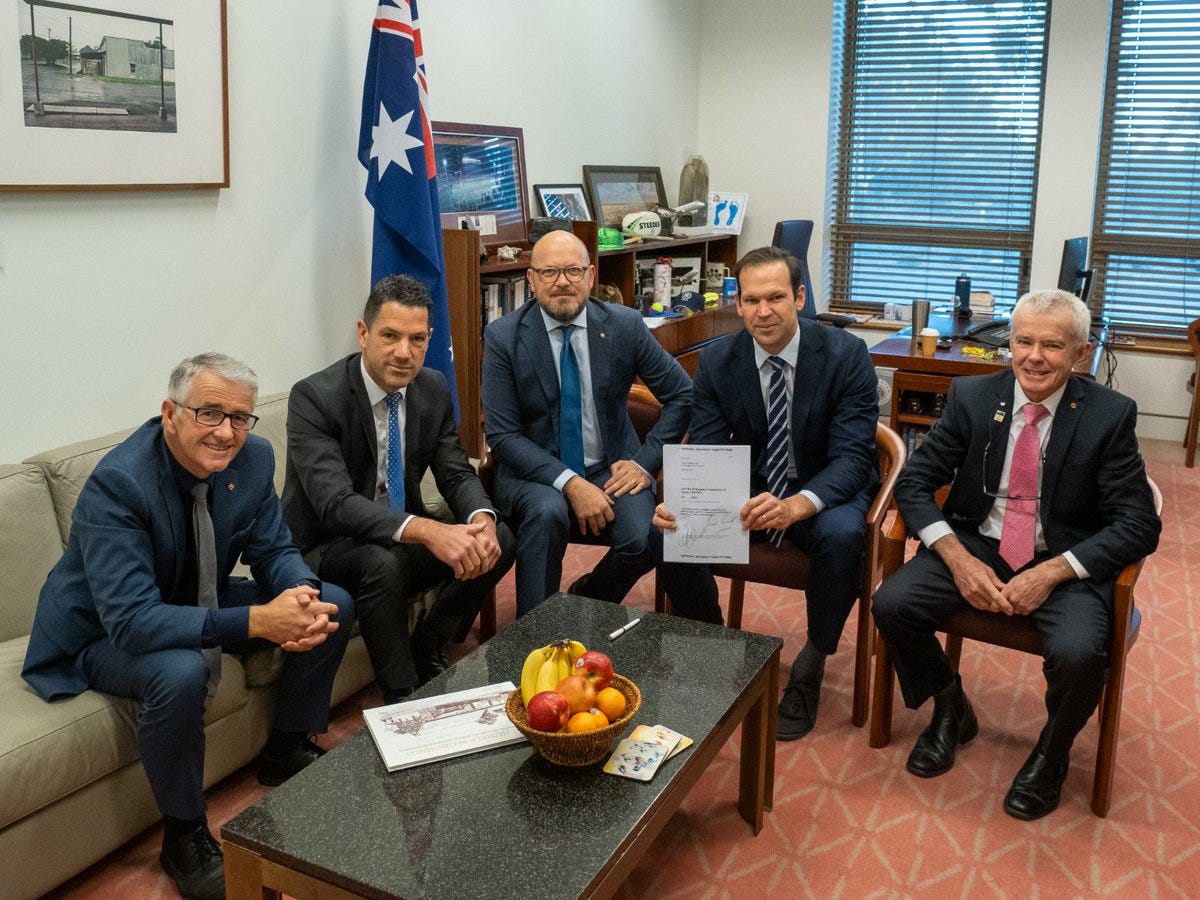
Source: Senator Alex Antic on X
During speaking time, senators who sponsored the bill argued that a Covid Commission of Inquiry is needed so that Australia can finally move on from Covid with a good plan in place for future pandemics. A proper inquiry would get to the bottom of what went wrong (and what went right) to restore trust in public health, they said.
Senator Roberts also said that in light of the fact that multiple U.S. states are now suing Pfizer for misleading about its Covid vaccine, if an inquiry found that Pfizer was indeed guilty of fraudulent behaviour, this could shift the financial burden of injuries and deaths associated with Pfizer’s product from Australian tax payers to the pharmaceutical giant.
Australian tax payers have coughed up more than $20 million on compensation for Covid vaccine injuries, but they will have to pay a lot more if a Covid vaccine injury class action is successful. The action, which was filed in the Federal Court last year, has enrolled over 1,500 injured Australians (or families of the deceased).
However, only ten senators supported the bill when it went to a vote in Parliament today. The bill was supported by the above mentioned senators (with the exception of Senator Antic, who is on leave), some members of the Coalition, One Nation, and independent Senator David Pocock.
Despite Greens Senator Jordon Steele-John stating that his party supports the establishment of a “frank” and “transparent” inquiry with the powers of a Royal Commission, the Greens abstained from the vote. Labor voted against the bill.
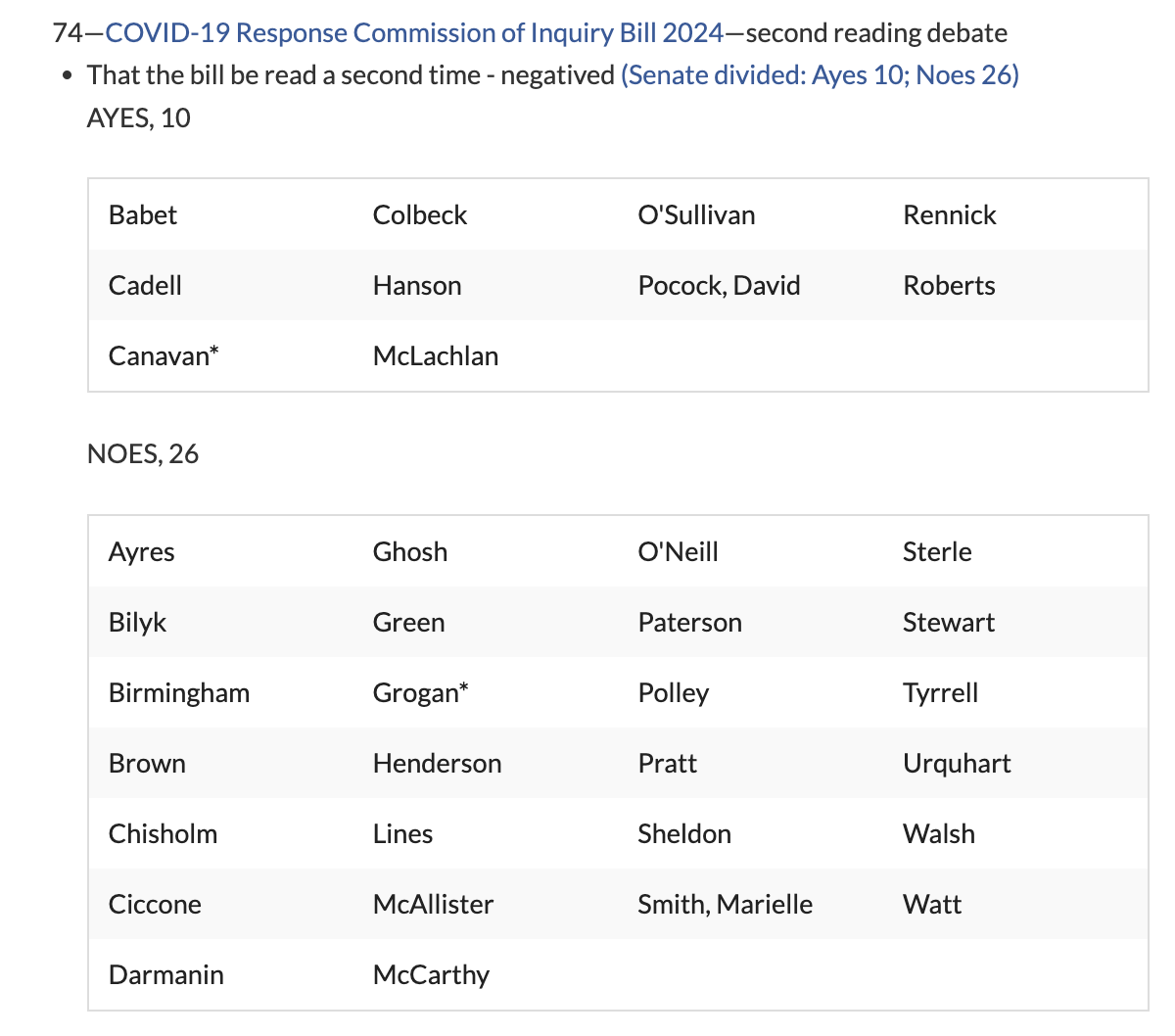
Source: Dynamic Red, 22 August 2024
I am told by the office of one of the senators who sponsored this bill that they have no intention of dropping the matter.
Previously, Senator Babet brought five separate motions to establish the world’s first government Excess Mortality Inquiry, which is now in progress thanks to Senator Babet’s persistence.
An inquiry into proposed terms of reference for a Covid Royal Commission has already been conducted, which will prove helpful in the event that either a Royal Commission or a Commission of Inquiry into Australia’s Covid response are eventually established.
Nonetheless, such efforts will face stiff opposition from the Albanese Government, if Labor Senator Tim Ayres’ speech in Parliament today is representative of his party’s position.
In speaking time before the vote, Senator Ayres said that the Government did not support the bill because “there’s already a public inquiry,” before launching into an astonishing diatribe of ad hominem attacks on the senators who proposed the bill.
Senator Ayres used the term ‘conspiracy theories’ or ‘conspiracy theorist’ more than twenty times, likened the efforts of senators to bring about a thorough Covid inquiry to movements motivated by “anti-semitism,” and called these same senators “cranks,” and the “nastiest, extreme, kooky elements of politics.”
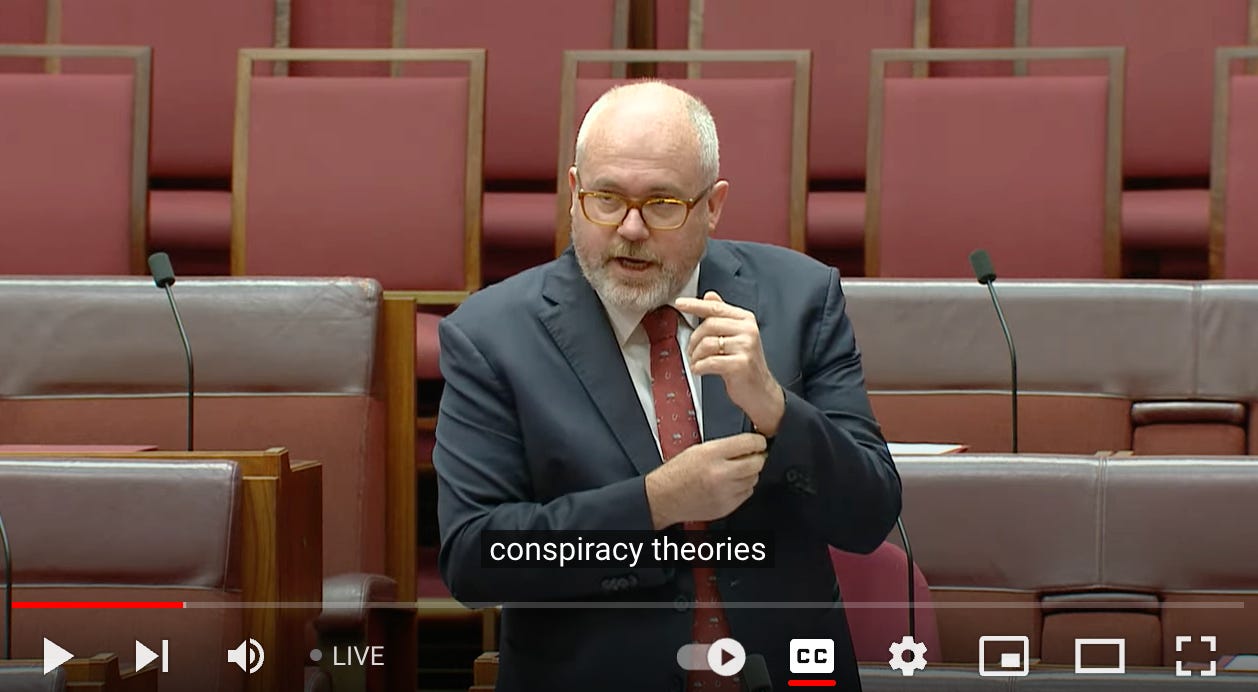
Senator Ayres referred to ‘conspiracy theorists/theories’ more than 20 times in Parliament, 22 August 2024. Source: Australian Parliament House Streaming Portal, YouTube.
Senator Rennick called Senator Ayres’ speech “disgusting,” stating, “all we’re recommending today and supporting is that we have a thorough inquiry.”
In a statement after the vote, Senator Canavan said that more disheartening than Australia’s damaging pandemic response was “the response to the response.”
“Those Australians hurt during Covid deserve to have the accountability of proper public hearings, the publication of all the health advice and an open, transparent attempt to recognise mistakes as well as put in processes to prevent such things ever happening again.
“Why can’t the Government accept that if it is given immense power to lock people in their homes and force people out of work, that there should be an equal and corresponding obligation for them to be accountable to the people hurt by their decisions?”
Senator Babet took to X to express his dissatisfaction with the outcome, calling the decision of the Senate “weak.”
“Is it too much for Australians to ask for governments and the bureaucrats advising them to be held to account for the advice and actions they took during the pandemic?”
Apparently, yes.
Featured Video

Iran’s Next Strike May Not Explode. It Could Shut You Down
or go to
Aletho News Archives – Video-Images
From the Archive
Zionism’s Violent Legacy
By Donald Neff | Washington Report On Middle East Affairs | January 1996
On January 4, 1948, Jewish terrorists drove a truck loaded with explosives into the center of the all Arab city of Jaffa and detonated it, killing 26 and wounding around 100 Palestinian men, women and children.[1] The attack was the work of the Irgun Zvai Leumi – the “National Military Organization,” also known by the Hebrew letters Etzel – the largest Jewish terrorist group in Palestine. The Irgun was headed by Revisionist Zionist Menachem Begin and had been killing and maiming Arabs, Britons and even Jews for the previous ten years in its efforts to establish a Jewish state.
This terror campaign meant that at the core of Revisionist Zionism there existed a philosophical embrace of violence. … continue
Blog Roll
 Aletho News
- Trump’s Iran war is on an Israeli leash
- Saudi oil boss issues global supply warning
- Riyadh Says Its Oil System Is Intact. The Numbers Say Otherwise.
- Trump and Netanyahu Want to “Finish the Job” on Iran
- US ‘one-sided dictation’ not Iran’s beliefs makes rational talks impossible: Baghaei
- Iran’s Next Strike May Not Explode. It Could Shut You Down /Col Doug Macgregor
- Iran: US political targets legitimate if assassinations return
- Iraq shuts key border crossing with Iran under US pressure: Report
- Undersea Internet cables could be targeted in retaliation for attacks on Iran: IRGC deputy chief
- EU sending ‘biased’ observers to interfere in Serbian election – president
- If Americans Knew
- The Israel Lobby’s Changing Fortunes
- AIPAC has become such a political liability that it’s shifting to a more “nimble” approach to buying politicians
- At least 160 Israeli settler attacks in 2 weeks
- Will Gaza’s Ancient Christian Community Disappear Forever?
- Israel’s vision of regional security rests on keeping Arab states weak
- Heidi Levine recounts how Palestinian youths helped save her in settler attack
- DAILY UPDATE: Latest essential news on Palestine, Israel, & region
- Trump’s Intensifying Sabotage of the ICC, for Israel’s Sake
- Israeli military detain US and UK volunteers in West Bank including Democratic NY politician Brad Lander
- Americans at National Conservatism Conference held in Israel this year criticize Israel
- No Tricks Zone
- E-Cars Reduce CO2 Emissions By Only 41% Compared To Internal Combustion Engine Vehicles
- Predictions Made By Renowned Climate Professor Over Past Decades Have Been Proven To Be Poor
- New Study Suggests Large Regions Of The Pacific Ocean Have Been Cooling For The Last 80 Years
- Germany’s Green Energy Debacle: High Energy Costs Force Kahla Porzellan to Close After 182 Years!
- New Study: 50 Years Of The Most Aggressive ‘Net Zero’ Policies Can Only Affect The Global Climate By 0.03°C
- US September “Heat” Was No Record…Many Records Set Decades Ago
- Latest European Green Energy Debacle; Portugal’s Largest Flagship Solar Park Insolvent!
- Green Energy Debacle: German Expert Professor Fritz Vahrenholt Warns Of Severe Economic And Social Consequences
- Two More Paleo Reconstructions Affirm Meters-Higher Sea Levels Across Ireland, Brazil 7000-6000 Years Ago
- New Study: Earth And Venus Surface Warmth Largely Explained By Convection And Lapse Rate, Not CO2 Or Radiation

