Do We Care About People If They Live in Bahrain?
By David Swanson – February 17, 2014
I had a heck of a time making sense of the U.S. Navy’s new motto “A Global Force for Good” until I realized that it meant “We are a global force, and wherever we go we’re never leaving.”
For three years now people in the little island nation of Bahrain have been nonviolently protesting and demanding democratic reforms.
For three years now the king of Bahrain and his royal thugs have been shooting, kidnapping, torturing, imprisoning, and terrorizing nonviolent opponents. An opponent includes anyone speaking up for human rights or even “insulting” the king or his flag, which carries a sentence of 7 years in prison and a hefty fine.
For three years now, Saudi Arabia has been aiding the King of Bahrain in his crackdown on the people of Bahrain. A U.S. police chief named John Timoney, with a reputation for brutality earned in Miami and Philadelphia, was hired to help the Bahraini government intimidate and brutalize its population.
For three years now, the U.S. government has been tolerating the abuses committed by Bahrain and Saudi Arabia, continuing to sell weapons to Bahrain and Saudi Arabia, and continuing to dock the U.S. Navy’s Fifth Fleet in Bahrain. In fact, the U.S. military has recently announced big and pricey plans to expand its bases in Bahrain and add more ships.
For three years now, the U.S. government has continued to dump some $150 billion (with a ‘B’) each year into the U.S. Navy, a large portion of which goes for the maintenance of the Fifth Fleet in Bahrain. Withdrawing and disbanding that fleet would save that gargantuan expense. Retraining and re-employing in peaceful activities all personnel would cost a fraction of $150 billion. Providing aid to nonviolent pro-democracy activists in Bahrain would cost a tiny fraction of a fraction. Establishing a policy in the case of this one country of supporting human rights over brutal dictatorship would be, as they say, priceless. It would create a very useful model for a transformation of U.S. policy in numerous other nations as well.
Accurate and timely information about the horrors underway for the past three years in Bahrain are available online, via Western human rights groups, and via small back-page stories in U.S. newspapers. There’s little dispute over the general facts. Yet, there’s little outrage. There appears to have been no polling done of the U.S. public on the topic of Bahrain whatsoever, so it’s impossible to know what people think. But my impression is that most people have never heard of the place.
The U.S. government is not shouting about the need to bomb Bahrain to protect its people. Senators are not insisting on sanctions, sanctions, and more sanctions. There seems to be no crisis, no need for “intervention,” only the need to end an intervention we aren’t told about.
Which raises a tough question for people who give a damn. We’re able to reject a war on Iran or Syria when the question is raised on our televisions. But we can’t seem to stop drone strikes nobody tells us about. How do we create a question nobody is asking, about a topic nobody has heard of, and then answer it humanely and wisely? And how do we overcome the inevitable pretense that the Fifth Fleet serves some useful purpose, and that this purpose justifies a little teargas, a bit of torture, and some murders here and there?
The Fifth Fleet claims to be responsible for these nations: Afghanistan, Bahrain, Egypt, Iran, Iraq, Jordan, Kazakhstan, Kyrgyzstan, Lebanon, Oman, Pakistan, Qatar, Saudi Arabia, Syria, Tajikistan, Turkmenistan, United Arab Emirates, Uzbekistan, and Yemen. None of these nations have ships in U.S. waters claiming to be responsible for it. None of these nations’ peoples have indicated majority support for having the Fifth Fleet be responsible for them. Afghanistan has suffered under U.S. occupation for over a decade, with chaos and tyranny to follow. Egypt’s thugs are rising anew with steady U.S. support, money, and weaponry. Iran has threatened and attacked no other nation for centuries, has never had a nuclear weapons program, spends less than 1% what the U.S. does on its military, and moves away from democracy with every U.S. threat. Why not leave Iran alone? Iraq, Jordan, Qatar, Saudi Arabia, Yemen, and others of these nations, including Bahrain, suffer under the rule of U.S.-backed governments. One might reasonably add Israel and the lands it occupies to the list, even if the Navy cannot bring itself to mention them. Yemen and Pakistan suffer under the constant buzzing and missile launching of U.S. drones, which are creating far more enemies than they kill. In fact, not a single nation falling under the past 19 years of benevolent “responsibility” of the Fifth Fleet has clearly benefited in any way.
At a third annual conference recently held in Lebanon, Bahraini activists laid out a plan of action. It includes building international connections with people who care and are willing to help. It includes supporting the International Day to End Impunity on November 23rd. It includes pushing Bahrain to join the ICC, although that may be of little value until the U.S. can be persuaded to do the same and until the United Nations can be democratized. The plan includes calls for an end to weapons sales and the initiation of sanctions against the Bahraini government (not its people).
Those would certainly be good steps. The first question in my mind remains: do the people in the nation that screams most loudly about “freedom” and does the most to support its repression wherever deemed useful, care?

US to Expand Military, Intelligence Presence in Bahrain

Al-Manar | January 17, 2014
The US military plans to establish an intelligence center in Bahrain in a bid to compensate for its dwindling presence in Afghanistan.
A senior US military official told a Senate hearing that the planned espionage center in the Arab state, home to the US Navy’s 5th Fleet, will be an “integral part” of the Pentagon’s post-2014 strategy in Afghanistan, the Washington Post reported on Thursday.
The official, Erin Logan, who oversees the Pentagon’s “counter-narcotics efforts,” claimed during a US Senate hearing on narcotics on Wednesday that the plan is part of Washington’s efforts to “continue fighting” Afghanistan’s “booming drug industry.”
“The center,” she added, “will help fill the gap where space for personnel on the ground in Afghanistan is no longer available.”
The US move to expand its military and intelligence presence in Bahrain comes, however, despite the grave human rights record of the ruling Al Khalifa regime for its brutal crackdown on a popular uprising that has left scores shot and tortured to death and many more injured and prosecuted for taking part and even sympathizing with the continuing anti-regime protests in the country.
The United States has long been suspected by regional countries, particularly Iran and Russia, of promoting the growth of the narcotics trade in Afghanistan ever since American and NATO military forces invaded the country in 2001 under the pretext of fighting terror and bringing stability to Afghanistan.
There have been numerous press accounts over the past years pointing to the involvement of US troops and CIA operatives in Afghanistan’s expanding drug trade that largely finances the al-Qaeda-linked Taliban militants in the country.
The US military aims to establish an intelligence center in the Persian Gulf kingdom of Bahrain in a bid to compensate for its dwindling presence in the war-torn Afghanistan.
West defending dictatorships from democracy in Persian Gulf
By Finian Cunningham | Press TV | December 9, 2013
In a breathtaking display of absurdity, US secretary of defense Chuck Hagel and Britain’s Foreign Minister William Hague were among senior Western delegates to address the annual conference on “regional security” held in Bahrain at the weekend.
These officials pontificated about regional threats, conflict, international law, human rights and so on; meanwhile out on the streets of Bahrain, not far from the venue, peaceful protesters calling for democratic freedom were being bludgeoned by regime police thugs.
How absurd can it get? Like a comedy double act, Hagel and Hague were enthusing about high-minded democratic principles to their unelected, dictatorial hosts, the Al Khalifa rulers, surrounded by representatives of the other Persian Gulf Arab dictatorships, prime among them the absolute, tyrannical monarchy of the House of Saud.
And yet outside, ordinary Bahraini civilians yearning to see these same principles put into practice were getting their heads cracked open by uniformed thugs acting under the orders of the very same despots applauding Hagel and Hague. Talk about inside-out, upside-down doublethink.
When Bahrain’s mainly Shia majority rekindled their decades-old protests against the unelected Khalifa crime family in February 2011, it was the Saudi-led [Persian] Gulf Cooperation Council that marched into the tiny island to crush the pro-democracy movement.
The GCC military force is perversely, but aptly, named “a defense operation”. For its purpose is not the defense against some alleged, non-existent threat from without, but the imminent threat from within.
That threat is the spread of democracy in the region, which would sweep away the unelected super-wealthy families that rule over Saudi Arabia, Kuwait, Qatar, the United Arab Emirates, Oman and Bahrain – the six member states of the [Persian]GCC.
The Saudi-led invasion of Bahrain in March 2011 to wipe out “the contagion” of democracy in the oil-rich region was given the green light by Washington and London, with whom the Saudi rulers consulted days before sending in the troops and tanks.
Saudi forces still remain in Bahrain – albeit covertly, wearing Bahraini uniforms – where they continue to brutally attack pro-democracy demonstrators every week, as they have done for the past nearly three years.
And it’s not just protesters on the streets that are killed and injured. Saudi-backed Bahraini forces attack whole villages and family homes with night raids and poisonous gas, many of the occupants, including infants and elderly, having died from suffocating fumes.
Thousands of Bahraini families have been ripped apart, as fathers, mothers, sons and daughters are hauled off to jails and torture centers. The prisoners are denied any legal rights, convicted on the basis of tortured confessions, and many of them imprisoned for life.
Prisoners who have incurred disabilities and diseases from their trauma are also denied basic medical attention, putting their lives at risk. Such detainees include the photographer Hussain Hubail, suffering cardiac problems, elderly political opposition leader Hassan Mushaima, who is battling cancer, and human rights defenders Abdulhadi al-Singace and Naji Fateel, both of whom have become paralyzed from their physical beatings.
The same vicious assault on pro-democracy civilians goes on in Saudi Arabia where some 30,000 prisoners of conscience are rotting away behind dungeon bars, as well as in the other Persian Gulf states, although to a lesser extent.
The US and British governments are fully apprised of the systematic violations and torture carried out by their Persian Gulf dictator allies. Let’s be under no illusion. It’s not just that Washington and London are merely aware of the abominations and turn a blind eye; these Western governments are colluding in the ongoing barbarity.
Addressing the Manama Dialogue conference in Bahrain at the weekend, US Defense Secretary Chuck Hagel said: “I am under no illusions, like all of you, about the daily threats facing this region, or the current anxieties that I know exist here in the [Persian] Gulf.”
Indeed, Hagel is “under no illusions”. The threat to security that he alludes to is not the fairytale, fictional threat attributed to Iran.
The very real danger is that of democracy taking hold in the Persian Gulf. Whereby the people of the region might be able to avail of the vast oil wealth for genuine social development instead of the billions of dollars being funneled into the hands of crony royal families who in turn squander these billions on American and British weaponry.
The abundantly evidenced risk to security in the region is from the US and British-backed Arab tyrannies fuelling terrorism in Syria, Lebanon, Iraq, Yemen and elsewhere, as well as brutally repressing their own people.
When Hagel and Hague and their despotic clients talk about “defense” what they are referring to is the defense of dictatorships against democracy in the Persian Gulf and the protection of multi-billion-dollar weapons contracts to American and British companies (who in turn buy political prostitutes like Hagel and Hague to do their bidding).
There is zero evidence of any other kind of threat, certainly not from Iran, except in the figment of twisted, propagandized imaginations. By contrast, the evidence for American and British-backed despotic terrorism (including that of nuclear-armed Israel) is glaringly real in the form of thousands of lives killed, maimed, displaced and rotting away in ghettoes and jails.
But cracks in this absurd façade are appearing and widening. The Omanis have given notice that they are no longer willing to participate in this ludicrous charade, saying at the weekend that they will not be part of any Persian Gulf military club, probably knowing that its pretext is patently untenable.
Also, Western and international public awareness is becoming increasingly indignant and intolerant of the parody. Why are billions of dollars being spent on planet-destroying weapons and manufacturing terrorism when so many urgent social needs are being trampled on at home and abroad?
Ordinary people around the world know that the threat to peace, security, democracy and prosperity is not Iran or any other alleged bogeyman.
They know the real and imminent danger stems from elite Western-dominated capitalism and its satellite terrorist-sponsoring regimes in Israel, Saudi Arabia and the other Persian Gulf dictatorships.
The truth is both arresting and liberating. Western ruling cliques and their despotic “allies” – under the control of corporate fascism – are now seen more acutely than ever as the enemies of democracy and peace.
The absurd pretence otherwise is well and truly over.
Bahraini court sentences four activists to life
Press TV – November 3, 2013
A court in Bahrain has sentenced four anti-regime activists to life in prison and six others to 15-year jail terms, as the country’s prosecutors begin interrogation of opposition leader Sheikh Ali Salman.
Bahraini opposition sources said on Sunday that the activists were handed prison sentences for taking part in anti-regime protests.
Earlier this week, ten protesters were also imprisoned over similar charges.
The court rulings are issued at a time when Bahraini regime forces have intensified their crackdown on opposition leaders.
Reports say the Manama regime has begun the interrogation of Sheikh Ali Salman, the secretary-general of the main opposition group, al-Wefaq.
The Saturday summoning of Sheikh Salman sparked protests across Bahrain.
The demonstrators expressed solidarity with the al-Wefaq leader.
The Bahraini opposition group believes the summoning of Salman “to be part of the political blackmail and revenge against the peaceful opposition that is asking for democracy.”
The Manama regime is under fire for its heavy-handed crackdown on protests.
On October 30, Bahraini regime forces stormed and shut down an exhibition, dubbed the revolution museum, which was opened by al-Wefaq.
The party says it will lodge a complaint with the United Nations over the raid on the exhibition, which had been organized in an effort to portray the brutal regime clampdown on peaceful protests.
In September, Wefaq’s deputy leader, Khalil al-Marzouq, was arrested on charges of “inciting protests” against the ruling Al Khalifa family. The opposition party said the detention was “a clear attack on political activism in Bahrain.”
Scores have been killed, many of them under torture while in custody, and thousands more detained since the popular uprising began in Bahrain in early 2011.
Bahrain dictatorship charges opposition ex-MP with inciting terror
Press TV – October 5, 2013
Bahrain general prosecutor says senior opposition and ex-MP, Khalil Marzooq, has been referred to court on charges of “inciting terrorist crimes.”
Abdulrahman al-Sayyed said in a statement on Saturday that Marzooq, a leading figure in the kingdom’s main opposition group, al-Wefaq, would also face charges of “promoting acts that amount to terrorist crimes.”
Marzooq was arrested on September 17. He served as deputy speaker in Bahrain’s 40-member parliament before a walkout was staged in 2011 by 18 members of al-Wefaq in protest against the violent crackdown on anti-regime demonstrators.
The statement added that Marzooq was also accused of using his position in al-Wefaq to call for “crimes” that are regarded as “terror acts under the law.”
The prosecutor also confronted Marzooq for his public speeches in which he supported an opposition group known as the Coalition Youth of February 14 Revolution.
On September 18, al-Wefaq, Bahrain’s main opposition group, boycotted national reconciliation talks in protest against the detention of Marzooq.
Last Sunday, a court in the kingdom sentenced 50 Shias to up to 15 years in jail for forming the Coalition Youth of February 14 Revolution.
The Bahraini uprising began in mid-February 2011. Protesters initially called for political reform and a constitutional monarchy, a demand that later changed to an outright call for the ouster of the ruling Al Khalifa family following its brutal crackdown on popular protests.
Scores have been killed, many of them under torture while in custody, and thousands more detained since the popular uprising in the Persian Gulf kingdom.
Related article
Bahrain Regime Jails 50 Opposition Protesters up to 15 Years
Al-Manar | September 29, 2013
A Bahraini court on Sunday sentenced 50 people to up to 15 years in jail, including a prominent Iraqi cleric, for forming an opposition group, a judicial source said.
Sixteen defendants were handed 15-year terms, while four others were jailed for 10 years and the other 30 sentenced to five years behind bars, the source said.
The defendants, including Iraqi cleric Hadi al-Mudaressi who was sentenced in absentia, were charged with forming the February 14 Revolution Youth Coalition, which Bahraini authorities accuse of ‘terrorism’.
Several defendants were sentenced in absentia, including Saeed al-Shahabi, a key London-based Bahraini opposition figure who faces an earlier life sentence for his role in the 2011 uprising.
The interior ministry in June named 11 suspects who were arrested in the case, in addition to 13 people who live abroad.
At least 89 people have been killed by the Bahraini authorities since peaceful protests erupted In February 2011, according to the International Federation for Human Rights.
Related article
Bahraini government ‘blocks’ activist from traveling home to Gulf kingdom
RT | August 10, 2013
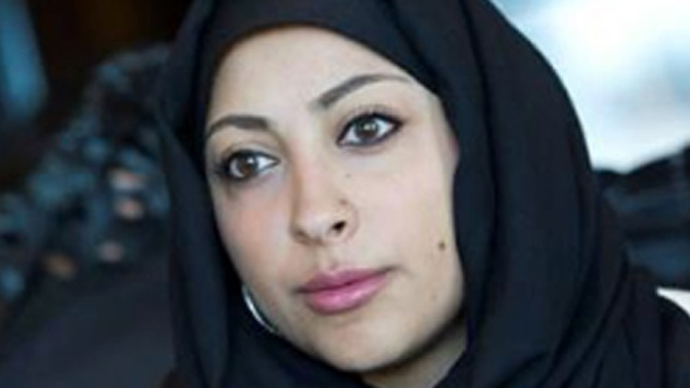
Maryam al-Khawaja (Image from twitter.com)
A prominent Bahraini activist was prevented from boarding a British Airways flight from Denmark ahead of major protests expected to occur in her home country next Wednesday. She says the Bahraini government denied her from traveling.
“I was blocked at the boarding and told to check with the counter because there was a problem. The lady called the office in London who told her that there was a denied boarding message as a decision from the Bahraini government,” Maryam Al-Khwaja told the International Business Times.
“Like all airlines, we are required to comply with requests from individual government authorities,” a BA spokesperson told the news website.
The activist asked the airline to explain why the ban had been issued, but was not initially given a reason.
“I’ve put in a request and they’re going to get back to me. I told them to move as fast as possible because if I don’t receive a response I’ll be consulting a lawyer on the possibility of going to court,” she said.
Mass protests are scheduled to take place in Bahrain on August 14 – the country’s Independence Day.
King Hamad, whose Gulf kingdom has been rocked by Shiite-led protests since 2011, banned protests in Manama on Wednesday in anticipation of the rallies.
The royal decree modifies the law to “ban organizing protests, rallies, gatherings or sit-ins in Manama, with the exception of sit-ins outside [offices of] international organizations” which have been approved by police.
Al-Khwaja said that Bahrain’s government wants “no witnesses to its current and anticipated future violations,” according to a statement from the Bahrain Center for Human Rights (BHCR).
She later tweeted, “What I want to know is what the regime is so afraid of that they [would] issue a ban preventing me from traveling to Bahrain.”
The activist was due to visit her father and her sister, who are currently imprisoned in Bahrain for their roles in pro-democracy protests.
Al-Khawaja, who holds dual Bahraini-Danish citizenship but has not renewed her Bahraini passport, is acting president of the BHCR.
Her predecessor Nabeel Rajab, the organization’s official president and prominent human rights activist, is currently serving a prison sentence. He was initially arrested for criticizing the prime minister on Twitter in 2012 and was later convicted of disturbing public order, calling for marches without giving prior notification, and participating in illegal gatherings.
Bahrain, which hosts the US Fifth fleet, has made a record 221 entry-denials since February 14, 2011, according to Bahrain Watch. Those barred from entering the country include foreign journalists, NGO members, trade unionists, politicians, aid workers, and activists.
Related articles
Bahraini regime arrests over 200 protesters in July
Press TV – August 9, 2013
Bahrain’s main opposition group al-Wefaq says more than 200 people including women and children were detained during the heavy-handed regime crackdown on protests in July.
The Bahraini opposition party recently revealed that at least 19 children and one woman were also among those arrested by the regime forces during the demonstrations last month.
According to al-Wefaq, over 170 people were also wounded due to the excessive force used by the Manama regime forces.
Meanwhile, Manama forces have raided some 650 homes over the past month, while 18 cases of brutal and inhumane tortures have also been reported.
On August 7, Bahraini King Hamad bin Isa Al Khalifa banned protests in the capital, Manama, ahead of the August 14 celebrations of the country’s independence from the United Kingdom.
The opposition is planning to hold a major protest on the same day. The Manama regime has warned that any protests would face the “force of the law.”
Bahrain’s loyalist-dominated parliament has also approved a bill banning all protests in Manama.
The Bahraini uprising began in mid-February 2011.
The Al Khalifa regime promptly launched a brutal crackdown on the peaceful protests and called in Saudi-led Arab forces from neighboring states.
Scores of people have been killed in the crackdown, and the security forces have arrested hundreds, including doctors and nurses.
The protesters say they will continue demonstrations until their demand for the establishment of a democratically elected government is met.
Related article
Bahrain Watch organization says Manama regime tracks critics via Twitter
Press TV – August 5, 2013
The Bahrain Watch organization has revealed that the Manama regime uses fake Twitter accounts to track government critics online.
Since October 2012, the Bahraini regime has detained several citizens for posting anonymous tweets that refer to Bahrain’s King Hamad bin Isa Al Khalifa.
An eight-month investigation showed that the Bahraini regime identifies those anonymous online critics by sending them malicious IP (Internet Protocol) spy links from a network of Twitter and Facebook accounts impersonating well-known opposition figures or other seemingly friendly individuals.
When a person clicks on an IP spy link, the report said, the security forces reveal the IP address of the internet connection they clicked from.
The regime can then force the internet service provider of the IP address to disclose the real name and street address of that internet connection’s subscriber.
According to the report, an examination of court records for five related cases shows that the Public Prosecution’s case centers on linking the IP address of the defendant to the offending anonymous Twitter account.
The prosecution, however, declined to disclose how the IP addresses were acquired, citing information obtained through “private methods that cannot be disclosed.”
The Bahraini regime apparently uses these accounts in secret, and may target their followers, friends, or contacts through private messages.
The report also lists over 120 other accounts that were also targeted in Twitter with IP spy links traceable to the government over the past two years.
Bahrain Watch lead researcher Bill Marczak said, “It is outrageous enough that individuals have been arrested and jailed for mere tweets criticizing the government.”
“That these individuals are being tracked down and convicted based on such weak digital evidence only makes matters worse.”
Bahrain Watch has urged political and social activists in Bahrain, and around the world, to be vigilant about impersonation accounts and malicious links.
“Given the government’s track record, it comes as no surprise that it would resort to such measures to stifle free speech,” Marczak stated.
“However, our hope is that this report will spread awareness of the methods that governments around the world use to trap digital activists.”
Related articles
- Al-Khalifa regime blocks Al-Manar website in Bahrain (realisticbird.wordpress.com)
- Bahrain Declares War on the Opposition (lobelog.com)
US Gulf allies crack down on Internet freedoms
RT | June 10, 2013
Gulf Arab allies of the US have come under fire for introducing a series of draconian measures that limit Internet freedoms. The measures restrict content on social media sites, making “offending” posts punishable by extensive jail sentences.
Saudi Arabia, Qatar, the United Arab Emirates, Kuwait and Bahrain have tightened controls on Internet freedoms recently, targeting social media and phone applications alike in their communications crackdown.
Across the Gulf, dozens of journalists and social media users have been arrested since the beginning of the year for being in violation of the uncompromising national laws.
Punishments include deportation and lengthy prison sentences for crimes such as making derogatory comments about the government “in bad faith,” and offending religion and family values. In Saudi Arabia last month, top cleric Sheikh Abdul Latif Abdul Aziz al-Sheikh warned citizens against using Twitter, stating that those who use social media sites “have lost this world and the afterlife.”
Saudi Arabia
After threatening to ban messaging applications like Skype and WhatsApp, Saudi Arabia’s telecom regulator has chosen a new target: The web-based communication app Viber. The instant messaging application has been blocked since June 5.
“The Viber application has been suspended… and the [regulator] affirms it will take appropriate action against any other applications or services if they fail to comply with regulatory requirements and rules in force in the kingdom,” the Communications and Information Technology Commission (CITC) said in a statement.
Viber allows its users to text, call and send photos and video messages worldwide using a 3G or Wifi connection, and boasts over 200 million subscribers worldwide.
In March, the CITC warned mobile providers in the Kingdom that if they could not find ways to monitor encrypted messaging and VOIP applications, then they would be blocked, according to local media. The commission then issued a statement saying that “it would take suitable measures against these apps and services,” in its push for greater control over the Internet.
The Saudi government has also begun arresting Twitter users for posts to their accounts. Local media reports that the government is looking into ending anonymity for Twitter users in the country by making users register their identification documents.
Qatar
Despite its status as a regional media hub, the emirate state is considering a new cybercrime law that would widen government control over news websites and online commentaries.
If passed, the law would enable the government to punish websites or social media users for violating “the social principles or values,” or for publishing “news, photos, audio or visual recordings related to the sanctity of the private and familial life of persons, even if they were true, or infringes on others by libel or slander via the Internet or other information technology means,” Qatar News agency reported.
United Arab Emirates
At the end of 2012, the UAE passed a sweeping new cybercrime law: Anyone found guilty of criticizing the country’s rulers or institutions online may be jailed or deported. The law attracted widespread opposition, with legal consultants warning it is broad enough to penalize anyone caught posting allegedly offensive comments against the state.
This law has been used to jail citizens for Twitter posts over the past few months. In May, the UAE appeals court sentenced Abdullah Al-Hadidi to 10 months in jail for tweeting details of the trial of his father.
He was arrested on March 22 on charges of disseminating information on Twitter “in bad faith.” The court ruled that he wrote false details of a public hearing that, along with his father, involved 93 other people accused of plotting to seize power in the Gulf Arab state.
Kuwait
The government has arrested dozens of activists and at least six journalists in 2013 in the constitutional emirate, often described as the most liberal country in the region.
In March, Twitter user Hamed Al-Khaledi was sentenced to two years in prison for allegedly insulting the ruler of the Gulf nation. Others have been accused of “threatening state security” or “offending religion.”
In April, a Kuwaiti court sentenced former parliamentarian and opposition leader Mussallam al-Barrak to five years in prison for remarks deemed critical of the ruler of the state, which he made last year at a public rally.
Kuwait has been a member of the International Covenant on Civil and Political Rights (ICCPR) since 1996, which protects the right to freedom of expression, including peaceful criticism of public officials.
Bahrain
The Bahraini government has been trying to suppress an ongoing uprising by introducing stricter penalties. In April, the government passed a law making it illegal to insult the Gulf state’s King Hamad bin Issa al Khalifa, or its national symbols.
Recently, Bahraini blogger and activist Ali Abduleman was granted asylum in the UK after two years in hiding. Adbuleman claims he was persecuted by the government “for exercising the right to express his opinions” on his website. The Bahraini government claims he was tried for “inciting and encouraging continuous violent attacks against police officers” and conspired to spread “false and inflammatory rumors.”
In May, 62-year-old Bahraini protester Abdulla Sayegh was sentenced to three months in prison for hanging a national flag from his truck during a 2011 rally. The same month, six Twitter users were jailed for allegedly offensive comments about the country’s ruler deemed to be ‘abusing freedom of expression.’ According to prosecutors, they posted comments that undermined “the values and traditions of Bahrain’s society towards the king.”
One of the best-known human rights abuse cases in Bahrain is that of activist Nabeel Rajab, who was sentenced to three years in jail in August 2012 on charges of ‘participating in an illegal assembly’ and ‘calling for a march without prior notification.’ He openly criticized the country’s regime on RT for Julian Assange’s show The World Tomorrow.
The country has witnessed mass protests led by the kingdom’s majority Shiites against the minority Sunni-led government for two years. The Shiite demonstrators call for a transfer to a democratic system, and complain of discrimination in jobs and government. Their loyalty is in turn questioned by the ruling Al Khalifa monarchy, which has been in power for decades.
Related articles
Prominent Bahraini activist Nabeel Rajab goes missing
Al-Akhbar | May 16, 2013
Prominent Bahraini human rights defender Nabeel Rajab has been removed from his cell to an unknown location, losing all contact with his family and lawyer, the Bahrain Center for Human Rights reported Wednesday.
In an appeal sent out by the human rights group, Rajab had reportedly witnessed prisoners at the central Jaw prison being tortured.
Rajab’s wife had received a phonecall from Rajab testifying on what he had witnessed in the prison. Shortly after, Rajab’s wife was told that her husband had been removed from his prison cell.
His lawyer, family and fellow activists have not been in contact with him since.
On Wednesday, six Bahraini tweeters were sentenced to one year in jail each for insulting the King and “misusing the right of free expression.”
Torture in Bahraini prisons is very commonly used to force prisoners to sign confessions. In February of last year, leading political prisoners began refusing food after reporting systematic abuses in Bahrain’s jails, including beatings, torture and the use of tear gas.
Nabeel Rajab, who founded the Bahrain Center for Human Rights in 2002, has been in custody since June 6 on charges of “public insults against plaintiffs,” the prosecution said in a statement at the time of his rearrest in June 2012.
The avid Twitter user has been charged with insulting the security forces, posting comments on Twitter deemed insulting to a government body and organizing peaceful protests.
His activism has given him the largest Twitter following in Bahrain, and the fourth largest in the Arab world.
The BHCR appeal calls for the immediate release of Rajab “as it is believed that he has been targeted solely due to his legitimate and peaceful work in the defense of human rights.”
Related article
Featured Video
Yemen joins the war – Red Sea could be blocked next – Saudi regime at risk
or go to
Aletho News Archives – Video-Images
From the Archives
Should Europeans ‘Thank’ the Americans for Destroying Nord Stream?
By Robert Bridge | Strategic Culture Foundation | September 29, 2022
With an investigation continuing into the destruction of the Nord Stream gas pipeline that provided energy supplies to Europe from Russia, there appears to be just one prime suspect, and that should surprise nobody.
Following the sabotage of the Nord Stream 1 and 2 gas pipelines, former Polish Foreign Minister Radoslaw Sikorski already seemed to know the identity of the perpetrator when he tweeted out: “Thank you, USA.”
At first glance, it seemed that Sikorski was speaking sarcastically, berating Washington for carrying out an attack that will have severe repercussions for the people of Europe. After all, how could anyone see any good coming from the termination of Europe’s primary source of gas reserves with winter just around the corner? It was Sikorski’s homeland of Poland, after all, that urged its citizens to collect firewood in the face of dwindling gas reserves.
In fact, the Polish diplomat was speaking one-hundred percent literally… continue
Blog Roll
 Aletho News
- America Racing to Strategic Defeat in Iran: Lt Col Daniel Davis
- FTC Warns Visa, Mastercard, PayPal, Stripe Over Political Debanking
- Russian tanker approaches Cuba despite US oil blockade
- Marandi: Yemen joins the war – Red Sea could be blocked next – Saudi regime at risk
- Pro-Palestinian French member of European Parliament denied entry to Canada
- Pakistan to Host US-Iran Talks
- How Indonesia’s tilt toward the US left it stranded in the Strait of Hormuz
- US has no choice but to retreat from Iranian borders: Top commander
- Iran Retaliation Strikes Chemical Plant Near Dimona
- AWACS’ Destruction is a Major Loss for US Military – Ex-DoW Analyst
- If Americans Knew
- Israeli police block Catholic cardinal from entering Church of the Holy Sepulchre on Palm Sunday
- Israel is assassinating journalists again, more than any other nation, anywhere, ever – Not a ceasefire Day 170
- Over 300 US service members wounded, majority have brain injuries – Not a ceasefire Day 169
- Researchers at Human Rights Watch Resign Over Blocked Report on Palestinian Refugee Return
- Jewish Groups Are Backing a War Americans Don’t Want
- Eric Fingerhut Thinks He’s the President of the Jews
- Top Jewish Philanthropists, Rabbis Urge Israeli President to Take Action Against ‘Jewish Extremists’
- Don’t Be Fooled. Zionist Leaders Have Always Wanted to Control Southern Lebanon
- Israel’s widespread use of torture is a core element of its genocide against the Palestinian people
- In Israel’s War on Iran, Many Middle East US Bases Rendered “All But Uninhabitable”
- No Tricks Zone
- New Study Finds Warming Saves Lives…Cold Temperatures 12 Times More Deadly Than Excess Heat
- German Science Blog Accuses PIK Climate Institute Of Hallucinating Climate Tipping Points
- Devastating Assessment Of Comirnaty Vaccine By Former Senior Pfizer Europe Toxicologist
- New Study: CO2 Is ‘Effectively Negligible’ As An Explanatory Climate Change Factor Since 2000
- Former Pfizer Toxicologist Dr. Helmut Sterz Tells Bundestag Hearing Pfizer Vaccine Should Have Never Been Approved
- Energy Expert: Germany’s Nuclear Phaseout Was A “500 Billion Euro Mistake”
- New Research: South Australia’s Mid-Holocene Sea Surface Temperatures Were 4°C Warmer Than Today
- Storing Green Energy To Last Germany 10 Days Would Require A 60-Million Tonne Battery
- New Studies: UK Sea Levels Were 4 Meters Higher Than Today During The Mid-Holocene
- Destructive Green New Deal: German Energy And Metal Group Warns Of Drastic Crisis
 Aletho News