Hundreds of Bangladeshi garment workers die
IndustriAll | 25.04.2013
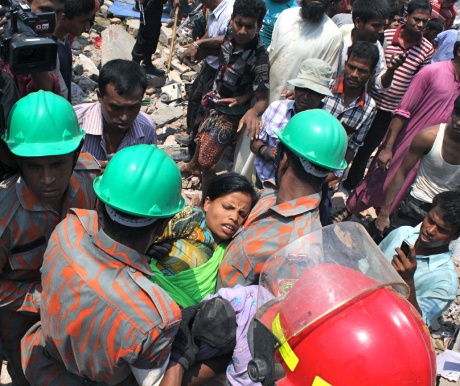
The worst ever industrial accident in Bangladesh has killed more than 200 garment workers with fears of a final death toll reaching 1,000 as hundreds remain injured and trapped in the debris.
“Cut off my hand, save my life!” screams a woman trapped under the collapsed eight-story Rana Plaza building in Savar, 30 kilometres outside Dhaka. The same request is shouted by trapped Aftab, while other screams in the rubble demand oxygen. 200,000 local people have assembled in Savar offering to donate blood to the rescue effort, as hospitals are gravely under supplied.
The mass industrial manslaughter occurred at 9am, 24 April. The collapsed building, illegally constructed, contained five garment factories with 2,500 workers. Those five factories are Ether Tex, New Wave Bottoms, New Wave Style, Phantom Apparels and Phantom-TAC. These factories are believed to have produced for several well-known western brands including Mango, Primark, C&A, KIK, Wal-Mart, Children’s Place, Cato Fashions, Benetton, Matalan and Bon Marché.
On 23 April, the day before the collapse, large structural cracks appeared in the supporting pillars of Rana Plaza, but local authorities were ignored by the building owner Sohel Rana and the garment factory owners when they gave the order to evacuate, while the three shops and bank on the building’s ground floor heeded the warning and evacuated. A Rana Plaza garment worker had to work three days unpaid for every one work day missed, so workers were reluctant to stay safe at home on 24 April.
Now over 2,000 workers are injured in hospital, many critically, 254 are dead and many more continue screaming from under the rubble. The IndustriALL Global Union affiliated textile and garment trade unions in Bangladesh are present and supporting the rescue efforts. Affiliates work jointly through the IndustriALL Bangladesh Council (IBC) which yesterday used a joint press conference to put forward joint demands and a programme of action, calling for justice and action from authorities and brands. The IBC will mobilize all affiliates in a mass demonstration on 26 April in front of the Dhaka Press Club.
20,000 furious garment workers from neighbouring factories this morning brought five major highways to a halt, and several local skirmishes saw angry protestors target garment factories that were not respecting the national day of mourning, forcing them to close and show respect to the dead. Protestors also targetted the building of the Bangladesh Garment Manufacturers & Exporters Association (BGMEA).
The systemic problems must be tackled immediately in Bangladesh’s garment industry and much responsibility must fall on the western clothing brands making enormous profits from items made in deadly conditions on poverty wages. While brands continue refusing to pay a sufficient price for safe production of their clothes, their calls for improved safety are not sincere.
Much needed improvements to the national labour law have been debated through Bangladesh’s legislative process, with the government cabinet approving revisions on 22 April. However this process has been lobbied by the global garment industry buyers who have demanded a scaling back of workers’ rights initially proposed in the reform.
IndustriALL Global Union believes that Bangladeshi garment workers deserve the right to work in safety, with full access to organize and bargain collectively in trade unions, and a substantial rise of the current US$38 monthly minimum wage.
IndustriALL Global Union General Secretary Jyrki Raina said:
This terrible tragedy highlights the urgency of putting a stop to the race to the bottom in supplying cheap means of production to international brands, a race in which hundreds of workers have lost their lives. Global clothing brands and retailers have a responsibility for their full production chains. Now it is time for them, suppliers and the Bangladeshi government to sit down with IndustriALL and its affiliates to agree on a safety program that will ensure this will never happen again.
Featured Video

Yemen joins the war – Red Sea could be blocked next – Saudi regime at risk
or go to
Aletho News Archives – Video-Images
From the Archives
A superpower and “the world’s sickest warrior state”
By Paul J. Balles | March 8, 2010
Living through five or six major wars has hardened me to what I thought were the extremes of inhuman cruelty and brutality.
Two things made those extremes almost bearable: the brutality always revealed – at least according to the media coverage – the viciousness of the enemy. It was therefore quite understandable when our “brave men and women” pulverized the enemy.
Films of Japanese torturing captive Americans somehow justified holding Japanese Americans in internment camps during World War II; and only a small percentage of Americans found the bombing of Hiroshima and Nagasaki unreasonably vengeful at best, at worst, depraved.
The media giants in America portrayed the North Koreans as barbaric beasts with their captives, quite unlike their southern counterpoints – our allies during the Korean War. No one ever felt the need to explain how the South Koreans were a civilized breed while the North Koreans were absolute savages, at least according to the official line.
In Vietnam, our warriors justifiably (or so the media made us believe) dropped napalm on the North Vietnamese who had the gall to hide in villages and tunnels to ravage our invaders. At least it was accepted practice until some rogue photojournalist filmed a young girl screaming down a Vietnamese road in flames. … continue
Blog Roll
 Aletho News
- America Racing to Strategic Defeat in Iran: Lt Col Daniel Davis
- FTC Warns Visa, Mastercard, PayPal, Stripe Over Political Debanking
- Russian tanker approaches Cuba despite US oil blockade
- Marandi: Yemen joins the war – Red Sea could be blocked next – Saudi regime at risk
- Pro-Palestinian French member of European Parliament denied entry to Canada
- Pakistan to Host US-Iran Talks
- How Indonesia’s tilt toward the US left it stranded in the Strait of Hormuz
- US has no choice but to retreat from Iranian borders: Top commander
- Iran Retaliation Strikes Chemical Plant Near Dimona
- AWACS’ Destruction is a Major Loss for US Military – Ex-DoW Analyst
- If Americans Knew
- Israeli police block Catholic cardinal from entering Church of the Holy Sepulchre on Palm Sunday
- Israel is assassinating journalists again, more than any other nation, anywhere, ever – Not a ceasefire Day 170
- Over 300 US service members wounded, majority have brain injuries – Not a ceasefire Day 169
- Researchers at Human Rights Watch Resign Over Blocked Report on Palestinian Refugee Return
- Jewish Groups Are Backing a War Americans Don’t Want
- Eric Fingerhut Thinks He’s the President of the Jews
- Top Jewish Philanthropists, Rabbis Urge Israeli President to Take Action Against ‘Jewish Extremists’
- Don’t Be Fooled. Zionist Leaders Have Always Wanted to Control Southern Lebanon
- Israel’s widespread use of torture is a core element of its genocide against the Palestinian people
- In Israel’s War on Iran, Many Middle East US Bases Rendered “All But Uninhabitable”
- No Tricks Zone
- New Study Finds Warming Saves Lives…Cold Temperatures 12 Times More Deadly Than Excess Heat
- German Science Blog Accuses PIK Climate Institute Of Hallucinating Climate Tipping Points
- Devastating Assessment Of Comirnaty Vaccine By Former Senior Pfizer Europe Toxicologist
- New Study: CO2 Is ‘Effectively Negligible’ As An Explanatory Climate Change Factor Since 2000
- Former Pfizer Toxicologist Dr. Helmut Sterz Tells Bundestag Hearing Pfizer Vaccine Should Have Never Been Approved
- Energy Expert: Germany’s Nuclear Phaseout Was A “500 Billion Euro Mistake”
- New Research: South Australia’s Mid-Holocene Sea Surface Temperatures Were 4°C Warmer Than Today
- Storing Green Energy To Last Germany 10 Days Would Require A 60-Million Tonne Battery
- New Studies: UK Sea Levels Were 4 Meters Higher Than Today During The Mid-Holocene
- Destructive Green New Deal: German Energy And Metal Group Warns Of Drastic Crisis
 Aletho News